I have other things to do with my time, but feel some obligation to my source – the (anonymous and unknown to me) person who seemed to take quite a personal risk, to help reopen the Orr departure story – to keep on making sense of developments, inch by inch as it often seems, in this story.
There are three things I wanted to comment on this morning, all prompted by yesterday’s release by Treasury of their internal file note of the 24 February meeting between the Bank, Treasury, and Willis.
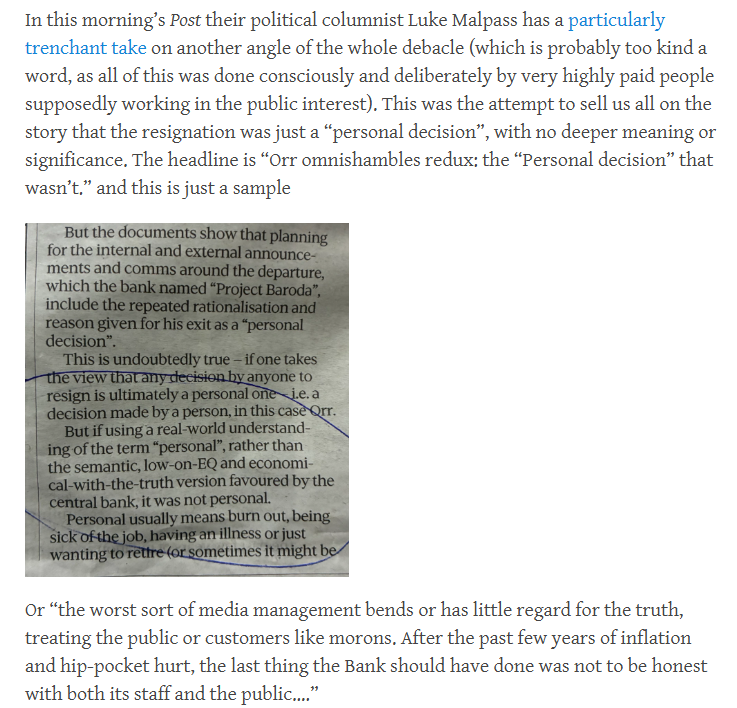
- an article in The Post this morning,
- one on the Herald website last night, with further comments from Quigley, and
- my own reflections on yesterday’s release.
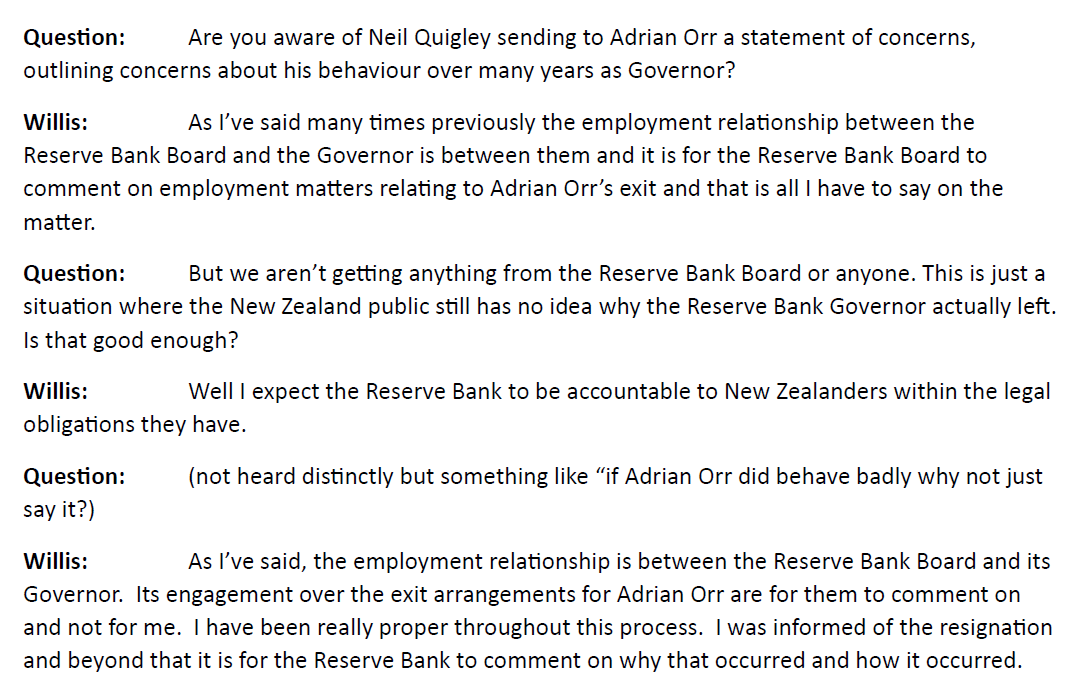
The relevant section of the record of that 45 minute meeting is this

Post article
The Post article really isn’t worth linking to (you can no doubt find it if you want). It is noteworthy only for this extraordinary line:
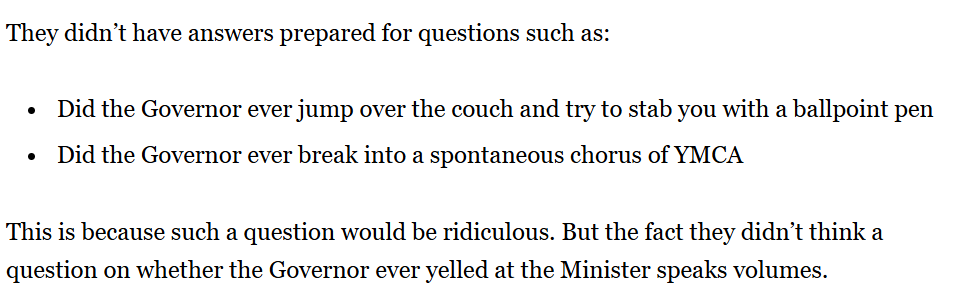
“Hawkesby, and then Orr, left the 45-minute meeting shortly before it ended, but there is no evidence in the minutes that the discussion became heated.”
Which seems to ignore several things. First, the Deputy Governor is recorded as having left the meeting, but at the end of his item. He was the Bank’s senior manager responsible for financial stability and the first two items on the agenda (Prudential Regulation and Competition) were in his bailiwick, and he left when that discussion ended. He wasn’t a member of the Bank’s Board, and the Funding Agreement is between the Board and the Minister. He also wouldn’t have been one of the senior managers (CFOs and the like) providing technical/operational support on budgetary details.
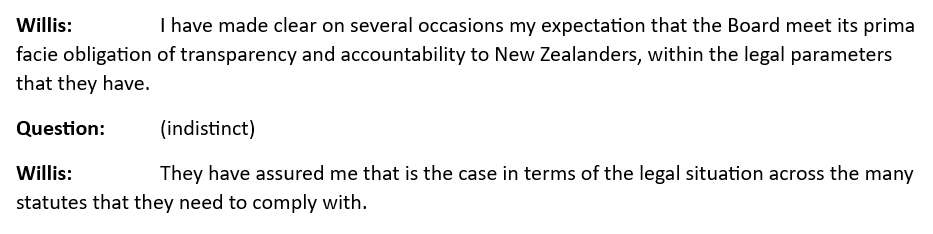
Orr, by contrast, left in the middle of the Funding Agreement item. Moreover, Nicola Willis has confirmed (it is in the Herald piece – see below) that Orr “chose to leave the meeting early” (and she is likely to be phrasing that diplomatically). And Willis told Heather du Plessis-Allan several days ago that it was clear to her that emotions were running high in that meeting.

And, finally, I guess the journalist has never been a bureaucrat. Writing down that the Governor “expressed frustration” about the Bank/Treasury relationship is likely to be a very muted and diplomatic rendering of the summary of the actual words and the tone around them. An official writing up such meetings isn’t, say, a Bob Woodward looking to capture all the drama for publication. (Note that my source last week suggested that the account was still not muted enough for Quigley, who reportedly was very upset to learn that such a record existed at all and allegedly rang Treasury to complain in no uncertain terms – an OIA may shed light on whether that was so.)
It might not be going too far to suggest that a more accurate account might involve words like “stormed out”, walking out not only on the Minister but on his own board chair, having (so the account suggests) sought to undermine his own board by making a direct play to the Minister for his personal view of what the Funding Agreement level should be (recall that Orr was both a board member, and working under board delegations of authority etc on management and budgetary issues).
Herald article
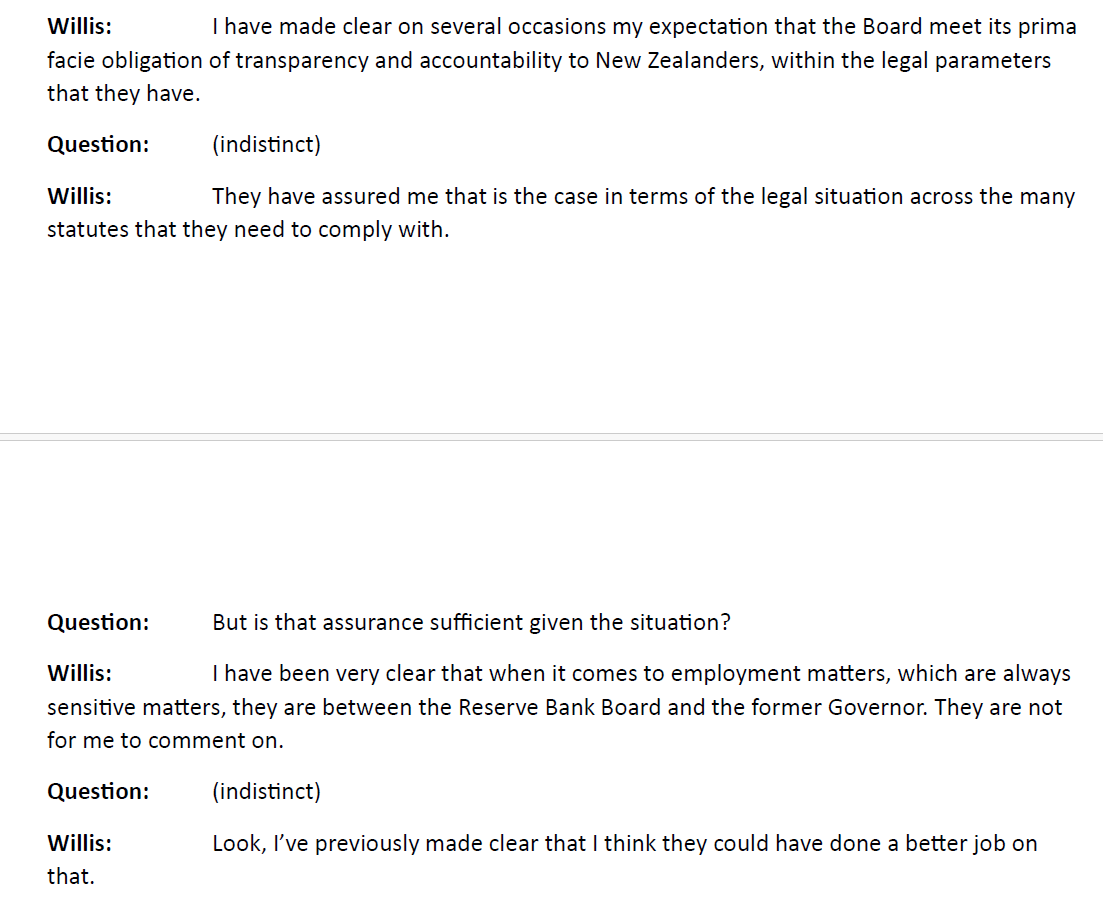
The Herald article appears to have been prompted by yesterday’s Treasury release (they, like me, have had long running OIAs in with Treasury – theirs longer than mine – and this release was a partial response, while we wait for the rest of the issues to be addressed). But the article also contains quite a few comments from Quigley, apparently from an interview Tibshraeny did with him late last week after the Minister’s meeting with the Reserve Bank Board, as well as a fresh report that Willis had again expressed confidence in Quigley.
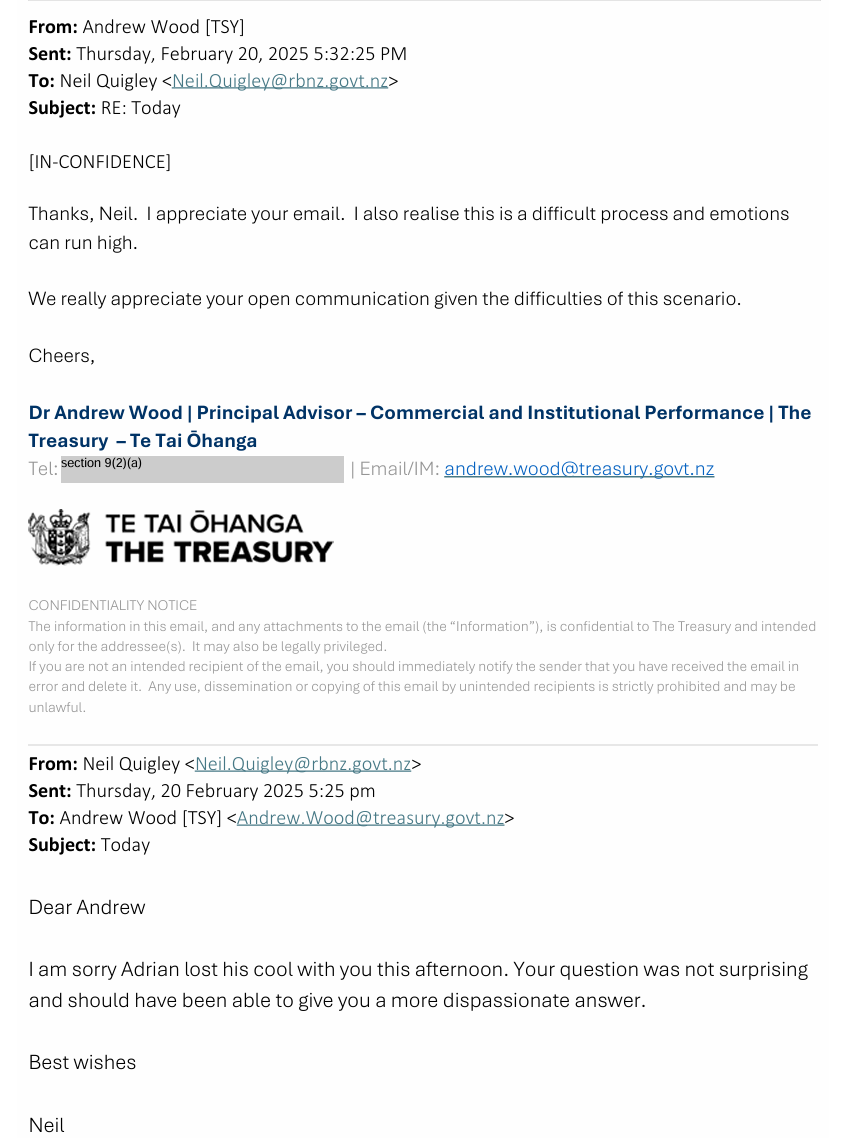
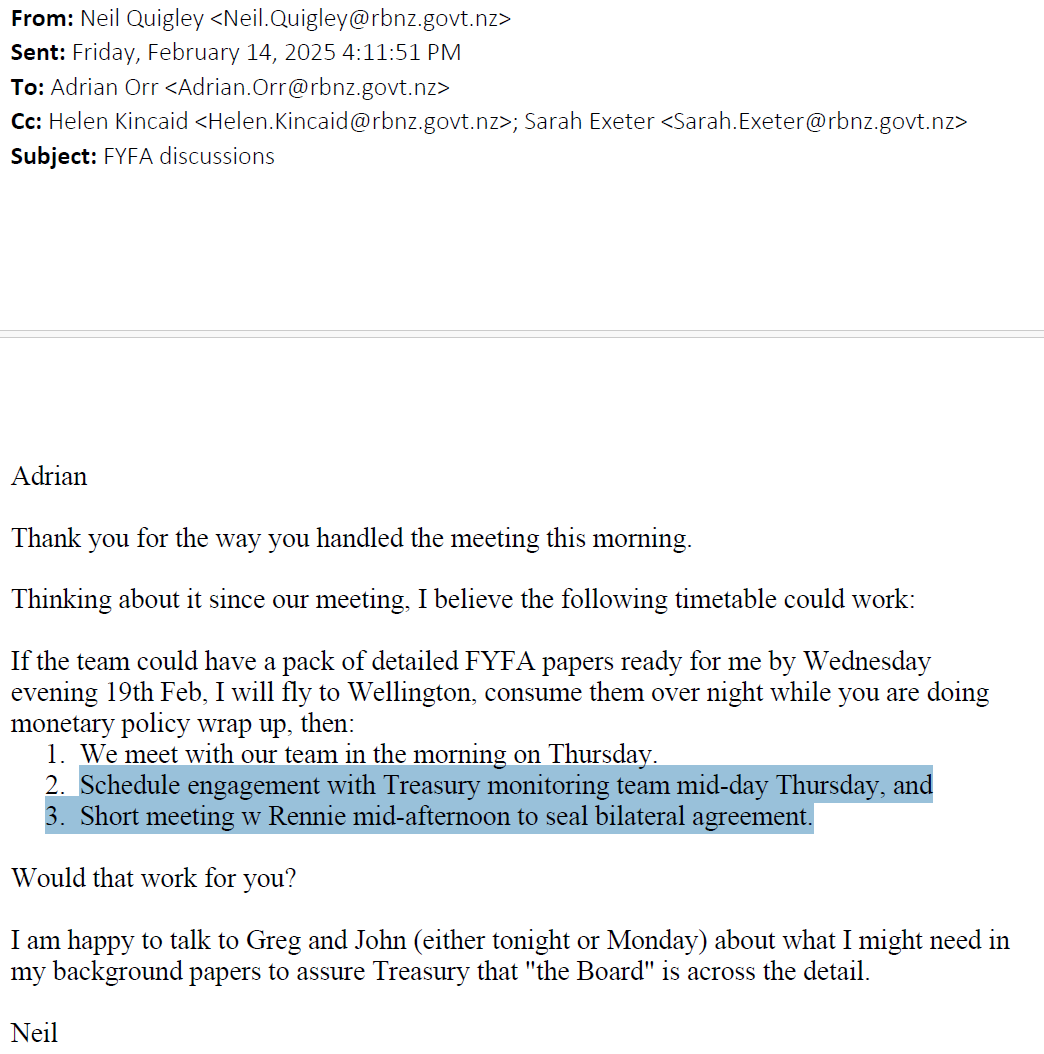
(It is to Treasury’s credit that they released both last week’s Quigley email (apologising for Orr’s conduct at a meeting with Treasury) and this file note. Either Rennie has decided that Treasury wants to be no part of the ongoing coverup and attempts to mislead by the Bank/Quigley, or (perhaps in addition) he has been encouraged in that direction by Willis, who seems to want more openness (and to be frustrated with the Board). If there are gag orders that Quigley signed the Bank up to they won’t bind Treasury.)
The article is behind a paywall so I’m not going to quote at length.
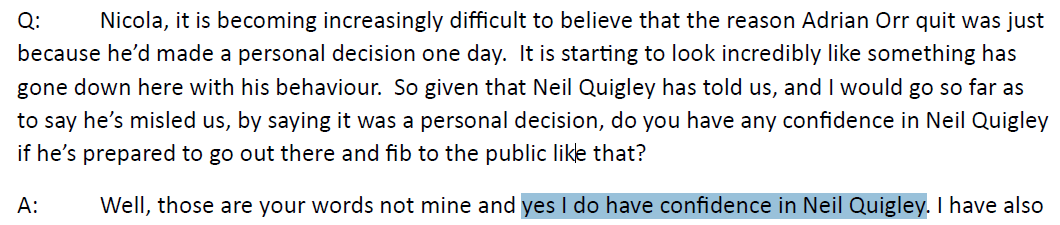
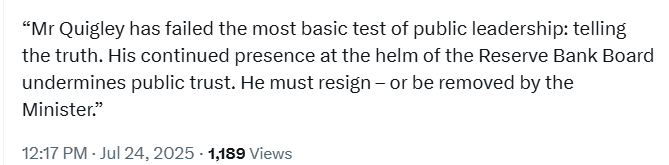
On Quigley, Willis is quoted as suggesting he is the right person for the job right now, including selecting a nominee for new Governor, and that at this “critical juncture” what matters is stability. It is pretty unbelievable, and utterly unconvincing stuff. The Bank is an embattled mess, and much of the mess is of Quigley’s own doing – spinning out the obstruction and misleading for months, overseeing the budget-busting spend up last year (that they’d not told the Minister about), and of course the appointment and reappointment of Orr in the first place. How can anyone have any confidence in a nominee out of a process led by Quigley? How could a good potential new Governor have any confidence in his chair? How can staff have any confidence in the board chair, when he is responsible for actively misleading them (as well as us) and for the big dislocations, layoffs etc the place is now going through? Rebuilding from here really demands a clean slate, led by someone commanding widespread respect and confidence.
But if the Minister’s line was perhaps predictable (you have to back someone until you fire them I suppose), Quigley’s comments were more interesting. He noted that the rest of the board had (we are told) expressed confidence in him – which perhaps isn’t unduly surprising as all but Spencer (new appointment) are as implicated as him in the events of recent months – but then must have been asked about the OIA obstructionism.

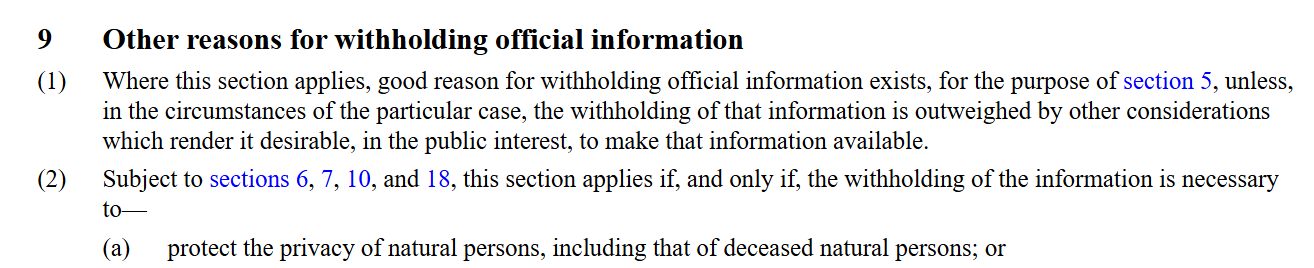
There has never ever been any sign that Quigley has any sort of commitment to openness or public scrutiny. The obstructionism, and reported quotes along the lines that he didn’t think the public had a right or need to know what went on (with one of the most powerful controversial officials in New Zealand), has to some extent been par for the course. But you did get the sense here that he feels the ground slipping away from under him. Most likely his staff gave him the sort of advice he wanted to hear on the law, but even if he got cover to hide there so far, it was a spectacularly bad call – in governance and public trust terms – to (a) be as obstructive as they’ve been (multiple OIAs have never been responded to directly, let alone completely) and b) to actively mislead the public repeatedly. No law required that. And any adviser who advised him that it was a good course of action shouldn’t be working there much longer.
In his final comments, Quigley seems to grudgingly acknowledge that his role included providing feedback to the Governor on his performance, but it is – on his telling – none of our business. He acts as if either Orr was some low level employee (say a junior accountant at Waikato University), or as if his responsibility is to the Bank and its management, rather than to the Minister and the public. And again, nothing warrants the calculated deceit of recent months, or attempts to substitute his judgement for the spirit and principles of the Official Information Act.

My thoughts prompted by yesterday’s Treasury release
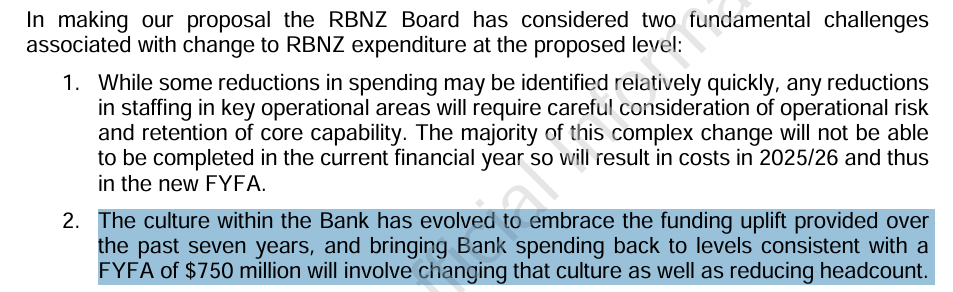
A couple of additional thoughts occurred to me after reflecting further on yesterday’s release. The first (and probably not central) was this from their covering note.

The Bank had submitted its Funding Agreement bid to Treasury back in September 2024. Can it really only have been in early February that officials did even a preliminary assessment of what levels of spending they thought the Bank should be allowed? It seems odd, and yet in the papers the Bank released on 11 June in which an Orr email records him stating on 14 February “We have not heard from Treasury as to a preferred number”. It seems puzzling, but perhaps some of the outstanding OIAs will eventually shed some light.
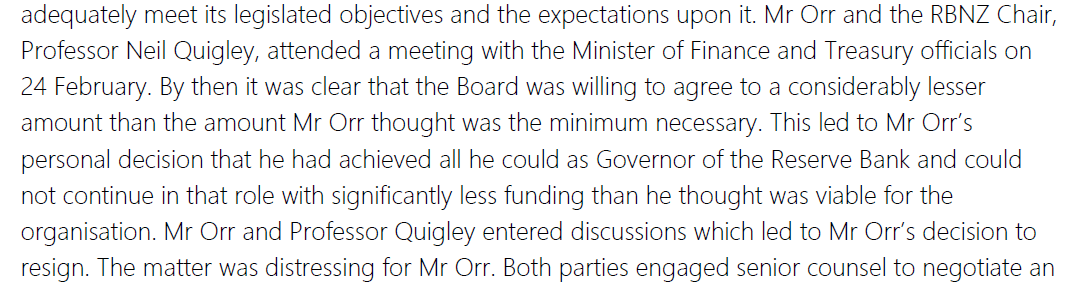
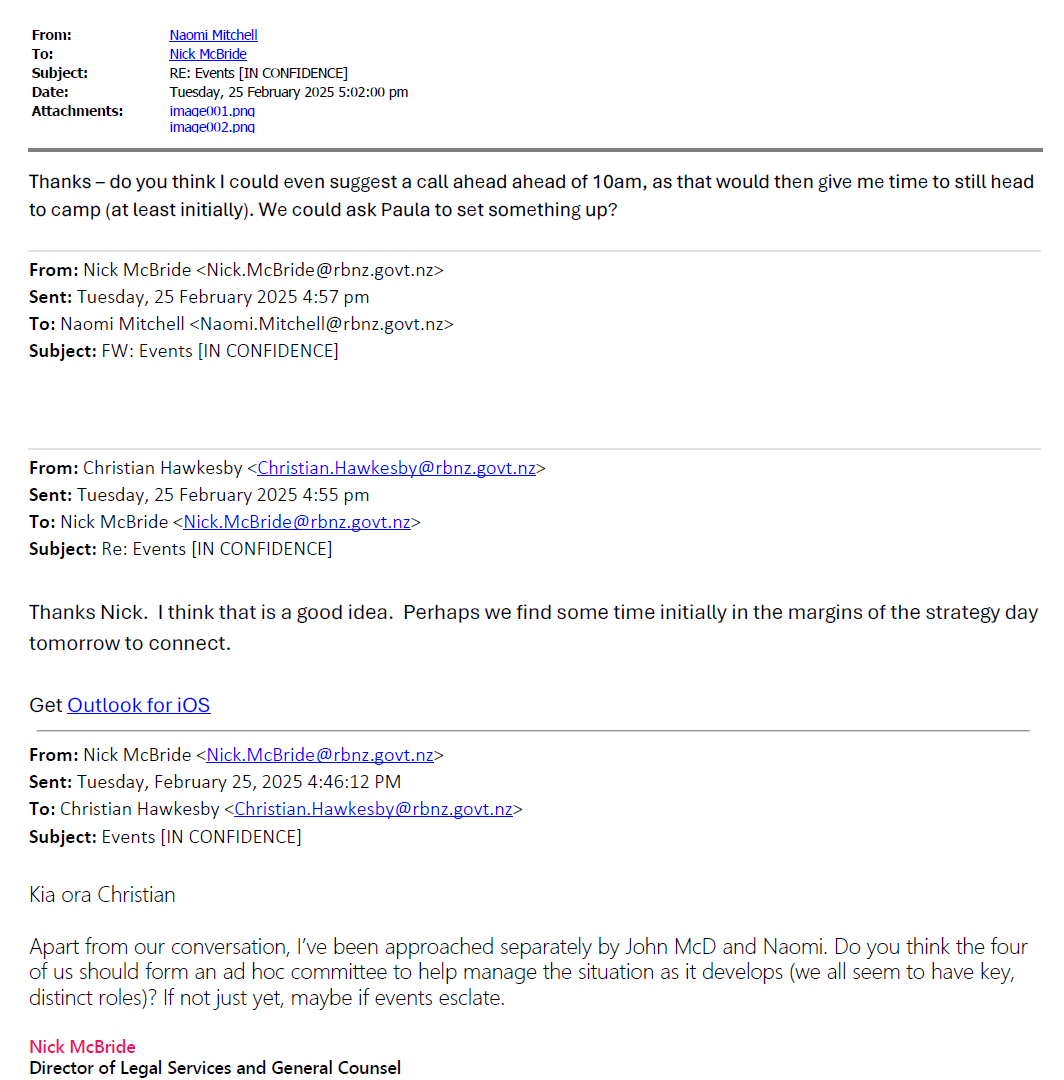
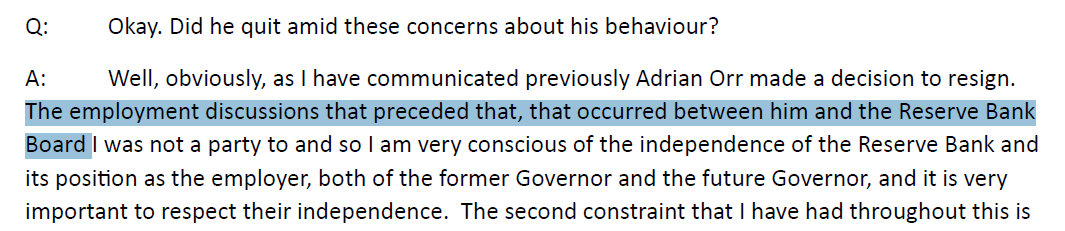
But the bigger question is what we make of this episode of Orr’s extraordinary behaviour on Monday afternoon 24 February, in light of all else we know (or suspect). It must have been critical because, as I highlighted yesterday drawing from the Bank’s own 11 June selective release, within 24 hours various members of senior management were (a) aware an exit was a possibility, and b) putting together a working group to manage things at the Bank’s end. But, equally, it cannot have been final and determinative – except perhaps that Quigley and Willis may have concluded to themselves that Orr had to go (after undermining his board chair in front of the Minister and then walking out of the meeting, all only a couple of days after Quigley had had to apologise to Treasury for Orr’s conduct, because Orr himself wouldn’t).
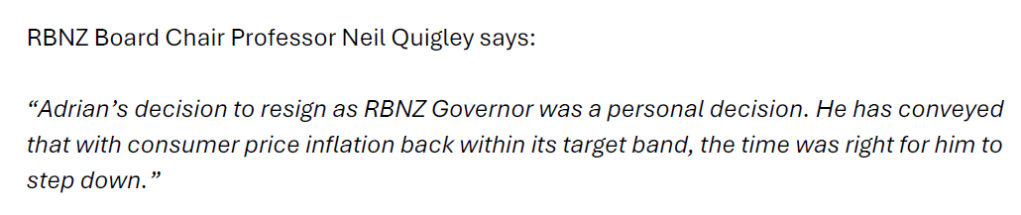
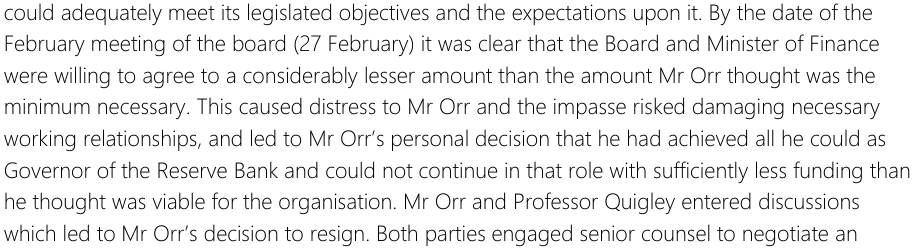
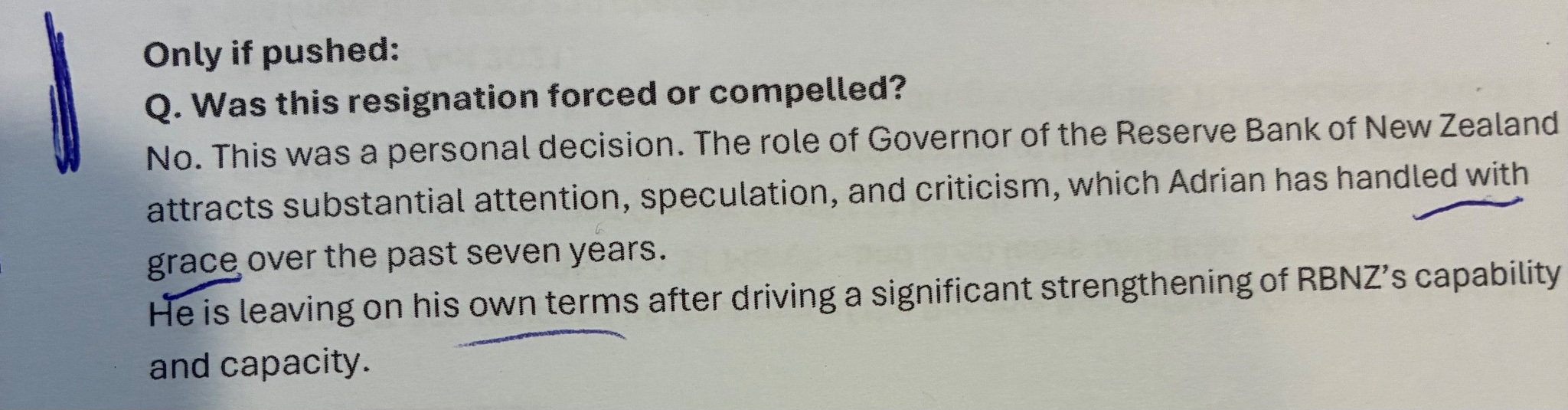
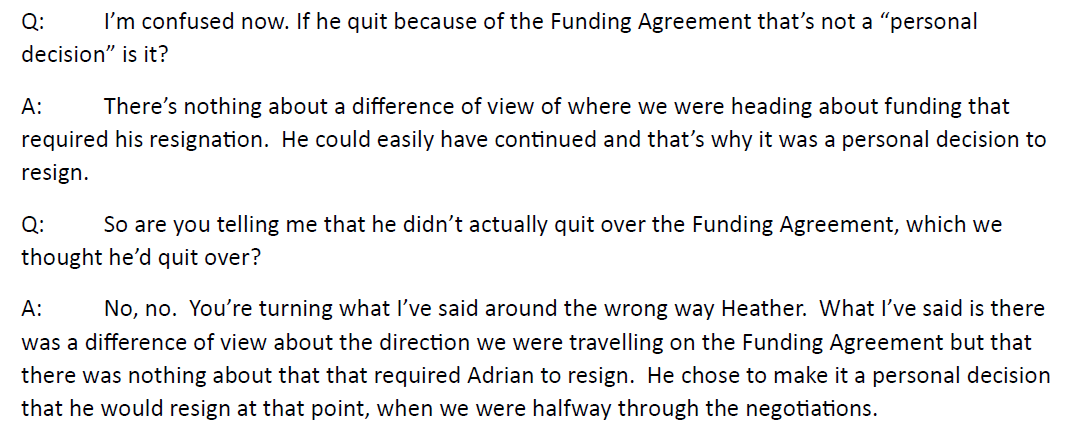
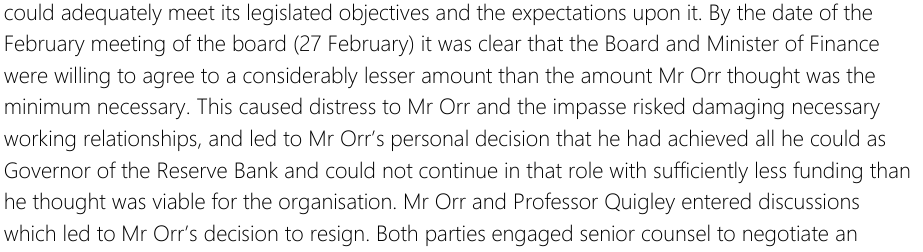
I had a useful exchange yesterday afternoon with someone whose views always force me to think. This person argued that Orr’s behaviour in that meeting was tantamount to a resignation. I certainly agree that, on what we know, it was the sort of behaviour that shouldn’t be tolerated from any public sector chief executive, and there was no obvious way back from it (especially given the track record of Orr’s behavioural issues in the job, recent and past). But did Orr see it that way? Over the years he’d held the job he’d already gotten away with so much, and perhaps it is unlikely (to say the least) that it was the first time his undisciplined side had been on display in a Minister of Finance’s office. The Bank’s statement of 11 June may at one level have been accurate (if misleading)

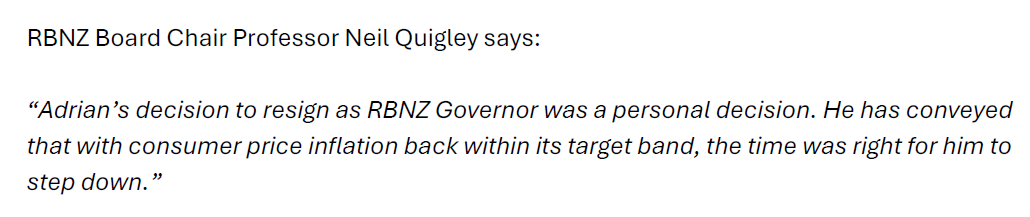
“Distress” sounds like a reasonable description for what we now know of the 20 and 24 February meetings, and “necessary working relationships” must have been quite deeply impaired – but not just with the Board, but with the Minister and Treasury too – and Orr did finally come to a decision to go.
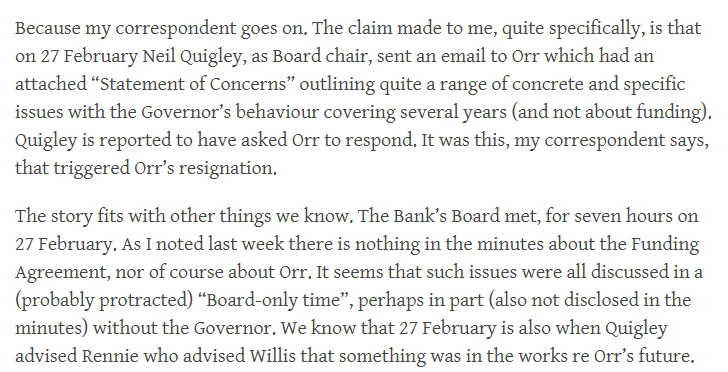
But there is still no sign that on 24 February he thought he was resigning, and every indication that his decision to go came only after quite a bit of pressure applied in the following few days. After all, recall my source’s story (and that person’s general account of what went on seems to have been vindicated so far where independent details have since emerged) that it wasn’t until 27 February that Quigley sent that Statement of Concerns to Orr, seeking a response (this wasn’t a quiet private chat, but something formal in writing by email), which seems to have been the final straw [UPDATE: Quigley probably also needed to get the rest of the Board squared away, who hadn’t witnessed Monday’s debacle]. And even then, if perhaps Orr wasn’t fighting too hard – it was clear he was going to lose the funding battle, and it clearly was close to his heart, and surely even he must have had some self-knowledge reflecting on his conduct over the past week – it was still a case of “senior counsel” called in by each side to negotiate, not a simple resort to standard resignation provisions in Orr’s contract, and getting him out of the office the very hour the resignation was announced.
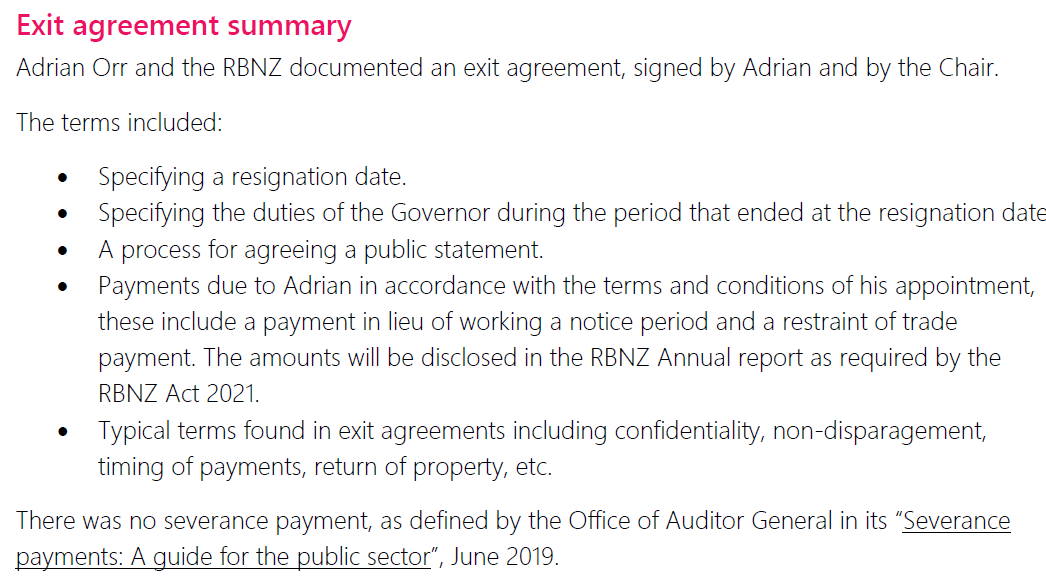
Both Orr and Quigley will have known that it was most unlikely the Minister would sack him, and so he held leverage – I’ll go, but only if you sign up to a gag order (the limits of which, or the authority for which – did the Minister really not know? – are still not clear). He was clearly pushed, and there is no way by this point that the Board chair can have had confidence in Orr continuing (despite what he claimed on 5 March). Perhaps it was one thing to pledge that precise details of behaviour would not be disclosed, except as required by law (you can’t contract out of the OIA), but Quigley and Willis should have insisted on something like “After discussions initiated by the Board, the Governor has chosen to resign and left office today”. Except that – unless we see clear evidence to the contrary – perhaps they then preferred that we not know (and no one else on the Board seems to have objected). And so the obstructionism and repeated active deception of the public began, and continues to this day.














 croaking cassandra