41 questions

I’m pretty tied up for the next couple of weeks so unless there are significant new developments (things like, for example, complying with the OIA) this will be my final post on events around the Orr resignation for the time being.

We know from what the Reserve Bank did choose to release last week that their story is now one in which Orr’s behaviour triggered by the prospect of deeper cuts to the Bank’s next Funding Agreement than he would have liked was what led to the departure. That is the gist of the (no doubt lawyer-vetted language) of the statement/press release last week:

“This caused distress to Mr Orr and the impasse risked damaging necessary working relationships, and led to Mr Orr’s personal decision that he….could not continue in that role with sufficiently less funding than he thought was viable for the organisation”. They wouldn’t have included that “this caused distress” stuff if it had just been a bunch of reasonable senior people (Board, management, Treasury, Minister) having a purely professionally-conducted disagreement and one deciding it was time for him to go.

But, as I’ve noted in a number of posts, having finally got that disclosure, more than three months after the resignation, there are still lots of unanswered questions (some for Quigley, some for the Board as a whole, and some for Willis, the people who continue in office). It would, of course, be great if Orr himself would give a substantive interview to a serious but searching journalist, but he is now just a private citizen.

This post attempts to bring the outstanding questions together in a list.

Questions for the Minister of Finance

  1. Did you really never ask (Rennie, Quigley, or indeed Orr) why Orr was planning to resign?
  2. Did neither officials nor the Board chair nor Orr (eg in his resignation letter, which had to be submitted to you to be effective) ever tell you why the Governor of the Reserve Bank was resigning?
  3. Did you ever make it known, directly or indirectly, that you did not wish to know?
  4. Were you aware that an exit agreement (going beyond resignation terms in Orr’s contract) was being negotiated? When?
  5. If not, why not? If so, did you ever make representations regarding possible severance payments and/or non-disclosure agreements?
  6. What was the atmosphere of the meeting held between you and Orr/Quigley and others (including Treasury officials and Hawkesby) on 24 February? Was the Governor’s conduct wholly and entirely professional?
  7. What representations and comments did you make on the Reserve Bank’s proposed 2024/25 Budget as part of their required consultation with you on the draft Statement of Performance Expectations?
  8. If those comments did not push back very strongly on planned levels of operating spending that went well beyond (around 23 per cent in excess of) what was permitted under the then-current Funding Agreement, why not?
  9. What was Treasury’s stance on that proposed budget?
  10. When did you first indicate to Treasury and/or the Bank (management or Board) that their initial bid for the new Funding Agreement (for $981 million in opex over five years) was unacceptable?
  11. Why were levels of Reserve Bank operating spending far in excess of (say) what the previous Funding Agreement had allowed for 24/25 included in the HYEFU numbers in December last year (reflecting fiscal policy decisions you had made up to 28 November). (NB: The previous Funding Agreement allowed around $154 million of (in scope) spending in 2024/25, while HYEFU appears to allowed $181 million per annum for each of 25/26, 26/27, and 27/28.]

Questions for Neil Quigley, Board chair

  1. Why did you approve a Bank budget for 24/25 involving levels of operating spending far in excess of what was allowed under the then-current Funding Agreement? Had any comments from Treasury or the Minister’s office raised any material concerns before the final Board decision was made?
  2. Why was it that as late as your email on Friday afternoon 14 February you seemed to believe that an agreement with Treasury on funding agreement matters could be sealed the following week?
  3. What stance had the Board taken on these matters at its meeting earlier that day?
  4. When did Treasury or the Minister first make it clear to you (or the Board generally) that the level of funding the Bank was still seeking by early February ($900m over five years, per Orr’s 5 February email) was quite unacceptable?
  5. Was there any communication from the Minister (or her office) to you after the 24 February meeting raising concerns about the Governor’s behaviour etc?
  6. When did you first learn that the Governor was seriously considering resigning? Was it at or after the 27 February Board meeting?
  7. Why was a negotiated exit agreement (covering anything more than, say, waiving notice requirements) considered necessary or appropriate (given that standard resignation provisions were presumably already part of the Governor’s contract)?
  8. Why did the terms of that agreement include paid “special leave” to 31 March rather than a resignation effective immediately (ie from 5 March)?
  9. Was there any discussion with the Minister, her office, or with Treasury regarding the possible terms of such an exit agreement. Did any of them raise concerns about gagging orders (whether binding on the Bank or on Orr?)
  10. What, if anything, are the terms of any gagging restrictions still in place? Given the extensive comments you have made, it seems the Bank may not be subject to material constraints? Is Orr, and if so why, and what consideration was given in exchange for him agreeing to such a term?
  11. Why did you say (per statement in the released pack) on the afternoon of 5 March (but independently of your press conference) “Adrian’s decision to resign as RBNZ Governor was a personal decision. He has conveyed that with consumer price inflation back within its target band, the time was right for him to step down.” Relative to the option (always open) of saying nothing, wasn’t this aggressively and deliberately misleading? How does that square with the Bank’s values around transparency and accountability?
  12. Why did you choose to hold a press conference at 5pm on 5 March? There is no suggestion of one in the pre-event planning. Was holding such a conference consistent with your agreement with Orr?
  13. Why did it take the Bank (for which, as chair you are responsible) more than three months to make the public statement that you did last week? Even if one granted some sensitivity around the Funding Agreement negotiations, the final Funding Agreement was released in mid-April?
  14. Did you and/or the Board approve what was released last week, including the text of the Summary Statement?
  15. What steps has the Board now taken to ensure that the Bank complies with its legal obligations under the Official Information Act, including in respect of requests on this broad issue (Orr resignation) that have been outstanding for months are were not addressed at all in last week’s release)?
  16. Why does last week’s release disclose nothing about dealings between you/the Board and either the Minister or Treasury in and around Orr’s release?
  17. Why does last week’s release disclose nothing about the Board’s own deliberations on these matters and/or their engagement with Orr once he made clear he was considering resigning?

Questions for the Board as a whole

  1. Why did you approve a budget for the Bank for 24/25 that was so far in excess of the level of spending authorised under the then-current Funding Agreement?
  2. Why did you agree to make a Funding Agreement bid that involved a large increase in future operating spending relative to levels authorised in the previous Agreement, despite being well aware of the prevailing climate of fiscal stringency. What sort of pushback did you provide to management, and did you insist on stress-testing the various options (including likely ministerial reaction to such a bid)?
  3. When were you first collectively made aware that the Governor was considering resigning, and what (if any) reasons were you given. What was the Board’s reaction?
  4. Why did the board agree to negotiating an exit agreement beyond the standard resignation provisions in the Governor’s contract. Did you approve the terms or was everything delegated to the chair? If the latter, given the sensitivity of such issues, why?
  5. Do you still have confidence in the chair after his handling of the public side of this issue, both on 5 March and since?

Questions for the temporary Governor

  1. Did you ever push back against either the 24/25 Budget, approved by the Board last June, or against the appropriateness of using such a vastly inflated level of spending as the starting point for the Funding Agreement bid?
  2. Who decided, and when, that Adrian Orr would not open or attend the inflation targeting conference (noting both his email at lunchtime on 5 March and comments later that day from the Board chair suggesting it still wasn’t clear)?
  3. Why did it take three months for any sort of statement (other than the highly misleading ones made to public and staff on 5/6 March) to be made on Orr’s resignation?
  4. What steps have been taken to ensure that the Bank meets its obligation under the Official Information Act, including actually addressing the specific requests lodged on this subject some months ago?

Questions for Treasury?

  1. What comments, if any, did you make on the proposed Bank budget for 24/25? What advice did you give to the Minister on this?
  2. When did you first make clear to the Bank’s Board that the initial Funding Agreement bid was quite unacceptable? Why weren’t they sent away early to revise and resubmit?
  3. Why were such spending numbers (well above previous Funding Agreement) included in the HYEFU fiscal numbers?
  4. Were you aware that an exit agreement was being negotiated with Orr? If so, did you make any representations on severance payments and/or gagging restrictions (if so, what?)?

UPDATE:

As it happens, I received a response to my OIA to The Treasury on (some of) these matters this afternoon.

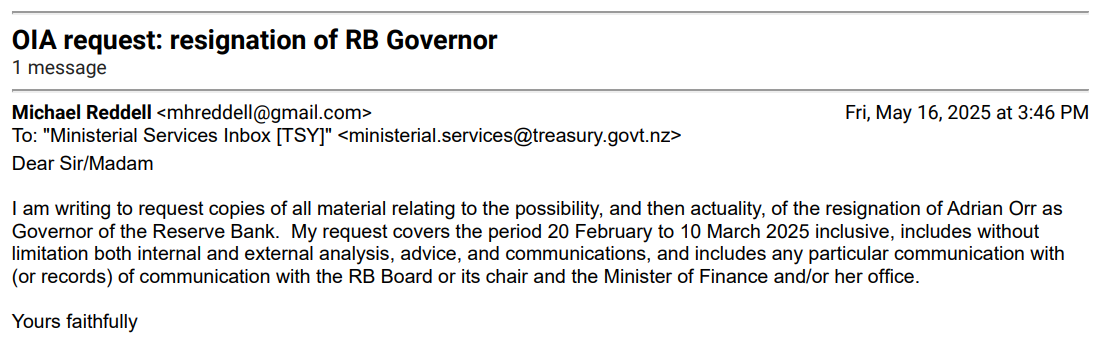
The request was as follows
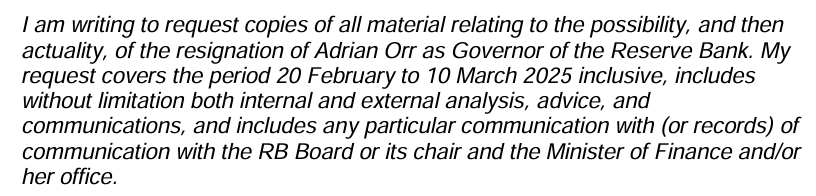
There is very little there. Here is the full response, including a note of one document (only) withheld completely, with even the title kept secret.

Treasury response to OIA re Orr departure 16 June 2025

I think the only positive things we learn from this is

  • Rennie’s initial advice to Willis on the afternoon of 27 Feb (the day of the crucial RB Board meeting) apparently reporting initial advice from Neil Quigley is very short (2.5 lines of a text) and not enough for more than a “Thank you for the heads up” from the Minister in reply.  It seems to have been followed up with fuller conversation (Rennie/Quigley) that evening, which seems to conclude with the suggestion of a meeting or phone call (Willis/Quigley?) presumably the next day.
  • On the Friday 28th, Quigley texts Rennie to ask him to call, saying he has an update.  It seems likely this was the point where Orr had decided to go.  Other papers reveal the exit agreement between Quigley and Orr was reached by Monday afternoon (3rd).

But what surprises me is what isn’t there.   Faced with the likely, and then certain, resignation of the Governor of the Reserve Bank, an agency Treasury is responsible for monitoring and where the Secretary sits as a non-voting MPC member, there is nothing else at all written down, either before the announcement, on the day, or in the few days following. 

Questions about the Funding Agreement, HYEFU, and last year’s RB budget were, of course, not covered by this request.

Willis and Quigley

Yes, that subject again/still.

Today, three main points:

  • the comments by the Minister, including claims that she didn’t know why Orr had resigned
  • the latest set of Quigley comments given to Newsroom’s Jonathan Milne, and
  • (largely for the record) restating events around MPC appointments that are minimised by Milne but which reinforce the sense that Quigley is unfit for the office he holds.

But first, a reminder of history. In The Post this morning it is claimed that “a governor had never resigned out of the blue before”. There have only been four Governors in the modern (independent) era and two of them have resigned out of the blue. Don Brash did on 26 April 2002. His resignation was announced at 9:54am that morning, with a brief explanation (including that there had been no disputes with the government) and an announcement that there would be a press conference (off site) at 11 that morning. where Don answered all sorts of questions. There were no gagging provisions, no secrecy or active misleading. If as Reserve Bank Governor you are going to resign and go with no notice (which I don’t advocate), it was the way to do it. The Minister, Board, and Governor might usefully have refreshed their memory of that experience in the week or so they had to prepare for Orr’s departure (there is no mention of it in the documents released the other day), rather than setting out on months of (as yet not fully resolved) obfuscation and distraction.

Willis

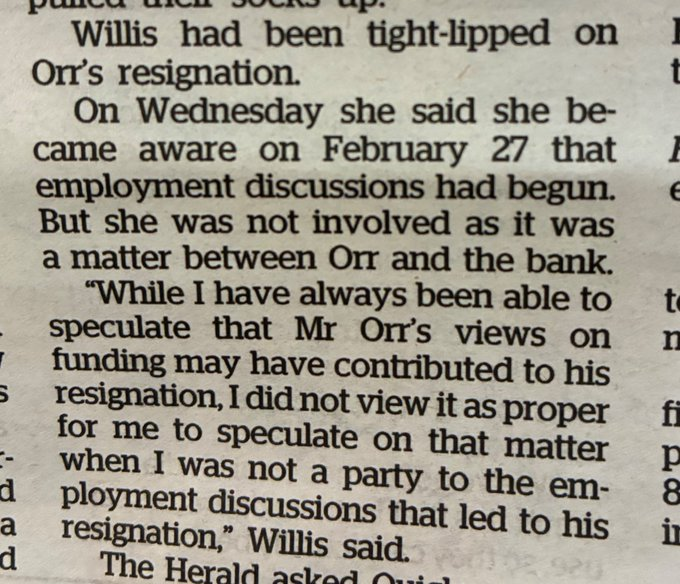
This snippet from an article in yesterday’s Herald caught my eye.

It crystallised something that had been playing on my mind for a while.

The Minister of Finance here seems to be saying that she did not know (at the time) why one of the most powerful officials in New Zealand, chief executive of a major agency in her portfolio, was resigning. The implication is that she never asked and was never told. If so, it would be quite extraordinary, and doesn’t seem at all likely. Decent answers to OIA requests might shed some light, but as I noted yesterday the Bank has so far simply ignored that part of my OIA request relating to communications with the Minister or her office.

The Minister has fairly consistently attempted to suggest that they were all matters only between the Board and the Governor. The Minister appoints the Governor, and while she does not set the terms and conditions of employment (the Remuneration Authority sets the salary and the Board the rest), the Act is quite clear about how a Governor resigns.

The Governor’s resignation is submitted to the Minister and is effective not before she receives it (the Bank gets a copy for information, and I guess to give effect).

Are we seriously expected to believe that the Minister of Finance was so little curious that she never enquired why, or what was going on, either when Iain Rennie first told her this was a possibility (earlier stories say this was 27 Feb, the day of the Bank’s Board meeting referred to in this week’s statement) or at any point in the following few days?

And if, as we are now told, Quigley (for the Board) went off and negotiated an exit agreement with Orr, on whose authority was that done? After all, the resignation itself was to the Minister. Wouldn’t an engaged senior minister, for example, have wanted to ensure that if there were any side deals done there were (a) no embarrassing severance payments, and b) no awkward gag restrictions, obstructing the public’s right to know (given that she now emphasises that the public should as far as possible have a right to know, and Quigley now cites the agreement he made with Orr as some sort of obstacle)? Perhaps Willis is a particularly disengaged minister, but….it doesn’t really seem likely, and especially in view of the balls that were in the air at the time (around both the Funding Agreement and bank capital issues). I guess it is just possible that she told her staff to tell Rennie and Quigley that she didn’t want to know anything (it might be politically convenient for her) but that would be a straight-out abdication of responsibility given her responsibility (including to Parliament and public) for this agency.

Put it together with the points I noted yesterday (did she ever object to the Bank setting a Funding- Agreement-blowing budget this time last year?, how did much higher than previous Funding Agreement numbers find their way into official HYEFU fiscal estimates?) and one senses that there are questions that should be asked of the Minister (journalists, Opposition MPs). And quite what was the character and tone of that meeting with her on 24 Feb, attended by Orr, Quigley (and Hawkesby and Treasury officials)?

I am left beginning to wonder quite what the balance was between Orr choosing to go and Orr being pushed. This seems to have come to a head between the meeting with Willis on the 24th and the Board meeting on the 27th. Orr had clearly engaged in something like an emotional over-reaction to coming funding cuts (“the matter was distressing for Mr Orr”). But why was there a need for an exit agreement if he was simply resigning entirely of his own volition (maybe with the exception of a one line agreement to waive notice requirements in his contract)? And why has the Bank deliberately – and it must have been deliberate – withheld anything about board engagement with the Governor or deliberations on his behavior, stance on funding, future etc?

They are questions not conclusions, but situation seems nowhere near as clear as the Bank might have liked us to believe with their press release (and was it a management position or one formally adopted/approved by the Board?) the other day.

As evidence, too, that the Minister had been part of the effort to mislead the public, I found this in a 5 March (day of the resignation) newspaper article

She too seemed to feed the line of “nothing much to see here”, while suggesting (contrary to the Act, see above) that the resignation was nothing to do with her, even though his resignation had been submitted to her.

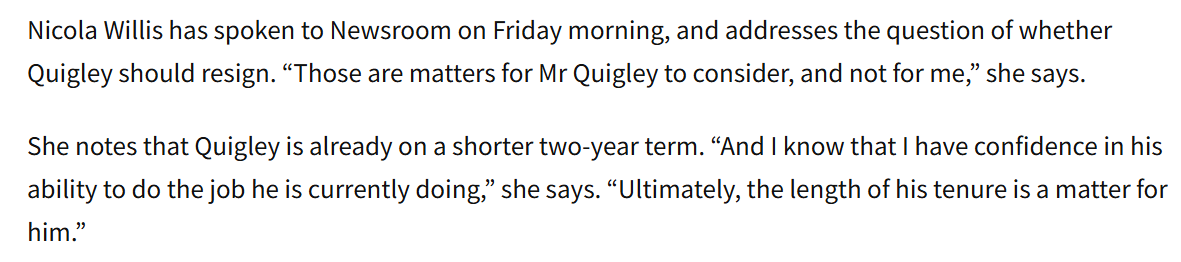
Coming forward, there were some comments reported from Willis in the Newsroom article yesterday on the position of the Board chair.

Hardly a ringing vote of confidence. More reminiscent of those old movies in which some officer’s conduct has disgraced the regiment and he is given a pistol and a bottle of whiskey and expected to do the decent thing.

Quigley

Jonathan Milne of Newsroom has an extensive article on Quigley, including reporting some of his conversation with Quigley on Thursday afternoon. The article still appears to be paywalled (usually Newsroom lifts the restriction after a day, so perhaps it will be freely available shortly) and so I won’t quote extensively from it.

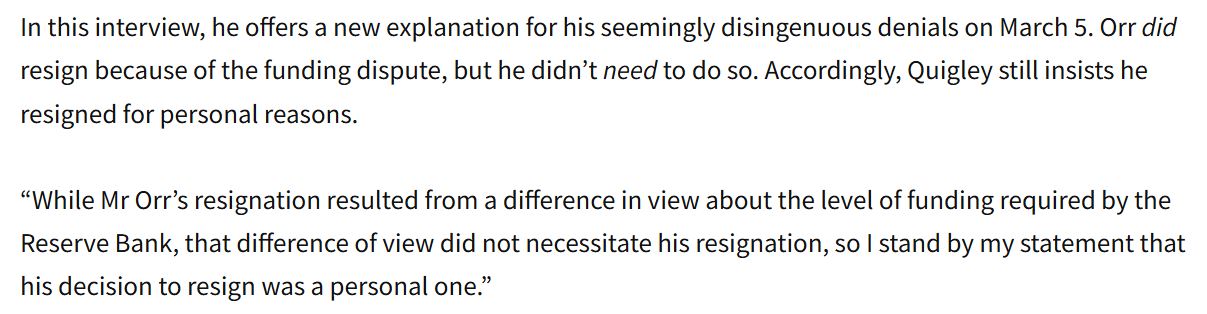
There are two sets of comments worth highlighting though. First, Quigley attempts to somewhat walk back his previous dismissive comments (to Dan Brunskill of interest.co.nz) and to justify his approach on 5 March (although not – not clear if it was asked – the three month wait for eventual partial answers). Little of it is at all convincing (and, for example, he never explains why he agreed to gagging restrictions he claims existed), but this was the most incredible (hard to take seriously) bit

It brings to mind that excellent encapsulation of the point by Luke Malpass in Thursday’s Post

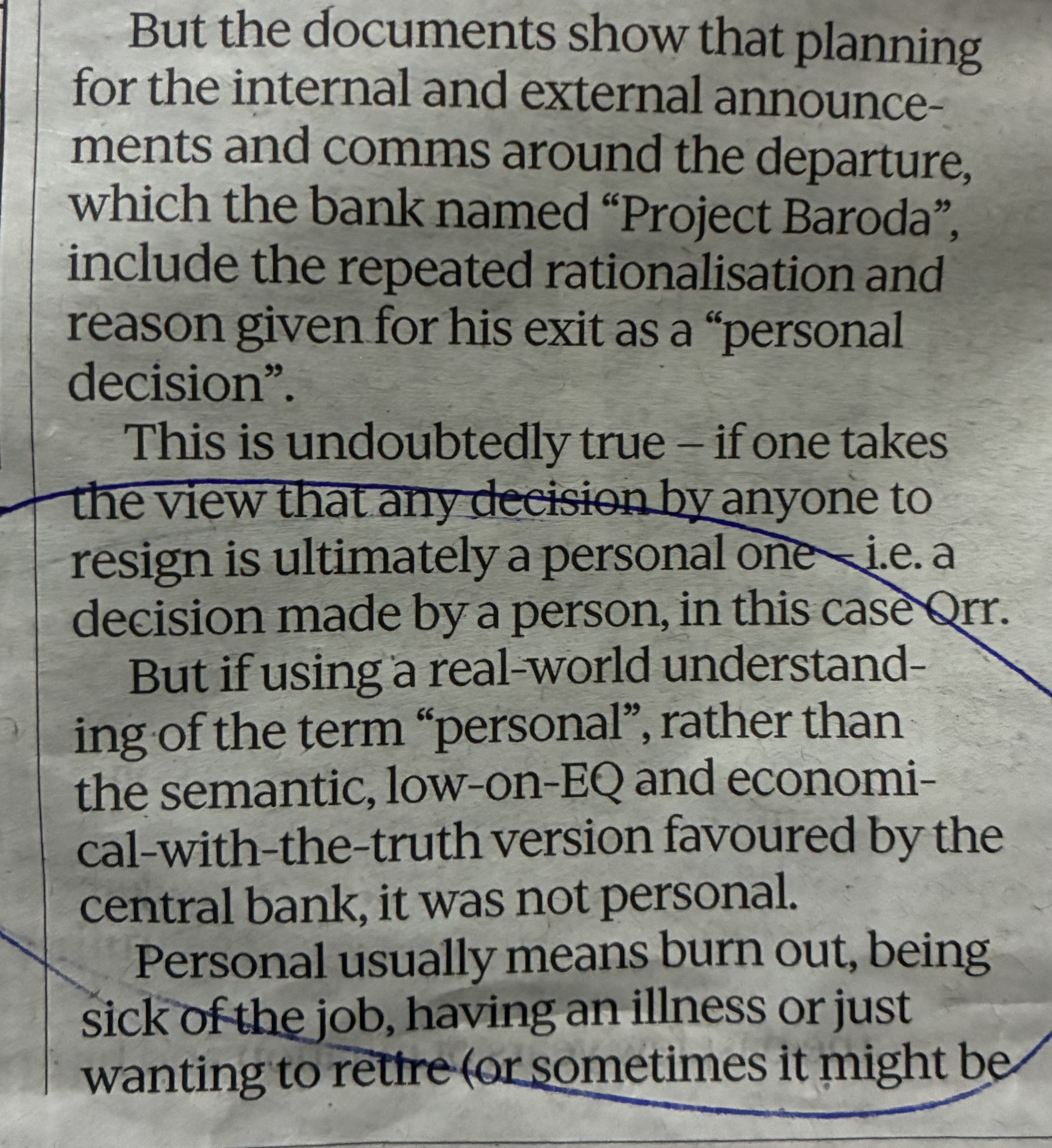
No one, but no one, thinks that a resignation over a major dispute with Board/Minister, involving conclusions that future working relationships would be deeply impaired (presumably because of Orr’s conduct), is what would reasonably be described as “personal” reasons. Except, it seems, Quigley.

He actively misled us.

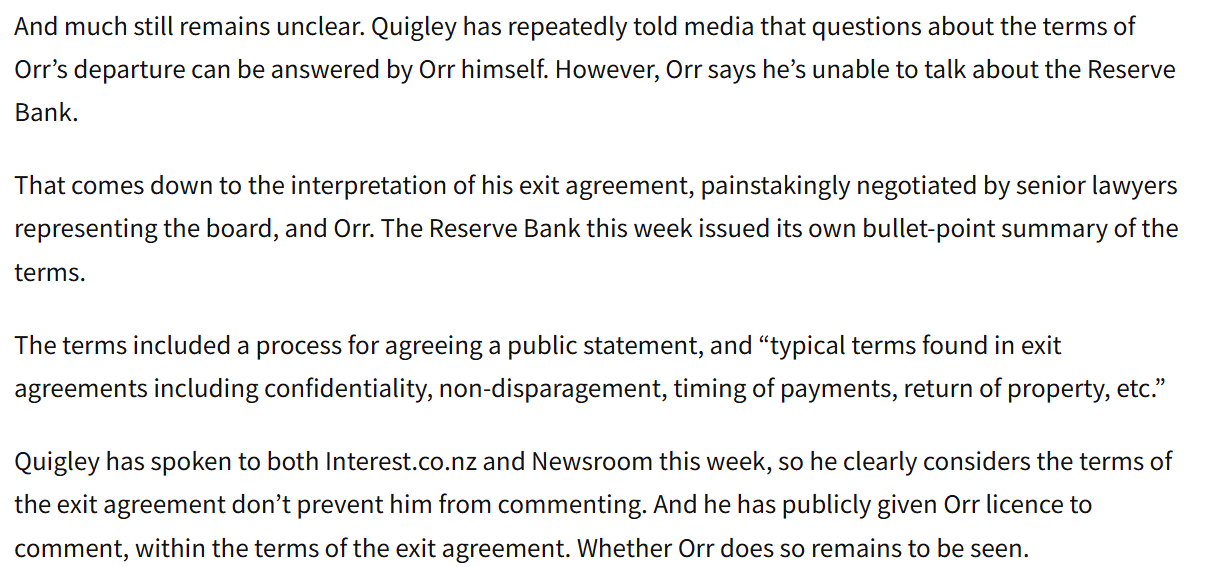
The second set relates to the question of what gagging restrictions still do (or don’t) exist.

If there is genuine uncertainty (Milne seems to contacted Orr himself) it should be resolved now, and clarified (waiving previous gag provisions if necesssary) in favour of transparency and accountability (and, at this point, it is less about accountability for Orr, but of the Board (specifically its chair) and the Minister. Among other questions, how was this departure so badly handled? (And recall that Orr was planning to turn up at the conference the next day and discuss the news, suggesting any gagging may primarily have come from the Board chair, with the acquiescence (at least) of the Minister. But we don’t know.)

The MPC blackball

(As noted above, this is mostly for the record. There is little new material beyond this point.)

In his article, Milne includes this

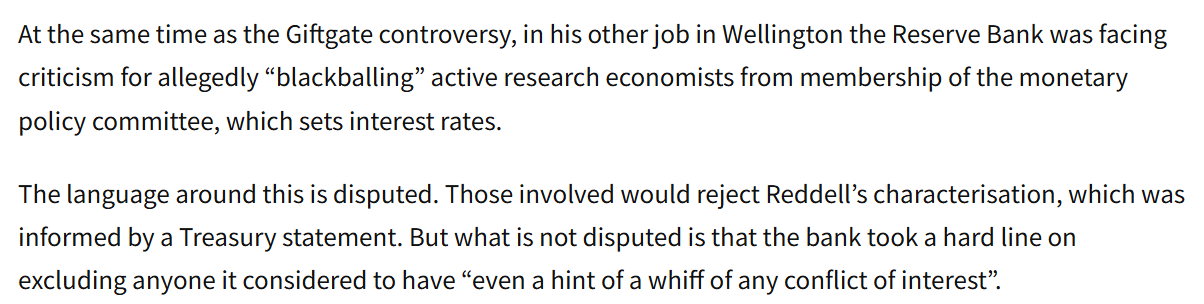
This is a characterisation I object to fairly strongly, having provided chapter and verse (including through Reserve Bank documents, and reported interviews with the person who was Reserve Bank chief economist at the time and with the person who was Grant Robertson’s adviser at the time) over several years. And from the first hand account of an academic who in any sane system would have been seriously considered but who was explicitly blackballed.

There are two separate parts to this episode though, both extensively dealt with and documented here:

  • the first related to decisions taken by the Board in 2018 about what sort of people to exclude from consideration for appointment to the new MPC (the Board recommends, the Minister decides)
  • the second related to Quigley actively misleading Treasury, and in the process the public, in 2023 by claiming that there was no such restriction.

Of these, the first is indisputable and to almost all serious outsiders quite extraordinary. As one of my former colleagues reminded me recently, it was a standard so absurd that if applied anywhere else in the world people like Ben Bernanke and Janet Yellen would have been disqualified from appointment (both served on the board of governors before later becoming Fed chair).

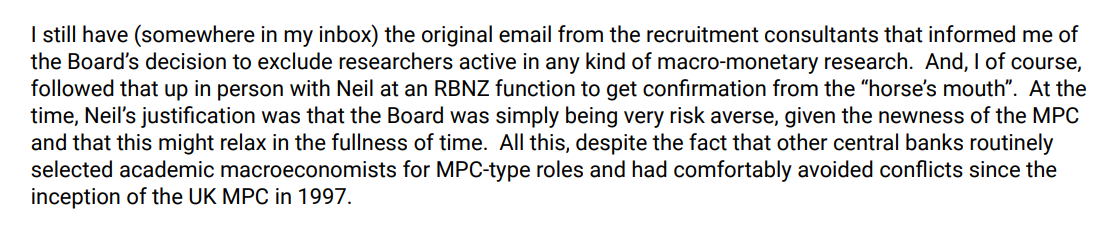
As I have noted in repeated posts, my knowledge of this blackball never relied on “a Treasury statement”, although the published Treasury statement provided an external hook to hang concerns on. I had been told months earlier by an academic (see above) that he’d been blackballed. I have never named this person (at their request) and have sought to rely on published material, but this was the relevant section of said academic’s email to me in 2023 when the whole issue came to the fore again.

In addition to published comments from John McDermott and Craig Renney, the post I linked to above has extracts from OIA releases setting out the Board’s position that researchers (in macro/monetary fields) should, pretty much automatically, be considered as conflicted and thus ruled out of consideration. The claim that this was about “conflict of interest” was simply absurd (as the academic notes in the email, in light of abundant overseas precedent (not just in the UK but, eg, in Sweden and the US), and any potential issues readily dealt with through the MPC Code of Conduct).

But absurd as the 2018 policy and practice was, I guess it was a lawful (ie legally open to the Board) choice. And had the Minister at the time strongly objected, I guess he could have pushed back and insisted that the field for consideration include active researchers in macro-type fields. That it is what actually happened was confirmed to the Herald in 2023 by Chris Eichbaum (one of those Milne talked to, former Board member in 2018/19) who confirmed that the blackball had been in place. Eichbaum defends the approach, but does not dispute that it was the policy/practice then: experts were explicitly excluded (consistent with the academic above’s account).

Eichbaum got involved again because earlier in 2023 Quigley had on two separate occasions denied to The Treasury that there had ever been such a blackball, suggesting that a Treasury official (who had since left, and could conveniently be thrown under a bus) had simply gotten the wrong end of the stick and had misadvised the Minister. In the context of questions around whether the blackball was still in place by 2023 this (very ill-advisedly) led Treasury to make a public statement denying that there even had been such a restriction, and tossing their own former employee under a bus. This is all documented, in painstaking detail, in the link above (including the email recounting the views of one Treasury Deputy Secretary (now leaving) suggesting that perhaps there really hadn’t been an error (on the Treasury side of the street)).

Eichbaum then talked to the Herald (and later confirmed that he was happy with how his views were reported), saying in effect “I don’t know what Neil thought he was doing. Why didn’t he just say, yes we had a ban then, but we don’t now”. Indeed. There wasn’t a ban in 2023, and a respected macro academic (Prasanna Gai) was appointed last year to the MPC.

At the time (2023) I was half-inclined to make excuses for Quigley (busy man, demanding day job, several years ago, perhaps he really had forgotten). It wasn’t a very persuasive story but I didn’t really want to believe that such a high office holder would actively mislead Treasury (not just once), never even clarifying things after the Treasury statement went out and there was pushback (including here). But events of the last couple of months suggest that when it comes to the Bank, Quigley seems to have been willing to say almost anything, with a close alignment with the truth not apparently being a prerequisite.

I’ve included all this here partly because I am a little annoyed at how Milne treated the issue (granting that he had huge amounts of material, and when I finished talking to him at 8pm on Thursday he was about to start turning it into a story before 5am), but more importantly because I think what this episode – in the 2018/19 and 2023 parts – demonstrates is that Quigley had long since proved himself unfit to be chair of our central bank’s board. The last three months (last week too) have been a debacle, coming on top of (eg) the egregious budget setting last June, all of which proved the point again, but the latest actively misleading shambles does not exactly come after years and years of previously spotless service as Board chair.

Quigley, Orr, and the RB board: edition number 965

This morning as the Quigley/Orr/Board saga rumbles on I wanted to touch on three items:

  • the latest comments from Board chair Neil Quigley (and the Minister’s comments on and to him)
  • a reminder of where this all started, with the Board unanimously approving a budget last year far in excess of what had been approved under their then-current Funding Agreement, and
  • outstanding OIAs.

Quigley

When I wrote my post yesterday morning I’d seen only Quigley’s extraordinary jaw-dropping comments to interest.co.nz suggesting that he had been deliberately (to say the least) economical with the truth and actively misleading the public because they had no right, or particular need, to know. And when Brunskill suggested that this was perhaps inconsistent with the Bank’s oft-boasted commitment to transparency, Quigley let loose with the classic line that “I’m not interested in having you question me like you’re a lawyer”. A journalist doing his job would have been more like it…. It was, sadly, consistent with the Quigley who has long acted as if public affairs are matters only for the chosen and that the great unwashed should really pipe down and be grateful.

Then I saw another story from Brunskill in which he recorded that in a follow-up email Quigley had said that an agreement with Orr limited “the communication we could offer on March 5”. Which may well have been true, but doesn’t take us any further since

(a) it was Orr who resigned, and there were presumably standard resignation terms in his contract,

b) even if they had mutually agreed that the only comment on 5 March would be the agreed official press release i) Quigley did not need to agree to content that actively misled the public (reread the statement it is clearly designed to give the impression of “nothing to see here”, but perhaps suggestive of a long-serving CE who was tired and had accomplished what needed doing), and ii) it was Quigley who chose to give the press conference later that afternoon in which he clearly went well beyond the press release, trying fairly explicit to suggest that it was all just personal reasons – but not conduct or anything of the sort – and more or less explicitly denied it had anything to do with (the emotional overreaction to disappointment around) the forthcoming Funding Agreement.

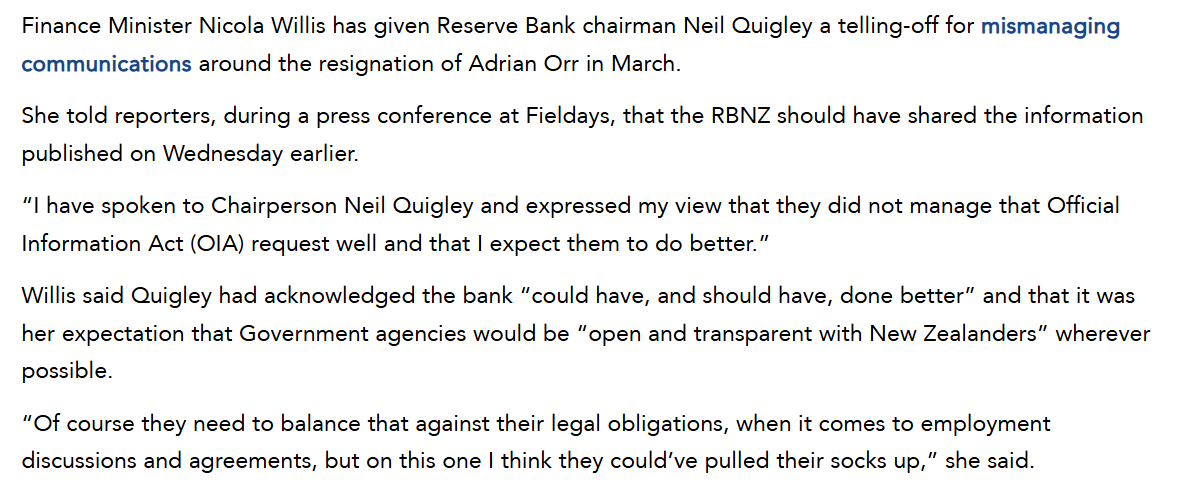
Then the Minister of Finance entered the picture, giving a press conference at Fieldays (account here)

Which was a good start, although re that final paragraph note that the Board (Quigley) chose what to agree to in the exit agreement. It seems to have been Orr who wanted out. Quigley should have been acting to protect the interests of New Zealanders, including in transparency and accountability.

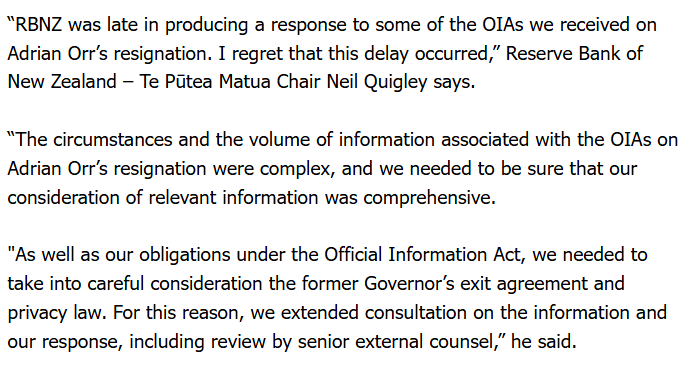
And then a few hours later a statement emerged from Quigley himself. It came via the Bank’s standard email advisory list (link here to a website version). I really don’t think it helped (and from people I’ve talked to I’m not the only one).

He started with this

“Late” doesn’t even begin to describe it. The bundle they have released – while interesting and revealing in itself – hides as much as it reveals, including almost everything about Quigley’s role, and does not even touch on large chunks of my request (not sure about others but my impression from reading coverage is that others are similarly underwhelmed). And the law is the law, and they knew from day 1 (well actually from when Adrian first said he was going) that there would be intense public interest in this and should have been pro-actively positioned to provide a comprehensive response early, for public and for staff.

As for that 3rd para, as noted above while Orr’s employment contract was a given, it was Quigley who decided what sort of non-disclosure restrictions to accept/impose.

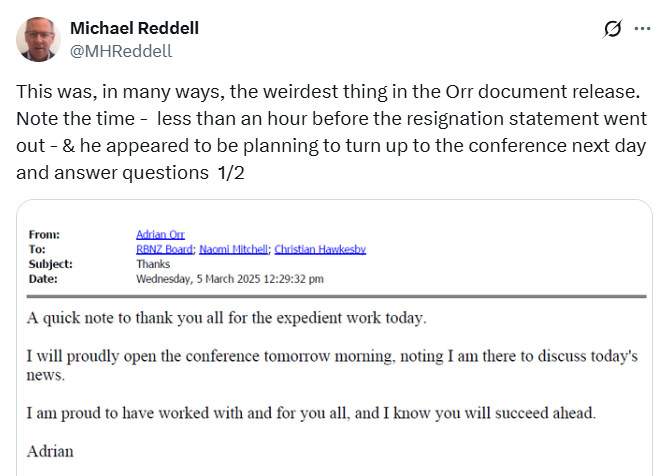
Note that in the early afternoon of 5 March, just an hour before the resignation statement went out, Orr was planning to front the conference the next day and “discuss today’s news”.

As it happened, going through some old articles this morning I found one from 5 March when Dan Brunskill had door-stopped Quigley and asked him about the conference (“Quigley said he did not know whether Orr would still host the central bank’s monetary policy conference”) He had sorted that out by the time of his ill-starred press conference later in the afternoon, but none of it feels like some advance commitment that Orr would disappear in utter silence and no answers would be given for months.

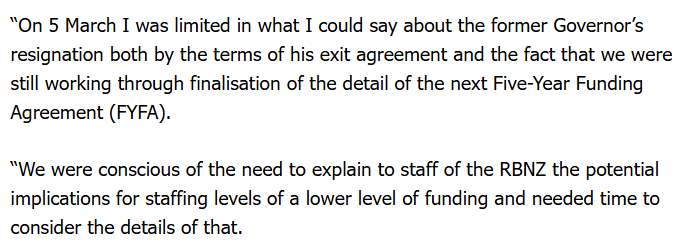
The second bit of Quigley’s statement was this

On the first para:

  • even if there had been an agreement that the only public comment on 5 March would be the official agreed press release (a not unreasonable approach in itself), a) Quigley had a great degree of control over what was (and wasn’t) said in any statement, and b) why then did he seem to go off-reservation with a press conference where again and again he seems to have actively misled the public (acknowledging to Brunskill on Wednesday that he had done so deliberately?
  • the fact that the Funding Agreement hadn’t been finalised is really just distraction. The Minister had already said in public the previous week that she was looking for cuts, documents released show even Orr was reconciled to a lower level of spending than they’d initially asked for (even if not to what the Board was willing to go to to reach agreement with MoF). What stopped them saying “negotiations between the Board and Minister on the next funding agreement are progressing. In straitened fiscal times it is unsurprising that the Minister is looking for cuts. The Governor did not believe that the scale of cuts sought was appropriate and chose to resign”. Sure, it would have been uncomfortable, but….that is what real accountability and transparency means. (And anyway, the Funding Agreement was published in mid April and we got no disclosure until 11 June.)

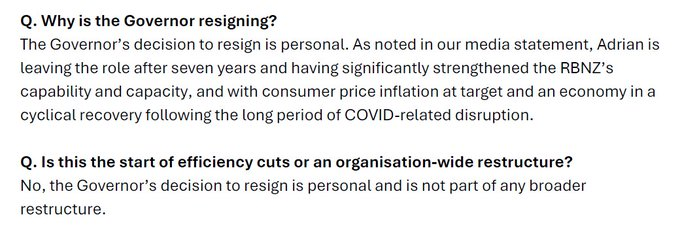
As for the second para, their treatment of their staff seems to have been particularly egregious. Recall this from their internal Q&As for managers to use with staff.

They lied. They – Board and remaining senior management – had known for weeks at least (it is the released documents) that staff cuts were going to be necessary. That is more or less what public sector budget cuts meant across the board. Staff are adults. They know that. Sure, the final budget numbers hadn’t been determined but it would have been perfectly possible – they had days to do it – to have crafted a message for staff that said “it is now certain that our funding next year will be materially lower than this year’s operating budget. We do not know how much lower but the implications will certainly include staff cuts this year”.

Or, slightly less bad perhaps than the way they actually treated staff, they could just have stonewalled and said “no comment, no comment, no comment” when staff asked what was going on.

Can Quigley survive? He certainly shouldn’t but who knows. When a journalist asked me last night I noted that since I didn’t adequately understand why Willis had reappointed Quigley for a final two year term last year, one couldn’t be confident she’d do the right and necessary thing, but I still reckoned that within a month there was a better than ever chance he’d be gone. Victoria University’s Martien Lubberink suggested on Twitter last night that he was buying a lettuce. The original lettuce outlasted Liz Truss. I hope this one lasts longer than Quigley. Any good he did in his 15 years on the board seems long long past and there needs to be change at the top now.

Budgets

I was in a meeting yesterday and chatting over lunch with people who aren’t very focused on central banking or government finance issues, and a couple asked “what was Orr planning to do with all that money?” My response was simple: it wasn’t what he was planning to do in the future, but rather that the money had already been spent. And in breach of the Funding Agreement they’d signed with the Minister of Finance in mid 2023 (an agreement that covered the 23/24 and 24/25 financial years, amending the 2020-25 five-yearly Funding Agreement).

All the details of this are in a post I wrote last month. But to quickly summarise:

  • in that 2023 amendment the Bank had been allowed to spend about $154.4 million on (within scope) operating expenses in 2024/25,
  • the Bank’s Board adopted on operating budget for the same (within scope) items for 24/25 of $191 million, 23 per cent above the level of operating expenses Grant Robertson had allowed them for 24/25. This Budget was adopted unanimously by the Bank’s Board last June (and overall budget numbers were included in the Statement of Performance Expectations published then),
  • the Bank’s bid in respect of its next Funding Agreement, also adopted unanimously by the Board, involved a 7.5 per cent cut from that $191 million level (with a bit of sleight of hand in proposing to move some more things out of scope).

If you doubt the story, here it is in their own words

Spend up hugely, far beyond what the Minister of Finance had allowed – something no other government agency or department could do – and then offer up modest savings relatively to that grossly inflated (and improperly authorised level).

Consistent with this, they’d increased staff numbers from, 601 to 660 between 30 June last year and 31 January, and the documents revealed Orr talking of a plan to take it as far as 742.

It really was that simple, that extraordinary. And if it represents an abuse of office in respect of New Zealand taxpayers, it was almost worse in respect of their own staff. People had taken on new jobs in those last few months as the empire continued to be built even as Board and management were (at best) deceiving themselves about the fiscal environment and the sort of restraint that might reasonably be expected from them (as most other public agencies).

Now, there are still a couple of puzzles around the role of the Minister and Treasury. As my detailed post documents, the Minister of Finance had to be consulted on that Statement of Performance Expectations (containing the budget). We do not yet know whether she ever pushed back strongly at that stage (just after last year’s government budget).

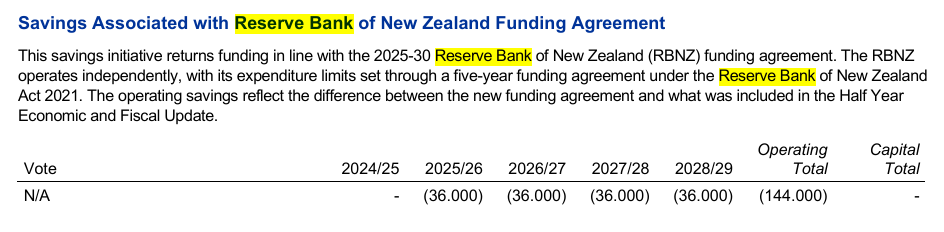
And then there was this, spotted in the recent (government) Budget Summary of Initiatives document

The savings are good, but it looks as though Treasury had included in the HYEFU numbers much much higher levels of spending than the Minister eventually accepted, and more in line with the Bank’s opening bid. Why did they do that, when those higher levels were well above the previous Funding Agreement? Had conversations with the Minister in the second half of last year indicated that she was then fairly relaxed? We do not know (but really should).

So, it was never a bid for even more, it was about consolidating most of the extraordinary growth in spending and staff in recent years, the last and most egregious bit (in 24/25) having happened without any ministerial authorisation, quite inconsistent with the statutory instrument governing Bank spending, the 2025-30 (amended) Funding Agreement.

Outstanding OIAs

I saw a serious observer on Twitter the other day note that he’d had several OIAs in with the RB since February (clearly not Orr resignation related) and had not yet had a response.

My experience isn’t that bad, but…..

On the spending levels and the Minister’s involvement, I still have this outstanding

All this will have been readily accessible. If Quigley is serious about sharpening up the Bank’s OIA act, perhaps he could get them to address this one rather more promptly.

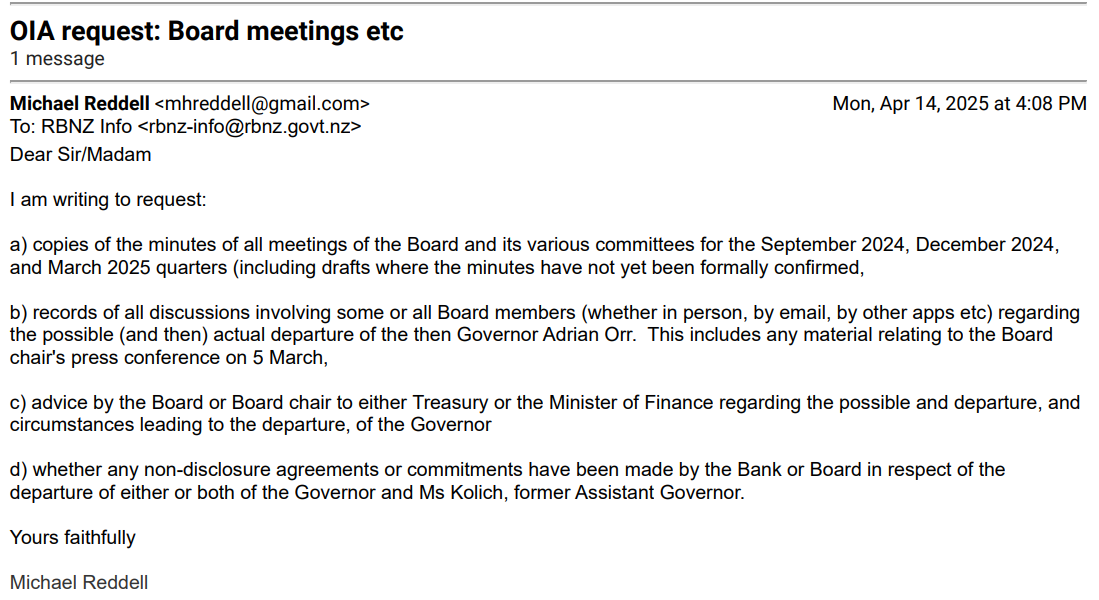
And then there was my request regarding the Orr resignation events. I didn’t put one in until quite late, and deliberately touched on only some specific aspects. This was lodged with them on 14 April

In their official response to me on Wednesday they claimed that the document dump dealt with this request.

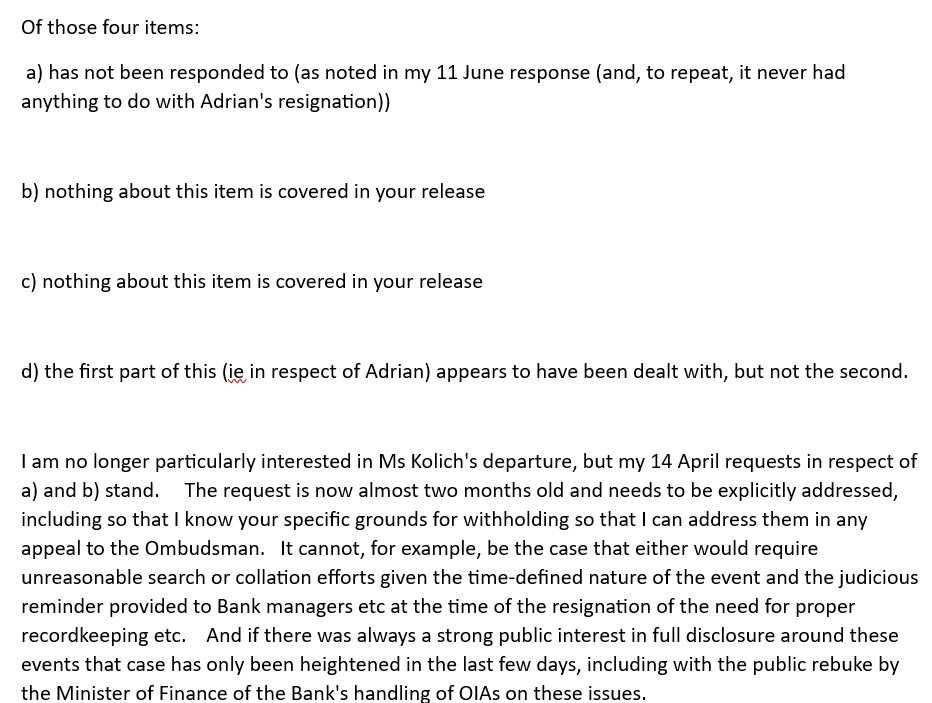
It didn’t. I had already pointed out to them that the first request had almost nothing to do with the Governor’s resignation (and of course nothing in the release dealt with that). This morning I went back to them as follows

It is as if they either can’t/won’t read, or somehow think the Official Information Act doesn’t apply to them. I’m not optimistic of getting anything more (well, at best this side of 2028 if it involves the Ombudsman), but they can’t get away with claiming they’ve responded to OIAs they’ve chosen to ignore.

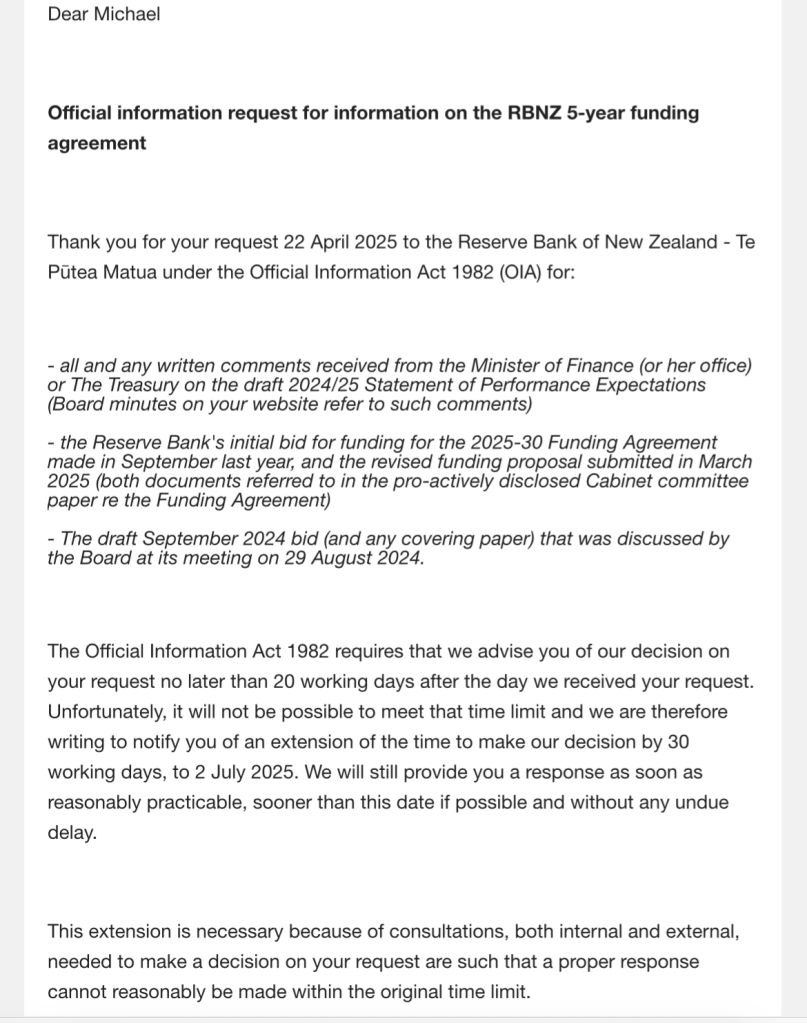
And then there is this outstanding from The Treasury, which should be due in the next few days.

Why is Neil Quigley still RB board chair?

In my post yesterday, I documented a whole series of ways in which Neil Quigley, Reserve Bank board chair (appointed by the Minister of Finance) appeared to have actively misled the public (and overseen the misleading of Reserve Bank staff) on the day Adrian Orr’s resignation was announced. Some of that material is here

Since writing that post, I’ve seen the excellent brief piece by Dan Brunskill of interest.co.nz who had taken the initiative to ring up Quigley and ask about what appear to have been deliberate and active misleading.

Just breathtakingly awful. From the chair of a powerful public sector board: the public had no right to know, and he wasn’t going to be questioned by a journalist doing his job (“like a lawyer” apparently).

In this morning’s Post their political columnist Luke Malpass has a particularly trenchant take on another angle of the whole debacle (which is probably too kind a word, as all of this was done consciously and deliberately by very highly paid people supposedly working in the public interest). This was the attempt to sell us all on the story that the resignation was just a “personal decision”, with no deeper meaning or significance. The headline is “Orr omnishambles redux: the “Personal decision” that wasn’t.” and this is just a sample

Or “the worst sort of media management bends or has little regard for the truth, treating the public or customers like morons. After the past few years of inflation and hip-pocket hurt, the last thing the Bank should have done was not to be honest with both its staff and the public….”

You might find this surprising after my commentary in recent years but I’ve always been reluctant to believe the worst of Quigley (we used to have quite a bit to do with each other) but we are now at the point where, after yesterday’s disclosures, it is impossible to take at face value a single word he says, at least on Reserve Bank matters (for which he is earning a cool $200000 per annum for a part-time job).

You might be wondering why the board, and particularly its chair (Quigley) are still in office after this shambles (which started from the blowing the previous Funding Agreement spending limit so badly this time last year).

It isn’t easy to dismiss members of the Board. One can debate the merits of that (relative to other government boards) but this is what the law says about grounds

One could mount a case that that standard has now been met, but as a purely legal matter it might be arguable and (more messily) contested.

The same standard does not apply to the Board chair, who can be removed pretty much at will by the Minister

(Having been removed the former chair would still be a board member)

So it is quite clear that the Minister can remove the Board chair for any reason whatever (although needs to consult him first), and probable that she could not formally dismiss board members.

However, in the face of this “omnishambles” and active deceit of the public, how plausible is it that if the Minister were to communicate to the Board and chair that the government no longer had confidence in their stewardship (not on grounds of policy differences – where it is important to respect operational independence – but on basic stewardship and obligations of integrity, accountability, and dealing with staff in good faith) that any half-decent board member would refuse to resign. And if they were to refuse to resign, the government would be in a very strong position to call out and shame them in public for the conduct for which they’ve been responsible. This stuff matters, both because of the disgraceful stuff that has already happened – and that barefaced refusal of scrutiny yesterday by Quigley – but because of the key gatekeeper role the Board plays in selecting which name goes forward to the Minister as nominee to be next Governor. Can anyone have confidence in them to do that sort of selection after all this?

Of course, it has long been a mystery why Willis reappointed Quigley last year. But a whole new series of questions need to be asked now. I hope, for example, Brunskill took that dismissive answer from Quigley to Willis and asked her if she considered that was acceptable behaviour in the chair of the board of a powerful public entity.

And, of course, there is that other utterly supine and useless body, supposed to be holding public agencies and their boards/managements to account, Parliament’s Finance and Expenditure Committee. But they weren’t even bothered when Orr repeatedly lied to them, so I suppose we shouldn’t expect them to care when Quigley and the rest of the Board actively misled the public, seemed (in Quigley’s) case to be proud of it, and then refused to even take questions.

The Orr story (well, part of it anyway)

Months after various OIAs had been lodged on the question of Adrian Orr’s sudden departure on 5 March, we finally got a partial dump of documents this morning.

(Sufficiently mishandled that at 10:04 this morning they’d send an email to OIA requesters saying they’d email out the response at 10:45 and then have it on their public website at 11 (it being usual to give requesters at least some advance notice)). Then it seems they changed their minds because the emails didn’t come until after 11. And then it turned out – they emailed us again – that they’d sent only a near-final version of the Summary Statement they were releasing, not the final version that is on the website. There are material differences between the two – see below.)

I noted above that this was a partial release. Why do I say that? Because what is released today contains:

  • nothing of advice to or communication with either The Treasury or the Minister (or her office),
  • nothing of any discussions between the non-executive members of the board and Orr, including reactions/responses when he first intimated his intention to resign,
  • no records or summaries of any meetings or conversations among non-executive directors

And those are just the omissions that I reckon were covered by my OIA on this matter (mine was only one of a number they claim to have responded to with their omnibus release this morning).

But, to the substance:

Strangely, and after months of speculation, these comments from my post the morning after the resignation ended up looking closer to accurate than I had recently supposed.

We have known for some time now that they had actually bid for a big increase in Funding Agreement resources over the levels allowed them by Grant Robertson just prior to the last election (and their statutory roles hadn’t changed since then), justifying this on the – simply extraordinary – grounds that it was in fact a modest cut relative to their own 2024/25 Budget; the one in which they had set out to spend far far in excess of the amount Robertson had allowed them for the last year of the previous Funding Agreement.

Both that 2024/25 Budget and the $1 billion funding agreement bid had been unanimously adopted by the Board last year (Orr himself was a board member). Details of all that are in this post.

Here is the text from the Summary Statement released (in error it appears) to OIA requesters this morning

For a start, this description seems odd. First, the Governor works for and to the Board not vice versa, so why the talk about Board members negotiating with Treasury “under the direction of the Governor”? But, second, all this paragraph talks about the Governor having a view as to what future budget resources were needed, but never mentions that the Bank’s bid had been adopted by the Board itself (the Funding Agreement is an agreement between the board – as the Bank’s governance body – and the Minister). Maybe Orr led the non-executives by the nose when the Funding Agreement bid was signed off last year, but in the end it wasn’t his call.

Then the Board seems to get blamed for bowing to reality. Too little has yet emerged of the Funding Agreement process documentation, but it seems likely that Treasury and the Minister had made pretty clear that a Funding Agreement that involved a large increase in funding relative to what Grant Robertson had approved just wasn’t going to be acceptable in these straitened fiscal times. It isn’t clear when the Minister or Treasury finally pushed back, but eventually they did, and the Board – recognising that ultimately choices about acceptable resources levels were for the Minister – had adjusted to that reality. Orr, by contrast, didn’t.

Here is the version of the Summary Statement that is now on the website (where there have been changes)

Note the attempt to shift the emphasis away from that meeting with the Minister of Finance on 24 February (the one that has already had quite a bit of coverage, with the Minister’s press secretary having to advise her to avoid answering a question about whether the Governor had ever shouted at the Minister).

Either way, what we are left with is a hotheaded Governor who finally came face to face with reality….and could not cope. And a Board which seems to have been as worse-than-useless as had been widely supposed since most of them were appointed in 2022, but who – in the end – could actually face reality.

Look at those descriptions about “The matter was distressing for Mr Orr” (or “This caused distress to Mr Orr”). It is a bit like a bloodless description of a moody teenager having lashed out in the playground.

Fiscal restraint has, in fact, been the order of the day for (most) central government agencies since the change of government. Many chief executives probably had had grand visions for how much additional growth their agencies needed, and even perhaps a belief that in some sense the national interest demanded it. But almost all of them – perhaps MFAT aside, which wasn’t asked to – faced reality, and got on and implemented the budget cuts that were demanded of them. Not one seems to have thrown his or her toys out of the cot and stormed off with no notice. They acted like adults, people who’d developed the resilience we like to help shape in our children as they grow. But not Orr.

And that is why I don’t think it is at all correct to characterise his departure as just a dispute over budgets. Plenty of people have conflicting views on budgets, and it wasn’t as if – even when the final Funding Agreement decisions were made – the Bank was being asked to operate with very material cuts at all relative to the last spending level approved by a Minister of Finance (a big-spending one at that). He just wasn’t going to get to grow his empire even bigger (you may recall from earlier posts that the Bank had grown staff numbers from about 600 on 30 June last year to about 660 on 30 January this year, and in the documents there is a note from Orr dated 5 Feb talking of having wanted to get up to 742 FTEs.)

It really looks to have been a toxic combination of headstrong volatile chief executive (who’d been lying to Parliament again just days prior to that critical meeting with the Minister), weak or non-existent accountability from his Board, and an utter lack of resilience or perspective which you’d only really expect to see from someone at the end of his tether. That is reinforced by that line in the final official version about how “the impasse risked damaging necessary working relationships”. Not among decent disciplined people – the Funding Agreement was a matter for the Board and the Minister (primarily the latter) and the Governor’s job as employee and chief executive was primarily to implement the agreement and manage within approved resources, and to do so in an effective not petulant way. After all, the reduced budget wouldn’t even come into effect until 1 July (so perhaps a resignation effective 30 June?)

Let’s grant (charitably) that Orr really really believed that the Bank’s statutory functions could only be performed with the $1 billion budget (and 40 or so senior managers). In those circumstances, perhaps the best thing to do was to move aside and let someone else take his place. But normal people – normal chief executives (see, eg the Vice-Chancellor of Auckland University today) – give notice, and work out that notice, enabling the governing body to do a thorough careful search for a permanent replacement. They don’t storm off with no notice, having engaged senior lawyers to negotiate an exit (presumably there were conventional resignation provisions in Orr’s contract already), offering no explanation whatever, despite holding one of the most powerful public sector positions in New Zealand.

If Orr emerges really badly from this Statement and document dump, he isn’t the only one.

Take the Board (Quigley and the other non-executives) for example.

It remains beyond belief how they (a) signed off on a budget last year so far in excess of the Robertson-approved levels, and b) how they ever imagined that it was appropriate to treat that unauthorised level as some new-normal base against which they could then offer up tiny cuts. Did any of them ever push back against management and insist that the Governor stress-test for them a range of alternative budget scenarios? (If so, there is no sign in the published minutes).

And where was the Board in controlling the process at the end? Why did they let the Governor simply leave office the day of the announcement, rather than insisting on him working out notice? Why did they grant him (presumably paid) “special leave” for the period 5 March to 31 March (rather than, say, making him take annual leave if his resignation was going to be legally effective until 31 March). And why did they allow such a pig’s breakfast of a communications debacle to (a) occur, and b) persist for months?

To be sure, both the Board and the Minister were put in a difficult position by the Governor’s petulant walk-off. They hadn’t, as at 5 March, finalised the Funding Agreement (indeed, the Minister’s later releases on that subject suggest some continuing back and forth over the coming weeks), so they probably couldn’t release the whole picture.

But as it was they actively misled both their own staff and the wider public.

On staff, this is from a set of internal Q&As given to managers the day after Orr’s resignation to use with staff.

When in fact, on their telling now, it was all about looming significant budget cuts (relative to the Bank’s own budget, if not relative to the previous Funding Agreement) the Board had, perhaps reluctantly, accepted and the Governor has refused to (and petulantly stormed off).

As for the wider public, Neil Quigley – the Board chair, with an unfortunate reputation now for not being straight on RB things, but somehow succeeding to keep getting reappointed – held a short press conference late on the afternoon of the resignation.

In it, he told us that he (he avoiding answering for the Board) had still had confidence in Orr? How is that possible when your chief executive stormed out the door apparently because he couldn’t live with not getting a further inflated Funding Agreement and reckoned he couldn’t work effectively with the Board and/or Minister?

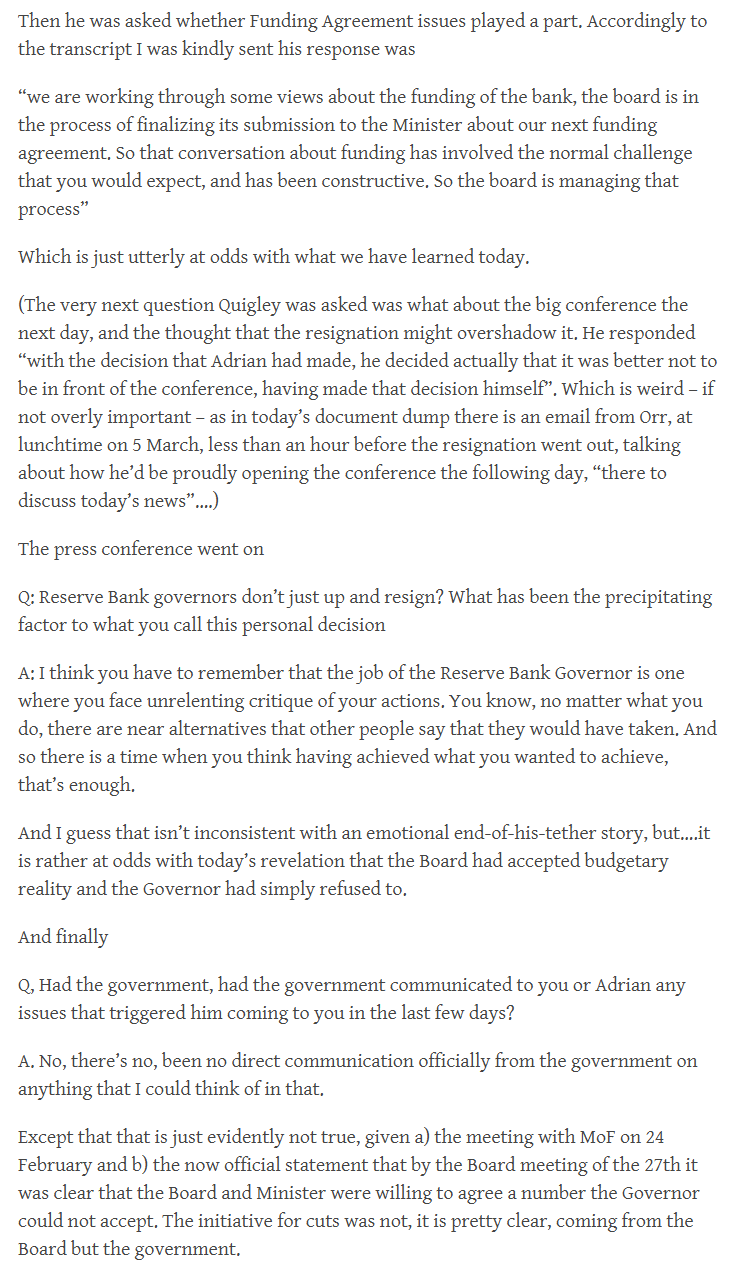
Then he was asked whether Funding Agreement issues played a part. Accordingly to the transcript I was kindly sent his response was

“we are working through some views about the funding of the bank, the board is in the process of finalizing its submission to the Minister about our next funding agreement. So that conversation about funding has involved the normal challenge that you would expect, and has been constructive. So the board is managing that process”

Which is just utterly at odds with what we have learned today.

(The very next question Quigley was asked was what about the big conference the next day, and the thought that the resignation might overshadow it. He responded “with the decision that Adrian had made, he decided actually that it was better not to be in front of the conference, having made that decision himself”. Which is weird – if not overly important – as in today’s document dump there is an email from Orr, at lunchtime on 5 March, less than an hour before the resignation went out, talking about how he’d be proudly opening the conference the following day, “there to discuss today’s news”….)

The press conference went on

Q: Reserve Bank governors don’t just up and resign? What has been the precipitating factor to what you call this personal decision

A: I think you have to remember that the job of the Reserve Bank Governor is one where you face unrelenting critique of your actions. You know, no matter what you do, there are near alternatives that other people say that they would have taken. And so there is a time when you think having achieved what you wanted to achieve, that’s enough.

And I guess that isn’t inconsistent with an emotional end-of-his-tether story, but….it is rather at odds with today’s revelation that the Board had accepted budgetary reality and the Governor had simply refused to.

And finally

Q, Had the government, had the government communicated to you or Adrian any issues that triggered him coming to you in the last few days?

A. No, there’s no, been no direct communication officially from the government on anything that I could think of in that.

Except that that is just evidently not true, given a) the meeting with MoF on 24 February and b) the now official statement that by the Board meeting of the 27th it was clear that the Board and Minister were willing to agree a number the Governor could not accept. The initiative for cuts was not, it is pretty clear, coming from the Board but the government.

We were actively misled (some would use stronger words). If you weren’t willing to give honest answers, why would a decent person hold a press conference at all? No one compelled him to.

And, a final question for the Board, why did not insist that straight answers be given weeks ago? If it was difficult to do so on 5 March, there can have been no possible excuse once the Funding Agreement itself had been agreed between the Board and Minister (published 16 April, almost two months ago now). The public was owed straight answers as soon as reasonably practicable (which also happens to be the OIA legal standard). The Board, and/or the acting/temporary Governor, seems to have been unbothered. But accountability is about things that are awkward or uncomfortable for you, not just the things you want the public to know.

Incidentally, the Minister of Finance also seem to have abetted keeping the public in the dark (if, perhaps, less directly responsible than the Board). This came out in an earlier Herald OIA, reported here

She must have been advised – assuming what the Bank today told us is true – that actually funding agreement issues were at the heart of the departure.

To wrap up, neither Orr nor the Board emerge with much credit from this affair – Orr none at all, having led the drive to the bloat and loss of focus, failed to read the (fiscal times), and then with so little self-discipline and without the sort of maturity one should be able to take for granted in someone holding high office as Governor, and the Board only a modicum for having very belatedly bowed to reality and accepted that the funding agreements weren’t going to go on rising forever.

Orr has gone, and you might think (hope) that after such an astonishing display he would struggle ever again to get a top-tier job.

But the Board – hardly changed at all over the last year – remains, and in particular Neil Quigley continues (reappointed by this government) as chair for another year. In that role, he drives the selection process for a nominee for the new Governor. This is the person with a track record of actively misleading the public on RB matters even before this last blow-up (remember his assertions, contradicted by both documents and his colleagues, that experts had not been blackballed from the first MPC), but who, more importantly, was responsible for driving the reappointment of a Governor so out of control and personally undisciplined that he couldn’t live with some budgetary restraint (recall that the final level MoF imposed represents pretty minor savings relative to Robertson’s last approved levels) and couldn’t even manage a disciplined and tidy no-drama exit. To add to which, Quigley was Board chair when that egregious 24/25 Bank budget was set. Every day he remains in office diminishes our central bank, and it is astonishing that the Minister of Finance has done nothing to force the issue, to make clear that the government no longer has confidence in Quigley to chair the Board, particularly given the vital role the Board has in the selection. We simply cannot afford another appointee – from Quigley and his board – even half as bad as Orr.

(There is more material in the documents released – including a 14 Feb email from Quigley to Orr suggesting that a deal was likely to be done with Treasury in the following few days – but that is enough for now.)

UPDATE: A response to this OIA should also be due shortly

Productivity growth languishing

I hadn’t had a look for a while at the OECD labour productivity (real GDP per hour worked) data, but the release of the latest OECD Economic Outlook the other day prompted me to spend some time in the (less user-friendly than it was) OECD database.

It takes a while for all the data to come together, and it is only annual, so the most recent near-complete data set is for 2023. On the OECD’s estimates – using national data, but converted at (estimated) PPP exchange rates – New Zealand stood 29th out of the 38 OECD countries (remembering that the OECD now has four Latin American “diversity hires” – all much poorer and less productive than the rest of the “club”).

Treasury highlighted a few years ago that the absolute level of reported New Zealand labour productivity may be understated (because of technical issues around how hours worked numbers are calculated/used, relative to the approach used for a number of other countries). The difference isn’t small but, as they noted, what is involved is largely a level-shift, and doesn’t affect materially comparisons of growth rates (of productivity) over time. Nor, of course, does it make any difference whatever to actual wages or living standards.

It is now quite well-recognised that productivity growth has been quite poor in many countries over the last decade or so (and the contrast between the US and some of bigger European economies has been remarked on often). Productivity growth in the typical high productivity OECD country has not been great – for example, for the eight years from 2015 to 2023, the median total growth in labour productivity for the top 10 countries [excluding Ireland and Luxembourg, for international tax reasons] was 4.9 per cent.

But much as we might like to catch up again with these high productivity countries, perhaps the most relevant comparators for us are the countries either side of us on the league tables, well behind the global productivity frontiers. In 2015, the start of our period, these were the countries with real GDP per hour worked already within 20 per cent either side of New Zealand’s. There are big gaps both above Slovenia and below Latvia (and, thus, even if the hours issue is fixed up, and there are no changes for any of these other countries, we wouldn’t even come close to the next country above Slovenia),

How has our labour productivity growth compared against these countries over 2015 to 2023?

The median productivity growth rate for this group of middle-to-lower (levels) countries was 17 per cent. New Zealand, by contrast, managed 3.5 per cent growth, not even managing to keep up with the median growth rate of the group of highest productivity countries (see above).

It really is a woeful record. And in case you are wondering if perhaps 2024 might have made all the difference, on national data (GDP per HLFS hours worked) average productivity in 2024 was about half a per cent higher than the average for 2023, so no, not really. Just possibly SNZ data revisions might lift our past productivity growth a bit, but (a) these 2023 estimates should already include last year’s SNZ updates, and b) even at the most hopeful, it is doubtful any revision would lift our past productivity growth even to Japanese rates. It seems pretty likely that we were in fact better only than Greece among this mid to lower productivity group of countries.

People tend to push back and say “yes, but so many of those other countries are in Europe”, and sure, about two-thirds are. But it isn’t as if being next to the US has done much for Canada’s recent productivity growth (productivity growth over this period was a touch worse than New Zealand’s, and the level of Canadian productivity is far below that of the United States), and quite a few of these countries border either Russia or Ukraine (Estonia appears to have taken quite a hit), and Israel has been fighting a war (there is 2024 data for them, no higher than the 2022 numbers). And to the extent geography matters, and it almost certainly does, it is a binding constraint we have to live with, not an excuse for perpetual underperformance (we were, after all, even in my lifetime – just – still in upper tier of advanced countries). It is a reflection of a series of poor policy choices, and the evident growing indifference of our politicians (and bureaucrats?).

And worse, there is no sense of urgency, about outcomes that shape the lives and options of this generation and the next. The glib “oh, they can always go to Australia” – itself not a stellar performer – is no decent basis on which to build a country.

Central banks expressing uncertainty

Last Friday I noticed in a story on interest.co.nz this chart taken from a recent BNZ commentary.

I stuck it on Twitter and then to illustrate more starkly something about the contrast with the pandemic period followed up with this

In 2020 there was (inevitably) extreme uncertainty about the outlook for Covid, for any possible vaccine, for border restrictions, and (you might have thought) for what it all meant for inflation. By mid 2021 the conditions that gave rise to the worst outburst of core inflation in many decades were all in train, and yet the MPC seemed not to feel (or, at least, state) any particular uncertainty at all.

Quite what, if anything, it meant wasn’t really clear. Perhaps they really were pretty complacent back in 2020 and 2021 (as the time series chart shows despite the apparent magnitude of the shock, and the lack of precedents, “uncertain” was not being used a lot more than usual). Or perhaps this year’s heavy use of the term is some sort of reaction to past mistakes, or Trump just makes an easy target? Perhaps, having suddenly lost a Governor (who’d overseen all the other MPSs used in this chart), things went a little wild in the latest statement with the new and inexperienced guy in charge?

So I wondered what a similar chart looked like for other central banks. I had a look at the Reserve Bank of Australia, the Bank of England, and the Bank of Canada, all of whom publish similar documents on a quarterly cycle (Canada in Jan, Apr, July, the others in Feb, May and August).

Three things caught my eye:

  • First, how similar the RBA and RBNZ usage frequency has been through these episodes. Not identical but quite close
  • Second, how much more commonly the Bank of England was referring to uncertainty through the pandemic period. The most recent statement still has a lot more references than back then, but the contrast is much less stark. For the pandemic period I’d say that is to their credit.
  • Third, the Bank of Canada had the fewest uses of “uncertain” in all five periods, including – and most strikingly, given Canada’s vulnerability to US tariffs etc – in the most recent set of reports (the Canadian one came out on 16 April, the period of peak “Liberation Day” tariff concern globally).

I also had a look at the final Monetary Policy Statement/Report for 2019 for each central bank (wholly pre-Covid). As it happened, the Bank of England had used “uncertain” 214 times in their November 2019 document, mostly as regards Brexit.

I don’t want to draw any strong conclusions from any of this. And I don’t even particularly disagree with the MPC’s on-balance assessment of where the US tariff risks lie (mainly in a disinflationary direction for New Zealand), but you do have to wonder about just how they went so far over the top in last week’s document with the number of references to “uncertainty”. The Trump stuff matters – both the uncertainty about the policies themselves (and retaliation) and uncertainty about the economic impact – but it isn’t clear that the degree of uncertainty we (or the MPC) face is anything like that during the early months of the pandemic or (though they did not recognise it at the time) the big policy mistakes leading to outburst of core inflation that we are still living with the aftermath of.

And how does uncertainty compare now to that at the height of the financial crisis in 2008/09? I’d have thought that, particularly for monetary policy purposes, the financial crisis offered at least as much uncertainty for the global macro outlook (as it affected New Zealand) than the current tariff chaos. But judging by MPS uses of uncertainty, the Reserve Bank appears not to have thought so.

All a bit puzzling really. I wouldn’t make too much of it, but the data are perhaps something for the MPC to reflect on.

(Incidentally, in case anyone is wondering about the Fed, they don’t do a six-monthly statement. On the couple of occasions when the dates aligned, including February 2025, they used “uncertain” less often than the central banks I looked at here.)

Advertising for a Governor

If you want to be Reserve Bank Governor, think you have what it takes, (and haven’t yet been approached by the Board’s recruitment company) you will need to get moving. Applications close on Friday.

As a reminder, much of the process (unusually by international standards) is controlled by the Bank’s Board, most of whom were appointed to their positions by the previous government. The Minister of Finance (and Cabinet) will finally make the choice, but they can only appoint someone the Board nominates. The Minister can reject a nominee – either before or after the (now required) consultation with other political parties represented in Parliament – but cannot impose her own candidate. I’m not aware that a recommended nominee has ever been rejected [UPDATE: I’m reminded that Michael Cullen rejected the Board’s nomination of Rod Carr], although in 2002 after Don Brash resigned it was understood that Helen Clark had made clear that she was not going to have a “Brash clone” appointed (hard luck for the acting Governor Rod Carr, who in those days had not really begun his migration to the left).

In practice, things can be less mechanical than the statutory model sounds (and, I believe, was intended to be). There is nothing to stop a Minister of Finance engaging with the Board before they advertise and making clear what sort of person s/he (the Minister) would or would not be looking for in an acceptable appointee. To me, that sort of engagement seems entirely proper. Much more questionably, there isn’t anything to stop the Board offering the Minister a menu of candidates and inviting her to pick one (this happened when the first external members were appointed, where the same statutory appointment process applies). How receptive the Board might be to such influence will, no doubt, depend. Stubborn Boards, with a strong sense of their own legitimacy, might be inclined to play by the letter of the law. Boards largely appointed by a previous government and having presided over things at the Bank going less than well, perhaps less so. It would be interesting to know what, if any, consultation there was with the Minister of Finance on the job description used to support the advert for the vacant Governor position.

(My own preferred model – a much more internationally conventional one – is that the Minister (and Cabinet) should be able to appoint her own person as Governor, taking advice no doubt from the Board and from her principal economic advisers at The Treasury. The government cannot escape responsibility for the Bank, and the powerful impact of its (good or bad) choices, and should be free to choose, not constrained by any Board, let alone one (a) appointed largely by the previous government, and b) with such a demonstrably poor record.)

These are key competencies etc they claim to be looking for

Might we guess that that third item, in particular that reference to “drivers of competition” might have come from – or been included to anticipate – the Minister? It is an odd one otherwise, given that promoting (or otherwise) competition isn’t really a part of the Bank’s responsibilities (think monetary policy, prudential regulation, and monopoly issue of notes and coins). But if they want someone to encourage the reintroduction of banknote competition it would be obscure, but I’m all for it.

I guess we should be encouraged that subject expertise seem to rank high on the list of required competencies, even if “strong understanding” may be weaker than it sounds, especially when contrasted with the “detailed knowledge” required on the subjects in the third bullet.

But the items that really caught my eye were further down the page.

First, there was that experience criterion “preferably at CEO level”. Since the Reserve Bank was given operational autonomy, three of the four Governors had had previous CEO experience (Wheeler was the exception). Internationally, I think it is less common (over the same period I think one of four of each of Bank of England and RBA Governors had previous CEO experience, and perhaps 2 of 6 at the Bank of Canada). Highly successful organisations tend to build the capacity to promote from within, which militates against past CEO experience while favouring actual subject expertise, but the last internal appointee to the Reserve Bank Governor role left in May 1984.

Second, there was this: “Have the personal resilience to cope with adverse and stressful circumstances and to withstand both justified and unjustified criticism.” It could hardly have been more pointed in its contrast to Orr, and I suppose it speaks to the credit of the Board that they (apparently belatedly) recognised behaviours they had tolerated. I guess they could have added explicitly “the integrity not to actively mislead, or worse, Parliament, or to abet such behaviours from a superior”.

Third, there is that odd requirement (odd to make it so explicit) about reviews, with the explicit expectation that the appointee “respond in an open-minded manner to any recommendations received”. Pretty basic stuff you’d have thought, but…..not from Orr.

And then there is the woke stuff. Of course, it might be a trick question – the Treaty of Waitangi is not mentioned in the Reserve Bank Act at all and perhaps not all applicants would have done their homework sufficiently to know, but it is probably just a continuation of the whims and preferences of Orr/Quigley and the former Labour government. Among other things, it might be thought to discourage really able overseas applicants (even if in the end it is unlikely to be make or break for the Board in coming to nominee to send to the Minister).

I also took a look at what the Board had advertised for in 2017 (post here), bearing in mind that Neil Quigley was chair of the Board then too. Arguably the 2017 advert was a little more ambitious in the quality of the person being sought, although as I quibbled then with some of the points they’ve now taken out I wouldn’t make much of it. Perhaps the only point worth making is that instead of someone with “outstanding intellectual ability” and “gravitas” they gave us Orr. The 2025 advert is broadly enough framed that really almost anyone could end up chosen. And neither advert put any sort of emphasis on change management or a vision for a different and better-performing Bank.

I note here just briefly again how extraordinary it is that Neil Quigley is still driving this process. When you were responsible for the nomination and reappointment of the previous Governor who did so poorly on multiple fronts and then walked off with no notice, when you were responsible for the Bank (a) setting budgets last year far in excess even of what Grant Robertson had allowed them, and b) bid for that to be new baseline, despite a climate of wider spending restraint on most agencies, you really shouldn’t be driving the selection of the next Governor. Oh, and when you were responsible – with the previous Governor – for keeping experts off the first MPC, and then later actively misled Treasury and the public about that blackball. It remains beyond comprehension why Willis reappointed him last year – although only for two years, clearly not envisaging that he would drive the performance of the next Governor – or why she has not prevailed on him more recently to step aside. The government has been advertising for two new Board members, but it seems unlikely they will even be in place before much of the winnowing process – including the guidance to the search firm – has already happened.

But who might emerge?

We haven’t seen much media commentary for a couple of months now. I haven’t seen any new names for quite some time (well, apart from the smart person who has tried a couple of times to convince me that Bill English will end up as next Governor). In one of my earlier posts, shortly after Orr resigned, I had these names from various newspaper columns and my own speculations:

(I think I also saw Karen Silk’s name in one article, surely only because someone was uneasy that there were no other women on any of the lists).

If you search this blog you can probably find posts with thoughts on McDermott, Archer, and Bascand. I won’t repeat that here.

All have had some background at the Reserve Bank, and quite a few at overseas central banks or central banking related institutions (IMF, BIS). Four (Grimes, Bascand, McDermott, Hansen) have some chief executive experience.

I don’t think any of these people would be ideal for the role now, but a lot depends on what the Minister really wants, and how much she cares about a better performing Bank. And several of these people may have no interest whatever in the role – whether from age, or inclination (better things to do with your life than 70 hours a week, endless meetings and bureaucracy, lot of travel etc). Archer – who would probably be very much the sort of candidate of bold and far-reaching change, backed by intellectual rigour etc – has lived abroad for more than 20 years now (we share the dubious responsibility of being trustees of the ill-governed Reserve Bank superannuation scheme). In key public sector appointments to date, the government has more often tended to recycle established figures.

Several of those names might count as, or risk being, establishment or status quo candidates. One could think of Bascand, probably not interested, or Gai (appointed to the FMA Board by the previous government, appointed to the MPC by this government, and while undoubtedly able has never once expressed even a jot of public concern through the Orr years, despite all that “critic and conscience” role of academics). And Hawkesby.

Hawkesby is, at present, the temporary Governor (six month stint while the permanent appointment is made). The last long-term acting Governor (Rod Carr) never made it to Governor, and left the Bank within a year of missing out. Hawkesby’s day job is Deputy Governor and head of the Bank’s burgeoning financial stability and regulatory functions. He has some things in his favour. First, the Board knows him (and will have seen at least a couple of months as acting Governor, including having wielded the knife to shrink the badly-bloated top management group). Second, he is a decent person, and it is very unlikely that he would be found repeatedly actively misleading FEC or the media (last week’s appearances, after Orr, were a breath of fresh air). And, third, he has an interesting range of relevant background (Reserve Bank in two stints, Bank of England, Harbour Asset Management – was that 3rd bullet put there for him?) And, fourth, he is closer to the age one might ideally be looking for in a longer-term Governor (I think appointees in their late 60s would be less than ideal).

All that said, I think it would be a bad appointment, for multiple other reasons. First, there is little or no sign of any real intellectual or policy depth (check out the various speeches he has given since rejoining the Bank in 2019). We have little or no insight on how, or what, he thinks (if anything) beyond the wholly conventional. Second, he has served on the MPC for its entire six year term so far, and was Assistant Governor responsible for monetary policy, markets, and macro during the height of the pandemic period, when the huge policy misjudgments (LSAP and the length of the period when the OCR was left well below neutral, even as inflation was blowing out) were made. Third, he was Orr’s handpicked deputy (the vacancy was never advertised when Geoff Bascand announced his resignation), through a much wider range of mistakes and misjudgements (down to and including last year’s budget and the last gasp big expansion in staff numbers). Fourth is a related point: no one survives in Orr world if they challenge him or disagree materially with him. Hawkesby survived, presumably by (at best) just keeping his head down, or at worst going along with it all (inappropriate jokes – per Paul Conway – and all). He sat alongside Orr on various occasions when his boss actively misled FEC, and never said a word of correction or clarification. Hawkesby has ability, but my view has consistently been that he was appointed and served at one level above his actual capability at the time (thus, when Orr headhunted him to be the Assistant Governor for monetary policy and markets, he might have been a very good appointment as Head of Financial Markets). He may be appointed Governor, but if it happens it will be a mark that neither the Minister nor the Board really care much about a world class central bank. But, as I say, he probably wouldn’t lie to FEC. A low bar, but we have to start somewhere.

What of other people? I rule out the Bill English suggestion (yes, former Ministers of Finance have become central bank Governors elsewhere, but usually when they’ve previously been well-regarded economists, and it would be highly desirable to have an appointee the political parties in Parliament were broadly comfortable with and confident in). But there must be people out there with stronger private sector experience, and yet some of the skills/experience one might normally look for in a central bank head. Craig Stobo, for example, is currently the chair of the Financial Markets Authority and is thoughtful on economics and markets issues (even if weirdly running commentary on The Platform on all manner of other policy and economic topics, including last week’s MPS). Or Andrew Bascand (Hawkesby’s former boss at Harbour, and ex RBNZ and BOE)? Or…..or…..or? (Just not Orr or Orr-like, please…….)

Remember, applications close on Friday. In several months’ time we’ll know who has got the nod.

______________________________________________________________________________________________________________

I’ve put the full advert and job description text below for future reference (since the link at the start of the post will no doubt be taken down in the coming weeks).

Recruitment process for new Governor of the Reserve Bank of New Zealand

The Board of the Reserve Bank of New Zealand Te Pūtea Matua has started the search and recruitment process to identify a new Governor.

Published:

23 May 2025

Recruitment process

The Board’s statutory responsibility is to nominate a candidate to the Minister of Finance, who then makes a recommendation to the Governor General for appointment.  

The Board has engaged the executive search firm Heidrick and Struggles to help with the search and recruitment process.

The advertising and search activity will run throughout May and June, with interviews and assessments in July and August, followed by a nomination to the Minister of Finance. The Minister will then consult with political parties and make a recommendation to the Governor General for appointment. See Reserve Bank of New Zealand Act 2021.

While this process continues, Christian Hawkesby remains Governor of the RBNZ

Application process

The requirements for the role are set out in the job description (PDF, 157KB).

To express interest in the role, please contact RBNZGovernor@heidrick.com before 6 June.  

Position Description for the Governor of the Reserve Bank of New Zealand

Key functions and responsibilities
The Governor performs the role outlined in the Reserve Bank of New Zealand Act 2021 (the Act). In
particular, the Governor is the:
a. Chief Executive of the Reserve Bank
b. a member of the Board of the Reserve Bank
c. Chair of the Monetary Policy Committee (MPC).
The Governor is responsible for performing and exercising functions and powers delegated by the
Board.

Chief Executive role

The extent of the Board’s delegation to the Bank is outlined in the Board’s current Delegation
Policy; however, it is anticipated for the purposes of this job description that the Board:

  • Will delegate the management authority to the Governor for the day to day running of the
    Bank.
  • Will delegate regulatory statutory powers to the Governor.
  • The delegation of day-to-day management authority will exclude any matters the Board
    reserves to itself for decision making.
  • The delegation of regulatory statutory powers will be subject to a framework laid out in the
    Delegation Policy for the referral of particular matters to the Board for either decision or
    guidance.
  • The carrying out by the Governor of any powers, functions, duties, authorities or
    discretions (or the carrying out by preapproved people he or she sub delegates to) must
    all times be consistent with policy and frameworks set by the board and any applicable
    Bank policies.
    The Governor is responsible for ensuring that relevant and sufficient information flows to the
    board and to support the board and its individual members in fulfilling their collective and
    individual duties outlined in Part 2, Subpart 4 of the Act.
    The Governor will be a key spokesperson and representative for the Bank in its external relations
    and carries significant responsibility for effective communication by, and the image and standing
    of, the Bank.
  • Board member role
    The Governor is a Board member of equal standing to other Board members and shares the
    collective authority and responsibility of members as outlined in section 24 of the Act.
  • Chair of MPC
    The Governor is the Chair of MPC with the responsibilities outlined in the Act, Charter and Code of
    Conduct. These responsibilities include convening chairing meetings of the MPC and being the
    official spokesperson for the MPC.
  • Criteria for appointment / key competencies
    The Governor will:
  • Have a strong understanding of monetary economics and monetary policy.
  • Have a strong awareness and understanding of financial policy and regulatory frameworks.
  • Have a detailed knowledge of domestic and international financial markets and drivers of
    competition.
  • Be familiar and up to date with best practice risk management frameworks applicable to
    the Reserve Bank.
  • Have advanced relationship management, influencing and communication skills, sufficient
    to successfully manage relationships with the Minister of Finance and other senior
    government ministers, opposition political parties, media, leaders in supranational financial
    institutions and peer central banks and regulators, regulated entities, other public agency
    CEOs, Iwi leaders and all members of the community.
  • Have a sound understanding of public policy decision making processes.
  • Have the ability to lead the effective deployment of the Reserve Bank’s resources and
    demonstrate performance achievements in a public sector environment.
  • Have a successful record of setting and leading a strategic path for a complex, multi
    faceted organisation. Have in-depth management experience of a substantial entity,
    preferably at CEO level.
  • Have the personal resilience to cope with adverse and stressful circumstances and to
    withstand both justified and unjustified criticism.
  • Have the capability to periodically commence external reviews of aspects of the Reserve
    Bank’s functions (including monetary policy), responding in an open-minded manner to
    any recommendation received and implement change processes as appropriate.
  • Highly developed cultural capability, particularly concerning Te Ao Māori, and awareness
    of the role of Te Tiriti O Waitangi
  • Demonstrate exemplary leadership skills:
    o Undoubted integrity.
    o Empathy and emotional intelligence.
    o Sound judgement and decision making.
    o Openness to new ideas.
    o Highly developed inter-personal skills.
    o Ability to develop human capital of an organisation.