It is the time of the cycle when plenty of groups are keen to have their policy ideas and prescriptions be heard. After all, parties may still be finalising policies and there seems to be a reasonable chance of a new government and different set of ministers before long.
Many are just self-interested (no doubt the authors mostly believe there might be wider benefits, but the fact remains that they are championing policies to help their firm/industry/sector). As an example I found a link in my email this morning to one called a “Blueprint for Growth”. It was this from the covering press release that made me rashly open the handful of slides:
“Today’s announcement is just the beginning, as we know that good, evidence-based, bipartisan policy leads to better outcomes for all New Zealanders. This is part of the key to unlocking the future prosperity and productivity in New Zealand.
Instead it was a bunch of suggestions from the Financial Services Council, some probably worthy, others purely self-interested, that were primarily going to be good for member firms of the Financial Services Council and which, whatever their merits, were going to do nothing at all for productivity,
Yesterday the New Zealand Initiative released a rather more substantive effort, an 86 page collection of proposals and recommendations across a wide range of areas of government policy (nothing on foreign policy for example, and no references to China at all, except perhaps by allusion when discussing the proposed foreign investment regulatory regime, and no mention at all of company tax). (I wrote about their Manifesto 2017 here.)
In some parts of the left, the New Zealand Initiative is looked on as some sort of lobby group for big business, and anything they say is, accordingly, to be dismissed without further examination. The Initiative would sometimes have you believe that it was the opposite: simply public-spirited disinterested people, focused only the well-being of all New Zealanders, who put up their money (in some cases, although mostly their shareholders’ money) only to produce research and analysis without fear, favour, or predisposition. The truth is probably in the middle, but it really shouldn’t matter because the Initiative is transparent about (a) who their members are, (b) their staff and the views of those staff, and (c) their analysis and research. Their stuff should be taken on its merits, and critically scrutinised in the same way as any other contributions to debates. Topics chosen will presumably reflect, to some extent, members’ interests (in both senses of that word) but that is a different matter than what is said on those topics.
I probably agreed with half the proposals in the latest Prescription. I often find myself agreeing with them on second order issues, while profoundly disagreeing with them on the diagnosis and prescription for New Zealand’s long-running productivity failure. But it is a fairly serious collection of ideas and I was a bit surprised not to have seen any media coverage.
In this post I wanted to comment only on their fiscal and monetary policy recommendations, summarised here (and discussed in a bit more depth on page 20-22 of the PDF.
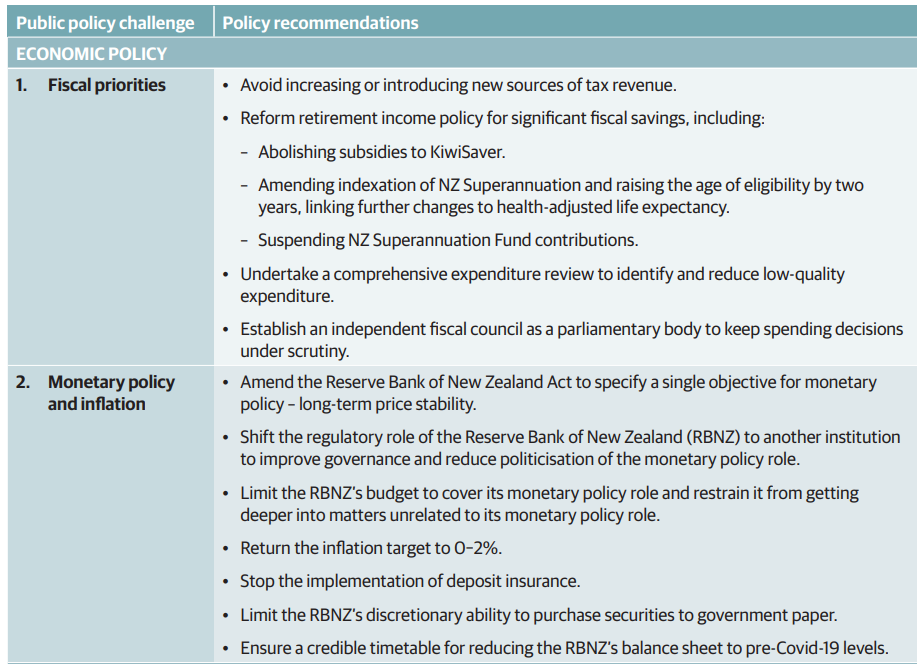
Take fiscal first.
While I generally agree with the first recommendation (no new or higher taxes) – since there is plenty of room to close the (large) deficit by cutting out low-value spending over several years – some of the arguments adduced in support don’t stand much scrutiny. Take, for example, this paragraph

It is certainly true that Singapore and Taiwan have markedly lower rates of tax to GDP than New Zealand (or other advanced countries). On the other hand, OECD data for taxes and social security contributions as a share of GDP show that these days both Japan and Korea have about the same or higher tax shares than New Zealand does. Switzerland, Australia and the US are certainly lower than New Zealand, but then Canada is higher. And “Europe aside” does tend to rather overlook the fact that most of the world’s advanced economies are in Europe. (The Ireland line was fairly disreputable, it being well-understood that Ireland’s GDP numbers are seriously distorted by international tax factors. Using as a denominator the one the Irish authorities recommend (modified GNI), Ireland’s tax share is much the same as New Zealand’s).
I largely agree with their proposals around retirement income, and was surprised to realise that Kiwisaver subsidies now cost about $1 billion per annum. The text suggests that they envisage a pretty slow increase in the age of NZS eligibility, which does fit with what National is promising but should not be necessary in a first-best set of recommendations. Lift the age of eligibility by one quarter a year and it would be at 67 in eight years’ time.
There is quite a difference between suspending contributions to the New Zealand Superannuation Fund (the headline recommendation) and the alternative they moot in the fuller text of simply winding up the Fund. Do the former and Labour is likely to simply resume contributions again. There is no natural place for the government taking your money and mine (or, worse, borrowing it) to punt in international markets at our risk. The NZSF was initially designed for two things: to keep Michael Cullen’s colleagues’ spending sticky fingers off his early large surpluses, and to help buttress an NZS age of 65. We’ve not now had regular surpluses for a long time, and there is no good reason – with improvements in life expectancy – why the eligibility age for the universal state pension should be the same now as it was set at, for the then means-tested age pension, in 1898. NZSF should be wound up and the government’s gross debt substantially reduced.
The third bullet – comprehensive expenditure review – is fine, even admirable. But specifics, and willingness to actually cut, will matter. I like the idea of getting rid of interest-free student loans (my kids look at me reproachfully) but…..what hope?
I have long favoured a (small) Fiscal Council, or perhaps a slightly wider Macroeconomic Policy Council. This is a quite different thing than the policy costings office National, Labour and the Greens are all keen on (as a public subsidy to political parties). That said, if one were serious about austerity in the next term of government – and for my money the NZI doesn’t give sufficient weight to the scale of the fiscal challenge – I’m not sure I’d be treating new nice-to-have agencies (even very small ones) as any sort of priority. I’d rather focus on replacing the Secretary to the Treasury (whose term is up next year) and revitalising the analytical and advisory capabilities of The Treasury.
What of the monetary policy and Reserve Bank proposals. In several places, they overlap with ideas I’ve pushed here over the years.
I was in favour of something like the change to the statutory monetary policy mandate to the Reserve Bank, and am actually on record (in my submission to FEC in 2018) as having favoured going further. The change to the way the mandate was expressed was never envisaged as materially altering how monetary policy was run (from Robertson’s perspective it mostly seemed to be political product differentiation), and I don’t think there is any evidence it has actually done so. The Reserve Bank has made big mistakes in recent years but they have been analytical and forecasting mistakes, not things that can be sheeted home to the change in the way the mandate was expressed (here I imagine the Governor and I would be at one, although of course he’d be reluctant to get anywhere near the world “mistake”). All that said, since making the change made no substantive difference and was mostly about product differentiation, so would undoing it. We need real change at the Bank (and in how it is held to account) so I won’t argue strongly about symbolic change, a least if it markets/headlines real underlying change.
On the other hand, I have long favoured splitting up the Bank, and leaving a monetary policy and broader macro stability focused central bank, and then a New Zealand Prudential Regulatory Agency (probably comprising the regulatory functions of the Bank and much of the FMA’s responsibilities). That such a model would parallel the Australian system is not a conclusive argument on its own, but it is a real benefit when the biggest banking and insurance players in New Zealand are Australian-based. The Initiative argues that
Separating the functions into two organisations would improve governance and reduce the risk of political interference in the RBNZ’s core mission of price stability.
I agree (strongly) with the former. The current (reformed) Reserve Bank has a dogs’-breakfast of a governance model. I’m (much) less persuaded by the latter argument. I have seen no sign – in my time at the Bank or in recent years – of political interference in the operation of monetary policy. The mistakes have been Orr’s, and if there are valid criticisms of Robertson they are that he has showed little interest in doing anything about holding the Bank (and its key personnel) to account. Monetary policy and financial institution regulation are just two quite different functions, and need different skill-sets in CEOs. It isn’t impossible to make the current combined model work – though it would need big changes, including some legislative overhaul – but it simply isn’t the best model for New Zealand. (Such a reform would, done the right way, also render the Governor’s position redundant, with two new chief executive positions to fill.)
Should the Bank’s budget be cut? Yes, of course (and that comprehensive spending review shouldn’t overlook opportunities there), and since the NZI document was finalised we’ve seen an egregious increase in approved Bank spending without even the courtesy (or statutory obligation) to provide any documentation in support. But the budget is only one lever. As important will be finding expert people to lead the institution and monetary policy function who are really only interested, in their day job, in thinking about macroeconomics and doing and communicating monetary policy excellently, without fear, favour, or suspicion of either partisan allegiance or using a public role for private ideological purposes.
I have written here previously that I favour returning the inflation target to 0 to 2 per cent. That said, I don’t find the Initiative’s reasoning very persuasive
A lower target range would encourage the RBNZ to pursue more prudent monetary policies,
minimising the risk of excessive inflation and promoting sustainable economic growth.
But there is no evidence for these claims. Adrian Orr and his minions would have made more or less exactly the same forecasting mistakes in recent years with a target centred on 1 per cent as with the actual target centred on 2 per cent.
Perhaps more importantly, I don’t think the New Zealand Initiative team has ever taken sufficiently seriously the current (regulatorily-induced) effective lower bound on nominal interest rates. That constraint can and should be fixed but unless it is fixed it would be irresponsible to recommend lowering the inflation target.
On deposit insurance, I have long favoured deposit insurance, as a second-best way of reducing the scale and risk of government bailouts of banks (if no one is protected a failing big bank will almost certainly be bailed out, whereas with (retail) deposit insurance it is more credible to think that wholesale funders might be allowed to lose their money in a failure. That said, my argument was primarily about the big banks, and the deposit insurance regime will not cover only them. I do worry about heightened moral hazard risks around the small institutions. One could, I suppose, argue that capital ratios are now high enough there is very little risk of a large bank failing, to a point where it is credible that depositors could face material losses, but that argument cuts both ways in that with high capital ratios moral hazard risks are much smaller even in the present of deposit insurance.
The second to last item on the monetary policy list is a curious one. The Reserve Bank has run up losses of about $11 billion dollars through an LSAP conducted almost entirely in government bonds. So while I agree with limiting what NZ assets the Bank can buy, I don’t think it gets near the heart of the issue. New Zealand legislation is generally for too lax in allowing huge risks to be assumed with no parliamentary approval (whether the Minister of Finance issuing guarantees, for which there is no limit, or the Reserve Bank – which cannot default on its debts – buying risky assets. While there is a need for some crisis flexibility, the scale of the intervention undertaken (over more than a year) should not again be possible without parliamentary approval. That, incidentally, does not impair monetary policy operational autonomy both because the LSAP is a very weak (just risky) instrument and because (see above) the effective lower bound on the nominal OCR itself can and should be fixed.
I have no particular problem with something like the final item on the list, but as regards the LSAP expansion it would seem to be already there. The Bank’s holdings of government bonds are being slowly but steadily sold back to The Treasury (and others are maturing in RB hands). One can argue that the mix of sales might have been different or that the pace should have been (much) faster, but the domestic monetary policy bit of the balance sheet will shrink a lot. There are debates to be had about how much of an “abundant reserves” approach is taken in future – I’d probably favour not – and there are issues that should have had more scrutiny around increases in foreign reserves that the Minister has approved this year, but they are probably second order in nature.
With only 86 pages and lots of policy areas to get through, the NZI document was never going to cover all the significant issues in any subject area. I have quite a list of others, both as regards fiscal policy and around monetary and financial regulatory policy, but this post was about engaging the debate on the ideas NZI has proposed, not tackling all the ones they didn’t or didn’t have space for. Overall, I’m mostly sympathetic to the direction they suggest, but any incoming government actually interested in change should subject the specifics to some serious critical scrutiny.
 croaking cassandra
Thanks Michael for another good post. I wonder if you saw Rebecca Stevenson’s article on National’s Andrew Bayly and his views on the general nature of financial regulation in NZ? (Interest.co.nz)
He reportedly says.. “the regulatory architecture is muddled & confusing with overlapping responsibilities falling to different regulators.”
He says ” National will ditch the Conduct of Financial Institutions Act (effective 2025) requiring banks and insurers to be licensed by the FMA.” He observed that no one has stood back & looked at how complex & prescriptive various regulations and codes are.
My first inclination is to welcome National’s intent but I suppose the devil will always be in the detail. I think he is certainly correct about the complexity. Our typical NZ response to wrongdoing is to say……”there should be a law against that.” And our socialist governments over the years (& I include National to some degree) are always ready to bang another statute through Parliament, often setting up another bureaucracy. In my humble opinion the FMA is just another one in a line of ineffective and very expensive state empires.
I would very much like to learn your thoughts on the matter.
LikeLike
I’m not close to the FMA issues but from what I have seen and heard would have quite a bit of sympathy with your take. It is another mushrooming bureaucratic empire (and why wouldn’t it be under this govt?). I saw some comments yesterday from an Auckland university economist who is on the Board that only reinforced my doubts,with lots of talk about guiding conduct etc but no clear basis for accountability directly.
My own encounters with the FMA are thru two super schemes I’m a trustee of. In one case there have been serious issues and yet it has proved impossible to get the FMA to take any interest whatever.
LikeLike
I am interested in your views on what to do with Super. I favour the slow ramp up in eligibility age, but what are we going to do to ensure individuals have a retirement income? As I have aged, my views on compulsion have also changed.
I actually favour compulsory contributions now, including ramping them up to say 10% over 10 years. At the same time I would have age eligibility for state super increasing.
I would also stop NZSF contributions and rather than return the funds I would use it to satisfy a minimum contribution amount to Kiwisaver so that the need for government super would ultimately diminish as all would have either privately funded or state funded individual retirement accounts i.e. there would be a State safety net but via contributions to individual accounts.
LikeLike
I guess the way I look at the “slow ramp up” argument is as a 61 year old. We’ve had the debate for years and years about raising the age further (Labour campaigned on doing so in 2014, Nat in 2017 and 2020) so no one my age could really claim to be too surprised if they had to wait until 66 rather than 65 to get NZS, esp as most 65 year olds are still working anyway (higher percentage than any OECD country).
I have come and gone on compulsion over the years, but now come down against. I reckon NZS is a pretty good second-best system, ensuring no one starves in old age while leaving the onus on middle class and higher income people to save themselves if they want more in old age (or to work longer). I’d focus energies more on, say, fixing the housing market and getting house prices and rents a long way down (given that housing costs are now one of the problems poorer people face in old age, totally unnecessarily if land use policy had not been so badly messed up).
LikeLike
[…] Source link […]
LikeLike
Thank you Mr Reddell for a prodigious week of quality comment.Prescriptions is apt.
A further thought is that it is not just the Reserve Bank regulation affecting the NZ economy.
It is regulation itselfs growth .
Over regulation in NZ has choked entrepreneurial activity and productivity.It is not only central Government , local Government has utilised legislation like the RMA to create a myriad of regulation of their own.Not only is this costly it restricts growth and resultant economic activity.
In passing it is noted that Councils are one of the major drivers of inflation in this country.Almost all have rates and charges accounts in excess of inflation rates, plus developing new charges for whatever is their favourite project!
It is hard to be productive in NZ!
LikeLike
Well. The number one change I would support to improve the long-term prosperity of New Zealand would be to completely reform the education sector. Currently, at both the school and university level, the system is controlled by a cabal of neo-Marxists. We should blow this system up, and replace it with a student voucher system. Alas, National have shown the past 70 or so years that they will reform precisely nothing, so there is no chance of this actually happening…
We need to be humbler in our hopes. The most we can expect is that that National tinker around the edges, and slow our economic decline. This shouldn’t be hard. I’m particularly concerned about our stock of private debt. A current account deficit of 8.5% per annum is unsustainable. Too big to fail can mean that some of these debts eventually need to be nationalized. The government should cut spending to run a budget surplus in their books immediately, and stay there. This would reduce the excess demand in the economy, and relieve the current account deficit somewhat.
LikeLike
Dear MR
I catch up with your blog every few weeks or so, reminded sometimes from another blog sidebar.
It’s way over my head in economic details, but I appreciate the intellect and writing, comments.
I think reading it furthers my education. It’s good to read dense prose, and attempt to understand.
Thanks. As a nearly 71 yr old, I’m grateful for Super, especially as injured and on a benefit before.
Indeed, I’m in my first ever HNZ/KO tenancy now, and still Super is almost my only income.
I’d like to be able to earn more. A small bequest has me out of overdraft, a few $ pw interest extra.
I keep hobbies alive, from audio electronics hifi to recently restoring a Tanner table saw, old as me.
But I also habitually proofread, so forgive me please for pointing to this maybe speed typing typo ~
_
“The second to last item on the monetary policy list is a curious one. The Reserve Bank has run up losses of about $11 billion dollars through an LSAP conducted almost entirely in government bonds. So while I agree with limiting what NZ assets the Bank can buy, it don’t think it gets near the heart of the issue.”
_
I don’t think, obviously.
A tiny typo. “Praising with faint damns” ;=}))
Cheers, kind regards, and best wishes!
RdM
LikeLike
Thanks very much for pointing that one out (now corrected). And thanks for reading from time to time.
LikeLike
Given deposit compensation schemes and the increased level of bank capital it’s unlikely we’ll see the desire to use QE as a Unconventional Monetary Policy tool by any Central Bank in the future given the recently incurred losses. As for QE being a tool for dealing with market dysfunction two things: (1) Understanding – As the UK LDI episode highlighted, if the user eligibility on the Bank of England’s existing standby facilities had been broader then there might not have been the need to use LSAPs, and (2) Timing – by the time the ‘intervention’ glass is broken invariably the moment of ‘crisis’ has passed.
On the size of the balance sheet ( putting aside the capital/ increase in foreign reserves – although given the former, the indemnity given to the unhedged foreign reserves is probably a mistake) that will grow along the lines of the nominal growth of the economy.
LikeLike
What do you see as the connection between deposit insurance and bank capital on the one hand and the chances of QE being used again on the other?
LikeLike
If QE works, then it is in an environment where there is systemic credit risk in the financial system ( GFC/Eurozone/ Japan early 90s) and the Central Bank acts as the buyer of the last resort -Bank Capital & Deposit Insurance ( Bank-Runs) ameliorates that risk.
LikeLike
hard to be confident people like Orr and the MPC will see it that way (NZ system was robust in 2019/20). will just have to hope that – despite the bluster – they are just scarred by the memory of staggering losses they’ve caused
LikeLike