Pandemic income insurance

Way back on 16 March, the day before the government brought down the first of its pandemic economic response packages, I ran a post here in which – among other strands of an approach to the rapidly worsening economic situation – I suggested that the government should legislate quickly to provide, for the coming year, a guarantee that no one’s income would fall below 80 per cent of what it had been in the previous year. The proposed approach was to treat individuals and companies in much the same way. The underlying idea was to provide some certainty – to individuals, firms and lenders – without offsetting all losses (society was going to be poorer) and without locking people in to employment or business relationships that may have been sensible/profitable previously, but which wouldn’t necessarily be in future. And to recognise that individual firms and people are better placed to reach those judgements – about what makes sense for the future, what makes sense (say) to borrow to support – that government ministers or officials.

I knew that any such scheme might be very expensive, and rereading the post I see that I proposed it even though I was talking about economic scenarios for potential GDP losses that were materially worse than most think we will now actually face. But part of the mindset was the parallel with ACC – our no-fault accident compensation system. Being able to treat people in a fairly generous way when a serious pandemic – that was no one’s fault – hit could be conceptualised as one of the bases for the low-debt approach successive governments had taken to fiscal policy over recent decades. And it did not require governments to pick winners – firms they thought might/should flourish – or pick favourites.

Since it was sketch outline of a scheme, dreamed up over the previous few days, I was always conscious that there were lots of operational details that would have to be worked through before an idea of this sort could be implemented, and any scheme would need to be carefully evaluated for the risks that might lie hidden just beneath the surface. But evaluated not relative to standards of perfection, but relative to realistic alternatives approaches in a rapidly unfolding crisis.

I wrote a couple of other posts (here and here) touching on aspects of the pandemic insurance idea, and as I reflected a bit further and discussed/debated the idea with a few people, I suggested some potential refinements, including greater differentiation between companies and individuals. Other people, here and abroad, also suggested ideas that had some similarities in spirit to what I was looking to achieve.

Of course, nothing like the pandemic insurance scheme was adopted. Instead, we had a flurry of schemes and of individual bailouts, the main attraction of which seemed to be a steady stream of announceables for Cabinet ministers in election year (generally a negative in terms of the public interest, in which similar cases should be treated similarly), all while offering little or no certainty to individuals, firms, or their lenders.

I’ve continued to regard something like the pandemic insurance scheme as a superior option that should have been taken, but mostly I moved onto writing about other things. But the return of community-Covid, more or less severe government restrictions on economic (and other) activity, and arguments about whether and for how long the wage subsidy should be renewed only reinforced that sense that there would have been a better way. But a few tweets aside, I hadn’t given the issue much thought for a while until a few weeks ago a TVNZ producer got in touch to say that they had found reference to the pandemic insurance idea in an OIA response they had had from The Treasury, and asking if I’d talk to them about it.

It was only late last week that I got to see the response Treasury had provided (Treasury having fallen well below their usual past standards has still not put the response – dated 12 August – on their website (or even acknowledged my request for a copy of the same material). A little of the subsequent interview with TVNZ was aired as part of their story on Saturday night, itself built around the notion that the government had rejected this (appealing sounding) idea.

OIA Response Pandemic Insurance etc

The TVNZ OIA request had actually been for material on “helicopter payments”, which was refined to mean

“one-off payments made by the Government to citizens with the purpose of stimulating the economy,

(which in some respects does not describe the pandemic insurance idea well at all).

And yet most of the material in the quite lengthy OIA response (77 pages) turned out to be about the work The Treasury had undertaken on the pandemic insurance idea over the couple of weeks from 7 April, including some advice to the Minister of Finance.

There seems to have been quite serious interest in the option, and there is paper to the Minister of Finance providing a fair and balanced outline of the scheme – merits and risks – dated 9 April

tsy pandemic

and suggesting that if the Minister was seriously interested Treasury would do more work and report later in the month. Although there is no more record of the Minister’s view, he must have been sufficiently open for more work to have been done, including drawing in perspectives from operational agencies (including IRD and MSD) on feasibility and operational issues.

My impression is that Treasury did a pretty good job in looking at the option.

tsy pandemic 2

That final paragraph was always one of the key attractions to me.

As I went through the papers, I didn’t find too many surprises. The issues and risks official raised were largely the ones I’d expected – including, for example, the risk that some people might just opt out of the labour market this year and take the 80 per cent guarantee, and issues around effective marginal tax rates for those facing market incomes less than 80 per cent. Perhaps the one issue I hadn’t given much thought to was a comment from IRD about the risk of firms being able to shift revenue and/or expenses between tax years, with the observation that existing rules were not really designed to control that to any great extent. But, and operating in a second-best world, the officials involved generally seem to have regarded few of these obstacles as insuperable, bearing in mind the pitfalls of (for example) the plethora of alternative schemes.

The work seems to have come to an end on or about 23 April with Treasury finally deciding not to recommend the pandemic insurance approach. This email is from a Principal Advisor heavily involved in the evaluation to the Secretary and key (on the Covid issues) Deputy Secretary.
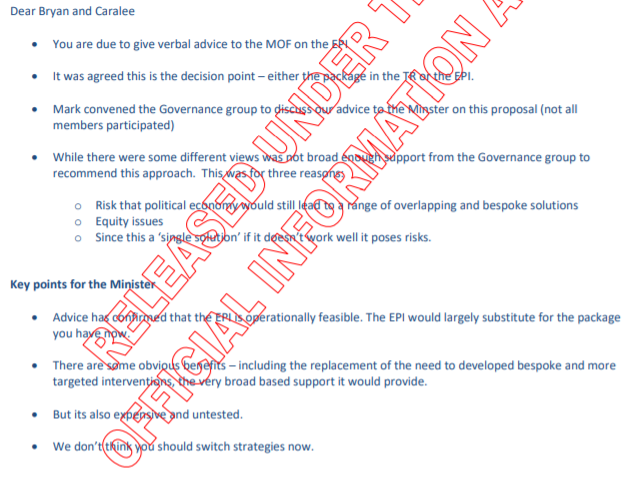
tsy pandemic 3

It probably shouldn’t surprise readers that I think the wrong call was made in the end, but equally it is probably not that surprising that the decision went the way it did. One reason – not, of course, acknowledged in the Treasury papers – is how slow officials were (across government) in appreciating the seriousness of what was already clearly unfolding globally – and as a major risk to New Zealand – by the end of January. As I’ve noted before there is no indication in any of the papers that have been released, or public comments at the time, that (for example) Ministers or the heads of the key government departments had begun serious contingency planning – devoting significant resource to it – any time before mid-March. This particular work didn’t get underway until well into April, by when a great deal had already begun to be set in stone, and when rolling out bite-sized new announcements – robust or not – no doubt seemed, and was, easier than a new comprehensive approach.

As it happens, even though there was a great deal of concern back in April about the affordability of the pandemic insurance scheme, with the benefit of hindsight there is a reasonable argument that it could even have been cheaper than the approaches actually adopted (GDP losses having been less severe, on a sustained basis, than feared in April), which in turn might have left more resources for the stimulus and recovery phase (pandemic insurance – like wage subsidies – was always more about income support and managing uncertainty in the heat of the crisis than about post-crisis recovery stimulus).

From my perspective, the post was mostly about recording my pleasant surprise at how seriously the pandemic insurance idea (mine, and some other variants) was taken by officials, and by what appears to have a pretty good job in evaluating it as an option, in what will have been very trying and pressured times.

From this vantage point – with the advantage of knowing how the first six months of the virus went, and with a sense of the economic ramifications – I still reckon it would have been a better approach. And yet – and I don’t recall seeing this in Treasury’s advice (perhaps it isn’t the thing for officials to write down) I can also see political pitfalls – around very large payouts to some companies, even if they weren’t gaming the system – that might have made it impossible, and unsustainable if tried, without (at least) a very strong degree of political leadership and marketing that such a no-fault no-favour approach was a better way to have gone. As I noted in an earlier post, I’d have hated having the Crown pay out to casino companies, but I would have endured for the sake of a fair across the board scheme. But every single person, every single lobby group, would have found some potential recipient to excoriate.

The TVNZ interviewer asked me about the pandemic insurance idea still had relevance for the future. My initial response to him was that yes it did, and that we might be much better off to have the infrastructure required to make it work in place and on the shelf ready to go for when future pandemics happen. Taxes will, after all, be a bit higher than otherwise as we gradually lower debt ratios, amid repeated talk of being ready for the next major adverse event, whether earthquake, volcano or pandemic.

And yet reflecting on it again over the weekend, I’m no longer quite so confident of that answer. More detailed work, and more thought, is probably required once this pandemic is behind us to strike the right balance – individuals vs firms, generosity in a no-fault shock vs moral hazard as just some of the examples of issues to be thought through, and planned for, ideally in a way that would survive contact with a new real severe adverse shock.
Macro policy pitfalls and options

The sad sight of someone who has seemed to be a normally honourable man –  Greens co-leader James Shaw – heading off down the path of Shane Jones-ism, is perhaps a general reminder of the temptations of politics and power, but also of much that is wrong about how the government is tackling the severe economic downturn we are now in.   Fiscal discipline around scarce real resources, always pretty weak at the best of times. is flung out the window and there is a mad scamper for ministerial announceables, and thus rewards to those who successfully bend the ear of ministers in a hurry.  Connections, lobbying, and the ability to spin a good yarn seem to become foremost, with a good dose of partisanship thrown in too.   The extraordinary large grant to a private business  planning to operate a school is just the example that happens to have grabbed the headlines, but there will be more no doubt through the list (apparently not all yet announced) of “shovel-ready projects”, and we’ve seen many through the Provincial Growth Fund almost from day one of its existence.

Don’t get me wrong.  I’m not opposed to the government running deficits –  even really rather large deficits – for a year or two.   Some mix of external events and government actions have tipped the economy into a severe recession and –  against a dismal global backdrop – the outlook is not at all promising.  Tax revenue would be down anyway, and that automatic stabiliser is a desirable feature of the fiscal system.   And one can make –  I have made –  a case for a pretty generous approach across the board to those, through no direct fault of their own, are caught in the backwash of the pandemic.  I’ve argued for thinking of such assistance as if we some ACC-like pandemic insurance, for which we paid the premiums in decades past through higher tax rates/lower government spending rates –  and thus lower debt – than would otherwise have been likely.

And some aspects of the government’s economic policy response have –  whatever their other faults –  had elements of that broadbased no-fault/no-favours approach.   I guess ministers couldn’t put a press statement for each individual who benefited from the wage subsidy, or the weird business tax clawback scheme.  But beyond that, and increasingly, what is supposed to be countercyclical stabilisation policy has become a stage for ministers to choose favourites, to support one and not another, to announce particular bailouts as acts of political favour.  It is a dreadful way to run things, rewarding not just ministerial favourites but the chancers and opportunists who are particularly aggressive in pursuing handouts.  So some tourist operators get handouts and other don’t.  Some sports got handouts and others don’t.     Favoured festivals –  I see the nearby festival on the list this morning –  get handouts.  And, in general, unless you are among the favoured, businesses (the myriad of small and low profile ones) get little or nothing at all.  James Shaw’s green school gets a huge capital grant and while no one –  of any ideological stripe –  should be getting such handouts, we can be quite sure no-one of a different ideological stripe than those associated with the governing parties would be getting one.    Perhaps many people involved really have the best of intentions, but frankly it is corrupt, and predictably so.

I was reading last night an open letter on economic policy that Keynes had addressed to Franklin Roosevelt in late 1933.  It was a bit of mixed bag as a letter, and had really a rather condescending tone, but the couple of sentences that caught my eye were these

“our own experience has shown how difficult it is to improvise useful Loan-expenditures at short notice. There are many obstacles to be patiently overcome, if waste, inefficiency and corruption are to be avoided”

Quite.

Now, of course, elections have consequences, and one would expect a government of the left to be deploying public resources in directions consistent with (a) manifesto commitments, and (b) their own general sympathies.    But in this case (a) the government was elected on a promise (wise or not) of considerable fiscal restraint, and (b) whatever the broad tenor of their policy approach, we should not expect public resources to be handed to individuals or favoured groups and companies, solely on the basis of the ability of those entities to get access to, and bend the ear of, ministers.  And it is not necessary to do so to deploy very substantial fiscal resources –  whether with a focus on consumption, investment, or business etc support more generally.  Broadbased tools, that do not rely on rewarding favourites, aren’t hard to devise or deploy.

More generally, of course, monetary policy is an option that has barely been used at all.   We have a severe recession, with little or no relief in sight (including globally) and yet whereas, faced with a serious downturn, we usually see perhaps a 500 basis point fall in interest rates and a sharp fall in the exchange rate, we’ve had no more than a 100 basis point fall in interest rates and no fall at all in the exchange rate.  And not because of some alarming inflationary threat that means further monetary support can’t prudently be risked…..but because the appointed Monetary Policy Committee, faced with very weak inflation forecasts and lingering higher unemployment, choose to do nothing.  And those with responsibility for the Bank –  the Minister of Finance, and the PM and Cabinet –  seem to be quite content with this abdication.

The beauty of monetary policy, and one of the reasons it has been a preferred stabilisation tool for most of the time since countercyclical macro policy became a thing, is that even if ministers are the ones making the day to day decisions –  and they usually aren’t because we mostly have central banks with day-to-day operational autonomy –  they don’t get to pick which firm, which party favourite, gets the benefit of lower borrowing costs, who suffers from reduced interest income, or what is affected by the lower exchange rate.    It is broad-based instrument, operating without fear or favour, and doing so pervasively –  it takes one decision by the relevant decisionmaking body and relative prices across the whole economy are altered virtually immediately, not some crude process of ministers and officials poring over thousands of applications for grants and loans and deciding –  on who knows what criteria –  whether or not to grant them.  And it has the subsidiary merit, when used wisely, of working with market forces –  in times like these investment demand is weak and precautionary savings demand is high, so one would normally expect –  if no government agency were in the way – the market-clearing interest rate would fall a long way.

On the left there still seems to be a view that monetary has done a great deal, and perhaps all it could.  I saw the other day a commentary from retired academic Keith Rankin on fiscal and monetary policy.  He claims not to be a “left-wing economist” –  although I suspect most would see him as generally being on the left –  but has no hesitation in pegging me as “right-wing economist”.  Apparently “right-wing economists tend to have a philosophical preference for monetary policy over fiscal policy”.   Anyway….he was picking up on some comments I made in a recent interview on Radio New Zealand.

To a non-right-wing economist, Reddell’s position in the interview seems strange; Reddell argues that New Zealand has – so far during the Covid19 pandemic – experienced a large fiscal stimulus and an inadequate monetary stimulus. In fact, while the fiscal outlay is large compared to any previous fiscal stimulus, much of the money available may remain unspent, and the government is showing reluctance to augment that outlay despite this month’s Covid19 outbreak. And, as a particular example, the government keeps pouring salt into the running sore that is the Canterbury District Health Board’s historic deficit (see here and here and here and here); the Minister of Health showed little sign of compassion towards the people of Canterbury when questioned about this on yesterday’s Covid19 press conference.

Further, monetary policy has been very expansionary. In its recent Monetary Policy Statement (and see here), the Reserve bank has committed to ongoing expansions of the money supply through quantitative easing. Because the Reserve Bank must act as a silo, however, it has to participate in the casino (the secondary bond market) to do this; perhaps a less than ideal way to run monetary policy. Reddell has too much faith in the ability of the Reserve Bank to expand business investment spending.

Reddell is a committed supporter of negative interest rates – indeed he cites the same American economist, Kenneth Rogoff, who I cited in Keith Rankin on Deeply Negative Interest Rates (28 May 2020). This call for deeply negative rates is tantamount to a call for negative interest on bank term deposits and savings accounts; that is, negative ‘retail interest rates’. While Reddell does not address the issue in the short interview cited, Rogoff notes that an interest rate setting this low would require something close to a fully electronic monetary system to prevent people withdrawing wads of cash to stuff under the bed or bury under the house.

I struggle to see how anyone can doubt that we have had a very large fiscal stimulus this year to date.  One can debate the merits of extending (or not) the wage subsidy –  personally (despite being a “right-wing economist”) I’d have favoured the certainty my pandemic insurance scheme would have provided –  but it doesn’t change the fact a great deal has been spent.  Similarly, one can have important debates about the base level of health funding –  and I’ve run several posts here in recent years expressing surprise at how low health spending as a share of GDP has been under this government, given their expressed priorities and views –  but it isn’t really relevant to the question of the make-up of the countercyclical policies deployed this year.  With big government or small government in normal times, cyclical challenges (including serious ones like this year’s) will still arise.

And so the important difference seems to turn on how we see the contribution of monetary policy.  Here Rankin seems to run the Reserve Bank line –  perhaps even more strongly than they would –  about policy being “highly expansionary”, without pointing to any evidence, arguments, or market prices to support that.  It is as if an announced intent to swap one lot of general government low-interest liabilities (bonds) for another lot (settlement cash deposits at the Reserve Bank) was hugely macroeconomically significant.  Perhaps it is, but the evidence is lacking…whether from the Reserve Bank or from those on the left (Rankin and others, see below) or those on the right (some who fear it is terribly effective and worrying about resurgent inflation.

While on Rankin, I just wanted to make two more brief points:

    • first, Rankin suggests I “have too much faith in the ability  of the Reserve Bank to expand  business investment spending”.  That took me by surprise, as I have no confidence in the Bank’s ability to expand investment spending directly at all, and nor is it a key channel by which I would be expecting monetary policy to work in the near-term.  It really is a straw man, whether recognised as such, often cited by those opposed to more use of monetary policy.  Early in a recession –  any recession –  interest rates are never what is holding back investment spending –  that would be things like a surprise drop in demand, heightened uncertainty, and perhaps some unease among providers of either debt or equity finance.  Only rarely do people invest into downturns,  When they can, they will postpone planned investment, and wait to see what happens.  There is a whole variety of channels by which monetary policy works –  and I expect I’m largely at one with the Reserve Bank on this –  including confidence effects, wealth effects, expectations effects and (importantly in New Zealand) exchange rate effects.  Be the first country to take its policy rate deeply negative and one would expect a significant new support for our tradables sector through a much lower exchange rate.  In turn, over time, as domestic and external demand improved investment could be expected to rise, in turn supported by temporarily lower interest rates, but that is some way down the track.
    • second, as Rankin notes I have continued to champion the use of deeply negative OCR (and right now any negative OCR at all, rather than the current RB passivity).  As he notes, in the interview he cites I did not mention the need to deal with the ability to convert deposits into physical cash at par, but that has been a longstanding theme of mine.  I don’t favour abolishing physical currency, but I do favour a potentially-variable premium price on large-scale conversions to cash (as do other advocates of deeply negative policy rates).  Those mechanisms would be quite easy to put in place, if there was the will to use monetary policy.

From people on the left-  at least in the New Zealand media –  there also seems to be some angst that (a) monetary policy has done a great deal, and that (b) in doing so it has exacerbated “inequality” in a way that we should, apparently, regret.   I’ve seen this line in particular from interest.co.nz’s Jenee Tibshraeny and (including again this morning) from Stuff’s Thomas Coughlan.  On occasion, Adrian Orr seems to give some encouragement to this line of thinking, but I think he is mostly wrong to do so

Perhaps the most important point here is the otherwise obvious one.  The worst sort of economic outcome, including from an inequality perspective (short or long term) is likely to be one in which unemployment goes up a long way and stays high, and where labour market participation rates fall away.  Sustained time out of employment, involuntarily, is one of the worst things for anyone’s lifetime economic prospects, and if some of the people who end up unemployed have plenty of resources to fall back on, the burden of unemployment tends to fall hardest on the people at the bottom, people are just starting out, and in many cases people from ethnic minorities (these are often overlapping groups).  From a macroeconomic policy perspective, the overriding priority should be getting people who want to work back into work just as quickly as possible.   That doesn’t mean we do just anything –  grants to favoured private companies to build new buildings are still a bad idea  – but it should mean we don’t hold back on tools with a long track record of contributing effectively to macroeconomic stabilisation because of ill-defined concerns about other aspects of “inequality”.

Asset prices appear to worry people in this context.    I’m probably as puzzled as the next person about the strength of global equity prices –  and I don’t think low interest rates (low for a reason) are a compelling story –  but it is unlikely that anything our Reserve Bank is doing is a big contributor to the current level of the NZX indices.  Even if it were, that would not necessarily be a bad thing, since one way to encourage new real investment is as the price of existing investment assets rises relative to the cost of building new.

And if house prices have risen a little (a) it is small compared to the 25 year rise governments have imposed on us, and (b) not that surprising once the Reserve Bank eased the LVR restrictions for which there was never a compelling financial stability rationale in the first place.

More generally, I think this commentators are still overestimating (quite dramatically) what monetary policy has done.   I read commentaries talking about “money flowing into the hands of asset holders” (Coughlan today) from the LSAP programme, but that really isn’t the story at all.  Across this year to date there has been little change in private sector holdings of government bonds, and certainly no large scale liquidation by existing holders (of the sort that sometimes happened in QE-type programmes in other countries).  Most investors are holding just as many New Zealand government bonds as they were.  All that has really happened is that (a) the government has spent a great deal more money than it has received in taxes, (b) that has been initially to them by the Reserve Bank, and (c) that net fiscal spending is mirrored in a rise in banks’ settlement account deposit balances at the Reserve Bank.  It would not have made any difference to anything that matters much if the Reserve Bank had just given the government a huge overdraft facility at, say, 25 basis points interest, rather than going through the bond issuance/LSAP rigmarole.  The public sector could have sold more bonds into the market instead, in which case the private sector would be holding more bonds and less settlement cash.  But the transactions that put more money in people’s pockets –  people with mortgages, people with businesses –  are the fiscal policy programmes.   Without them we might, reasonably, have anticipated a considerably weaker housing market.  Since few on the left would have favoured less fiscal outlays this year –  and neither would I for that matter –  they can’t easily have it both ways (Well, of course, they could, but the current government of the left has been almost as bad as previous governments of the left and right in dealing with the land use restrictions that create the housing-related dimensions of inequality.

Coughlan also seems to still belief that what happens to the debt the government owes the (government-owned and controlled) Reserve Bank matters macroeconomically.  See, on this, his column in last weekend’s Sunday Star-Times.   As I outlined last week, this is simply wrong: what matter isn’t the transactions between the government and the RB, but those between the whole-of-government and the private sector.  Those arise mostly from the fiscal policy choices.  The whole-of-government now owes the non-government a great deal more than it did in February –  reflecting the fiscal deficit.  That happens to take the form primarily of much higher settlement cash balances, but it could have been much higher private bond holdings.   Either way, the asset the Reserve Bank holds is largely irrelevant: the liabilities of the Crown are what matter.  And as the economy re recovers one would expect that the government will have to pay a higher price on those liabilities.   It could avoid doing so –  simply refusing to, engaged in “financial repression” –  but doing so would not avoid the associated real resource pressures. The same real resources can’t be used for two things at once.  Finally on Coughlan’s article, it seems weird to headline a column “It’s not a question of how, but if we’ll pay back the debt” when, on the government’s own numbers and depending on your preferred measure, debt to GDP will peak at around 50 per cent.  Default is usually more of a political choice than an economic one, but I’d be surprised if any stable democracy, issuing its own currency, has ever chosen to default with such a low level of debt –  low relative to other advanced countries, and (for that matter) low relative to our own history.

Monetary policy really should have been –  and should now, belatedly –  used much more aggressively.  It gets in all the cracks, it avoids the temptations of ministerial corruption, it works (even the RB thinks so), and it has the great merit that in committing claims over real resources the people best-placed to make decisions –  individual firms and households, accountable for their choices –  are making them, not politicians on a whim.

For anyone interested, the Reserve Bank Governor Adrian Orr is talking about the Bank’s use of monetary policy this year at Victoria University at 12:30pm today.  The event is now entirely by Zoom, and the organisers invited us to share the link with anyone interested.

Reviewing monetary policy (US) and spin (NZ)

There was an interesting development in US monetary policy last week with the announcement by the Fed that it would in future be thinking of  –  and operating – its inflation targeting regime a bit differently than in the past.  Note that for the last decade or more inflation has typically been below the 2 per cent annual rate (PCE deflator measure) the Fed described itself as targeting.

The Committee judges that inflation at the rate of 2 percent, as measured by the annual change in the price index for personal consumption expenditures, is most consistent over the longer run with the Federal Reserve’s statutory mandate.

Note that the US system itself is very different from our own.   Congress gave the Fed a single goal a long time ago, expressed in a way no one would today,

Section 2A. Monetary policy objectives

The Board of Governors of the Federal Reserve System and the Federal Open Market Committee shall maintain long run growth of the monetary and credit aggregates commensurate with the economy’s long run potential to increase production, so as to promote effectively the goals of maximum employment, stable prices, and moderate long-term interest rates.

And then left everything to the Fed.  The President (or the The Treasury) has no further power over how goals are conceptualised and operationalised, other than through powers of appointment (and potentially dismissal).

And last week, after a review that has gone on for some years, the Fed announced a new articulation of its target (emphasis added)

The Committee reaffirms its judgment that inflation at the rate of 2 percent, as
measured by the annual change in the price index for personal consumption expenditures, is most consistent over the longer run with the Federal Reserve’s statutory mandate. The Committee judges that longer-term inflation expectations that are well anchored at 2 percent foster price stability and moderate long-term interest rates and enhance the Committee’s ability to promote maximum employment in the face of significant economic disturbances. In order to anchor longer-term inflation expectations at this level, the Committee seeks to achieve inflation that averages 2 percent over time, and therefore judges that, following periods when inflation has been running persistently below 2 percent, appropriate monetary policy will likely aim to achieve inflation moderately above 2 percent for some time.

Reasonable people can probably differ on the merits of this change which, at least on paper, represents quite a material shift from the way inflation targets have been articulated pretty much everywhere since the regime was developed in the 1990s.

Previously, bygones were treated as bygones: if inflation was above (below) target for a period of time, the goal was to get it back down (up) to target over some reasonable period, and thus to support the goal –  repeated in that Fed statement –  of keeping longer-term inflation expectations at close to the target level.    Mistakes would happen, shocks would happen, but there was no reason to think they would be consistently on one side of the target rather than the other.

There was always the alternative of price level targeting.  People had discussed the option for years, researchers had analysed it, but no one (no country, no central bank) had ever found it sufficiently attractive to adopt as the basis for running policy.  There are good reasons for that.  Under price-level targeting, bygones are not bygones.  Run a few years with inflation higher (lower) than consistent with the price level target, and the central bank then has to deliberately and consciously set out to offset that deviation with a few years of inflation lower (higher) than the rate consistent with the longer-term price level target.  And since there are very few long-term nominal contracts, it was never really clear what was to be gained by a price level target.  And there were real doubts as to whether such targets would prove to be credible and time-consistent.   Would central banks really drive inflation a long way below target –  with likely unemployment consequences –  just to offset a period of above-target inflation?  At the Reserve Bank we never thought that likely or credible.

But the Fed has decided to give it a try, at least after a fashion.  As expressed, their new self-chosen goal is asymmetric –  there is no reference to how they would treat periods in which inflation had run persistently above 2 per cent  –  and it has the feel of something a bit jerry-built and opportunistic.

Like a number of other central banks, the Fed has undershot its inflation target for some years now. In part, as they themselves identify, that reflected mistakes in assessing how low the unemployment rate could go without resulting in higher trend inflation.   Arguably there is enough uncertainty about that –  and other indicators of excess capacity – that it no longer really made much sense to try to set and adjust the Fed funds rate on the basis of macroeconomic forecasts (a common description of inflation targeting was that it was really “inflation forecast targeting”).    If so, one might have to wait until one actually saw inflation itself moving clearly upwards. to or beyond target, before it would be safe or prudent to tighten monetary policy.  But since monetary policy adjustments only work with a lag –  a standard line is that the full effects take perhaps 18-24 months to be reflected in the inflation rate – if such an approach was taken seriously it would almost guarantee that if inflation had been persistently below target, there would be at least some offsetting errors later.  In a New Zealand context –  on which more later –  I’ve argued that against a backdrop of 10 years of having undershot the target, and inflation expectations quite subdued, if we ended with a few years with inflation a bit above 2 per cent it shouldn’t be viewed as particularly problematic.  As an outcome, it might not be a first-best desired thing, but –  given the uncertainties –  it wasn’t worth paying a significant price (eg in lost employment) to avoid.

But that has a different feel to what the Fed is now articulating.  They are now saying that they expect to consciously and deliberately set out to offset years of undershoots with years of overshoots.  And you can be sure it won’t be a case of careless drafting but of conscious choice.

There is perhaps one good argument for this approach.   Since the Fed refuses to use monetary policy instruments themselves aggressively to counter directly the persistent inflation undershoot, and more latterly the recession –  notably refusing to take their policy rate even modestly negative, let alone the “deeply negative” that people like former IMF chief economist Ken Rogoff have called for – they want to try to hold up inflation expectations by persuading some people that they won’t be aggressive on the other side either –  jumping to tighten monetary policy at the first glimmer of sustained recovery, the first hint of higher inflation.

There are some hints in market prices – breakeven inflation rates, between indexed and conventional government bond yields –  that the announcement generated a small move of this sort. But…..breakeven inflation rates in the US had been rising fairly steadily for the last few months, and even now are only back to where they were at the end of last year.      That isn’t nothing – especially against the economic backdrop – but at the end of last year five and ten year breakevens were not high enough to be consistent with the Fed meeting its own target in future.  And now they certainly aren’t consistent with inflation outcomes being expected to overshoot the 2 per cent inflation target for several years, to consciously offset the past undershoots.

And then there is the problem of time-consistency.  It is one thing to suggest now that you –  or, typically, your successors –  will be quite content to deliberately target inflation persistently above target for several years several years in the future.  It is quite another to actually deliver on that.    Like many other central banks, the Fed has consistently undershot its target for a long time, preferencing one sort of error over another.  Why will people believe things will be different this time?  The Fed isn’t operating monetary policy more aggressively right now.  And if the core inflation rate does look like getting sustainably back to 2 per cent in a few years, won’t there be plenty of people running arguments like “well, that was then, that statement about overshooting served a purpose in the crisis, but this is now, the economy is recovering, and anyway who really wants core inflation above 2 per cent.  Remember, inflation itself is costly.”    And any rational observer will have to recognise that risk.

In the absence of a symmetrical approach to errors, one has to wonder why not just raise the inflation target itself –  something various prominent economists have called for over the years since 2008/09.  But perhaps to have done that would have stretched credulity just too far: it is one thing to set an inflation target at, say, 3 or even 4 per cent, but another to do effective things to actually deliver such an outcome.  The monetary policy the Fed has actually chosen to run –  and they are all choices –  over the last decade hasn’t successfully delivered 2 per cent inflation, let alone anything higher.

Interesting as the US change of stance is, my main focus is still New Zealand, and so I was interested to spot a short article on Bloomberg yesterday. in which the journalist reported on our Reserve Bank’s response to questions about the new Fed monetary policy strategy.    Somewhat surprisingly, Orr’s chief deputy on monetary policy Christian Hawkesby was willing to go on record.

“Our observation is that the U.S. Federal Reserve implementing its approach through ‘flexible average inflation targeting’ has a number of parallels with the Monetary Policy Committee’s stated preference to take a ‘least regrets’ approach to achieving its inflation and employment objectives,” Hawkesby said in response to written questions from Bloomberg News. “That is, if inflation has been below the mid-point of the target range for a time, the Committee’s least regret is to set policy where inflation might spend some time above the mid-point of the target range in the future.”

That final sentence might initially look the same as what the Fed is now saying, but it isn’t really the same thing.   From memory, we have seen lines of this sort once or twice before from individuals at the Reserve Bank,  and they seemed then to be saying something like what I was suggesting earlier: since it is hard to forecast with confidence, it probably doesn’t make much sense to be tightening until you are confident core inflation is actually back to target, and if so the lags mean there has to be some chance there will be a bit of an overshoot.    That is different in character from actually setting out to deliver above-target outcomes.

As it is, the policy documents the Reserve Bank works to still explicitly require them to focus on the target midpoint, and explicitly treat bygones as bygones in most circumstances –  so long as inflation expectations remain in check.

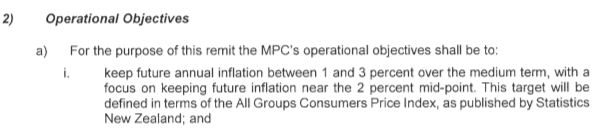
Here is the inflation bit of the Remit –  the document in which, by law, the Minister of Finance sets out the job of the MPC.

remit bit

The operative word there is “future”  – which has been in target documents (previously Policy Targets Agreements) – for many years.  Bygones are supposed to be treated as bygones, with a focus always on inflation in the period ahead.

I checked out the latest Letter of Expectation from the Minister to the Governor, dated early April this year (so well into the current crisis).   These documents have no legal force, but the Minister of Finance is the ultimate authority, including in deciding whether the Governor and MPC members keep their jobs.    There is no mention of the inflation target, and no suggestion that the Minister thinks the MPC should be reinterpreting their legal mandate to target inflation outcomes above the “2 percent midpoint” (only the strange suggestion that the Bank should be “ensuring a Māori world view is incorporated into core functions” –  whatever that might (or might not) mean for monetary policy.

Just in case, I read through the minutes of each of the Monetary Policy Committee meetings this year.  Unsurprisingly there was no hint of any idea of actively targeting inflation above the target midpoint –  despite 10 years of outcomes below target.    Consistent with that, in February the MPC has adopted a very slight tightening bias consistent with forecasts that delivered medium-term inflation outcomes right on 2 per  cent.

But, of course, none of this should be surprising given how little the Reserve Bank has actually done this year.    We can debate what contribution the LSAP programme may or may not have made, but the bottom line –  as even the RB says –  is how much interest rates have fallen,  Term deposits rates have fallen by perhaps 100-120 basis points.  Mortgage interest rates seem to have fallen by similar amounts (and as the Bank acknowledges their business lending rate data are inadequate for purpose).   Inflation expectations have fallen quite a lot –  affirmed again in yesterday’s ANZ survey – which is both a problem directly (people no longer expect 2 per cent to be achieved) and because it diminishes the impact of those (quite limited by historical standards) falls in nominal retail rates.  And, of course, the exchange rate is only slightly lower than it was before the Covid economic slump.

And what of the inflation outlook?  With all the Reserve Bank thinks it has thrown at the situation –  all the beneficial impact it thinks it is getting from the LSAP – even the Bank’s August inflation projections had inflation below the bottom of the target range for two years from now, only getting back to 2 per cent –  on their numbers, on which they have a long-term record of being over-optimistic –  three years from now.   By then it would have been almost 14 years with core inflation continuously less than 2 per cent.

Despite those years of actual undershoots –  the sorts of ones Hawkesby alluded to in his response to Bloomberg –  there is no hint at all in the actual conduct of policy of the Reserve Bank consciously and deliberately acting as if it is willing to see inflation come out a bit above 2 per cent (of course, it could still turn out that way, events can change and all forecasts have considerably margins of uncertainty).

After all, having failed in one of their prime duties –  to ensure banks could easily adjust to the negative interest rates they recognised that the next recession might require – they now suggest that they are bound by a rash pledge they made in March, not to change the OCR at all for a year.  No one except them regards such a pledge –  and certainly not one made when the Bank itself was still underestimating coronavirus –  as binding.  But they choose to do so, choose to run the consequent risks.  Thus, the OCR is still set at 0.25 per cent, only 75 basis points lower than it was at the start of the year.  90 day bank bill rates, as a result, sit at about 30 basis points.  By contrast in Australia –   where the Governor is also pretty hesitant about using monetary policy aggressively – the comparable rates are about 10 basis points.  Even if one accepted as valid the Governor’s claim that banks can’t cope with negative rates –  and I don’t; people adjust quickly when they have to, and those who are best-prepared get a jump on the rest, as it should be –  there is no reason at all not to have the OCR at zero now (and don’t tell me systems can’t cope with zero either, since there are numerous non-interest bearing products).   The MPC chooses not to change, and as a result monetary conditions are tighter than they need to be.   Of course, 25 basis points in isolation isn’t huge –  in typical recession we have 500+ points of easing –  but when so little has been done, when inflation forecasts and expectations are so low, and against the backdrop of a consistent undershoot, it is inexcusable not to use the capacity that unquestionably exists now, not idly talking of possible cuts sometime next year.

The MPC is running risks, but they are the opposite of those the Assistant Governor alluded to.  His attempt to suggest some sort of parallel with the new Fed approach –  which, in fairness, we have yet to see making real differences to policy –  has the feel of opportunistic spin.

(For those recalling my past emphasis on New Zealand inflation breakevens, yes I am conscious that they have risen a long way in the last few weeks.    I’m not sure quite what to make of that –  especially as it has been reflected in a sharp fall in real yields (20 year indexed bond (real) yields are down 40+ basis points over August) –  and it is certainly better than the alternative. But we still left with inflation breakeven numbersthat, even on the surface, are no higher than they were at the end of last year, when they were not consistent with the Bank consistently delivering on the inflation target,)