The Herald on housing and history

First, welcome to those readers who’ve come here today as a result of Tyler Cowen’s brief mention on Marginal Revolution.  I’ve set out something of my background, and what I’m trying to do, here.  My focus tends to be on New Zealand issues – macro and micro – but I’ll also be offering some perspectives on international issues, especially around inflation targeting, financial regulation, and the euro.

Last week, my old boss Grant Spencer, Deputy Governor of the Reserve Bank, gave a speech outlining his view of what needed to be done about the New Zealand housing market.  National house prices are high, and rising, but the house price inflation is now mostly a phenomenon of our largest city, Auckland . I was quite critical of a number of aspects of the speech, and commented here, here, and outlined my own perspective on New Zealand policy here.  My main criticism of the speech was the absence of any serious analysis on the scale and nature of the financial stability risks it is asserted that New Zealand faces.

New Zealand’s biggest-circulation daily newspaper, the Auckland-based New Zealand Herald has given Spencer’s speech considerable, and almost entirely favourable, coverage, with both an editorial and political and business columnists weighing in in support.   The Reserve Bank might be a little embarrassed by some of the support.

The Herald’s political correspondent John Armstrong began his Saturday column asserting that “the overheated Auckland property market makes the South Seas Bubble of the 1700s look like an exercise in financial probity”.  As Charles Kindleberger wrote in his classic account of Manias, Panics, and Crashes, “Some bubbles are swindles, some are not. … The South Seas Bubble was a swindle”.  In a more litigious society, the local banks might this morning be consulting their lawyers on this preposterous claim, and the associated slur on the banks’ lending practices and standards.  As a reminder, the stock of loans to households is growing at around 5 per cent per annum (as it total Private Sector Credit), while nominal GDP can be expected to grow at around 4.5 per cent.  There has been no growth in household debt/disposable income, or in private sector credit/GDP since 2007.  There is simply no evidence of widespread poor quality lending practices – and neither Armstrong, nor the Reserve Bank, has provided evidence to the contrary.  That is a very different  than the US position towards the end of its housing boom, which I discussed last week.

Fran O’Sullivan has been writing about New Zealand business, economics and politics for decades.  In her weekend column on Spencer’s speech (under the sub-heading “Failure to heed Reserve Bank’s words on possible crisis plain irresponsible”) she reaches back into New Zealand history, and the lead-up to the large exchange rate devaluation in 1984, which acted as the trigger for the wave of reforms adopted in New Zealand over the following decade.  O’Sullivan adopts unquestioningly  the Bank’s talk of potential crisis and threats to financial and economic stability, and draws parallels with the advice provided by the Reserve Bank and Treasury to the then Minister of Finance in the early 1980s to devalue the exchange rate.

The Bank’s then Deputy Governor, Rod Deane, had been at the forefront of the analysis and advice provided to Robert Muldoon, then Minister of Finance and Prime Minister.  Deane was probably the greatest figure in the history of the Reserve Bank of New Zealand, building up its policy and research capabilities and giving it voice and influence within Wellington official circles.  His legacy at the Bank lasted for many years.

In the early 1980s Deane paid a high price for the courageous analysis and advice that he was primarily responsible for:  Muldoon refused to appoint him as Governor.  The Bank at the time generated a lot of practically-oriented research and analysis, and had done a lot of work not just about how to end New Zealand’s lamentable inflation record, but also about how to restructure and reform the New Zealand economy, with a focus on the macroeconomic dimensions of those issues.    There was a generally shared view among the economic elites at the time that a much lower real exchange rate was likely to be an essential part of rebalancing the New Zealand economy, and putting it on a path in which the growing external debt and the decline in New Zealand’s relative living standards could begin to be reversed.

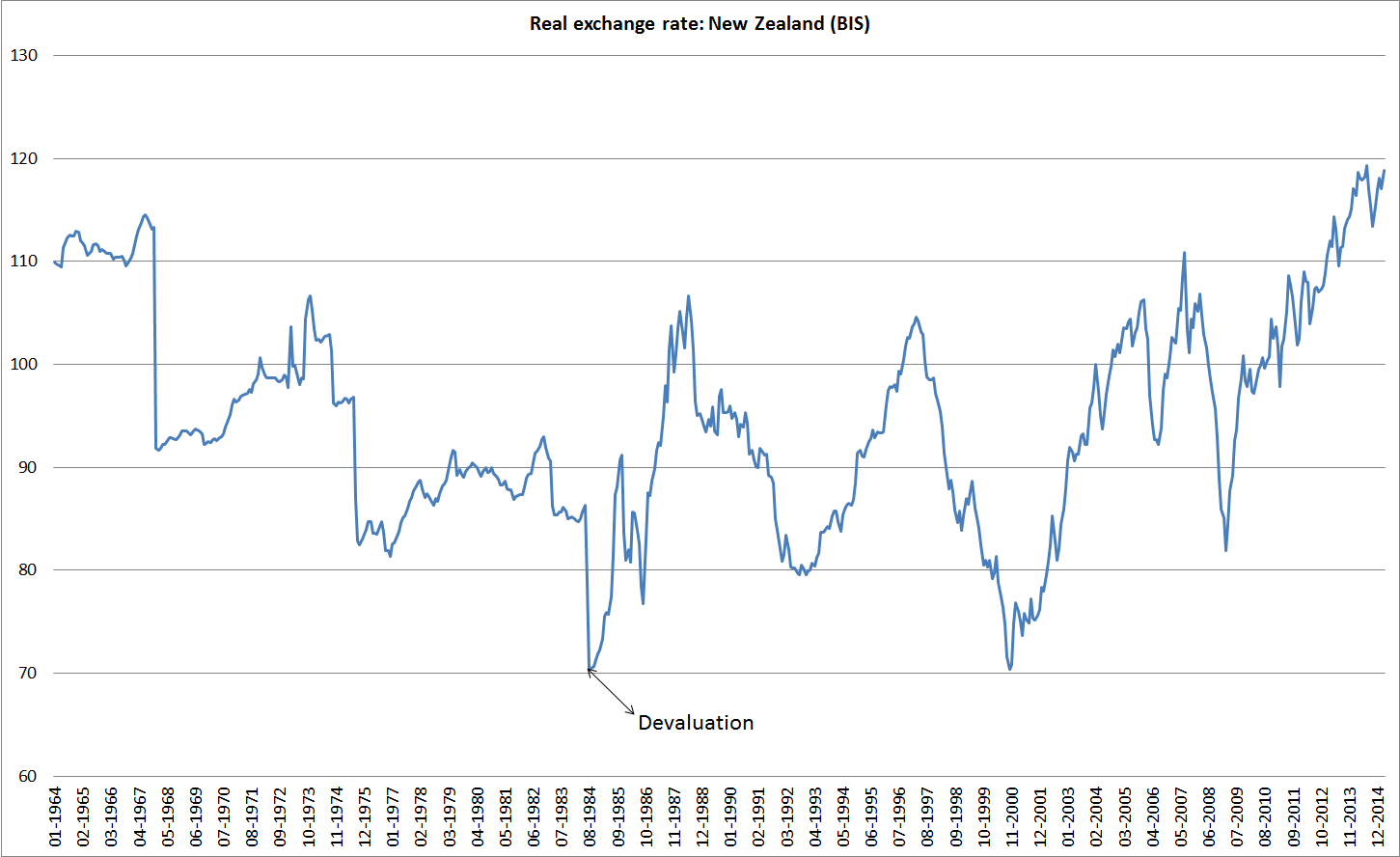
As New Zealand readers know, New Zealand was forced into a 20 per cent devaluation in July 1984 – the timing was “forced” by a combination of interest rate controls and a growing conviction that the likely new government wanted to devalue anyway.  Among elite bureaucratic circles there was a strong sense that the devaluation was a first step to rebalancing the economy and re-stimulating the tradables sectors.  I was a first year graduate at the time, sent along on occasion to take minutes of meetings of key figures in the Reserve Bank and Treasury: there was a very strong sense that the biggest macroeconomic policy challenge was to “cement in” the new lower real exchange rate.  There was no discussion around the possibility that the new lower real exchange rate might not prove to be sustainable.

And yet here is the chart of the New Zealand’s real exchange rate (using the BIS measure, as the RB has not yet backdated their measure far enough).  The 1984 devaluation certainly stands out, but not as some turning point in New Zealand’s competitiveness.   Rather it stands out as a level only once reached  again –  and then very briefly – in the subsequent 30 years.
1984

In short, they were wrong.  Not wrong, in my view, about the longer-term challenges. I’ve argued that the failure of the real exchange rate to move sustainably lower, to reflect long-term adverse productivity growth differentials, is a key proximate marker (please note that I did not use “cause”) of what has gone wrong with New Zealand’s economy over the long term.  But real exchange rate can’t be adjusted, by ministers and senior officials, in a vacuum.  I have the utmost regard for people like Rod Deane, and some of his Treasury counterparts.  But on this issue – where Fran O’Sullivan lauds them as heroically correct – they were simply wrong, or incomplete in their analysis of what achieving a sustainably lower real exchange rate would require.  And that despite a lot of expert analysis and research, laid out in books, and discussion papers, and Bulletin articles.  The limitations of knowledge we all face – great figures like Rod Deane not much less than the rest of us – seems to get continually swept under the carpet.

As I pointed out the other day, I’m not remotely relaxed about Auckland property prices. They are a social and political scandal.  But they look like the rational outcome of a misguided set of central and local government policies (supply and land use restrictions, combined with high trend target levels of non-citizen immigration).  No one knows when, or even if, such policies will be changed.

But the weight that should be given to the Reserve Bank’s arguments around housing depends on its claim that financial stability is being materially jeopardised.   New Zealand banks have high levels of capital, and are subject to high minimum risk weights on housing loans.  The Reserve Bank’s own stress tests suggest a high degree of resilience at present, even if house prices were to fall sharply in Auckland (they have been falling in various  other places in the country).  If the Reserve Bank really believes there is a growing risk of financial crisis, they should set out their analysis and evidence.  A good start might be to answer the question as to whether there has ever been a systemic financial crisis in a system where the stock of credit has been growing at only around 5 per cent per annum, and at growth rates than haven’t exceeded average nominal GDP growth for a number of years.  Perhaps there are such cases – the Reserve Bank has more resources than I do, and should be able to lay them out for us.     In the meantime, John Key and Bill English might usefully set the Bank’s warnings to one side (while still thinking hard about housing supply and immigration issues) and perhaps have a quiet word with the Bank’s Board about their performance monitoring of the Governor and his team.

UPDATE: A nice piece from Oliver Hartwich on the importance of expectations.  Of course, this is true not just of possible housing supply responsiveness reforms such as those he (and I for that matter) would favour, but of any changes in migration targets, or (indeed) complex tax regime changes as well.
Spring time at the IMF, and Greece

This weekend is the Spring Meetings for the IMF and the World Bank (just “Springs” to the insiders, to match “Annuals”, the October Annual Meetings of the Governors of the Fund and the Bank.  The Spring Meetings are always held in Washington, the location (for the time being) of the headquarters of the two Bretton Woods institutions, whereas every three years the Annual Meetings venture abroad at great expense (and presumably perceived prestige) to the host city, and great expense and inconvenience to the institutions themselves.   For anyone who wants a flavour of the Annual Meetings, Liaquat Ahamed (author of Lords of Finance) captured them rather well in a chapter in his recent book-length portraits of the IMF, Money and Tough Love.  My memories of the Dubai Annual Meetings included potential protestors being allocated a bare paddock where no one could see or hear them, and security forces who reproved me sternly for daring to get some fresh air by walking between the convention centre and the (next door) hotel.

The main formal events at the Spring Meetings are the meetings of the International Monetary and Financial Committee (IMFC), which the IMF website describes as follows:

The IMFC advises and reports to the IMF Board of Governors on the supervision and management of the international monetary and financial system, including on responses to unfolding events that may disrupt the system.

and its development-focused counterpart, the Development Committee.

Membership of these committees largely mirrors the respective Executive Boards that govern the IMF and World Bank on a day-to-day basis.  New Zealand is part of a multi-country constituency, and is “represented” by either the Australian Treasurer or the Korean Minister of Finance.   Representation is a bit notional, both because whichever Minister is in the chair is mainly concerned about his or her own domestic political interests, and New Zealand’s leverage is typically very small.  And these are ritualised, largely formulaic, meetings anyway.  Communiques emerge from them, which – while hard fought at times – rarely have anything of substance to them.  Real decisions are made in other fora –  e.g. G7 Finance Ministers meetings, and in bilateral negotiations among key countries.

So why do people bother with Springs?  A bit like the Annual Meetings, the formal meetings are much less important than the informal ones –  the networking opportunities (especially at the Annuals), the meetings of smaller groups of similar countries, and the opportunities for one-on-one meetings with other countries’ ministers or senior officials, or with IMF/World Bank senior staff themselves.  Constituency countries get together, often over a drink. Personal contacts and relationships matter.  New Zealand has been rather spasmodic in its attendance at Spring Meetings, (although the Minister of Finance usually attends Annuals) –  in my two years as an alternate Executive Director on the IMF Board, New Zealand sent an Acting Deputy Secretary of the Treasury one year, and no one the other year.  That seemed a wise use of resources, although when John Whitehead held the Executive Director role on the World Bank – probably the last time New Zealand will ever hold the top position – attendance was stepped up considerably.

No doubt over the weekend there will be lots of discussion of the faltering world economy.  I suspect Greece will get a lot of mention in the corridors, but rather less at the top table.  The overdue Greek exit from the euro is looking increasingly certain – I’m even beginning to think I might win a modest wager entered into 3 years ago with someone rather closer to the process, that at least one country will have left the euro by June 2015.

But I suspect what won’t be discussed –  at the top table, or in corridors –  is the failure of the IMF around Greece and the euro more generally.  Not that the IMF can be blamed for the choices the Greeks and other Europeans made to let Greece into the euro, let alone for the choices that the Greeks have made over the years.  But one of the key roles of the IMF is “surveillance” –  free and frank analysis and advice on the risks and pressure points in system, as they affect individual countries, and the world economy as a whole.  If there is a global public good to the IMF (and I’ve questioned that), it has to be in its willingness to ask hard questions, to push analysis where current politicians don’t want to pushed, to prod and probe even when no one else in much interested in doing so.  And in bringing to bear the perspectives of experience – past economic and financial history, and the ongoing experiences of its large membership.

But the IMF was for too long largely supine around the euro, and about what has become its key pressure point/vulnerability.  The institution was both uniquely well-placed, and uniquely compromised, when it came to dealing with Europe.  Managing Directors of the Fund have always been from European countries – most recently, former politicians from those countries.  Compared to the emerging and developing countries the Fund often had to deal with, the data in European countries are pretty good, and many of the Fund’s own staff are European – and others have trained in European universities.  And yet the Fund said almost nothing seriously critical of the great euro experiment.  Oh, don’t get me wrong, they devoted acres of text to technocratic issues around the fiscal provisions of Maastricht.  But so strong did the institutional belief appear to be in the end being pursued that serious questioning and stress-testing was discouraged and silence was the order of the decade.   I’m not aware of anything that the Fund produced in the decade prior to the crisis that pointed to the sorts of stresses the system has experienced, stresses that have had catastrophic consequences already for ordinary Europeans, and the potential to get worse.  No doubt euro-area ministers of finance didn’t want the IMF – in which they had a pretty dominant place (both voting shares, and seats on the Executive Board) – asking awkward questions.  Managing Directors came from that same environment, and often wanted to get back to it.  In the short-term no one had an interest in asking the hard questions, and so no one did.  I’m sure some of the very able staff were uneasy and may have profound insights to offer, but they had careers to pursue, and the more able ones on systemic risk probably didn’t relish the prospect of an assignment as Resident Representative in Monrovia (or some less stark shuffle sideways at HQ).

And so the question needs to be asked, what value did the IMF add in the process?  Come 2010, the IMF then put itself at the disposal of European governments, who wanted to kick the crisis down the track (“a crisis might still happen tomorrow, but at least we avoid the certainty of one today”), compromising and relaxing yet again its own rules, to put more money into a country where the prospects of success, on the strategy adopted, were always modest.  Of course, one can’t just blame the Europeans.  The US was as keen as anyone to avoid immediate stresses, and even countries and constituencies like our own were unwilling to go out on a limb and openly question what was being done with our citizens’ money, and whether the emperor had any clothes at all.

I don’t lay claim to having been overly prescient about how the European situation would play out.  I was always a bit of a sceptic, as many Anglos were.  But while I sat on the Fund Board – with, to be honest, not that much to do –  I did take the chance to ask a few questions, and make a few observations, at the Board, about both Greece, and the euro-area itself.  I discovered recently that all these statements are available on the IMF’s archives website.  I think what disconcerted me most at the time (around 2003) was the way the euro was presented as something akin to the end of history, rather than being a new and rather bold experiment – a large scale currency union among advanced democracies, with no fiscal union or political union.   Bold experiments inevitably involve risks and stress points.   Staff, no doubt acting in their own perceived interests and as they often did, mostly ignored my questions.  European directors loudly harrumphed and suggested that it was simply wrong and inappropriate to raise such questions.

To his credit, one (a hugely impressive former academic) came to me afterwards and observed something along the lines of “well, of course you are quite right, but we can’t be seen to be saying that.”    Today he is Finance Minister of a struggling euro-area economy.  I’d wager that there won’t be a euro-area for his country to be a member of five years from now.

The IMF, its Board, its Governors, and the IMFC, are likely to pass over the failures around the euro in silence.  Perhaps in time the Fund’s Independent Evaluation Office will produce a good report on the subject, but when so many entrenched interests have so much at stake it is difficult to be optimistic even on that score.

Still going nowhere, after 25 years

A couple of comments from politicians caught my eye recently.  In his pre-Budget speech the earlier in the week the Prime Minister commented on the “One of the unsung success stories of the last few years has been the resilience of our exporters in the face of a high Kiwi dollar”.  And Steven Joyce was talking of revising the government’s target for exports/GDP, to take account of the revisions to the national accounts last year.

The idea of an exports target is an odd one.  I’d go so far as to agree that a high-performing New Zealand economy is likely to be one with a rising share of exports, as New Zealand firms successfully develop products that sell well not only (perhaps not even) at home, but in the much bigger world market.  It isn’t that exports are special, but that ability to export successfully is often – not always (think export incentives/subsidies) –  a marker of something going well.  Again, we don’t export for its own sake, but stronger exports provide the incomes that support New Zealanders’ ability to consume the wide range of products and services the rest of the world has to offer.

exports

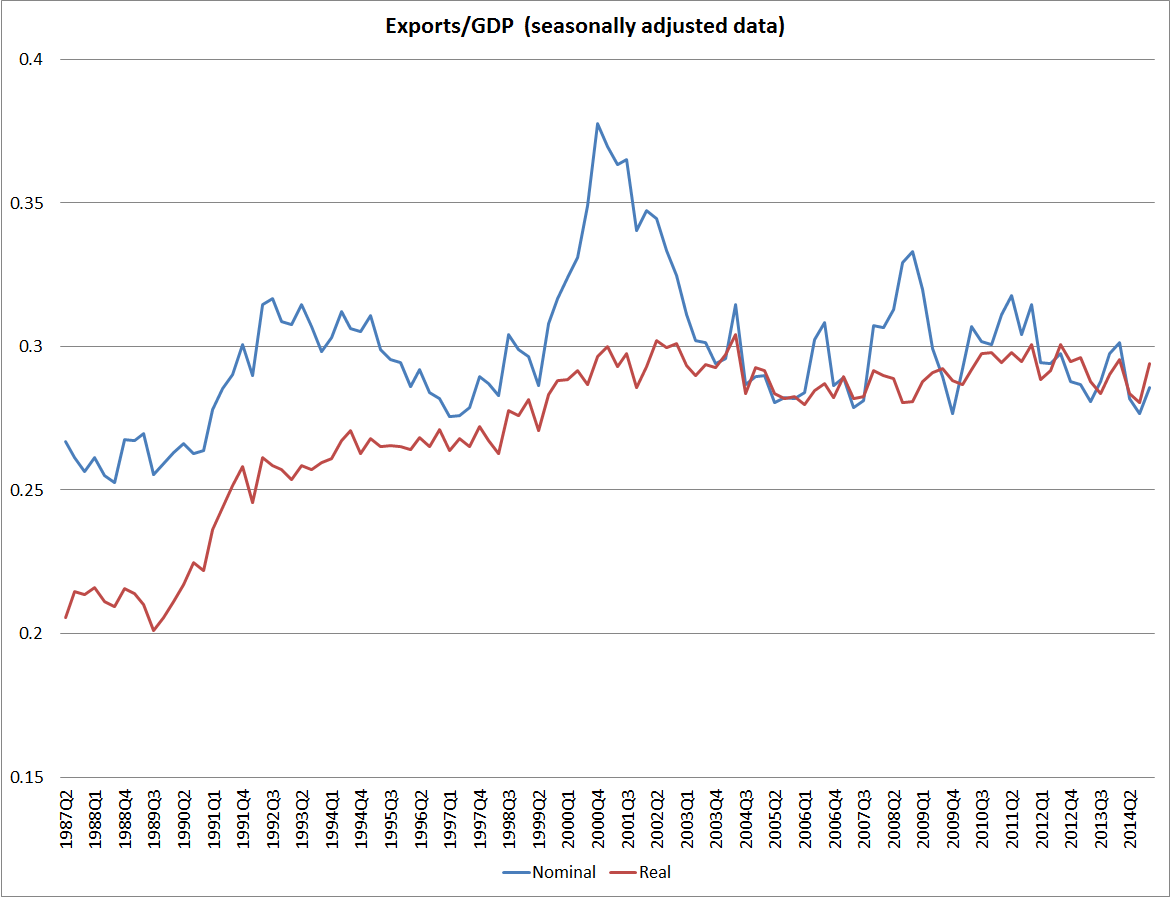
The chart shows two lines.  The first is nominal exports/nominal GDP, which is a reasonably economically meaningful measure.  The second is real exports/real GDP.  In my discussions with them over the years, Statistics New Zealand people tend to discourage using ratios of real variables, especially as measures of change over time.   Since nominal exports are thrown around (a lot) by commodity prices and exchange rates, there can be some limited information in this real ratio.  But not a lot, and not as a basis for a government economic target.  But the government’s target is apparently expressed in real terms.

So what has happened to these New Zealand ratios?  Exports as a share of GDP were rising in the 1970s and 1980s (my chart uses the current quarterly national accounts, which unfortunately go back only to 1987 but one can see the older trends in OECD data).  But that rise came to an end a long time ago.  In nominal terms – actual exporter receipts as a share of actual nominal GDP – we’ve gone nowhere for almost 25 years.   In most advanced countries that export share expanded.   If the exchange rate remains around current levels –  as many commentators seem to think – New Zealand’s nominal export share is likely to drop further this year (perhaps the counterpoint to the brief surge in 2000/01 when the exchange rate was at its lowest)   For what it is worth, the real ratio has now gone nowhere for 15 years.

World trade growth has been pretty subdued since around 2007, but a lot of that has been about China, allowing its currency to appreciate and markedly shrinking the export share of its economy.  Most – like the government – think that transformation of the New Zealand economy is likely to involve a larger export share, but there is no sign of it happening.

Of course, the higher terms of trade made New Zealanders better off even if export receipts as a share of GDP haven’t risen.  Imports are cheaper, and we can consume more of them.   But if higher world export prices have been (more than) totally neutralised by the higher exchange rate, there isn’t much incentive for firms in the tradables sector to invest more heavily in developing offshore markets, or expanding production capability.

Sceptical as I am of the exports target, the broad sentiment behind it is roughly in the right direction.  But there is not much sign of policy aligning in ways that would materially lift the competitiveness of New Zealand firms; the only sustainable way to help bring about the sort of lift in exports the government claims to be pursuing.

My own take on housing

I was exploring joining the Reserve Bank in late 1982,  and as the then Deputy Chief Economist was walking me round the floor he commented that one of the attractions of the Reserve Bank was getting involved in all sorts of housing issues.  It struck me at the time as slightly odd.  I don’t recall housing coming up as an issue in the previous years of macro-oriented university study.

But, sure enough, housing issues came up a lot in the course of my time at the Bank.  Rapid housing credit growth in the years after the share market crash (we concluded that it couldn’t go on for long), the mid 1990s housing boom and Don Brash’s hankering for “tweaky tools”, the treatment of housing in the CPI (and in early Policy Targets Agreements), the Supplementary Stabilisation Instruments Report, the Mortgage Interest Levy, more work on possible alternative instruments including tax options, arguments about appropriate risk weights for housing, connections (or the absence of them) between house price booms and savings, reviewing OECD reports on this, that, and the other dimensions of housing, 2025 Taskforce reports,  “macro-prudential” policy frameworks, and most recently –  and terminal to my relationship with Graeme Wheeler – the LVR speed limit.

This was never intended to be, and won’t be, a housing blog.  When I left the Bank a couple of weeks ago, I’d put together a large pile of items I wanted to write about –  some of which will interest many, and others few – and so far I’ve got to only few of those topics.

But housing has become the topic of the week.  An anonymous commenter yesterday suggested that:

The tone of the blog suggests you have an emotional attachment to not wanting housing to be considered over valued, subject or likely to unwind, and resistant to anything to curb further inflation. Sounds venal. Own a few investment properties – or just one of those people who becomes emotionally invested into an issue and starts becoming irrational?

I don’t own, and have never owned, an investment property.  As it happens, Welllington looks like one of those places where investment properties would not have offered a very attractive return in the last decade.  I grew up mostly in “tied cottages” (my father became a Baptist minister when I was young) and I’ve owned two houses, in succession, in the same seaside suburb.  I hope that the executors of my estate (several decades hence I hope) will do the next property transaction.

But if I have an emotional investment in this issue at all, it is to be scandalised at the way in which a succession of no doubt well-intentioned political choices have been pushing home ownership beyond the reach of a growing  number of young and middle-aged New Zealanders.  Good intentions do not excuse bad outcomes.

It is not that accommodation itself is beyond the reach of those people. One of the striking features of the last 10-15 years is that rents have not increased that much.  Partly as a result, the cost of consumption (the private consumption deflator) has increased much less than the CPI.  I also don’t have an instrumental view of home ownership – that we should promote it because it is good for societal cohesion or any number of worthy outcomes that are often argued.  I don’t think home ownership should be promoted at all, as a matter of public policy – and, while I wouldn’t push the case, I would have no principled objection to a tax on imputed rentals, provided that the costs of home ownership, including the interest cost of the debt finance component, were deductible.

But we should not stand in the way of home ownership, by adopting policies which put high hurdles in the face of young people getting into purchasing a house, if that is what they want to do.  And nor should we be settling for the diminished ambitions I heard in a discussion on National Radio yesterday – two panellists talking of how perhaps we should all get used to living in small apartments, and well, really, well-designed apartments could be surprisingly spacious.  Perhaps they do if they want to live in the inner-city, with all the other amenity value than can offer to some people.  But there is no reason why it should be the norm.  Most people still want the backyard, where the kids can kick a ball.

If New Zealand isn’t one of the most successful advanced economies, we are a rich and fairly prosperous country, with real incomes well above those 50 or 100 years ago.  Housing is a normal good: when we get richer we generally want more of it, not less, and in a country with lots of land per capita, there is no obvious reason why we can’t have more of it.   My parents were like many of their generation: they bought a first house in the early 1960s in the then outer suburbs of Christchurch.  It was new, and quite small.  As people did, they landscaped it themselves over time.  And they serviced it on one income.   Incomes today are much higher than they were then.  But despite the higher income, land prices would put that beyond reach of the typical young family today.

No doubt some planning restrictions are an efficient coordination device (thoroughgoing libertarians might disagree).  I have no particular problem with the idea that new factories shouldn’t be allowed to set up in residential areas.  Perhaps too there is a case for some basic government building standards for houses – though we and our children live in our houses (and take any risks), not central or local government officials.   And, yes, new housing does involve infrastructure requirements, and we need good models for ensuring that the costs of that infrastructure are borne (upfront or over time) by those who create the additional demand.  But when land and building costs have got so high – and ownership of a basic family home has got beyond so many – surely it is time for an urgent rethink.

Good dairy land sells for perhaps $50000 per hectare.  I just googled Upper Hutt sections –  not exactly central Wellington, let alone Auckland –  and it looks as though one would pay $250000 there for not much more than 500 square metres of a residential section.  The two aren’t the same –  services, streets etc cost money – but the gap between the two should be a reproach to our politicians.  The 2025 Taskforce some years ago suggested that councils should have to publish regular reports documenting the cost of land in their area, explicitly comparing land zoned residential with otherwise similar land not zoned for residential purposes.  Information helps change things, and this still looks like a modestly useful recommendation to me. Better still might be some sort of statutory presumption that landowners can build houses (perhaps to three floors high) on any land (not, for example, seriously geologically unstable).    It isn’t the full answer, but we need to shift the presumption towards the rights of landowners (and the interests of potential purchasers/residents) rather than agendas of central or local government officials and politicians.

Land use restrictions are much less binding in communities/countries in which there is little population growth.  I’m sceptical of New Zealand’s immigration policy for other reasons, but if we are going to target large inflows of non-citizens, and we know that a large proportion will end up in our largest city (which is what happens with migrants around the world), we owe it to our own people to ensure that they aren’t inadvertent victims of this policy choice.  Again, good intentions don’t excuse bad outcomes.  New Zealand governments should make policy for New Zealanders: we should allow/promote non-citizen migration to the extent that it benefits New Zealanders.    There is no necessary conflict between rapid population growth and affordable urban house prices –  cities such as Houston have illustrated the point.  But if, for whatever reasons, the New Zealand political process can’t or won’t make urban land supply much more responsive, we need to think much harder about medium-term target levels of non –citizen inflows.  Trying to combine rapid population growth and fairly tight land use restrictions comes at great cost to younger generations of poorer (and often browner) Aucklanders (in particular).    That is simply unjust.

Perhaps because I don’t know when to stop I want to comment briefly on foreign ownership restrictions on residential property.   My general starting point is that foreign investment should be welcomed, and that New Zealanders should be free to sell their houses (or farms, or businesses) to pretty much whomever they prefer.  And when someone migrates to New Zealand of course they should be free to buy a house.   But Auckland (in particular) is now a hugely distorted market, and the policy priority has to be minimising the damage those policies are doing to ordinary New Zealanders (and approved residents).    Auckland houses (and land) shouldn’t be particularly scarce, but government choices have made them so.

I haven’t seen convincing evidence that there is yet much purchasing of Auckland (or New Zealand more generally) residential property by non-resident foreigners, but it would not surprise me if it were gradually becoming more of an issue.  We know that there is a lot of private capital flowing out of China, and jurisdictions with secure property rights will look attractive.  If there were evidence of significant non-resident buying in New Zealand, I would somewhat reluctantly support tax or regulatory restrictions.  Yes, doing so restricts the sales opportunities of New Zealanders, but that scarcity value (in the land price) has only arisen from the supply restrictions interacting with government choices about population/immigration pressures.   There was no good economic case for the supply restrictions in the first place.  So the lost opportunity to sell this artificially scarce asset is not something that should unduly trouble New Zealand policymakers.

I haven’t touched much here on the tax treatment of housing.  My views were pretty much summed up in various earlier Reserve Bank documents (eg here or here).  There is no perfect tax system, and no doubt the tax treatment of housing isn’t ideal or fully “neutral”.  But the key features of the tax system have been in place for a long time, and if anything have become less supportive of housing in the last decade or so.   They cannot credibly explain the transition from affordable to severely unaffordable urban land and house purchases.

So , finally, do I have an emotional attachment to some of these issues?  Of course.  These things matter.   Good intentions have produced shocking outcomes, and that really needs to change.    House and land prices should come down, in real terms.  But there isn’t anything obviously irrational about house prices as they are – they look a lot like the rational outcome of a badly chosen combination of policies.  And who knows when, or if, they will change.

Spencer again

Grant Spencer’s interview on Radio New Zealand’s Checkpoint last night answered one of my questions.  It seems that Spencer, and the Reserve Bank, now favour a capital gains tax.  Previous Reserve Bank documents have always refused to take a position on the general merits or otherwise of capital gains taxes, while both pointing out some of the practical limitations, and observing that international experience (including in Australia) suggests that capital gains taxes have not made much obvious difference to housing cycles.    I’m puzzled at what has led to the change of view, and have just lodged an OIA request for any recent material or analysis the Bank has produced, had access to, or pointed ministers to, on the case for (and evidence on)  a capital gains tax.

Spencer noted last night that the Bank was not trying to enter a political debate, but just wanted to deal with the economic issues. So can we assume that the Bank favours a general capital gains tax (ie on all assets, and with no carve-outs for owner-occupiers)?    Since any tax advantages to housing are greatest for unleveraged owner-occupiers (which is what most owner-occupiers aim to become) it could surely only be political considerations that would warrant an exclusion?  Does the Bank favour a CGT regime based on annual fluctuations in market values?  If, for practical reasons, it favours a realisations-based regime, how does it respond to the proposition that the resulting lock-in would reduce the efficiency of the housing market?  One presumes that the Bank favours a symmetrical application, so that capital losses would result in a tax refund from the Crown (those property investors in Gisborne and Wanganui – see below – will no doubt be grateful)?  Does the Bank favour inflation-indexing capital gains before taxing them, and does it favour taxing capital gains at full personal income tax rates (even though no other country I’m aware of does)?   And, presuming that the Bank is concerned with wider macroeconomic stability, have they given much thought to how to manage the much greater pro-cyclicality of government revenue that would be introduced by adopting a broad-based CGT?   Tax revenue would soar, even more than it does now, in boom times, only to slump more sharply in downturns.   Heavy reliance on property market based revenue sources was one of Ireland’s many mistakes.

The Deputy Governor mentioned yesterday that New Zealand was one of a small number of countries that had not had a large fall in house prices at some point in the last 45 years.  I’m not quite sure why  45 years is chosen –  I presume it must relate to some international data set.  But it is worth remembering that real house prices fell very steeply – by around 40 per cent – in the late 1970s (as population growth slowed sharply), and of course nominal house prices fell significantly during the Great Depression of the 1930s.  So significant falls in house prices aren’t unknown here, even nationwide.

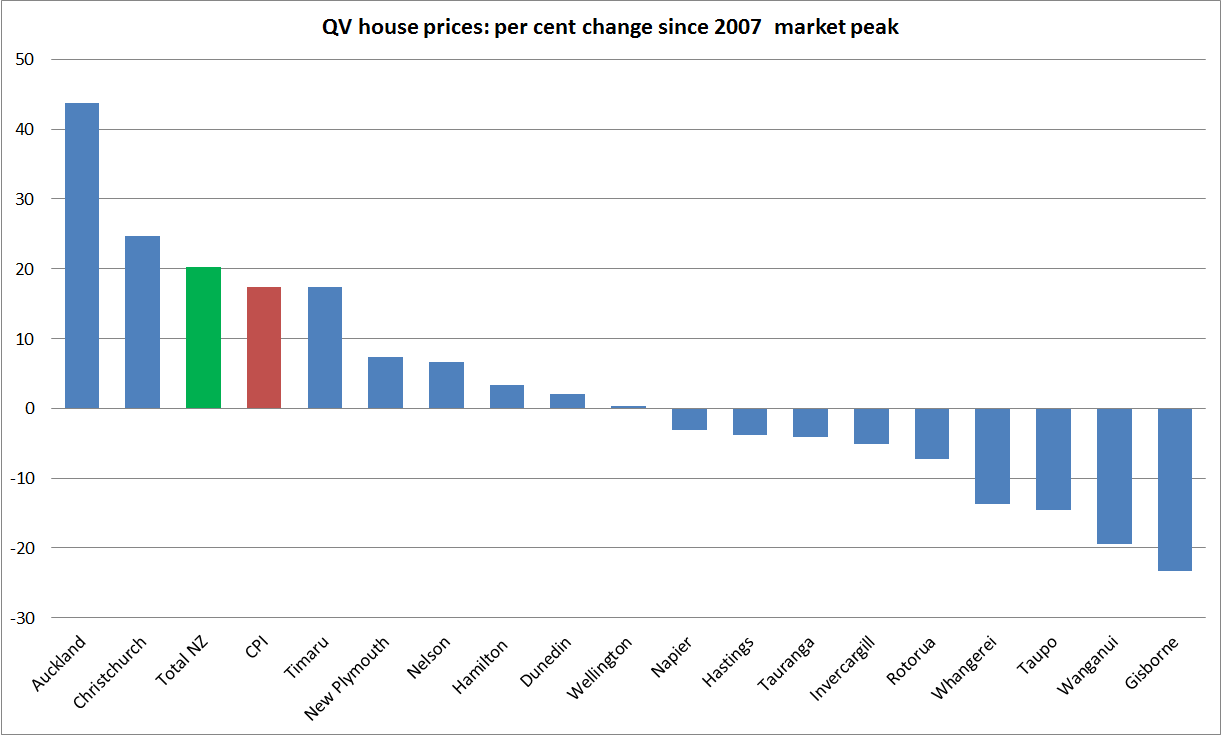
But more recently, and as I mentioned in passing yesterday, significant parts of New Zealand have been experiencing falling house prices.  The chart below uses QV data and shows changes in nominal house prices for a selection of urban areas since what QV describe as the “2007 market peak”.    I’ve also shown CPI inflation since mid-2007.   Only Auckland and Christchurch have seen any growth in real house prices since 2007.  In Christchurch the growth in real house prices is modest (about 6 per cent) and the reason for that growth is both obvious and likely to be quite short-lived.  All other significant urban areas have seen flat or falling real house prices in the 7-8 years since 2007, and many now have nominal house prices that are below levels seen in 2007.  Eyeballing the various TLAs, it looks as though most of the population has experienced flat or falling real house prices since 2007, and perhaps as much as a third of the population has experienced falling nominal house prices since 2007.  Perhaps the Deputy Governor should be pointing this out.  And I wonder if the Reserve Bank has gathered any information on the loan loss experiences in the areas that have experienced falling nominal house prices in recent years.   Are there any surprises in that data?

qv Spencer seemed to have a knee-jerk negative reaction to investment property purchasers.  Spencer observes, disapprovingly (?), that rental yields have been falling, but doesn’t seem to connect this to the fact that yields on a wide range of assets (government bonds most obviously) have been falling, and keep on surprising financial markets –  and central banks –  by how low they have gone, and for how long.  With the prospect of lower fixed income yields for longer – here and around the world – it is hardly surprising that fixed assets (especially supply-constrained ones) would tend to increase in price.  Perhaps New Zealand interest rates (which are high by international standards) will rise at some point, but the Reserve Bank’s track record doesn’t suggest it is better placed than anyone else (including borrowers and lenders) to know when, or by how much.    And finally, Spencer doesn’t seem to connect an increased share of investors in the housing market with the Bank’s own LVR speed limit.  Their own analysis, conducted before the LVR speed limit was put in place, told them that if life was made more difficult for first home buyers –  who have always (and sensibly) tended to be disproportionately those who take out high LVR loans –  other buyers would replace them to some extent.  Investor purchasers were always the most likely replacement purchasers.  There is a real danger here of one control begetting another, and another.

Spencer claims that 39 per cent of total dwellings in Sydney are apartments, whereas in Auckland only 25 per cent are.  I’m not sure what the definition of “apartment” he is using here, but even if his numbers were right, what should we take from them?  Everyone knows that Sydney house prices are absurdly high – on Demographia numbers, relative to incomes, even higher than those in Auckland.  And planning restrictions, and suggestions of corruption around the process, are even worse in New South Wales than those in Auckland.  No one should look to Sydney for positive guidance on housing supply.   More generally, there is no evidence that the vast mass of people in Australasian cities want to live in apartments.  Instead, apartments – which use less of the regulatorily-constrained factor, land – become a second or third best endogenous response to exceedingly high prices.  Don’t get me wrong, I’m all for ensuring that planning laws are sufficiently flexible to accommodate apartments and greater urban density to the extent that private preferences call for that sort of housing, but we shouldn’t be using planning law to prioritise one type of dwelling over another.  As I noted a couple of weeks ago, as cities get richer they tend to become less dense over time.

The speech is puzzling. Spencer claim to want fast-acting measures, and laments that supply changes are likely to cut in only slowly.  And yet he is reacting to short-term phenomena – the latest pick-up in house prices in the last six months, and the effects of a surge in migration that –  as all previous ones have been – will probably prove short-lived.  Spencer surely knows that far-reaching RMA reforms are unlikely in the near-term.  And significant tax changes are also unlikely. We shouldn’t be making fundamental changes in the tax system based on short-term developments in a single asset market, the current government has been quite clear in its opposition to a CGT, and even if it were not so,  it is unlikely that any such regime could be put in place in less than 18 months.

Migration policy should also not be determined primarily by short-term swings in the housing market, but actually the target for non-New Zealand migrant inflows is set by ministers, and could be altered quite readily, without the need for legislation.    If the issues are really as urgent as Spencer suggests – and from a financial stability perspective their case is still not made  – it is puzzling that the Bank is not more supportive of exploring winding back the target level of non-New Zealand inflows.

If the Bank is really worried about the financial stability risks, they have relatively neutral non-distortionary tools at their disposal.  For example, increasing the required minimum capital ratios (or even just housing risk weights, or Auckland housing risk weights) would build bigger buffers to cope with the risk of an eventual nasty correction.    That is less ambitious than attempting to directly controlling high LVR loans, or loans to investors, but it is also much more realistic about the limitations of the Bank’s (and everyone’s knowledge).  The Bank has no better knowledge than anyone else as to when, say, population pressures might ease or supply responsiveness might be permanently increased.  But adopting such measures would require them to front up more directly and explain why such additional buffers are necessary when the results of their own stress tests suggest that the banking system’s assets, and capital, are robust to even substantial adverse shocks.  Rapid credit growth is the most important factor in heightened crisis risks.  We don’t have that across the country as a whole, and all our major institutions are nationwide lenders.  The risk of severe loan losses is also much higher when there is extensive overbuilding – whether housing, or commercial property.  Again, we don’t see any sign of that.

In the end I’m wondering if the speech should best be seen as defensive cover for the next round of regulatory interventions, which the Bank keeps alluding to, but which we have yet to see details of.  Perhaps we’ll be told not to complain about further quite intrusive restrictions imposed by a single unelected official if the political process won’t tackle the Bank’s view of a policy reform agenda?  I didn’t think that was how democracies were supposed to work.

Housing and the Deputy Governor

I had been going to write something about housing this morning, but got distracted in the WEO database.  House prices, especially in Auckland, are a political and social scandal.

But now Grant Spencer, Deputy Governor of the Reserve Bank with responsibility for financial stability, is out with a speech on housing, “Action needed to reduce housing imbalances”.  It is difficult to know where to start in commenting on the speech, although the title will do.  The tone  of “Action needed” seems to inject the Bank into politics, and the political debate, rather more than is prudent or than its two main statutory responsibilities, price stability and prudential supervision to promote the soundness and efficiency of the financial system would warrant.  For better or worse, the Reserve Bank has a variety of statutory powers it can exercise.  If it judges those powers should be used it should lay out its case for our scrutiny, and then act.  Instead we have a long, but once-over-lightly, rehearsal of a bunch of mostly familiar material, with little or no in-depth analysis of the issues in the Reserve Bank’s own areas of responsibility.

We should expect the Reserve Bank to provide in-depth analysis to back its claims around the housing market.  But in a 19 page speech, only five paragraphs are devoted to the “housing pressures are a threat to stability” section.  And if not everything can elaborated in a speech, we might expect to see links to recent Reserve Bank research in the area – but there are no such links, and not even references to the issue of the Bulletin published only a few weeks ago which cited international research suggesting that housing mortgage loans have rarely played a major role in systemic banking crises.  Issues of the Bulletin are generally regarded as speaking for the Bank, so it might be useful for the Bank to clarify just where it stands, and why.  New Zealand might be different, but if so why does the Bank think this is likely?   Perhaps the Bank can point us to countries in which private sector credit growth of around 5 per cent per annum, from starting levels of PSC/GDP that are still materially below the peaks reached 7-8 years ago, have led to serious threats to financial system soundness, or even to wider economic stability.

The Deputy Governor has been consistently reluctant to engage with the proposition that any financial stability risks must have been much greater in 2007 than they are now.  In the years leading up to 2007 we had seen:

  • Very rapid nationwide growth in real house prices, on a scale not seen previously in modern New Zealand history
  • Very rapid growth in credit and credit-to-GDP, on scales consistent with some of the international indicators that have been taken as suggesting heightened risk of crisis.
  • Much lower overall bank capital ratios (actual and required)
  • A move (in the adoption of Basle II) towards lower risk weights on housing.
  • A long-running period of economic expansion and consistently high levels of optimism
  • High levels of real investment in housing
  • Rapid growth in commercial property and farm prices, and in the associated stocks of credit.

All of which was followed by one of the nastier recessions New Zealand has seen in the post-war period, and a double-dip recession in 2010.  GDP per capita (real and nominal) settled onto a much lower track than had previously been expected – so that many borrowers’ income expectations proved to be quite severely disappointed.    Nominal house prices did fall during the recession, and by more than the Reserve Bank projected at the time.  And yet with all these factors, the soundness of our systemic institutions was never questioned (even in the midst of a global panic centred on concerns around housing) and the level of impaired housing loans rose only modestly to extremely low levels.

The current climate just does not bear comparison.  If the Reserve Bank disagrees, it would be helpful for them to lay out their arguments and evidence.  All the crisis literature is clear that big changes in credit stocks in short periods are the biggest crisis threat.  Not only are we seeing nothing of the sort at present, but – thanks to market pressures and the Bank’s efforts – buffers are much bigger than they were before.  In many areas of the country – barely mentioned in the Reserve Bank material – real house prices have been falling.
The one other bit of the Deputy Governor’s speech I’m going to touch on today is tax.  In his speech Grant states:

The tax treatment of housing is a major factor with potential to influence the demand/supply imbalance in the housing market. As reflected in our submission to the Productivity Commission’s inquiry on housing affordability, housing is the most tax-preferred form of investment, particularly when it is highly leveraged. Investors are often setting the marginal market prices that are then applied to the full housing stock within a regional market. Indicators point to an increasing presence of investors in the Auckland market and this trend is no doubt being reinforced by the expectation of high rates of return based on untaxed capital gains. While there are difficult issues and trade-offs to consider in this area, the Reserve Bank would like to see fresh consideration of possible policy measures to address the tax-preferred status of housing, especially investor related housing.

This reference to the Bank’s submission to the housing affordability inquiry took me by surprise, as I had had some involvement with that submission. So I went back and read it.

Tax issues

Housing is a favoured investment from a tax treatment perspective. This is especially so for unleveraged owner occupiers (see Hargreaves 2008), since owner-occupiers do not pay tax on the imputed rental value of the equity in their houses (although they do pay rates). The inadequate tax treatment of the inflation component of interest, whereby all interest received is taxed and all interest payments by investors are deductible, compounds the distortion and extends it to the rental property sector. With an inflation target centred on 2 percent per annum, a significant chunk of the any interest rate reflects simply the expected general rise in the price level (rather than a real income or real cost).

The tax treatment of housing and savings products varies widely across countries. Tax regimes can be shown to influence both the level and volatility of house prices (see Hargreaves 2008 and van den Noord 2003, for example), especially when supply responses are sluggish. But countries with a variety of tax regimes experienced similar housing booms in the mid to late 2000s. Moreover, it is not clear that, in aggregate, housing is more tax favoured in New Zealand than in other countries. For example, householders in the US can deduct owner-occupier interest payments for tax purposes and in most cases face no capital gains tax. In addition, relatively high local government rates in New Zealand compared to other countries, act as a tax on property ownership.

Some have also argued that the increase in the maximum marginal tax rate in 2000 (perhaps in combination with the change in the inflation target in 2002) played a major role in the last cycle. We are sceptical for a variety of reasons outlined in our 2007 work. At most, we believe it was an exacerbating and amplifying factor. At the time, the underlying regulatory model made new housing supply relatively slow to respond and expectations of persistent future price increases became entrenched for a time. We also doubt that loss-offsetting in and of itself, was more than an amplifying factor, because rental yields at the start of the housing boom were high enough (and interest rates relatively low) that large losses were limited. More generally, however, correcting the tax treatment of interest to assess or deduct only real interest would remove the distortion in this area.

One tax issue that periodically receives considerable attention is capital gains taxation. Houses bought by investors with the intention to resell are already, in principle, caught by the income tax net, but New Zealand does not have a general capital gains tax. The Reserve Bank has never taken a stance on the general merits or otherwise of capital gains taxes. We have fairly consistently noted (including in the Supplementary Stabilisation Instruments report (Blackmore et al 2006) and the 2007 submission to the Commerce Committee) that there is little evidence internationally that countries with capital gains taxes have experienced less marked cycles in house prices. In the 2007 document, we noted that, in practice, capital gains taxes are only levied on realised gains (rather than accruals), which creates additional distortions and that capital gains taxes usually largely exclude owner occupied houses, even though unleveraged owner-occupied housing is the most lightly taxed component of the housing stock. We summed up that “capital gains taxes are common internationally but are hard to design and implement in a way that works well”. To avoid establishing new distortions, any capital gains tax should only tax real capital gains and needs to treat gains and losses relatively symmetrically.

Perhaps the Reserve Bank now reads the evidence differently – but, if so, perhaps they could lay it out for us. For now, the submission they themselves pointed us to makes a couple of important points:
◾To the extent that the tax system favours home ownership the advantage is greatest not for investors, but for unleveraged owner-occupiers.
◾It is not clear that housing is more tax-favoured in New Zealand than in other advanced countries.
◾Tax systems, and the treatment of housing, vary widely across countries and don’t seem to explain differences in house price cycles
◾Some distortions arise from the existence of positive expected inflation (combined with the non-indexation of the tax system) and yet this issue is not even touched on in the speech.

As a final point, it is worth remembering that the broad features of the tax system have been in place for a long time. If anything, most relatively recent changes – including lower maximum marginal tax rates, the introduction of the PIE regime, and successive reductions (and the eventual elimination) of depreciation allowances (on assets than manifestly do deteriorate) have worked to reduce any advantages to owning/investing in residential property.

So when the Bank talks loosely about how it “like to see fresh consideration of possible policy measures to address the tax-preferred status of housing”, it would be helpful if they could be more specific. Do they now favour a real-world capital gains tax (including on owner-occupied houses?), and think it would make a useful material difference to housing markets? Do they favour indexation of the tax system? Do they favour abolishing loss-offsetting provisions in respect of housing investment, thus treating housing differently than any other small businesses? Do they favour a tax on the imputed rental, and if so would they also favour allowing full interest deductibility on owner-occupied mortgages?

Without more detailed and extensive analysis, it is still difficult to escape the conclusion that the Reserve Bank’s approach to housing is being shaped more by impressions of the US last decade than by robust in-depth analysis of the sorts of specific risks the New Zealand economy and, in particular, New Zealand banks and the New Zealand financial system face.

Fossicking in the IMF WEO database

The IMF’s twice-yearly World Economic Outlook has just been released.  With it comes the very useful and accessible database, which has a wide variety of data (back to 1980) and forecasts (now out to 2020), especially for the 37 “advanced economies”.   These are the sorts of places New Zealand often wants to compare itself against – although quite why tiny San Marino is in included has never been clear to me.

I had a quick look at some of the series.

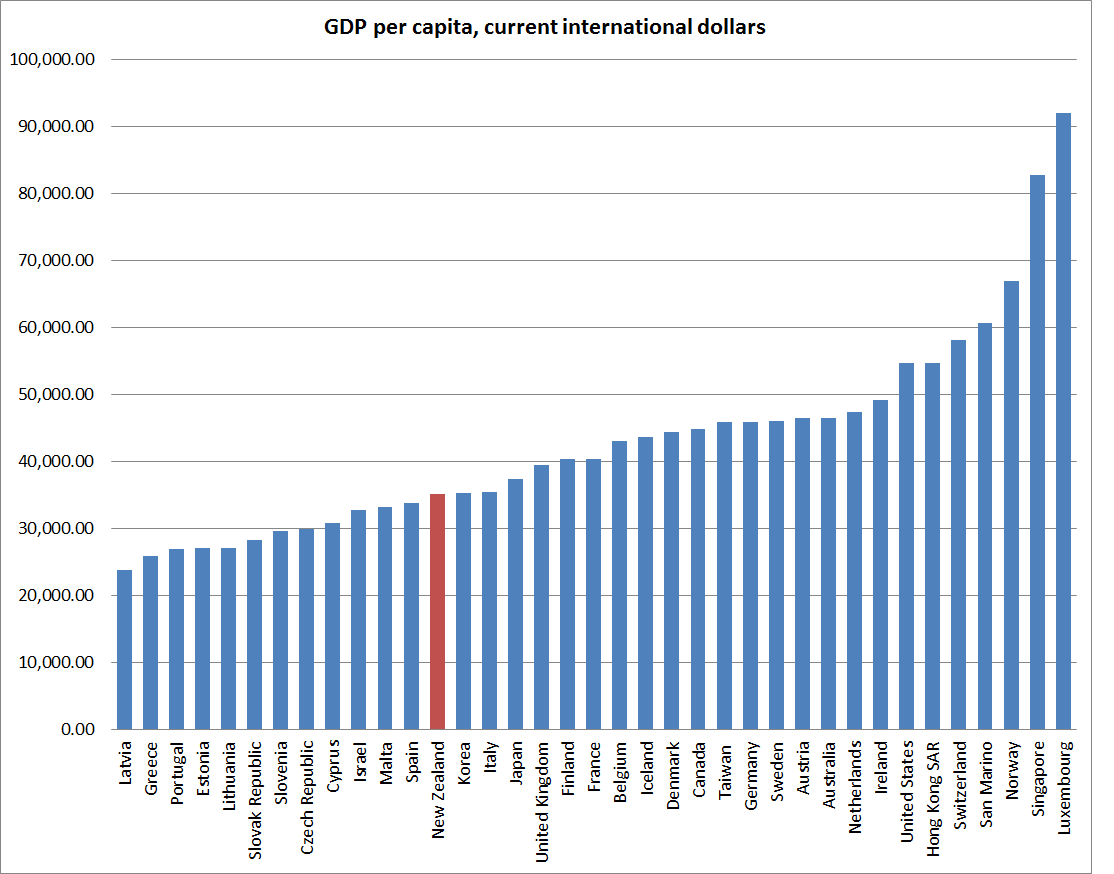
First was GDP per capita, in current international dollars for 2014. That measure of purchasing power parity captures the effects of New Zealand’s record terms of trade last year.  12 of these countries had lower GDP per capita than us last year.  That is an improvement from the last pre-recession year, when only 10 countries were poorer.  Since 2007 three euro area crisis countries have dropped below us, while Korea has moved above us.
imfgdp

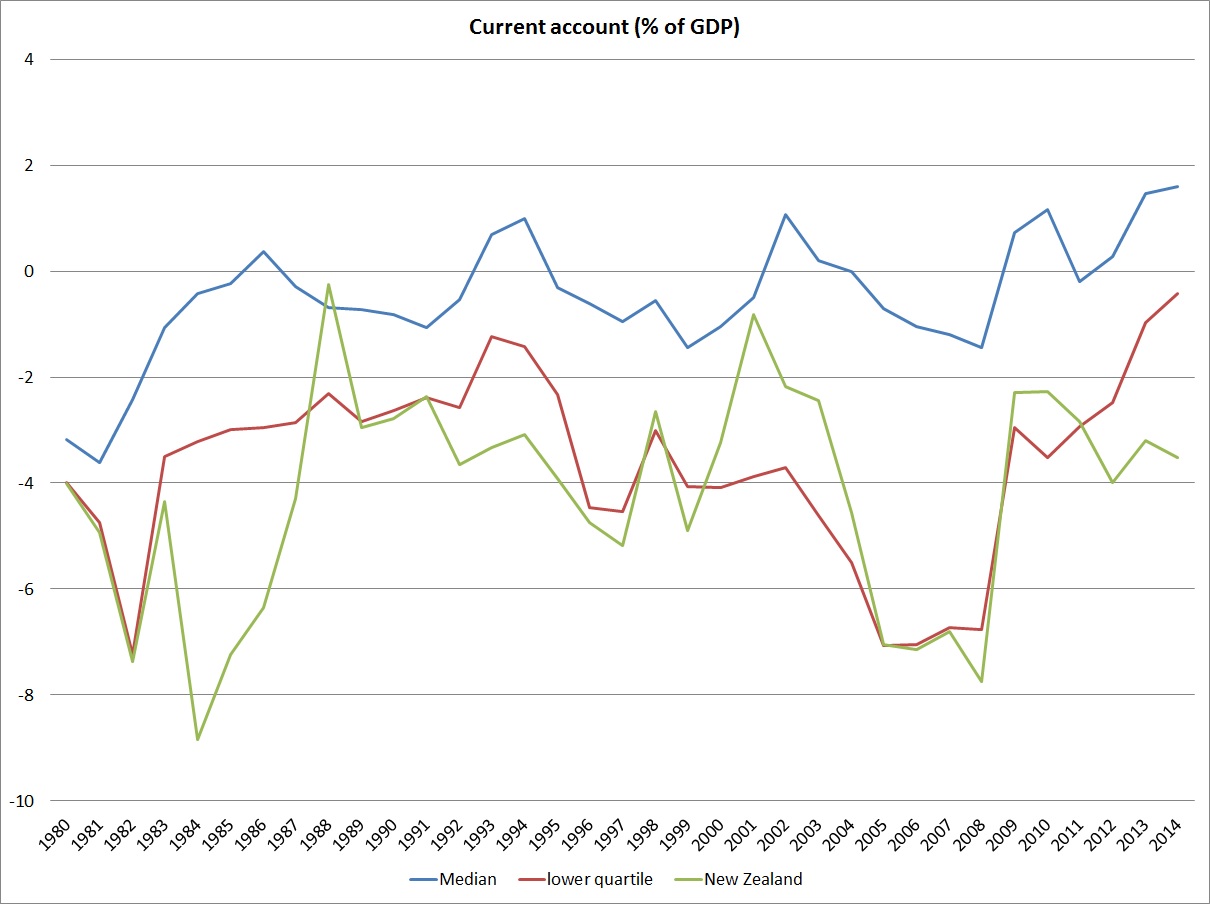
Second is the current account deficit.  When he was Opposition Finance spokesman David Parker was fond of highlighting the WEO forecasts for the current account deficit.  In recent years those for New Zealand were often the largest in the advanced world, and they still are.  That comparison was never overly enlightening, mainly because the IMF’s methodology assumes an unchanged exchange rate.  But what about actual data?  In 2014 we did have the second largest current account deficit among the advanced economies (only the UK had a larger deficit).  And over the longer-term we’ve had current account balances averaging around the lower quartile of OECD countries.

imfcaD

Current account deficits (or surpluses) aren’t good or bad in and of themselves.  Context matters.  Large current account deficits make a lot of sense in a country with rapid productivity growth and lots of productive investment opportunities – borrowing from abroad to finance high levels of investment, without unduly constraining current consumption is a sensible choice.  But, as is well known, New Zealand’s productivity growth has been poor for decades.

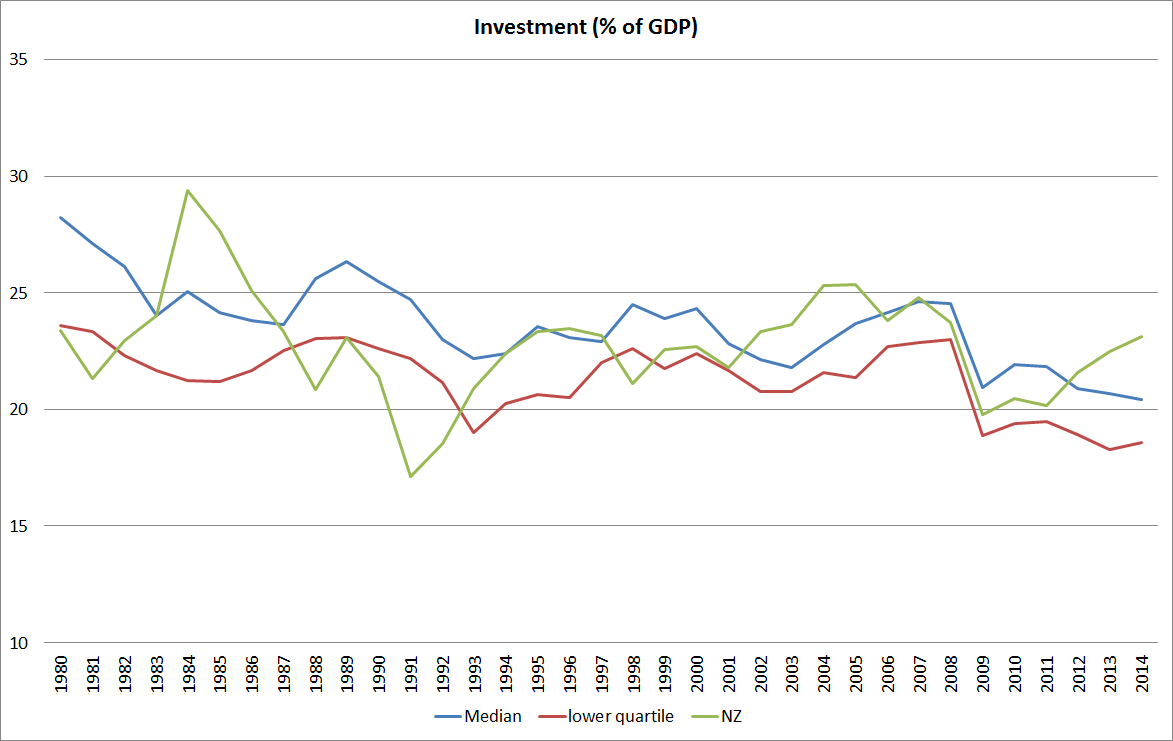
Another way of expressing the current account is the difference between investment and savings.  Investment as a share of GDP in New Zealand has increased quite markedly in the last couple of years, accounting for the widening in the current account deficit.  Much of that has been the spending on the repair and rebuilding process in Christchurch.  That spending had to happen, and we were fortunate that offshore reinsurance covers much of the cost, but it doesn’t lay the foundations for future prosperity.

IMFI

What about fiscal policy?  The IMF’s main measure is general government net lending/borrowing as a share of GDP

imfg

New Zealand doesn’t look too bad on this measure, but it isn’t that good either.  Roughly a third of the advanced economies had smaller deficits or surpluses than we did in 2014, and that is despite New Zealand’s record terms of trade (a windfall gain to the budget, and unlike to be repeated as the global commodity “bust” deepens) and the view (embedded in the IMF numbers) that our economic recovery was more advanced than those in many other countries.  The government has made a lot of the idea of gradual adjustment to support the recovery, but faster fiscal consolidation might have eased pressures on the real exchange rate.

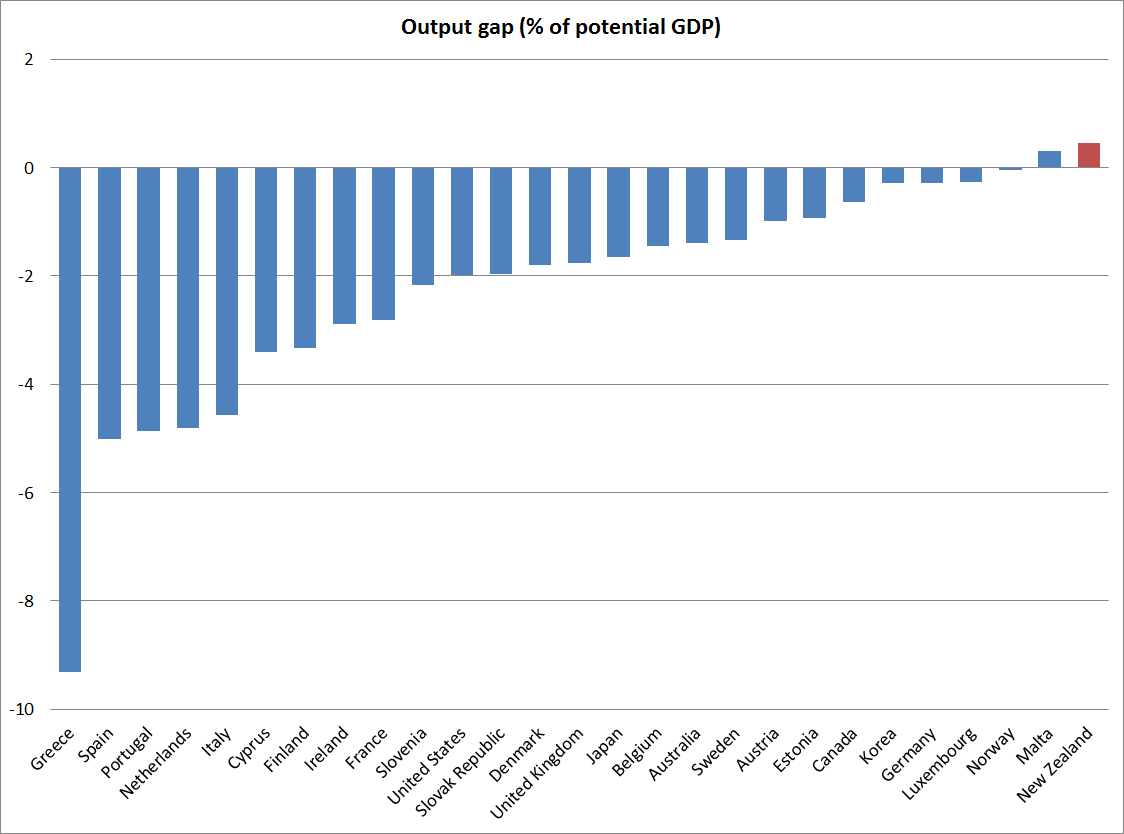
And, finally, the output gap.  All recent numbers are subject to revision, but output gap estimates are more rubbery, model-dependent, and subject to substantial reassessments than most (a recent Reserve Bank Analytical Note illustrated this in the New Zealand context).  The IMF doesn’t produce output gap estimates for all the advanced economies (nothing for San Marino for example), but of the 27 countries for which there are estimates, New Zealand and Malta were the only countries currently estimated to have had a positive output gap last year.  Indeed, if you believe the IMF New Zealand’s spare capacity has essentially been all used up for at least three years.
imfoutputgap

Believe it if you will (the Reserve Bank has certainly been running policy on a similar view of New Zealand), but when output is almost 15 per cent below pre-recession trends, business investment (outside Christchurch) is pretty subdued, wage inflation shows no sign of picking up, unemployment is still 5.7 per cent (and there is considerable underemployment), inflation is well below the middle of the Reserve Bank’s target range, credit growth is pretty subdued, and inflation expectations are falling, it is questionable what meaning can be placed on estimates that suggest that all the spare capacity in this economy has already been used up.  We certainly aren’t Greece or Spain, but it is less clear to me that we are so different from a swathe of countries in the middle of this chart –  perhaps from Slovenia to Sweden.

Hidden in plain sight?

Peter Wallinson’s Hidden in Plain Sight (“what really caused the world’s worst financial crisis and why it could happen again”), had been sitting for a couple of months on the unread pile on the coffee table, when I found a reference to it on one of my favourite economics blogs/newsletters.  David Warsh’s Economic Principals is a weekly must-read, for his ability to put together succinctly enlightening perspectives on a range of issues in economics, including the history of economics.  So when, last week, in the middle of a column devoted to the American Enterprise Institute, I found a sneering attack on Wallinson, I decided it was time to read the book.  Without taking time to engage the substance, Warsh drips contempt:

He is, however, a lawyer, with no sense of what constitutes a satisfying economic explanation. What makes him a crank is the affable certainty with which he asserts a partial truth explains the whole.

No sensible analyst thinks that political pandering to poor people is a sufficient explanation of the crisis.

The book clearly polarises readers – when I checked on Amazon this morning, readers’ ratings were roughly evenly split between five stars and one star, with almost nothing in between.    That is something of a pointer to how much is at the stake in ongoing debates of how best to understand the causes, and handling, of the 2008/09 crisis.

So what is the essence of Wallinson’s story?    It is that without repeated, sustained and frighteningly successful US government efforts – under both Clinton and Bush administrations – to promote easier access to housing credit, particularly through the agencies (Freddie Mac and Fannie Mae), there would most likely have been no serious US financial crisis.  Wallinson documents how government mandates compelled the agencies to drive down their lending standards, and how because of the dominant role of the agencies in the market, this contributed to a sustained deterioration in the quality of new housing loans being made across the United States.  As late as 2004, new mandates were imposed, forcing the agencies to meet higher low income lending targets with loans for new purchases, excluding any refinancing or equity withdrawal loans.

Wallinson also explains how the distinction between prime and subprime was progressively eroded, and yet how difficult it was for anyone to be fully aware of the scale of what was going on.   Even in the early days of the crisis, data were interpreted as suggesting that the agencies had very little subprime exposure, and indeed that subprime exposures were a small part of the stock of housing credit.  But in fact commercial data providers treated all mortgages purchased by the agencies as prime by definition – unless they were purchased from explicit subprime lenders.   In other words a sustained deterioration in the quality of the agencies’ loan books was largely masked from outside observers –  Wallinson, who had worked on agency issues for some years, notes that he was himself in this category.

And he deals with an argument that the agencies themselves were responsible, pursuing profit-maximising strategies at least during the boom years.  In fact, the agencies constantly struggled, and often only narrowly met, the ever-increasing minimum legal requirements for the share of lending to low and below-median income borrowers.    If loan losses on agency-held mortgages were a little less bad than those in the market as a whole, that is also unsurprising  –  given the dominant position of the agencies, and their low (implicitly government guaranteed) costs of funds, they could typically out-compete other purchasers and get the best (least bad) loans available in any cohort.      The argument isn’t intended to elicit much sympathy for the agencies or their shareholders, who fought doggedly to protect their political position and government preferences, but they increasingly found themselves in an ever more threatening vice.  Their political position depended on being able to sell themselves as facilitating the “American dream” of widening home ownership, and this vulnerability was increasingly exploited by politicians who did not (or would not) appreciate the scale of the risk they were driving into the system.

I don’t agree with everything in Wallinson’s book, but that doesn’t detract from its value.  I think he overstates the importance of fair value accounting requirements – in a panic, fear and uncertainty will drive equity prices deeply lower, regardless of the basis on which institutions are formally valuing the assets in the spotlight – and I’m still not persuaded that, even given the Bear Stearns precedent, Lehmans should have been bailed out.

But if you are at all interested in the 2008/09 US crisis, this book is well worth reading.  It matters to New Zealand oriented readers for at least two reasons:

  • The crisis was a hugely influential event, not just on near-term economic developments back then, but in influencing the global debate about markets, banks, regulatory policy, and the role of government.  It will be a reference point for decades to come, and which narrative dominates will matter.
  • Graeme Wheeler’s perspectives on the New Zealand housing market seem very shaped by having lived in the United States through the boom and bust years.  But if the experiences of other countries are to shape policy in New Zealand –  and it is very important that we do learn from other countries’ experiences –  it matters greatly that we understand those experiences correctly.

The conventional wisdom of recent years has been that the crisis was primarily a result of flawed private market behaviour, with the world pulled back from the brink by the heroic efforts of various government actors.  The understandable mood of “never again” translates into a bigger role for government – more regulation and more regulated entities.  Governments protect the public from the (mostly unwitting) predations of inadequately regulated private markets, and the too easy ebbs and flows of private capital.  But an alternative story – to which Wallinson’s story contributes – would emphasise the role of government choices in generating the conditions that made severe crises likely in the first place.  For example, the US crisis would never have occurred, on the scale it did, without the sustained government efforts to drive down lending standards and expand credit, all made possible by the role of the extraordinary role that state has long had in the US market for housing finance.  And the two other worst housing collapses of recent years –  Spain and Ireland – would probably never have happened on anything like the scale they did without the decisions of the respective governments to adopt the euro, and hence apply interest rates not set to reflect domestic economic conditions.

No single story is ever the whole explanation of complex phenomena, and the two perspectives in the previous paragraph are deliberately sketched out in slightly caricatured fashion

Of course, John Taylor would add another strand to the “government failure” story, with his emphasis on the Federal Reserve’s departure from the prescriptions of the Taylor rule in the early 2000s.  I don’t find that particular argument very persuasive, and indeed in some respects I think it helps shed light on the Wallinson story.  The US was far from being the only country where monetary policy departed from the prescriptions of a Taylor rule.  For example, Willy Chetwin and I showed a few years ago that New Zealand’s OCR had for some years in the early-mid 2000s been set below what a New Zealand Taylor rule (using the Reserve Bank’s own estimates of the output gap and neutral interest rates) would have suggested.    The US was also far from the only country exposed to foreign capital inflows pursuing yield.  But the US experience of housing loan losses was uniquely bad.  It points to something unique to the United States as being a key part of any explanation.  Statutory mandates to drive lending standards ever lower looks like a pretty compelling element of any successful story of the causes of the crisis.  Fortunately, we’ve had nothing similar in New Zealand…or in Australia, the United Kingdom, or most other countries.  That doesn’t mean we can’t have big sustained falls in nominal house prices here, but it might mean the narrative around the US-centred crisis might not shed much light on vulnerabilities here.

Case not made: investor housing consultation

The Reserve Bank has been out consulting, I think for the third time, on proposals to differentiate clearly, in bank capital requirements, between loans for investment properties, and loans to owner-occupiers.   I made a fairly short high-level submission on their consultation document.  It is here:

housing consultation document 13 April 2015

The thrust of my argument is “case not proven”.  The Bank argues that, for otherwise similar borrower/loan characteristics, loans for investment properties are materially more risky than those on owner-occupied properties.  But they present surprisingly little data –  none from New Zealand, since we’ve had no material housing loan losses since the 1930s –  and what data are presented are largely taken as is, with no attempt to think seriously about how the New Zealand investor property market might be similar to, or different from, those in other countries.  In particular, the longstanding prevalence of small investors  –  which arises because our tax system treats them fairly neutrally with other potential holders –  is different from countries that often have large corporate holders of residential properties, and perhaps a rush into buy-to-let by individuals very late in the boom.

The Bank is quite open about the fact that its proposals would facilitate the imposition of eg a investor-specific LVR speed limit.  That is presented as an advantage, but as they have not consulted on the benefits and pitfalls of such a further intervention –  on top of the avowedly temporary initial LVR limit –  it cannot be considered as a public benefit at this stage.  The latest iteration of the proposals has the feel of something more focused on making an investor speed limit work, than on remedying material deficiencies in the New Zealand bank regulatory capital framework.  New Zealand already has among the very highest risk weights on housing loans of any advanced countries and, as the Reserve Bank has recently acknowledged, international experience is that housing mortgages are rarely central to even very serious financial crises.

2014 vs 1936

I noted in passing the other day that real economic performance across the advanced world had been so bad recently that comparing 2014 against 2007 would not look so different from 1936 vs 1929 comparisons.

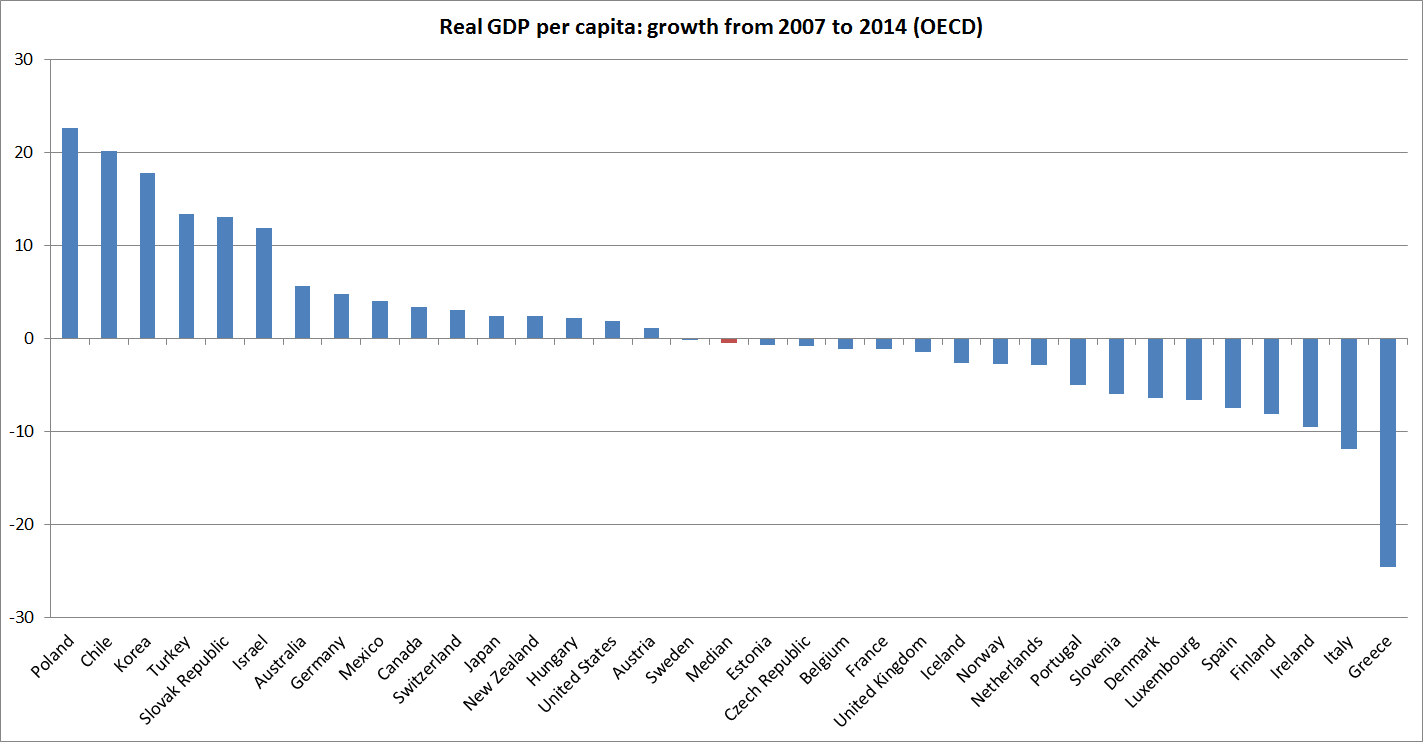
Data, of course, are a problem.  But I went to the OECD databases and got their PPP estimates for annual per capita real GDP.  They have 2014 numbers for only around 60% of the member countries, and for the others I simply updated the 2013  numbers with some plausible guesses.  Here is total growth in per capita GDP for each of these countries since 2007.

2007 to 2014

The median OECD country has had no per capita growth over those seven years.

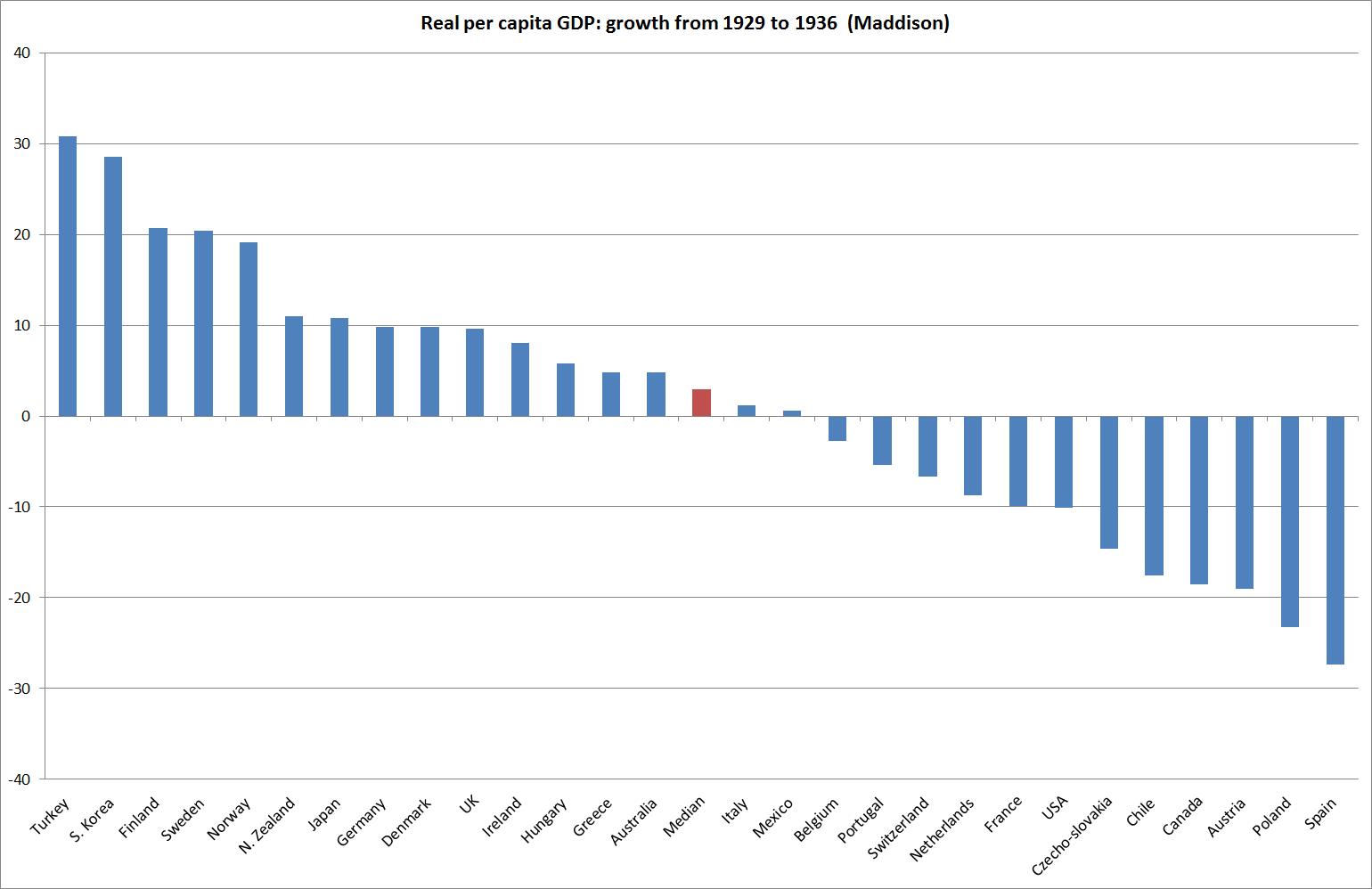
Angus Maddison’s estimates are the standard resource for looking at earlier periods.  He has estimates for most of the current OECD countries, and the chart below shows total growth in real per capita GDP from 1929 to 1936 ( also a seven year period).

1929 to 1936b

I wouldn’t want to make too much of these comparisons.  Data for the early period are unofficial, but careful, scholarly estimates, and data for the more recent period are still subject to considerable revisions.  Maddison used 1990 prices –  far distant in time from the 1930s, and even the OECD numbers use 2005 prices.  For individual countries prone to terms of trade fluctuations, those choices around prices can matter.  But we can only use the data we have.

The point isn’t to say that the most recent period has been as bad as the Great Depression – in most countries, the slump in the early 1930s was much deeper,  both in output and in employment (although the recoveries were also faster).   But  recent outcomes have been very bad  – across a group of 30 or so advanced countries, to have little or no growth over seven years has no peacetime precedent outside the Great Depression.  The Great Depression was, with hindsight, a failure of demand – TFP growth in the US, for example, was very strong during those years.  Perhaps it is different this time, and the limits of innovation were reached some time ago.    But I’d be reluctant to bet on it, when inflation is so low and the near-zero bound on nominal interest rates appears to have become an increasingly binding constraint.

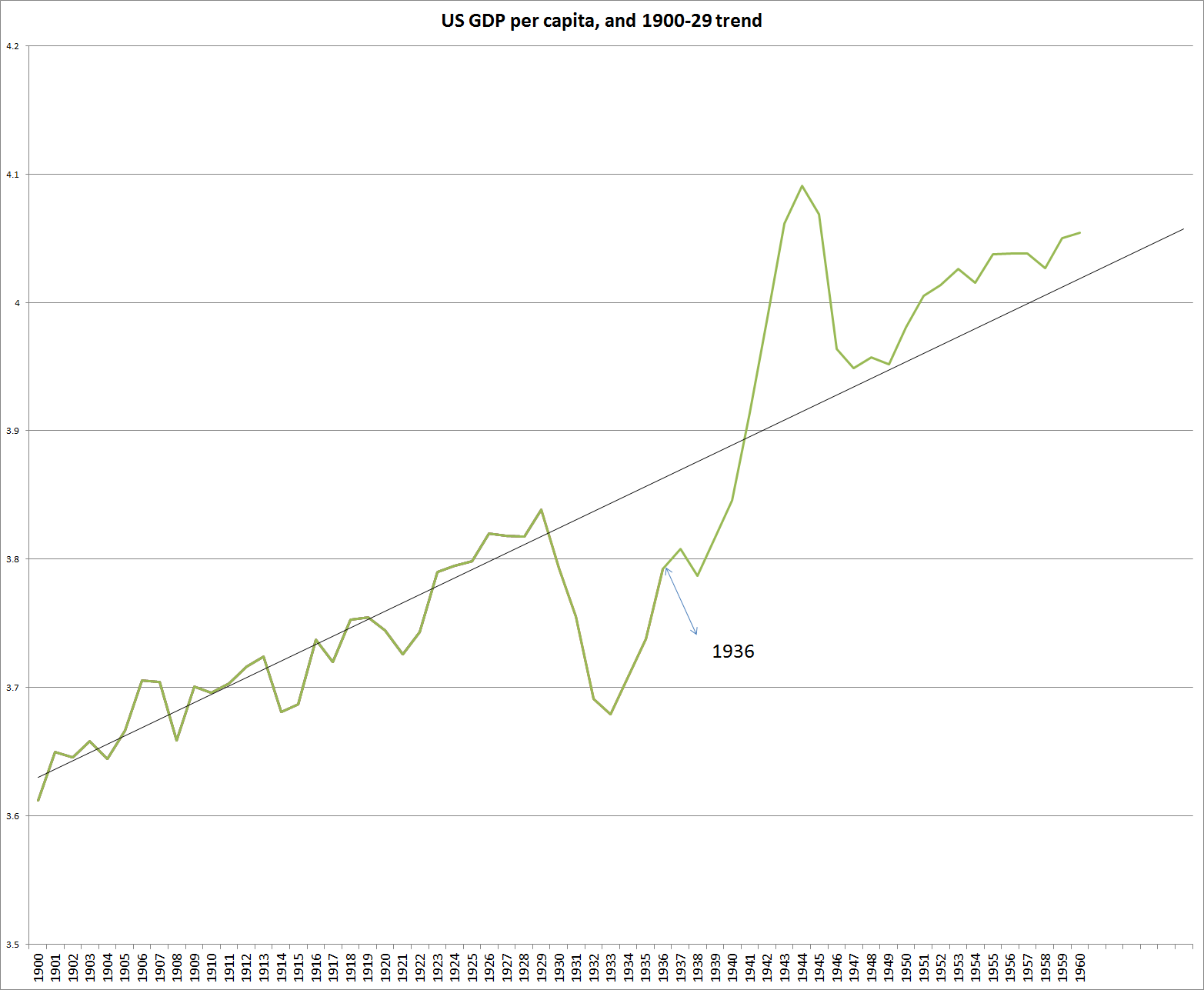
It is well-known that real GDP per capita in almost every advanced country is now well below the pre-recession trend.    Perhaps it will stay permanently lower.  But it is worth reminding ourselves of the US experience.  Estimates of real GDP per capita have stayed pretty close to a fairly constant trend for 150 years.  Two episodes looked like they might foreshadow material deviations: the last few years, and the 1930s.

1936

By 1936 US real incomes had been recovering strongly for a couple of years, but were still well below pre-Depression trends.  Many probably judged those to be permanent losses, and by 1936/37 the authorities were comfortable with tightenings in both fiscal and monetary policy.  But, in time, real per capita GDP came right back to something around the pre-Depression trend.  Tighter macro policies probably only slowed the rate at which people got back to work.