More housing risks….in the US

Last month I wrote about Peter Wallinson’s book Hidden in Plain Sight, about the role that Federal government interventions, and mandates, in the US housing finance market had played in the US housing credit boom of the late 90s and early 2000s.  Wallison argued, pretty persuasively to me, that it was these interventions that drove down credit quality and which meant that when house prices in the US fell, the losses to lenders were large – much larger than has typically been seen when house prices have fallen sharply in other countries.  Those losses in turn –  and the uncertainty around them –  was the catalyst for the US-centred financial crisis of 2007-09.

The US government has had a very large role in the housing finance market for decades now.  That has become quite unusual by the standards of advanced market economies.  Take New Zealand, by comparison.  In the early post-war decades, most first home buyers got a mortgage from the State Advances Corporation.  Indeed, the Monetary and Economic Council in their 1972 report on Monetary Policy and the Financial System reported that in 1965 just over 50 per cent of all outstanding mortgage debt advanced by financial institutions was held by the State Advances Corporation.
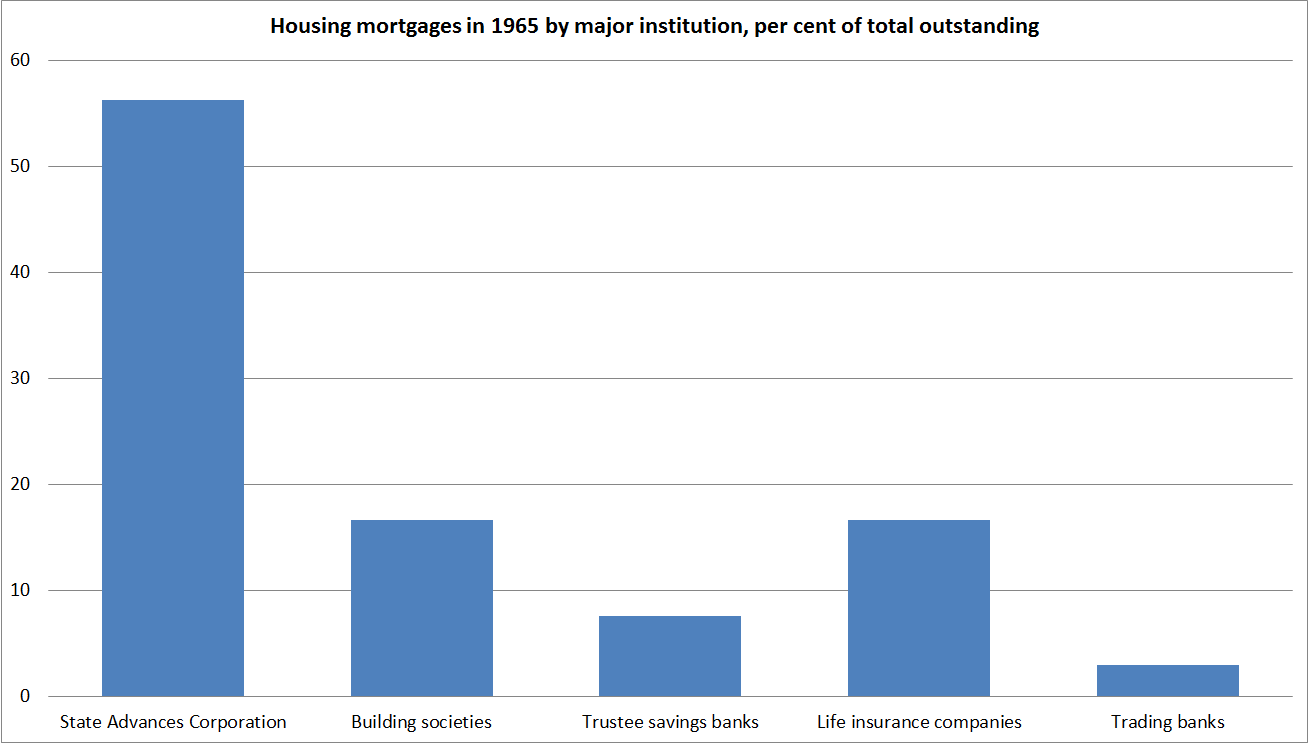
sac

That lending didn’t go bad for a variety of reasons –  overall debt levels were low (relative to GDP or household income), inflation increased, and credit rationing was pervasive (SAC dominated the market, but government policy was focused on administrative measures to restrain excess demand and so even SAC lending standards were not overly liberal).  By contrast, any government-provided or government-guaranteed mortgages in New Zealand now make up a derisory share of the market.  That has been the trend in most advanced economies in recent decades.  Housing debt is now initiated by private lenders, and while those lenders have at times made mistakes, or got over-exuberant, the losses on housing loans have not typically been large enough to threaten the health of the system.

The United States was different.  Not only did the government stay actively involved, but possibly in the worst possible way: mandating greater access to credit in a system where the private rewards from complying (and private costs from failing to comply) were very high.  State Advances Corporation managers did not have the sorts of bonuses and options at stake –  let alone the potential for merger approvals to be withheld –  that characterised the US.

But I’m not writing about this today simply to rake over history, but because in some respects the US government involvement in the housing finance market has just got worse since last decade’s crisis.  Around 80 per cent of all new residential mortgages initiated in the US now have a federal government guarantee.

This new short piece from Stephen Oliner, a former senior Fed official and now a fellow at the UCLA Ziman Center for Real Estate, outlines some of the facts and some of the risks.  (The FHA is the Federal Housing Administration, which accounts for a quarter of all government guaranteed mortgages.)   Oliner writes:

A few statistics about FHA loans are sufficient to dispel the myth that only pristine borrowers can get a mortgage. In recent months, the median credit score for borrowers who took out an FHA-guaranteed home purchase loan was 673. About two-thirds of all individuals in the U.S. have a higher credit score than that. FHA’s credit standards are loose as well for two other primary determinants of loan risk: the size of the down payment and the monthly payment burden. The median FHA borrower makes a down payment of less than five percent. If the borrower were to turn around and sell the home, the agent’s commission and other costs would exceed five percent. Hence, the median borrower is effectively underwater on day one. Second, many FHA-guaranteed loans have onerous monthly payments relative to the borrowers’ income. In fact, the payment-to-income ratio for more than four in ten FHA borrowers exceeds the ability-to-repay limit that was set in the recent Qualified Mortgage rule. This is a not a picture of tight credit.

The default rate on these FHA loans, while relatively low in today’s benign environment of solid job growth and rising home prices, would increase substantially in an ordinary recession and would skyrocket if we have another financial meltdown. To gauge the vulnerability of recently originated mortgage loans, AEI’s International Center on Housing Risk publishes every month the results of a rigorous stress test, the National Mortgage Risk Index (NMRI). The NMRI uses the default experience of loans originated in 2007 to estimate how recent loans would perform if hit with a shock akin to the 2008-09 financial crisis. The index shows that nearly 25 percent of recent FHA loan borrowers would default in that scenario. This would be exceptionally harmful, not just to the borrowers, but also to the neighborhoods in which they live and to the taxpayers who would have to make good on the FHA’s loan guarantees.

Note that well: the median FHA borrower –  and typical FHA borrowers have low credit scores –  has a down payment of less than 5 per cent.

The US systemic risks are not nearly as great as those in 2007.  The total stock of mortgage debt is growing much less rapidly, and so far most US housing markets seem less overheated.  But it is a reminder both of how hugely distorted the US housing finance market is, and a contrast to the sorts of housing finance markets we see in New Zealand, Australia, or the UK.  In those latter countries, private lenders make their own assessment of the riskiness of the loans they are making, and of the wider market.  And those private lenders have their own shareholders’ money primarily at stake.  The risks here are simply very different from those in the United States –  both pre-crisis, and now.  For that, we should be very grateful.  But we also need to recognise that it is not primarily a matter of grace, but of superior policy.  When governments stay out of markets things are  – generally – much less likely to go spectacularly wrong.
Some bigger picture thoughts prompted by Budget day

Some further, slightly scattered, thoughts prompted by the Budget.

I can’t get excited about the question of which year a surplus is finally recorded.  Apart from anything else, the government’s interest costs include an inflation-adjustment component (medium-term inflation expectations are still around 1.85 per cent per annum).  That is effectively a repayment of principal, not an operating cost.  A modest deficit is consistent with inflation-adjusted balance or surplus.  And if one is content to have a positive target level of debt –  as those on both sides of politics seem to be –  then a small deficit each year is still consistent with a stable or falling ratio of debt to GDP.  We probably should be a little more worried about the continuing structural deficits, especially once an adjustment is made for the above-average terms of trade New Zealand has been experiencing.  High terms of trade should have made it easier than otherwise to get back to balance.   Then again, the Treasury appears to be quite optimistic about the future path of the terms of trade – let’s hope they are right.

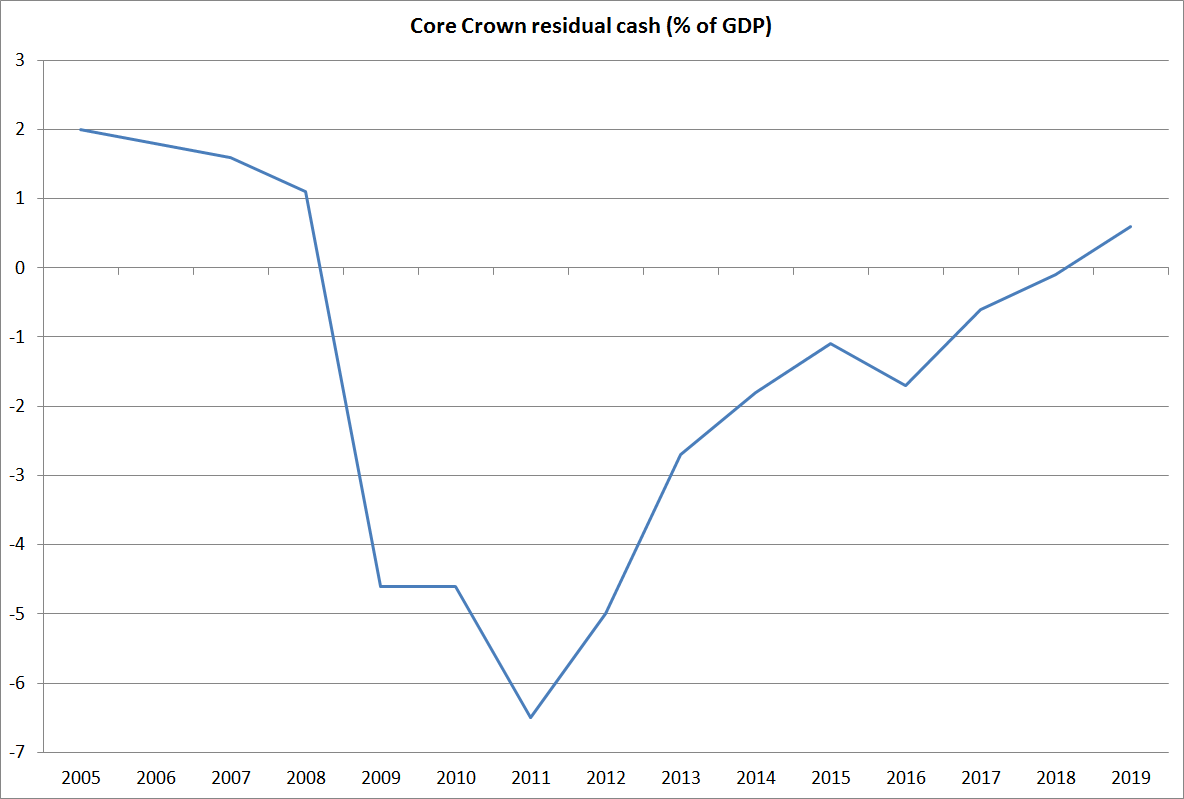
When I went to Treasury for a couple of years, one of their more sage observers counselled me to focus on the core Crown residual cash balance (just like analysing a set of corporate accounts – look for the cash). That measure includes all the gains from the buoyant terms of trade, and the cycle peaks, and still doesn’t get to balance for another three years.

residual cash

Perhaps the more important question is how much debt should governments aim to have.  We like to think of New Zealand government debt as quite low.  Debt is often quoted as a ratio to GDP, but if we take government gross debt as a percentage of government revenue, that ratio is now around 130 per cent – not so different from the ratio of household debt to disposable incomes that often seems to trouble observers.  Net debt is certainly lower, but a considerable chunk of the financial assets are in the highly volatile New Zealand Superannuation Fund (which I have been meaning to write about).

gross debt

Looking at the tables in the last OECD Economic Outlook, six OECD countries currently have positive net government financial liabilities (Estonia, Finland, Korea, Luxembourg, Norway and Sweden).  Some argue for the government to run net assets, to counter the effects of the welfare system in deterring private savings.  Others could construct a case for a positive net debt, because of the significant real assets governments own (some of which are, arguably, productive).  Those effects go in opposite directions.  Personally, I’m not convinced there is a case for governments holding large net assets, but perhaps we should be looking at reframing the local debate, and aiming to see net government debt at least fluctuate around zero.    Shakespeare’s “neither a borrower nor a lender be” has some appeal as a medium fiscal strategy.  It won’t be a textbook public finance strategy, but those particular textbooks don’t give much weight to the failures, and weaknesses, of governments.  Aiming for something around zero would also mean citizens just didn’t have to worry about government debt, one way or the other.

As a strategy for normal times, I also quite like the longstanding Swedish fiscal rule, of aiming for a 1 per cent of GDP structural surplus (although I see that the current Swedish government is looking at scrapping it).  No one can do structural adjustments particularly accurately in real time, but a 1 per cent structural surplus target is a cautious pragmatic second best approach.  If you get it right, debt will be low when crises hit – and they eventually will.  But often enough you will misjudge your how structural your surplus is.  But if you think you are running a 1 per cent surplus, and it later turns out that it was in fact a structural deficit (if, say, potential GDP turns out to have been lower than was thought) you are most unlikely to be in major fiscal problems.  Getting back to balance from a 2 per cent structural deficit isn’t likely to be that hard, or that urgent.

And, on the other hand, aiming for no more than a 1 per cent structural surplus deliberately foreswears the over-optimism of those who believe that very large swings in structural fiscal balances can act as effective macro-stabilisers in boom times (ZLB periods might be different).  In fact, running up large surpluses in boom times – when no one knows how long booms will last –  just tends to set up an electoral auction.

The previous government in many ways deserves a lot of credit for keeping spending in check for their first six years, but the structural surplus in 2006 peaked at 4.7 per cent of GDP (OECD estimate). Those huge surpluses just set up an electoral auction in the 2005 election campaign.  No political party will ever want to be in the position of allowing their opposition to spend the surplus their way –  those choices, about priorities, are a large part of what politics is about.  And the large surpluses built up in the early 2000s didn’t even do much to ease pressure on monetary policy, because they were run up well before the peak pressures on resources (2005 to 2008).  Quite possibly, overall macroeconomic management in New Zealand over the last 15 years would have been a little better if piecemeal adjustments had been made throughout.  We’d never have got into a position where we had highly stimulatory discretionary fiscal policy in the period (2005-2007) of greatest pressure on resources (and on the exchange rate).  And it would also have avoided a situation where Treasury, applying its best professional judgement, finally determined only just before the great recession of 2008/09 that the revenue increases looked permanent.  A high stakes judgement that turned out to be quite wrong.  Fiscal institutions, and ambitions, need to take more serious account of the severe limits of anyone’s knowledge.  A Fiscal Council, as the New Zealand Initiative and the former director of the IMF’s Fiscal Affairs Department have recently called for, might explore some of these issues.  Or a Macroeconomic Council might?  Then again, our academics and think tanks might lead such debates,

In passing, it is worth noting that the Reserve Bank is always curiously reluctant to analyse sovereign debt risk in their FSRs, even though the New Zealand government would be by far the largest single-name credit exposure of any of the banks.  And the New Zealand government last defaulted on its debts some decades more recently than the last time a New Zealand bank defaulted on any of its debts.  In a through the cycle sense, how robust are the risk weights on domestic sovereign debt exposures?  I’m not suggesting that the New Zealand government is in any near-term danger of defaulting, but then neither are the banks – apart from anything else, the Bank’s stress tests told us so.  The Reserve Bank tends to assume that governments can always just increase taxes to pay their debts, or inflate it away, but the historical track record is that they don’t always do so.  Sovereign debt defaults are simply not that uncommon.  We’ve done it.  The US and UK have, and Reinhart and Rogoff reminded us of the rather long list of others.

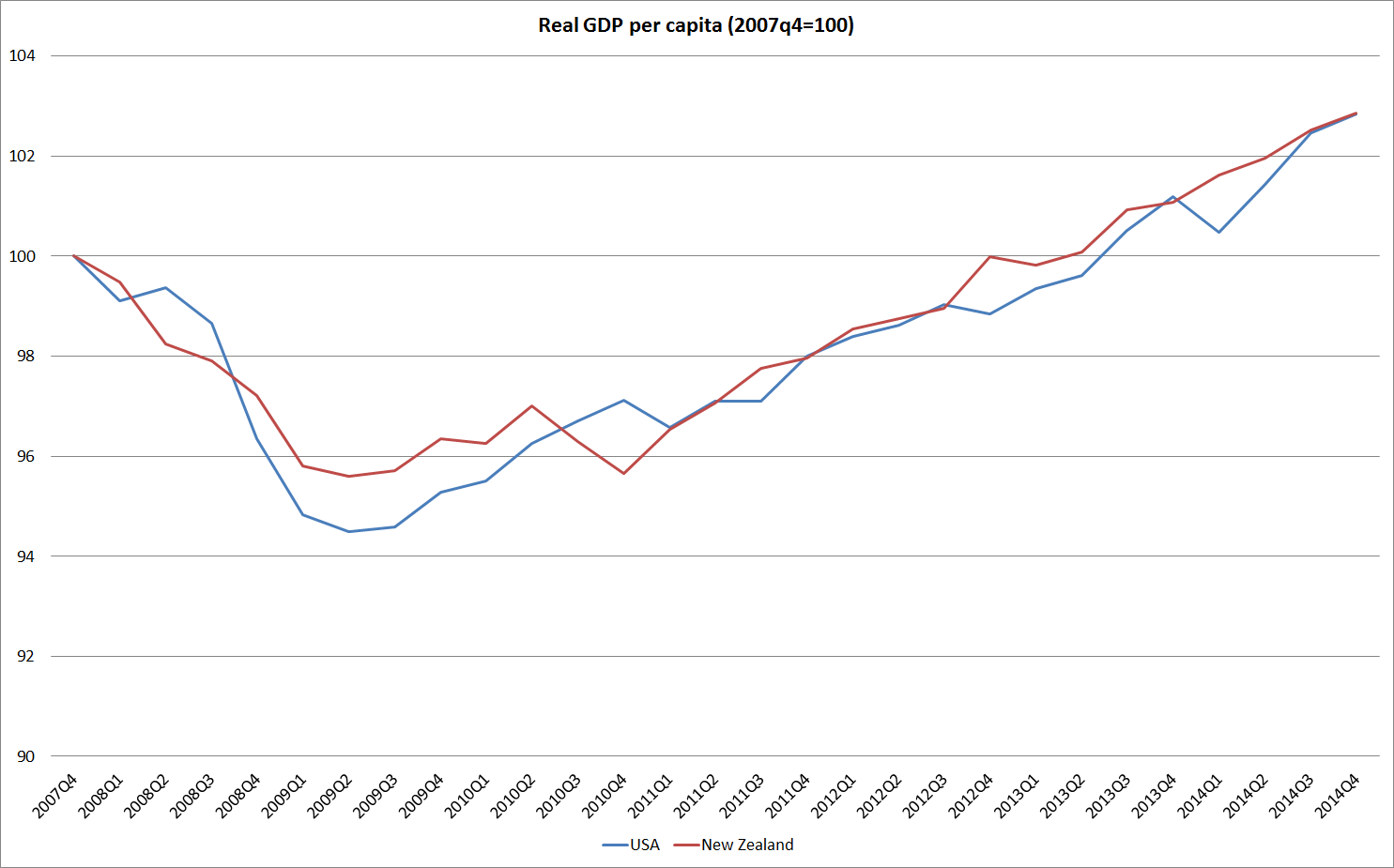
But to return to the Budget, perhaps the saddest aspect is that there is no sign of any serious effort to turn around New Zealand’s decades of relative economic decline, or indeed to materially alter the state of affairs that sees 10 per cent of the working age population on welfare benefits.  Another year, another wasted opportunity.  There is a line in the Bible, “to whom much is given, from much shall be required”.  I doubt history will look that kindly on Key, Joyce and English, or Clark, Anderton, and Cullen –  stewards of our country’s affairs for the last 16 years between them. .  It is not that the macroeconomic stewardship has been that bad, under either government, but both seem to have been content to preside over whatever direction the ship is taking, rather than exercising effective and persuasive leadership to make of this country what it once was, and again could be.  The common line is ‘ah, but at least we avoided a financial crisis”, but to what advantage when our overall economic performance in recent years has been as bad as that of the United States, the country at the heart of the crisis, despite having had the best terms of trade in decades.

nz vs us

Jordan Williams does this better, but…

The government’s Budget was delivered yesterday.  I’ll post a few more analytical thoughts later, but this post is just a few scattered observations on individual measures:

  • Another $10m for the SuperGold card public transport subsidies.  Really?
  • A new tax on international travel.  I wonder if the government looked at the possibility of levying these costs on, for example, the apple and kiwifruit industries, for whose benefit most of the biosecurity apparatus seems to exist?  Are those industries really economic?
  • Scrapping the $1000 sign-on bonus for Kiwisaver is a good move, and perhaps next year they could scrap the $500 tax credit, and then abolish the scheme altogether (as a statutory provision).  At present, there is no evidence that Kiwisaver has raised the national savings rate at all and for people with both Kiwisaver accounts and mortgages the effective after-tax returns on funds held in Kiwisaver accounts must be pretty low (mortgages are repaid out of after-tax earnings, and tax is paid on earnings on Kiwisaver funds).   A more thoroughgoing review of capital income taxation, with a view to lowering it, would be a better step.
  • Radio New Zealand often doesn’t find very sympathetic people for its interviews.  As I was making lunches for my children this morning, I heard a benefit recipient complaining that the $25 benefit increase would only pay for buying a couple of school lunches for his kids.  That didn’t sound quite right:  On the one hand, if he really isn’t giving his kids lunches now, the increase must surely make a considerable difference.  And on the other hand, I’m pretty sure that the total cost of my three kids’ school lunches for a week, home baking included, is less than $25.  Incidentally, the Dom-Post reports that the benefit increases are around 8 per cent.  That is not small – real GDP per capita has increased by only that much since June 2005.
  • And does the government really have its priorities right when we still fritter money away on a Retirement Commissioner, a Children’s Commissioner, a Ministry for Women, a Ministry of Tourism, and a Ministry of Pacific Island Affairs.  I could go on: why are we funding a Reserve Bank museum (in what would be prime Wellington café space) or a “state of the nation” report answering the question “Who are NZ’s ethnic communities?”  And that is before we ask more serious questions about $400 million more to Kiwirail, and lots more to UFB (to which I have a jaundiced view after asking a senior minister at a forum some years ago why there had been no cost-benefit analysis of government spending in this area, to which he responded that one was not necessary because he knew the answer).
  • One hopes (surely?) that the reference in a press release to “up to $52 million” to replace a wharf on the Chatham Islands was a typo.  Then again, we are giving away money to a spa operator in Rotorua, so perhaps not.

Dairy debt

I’ve had a couple of questions about risks around the dairy debt, and since the sector intrigues me – and my wife’s family has quite a few present or former dairy farmers – I dug around a little more.

The Reserve Bank publishes agricultural debt data monthly, but debt by agricultural sub-sector is only available annually, as at the end of each June.  Last June there was $34.5 billion of dairy farm debt.  In the year to the end of March 2015, agricultural debt grew by 6 per cent.  If that was representative of dairy, there will be around $36.5 billion of dairy farm debt by the end of this June.

As I noted last week, the rate at which new dairy debt has been taken on (and made available by lenders) has slowed markedly since around 2009.  Dairy debt grew at an average annual rate of 17 per cent from 2003 to 2009, and by around 4 per cent per annum in the six years since then.   Last week I showed the chart of dairy debt to total nominal GDP –  it rose sharply until 2009/10, and since then has fallen back a bit.

A commenter reasonably pointed out that nominal GDP (incomes of everyone in the country) doesn’t service dairy debt.  That is quite true –  although any aggregate debt ratios (except perhaps those involving government debt) have somewhat similar problems.  My household’s income isn’t servicing any mortgage debt either, and yet charts of household debt to GDP or to disposable income are quite common. And people who have debt are different, in a variety of ways, from people who don’t have debt.  For some purposes, these sorts of ratios are useful, but sometimes they can mislead.   Micro data are great when they are available –  and I commend the work the Reserve Bank has done in using the data that are available for dairy.  As everyone recognises, dairy debt is very unevenly distributed: plenty of farmers have no material debt at all, while others –  often the most aggressive and optimistic industry participants –  have huge amounts of debt.  A net $25 billion has been taken on in only 12 years.  Unsurprisingly, there were some nasty loan losses in the 2008/09 recesssion.

But sticking with aggregate measures, what about some other denominators?  This chart shows dairy debt as a percentage of annual dairy export receipts.

dairy2

The last observation is an estimate –  using the 6 per cent debt growth for the year to 2015, and assuming that the June quarter’s dairy export receipts bear the same relationship to the June quarter of 2014, as the March quarter of 2015 bore to the March quarter of 2014.  It will be wrong, but any error won’t materially affect the picture.  The stock of dairy debt this year will be just under 2.5 times the latest year’s dairy export receipts (industry sales, if you like).  Note that that is less than the average for the 12 years for which we have data.  That just reflects the fact that the fall in global commodity prices takes a while to feed into actual dairy export receipts.  On present trends –  including another fall in the GDT price yesterday – dairy receipts will fall a lot in the coming year, unless the exchange rate were to fall sharply.  But it is hard to envisage, at this stage, that the fall in dairy receipts will be enough to take the ratio of dairy debt to exports above the previous peak.  At a time when there was a lot of very new debt, reflecting exuberant attitudes among lenders and borrowers alike, that previous peak generated a nasty fall in rural land values, and some material losses for lenders, but no systemic threat.

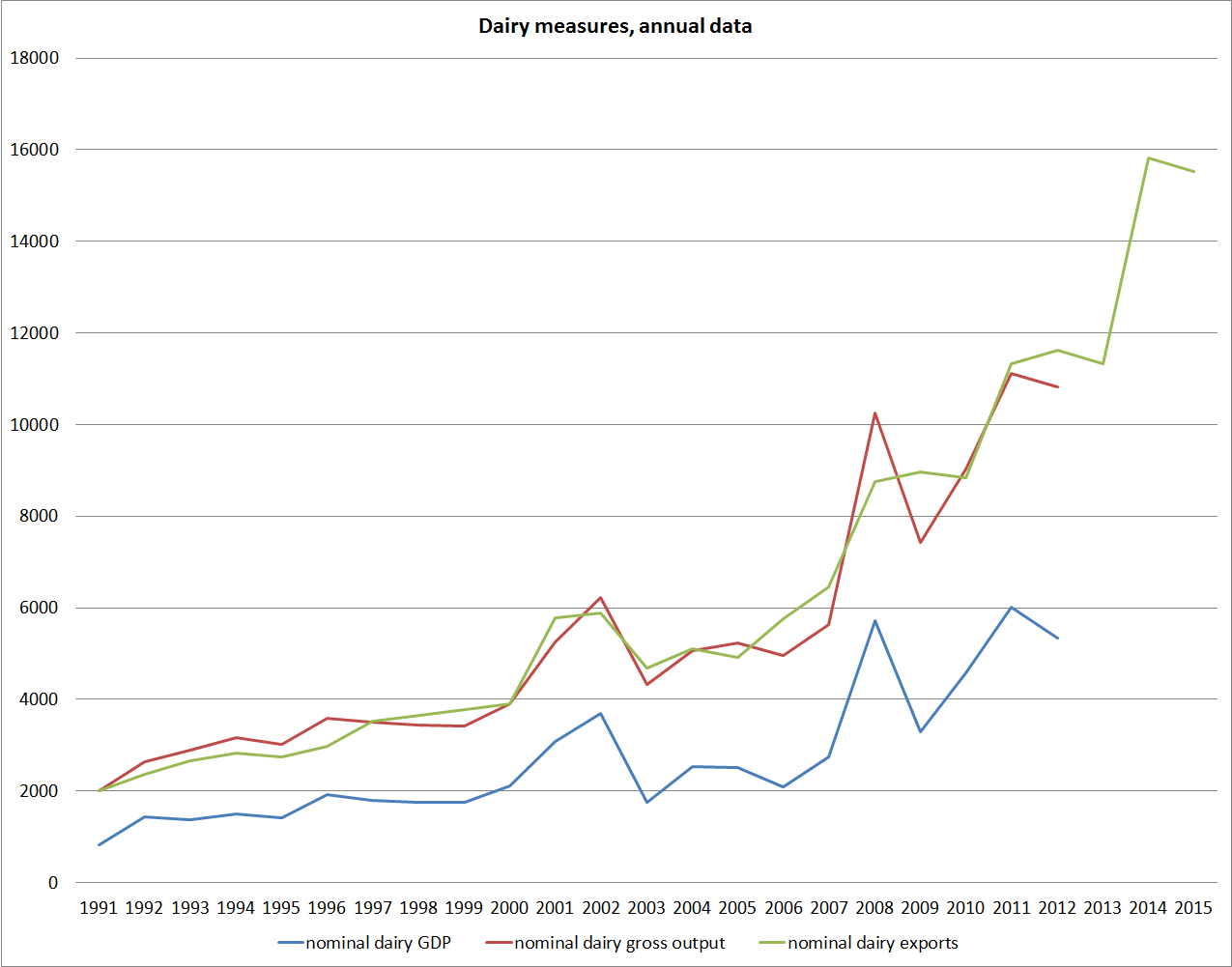
Statistics New Zealand produces annual data on the GDP and gross output of the dairy sector.  Unfortunately, it is only available with a considerable lag.  Fortunately, dairy export data and dairy sector gross output data line up quite well.

dairy3

When the data are available, we will no doubt see that dairy sector gross output and GDP rose quite sharply over the last couple of years.  The year to March 2015 will no doubt be a record high (in as much as record levels of nominal variables mean very much).  And then it is likely to fall back.  But again, on international dairy prices as they stand now, and the exchange rate as it is, it seems unlikely that nominal gross output or GDP for the dairy sector will fall much below the previous peaks – $10 billion gross output, and $6 billion of GDP.  If so, again it is difficult to see where material banking system stresses could arise from –  even though it will no doubt see some more exits, and quite a bit of nervous hand-holding by the banks.

It is worth briefly reflecting on the $6 billion of dairy GDP.  That does mean that dairy farmers on average have $6 of debt for every $1 of GDP they generate –  and among the indebted farmers that ratio will be much much higher.   That would be much higher than the ratio of household sector debt to household sector income, but then much of the household debt is supporting consumption not production.

So what could go really wrong?  The usual story around dairy debt is that if New Zealand’s export commodity prices collapse then the exchange rate should also be expected to fall sharply, mitigating the adverse impact on New Zealand dollar prices, and probably on local rural land values too.  That hasn’t happened so far.  There are some obvious reasons, including the  Reserve Bank choice to hold policy interest rates above the level that was required to have kept inflation on target.  And weak as dairy prices are now, our overall terms of trade still don’t look likely to fall to any sort of historically low level this year.   But if global dairy prices don’t fall much further, and the exchange rate hangs around current levels, or falls, there isn’t likely to be any systemic threat arising from the dairy debt.  The nightmare scenario is one in which, for some reason, the exchange rate rises sharply from here, even as commodity prices stay weak.   One possible scenario we toyed with a couple of years ago was a very disruptive new euro-area crisis, in which somehow currencies like the NZD and AUD became seen as some sort of refuge in the storm.    It isn’t likely, but then tail risks matter.  The experience of 2008/09 also argues against it: then both the NZD and AUD fell very sharply as speculative risk appetite unwound, even though the crisis had nothing directly to do with our two economies. It would seem likely that, eg, a disorderly break-up of the euro would be at least as large a trigger for hunkering down, and a  quick flight to safety, that didn’t involve a surging NZD TWI.

I noted last week that deflation remained the biggest (if remote) medium-term threat to the stability of the New Zealand financial system, as its loan books are structured currently (debt ratios pretty flat, debt stocks growing slowly).   But the dairy sector debt should be relatively immune to that threat.  I think it is pretty common ground that if the OCR were ever cut to zero, or slightly negative, the NZD TWI would fall sharply,  The main attraction in holding NZD assets over the years has been yield pick-up, and when that vanished-  as it did in 2000, when the Fed funds rate briefly matched the OCR –  so does any strength in the NZ exchange rate.  Of course, during the Great Depression deflation did pose huge problems for New Zealand’s farm debt, but getting a downward adjustment in the exchange rate then was a much more difficult and political process.  The then Minister of Finance resigned in protest when the government finally imposed a devaluation –  these days if things went badly a sharp fall in the exchange rate would seem much more likely to be welcomed.

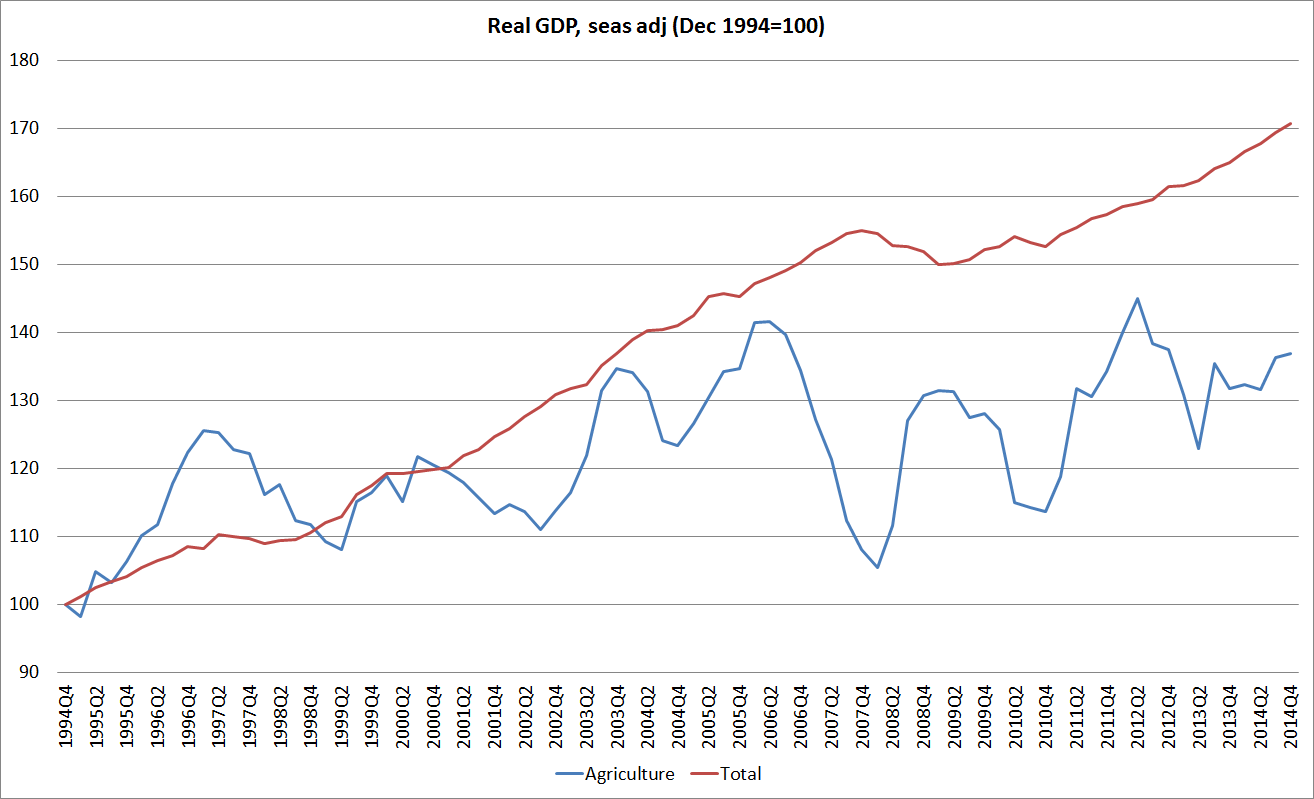
And, finally, one of the more sobering graphs I’ve seen in recent years ( there are many to choose from).  This is real agricultural sector GDP, which is available quarterly (albeit prone to considerable revisions), shown alongside total real GDP.

ag gdp

There is quite a bit of variability of course  – droughts etc  – and this is the whole agricultural sector, not just dairy, but over the 10 years or so that the terms of trade have been strong there has been almost no growth at all in real agricultural sector GDP.  Representatives of the manufacturing sector are prone to lament how manufacturing activity has been squeezed out, but actually even farm sector GDP has been tracking well below growth in total real GDP.   In some respects, things might be a little better than the picture suggests.  High dairy prices have encouraged greater use of more intensive production systems –  more irrigation and more supplementary feed.  Those inputs allow the production of more outputs, and the outputs can be sold for a higher price than previously.  In other words, more money might be being made in dairying, even if the real (constant price) value-added in the diary sector hasn’t changed much.  Ultimately it reflects the fact that there has not been much business investment taking place in recent years in response to the higher terms of trade – a very different picture from what was seen in Australia.  If commodity prices settle back at pre-boom levels that may be no bad thing[1] –  fewer wasted resources –  but if, as the optimists believe, the long-term prospects for global agriculture, and the sorts of products New Zealand produces in particular, are very good then it might end up looking like something of a last opportunity.   Daan Steenkamp wrote up some of this material at more length in a Reserve Bank Analytical Note last year.

Nasty financial crises usually follow fairly hard on the heels of periods of exuberance –  surging asset prices, surging credit stocks, downward revisions in credit standards, and so on.  In respect of dairy, all of those things were present in 2008, but they haven’t been in the last couple of years.  That suggests that the systemic risks associated with the high level of dairy debt are low.  Yes, an overhang of high debt stocks could still cause severe problems if a particularly unusual set of circumstances were to arise –  there is always a hypothetical shock which could, in the extreme, prove too much for an indebted industry – but that is simply to say that all business, in a competitive market economy, involves taking risk.  As consumers, we should not want it any other way.

[1] And the dairy component of the ANZ Commodity Price Index (expressed in USD terms) is now only around 10% higher in real terms than it was when the series began in 1986.

A letter of expectation to the Reserve Bank

In recent years a practice has grown up of government ministers writing to agencies (Crown entities and the like) in a “letter of expectation”.  These are formal documents, but they are not legally binding.  They do not replace, or in any way either reduce or extend the obligations of the agency concerned under either its own legislation, or under any relevant provisions of other legislation (eg the Public Finance Act or the State Sector Act).  But they can still play a useful role in setting out things that are particular priorities for ministers, and particularly aspects around the engagement of the agency with the minister concerned and the minister’s office.

For some time, the Minister of Finance has been sending an annual letter of expectation to the Reserve Bank.  I asked for copies of those the current Governor had received from the Minister of Finance  and –  after pretty well the full extent of the lawfully available time had been used, including extending the deadline by transferring the request from the Reserve Bank to the Minister of Finance –  I received copies in the mail the other day (the technology was a little surprising in this age of e-government, but still….).

The first thing to note is that letters of expectation to the Reserve Bank Governor are not routinely published.  A quick search suggests that those to many other government agencies are.  There are pros and cons to routine pro-active publication.  Do so, and any really sensitive points won’t be included in the letter, unless the minister concerned particularly wants to make a public point.  Then again, these are public agencies, and letters like these can affect the emphasis that agencies put on various aspects of their statutory powers and responsibilities.

These documents can be a bit of a grab bag.  Sometimes the minister himself really does have a point to make, about something in the relationship that isn’t working that well.  Sometimes the contents might just reflect a hobbyhorse issue of people in the relevant policy ministry (when I was at Treasury I made a few comments on draft letters of expectation to the then Reserve Bank Governor).   And a letter of a couple of pages can’t capture everything about the dynamic of an ongoing relationship.  But the letters do go out under the signature of the minister, in this case a long-serving senior minister, and the contents should tell us something interesting about what Bill English is looking for from the Reserve Bank.  The Reserve Bank is an interesting mix – an institution with a very high degree of operational independence in most of its function, but with some key powers reserved to the Minister of Finance.

Graeme Wheeler has received three letters of expectation from Bill English since becoming Governor.  The most recent was sent on 2 March 2015.  A copy of it is here:

letter of expectations

A few things struck me as interesting:

  • The focus is almost entirely on the regulatory functions of the Reserve Bank.  One senses that these must be where the pressure points in the relationship have been  –  around advance consultation and around the analysis underpinning regulatory and legislative proposals.
  • No questions at all are raised about the way that inflation has consistently undershot the midpoint of the inflation target range, even though the target is a formal agreement between the Minister and the Governor, in which the Governor has the operational freedom to adjust policy to meet the target, but the Minister has the prime responsibility for setting the target, and holding the Governor to account for his performance in achieving it.  I was a bit surprised by this omission.  It may reflect some sense, whether in the Minister’s office or in Treasury, that the Minister should avoid being seen putting pressure on the Governor in respect of specific OCR decisions.  That is fine, but the Minister is responsible for how the Governor exercises his considerable powers in this area, and the surprisingly weak inflation has now been around for a long time.  And there was that curious comment in the newspaper a few weeks ago about the Minister’s apparent concerns.
  • The Minister is formally asking the Bank to supply him with advance information on any significant institution regulated by the Reserve Bank “that faces a material risk of financial difficulty”.  At one level, one can understand this request – ministers don’t like being surprised –  but the administration of prudential policy is typically put at arms-length from ministers for good reason.  In many countries (perhaps especially less developed ones), ministers (and their friends and donors) have been too close to major financial sector participants.  Knowing that an institution is at risk –  because sensitive information about its finances has been disclosed to the Minister – does not give the Minister power to intervene, but it does increase the risk of political pressure being brought to bear on the Bank in respect of how it handles an institution in difficulty.    There are no easy answers to where the line should be drawn, but this feels like one of those situations where what is written down goes a little far.
  • 2015 is the first time that the letter of expectation has been copied, formally at least, to the Chair of Reserve Bank’s Board of Directors.  The Board exists largely as the monitoring agent for the Minister of Finance, and it must be helpful for them to have formally the document recording the Minister’s expectations of the Governor.
  • In the last two letters the Minister has noted that “I also look forward to the Reserve Bank’s analytical contributions to deepen our understanding of New Zealand’s economic performance and macroeconomic imbalances”.  Perhaps this is now meant largely as a ritual incantation.   There has been little sign of such analysis in the last couple of years and given the Bank’s apparently much tighter funding constraints (in the forthcoming Funding Agreement) it may not be realistic to expect that they will have the resources to make much contribution in this area.
  • In each of the three letters, the Minister has highlighted his desire to reduce the contingent fiscal risks associated with the banking sector.  He notes the existence of the OBR tool but wants to better understand “opportunities to reduce these risks further”.  At one level, that prompts a reaction of “just say no”.  Ministers, not central banks, make the choices in which banking failures become direct fiscal risks.    But there is also a balance here.  Even under OBR, it is generally accepted that for the tool to work the non-written-down component of the failed bank’s liabilities will need to be government guaranteed.  Many (including me) would argue that, in most circumstances, when a major bank failed the liabilities of the other banks would also need to be guaranteed.  Eliminating fiscal risks associated with bank failure –  or even reducing them much further from the already very low levels (see the Bank’s work on the implications of Basle III) –  would require either a rock solid political determination to let a failed bank fail (and either close, or be taken over quickly)  –  unlikely ever to be a time-consistent strategy –  or even higher  minimum capital requirements.  I think that, at current capital levels, the Modigliani-Miller proposition would hold, and higher capital requirements would not raise overall bank cost of capital.  But I’m sure the banks wouldn’t see it that way.  The Reserve Bank itself can’t quite make up its mind what it believes on that score, but I can imagine a great deal of lobbying of ministers (here and in Australia) if the Reserve Bank were to respond by looking to materially raise required capital ratios.

It was interesting to have the material.  It does add a little to our ability to understand the Reserve Bank and its relationships with the Minister (and Treasury).  Perhaps they could at least consider routine publication in future, as part of enhancing the transparency of the Reserve Bank.

(If anyone does want the letters from 2013 and 2014 they can email me.)

Some overnight reading

Last week I wrote up some thoughts on negative nominal interest rates, and how important it is that finance ministers and central banks start treating as a matter of urgency the elimination of the regulatory constraints and practises that make it impossible for policy interest rates to go materially negative.  If they won’t, they need to raise inflation targets, but that would be a distinctly inferior option.

In that light, it was encouraging to read the blog of Miles Kimball –  one of key academic proponents of action in this area – and learn that he was talking overnight on exactly that topic at the annual central bank chief economists’ workshop hosted by the Bank of England.  The annual BOE meeting is an important and interesting forum (I got to go once) and typically John McDermott, chief economist at the Reserve Bank, attends.  The link to Kimball’s slides (“18 misconceptions about eliminating the zero lower bound”) is here.

I don’t agree with everything in Kimball’s presentation.  In particular I still think he puts too much weight on government providing the answer, rather than just getting out of the way and providing greater scope for market innovation. But then there is (or should be) a much greater urgency to addressing the issue in most of the rest of the advanced world, where policy interest rates have now been stuck at or near zero for a depressing number of years now.

The obstacles to negative nominal interest rates have been around as long as banknotes, but haven’t mattered very much in the past  –  after all, despite the occasional peripheral discussions and local experiments during the Great Depression, there was then a mechanism to generate recovery –  breaking the link to gold.  That option isn’t available this time.  Kimball rightly compares creating the ability to take nominal interest rates materially negative to breaking off gold in the 1930s.

In countries where interest rates have not yet hit zero, such as New Zealand and Australia, the Minister of Finance (who controls the gateway to taking legislation to Parliament), the Treasury (as chief economic adviser to the governments), and the Reserve Bank (as, in essence, implementation agents –  and to some extent the institution that benefits from the current system) need to be planning now to ensure that these old restrictions don’t impede the ability of our countries to cope with the next severe downturn.  This isn’t just something of academic or obscurantist interest – it is about unshackling one limb of macroeconomic policy so that it is ready when it is needed.  And as I’ve noted before, at 3.5 per cent our OCR is less high now than most of policy rates were in 2007 in those countries now stuck with the near-zero lower bound constraint.

And two other brief items:

I drew attention some weeks ago to the work Ian Harrison had been doing on earthquake strengthening requirements, an area of policy which appeared to have the makings of another government “blunder”.   A group Ian is associated with called EBSS (Evidence Based Seismic Strengthening) now has a website, and it includes a brief critique of the government’s revised proposals in this area announced earlier this month.  Those changes seem to amount to a step forward, in reducing the extremely heavy cost burden that the government had planned to impose on building owners, to mitigate extremely low probability and low cost risks.

However, as the EBSS paper notes, the new proposals still seem a long way short of ideal.  Now that I’m based at home I’m often down in the Island Bay shopping centre.  Many of the older buildings there –  including one housing the excellent and popular butcher –  are yellow-stickered, but I neither notice among other people, nor feel any myself,  any unease in using them.  Sometimes I wonder if that is just a short-sighted perspective, oblivious to the risks, but that is where numbers help.  This quote from the EBSS paper caught my eye.

As a point of comparison, flying has similar characteristics to earthquakes. There is a very small chance that there will be a catastrophic event that results in death. The chance of being killed, per hour, when flying is 4000 times greater than being in a typical Auckland ‘earthquake prone’ building. For New Plymouth buildings it is about 600 times greater, and for Wellington 20 times.

We fly because we know that flying is very safe. But the Auckland, New Plymouth and Wellington buildings will be shunned because they will be falsely identified as ‘high risk’ when there is overwhelming evidence that they are not.

And finally China. I must have missed the reports of the recent Chinese government instruction to banks that they must keep lending on local authority projects even if those local authorities can meet neither interest nor principal commitments on existing debt.  Christopher Balding has an excellent summary of what an edict like that seems to mean.  As he puts it “the Chinese bailout is starting to bail fast”.

High house prices: a blunder of our governments

That was the title of an address I did to a group of several hundred investment management professionals in Auckland this morning.  The organisers wanted snappy titles: mine was inspired by the book, The Blunders of our Governments that I wrote about a few weeks ago.

The essence of my story is in this summary I gave them for the programme.

High and rising house prices in Auckland hog the headlines.  The tax regime and bank lending practices are largely irrelevant to what has gone on.   Instead, increasingly unaffordable house and land prices result from the collision of two, no doubt individually well-intentioned, sets of policies.  Tight restrictions on land use crimp the supply of the sort of properties most people want to live in, while very high target levels of non-citizen inward migration persistently boost demand for housing.  One or other policy might make sense, but together they represent a blunder that is enormously costly to the younger generation of Aucklanders.

I only had 20 minutes to speak, but a fuller version of my story, with a few more of i’s dotted and t’s crossed, is here.

High house prices a blunder of our governments

In a slightly intimidating approach (at least for the speaker), each presentation was rated electronically by each member of the audience as soon as it ended.  93 per cent of the audience claimed to “largely agree” with my story.  I’m sure that won’t be the general reaction, and as ever I’m interested in thoughtful comments etc.

A new housing tax proposal

I’m a bit pushed for time today, so just a fairly quick post on the latest housing “patent remedy”.

I was quite critical last week of the Reserve Bank’s latest proposed regulatory intervention in the housing finance market.  I noted that

The Auckland housing situation (a social and political scandal, as I’ve said before) calls for careful diagnosis, informed by experience and insights from the rest of the country, and remedies that deal effectively with the underlying issues and causes.

The Government’s proposed new  tax measure –  a brightline test in which gains on (almost) any sale of a non-owner-occupied house held for less than two years will be liable for income tax at the seller’s usual marginal tax rate-  doesn’t seem to fit the bill much better than the Reserve Bank’s new intervention.  It is also unrelated to the basic causes of the problem – laws and regulatory practices that impede the responsiveness of new supply, while at the same time other policy instruments actively drive rapid population growth in Auckland.  (Taking a medium-term perspective, almost anything else is largely irrelevant.)  It will be interesting to see what Treasury’s advice on the proposal was –  they have long-favoured a capital gains tax, but it would be surprising if they thought this was either good tax policy, or something well-targeted at the housing market issues[1].

Last week’s Reserve Bank announcement drew editorials praising the fact that someone, anyone, was doing something, anything.  There doesn’t seem to be anything similar this morning, but perhaps that is the nature of politics.

In fact, relative to the Reserve Bank’s announcement, there are some things to be said for the government’s announcement.

  • Neither announcement has an electoral mandate – and it is only eight months since the General Election –  but at least the latest announcement was made by Ministers, who are elected members of Parliament.  The public can oust MPs, and as Australia illustrates leaders (and ministers) serve only at the pleasure of governing party caucuses.
  • Whereas it is virtually impossible to mount a credible argument that not a cent can safely be lent, at any interest rate, to Auckland investor property purchasers at LVRs over 70 per cent, at least the two year bright-line test can defended as reducing the weight the tax system places on establishing intent.  Taxes should be levied based on actions (or even assets), not on highly intrusive bureaucratic assessments of intent.
  • The government’s announcement yesterday will require legislation, and media report that there will be Select Committee scrutiny.   Elected representatives will scrutinise the proposal, and the media will report on the process.  Contrast that with the Reserve Bank’s proposal, which will be shoehorned in under legislative provisions that were never intended for the purpose.  Submissions will be invited, but (unlike Select Committee submissions) we will see those submissions only after the final decisions have been made, and the unelected Governor will be judge and jury in his own case.  Yes, it is probably lawful, but it lacks some legitimacy.

But in addition to being ill-targeted, yesterday’s announcement looks as though it will add to the pro-cyclicality of government revenue.  In other words, more revenue will flow into the government’s coffer at the peaks of booms (when it shouldn’t need extra revenue) only for that source to dry up when downturns happen.  Pro-cyclical discretionary fiscal policy is something to avoid as far as possible –  see, for example, Anne-Marie Brook’s work –  and this change will only (slightly) worsen the problem.  On a much larger scale, this issue was a major problem in Ireland.

I’m not close enough to tax administration to know quite how this will work if house prices ever fall sharply, but if people can offset losses on a house sale against other income, it would be quite an incentive to realise one’s loss quickly (inside the two year window when one can avoid the intent test), potentially exacerbating the speed of a correction.  So in a severe housing downturn, will the government be writing cheques to housing investors who’ve punted and lost?  Even if losses can only be carried forward to be offset against any future gains, the procyclicality of revenue will increase and the risk of more procylical discretionary policy will rise.

Capital income is generally overtaxed.  That said, I’m not resolutely opposed to a theoretically pure capital gains tax.  With efficient asset market pricing, there are no rationally expected real capital gains.  Any actual gains and losses (of which there will be many) are then just windfalls.  One can treat them as taxable income/losses or not, and it is mostly just a distributional issue with no very material efficiency implications.  But that assumes:

  • All assets are subject to tax (not some assets, held by some types of people)
  • Gains and losses are treated symmetrically
  • Only inflation-adjusted capital gains (losses) are taxed
  • The CGT applies based on changes in market values, not realisations

I’m not aware of a single capital gains tax anywhere, ever,  that has met those tests.  Real world CGTs are distortionary in a whole variety of ways, including discouraging turnover and encouraging assets to be held not by those who can most efficiently hold and manage them, but by those who are at least risk of having to trigger a transaction.  Big investment funds might never need to trade a property, but an individual small business operator (eg a family with a single investment property) can face many possible changes in life circumstances which could compel a sale – including, but not limited to, redundancy or job relocation.  The PIE regime already started to skew the ground against individual holders of investment properties, and this measure will skew it a bit further.

In the end, yesterday’s announcement looks a lot like political theatre.  As ministers, and the Reserve Bank, have rightly noted previously, CGTs don’t change the character of house price cycles, and attenuated ones like this are even less likely to.  Some will feel better that “something is being done”, but it will just divert attention, and policy and legislative time, away from measures that grapple with the real issues.  My first reaction yesterday when I heard the announcement was to think of the Third Labour Government’s Property Speculation Tax in 1973, introduced at the height of an earlier house price boom.   We had a look at it when we did the Supplementary Stabilisation Instruments Report in 2005/06.  It also made good political theatre, distracting from the real issues.   Every asset price boom is a little bit different.  But like this proposal the Property Speculation Tax attacked symptoms and was largely irrelevant to ending the 1970s house price boom (which was followed by a multi-year very deep fall in real house prices).  Marked changes in immigration policy, and a collapse in the terms of trade which helped prompt an exodus of New Zealanders to Australia, had much more to do with that.  House prices are influenced by a whole variety of factors, but Auckland prices are only likely to fall very much very sustainably if there is some combination of a far-reaching freeing up of restrictions that impede supply and an end to the policy-fuelled population pressures.

UPDATE:  This article is interesting in light of the Reserve Bank’s response to my OIA last week in which the Bank confirmed that it had done no substantive analysis of capital gains taxes, and had provided no advice on such issues to a variety of ministers or agencies.  Since I inadvertently omitted the Prime Minister from the list, it is possible they may have given such advice directly to him, but it would be surprising then that nothing had been provided to Treasury (or IRD).

[1] The brightline test idea has been around for a while.  I found that it was referred to in the Supplementary Stabilisation Instruments Report the Reserve Bank and Treasury prepared at the request of the then Minister of Finance in 2006.

House price collapses, stress tests and the like – the RB speaks

I have been making the point (ad nauseum perhaps) that it is hard to reconcile the Reserve Bank senior management’s public anguishing about the threat house prices allegedly pose to the soundness of the New Zealand financial system with the results of their own 2014 stress tests, reported in the November 2014 Financial Stability Report.   The latest FSR does not even mention the earlier stress tests, despite the new regulatory controls the Bank is planning.

But in the Herald this morning –  not the Bank’s own statutorily-required accountability document – we find an official Reserve Bank spokeswoman quoted on the very topic.  Mary Holm, the Herald’s personal finance columnist had had a question from a reader about what would happen if house prices dropped sharply.  Surely, the reader suggests, banks would collapse?  So Holm went to the Reserve Bank for comment:

What does the RB think about the possibility of a property plunge. “Whether property prices could drop by half from today’s values is purely speculative,” she says. “Nevertheless, a 50 per cent drop matches some of the more severely affected economies in the global financial crisis such as Ireland.”

So they’re not ruling it out. But would such a drop cause banks to “collapse”? “The short answer is no, we do not believe so,” she says.

“The Reserve Bank conducts regular bank stress tests in collaboration with the Australian Prudential Regulation Authority. The most recent one was last year, and the results of it are featured in the November 2014 Financial Stability Report, pages 9 to 11, on our website.

“This stress-test exercise featured two imagined adverse economic scenarios over five years, one of which involved a sharp slowdown in economic growth in China, which triggered a severe double-dip recession in New Zealand. Among the impacts were house prices declining by 40 per cent nationally, with a more pronounced fall in Auckland – similar to your reader’s worst case scenario.”

So how would our banks fare?

“The Reserve Bank was generally satisfied with how the banks managed their way through the impacts of these scenarios, and we are comfortable that the New Zealand financial system is currently sound and stable, and capable of withstanding a major adverse event.”

So our own Reserve Bank, required to run prudential regulation to promote the soundness and efficiency of the financial system, is quite comfortable that, based on the asset structure of the major banks last year, our banks and our financial system would come through just fine if (Auckland) house prices were to fall by 50 per cent.

Note carefully, I am not misreading them as suggesting that our banks would always be robust to any such collapse in asset prices.  In other circumstances, with a different mix of loans on the books, the threat could be much much greater.  But as things stood last year –  and bank loan books haven’t changed much since then – the New Zealand financial system would be fine.  Recall that it is not residential mortgage loans that typically threaten banking systems, but construction and commercial property exposures.  The Reserve Bank spokeswoman mentioned the Irish case, but in Ireland it was reckless lending on a huge property development boom (commercial and residential) that played the central role in undermining the health of the Irish banking system, and in particular which brought down their most egregious lender , Anglo Irish Bank (read about it here).  We don’t have any such large scale credit-financed property development boom in New Zealand.

Which brings us back to the question, what does Graeme Wheeler think he is doing with his proposed new restrictions on banks lending to small businesses in the rental property market?  His spokeswoman just told us that the financial system was likely to be robust even if house prices fell 50 per cent, and his only statutory mandate is about the soundness and efficiency of the financial system.  His proposed new controls will impair the efficiency of the financial system, and his own spokeswoman says (what his FSR opened by saying as well) that soundness is just fine.  Dampening house prices temporarily just does not, and should not, figure as an objective in the Reserve Bank Act.

Just one other quick point on the Bank spokeswoman’s comments.  Holm reports her as saying:

“In the extremely unlikely event of a bank failure, our Open Bank Resolution (OBR) policy would apply. The aim of OBR is to allow a distressed bank to be kept open for business while placing the cost of its failure primarily on the bank’s shareholders and creditors rather than the taxpayer.

The first sentence of that statement is just wrong, as I’m sure the Bank now recognises.  Any decision to use OBR will not be a matter for the Reserve Bank, but for the Minister of Finance.  The chances of OBR being used in respect of a major bank have always seemed to me quite small.  It is a good tool to have available, and might be a credible option for the failure of a small New Zealand bank, but it has always only been one option to have in the toolkit (as the Bank reports here) , to present to the Minister of FInance at the point when a bank fails.   For the major banks, it is good to be able to scare the Australian authorities that we just might use it, but in most plausible failure scenarios OBR is much less likely than a government bailout.  And that is partly because New Zealand has not yet come to grips with deposit insurance.  Deposit insurance is  not an ideal policy by any means, but without it the chances that a Minister of Finance and his Prime Minister will agree to allowing widespread losses for retail investors seems vanishingly small.  That is a general proposition, not specific to the current government, but having bailed out every creditor of AMI this particular government does have form.

Monetary policy transparency – and the lack of it

The Reserve Bank makes much of its transparency around monetary policy.  A good example was this speech by central banking newcomer, Deputy Governor Geoff Bascand, which invoked a recent academic study by Dincer and Eichengreen, in which the Reserve Bank of New Zealand scored second on transparency, behind only Sweden’s Riksbank.

There is a range of different dimensions of transparency.   Central banks and monetary policy are generally materially more transparent, and open to scrutiny, than they were in the early post-liberalisation years.   But things aren’t necessarily so much more transparent than they were in earlier decades.  A fixed exchange rate, such as New Zealand had for many decades, was very transparent – probably easier to understand, and benchmark performance against, than the inflation target (with all its caveats and exclusions).  Reserve requirements on banks, and regulated interest rates were also very visible and open.  Price freezes were also transparent and, like them or not, LVR restrictions are rather more transparent than adjustments to minimum risk weights in bank regulatory capital frameworks.  More transparent policies are not always better policies than less transparent ones, but in respect of any particular type of policy more transparency will generally be better than less.  That is more about democracy, open government, and substantive accountability than it is about the ability of transparent policy to influence behaviour towards government ends.  On that latter score, the benefits of transparency are typically oversold.

Perhaps a useful distinction for thinking about the transparency of New Zealand monetary policy is between transparency about stuff one knows little about, and transparency about stuff one knows a lot about.  The Reserve Bank is very good about the former, and quite poor on the latter.

Let me explain.  Since the 1980s (and initially under the influence of the new Official Information Act) the Reserve Bank has been publishing economic forecasts.  No other central bank did so at the time.  For a long time the forecasts didn’t mean a great deal – I once sat in a meeting with Roger Douglas in which the then Deputy Governor memorably disowned the forecasts as “just those of the Economics Department”.  But by the mid- 1990s, as inflation targeting bedded down, economic and inflation forecasts became the centrepiece of how the Reserve Bank formulated, and talked about, monetary policy.  From 1997, and almost by accident, the Bank started publishing forecasts of its own actions.  A new model had a policy rule embedded in it, in which the interest rate adjusted to keep inflation, over the medium-term, near the midpoint of the target range.  The Reserve Bank of New Zealand was the first central bank to publish such endogenous interest rate projections.  It is still in a minority in doing so.  If one is going to publish forecasts, there are pros and cons to publishing an endogenous interest rate track (rather than, say, publishing economic projection based on current interest rates, or using market implied future rates).  My bias has always been not to have done so, but reasonable people can differ on that.

Economic forecasts take a lot of effort to put together, and a lot of effort to burnish and refine for publication.  They remain at the heart of the Reserve Bank’s Monetary Policy Statements, and interest rate announcements, more so than in many other countries.  And yet they contain almost no useful information.    The Reserve Bank publishes projections two to three years ahead, which in the case of the interest rate projections involves looked four to five years ahead (since interest rates work with a lag and are, in principle, set in response to the outlook for inflation pressures).  But no one knows anything very much about what will happen to the New Zealand economy, or that of the wider world.  Perhaps there might be a little bit of information in economic projections three to six months ahead, but beyond that the Reserve Bank has no useful information, and so can convey no useful information to the public or to markets.    The Governor might have a policy reaction function in mind (ie how he might react if things turn out the way the projections suggest) but that reaction function has never been disclosed and has probably changed over time (perhaps from quarter to quarter).

Suggesting that central banks don’t know much about the future should never have been a controversial proposition, but the last decade makes the point very starkly.  The Reserve Bank (like everyone else) was totally wrong-footed by the recession of 2008/09, and then has been consistently wrong about the outlook for inflation and interest rates since then.  I’m not particularly critical of them for that (after all, markets have mostly been more wrong, and other central banks almost as wrong).  It is the way the world is.  My point simply is that there is not much more information in a central bank’s medium-term economic forecast than in a horoscope.  And the horoscope takes a lot fewer expensive (and scarce) real resources to generate.

For all the rhetoric about forecast-based policies, the success of the Taylor rule in describing how central banks operated, across many countries and several decades, also illustrates that central banks mostly adjust policy by “looking out the window”.  Even contemporaneous data are ridddled with uncertainty and scope for revision, but looking at what is going on today and responding to that is about as good as it gets.  It might not be “optimal” in some models, but such models typically won’t capture the degree of uncertainty in the real world.

So our Reserve Bank –  like many of its peers –  is quite transparent about the stuff it knows almost nothing about, but it is really not very transparent about the stuff it knows a lot about.  Open government and accountability are more about those latter things.

Let me illustrate:

  • The Reserve Bank’s main forecasting model is still not public.  I gather the intention is to publish it (they keep referring to it as “forthcoming”) but it has now been in use for a couple of years, was put together at significant public expense (replacing a predecessor compiled at even greater expense), but is not public, and certainly not in a useable form.  Why not?  Similar concerns have been raised in the UK about the non-disclosure of the Bank of England’s model.  The point here is not that the model itself will offer any great insights to future policy, but that it documents the understanding of the Bank’s economic staff as to how the economy works, and what the key relationships are.  Those are insights we should have direct access to –  apart from anything else, we paid for them.  Similarly, it would be useful for observers to know what policy reaction function the Bank uses as the baseline in its model.   It is one benchmark which observers could use to pose questions about the Governor’s actual interest rate decisions.  And it would be useful to know whether, eg, changes in the PTA changed the reaction function staff used to describe policy.
  • The Bank does not publish any minutes of any of its monetary policy meetings (or those in other areas of policy, but that is a topic for another day).  The standard argument has been that the MPS itself is the New Zealand equivalent – it lays out the conclusions of the single decision-maker.  But that argument won’t wash.  Successive Governors have stressed that they operate collegial processes, seeking advice from a range of internal and external advisers. The current Governor says he makes major decisions in the forum of a Governing Committee.  Especially in an area as riddled with uncertainty as monetary policy, citizens should be entitled to understand the range of competing considerations and arguments that went in to shaping particular policy decisions.  Submissions to Select Committees on draft legislation are public, and private citizens’ submissions on public sector consultative documents are typically published, so why shouldn’t we, after the event, be able to see the range of perspectives that went into setting a particular interest rate?  Reasonable people can disagree on how full such minutes should be, and how quickly they should be released, but the Reserve Bank of New Zealand has refused to release such material at all.  Are substantive minutes being made at all of meetings of the Governing Committee?
  • The Reserve Bank does not release, even with a considerable lag, the key background papers considered by the Governor in preparing each quarter’s forecasts and MPS.  As regulars readers will know, when I recently requested these documents from a forecast round ten years ago (about which there can be no market sensitivity, and no difficulty around free exchange of views), I was fobbed off with the claim that they could not process the request in the standard 20 working days.  I’m still awaiting the final response.  I hope the Bank is thinking seriously about a new standard release policy for all these background papers –  perhaps releasing all them with a lag of no more than one OCR review after the decision to which they related.  Pro-active release of background documents is a growing practice in other areas of government (and has been around Budget papers)  but it has not yet come to the Reserve Bank.  This is hard information, generated at public expense, and yet there is no openness or transparency in making the material available.
  • There is little or no openness around the process for negotiating Policy Targets Agreements.  In Canada, several of the five yearly inflation control agreements (and these are not legally binding documents, just statements of shared understanding) have been proceeded by an extensive programme of research and debate on possible areas of change.  There has been nothing similar here, ever.  In New Zealand’s case, the possibility of ex ante transparency is not helped by weaknesses in the legislation: a PTA must be signed by the Minister and Governor before a new Governor is formally appointed.  If, by contrast, a Policy Targets Agreement were reached with the Bank – not an individual – at a time not tied to the appointment of the Governor, it would be much easier to run an open process.  Perhaps a year out from the expiry of a PTA, the Minister of Finance or Treasury could invite submissions. A workshop could be held to explore alternative proposals, even if the final result was simply to reaffirm the status quo.     But even now, there is no good grounds for an ex post lack of transparency.  What stops the Reserve Bank, the Treasury, and the Minister of Finance publishing all significant documents generated in the course of negotiating a new PTA once it has been published?  I recently asked for copies of the background documents to the 2012 PTA (something signed almost three years ago).  I didn’t want them to find out stuff I didn’t know –  I had some involvement in the process, and so had a fair idea of the issues that were discussed etc  –  but to serve the interests of public transparency, and to enable people to see how, if at all, risks like the zero lower bound were taken into account.  I was presented with a large bill that would have to be paid if I wanted to pursue the matter.  The Bank is probably within its legal rights to do so, but what does it say about the transparency of the institution and monetary policy that it does so?
  • The Reserve Bank’s Board exists to hold the Governor to account.  And yet papers that go to the Board, and the conclusions of the Board on monetary policy, are not published.  The Green Party was, for a while, routinely requesting Board papers, as much as anything to make a point about lack of transparency.   It is certainly true the the Board now publishes an Annual Report, but it is an anodyne document offering no real insight into the processes or debates the Board might have had, in assessing the Bank’s conduct of monetary policy.  Again, no doubt release would need to be with a lag.    For some other work I have underway, I recently obtained Board minutes from 20 years ago, unexpurgated.  But I wonder how someone would get on asking for material the Board considered on monetary policy perhaps one to two years ago?
  • Another aspect of monetary policy where the Bank is not very transparent is foreign exchange intervention.  Best practice internationally is to disclose such intervention within a few days. In the Reserve Bank of New Zealand’s case, there is no disclosure until the end of the following month (ie the lag can be as long as two months) and even then we are only left to deduce the size of the intervention from tables that have not changed since the intervention policy was introduced.  Again, best practice would make available, with a modest lag, daily data on the Bank’s intervention positions.  Doing so would enable people to better assess any impact of the intervention, and to better hold the Bank to account for the profits and losses on intervention (its large wager at our risk/expense).
  • The Bank also isn’t very good about transparent self-critical analysis of its own performance.  The provisions of the Act around Monetary Policy Statements are awkwardly worded, and need updating, but they actually require the Bank to provide a regular “review and assessment” of its own past policy.  That is difficult to do well, and there are inevitably lags involved, but it just isn’t done very much at all.  “Assess” means more than “describe and defend”.    Perhaps, for example, they could take the opportunity every two years or so to do a special chapter in an MPS self-critically reviewing their own performance.  The idea isn’t about a public whipping – monetary policy is one of those areas where everyone faces huge uncertainty.  We have live with the mistakes and misjudgements central banks make, but there needs to be a strong commitment to learn from those inevitable mistakes and account for them to citizens.
  • And finally, the Reserve Bank does not typically release its MPS OCR decisions until almost two weeks after they are made.  This is less an issue of transparency than of risk, but is out of step with practices anywhere else in the advanced world.

In each case, no doubt arguments can be made that particular items on my list should not be disclosed, or should only be disclosed to researchers years later.  My point is simply that the Reserve Bank is not very transparent, or committed to open government, on things it actually knows about –  its own operations, its own analysis, its own deliberations.  It is pretty transparent about what it thinks might happen in the future –  but that isn’t much use to anyone since the Reserve Bank knows no more than anyone else about the future, and “anyone else” knows almost nothing.

And the benchmark here is not just about what other central banks do.  It should be about a strong commitment to open government and substantive accountability.  To, for example, the principle in the Official Information Act –  one of the surprising legacies of the Muldoon government –  that

The question whether any official information is to be made available, where that question arises under this Act, shall be determined, except where this Act otherwise expressly requires, in accordance with the purposes of this Act and the principle that the information shall be made available unless there is good reason for withholding it.

A much more pro-active approach from the Reserve Bank would, over time enhance its own reputation, for good quality policymaking and for a commitment to recognising the obligations powerful government agencies should have in an open democracy.