About 15 years ago (partly thanks to a couple of years at Treasury, partly to the financial crises in the US and Europe) I started to get much more systematically interested in New Zealand’s disappointing and underwhelming economic performance, and in economic and financial history more generally. And as our kids were growing I was thinking about what to do next. The idea of writing a blog (it was still the heyday of economics blogging) appealed, focused on New Zealand economic (under)performance issues – something I obviously couldn’t do as a public servant. The kids were going to grow up fast and I wanted to be around more for them. My wife got to a position in her career where we could live fairly comfortably on one income and fortunately that coincided with Graeme Wheeler’s desire to be rid of me. And thus, with that double coincidence of wants, this blog launched on 2 April 2015.
Those who’ve followed the blog from early days may recall that for several years I was often writing twice a day, often six days a week. I had fairly voracious interests and the blog found a surprising (to me) number of readers. It also became more Reserve Bank focused than I’d ever envisaged (productivity etc matters a great deal more).
From time to time I’ve thought about how long to continue and in what form. Frequency of posts dropped off, through some combination of circumstances, including poor health for much of the last five years (weird fatigue, including post-Covid, that came and went to some extent but never seemed to go away) and other commitments. I was fortunate enough to be appointed to the board of the (central) Bank of Papua New Guinea two years ago, which has proved to be a big time commitment, and introduced something of a six-weekly cycle to posting here.
On the 10th anniversary of the blog earlier this year, I noted
Circumstances change and I’ve got busier. I have occasionally thought about shutting it down and doing other stuff – I had an outline on my desk when the BPNG appointment came through of a time-consuming project I’d still like to pursue. For now, various circumstances and considerations mean I’m going to try to discipline my public comment more narrowly. There has been an increasing range of things I’d like to have written about but it wasn’t possible/appropriate. For this blog that will mean primarily Reserve Bank things, fiscal policy, productivity and not much else, which was the original intended focus.
And now the time has come to discontinue the blog, at least as a forum for regular economic and economic policy commentary/analysis. I certainly haven’t lost interest in the issues, and the economic and institutional problems, here and elsewhere, haven’t gone away. But there have been a couple of influences. As I noted in April there has been an increasing range of things I couldn’t really comment on. Some of that was about the senior role my wife has held this year (eg largely avoiding things – many – her minister was responsible for). But longer-term my BPNG role, where I now chair the board’s financial stability and related issues committee, has also come to act as a constraint: I don’t find it as easy to comment much on things like bank capital, CBDCs, exchange rate regimes, financial market regulation, payment systems, emergency liquidity provision, failure management (or the IMF). I’ve also become increasingly uneasy about writing on central bank governance and related issues, even when specific issues are very different by country. I’d have stopped months ago if it hadn’t been for the whistleblower whose disclosures to me helped us get closer to the bottom of the Orr/Quigley stories.
So those were some constraints. But at least as importantly is the question of opportunity cost. I could have kept on writing this blog in some form or another more or less indefinitely. But time isn’t unlimited, and having given this ten years plus, I might have ten good years ahead. There are other things to do and focus on. As just one example, thinking more seriously about New Zealand’s economic and financial history, including in a cross-country context.
And, mercifully, in recent months my health seems finally to have fully recovered. I’m back to walking, fairly fast, an hour a day and getting home not exhausted. It is a very nice change to have that energy back.
I’m not going into some sort of economics purdah, but I won’t be writing regular commentary etc here at all. I will leave the website in place, and may occasionally add a post on some interesting economics book I’ve read or an aspect of economic history that takes my fancy. Perhaps also I’ll weaken very occasionally if some current issue really gets my goat, but this post is about tying myself to the mast. My intent is to stop, and to stay stopped.
And if I’m writing shorter pieces much of it may be more oriented towards my fellow Christians. I do have another blog, and I have started writing there again in the last couple of months. I intend to keep on with that, and to read more deeply in theology, biblical studies, and related societal issues.
Anyway, thank you to the everyone who has read the blog over the last 10+ years. It has, mostly, been fun, and stimulating. Writing has often clarified my own thinking and it has been great to have had an audience. I’ve enjoyed interacting with a range of people through blog comments and private correspondence. And I’m not going anywhere.
It is the church’s season of Advent. In the first few years of the blog I’d often include some explicitly Christian material to end my final post each year. So here I’ll leave you with the words of one of my favourite Advent carols.
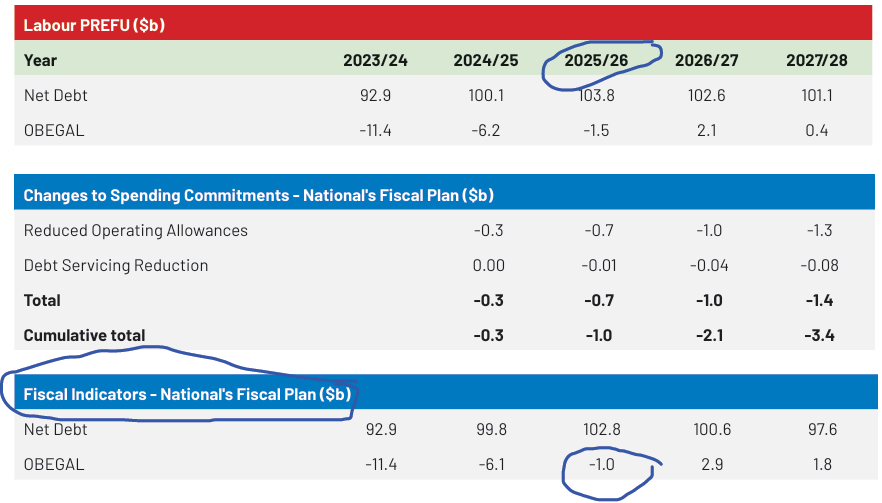
Back in the far flung days – well, really only just more than two years ago – the National Party went to the election with a fiscal plan under which the government’s operating deficit would have been more or less closed by now. This was the table from that plan.
And in case you are wondering, the PREFU projections that provided the economic base for National’s numbers still had a negative output gap of 0.9 per cent of GDP for the 25/26 year, so it wasn’t exactly a rosy economic scenario. But the deficit was to be more or less closed by now ($1bn for the full year is a bit under 0.25 per cent of GDP, and by the second half of that year – which we are almost in – presumably consistent with a tiny surplus).
There will be an update with the HYEFU next week, but in this year’s Budget – where the government last made overall fiscal decisions – the deficit for 2025/26 was forecast to be $15.6 billion.
Now, to be fair, going into the 2023 election National wasn’t exactly making much of the structural deficits they expected to inherit (I recall at the time noting that there were few or no references to the deficit in the fiscal plan document). And, thus, I guess they’ve been consistent. When the deficit turned out to be more embedded than they’d expected – Treasury having badly misjudged how much tax revenue the economy was generating – National chose not to be any more bothered. They simply chose, in both budgets so far, to do nothing at all about closing the deficits.
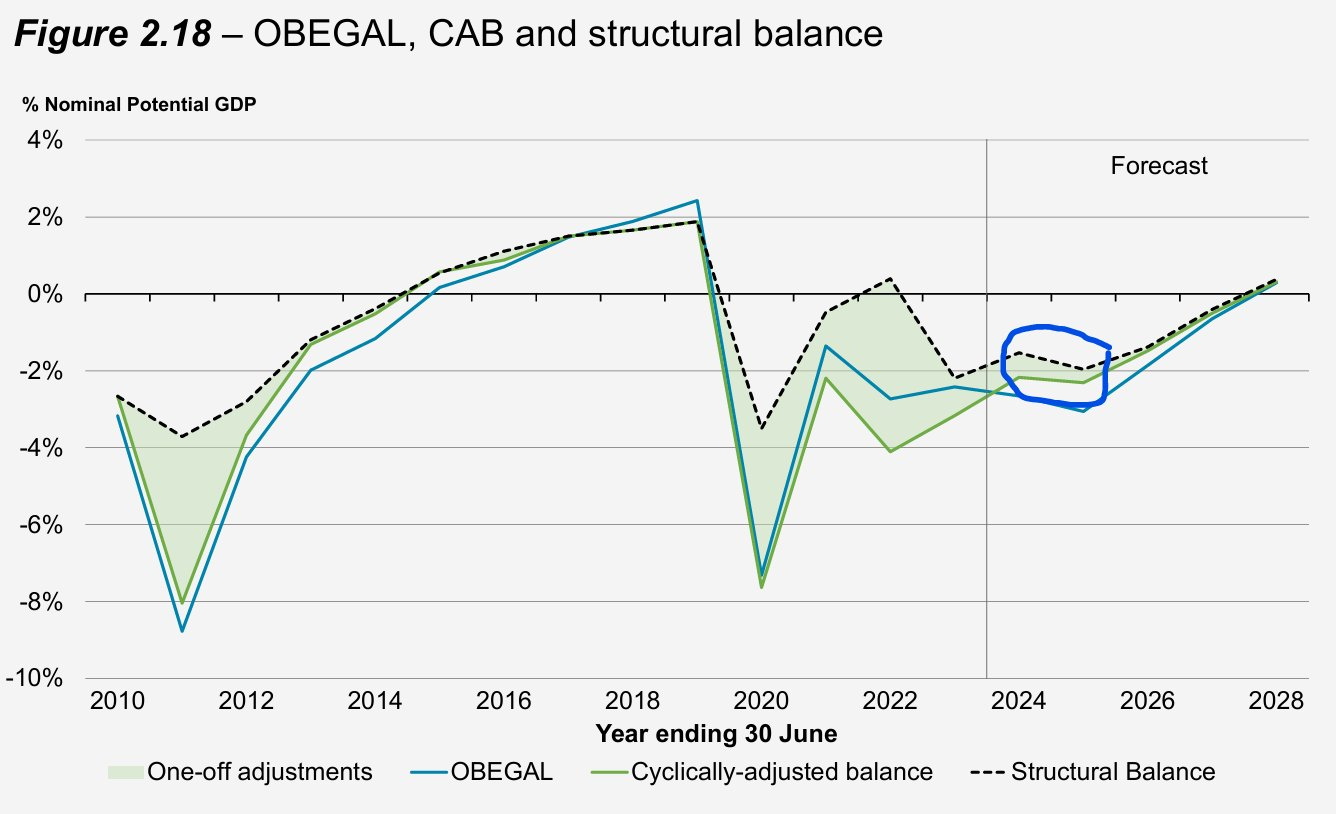
This had been apparent in Treasury’s analytical numbers. They publish estimates each year of the structural deficit – ie the bit not amenable simply to the cyclical state of the economy.
This chart was from 2024 budget documents
History is as it is (or, at least, is estimated to be). The medium-term future numbers are, under any government, just vapourware (Treasury uses the future operating allowances the then Minister advises them, which need not bear any relationship to what is actually done when the time comes). But what I’ve highlighted is the move from one year to another, for the fiscal year to which the Budget relates. Thus, in the 2024 Budget Treasury had an estimate as to how big the structural deficit had been for 23/24 and then, given the hard decisions ministers were making, and getting parliamentary approval for, a forecast as to what the structural deficit would be for 24/25. As you can see, in that Budget, the government chose – they had these numbers and associated analysis – to take steps that, taken together, slightly worsened the structural deficit.
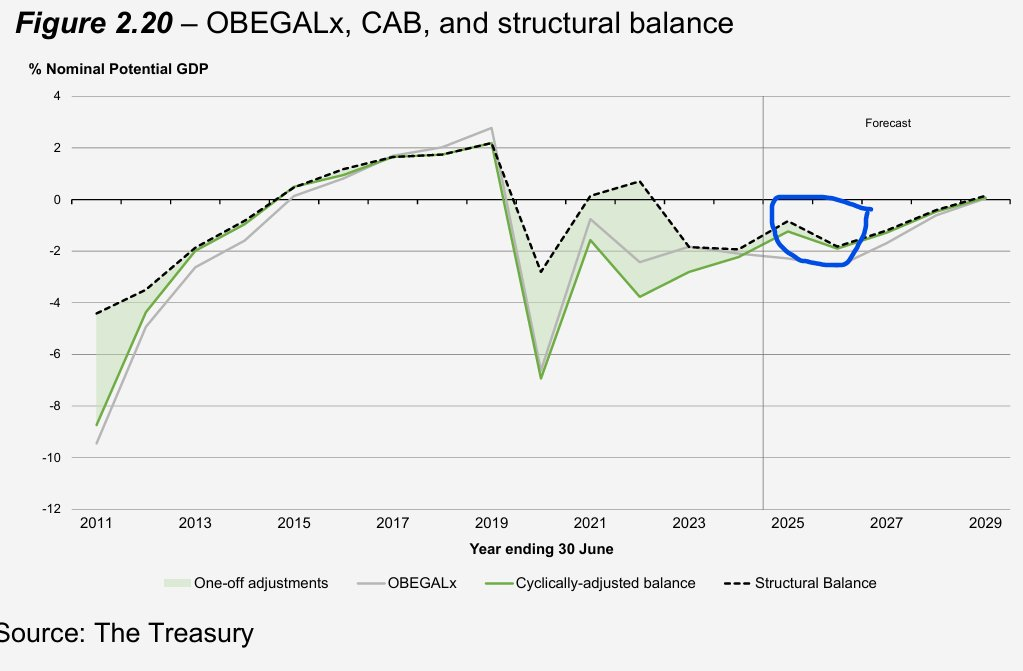
The picture from the 2025 Budget was much the same
For a second year in succession, this government’s Budget slightly worsened the structural deficit.
Of course, all the numbers are imprecise estimates, but they were the best estimates available to ministers when they made the Budget decisions.
And recall that a structural operating deficit is akin, in a family context, to borrowing to pay for the groceries even when the family’s employment and income position is pretty normal. A bad practice….for the family, and for the Crown.
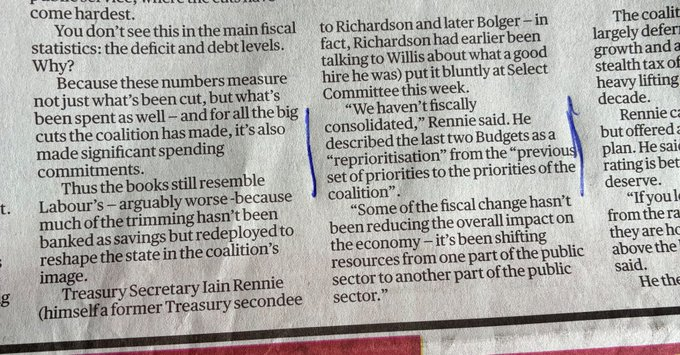
It was the Secretary to the Treasury himself who told FEC last week that there had been no fiscal consolidation under this government.
Things haven’t got radically worse in structural terms, but all this has come on the back on deficits under the previous government, and the ever-increasing ageing population fiscal pressures that Treasury has (among other people) warned about for years.
Of course, it hasn’t suited politicians on either side of the aisle to acknowledge Rennie’s point. The government has repeatedly suggested that their fiscal consolidation efforts have helped considerably in bringing about the large cuts in the OCR over the last 16 months, while the Opposition has been content to suggest that something akin to a “slash and burn” approach explains the weakness of the economy over that period. The numbers don’t back up either side – which surely their smarter people actually knew? – because there has been no fiscal consolidation. Sure, the government has cut some spending, but those savings have been (slightly) more than outweighed by new spending. Consistent with that. core Crown expenses as a share of GDP for 2025/26 were estimated at Budget time to be 32.9 per cent of GDP, up slightly on the previous year, and a full percentage point higher than the last full year for which Labour had been responsible. All those numbers are in the public domain, but….politicians……. (In the last full year pre Covid, by the way, spending was 28.0 per cent of GDP.)
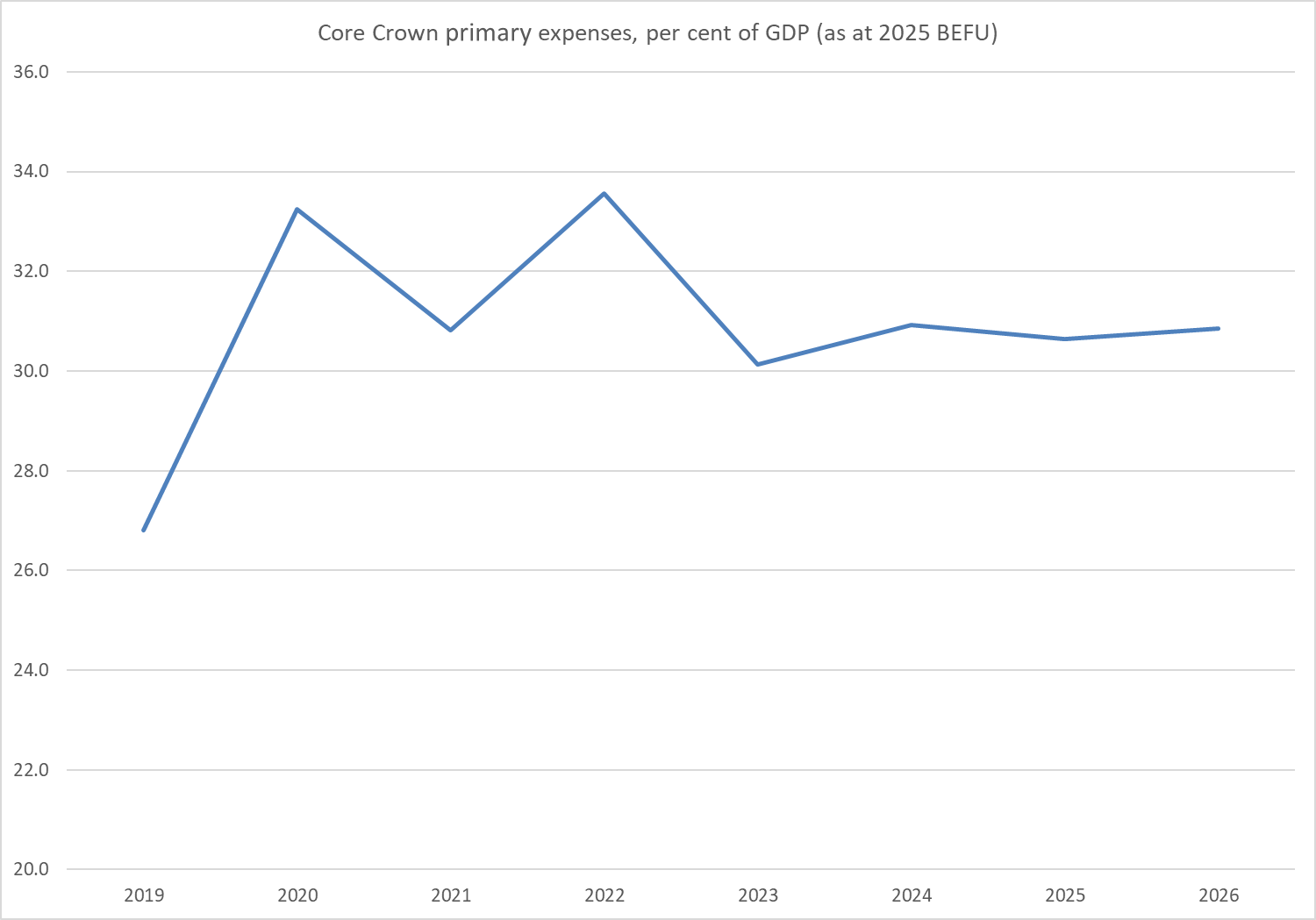
Ah, you might be thinking, but what about the interest burden run up by the accumulated deficits of recent years. Surely the incoming government was pretty much stuck with that, making overall expenditure cuts more difficult? And there is something to that, so in this chart I show primary spending (ie excluding the finance costs line from the core Crown expenses table).
It doesn’t really make much difference to the picture: primary spending is still a) far above levels for the June 2019 year (last pre Covid), and b) higher than in the last full year of the previous government, both as a share of GDP.
Spending levels aren’t really my focus. If governments want to spend more then so be it, provided they raise the taxes to pay for the spending. This government simply hasn’t done that, and so the structural deficits stay large, and have been widened a bit (an active choice, not a passive outcome).
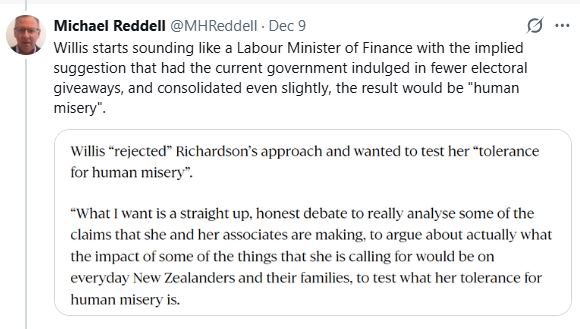
In the last couple of days there has been something of a spat between the current Minister of Finance, Nicola Willis, and her National predecessor Ruth Richardson. It seems there is to be a debate between them, after the HYEFU numbers come out next week. But if no one ever really expected Nicola Willis to take anything like a Ruth Richardson approach to public finances, her comments yesterday (as reported in The Post, still seemed extraordinary.
Can the Minister really have been serious in suggesting that any fiscal consolidation – and recall she did none – would have come only at the cost of “human misery”? Fewer film subsidies for example? Or cutting the Reserve Bank budget back a bit more? Or…… (and there is a long list of new initiatives, all choices)? Really?
I’m not overly interested in relitigating the Richardson record, particularly in 1990/91. One can mount an argument that by the time National took office in late 1990, there was already a primary surplus – itself usually sufficient over time to bring finances into order – with the high interest costs themselves somewhat exaggerated (in terms of real burden) by the persistently high inflation of the previous few years. And, as it turned out, even the return to headline surpluses took place sooner than had generally been expected after the 1990 and 1991 fiscal cuts (I was co-author of a Reserve Bank Bulletin article that attracted the ire of Michael Cullen for suggesting that surpluses might not be too far away, and even we were too pessimistic). All that said, fear of large credit rating downgrades was a major consideration at the end of 1990 and into early 1991, and the second failure of the BNZ wasn’t exactly confidence-enhancing. (Then again, the demographics were much less unfavourable back then – in fact quite favourable for the following decade or so, given low birth rates during the Great Depression.)
But whether or not the full extent of the fiscal adjustments back then were strictly necessary is beside the point now. We have much better fiscal data and analytical models, and we have substantial structural deficits on which the government has chosen to make no inroads at all, all while also doing nothing about the medium-term demographic pressures on government finances. The Minister is quoted in the Herald this morning as suggesting (in effect) that the lady’s not for turning, and that she is keeping right on with her borrow and hope strategy – hoping, no doubt genuinely, that one day something will turn up and the deficits she has chosen to run will just go away. If they don’t, we are on a path that – persisted with – takes us in the same direction as, for example, the UK, once – not that long ago – an only modestly indebted advanced economy.
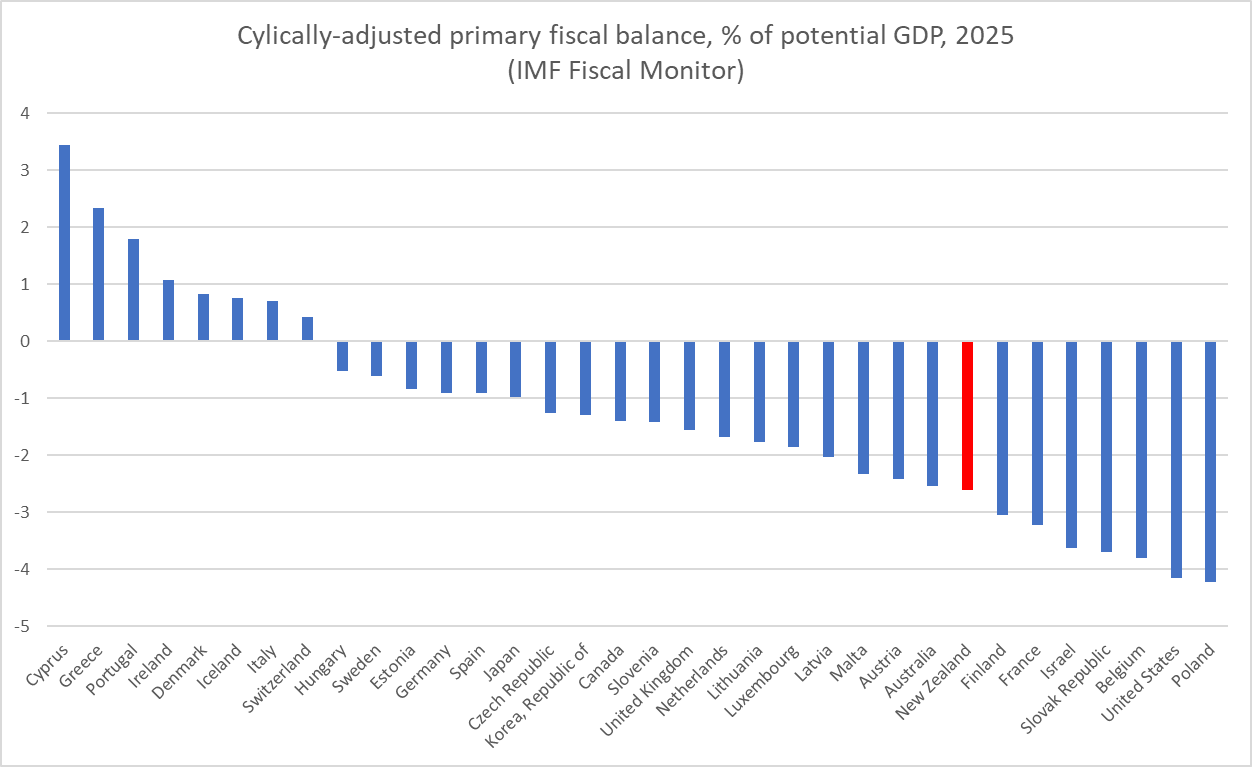
Cross-country comparisons of fiscal situations aren’t made easy by the way New Zealand presents its own data (useful for some purposes, but rendering comparisons hard). But twice a year the IMF produces a Fiscal Monitor publication with a range of indicators presented on a comparable basis across countries. This chart, using data from the October issue, shows the cyclically-adjusted primary balance for New Zealand and other advanced countries (these are overall balances, not operating ones). There are countries running larger deficits, but most advanced economies are running much deficits or even primary surpluses.
When it comes to deficits, the New Zealand government is choosing to do poorly on almost metric you choose to name (history, cross-country comparisons, expectations of the Public Finance Act). And it is choosing to do nothing about it. With an election year next year, not a time known for fiscal consolidation.
I had noticed reports that the Taxpayers’ Union was launching its own campaign on these issues, and the government’s fiscal fecklessness – choosing to do nothing about fixing a problem they inherited. I don’t have anything to do with that but while I was typing this a courier turned up with the props they are distributing to journalists and commentators. I’m sure we’ll enjoy their fudge.
Is it a fiscal fudge though? More like open and outright bad, and rather irresponsible, choices. We need something better.
A couple of weeks ago the editor of Central Banking magazine (something of an house journal for central bankers, and for whom I’ve done book reviews for some years) invited me to write a fairly full article for a non-NZ audience on the extraordinary events of recent months. The request/invitation was for a piece along the following lines:
“The aim would be to provide readers with an insight into how a highly respected institution (internationally, too) ended up in a position where both its top two officials were forced to resign and (perhaps) what steps could to be taken to redress the matter and restore the RBNZ’s reputation for sound governance?”
Having been so caught up in the unfolding detail, writing something like that proved to be a useful discipline, trying to stand back just a little and tell a story.
I wrote the article in the couple of days before we left on holiday, answered the follow up questions, and then Central Banking published the final version on their website yesterday morning (there is a paywall but registration should provide access)
[Link deleted as no longer relevant – see below]
There are only trivial differences between draft below and the final version, mostly the addition [UPDATE: by Central Banking] of various references/footnotes to the published version.
[UPDATE: Both I and Central Banking magazine have received demands to retract and apologise for the article under threat of legal proceedings by Adrian Orr, who appears to have objected to aspects of how his time in office, as a senior public figure and Governor of the Reserve Bank of New Zealand, was characterised. Central Banking has for now removed the article (link above) for further review. I posted the article here initially mainly to help readers who had had difficulty getting free access to the original via registration on the Central Banking website. As I’m currently travelling and cannot easily modify the text to make clear and extensively document a few points I have chosen to delete the article here as well.]
[FURTHER UPDATE 1 Oct: I have now been advised that there has been a “confidential settlement” between Orr and Central Banking magazine’s owner, under which they have agreed to remove the article permanently. The following statement now appears on the Central Banking website.]
UPDATE 21 October
I have decided that I will not republish the text of the article I wrote for Central Banking here, even with amendments. The piece had been written for an overseas audience, and through the sort of lens the magazine had requested. There is copious material on my blog on the events of the last two years, pre and post Orr’s exit, and more snippets have emerged in recent weeks. I hope at some stage to produce a NZ-focused summary account and analysis of those events.
UPDATE: 24 November
Among Orr’s claims has been that in my opinion piece I had alleged that he had “bullied his staff”. I was surprised by this claim. Several weeks ago I asked my lawyers to communicate with his to make clear that I had not made any such claim (and had not intended to do so and did not intend to do so now) and expressed my regrets if Mr Orr had read the text in the way suggested.
On two separate themes; aggregate fiscal policy, and the Investment Boost initiative.
Aggregate fiscal policy
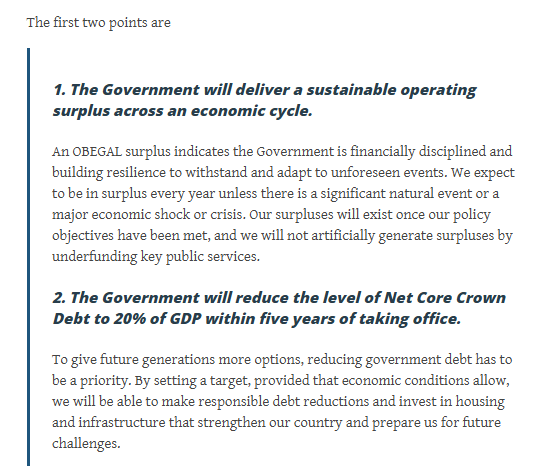
Over the weekend for some reason I was prompted to look up the Budget Responsibility Rules that Labour and the Greens committed to in early 2017 (my commentary on them here). At the time, the intention seemed to be to fix in the public mind a sense that these two parties of the left would nonetheless be responsible and prudent fiscal managers (as I recall a fair bit of the more left wing parts of the bases of the two parties lamented the agreement for giving much too much ground to what might have been thought of as orthodoxy).
And what were they promising?
The debt measure they were using at time had been 24.6 per cent of GDP in June 2016.
To which one can only say, those were the days:
the last time there was an OBEGAL surplus was the year to June 2019, and neither government nor opposition now seem bothered by the forecast of another 3.4 per cent of GDP deficit in 25/26 (just the same as the latest estimate for 24/25). Under the current government, the preferred deficit measure has been changed, against Treasury advice, to make things seem less bad. The current government’s long-term fiscal objectives (in the Fiscal Strategy Report) still include maintaining on average “over a reasonable period of time” a zero operating deficit, but there is little practical sign it means anything to them (or that Labour now would be less bad)
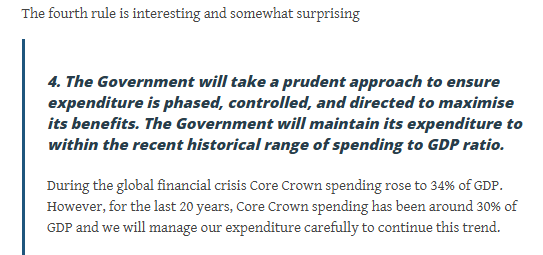
core Crown expenses are projected to be 32.9 per cent of GDP in 25/26, up slightly from 32.7 per cent in 24/25, and down only a touch on the 33 per cent actual for 23/24. Back when Labour and the Greens made those 2017 commitments core Crown expenses were a touch under 30 per cent.
debt measures have chopped and changed (and the current government was stuck with the additional debt their predecessors took on, although have not hesitated to take on much more since). These days, net core Crown debt is about 42 per cent of GDP. The government’s long-term fiscal goal is stated to be getting into, and keeping that measure in, a range of 20-40 per cent of GDP, but even on their rose-tinted fiscal forecasts that measure is projected to be 45.5 per cent of GDP by June 2029 (NB, that will be seven years on from the end of Covid as a big budgetary item). Meanwhile, Labour seems uncertain whether they’d attempt to even keep this debt measure below 50 per cent of GDP.
A political party today that seriously pledged to do what Labour and the Greens promised in 2017 to do (and by 2019, net core Crown debt was below 20 per cent, OBEGAL was in surplus, and core Crown expenses were below 30 per cent of GDP) would almost certainly be slammed as dangerous, extremist, unrealistic etc. So far have things fallen, under Labour and under National.
Meanwhile, too many journalists still seem to accord some degree of seriousness to fiscal projections for the end of the forecast horizon (four years out, so currently the year to June 2029). When the date for the crossover point from deficit to surplus keeps getting pushed out (and more recently, the Minister’s definition changes to make things easier), people should eventually realise that there is little or no substance to these numbers. They might be generated by The Treasury, but they aren’t some sort of best unconditional forecast, but rather the best forecast conditional on whatever successive ministers tell Treasury will be their policy for several years ahead (the end of the forecast period always, by construction) being well beyond the following election). The problem is that even if ministers honestly believe what they tell Treasury at any point in time (and probably they mostly do), it isn’t then anything more than a statement of good intention, perhaps even wishful thinking.
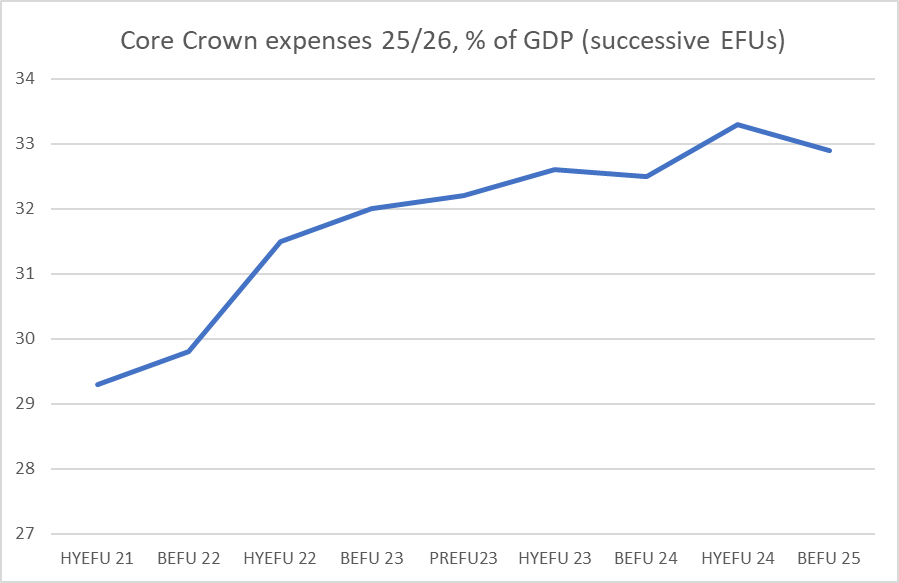
As an illustration of the point, consider this chart which shows projected core Crown expenses for 2025/26 as a share of GDP in successive Treasury economic and fiscal updates, going back to the end of 2021. The biggest further increases happened under Labour, but the line has continued to trend up under the current government.
Now, sure, further out the projections show core Crown expenses falling as a share of GDP, but that is sort of my point. Such projections are just vapourware. Exactly the same trend showed in the projections Treasury did under Labour (HYEFU21 to PREFU23 in this chart). It is easy, and perhaps appealing, to show such downward trends in future. It is quite another thing – politically rather than technically – to actually deliver. In both of the last two Budgets there has been plenty of hullabaloo (from politicians left and right) about expenditure cuts. But whatever the merits of those cuts, the bottom line remains that most of the proceeds have been used to increase other spending (some tax cuts last year)….and thus core Crown spending as a share of GDP is not actually falling.
Journalists, in particular (since politicians will politick), would be well-advised to ignore pretty much everything in the Treasury fiscal forecasts beyond the financial year to which the Budget actually relates (25/26 in this case), the year for which Parliament is actually being asked to make specific concrete appropriations. Most of the rest is vapourware.
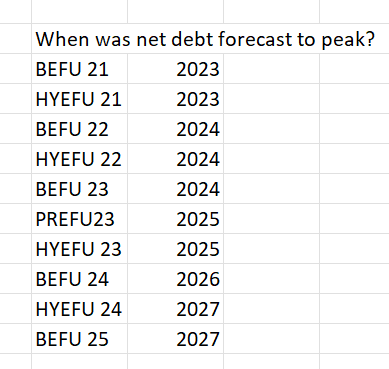
In a similar vein, here is a little table I stuck on Twitter on Saturday. The peak in net debt remains consistently two years ahead of whichever of five years’ Budgets one is looking at.
The government’s fiscal strategy seems to be not very different from that of the last couple of years of the previous government – do nothing about the long-term and in the short-term spend just as much as you possibly can without scaring the horses by blowing out the fiscal projections for net debt peaks and deficit crossovers too much in any one go.
Treasury are somewhat caught in the middle in all this. They have to forecast on the basis of fiscal policy as communicated by the Minister. That might be inescapable, but as I’ve argued previously in a PREFU context, maybe it would make sense to require Treasury to do a parallel set of forecasts showing the main fiscal variables on (a) unchanged tax rates (as at present), and b) maintaining the real per capita level of central government purchases (health, education, defence, Police etc) and the current programmes of transfers and income support. Those latter shouldn’t of course be treated as set in stone – efficiencies can be made, and different governments can have different priorities – but the expected cost if none of the expected deliverables are changed is still useful information, both for ministers (who may well already get something similar) and those seeking to hold them to account.
Investment Boost
Having been promised, by the Minister of Finance herself, “bold steps” in the Budget to address economic growth and productivity underperformance, in the end it all came down to a single measure, the so-called Investment Boost. In my quick post last Thursday I was mostly focused on the fact of the single measure and the rather underwhelming forecast change to our longer-term growth prospects (the level of GDP lifts by 1 per cent, not getting there fully for more than 20 years). [Note that this is quite similar to the then-estimated long-run effect of the 2010 tax-switch reform, which involved a switch from personal income to consumption tax and a slight increase in the corporate tax burden.] Considered against the size of gap between New Zealand average productivity and that of OECD leaders (60 per cent or more), it would represent little more than rounding error, even if the case for the new policy measure itself was strong.
I don’t envy IRD and Treasury having to come up with estimates of the economywide long-term impact of an intervention like this investment incentive. Their Regulatory Impact Statement is here, and it reports that while there have been various experiments with such policy interventions in other countries in fact there doesn’t seem to be much in the way of robust evaluations (and often these investment incentives have either been time-limited and/or applying to a materially more restricted range of assets than Investment Boost).
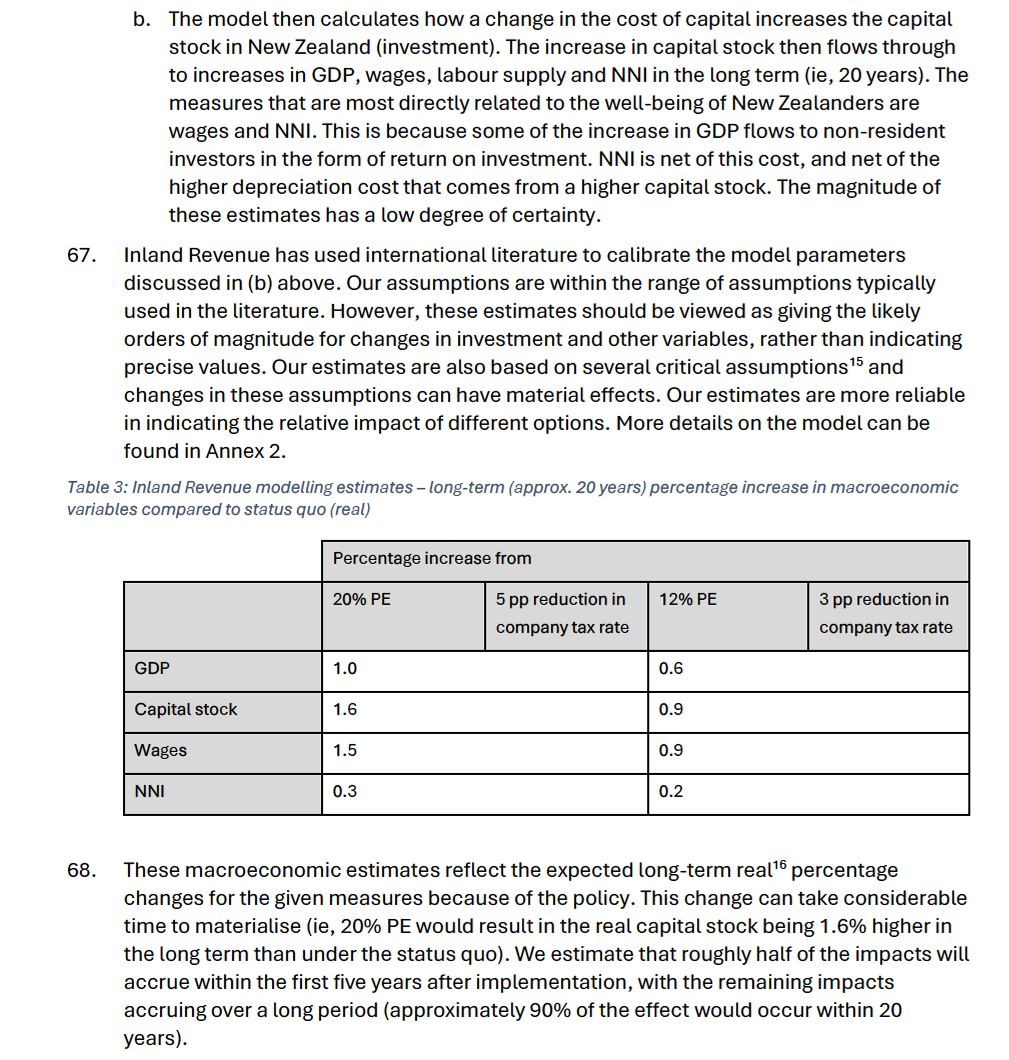
This is the bit of the RIS where they describe the economywide results
Note that in the new steady state (many years hence) GDP is 1 per cent higher than otherwise, and the capital stock is 1.6 per cent higher. Since it is stated (and both IRD and the Minister have confirmed) that the results include an increase in jobs/hours (increase in total use of labour), it is a bit difficult to see how there is likely to be any material increase in total factor productivity at all. Among the other oddities is that if total wages are rising by more than GDP, and yet the capital stock in increasing even more, the model must be generating quite a reduction in rates of return to capital. Why that is, and how plausible it is, I’ll leave to the specialists.
But perhaps more worthy of attention is that last line in the table. NNI is net national income (ie net of depreciation, and national= benefits to New Zealand residents, as distinct from “domestic” which is things generated in New Zealand, whether by New Zealand residents or foreign investors), and by far the best measure of the economic gains (or otherwise) to New Zealand. Note that NNI in New Zealand is currently about 80 per cent GDP, so – on this particular model – only 25 per cent of the lift in GDP flows through to economic benefits to New Zealand residents ((0.3/1)*0.8). Most of the GDP gains accrue to foreign investors (something IRD is certainly not hiding, but obviously wasn’t being advertised by the government). Now, to be clear, I am all in favour of facilating foreign investment, but as with almost any policy intervention the test is whether whatever benefits foreigners may pick up result in sufficient gains to New Zealanders. For interventions that cost NZ taxpayers’ lots of money (as this one does), gains to foreigners are not themselves a benefit. The question is whether they enable greater benefits for New Zealanders.
(Note that IRD makes the point that “the magnitude of these [absolute] estimates has a low degree of certainty”. But their best estimates are, presumably, what ministers had available to them.)
How large is the direct fiscal cost?
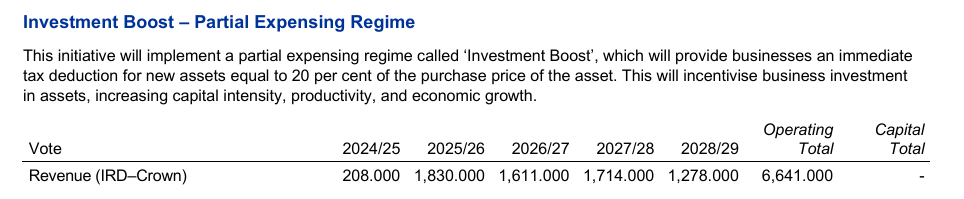
This is from the Summary of Initiatives document
Note that the cost in the early years is considerably higher than that by 2028/29. I presume that is reflecting the fact that for most investment the Investment Boost deduction is “just” changing the timing of the deduction (you get to write off 20 per cent of the cost in the first year, but then subsequent depreciation deductions over the remaining life of the asset are correspondingly reduced: for shorter-lived assets those reduced future deductions is significant once you are beyond the purchase year). In the RIS it is stated that that 2028/29 number is also the one they assume for the out-years (although presumably adjusting for inflation, and with a trend increase in the level of business investment – population growth etc).
And how much is $1278m per annum relative to net national income? Net national income, based on Treasury’s GDP forecasts, for 2028/29 is likely to be around $420 billion (80% of forecast GDP of $524bn), so the direct annual fiscal cost to New Zealand residents of this policy, once we get through the more expensive introductory phase, looks to be about 0.3 per cent of NNI. And that cost is being incurred every year, even though the NNI income gains don’t get up to 0.3 per cent for 20 years or more. Apply a discount rate of 8 per cent (as surely Treasury should insist on for what is a commercially-focused policy) and things could quickly look not overly attractive if a proper cost-benefit analysis had been done (it wasn’t). I guess there will be additional tax revenue on the additional GDP (tax/GDP is about 28 per cent), but again you don’t earn the tax until the real GDP benefits gradually flow through, while the fiscal cost is frontloaded. Time costs.
So perhaps the policy is net beneficial to New Zealanders (even if the scale is small). But is it an appropriate policy?
Reflecting on it further over the weekend, I’m not sure it is really either appropriate or particularly intellectually coherent. (I could add that I’m not greatly bothered by it being uncapped – so, for example, is the unemployment benefit which costs what it costs depending how many people end up unemployed, or interest deductibility etc. Government champions will no doubt add that since the point is to increase investment, if there is even more new investment than IRD/Treasury forecasts that is likely to be a good thing, not a bad thing. In some commentary I wondered if people realised that it is not a 20% grant, but rather a reduction in first year tax of 5.6 per cent of the purchase price (0.28*20).)
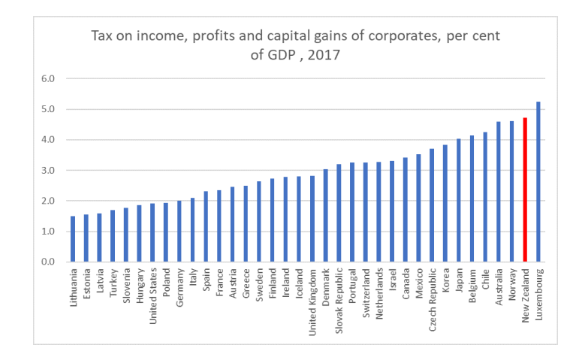
To me, there is little serious doubt that New Zealand has overtaxed business income. IRD show some of the cross-country comparisons, and they could have added this one (which is a few years old but was in the background documents for the Tax Working Group).
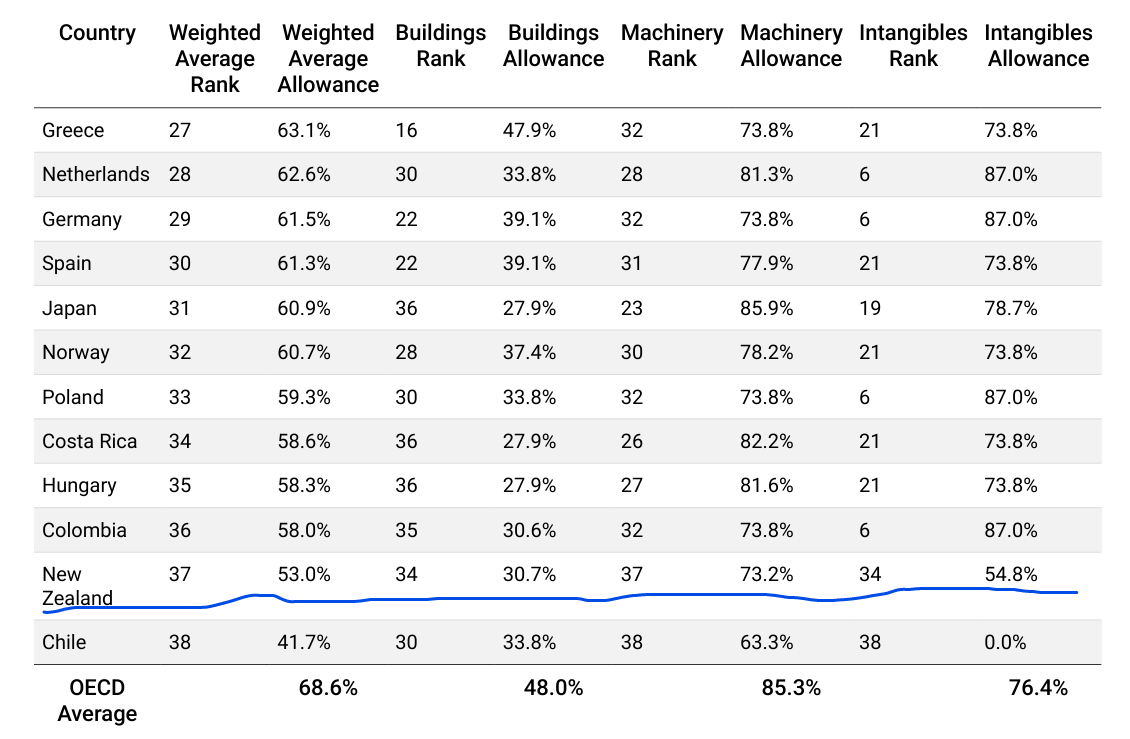
They could also have cited the Tax Foundation’s recent piece on capital cost recovery, depreciation etc. This was the bottom (worst) bit of their table for OECD countries showing the net present value of total write-offs over the life of an asset
Very few countries, for example, do as they should and inflation-adjust the value of assets to allow full real economic depreciation over the life of an asset.
But I’m still left uneasy about this particular Investment Boost initiative.
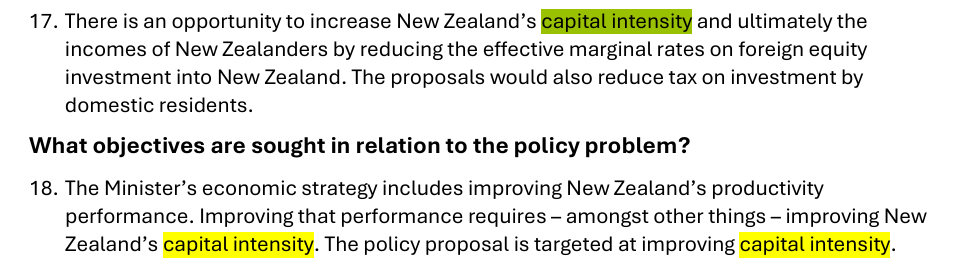
You hear a lot these days about “capital intensity” (lack thereof). For years, Treasury has talked up this rather mechanical growth accounting decomposition – business investment has been quite modest for decades, and so capital stock per worker has tended to lag – and this year ministers have taken to championing the line. And sure enough, from the RIS
There aren’t (in the views of ministers) enough capital assets, so we’ll offer an incentive (quite an expensive one) to encourage firms to have more capital assets.
The problem with this mentality – whether it is officials or ministers talking – is that it too easily fixates on symptoms rather than underlying economic causes. It never asks the question as to what is is about the New Zealand economy or its policy settings that means either New Zealand firms or foreign ones don’t seem to find that many profitable (after tax) opportunities available here (let alone look at what might be the best, or most cost-effective ways of addressing any issues thus identified.)
[Perhaps I should add here I’m old enough – as is Nicola Willis – to have been around when, a mere 15 years ago, New Zealand’s accelerated depreciation regime was scrapped – something signed off by the government (for which Willis worked at the time) and enthusiastically welcomed by Treasury (where I was working).]
Instead, there seems to have been a lurch to subsidise (one group of) inputs, even though outputs and outcomes are the things we should care about (much) more. Are more and more- highly-successful companies likely to also be engaging in more capital investment? Of course, but that is a different framing than one of “if we subsidise more capital goods will we see more highly successful companies?”
There are reasons to be ambivalent at best. For example, the goal of the policy appears to be more new investment (rather than higher GDP or NNI themselves), and thus you can get the subsidy for buying a new asset (or a used one from abroad), but not for buying an existing asset which some other might no longer need, or not be using as efficiently as your firm perhaps might. A whole new wedge is inserted, actively discouraging more efficient use of existing resources (TFP) in favour of subsidising more resources. Is that effect likely to be small enough not to worry about? Hard to tell, but (for example) very long-lived assets like factories and office buildings are caught in the net, and it is quite likely that a building won’t have the same best owner for its entire life. And what about vehicles? Some tradesman’s business fails and there is a vehicle to be sold – there is less likely to be a good recovery when a new or expanding business can get a subsidy on a new asset, but not on picking up an under-utilised existing one. And if, for small businesses in particular, there is an element of personal consumption in some business assets (be it the fancy ute or the higher-end-than-strictly-necessary laptop), lower rates of tax on business income would seem more likely to generate efficient outcomes than subsidising the purchase of capital assets. Again, perhaps small in the scheme of things, but not self-evidently an efficient approach.
Then, of course, there is the question of the intellectual coherence of the government’s approach to the taxation of business.
Last year, it was important (or so both government and Opposition believed) to remove tax depreciation from commercial buildings (otherwise the 2024 Budget numbers wouldn’t have added up), but this year new commercial buildings (including, according to the fact sheet, work already underway last Thursday) gets a 20 per cent deduction in the first year of purchase (absolutely huge upfront compared to the usual depreciation rates for buildings) – and since there is no clawback in reduced depreciation in later years, by far the biggest winners from this policy will be those adding new commercial buildings. So was tax policy last year correct – when it went one way on commercial buildings – or is correct this year, when it went quite the opposite direction? (And what was the net NNI effect of those two contradictory policy changes?)
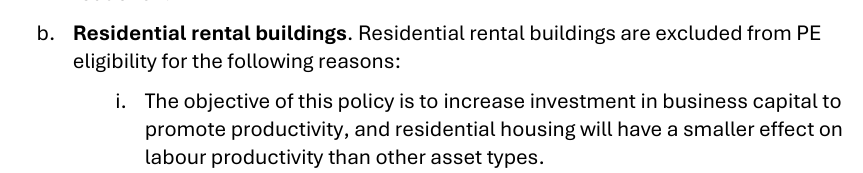
Last year, the government also moved to reinstate interest deductibility in respect of residential rental property. The argument – which I supported totally – was that interest was and is a normal cost of doing business and as it was deductible for every other sort of company there were no good grounds for disallowing interest deductions on residential rentals. Firms need office, people need places to live, and in both cases owner-occupation will suit some but not others. So last year, residential rentals were a business like others, but this year……”residential buildings and most buildings used to provide accommodation are not eligible for Investment Boost – though there are explicit exceptions for some buildings such as hotels, hospitals, and rest homes”. Rest homes – you mean places where people live and are not owner-occupiers? I guess Rymans and the others will be happy, but where is the intellectual coherence? (And it is not as if the fact that depreciation is not allowed on residential rentals – itself a flawed policy- is a decent justification; after all, see above in respect of commercial buildings.)
Here is the main IRD/Treasury justification for excluding residential investment
As if the ultimate point was not improved household wellbeing, whether that arose via higher wages or lower real rental prices. And not a mention of last year’s policy stance, just officials and ministers again picking preferred types of capital assets.
I’m left rather ambivalent at best. There have been, and no doubt will be again (from whoever is in government) worse policies but this is simply a not very good one (despite the Minister touting apparent Treasury advice that there was something “optimal” about the 20 per cent). Had the government wanted to do something economically rational and rigorous around depreciation – see table above – it might have been better to have reinstated depreciation on buildings (residential and non) and inflation-indexed the depreciable values. But if it was coherent, it would have been a lot less catchy, since lots of machinery and software etc depreciates quickly and things like the inflation distortion matters less.
Finally, from a purely cyclical perspective, it isn’t impossible that there could be a larger short-term boost to demand and activity than implied by those long-term numbers.
Working back from the IRD cost estimate for 2025/26 ($1830m) and a company tax rate of 28 per cent suggests a base level of (covered) business investment of about $33bn. GDP is estimated at just over $450bn in 2025/26. Whatever the longer-term effects, perhaps there is reason to think the short-term lift to investment might exceed the long-term one: on the one hand, the enthusiasm effect among small businesses in particular (the policy seems to have gotten good headline reaction where it was presumably supposed to do so), and on the other, the risk/possibility that if there were to be a change of government after next year’s election this incentive could be wound back or abolished (the left would need money to fund their preferred initiatives, just as this government has – and the Greens, notably, have promised to increase company tax rates). If one were thinking of doing some capex in the next few years, the next 18 months or so might seem a particularly propitious time all else equal. A 10 per cent lift in business investment in a year would itself represent about a 0.7% lift to aggregate demand. At very least, and like all tweaky tool incentives, it will make for an interesting case study.
On Twitter on Saturday I indicated that there had been a mistake in my post from last Thursday in which I attempted to step through the Reserve Bank Funding Agreement issues. Making mistakes (there are two) is annoying and I don’t fully understand how I did it (probably too much haste). I can only apologise to readers (and acknowledge that it was a sentence in the Herald’s Thomas Coughlan’s article on the Funding Agreement that prompted me to go back and check). The central point isn’t affected: real spending in the next couple of years is hardly cut at all from levels authorised by Grant Robertson just before the last election.
As it happens, since writing that post on Thursday morning a couple of other relevant documents have been released by the Reserve Bank. So, and at risk of some repetition, I’m going to attempt in this post to cover the full ground, focusing under three headings:
the change in approved spending from one Funding Agreement (Robertson’s) to the next (Willis’s)
the change in actual spending, and
what seems to have gone on regarding last year’s Reserve Bank Budget and their bids for the new (just signed) Funding Agreement.
This post is long. I have a summary in six bullet points at the end.
From one Funding Agreement to the other
In the Funding Agreement for the period 2020-25, as varied by agreement with Grant Robertson in August 2023, two classes of operating expenses are separately provided for. A fairly large chunk of the Bank’s operating expenses (around $30m a year) is not covered by the Funding Agreement at all – for reasons good and less so. But of those that are dealt with by the Funding Agreement, the first class was what we might call “core” operating expenses (where $149.44m was the allowable expenditure for 2024/25) and the second is “net direct currency issue expenses” ($14.5 m for 2024/25).
In the new Funding Agreement released last week there is no longer a set of annual allowances for the currency issue expenses. Instead, under the “Excluded expenditure” heading there is provision for the Bank to spend up to $65m in total on this item over the full five years covered by the Agreement.
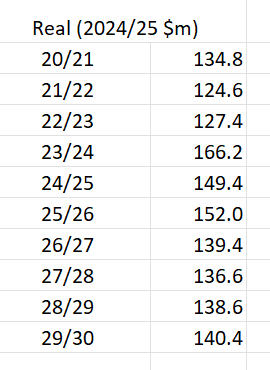
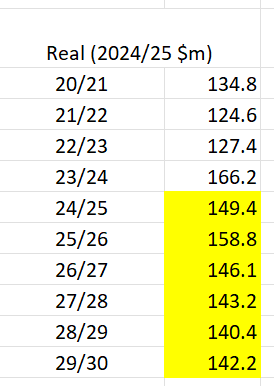
Consistent with that, in Thursday’s post I included this table, which covers the “core operating expenses” covered by the Funding Agrement in real, inflation-adjusted, terms, for the periods covered by the old and new agreements
As you can see, approved core operating expenses in the coming financial year ($152m) are actually a couple of per cent higher in real terms than those Grant Robertson had approved for the year ending in June ($149.4m). Over the remaining life of the agreement the numbers are lower (in 29/30 the approved allowance is 6 per cent below the level Robertson had approved for 24/25).
However, in the new Funding Agreement a number of new items are excluded from being counted against that spending limit. Thus, a true apples for apples comparison with approved spending levels under the old agreement would mean higher numbers for the 2025 to 2030 years. Only one of these new exclusions is quantified: an average of $5m a year for the next three years is allowed for implementing the new Deposit Takers Act (which has been being implemented gradually including over the last two years – it was part of the justification for Robertson revising up approved funding in August 2023). Other items aren’t quantified, including operating expenses associated with such potentially costly items as work on a Central Bank Digital Currency and those operating expenses associated with refurbishing or replacing the head office building. If we allowed another couple of million per annum for these other new exclusions (aiming to be conservative – low end – in our guesses), we might end up (illustratively) with a table like this
where, say, even in 2026/27 approved real operating spending would be only 3 per cent lower than the level Grant Robertson had approved for 2024/25.
Note too that the Bank’s actual and budget (for 24/25) spending on those net direct currency expenses over the five years of the last Funding Agreement was about $32 million. Although the new Funding Agreement does not provide annual limits for this item, it allows $65 million spending on it over five years in total – much higher than recent actual spending, and not very different from what was allowed in this component of the previous (2020) Funding Agreement (although note some unexpected inflation since 2020)
Overall, the new Funding Agreement doesn’t represent much fiscal restraint relative to the last approved levels by Grant Robertson in August 2023.
And it isn’t as if the Bank had been consistently abstemious over the years.
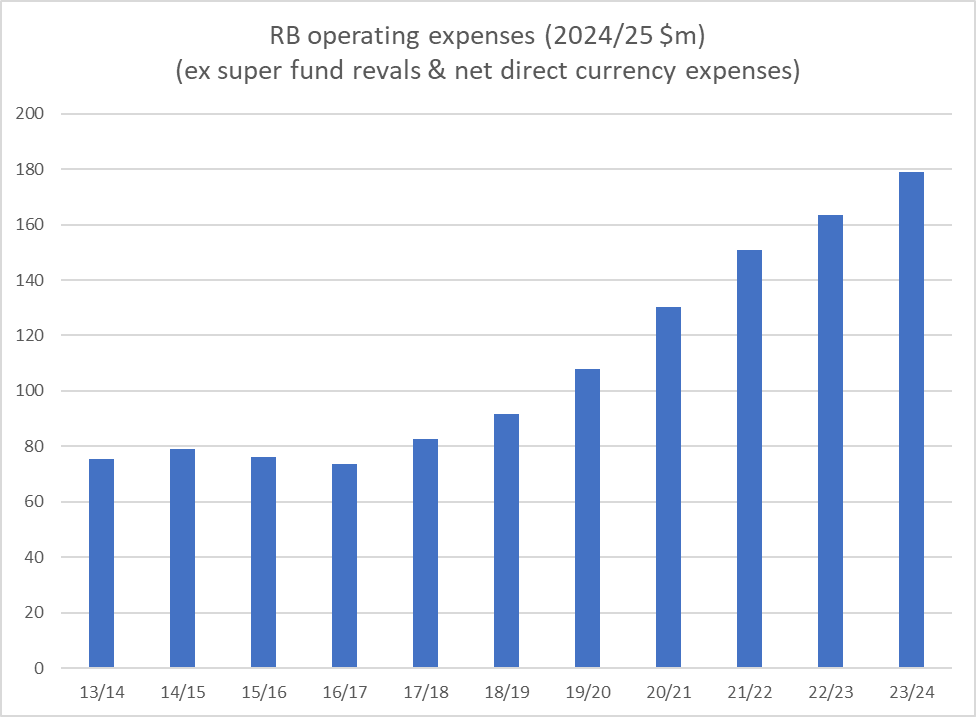
Because the definitions of what is and isn’t covered by Funding Agreements has changed over the years, it can be helpful to look at the trend in operating expenses, as disclosed in successive Annual Reports.
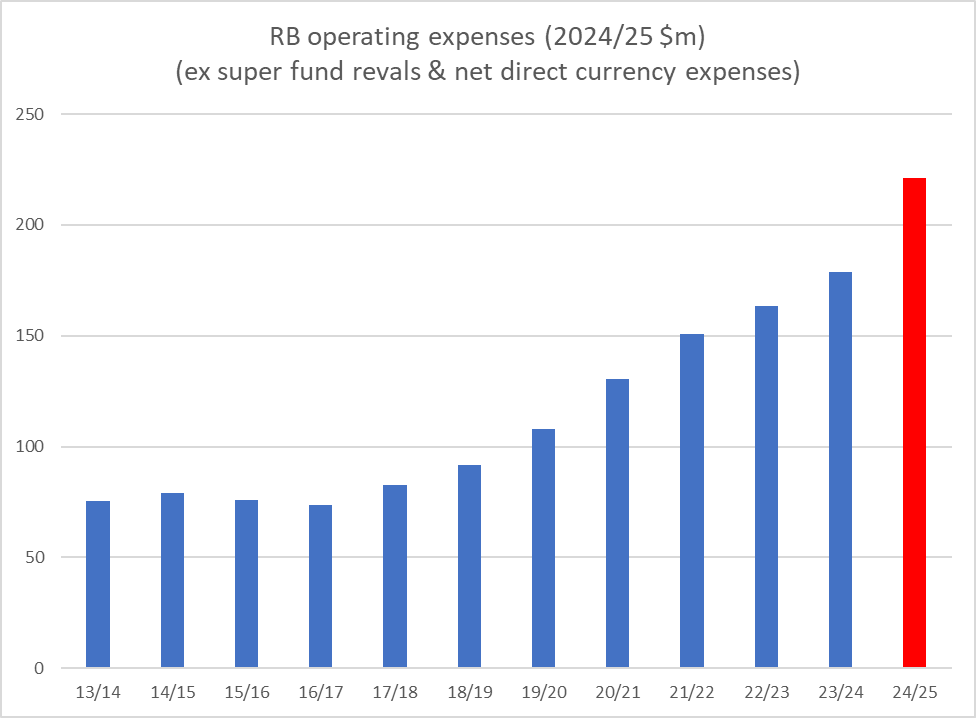
This chart shows actual total operating expenses in real inflation-adjusted terms (excluding actuarial gains/losses on the staff super fund, which aren’t controllable, and the net direct currency expenses item). Adrian Orr became Governor in March 2018 and real spending in 2023/24 (the last year for which we have actual data) was already more than twice 2017/18 levels.
Funding agreement vs actual and budgeted spending
The Funding Agreements cover five financial years. The Act is quite clear that when an amount is stated for each of those five financial years, that is the intended limit for that year. The Bank is not free to underspend in some years and overspend in others.
Note, however, that there is no direct disciplining mechanism. If the Bank overspends in total, or underspends in some years and overspends in others, there are no (automatic) consequences. And as I recall it, including my time on the senior management group at the Bank (long ago now), there used to be a practical view that small unders and overs in individual years weren’t too concerning, particularly so long as spending over the full five years stayed under the total allowed in the Funding Agreement.
The Bank discloses in each Annual Report how its spending on Funding Agreement items has aligned with the amount provided for each year in the relevant Funding Agreement.
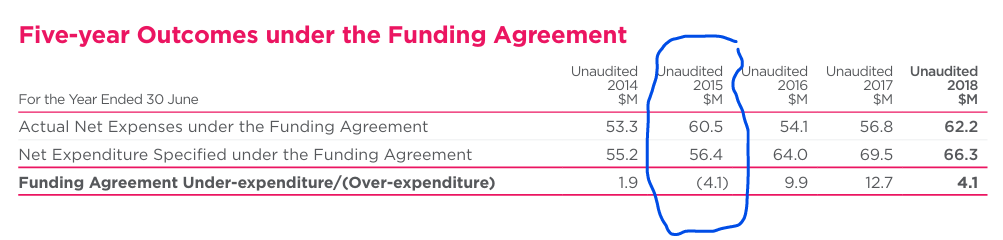
Here is an example from the 2018 Annual Report
This period happened to straddle two different Funding Agreements (and mostly Graeme Wheeler’s stewardship as Governor). Over the full five years, the Bank ran operating expenses below the Funding Agreement level. In 2014/15 they ran over the Funding Agreement amount, something that disconcerted management at the time (and prompted a round of redundancies and cost savings.
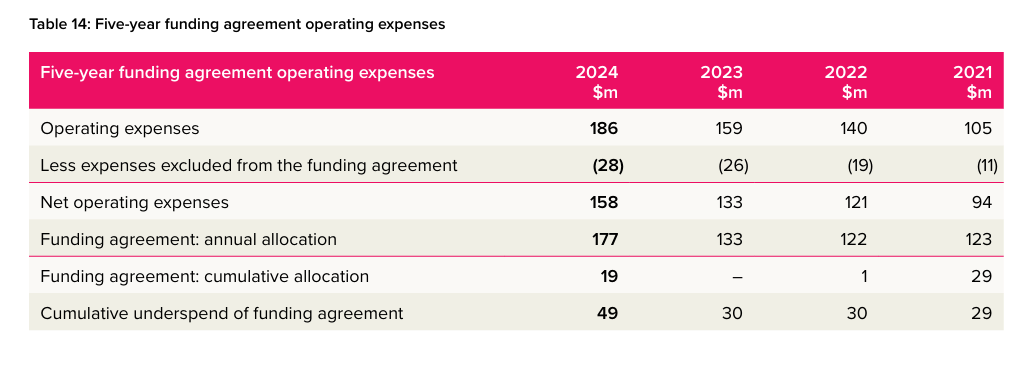
Here is a similar table from the 2024 Annual Report
Really big increases in operating spending had been allowed both in the original 2020 Funding Agreement and in the August 2023 variation that Orr, Quigley, and Robertson had signed just before the election.
You will note that in 2020/21 the Bank substantially underspent the Funding Agreement allocation (although operating spending under the Funding Agreement still increased by 13 per cent that year). In its 2021 Annual Report the Bank offers several factors as explanations for the underspend, but they mostly seem to come down to Covid (and a serious data breach the Bank experienced). I’m less interested in the specific explanations than in the final comment: “We expect this underspending to reverse in future years and the Bank to be within the five-year aggregate expenditure provided for in the funding agreement”.
Maybe that didn’t seem unreasonable at the time – Covid, after all, was out of blue for them (and all of us) – BUT (as noted above) the relevant provisions of the Act do not envisage or provide for carrying forward underspends from one year to the rest of the Funding Agreement period.
But then, as it happens, for the next two years, net operating expenses were almost bang on the Funding Agreement allowed amount (when the allowances for core operating expenses and currency issuance expenses were combined). But the Bank – management and Board – still seemed to think it was just fine to carry forward an underspend from years earlier. You can see that in the final line of the table.
You’ll also see in that table that there was a big increase (33 per cent) in approved Funding Agreement spending for 2023/24, made possible by the August 2023 variation. The Bank then underspent that allowance rather dramatically ($29m), even though they’d increased (funding agreement covered) actual operating expenses by almost 19 per cent in a single year. This was still a year (more than half of which occurred on the watch of the new government) in which they had increased actual FTE staff numbers by 91 (18 per cent). As for that delayed project spending, it doesn’t seem like great management and Board oversight given that they’d only got Funding Agreement variation approval as recently as August (ie already into the relevant financial year).
By the end of the 2023/24 year the Bank’s total (Funding Agreement) operating spending was a total of $49 million below the sum of the Funding Agreement limits for each of those four years. $19 million of that shortfall had occurred years earlier.
But what of it? Recall that under the Act, there really wasn’t discretion for the Bank’s management and Board simply to decide to shift large amounts of spending from one year to the next. (No one might have quibbled over a few million here or there – given the way the Funding Agreement system and legislation were set up – but…..this was $49 million).
And, by then, we had a new government, which had made quite a fuss in the election campaign around bloated public spending, and had started on cuts to most central government departments.
The Bank’s 24/25 budget, Statement of Performance Expectations, and 2025 Funding Agreement bids
Annual budgets are set by the Reserve Bank’s Board which now has full responsibility for the governance of the institution. The high-level budget numbers are published in a document, required by law, called the Statement of Performance Expectations. Last year’s was signed (by Governor and Board chair) on 21 June and included this table.
Here is the chart above updated for the Board-approved 24/25 budget
It was to be the largest percentage increase in core operating expenditure in any of the Orr (& Quigley) years (about 24 per cent in real terms).
The Bank does not report its budget on a Funding Agreement-consistent basis, but the proactively released Board minutes indicate that $31m of the operating expenses were on items not covered by the Funding Agreement. So $200 million was on item covered by the two Funding Agreement streams, up from $158m actual spending on these streams in 23/24 (the Board would not have had final 23/24 numbers when they approved the 24/25 budget on 20 June, but the estimates must have been pretty close).
How did this happen you might be wondering. After all, hadn’t the Minister of Finance handed down her overall government budget as recently as 30 May with a heavy, and very public, emphasis on expenditure savings and redirection of resources towards so-called frontline services? Those with access to the Minister might well ask her.
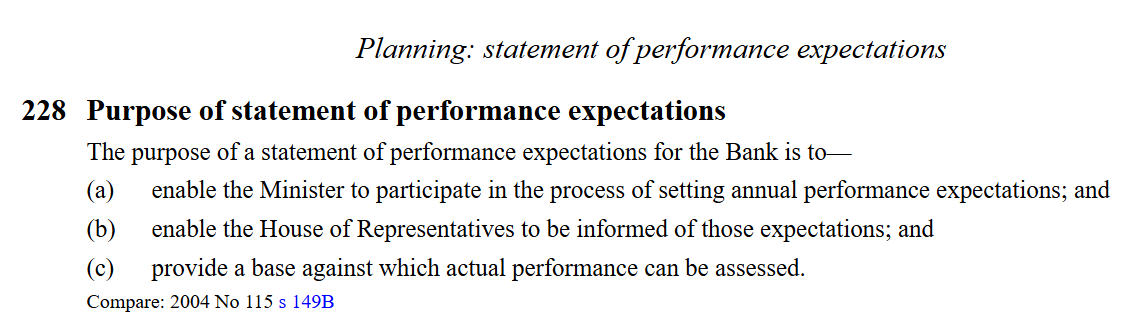
Perhaps you are wondering if the Board did all this 24/25 budgeting in secret, and the Minister of Finance simply didn’t know. But the numbers had to be included in the Statement of Performance Expectations (SPE) and the Minister had to be consulted on a draft of the SPE. In fact, the law says that a main point of the SPE is to enable the Minister to be involved
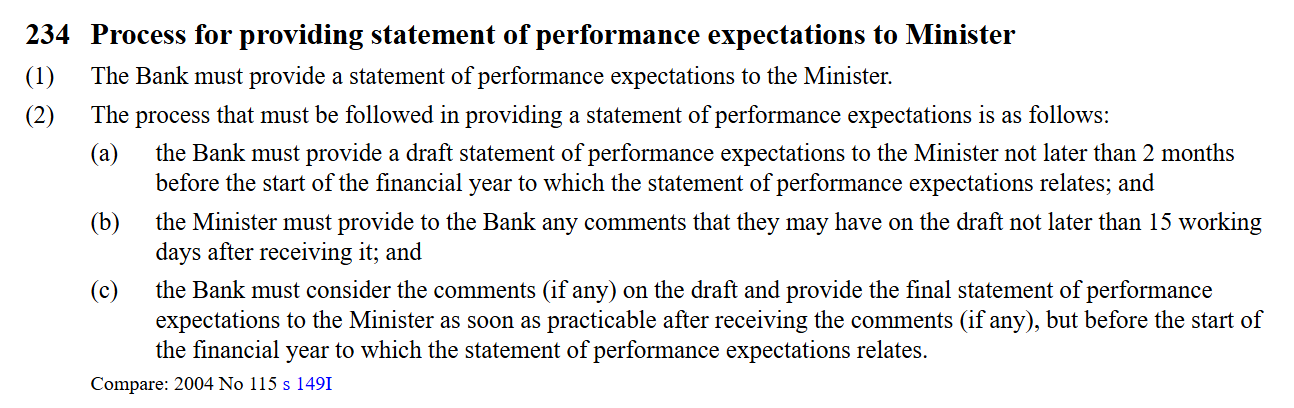
and the “how” is covered, among other sections, here
And it isn’t as if somehow the Bank overlooked the need to provide a draft to the Minister last year. The Board minutes for 20 June record that written comments (on the draft Statement of Intent and the draft SPE) had been received from both the Minister of Finance and Treasury and “had been incorporated”. There is no suggestion of any material difference of opinion, or of the Minister taking a harder line than the Board. It is really quite extraordinary…..coming just weeks after the expenditure saving and reallocating government budget. One of her agencies was going to increase spending by 25 per cent or so, in a single year.
What was the Minister thinking/doing? What was Treasury thinking/doing? (I have lodged an OIA asking for the comments from both of them on the draft SPE.)
Now, again if you were inclined to bend over backwards to excuse her responsibility you might note that the Minister of Finance could not formally stop the Bank’s Board setting the budget for 24/25 at any level it liked. The Bank has that degree of operational independence.
But…. she is the Minister of Finance and has a bully pulpit. Imagine if she’d told the Board “well, you can increase your budget by 25 per cent for this coming year if you like, but if you persist in doing so I will go public and excoriate you for a reckless and irresponsible use of public money, for operating in breach of the Funding Agreement, and for choices that are utterly out of step with the government’s wider fiscal priorities. Do we really suppose there’d have been a wave of public sympathy for the Board?
More directly, Board members are appointed by the Minister of Finance. Reserve Bank board members cannot be dismissed at will, only for cause. But the Reserve Bank Board chair’s term was due to expire on 30 June 2024. It had been widely assumed that, having been in place for many years, he’d be replaced by the new government. Being responsible for an egregiously large budget increase might have been just another reason to replace Quigley. Instead, Willis reappointed him, and as if to add insult to injury she announced that puzzling reappointment on 20 June, the very day the Board confirmed that huge operating expenses budget, that she’d had every chance to comment on.
Like many, I was genuinely mystified last June when Quigley was reappointed. Now that one realises (a) the timing and b) the huge budget increase he was overseeing I’m simply flabbergasted.
(Note that the 2024/25 Budget was so out of step with the Funding Agreement provisions/levels there would appear to have been – perhaps still would be – good grounds for the Minister to dismiss board members for cause (not one of them having recorded a dissent when the budget was adopted).)
Now, as a final effort towards trying to understand what she might have been thinking, perhaps the Minister was advised by the Board and management that the Bank was simply utilising the underspends from earlier in the Funding Agreement period. The Bank was claiming (see table above) that they had $49m up their sleeve. Add $49m to the Funding Agreement allowances of $149.4m for 24/25 core expenses and $14.5m for 24/25 net currency issuance expenses and you get $212.9m. Perhaps it looked as though the Bank’s big new budget ($200m on Funding Agreement items) was actually less than was allowed.
If the Bank claimed as much to the Minister, we might (at a pinch) excuse her. She is busy and you might assume the board of your central bank was giving you honest advice and an honest interpretation of the Funding Agreement and Act. But……she has an entire department of her own, The Treasury, supposedly expert in such stuff. And they should have told her in no uncertain terms that neither the Funding Agreement nor the Act envisaged carrying forward substantial underspends from past years to allow lots more spending in later years. To be consistent with the Funding Agreement, the Bank’s total (funding agreement covered) operational expenses could be no more than $163.5m in 2024/25. Not $200 million.
Why weren’t they (apparently) doing those basics properly? It is clear that they had seen the draft SPE and the Board minutes record regular senior-level engagement with Treasury (a couple of Treasury DCEs often attended a session with the Board, and sometimes the Secretary herself). They’d been overseeing the advice on the government budget, probably putting pressure on numerous departments to deliver savings. And yet the Bank’s Board adopted a budget with a 25 per cent or so increase in operating spending, and nothing seems to have been said or done.
All of which brings us to the 2025 Funding Agreement (bids and final settlement).
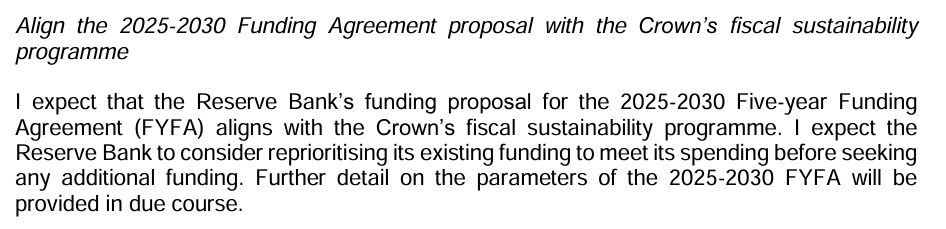
The Minister had written a Letter of Expectation to the Board chair in April stating, among other things,
The messaging seems pretty consistent with what the Minister had been saying in public (see references to the “fiscal sustainability programme”)
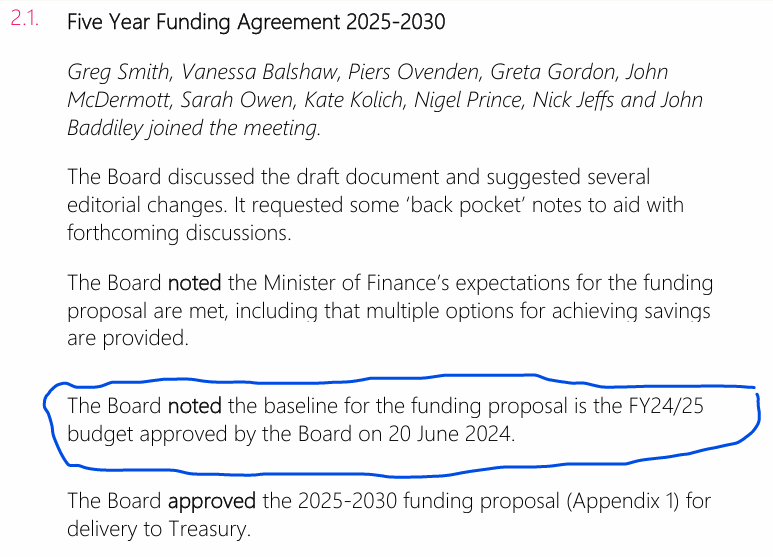
Here it is helpful that late last week the Bank finally get round to proactively releasing the Board minutes for the September quarter of last year. You may recall that in the paper to the Cabinet committee on the new Funding Agreement the Minister indicated that
This submission was approved at a meeting of the Board held in Auckland on 29 August late year. The minutes record as follows
It is quite explicit there that they had bumped up the 24/25 budget massively – using some illegitimate argument about carrying forward past underspending – not just to clear out some backlog one-offs, but providing a baseline for their bid for operating spending for the following five years. You’d think perhaps we were still in the era of Grant Robertson budgets. And although it is easy to focus on Adrian Orr as Governor, these bids – and the budgets – were the responsibility of the board, and particularly its chair, Neil Quigley.
But there are still puzzles. For example, note that in the paragraph above the one I highlighted the minutes record the Board’s understanding that “the Minister of Finance’s expectations for the funding proposal are met, including that multiple options for achieving savings are provided”. What, one is left wondering, led them to think that what they were bidding for had met the Minister’s expectations (presumably as conveyed not only in that April Letter of Expectation but in regular engagement with top Treasury officials)?
The Minister now is keen to highlight that she cut back the Bank’s spending relative to its 2024/25 hugely increased budget (not by 25 per cent but probably by an apples-for-apples 17-18 per cent or so) but (a) how did she let the budget happen in the first place, b) how did the board get the impression that its bid for massively increased real resources (relative to the previous Funding Agreement) met her expectations, and c) why did it take so long then to pull the Funding Agreement bid back to earth? Given that she has made clear that Orr’s resignation did not have to do with the Funding Agreement, we might reasonably also ask why no one involved has lost their job over this?
The initial Funding Agreement bid wasn’t approved, but you’d have thought the Minister – and Treasury – would have told them many months ago that a bid based on the inflated 24/25 budget simply wasn’t acceptable, and that they should go back and try again, perhaps benchmarking themselves, as a start, against the last ministerially approved level of spending (the 2023 Robertson variation). But they seem to have done nothing of the sort, and there wasn’t a revised funding proposal from the Board until a week or so after Orr left. We are left to wonder if – and one really hopes it is not so – it was not until very late in the piece that the Minister and Treasury actually started demanding some serious fiscal restraint from a Bank that was (a) far overspending its own Funding Agreement approved levels for 24/25 and b) wanted that to be the starting point for what they could spend for the next five years. As it is, even the final settlement – above what Treasury had wanted – largely validates the bloated spending and organisational size up to 2023/24, just undoing the further excess that occurred on Willis’s own watch.
(Note too that we do not know how much actual spending will have to be pulled back in 2025/26 as all the papers refer only to last June’s approved budget and not to any mid course corrections the Bank may have made. The board must have updated forecasts of actual operating expenses for 24/25 but none of that has been disclosed. That said, any such mid year savings might be small: after all, as the Cabinet paper disclosed, the Bank increased staff numbers by another 10 per cent between 30 June last year and 31 January this year. In straitened fiscal times….)
Finally, I noted in the posts late last week that the Bank was then in breach of the Act, which requires a Funding Agreement when published to
A document purporting to meet this requirement seems to have turned up on website on Thursday afternoon. On the operational expenditure side this is all there is
Not only is there is no starting point comparison (forecast figures for 24/25) but there is no information at all enabling us (public or, say, FEC) to know in what functional areas the Bank will be looking to make cuts. This document probably doesn’t meet the statutory requirements but if it does it just highlights again how deficient the Reserve Bank funding legislative framework is, including the absence of any requirement for parliamentary approval. That was an egregious omission (when the legislation was amended by the previous government) but the gap is even more stark now when considered against what the Reserve Bank Board (and management) got away with last year.
Summary
There was a lot of ground to cover. My bottom lines messages are as follows:
the new Funding Agreement represents pretty limited cuts in the Reserve Bank’s authorised spending, using as a benchmark the previous Funding Agreement variation in 2023,
the Minister of Finance appears to have done nothing when advised in the first half of last year that the Bank’s Board was proposing a near 25 per cent increase in operational spending for the 24/25 year, and in fact announced the reappointment of the Board chair the very day the Board gave final approval to that budget,
the Bank’s Board was in breach of its collective duties in authorising 24/25 spending far in excess of what the Funding Agreement allowed for that year, and
was egregious in bidding for that 24/25 grossly inflated level of spending to be the baseline for the next Funding Agreement period,
where was Treasury in all this?
how can we have any confidence in those involved at the Bank (board chair and members, senior managers including the CFO, the former Governor – now gone – and the Deputy Governor, currently the temporary Governor)?
Appendix: Aggregating the Two Separate Streams of Spending in the Funding Agreement
There is an aspect of the 2023 variation to the Funding Agreement that deserves a bit of attention, without distracting from the main flow of the argument.
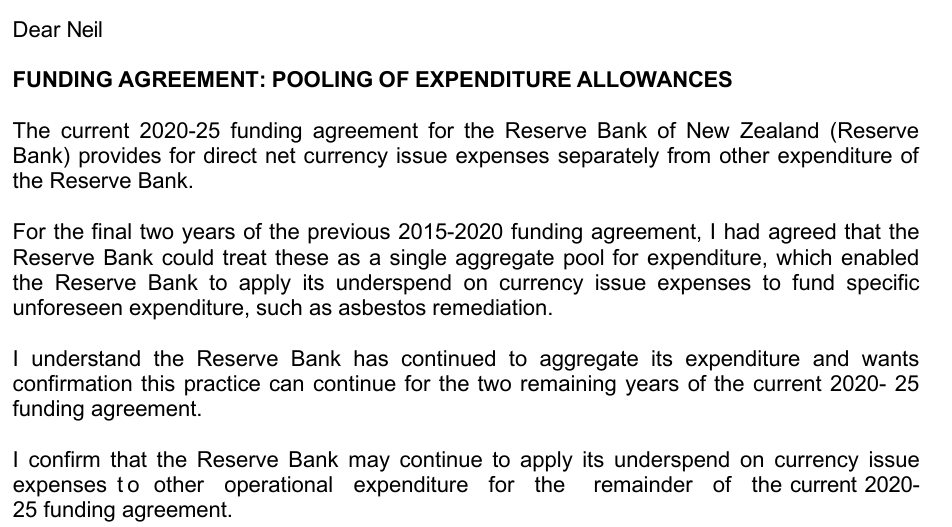
This letter from Grant Robertson to the board chair, Neil Quigley accompanied the 2023 variation to the Funding Agreement
There is a good logic to providing separately for (net) direct currency expenses, since currency issuance is a (the key) profit centre for the Reserve Bank, and we wouldn’t want any incentive for the Board or management to skimp on spending there to give them more freedom to spend on nice-to-haves.
According to Grant Robertson’s letter, the Bank wasn’t needing to spend as much as allowed (in the 2015-2020 Funding Agreement) on currency in the late 2010s, and on the other hand faced some unanticipated cost pressures in other areas (the asbestos remediation referred to in the latter). Grant Robertson’s permission then was, in many respects, equivalent to a variation to the Funding Agreement, raising the amount that could be spent in 2018/19 and 2019/20 on core operating expenses and reducing what could be spent on net direct currency issue expenses. That may well have been a reasonable call by the then Minister of Finance (and is water long under the bridge now).
But, remarkably, Robertson’s letter suggests that whereas he had given permission for the two Funding Agreement expenditure components to be pooled for 2018/19 and 2019/20 for a specific purpose (that asbestos remediation), the Bank had actually treated it as carte blanche, a general permission to pool the two buckets that had deliberately been set up separately, so as not to be pooled. It appears they had had no authorisation for doing so at all. Perhaps by 2023 someone was asking questions (Treasury, or just possibly the Bank’s Board which actually became formally responsible for the governance of the Bank on 1 July 2022)?
That 2023 Funding Agreement variation had already given the Bank a massive increase in permitted core operating spending (up a total of $79.3 million for the 2023/24 and 2024/25 years). But in addition, Robertson allowed them to add any underspend on currency issuance to their other operating spending (another $6m a year or so). Note that this aggregation was only allowed within years, and there is never suggestion that underspends can be carried forward into overspends in subsequent years.
I came in this morning after doing some chores and looked quickly at Twitter before unpacking the groceries. Someone was retweeting a Radio NZ story with the headline “Reserve Bank’s budget to be slashed by 25%”. Wow, I thought, the Minister of Finance has really delivered this time. And then got on with putting the groceries away, relieved that the story I’d heard last week, that the final agreement hadn’t cut future spending much and wasn’t unduly bothering the Bank’s senior management, seemed not to have been true.
Coming back a little later, it was very quickly clear just how much spin was involved in that headline. And that, while journalists really should dig even slightly deeper than a ministerial press release, the headline could perhaps be excused when one looked at the Minister of Finance’s own press release. And, critical as I sometimes am of Reserve Bank Board chair Neil Quigley, it should be said that if his press release wasn’t very illuminating, it also played things straight. The “25%” did not come from him. (In fairness to RNZ, their headline was what I noticed, but some other media seem initially to have fallen for the spin.)
Here was the key bit of the Minister’s press release
I’d heard a while ago that the Bank had bid for in excess of $1 billion for the coming five years, and had struggled to quite believe it. But it turned out that that story was accurate. It was quite remarkable, even coming from the noted empire builders, Orr and Quigley. But what empire builders bid for going into budget round (in this case the Funding Agreement round) is really neither here nor there. Kids want lots more pocket money too, and yet the extent to which their desires are not met tells us nothing about actual parental restraint. Of course $1.03bn wasn’t going to be “value for money” when most observers struggled to work out how Orr/Quigley had ever persuaded Grant Robertson to allow the evident bloat that had occurred over the last few years.
Which leads us onto a genuine puzzle. You’ll note that the Minister refers to an operating budget for the current financial year of $200 million. She also refers to it twice in the short paper she put to Cabinet’s Expenditure and Regulatory Review Committee.
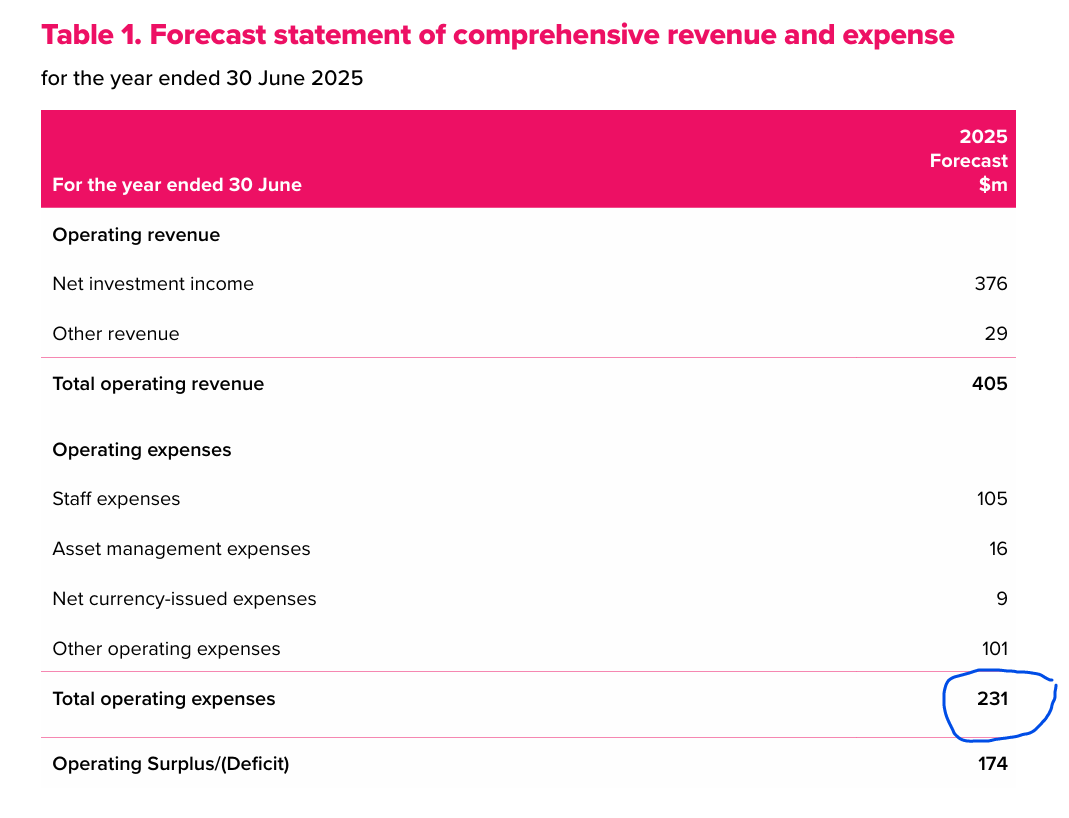
But in the most recent variation to the previous Funding Agreement, signed by Grant Robertson just weeks before the 2023 election, provided for operating expenses (those covered by the Agreement) to be $149.44 million in the year ending 30 June 2025. And the Bank’s own published Statement of Performance Expectations for the year to 30 June 2025 showed a budget for Total Operating Expenses of $231 million. The $231 million will, presumably, have included some items not covered by the Funding Agreement, but we – and Ministers – are left with no idea where the Minister’s $200m comes from or how it relates to the $149.44m that Grant Robertson had approved for that same year. The Bank’s Annual Report says they had underspent their budget in the 2024 year, so perhaps there was some catch-up spend while they could. But whatever the case it is very hard to see anything like $200m as some sort of baseline annual operating spending (although presumably Orr had tried to make it so to justify his billion dollar five year bid).
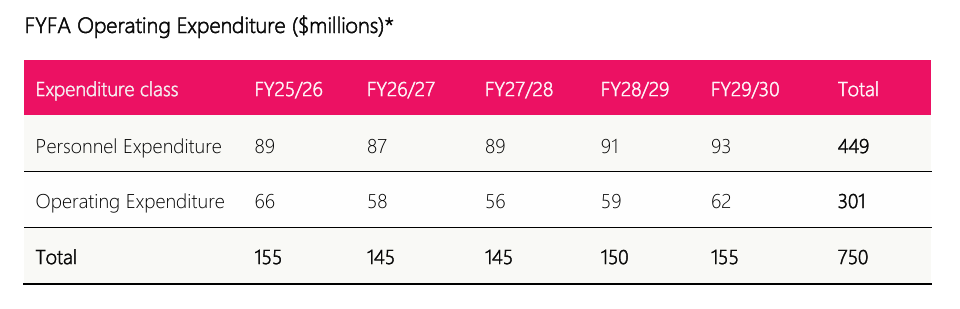
This is the core section of the new Funding Agreement
On headline numbers, the Bank is being allowed to spend in the coming financial year 3.7 per cent more than Grant Robertson in August 2023 thought was appropriate/necessary in the current (24/25) financial year. Headline inflation came down pretty much as had been expected in August 2023 and is now pretty close to the midpoint of the target range. Some restraint…… Things get a bit tighter for them in the following couple of years, although nothing has been released so far to explain the phasing. Perhaps they’ll have some redundancy costs in the first (2025/26) year?
Note also the list of things the Bank spends on that aren’t covered by the Funding Agreement is noticeably longer than the list in the previous one. Some of the changes are small (eg the exclusion for the Bank’s legacy superannuation scheme used just to be for actuarial gains and losses, while now it is for any expenses – and the Bank meets most of the direct admin expenses associated with the scheme) but others don’t look very small at all.
I’d have thought costs associated with refurbishing or replacing the building would have been expected to be met from depreciation. But apparently not. And the Bank has been spending a lot of money over several years pursuing its CBDC dream (the solution in search of a problem). Those expenses were presumably covered by the Funding Agreement in the past, but a material chunk of them now appears to have been moved outside that limit. (I’ll save for another day the question of why a Minister preaching fiscal restraint is letting them continue to pursue this – at best – nice to have.)
There was also this new exclusion
The simple comparison between past and present Funding Agreement operating expense numbers seems to exaggerate (by unknown amounts) the extent of any restraint. And even if we discount that problem, the massive expansion and bloat made possible under Orr seems to have been largely cemented in. Approved operating spending (inside the Funding Agreement scope) in the final year of the new agreement appears to be just 6 per cent lower than it would have been if Grant Robertson’s last approved number had just been increased by 2 per cent a year (midpoint of the target range). Real spending had roughly doubled during the Orr years, even on that Robertson number for 24/25 – which appears to have been far below actual spending this year. These aren’t exactly the much-vaunted “frontline services”)
And, as the Minister had advised her Cabinet colleagues, it wasn’t as if the growth had been in core statutory functions
Now, it is pretty clear that the Bank had been remiss in maintaining its IT systems and needed to spend more, but on the table included in the Cabinet committee paper, IT spend doesn’t look as if it stands out. The Bank just grew a great deal, least of all in the most core function around monetary policy, and now Willis is proposing little more than stopping the growth. We should, I suppose, be thankful for small mercies, and that the Orr/Quigley bid wasn’t accepted, but really……in a time of very straitened fiscal circumstances.
Here is the table on where the money has been spent
The Cabinet committee paper reveals that there had been a suggestion of cutting by more, but the Minister had had her arm twisted by Quigley (probably after Orr left).
Having presumably been told that their billion dollar bid was simply unacceptable
Frankly, it doesn’t seem very persuasive, given that Treasury had been looking at the numbers for months and had even engaged an external consultant to help them. 4 per cent lower spending might have started to look like making real inroads in reversing the bloat, but….the Minister simply gave it away, with no indication of what it was that Treasury had not previously appreciated about the scope for savings.
It is all pretty underwhelming, and perhaps does not bode well for the extent of fiscal restraint we might see in next month’s Budget. Structural deficits don’t close themselves.
Finally, lets return to some of the statutory provisions. It remains pretty astonishing that the Funding Agreement – authorisation to spend for five years for a major public policy agency – no longer requires parliamentary approval. It is a gaping democratic deficit introduced by the previous government, and means there is also no parliamentary debate on how much this behemoth spends, let alone on what.
On which note, note (f) below. In today’s release there is no sign of any such budget, so we have no idea where the Bank intends to make savings.
and in case you are wondering, yes the law does require the budget to be published with the Funding Agreement (or any variation to it, as in 2023)
SImple defiance of the law (as it seems, and as it seemed in 2023) seems more Trumpian than the way we do things in New Zealand. But there is no sign of a budget, with the required detail, with either the Bank’s or the Minister’s releases.
Apologies for nothing much recently on New Zealand macroeconomics and related topics. My spare time is pretty much consumed at present with my Bank of Papua New Guinea responsibilities and those associated with the troubled (and troubling) Reserve Bank of New Zealand Staff Superannuation and Provident Fund. Yes, it is Orr and Quigley again.
In my last post I wrote about the scheme being cooked up to transfer the pension liabilities of the Reserve Bank scheme to the Government Superannuation Fund by means that look highly likely to be ultra vires, and in any case are extremely risky for pensioners over coming decades. The basic goal, transferring the liabilities of a small scheme to a much larger scheme, in exchange for a full and final payment from the small scheme before it itself is wound up, isn’t in question (indeed, I’ve championed the search for such a solution). But pretty illegal foundations are a poor basis for anything, most especially when it involves the Minister of Finance, our prudential regulatory agency (concerned with standards of governance and conduct in its bit of the financial sector) the Reserve Bank, and the government’s key economic adviser, The Treasury. It is all the more extraordinary when there are simple, well-grounded, legislative solutions available, which would remove most of the legal and financial risks in what is planned. Such a solution might take a couple of months, but there is simply no urgency about this resolution (and no one involved seriously claims otherwise).
Here is the relevant bit of the Government Superannuation Fund Act, a provision added many decades ago, decades before that scheme was closed to new members.
That looks like a pretty objective test to me. The Governor-General can’t just make any old regulation (Order in Council), not even as regards to superannuation. The test isn’t even whether in the opinion of the Governor-General (or her ministers) a proposed OIC might be (say) in the best interests of some people. The test is that an OIC under this section can only be made if it is giving effect to an arrangement that is intended to provide “reciprocity in matters relating to superannuation”.
In a standard conception in decades past such a (hypothetical) arrangement could have involved government department employers and the Reserve Bank (and their respective pension schemes) agreeing to recognise service with the other employer for purposes of each other’s pension scheme. Spend 35 years at The Treasury and 5 years at the Reserve Bank (or vice versa) and your service at the Reserve Bank will count towards your GSF pension (or vice versa). The way defined benefit pension schemes operate that is valuable for employees and enables a bit more labour mobility among related entities that would otherwise occur. Both sets of pension funds, both sets of employers, continued to function.
(To be clear, this is a hypothetical – there was no such historical agreement)
The scheme the Minister of Finance got her Cabinet colleagues to agree to (presumably acting on Treasury advice, although Treasury refuses to release that advice) bears no resemblance to that sort of (genuinely) reciprocal arrangement at all.
Instead, the Reserve Bank scheme would, in effect, sell its liabilities to the GSF, pay the price GSF names to take on those multi-decade liabilities, and then be wound up. All very efficient (in principle) but there is nothing reciprocal about it. And as it happens, since to close the Reserve Bank scheme the trustees have to purchase contracts that replicate the pension etc benefits that would otherwise be payable, and since there are differences between the two schemes, what is actually proposed is not that Reserve Bank pensioners are simply added into GSF (its so-called New General Scheme, a set of clauses in the GSF Act) and paid per the GSF rules. For any aspect where the GSF rules are less generous than the Reserve Bank rules, GSF is agreeing by contract to provide better benefits in those areas than it provides to its own members. Which is fairly weird given that the GSF benefits themselves are explicitly outlined in the GSF Act itself, but somehow this contract (and authorising Order in Council) are going beyond statute for this group of pensioners. Which would work out nicely for us…….except that the legal foundations appear incredibly shaky, and thus highly vulnerable. And the nature of DB pension schemes is that they run for many decades – this isn’t simply an arrangement for a year or two.
It simply isn’t providing for reciprocity at all. It is just an outright sale and purchase agreement.
It appears that section 98 has never been used before (despite 75 years in the legislation) so there are no judicial rulings on what “reciprocity” means in this context. As far as I can gather there also isn’t any authoritative legal commentary on the use of the term in New Zealand legislation.
But I thought it might be worthwhile to check all the references, with a search on the legislation.govt.nz database for how “reciprocal” or “reciprocity” is used. Absent specific authorities on this particular section one might think a court would look not just to the dictionaries but to actual New Zealand usage, in both primary and secondary legislation. My exercise here is simply about interpreting from context (what arrangements are being described when the operative words were used by drafters, Parliament (acts), and ministers (regulations).
I did two levels of search. The first was to search by title, and the second by the full text of each instrument. (If you are happy to accept my word about the overwhelming weight of how those words are used, then feel free to skip ahead to the Summing Up section at the end of the post.)
Titles of Legislation
16 titles contain the word “reciprocal” and 13 “reciprocity”.
Of “reciprocal” 13 examples are regulations made under one piece of primary legislation, the Reciprocal Enforcement of Judgments Act 1934 (which incidentally was thus in place when reciprocal/reciprocity were first introduced to what became the GSF Act). Neither “reciprocal” nor “reciprocity” is defined in the Act, but the purpose is illustrated thus
The other examples, using “reciprocal” in the title, are regulations around child support (and spousal maintenance) payments, one giving effect to an agreement with Australia and another with Hague Convention countries. The core of these regulations is that orders in one country are “entitled to recognition and enforcement by operation of law in the territory of the other”.
What of the 13 with “reciprocity” in the title? 12 of them are health and social welfare provisions. It is quite clear that what they are describing is the parameters for arrangements under which foreigners can be treated the same as New Zealanders here (mirroring the other side of the agreement re the way NZers are treated abroad – eg as between NZ and the UK our public health service and their NHS).
The 13th is the Law Practitioners (Victoria Reciprocity) Order 1937, made pursuant to the Law Practitioners Act. The entire order is as follows
Mutual recognition and all that.
Use in the body of legislation
What of uses of “reciprocal” and “reciprocity” in the content of acts and regulations? There is overlap of course: legislation with one or other word in the title also tends to have it in the body. There are 79 examples of a use of “reciprocal” in the content of acts or regulation and 45 examples of “reciprocity”. I haven’t reproduced all these search results (easy enough to do yourself), but I have gone through and checked all examples not already covered by the review of the titles above.
Take the “reciprocal” list first:
The Trans-Tasman Proceedings Act 2010 seems to cover very similar ground to the Reciprocal Enforcements of Judgements law, replacing some orders (Australasian) under that law with this specific Australia-focused legislation
The High Court Rules also show up, but again in reference to the Reciprocal Enforcement of Judgements Act
Maritime Transport Act references all relate to reciprocal enforcement of judgements.
The Tax Administration Act has a specific provision, along the lines of mutual recognition
The Contracts and Commercial Law Act 2017 seems in a similar vein
Or the US-NZ double tax agreement 2014
Or the Sale and Supply of Alcohol Regulations
Those are the examples (all of them) from the first page of search results.
I have gone through all the others and have not been able to find a single of example of a usage that is other than something akin to “like for like” (there is perhaps a partial exception in some Treaty of Waitangi settlement legislation, but there the context seems to have been one of mutual obligations over long periods of time). Not one of the references has the sense of “one-off full and final payment of dollars for services”. I’ll include just one more in deference to the “creative” lawyers we seem to be dealing with (whether in/for Treasury, Crown Law, PCO, the Reserve Bank, or the Government Superannuation Fund Authority), from the Lawyers and Conveyancers Act
And then I turned to uses of “reciprocity” in the body of legislation (acts and regulations), again skipping over laws already covered above.
There is the UN Convention on Refugees 1951 (made part of our law as a schedule to the Immigration Act)
The District Court rules
The Valuers Act 1948
And the 1923 international treaty on arbitral awards, a schedule to our Arbitration Act 1996.
Again, there is not a hint or a single example of “reciprocity” used in ways that might encompass a one-off payment from one entity to another in exchange for the latter assuming a bunch of obligations from the former (let alone the former entity then winding itself up and disappearing).
It is, perhaps, telling that (as far as I can see) in not a single act or regulation are the words “reciprocal” or “reciprocity” defined, suggesting that something akin to dictionary definitions and common usage is envisaged. Here is the definition of reciprocity from my two-volume Shorter Oxford English Dictionary:
Summing Up
The last couple of sections have probably been a somewhat boring trawl through pieces of obscure legislation. But it becomes necessary when parties – the Minister of Finance, backed by a Cabinet committee, the Reserve Bank, and The Treasury – are content to rely on a “meaning” for the term “reciprocity” seemingly dreamed up by some lawyer or other from thin air. There is no dictionary precedent for such a usage and nor is there anything in 100 or so years of New Zealand legislation. It is very hard indeed to see how section 98 of the GSF Act could possibly encompass the sort of deal the Cabinet – led by the Minister – proposes to authorise their Crown entity (GSFA) to undertake. There is nothing in the dictionary to support it, nothing in a plain common reading, and nothing in the legislative history of this old previously-unused provision.
Three last points:
why does any of this matter?
is the proposed deal bad in intent? and
if not, is there are a better way.
It matters because lawmaking should be done properly. It certainly shouldn’t be done on a basis that happens to suit decisionmakers who themselves having nothing at stake if things later go wrong.
And what could go wrong? A court could find that the entire Order in Council was ultra vires. A future set of ministers could decide either that they don’t like one or more Reserve Bank pensioners, or just that the original OIC was bad law and probably ultra vires. Or Parliament can disallow the Order in Council (takes one member of the Regulations Review Committee and no other objection), perhaps recognising that it was bad (secondary) law. In each of which scenarios elderly pensioners could be left in limbo, uncertain as to whether they had any entitlement to a pension, but with the money (currently in the Reserve Bank pension scheme) now gone, and at best facing expensive legal action to attempt to assert any claim against someone/anyone (RB, GSFA, former trustees…..).
As I noted at the start of this post, the idea of a transfer (with full and final payment) of Reserve Bank scheme pension liabilities to the GSF isn’t a bad one (and I was, and remain, a champion of it in principle). There are genuine administration cost savings to be had (a gain to the Reserve Bank, which is thus keen on the scheme, facing no risks itself), and for anyone involved in governance of the scheme in the last 10 years also an opportunity for personal escape.
But it needs to be put on more secure legal foundations. Parliament is, of course, sovereign, and so can legislate anything it likes (for good and ill). A simple amendment to the GSF Act (rather than an Order in Council, resting on the tenuous provisions of section 98) would achieve that. Readers of my previous post may recall that the Minister of Finance told Cabinet that this wasn’t an option because it couldn’t be done until 2025. That is now a mere six weeks away (and at this point any transfer isn’t likely to be feasible before the second half of next year). Taking a punt that things will probably turn out okay simply isn’t good government, whether from ministers or officials (and not an approach they’d be likely to take if they themselves had anything at stake).
What about the trustees of the Reserve Bank superannuation scheme you might wonder (of whom I have the misfortune to be one)? All this material was presented to them as long ago as January, and they have simply refused to engage. Not only that but they have specifically and consciously chosen not to seek independent legal advice on whether there is a robust legal foundation for the transfer they propose to enter into. In doing so they appear to rely on a view that one does not need to look behind to check the bona fides of a party they are dealing with to see if they are able to enter into the proposed contract. That seems imprudent generally, but even if it were a model which might make some sense in a corporate context, when Party A can’t easily look into the private authorising documents of Party B, and might have to rely on warranties, it makes no sense at all when (a) the GSF Act is a public piece of legislation available for all to read, and b) all these issues have, more than once, been brought to their attention.
It is pretty reprehensible, but then it is what one might expect from two of Orr’s deputy chief executives (appointed to the super fund roles by Quigley’s board) and a Licensed Independent Trustee (a statutory position created a decade ago, notionally to help protect members) who has long been (a) keen to get out of the role, and b) in eight years has never displayed evidence of the slightest interest in the best interests of members and who is on record as suggesting, contrary to the statutory duties, that trustees also need to look out for the interests of the Bank.
As a bottom line, the law requires that any such OIC under the GSF Act be with a view to providing reciprocity in matters relating to superannuation. The proposed arrangement, which the GSFA cannot enter into without specific legislative authorisation (the Act prohibits new members), does no such thing, and there is thus no power for an OIC to authorise what is proposed. There is, by contrast, a better way.
Finally, note that these matters were raised, in a careful and considered manner, in a letter to the Minister of Finance months ago. I find it remarkable that the Minister has not even had the courtesy to respond, even as she and her department have blocked OIA requests on these matters. I have legal duties to our members. I would hope she senses a moral obligation, to them (former public employees) and to the cause of good, and certain, lawmaking itself.
It was a tweet from Olivier Blanchard, emeritus professor of economics at MIT and former chief economist of the IMF, that first drew my attention to the book
Please, please, read it. It is worse than you imagined… (and the book is a page turner). Then, worry about the following headline from Axios today: "1 big thing: Crypto dominates corporate election spending." https://t.co/riryXjtiLI
“A brilliant and fascinating description of crypto. It makes painfully clear that, on the buying side, there is no limit to human credulity, and the faith in magic returns. And, on the selling side, no limit to hubris, deception and scamming. Read the book, and cry.”
As I sat reading the book yesterday I kept wondering quite how it had got through the publishers’ lawyers. But it seems to have been written under a pseudonym and various significant names have been changed, including that of the UK-based crypto firm (that briefly became one of the biggest crypto marketing companies around) in which the author was a senior figure, and more than a few of their client firms. Presumably that was seen as enough to reduce the legal risks sufficiently to publish.
Readers should be grateful: it is an easy and absorbing read, and if you are anything like me you’ll read it with some mix of astonishment, despair (human nature and all that), and moral outrage. I’m pretty sure the author intends to prompt readers to think more regulation is an obvious and necessary response, but I’m less easily persuaded on that count. Fools and their money…. If there are decent people and firms in the sector, operating consistently ethically, there is pretty strong incentive on them to differentiate themselves from the (apparently) very many rogues and rank opportunists.
“Donoghue” (from here on I’ll drop the quote marks) – who seems to be still quite young (says he was still a student in 2016) – had a background in PR, apparently in both finance and politics in the UK, before he jumped aboard a crypto startup being put together by an old university friend and the friend’s cousin. In the early days – Donoghue still holding down a fulltime PR job elsewhere – it seems not to have been much more than three or four of them, chasing the dream of “generational wealth”. The plan was to launch a gambling platform – on the future price of Bitcoin – with an associated crypto token. As Donoghue writes it now – while claiming, perhaps plausibly as he was the PR guy, not to have realised it at the time – it was a “totally implausible business model”. Which, in the crypto sector, didn’t stop lots of weird projects getting off the ground, and a lot of wealth being redistributed (and some apparently made – with an emphasis on the “apparently”; it was close to the sort of stuff J K Galbraith was writing about when he coined the phrase “the bezzle”). The shortlived boom Donoghue was in the midst of collapsed in late 2022, most prominently including the fall of Sam Bankman-Fried’s FTX.
It is a lively story. Donoghue’s firm started with its own platform/token, but very quickly found that there was more money to be made parleying their experiences and expertise (such as it was) into selling marketing and promotional services around the launch of new crypto firms/products/token to the myriad of other ambitious opportunists wanting to get on the boom quickly. In some cases, firms were almost throwing money at Moonshot (the pseudonym of the advisory firm). There are weird tales of the launch of improbable NFTs (non-fungible tokens) – who, they wondered, was going to want to buy NFTs of pictures of the football players of some US team, whose CFO had got keen on the idea, especially when there was no easy way – for those not already engrossed in the crypto world – to buy the product. But it sold. Or an NFT of a stamp, when one could simply own the stamp itself (as I recall it, that one didn’t get off the ground).
There are plenty of accounts of “influencers” being paid in heavily discounted crypto tokens they were to hawk, never disclosing to the influenced their own direct stake in the success of the token/platform. Or of venture capital firms issued with deeply discounted tokens, typically undertaking next to no due diligence, and wanted less for the immediate money they provided, than for the apparent (but highly misleading signal) that if the VCs were on board, it must be okay for the public to buy. And the parties, so many parties, so lavish.
In Donoghue’s words:
It’s an insider’s view, into the lives and livelihoods of some of the inner circle to which I used to belong. It’s a record of the sheer extravagance, excess and absurdity, which seemed to take place on a daily basis. And what it illustrates is how the people behind one of the most captivating, disruptive and incomprehensible industries the world has ever seen act when the cameras are off, and their guards are down.
I strongly recommend the book. And if the recommendation of someone like Blanchard (and blurbs from two Nobel memorial prize in economics winners) isn’t the thing for you, it also comes blurbed by people like Frank Abagnale (subject of Catch Me if You Can), Izabella Kaminska, Frank Partnoy, William Cohan and Dan Davies, authors many of you will recognise. Oh, and by Andy Verity, whose excellent book – published by the same firm – on the scandalous prosecutions that followed the LIBOR issues in 2008/09 I wrote about here last year.
As it happened I had a couple of emails from Donoghue himself a couple of weeks ago offering me a review copy (not sure why, this being a fairly obscure blog, but I guess PR was his expertise. And I’d already ordered a copy). This is how he describes his own book.
The book is a narrative non-fiction account of my time spent working in the cryptocurrency industry. It’s a cautionary tale of the scams and fraud endemic to the space, and the often-devastating consequences inflicted on ordinary investors who get caught up in these.
For several years, I ran one of the most prominent marketing agencies in the industry, working with some of the largest companies and projects in the space. I was also on the founding team of a number of projects myself, one of which obtained an all-time-high fully diluted market capitalisation of $300 million.
My book now seeks to shed light on the corruption and malpractice which I saw unfold on a daily basis.
What could usefully be added is the line from the end of the book’s Prologue: “In order to tell that story, I first need to tell my own. It’s the story of a player on the inside who became so blinded by greed that he didn’t even realise he’d lost his way until it was almost too late”. It was a wild ride, and perhaps one he is now ashamed of. His penultimate paragraph is a good place to end.
I can only hope that, after the actions of SBF, Do Kwon, and the countless other characters in the rogues’ gallery of crypto we haven’t heard of – who will all hopefully get their day in court sooner rather than later – people will be dissuaded from having a punt in the murky and malevolent markets of crypto.
Back in June the Minister of Finance (and the coalition government more generally) surprised many/most observers by reappointing, for another two-year term, the chair of the Reserve Bank Board, Neil Quigley. Quigley, you may recall, has been on the Bank’s Board since 2010, has been chair since 2016, and in 2022 (when the new Act and Board structure came into effect) had been appointed for what then seemed like a two-year transitional (ie final) term by then Minister of Finance Grant Robertson.
I wrote about this astonishing (to put it politely) reappointment at the time, and then lodged an Official Information Act request with the Minister of Finance for any and all material relating to Board appointments or non-appointments (there are still vacancies on the Board and to date the Minister appeared to have done nothing about filling them either). Nothing about either the conduct or the policy performance of the Reserve Bank over recent years suggested that simply reappointing the Board chair would make a lot of sense, at least for a government that cared two straws about institutional quality, massive losses to the taxpayer, let alone debacles like the worst outbreak of core inflation in decades (recall the “cost of living crisis” that helped see off the previous government).
It took the Minister a long time to reply, running over her own extended deadline, but the results finally turned up last week. The response didn’t shed much light on the reappointment, but I’ll come back later to what little we did learn. There was, however, some interesting snippets on other aspects of the Minister and the Reserve Bank.
The first was about appointments to the Monetary Policy Committee (there were two new external appointments earlier in the year). I hadn’t asked about MPC appointments, but I guess they must have got caught up in the response because the Board recommends these appointments.
The new appointees – Carl Hansen and Prasanna Gai – represented a step forward (including final confirmation that the absurd Quigley blackball on expertise on the MPC had well and truly gone). They were announced on 28 March, four months into the government’s term. But what the OIA response showed was that the nominations had been delivered to the Minister in a paper dated 15 December 2023, just a couple of weeks after the government took office. It confirmed, what had seemed likely, that the MPC appointees had been selected by the Labour-appointed Board to selection criteria that had been developed much earlier last year, under Labour. My OIA response doesn’t specifically show that Gai and Hansen were those nominated in December, but there is no hint in any of the papers that the Minister of Finance pushed back at all on those nominations, or did anything about seeking to reconfigure the way the MPC works to encourage more openness and accountability. Instead, the pre-election nominations simply worked their way slowly through the system, and were finally announced just before the first appointee needed to take office. Neither appointee was, on the face of it, bad (although we have yet to see any evidence that either has made a positive difference), but the process revealed a Minister who wasn’t very interested and just went along.
The other unrelated aspect that the OIA revealed something about was the government’s approach to Reserve Bank spending. I’ve previously noted my surprise that there had been nothing in the 2024 Letter of Expectation from the Minister to the Board calling for expenditure savings or strongly stating that the next five-yearly funding agreement (from 1 July 2025) would do something about the bloat that had grown up under Orr/Quigley/Robertson.
But it turns out that there were actually two letters of expectation, only one of which has been disclosed pro-actively.
The mention of a “savings target” for next year and beyond of 7.5 per cent is, I guess, a start, and better than nothing from the Minister, although seems rather light given the huge increase in spending and staff numbers the Bank has undertaken over the last few years, including (for example) the 27 comms staff.
But then there is no sign at all of anything pro-active in the Reserve Bank’s response, or even in the Minister’s follow-up. The contrast with ACC is stark. It also isn’t directly Budget funded so also wasn’t included in this year’s fiscal savings targets but this was the CEO in February
Seemed like the approach of a responsible CEO and Board.
But very different from the Orr/Quigley approach. As they are required to by law, the Reserve Bank at the end of June released its Statement of Intent and Statement of Performance Expectations. The draft Statement of Intent has to have been provided to the Minister early, the Minister can provide comments, and the Bank must consider those comments. But there is little or no substantive mention in either the Statement of Intent or the Statement of Performance Expectations of the forthcoming new funding agreement, nothing at all about cuts, savings targets or anything of the sort. And, you may remember that for 24/25 the Board had approved budgets with a further 21 per cent increase in staff expenses.
Doesn’t quite seem to compute, against the reported talk of a 7.5 per cent savings target from next year.
(One person I discussed this with suggested – flippantly I think – that perhaps the 21 per cent increase included big redundancy costs, but I think we can discount that rather charitable interpretation.)
Where was the Minister of Finance in all this? Why, she was finalising the further reappointment of the Board chair. It seems to speak to an extraordinary degree of indifference.
What do we learn from the OIA about that reappointment. To be honest, not a great deal. We do learn that the Opposition political parties (who she was required by law to consult) raised no objection (but then Robertson had appointed Quigley in the first place and run defence for the Bank over recent years, backing the Board’s recommendation to reappoint Orr).
But there was also this line in the talking points provided by The Treasury to the Minister of Finance to accompany the reappointment paper she was taking to Cabinet’s Appointments and Honours Committee in early May (this sentence was the only content on reasons for the proposed reappointment).
It was pretty staggering stuff really. A Governor whose personal conduct leaves a great deal to be desired, who repeatedly misleads (or worse) FEC, treats MPs (including Willis when she was in Opposition) with disdain, and who had presided over the worst monetary policy failures in decades, with not a word of contrition or straightforward reflection and ex post analysis……and what is supposed to commend the Board chair (himself with a fairly shady record, misleading Treasury) is that he works well with the Governor. Just astonishing. Now, to be sure, one would not want a Board chair who was perpetually unnecessarily at odds with the Governor, but one of the prime jobs of the Board and its chair is to hold the Governor and MPC to account, and – in the wake of failures of recent years – you might hope that things between the Board and Governor were actually a bit tense, with pressure on the Governor to markedly lift his game. (Cabinet in early May wasn’t to know that they were just about to be treated to another example of MPC/Governor very poor performance, with the baffling MPS in May, the quick U-turn, and then the attempt by the Governor to suggest that anyone suggesting there’d been a U-turn shouldn’t be taken seriously.)
It is always easier to reflect on what is in documents (and OIA releases) than what isn’t there. But reflecting on this bundle of documents, what is striking is that there is no written advice at all from The Treasury to the Minister on the performance of the Board or the Board chair (and my request specifically encompassed such advice). Part of the overhaul of the Reserve Bank Act was to give Treasury a clearer and more explicit (and better-funded) role in monitoring the Bank and its Board. And yet……there was just nothing when it came to the decision whether or not to reappoint the incumbent, who’d presided through the years of woe (and whose Board Annual Reports, supposedly providing accountability, never expressed any concerns whatever). Whether this was Treasury falling down on the job (quite badly) or just keeping quiet because the new Minister had been clear from the start that she was reappointing Quigley anyway is impossible to tell from this set of documents. Even if it was the latter, you might have hoped that a fearless Treasury, serious about its new monitoring role, would have recorded some advice anyway. But apparently not.
When Willis announced the reappointment of Quigley, her statement included this line
You were left wondering why a new Minister of Finance wouldn’t have just got on and made appointments when she could (she’d already been Minister of six months then, and pretty everyone outside thought the current Reserve Bank Board was seriously underqualified).
On 29 May, Treasury provided some advice to the Minister about future Board appointments, notably a “late 2024 appointment round” that they were proposing. Much of it is fairly sensible stuff, and they clearly had in mind the eventual replacement of Quigley proposing to find a new member “with specialist domain knowledge and the potential to succeed Professor Quigley as chair”, and noting later again the need for a succession plan for Quigley’s position as chair.
The paper has a timetable, that envisaged getting onto things pretty promptly, with nominations/applications to fill the various vacancies to close on 24 June, appointments to be formally made late last month, with the appointees taking up their new positions on 9 September. Which would have been all well and good, but…..there is no sign (either in the release, or in anything seen in public since) that the Minister accepted this advice or that anything has anything has yet happened.
And so we are just left with not much further insight, but perhaps a confirmation that the Minister of Finance really didn’t care much. Which really shouldn’t be good enough, in an institution (management, Board, and MPC) that has done so poorly in recent years on so many dimensions.
I don’t usually find cynical explanations that convincing, so I’ve been reluctant to take very seriously the line that Quigley was reappointed because he was in league with National Party figures (be it Steven Joyce, the very expensive lobbyist Quigley had hired, or Shane Reti and the promise of “a present” for a second term in government that a new medical school would be). If I had a cynical explanation of my own it might be along the lines that National really had no reason to be concerned about all those Reserve Bank failures because, after all, the dreadful inflation outcomes helped them win the election. What wasn’t to like? But I don’t really believe that is the answer either.
And so I fall back on the idea that Willis just doesn’t care very much. There might be no political price to pay for making a start on sorting out the Reserve Bank, but there probably is no price to pay among the general public for doing nothing about it all. So, if you really are mostly just a political operative, why bother? Who cares? That should be a fairly damning indictment of the individuals involved, and of the system, but it is hard to think of a better story. (Lines about needs for succession planning ring pretty hollow: plenty of Crown entity chairs have been replaced in short order, and it is hardly as if anyone outside the Bank seems to think the Orr/Quigley Bank had been doing a good or professional job.)
I’m not going to repeat all the text I wrote when the Quigley reappointment was first announced, but I’ll end with just a few sentences from that post
Even among those with low expectations of the current Minister of Finance, it was pretty astonishing news. It isn’t really possible to get rid of the Governor – unless he had been inclined to do the honourable thing, including accepting responsibility for the macro mess, and resign – but the Board chair’s term expired just six months after the new government took office. Of the three parties in the government, the two who had been in Parliament last term – ACT and National – had both objected to Orr’s reappointment when, as his new law required, Grant Robertson had consulted them. And it was the Board, led by Quigley, that was responsible for choosing to recommend Orr.
Just astonishing. But remember that “excellent working relationship” he has with Orr…..
PS Not that is a particular concern of mine, but I noticed in the documents that Quigley is getting paid $2300 a day for his Reserve Bank role. Last year’s Annual Report showed that he received $170127, or about 74 days at that approved daily rate. That seems like a large chunk of time for someone with a fulltime chief executive role, as a university Vice-Chancellor, to be able to devote to an outside Board position
The Reserve Bank’s Monetary Policy Committee yesterday delivered their latest OCR review.
In my post on Tuesday, in which I suggested that an OCR cut was appropriate now, I’d noted
As it happens, yesterday was another reminder that it is unwise ever to bet against Reserve Bank induced volatility, sometimes intended, sometimes not.
You’ll recall that the May MPS (forecasts and words) was a lurch in the hawkish direction. This was their OCR track, revised out and up, showing an on-balance probability of OCR increases for the rest of this year, and nothing below the current rate until the August 2025 Monetary Policy Statement.
and this was a chart I’d constructed from the same projections:
Real interest rates kept on rising until the second half of next year, but somehow – as if by magic (given the absence of domestic or external macro stimulus) – the economy gradually recovered anyway.
The MPC then seemed to have barely understood what it was doing, and a couple of days later the chief economist was indulging in the old bad workman’s excuse (blaming his tools). We weren’t really meaning to suggest possible rate hikes, they claimed. but if so why publish the projections that showed exactly that, when any half-competent MPC member would have known precisely how they’d have been read? And in the end the markets seemed all rather underwhelmed and unconvinced and didn’t really move much at all.
But say what you like about the May MPS, at least it was done in the context of a full set of economic and inflation forecasts. And it was finalised with the full MPC present.
By contrast, what of yesterday’s statement? Not only wasn’t there a full set of forecasts (internally, let alone published), but the Bank’s chief economist – who is presumably primarily responsible for both sets of forecasts and economic analysis – had been allowed to go off on leave and wasn’t even at the meeting (they only happen seven times a year). And there really hasn’t been that much data since late May, and none of it that (to my eye anyway) seemed particularly surprising or game-changing. Most notably, especially in the context of all the explicit concerns in the May MPS, there hasn’t even been another CPI outcome (and the Bank rashly chooses to do these reviews a week before the CPI comes out).
Now, as it happens I think the view articulated in yesterday’s statement is much better and much more likely to accurately reflect what is going on, and is likely to go on, in the economy and inflation than the one delivered in May. And in that sense, and in isolation, I welcome it. Perhaps the two new MPC members have begun to make some useful difference (although in the culture, and under the obligations of silence they’ve assumed, we may never know – we get much more openness from our Supreme Court justices than we do from MPC members).
But we should be able to expect better than such policy lurches, that are neither signalled in advance (none of the frequent speeches we see in the better and more open central banks) nor evidently grounded in big shifts in hard data. Take as just one example: the May MPS was full of worries about and references to non-tradables inflation. The chief economist’s speech just a few weeks ago was in the same vein, and if anything more stark. By contrast, in yesterday’s two page statement there was not a mention, and barely even an allusion. And did I mention that in meantime we haven’t had a CPI outcome (in fact since April)?
It really isn’t good enough. In fact, it is amateur hour stuff from a statutory committee, allegedly with some expertise, which has been delegated by Parliament a huge amount of power and influence and yet seems to face almost no real accountability (apart perhaps from an ever-growing lack of respect, as if that seems to matter to Orr et al).
This time it seems that they did move the market (significant changes in both the exchange rate and short-term interest rates). And you can see why that might be the case. This was the concluding line in May
and this was yesterday’s
One is a great deal looser, leaning towards easing, than the other. That is especially so when they chose to frame yesterday’s statement in terms not of inflation itself, but of “inflation pressure” (usually a reference to the economic imbalances – output gaps, unemployment etc – that precede changes in inflation).
Combined with a unqualified statement that they are confident inflation will be under 3 per cent this year, and rather gloomy comments on the state of activity and demand, it would normally be a pretty strong signal of the likelihood of an OCR cut really rather soon (perhaps even in August).
But this is the MPC we are dealing with. Having lurched in one direction in May, in the other direction (without much data or a full set of forecasts) in early July, who knows where they will be by late August? No doubt next week’s CPI should be quite important, perhaps even decisive now in a normal MPC, but…..this is the Orr/Quigley MPC.
It really isn’t good enough. A couple of weeks ago the Associate Minister of Finance was defending the weird reappointment of Neil Quigley (as if everything had just been fine in the Bank), with a claim that too much “chopping and changing” wasn’t a good thing.
Quigley has been chair, through all the various mishaps, for eight years already. The MPC that he is responsible for – the Board determines who ministers can appoint or reappoint – can’t hold a stable view for even six weeks at a time.
But there is no sign any of it bothers the Minister of Finance, primarily responsible for the Bank and for Quigley/Orr, or presumably her boss or the rest of the Cabinet.
And perhaps again it is time to reflect on the monolithic approach to the MPC put in place by Orr/Quigley, with the imprimatur first of Grant Robertson and now apparently (since she has done nothing to change it) endorsed by Nicola Willis.
Monetary policy is an area of legitimate and real uncertainty. As I noted in the post earlier in the week, if ever a policymaker isn’t conscious of much uncertainty, either they aren’t thinking hard enough or they’ve left things far too late. But go back and read the May MPS, and you will search in vain for any sign of intelligent differences of opinion. There simply is none. In fact this is the only use of “some members” in the entire document
Nothing at all of different models of how things are playing out here, or how monetary policy might best respond. These are matters of real uncertainty (at least among sentient thinking people).
And as demonstrated by the fact that only six weeks later the Committee had lurched to a materially different position. And again unanimously. This time the only “some members” was this statement of the blindingly obvious.
This is a Committee that simply has not earned anything like deference. It, like any powerful goverment entity but perhaps especially after the record of recent years, deserves constant scrutiny and real accountability. Instead, we get lurches and bluster….and a government so unbothered they reappoint the man directly responsible for the MPC (appointments and performance) to yet another term.
On a slightly lighter note to end, the Committee yesterday expressed unconditional confidence that inflation will be under 3 per cent this year. You may recall this, little-reported, line from the Governor, captured by an ODT reporter just after the last MPS
We should be getting, and really need, something much better, much more commanding of respect and confidence, from our central bank. That is on the Minister of Finance. But she shows no sign of caring.