Is NZ less receptive to immigrants than Australia?

Tyler Cowen had an interesting and thoughtful piece on Marginal Revolution yesterday, headed Why Brexit happened and what it means. He summarises his answer as “ultimately the vote was about preserving the English nation” –  on this telling, primarily about immigration. And despite his own pro-immigration inclinations, he runs a sympathetic interpretation of why a majority of British voters might reasonably have voted as they did.

He runs a story in which there is something distinctly different about Britain (along with Japan and Denmark)

One way to understand the English vote is to compare it to other areas, especially with regard to immigration.  If you read Frank Fukuyama, he correctly portrays Japan and Denmark, as, along with England, being the two other truly developed, mature nation states in earlier times, well before the Industrial Revolution.  And what do we see about these countries?  Relative to their other demographics, they are especially opposed to very high levels of immigration.  England, in a sense, was the region “out on a limb,” when it comes to taking in foreigners, and now it has decided to pull back and be more like Denmark and Japan.

The regularity here is that the coherent, longstanding nation states are most protective of their core identities.  Should that come as a huge surprise?  The contrast with Belgium, where I am writing this, is noteworthy.  The actual practical problems with immigration are much greater here in Brussels, but the country is much further from “doing anything about it,” whether prudently or not, and indeed to this day Belgium is not actually a mature nation-state and it may splinter yet.  That England did something is one reflection of the fact that England is a better-run region than Belgium, even if you feel as I do that the vote was a big mistake.

I’m not sure I’m totally persuaded by the idea that immigration was the main factor explaining the British vote.  One of a package of issues no doubt, but whether it is the main story is another question.  After all, Lord Ashcroft’s poll asked thousands of people why they had voted as they did.  Here were the results
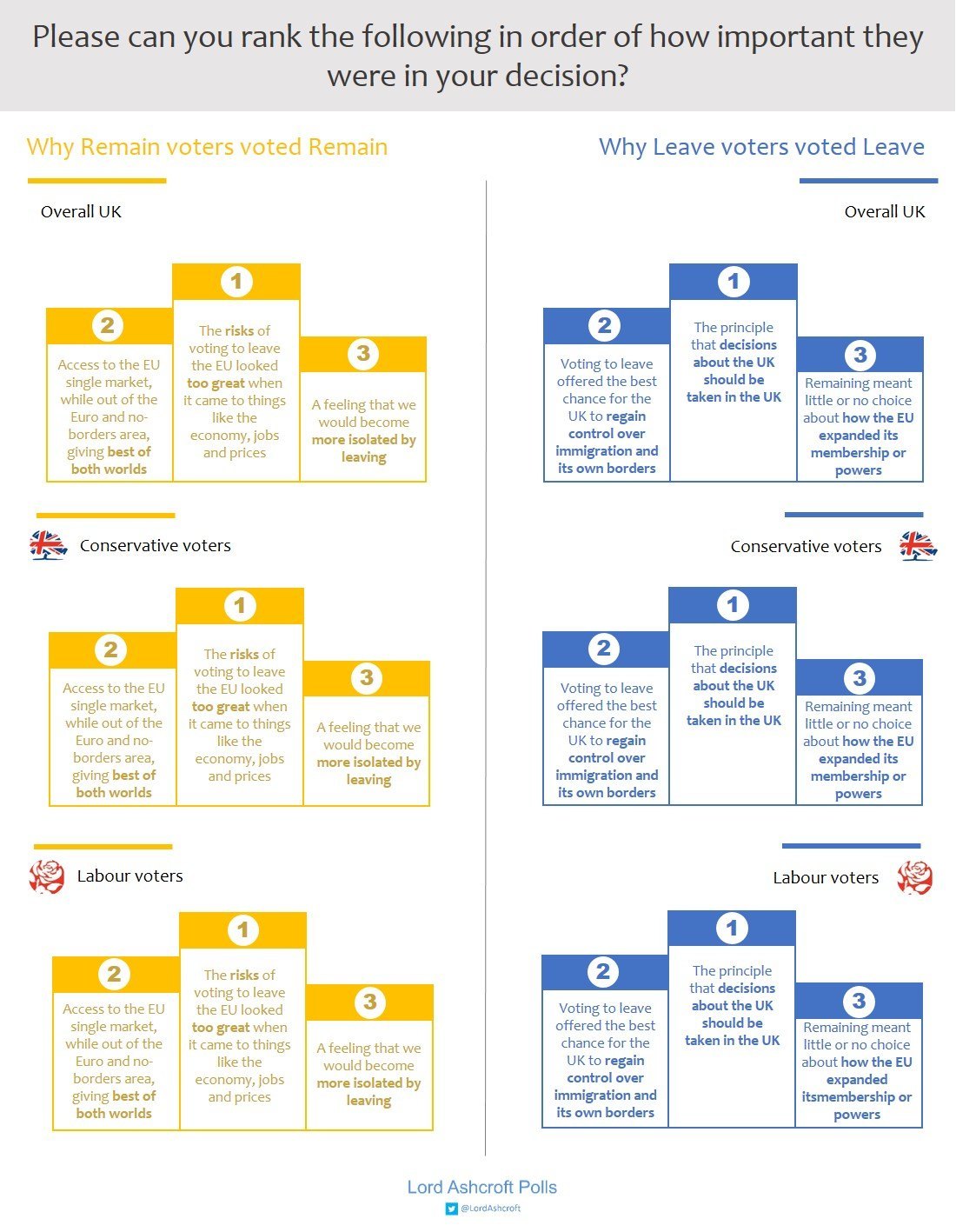
Leave vs Remain podium rankings

  • Nearly half (49%) of leave voters said the biggest single reason for wanting to leave the EU was “the principle that decisions about the UK should be taken in the UK”. One third (33%) said the main reason was that leaving “offered the best chance for the UK to regain control over immigration and its own borders.” Just over one in eight (13%) said remaining would mean having no choice “about how the EU expanded its membership or its powers in the years ahead.” Only just over one in twenty (6%) said their main reason was that “when it comes to trade and the economy, the UK would benefit more from being outside the EU than from being part of it.”

Among both Labour or Tory voters the biggest single reason for voting Leave was, on respondents’ own accounts, “the principle that decisions about the UK should be taken in the UK”.    If governments are going to do something as silly as ban powerful vacuum cleaners, at least it should be our own government that does it.

Perhaps voters were reluctant to own up to concerns about immigration as the most important factor?  And perhaps immigration and the changing character of the country was important beneath the surface –  as the economic underperformance of the last nine years has probably been.  But it isn’t an open and shut case that this was mostly an immigration referendum.  After all, stories – accurate or not –  about the EU wanting to ban bendy bananas, or force people to use metric units, have had considerable traction in Britain for decades.

And if you were British you might reasonably think you would be at least as well off having your own government makes the choices for you.  Things might seem different in the rest of Europe where, for example,

  • in 1970, Spain, Portugal and Greece were under authoritarian dictatorships,
  • in 1980, the Baltic states didn’t exist as recognized entities, and Poland, Rumania. Bulgaria, the Czech Republic, Slovakia, Slovenia, Croatia and Hungary were all under failing Communist rule (and four of those countries didn’t even exist independently),
  • Finland Ireland, and Norway (the latter not in the EU, only the EEA) weren’t independent countries as recently as 1900,
  • Germany had its unsavoury 20th century history (accompanied by Austrians cheering for the Anschluss),
  • Denmark, Belgium, Netherlands and Luxembourg were all occupied by Germany for several years,
  • Having been defeated by Germany in 1871, and narrowly  (and at vast cost) winning World War One, France then endured the shame of German occupation in World War Two, the collaborationist Vichy regime, and the crisis of 1958,
  • Malta’s 40 years between independence and joining the EU was the historically abnormal self-rule phase.

It doesn’t leave many countries where citizens can look back over the last 150 years and say “yep, we ran ourselves over long periods of time pretty well really”.   But Britain did. Now, as we know, there is plenty of anti-EU sentiment in much of the rest of Europe as well, but it seems quite readily understandable, just in terms of their own country’s history, that UK voters would prefer their own governments to make decisions for them.    And it doesn’t take a huge political and bureaucratic edifice to establish a free trade area, or a mutual external defence arrangement (such as NATO).

Having said all that, what really prompted me to write this post was this line in Cowen’s post.

Of course, USA and Canada and a few others are mature nation states based on the very idea of immigration, so they do not face the same dilemma that England does.  By the way, the most English of the colonies — New Zealand — has never been quite as welcoming of foreign immigrants, compared to say Australia.

I’m at a loss to know what he is basing that final sentence on.  For better or worse –  and given the economic opportunities here, I think it has been mostly for the worse –  that proposition seems to be defied by the data.

At times, I’ve had people run the line to me that since in 1500 the non-indigenous populations of New Zealand, Australia, Canada and the United States were all, essentially, zero, and since New Zealand has by far the smallest population of any of those countries we must have been less open to immigration.  But those other places started European settlement and immigration earlier than we did –  and were closer to Europe, at times when travel costs (mostly elapsed time) mattered hugely.

I’m going to start my comparisons from 1870.  That is partly because I was using the Maddison database and its first annual New Zealand population numbers are for 1870.  But it also seems reasonable on other grounds. In both New Zealand and Australia the influxes (and outflows) associated with the respective gold rushes were over by then, and by 1870 the New Zealand Land Wars were winding down –  never thereafter was there any serious question about settler control of the North Island.  The large scale Vogel immigration and public works programme began shortly thereafter.

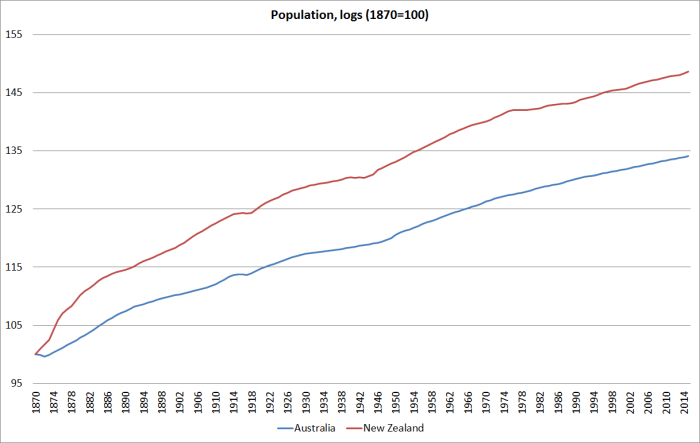
Here is a chart showing the total populations of New Zealand and Australia since 1870, both normalized to 100 in 1870, and done in logs so that readers can see changes in growth rates over time.
aus and nz popn since 1870.png

Over the full period –  145 years – New Zealand’s population has grown materially more rapidly than Australia’s.  Of course, the largest differences were in the first decade, but the gap hasn’t narrowed since.

I’ve often run the argument that New Zealand’s post-WWII immigration policy was materially misguided, at least on economic grounds, given the absence of new favourable productivity shocks or technological opportunities that would support top tier incomes for a rapidly growing number of people in these distant islands

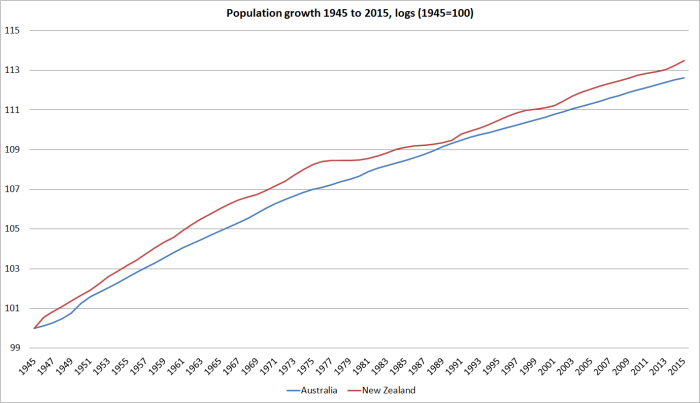
Here is same chart starting from 1945.
aus and nz popn since 1945


You can see the period from the mid 1970s to the late 1980s when New Zealand had very low rates of net immigration, but over the full period New Zealand’s population growth has still modestly exceeded that of Australia.

And here is the most recent period since 1991 –  which uses official New Zealand population data, and ties in quite well with the change in immigration approach in New Zealand that largely prevails to today.

aus and nz popn growth since 1991

Again, our population growth has been a bit faster than that of Australia.

Now it is perfectly true that in the immediate post World War Two period, Australia was much keener on taking continental European migrants than we were.  Then again, in the 1960s and 70s we had large inflows of Pacific Island migrants, and there was nothing comparable in Australia.

But, and here is my other key point, we’ve had faster population growth than Australia even though we’ve had huge outflows (net) of New Zealand citizens, that swamp any outflow from Australia of Australian citizens.

Here are the numbers on the total net outflows of New Zealand citizens for each decades since the 1950s

Net PLT outflow of NZ citizens (March years)
1950-59 -2494
1960-69 -34,057
1970-79 -161,231
1980-89 -229,874
1990-99 -146,229
2000-09 -263,651
2010-16 -138,705

That is a total of 976000 people, from a country which at the start of the period had only 2 million people and now has around 4.6 million people.

Some of the people who left will have died by now, but official estimates reported by Statistics New Zealand suggest 600000 New Zealand born people living abroad (and perhaps 1 million New Zealand citizens living abroad).     Australia has five times the population of New Zealand, and yet estimates of the total number of Australians living abroad are around one million.

Yes, there are differences in rates of natural increase from time to time, but the big story of recent decades in particular has been one in which New Zealand has taken materially more non-citizen migrants (per capita) than Australia has, reflected in the slightly faster population growth we’ve had despite the huge continuing outflow of New Zealanders.

In fact, you can see this in the respective policy-controlled bits of the immigration programmes.   This chart is cobbled together using data since the late 1990s on Australian permanent migration approvals under their Migration stream and Humanitarian stream, and New Zealand data on residence approvals. To the Australian numbers I’ve added the net inflow of New Zealand citizens to Australia, and to the New Zealand numbers the (much smaller) net number of Australian citizens moving to New Zealand.

migration rates nz and aus

Most years, the rate of permanent immigration of non-citizens to New Zealand has been higher  –  often materially higher – than that to Australia.  And the Australian numbers have dropped back since the end of this chart as the flow of New Zealanders moving to Australia has fallen back.

Perhaps Cowen had some less numerical basis in mind for thinking that New Zealanders have been less welcoming of immigrants than Australia.  But I’m not quite sure what it could be (although there is always this site).  And given our continuing economic underperformance, it is quite remarkable how receptive New Zealanders have been to such high rates of immigration (roughly three times per capita the size of net non-citizen inflows to the US and UK) –  especially as the programme is repeatedly sold as an economic-based measure, a “critical economic enabler” in the words of the government department responsible for immigration policy matters.


More states or fewer?

I was going to write something today about monetary economics, the 2008/09 crisis, and reform options for financial systems and economies, but….the Brexit aftermath is pretty much all-absorbing, at least to a politics/economics/geopolitics junkie.   So far, it is difficult to see why anyone would be very surprised about what has happened since Friday, but of course it is very early days.  Media coverage seems dominated by perspectives from those –  including the journalists writing the stories – almost personally affronted that the populace of a major, quintessentially moderate, country could have voted as they did. The stories highlight, without really needing to try, the disconnect between what might be loosely described as a metropolitan urban liberal mindset that downplays the local in favour of a network of internationalist rule-setting, and what might loosely be described as a more small-c conservative mindset that puts a greater emphasis on the local and the national as the basis for rule-setting and governance.  Peter Hitchens highlights this contrast in his column here – highlighting how detached the majority of MPs of both main UK parties have become from the views and attitudes/priorities of very large shares of their voters.  The situation probably isn’t much different in a whole variety of advanced countries.

But what got me particularly interested over the weekend was talk of the United Kingdom itself breaking up.  Of course, that started a long time ago.  The Irish Free State (as it was then called) became independent in 1922.  If Northern Ireland should eventually reunite with the Republic of Ireland –  and frankly I would be surprised if it happens in the next few decades, given the risk of reigniting the decades-long civil conflict – it would only be the culmination of the Home Rule movement that was convulsing British politics as far back as the 1880s, and which saw Britain facing the possibility of an army mutiny and civil war on the eve of World War One.

The chances of Scotland becoming independent seem somewhat higher –  after all, the Out vote got 45 per cent in the last referendum only two years ago.  If the headline-grabbing opportunity to push for a new referendum is the desire to stay in the EU –  and for all the hype, even 38 per cent of Scots wanted out –  they had better hope there is still an EU to belong to a decade hence.  But even if not, is the idea of Scottish independence so different from that of Irish independence –  which we all now take for granted, even if (at the time) it probably came at a considerable economic cost?  Scotland had been independent for hundreds of years, and if it did well economically from the Union and its people played a huge role in the British Empire, who could begrudge them the right to govern themselves?

After all, although it wasn’t always so, the people of England and Wales make up 90 per cent of the population of today’s United Kingdom.   Even without Scotland and Northern Ireland, England and Wales would be the fourth most populous country in Europe, just a little behind Italy.

But then I got thinking about other countries.  Hasn’t a move towards more countries been underway for some considerable time?  The unification of Germany and of Italy were huge developments in the mid 19th century, but they were largely completed by 1870.   Our own Land Wars finished around the same time, securing a single state entity on these islands. The US grew hugely (in territory) during the 19th century, but had largely reached its current size with purchase of Alaska (from another large state) in 1867.  Even the acquisition of Hawaii was almost 120 years ago now.

I found a list of countries ordered by population in 1900.  Here was the 25 largest:

China 415,001,488
Indian Empire 280,912,000
Russia 119,546,234
USA 75,994,575
Germany 56,000,000
Austria-Hungary 51,356,465
Dutch East Indies 45,500,000
Japan 42,000,000
United Kingdom 38,000,000
France 38,000,000
Italy 32,000,000
Ottoman Empire 30,860,000
Spain 20,750,000
Brazil 17,000,000
Mexico 12,050,000
Korea 12,000,000
Northern Nigeria 8,500,000
Egypt 8,000,000
Morocco 8,000,000
Philippines 8,000,000
Southern Nigeria 7,500,000
Siam 7,200,000
Persia 7,000,000
Romania 6,630,000
Belgium 6,136,000

Of these, the two parts of Nigeria (both then administered by the UK) are now one country.  Quite a few of the other countries are much the same as they were then, subject to some (mostly relatively minor) border adjustments (eg the return of Alsace-Lorraine to France).

But the bigger story surely is the break-ups.   What was the United Kingdom is now two countries, the UK and Ireland.  What was Korea is now –  at least for the time being –  two countries, North and South Korea.  India as it was is now Sri Lanka, India, Pakistan, Bangladesh and (depending where the boundary lines were drawn) Burma.  And the erstwhile Russian, Austro-Hungarian, and Ottoman Empires have split into dozens of new independent countries between them.

What of today’s 25 most populous countries?

China 1,376,048,943
India 1,311,050,527
USA 321,773,631
Indonesia 257,563,815
Brazil 207,847,528
Pakistan 188,924,874
Nigeria 182,201,962
Bangladesh 160,995,642
Russia 143,456,918
Mexico 127,017,224
Japan 126,573,481
Philippines 100,699,395
Ethiopia 99,390,750
Vietnam 93,447,601
Egypt 91,508,084
Germany 80,688,545
Iran 79,109,272
DR Congo 77,266,814
Turkey 78,665,830
Thailand 67,959,359
United Kingdom 64,715,810
France 64,395,345
Italy 59,797,685
Tanzania 53,470,420
South Africa 54,490,406

Of these countries, only the last two comprise what were smaller entities in 1900 –  and neither is, perhaps, an advert for the cause of ever-larger unions.   Tanzania was previously the colony of Tanganyika and the protectorate of Zanzibar (ruled by a Sultan, under British oversight).  Zanzibar was granted independence in 1963, but this was quickly followed by a bloody revolution, at the end of which Zanzibar was absorbed (semi-autonomously) into the new Tanzania.  And, of course, South Africa in its current legal form was the fruit of the Boer War, essentially a war of conquest in which –  at great cost –  the British Empire and the British colonies beat the Afrikaaner states.

Have there been other mergers attempted?  Well, yes, after World War One the artificial state of Yugoslavia was created by the powers.  That has now long gone.  Czechoslovakia also emerged from that settlement –  also (peacefully and successfully) gone.  In the 1950s there was political union between Egypt and Syria: it last for all of three years.  The British created the Federation of Rhodesia and Nyasaland in the 1950s, and it was also gone a decade later.

Can one think of exceptions?  No doubt.  Various colonial enclaves have been reabsorbed by the surrounding power, peacefully or otherwise –  Goa, Hong Kong, Macau.    But there isn’t much else for more than 100 years, and none that I can think of where the voluntary choice of the respective populaces has led to the formation of larger states from smaller states (happy to hear if I have forgotten any).  Germany reunited –  but then it never separated voluntarily, and indeed in 1945 the intention was never two separate states.

None of this should really be very surprising.  The other great trend of the last couple of hundred years has been towards democratic government. People clearly  seem to want to rule themselves with – and be governed by  – people with whom they feel some significant sense of common identity and shared perspectives (which might be ethnic, or religious, or linguistic, or simply historical).  Little really –  in the scheme of things –  divides New Zealand and Australia, and yet there is no great appetite for the two to become one.   The metropolitan elites might wish it were otherwise –  and might even believe quite genuinely that everyone could be better off it only things were done their way –  but the citizens of the world show little sign of being convinced by their story.  Are the people of the world poorer as a result?  Possibly –  despite the huge volumes of cross-border trade –  but some things seem to matter more to most of them.

And it isn’t as if the trend towards more and smaller states looks like having run its course.  Even in Western Europe, there is Scotland, demands from Catalans for independence, and the ever-present question of what unites Belgium other than, say, a football team.

In that light I was quite puzzled by Wolfgang Munchau’s FT column today. In many ways it was a hardheaded piece, noting that the risk from the UK referendum for the rest of Europe may be greater than those for the UK.  Highlighting Italian risks in particular –  and Italian stocks fell savagely on Friday –  he ends

To prevent such a calamity, EU leaders should seriously consider doing what they have failed to do since 2008: resolve the union’s multiple crises rather than muddle through. And that will have to involve a plan for the political union of the eurozone countries.

How he imagines that the citizens of the Eurozone countries will ever agree to political union, especially now, is beyond me.    I guess the traditional European elite approach is not to give them a say.

UPDATE: For anyone wanting a more systematic treatment of some of these issues, see Alesina and Spolaore The Size of Nations (my copy of which I finally found on my shelves).  They devote an entire chapter to the EU.  In a book published in 2005 – with an expanding EU, and the general contentment with the early years of the euro –  they seem (perhaps understandably) slightly  uncomfortable with how the EU fits with their general model in which lower trade barriers and fewer wars would typically result in more states, not fewer.  But they conclude their EU chapter boldly: “Quite simply, it is not possible for Europe to become a federal state”.


Brexit

I guess people need to mourn their defeats, but flicking around various TV channels’ coverage the comment that staggered me most was that of the prominent English historian, Simon Schama, who declared –  well before the result was clear –  “if Leave wins, it will be a repudiation of knowledge; a repudiation of reality’.

Or simply, perhaps, just a choice by UK voters to have their country governed by their own MPs, their laws interpreted and applied by their own judges, and so on.   Rather like New Zealand, Australia, Canada, or the United States.   Many other commentators have seen the vote as a vote against the Establishment,  which is no doubt true in part  – as the election of Jeremy Corbyn was, and perhaps the success of date of Donald Trump has been – but if so, comments like those of Schama, totally dismissive of the choices of his fellow citizens, might go down as a classic example of the sort of attitude and approach that many saw encapsulated in the EU model, and the way in which too many countries have been governed in recent years.

The market reactions so far seem hardly that surprising – except perhaps in highlighting the bounded rationality that had left so many (I was among them) almost unable to believe that, even though the polls had been a dead-heat for weeks, a Leave vote could actually happen.

The headline fall in the value of sterling is striking  – currently down 9.9 per cent against the USD.  But it brought back memories of the wild days of the New Zealand foreign exchange market, especially in the early years after the 1985 float.   But as recently as 28 October 2008, the NZD was down 9.3 per cent in a day (and more like 12 per cent against the yen).  The trend was strongly down in that global crisis and recession, but there was also a sharp bounce the following day.  I recall watching CNBC each evening during the 08/09 crisis.  It might be another few days for that  –  and to be glad it is “spectator sport” rather than something I have direct exposure to.


UPDATE: I thought this piece by US economics columnist Megan McArdle was a very nice articulation of views I share almost entirely.

UPDATE 2:  An absolutely fascinating set of results from exit-polling of referendum voters


What do the Brits have to be grumpy about?

UK voters go the polls tomorrow for the EU membership referendum.  Of the two polls of polls I follow, one has a very slight lead to the Leave side, and the other a very slight lead to Remain.

You might have thought –  rightly –  that New Zealand’s productivity performance over recent years had been pretty poor.  But here is what happens if we add the United Kingdom to the chart of real GDP per hour worked (labour productivity) that I ran the other day.

nz aus uk gdp phw

In their case, no productivity growth for eight years.

But even cyclically the story isn’t all bad in the UK.  Take unemployment for example.  Going into the 2008/09 recession, the OECD reckons that if anything the UK had a slightly larger positive output gap than New Zealand did.  British labour market regulation seems to generate a higher “natural” rate of unemployment than New Zealand’s does –  over the decades, the UK unemployment rate has averaged a bit higher than New Zealand’s.   And yet right now, not only is the UK unemployment rate materially below New Zealand’s, but it is right back to where it was – around 5 per cent –  going into the recession.

uk and nz U

By contrast, in New Zealand the unemployment rate is still more than 2 percentage points higher than it was pre-recession.

The British productivity record in recent years has been pretty dismal.  Then again, taking a slightly longer-term perspective, we are the ones with something to complain about, not them.    There are no perfect starting points for any of these sorts of comparisons, but I’ve started this one from the end of 1990.  That was just before our 1991 recession, and before the stresses and disruption that Britain faced culminating in the exit from the ERM exchange rate system in late 1992.

uk and nz gdp phw

I’ll take the British performance over that full period over ours.

Incidentally, I noticed George Soros yesterday suggesting that if the vote went in favour of Brexit, the outcome would be more disruptive for Britian than the ERM exit in 1992.  Even though that exit –  or rather the foolhardy effort to avoid it –  transferred a lot of money from the British taxpayer to Soros and his clients, the economic outcomes were generally pretty positive.  In the chart above, for example, there is no dip in productivity growth in 1992.  Yes, a Brexit would be quite disruptive, but were I a British voter I’m not sure I’d looking for advice from Soros as to whether to stay or go.

Despite my interest in immigration issues, the centrality of immigration in the Brexit debate has intrigued me.  Even in the UK context, I’m don’t find particularly persuasive the case that British citizens have had any particular economic benefit from increased immigration.  Then again, immigration to the UK has been on a much smaller scale than that to, say, New Zealand (or Australia and Canada), and the UK seems to face fewer of the constraints that lead me to question whether New Zealand’s immigration policy is right for us.

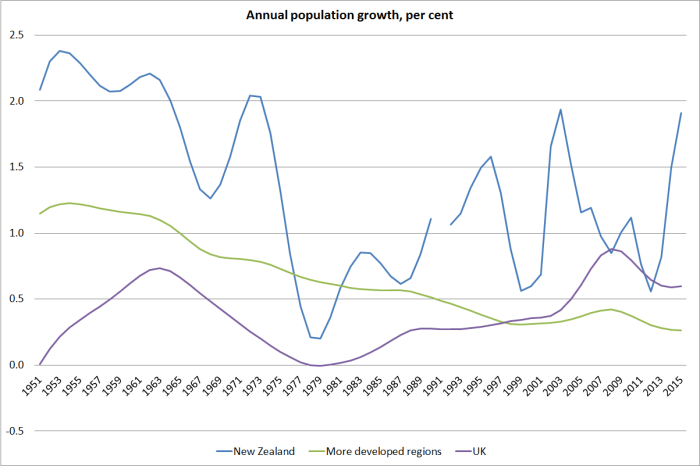
Part of the explanation is, no doubt, captured in this chart.

uk population

I showed the NZ and “more developed regions” of the world lines yesterday.  This time, I’ve added population growth rates for the UK.

For a long time, the UK was predominantly a country of emigration.  Yes, they had waves of inward migration  –  West Indian and South Asian in particular –  but it wasn’t until the policy changes of the late 1990s that the UK had had population growth rates even matching those of the advanced countries as a group.   With quite limited rates of natural increase, their immigration policy has now delivered population growth rates averaging higher than those experienced on average in the baby boom years of the 1950s and 1960s.  Whatever the economic impact of that change, seeing it in this perspective makes it a bit easier to understand the salience of the issue in the current debate.

The short answer to the question in my title is probably “less than we do”.  But at least we get to make our own decisions, not having subordinated a huge part of domestic law-making to unelected people in Brussels.

UPDATE:  A commenter provided a link to one academic’s perspective on how large (or otherwise) the EU influence on British law is.  I have no idea what the correct answer is, but I thought this piece on a fact-checking website was a useful perspective on trying to make sense of the issues.


Cry Freedom…but count the possible cost

As I noted in my post on Saturday, were I British I would be voting for Brexit, and so I’m pleased to see the polls moving that way.  Should that cause succeed, there is likely to be considerable disruption, both to Britain, the other EU countries, and to the wider world economy and financial system.  Perhaps it will be the episode which illustrates the point I and others have been making for several years: when interest rates are already at or very near the effective floor, and there is little fiscal room left, any new serious adverse shock will expose countries as having few tools left to respond.  Central banks and governments that have done nothing about removing the near-zero lower bound would then have something to answer for.

In the Telegraph a day or two ago, Ambrose Evans-Pritchard had a powerful column articulating his own reasons for voting to leave the EU.  It was all the more powerful because it recognized and gave full weight to the transitional disruptions that are all but certain, and to the possibility that even in the medium term there might be some economic costs.  The cause of freedom –  the ability to set one’s own laws, appoint one’s own judges, and toss out elected leaders  –  might have a price, and he thinks it is a possible price worth paying.

In my post the other day, I noted that there were other examples of people being willing to pay such a price.  By the end of the 19th century Ireland was an integral part of the United Kingdom, with full representation at Westminister and unrestricted markets in goods, services, people, and capital.  And yet the cause of Irish independence gained strength rather than abated, and the south eventually gained independence, as the Irish Free State, in 1922.   Ireland kept on using sterling, and kept close economic ties to the UK –  as one would expect, given the proximity of the two countries and the previously highly-integrated economies.  But no one thinks Irish independence was good for Irish material living standards in the subsequent decades.

Here are the data in the Maddison database for GDP per capita.  The first observation is for 1913, before the disruptions of World War One, and the subsequent unrest leading up to independence.

ireland real gdpI’ve also shown the data for 1929 (the eve of the Great Depression) and 1939 (the eve of World War Two, which Ireland stayed out of).  There is always a lot else going on, so the whole story of Irish relative economic decline isn’t (the policy choices/constraints that followed) independence.  But much of it was.   Today, of course, Irish real GDP per capita is higher than that of the United Kingdom.
Was independence a mistake?  Well, it had a cost, but most things people count worthwhile do.

I got curious about some other post-colonial episodes, each involved economies much less integrated with the UK than Ireland’s had been.

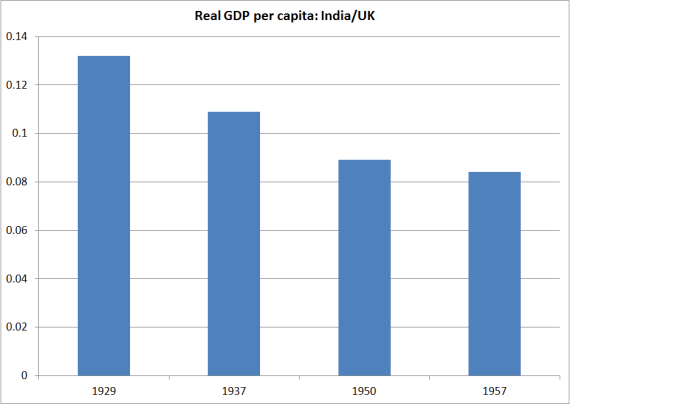
India, for example, became independent in 1947.  In the late 1920s, full independence probably appeared to be many decades away, and probably wasn’t influencing investment choices or other economic decision-making.

india

Independence came at a cost –  wars in addition to any economic cost – but with hindsight would the Indians have chosen continued colonial rule?  Almost certainly not.

I spent a couple of years working as an economic adviser in Zambia.  At independence in 1964, Zambia had had GDP per capita as high as those of South Korea and Taiwan.  By the early 1990s it was something of a byword for basket cases (Zimbabwe’s true awfulness was still to come).  But here are the comparisons with the UK –  not, itself, a great economic success story over these years.

zambia

There were a few people who regretted independence – my colleague, the (local) chief economist lamented to me one day that the British had left when they did.  But it wasn’t a very common sentiment (or one that was politically acceptable to voice).

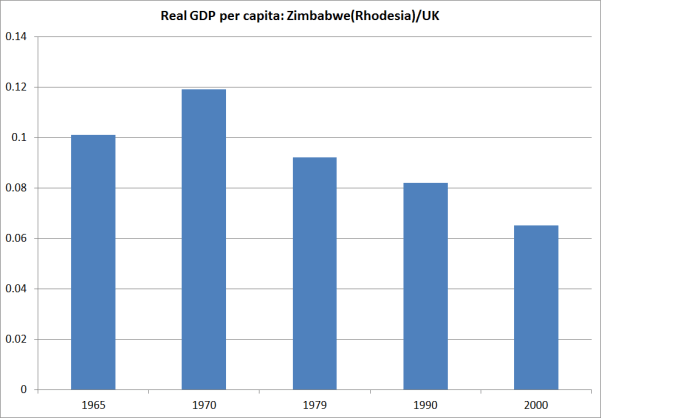
How about Rhodesia/Zimbabwe?  There was a two-stage process.  The white-minority government declaring unilateral independence in 1965, and then full legal independence with a universal franchise came in 1980.

rhodesia

In the first few years after the UDI there doesn’t seem to have been a material economic cost.  Those who supported UDI probably thought of it as some sort of win-win.  It didn’t last  –  the country soon descended into an insurgent war –  and of course the economic consequences after independence in 1980 are all too apparent.  I can imagine that quite a few Zimbabweans might really regret the course of the last 35 years –  though not, I imagine, too many members of ZANU-PF.

My final example is Bangladesh.  At Indian independence in 1947, what is now Bangladesh became East Pakistan.    But in 1971, after brief but awful war Bangladesh became independent.

bangladesh

Pakistan has scarcely been an Asian tiger –  model of economic transformation.  Bangladesh has done worse.

Inevitably this has been a rather limited exercise, focusing on countries in which I had an interest (NZ Baptist churches have had missionaries in what is now Bangladesh for 130 years), and where there is accessible –  if probably no better than indicative-  data.

I didn’t include New Zealand, Australia, and Canada because in all three cases there was no clear point at which the countries broke away from Britain.  It was an evolutionary process.  Perhaps in an ideal (economic) world, if Britain were going to pull back from the EU it would do so in a similarly evolutionary way.  But that option doesn’t seem to have been available.

And there may well be other examples of countries which flourished with independence –  Singapore is perhaps the striking example (although productivity growth in Singapore over say 1960 to 2000 was very similar to that in Hong Kong, which was British-ruled for almost all that period).  My point is not to argue that independence, or taking back parliamentary sovereignty, is inevitably or even generally costly.  I’m sure it isn’t.  But it can be.  And that may well be a price that citizens, even with hindsight, think is worth paying.

The relationship of Britain to the EU today isn’t that between, say, colonial Zambia and the UK, or even East Pakistan to West Pakistan.  But, equally,  Britain has strong established institutions and, if Brexit happens, every motivation, and plenty of opportunity, to secure pretty good economic outcomes.  If Brexit happens, I suspect that in 30 years time  –  perhaps 100 years time – scholars will still be debating what the long-term economic consequences of exit were (as indeed, they are still debating the economic consequences for Britain of entering the EU 43 years ago).  If so, perhaps the economic issues are not of first-order significance.


Brexit thoughts from the Antipodes

My wife suggested a post on the contrast between British entry to the EU (or EEC as it was then) and the looming possibility of British exit.  She is young enough that British entry was a featured topic in New Zealand history when she did School Certificate history in the 1980s (for me, it was closer to being current affairs).  By contrast New Zealand media coverage of the British referendum is largely devoid of any particular New Zealand dimensions.  On a day when the British papers are highlighting a new poll suggesting that the Brexit cause could win, it seems like a good day for a few thoughts.

A lot has changed in the years since the early 1960s when New Zealand first faced the possibility of Britain entering the EEC, and the threat that posed to New Zealand’s major markets for dairy and lamb exports.  So important was the issue that, apparently, at New Zealand economists’ conferences in the 1960s a toast was often drunk to Charles de Gaulle, for his two vetoes of UK entry.

The make-up of our population has changed over that time, but in some ways less than one might think. In the 1961 Census, 9 per cent of the population had been born in the United Kingdom, and in the 2013 Census, 6 per cent had been.  And in most years, the United Kingdom is still the source country for the largest group of those given residence permits to live in New Zealand.  The UK still seems to be the favoured destination for New Zealanders looking for an OE, at least one beyond Australia.  Sporting ties, and rivalries, seem as strong as ever.   But if state high schools still sing “Jerusalem” and cathedral choirs still sing Stanford and Parry, the emotional ties are much less strong than they were.   In the early 1960s, it was less than 20 years since the end of World War Two, and less than that since the conflicts in Korea and Malaya where New Zealand and British troops had fought side by side.

But it is probably the economic ties that have changed most.  One of the after-effects of the war  –  and the huge overhang of debt the UK had taken on – was the Sterling Area, of which New Zealand was a part.  With a fixed exchange rate to sterling –  unchanged for almost 20 years – and our foreign exchange rate reserves held in sterling, overall sterling area access to US dollars affected each country in the area. Private international debt markets were much less developed than they had been in the past, or are now.  And New Zealand government offshore borrowing had been undertaken in the UK for more than 100 years –  it wasn’t until the very end of the 1950s that the first, expensive, New Zealand government loan was raised in the US.  Britain had been keen on New Zealand joining the IMF and World Bank –  we didn’t until 1961 –  partly because it would facilitate access to dollars for New Zealand’s capital needs.

And, most of all, the United Kingdom was a major export market –  as late as 1967, 44 per cent total exports went to the United Kingdom.  In the 1960s, almost all our dairy and lamb/mutton exports went to the United Kingdom.  As the New Zealand Ambassador to the US put it, in a prominent lecture he gave in New York in 1963, “the problem which we faced….was the threatened removal of the one remaining important free market for primary produce at a time when the highly industrialised countries of Europe are intensifying the trend to self-sufficiency in these products”.   There were, at the time, no credible alternative markets for some of the largest chunks of our exports.  And if Continental leaders were willing to consider UK entry to the EEC, they certainly didn’t see continuing New Zealand easy access to UK markets as part of the deal,  Indeed, one of the attractions of UK entry to them was detaching Britain from the Commonwealth and traditional suppliers of agricultural products (Australia as well).

Possible British entry was a huge issue for politicians and economic advisers in New Zealand in the 1960s and early 1970s, but it wasn’t a trivial issue in the British debate either.  Some of that was about past ties of blood, shared military sacrifice, shared family bonds and so on.  But some of it was economic too: New Zealand lamb and butter –  known as coming from New Zealand – had an established and significant place in the British retail market.  It would have been difficult –  perhaps impossible –  for Britain to have joined the EEC –  for British public opinion to have allowed it –  without “acceptable” arrangements for New Zealand and Australia.

At the time, material living standards in New Zealand were still higher than those in the United Kingdom –  ours were still among the best in the world.  The prospect of UK entry, with all that risked implying for markets for New Zealand produce, was a very dark cloud over those living standards.  (In that same lecture, our Ambassador to US, presumably citing received official opinion saw import substitution by building up local manufacturing, combined with rapid population growth –  natural increase and immigration –  as part of the solution).

The situation is nothing like symmetrical today.  The United Kingdom is still our sixth largest trading partner, but lagging a long way behind Australia, China, the United States and the euro-area.  If London remains one of the most important financial centres in the world, open capital accounts mean that the UK is not a particularly important source of financial capital at the margin –  and, of course, our government doesn’t borrow abroad, and our exchange rate floats.    There might be opportunities for New Zealand individuals and firms if the UK actually leaves the EU  –  our lamb exports to Europe (including the UK) are still restricted, and there are some hopes that revised immigration policies might treat New Zealanders the same as, say, other Europeans.  But these are probably second or third order issues for the New Zealand economy as a whole.   Some of those strongly campaigning for Brexit would favour a much more market-oriented approach to trade and regulatory policy, and anything that lifted medium-term productivity prospects would be good for the world (including us).   Whether there would be much improvement in the quality of policy is perhaps debatable –  other Anglo countries, not caught up in the web of Brussels, have not exactly been at the forefront of market-oriented liberalization in the last decade or so.

If Brexit isn’t a great economic opportunity for New Zealand, what about the risks on the other side?  The great and good of the economic establishment –  in Britain and internationally –  have been weighing into the debate to urge British voters to vote “Remain”.   Even President Obama has been recruited to the Prime Minister’s cause –  as if the views of a foreign leader should influence British voters views about the future of their own country.  Hundreds of economists have been writing to the papers urging the voters to vote to stay in the EU.  It is a curious spectacle.  One might have supposed that agencies such as the IMF and the OECD would have little credibility with anyone these days, and nor is it clear that they have (or even should have) British voters’ best interests at heart when they offer their advice.

The economic debate seems to turn on two, separate, issues.  The first is about the transition, and the second about the medium-term.  Actually, the two quickly converge.

We’ve already seen markets rattled each time polls suggest a heightened probability of Brexit.  It will, almost certainly, get much worse in the next few weeks if the latest polls are picking up something real.  And if Britain votes to leave, the days after that result is declared could be very very messy indeed.  Apart from anything else, the path ahead –  even for Britain –  is quite unclear, starting with who will be leading the British government to negotiate the exit terms.

The world economy and financial system are hardly in fine robust health.  And the policy buffers if things go wrong are few and very limited –  in monetary policy alone, almost everyone is already starting with interest rates around zero.  Britain itself just isn’t that important –  nukes, a Security Council seats, and London as a financial centre notwithstanding. Then again, it is only a year or so since the Scottish referendum was unnerving markets, and Greek crises have repeatedly wrought havoc for the last few years.  Why?  Because what starts in one place probably won’t stop there.   No one was really comfortable that the wounds to the euro could be cauterized if Greece left. What of the EU itself?

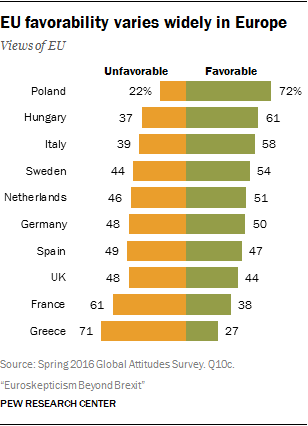
It isn’t as if euro-skepticism is a uniquely British phenomenon.  I thought this Pew Research chart from a few days ago was fairly telling

eu favourability

Public opinion in France is less favourable to the EU than that in the UK, and the UK numbers are little different than those in Spain, Germany and the Netherlands.

Which is why a lot of the economists’ contributions to the UK debate seem rather moot.  They come up with estimates –  really not much better than back of the envelope ones, despite all the apparent sophistication  –  suggesting a potential loss of income to the average Briton if the UK leaves.  But that all assumes that the rest of the EU holds together largely as it is.  And that doesn’t seem very likely at all.  In fact, as with the cause of Scottish independence, a defeat in a single referendum seems unlikely to make the exit issue go away even in the UK.  As with the euro itself: break-up fears wax and wane, but it will be a very very long-term (most likely never) until that risk disappears altogether.

So really the economic establishment –  in the UK and globally –  is urging British voters to vote “Remain” to hold the whole EU project together.  They can’t actually say that –  that would suggest a fragility they just can’t publicly acknowledge –  so they have to pretend that it is all about the British voters’ own best interests.  This week it reached ludicrous extremes with David Cameron suggested that people who voted “Exit” weren’t being patriotic and didn’t believe in their country.

But very few British voters really want any part of an “ever-closer union”.  Actually, few voters in most of the rest of Europe do either.  And yet everyone recognizes that  the euro in particular can’t credibly hold together without further progress in that direction.  Probably most voters are quite keen on free trade in goods –  and to a lesser extent in services – among European countries, but they don’t want their laws made by unelected officials in Brussels, or even by majorities of ministers from other countries.  And they don’t want their laws interpreted, and application decided, by foreign judges.  It is quite a bit about what being a nation state is.  Many aren’t too keen on a lot of immigration either –  no matter how often the elites assert that benefits flow from it.  That seems like the sort of choice citizens of each country should get to make.  And to be able to toss out the people who make laws and regulations they disagree with.

I’m not a Brit –  all my ancestors were, but they left in 1850 and shortly thereafter –  but of all the countries in the world other than New Zealand, Britain is  probably the one I care most about.  Were I a British voter, I’d vote for Exit.  Not because Britons would necessarily be better off economically –  they could be, with the right policies, but one doesn’t decide the future of one’s country based solely on narrow economic considerations.   Had it been otherwise, perhaps New Zealand in the 1960s could have done a Newfoundland, and given up our independence to become part of the UK (in case anyone is wondering, I’ve not found any who suggested doing that).

Voting to leave the EU would be, to some extent, a step into the unknown.  But big important choices often are – whether to go to war, to marry or to break-up a marriage, to split a country, or an empire.  People in Ireland were probably worse off (economically) for decades from leaving the United Kingdom, but who is to say their choice was wrong or illegitimate. One must be prepared to count the cost of those choices.   But if British voters want their country to be as independent –  but still, inevitably interdependent –  as New Zealand, or Australia, or Canada, or the United States, then Exit seems like the way to vote.  It might be a rocky ride, even for the rest of us –  perhaps it might even be the unwelcome way in which Graeme Wheeler gets the TWI down –  but it is a perfectly reasonable choice.  And one voters in other countries are likely also to make before long.   The EU as we see it today looks a lot like a project that has badly over-reached.