The Reserve Bank’s stress tests – again

On 13 May, the Reserve Bank released its latest Financial Stability Report. As part of that release, the Governor announced that he intended to impose a ban on (highish LVR) lending secured on Auckland residential investment properties. The Bank indicated that a consultation document on the proposal would be released in “late May”.

The consultation document finally appeared yesterday. I have some fairly extensive comments on the contents of the document, and on the process. I will be making a submission, and will publish that here in due course.

But today I wanted to focus on just one aspect: the place of the stress tests the Bank undertook, with APRA, last year.

As a reminder, the results of the stress tests were reported in the November 2014 FSR (details on pages 9-11 here). The Reserve Bank was, apparently, then very happy with the resilience of the banks (individually and as a system – the latter rather than the former being the required statutory focus). As they noted:

The Reserve Bank’s emphasis tends to be on ensuring that banks have sufficient capital to absorb credit losses before mitigating actions are taken into account. The results of this stress test are reassuring, as they suggest that New Zealand banks would remain resilient, even in the face of a very severe macroeconomic downturn.

As I noted on 13 May, it was somewhat surprising then to find no reference to these stress test results in the latest FSR, even as the Governor was moving to impose very restrictive and intrusive new controls. I suggested that perhaps the Governor did not believe the stress tests. But if so, he owed us an explanation for why, especially in view of the fairly unconditionally positive coverage of the stress test results which he had signed off on in finalising the November report.

I was further puzzled when someone who had attended the Finance and Expenditure Committee hearing on the FSR told me that when the Governor was questioned about the stress test results and their implications for conclusions about the soundness of the financial system, he had simply avoided answering that element of the question.

However, the Reserve Bank then referred to the stress test results in responding to questions to the Herald’s personal finance columnist, Mary Holm. I covered those comments earlier.

On 16 May, there was this extract:

What does the RB think about the possibility of a property plunge. “Whether property prices could drop by half from today’s values is purely speculative,” she says. “Nevertheless, a 50 per cent drop matches some of the more severely affected economies in the global financial crisis such as Ireland.”
So they’re not ruling it out. But would such a drop cause banks to “collapse”? “The short answer is no, we do not believe so,” she says.
“The Reserve Bank conducts regular bank stress tests in collaboration with the Australian Prudential Regulation Authority. The most recent one was last year, and the results of it are featured in the November 2014 Financial Stability Report, pages 9 to 11, on our website.
“This stress-test exercise featured two imagined adverse economic scenarios over five years, one of which involved a sharp slowdown in economic growth in China, which triggered a severe double-dip recession in New Zealand. Among the impacts were house prices declining by 40 per cent nationally, with a more pronounced fall in Auckland – similar to your reader’s worst case scenario.”
So how would our banks fare?
“The Reserve Bank was generally satisfied with how the banks managed their way through the impacts of these scenarios, and we are comfortable that the New Zealand financial system is currently sound and stable, and capable of withstanding a major adverse event.”
Note that present continuous tense in the final sentence: we are comfortable “that the New Zealand financial system is…capable of withstanding a major adverse event”.

That was reassuring, but it did appear inconsistent with proposals for heavy-handed new controls on the other.

And then the following Saturday, we got some more comment from another Bank spokesperson.

“We repeat our comments from last week that the Reserve Bank was generally satisfied with how banks managed their way through the impacts of two adverse economic scenarios in the 2014 bank stress tests, which included a scenario similar to what your reader describes.
“We are comfortable that the New Zealand financial system is capable of withstanding a major adverse event, such as a collapse by up to 50 per cent of the Auckland housing market.”
These words, given to the Herald after the publication of the FSR and published less than two weeks ago, stated quite explicitly that the Bank is “comfortable that the New Zealand financial system is capable of withstanding a major adverse event, such as a collapse by up to 50 per cent of the Auckland housing market”.

And there I half-expected the matter to rest. Since policy development around LVRs seemed to be on a (rather distant) parallel track to stress-testing analysis, I half-expected the consultation document to avoid any mention of the stress-testing results at all, the Bank having reaffirmed only 10 days or so ago the resilience of the system.

But in yesterday’s consultation document, they do address briefly the stress-testing issue. Here is what they say:

The Reserve Bank, in conjunction with the Australian Prudential Regulation Authority, ran stress tests of the New Zealand banking system during 2014. These stress tests featured a significant housing market downturn, concentrated in the Auckland region, as well as a generalised economic downturn. While banks reported generally robust results in these tests, capital ratios fell to within 1 percent of minimum requirements for the system as a whole. Since the scenarios for this test were finalised in early 2014, Auckland house prices have increased by a further 18 percent. Further, the share of lending going to Auckland is increasing, and a greater share of this lending is going to investors. The Reserve Bank’s assessment is that stress test results would be worse if the exercise was repeated now.

First, they note that “capital ratios” in the stress test fell to within 1 per cent [percentage point] of minimum requirements for the system as a whole. But here is how those results were described in the November FSR.

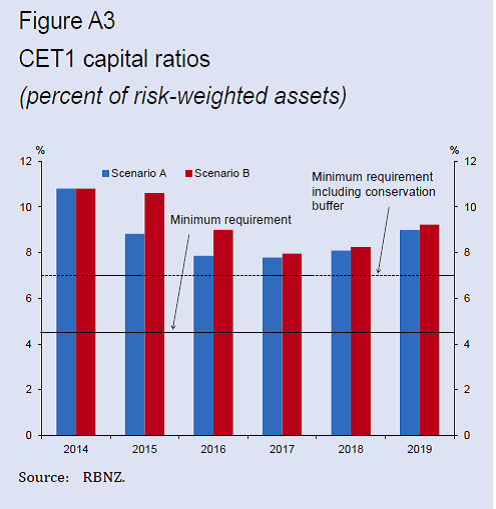
Common equity Tier 1 (CET1) capital ratios declined by around 3 percentage points to a trough of just under 8 percent in each scenario, but remained well above the regulatory minimum of 4.5 percent (figure A3). Banks are also required to maintain a 2.5 percent conservation buffer above all minimum regulatory capital requirements, or else face restrictions on dividends. On average the banking system fell within this buffer ratio in both scenarios, due to total capital ratios falling close to minimum requirements (figure A4). Average buffer ratios reached a low of 1 percent in both scenarios. As a result, some banks would have been faced with restrictions on their ability to issue dividends. The intention of the buffer ratio is to provide a layer of capital that can readily absorb losses during a period of severe stress without undermining the ongoing viability of the bank. Given the severity of the scenarios, capital falling within buffer ratios was an expected outcome.

In other words, the Bank seemed pretty comfortable. As they should have been. A banking system that can withstand a very severe asset market correction and adverse macroeconomic shock with, at worst, “some banks would have been faced with restrictions on their ability to issue dividends”, while all were always above minimum required ratios (themselves calculated using risk weights that are demanding by international standards) is an extremely strong banking system. Plenty of banks abroad raised additional capital during 2008/09 without ever coming close to failure, but not one of the big New Zealand banks ever needed to raise any new capital in these stress test scenarios. But that it is what one would expect when capital buffers are large, and credit to GDP ratios have been going nowhere for seven or eight years.

As the Bank also notes, it is not even that the loan losses in the scenario were large enough to cut into the dollar level of capital banks held: the deterioration in capital ratios arises only because the risk weights on bank loan books rise in the course of the severe downturn. Not a single bank had less capital at the end of the severe stress scenario than at the beginning.

CET1 (tier one, common equity) is the focus of the Bank’s capital framework.  Here is the chart from the stress test results.
CET

The Bank also rightly notes that the scenarios for the stress tests were finalised in early 2014 and things have changed since then. Of course, they have not changed materially in the two weeks since the Bank publically reaffirmed the resilience of the system, but let’s put that detail to one side for the moment.

Unfortunately, neither the Bank nor I can easily tell what this set of facts means for the results if the stress tests were to be run today. Auckland house prices have certainly increased a lot in the last year, the share of lending going to Auckland has increased, and a greater share of this (Auckland) lending is going to investors.  But other things have changed too – among other things, nominal incomes are higher than they were then, and interest rates look to be lower for longer than the earlier scenario envisaged. Those owing the large accumulated stock of debt (a stock that continues to worry the Bank) have had more time, and more income, to strengthen their own ability to handle adverse shocks.

Perhaps the much higher level of Auckland house prices now suggests that any future stress test scenario should use an even larger fall than the 50 per cent used last year. But 50 per cent is about as large a fall in house prices as has been seen, on any sustained basis, anywhere. If a 50 per cent fall is still a reasonable scenario from the new higher level (as I’d argue it is, given that no one has a good basis for knowing the “equilibrium” level of prices in the presence of ongoing regulatory constraints and policy-fuelled population growth), then all else equal there would be fewer loan losses for banks in an updated test not more.

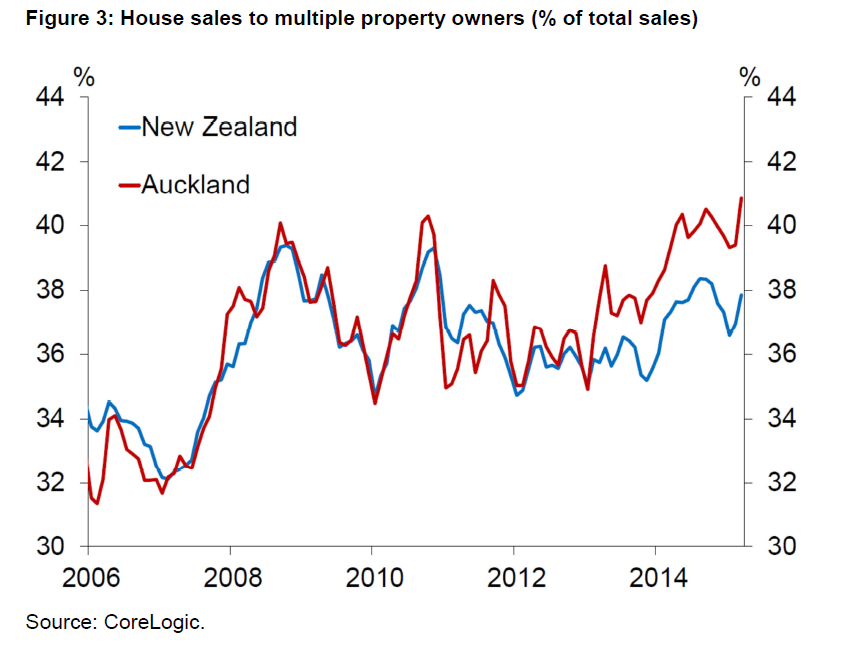
It is certainly true that a higher share of residential lending is now taking place in Auckland (although I suspect the share of the stock can’t have changed much in one year). In the stress test scenario that would, mechanically, mean a higher level of losses (since the scenario assumed a larger fall in house prices in Auckland than elsewhere). And of the lending in Auckland a little more has been going to investors. But note that final point carefully – as Figure 3 in their consultation document illustrates, the proportion of house sales being made to “multiple property owners” (the proxy for investors) is now no higher than the average in the series since 2008.
multiple

The investor property share is higher than previously in Auckland but (a) the difference from the rest of New Zealand is small, and (b) the greater role of investors is partly due to the earlier LVR restriction, which will have forced some first home buyers out of the market, to be replaced by investors. Moreover, in the consultation document the Bank indicates that the earlier LVR restriction has improved the overall “resilience” of the financial system. Even if one believed that lending to investors was riskier than lending to owner-occupiers, all other characteristics of the loan held equal (and the Bank has still not yet persuasively made that case), the overall implications of any changes in portfolio structures over the last year look likely to be small.

Stress tests run today would certainly produce different results to stress tests run a year ago.  But housing loan losses have hardly ever been at the heart of a banking crisis, the stock of debt is rising only slowly, and the 2014 results were so strong that it is difficult to believe that the Bank’s analysts are seriously wanting us to believe that stress tests run today would suggest that the financial system was now imperilled. Indeed, I noted the careful way their claim was worded – they suggest that the results today would be “worse”, but not “materially” or “substantially” worse. Given how strong the 2014 results were – as the Bank itself told us – a slight deterioration, in a business so fraught with uncertainty, should not really be a matter of particular concern.  Recall that in last year’s tests –  an exercise to which the Bank and APRA devoted a lot of resource –  not a single bank had a single year of losses.    It might sound too good to be true, but it is the Bank’s own work, and “no losses” leaves rather large room for them to be wrong without the soundness of the system being in jeopardy.

Unfortunately, the Bank seems to be all over the place on this issue. It is difficult not to feel some sympathy for the staff who are required to dream up rationalisations, and explain away past robust results, to provide some support for the Governor’s strong pre-determined views.  But if they really do believe that stress tests run today would result in a materially greater threat to the financial system then (a) they should probably have steps in train already to raise required levels of bank capital, and (b) it might have been helpful if they made the case in the Financial Stability Report.
Time to reform Reserve Bank governance – domestic public sector perspectives

Yesterday, in discussing my proposition that it is now Time to reform the governance of the Reserve Bank I outlined the contrast between the international perspectives available in the late 1980s when Parliament set up the governance model for the Bank and those available now.  Very few countries then  central banks (or financial regulatory agencies) that had statutory and effective operational policy independence. There was no international standard that could have been followed.  But of the many countries who have reformed their institutions since 1989 not one has followed the New Zealand model.  It is very rare for a single unelected individual to have sole legal responsibility for monetary policy decisions, and unknown for one such person to have decision-making authority on both monetary policy and major policy aspects of financial institution regulation and supervision.

Today, I went to look briefly at how New Zealand public sector governance, and conception around it, have changed since 1989.   The Reserve Bank is just one among many New Zealand public sector agencies, and it is inevitable, and highly appropriate, that thinking around how to design, manage, and govern other New Zealand public sector agencies should influence how we structure our central bank and financial institution regulatory agency.  Huge change took place in the New Zealand public sector in the late 1980s, and the Reserve Bank was somewhat uneasily fitted in to the model.

Back then, the Governor of the Reserve Bank was seen as somewhat akin to a core government CEO. In the reforms of the day, those CEOs were to have performance agreements with ministers, and would be able to be dismissed if they did not achieve the “output” targets specified in those agreements.  Departmental CEOs were envisaged as having considerable operational autonomy to achieve these measureable goals.

The state sector has changed considerably since then.  For a variety of reasons, departmental chief executives have much less autonomy, and there is much greater emphasis on departments working together, and a recognition that most key decisions rest with ministers.  The public service CEO model is not a good guide to how to organise the Reserve Bank, which does have considerable autonomy in policy.

By contrast, the Crown entity model has been developed and systematised subsequently.  The numerous Crown entities each perform statutory roles, across a range of types of activities (some more policy-oriented, and others largely just service delivery).  But I am not aware of any of these entities in which a chief executive has principal policymaking powers.  Rather, key framework decisions are typically made by the board of the respective entity –  and members, and the chair, are directly appointed by a minister.  The Reserve Bank is not a Crown entity (in the formal central government organisation chart) but as a model for governing agencies that exercise independent authority on behalf of the Crown the approaches used in Crown entities (perhaps especially the “Crown agents” class) seem to be a much more suitable starting point for thinking about governing the Reserve Bank.

In the rest of our system of government, single individuals simply do not exercise the degree of power –  without meaningful prospect of appeal or review – that Governor of the Reserve Bank has.

Some extracts from my paper:

As things stood in the late 1980s:

The Reserve Bank was just one of many New Zealand public sector agencies to face far-reaching reforms in the late 1980s.

The governance of government-owned commercial operations had been reformed first (the   SOE model came into effect in 1987).  For entities operating under the SOE model, the governance was to be very similar to that in a conventional corporate: the Minister appointed Board members, who in turn appointed a CEO to conduct affairs under authority granted to him/her by the Board.    For a time, the Treasury had been very interested in the possibility of applying the SOE model to the Bank[1].

The State Sector Act 1988 (and the Public Finance Act 1989) dealt with the non-commercial departments.  The insights that shaped that legislation were more practically relevant to later discussions around the Reserve Bank.

Under the previous state sector legislation, heads of government departments had permanent appointments – a model which had both significant advantages (as regards free and frank policy advice) and significant disadvantages (all but impossible to get rid of weak performers).  The new legislation put chief executives of government departments on fixed term contracts and provided for the establishment of performance agreements between chief executives and the respective ministers.  It provided stronger operational autonomy (from Ministers and from the State Services Commission) for chief executives and agencies, and the focus was on being able to hold individuals to account.

A key part of this, at least conceptually, was the attempt at a clear delineation between, on the one hand, the “outputs” of government agencies (things agencies could directly control – e.g. volume and quality of policy advice; hours devoted to traffic patrols etc) and, on the other hand, “outcomes”.  Outcomes (e.g. a lower crime rate) were things that politicians and the public probably most cared about.  Outcomes were typically affected by the actions of government agencies, but there was no direct and unambiguous mapping between specific actions of agencies and desired “outcomes”.  The conception was that CEOs could be held directly accountable for the achievement of output targets that were set by Ministers in performance agreements.

And as things stand now

Some aspects of 1980s public sector reform have proved resilient.  The domestic SOE model proved relatively successful for commercial operations owned by government, and relatively enduring, in form as well as in substance.  It is becoming less important, particular since the recent wave of partial privatisations, but the proposition that government business activities should be managed commercially, using fairly standard business governance models, has stood up well.

By contrast, in core government departments, the usefulness of the outputs vs outcomes approach as a guiding principle for assignment of responsibilities, and accountability, has probably not lived up to the hopes of the designers.   And, not unrelatedly, the degree of effective operational autonomy for (single decision-maker) department chief executives is far less than was probably envisaged by the early advocates of the model.  More recently, as a matter of active policy, departmental autonomy now appears to be consciously discouraged, with an emphasis on “whole of government” or “joined-up government” approaches –  whether with a view to cost-savings, better policy outcomes, or both.

Much about the way policy is implemented is politically sensitive (i.e. voters expect politicians to be accountable for choices about both “whats” and “hows”).   A government concerned to lift educational standards (an outcome) cannot conceivably simply leave to the Secretary of Education the question of whether to adopt, say, a National Standards regime as an “output” in support of the government’s desired “outcome”

As a result, the clean delineation between outcomes and outputs has rarely worked overly well.  Government departments still have single (unelected) decision-makers (i.e. their chief executives) but those individuals have little effective independence over outward-facing “how” decisions[2] (or, increasingly, over key aspects of the internal management of their own agencies).

There have always been many government entities beyond departments and SOEs.  Numerous Crown entities exist to carry out a wide variety of public functions[3].   A consistent framework for these institutions did not exist in the 1980s but in 2004 the Crown Entities Act was passed.  It was designed, in Treasury’s words, to “reform the law relating to Crown entities and provide a consistent framework for the establishment, governance and operation of Crown entities. It also clarifies accountability relationships between Crown entities, their board members, their responsible Ministers and the House of Representatives”.

The Reserve Bank is not, formally, a Crown entity, standing in a category of its own in the government organisation chart.  There is no obvious reason for that to continue, since there is little obviously unique about the role or functions of the Bank.  But the point I wish to make here is simply that, across the wide range of Crown entities (and various sub-categories within that grouping), I am not aware of any case where a chief executive has principal or exclusive decision-making powers  Crown entities typically exist to give effect to:

  • implement some aspect of government policy (e.g. EQC, ACC, FMA, NZQA),
  • provide advice and/or participate in public debate (e.g. Productivity Commission, Retirement Commission, Law Commission), or
  • carry out some function government has determined to fund and provide (e.g. NZSO, Te Papa).

In some areas, of course, aspects of the application of policy will shade into policy itself, but matters with pervasive external effects are not simply decided by a CEO.  Each of the significant entities I am aware of have a board which has ultimate responsibility for the conduct, and key framework decisions, of the organisation[4].  Board members, and typically the chair, are directly appointed by Ministers, and each chief executive exercises their delegated power under the direct authority of the respective board.

The practice of collective decision-making (and/or formal review or appeal rights) goes still broader, and is deeply entrenched in our system. Indeed, in New Zealand public life, it is difficult to think of any other position in which the holder wields as much individual power, without practical possibility of appeal[5], as the Governor of the Reserve Bank does.  Judges, of course, have the power to imprison – but all lower court decisions are subject to appeal, and higher courts sit as a bench, so that no one person’s view alone decides the case.  Resource management consent decisions, which hugely and directly affect property rights and values, are subject to appeal.  Individual Ministers exercise significant authority, although often requiring the involvement of Cabinet.  In New Zealand, all ministers are elected MPs, and any individual minister serves only at the pleasure of the Prime Minister.  The Prime Minister, of course, has huge power, but cabinet government is a key feature of our system, and (more hard-headedly) the Prime Minister holds power only while he commands the confidence of his own (elected) caucus.  As Kevin Rudd found, that confidence can be withdrawn very quickly.

Typically, public policy decisions that have far-reaching ramifications or that are not customarily made within clear and prescriptive guidelines, are either made collectively, or are subject to appeal, or both.       There is nothing comparable in respect of the Reserve Bank.

[1] The ideas are discussed, not entirely impartially, in chapter 5 of the Singleton et al history of the Reserve Bank.  Note that at the time there was no formal framework for Crown entities.

[2] Of course “who” decisions (eg on prosecutions, or tax audits, or licenses etc) rightly remain far-removed from Ministers.

[3] http://www.ssc.govt.nz/state_sector_organisations sets out all current state sector organisations.

[4] I have not attempted to work through the entire list of Crown entities to check their respective pieces of legislation, so if there are exceptions I would be happy to be advised of them.

[5] The override powers in Section 12 of the Reserve Bank Act do, of course, provide some scope for acting to deal with a Governor doing rogue things – but are not a routine part of governance (and have never been used).  The Reserve Bank can induce, or materially worsen, a recession without significant threat of those powers being used.  Perhaps, for example, it did in 1998, during the MCI fiasco.

Time to reform the governance of the Reserve Bank

[Here is the link to the coverage of my paper on governance in the Sunday Star Times]

This post had its origins in an earlier OIA stoush –  not mine, but that of one of the Green Party’s parliamentary staff.

For at least 15 years, I’ve thought that the way the Reserve Bank was governed should be changed and that we should move away from the situation (unusual internationally and anywhere else in the New Zealand public sector) where a single unelected official makes all the policy decisions (in the Reserve Bank case, on monetary policy and financial regulatory matters).  Other countries don’t do it that way.  New Zealand doesn’t do it in any other field of policy.

In late 2011, I was filling in time in the office between Christmas and New Year.  Alan Bollard’s second term was coming to an end, and while he hadn’t confirmed he was going it was widely (and correctly) expected.  I’d been saying to people for some time that a change of Governor was the best time to try to trigger discussion on the issue.  So I decided to write a brief internal discussion note making, in writing, the case I’d been making in conversation for years. I didn’t propose a detailed alternative model, and simply urged that change be considered, and that the Bank think about getting in front of the issue.     I wrote the note, and sent it round to only perhaps 10-12 of the Governor’s senior advisers on monetary policy.  I went on holiday, and when I got back word came down that the Governor was not all happy that the discussion note had been written.

Some months later, I took the opportunity to revise the note, and to take on board some useful comments I had received.  By this time, it was confirmed that Alan Bollard was going, but no decision had quite yet been announced as to who would be the new Governor.  Since no one could then think the paper was in any way a criticism of any individual, I sent it around a wider group of the Bank’s policy and analytical staff.  When Graeme Wheeler joined the Bank I sent him a copy, and had an appreciative response.

At some stage in 2013, the Green Party became aware that the paper existed (because the Bank had released another paper under the OIA, and my note was included in the list of references).  Their staffer asked for the paper, and was turned down.  He pursued the matter to the Ombudsman, who accepted the Governor’s argument that if this paper were released he would not be able to allow free and frank debate among staff.  I didn’t have a strong view on whether it should be released –  internal debate is important, and my note had been intended only as a contribution to that.  But it wasn’t a very recent paper, hadn’t even been written when the current Governor was in office, was not on a topic that was under active review, and the Governor’s argumentation was perhaps a little chilling.

Anyway, had the 2012 paper been released a couple of years ago, I probably wouldn’t have done anything more on the issue.  But I had continued to think about the issues, and particularly to think about them in the context of the much wider ranges of responsibilities and powers the Bank now exercises.  The result is this paper.

time for Parliament to reform the governance of the Reserve Bank online version

My preamble is partly to make clear that this is an issue that I have been thinking about for a very long time.  As people occasionally remind me, some of my comments on this blog could be seen as (but are not) motivated by grudges against current Bank management.  As Don Brash will confirm, I was running (less-developed forms of) the argument fifteen years ago.  The best Governor in the world simply should not have the extent of power any Reserve Bank Governor now has.

As important are two things:

  • The Reserve Bank does not write its legislation, Parliament does.  The Bank, and its Governor, operate within laws that Parliament has passed. The responsibility for legislation in this area rests with the Minister of Finance and Parliament.
  • To his credit, Graeme Wheeler seems to have recognised some of the weaknesses of the current system.  I suspect he and I would not agree on the solution (I don’t think staff should make the sorts of decisions the Reserve Bank is responsible for), but what matters at this stage is to get a good discussion and debate going, and to have a careful examination of the pros and cons of various possible models.

As it happens, I’m not sure if anyone is now particularly wedded to the current model.  The Treasury favoured a review in 2012, and they reported that many or most of the market economists then favoured change.  The Governor appears to recognise the risks and deficiencies of the single decision-maker model, and several political parties have also at times talked of proposing change.

This isn’t an issue that should divide people on any sort of ideological lines.  I’ve taken as given the current powers and objectives of the Bank.  Perhaps some of them should be looked at again, but this paper is just an attempt to prompt some discussion about how best to organise and govern a powerful New Zealand public agency, carrying out the wide range of functions that Parliament has assigned to it.

As ever, I’d welcome thoughtful comments and alternative perspectives.

The first page of the paper, an introduction and summary, is here:

Introduction and summary

When Parliament passed the new Reserve Bank of New Zealand Act in December 1989 a key, and innovative, feature of the Act was that the powers of the Reserve Bank were to be exercised by the Governor, and the Governor alone.  The legislation provided substantial operating autonomy to the Reserve Bank, and the establishment of a single decision-maker was seen as a way of providing effective accountability. If things went wrong, the Governor would have been responsible for any decisions, and the Governor could be dismissed, for cause, by the Minister of Finance.

But the model is out of step and out of date.  It is out of step with international practice in respect of monetary policy and of financial system supervisory and regulatory policy.  As importantly, it is out of step with approaches to governance used in the New Zealand public sector more generally.

The Reserve Bank governance model was developed, in part, to parallel reforms to core government departments that were going on at much the same time.  Those reforms themselves have since been considerably modified.  But even if that were not so, the conception of the Reserve Bank that the 1989 legislation reflected has not been borne out by reality.

The 1989 governance model might have been thought appropriate (if still unusual) for a very simple and uncontroversial most-monetary-policy agency.  Today’s Reserve Bank is a complex, multi-functional, organisation, exercising much more policy discretion in a range of areas, that are all characterised by considerable risk and uncertainty, than was envisaged in the 1980s.   Vesting all that power in a single unelected person is too risky, and is inappropriate.  It is not the way we do things in New Zealand.

In this note I will take as given both the range of functions the Reserve Bank has, and the allocation of powers between the Minister of Finance and the Bank.  Aspects of both issues should probably be revisited, but here I focus simply on the weaknesses in the governance model given the responsibilities that Parliament has assigned to the Reserve Bank.

The rest of this note outlines the key aspects of Reserve Bank governance and explains the background to the governance choices made in the 1989 Act.  It then focuses on how different things are today and why, even if it was a suitable model in 1989, it no longer is today.  I outline some alternative options and conclude by outlining my own preferred option.  Key aspects of any reforms should be (a) a move away from having policy decisions made by a single unelected official, and (b) the establishment of collective decision-making bodies which clearly distinguish among the main functions the Reserve Bank undertakes.

The Reserve Bank and the Official Information Act

(for anyone who is bored with this subject, feel free to read no further).

I have mentioned various Official Information Act requests I have lodged with the Reserve Bank, and the difficulty the Bank seems to have with the proposition that its information is public information and that, unless there is good statutory reasons for withholding the information, it should be released as soon as reasonably practicable, and in any event no later than 20 working days after the request was lodged    Agencies are funded to cover their statutory responsibilities, including those under the OIA.

It would be tedious to readers to run through all the responses I have had, so I will highlight three.

In this post, I discussed a request I had made for a limited range of papers that fed into the March 2005 Monetary Policy Statement (ie 10 year old papers).  On the last working day of the originally available 20, the Bank extended the request for up to another 20 working days,  I’m still waiting, and will no doubt hear something next week.  As a reminder to that Bank, that “as soon as reasonably practicable” is the law of the land.

I also asked the Bank for papers around the 2012 PTA.  As I noted earlier, they came back wanting to charge me for it.  I asked how I could usefully narrow the request to expedite the matter, and (as they are required by law to assist requesters) we had a helpful conversation in which it was agreed that I would revise my request to those (five or six apparently) documents held in the relevant folder in the Bank’s document management system.  I had hoped that might be a matter of only a few days.  I’m looking forward to the final response.

As I was winding up my time at the Bank I lodged an OIA request, asking for clearance to quote historical papers that I had written while I was at the Bank.  In the last decade, those have mostly been opinion pieces.  As I noted to the Bank, I had looked through most of them recently, in the course of clearing my desk, and couldn’t see anything particularly sensitive or likely to cause trouble under statutory OIA grounds.  I suggested that perhaps for older papers they could consider a blanket waiver, and then could have someone look through things I had written in the last three years or so. (I knew that there was one 2012 paper that the Governor had already persuaded the Ombudsman to withhold, and I indicated that I would not be unduly bothered if the Bank still wanted to withhold it, even though the paper was now several years old).

I got a response, again near the end of the 20 working days, saying that the Bank could not give any blanket waivers, and suggesting that if they had to go through the papers it would cost $100000.

Accordingly, I revised my request.   A month ago, I asked only for the papers I had written in a single year, and was very specific that I only wanted papers lodged in the Bank’s document management system, not emails or the like.  As it happened, in the year concerned –  2010 –  I was only working at the Bank for six months.  I don’t know how many papers there are, but I was simply not that productive (and had other things to do).  And these are five-year-old pieces of opinion or analysis[1].

Yesterday, again almost right to the end of the 20 days on this request, I had a response from  the Bank.

Meeting the original 20-day time limit would unreasonably interfere with the operations of the Reserve Bank. Accordingly, and under the provisions of section 15A(1)(a) of the Official information Act, the Reserve Bank is extending by 20 working days the timeframe for a response to your request.
 

It would be almost laughable, if it were not serious.  The Reserve Bank is a very powerful public agency, and the Official Information Act is a key element in open government.  The Reserve Bank seems not to regard obeying the law as a matter of importance.  It is a good example of why, on the other hand, the Ombudsman’s review of the Official Information Act, currently underway, is so important.

If it is of any relevance, which it should not be, I can assure the Bank that my only agenda, in each of these requests, has been transparency.  There is no single document that I desperately want to get hold of and post to make a point, to embarrass the Governor, or anything of the sort.    But if there was, the law is still the law, and information must be provided as soon as reasonably practicable.

[1] Although it occurs to me that the Bank might have interpreted the request as including any advice to the Governor on specific OCR decisions.  I never lodged those pieces in the document management system (the committee secretary did), and am not after those.

Yet another policy lurch

Having now read the Financial Stability Report, and listened to the Governor’s press conference, I was surprised by the poor quality of the Report and of the policy that it discusses.  The FSR is supposed to contain material to enable us to assess the effectiveness of their use of their powers (here and here).  This one just does not.

Policy seems to be lurching from one intervention to the next, without any compelling analytical framework or evidence.  There also appears to be little sign of any historical memory.

For example, only six months ago the Bank was reporting the results of its own stress tests, which suggested that the major New Zealand banks (and presumably the financial system) were resilient to even very severe shocks to asset prices and servicing capacity.  And yet, despite announcing its intention to impose yet more, quite invasive, controls on bank lending to one sector of SMEs, there was no reference at all to this assessment and experience.  Perhaps the Bank does not believe the results of the stress tests, but if not surely they it owe it to us to explain why.  .

Similarly, the Bank laments that investors have become a larger share of property purchasers in Auckland (what is the “right” or “appropriate” share, and where is the “model” to determine that, we might reasonably ask them) but they don’t seem to see any connection between the imposition of the first LVR speed limit 18 months ago –  which will have borne most heavily first-home buyers, who have always been those who relied most heavily on debt finance –  and the greater presence of investors in the market.  At the time their own analysis and modelling (eg see chart on page 9) made the point that potential buyers who were displaced would, over time, be replaced by other buyers.  Their modelling also showed that the most that could be expected of the speed limit was a dip in house price inflation for a year or so, which would then be reversed as the new buyers entered the market.

If amnesia is a problem, so apparently is schizophrenia.  On the one hand, the FSR and the press release tell us that “New Zealand’s financial system is sound and operating effectively”, but on the other hand they apparently think that banks are operating so recklessly that not a single Auckland investor purchaser should be able to take a loan of over 70 per cent of the value of the property, no matter how sound a proposition that borrower might otherwise appear to his/her lender (including their flow servicing capacity).    Continuing the theme of an institution that can’t quite make up its mind – or perhaps doesn’t want to scare the investor horses, but wants cover for yet more regulatory interventions – the Governor told us in the press conference that he was becoming seriously concerned about financial stability risks.  If so, perhaps the first sentence of the Report should have been written somewhat differently.

The Bank also doesn’t seem to display much regard for good process.  It is going to produce a consultative document shortly on its proposals to restrict investor loans in Auckland (which I hope will have much more substantive justification for the proposed policy than is in the FSR), and yet it ‘‘expects banks to observe the spirit of the restrictions” now.  “Consultation” is supposed to have substantive meaning, and not just around the fine details of the regulations.  Is the Reserve Bank open to countervailing arguments, or has it already made up its mind and just going through the motions?  If the latter, it might leave itself exposed to the risk of someone seeking judicial review.

The Bank blunders in with these policies, each no doubt well-intentioned, but with little apparent recognition of the way that its actions affect real people, their lives and their businesses.  18 months ago a nationwide LVR speed limit was put in place, apparently because the Bank thought that house price inflation and associated credit growth was going to become a widespread problem.  If the Bank was omniscient it might be one thing, but they were simply wrong.   Ordinary house-buyers in Invercargill or Wanganui had to delay purchasing a house because of a mistaken Reserve Bank hunch.  And these weren’t measures that were ever necessary –  by contrast there will always be an interest rate in an economy –  since large capital buffers were already in place.  And in Auckland, the Reserve Bank’s earlier policy won’t have materially adversely affected those from upper income families, where parental support will have helped young people get around the 80 per cent limit.  But what about those without wealthier parents, who are surely disproportionately Maori and Pacific? There was no hint of that distributive impact in the Regulatory Impact Statement for the earlier restriction.    In Auckland the earlier restriction provided cheaper entry levels for the lucky (those who got inside the speed limit), the wealthy, investors, and cashed-up purchasers.  Is that good public policy?

Who will be adversely affected and who will benefit this time?  One group that springs to mind who might benefit are the fabled offshore investors.  No one has any good idea how many of these people there are, but as Grant Spencer acknowledged in the press conference his regulatory restrictions won’t bear on them.   From a financial stability perspective that might not matter to the Reserve Bank, but I suspect that to voters it will.  First penalise first home buyers. Then penalise people looking to build a rental property business (and perhaps those who rent from them).  And who will that leave?  The middle-aged cashed-up purchasers, and any offshore purchasers.  It doesn’t look fair, it doesn’t look like a reasonable use of Reserve Bank powers (when less intrusive instruments, such as risk weights and overall required capital ratios are available), and frankly it doesn’t look very democratic.

Of course, Parliament gave these powers to a single unelected official –  although I doubt that anyone in 1989 ever envisaged them being used for such purposes.  Jim Anderton, a staunch opponent of that Act, must now be rubbing his eyes in disbelief.  And, on the other hand, the current government was supposedly committed to reducing the burden of regulation, not increasing it.  One wonders if the Reserve Bank given much thought to the lobbying it now opens itself up to  –  carving out one set of rules for Auckland will, in time, open it to lobbying for special rules for other areas.   Cashed-up purchasers wanting to buy more cheaply in Queenstown might be knocking on the Governor’s door before too long.   If we must have regional policies (in bank regulation or other areas), let the choices be made by those whom we elect, and can toss out.

And then we are back with the larger questions.

  • Is there any evidence, from anywhere, ever, of a systemic financial crisis in a country where credit has been growing around the rate of growth of nominal GDP, and has been doing so for the last six or seven years?  The Bank has produced some interesting new data on gross credit flows, but it doesn’t change the underlying evidence from the international literature: when credit is not growing fast relative to GDP one of the key risks of a future crisis is missing.
  • Where is the evidence that loans to investors, all else equal, are riskier than other residential property loans?  Repetition of the claim over and over again is not the same as evidence.  As I have noted previously, the evidence from Ireland and the UK (tho in UK loan losses were always small) is not particularly enlightening, since the rush into buy-to-let properties was very much a late cycle phenomenon.  None of the sources the Reserve Bank mentions look at losses on like for like (eg similar age, similar LVR) loans.    In an earlier post, I questioned whether the Reserve Bank had any domestic evidence on losses on loans to investors, as compared to those to owner-occupiers, in those places where nominal house prices have fallen considerably in recent years.  If there really is the sort of difference the Reserve Bank asserts, surely it should be showing up in New Zealand data.   The one area where international evidence does seem to suggest that loan losses are greater is new house building –  but the Reserve Bank is still carving that out from the limits.

One word that appeared very little in today’s document was “efficiency”.  The Act talks repeatedly about the “soundness and efficiency” of the financial system. The efficiency references were put in for good reason – to limit the risk of recourse to direct controls, of the sort that plagued our system for decades.   By almost any definition, somewhat arbitrary controls like the LVR speed limit and the proposed new Auckland investor lending limit impede the efficiency of the financial system.  Almost inevitably there is some trade-off between soundness and efficiency considerations in any set of prudential measures, but in this document the Reserve Bank gives us nothing to allow us –  or those paid to hold the Bank to account –  to see how and why they have made the trade-offs they have.    What basis is there, for example, for imposing a blanket ban of any investor loans in Auckland in excess of 70 per cent LVR[1] when, for example, the soundness of the system could have been protected at least as well –  if there is a material threat at all –  with, say, higher risk weights for Auckland property loans more generally, which would not skew the playing field between different classes of potential borrowers/purchasers at the whim of the Governor.   There may be good grounds for the trade-off that is made, but they simply aren’t presented.  How can people assess the effectiveness of the Bank’s exercise of its prudential powers?

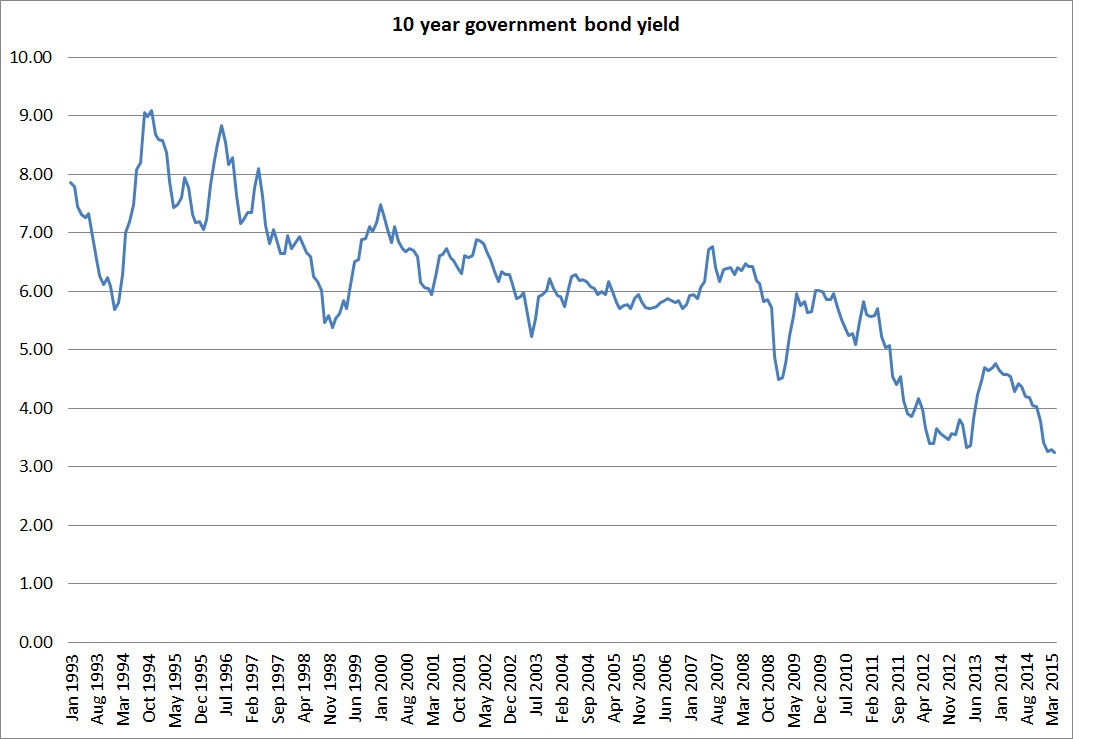
Finally, the Bank partly justifies its targeted intervention in Auckland, against one class of potential buyers, on the basis of rental yields in Auckland.  They argue that rental yields in much of the rest of the country are around 10 year average levels, but are at record lows in Auckland.  But has the Bank looked at a chart of New Zealand bond yields recently?  New Zealand 10 year bond yields are now at the lowest level probably ever (and certainly in the 30 years on the Reserve Bank’s website).  And the market now expects that the Bank will have to cut the OCR not raise it.  Shouldn’t we expect rental yields to bear some relationship to yields on alternative investments, such as long-term government bond yields.  Of course, the Bank would no doubt defend its stance by reference to the abnormally low level of bond yields globally.  And it is true that they are very low  (while NZ’s remain high by cross-country comparison), but the Reserve Bank –  even more than its overseas counterparts –  has been getting the future path of interest rates wrong for six years now.  Perhaps they will be right this time, but why should we be confident that they know better than the market?

10yr

It is difficult to fully make sense of what the Governor is up to. I suggested a few weeks ago that he didn’t want to be the person who presided over a NZ version of the US experience of 2006 onwards.  Which would be a laudable goal if there were any evidence that circumstances were even remotely similar. But there isn’t: overall credit growth is subdued, the Bank presents no evidence of a systematic deterioration in lending standards, and fundamental factors  provide a good basis to explain what is going on in house prices, both in Auckland and in the rest of the country.  Perhaps the Governor just wants to “do his bit” to solve the problems in Auckland, but (a) the Reserve Bank has no statutory mandate to focus on trying to manage house price cycles, especially in a single city, and (b) it isn’t clear how impeding access to finance (in a climate of modest per capita housing turnover, modest volumes of mortgage approvals and modest overall credit growth) is going to in any sense help deal with the structural problem.  There just isn’t a financial system problem –  and if there is the Bank just hasn’t made its case, and should get the evidence out there –  and it feels as if the Bank is misusing its extensive powers, based on a flawed reading of what is going on, and a failure to give due weight to how often past regulatory interventions have just made problems worse.

I pointed out a few weeks ago that it was now over a decade since the words “government failure” had appeared in a document on the website of the State Services Commission.  The Reserve Bank is now a major regulatory agency, exercising more and more powers by the decision of single unelected official.  I checked the Bank’s website, and the phrase “government failure” appeared only once (in a Bulletin article on historical crises), and “regulatory failure” appeared not at all.  It should disconcert citizens –  and those paid to hold the Bank to account –  that there is not more evidence of the Bank having reflected seriously on what that entire literature, and the experience of countless other regulatory bodies, might mean for how they should exercise their powers.

PS    In the press conference the Bank seemed to back away (perhaps just diplomatically) from the Deputy Governor’s expressed support for a capital gains tax. Almost a month ago, I lodged an OIA request for any material the Bank had considered on a CGT.   Since the Bank has taken so long to respond, and is required by law to respond “as soon as reasonably practicable”, I’m assuming they must have a considerable amount of substantive material that needs review.

[1] And, on the other hand, no such restrictions in Christchurch even though the Governor observed that he thought a glut of houses in Christchurch was quite likely.