Golden fetters and paper chains

In various posts over the years I’ve mentioned how countries finally got out of the Great Depression.  Generally that involved breaking the link between their respective currencies and gold and then being able to adopt more-expansionary macroeconomic policies.  That was relatively easy to do as a purely technical matter, but it took a long time for countries to get there (a handful of significant countries not until 1936).  I’ve worried aloud that given how low the starting point for nominal interest rates was going to be that in the next serious downturn the refusal of central banks –  and it is simply a refusal –  to take policy rates deeply negative would end up as much the same sort of fetter as gold once was.

The definitive book-length treatment of this angle on the Great Depression is Berkeley professor Barry Eichengreen’s  Golden Fetters.  It was published in 1992 – decades ago now – and going by the marks in the margin of my copy I seem to have read it once a crisis since then.  It is one of those books that repays rereading, partly because the contemporary context against which one reads it is different each time.  I read it again last week.

What follows is informed by Eichengreen, although refracted through my lenses.  There are places where Eichengreen’s argument isn’t fully persuasive (and he has one or two facts wrong about New Zealand).

Much of the book is scene-setting for the experience of the Great Depression.  That includes a perspective on the pre-War Gold Standard, which tied together most of the major (and many of the minor) economies of the time, with a leadership role played in particular by the Bank of England.    In many of the core countries –  UK, France, Germany notably –  central banks played an important role, but in other countries operating on a gold standard there was no central bank at all (most importantly, the United States, but also countries like New Zealand and Canada-  all three of whom were net capital importers).    Price levels didn’t change much over time (the British price level was about the same in 1914 as it had been in 1834), capital flowed freely, trade (and migration) was extensive, and if there were periodic crises or threats to the system, central banks worked together to maintain stability.

World War One greatly disrupted the picture.  Some countries formally went off gold, others didn’t formally but there were enough interventions that the pre-war parities didn’t act as any sort of constraint on price levels.  Huge debts –  internal and external – were run-up in the process, and the US moved from being a net borrower to being a net lender to the rest of the world.  And in the aftermath of the war there were reparations obligations established, huge distributional fights (inside countries) as to who should cover what portion of the accumulated costs, and some countries collapsed into hyperinflation sooner (Austria) or later (Germany).   All manner of other countries had much higher price levels than pre-war, and in some –  notably France –  high inflation remained an issue well into the mid-1920s.

Against that backdrop, in many quarters a return to a money convertible to gold was seen as partly as a key confidence-building commitment, and partly as a return to something like normality.  It took a long time –  in one case, Japan, it din’t actually happen until early 1930 – and for good reason.  There were debates about which rate to restore parity at –  the UK eventually, perhaps unnecessarily, chose to re-peg at the pre-war parity, which implied several more years of moderate deflation.  For France, having had so much inflation, the pre-war peg quickly became unrealistic and they stabilised at a considerably devalued exchange rate to gold.  For Germany, of course, hyperinflation made a nonsense of the pre-war parity.

There hadn’t much gold mined in the previous few years, and yet global price levels were much higher than they had been.  That in itself posed some challenges.  But international cooperation and trust wasn’t what it had been pre-war either.  And particular policy choices made by the US and France meant that those two countries’ central banks accumulated an increasing share of the world’s gold are were unwilling and/or unable to let those inflows flow into much looser domestic monetary conditions (France, for example, having just stabilised was understandably averse to a fresh wave of inflation).  The UK –  still operating as a major global financial centre, significant source of long-term foreign lending –  operated with low gold reserves.  Germany, with a populace only too conscious of hyper-inflation just a few years previously, had high minimum gold cover requirements, but those buffers couldn’t be cut into.  Higher interest rates in the US – as in 1928/29 – forced both the UK and Germany to adopt tighter domestic monetary policy.   And so on.

The Depression itself got underway in a variety of countries influenced by various factors, domestic and international.    The 1929 sharemarket “crash” wasn’t particularly important, except perhaps in shaping the mindset of various US policymakers (including at the Fed) who were uneasy about much looser monetary policy because they reckoned the excesses of speculation needed to be purged.    Some countries were affected worse than others early on –  Australia for example on the worse side, and France on the more positive side.

Generally, however, monetary conditions did ease as the respective economic conditions deteriorated.  But the fixed exchange rate system, underpinned by convertibility to gold, severely limited what could be done with either fiscal or monetary policy –  and that was true even in the countries with large gold holdings, the US and France.

The financial crisis aspects really intensified in mid-1931, in Austria and Germany (where there were significant domestic banking system issues) initially, and then spilling over to the UK, where the economic slump itself had been relatively mild –  relative being the word –  but the pressure eventually told on gold parity.   The re-formed National government –  still led by former Labour Prime Minister Ramsay McDonald –  decided not to impose further pain on the domestic economy (which might have been insufficient anyway) and went off gold.    The break in the parity was initially envisaged as temporary, and it was some months before domestic policy itself became much more expansionary.  But the consequence of the lower exchange rate –  although many smaller countries moved to peg to sterling, giving rise to the “sterling area” which persisteed for several decades) and easier domestic monetary conditions meant that the UK was the first significant economy to recover from the Depression.

The US held on to the old gold parity until April 1933, and while that old parity held it acted as a real and binding constraint on the ability of domestic authorities –  including the Fed – to run much easier policy.   Fear of devaluation sparked capital (and gold) outflows.   But as Eichengreen records, many of the senior Fed officials were not that keen on much easier policy anyway, and some saw the roots of the Depression primarily in past speculative excesses.  Even in the US, concern about possible inflation risks – in the depths of a deflation –  were heard, and were evidently sincere.  The US later returned to a gold parity (while prohibiting for decades citizens from holding gold) but at a much-devalued exchange rate.

Those inflation concerns were all the greater on the Continent.  Germany never abandoned the old gold parity, but just rendered it non-binding with an increasing complex of exchange controls and other payments restrictions.   But for the remaining gold countries –  most notably France, Belgium, Netherlands and Switzerland –  the tensions grew between the desire to maintain the parity –  whether as symbol of normality or (more strongly in the French cases) ran increasingly up against the losses of competitiveness producers in those countries faced as other countries devalued, and the market recogmition of those pressures (thus capital flight).  It wasn’t until 1936 that those parities were finally abandoned.

As Eichengreen notes, at the end of it all, by the late 1930s, real exchange rates among the major economies had not changed that much at all.  Some countries had got the initial advantage of moving earlier (the UK notably) but in the longer-term the beneficial effect was not breaking the gold parity and getting a lower exchange rate, but breaking the constraints (domestic and international) on domestic macro policy (fiscal and monetary).  As he also notes, it wasn’t enough just to break from gold, since countries also had to be willing to break with the Gold Standard ethos, and allow/adopt looser macro policies.  One obstacle to that had been the fear of inflation.  That fear might look unreasonable –  whether from this standpoint, or contemplating a country with a deep deflation in the early 1930s –  but the hyperinflationary and high inflation experiences really weren’t that far in the past, and had been utterly destructive for many.

Eichengreen has a nice table late in the book illustrating how industrial production –  the main macro variable at the time, before quarterly national accounts were a thing –  responded in different groups of countries.

eichengreenLook at the last two columns and you can readily see the difference of experience in the countries that went off gold/devalued (sterling area and the “other depreciated currencies” lines) with the experience in the gold bloc countries, where even by 1935 industrial production was still 20 per cent lower than in 1939.

It need not have been.  It wasn’t as if the 1920s and 1930s were a period of underlying economic stagnation.  The US –  by then the world’s leading edge economy – experienced really strong total factor productivity growth in both the 1920s and the 1930s.  I’m sure some economic ups and downs were inevitable, but nothing on the scale and duration of what actually happened in the 1930s was in any way inevitable –  it was largely the consequence of a succession of choices, of almost entirely well-intentioned people, working against the backdrop of presuppositions, presumptions about normality, and the backdrop of some deeply unsettling experiences, that led to those savage and prolonged losses.   When countries broke the golden fetters –  and for many it was regretted initially or felt to be hugely risky – economies started to recover, and the gains in an increasing number supporetd a sustained global recovery in demand.

(You might be wondering where New Zealand fits in all this.  That is mostly another post.  We had no central bank.  We went off gold in 1914.  That left our banks issuing their own currency, in practice loosely pegged to sterling (but not legally so), with banks managing domestic credit based on their holdings of London funds.  Our exchange rate – managed by the banks – was allowed to depreciate a bit, but the big movements were in September 1931 when the UK went off gold and their exchange rate depreciated against the rest of the world and so, thus, did ours, and –  more importantly –  then in January 1933 when the government initiated a formal devaluation against sterling (still not having a central bank) over the objections – and resignation –  of the Minister of Finance (and with not a little domestic unease and debate).  In 1931 and 1932 even after the UK went off gold our economic policy options were very very few, and our devaluation was much more of a turning point (probably helping that it was followed a couple of months later by the beginnings of the US reflation).  I have an old post on New Zealand and the Great Depression.)

Of course, the point of the post is to draw some loose comparisons between the golden fetters of the early 1930s, which proved so costly in the specific circumstances of the time, and what I’ve taken to calling the paper chains, the refusal of the world’s central banks now to do anything about taking official interest rates deeply negative, even though standard macroeconomic prescriptions –  such as the Taylor rule –  suggest that is exactly what should be done.

I’m not suggesting it is some sort of allegory for our age, in which every detail of the 1930s can be mapped to something now.  It can’t.  It is really just about a single point: that self-imposed constraints, which can seem very very important to preserve at the time, can actually in some circumstances prove incredibly costly, and in those circumstances the sooner they are jettisoned the better.

One area in which the parallels certainly aren’t exact is around fiscal policy.  Most countries in the 1930s had very little freedom of fiscal action initally, precisely because of the monetary/gold parity constraints  –  increase your fiscal deficit and the resulting increase in demand will also result in increased current account outflows (of gold).    In some cases – New Zealand –  there was just no effective borrowing capacity at all –  thus, Keynes’s advice to Downie Stewart that I’ve quoted here previously (“if I were you I’d try to borrow; if I were your bankers I would not lend to you).  We have nothing like those sorts of technical constraints.  But that doesn’t mean there are no limits in practice –  as we saw after 2008/09, public tolerance of continued very large ongoing fiscal stimulus, even in badly affected countries, was really quite limited.  In the real world, fiscal policy isn’t any sort of fully adequate substitute for monetary policymakers choosing to sit on the sidelines –  dealing, perhaps, with market liquidity issues, but not doing much about the overall stance of monetary policy, even as deflationary risks mount (thus, real retail interest rates have not fallen at all in New Zealand and Australia this year, despite the huge economic slump).

There is a, perhaps understandable, sense in some quarters that there wasn’t too much wrong with economies last December.  Perhaps, but things have now changed, and if one strand of macro policy – typically the most important for cyclical purposes, and easiest to adjust –  is allowed to sit on the sidelines doing nothing –  and elected ministers have the power to change thatg –  there is risks that this economic downturn ends up much more severe and protracted than it needs to be.  All because central bankers won’t break free of their paper chains and their old mindsets (aggravated in New Zealand’s case by the stunning negligence of a Reserve Bank that talked modestly negative interest rates for some time but did nothing at all to ensure there were no technical/systems obstacles): we pay the price for both lack of preparation and the reluctance/refusal to break the paper chains and put in place quickly the sorts of rules and practices that could allow official rates to be taken deeply negative for a time, in turn supporting demand (directly and via the exchange rate) and supporting medium-term expectations about the economy and inflation.


Social Credit – too timid by far this time

Social Credit ideas have a long history in New Zealand.  The originator, Major Douglas, even visited New Zealand in 1934 and testified to a parliamentary committee.  The ideas influenced Labour in particular in the 1930s, and some who later played very prominent roles in National.  We got our very own political party – the Social Credit Political League – in 1954 and from time to time Social Credit did very well in the polls (and under FPP even managed four MPs at the different times from the 1960s to the 1980s).  I recall a time –  perhaps 1980 –  when Social Credit briefly polled ahead of Labour.  There had been an entire Royal Commission in the 1950s, mostly intended to debunk them, but  they weren’t deterred –  as a young economist at the Reserve Bank, a fair amount of my time was spent responding to letters, to us or the Minister, from Social Credit monetary reformers.  Some of were admirably dogged, and typically very polite, although one particular frequent letter writer once lamented that his letters were getting nowhere with us and felt as if he might just as well jump off a cliff.  Our then chief economist suggested that perhaps writing a book might help, and a year or two later we got the book in the mail.

It is a fascinating history but today I’m not going to wallow further in it.  The key policy plank always used to be cheap Reserve Bank credit as the macroeconomic answer.

It still appears to be so.   Social Credit still exists in New Zealand.   Democrats for Social Credit got 806 party votes at the last election.  And on Saturday I opened both papers – Dominion-Post and Herald – to find full page adverts from the NZ Social Credit Association.

social credit apr 2020

Several economists and various other commentators have extracts of their work presented as supporting the Social Credit vision/platform (to be fair, the advert makes clear that none of the people concerned have any association with Social Credit or with the advert).  It isn’t hard to find such quotes –  as my wife notes, I should probably count myself lucky that none from me appeared (after all, that quote from Shamubeel Eaqub is very much in line with my post the other day noting that there was no real macro difference between the Reserve Bank, at its discretion, choosing to buy bonds on the secondary market and choosing to buy them direct from the government).

Anyway, Social, Credit is trying to gather signatures for a petition (although not, it appears, a real parliamentary one) as follows:

We are calling on the New Zealand government to use the Reserve Bank (which the government owns) to fund the Covid-19 economic rescue package.

It is, they claim

The world’s first fully-funded plan to reclaim our environmental and social well-being

And here is underlying graphic

socred 2

The thing that seems to unite most monetary reformers is that they believe monetary policy and things around “the money supply” are much more powerful, much more important, than most monetary economists and central bankers do.

Before addressing what the Social Creditors are proposing, I should say that I am not one of those who thinks governments can do little or nothing useful in severe economic downturns  (there are a few such people, at least in principle, although few are visible/audible right now).  I’ve been championing here a more aggressive use of fiscal policy in the short-term (the 80 per cent net income guarantee for 2020/21), and for a much more aggressive use of conventional monetary policy.  Macro policy can help get the economy back to work as promptly as possible, but borrowing from the Reserve Bank –  whether at 1 per cent as Social Credit used to call for, or 0 per cent as they may now belief –  is largely irrelevant to the solution.

Note –  and here perhaps I depart from some of my friends on the right –  I did not say reckless and highly inflationary (as, for example, Social Credit prescriptions in the 1950s would have been).     There is far too much jumping at inflationary shadows still –  as there was 10 years ago in some circles (in the US in particular), and (so I was reminded rereading Eichengreen over the weekend) in the depths of the Great Depression –  at a time when the predominant macro risk (reflected in market prices themselves) is deflation.  Just largely irrelevant for now.

There is much talk of the government simply borrowing from “its own bank”, the Reserve Bank.  But the Social Creditors don’t seem to realise that there is really no such thing –  in any substantive sense.  After all, to most intents and purposes the Reserve Bank is just another division of the government –  the bit the banks bank with.

Take a really really oversimplified example.  The government wants to spend $20 billion in the depths of the recession and gets the Reserve Bank Governor to agree to lend it $20 billion (the government’s account at the Reserve Bank goes up by $20 billion and the Bank’s holdings of government bonds go up by $20 billion).  For most macro purposes, the interest rates charged/paid on either leg doesn’t really matter.

Now, assume the government goes and spends the money, perhaps distributing it in something like the wage subsidy programme.  The government’s operating account at the Reserve Bank will drop by $20 billion, and the accounts the banks hold at the Reserve Bank will rise by $20 billion (as recipients of the wage subsidy payouts bank the proceeds).

For the government sector as a whole, the net effect of this set of transactions in that the government sector has borrowed $20 billion from the banks.

Which is just what Social Credit thought they were avoiding.    They weren’t.  And the other relevant detail here is that the Reserve Bank pays interest on those deposits banks hold with them: at present 0.25 per cent per annum on the entire stock.

Banks, of course, have their own liabilities on the other side of their balance sheets, on which they too pay interest.    Some of them might be “wealthy foreigners”.  Others will be Grandma.

And what determines (or is supposed to determine) the rate the Reserve Bank pays on the deposits banks hold with it –  the OCR?  Why, that would be the inflation outlook, since they are required to aim to keep inflation at or near the target the Minister of Finance sets for them.

Perhaps advocates of Social Credit will be saying “ah, but 0.25 per cent is still cheaper than the interest rates the government might pay if it issued the bonds directly on market” (at present, long-term bond yields are a bit below 1 per cent, but would be higher than that if the Reserve Bank were not in the secondary market).   And that is true, but a 10 or 15 year bond yield is capturing, among other things, implicit expectations as to what monetary policy will be doing –  where the OCR will be set –  for the next 10 or 15 years.  Perhaps rightly, perhaps wrongly, at present the consensus view is that on average over that period the OCR will be higher than it is now, once the economy gets back to something more like full employment.

If that is right then, all else equal, even if the government has locked in zero interest funding itself from the Reserve Bank at zero per cent interest, the Reserve Bank would find itself having to pay higher interest rates over time to holders of settlement cash balances (or it might auction off some of its bonds to reduce settlement cash balances, but the macro effect would be much the same).    Reserve Bank interest expenses are a net cost to the Crown just as surely as if the Crown issued the debt directly on market.

And if the Reserve Bank did not make those adjustments –  higher OCR if and when inflation pressures eventually recovered – the result would be higher inflation.  And high inflation would be just as surely a “tax” –  transferring real resources from the public to the Crown –  as the taxes Social Credit claims they offer a path to avoid.

Perhaps the bigger problem still is that the Social Credit proposals are probably inadequate to the needs of the hour.

As I’ve noted in various posts in the last week or so, the Reserve Bank has added a huge amount to banks’ settlement account balances in total (balances last week were more than $20 billion higher than usual).  The “money supply” –  particular aggregate measures the Bank publishes – will also have increased to some extent (we’ll be waiting for weeks to see the end-April numbers).   But the higher settlement cash balances simply don’t mean very much.  For banks, it is just another asset –  a rock-solid one (which must be welcome) paying a reasonable interest rate for now, 0.25 per cent.    It isn’t as if there is much real effective credit demand at present, and the nervousness of many households and firms is probably reflected in quite a strong desire to save.

And whichever mechanism the Reserve Bank uses to buy bonds isn’t itself affecting how much the government is spending.  You might think (I suspect Social Credit do) that the government should be spending more.  That’s fine, but it won’t have any problem raising those funds –  whether it does so by issuing bonds on market, or issuing them to the Reserve Bank.  And it isn’t as if a shortage of settlement cash is constraining bank lending at present –  instead it is primarily weak demand from demonstrably creditworthy borrowers and perhaps an absence of attractive projects to fund (two sides of the much the same coin).

If the Social Creditors wanted a monetary policy that made a real difference in the current climate they’d give up their small ambitions and focus instead on where the big gains might really be on offer.

Perhaps a 1 per cent interest rate sounded really low to Major Douglas back in the 1920s, or to Social Creditors in most of the decades since.     These days it would be a very high interest rate, quite out of line with the needs of the economy.   Same goes for that 0.25 per cent the Reserve Bank is paying on the tens of billions of settlement cash balances.   Same really goes for zero, when so much of the government debt of major advanced economies has been earning a negative yield for some time.  Not surprisingly then, on the one hand our exchange rate is staying quite strong –  really unusual for a serious New Zealand recession –  and expectations about future inflation are falling (in turn raising the real interest rate –  a simply insane outcome in the midst of a deep recession with a highly creditworthy sovereign borrower).  But it isn’t wealthy investors or evil foreign banks who are determining that our interest rates are still so high: instead, it is Adrian Orr (and his Monetary Policy Committee, several of whom share the Governor’s left-wing credentials) and Grant Robertson, he who is always talking about the significance of full employment, but yet who does nothing to bring about the much lower (short-term) interest rates the current situation calls for.   Even in the last US recession, highly orthodox researchers within the Federal Reserve system concluded that a Fed funds rate of more like -5 per cent would have been helpful.  Our starting point this time, is worse than the US’s in 2008 (the Fed funds rate then started at 5.25 per cent).

In this environment, Social Credit is a distraction, but then so is the Governor’s bond-buying programme itself.    As in the Great Depression it was breaking free of the “golden fetters” that eventually allowed robust recovery, so this time it is the self-imposed “paper chains” – the refusal to do anything about seriously negative interest rates, that will impede prospects for any sort of robust recovery (and, not incidentially, worsen the worthy outcomes in the Social Credit graphic above).  Bond-buying programmes at yields well above the current natural rate of interest are just flashy-sounding asset swaps with little macro significance.

(And in case people are worrying about threats to central bank independence, recall that (a) the Bank’s current bond-buying programme, and any purchases it might in future make directly from the Crown, are a discretionary choice for Bank, and subject to the inflation target, and (b) central bank independence is not an absolute, or even always helpful –  the Fed, for example, was independent in the early 1930s and consistently resistant to doing very much of what needed to be done to get the US economy going (statutory powers for the Minister to (a) set the Bank’s target, and (b) override the Bank in some circumstances, but openly, exist for a reason).

And two final historical points:

  • one of the quotes Social Credit use is from Bernard Hickey about the 1930s.  Not only was the macro environment rather different –  fixed exchange rate and all that –  but the experiment did not end well (being used when the economy was already back near full employment) leading to a crisis in which a sovereign default would have been the outcome but for the looming war, and the imposition of tough exchange controls that took decades to get rid off
  • Canterbury economics academic Paul Walker has links here to a couple of pieces on Social Credit from the 1950s, including extracts from the Royal Commission report.


One chart

I was having a bit of an exchange yesterday with a couple of people about the execrable and inadequate President of the United States, and started looking at something that became this chart (of confirmed Covid-19 deaths per million population).

confirmed deaths per million

Which countries?  Basically, the advanced countries (most OECD members plus Singapore and Taiwan).

The exchange yesterday started with noting simply that for all Trump’s manifest inadequacies the US death rate at present is lower than those in most western European countries.   To the extent these data are a roughly representative picture of reality, presumably that largely reflects a decentralised system in which many/most of the relevant powers and responsibilities rest with states, cities and counties.

But what really interested me as I extended the number of countries on the chart is the extraordinary range of Covid death experiences to this point –  and we are surely only in the latter stage of Round 1 of this – across advanced economies.  In some cases, there are stark differences apparent even between countries that share a common border (notably Austria and Slovakia).   And big differences across countries that were all part of the free-mobility Schengen zone.

I’m not using this post to champion any particular view or any particular country’s experience.  For a start, we know that Covid death counts are being done differently in different countries –  Belgium errs on the side of inclusiveness, relative to most other European countries – and none of the numbers (at least for severely affected countries) will be even remotely sound until there are some consistent excess mortality calculations done (deaths at this time of year this year compared with those in more normal years), presumably with some adjustments for other changes in mortality (fewer road deaths, perhaps more from other delayed treatments).

As people start to dig into the cross-country differences (even to this point) presumably there will a range of relevant factors including:

  •  differences in the stage of the virus (when a country first experienced Covid infections –  even exponential processes take time to become very visible, and it was only three months yesterday since even the Wuhan lockdown),
  •  luck,
  •  the extent of testing, tracing and isolating (and consistency of approach/enforcement),
  •  the nature and extent of lockdown policies (and in some countries there will be notably useful differences in those policies in different regions within countries)

And, of course, there are interactions among those –  lockdowns in particular can be endogenous responses to weaknesses in other areas (as, say, champions of the Taiwan experience might suggest).

And with the literature on the Great Depression still active and that on the 1918 flu pandemic resurgent over the last couple of decades, presumably we can expect scholarly debate to rage for decades, perhaps well beyond our lifetimes.

For me, and perhaps mainly because I’ve long been intrigued by their economic performance, I’m interested to learn more about why –  for now at least, and on these numbers –  the former Communist central and eastern European countries are so far down this chart.  The worst of them –  Slovenia –  currently has a death rate less than a quarter of that of, say, Switzerland (and the geographic distance between the two countries is pretty small).  Most/all of them were in the Schengen area right along with (most of) the dreadfully bad performers of western Europe.

No answers, just questions.   And, of course, relief that New Zealand is in that diverse group in the bottom quarter of the chart.


The Minister of Finance spoke

I’m writing something on economic policy options and challenges for New Zealand as it eventually emerges from the shadow of Covid-19, and in doing so was prompted to pull out and reread the speech the Minister of Finance gave to Business New Zealand little over a week ago.

There was even a welcome touch of apparent humility in the Minister’s speech –  without ever quite specifying where the government might have mis-stepped, he did state that

I am not saying for a minute that we have got every single action as a government 100% right

Sadly, I don’t suppose he meant the permanent erosion in the fiscal position –  in an economy that will be poorer –  in his economic package last month, the one dressed up as an emergency coronavirus-response package.

But the main thrust of the speech appeared to be intended to about the path ahead.

What I want to do today is further fill out the detail our plan for the response and recovery from COVID19, through the first wave of the immediate response, to the second wave of kickstarting the economy and the third wave where we reset and rebuild our nation from this once in a century shock.

Which sounded good, although it immediately put me in mind of the three scenario model he was taking to the coronavirus risks not much more than a month previously, which in practice proved to be a justification for not really focusing much at all on the biggest threat just about to overwhelm us.   But set that past to one side for now; on paper the Minister’s three “waves” might be a sensible way to organise thinking.

Unfortunately, as the speech went on there still proved to be not much there, and what was there was really quite concerning.  It seemed of a part with a Minister of Finance who, from the start, hasn’t had a compelling framework for thinking about the issues, the risks, the appropriate responses, and the longer-term challenges.  In that, he probably isn’t helped by the weakness of The Treasury, but their analysis/advice such as it may be, has been largely invisible to outsiders so far (one hopes that in time the OIA will help remedy that).

We’ll take the issues in the same order as the Minister.  First, what he calls “Fight the Virus and Cushion the Blow”.

Here we learn that the Minister would like us to think that they have operated this way

In doing so, we have applied three key principles to our economic approach: First to act swiftly with no regrets. Second to improve cashflow and confidence. Third to act in coordination to secure and support our financial and business sector.

Count me a little sceptical, but in some respects they haven’t done badly at all. It is quite impressive how quickly the wage subsidy money has been got out the door, even if unfortunately it is a scheme that still looks more attuned to the China-shock it was originally conceived for than for what we have since faced.  Thus, you can get a full 12 week payout even if you only had a 30 per cent actual/projected drop in revenue for one month, and there is surely scope for some businesses at least to alter the timing of their revenue flow to ensure they legally qualified.  It is water under the bridge now, but something that needs to be taken a lot more seriously as the government thinks about what comes next, since the wage subsidy covers only the period to June.  Given the need to provide whatever certainty is possible, perhaps they will have those details in next months’s Budget.

For the rest, there has not been that much there.   We’ve had isolated bailouts  (Air New Zealand), contentious sector/firm specific handouts (yesterday’s media package) but little or nothing systematic to instill much confidence or willingness to stay the course.   For example, even though the Governor keeps reciting that “cashflow and confidence” mantra too, he’s refused to cut interest rates very much at all (barely changed in real terms this year), and the Minister of Finance seems unbothered by that.  There is scheme that will allow SMEs under which

Our tax loss carry-back scheme will allow a large number of businesses to access their previous tax payments as cash refunds, at an estimated benefit of $3.1 billion.

That will be a pure gift to the owners/creditors of firms that eventually fail, but simply a loan to firms that somehow survive.    Seems like rather skewed messages/incentives.

There is the business loan guarantee scheme, which seems sensible enough in its way, but really only deals with the subset of businesses for whom taking on more debt actually makes much sense.

We keep hearing talk about the tailormade solutions they are looking at for big firms, but (a) that offers no confidence and certainty, and (b) seems set to reward lobbying/connections/public profile.

And several of their measures will rely on retrospective legislation because the government chose to suspend Parliament –  and its lawmaking capabilities –  through the peak of the crisis.

I remain of the view that the government would have been better to have conceptualised the immediate economic response mainly with a “national pandemic insurance” frame of thinking.   Doing so, in the way I suggested, would have cost more than they are now spending –  a merit in my view, given the scale of the slump –  but would have offered much more certainty, more transparency, and less of sense of favours being granted to individual firms and sectors (eg singling out particular parts of the media for help sends out unfortunate messages that more-generous across the board support would not do).

Perhaps my pandemic insurance approach isn’t the right way to frame things. but it isn’t clear that the government/Minister has an alternative framing at all.

What about the second stage, what the Minister calls “Wave Two: Kickstarting the Economy”?

It is here that the concerns really start to mount.  After all, given the virus management measures not much else governments do make much difference to economic activity right now (indeed the goal in lockdown was to shutdown as much as possible, but get people through).

But if there is a framework for thinking about things beyond that immediate crisis point it appears very statist in orientation and, mostly, quite inward-looking.  That isn’t, historically, a recipe for productivity and prosperity.

Thus we hear quite about the the efforts of two Cabinet stars

Phil Twyford and Shane Jones have tasked the Infrastructure Industry Reference Group to prepare a list of infrastructure projects and programmes from across central and local government, and the private sector, that are shovelready. These could be deployed as part of a stimulatory package as soon as the construction industry returns to normal.

And then we get this list

Phil Twyford and Shane Jones have also continued to work on redeployment support, especially in our regions and they will have more announcements to make about that in the near future.

  • Megan Woods as Housing Minister is working to bring forward projects that will drive not only jobs, but also deal with our long term housing issues.
  • I have asked Chris Hipkins to lead the work on the critical training and employment support programme that has to take place from here.  Thousands of New Zealanders are going to need to retrain, gain new skills and support the kickstarting of our economy.  This work is in partnership with business, with unions and with training providers.
  • The Prime Minister, drawing on advice from her Business Advisory Group, has called for the creation of the world’s smartest border.  Using technology and our ‘natural moat’ as she calls it, to give us not just protection against the virus but a window to a future where we can move people and goods safely again.
  • Winston Peters and David Parker are charting a new course for trade and diplomacy in a radically changed world.  We need to continue to trade, and look again at our relationships to see how we can leverage our natural advantages and excellent progress on controlling the virus.

In every sector of our economy and society we have a need, and an opportunity, to come through the other side of this with a strong recovery plan. We have tasked all Ministers with reaching out to their sector to help develop these plans.

Every sector a plan……isn’t exactly reassuring, in a climate that will inevitably be characterised by extreme uncertainty.   And whatever “the world’s smartest border” means it isn’t clear what it has to do with kickstarting the economy.  And when the Minister talks about “we need to continue to trade”, that is certainly true, but seems barely aware of how dismal our foreign trade was (shrinking share of GDP) through the peak years of that wave of globalisation.   We need a much more outward-oriented economy than we’ve had –  not simply taking in each others’ laundry in the form of inward-focused government “infrastructure” projects.  That inward-focus (in effect, and despite the rhetoric) has been the underwhelming way of the New Zealand economy this century to date –  a century in which the gaps to the rest of the advanced world have kept widening.

What of the Minister’s “Wave Three: Reset and Rebuild”?

Hard to disagree with this

We must also make this the opportunity to reset our economy, to take account of the massive disruption to some sectors, but also to address some of the long standing challenges we face.  In doing so we also must chart a course to return to a sustainable fiscal position.

Although I would observe that most of the fiscal deterioration has been either one-off (specific coronavirus response) or cyclical –  revenue drops when the economy does –  and that getting back towards full employment remains the main salve for any fiscal challenges (and a balanced budget –  not even material surpluses –  for 20 years thereafter will secure big reductions in debt to GDP ratios).

But what the Minister has in mind is this

We must answer the big questions about our economy in these unprecedented times.  What should we make and do here in New Zealand to ensure our sustainability; what institutions do we need to support our economy; what is the role of the State; how do we trade with the rest of the world in this new environment; and how will the financial system, both here and globally, cope?

Climate Change will continue to be a major challenge long after the effects of this pandemic have been mitigated. As Rod Carr raised yesterday, our economic recovery needs to be one where emissions continue to reduce and more sustainable technologies are invested in and taken up.

New Zealand has had a long-run problem of low productivity. We need to look at our uptake of new technology and new ways of working to ensure that this problem does not again become baked into the New Zealand economy through our recovery.

Underpinning all of this, as the Prime Minister said yesterday we must also not allow inequality to take hold in our recovery. In fact we need to take this opportunity to improve the prospects of all New Zealanders and tackle those long standing divisions.

We’ve seen through this virus what happens when sectors and industries are overly reliant on certain markets for their export revenue. New Zealand must always remain a trading nation, but we will need to look at greater diversification of our export markets to make sure we are prepared for any future shocks to trade networks.

The importance of the role of the state has been underlined by this crisis. I hold a strong personal belief in the power of the state to do good. It is through a well-funded, highly functional public service, that we have had the ability to coordinate and provide leadership for New Zealanders, guiding both the public health response and the economic response to this crisis.

I believe it is of the utmost importance that the state continues to play an active part in the economic recovery, providing leadership and direction as we move forward through the challenging times ahead.

I didn’t find any of that encouraging –  no, not even the bit about not being overly reliant of “certain markets”, given that Covid-19 has long since become a global shock.  And while it is fine to talk about “greater diversification” the milk powder demand is where it is, and actually even the availability of potential foreign students is where it is too.   Firms have to be able to manage those concentration risks, but this specific shock was one that shut down businesses almost indiscriminately.   It is a distraction from the real economic challenges.

And inequality, well yes sure, but there doesn’t seem to be any sense that the very worst thing we could do for a lot of people is leave the economy running below potential, unemployment hanging up there for a moment longer than necessary.  These people on the wrong side of that will, in many cases, end up disadvantaged for life, and we know it is mostly the less-skilled, less well-equipped generally who find it hardest to get back into employment.

More generally, there is a great deal there about the role of the state and very little about the power and value of the private sector, market entities pursuing best opportunities, once the big policy signals have been got right.  And for all the passing mention of productivity –  the sort of passing mention (and no more) that Robertson has always given –  there is no sense that he or his advisers have much sense as to why those poor outcomes have happened, or what might enduringly change the business environment for the better.   There is no sense, for example, of a pro-productivity reform agenda (whatever specifics you or I might think should be part of such an agenda).  Nothing at all about a more propitious climate for outward-oriented business investment.

Strangely –  from a Labour minister, in an election year –  there was also remarkably little focus on the imperative of getting back towards full employment just as quickly as possible.  Perhaps that would have required conceding that the starting point would be a high rate of unemployment? Perhaps it had to do with talking to a busines audience?  Whatever the reason, it was a curious omission.    But a relative de-emphasis on that point seems to allow the Minister to get away without focusing on the tool that usually plays the large part in cyclical stabilisation and getting short-term growth rates up to reabsorb unused labour and capital: monetary policy.  The (in effect) complacency about the lack of any material fall in real  interest rates in response to this dramatic economic slump is quite remarkable –  and really rather alarming.  The exchange rate didn’t, I think, get a mention in the speech at all, and yet (a) it hasn’t fallen far, even though one of our major export sectors is just closed off for now, and (b) if the government is serious about doing better on the trade front you’d have hoped that a sustained lower real exchange rate would be a material part of the mix.  For that, a much looser monetary policy is a key upfront part of the initial mix.

(And for those still keen on much more use of fiscal policy beyond the crisis period, recall that generally higher fiscal deficits put upward pressure on the real exchange rate, working against any sense of a more outward-focused highly productive New Zealand economy.  In addition, of course, there are likely to be large cyclical deficits for a few years anyway, and the experience in other countries after 2008/09 is that in well-governed countries there isn’t limitless tolerance for sustained large fiscal deficits.  We need monetary policy back in action –  the Minister should be doing more to get it there.)

Overall, I remain concerned that there is no clear and credible economic strategy for any of the stages ahead we now face –  and the refusal to rule out the wasteful ill-targeted idea of a lump-sum payment to every household (when many households haven’t had much income impairment in the first place, while others are in dire straits) isn’t exactly reassuring.

Perhaps there really is a great deal of hard and serious medium-term thinking going on and in the Budget in a couple of weeks time much –  and much more encouraging –  will be revealed.  We must hope so, because on the evidence of last week’s speech the prospects are for lingering high unemployment, further reductions in trade/GDP (the environment having got tougher and the relative prices not changed in our favour) and no credible prospects of any improvement in our productivity performance.    The world is going to be a tougher place to take on, but we need to focus our energies on policies that might help us successfully do so, supported by making getting macro policy signals right, in ways that help get New Zealanders back to work just as soon as possible.  Turning inward –  which seems to be the default emphasis of the government at present – is no more sensible a strategy now than it was in 1938 (when the government’s hero, Michael Joseph Savage, presided over just such a lurch, part consciously chosen, part driven by misfortune and poor prio management).

From the other side of politics, I noticed this morning a link to a piece by one of National’s Associate Finance spokespeople, Andrew Bayly MP.    I don’t want to comment on it in any detail, but I noticed that same glaring omission as in the Minister’s speech: nothing at all about the combination of an exchange rate hanging up, and real interest rates hardly down at all, in the face of one of the most severe economic slumps in a very long time (even after “Level 4” has passed).   It is no way to get excess capacity reabsorbed –  as people eventually realised, and finally acted, in the 1930s.


Reserve Bank answers to questions from MPs

I haven’t changed my view that suspending Parliament for the duration of the greatest economic disruption, social dislocation, impairment of civil liberties, and assertion of executive power in a very long time (probably ever on at least some of those counts) was a (telling) mistake.  Nonetheless, the Epidemic Response Committee –  which is no real substitute for Parliament (including that it could not pass all the retrospective legislation the government is now promising) –  has done some useful work.

My interest, of course, has been mainly on the economic side of things.  Last Thursday they called the Governor of the Reserve Bank (and offsiders) to appear.  I sketched out here some of the sorts of questions the Bank needs to be asked, whether now or in a subsequent inquiry.  And I wrote about the questionable nature of many of the more important responses the Bank gave to the Committee when they appeared, some of which could only fairly be characterised as some mix of pure spin and just making things up.  That was particularly so around the alleged extent of the easing in monetary conditions, and the promise by the MPC not to cut the OCR further, no matter what.

Anyway, I assumed that was all over and done with, so it was a pleasant surprise when a reader sent me a link to some additional written questions the Committee had lodged and the Bank’s responses, which were quietly released onto Parliament’s website yesterday (the Bank certainly wasn’t drawing attention to this material).   There were a few odd questions at the start, but then the questions got quite meaty and serious, and appeared to draw on some of the lines I’d suggested last week.

Here were the questions that caught my eye:

  1. What steps had the Reserve Bank put in place prior to the Covid-19 outbreak to ensure it could practically implement negative interest rates?
  2. What work did the Reserve Bank undertake, and when, to explore ways in which it could reduce any practical constraints to negative interest rates?
  3. If there was any work or research undertaken to remove any practical constraints to negative interest rates, could any papers or advice be released?
  4. What modelling or research was undertaken, if any, to prepare for the possibility of a significant economic downturn while the OCR was at such low rates?
  5. In the Governor’s speech on March 10th 2020 negative interest rates were discussed as an option for unconventional monetary policy – what changed between that speech and the OCR cut on March 16th 2020 that stated “that an OCR of 0.25 percent was currently the lower limit, given the operational readiness of the financial system for very low or negative interest rates”?
  6. When did the Reserve Bank first become aware that not all Banks were operationally ready for low or negative interest rates?
  7. How many banks are not operationally ready for low or negative interest rates and what share of the banking market do they account for?
  8. What are the operational barriers to negative interest rates (for example, are the barriers at the wholesale or retail levels)?
  9. What steps is the Reserve Bank taking to remove barriers to negative interest rates?
  10. When does the Reserve Bank expect any operational barriers to negative interest rates to be removed?
  11. What evidence does the Reserve Bank have that the large scale asset purchasing programme has been an effective substitute for lowering the OCR?
  12. What is the Reserve Bank doing to address falling inflation expectations considering the Reserve Bank’s pledge not to reduce the OCR further?
  13. By how much have retail interest rates fallen this year and how does that compare to every previous New Zealand recession?
  14. Will the Reserve Bank immediately release all relevant papers relevant to Monetary Policy decision-making this year?

For most of the questions they avoided giving straight answers, or even answering at all (which seems unusual, since my impression had been that when, for example, the Finance and Expenditure Committee asks the Bank supplementary questions in normal times they actually get answers).

Of the questions, there is a clear and specific answer to number 14.  That’s a no.  The Bank has no interest in any greater degree of transparency than the (very limited) amount there normally is, and that despite the huge uncertainty, unconventional policy and manifest unpreparedness.

There are no answers at all to questions 2 and 3, suggesting the Bank had done no work at all on these issues (eg limiting the potential for conversion to physical cash to hamstring the transmission mechanism), despite the extensive literature over the years on issues and options.

For question 4 they supplied this answer

The Reserve Bank has been updating internal forecasts for the probability of the Official Cash Rate (OCR) needing to reach negative territory on a regular basis since August 2019, and had been monitoring this probability less frequently before this. The possibility of a significant economic downturn in 2019 prompted the Reserve Bank to begin a closer examination of its alternative monetary policy options, and resulted in the Reserve Bank developing a range of alternative monetary policy options to respond to the COVID-19 event, meaning it would not have to rely on using only the OCR to conduct monetary policy.

Which isn’t very specific, but perhaps they regard as good enough for Parliament. There is simply no indication that they ever engaged with the fact that in typical past recessions 500 basis points of OCR easings had occurred, and by late last year the OCR was only 1 per cent.  And if they’d got to this point –  explicitly updating forecasts for the probability of needing a negative OCR –  by August last year, you’d suppose they’d have checked that there were no remaining technical obstacles, and if they’d found any made it a matter of urgency for them to be resolved.

That is what might have happened in a well-functioning agency –  bearing in mind, that this wasn’t even the first time they’d turned their mind to the issue (having published a Bulletin article in 2018, had an internal working party in 2012 recommend these issues be investigated and resolved, let alone the precedent of several other advanced country central banks for several years.

But as their answers to questions 1 and 6 make clear, that wasn’t the approach of our central bank –  recall, this was the central bank whose Governor keeps talking up his ambition for the Bank to be “the Best Central Bank”.

The Bank provided a page or so of summary response to the questions about negative interest rates.  Here are some extracts (emphasis added).

The Reserve Bank has been undertaking a programme of work on unconventional monetary policy tools, including negative interest rates, for some time. Since late 2019, this work included ensuring that the Reserve Bank’s systems can operate with negative interest rates, and understanding the banking system’s operational preparedness for negative interest rates. The Reserve Bank has the operational and legal ability to implement negative interest rates.

I guess that is good to know, although as I recall it the working paper I chaired in 2012 was told then that the Bank’s own internal systems could handle negative rates.

But what about the wider financial system and banks?  First there was this

Over the second half of 2019, the Reserve Bank engaged with registered banks regarding their ability to operate negative interest rates. This first involved engaging with the Reserve Bank’s counterparties in its open market operations in financial markets.

Okay, but this must have been a pretty minor issue.  After all, plenty of overseas wholesale instruments had been trading with negative yields for years, and according to the tables on the Bank’s website, indexed bond yields here first went negative in August last year, and presumably all those trades were conducted and settled just fine.

The real issue was always going to be banks and other deposit-taking institutions.  Here we learn

More broadly, bank supervisors raised the issue of preparedness for negative interest rates at banking sector workshops in December 2019.

This sounds pretty low-level, non-specific, and not at all urgent.  And this was the end of the pre-Covid era (the timing posed in question 1).

But then, very belatedly, they seem to finally started to get the grips with the potential for problems.

In late January 2020, the Reserve Bank’s Head of Supervision sent a letter to banks’ chief executives formally requesting they report on the status of their systems and capability.

By this point, of course, Wuhan was already in the daily headlines.  All those years, all that talk, and not til late January did they even start to do anything serious.  What did they find?

The responses raised a number of material constraints and concerns regarding operationalising negative interest rates. These included:
 – technical system issues (including front, middle and back office IT systems);
 – required changes to loan documentation;
 – tax and accounting considerations; and
 – market conventions for settling negative interest rate transactions.
Some of the issues affected the entire banking system, while others were limited to particular banks. The majority of banks reported further testing was required, and advised it was being undertaken.

Which is interesting, I guess, but does not answer some of the specific questions.  Thus, if the issues relate primarily to retail systems and retail rates (question 8), most retail rates are still well over zero now, and that is not a constraint to taking the OCR itself negative (and the Bank more or less tells us the wholesale instruments can’t have been the problem –  see the note above about the OMO counterparties).

They also don’t say when they got these responses (question 6) –  although I have an OIA request in that may eventually shed some light on that.

It all seems astonishingly negligent on the Reserve Bank’s part, put on notice of the issue years ago, claiming to be actively looking at it last year (recall the Governor’s major interview talking up his preference for the negative rates option).  This from an institution that has boasted since the last crisis how well positioned it was because it was both the monetary policy agency and the banking regulator (and operator of the wholesale securities settlements system) so that all the synergies should be realised and little or nothing should have fallen through the cracks.  This one –  a big one –  most clearly did.

(Of course, none of this reflects particularly well on the banks either, although quite how many are at fault, and how large those ones are, is still unknown –  the Bank won’t tell us.  They must have heard the Bank talk about negative rates, they must have looked abroad, in some cases their economists even wrote useful pieces on unconventional options….and yet.)

Then note that final sentence in which it is stated that “the majority of banks reported further testing was required, and advised it was being undertaken”.   But there is no sense of time frame there, or any urgency whatever (and recall that the Bank’s previous answers –  and even this one – suggest that “testing” wasn’t the only issue/constraint).   The Bank’s answer goes on

The Reserve Bank is engaging with the banks and expects them to be taking steps to be operationally prepared for negative interest rates.

But there is nothing hands-on or specific about that (and thus there is no answer at all to question 10).

Elsewhere in the answers they include this observation, attempting to justify their relaxed attitude.

As discussed in Preparations and readiness for negative interest rates [the one pager], many of the commercial banks still needed to undertake work to be able to operate with negative interest rates. This would have been disruptive for these banks at a time when they were also adding other new programmes, working remotely, and having to greatly increase customer service capacity.

But even this is playing distraction, and seems more about not inconveniencing the banks, and perhaps a Governor who no longer believed that lower interest rates were even desirable/appropriate.   After all, people weren’t working remotely in late January, in late February (after the  MPS), by 10 March when the Governor gave his speech still listing negative interest rates an option (and talking up the possibility of easing the effective lower bound itself) or even on 16 March when the MPC made its public commitment not to cut the OCR further no matter what happens, and we started to be run the “technical obstacles for banks, wouldn’t want to bother them, sorts of lines” from Bank management.  Instead, it is pretty clear that the Reserve Bank badly dropped the ball, and is now playing distraction to cover for its past and ongoing failures.  The Governor and Deputy Governor (the latter responsible for bank supervision) must bear particular responsibility.

What of the other questions?    There was one (qn12) about falling inflation expectations –  this was a big theme of the Governor and his monetary policy deputy for a time last year.  But this time round, amid actual market price and survey evidence of inflation expectations falling away and, all else up, driving up real interest rate?  Well, we (well, Parliament actually) simply got boilerplate bureau-speak

The Reserve Bank and Monetary Policy Committee are committed to the Remit’s dual economic objectives of achieving price stability and maximum sustainable employment, and will continue to evaluate the use and extension of its monetary policy tools, and enhanced coordination between monetary policy and fiscal policy.

An utter refusal to even engage on one of the core issues of monetary policy.

But my bigger concern, as when I wrote about the appearance at the Committee itself, is how the Bank is attempting to spin its large-scale asset purchase programme.    You can read the detail there, but this extract captures the point

I think there is little doubt that the Reserve Bank’s large-scale asset purchase programme –  which, mostly, I support –  has acted to bring government bond yields back down again (and with them some other interest rates).  In that sense, there is probably quite a large effect in those markets.  But what that has done is to reverse a tightening in monetary conditions that got underway as assets were being liquidated globally; it is not any sort of easing relative to where conditions stood three months or so ago.

In its latest answers, the Bank attempts more of the same sort of spin and distraction.   Thus, in question 11 they were asked about their claim that the LSAP programme had been an effective substitute for a lower OCR.   Mostly they avoid the question, falling back on the questionable claim that the LSAP is equivalent to 150 bps of OCR easing, but acknowledging that there is “considerable uncertainty” about these estimates.  Then there is this bit of the answer:

The LSAP has been successful in offsetting the rise in government bond yields that was observed in the lead-up to the decision to implement it. In addition, LSAPs have stabilised financial markets by providing liquidity and surety at a time when it was needed. These effects would not have been achieved with a negative OCR

Both of which strands are true, but not really relevant, since the MPC made the pledge not to cut the OCR further at a time when bond yields were still falling sharply.   As I noted in the earlier piece, the LSAP successfully reversed the later panicky rise in bond yields, but has done nothing to actually ease conditions relative to where they were on 16 March.   It is also true that the OCR and LSAP are not straight substitutes  –  as the Bank notes in the final sentence –  but in a sense it was them who were claiming otherwise.  Stabilising the government bond market might have been helpful –  although its role in the monetary transmission mechanism is much less important than in, say, the US – but it isn’t a substitute for actually easing monetary policy.

In fact, the Bank more or less gives the game away in their answer to question 13.

Retail interest rates have fallen by considerably less this year than during previous recessions. This in part reflects the OCR falling by less, and dislocations in global and domestic financial markets have also hampered the full transmission of monetary policy. Marginal market funding costs for New Zealand banks have increased due to stress in financial markets, and this has limited falls in mortgage rates. Benchmark short-term interest rates have fallen by around 0.8 percentage points this year, compared to falls of almost 6 percentage points during the Global Financial Crisis (GFC). Deposit rates and 1-3 year fixed mortgage rates have fallen on average by 0.25 percentage points since the beginning of the year, and floating mortgage rates have declined by 0.75 percentage points. By contrast, fixed mortgage rates fell by an additional 2 percentage points on average during the GFC.

I could also help with this extract from my previous post

In December, before anyone in New Zealand had even heard of the new coronavirus, those interest rates were 2.63 and 5.26 per cent respectively.  As of this morning, using the data on current rates on interest.co.nz, the big banks are offering between 2.3 and 2.45 per cent for six month terms deposits (shall we call it 2.38 per cent), and offering between 4.44 and 4.59 per cent for floating rate mortgage (call it 4.5 per cent).   In nominal terms these deposit rates have come down by 0.25 percentage points and 0.75 percentage points.  It is harder to replicate the Bank’s “SME new overdraft rate”, but by March it had come down by 0.59 percentage points.

Here, by way of comparison, is how much those three series fell from December 2007 to April 2009:

Six month term deposit rate:     -4.6 percentage points

Floating first mortgage rate:      -4.1 percentage points

SME new overdraft rate:             -2.4 percentage points

Oh, and inflation expectations have come down, so actually real retail interest rates –  the ones that mostly matter –  have hardly fallen at all in face of the biggest economic slump in a very long time.

They simply have not been doing their job.   Recall that the Remit that guides the MPC, set for them only last year by the Minister of Finance requires them to

a) For the purpose of this remit the MPC’s operational objectives shall be to:

i. keep future annual inflation between 1 and 3 percent over the medium term, with a focus on keeping future inflation near the 2 percent mid-point. This target will be defined in terms of the All Groups Consumers Price Index, as published by Statistics New Zealand; and

ii. support maximum sustainable employment.

When core inflation started below the target midpoint, inflation expectations are falling away, demand is slumping and unemployment is surging, it is time for much more of an effective monetary policy response than modest falls in nominal retail interest rates –  little changed in real terms –  and a small fall in the exchange rate.  Focusing instead on stabilising government bond yields, worthy as it might be, is really a bit of a distraction (whether they realise it or not).

In a way this is the bizarre thing about the flurry of excitement caused by the suggestion from the Governor and the Minister that it might make sense at some point for the Bank simply to buy more new-issue government bonds directly from the market.    For any given stance of fiscal policy –  and realistically, fiscal policy has remained pretty cautious (too much so in my few) since this crisis launched –  however the Bank buys the bonds it is going to hold is really neither here nor there when the  prevailing interest rates are still well above where they should be and when the exchange rate has not fallen much at all.     There is little or no significant risk of a surge in inflation in the next couple of years –  any more than such surges happened in the countries that engaged in large scale bond purchases after the last recession –  and the big presenting risk is on the deflationary side at present.      Lower financial market prices (retail interest rates and the exchange rate) won’t make a huge difference to economic outcomes right now –  heavily constrained by regulation anyway –  but are about (a) relieving debt service burdens, (b) sending the right signals as people think about spending and borrowing for the next few years, and (c) supporting inflation expectations, avoiding rising real interest rates, by giving people confidence that central banks will do what it takes –  and what will make a difference – to get inflation back towards target and keep it there.

There has been much talk about negative oil prices in the last few days.  They really are an unsustainable anomaly –  about storage capacity – and the marginal extraction costs set a floor on sustainable prices.  There is nothing natural or inevitable about positive interest rates.  Interest simply serve to balance savings preferences and desired investment plans: if investment intentions collapse and private savings preferences rise significantly, it is quite plausible for the market-clearing price –  the interest rate – to be negative.  The only thing that stops nominal interest rates being materially negative at present is central bank conservatism, and reluctance on the part of central bankers to simply do their job.

In Orr’s case, playing distraction and pandering to all his other interests is clearly easier and more to taste.  See this account of his speech this week –  a speech for which there is no transcript and no public record of the Q&A session –  for Orr the politician, Orr the philosopher, Orr’s judgement on the public’s desire to consume, Orr on the (alleged) failings of democracy, but little or nothing on Orr charged with getting inflation to 2 per cent and supporting employment in the face of a huge deflationary shock and slump.

It is too bad the Epidemic Committee can’t call the Governor back and insist on some straight answers.  Better still might be if the Minister of Finance and the chair of the Bank’s Board did their job and insisted that the Governor does his.


Bond purchases

It has always been the policy of this blog to try to call it as I see it.  That means that even when people –  officials, politicians –  whom I think are doing a generally poor job, and are perhaps even unfit for office, do or say something significant I largely agree with, I will try to say so, even (perhaps especially) when people I might otherwise normally agree with are attacking them.    That standard –  probably inevitably adhered to fitfully –  applies to Reserve Bank Governors as much as anyone else.

My next post will be quite highly critical of the Reserve Bank and the Governor, but in this one I am going to defend some remarks the Governor is reported to have made yesterday in an interview with a Stuff journalist.  There was some other stuff in the interview I was quite uncomfortable with but here –  because various people have raised concerns with me about them – I want to focus just on these remarks.

The Reserve Bank would consider additional stimulus beyond the $33 billion it had committed to quantitative easing so far, he said.

Orr would not rule out the Reserve Bank directly lending money to the Government, rather than only buying central and local government bonds on the secondary market from other investors.

But he said that former “heresy” came with risks.

“Blurring monetary and fiscal policy together can lead to very relaxed fiscal policy … and high inflation, if there isn’t that operational independence to tighten when you need to tighten, when the economy is back on its feet.”

It was a bit loose, but that’s Orr.  I don’t suppose he went into the interview wanting to openly raise the option –  although perhaps he did –  and it seems more likely he was just answering a question.

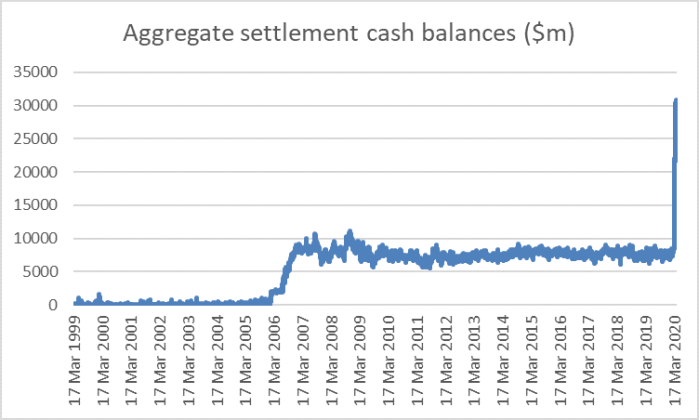
At present, the Reserve Bank has committed to buying $30 billion of government bonds on the secondary market over the year from March.   When the Bank goes into the secondary market and buys government bonds, it acquires the bonds (yielding on average a bit less than 1 per cent, judging by current secondary market yields) and it credits the proceeds of the purchase to banks’ settlement accounts at the Reserve Bank  (the Bank isn’t necessarily buying the bonds from a bank with a settlement account, but all transactions between the Reserve Bank and private sector parties eventually end up affecting settlement cash balances in total).  The Reserve Bank could choose to “sterilise” that impact –  do short-term open market operations types of transactions, to reduce settlement cash balances and increase some other bank asset/Reserve Bank liability –  but they don’t appear to be doing so at present.  There is no real need to: the Bank is paying 0.25 per cent of all settlement cash balances at present, which underpins the level of short-term rates near what the MPC is (rightly or wrongly) targeting.   Between Reserve Bank liquidity management operations to stabilise the fx forwards market (initially), bond purchases, and the heavy government deficits at present, there has been a huge increase in the level of settlement cash balances since this crisis really got going.   The Bank isn’t that good at releasing timely high frequency data, but they do release this series

sett cash apr 2020

It is no longer easy to see from the chart but there were significant increase in aggregate settlement cash balances in the 2008/09 crisis.  But the scale of those interventions is totally swamped by what we have seen in recent weeks.  In normal times, banks get by with about $7bn of settlement cash in aggregate (and the Reserve Bank actively capped demand) but the last observation was $29.725 billion.

Is this a problem?  Well, not in and of itself.    Recall that the statutory authority here, the MPC, set the OCR at 0.25 per cent.    Consistent with that, the 90 day bank bill rate was yesterday 0.35 per cent –  more or less what you’d expect if markets put little probability on the OCR changing in the period ahead.   The fact that the Reserve Bank is paying 0.25 per cent on all those $30 billion of balances means there is no obvious problem of excess supply –  the Bank’s price supports, underpins, demand.

(There is potentially relevant background in an old post on some of these issues in a US post-crisis and New Zealand context.)

Are the bond purchases on the secondary market lowering the interest rate the government is paying on its newly-issued debt?  Well, of course.  That probably isn’t the main intention of the purchases –  asset purchases might well have been appropriate even if the government had no new debt to issue –  but it is a clear and well-understood implication.  In fact, the Reserve Bank’s announced and actual purchases –  and the possibility/probability of an increase in the purchase programme at the MPS next month –  will make the Bank by far the dominant player in the market for government securities over the period ahead.  The Bank is, to all intents and purposes. “setting” –  or hugely influencing – the government’s borrowing costs.    It is, of course, doing much the same –  albeit a little less directly – across the economy as a whole.

Note that I said that one of the influences on settlement cash balances will have been the government’s cash deficit over the last couple of months –  taxes will be down, $10 billlion of wage subsidies has been paid, and on the other hand some new bonds will have been issued.    The government typically operates with credit balances at the Reserve Bank (the Bank and the government are not very transparent, but as at 30 June last year government deposits at the Reserve Bank were $6.2 billion) but it does not need to, at least if the Bank agrees.

Unlike many central bank laws that were overhauled in the last few decades, the Reserve Bank of New Zealand Act was deliberately written in a way that did not prohibit direct lending from the Bank to the government.  Instead, the ability to lend –  whether by overdraft or by purchase of government bonds –  was made a matter for the Governor.  And the Governor’s binding constraint was that he had an inflation target to pursue, and could lose his job if he was not adequately pursuing that target.    The target itself could, of course, be changed, but that had to be done transparently by the Minister of Finance.  And the Minister of Finance has not been able to direct the Bank to lend to the Crown, let alone set the interest rate on any such advances.     The logic of this model was that Reserve Bank credit to the Crown was not a threat or a macro risk so long as the Bank had the inflation target and unfettered ability to adjust monetary policy to counter inflationary risks wherever they arose from.   The Bank could agree to lend to the government at (in ye olden days, as Social Credit used to advocate) 1 per cent, so long as it could, say, impose an interest rate of 10 per cent on the rest of us.  It might be inefficient –  and this was mostly hypothetical –  but the point of the Reserve Bank Act was mostly to sustain low stable inflation, and voluntary lending to the Crown on terms agreed by the Bank did not threaten that.

The extremes were hypothetical, but the moderate practice was not.    We used to have a standing agreement with The Treasury as to the rates the Crown would be paid on its deposits and the rate it would be charged on any overdrafts it had from the Bank.  And overdrafts were simply not that uncommon –  nor was there anything obviously wrong with them, given the seasonal patterns in government finances.  The terms used to be set out in an Agency Agreement between the Bank and The Treasury’s Debt Management Office. I’m not sure how things work these days. but there was nothing wrong or threatening about the arrangements.

What is more, the Reserve Bank has significant holdings of government bonds in normal times.  These are normally thought of, although not mechanically so, as the counterpart to the Reserve Bank’s note issue liabilities and historically represented the Bank’s main form of income.  The Bank typically does not –  or at least did not, and I have no reason to suppose things have changed –  go to the secondary market to purchase the bonds.  Rather they had an arrangement with The Treasury to pick up tranches of bonds directly at new issue, at the same weighted average yield private auction participants pay.    In normal times, this is a direct addition to settlement cash balances –  the Crown gets some money it can spend without borrowing it from the private sector or raising it in taxes –  but is usually offset by the Bank’s regular open market operations (which keep settlement cash balances in aggregate fairly steady in normal times –  see chart) and over time by the trend increase in, for example, currency on issue.

This is probably a bit longwinded, but it is by way of establishing the point that Reserve Bank lending to the government, whether by overdraft or direct securities purchase is not unknown or, within the overall monetary framework (target, operational independence), at all particularly problematic.

So what got people excited?   Well, the Governor touched on the possibility that instead of going into the secondary market to buy tens of billions of dollars of bonds, the Bank might at some point, and on some scale, simply buy the bonds direct from the Crown itself.

I’m not sure why they would choose to go that route –  and it didn’t have the feel of something the Bank was just about to do – but the key point of this post is that it really would make almost no difference macroeconomically if that was an approach the MPC and the Minister of Finance at some point agreed to take.

For a start, the amount of settlement cash in banks’ accounts at the Reserve Bank would not change.  Instead of private bidders buying the bonds, and paying for them by having settlement accounts at the Reserve Bank debited and the Crown account credited, only to have the Reserve Bank then buy the bonds in the secondary market, in turning crediting the same amount to banks’ settlement accounts at the Reserve Bank, the Reserve Bank would simply cut out the middleman: the Crown account would be credited and the Reserve Bank would have the bonds.  By assumption, the level of deficit spending itself wouldn’t be changed.

Recall that as the law stands, it is the Reserve Bank that has full discretion over whether it agrees to such purchases and the terms on which it does them.  The Minister of Finance cannot direct them.

So what might the objections be?  One I heard was about price discovery –  if the Bank is buying bonds directly, how will we know what the market price is?  But the objection is largely moot because every individual bidder in the bond auctions, or the secondary, is bidding conscious of the Reserve Bank behemoth that has promised to be a huge presence in the market for the next year.  The Reserve Bank is already the dominant influence on the market and that would not be changed if they were to buy direct during this extreme period –  and there would still be a secondary market operating on the sidelines.    It is really no different than if, say, the government insisted on buying huge numbers of new houses off the secondary market rather than direct from builders/developers –  if the government is the dominant purchaser, it will have a dominant influence on price either way.    In the government bond case, the relevant constraint is the inflation target.

There are old central banking mantras about the dangers of direct government finance.  And that is certainly an issue if (a) your political system is breaking down, and (b) the Minister can insist on the borrowing and set the terms (or have appointees more aligned to government interests than to macro stability).   Direct credit in Weimar Germany fed and facilitated the hyperinflation.     But that simply isn’t the world modern New Zealand finds itself in.   As I’ve already shown our institutional arrangements –  under the dreaded hardline 1989 Act –  have always allowed direct purchases and even direct overdrafts, but the critical point was (a) the control by the Bank ,and (b) the transparent inflation target.

Some of the old rhetoric popped in an otherwise quite good speech yesterday by the RBA Governor Phil Lowe.

I would like to restate that we are buying bonds in the secondary market and we are not buying bonds directly from the government. One of the underlying principles of Australia’s institutional arrangements is the separation of monetary and fiscal policy – that is, the central bank does not finance the government, instead the government finances itself in the market. This principle has served the country well and I am confident that the Australian federal, state and territory governments will continue to be able to finance themselves in the market, as they should.

As I noted, this wasn’t the way our Act was written, even though in normal times and on average across the year that separation was observed in practice (appropriately enough).

Lowe goes on to argue that

While we are not directly financing the government, our bond purchases are affecting the market price that the government pays to raise debt. Our policies are also affecting the price that the private sector pays to raise debt. In this way, our actions are affecting funding costs right across the economy as they should in the exceptional circumstances that we face. But our actions should not be confused with the Reserve Bank financing the government.

But this is really a distinction without a difference in the current climate, even more so in Australia than in New Zealand. A key aspect of the RBA policy response has been

the introduction of a target for the yield on 3-year Australian government bonds of 25 basis points, and a preparedness to buy government bonds in whatever quantities are needed to achieve that target

They have bought A$47 billion of bonds so far, have effectively pegged the three year yield, and are willing to buying whatever it takes.  The distinction between secondary and primary market activity is without any material macro significance, especially as long as these actions are under the Bank’s control.  The Australian government could issue as many bonds as they like and the RBA is committing, in effect, to pick them up at a stable yield, just on the secondary market rather than the primary market.

Could such activities become problematic?   Well, of course.

A hypothetical government might respond to an agreement to buy bonds directly by greatly increasing its deficit spending.  But that in itself does not pose a macroeconomic problem (around inflation) unless and until such spending gets to the point where new demand is outstripping the economy’s capacity to supply, or is expected to do so.    That doesn’t seem to be the presenting problem in advanced economies at present.  And were it to look like doing so you would (a) expect the MPC to alter the terms on which they were buying bonds, and (b) potentially raise the OCR.  In other words, to do their job and aim to keep inflation near the inflation target.

Which brings us back to the real issue/risk.  Inflation could become a problem a little down the track if (a) the MPC went rogue and decided to simply ignore their mandate or (b) the Minister of Finance was either complicit with the MPC  (“don’t bother about the target; there’ll be no sackings”) or simply used his entirely-legal statutory powers to change the inflation target (raise it) either temporarily or permanently.  A Minister could do that, of course.  But there is not the slightest sign of it happening, here or in the rest of the advanced world. Indeed, there have been some highly reputable overseas economists calling for inflation targets to be raised for the last decade –  precisely because of lower bound concerns at the next crisis –  and decisionmakers took precisely no notice.

More generally, the biggest challenge central banks have faced here and abroad in the last decade or so has been getting inflation up to target, and that despite huge bond purchases –  often unsterilised –  in other countries that used that tool earlier.

Which brings me to my more overarching point: the biggest risk around inflation at present, here and abroad, is deflation not an acceleration in inflation.   That isn’t just some idiosyncratic Reddell view: it is reflected in market prices from the bond markets, and in survey measures of inflation.  It is what tends to become a predominant risk when central banks can’t or won’t lower interest rates much and yet demand falls away quite sharply.  As I’ve noted in various posts –  and there will be more –  the more appropriate criticism of central banks here and abroad is that they are doing too little to stabilise the economy, support inflation expectations, and support conditions for the recovery, not too much.

(Oh, and for other related precedents, a week or two back the independent Bank of England agreed to extent its direct overdraft facility for the UK Crown.  Again, this is done by an operationally-independent central bank, still operating within the constraints of an inflation target.)

So, there you go, another post in support of the Governor.  For cleanness/appearances sake, I’d probably prefer the Bank didn’t go the direct purchases route, but the macroeconomic risks if they did so in these exceptional circumstances, are small to non-existent.  So long as the MPC remains independent and the inflation target is unchanged, and their lodestar, it is simply not macroeconomically different from what they are doing now.


The lack of any serious transparency

People can agree or disagree with the government and its official agencies on the various numerous specifics of the handling of the coronavirus, up to and including yesterday’s decisions.  But whether you, or I, agree with individual choices that have been made –  and I’m sceptical of more than a few of them – isn’t the point of this post, which is about the serious lack of transparency of official advice etc through this period of wrenching dislocation, in which lives were at risk, civil liberties shredded, the ability of people to earn their living badly disrupted, Parliament suspended and so on.   Perhaps most or even all those decisions were the right ones –  something that will probably be debated for the next 100 years, as aspects of the 1918 flu or much about the Great Depression still is-  but no one can argue they were normal, routine or inconsequential matters.   And yet the government and its agencies have revealed only what suits them, when it suits them, exposes itself to little serious scrutiny, and treats the public like children, or subjects, not citizens (I gave up reading the full page propaganda in each day’s newspaper after one particular piece of official condescension –  implying, as I recall, that I was doing the government a favour by looking after my children – got too much for me).

Once upon a time, almost 40 years ago now, a government (it and its leader still widely reviled by many) passed into law the Official Information Act.

OIA purpose

Fine words, admirable principles.

Come forward in time and less than three years ago we find a Cabinet minister in the current government –  the minister responsible for open government no less –  telling Parliament

Hon CLARE CURRAN: Thank you, Mr Speaker. My priority is that this will be the most open, most transparent Government that New Zealand has ever had. We will do this in several ways, including requiring proactive disclosure of some official information,

Of course, she didn’t last long.  And if the rhetoric lingered for a while, it never seemed to have very much substance at all.  Little, for example, has been seen of the promised overhaul of the Official Information Act, to help better align agency practice with the intent of the Act.

Even many public servants quite like proactive disclosure –  it takes less work than dealing with Official Information Act requests –  but not this government apparently, and certainly not as this crisis has unfolded.    For them, it seems as though they’ve taken the “war” rhetoric to heart and decided to act as if some enemy is listening, and never mind citizens –  whose country, whose lives, whose livelihoods, whose freedoms are being upended.   Perhaps the government acts from the best of motives, but so what?  Being human they’ll make mistakes too.  Facing an election, they’ll make partisan calls under the guise of responding to a crisis (we saw several of those in last month’s economic package).  And even if they operated flawlessly and only with the best of motives, official information is presumptively our information.  Our taxes paid for it.   And when politicians claim to be acting on advice –  which may or may not be the right thing to do, depending on the quality of the advice and the alignment of the interests/rersponsibilities of those giving the advice –  surely it is only reasonable that citizens (mostly not being children) should be able to see that advice, now when it matters,  not in a year’s time when, with luck and a favourable wind, the Ombudsman finally compels release?

As far as I can tell, we have seen not a single pro-active release by the government or any of its ministries or agencies of any analysis or advice generated with those agencies and relevant to decisionmaking, or evaluation of decisions, on responding to the coronavirus, or the economic or social effects of the virus and private or public responses to (the risk of) it.  Perhaps worst is the Ministry of Health, which appears to have a central role in advising the government, and exercising some powers itself: they have belatedly released some (questionable) Otago University modelling, and belatedly released the Verrall report on contact tracing, but we have seen not a word of their advice or analysis, or of any frameworks they are using to shape their advice.

It is no better on the economic side.   On the purely economic response side, the Reserve Bank and its Monetary Policy Committee has appeared consistently complacent and slow to react, then lurching into the extraordinary commitment not to cut the OCR further no matter how bad the economic and inflation situation gets.  But none of their supporting analysis or advice, for far-reaching unconventional interventions (and not), has seen the light of day –  and, despite the Official Information Act, is unlikely ever to do so, successive Ombudsmen having proved extraordinarily deferential to the Bank.

On The Treasury side, pro-active release of papers relating to the annual Budget has long been a very positive feature.  But we’ve seen nothing at all of the analysis and advice that contributed to the large economic package –  some coronavirus related, some just electioneering –  announced a month ago, or any of the interventions since.   And, of course, we have seen not a hint of any advice or analysis provided to the government or the Ministry of Health in advance of either the inital partial lockdown decision or the latest extension of restrictions announced yesterday.    Is there even a hint of any sort of serious cost-benefit analysis in The Treasury’s approach/advice?  Are they even seriously near the top table at all?  We simply don’t know.   Even the economic scenarios paper released last week –  useful in its way – masked as much as it revealed, because most of the underlying analysis –  eg just how large are the economic losses at each of the government’s “levels” –  is hidden.

And, of course, we have seen precisely none of the Cabinet papers –  of which there must be very many, large and small, relevant to decisionmaking around the crisis over the last three months.  The Epidemic Preparedness Act can only be invoked on the advice of the Director-General of Health, but we’ve not seen the substance of his advice or recommendation.  We are told that yesterday Cabinet acted in accordance with the advice/recommendation of the Director-General, but we’ve seen no sign of that either –  including, thus, no ability to assess the Director-General’s advice on aspects that he (and his agency) know precisely nothing about –  not just the economic dimensions of choices, but those around liberty, rights, civil society and so on. It would be good some day to see, for example, the advice that led the government to acquiesce in the barbarism of banning funerals –  and, recall, they are still banned until next week.  At present, instead, we have nothing.

Now, no doubt in time at least some of this material will emerge, whether in response –  typically very slow response –  to Official Information Act requests, or perhaps to the Royal Commission which a growing number of people have called for but which calls the government continues to ignore (it might be a little easier to cut them some slack now if there were a serious commitment to open and transparent ex post accountability).  But generally openness and transparency –  perhaps taken to the limit, deluging people with material – is a good way to win trust and confidence.  Unless, that is, the processes are so chaotic, and the analysis/advice so flimsy and insubstantial, that actually confidence might be eroded. But if things are really that bad –  and just on what we know it wouldn’t surprise me at all if much of it is –  surely citizens, whose lives, health, livelihoods, and freedom are at stake –  have a fundamental right to know.

Instead, all we are left with is a “trust us, we know what we are doing” approach, accompanied by communications that treat us as children not citizens.

Perhaps some of you have some great confidence in one or more of the sets of individuals, or institutions, involved.  I can only say that I wish I shared your confidence.

At a political level –  the people we elect, the only people we can toss out –  we must be the only country in the world where the Minister of Health is banished and invisible amid a major public health event.      Before he went invisible he was pretty consistently upbeat and complacent –  nothing to suggest he saw the most stringent lockdown in the western world on the horizon (that lockdown is, after all, a sign of relative failure not of success).  That Minister was appointed, and left in place, by the Prime Minister –  the same one who promised that last year was going to be her government’s “Year of Delivery”, which didn’t quite eventuate.  The Minister of Finance seems to be competent enough within established bounds, but there is no sign of any developed framework for thinking about the economic issues and challenges from him either.

Then, of course, there is the Ministry of Health.  Everyone in Wellington recognised how degraded its capability had become under the previous Director-General.  And while it remains all the thing in some circles to praise the current Director-General, it isn’t really quite clear why.   Wasn’t there a measles epidemic going on just a few months ago (although in coronavirus-time it is easy to lose track of the months)?  As I noted on Twitter yesterday, I went back and looked at the most recent Ministry of Health Annual Report and the Ministry’s output plan, and found no substantive references to epidemic/pandemic issues at all, but a lot of right-on Wellington public service rhetoric.  It isn’t as if there have been no pandemic threats this century, and if the Ministry of Health isn’t keeping these issues/risks front of consciousness, including public/political consciousness, they aren’t really doing their job.

What about after the coronavirus itself became an issue?  As I’ve noted in earlier posts, there is little practical sign of much urgency about their approach, or their advice.  We can see this, for example, in how other government agencies (including the RB) did or didn’t respond.  We can also see it in how the Director-General was talking in public, including constantly playing down the risks of asymptomatic infections. We can see it in the Ministry’s official Twitter feed: as late as 29 February it was still telling us there was more of a threat from fear, rumours, and stigma than from the virus itself, and as late as mid-March was still sounding quite unconcerned about major events (no doubt a bit constrained by the Prime Minister’s indifference).

So perhaps the Ministry of Health has had everything just right for the last month or more – although the Verrall report didn’t suggest so –  but even if that were true, and it frankly seems unlikely (where was this excellent capability – including, for example, in integrating economic and health perspectives – going to spring from?) we shouldn’t simply have to take their word for it.  It is one of those principles of open government.

I could go on.    Thanks to Peter Hughes, the State Services Commissioner, in whom few in Wellington (his acolytes apart) seem to have much confidence, we have a new Secretary to the Treasury with no past experience whatever in national policymaking, in charge of an institution that under its previous head had become more interested in, and recruiting for, luxury fluff around “living standards frameworks”, “wellbeing budgets etc” than around hard analysis, including the contigency planning for really severe adverse events.  Perhaps the agency has been offering consistently superlative advice through this crisis, but it would be a surprise –  whether given the starting disadvantages, or the evidence of complacency seen in the Secretary’s involvement in Reserve Bank decisionmaking. But again, it would not  natually be the assumption I’d make.  And we should’t have to assume, we should have timely access to relevant advice and analysis.

And then, of course, there is the Reserve Bank.  They talk a little more than most agencies, but unfortunately little of it is reassuring in this context.   There was the public minimisation of the issue as late as late February –  when they were still expecting an upturn this year – the sluggish monetary policy response, the inexplicable pledge not to cut the OCR further no matter how bad things get, the misrepresentations to Parliament about the scale of what they have been doing, the public flip-flops over just a few weeks on negative interest rates, and so on.  All this from a Governor who had previously seemed much more interested in climate change and infrastructure than in doing his job, and who spent last year telling us how much more capital our banks needed to just be up with international peers, and now tries to tell us (more correctly in my view) that without any increases we have one of safer banking systems in the world.  Oh, and then there was that strange strange Stuff op-ed in which Orr sought to present the coronavirus economic shock as something akin to a summer shower of rain, from which the economy would emerge refreshed and vibrant.    Based on what we see, there is little reason to have any particular trust in the analysis and advice they will fight hard to ensure we will never see.

There simply is no class of superb mandarins, to whom we might prudently and confidently defer. The systematic degrading of the public service has seen to that.  Even if there were such people, they need to be open and accountable.  Even if there were such people, their values –  inevitably statist in nature –  aren’t the only ones.  But if there are any such superb mandarins at all, it isn’t obvious where in the relevant bits of the public sector they are hiding.

It isn’t really clear what the government thinks it has to gain by the secrecy.  Perhaps things really are worse than even sceptics assume.  Perhaps the Prime Minister is allowing herself to be led by the nose by officials who are routinely averse to scrutiny and transparency, and really do think the public –  citizens, voters –  really are just best kept in the dark, treated as children –  while the adults sort things out.    Whatever the explanation, there is no adequate justification.  And responsibility for the failure –  the secrecy, the obstruction –  rests totally with the Prime Minister.  If she wanted an open and transparent government – amid a wrenching crisis with no real precedent –  she could have it tomorrow.  By her (in)actions, she reveals her preferences.

How large a GDP loss under “Level 4”?

I’ve mentioned in posts over the last few days The Treasury’s estimate that the current “Level 4” restrictions will have reduced GDP by about 40 per cent relative to normal levels and the Reserve Bank’s estimate of a 35 per cent reduction.    Both estimates seem a lot more realistic than some of the private sector estimates that were still doing the rounds early in the week.  But I still reckon the Reserve Bank estimate, in particular, is almost certainly too low –  especially if we are concerned, as we should be, with the “true” reduction in the volume of economic activity, not with what SNZ may initially report (accurate measurement is going to be a challenge).

What makes me sceptical?  Well, there is the fact that our partial lockdown seems to be more restrictive, particularly (but not exclusively) on economic dimensions, than those in many other countries.  Thus ANZ yesterday ran this chart of some Oxford index of restrictiveness.

oxford response

Some weeks ago, the French national statistical agency published its estimate that the French economy was then running 35 per cent below normal levels.   Overnight, I noticed the Governor of the Bank of England endorsing the UK Office of Budget Responsibility’s view that UK output had fallen 35 per cent since their lockdown began – and not only will activity levels already have been weakening prior to that but, as the chart illustrates, the UK lockdown is less severe than New Zealand’s.

I also listened again to the Reserve Bank testimony to the select committee on Thursday and noticed that Assistant Governor refer to OECD estimates of a 30 per cent reduction as some sort of baseline estimate for New Zealand, but as I noted in a post here on those estimates they were done (a) for direct effects only, and (b) for a constant (across countries) set of assumptions about lockdowns, just distinguishing between countries by their initial economic structures.  In an initial lockdown period, indirect effects may not matter much, but different degrees of lockdown intensity certainly do.  As just one example, many countries have not prohibited construction work, but New Zealand (mostly) did, and construction alone is perhaps 8 per cent of New Zealand’s GDP.

I was also interested to see this footnote in the Treasury scenarios paper the other day

“MBIE estimates that the essential workforce numbers around 640000, with 510000 of those not able to work from home, while the number of non-essential workers that are unable to work from home is around 1.1 million people, or 49% of the workforce”

I’m not quite sure where they get those numbers from – according to the HLFS, for example, there were 2.648 million people “employed in the labour force” (which includes employers and the self-employed in December) –  but presumably there is some good basis for their estimates.  If they happen to be right that 49 per cent of the workforce is both non-essential and can’t work from home, that alone should produce a very substantial reduction in GDP –  even if less than half if we assume (as I do) that the people unable to work from home are in jobs that are, on average, lower productivity.  Even if the 1.1 million people unable to work from home is really over a denominator of 2.648 million, that is still 42 per cent of the workforce.

But even of those who are left –  able to work from home, or working on site as “essential” –   what do we suppose the average productivity level is like?  It is most unlikely to be normal levels.  And some of those essential services are being very lightly utilised at present –  think of hospitals.  I don’t suppose, for example, that immigration call centres are very busy.

In his presentation to the select committee, the Reserve Bank’s Assistant Governor ran through some sector-by-sector numbers to support his 35 per cent estimates.    The numbers he cited (no sources provided, but perhaps MBIE as well?) were:

Food and accommodation:  16 per cent of normal

Construction:                          25 per cent of normal

Manufacturing:                      60 per cent of normal

Primary:                                   76 per cent of normal

Government:                            80 per cent of normal

That seemed to satisfy Simon Bridges, chair of the committee, who responded “oh, so 30 per cent of the economy at 80 per cent?” and Hawkesby offered no dissent.

However, even though in normal times government revenue and expenditure are equal to about 30 per cent of GDP, the share of government activity (employment, production, purchases etc) is much smaller than that (lots of the rests is just transfers: welfare benefits etc).   The last detailed national accounts I could see on the SNZ website were for the year to March 2018 and in that year government as a whole accounted for only 16.8 per cent of GDP –  3.2 percentage points of that local government.

And even if there are significant chunks of government that are at least as busy as ever (Police, Ministry of Health, Treasury) there will be lots that just aren’t working at all (no work to do, no working from home capability, Level 4 prohibitions or whatever).  Just at a local government level, are libraries open, streets being swept, public gardens maintained, pools open? No, of course not.  Of those who are working, most will be working at less than normal productivity/levels of output (whether because working from home generally isn’t as suitable, distractions of children at home, or whatever).

I was also a bit surprised by the Bank’s assumptions around construction –  sure urgent repairs etc can be done, but at the peak of a building boom, can that have been anything like 25 per cent of the sector? –  and manufacturing, even allowing for the importance primary food processing plays in New Zealand manufacturing (building supplies, including cement, is also a large chunk of New Zealand manufacturing).

I went through the detailed (50+ sub-sectors) national accounts data and did some rough estimates myself.   There are clearly some sectors where there is no reduction in output at all (eg the imputed rent on owner-occupied housing, and actual volumes for public and private rents, and –  most probably –  agricultural production).  There are others where activity will have dried up almost entirely.  There is also quite a bit of uncertainty over all the numbers, but my bottom line was something between 40 and 45 per cent less GDP than normal under “Level 4” conditions.  That is a bit less than I had previously thought, and not that out of line Treasury’s estimates, but still rather higher than the Reserve Bank’s numbers.

There is no real certainty about any of it, but these numbers aren’t just of some obscure academic or historical interest.   Recall that a month’s GDP is roughly equal to $26 billion.   If we allow –  as Treasury does –  that even under “Level 1” there is a 7.5 per cent output loss, and that under Level 4 a 42.5 per cent output loss, that is a $9 billion loss (very little of which will ever be made back) for each month.     That overstates a bit, since the realistic choice at present seems to be between something very restrictive indeed, and some like “Level 2”, which will still have –  on both Treasury and Bank estimates –  incremental output losses.   And whatever governments mandate, there would still be activities citizens simply choose not to do.   But whichever way you cut it, these are still very big numbers that need to be factored in when the Cabinet makes decisions.

One day, when the Official Information Act finally forces the papers out of “the most open and transparent government ever”, we may finally see how their official advisers have attempted to do the sort of cost-benefit analysis that should have been being done at each stage of the process.


Making it up

And by that title, I don’t mean to imply the semi-positive tone associated –  in a crisis –  with “making it up as they go along”, but just making it up: things that fundamentally are not so, and telling Parliament’s select committee those things.

The Governor of the Reserve Bank and two of his deputies turned up yesterday to Parliament’s Epidemic Response Committee.    There were things I was pleased to hear (including that the numbers in next MPS are likely to be primarily in the form of scenarios, rather than central views) and things I fairly strongly agreed with.

Among the latter there were obvious points such as that monetary policy can’t prevent or offset the current economic losses (many of which are discretionary policy choices anyway) but it can act to soften the blow.  And there were important points including that the financial soundness of our banks is not in any sort of immediate jeopardy and that it would take several years of unemployment well into double digits, and substantial sustained falls in asset prices, for that outlook to change (although that assumes banks aren’t pressured to take on too much more low quality new debt now).  I welcomed the observation that the IMF’s view on the economic situation is probably too rosy (but then that is almost always so in downturns).   I was sympathetic to the Governor’s view that, after any immediate rebounds in activity, a full recovery –  here and abroad – is likely to be a long and slow process, where domestic demand globally will tend to pretty subdued (I thought I heard the Governor suggest that the recovery might be even more sluggish than after the last recession –  if so, that is really bleak given that, as I noted the other day, it took five years for New Zealand’s unemployment rate then to drop by a mere two percentage points.  And I welcomed the Governor’s mention that this shock is/was a significant deflationary risk.

(There, probably more things than you’ve ever previously heard me agreeing with the Governor on in a single paragraph.)

Of course, any decent analyst could easily say many of the same things. But we don’t primarily hire Orr and his offsiders as analysts but as policymakers (and policy advisers).    And on that count, their lines yesterday came up a long way short.

Thus, when Orr began by talking about monetary policy being an “important support player” in the overall economic response, he attempted to illustrate the point by claiming that they had taken steps that ensured that “interest rates are as low as they can possibly go” and that “the exchange rate was low and competitive”.

At least some of this claim was not allowed to go unchallenged.  In particular, National’s finance spokesperson Paul Goldsmith asked the Governor about negative interest rates, including noting that even if the OCR was near zero, most retail interest rates were still materially positive.  He also asked about the pledge the MPC had made not to cut the OCR any further, referencing the Bank’s claim that “some banks” did not have systems that could cope with negative interest rates, and asking – for example –  when the Bank first became aware of this (mentioning that the Bank had repeatedly over the last couple of years talked about the possibility of negative rates).  If I say so myself, they were good questions.  Shame about the answers then.

First, the Governor claimed that they had not ruled out negative interest rates.  Of course, his own press release said they had been ruled out for at least a year –  and probably most of us would hope that the worst of this economic crisis will have passed in a year’s time.  Oh no, he said, they hadn’t ruled out negative interest rates, they had just decided to use large-scale asset purchases (government bonds) first, not having wanted to bother the banks when they were very very busy on other matters.  (Note that he never actually answered Goldsmith’s question about when the Bank first learned of the systems issues, let alone how widespread they actually are.)  Moreover, claimed the Governor, the asset purchase programme had achieved the same effective level of easing as OCR cuts might have, and that interest rates were “down significantly across the board”.    He claimed that a “shadow short rate” –  of the sort developed by their former researcher Leo Krippner and discussed in a post here –  was already “significantly negative”.   (On which note, he stated that the Bank will have a “range of new indicators” to illustrate this in next month’s MPS – which is welcome.)

It is fair to say that Paul Goldsmith did not seem persuaded by the Governor’s grand claims about the asset purchases programme was doing all that needed to be done.  He pointed out to the Governor that in typical New Zealand recessions (well, US and other ones too) short-term rates had typically fallen by perhaps 500 basis points or more (575 basis points in 2008/09) and that, on the face of it, what we’d seen so far this time was nothing remotely comparable to that.

The Governor, as is he way, pushed back boldly, claiming that he reckoned the measures they had taken to date were the equivalent of “half to two-thirds of that”.   Roughly speaking, he seemed to be claiming that what they had done to date was the equivalent of a 300 basis point cut in the OCR.   His offsider Hawkesby is a bit less given to overreach, but he claimed that “international research” suggested that an asset purchase programme of the size the Bank had announced was equivalent to 150 basis points of OCR cuts.  Even if so, that would be a total of 225 basis points……in the face of a much bigger slump, and negative output gap, than in any of the previous downturns (the 500 basis points numbers came from).

The Governor was getting a bit defensive at this point, and tried to claim that “negative rates aren’t off the table”, but fortunately wasn’t allowed to get away with that claim as one of the MPs pointed out that they had, in fact, explicitly ruled it out for a year.  In fairness, I suppose the MPC could change its mind.

(Having given credit to Goldsmith for this line of questioning, I should note that a little later a government MP –  a peripheral member of the Executive no less –  Fletcher Tabuteau also weighed in suggesting that actual negative interest rates would be much better for business right now.)

I think there is little doubt that the Reserve Bank’s large-scale asset purchase programme –  which, mostly, I support –  has acted to bring government bond yields back down again (and with them some other interest rates).  In that sense, there is probably quite a large effect in those markets.  But what that has done is to reverse a tightening in monetary conditions that got underway as assets were being liquidated globally; it is not any sort of easing relative to where conditions stood three months or so ago.

The best way to look at actual monetary conditions facing firms and households is to look at the financial prices they are actually facing.  At a retail level, the Bank publishes two monthly series that are readily updatable with public information: a six month term deposit rate and a floating first mortgage rate.

In December, before anyone in New Zealand had even heard of the new coronavirus, those interest rates were 2.63 and 5.26 per cent respectively.  As of this morning, using the data on current rates on interest.co.nz, the big banks are offering between 2.3 and 2.45 per cent for six month terms deposits (shall we call it 2.38 per cent), and offering between 4.44 and 4.59 per cent for floating rate mortgage (call it 4.5 per cent).   In nominal terms these deposit rates have come down by 0.25 percentage points and 0.75 percentage points.  It is harder to replicate the Bank’s “SME new overdraft rate”, but by March it had come down by 0.59 percentage points.

Here, by way of comparison, is how much those three series fell from December 2007 to April 2009:

Six month term deposit rate:     -4.6 percentage points

Floating first mortgage rate:      -4.1 percentage points

SME new overdraft rate:             -2.4 percentage points

So nominal lending rates have come down to some extent.  Unfortunately, but fairly predictably, so have inflation expectations.  I often highlight the implied expectations from the government bond market, and they are now about 40 basis points lower than they were at the end of last year.  The Reserve Bank tries to avoid engaging with that series, but here is the ANZ Business Outlook survey of year-ahead inflation expectations

ANZBO infl expecs

and they are also down about 40 points since late last year.

In other words, real retail interest rates have barely changed –  those on term deposits are actually up a little, and those for loans down a little (and there have been indications that bank wholesale funding has got more expensive –  consistent with term deposit rates holding up –  suggesting banks may now be regretting passing through the full OCR cut to floating mortgage rates.

These are simply tiny effects/adjustments really to the scale of the economic slump, and the scale of the recovery challenge –  shortfalls of demand –  the Governor rightly talked about.

Or here is the secondary market yield for the last year for the government inflation-indexed bond maturing in September 2025.

IIB sept 2025

You can see the impact of the bond purchase announcement (even though that programme does not yet directly encompass indexed bonds), but the current yields are still well within the range this bond traded in over the six months from, say, August to February. Big falls back last year, but really rather tiny changes now –  in face of the biggest economic slump on record.

What about a wider range of interest rates?

Basis point change since 31 Dec
90 day bank bill -87
1 yr govt bond -85
5 yr govt bond -78
10 yr govt bond -65
1 yr interest rate swap -85
2 yr swap -85
5 yr swap -87
10 yr swap -81
15 yr swap -80

Pretty consistent across the board, but nothing like the 300 points of total easing the Governor was suggesting or the 225 points of easing Hawkesby was suggesting.  In fact, it looks a lot like what might expect if the OCR had been cut by 75 basis points and people expected it would remain low for a very long time.

By contrast, for example, 10 year government bond rates fell almost 200 basis points over the 2008/09 recession –  at a time when belief in a fairly quick snap back was still common – 5 year government bond rates fell by about 320 basis points, and 90 day bank bill rates……well, they fell by about 550 basis points.

And that episode, bad as it was, was mild by comparison to what we are confronting now.

So where is this great easing that the Governor and his offsiders tried to persuade the Committee of?  Well, as noted above, the Governor mentioned the exchange rate.  It has certainly come down, but here is a chart of the TWI for the last 20 years or so, with the last observation being yesterday’s reading on the TWI.

twi corona

The scale of the fall in the exchange rate in recent months doesn’t begin to compare with (a) the slippage in 2015, (b) the fall in early 2006, or (c) the fall to the lows in 99/00 –  each rather minor economic slowdowns in New Zealand –  let alone with the fall during the last real recession in 2008/09.    Now, sure, commodity prices are holding up for now. On the other hand, one of our major export earners has just gone to zero, and another –  export education –  is looking quite severely impaired.

The Governor is just making stuff up.  The measures the Bank has taken have led to some slight easing in monetary conditions –  real interest rates down just a little, the exchange rate down a bit too – and, importantly, have successfully prevented a temporary sharp rise in longer-term interest rates.    But there is just no way that the cumulative effect of all that has given us monetary conditions much easier than they were three months ago –  when market thoughts (and RB ones) were beginning to contemplate the next tightening.  And they’ve produced nothing like the extent of effective easing that is customary in New Zealand recessions, all of which previous ones have been materially milder than we are experiencing now.

Does it matter?  Absolutely it does. Not only should powerful government officials not be trying to spin in front of MPs, but this stuff has real consequences.  As I noted, I agree with the Governor that (a) this shock is seriously deflationary in nature, and (b) that the full recovery is likely to be slow and difficult, with demand hard to find.    But part of the reason why the full recovery is likely to be so sluggish is because central banks –  having stopped the tightening –  are now sitting on their hands doing nothing, when historically monetary policy has played a key role in bringing forward demand, and assisting the process of getting back to full employment.  In the good old days –  just a few weeks ago really –  it used to be a theme of the Governor’s, championing his spin on the new statutory mandate.

In their remarks yesterday, Bank officials indicated that their view of the relevant economic scenarios were pretty consistent with those The Treasury had published earlier this week.   But as I noted in my post on them, those scenarios have very weak inflation outcomes – and, typically, lingering excess capacity.  The Governor (rightly) confirmed yesterday that monetary policy is focused on keeping inflation moderately positive, consistent with the target (centred on 2 per cent).   But the scenarios were inconsistent with that target, and they assumed that nothing more was coming from monetary policy.  Nothing the Governor said yesterday suggested the Bank takes a different view.  The risk then is that inflation expectations continue to fall, real interest rates tend to rise, and it becomes harder and harder to engineer anything like a timely return to full employment.  That should really worry policymakers, especially the Minister of Finance who is responsible for the Bank.

I’ve highlighted previously the disconcerting parallels with monetary policy in the Great Depression.  When the Depression first hit, it wasn’t as if central bankers did nothing.  In  fact, in the US notably monetary policy was eased, within the limits of the technology and institutions as they were seen at the time.  In New Zealand –  then without a central bank – the exchange rate was allowed to depreciate a bit.  But the problem was that it took years for governments and central banks to get to the point of recognising that the needed to break the “golden fetters” (the title of Eichengreen’s classic book) and allow a much more expansionary monetary policy.  The countries that did so first –  the UK notably –  had the least bad experiences and recovered soonest.  In New Zealand it took more than three years –  and the resignation of the Minister of Finance –  before the government finally substantially devalued. It took a similar length of time before the US devalued against gold, and in the process give a decisive start to lifting the restarting demand and lifting the price level.

As the Governor noted yesterday, the Reserve Bank here is doing much the same as its peers abroad. That isn’t quite true, since several of them already have moderately negative policy rates (and negative government bond yield curves) but for these purposes it is true enough.  None of them has been willing to break the entirely self-imposed paper chains that prevent interest rates being taken deeply negative.  Unless and until they do, recovery is likely to be quite muted at best, and the risks of the advanced world becoming locked into even lower inflation will rise by the month.   Conventional wisdoms can be hard to break, but in the right crisis doing so really can make all the difference.  (Recall, here, that interest rates are simply the price the reconcilies desired savings and desired investment: desired investment having collapsed for now, and desired private savings almost certainly having risen, a negative real interest rate facing firms and households looks like a natural and inevitable balancing price in the current context –  once immediate lockdowns are past we don’t want macro policy encouraging savings for the next few years, and we do want every signal to encourage firms to consider new investments.  Hand in hand with whatever government fiscal policy can do  –  which will be limited – it is how economies get back to full employment as soon as possible.

Incidentally, in the course of yesterdays’s presentation the Bank gave its estimates of how much the GDP losses might be (relative to normal) for each level in the government’s four alert level framework.  The Treasury published their estimates earlier in the week.

Loss of GDP (%) while restrictions in place
Treasury Reserve Bank
Level 4 40% 35%
Level 3 25% 20-25%
Level 2 10-15% 10%
Level 1 5-10% 5%

The numbers are similar, although the Bank seems to be a bit more optimistic (wrongly so, in my view).

The table is probably outdated now since the new “Level 3” outlined yesterday is more akin to “Level 4-“.  But what really interested me was the gap between the Level 4 and Level 1 estimates, which are really the difference between the situation if all domestic controls now in place were removed in full, but the borders remain closed.    On these numbers, even if we went to what they are calling “level 2” now and had those sort of controls in place for the rest of this year, we’d be giving up perhaps 6 per cent of GDP  (30 per cent loss for the level 4 month, or 2.5 per cent of a year’s output, and a 5 per cent loss for the remaining eight months or 3.3 per cent of a year’s output.    In the New Zealand Initiative’s paper last week, using the Otago modelling framework, they suggested 6.1 per cent of GDP might be a price worth paying to save 33000 lives.  Ian Harrison’s paper yesterday (and John Gibson’s as well) raised serious questions about the number of lives that could have been saved only by these level restrictions.  Personally, I think all the numbers in the table above are insufficiently negative, and perhaps the slope –  from level 1 to level 4 –  is insufficiently steeep. But it is the numbers in the table that are those the government’s chief economic advisers appear to be using.


Coronavirus economics and policy: from the mailbox

But first an update of the chart showing numbers of new announced coronavirus cases for New Zealand and Australia (the latter divided by five to produce a comparable per capita number).

new cases 15 apr

A few days on from the last time I ran the chart and New Zealand is still finding about twice as many new cases per capita as Australia.  At the margin, we seem to do be doing a few more tests per capita each day than Australia is –  in both countries the number of tests being done has fallen back from the peak.  But despite our more restrictive regime, we don’t seem to be producing better (lower new cases) results than Australia.    Who knows why, although those left-wing academics from Otago, professors Baker and Wilson, while lavishing praise on the Prime Minister in the Guardian

One critical success factor that is, unfortunately, harder to guarantee is high-quality political leadership. The brilliant, decisive and humane leadership of Ardern…

went on to note to Stuff yesterday that in their view the case for a tougher lockdown in New Zealand than in Australia rested on the fact that

“New Zealand has had to go to this strong, intense, lockdown, because it started from a pretty low base.

“It didn’t have really sophisticated systems for mass contact tracing…Things like basic contract tracing were working better in Australia from earlier on.”

Wasn’t Ardern Prime Minister for more than two years prior to this, including the two months apparently wasted prior to the lockdown? Wasn’t David Clark Health Minister?  In fact, wasn’t Ashley Bloomfield Director-General of Health for most of that time?

But my heading suggested this post was about things that had turned up in my mailbox.

First was a useful short note from the trans-Tasman economics consultancy Castalia on the respective experiences and approaches of New Zealand and Australia.  I found the summary table of the regulatory restrictions particularly helpful.

Second, and following on from my post on Monday about the New Zealand Initiative’s short attempt to think about some sort of cost-benefit approach to assessing interventions, I had an email from one of New Zealand’s leading academic economists, Professor John Gibson from Waikato.  I’ve never met Professor Gibson –  although it turns out we both spent time in Papua New Guinea early in our careers –  but he kindly sent me a note he’d done looking at similar issues through a slightly different lens.  Gibson’s paper is not available online, but he has given me permission to quote from it.

His note opens this way

The approach taken in New Zealand to dealing with Covid-19 may result in unnecessary loss of life. The outbreak of a hitherto unknown disease poses an important new risk to humans, so it is appropriate to devote resources to mitigating this risk. These risk mitigating resources mean some output is foregone. In other words, our lives are going to be somewhat more risky and people will be somewhat poorer, than would have been the case without this new disease.  A key question for public policy is where to strike the balance between reduced risk and foregone economic output.

Gibson doesn’t pull his punches in places

There are at least two grounds for concern about the New Zealand strategy. First, the people making decisions are the same ones who botched the preparation for the arrival of Covid-19 and so there is little reason to have faith in the wisdom of their choices. I say “botched” advisedly and would ask readers to consider the following four facts:

  • Taiwan recorded their first case of Covid-19 on 21 January, a full month before New Zealand’s first case
  • Taiwan usually has about three million visitors a year from China, while New Zealand gets about 400,000. The gap is even bigger in terms of visitors to China (who posed a risk of spreading the disease upon their return)
  • Taiwan has not had a lock-down
  • Yet despite earlier exposure and much greater risk due to more travel to and from China, Taiwan has just 373 cases (16 per million) of Covid-19 while the rate in New Zealand is currently 17 times higher (266 cases per million)

Similar comparisons could be made with respect to Hong Kong or South Korea, who also provided lessons on management of this new risk. The complacency by politicians and bureaucrats in New Zealand, who had the advantage of an extra month for preparation and much greater distance from China, is staggering. Obviously that chance to respond to the risk in a low-cost manner was missed and so a very costly lockdown has resulted. While we can hope for better decision-making going forward, there is little reason to be confident of this.

He goes on to lament the lack of an informed open public discussion

In that regard, it is mainly the BIG SCARY NUMBER approach to political decision-making that has been evident, rather than a careful discussion about trade-offs. When announcing the lockdown, the Prime Minister claimed that if strong action was not taken against the spread of the SARS‑CoV-2 virus, New Zealand’s health system would be overwhelmed and tens of thousands would die:

“If community transmission takes off in New Zealand the number of cases will double every five days. If that happens unchecked, our health system will be inundated, and tens of thousands of New Zealanders will die”[1]

There is very little critical scrutiny of this claim, which seems to be based on modelling done by public health academics at the University of Otago. No empirical data from New Zealand on key parameters informed this modelling, which used an off-the-shelf European model (http://covidsim.eu). It is unknown whether the spread of the virus in a low-density, younger population like New Zealand is the same as in high density, public transport-reliant Northern Hemisphere populations, that are older, and have worse respiratory health to start with.[2] At best, these models are informed projections. It is also the case that across the six scenarios modelled by the Otago academics, the average number of forecast deaths was just over 8000 (mean 8,300, median 8,600).[3] So Prime Ministerial claims that “tens of thousands will die” are vague at best and alarmist at worst.

Moreover, the projections have not been presented in a way that empowers people to make considered judgements. We are shown big numbers of projected deaths, with no context to interpret them. Deaths are bad, more deaths are worse, so it feeds into the narrative that there is no alternative to the approach taken. This approach to public policy tends to disempower people who are not privy to the epidemiological models.

Of course this is unwarranted, as ordinary people make decisions about trade-offs all the time and typically use careful judgement when doing so.

[1] https://www.stuff.co.nz/national/health/coronavirus/120501534/coronavirus-jacinda-ardern-just-made-the-most-consequential-decision-of-her-career-putting-nz-on-house-arrest

[2] There is also a more subtle criticism of the “If that happens unchecked…” phrasing by the Prime Minister. This implies no change in behaviour but we know from the Lucas Critique that when circumstances change, people change their behaviour, so forecasts that are not based on “deep” or “structural” parameters provide poor predictions. The virus reproduction rate is unlikely to be a deep parameter, which is why careful treatments distinguish between R0 – the reproduction number in the absence of behavioural change or immunity, and R‑effective (see https://fivethirtyeight.com/features/coronavirus-case-counts-are-meaningless/). So a forecast that assumes no behavioural change by people seeing an epidemic unfolding is not a plausible counterfactual.

[3] https://www.health.govt.nz/system/files/documents/publications/report_for_moh_-_covid-19_pandemic_nz_final.pdf

It is perhaps worth noting here that Professors Baker and Wilson are among the academics with their names on that modelling.

And here I would interject to note that whatever modelling the government may have solicited or received unsolicited, so far we have none of the official advice (from the Ministry of Health, from Treasury) on what officials made of the modelling, how they assessed risks, costs etc.   As I’ve noted before it is our country, our lives, not those of a few Cabinet minister and officials: transparency of key documents should have been an integral part of any sort of serious confidence-building approach.

Gibson’s own contribution is to attempt to recast things in terms of the potential impact on life expectancy

One contribution I want to make with this essay is to show that it is entirely possible to recast these projections of forecast Covid-19 deaths in terms of reductions in life expectancy, and there are four advantages of doing so:

  • Life expectancy is intuitive to most people, as a measure of the lifespan that can be expected by the average person;
  • The calculated impact on life expectancy can be used for risks that change in the future, such as if controls on spread of SARS-CoV-2 fail;
  • Life expectancy summarizes the impact on everyone in New Zealand, and is naturally weighted in the sense that the people who will suffer the consequences the longest (the young) contribute more to the average value; and,
  • Life expectancy is affected by health shocks and by income shocks and so it naturally allows analysis of trade-offs without needing so-called contests between health and the economy which may initially seem incommensurable.

In terms of this last point, a key fact being ignored in New Zealand discussions is that poorer people and poorer societies have lower life expectancy. The actions being taken to deal with the Covid-19 risk are making New Zealand poorer, and so will reduce life expectancy.

Specifically

It turns out that life expectancy in New Zealand is more sensitive to changes in real income than is so for many countries. Using World Bank data on real GDP per capita (in purchasing power terms) and life expectancy, from 1990 to 2017, the income-elasticity of life expectancy for New Zealand is estimated as 0.171±0.009. In other words, a ten percent decrease in real per capita GDP reduces life expectancy by 1.7 percent. The most recent period life tables for New Zealand report that male life expectancy was 79.5 years and female life expectancy was 83.2 years, so 1.7 percent of the average of those two values is 1.4 years. In other words, if real per capita GDP in New Zealand falls by ten percent due to the lockdown and other effects associated with Covid-19, life expectancy would be predicted to fall by 1.4 years.

and

No one knows how much lower New Zealand’s real GDP per capita will be as a result of the lockdown and other steps taken to deal with the risk of Covid-19. So to help people think about the trade-offs, I present a range of values: if real GDP per capita falls by five percent, that would translate into a fall in life expectancy of 0.7 years; ten percent would be 1.4 years lower life expectancy, and with a 15% fall in real income then life expectancy would be reduced by 2.1 years. Some readers might object that these effects are on some unidentified people sometime in the future, but exactly the same point can be made about the forecast deaths from the epidemiological models. Moreover, the current calculation has the benefit of being based on actual New Zealand data, rather than just on assumed values.

He works through various calculations concluding

With these estimated impacts on life expectancy it is now possible to compare both the health shock and the income shock using the same measuring rod of life expectancy. For example, if the lockdown leads to a ten percent fall in real GDP per capita, we can expect life expectancy to be 1.4 years less than otherwise. This could be justified as a rational investment in risk reduction if it prevented a Covid-19 death toll that would be ten times the usual flu shock. In contrast, if the death toll would otherwise have been four flu-shocks or less (so 3500 or fewer deaths), shrinking the economy by ten percent would reduce life expectancy by 1.4 years, in order to avert a risk that otherwise would have produced a 0.6 year decline in life expectancy. In other words, this mix of risk and response would take almost one year off the expected life span of everyone in New Zealand. The apparent kindness of doing everything possible to limit deaths due to Covid-19 would, instead, be killing more people by making them poorer.

There are no easy choices here. Nevertheless, it is possible to present the trade-offs in ways that can be interpreted by ordinary people, who rightly should have far more input into these decisions than they have to date.

I found it an interesting approach –  even if I was a bit less convinced than Gibson that the framework was likely to be widely accessible –  but had a couple of questions about his approach.  I went back and asked him about this one

It is an interesting way of looking at the choices/tradeoffs issues. I suppose my only question is how we should think of a single year very steep drop in GDP per capita.  Given that GDP per capita is usually a very persistent series (a bad recession might be perhaps only a 3% fall), do you think that (say) a 15% fall in GDP per capita fully regained perhaps three years hence, would have a material life expectancy effects (by contrast, if the whole future path of GDP per capita was pulled down by 15% the likely effect seems pretty clear?)

To which the relevant bit of his response

What I do think would occur if we lost three years of progress in raising GDP is that the strong progress that has been made in extending life over the past couple of decades would weaken, so we would lose much of the rise in life expectancy that would have been expected to occur over that time with rising incomes. I have two reasons for thinking this: a. even though we haven’t lost the old blueprints for longevity improvements turning those blueprints into reality often takes a lot of resources that will be in short supply – we already see this with expensive treatments that can be afforded in Australia but not NZ, reflecting our falling income relative to over there, and b. even with a three year deviation from trend rather than a permanent lower track in real GDP per capita, that is three years where there will be far fewer resources for developing new blueprints for improving life expectancy – those blueprints might be both the technological ones (where we can free-ride a bit on international leaders) but also the social ones like improved childhood nutrition, interventions on family violence, substance abuse and so on.

That seems plausible.

I suppose my other observation, which I have made about all manner of contributions to these discussions over recent weeks, is that in thinking about what policy approach the New Zealand government should take we have to be careful to look only at the truly marginal effects of that particular set of policies.  For example, even if GDP per capita this month is 40-50 per cent lower than normal (roughly where The Treasury and my own guesses would put it) only part of that is attributable to the lockdown regime, only part of it is even attributable to any New Zealand policy choices.  Gibson’s note does not attempt to directly address that point. Perhaps his response might be to note that, whatever the source of the sharp losses in GDP per capita, we should expect them to result in worse long-term health outcomes (life expectancy) whatever effect they may have in saving lives from Covid itself.

That, in itself, makes it a worthwhile contribution and I was glad to receive it.

The final item this morning is still work in progress, although I gather the author hopes to finish and release it in the next day or two. My former Reserve Bank colleague Ian Harrison, now operating as Tailrisk Economics, has developed something of a knack for picking apart papers used by officials and politicians to support favoured regulatory interventions.  Ian is much more willing to read every single cited source than, say, I am, and his deep dives have often revealed significant weaknesses and issues in papers officials and ministers claim to rely on.    His collection of past efforts is here.

Over the last week or two Ian has turned his attention to the Otago modelling (also referred to above by Professor Gibson) released by the Ministry of Health and waved around  –  for support if not necessarily illumination –  by the Prime Minister.  He focuses particularly on this paper, dated 23 March (which Baker and Wilson are among the co-authors).

Ian has given me permission to quote from his draft paper.  In that paper he raises some significant concerns about the Otago modelling, but also reports some modelling work he has been doing (Ian is pretty experienced with models, having been primarily responsible for the Reserve Bank’s capital modelling in years gone by and done related work since leaving the Bank).  For now, I will focus on the critiques and concerns about the Otago work, given the role we are led to believe it played in government decisionmaking (or at least in post-decision spin).

Ian begins his paper this way

The only publically available information on the Ministry of Health’s (the Ministry) modelling of the impact of Coronavirus on New Zealand is a set of reports on the Ministry coronavirus website, all produced by the University of Otago Covid-19 Research Group (OCRG). These papers address a range of issues and the later ones used a model, that is in the public domain and is available at covidsim.eu. Here we focus on one paper -‘Potential Health Impacts from the COVID-19 Pandemic for New Zealand if Eradication Fails: Report to the NZ Ministry of Health’ that was dated 23 March. It has received a substantial amount of media attention.

The key headline result in the report is that if this lockdown shock therapy fails. the consequences are serious. Between 8560 and 14000 could die over the next year. The conclusion was:

If New Zealand fails with its current eradication strategy toward COVID-19, then health outcomes for New Zealand could be very severe. If interventions were intense enough however, in some scenarios the epidemic peak could still be suppressed or pushed out to the following year (at which time a vaccine may be available.

and

Like any modeling the OCRG results depend on the most critical assumptions used by the modelers. To a degree modeling results can be what the modellers want them to be, so it is always critical that modellers clearly report their main assumptions and their impact on the results, upfront. They should not be hidden in the technical detail.

We found that OSRG’s model runs grossly overstated the number of deaths because they made an assumption about the critical tool in the Ministry’s arsenal. It was assumed that there would be no tracing and isolation of cases. This led to an explosion in the number of cases and deaths. The reporting of the range of deaths was also inflated by the simple expedient of excluding the model runs that produced low numbers. One of their six scenarios showed just seven deaths over a year.

But that is not what the public saw. The Stuff report on the modeling read as follows:

Up to 14,000 New Zealanders could die if coronavirus spread is uncontrolled, according to new modelling by the University of Otago, Wellington.

Covidsum is, apparently, relatively easy to use.

When we ran the Covidsim model we found credible paths that could reduce the pace of infections to sustainable levels. Deaths in the range of 50 – 500 over a year are more realistic numbers. 500 deaths is around average for normal seasonal flu [note that Gibson used 870 annual flu deaths]. We found that the higher OCRG numbers were mostly generated by their assumption that tracing and testing would be abandoned.

and

The main purpose of this report is to look behind the ‘shocking’ headlines to assess the robustness of the ORSG modeling, and to present our own modeling results, using the same model. We also present the arguments for the lockdown being less restrictive and present a rough cost benefit analysis of the decision to lockdown the building and construction industry.

From the body of the paper

The OCRG modelling

The OCRG ran six scenarios with the Covidsim model. Three R0 assumptions (1.5, 2.5 and 3.5) were combined with two intervention scenarios that assumed either a 50 percent contact reduction in R0 over six months; or a 25 percent reduction over nine months. As previously noted there was no reduction in the post intervention effective R0 reduction due to case management.

The results are shown in table x

Table x: OCRG scenario results 

Model assumptions Deaths over one year
R0 1.5 25% control over 6 months 2520
R0 1.5 50% control over 9 months 7
R0 2.5   25% control over 6 months 12,700
R0 2.5   50% control over 9 months 8560
R0 3.5   25% control over 6 months 14400
R0 3.5   50%   control over 9 months 11800

As noted above, the R0 1.5 results were not reported in the media. The range was reported as between 8560 and 14400. If the OCRG had so little confidence in the 1.5 estimate then they should have replaced it with a more plausible lower estimate, such as a R0 of 2, and then reported that number. Similarly the upper estimate could have been set at a high, but still reasonably possible 3. Instead the public is given a range of between 8560 and 14400 deaths, giving the misleading impression that there is a good deal of certainty around the estimates of high death numbers because the upper and lower bands are relatively close together.

More importantly the headline results are absent the impact of any case management. They should never have been released to the general public without explaining that there was no contract tracing and isolation process in effect. The numbers with contract tracing should also have been prominently reported.

Who knows what mandate was given to the Otago researchers, but again the bigger issue here is that we do not have any access to the papers the government itself used, to know whether or not the Ministry of Health, Treasury, or ministers themselves were really influenced by these headline numbers –  or whether, for example, they were just being used to sway the public.

There are lots of other specifics in Ian’s paper and when he releases the final version I will be sure to link to it here.  As allluded to earlier, he attempts a cost-benefit analysis for restrictions on one particular large sector –  construction, which has not been closed down in some other lockdown countries –  and concludes that any benefits are vanishingly small relative to the economic costs of that particular marginal restriction.

Ian also tells me that he has attempted to contact the Otago researchers but has not (yet) had any response.

In giving these papers some coverage I am not myself advancing any particular policy view.  I have more questions than answers –  in part because of the continued refusal of the government to make core pieces of analysis and advice public, and instead to fling around numbers that others have generated but that don’t seem to stand up to much scrutiny (and in some cases are not public at all).   As I noted the other day, at a visceral level (rather than an analytical one) I am somewhat uneasy about the rush towards easing restrictions, and I’m not sure 20 cases a day (that the authorities know of) is yet that reassuring.  But, equally, the costs of the path the government has taken to date have also been very high –  and those costs are not just economic in nature (if anything I worry that all the pressure building to ease restrictions is economic in nature, and little at all about families, civil society, and so on.)

And now it is almost time for Orr’s appearance at the Epidemic Response Committee.   Of the Reserve Bank’s institutional failings around this crisis –  and, par for the course, utter lack of transparency –  I am much more confident.

UPDATE: Ian Harrison’s report is now available here.