Thinking about fiscal policy

A few weeks ago the Minister of Finance announced that the government’s Budget would be delivered on 14 May.    That really isn’t far away now.  I noticed the Minister, on TVNZ’s Q&A yesterday, suggesting the timing was opportune in light of the coronavirus.     Perhaps, but contemplate some relevant dates.   Last year’s Budget was delivered on 30 May and according to the documents these were the relevant deadlines

budget 19

Assuming much the same sort of timetable holds this year, the economic forecasts the Budget draws on will have to be finalised in not much more than three weeks from now.  The tax and other fiscal forecasts are finalised later but they draw on the economic forecasts.  And who supposes that there will be any meaningfully greater certainty in three weeks time than there is now?  In truth, the Budget economic forecasts will be little more than (well, really less than given the long publication lags) one potentially useful scenario.     They simply aren’t going to be –  and can’t be –  any sort of useful guide for policy in the current climate, and I hope the Minister and the Treasury Secretary (the forecasts are Treasury’s and the Secretary has to sign off on them) start making that clear soon.    Consistent with that, in setting budgetary policy no one should be getting hung up on (for instance) whether the bottom line is a small surplus or small deficit.   Any such forecast number –  in a period of extreme uncertainty –  will be just meaningless.

In his interview yesterday the Minister of Finance seemed to be saying much the same sort thing as in his speech on Thursday.   Much of it was, at one level, sensible enough, but to me it fell a long way short in grappling with the likely severity of the issues, and the related uncertainty, and with the vulnerability of the world economy and the limitation of current macro policy.   Perhaps it was partly what he was (wasn’t) asked, but he is an experienced politician and knows how to get across the messages he wants to convey.    When community outbreak becomes a significant thing here, there is going to be a lot of economic disruption (even in the most optimistic cases abroad, eg Singapore, containment so far has appeared to rely on extensive social-distancing –  voluntary and compulsory –  none of which is conducive to holding up short-term GDP (or similar indicators).

But even pending that, what will be happening to tourism right now?  We know tourism from China collapsed a month ago –  first PRC restrictions and then our own –  but what about travel from other markets.  How many people are going to be keen on booking new trips, or even – if they have the option –  embarking on new trips now? I don’t know about you but I flicked through the travel sections of newspapers yesterday and today, wondering quite how many takers there would be.  Allowing for both direct and indirect effects, tourism is estimated to be about 10 per cent of the economy and about 55 per cent that is international tourism.  Even if international tourism only halves for the duration –  and it would be a lot lower than that if there is significant community outbreak here, that alone is equivalent to taking almost 3 per cent out of GDP.   Sure, there is scope for some switching –  more domestic tourism, as New Zealanders pull back on their foreign travel –  but a couple of nights in Picton is for most hardly a substitute for the trip to Disneyland.     And, of course, there are more and more reports of business travel –  typically higher-end – being cancelled.   And all of that is just one sector of the economy: that associated with foreign travel.   It takes no account of scenarios in which people are unable to work, whether because of illness, movement restrictions, school closures or whatever.

There is simply no way of knowing how long or how deep the economic effects will be, or (for example) what public psychology –  including eagerness to spend and to travel –  will be like as the world gets through the other side.  But with strongly asymmetric risks I reckon there is a pretty strong for an aggressive macro policy response.  And some part of that clearly has to be fiscal, especially given the failure of authorities –  here and abroad – to deal with lower bound constraints on monetary policy (covered in my post on Friday).  If you are sceptical that I’m over-egging the monetary policy limits point, I’m not nearly as pessimistic as the local ANZ economics team

Not as pessimistic only in that I think the OCR can usefully be cut further than they believe.  But if they are right and we really will be at the conventional limits of monetary policy by May (the day before the Budget in fact) people really should start worrying, because the ANZ economic scenario is not as bad as it could get.  And there are few additional buffers that people can really count on in planning and forming expectations (including of inflation).

There has been quite a bit of talk about how monetary policy (and aggregate fiscal policy for that matter) can’t solve immediate problems –  even bizarre articles from people who should know better suggesting there is some sort of either/or dimension between medical solutions and macro policy responses.  And that is true, of course.    Macro policy can never deal with the sectoral effects of sectoral-focused shocks.  Macro policy is about stabilising the wider economy.  Macro policy also can’t do a great deal in the very midst of a crisis –  financial or otherwise.  But what it can do in the midst of a crisis –  perhaps especially a disease one, where moral hazard concerns are less of a worry –  is better than nothing (easing servicing burdens, easing the exchange rate, signalling activity, leaning (a little) against collapses in confidence etc).  Perhaps more important is the value of such tools when either the immediate crisis passes and we are left with chronic weakness in demand (perhaps for a few quarters, perhaps longer) and during the recovery phase.   Macro policy tools work with a lag, and it is well to get adjustments in place pretty early (which is why monetary policy flexibility is so good to have: it is a very easy instrument to adjust, including to unwind when the need has clearly passed).

What sort of fiscal policy?   I’m not that interested in specific assistance packages to individual sectors.  In some cases, that sort of action might be justified, but much won’t really be –  and the announcement a couple of weeks ago of funding to promote non-Chinese tourism looks even sillier now.  Realistically, political considerations are likely to be more important than anything else in shaping those sorts of handouts, but (fortunately perhaps) such specific interventions/distortions/bailouts aren’t likely to be large enough to materially respond to wider weaknesses in aggregate demand.

And whatever you think of the case for more – even much more – government infrastructure spending, there are long lags to getting any such projects up and going.  The case for a second Mt Victoria tunnel in Wellington might be rock-solid –  and it is even in Grant Robertson’s constituency – but it is no sensible part of a response to a coronavirus-induced recession, even if (say) you worried about several waves of the virus over a couple of years.

Generalised tax cuts in income tax rates –  which might or might not make sense longer-term –  aren’t particularly effective because (a) the overwhelming bulk of any cut would go to higher-income households, (b) there is no particular incentive to spend (and some of the things higher income people might othewise spend on –  an extra overseas holiday –  aren’t likely to be so attractive in the next few months, and (c) as the Minister observed in his interview yesterday, such cuts tend to be permanent.

One could do, as Hong Kong announced last week, some sort of lump sum distribution –  perhaps $1500 payment to each adult.  It is much more concentrated ($ value) towards people likely to spend additional cash, but it is still less likely to be spent at the height of a crisis than in other circumstances, just because people will be (eg) staying away from shops.  But perhaps a more significant issue is precisely that it is one-off –  you might get a one-month lift to demand and activity, but the situation is reasonably likely to require longer-term support than that.

The point of this past was really to explore one other option I haven’t yet seen mentioned: an explicitly temporary reduction in the rate of GST.     The idea has been around for a while, it was tried by the United Kingdom as part of their macro policy response in 2009, and was discussed in some detail in a paper presented in New Zealand almost 15 years ago by the (then) academic economist Willem Buiter, who had also served as a member of the Bank of England Monetary Policy Committee.

Buiter was invited to New Zealand as part of a focus in the mid-2000s (including this work) looking at possible tools that might enable more downward pressure to be maintained on aggregate demand –  keeping inflation in check –  without the concomitant upward pressure on the real exchange rate; the latter having become something of a sore point with both the Governor and the Minister of Finance.    One element of that involved inviting four international experts to offer advice.  The resulting papers, and discussant comments, are here.  Buiter was invited to focus on fiscal policy issues and his specific paper is here.  One of the options he explored (from p51 at the link) was using a temporary change in the rate of GST.

As a stabilisation option, supplementary to whatever monetary policy can do, a variable GST rate has one very big advantage relative to most fiscal options that are often touted.  Not only does a temporary cut put more money in the pockets of households –  and do so in a moderately progressive way (whatever lifetime consumptions patterns, in any particular period low income people typically spend a larger proportion of that period’s income, and face tighter credit constraints) –  but it provides an active incentive to spend now because you know that prices will be more expensive later.   Take as an example, an announcement that the rate of GST would be lowered by 2.5 percentage points for a year.  For a person/household facing the choice between saving and spending now, at the start of the period, it is akin to a 250 basis point cut in interest rates.  As the year goes on, the (annualised) effect gets even stronger (as we’ve seen with past GST increases, spending is brought forward to just before the increase).

There are all sorts of drawbacks with this instrument in general, whether used for temporary increases or temporary cuts, including judging when it would be appropriate to deploy the instrument (relative to, say, using monetary policy). Buiter favoured an independent committee –  akin to an MPC –  having the power to adjust the rate (something which I’m old-fashioned enough –  only Parliament should change tax rates –  to find abhorent).    But this is an unusually stark situation (and may well be starker still by Budget day) –  as, in a different way, was the UK financial crisis in 2008/09.    It is not just a matter of slowly accumulating pressures (or lack of demand pressures) but a stark, truly exogenous (to the New Zealand economy) event.  Defining a trigger for action shouldn’t really be a problem.  And we are very close to the limits of conventional monetary policy, so the tradeoff-among-instruments questions also presents less starkly than Buiter would have imagined.

One of the other drawbacks –  which the UK ran into –  is defining an exit point.   The period of weak demand around the world lasted much longer than any authorities expected in 2008 when they were devising responses to the financial crisis/recession.    The extent of that weakness was hard, perhaps impossible, to foresee.  With a pandemic virus perhaps it is a little easier – these things tend to sweep through in perhaps 12-18 months (even in 1918) so –  for example – a cut in the GST rate announced/implemented in May, to end at end of 2021 might seem reasonable (while still providing a substitution effect signal).  And if, spare us, at the end of the next year severe problems still faced us, then realistically choices could still be made then about whether to proceed with raising the GST rate or not (to not do so should require new legislation) –  there shouldn’t be (but who can really imagine) the same debates about whose fault it was the banks had failed etc.

One other drawback in the risk to inflation expectations.   Cut the rate of GST by 2.5 percentage points and the level of the CPI will fall by perhaps 2.1 per cent –  and the reported annual rate of inflation will be that much lower than otherwise for a year.   With a heightened risk of inflation expectations sliding away, there is a risk that those headline effects could accentuate the problem, even though none of the core inflation measures –  the ones most analysts emphasise –  would fall.   There is no easy way to know how large this effect would be, and it would be quite circumstance-dependent.  If, for example, the New Zealand dollar fell sharply –  as it usually does in severe adverse global events –  the direct price effects of more expensive imported tradable goods would lean against the GST effect on headline inflation (the UK, for example, had a sharp fall in its exchange rate around 2008/09).  And if the temporary GST cut was part of an aggressive multi-faceted (monetary and fiscal) stabilisation package, the (helpful) demand effects might well outweigh any risks of adverse headline effects on expectations.

The other downside concern might be implementation lags.  When I was around these sorts of discussions, IRD used to emphasise that these sorts of changes couldn’t be done overnight.  Announce on Budget day a GST cut starting three months hence, and the risk is that you worsen things in that three month period.   But when I went back to check the UK experience, I found that the policy had been announced on 24 November 2008, to come into effect on 1 December 2008.    If a change can really be implemented that quickly –  and hard to see why New Zealand IRD should be less capable than HMRC – a one week disruption might be tolerable.

Finally, relative to using monetary policy more heavily, fiscal options will tend to hold up the exchange rate more than otherwise.  That might be less of concern in a scenario in which it has fallen a lot anyway and –  as importantly –  monetary policy options are approaching their limits.

I am not, repeat not, recommending that the rate of GST be temporarily cut, even on the assumption that the economic situations looks as bad or worse late next month when final Budget decisions have to be made.   But, in a highly policy-constrained world, it looks like an option that should be pulled out of mothballs and looked at fairly closely by the Minister’s advisers, including a closer review of the strengths and pitfalls of the UK experience.   In situations like the one we seem to find ourselves in –  with the world one shock away from exhausting normal macro policy capacity, and that shock now seeming to be upon us –  it is probably better to err on the side of doing more rather than less, and to consider taking risks with instruments that would not normally count as ideal (in which category I put the variable GST).

And whether or not the Minister of Finance thinks it an option worth exploring, I’d welcome comments here, including from those closer to the operational details of GST than I am.


On reading the official pandemic plan

I’ve been dipping into the official New Zealand Pandemic Action Plan  –  all 193 pages of it –  a bit in the last few days.  The document has evolved over the years and now describes itself as

This edition of the New Zealand Influenza Pandemic Plan reflects the sophistication of a third generation, risk-based plan that promotes collaboration across all levels of government, agencies and organisations when planning for, responding to and recovery form a pandemic event.

and

Pandemics by their nature are unpredictable in terms of timing, severity and the population groups that are most affected. This version of the New Zealand Influenza Pandemic Plan establishes a framework for action that can readily be adopted and applied to any pandemic, irrespective of the nature of the virus and its severity.

It isn’t really clear what status the document has at present.  It was finalised late in the term of the previous government, it was finalised under a different Director-General of Health, and it was designed for an influenza pandemic, and the current virus is not influenza.    As the Ministry of Health notes, in any case it is only a “framework for action”, and has to be adapted for the particular virus –  and presumably for the policy preferences (on how best to respond, what trade-offs to make etc) of the government of the day.   As a document, or even a framework, it seems most likely to be useful the more closely to health the immediate issues are –  but even then, different virus, different issues.

There are various workstreams described in the plan.  One of them in “Economy” –  something I had quite a bit to do with in earlier iterations of the planning almost 15 years ago now – described from page 48 of the plan.  But it really does no more than list the key relevant official agencies (Treasury, MBIE, Inland Revenue, and Reserve Bank) and a brief plain-vanilla description of the sorts of roles and responsibilities those agencies have.  And that’s it.

The plan itself is dealt with in about 35 pages.  But about a quarter of those aren’t about immediate issues, but about longer-term planning and preparation (important of course, but not the uncertainties we now face).   The “Keep it Out” phase –  the one officials and politicians regard us as being in at present –  then takes another seven pages.    I presume it is mostly worthy and sensible stuff, although there is little or nothing about the frameworks or evidence base used to shape official advice to ministers (eg around border restrictions of the sort we have in place now).

The next phase is “Stamp it Out”

Objective
To control and/or eliminate any clusters that are found in New Zealand.

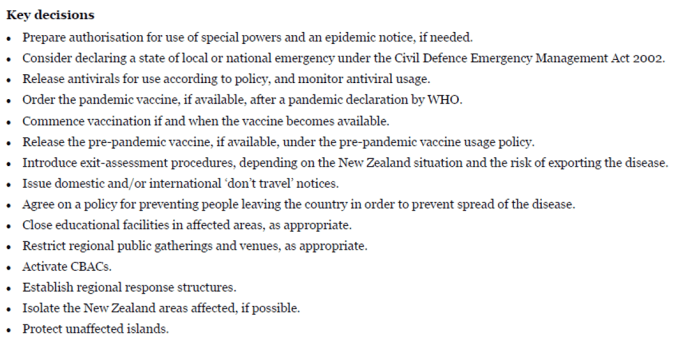
There is a set of key decisions listed

stamp it out

(Many of which won’t be relevant here/now, absent a vaccine)

And there is a detailed listing below that, but it is all lists, and no analytical or policy framework.  One hopes there are more-detailed analytical papers in the Ministry of Health or other agencies, but the Pandemic Action Plan document is what the public has.  The Ministry’s website claims that

The NZIPAP provides information to guide key decision-making.

But really the only information is a listing of issues, agencies, and formal statutory powers. Useful as far it goes, but not that much help –  in particular to the public.

And it is no different in the “Manage It” and “Recovery From It” phases.    Catchy phrases –  useful enough –  and long lists –  again useful enough –  but little substance to guide decisionmaking or public debate/scrutiny of governments plans and actions.

The second half of the document is a little more discursive, and perhaps more useful.   For example, there is a discussion of Public Information Management. But it is limited by the fact that it seems wholly focused on the Ministry of Health, and not on the key role that political leaders (notably the Minister of Health and the Prime Minister) play throughout any pandemic period.    And it is a bit disconcerting when the very first item in the key objectives around public information management

Key objectives are to:
- maintain public confidence in the response and in agencies’ competence and capability

That might be the Ministry’s aim –  pursuing its own interests –  but it isn’t clear it should be what would be most important for the public, who cannot simply assume (need to be shown by transparency, consistency, humility etc) that the response is being well-managed.

The section also seems disturbingly oblivious to both the extent of information available to the public from other countries and public health agencies and to the genuine political choices likely to be faced during the pandemic period.

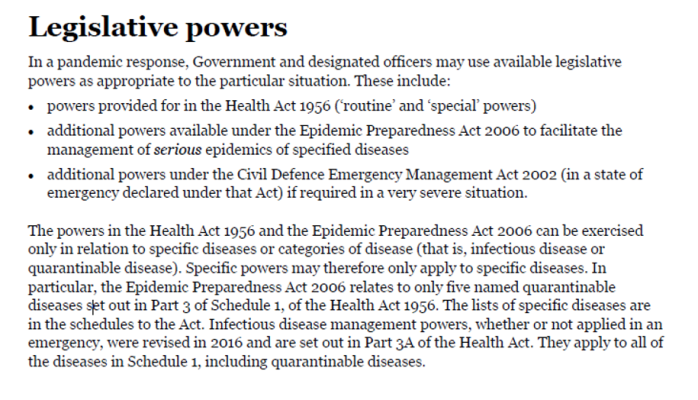
What first took me to the document was a desire to understand the relevant statutory powers and options.  There is what seems to be quite a good description (p109f).    Here is one summary

legis powers

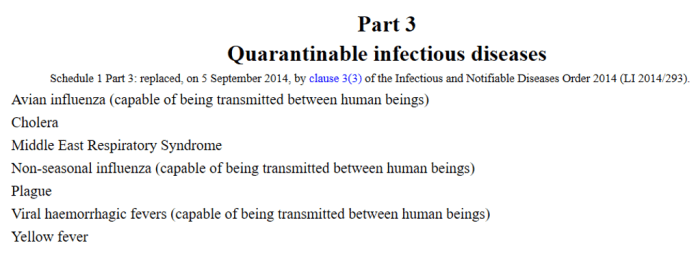
Do note that reference to the Epidemic Preparedness Act.  It has really far-reaching powers, which appear to allow the government to temporarily waive lots of legislation once the Prime Minister issues an authorising notice. But as the Plan says, it relates “only to give named quarantinable diseases set out in Part 3 of Schedule 1 of the Health Act 1956”.

quarantine

Remarkably, this schedule appears to be able to be updated by regulation, rather than by legislation – itself a little worrying given the scale of the powers given to the executive –  but you might suppose it was about time that the current virus was added to the list.

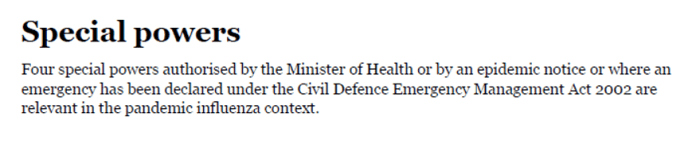
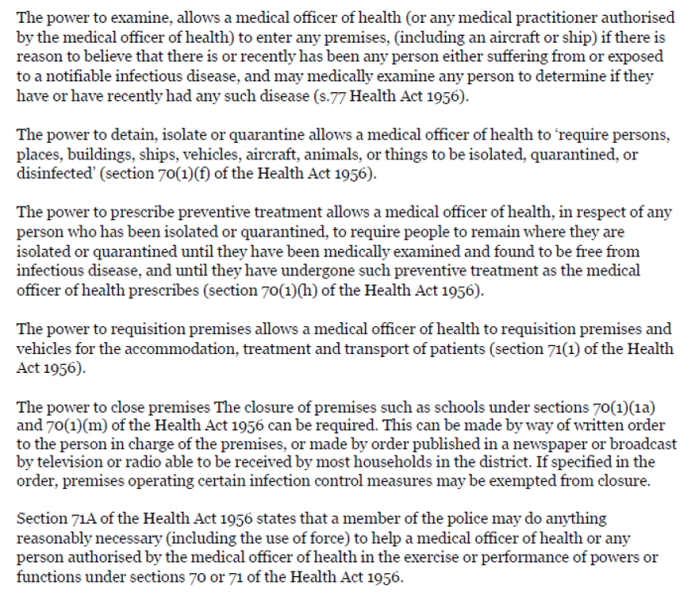
But to take the Health Act special powers first

special 1


special 2

All of which is good to know, but there is no discussion anywhere as to the circumstances, considerations etc that might lead to such powers being exercised.   Now, perhaps one could argue that they would be context-specific, but in a sense that is my point.  In the current context, the Plan itself offers little or guidance to the public, and we have had no guidance, consultation etc specific to the looming event from either the Ministry or (more importantly, since they are the ones we can hold to account) the Minister of Health or the Prime Minister.  (As there was no open discussion of considerations relevant to decisions around border closures, either the initial ones or subsequent decisions.)

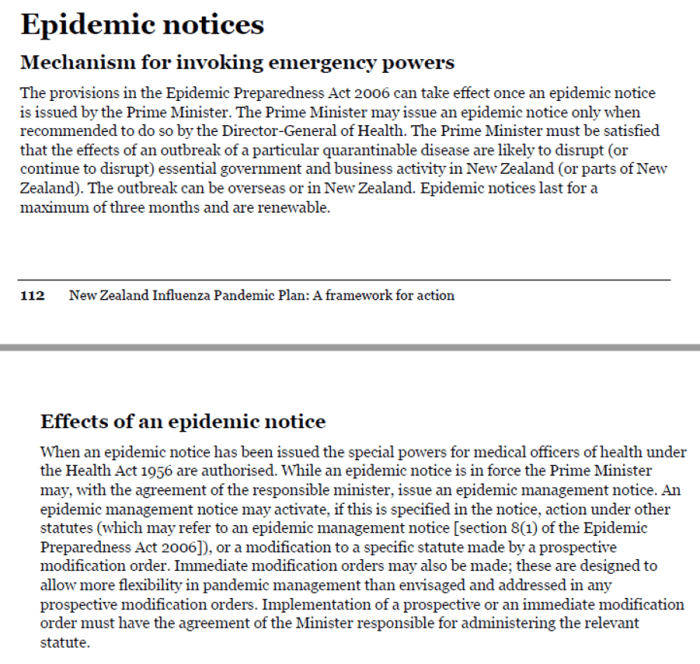
And what about that Epidemic Preparedness Act?  Here is what the Plan says

epidemic preparedness act

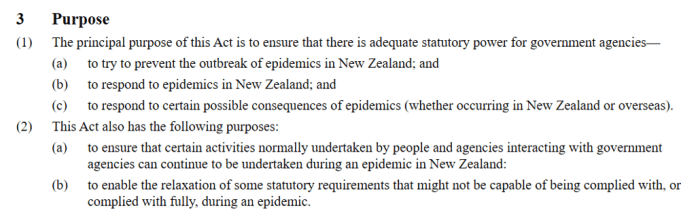
That is quite a mouthful.  The Act itself isn’t long, and if anything I found it a little clearer.  Here is the purpose statement

epidemic act

Such legislative overrides can themselves be disallowed by Parliament, which has to be called together pretty quickly if the Act is invoked –  unless, potentially an issue this year, the House has been dissolved for the election.

My point isn’t to debate whether or not these powers should exist –  although it does seem strange that the criteria relate to “essential government and business activity in New Zealand” (a term itself not defined anywhere, and you have to wonder how the Director-General of Health is qualified to judge what is “essential business activity”) not to human health, societal functioning etc (as well).   My point is that there is nothing in the Plan, and nothing we’ve heard from the officials or politicians on (a) what grounds they would look to invoke this Act, and (b) what statutory requirements they would look to suspend, in what circumstances (for those particularly worried, there are some core Acts they can’t touch).

Perhaps that might be unavoidable if there was a sudden outbreak of some disease with no real warning at all.  But we’ve had time –  now weeks and weeks of it – and there is nothing.  Ministers and officials act in ways that look as though they think “there, there, don’t worry your silly little heads about it, we’ll tell you what you need to know when you need to know it”.   But that is no standard for an open and democratic society.  It doesn’t even really seem consistent with the “public information management” themes, which talk about transparecy, building and maintaining trust.  You do that best by (a) being excellent, (b) being humble, but (c) being open and letting the public in on your thinking and planning, and being responsive to feedback.

As a good example, there is some discussion in the Plan of the possible closure of schools (and similar entities) –  pages 125 and 126 –  but it offers almost nothing.  And, as they note, much will depend on the circumstances of the virus.  In the current episode globally, we’ve seen many countries move to close schools, but one highly-regarded example of management (Singapore) where schools etc have been open throughout.  What is our government’s view on the matter at present, when New Zealand experiences community outbreak?  Surely it matters to the sort of planning individuals etc can/should be doing now.   If universities might end up closed quite soon, might that be relevant to questions around reopening borders to foreign students?   More generally, what is the government’s thinking on the movement restrictions etc being adopted in other democratic countries, notably Italy and South Korea.  Both ministers and officials seem missing in action –  no doubt talking among themselves, but not talking with citizens.

In an Appendix to the document there is a longer Public Information Management Strategy.  Much of it appears sensible enough.  There is even a specific extended section on

Key messages
It looks like a flu pandemic is about to start

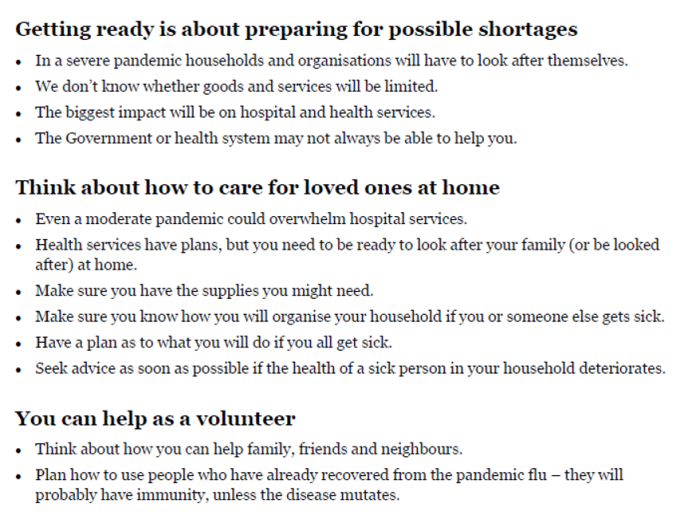
Again, a lot of it seems sensible and seems consonant with what we are hearing from health authorities in various other countries. For example

plan

But we aren’t hearing any of this from our officials and ministers, even though –  as we’ve in the last week –  countries have gone from thinking they have no major immediate problem to full-bore crisis in a matter of days.  If anything, the Director-General of Health on RNZ this morning sounded rather Trump-like still talking of low risks of community outbreak in New Zealand  (when plenty of international experts talk in terms of having got well beyond that point everywhere, even if some still think Stamp It Out strategies can work –  viz encouraging signs from Singapore).    They still seem more interested in playing things down –  don’t worry your heads about it –  than in helping guide the public to realistic preparations and precautions, or even to offering substantive answers to specific reasonable questions about how the health system –  under pressure at the best of times –  would be able to step up, add capacity in short order etc when/if significant community outbreak becomes established here.  Perhaps there is a good case for such a choice, but we don’t see the Prime Minister or the Minister of Health even trying to make that case.

And since this blog is still primarily economics-focused, much the same point could be made about economic issues.  The Minister of Finance’s speech the other day seemed okay as far as it went, but it stopped well short of taking seriously the sort of disruption, risks and economic losses, if we see widespread closures (from regulation or fear) when the virus hits here.  There might not be much governments can do in the very short-term if those losses happen, but there are important specific issues, including those around how things like the food distribution system keeps working (if, say, one main city is largely locked-down and movement in and out restricted).

We really deserve and need more pro-active leadership and preparation from key ministers, and perhaps from officials too –  but they mainly work for and to the ministers, whose handling of these event may yet feature significantly in this year’s election campaign.


Coronavirus can’t just be thought of as an illness for other countries

There was quite a bit of media coverage this morning around the potential economic impact of, and possible policy responses to, the coronavirus.   There have been commentaries from, or interviews with, various economists and a fairly substantive interview on RNZ with Grant Robertson, the Minister of Finance.  Each of them left me a little concerned, but of course the comments from the Minister of Finance –  who gets to decide things and is backed by phalanxes of official –  matter the most.

In his comments at the post-Cabinet press conference on Monday, the Minister indicated that he and his officials were working with three distinct scenarios.   There doesn’t appear to be anything in writing (eg on The Treasury’s website) but broadly the scenarios were as follows:

  • something (probably not too different than the Reserve Bank’s quite-sanguine recent published forecasts) that seems wholly focused on China, and with things beginning to get back to normal next month,
  • something where the effects, perhaps around a wider range of countries, linger for the rest of the year, and
  • a third scenario which he characterised as a serious global recession.

The government is still working with the first of those scenarios, although the Minister acknowledged that the risks of the second scenario looked to be rising.

Many of the other commentators seemed to be thinking along similar lines.  The NZIER, for example, released their quarterly forecasts overnight and their press release says

It is early days and there is a large degree of uncertainty over the magnitude and duration of the effects from the coronavirus outbreak. In the short-term, the uncertainty revolves around the ability of exporters to redirect their exports to other markets. Over the longer-term, the uncertainty is whether the coronavirus has any persistent negative effects on global growth.

And I’ve seen/heard other economists commenting on whether or not GDP growth for the first couple of quarters might or might not be negative (the popular definition of a recession –  more demanding here than in most countries, given our fairly rapid population rate).

But, frankly, it all seems a bit pointless, especially the very short-term forecasting, because all of them –  including the Minister of Finance –  seem to be dealing with a scenarios in which coronavirus is someone else’s health (and attendant domestic disruption) problem, for which New Zealand is only exposed to the global growth backwash.  Of course, that backwash might well be quite severe.   But none of them seem to be grappling with the near-certainty that coronavirus will soon be confirmed in New Zealand (based on what we’ve seen abroad, there must be a reasonable chance it is already here  –  and the Ministry of Health tell us that under their narrow criteria only 120 tests have taken place here).  And, more specifically, none of them is grappling with the possibility that we –  like any city in the world, it appears – could have Korean, Iranian, Italian, Bahrain situations here at any time from today (none of those countries seem to have thought last week that they’d be imposing all the the restrictions they now have).   If the experts who tell us there is now a high chance of a general global outbreak, perhaps infecting 40 to 70 per cent of the world’s population, are correct, probably most cities will face such a scenario.   And those sorts of events have the potential for huge disruption, and economic cost, which would swamp the sorts of narrow effects forecasters like the Reserve Bank have already allowed for.

Take as a scenario a significant outbreak in Canterbury (or Wellington).   Canterbury accounts for about 12.5 per cent of New Zealand’s GDP, and suppose that for a month economic activity in Canterbury is reduced to 50 per cent of normal  (some mixture of schools and daycare centres etc being closed, lots of people being sick or self-isolating because a family member was sick, restrictions on public gatherings, the evaporation of tourist arrivals, and fear).   If that was the only effect New Zealand’s GDP for the quarter of the outbreak would fall by 2.1 per cent –  not annualised, an actual fall of that amount.   That alone would be almost as bad as the worst quarter of our worst recession in modern times in 1991.      You could triple the effect if the outbreak was in Auckland (38 per cent of national GDP).

And even if by some chance the outbreak –  and tough restrictions –  was contained to a single city/region, the economic effects won’t be –  partly about domestic supply chains, partly about transport networks, and lot about precautions and fear.     If there is a Korean or Lombardy style outbreak in Sydney or Brisbane, we’ll already see a lot of costs start to rise rapidly here –  both domestic fear, and how many foreign tourists do we suppose would still be coming here?   So we can’t even assume that even if an individual city’s outbreak takes just a month to work through, that the national effects would be limited to a single month.     It isn’t inconceivable that we –  or small/compact countries like us –  could see the level of GDP fall by 10 per cent or more in a single quarter, and then take quite a long time to recover from the shock of what the society has just gone through.    Quite apart from anything else, that is quite a lot of lost tax revenue, even if 12-18 months hence things were more or less back to normal.

Of course, no one doing quarterly forecasts can allow for these sorts of events in their specific numbers, because we have absolutely no idea whether these scenarios hit tomorrow, next month, June (or, indeed, not at all).   But anyone –  policymaker, business, or householld – thinking about the outlook for the next year would be pretty unwise not to explicitly factor in a fairly probability that exactly that sort of highly disruptive short-term scenario could occur.     And then you have to factor in the near-certainty (so to speak) of extreme uncertainty, and associated disruptions –  forced on individuals or firms, or self-chosen as a precaution – across the world for much of the year ahead.   At very least, a lot of travel just won’t happen, a lot of investment projects will go on hold, and cash-flow/liquidity is likely to be a big issue for many firms and households, whether or not banks are more or less as supportive (or otherwise) in other stress periods.   Whether that will amount to the Minister’s “serious global recession” scenario or not, who knows (but probably, given other underlying vulnerabilities).

In many ways, GDP is just a headline number in thinking about the challenges we face, and in time it is likely to recover more or less fully (even allowing for the limits of monetary policy).  Much the bigger issue in the disruption to lives –  even lives lost –  lost jobs, debt defaults, perhaps stranded sick tourists, overwhelmed health systems, disrupted supply chains for things as (normally) mundane as food.  I suspect policymakers shouldn’t be focused so much on the Minister of Finance’s scenarios –  which in many respects from a New Zealand perspective are fairly vanilla as regards policy responses –  as on handling, and preparing for, the extreme but short-term disruption of actual coronavirus outbreaks here.

(As a reminder here of my post last week with some speculative thoughts on the potential economic ramifications if things go really bad.)

Of course, “preparing for” here should include preparing the public.  So far, both officials and ministers have been almost totally silent on that count.  In the early days, Health officials seem to be more interested in minimising the issue, but even having got beyond that they and their political masters seem to think all these issues are really just matters of bureaucrats, not for the public themselves.  News coverage seems more interested in what the government might or might not do to help currently-affected industries, and media representatives don’t seem to be pursuing ministers on how they will handle (the likelihood of) a significant outbreak here.  There was not a single question along those lines at the PM’s press conference on Monday.

There is, of course, a pandemic plan on the Ministry of Health’s website.   It was last updated in 2017, under a previous government.  It was designed with influenza in mind, and the current virus appears to be different in some material ways.     There is even an explicit appendix (p155f) on “public information management”, including for use at a stage when a pandemic might be looming.  But almost none of the messages mentioned there seem to be being conveyed at present.   There is no evident leadership –  from the Prime Minister, the Minister of Health, or some other minister leading the government’s response –  and no sense of what choices the government might make under what conditions.

As just one example, what approach does the government intend to take around schools and daycare centres?  Some places have closed them pretty quickly –  Hong Kong just extended school closures until April – while other places (notably Singapore) have left them open.   That single choice has big implications for many parents, and for their employers, and yet we’ve heard nothing, meaning no one can plan with reliable information.

Or at a more-mundane level, is there any sign of advice to people to consider stocking up on various non-perishables that might better enable them to cope with a few weeks at home.   Probably many of those paying attention will already be doing so (I certainly am) but a lot of people are probably barely conscious of the issue –  which could be on us tomorrow, or months away.  And what thought has the government given to people without the financial capacity to do much about stocking up –  living from pay cheque to pay cheque –  including if we were to see the sorts of runs on supermarkets you can see photos of from Milan.   If cities are more or less closed down, foodbanks aren’t likely to be available/effective either.    And what are the plans if 10 per cent of the population needed fairly serious medical treatment over a matter of a few weeks?   What plans might community support groups be making now?  Is it wise, or humane, to look at encouraging more young foreigners in now, when we might soon face serious stresses on our own health systems, with the visitors having few/no domestic support networks?  And so on.

There are lots of these sorts of questions/issues. Eric Crampton had a useful post on the point with some more of the relevant questions set out.  Perhaps there is some really effective planning going on behind the scenes, but even if so that simply isn’t good enough in the face of this sort of event, especially when we can all see and read about what is going on elsewhere and the advice being given elsewhere.   How much better to have some visible leadership and open serious conversations about how, as a society, we manage the high likelihood of extremely disruptive, costly, perhaps deadly, events quite soon.

What if COVID-19 things get really bad?

As I prefaced my very first post on coronavirus-inspired issues –  less than four weeks ago – “who knows quite what will happen with the current coronavirus”.  No one does, and I certainly don’t claim any insight on that medical/epidemiological point.   But there are serious experts in those fields now beginning to talk about the possibility –  some put it much stronger than that – of it turning into something that infects perhaps 40 to 70 per cent of the world’s population (I gather that sort of incidence isn’t uncommon in past serious pandemics), with perhaps 1 to 2 per cent of those people dying.  In that scenario –  it is purely a scenario –  something from 0.4 to 1.4 per cent of the world’s population dies.  The middle of that range would be similar to New Zealand’s experience in 1918.

My interest here is in the the economic impact of such a scenario (and can I repeat, this is simply based on one scenario –  with no probability attached, and one every sane person presumably hopes does not eventuate, but probably still the sort of thought experiment people in the economic agencies of governments should be thinking through, even just as a tail risk).

Perhaps a first stake in the ground is that even if something this bad happens, in a couple of years time the crisis would be over and something akin to normality would have returned.  Societies would no doubt still be scarred by the disruption –  economic, social, and perhaps political – and by the utterly unexpected scale of the human losses (the normal annual number of deaths in New Zealand is around 0.8 per cent of the population), perhaps in a way they don’t seem to have been in 1918 (coming off far greater death, destruction, and dislocation in the war).  But borders would open, commercial premises operating, people free to come and go within countries as they like with no unusual fear etc etc.  Health systems –  potentially grossly overloaded during the crisis scenario –  would be back to more or less normal either.  In other words, most of the effects are temporary.

Readers will know that there are debates, with real world consequences, about the nature of the costs and losses associated with financial crises, and debates about whether most of the effects are temporary or more permanent.  I can’t see how the overwhelming bulk of the economic effects of a even a very severe pandemic would be other than temporary.  The pandemic won’t have been endogenous to our economic system (so it won’t tell us much about initial gross misallocation of resources), isn’t likely to affect innovation or incentives to innovate or invest, and isn’t even likely to have much impact on productive human capital (especially if, as at present, deaths are concentrated among the elderly).   Perhaps there would be some persistent effect in dampening globalisation (reassessment of risk of cross-border supply chains etc), but the aggregateeconomic effects would take time to cumulate and spot, and be second-order relative to the near-term disruption.

But if we could be pretty confident that a couple of years hence things would be functioning more or less normally again –  even if, as globally in 1918, there were several distinct waves of the infection –  at the other end of the calendar, things would be characterised by extreme uncertainty.  First, even if a scenario of the sort I’m dealing with here comes to pass, none of us it will know it for some considerable time.  There would be duelling optimists and pessimists, each with plausible arguments and straws in the wind.   And presumably none of us would know where the infection rate would surge next.

That alone is a recipe for economic paralysis: the rational response to extreme uncertainty (often quite well-warranted uncertainty)  is to postpone (travel, investment, discretionary spending), delay, stick close to home etc etc (and that without the seemingly irrational responses we see reports of in New Zealand at present, of people avoiding Chinese restaurants).  Even if air travel was still possible –  it would quickly get much harder, as commercial imperatives (let alone regulatory ones) led to cancellations, and the rational prospect of future cancellations –  the number of people willing to travel far or for long will drop away.  Travel insurance also becomes a real issue.  Who wants even a modest risk of being stuck for weeks, with a potentially life-threatening conditions, in some foreign hospital with doubts about your ability to pay.   Nations will be reluctant to host lots of visitors who could fall sick while in your country, who – even with ability to pay, which not all would have –  could further overburden a potentially severely stretched health system.    As flights get cancelled, air freight is also disrupted.

We are already seeing the extent of social-distancing, cancellation of events etc –  mostly not forced by governments –  in places that currently have a relatively modest number of cases (Singapore, Hong Kong, and to some extent Japan).  Imagine the demonstration effects when –  this is a scenario remember – the next country, and one more transparent than China, gets a severe outbreak.    And the next, and so on.  (Scenario, remember.)

When such an outbreak happen, lets assume that no free country is going to be able or willing to impose such extreme lockdowns as the PRC has done.  But you don’t need that level of lockdown for the level of economic activity to be savaged.  Lots of people are sick in this scenario, in many cases really quite seriously ill, and typically (it appears) not just for a few days.  Those people will need people to care for them (not necessarily medically, but just the comfort we’d all want to offer to a seriously ill family member).  And between voluntary and semi-compulsory pressures, not that many people with a sick family member are going to be welcome in the office/workplace for a while.   More than a few employees will find hours drying up, or jobs disappearing altogether.  Sure, people still need to eat –  though who knows how effectively distribution systems hold up –  but there is a great deal of expenditure, business and private, that is discretionary (over a horizon of several months).   At one extreme –  long-term asset sales –  for example, the Chinese data show the property market having dried up for now.

(There were estimates last week that regions accounting for more than 50 per cent of Chinese GDP were in lockdown.   If those areas are operating at no more than half capacity for a month –  stabs in the dark, but they don’t look implausible numbers based on (for example) charts like these –  “true” Chinese GDP for this quarter could be 8 per cent lower than otherwise, when reported quarterly GDP growth is about 1.5 per cent.)

Now assume –  as the scenario requires –  that this isn’t just about one country, but about a steadily increasing number of countries.  And start factoring in the serious disruption to supply chains –  which we are already seeing in and from China (and recall that a supply chain isn’t much stronger, in effect, than its weakest link) –  and there is lot more economic activity at risk, even if all the workers were available and ready to work.

In each and every country, lots of businesses –  and more than a few workers –  are going to be facing big drops in income.  Initially each will like to think it is a matter of a week or two, but already that doesn’t really look like the China experience, and on this scenario, the problem has become worldwide.  Plenty of businesses have debt or very very limited cash reserves and so lots of firms will soon be in the hands of their bankers.  Responsible banks will want to stick by and support good longstanding clients, but there are limits (collateral values are likely to be falling, markets illiquid, even if temporarily), and banks themselves are likely to be affected by fresh waves of caution and risk aversion.    Bank funding might start to become a bit on issue playing on the minds of boards and management.

Financial markets have proved remarkably sanguine about the coronavirus so far.  Perhaps that makes sense if you believe the public-facing PRC story, that everything is coming under control before too many more weeks things will be getting back to normal.  But that isn’t the scenario I’m working with in this post.  In such a scenario, global uncertainty would be huge and uncertainty is the enemy of asset market valuations.  Quite probably there would be some real high profile company failures (or big state bailouts) going on –  airlines anyone? – short-term earnings estimates would be being savaged, and risk spreads would be widening   I doubt any supervisory agency has stress-tested its financial system for a shock of the sort I’m using in this scenario, and even if the event wasn’t severe enough to pose a systemic threat (a) there would be a great deal of uncertainty, including about who had what exposures, and (b) this scenario would come on the back of a global economy with a lot of vulnerabilities, including in financial systems, anyway –  the euro area economic performance anyone?

Perhaps the mitigating factor in all this is macro policy?  Which is a nice thought, except that so many advanced countries already have official interest rates at zero, or below (few/none have more than a 200 basis point buffer, and in major past downturns –  even shortlived ones –  500 basis points has been a not uncommon reaction).  No doubt, fiscal policy would swing into action –  in fact, you rather hope practical contingency thought is already going on.  Even in highly-indebted countries, for a genuinely short-term shock (1-2 years) there is room for some additional spending.   Some of it might even be effective – in eg retaining attachment to the labour market (some of the specific subsidies after Christchurch and Kaikoura), but it is hard to be that optimistic about the overall degree of effectiveness.  Governments can cut taxes in short order and put more money in individuals’ pocket, but in this scenario risk-aversion, social-distancing etc, suggests that cash constraints won’t be the ones binding individuals.  Governments can, of course, purchase real goods and services…..a common last-resort stimulus suggestion, but not one likely to work as well when it is a struggle to keep factories/shops open with staff turning up.

For New Zealand, one mitigant we could probably count on to help would be a lower exchange rate.  Historically, global risk events tend to be really rather bad for the NZD (and the AUD).  Export volumes and world prices might take a hit –  savage in some cases –  but what foreign exchange was being earned would generate quite a bit more income.

What about inflation?  One sees various stories already about disrupted supply chains putting upward pressure on prices/inflation for manufactured goods.  That seems plausible enough in some cases –  if, as reports suggest now, there are disruptions to the flow of winter fashions to our stores, there is less likely to be excess stock for sales late in the season, and so on –  but my sense is still that a scenario of the scale I’m writing about here is, on balance, a seriously disinflationary one.  That is both because commodity prices would be falling –  in some cases plummeting –  but also because the hit to demand for the fear, uncertainty, delay, distancing, physical disruption, would exceed the disruption to supply (but that needs teasing out with further analysis) and the risks of inflation expectations taking a further downward hit is also real.  This is the risk I, and others, have been highlighting for some years –  that in the next serious downturn, people will quickly realise that policy capacity is much less than usual and adjust expectations accordingly.  If that happened, it would risk severely impeding a return to full employment, even after the virus itself had passed into history.

This is all very speculative –  and around a scenario we must all hope never happens.  But we need policy agencies –  and others, be it academics or other commentators – to be thinking hard about these contingencies, including thinking about what options (and when) make sense to deploy early to minimise, to the extent possible, the human and economic dislocations, which could be very large.

I’m wedded to very few of the arguments here, and would welcome comment/challenge (not about the probability – on which I have no particular view – but on the implications of a deliberately extreme scenario, even if one that more medical experts of warning us we could yet face).  It would also be good to have a sense that the New Zealand governments was taking the issue and risk seriously and pro-actively planning.  On what we see at present –  which perhaps isn’t all there is –  it looks like lethargic political leadership, as keen as anything on keeping Beijing not too unhappy, with not much sign that the bureaucracy is much more than reactive either (officials will, no doubt, respond to political incentives).

An unimpressive MPC

I didn’t expect to be particularly critical of the Reserve Bank after yesterday’s Monetary Policy Statement.  A journalist asked me yesterday morning what I’d say if they didn’t cut the OCR, and I noted to him that whether they cut or not, what I’d really be looking for was evidence of the Bank treating the issues in a serious way, alert to the magnitude of what was going on and the sheer uncertainty the world faces around the coronavirus.

They –  the almost a year old new Monetary Policy Committee –  did poorly on that score.  And in his press conference, I thought the Governor simply seemed out of his depth.  Much of what the Bank had to say might have seemed reasonable two weeks ago –  no doubt when the bulk of their forecasts were brought together – but the situation has been moving (deteriorating) quite rapidly since then.   They can’t update published forecasts by the day, but there was little sign in the record of yesterday’s meeting, or in the Governor’s remarks yesterday afternoon (or those of his senior staff), of anything more immediate or substantive.  The Governor seemed to attempt to cover himself by suggesting that the Bank”s line was consistent with some “whole of government” inter-agency perspective, but….that is (or should be) no cover at all, since Treasury and MBIE don’t face the same immediacy the Bank does (it had to make an OCR decision) and whatever the Ministry of Health might be able to pass along about the virus itself, it knows nothing about economic effects.  On those, the government should be able to look to the Bank for a lead.  Instead, we got something that seemed consistent with the lethargic, lagging, disengaged approach of our government (political and official) to the coronavirus situation.

Thus, remarkably, faced with one of the biggest out-of-the-blue economic disruptions we’ve seen for many years, arising directly and most immediately in one of the world’s two largest economies, we get three-quarters of the way through the press statement before there is any mention of the issue, ploughing our way through upbeat commentary including on the world economy.   Even when we do get there, the coronavirus effects are described only as an “emerging downside risk” –  for something which has already sharply reduced activity in parts of our economy.  It is the sort of language one might use for things where the effects are hard to see, not for something this visible, direct, and immediate.   And on the day when the head of the WHO –  who has often seemed to play defence for the PRC – was highlighting the scale of the global threat.  On a day when a CDC expert was on the wires noting that the only effective response is social distancing –  the more distant people stay the less economic activity there is.

The Bank loves to boast about how transparent it is. As I’ve noted, they are happy to tell us the (largely meaningless) forecasts for the OCR three years hence, but they are astonishingly secretive about their own analysis and deliberations.   Thus, we now get a “summary record” of the final MPC meeting.  Here is pretty much all we get to see about the coronavirus issue

The Committee discussed the initial assumption that the overall economic impact of the coronavirus outbreak in New Zealand will be of a short duration. The members acknowledged that some sectors were being significantly affected. They noted that their understanding of the duration and impact of the outbreak was changing quickly. The Committee discussed the monetary policy implications if the impacts of the outbreak were larger and more persistent than assumed and agreed that monetary policy had time to adjust if needed as more information became available.

….The Committee discussed alternative OCR settings and the various trade-offs involved.

There is no sense of the sort of models members were using to think about the issue and policy responses.  There is no sense of the key arguments for and against immediate action and how and why members agreed or disagreed with each of those points.  There is no sense of how the Bank balances risks, or of what they thought the downsides might have been to immediate action.  There is no effective accountability, and there is no guidance towards the next meeting.  Consistent with that, the document has one –  large meaningless (in the face of extreme uncertainty) – central view on the coronavirus effects, but no alternative scenarios, even though this is a situation best suited to scenario based analysis.   It is, frankly, a travesty of transparency, whether or not you or I happen to agree with the final OCR decision.

Consistent with that, there was no mention –  whether in the minutes or in the body of the document or in any remarks from the Governor –  of past OCR adjustments in the face of out-of-the-blue exogenous events.  Again, perhaps there are good reasons why the cuts in 2001 (after 9/11) or 2011 (after Christchurch) or –  less clearly –  around SARS in 2003 don’t offer good lessons for policy-setting now.  Presumably the MPC thought so, but they lay out no analysis or reasoning, and thus no way to check or contest (or even be convinced by) their thinking.  It really isn’t good enough.   Then again, in the press conference no journalist challenged the Governor on these omissions.

Similarly, there was no sign in any yesterday’s material or comments of having thought hard about the limitations on monetary policy (globally) as interest rates are near their effective lower bound.  All else equal, and with inflation well in check, that starting point should typically make central banks more ready to react early against clear negative demand shocks to do what can be done to minimise the risk of inflation expectations dropping away.  Perhaps again it still wouldn’t have been decisive this time –  and our Reserve Bank still has a little more leeway than many –  but to simply ignore the issue, and show no sign of having thought hard about the wider policy context, was pretty remiss.

From his tone in the press conference, it was as if the Governor really didn’t want monetary policy to have to play a part –  to do his job –  as if it was all just an unfortunate distraction from good news stories he’d been hoping to tell.   So he told one journalist that at best monetary policy would be a “bit player”: for individual sectors that is no doubt true (but then monetary policy is never about dealing with specific sectoral problems), but not really the point, since there has been a clear and significant, highly observable negative demand shocks, and a huge increase in uncertainty (often a theme of RB speeches etc over the last year).  In fact, in answer to another question the Governor was heard claiming that there was “no specific event” to consider reacting to (hundreds of millions of people locked down in China, second-largest economy in the world?) and –  worse –  then claimed that there was no need to act as we already have very low and stimulatory interest rates.  The problem with that argument is that they were just as low six weeks ago, and since then we’ve had a clear large negative demand shock.

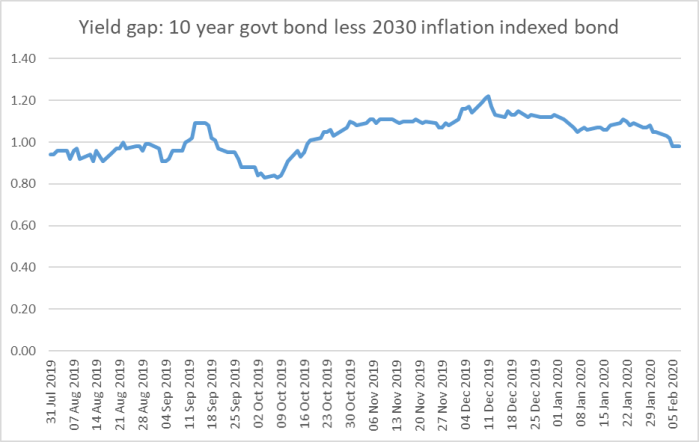
Asked about the fact that implied long-term inflation expectations (from the government bond market) were barely above 1 per cent, the Governor took a lesson from politicians and simply refused to answer the direct question.  He then went to on to claim that the monetary policy foot was already on the accelerator, that we’ve had more positive global growth –  even as global projections are in the course of being revised down – and that if anything the question that should have been being asked was why we weren’t thinking about raising the OCR (“renormalising”).

One journalist thought to ask the Governor about the difference between the Bank’s GDP forecasts for the year ahead (2.8 per cent I think I heard) and those of various outside commentators (more like 2.0 per cent) and asked about the difference.  The Governor’s response was that of glib teenager: “0.8 per cent I think”.  Pushed a bit further, he indicated that he had no idea why the difference and (more importantly) no real interest. He claimed (fair enough) not to accountable for anyone else’s forecasts, but showed no interest in the cross-check (that used to be pretty standard around the MPC table) of understanding why the Bank is different from others, and why the Bank still thinks that is the best forecast.

There was also the line about market prices constantly adjusting and buffering……all this as the exchange rate rose the best part of 1 per cent on his announcement yesterday, rather undercutting any exchange rate buffering  of the economy that had been underway.

Oh, and then we had gung-ho political cheerleading for the government’s infrastructure spending plans.  He claimed to be “very excited” by it and rushing past any issues around “crowding out” was keen to talk up all the possibilities of “crowding in” accompanying new private sector investment etc.  No evidence, no analysis, but it probably went down well with the Labour Party.  Sadly, the Governor seems to do campaigning and cheerleading better than he does monetary policy, and there seems to be no serious and substantial figure on his team to compensate for those weaknesses (while, as far we can tell, the invisible unheard external MPC members just function as ciphers and political cover).

As an illustration of what the Bank simply seemed to be missing –  or choosing to ignore – a reader left this comment here last night

The shock from nCoV isn’t just confined to China. It’s spilling rapidly across the Asia-Pacific region…

I have just spent the past few days in Singapore and I write this on a flight to Hong Kong, which is maybe 15% occupied. Singapore is shutting down, which is worrying given its entrepôt status. Malls are emptying, as are hotels and restaurants. Traffic is thin. Companies are rolling out their business continuity plans which will further exacerbate the dislocation. This isn’t about just China, it’s region-wide.

The same reader sent me directly a photo of one of Changi airport’s main terminals at lunchtime yesterday, with this note “Changi T-3 unloading zone. Today, 12 noon. Not a soul in sight.. no cars no people..”

I noted yesterday that more or more people would be cancelling trips, business or leisure, in the face of some mix of risk aversion and sheer uncertainty.  That happened to me yesterday –  less about immediate threat than about the extreme uncertainty about the environment a few weeks hence.

And this morning we hear a local public health expert calling for our sluggish government to expand travel restrictions to people coming from various other countries (including Singapore and Hong Kong) where there is now established community outbreak. Or news of major international events in Hong Kong being cancelled. Or a major world telecoms convention in Barcelona being cancelled.

I’m not suggesting the Reserve Bank should have tried to turn itself into disease experts or even to pin their colours to a different central scenario.  But they simply don’t seem alert to the magnitude of what is already going on, including that huge rise in uncertainty, and they provided us with very little useful analysis about the way they think about monetary policy, demand shocks, risks, instrument stability etc –  nothing to give us any confidence in their stewardship.

Oh, and you’ll recall I mentioned yesterday their interesting –  and potentially positive – experiment in transparency, inviting real-time questions to the Governor during the press conference via Twitter.  As I’d noted in advance, one might well be sceptical about just which questions they would choose to answer.  Actuals were even worse than my expectations.  The Bank’s comms guy had clearly been primed not to expose the Governor to any searching questions, and only two were let through at all, essentially translated into patsy questions, allowing the Governor to wax eloquent on a couple of favoured themes.   No one forced them to adopt this particular approach to being more open.  But if they want kudos for it, they need to be seriously willing to allow real and searching questions to the Governor.


Coronavirus and the OCR

A month ago there were no commentators suggesting the OCR should be raised at the next review.   Since then we’ve watched day-by-day as the news about the coronavirus (now named “SARS-CoV-2” and the disease it causes “COVID-19.”) has got relentlessly worse.   Against that backdrop, the case for an OCR cut today looks pretty unanswerable. Not because an OCR cut will make any material difference to March quarter GDP – it won’t –  but because the job of discretionary monetary policy is to lean against demand shocks, positive or negative, so long as inflation is well in check.

As I noted the other day, core inflation hasn’t got as high as the target midpoint for the whole of the last decade.  In that context, when there is a clear-cut (if not readily calculable) adverse demand shock, the Monetary Policy Committee would be remiss if it simply sat on the sidelines today, suggesting that they would merely be “watching closely” and be ready to act down the track.  In the current macro climate –  quiescent inflation, flat or falling inflation expectations –  there is simply no downside to acting now.    There is no particular virtue in instrument stability: the instrument exists to lean against macroeconomic instability (doing what it can to maintain “maximum sustainable employment”, in the current jargon).

Even a couple of weeks ago one might perhaps reasonably have reached a different view.  But now we have Chinese inbound tourism cut to almost nothing overnight (first as a result of Chinese restrictions and then our own), and confirmation from the universities that perhaps 60 per cent of their PRC students are still out of the country and unable to travel here.    We have much the same situation in Australia, a key economy for us, and in China itself –  one of the world’s largest economies –  huge economic disruption, and a spreading range of restrictions on movement, social gathering etc etc.  We see photos of largely empty streets or public transports in big Chinese cities that aren’t locked down, quite limited returns to work after earlier shutdowns, and so on. From Hong Kong there are reports of more cases, but again the bigger impact is probably people staying home, avoiding social gatherings etc.  Investment banks doing business in China –  ie quite severely constrained in their freedom to run negative lines –  have been marking down their 2020 Chinese and global economic forecasts.  Even the WHO –  which previously presented as relatively complacent – is now talking of this as

WHO chief Tedros Adhanom Ghebreyesus told reporters in Geneva the vaccine lag meant “we have to do everything today using available weapons” and said the epidemic posed a “very grave threat”.

“To be honest, a virus is more powerful in creating political, economic and social upheaval than any terrorist attack,” Dr Ghebreyesus said.

“A virus can have more powerful consequences than any terrorist action.

I’ll leave the florid rhetoric to him, but if there was a good case for cutting the OCR after the 9/11 attacks and after the February 2011 earthquake (and I think there was) that case is at least as persuasive –  compelling in my view –  now.

It isn’t really clear to me why, faced with a decision to make today (not, say, a week ago as with the RBA), anyone would favour not cutting the OCR.   The OCR (monetary policy more generally) is designed to be flexible and responsive (easing and, if warranted later, reversing such easing).  The OCR isn’t about support for individual adversely affected sectors –  if that is really needed in some areas it is a fiscal policy/government matter –  but about stabilising the overall economy faced with (in this case) clear negative shocks.  The tool is fit for purpose.

One argument sometimes heard is that we shouldn’t do anything because things are so uncertain.  But that argument should run exactly the other way round. The high degree of uncertainty, which is probably now rising by the day, is exactly the conditions in which people put off spending, put off travel, are a bit warier about eating out, and so on. It represents a likely material adverse demand effect on top of the specific channels (tourists, students) we already knew about.  Think of travel.  You might have been planning a business trip into Asia.  You might be happy enough to go today, and yet you look ahead and wonder what things might be like when you want to get home again, let alone what conditions might be like if somehow you got sick.  I reckon we’ll see an increasingly number of non-essential trips postponed, whether business or leisure.  And that won’t be so just in New Zealand.   With each passing week, we’ll also see more spillover effects into spending elsewhere in the economy and the confidence surveys –  whatever we make of them –  are likely to take a hit.

There is also the argument that things will snap back once the virus is behind us.  No doubt that is the most sensible assumption, but an increasing number of commentaries are noting that a full snap back isn’t likely to be a matter of a few weeks: it seems increasingly likely that the level of economic activity over much of this year, in much of the world, will be weaker than otherwise –  perhaps not a lot by the end of the year, but that is still 10-11 months away.    And assuming things will simply snap back risks being a recipe for doing nothing with monetary policy when it was actually needed (there are plenty of things forecasters think will be shortlived, but turn out to drag on rather longer).

I’ve also heard a story that the Reserve Bank cutting the OCR by 50 basis points last August may have instilled in some a sense of unjustified worry, becoming a bit of an own goal. Is there a risk of something similar now?    First, the August cut wasn’t well-handled.  It may have been substantively justified, but was poorly communicated and was not clearly tied to specific and very visible adverse developments here and abroad.  As it happens, I don’t think the “own goal” effects, if they existed at all, lasted for long at all (little sustained evidence in eg confidence surveys).    What about a move now?  Sure it would be unexpected, in that surveys of economists were all picking no change.  But (a) those surveys were often done a week or more ago, (b) economists generally aren’t asked what they think the Bank should do, and (c) there is a very clearly identified adverse event, which every commentator will be focusing on.  It would be quite easy for the Bank to credibly justify a cut today, specifically tagged to the coronavirus (and referring to 9/11 and 2011).  And if in doing so the Bank raised a bit more public consciousness of the mounting economic issues, it would probably be no bad thing anyway.

Perhaps the final caveat I’ve seen is that global equity markets seem quite surprisingly sanguine.  If they aren’t pricing something quite bad –  or even high risk – why should central banks react?  It is a fair question.  One answer is a matter of different time-horizons.  Equity markets are pricing earnings prospects over the life of the firm, while central banks are (by design) supposed to be focused more on the short-term.  A few bad months might not rationally affect the value of most firms much, but might still warrant lower policy interest rates. It is just a different game.  But it is also worth noting that New Zealand markets are pricing an OCR cut by the end of this year.   If it is needed, and likely to be useful, in a coronavirus context, it is much more useful –  and more likely –  frontloaded.

Time (not long now) will tell what the Monetary Policy Committee decides to do.  I am encouraged by two things: first, was the MPC’s willingness to act decisively last August (even if the accompanying communications etc were hamfisted) on much less clear-cut evidence, and second by the fact that one of the external members of the MPC (retired economics professor, Bob Buckle) was heavily involved in The Treasury’s early work on pandemic economic effects last decade.

Whatever the MPC chooses to do, the Reserve Bank has introduced an interesting new exercise in transparency.  If you are on Twitter you can ask the Bank directly a question during the press conference this afternoon.

The OCR should be cut

The Reserve Bank Monetary Policy Committee releases its next Monetary Policy Statement and Official Cash Rate (OCR) decision next Wednesday –  the first we’ve heard from them since November.

Until a couple of weeks ago you could probably mount a pretty strong case for the status quo. If the MPC was right to have left the OCR unchanged at 1 per cent in November,  it probably looked as if that was still going to be the right decision in February.  I thought they should have cut in November, and so was still inclined to think they should cut now –  but it wasn’t a particularly strongly held view.  It is worth remembering that after all these years, the Bank’s favoured core inflation measure still isn’t back to 2 per cent (it was last there in 2009) and there wasn’t a lot in the wind suggesting it was likely to rise further.   But there hadn’t looked to be a lot in it.

The Reserve Bank’s Survey of Expectations, released at 3pm today, looks to be not-inconsistent with that sort of status quo story.  But the survey closed a week ago, and opened two weeks ago –  the Bank doesn’t tell us when responses came in, but I know I completed mine on 25 January.

Since then coronavirus has become a huge story.  From an economic perspective, the issue isn’t so much the number of deaths –  50 or so in total two weeks ago and 640 now, on official figures –  as the policy and personal responses, here (and in other similar countries) and in China.    Two weeks ago, perhaps optimists might have hoped a one week shutdown over Lunar New Year might break the back of the problem.  But then, of course, ever more cities in China were locked down, the PRC authorities banned most outbound tourism, countries starting putting restrictions on arrivals of non-citizens who’d been in the PRC, and finally New Zealand –  apparently dragged along by Australia –  banned the arrivals of anyone other than citizens (and their close family members) who’d been in China recently.  We’ve also seen dairy product prices falling, talking of serious disruption in the logging industry, and so on.   We’ve even seen some more-domestic effects, including the cancellation of the Lantern Festival in Auckland.  Oh, and there seems to be no sign in the PRC responses that suggests they think they’ve already got on top of the problem.

No one knows how long these effects will last, or whether things may yet get (perhaps materially) worse from here (I was talking to a journalist the other day about possible extreme scenarios, and it doesn’t really do to contemplate what would happen to world trade –  perhaps only for a short period – in such scenarios).

When I say ‘no one”, that of course includes the Monetary Policy Committee, who will have not a shred more information on the underlying situation –  and probably very little more on domestic economic effects – than you, I, or anyone else.   Any data available just yet –  perhaps daily air arrivals, or electronic transactions volumes in (say) Queenstown –  will be fragmentary at best, and there won’t even be new local business survey data for a few weeks.  So they have to work with what we know, perhaps how things would be likely to play out if the policy responses (here and abroad) remain much as they are for any length of time, and within a framework for thinking about risk and regret.

All of which looks a lot like the classic sort of shock monetary policy is designed to help manage (lean against).  Aggregate demand in New Zealand will take a not-insignificant hit: tourism and export education from the PRC is about 1 per cent of GDP, and tourist numbers will dry up almost completely for now, and (if our numbers are similar to those in Australia) the export education numbers are likely to more than halve.

These effects might not last long, but they are the situation we face now and no one has any idea how long the adverse effect will last.

But these aren’t the only demand effects.   Australia and the PRC are our two largest overall export markets: economic activity in China is likely to have taken a substantial hit this quarter, and Australian universities are (for example) even more dependent on the PRC student market than the New Zealand ones are.

And how would you respond to uncertainty if you were in business, or were (for example) a lending institution.  The rational response is to put projects on hold where possible.  That seems likely to happen –  perhaps on a very small scale initially (few new projects start each week, but mounting as the situation becomes more protracted (and perhaps doubts grow about just how quickly business might rebound).

Also, although the focus to date has been on services exports (tourism and export education), and a couple of goods export sectors, even if goods can be still shipped out to China, you have wonder how soon the flow of imports is going to be affected –  people who’ve been in China in the last 14 days can’t enter Singapore, Australia, PNG, Fiji, Taiwan or…..New Zealand (and, I understand it, much of New Zealand’s trade is trans-shipped through Australia or Singapore).  Ships need sailors.

I don’t know what the Reserve Bank will have chosen to do about their formal economic forecasts.  In their shoes, I’d probably publish ex-coronavirus forecasts, and then a series of scenarios around coronavirus effects (what else can they do: they usually treat other policies as a given, and in this case the ban of people who’ve visited the PRC is scheduled to lift next Sunday, but I doubt anyone much expects it will be, and more importantly neither they nor anyone else can credibly forecast the path of the virus, including how its is beginning to spread outside China).

But whatever they do in the body of the document is much less important than the policy call they make.     This is the time to cut the OCR. perhaps even by 50 basis points.  It would be a mix of risk-mitigation and responding to a real loss of demand (very rarely do we see such hard early evidence of a specific source of demand drying up so quickly).

The standard counter-argument is something along the lines of “early days”, “likely to rebound quite quickly –  eventually”, and so on.  But here is the thing about monetary policy: it can be adjusted quickly (to cut and to raise); it is the tool designed for short-term macro-stabilisation (unlike fiscal policy) and some of the channels –  notably those to the exchange rate –  work really quite quickly.  I’m not suggesting that cutting the OCR would make more than a trivial difference to GDP in the March quarter (the tourists and students still won’t have come), but if the effects are any longer-lasting we would start to see the benefits.

Twice before the Reserve Bank has cut the OCR is response to truly-exogenous external events.  The first was the unscheduled 50 basis point cut in September 2001 (a week or so after the terrorist attacks).  Here was the case we made then

“It seems more likely now that the current slowdown in the world economy will worsen. In these circumstances, New Zealand’s short-term economic outlook would be adversely affected, although any downturn might well be relatively short-lived.
“New Zealand business and consumer confidence will be hurt by recent international and domestic developments, and today’s move is a precaution in a period of heightened uncertainty.

I still reckon that was an appropriate response at the time, even though we had (a) no new survey or hard data, (b) there were no foreign or domestic government restrictions which would have the direct effect of biting into domestic demand in New Zealand and (c) the exchange rate –  already low –  was by this point almost 5 per cent lower than it had been on 11 September.  It was explicitly precautionary, but in a climate where our best judgement told us that if there was any effect it was going to be adverse (disinflationary).

The second such 50 point cut was in March 2011, after the severe February earthquake.    As the Governor put it at the time

“The earthquake has caused substantial damage to property and buildings, and immense disruption to business activity. While it is difficult to know exactly how large or long-lasting these effects will be, it is clear that economic activity, most certainly in Christchurch but also nationwide, will be negatively impacted. Business and consumer confidence has almost certainly deteriorated.

Going on to observe

We expect that the current monetary policy accommodation will need to be removed once the rebuilding phase materialises. This will take some time. For now we have acted pre-emptively in reducing the OCR to lessen the economic impact of the earthquake and guard against the risk of this impact becoming especially severe.”

We knew that the longer-term impact of the earthquake would be a big positive boost to demand (all that rebuilding activity, which would crowd out other activity in time) but still concluded that it was appropriate to cut early and quite hard to lean against adverse confidence effects etc (and some direct adverse demand effects –  eg to South Island tourism).    Perhaps we just got lucky, but it still looks like an appropriate response to me, even with years of hindsight.

In June 2003, SARS also played a role in the Bank’s decision to cut the OCR then.  I wasn’t involved in that decision –  I was working overseas –  so don’t have as strong a sense of the balance of factors.  One can mount an argument that it was unnecessary to have cut  –  the Governor eventually concluded as much –  but much of that argument was with the benefit of a hindsight that real-time decisionmakers could not have had (about how quickly the virus would be contained).

Set against the backdrop of those three cuts, I reckon the case for an OCR cut now –  even it had to be pullled back in six months’ time –  is stronger than in any of those other cases.  We have clear adverse domestic demand effects, that aren’t just about confidence but about policy choices in China and in New Zealand (and, more peripherally, in other countries), we don’t just have a one-day event which we live with the aftermath of (rather an ongoing situation, which is probably still worsening), the epicentre of the issue is in the world’s largest or second-largest economy which itself is taking a large negative economic hit for now, and Australia –   our other main trading partner, and major source of investment –  faces very similar issues to New Zealand.

Against that backdrop, it isn’t obvious what the downside would be to an OCR cut next week.  Core inflation is still below the target midpoint, and yet the demand shock is adverse.  Perhaps things resolve themselves very quickly in a couple of months and the Bank is slow to pull back the OCR cut.  The worst that could happen then might be core inflation going a bit above 2 per cent.  But since 2 per cent isn’t supposed to be a ceiling, and we’ve haven’t even been to 2 per cent in the last decade, that might count as a gain not a loss, in terms of supporting core medium-term inflation expectations.

Then, of course, think about really bad scenarios, and a world with very limited fiscal and monetary policy capacity to respond to a serious downturn. It really is important to keep those expectations up.  Recall that that was one of the stories the Reserve Bank told for a while after the unexpected 50 basis point cut last August.

But here is the implied inflation expectation measure from market prices, right up to today (the difference between yields on nominal and indexed 10 year government bonds)

IIB jan 2020

There was a bit of lift in this measure of implied expectations late last year (partly global, but a range of central banks were responding similarly).  But now we are pretty much back to where we were before the Bank cut the OCR unexpectedly sharply six months ago (and this even after bond yields have bounced off their lows earlier this week).   I guess we should take some comfort that implied expectations aren’t lower than those in August, but 0.98 per cent is a long way from 2.

And as one last straw in the wind, in 2017 the Bank (helpfully) added a couple of questions asking about respondents expectations for inflation five and ten years hence.  The answers have hewed pretty close to 2 per cent –  I usually put in 2 per cent for 10 years hence, noting that the current MPC/government won’t have any effect on those outcomes –  but when I opened the survey results today I noticed that even these expectations (which the Bank likes to boast of, as a sign of confidence) have been edging down.

long-term expecs

The differences are small, and in isolation I wouldn’t put much weight on them.  But not much is moving in the right direction, and these results were surveyed two weeks ago when most respondents thought the policy status quo was just fine for now.

It seems a pretty obvious call to me that they should cut on Wedneday –  absent some startling positive turn in the virus and related news between now and Wednesday morning –  rather than just idly handwringing about “watching and waiting”.  And the Governor/MPC was willing to make some big and unexpected calls (wisely or not) last year.    The Bank wouldn’t be the first central bank to move either.

Who knows whether or not the Bank will actually move on Wednesday – quite possibly not even them yet – but I’m sure the MPC will have been looking for some analysis of past responses to out-of-the-blue shocks and thinking about the similarities and differences here.    Whichever path they finally choose, that thinking should be laid out – not just noted – in the MPS and/or the minutes.


Flu and coronavirus thoughts

Ten days or so, prompted by the news emerging from China, I’d gone and found the pile of books I’d accumulated –  and in many cases not read –  over the years on pandemics, plague etc etc.  Since then I’ve read three of them, including two on the 1918 flu pandemic.

The first, published in the 1970s, was Richard Collier’s  The Plague of the Spanish Lady, a week by week treatment, drawn from some mix of contemporary accounts and survivors’ memories, of the experience with the flu pandemic (which got associated with Spain, mostly because Spain wasn’t at war and so there wasn’t the press censorship there was in many other countries).  It isn’t a global perspective, but he captures accounts from across the Anglo countries and northern Europe –  with quite a surprising number of snippets from New Zealand (the author apparently got a good response here when he advertised for survivors’ memories).   It isn’t an analytical treatment by any means –  there are various other good books for that –  but it was an absorbing impressionistic read.

Someone asked me the other day whether it was “scary”, and I guess in a way it was.  But I was more struck by the complex mix of responses, individual and institutional.  At the official level, often a reluctance to disrupt the ordinary course of business, life etc –  all compounded by the fact that there was still a war on.  It is always difficult to tell whether, in its early stages, something will turn really serious, and to judge best which risks to run.  But if those sorts of errors were pardonable, others were almost inexcusable –  the French Governor of Tahiti, and the New Zealand Administrator in western Samoa being just two prominent examples.  There are stories of sheer horror –  an Eskimo village in northern Canada where many human victims were finished off, and dead human bodies eaten, by ravenous dogs that no one was well enough to feed –  but also those of immense personal sacrifice, of people –  professional and otherwise –  rising to the occasion in ways they themselves might never had imagined, and so on.     And there was the sheer number of deaths in a matter of weeks – New Zealand lost half as many to the flu in little more than a month than we’d lost in four years of World War One.     Western Samoa is estimated to have lost 22 per cent of its population (while American Samoa lost no one).

The second was Prof Geoffrey Rice’s Black November: The 1918 influenza pandemic in New Zealand.  I was reading the 2005 version, but there is a new, and shorter, version still in print.   Rice –  an academic historian –  records that he had known nothing of the pandemic until he had an after-dinner conversation in 1977 with his father, who’d been a child in Taumaranui in 1918 and whose grandmother had been the final death in that unusually severely-affected town (if I recall rightly, around 80 per cent of Taumaranui’s population had come down with the flu and almost 2 per cent of the population had died (the national death rate was under 1 per cent).    That conversation sparked Rice’s interest, and a sustained research project, culminating in a first edition of his book in 1988.

The more formal side of the book was built on a reassessment of the death toll, based n a careful examination of all New Zealand death certificates during the period of the flu  (the advantage of a small population).   The book includes the detailed data by suburb (and town/county) –   18, or just under 0.5 per cent, in Island Bay for example.  And the data is there too (and a whole chapter of the text) for the staggeringly bad Maori death rate (4.2 per cent of the population died), although as Rice notes even in other years the Maori flu death rate far exceeded that for the European population up to at least the 1930s.

A significant chunk of the text is three chapters on each of the Auckland, Wellington, and Christchurch/Dunedin experiences –  city death rates (especially Auckland and Wellington) were consistently above those in the rest of the country – but there is a selection of detailed small-town accounts too (more than I’d ever previously read on Temuka).  The book is liberally illustrated –  photos, charts, and various survivors’ accounts (Collier providing his full New Zealand material) – and a nice mix of the more-analytical and the impressionistic/anecdotal.   I’d strongly recommend it to anyone interested in the period.    There is much the same mix of impressions –  positive and negative- as in the Collier book, but with more space and a single country, more depth and insight.

There was the New Zealand Ministry of Health with a grand total of about 11 staff.  A Minister of Health –  George Russell –  who was initially sceptical but then energetic, hard-driving, and pretty effective, even as he got offside with numerous local authorities.  There was the heavy community engagement in many places –  including an important role played by, for example, Boy Scouts in delivering messages, meals etc –  but Rice highlights the difficulty local organisers had in finding enough volunteers to help in Wellington (life still going on, the mayor had lamented seeing various young and fit people playing tennis one weekend, even as the pandemic raged).  There were doctors who gave everything and others who wanted only to tend their own patients.  There was the extreme – but shortlived – commercial disruption, even a week-long “bank holiday” (for all banks other than the Post Office, which apparently attracted more deposits that week).   There was the university exams suspended –  it was November –  after one student died while sitting his exam (the Chanceller of Victoria, former Prime Minister Sir Robert Stout, was outraged at the Minister of Health interfering in the internal affairs of the university).  The residents at Te Araroa who, collectively, got out their shotguns to prevent (anyone who might carry the) disease entering their settlement. And the deaths, so many deaths.  And the funerals –  elaborate funerals and funeral processions being a more important element in society then.   And perhaps in a testimony to some bits of government working better and faster then, the epidemic had only run its course in New Zealand by mid-December 1918, but the Epidemic (Royal) Commission’s report was presented to Parliament on 13 May 1919.

(Oh, and for those marvelling at China’s ability to build a new hospital in a week, I even noticed a couple of references in Rice’s book to small New Zealand towns  – with limited people and technology –  building new hospital wings in a matter of days.)

That’s enough history for now.

Ten days or so ago I also wrote a post, almost entirely hypothetical at time, about pandemics and potential economic effects when/if there ever were a serious one again.  Much of it had just drawn on thinking I’d been part of back in the 00s when there was a major official government effort to prepare against the risk of pandemic (H5N1 being around at the time).  But as I noted then –  it was the standard view in that earlier planning exercise

….in a modern economy a serious pandemic could have major economic consequences, less because of the loss of life itself (although the loss of 1 per cent of the population would, all else equal, lower potential GDP semi-permanently by around 1 per cent) than because of the disruption, the fear, and the voluntary or semi-compulsory social distancing that would be put in place to try to minimise the risk of the virus spreading or of particular individuals contracting it.  In a quarter in which an outbreak was concentrated, it is quite conceivable that GDP could fall by as much as 20 per cent  (if every worker was off work for just a week –  whether sick themselves or caring for others –  and that was the only adverse effect –  it wouldn’t be –  that alone would be a loss of almost 8 per cent).   Even if the outbreak was quite concentrated in time and normal economic activity resumed in full very quickly, in such a scenario GDP in the year of the outbreak would be 5 per cent less than otherwise.

Ten days on, that must be a lot like what is going on in Wuhan – and, it seems, an increasing number of Chinese cities.  Read the stories, watch the video footage etc and it is hard not to suppose that GDP in these parts of China will not be very very sharply lower in the first quarter (whatever the official statistics eventually say).  And all that with “only” 17000 offically confirmed cases –  that is a lot of people in absolute terms, but a tiny share of the population relative to (say) 1918 or those earlier pandemic planning scenarios.  There are doubts among some experts as to whether the PRC numbers are being properly collected/reported, but whether that is so or not, the economic effects (in large chunks of one of the world’s biggest economies) are already looking real and substantial.

And that is just China.   What about here, where there has not yet been a confirmed case?  We already had some direct effects last week (on the small scale, crayfish exporters and on the much larger scale, the PRC authorities themselves banning any outbound tourism (booked through official agencies, but we are told that is most of it)).   And non-trivial numbers of people wouldn’t have been able to travel anyway because they were locked down in their own cities or even neighourhoods in China).     But now we have joined a range of other countries in banning entry to non-citizens who had been in China in the last 14 days.  Probably the Chinese students coming for secondary school were mostly already here –  the treasurers of the respective boards of trustees will be grateful for that –  but the university year is still several weeks away and there are normally lots of PRC students (new ones, and ones returning after the long break).  For the time being none will be arriving.

Despite the idle government talk –  unquestioningly repeated by most of our media –  there seems very little chance that this ban will be only for 14 days.  It wouldn’t take that long presumably before, even if the ban was lifted, it wasn’t worth coming for the rest of the first semester.  There is a lot of revenue at stake for most of universities (and plenty of other tertiary institutions).  Tourism and export education receipts from the PRC alone make up 1 per cent of our economy –  direct effects only.   Once this is all over it would be interesting to launch a series of OIAs to discover how much education sector lobbying of the government was going on last week –  “never mind about public health risks, think about our bottom line”, and if you think that is excessively cynical, recall that this is basically the approach our universities take to the PRC more generally (“don’t expect us to be critic and conscience, there are joint ventures to be done, revenues to raise”).

(As it happens, this episode looks like an interesting quasi case study on PRC issues more generally.  In writing about the appalling way our political classes pander to the PRC, I have pointed out that export education and tourism are the two sectors that are most vulnerable –  commodities are sold in a global market.  One could envisage the PRC “punishing” New Zealand if it ever chose to speak out and push back more seriously –  has happened to other countries – but probably the most severe scenarios wouldn’t have envisaged PRC tourism and export education revenues being shut off almost completely overnight.  These will not be trivial effects, but I’ve argued that we could expect exchange rate adjustment and monetary and fiscal policy offsets, and that in the event of any such “punishment” it would not in any sense be catastrophic for the New Zealand economy, tough as it might be for individual over-exposed firms.  Time will tell how this particular unfortunate “experiment” plays out.)

It is very hard (for anyone) to know what the right policy response for countries like ours (or the numerous others that have imposed similar restrictions) might be.    You could mount a fairly good case, I’d have thought, for putting in place these sorts of restrictions a week ago –  after all, the Chinese authorities are the ones with the only real and hard information and they’ve imposed unprecedented lockdowns and stopped their citizen tourists going abroad (the latter arguably a very public-spirited approach to the rest of the world).   The revealed preference signals were pretty strong, and have only got stronger as the week has gone on.  You might also be troubled –  as I’ve been –  by the small number of cases the PRC is reporting completed and discharged.    The WHO might not approve of restrictions –  appears still not to –  but the WHO is responsible to no citizens or voters.  But our government was almost entirely silent all week –  nothing at all from the PM, little or nothing from the Minister of Health and mostly sunny upbeat stuff from the Director-General of Health and his staff.   They seemed to think this wasn’t a matter they needed to engage seriously on, and the media seemed to not pursue the issue in any meaningful way.

There were telling comments in an (otherwise strange) interview on Radio New Zealand this morning with the PRC Consul-General in Auckland.    Having taken the lead in banning its own people from heading abroad as tourists, the PRC now appears to have got grumpy at countries imposing their own restrictions.  The Foreign Minister has been quoted criticising the US restrictions.  And here is the Consul-General (and recall this is an agent of a highly authoritarian state, he won’t going off-message or talking out of school).

The Chinese people are now isolating the coronavirus, but New Zealand is … joining efforts to isolate the Chinese economy. That’s why I feel very disappointed.

“I think the epidemic will certainly have a impact on the business between the two countries. China is New Zealand’s largest trading partner … as I said before trade should be based on a normal exchange on people. But this sudden travel ban will worsen the current situation. If Chinese economy suffers from international isolation, the New Zealand economy will also be in a loss.”

No one here is trying to “isolate the Chinese economy”: rather our authorities are simply doing what the PRC had already been doing.  You and I are free to buy stuff from China: the big question this week is how many Chinese factories or offices will be actually at work.  If China is suffering, it is from a virus that got started in China (and which was covered up initially be the Chinese authorities).

But my real interest was in the Consul-General’s comment on the New Zealand government

“I can tell you that only two days ago, our foreign ministers talked over the phone about the outbreak… Foreign Minister Winston Peters said that New Zealand will maintain normal exchanges and people’s flow between the two countries. However, just overnight, the New Zealand changed its mind.

Now that is very interesting. It suggests that as recently as Friday or Saturday our deputy prime minister –  presumably reflecting whole of government policy – was telling the Chinese Foreign Minister that we would be imposing no travel restrictions.  I suppose the PRC could have got the wrong end of the stick, or be misrepresenting the conversation, but someone should surely be asking Winston Peters some hard questions about just what went on the inner counsels of our government (all this apparently without a Cabinet meeting).

Because suddenly yesterday afternoon we were imposing travel restrictions, much the same of those imposed by various other countries –  against WHO preferences apparently – a day earlier.  The notable late movers were the United States and Australia.

One has to wonder what the New Zealand government learned in the 24 hours prior to yesterday afternoon that led to such an (apparently) sharp change of stance.    I wonder whether pressure was put on them by the Australian government?  One could imagine the Australians thinking “well, if we put on restrictions and New Zealand doesn’t, the virus could get established there, and with incubation periods etc that would allow backdoor entry to Australia. “Nice visa-free entry to our country you have there: shame if something got in the way of it” might have been the message, express or implied.  Perhaps someone might ask our government, or Australia’s.

(Having imposed the restrictions, I presume the government is now thinking hard about what criteria it would use in deciding whether to extend the ban to people who’ve been in other places.    Will 100 human-to-human cases in Australia, or Hong Kong, or the US, or the Philippines, be enough for a ban on people having visited those countries. If not 100, then how many?  I don’t know the answer, but I hope the government has one in mind.)

And an almost-final thought for now, I’ve been staggered at how poor the New Zealand media coverage of these issues –  as they directly involve New Zealand policy choices –  has been.  It is easy to run foreign stories on events in China, but what we also need is seriously reporting and scrutiny of choices made, risks run (or averted here).  Last week, our media seemed simply engaged in channelling Ministry of Health lines, and a few personal stories.  In today’s media there still isn’t much sign that anyone has done any digging, talked to inside sources etc, to understand the dynamics of government decisionmaking.  And there is hardly any mention –  I saw one very brief snippet in the Herald – of the economics of the tertiary education sector, no attempt to talk to vice-chancellors, no attempt to talk to other commentators.  (Not even any apparent attempt to talk to the China Council, who must be torn –  when David Clark says the Chinese authorities were relaxed about NZ government choices, and the Consul-General says the opposite).   And there has been no serious challenge or discussion on the “14 day ban” –  which seems to risk giving quite misleading signals to people in relevant industries, against a global backdrop where unease is increasing, not showing any sign of relief).

And a final purely anecdotal point.  I was staggered over the weekend to hear of two teenagers, one of whom was reluctant to go into central Wellington over the week for fear of being exposed to coronavirus, and another whose parents forbade her to go.  And then this morning I was in the supermarket and noticed a customer in front of me (as European-looking as me) coughing her way down the aisle, not covering her mouth at all.  I suspect at another time I wouldn’t even have noticed, and yet I was brought up short –  not because I have any unease at all about being out and about anywhere in New Zealand, but in realising what the recent news had made me take notice of.   One has to wonder how much self-initiated social distancing will start going on here.  It doesn’t take much – rational or not – to put a dent in entertainment etc spends.

Pandemics and the economy

Who knows quite what will happen with the current coronavirus.  But experts in such matters seem pretty confident (resigned?) that one day there will be virus that really takes hold and causes significant infection, disruption, and probably loss of life across a wide range of countries.  The 1918 flu outbreak is the (relatively) modern best known case –  estimated to have infected 500 million people worldwide and killed anything up to 50 million people.  In New Zealand, with a population then of little more than a million, almost 9000 people died.    Rather milder flu outbreaks in 1957 and 1968 also feature in the literature, and the memories of older people.

I got interested in pandemics when there was a major ongoing whole-of-government focus on the risk last decade.  I was the Reserve Bank’s representative on various fora, including specific multi-agency working groups focused on economic issues and risks, and led our own consultations with banks (where the head of risk of one major bank memorably assured me, when we pursued the issue, that wholesale funding markets just could not dry up –  this just a year or two before they did in 2008).

The prime focus in much discussion around pandemics is (understandably) on the potential loss of life, but in a modern economy a serious pandemic could have major economic consequences, less because of the loss of life itself (although the loss of 1 per cent of the population would, all else equal, lower potential GDP semi-permanently by around 1 per cent) than because of the disruption, the fear, and the voluntary or semi-compulsory social distancing that would be put in place to try to minimise the risk of the virus spreading or of particular individuals contracting it.  In a quarter in which an outbreak was concentrated, it is quite conceivable that GDP could fall by as much as 20 per cent  (if every worker was off work for just a week –  whether sick themselves or caring for others –  and that was the only adverse effect –  it wouldn’t be –  that alone would be a loss of almost 8 per cent).   Even if the outbreak was quite concentrated in time and normal economic activity resumed in full very quickly, in such a scenario GDP in the year of the outbreak would be 5 per cent less than otherwise.

What are the sorts of disruptions I have in mind, in the event of a major pandemic (although events like 1957 were also estimated to have non-trivial economic effects)?

  • think of schools being closed to reduce risk of infection spreading, and the associated time off parents would have to take to care for even well children,
  • let alone the losses of production as successive waves of individuals (children, parents, aged parents or whoever) got sick and needed to be nursed,
  • and even if cafes, movie theatres etc remained open –  and they might be closed, either voluntarily and pre-emptively, or compulsorily – people would become reluctant to go out more than strictly necessary,
  • and if the borders weren’t closed, how many people are likely to be keen on holidaying in a New Zealand experiencing serious pandemic flu outbreaks.  Fewer New Zealanders will be interested/able to travel abroad either,
  • plenty of deliveries just won’t get made (drivers sick, production staff sick, and so on).   And perhaps the single most sobering statistic I heard in the various economic working group discussions was that big supermarkets typically hold stock equal to only about 48 hours or so of sales.   You could expect people to stock up early, and then for deliveries/sales to be patchy at best –  a real reluctance to venture into crowded places more than strictly necessary.   Unlike 1918, few people now vegetable gardens.  Unlike 1918, many businesses (including those supermarkets) now rely on just-in-time deliveries, and things working smoothly, which they are unlikely to in the presence of potentially deadly virus spreading among a lot of the population.
  • the housing market would seize up (not many would be keen on open homes, and a potential loss of population would lead to uncertain downward revisions in expected future prices),
  • and in all this a lot of people are losing their jobs (eg staff in tourism or entertainment sectors), further reinforcing the downturn in demand,
  • and also raises issues around income support (could MSD cope?) and ability of borrowers (commercial and residential mortgage) to service their debts,
  • assume this hypothetical event is pretty global in nature and one can also assume that financial markets will be adversely affected (bankers get sick too, but uncertainty and risk aversion, with tightening credit standards, would be the much bigger issue).  Investment decisions would be postponed, including because no one would know what the post-pandemic world might look like (the difference between say a 0.5 per cent and a 1.5 per cent population loss would make quite a difference to infrastructure needs over the following decade.

And in all that I haven’t even talked about potential disruption to parts of global trade that aren’t mainly about the movement of people.  But will the cows all be milked, the milk collected, foreign consumers be looking to buy as much, and so on?  Global supply chains (often crossing multiple border) for products that we import are also likely to be disrupted.

Many of these effects would wash through quite quickly on some scenarios: the outbreak comes quickly, strikes hard, and passes almost equally quickly.  But presumably there are other scenarios, in which some countries are initially affected much more severely than others, and so some countries look on for time in anxiety and unease –  bearing many of the costs of precautions/fear, even before much of the illness has struck.  Or perhaps there are resurgent waves over several quarters.  In those sorts of scenarios, the accumulated economic costs (and social dislocations) could mount rapidly.

In the years since I was involved in thinking about these issues in the public sector, some things have changed.  For example, remote working is more feasible, generally accepted, and widespread than it was in 2006/07.  More business can go even if people aren’t able to work in central city office space, in close proximity to lots of other people.   But people caring for a seriously ill or dying family member, or caring for little kids not able to be in daycare won’t be producing much (GDP).    And much of the reduction in economic activity will the result of a reluctance to go out, disruptions to tourism, perhaps closure of public places.  Netflix should do well –  and I guess Uber Eats, if restaurants have staff and there are drivers willing to deliver –  but the scale of the potential disruption, and losses that can’t be recouped, would still be huge.

To repeat, all this is a discussion of a hypothetical extreme scenario, but the sort of event highly likely to face us one day, and the sort of scenario officials took very seriously in thinking about risks and options last decade.  For anyone interested in some of the economic issues in a New Zealand context, there is a 2006 Treasury working paper here, and some advice to the Minister of Finance in 2009 at a time when there were fresh worries about emerging risks.   Other papers we wrote at the time, with contingency planning thoughts, don’t seem to have been released.  Here is a 2009 UK academic paper with some similar-sized estimates to those NZ officials were using, and here is a 2013 Reuters story looking at some related issues.  Pandemic risks were a big issue in the mid-late 00s, but I can’t see much more recent that has been written on the economic issues.

Finally, three points:

  • it isn’t easy to see huge macro effects in 1918, but that is probably because of a combination of three things; the end of the war, the paucity of high-frequency data, and a less highly-interconnected economy,
  • the standard assumption in planning in the 00s was that interest rates could be cut as much as was helpful, to at least buffer some of the adverse economic effects (not prevent most of them).  That mostly isn’t an option now for advanced countries including New Zealand, where the OCR (or equivalent) is already very low or (in some places) even negative,
  • and, the single most sobering line I heard in all the discussions in the 00s came from Geoffrey Rice the historian who wrote the book on the New Zealand experience in 1918.  In a public lecture he noted in 1918 much food had been distributed to sick families or individuals by groups like the Boy Scouts.  How many middle class parents now, he asked, would be willing to have their children delivering food to potentially highly infectious households at the height of a disease outbreak (when all public services will be stretched very thin).   It is a question I’ve never forgotten.  The institutions of civil society aren’t mostly what they used to be.