Pandering to the PRC

The capital’s daily newspaper the Dominion-Post had an editorial that must have warmed hearts in the Beehive and MFAT.   “Fawning” would not be too strong a word for it.

The handshakes appeared warm, the smiles generous. Prime Minister Jacinda Ardern described the talks as constructive.  China’s President Xi Jinping said New Zealand was a “sincere friend and co-operative partner”, one of his country’s closest relationships with the developed West.

Job done. Trust restored. Many billions of dollars in trade secured

Trust?  In a regime responsible for so much evil at home and intimidation abroad (wasn’t it only this week PRC fighters were intimidating free and democratic Taiwan)?  Surely not even the PM and MFAT take that line seriously?  But I guess “trust” was more about what the CCP rulers were supposed to feel towards the New Zealand government, the Prime Minister having abased herself, and joined the principle-less ranks of New Zealand politicians dealing with the PRC and eager for some deals and donations.

Then there was a little lesson to dear readers not to expect governments to speak up on the abuses of the PRC.  There is “a great deal of money at stake” don’t you know, and it isn’t the done thing to speak up.  Know your place peasants, we act for the business community.

The newspaper channels the convenient, but false, line about how much power the PRC wields over New Zealand, oblivious to the fact that countries make their own prosperity. Individual firms who over-expose themselves to thugs shouldn’t expect backing from the rest of the community, let alone from our government.  Unless, of course, our government –  once known for rhetoric about “kindness” – thinks the thugs are just fine.

And then the fawning editorial departs completely from reality, trotting out the weird line touted by David Parker a few months back that somehow we could be a conduit between “two competing superpowers” as if (a) either side would be interested, and (b) the United States and the PRC were really much the same, moral equivalents.

But it was the NZME stable of media that was really all in with Beijing today.  In no particular order I noted these pieces:

First, John Key was back, talking about how “critical” the PRC relationship was and that nothing should be allowed to get in the way.    The government is told to mind its words, and there was the bizarre assertion that

“China is the only country effectively where have unfettered access to all parts…If we treat that relationship properly we will continue to prosper off the back of that.”

Setting aside the more general claimed that New Zealand “prospers” –  when it actually languishes and has closed no productivity gaps in the last decade, or two, or three –  ask services exporters about “unfettered access to the PRC” or potential foreign investors about “technology transfers”.

He goes on

The Former Prime Minister said people don’t need to be concerned by China’s involvement in New Zealand.

I guess he would say that wouldn’t he? He works for companies trying to do business in China, he worked closely with former PLA intelligence official, Jian Yang, in his caucus, and seemed totally content with the fawning adulation his party president Peter Goodfellow has given to  Xi Jinping and the regime.   And all those party donations must have come very much in handy.

The article ends

He said our relationship with China needs to be treated really carefully.

Even John Key seems to know this is a subservient relationship he champions, about deals and donations, not about any natural friendship or commonality of values.  Values are simply of no account, it seems, in a Key view of the PRC.

And then there was the Wednesday column from NZME’s columnist Fran O’Sullivan, who travelled to Beijing, courtesy of Air New Zealand –  a big corporate very keen to keep on good terms with Beijing.  That travel support was disclosed, but not the fact that O’Sullivan –  along with Jian Yang and Raymond Huo and others –  sits on the Advisory Board of the (largely government-funded) propaganda outfit the New Zealand China Council, or that she is head of something called the China Business Summit.   It wasn’t particularly fawning, but it was framed around conveying PRC messages, and a sense that New Zealand governments owed something to Beijing.  Certainly no sense of Beijing as something of a rogue actor, at home and abroad.  More gushy was O’Sullivan’s piece in the big “China Business” supplement to today’s paper.   It isn’t so much that O’Sullivan’s views are necessarily wrong –  appeasement will always have its defenders, in 1938 and now – as the total absence of any alternative perspective in the nation’s largest paper.

The Herald was back to its fawning, if patronising to the PM, self in its editorial on the Prime Minister’s visit to Beijing.  The online title “PM makes a good start on China repair” casts her as some naughty schoolgirl who has now come to herself and made amends, as if there was ever anything to make amends for.   The Herald also did not like, one bit, the idea that the government might have dared to think that the PRC was not always a force for good, whether in the Pacific or the wider world.  As if it was channelling the People’s Daily –  then again, Beijing is reported to substantially influence the Herald’s Chinese language offshoot –  we read

In Beijing on Monday President Xi Jinping told the Prime Minister, “Our two sides must trust each other”. That is a message we must take to heart. Trust does not mean closing our eyes to possible risks but it means we should look for evidence of a threat rather than assume one is there.

No evidence of the PRC being an untrustworthy partner?  No, of course not.  Forget, shall we, small things like the GCSB joining other countries in calling out PRC state-sponsored intellectual property theft?  Or Beijing’s actions in pressuring Chinese language media here and in other western countries?  Or the intimidation of ethnic Chinese who speak up about the regime?  Let alone, the way Beijing operates around Taiwan, the South China Sea, or as regards it own people –  despite being party to all manner of international human rights covenants.  A trustworthy lot, the Herald reckons.  Yeah right.

They do get briefly descriptive

China is a monolithic state where ruling Communist Party controls every level of government and every sector of the economy. It is a nuclear-armed superpower and makes many of the world’s consumer goods.

I presume it was accidental that that first sentence was so all-encompassing that it must have included Huawei?

And then we get back to the cravenly creative.

Xi is more autocratic than any leader of China since Mao Tse Tung and is asserting China’s external interests more strongly. But he is doing so in proper ways, through diplomacy and development aid, notably the “belt and road” infrastructure schemes.

“Proper ways”!   None so blind as those who choose to look the other way.  If Taiwan or the South China Sea, or ethnic Chinese in New Zealand and other countries, don’t bother you, if state-sponsored intellectual property theft bothers you not at all, if widely-recognised attempts at economic coercion don’t bother you, then perhaps the Herald is quite right.  Most people will wonder if the text was just lifted from the People’s Daily.   And wasn’t “economic coercion” precisely what the China-panderers would have us worry about?

The first half of the very final paragraph might also have been lifted from a CCP propaganda sheet

China has been a superpower for a long time and it has not flexed its muscle much further than the South China Sea to which it has an historic claim.

“Historic claim” indeed –  a proposition for which there is very little evidence.  And might it be too much to have pointed readers to aggressive PRC activity in the East China Sea, its invasion of Vietnam in 1979, its confrontations with India –  as well as all that other interference and pressure touched on earlier.  Not the stuff friendly powers do.

But, channelling Beijing to the end, the Herald tells us that the PRC had “earned” trust (precisely how, they don’t attempt to explain) and that

Our Government now needs to show the Prime Minister’s one-day visit was not a one-day wonder.

Just stay flat on your face Prime Minister and the Herald and its business advertisers will be happy.

As I noted a bit earlier, there is a full 28 page China Business supplement to today’s paper.  It is pretty fawning from start (the front page leads with “Jacinda Ardern: Mission Accomplished”) to the end (the full page advert from Huawei).  There is the odd interesting piece in the supplement but not a word that might upset Beijing (or probably even MFAT and their front, the China Council).    The only bits I really wanted to highlights were two columns suggesting that it was simply illegitimate for New Zealand to express any serious unease about one of the most awful regimes on the planet.

There was a column by Todd McClay, National’s foreign affairs spokesman, who nailed his colours firmly to the mast last year talking of the Xinjiang “vocational training camps” (a million or more people in concentration and indoctrination camps) being no business of anyone’s but the PRC.   This time

Where we have differences, like the death penalty or South China Sea, we have learnt to raise them respectfully and diplomatically, directly between officials, leaders and ministers, and not via the media.   This is a respect that must be maintained.

Mr McClay and his party can choose to respect the butchers of Beijing if they choose, but don’t come asking for my vote while they do.  To him/them, it is all about deals and donations, and nothing else.  If he’d been the trade spokesman in December 1938 perhaps he’d have stressed how important it was to be respectful of Adolf Hitler and his henchmen and not let some local disturbance like Kristallnacht colour any sort of relationship.  It is sickening, and there is no evidence that the current Prime Minister is any different.   I thought this New Zealander studying matters Chinese at ANU put it well

(As it happens, I don’t think the PM should have been speaking out in Beijing,  She simply shouldn’t have been there, like some supplicant indifferent to the evil prepetrated daily by her hosts.)

And then there was the egregious but revealing column by a senior lawyer who is also involved in the China Council, repeating the myth that somehow the PRC is “critically important to our economic security” and offering a lecture concerned that New Zealand is “driving away” PRC investment in New Zealand –  and all that advisory work I suppose.

In business, we typically seek to avoid getting offside with a major customer.  If we have differences we tend to try to deal with those with great care with a view to preserving the business relationship beyond the immediate issue. Politicians may well disagree with me but I’d argue that fundamentally the approach should not be much different when we have a divergence of views or concerns with a major trading partner.

I guess if Ms Quinn wants to deal with thugs we probably shouldn’t prevent her from doing so.  But if you sup with the devil, or provide advisory services for the Mafia or its affiliates, don’t expect to be looked on favourably.  It is private firms that deal with Chinese companies, the New Zealand government – supposedly representing all New Zealanders, not just a few business interests – does not having a “trading partner”.  It is a government, not a business.  Private firms –  and the individuals involved –  must make their own calls about morality, but from reading article after article like this, it is almost as if they’ve chosen not to care.  Care or not, they make themselves complicit in what the regime does.   Private businesses, pursuing personal economic interests, shouldn’t be allowed to skew our foreign policy to their private ends.

It is all relentless.  Earlier today someone emailed me wondering how long it would be before the Herald was emulating papers like the Washington Post in publishing paid PRC propaganda inserts.   In the Herald’s case, why would the PRC waste money when they can get the one-sided propaganda for free?

[UPDATE: A reader points to People’s Daily material that the Herald is already running.]

But I guess it was a good day for the China Council, MFAT, and the Beehive –  unless, that is, readers actually stopped to think about the pap they are expected to swallow.

The Herald also made room today for a column from Labour MP, and chair of the Justice committee, in which he presents what can only be called a “creative reimagining” of the way in which he had led his Labour colleagues to block Anne-Marie Brady from appearing to discuss foreign interference, was backed in that stance by the Prime Minister’s office, until the blowback was just too great and he had to backdown and agree to open the inquiry to public submissions.  Amid the creativity, it was encouraging to read –  very belatedly – that Huo will recuse himself from involvement in the foreign interference bit of the inquiry (or does he just mean the Brady bits?) “to avoid any perceived conflict of interest”.


Deferring to Beijing

The Prime Minister is off to Beijing, to spend April Fools’ Day chatting with Xi Jinping and Li Keqiang, leaders of the brutal Chinese Communist Party regime.

It has seemed as if the carrot and the stick have both been at work in the PRC’s effort to keep the New Zealand government in line.   We had the failure of the Prime Minister to secure a visit Beijing last year.  Perhaps there really were some “scheduling difficulties” but no one really believes that was the whole story.  Only a few weeks ago the impeccably well-connected former New Zealand Ambassador to Beijing, John McKinnon, was telling us that a visit would happen but “not necessarily soon”.   And then suddenly 15 March happened, and suddenly a one day visit is scheduled at short notice.

In the meantime, we’d had the need to cancel the grand opening of the New Zealand-China Year of Tourism, at the PRC’s behest.  No one really supposes it was just “scheduling difficulties” –  even in a modestly sized bureaucracy if the key person does happen to be busy, you find someone else to turn up to significant events that matter to you and your friends.  But the bureaucratic and political “elites” scurried around, made clear their obeisance, and had the PM make coordinated statements with the CCP’s representative in New Zealand, and before long the opening of the year of tourism was back on again.  Lucky us, we were told, we were even getting a PRC government minister.

Who knows quite what really was going on.  Neither government is going to give a straight account.  But no one really doubts that the PRC was more than a little miffed at New Zealand and its government (the National Opposition was meanwhile doing its very best to demonstrate its cowed and subservient approach –  from Simon Bridges and Peter Goodfellow on down through Jian Yang).  Perhaps the New Zealand government hadn’t actually said or done much –  not a word of concern had ever been expressed by the Prime Minister –  but the PRC had previously had New Zealand pretty much where it wanted our government, and it wouldn’t do to let them back away from that silent subservience (on anything that concerns Beijing).   And their approach –  pretty mild in the scheme of things (no apparent deliberate hold-ups of coal deliveries, canola seed orders or whatever) –  seems to have been quite enough to scare the locals and bring the government more or less back into line for now.   The Huawei situation still hasn’t gone Beijing’s way – perhaps it eventually will, perhaps it won’t –  but probably even Beijing recognised that a heavy-handed approach over that specific issue might well enrage the natives and spark a political backlash (against them) at a time when they had other battles to fight (notably Canada).  And they’ve already demonstrated that even the mildest, deniable, expressions of unease can get official Wellington not just jumping, back asking how high.  Of one of the most odious and evil regimes on the planet (which has little substantial clout over New Zealand, except perhaps among a few businesses that have chosen to over-expose themselves to supping with the devil).  Much relief at the New Zealand China Council, in MFAT, among our universities…..and, no doubt, in Beijing.

And so the Prime Minister will head off to Beijing for lunch, tea, or whatever with Xi Jinping.   If anything of substance is on the agenda –  and the main purpose of the visit appears to be being seen in Beijing, so quite possibly nothing will –  we can confident that it won’t be things like:

  • Xinjiang,
  • the South China Sea,
  • the East China Sea,
  • Taiwan (PRC threats to),
  • the abduction, and continued detention, of two Canadians,
  • attempts to use economic coercion on Australia and Canada,
  • state-sponsored thefts of intellectual property,
  • the imprisonment, torture and intimidation of Christians,
  • the organ transplant business (highly dubious acquisition of organs),
  • other domestic repression (such as this, just this week).

And should there be any mention of Xinjiang (which seems unlikely, since she’ll say nothing critical here), it is perhaps more likely to be along the lines of “so tell me about those vocational training camps….”.

Most likely it will be an act of supplication on her part (“please Mr Xi, could we please have some more FTA…….please”), and a beneficient smile from the CCP rulers of Beijing. bestowing some sort of favour on one coming so compliantly.  More of this –  never ever saying anything that might upset Beijing – and perhaps we can be helpful again.

Why would an, apparently decent, person do this?  Does she (and one could ask the same of Simon Bridges) represent no values, no morality?  Is there any sense of national self-respect?

Which brings us nicely to how these parties operate at home.  A few weeks ago there was one day flurry of excitement when Labour MP Raymond Huo got his Labour colleagues on the Justice select committee to agree to block a request from Anne-Marie Brady to appear before the committee as part of its inquiry into possible foreign interference in our election.  This bit of the inquiry had been requested by the government after public submissions on the wider review of the 2017 election had already closed.    National’s Nick Smith, to his credit, took this public.  The Prime Minister’s office initially defended the effort to bar Brady, claiming that government departments could tell the committee all they needed to know (isn’t that a typical minister-captured-by-officials sort of line?).  And then the resistance collapsed and word came that Huo had been told to rethink.

And then the waters closed over the story and no more was heard (even before the 15 March murders).  None of our media seemed remotely interested in pursuing the story –  asking those other Labour MPs on the committee, for example, about what they’d been thinking when they blocked one of New Zealand’s experts on such matters (at least as regards the PRC), or asking the Prime Minister what her office had been doing backing Huo.  Let alone asking pointed questions of Huo, and insisting on answers.  For example, about he can possibly chair the committee, or have even involved himself in the specific decision on Brady, when he himself is the subject of serious concerns identified in Brady’s Magic Weapons paper (reported/excerpted in this post).  They might even have asked the National MPs –  who had done the decent thing in taking the issue public, and who perhaps even warned Huo that his stance would backfire –  why they still seem unbothered about Huo serving as chair on this particular issue.  How come they didn’t insist –  and aren’t now insisting – that he recuse himself?  It would be a quite standard application of any decent conflict of interest policy (even Shane Jones had declared his conflict of interest).

But, as it happens, the Huo-chaired committee has reopened submissions, from anyone. You have until 26 April to make a submission.  This is, quite clearly, what should have happened in the first place, once Andrew Little belatedly asked the committee to focus on foreign interference issues.  They’ve even approached Professor Brady and invited her to submit, and she says she will do so.

But it has hardly been done with good grace by the government members (all Labour in this case.  Here is Raymond Huo in the Stuff article earlier in the week on the reopening.

Huo said reopening submissions and updating the terms of reference had always been the preferred option of the committee.

“I should emphasise, Labour members of the committee did not ‘block’ Prof Brady or anyone from making a submission as the due process is to reopen the submission session, which would allow and encourage anyone who’s interested to make a submission,” he said.

The perception that Labour members, chaired by a Chinese-born MP, blocked her submission was so entrenched that nobody seemed to care about the due process, he said.

How does he even say this stuff with a straight face?  He was chair of the committee.  He was quite at liberty all along to have moved a motion to reopen submissions.  Instead, not ony did he not do that but he persuaded his Labour colleagues –  who should have known better – to go along with blocking the efforts of National members to allow even Professor Brady to submit. And all the time with a clear conflict of interest which it appears that, even now, he doesn’t acknowledge.  It would have been much better for him, at this late date, if he’d just kept quiet –  if he couldn’t bring himself to apologise –  than to open his mouth and further condemn himself.

Then again, it is not as if National MPs are calling on him out on it.

It is also worth bearing in mind that the reopened inquiry is (presumably deliberately) conveniently narrow in focus.  This is the notice from the Committee.

huo inquiry

I suppose people can submit on anything relevant to that broader question of “how New Zealand can protect its democracy from inappropriate foreign interference” (is there “appropriate” foreign interference –  perhaps the committee could offer its thoughts on that point in their eventual report?), but there is pretty clear steer on what members (chaired by Huo) actually want to hear about.

I’m no more keen than the next person on private emails of candidates or political parties being hacked, but to be honest I don’t see it as more or less of a concern than foreign powers hacking anyone New Zealander’s emails.  Official New Zealand government websites etc (as the PRC hack of the US government personnel database) might be more concerning.

As for the second item, I guess I don’t use Facebook, and we’ve all heard of these Russian bot-farms, but it looks a lot like a second-order issue in a New Zealand context (where Russian interests seem slight).  I’ve not heard any credible suggestion that the 2017 election here was influenced by such activity.

And, as for the third item, at present the law allows foreign entities to make (small) direct donations to political parties, and there are (apparently) few/no restrictions on such donations to local election campaigns.    There probably is a real issue there –  and it is one on which the National Party seems to have had a belated conversion –  but it is almost certainly less of an issue than legal donations made by New Zealand citizens and residents (individuals and companies) where there is reason to be concerned that even the ostensible donor has associations with, and interests to pursue with, a foreign power whose interests are not routinely aligned with those of New Zealanders.  But the committee shows no sign of being interested in pursuing that avenue.

I have had an exchange with someone encouraging me to submit, not as any sort of expert in the specific issues, but as a concerned New Zealander. I probably won’t do so, for two reasons.

The first involves the framing of the inquiry.  It is set up in a way that suggests that if there is an issue, around protecting our democracy (not just specific election results) from foreign interference, then (a) the responsibility rests abroad (bad foreign actors pursuing their interests, and innocent put-upon New Zealanders, and (b) that the answers are likely to lie with new laws or new powers for government agencies etc.

Evil regimes –  notably the CCP-controlled regime in Beijing –  will do what they will do.   But in my reading of the situation, very little about what is problematic in New Zealand is down to Beijing, it is about the choices –  quite explicit, and frequently renewed –  made by New Zealand MPs, ministers, and political parties.  Thus, as I’ve noted here before, I don’t (broadly) disagree with many of the policy recommendations Anne-Marie Brady has put forward.  And I do think the foreign donations law  – and donations law generally –  should be explicitly tightened so that only people enrolled to vote in New Zealand can donate (thus no corporate donations), and all donations above, say, $200 will be disclosed in near real-time.  Perhaps –  but I’m not convinced –  there is a place for some sort of register of people working for foreign interests.

But none of this gets near the real issue.  Things like:

  • party presidents of both main parties tripping off to Beijing to sing the praises of the regime and its leader (in public),
  • both main parties having MPs with strong United Front affiliations and widely seen as close to the PRC Embassy,
  • the way governments of both main parties stay almost totally silent on gross human rights abuses, and external threats, committed or posed by the PRC,
  • a National MP who formerly worked for the PRC military intelligence system, is/was a Communist Party member, and who acknowledges –  openly, to the Herald –  misrepresenting his past on his immigration/citizenship forms (and who is very much in the good graces of the PRC Embassy and its affiliate organisations in New Zealand),
  • the fact that no government agency has done anything about those acknowledged misrepresentations,
  • the fact that all political parties are now totally quiet on Jian Yang (none will call out his position as unacceptable), and that no political party seems bother about Huo (not even about him chairing the committee on foreign interference),
  • the fact that our two main parties got together to bestow a royal honour on someone with very strong PRC/CCP affiliations for what amounts to services to Beijing,
  • and the fact that the main parties (more so National in the past, although that may be changing now that Labour is in government) is totally unbothered about raising large amounts of donations from parts of the ethnic Chinese community that are closely aligned with PRC interests.

Decent parties wouldn’t do any of that.  New Zealand political parties do.  Beijing doesn’t make them make those choices.  None of those actions appears to be against the law (well, misrepresentation on the forms may well have been, but my focus is on the response of government and political parties).   Each of those things could be fixed now.  Today. No law changes needed, no inquiries needed, but the word would go out from party leaders –  who’d suddenly had an outbreak of decency –  that this sort of stuff just isn’t on.    But nothing happens.

Instead, we have a half-hearted inquiry, run by the very people – National and Labour Party MPs – who are the source of the problem. Perhaps individually they are decent people, but they are active participants in a corrupted system.  Probably both sides have an interest in appearing a bit open –  Labour is probably keen on playing the (US Democratic Party) card about social media or email hacking, and National seems willing to promote essentially cosmetic change around foreign donations.  But they show no sign of wanting to confront the real issue: themselves, and their party leaders (Ardern, Bridges, Haworth, Goodfellow).  The problem isn’t primarily Beijing – evil states will pursue their interests in whatever way they can –  but them.

And so anyone who submits to this inquiry, let alone appears, risks giving the inquiry a degree of legitimacy it doesn’t deserve.  It is a bit like the choices parties in troubled semi-democracies have to make about whether to participate or not to participate is the least-worst choice.  I won’t criticise anyone for appearing –  and someone of Professor Brady’s stature will likely attract considerable coverage, at “the hearing the chairman tried to ban” – but it isn’t choice people should make without careful thought.

After all, in addition to the bigger picture issues around the two main parties’ complicity (and it isn’t obvious the others are any better, just less important), the inquiry is still being chaired by Raymond Huo, the man with strong United Front connections, the man who adapted one of Xi Jinping’s quotes as the Labour slogan among the ethnic Chinese community, a man who (in a quote from Brady’s paper) apparently said

In 2009, at a meeting organized by the Peaceful Reunification of China Association of New Zealand to celebrate Tibetan Serf Liberation Day, Huo said that as a “person from China” (中国人) he would promote China’s Tibet policies to the New Zealand Parliament.

You really couldn’t make it up.    But no wonder Xi Jinping is happy to host the Prime Minister.  She is the leader of Huo’s party, she controls select committee apppointments and chairmanships.  She, via Andrew Little, controlled the narrow scope of the inquiry.

And all for what?  Deals and flow of donations.  Most people would thought she was better than that.

For anyone who wants another angle  –  to Brady’s – on Huo, here is an article (scroll down) from 2017 by the commentator who goes by the pseudonym of Jichang Lulu.

It should be sufficiently clear that Huo is another United Frontling. There’s nothing surprising about his incorporation of Xi’s personality cult into electoral politics, or his silence regarding the revelations about Yang Jian’s background. Regardless of his views on non-China related issues (which do indeed differ from the National Party’s), Huo isn’t Yang’s opponent as far as the CCP agenda is concerned. For united-front purposes, Huo is simply an egg in another basket.

By focusing on two key individuals from both sides of New Zealand politics, I have attempted to show how successful united-front tactics have been in ensuring permanent control of the Chinese community politics by hedging against democratic power shifts. This is only one of its successes. I refer you to Brady’s work for an overview of the extent of its penetration in politics beyond the Chinese diaspora, business and media. Its pervasive character helps explain why the reaction to the Yang case has been so muted, suggesting a ‘code of silence’, with the most senior figures in the major parties essentially glossing over the problem.

And, more generally, he ends this way

The Brady report isn’t about finding spies. Reactions seem to be addressing a straw-man. Raymond Huo, the Xi-quoter, denied “insinuations against his character”, but it’s not clear that any have been made. If anything, Huo is consistent in his support for CCP policies and increased PRC influence in New Zealand. This is not a spy thriller, but a story about the institutions of a democratic country being coopted to serve the agenda of a much larger state ruled by an authoritarian regime. Most of the people involved may very well have acted legally at all times, and their support for certain policies isn’t necessarily an issue of moral ‘character’. The issue is whether the actions of many members of the NZ elite are a risk for the country’s security, independence and democratic system. The latter has obviously been damaged. …..

The intersection of each of ‘National’ and ‘Labour’ with ‘Chinese’ is firmly under the aegis of the United Front. Perfunctory reactions from top politicians are a sign that UF successes aren’t limited to that community. Such control over an advanced democracy is something the united-front pioneers in the 1920s and 1930s could hardly have predicted.


Reading our censorship act

I’ve been reading the Films, Videos, and Publications Classification Act 1993.  Fortunately, it isn’t a long act (by the standards of our Parliament), having a mere 177 clauses.

I dipped into it initially wanting to better understand what David Shanks, the unelected bureaucrat operating under the title “Chief Censor”, had been up to in deeming the Brenton Tarrant “manifesto” “objectionable”, and banning the rest of us from ever (re)reading it.   Regular readers will know my longstanding concerns about unelected unaccountable bureaucrats exercising substantial policy power.    At least in this legislation there is provision for substantive appeals to a review board, and for appeals to the courts on matters of law.   That is more accountability/potential for restraint than exists around the choices of, notably, the Governor of the Reserve Bank.

I’ll come back to the Tarrant case shortly. But as I read the Act –  and here I should stress that my personal stance would not favour the abolition of all censorship – it became increasingly apparent what an odd act it is.   There doesn’t seem to be a proper purpose statement, of the sort common in more recent legislation.  But perhaps the key point is found early on when Parliament attempts to define “objectionable”.

OFLC 1

Which might look like a solid start, except that I turned to the Interpretation section of the Act (section 2), and between “public display” and “public place” (both of which were defined) there was no definition of “public good”.     So the basic and overarching standard against which publications etc are to be assessed, and may be banned, simply isn’t defined, and appears to be solely matter for one unelected bureaucrat and – by dint of rights of appeal –  the Film and Literature Board of Review, and perhaps eventually some judges (aka, committtees of ex-lawyers) to decide.  On a whim and some personal preference?

Being a conservative Christian, I happen to believe that the availability of publications promoting pre-marital sex, homosexual sex, adulterous sex and so on is “likely to be injurious to the public good”.  I quite get that most of modern New Zealand society disagrees and I don’t attempt to push the point.  But it seems just weird that the standard is so (un)defined by Parliament, just deferring the decision ultimately to some unaccountable people and their particular whims and preferences.   It is not even like the US, where the Supreme Court has to at least make up some grounding for its more controversial rulings in the specific provisions of the constitution.

And it just got odder as I moved on to section 4

OFLC 2

According to Parliament, the “public good”, and what might risk being injurious to it, is a matter for “expert judgment”.    What was Parliament thinking, other than passing the buck and abdicating its own responsibility?

And what expertise then is required to be appointed as Chief Censor?  Well, none really.  Section 80 of the Act deals with that appointment, and all you really need is a Minister of Internal Affairs to nominate you, and the concurrence of the Minister of Women’s Affairs (why?) and the Minister of Justice.   The relevant sub-section notes that

In considering whether or not to recommend to the Governor-General the appointment, under subsection (1), of any person, the Minister shall have regard not only to the person’s personal attributes but also to the person’s knowledge of or experience in the different aspects of matters likely to come before the Classification Office.

Nothing about political philosophy, nothing about the theology of the body, nothing about the family, not about history, nothing about the political or judicial traditions that have underpinned our society for centuries.  Nothing really that gives an appointee any real expertise in determining “the public good” –  and in fact, given that Chief Censors have tended to come from the Wellington bubble, probably less well-equipped to assess “the public good” (as citizens might define it) than the first 100 names in the phone book.

What of Mr Shanks specifically, the incumbent (and relatively new) Chief Censor?  His background is almost entirely as a lawyer for government departments, and then as HR and corporate manager for one in particular (MSD).  There is nothing there that suggests any particular ‘knowledge or expertise’ in the substantive matters his office deals with (sex, violence, horror….or terrorism), let alone any background or expertise that gives us any reason to suppose he could “expertly” (or otherwise adequately) define “the public good” for the rest of us.  Almost his entire career has been built around enabling ministers to do their thing.  Nothing in his background suggests any interest in, or passionate commitment to, an open and accountable free society.

And, in fairness, perhaps much of what the office does, doesn’t really require that set of big picture set of skills.  But something like the Tarrant “manifesto” clearly does.   Nonetheless, Mr Shanks –  the public service lawyer – has decided it is “objectionable”, in terms of the Act, and “likely to be injurious to be the public good”.

Having made his determination a whole series of offence provisions (Part 8 of the Act) cut in.  There seem to be two broad categories.  The first relate to “distribution”  where distribution is defined thus

OFLC 3

Then we get the key bit of section 123 –  complete with the odious concept of “strict liability offences”

OFLC 4

Breach that and the penalties are draconian.

oflc 5

(Another case where fines have got out of whack with imprisonment: for most people 14 years of your life is worth a lot more than $200000).

What about possession?  On that point, there does seem to be a distinction based on knowledge or intent.   Inadvertently or unknowingly having an objectionable publication doesn’t carry stiff penalties

OFLC 6

But knowing possession does

oflc 7.png

Since “the public good” isn’t defined by statute law, and we’d had no similar “manifestos” relating to events in New Zealand history, if Mr Shanks and his inspectors start coming after people who had the document before Saturday, everyone could reasonably argue they had no “reasonable cause to believe” the document was “objectionable”, in terms of the statute.  None of us can read the mind of the government lawyer, Mr Shanks.

But to get back to the Shanks decision, what is remarkable about his statement on Saturday is that it contains no reference to, or discussion of, the “public good” statutory test at all. In most of it, he simply runs his personal views of the document, perhaps views he was encouraged to by Police (and perhaps ministers?). Perhaps befitting his (lack of) background in such things, there is no discussion at all as to how the public good might well be served by people being able to read, understand (and disagree, rubbish, or even agree with some or all of the text – some of which is reported to have been substantially factual) and then debate – in an informed way – a document that appears to reflect the thinking behind one of the most heinous crimes in New Zealand history, an event that is near-certain to be grist to the mill of all sorts of political debates for decades to come.

I can (at a pinch) see how one might reflect on that point and still reach the conclusion Shanks did, but there is no sign in his statement that he has even considered the issue.  Let alone of “expert judgment” at work –  after all, what expertise does he have?   Where is the evidence that any “expert” judgement was involved, let alone any “experts” other than those on the staff of government agencies?

Now it is true that, buried further down in section 3, there is specific reference to terrorism.  The Act notes that “particular weight” should be given to “the extent and degree to which, and the manner in which” the publication “promotes or encourages criminal acts or acts of terrorism”.   I’m sceptical that is what the document did, but even if to some extent it does, “the public good” appears to be the overarching test.  It just cannot make sense –  after an event of such defining horror as the Christchurch attacks –  for the substantial document the (alleged) shooter wrote to explain himself to be kept from public view forever.   Not even made available with specific deletions, but the whole document is simply banned.

But, of course, there is an ability to apply for exemptions (although you have to pay even to apply), but the release seemed to suggest that Mr Shanks might allow exemptions for some in the media (at least the bits he counts as “safe”) and parts of academe (and MPs might well be able to argue they needed it for their official duties), while forbidding it to the general public; the people who actually vote and set the ultimate direction for the country, including how we respond to these attacks.   Would you trust the Police and intelligence agencies to tell you what to take from the attack and attacker?  I wouldn’t (in general and in principle, let alone in these specific circumstances).  Would you trust a government that does nothing to damp down the inflammatory rhetoric of senior MPs from its support partners?  I wouldn’t.  Let alone a government 10 years hence that might want to use the event for its own purposes (viz Simon Bridges this morning calling for more personal privacy to sacrificed to the state).

And in many respect Mr Shanks’s ban is pretty futile anyway, as he more or less acknowledges in his statement

Those engaged in further reporting on the Christchurch attack may be tempted to consider the use of quotes from the publication that have already been used in other media reports.

“That use of excerpts in media reports may not in itself amount to a breach of the FVPCA, but ethical considerations will certainly apply,” said Shanks.

If I read that rightly, it isn’t illegal to quote from the document, just to possess it. Overseas people can and will possess it. They will, and should, debate, argue about it, agree and disagree with it, and (presumably) mostly deplore the actions associated with it.  But that in turn leads to the bizarre conclusion, that the people whose polity is most directly affected can only count being able to debate the document to the extent that (a) they can copy bits of it (or analyses of it) from overseas sources/publications, or (b) presumably, to the extent that having once read it they have a retentive memory.   That latter might be one thing now, it is quite another 10 or 20 years hence, as generations grow up who barely remember the events of the last ten days themselves.

It is simply a bad decision, made by someone who looks ill-equipped to have made it, probably under considerable influence from the Police (perhaps of the government), with no opportunity for a wider range of perspectives to have been heard.  It doesn’t seem to have been a decision Mr Shanks was compelled by law to have made; rather he exercised his huge personal discretion in ways that will damage our democracy and confidence in it if it is not quickly reversed.    What is perhaps chilling is that there has been not a word from the government ministers or MPs –  let alone the Prime Minister –  or the political Opposition (who seem mostly focused at present on keeping in lock step with the government, when they do well and when they are falling down).    Sure, Shanks is independent, but there would have been nothing improper in MPs, ministers, or senior Opposition figures making clear that they thought a wrong and counterproductive decision had been made.  Instead, it looks as though they are simply ready to go along.  It will look a lot as if the “establishment” is keen on having debate, if at all, only on its terms.   That is never a good basis for anything, and particularly not for confidence in the workings of a free and open society.

As many people have pointed out, by Shanks’s logic all manner of historical documents –  that are freely available –  would in fact be banned.   It serves the public good to be able to better understand Hitler or Mao or the Unabomber or the IRA, the PLO, or the Irgun Gang.  It won’t serve public confidence, or the public good more generally, to attempt to maintain some half-cocked ban on the Tarrant “manifesto”, in a world in which writings about it –  and quotes from it –  will be readily available in mainstream publications, serious and otherwise, internationally.  In addition to more serious risks, it will also bring Mr Shanks and his office into disrepute.

I’ve lodged an OIA request for the relevant documents.

OIA OFLC

In the meantime, I hope someone is able to seek a formal review of the decision. Weirdly, under the law, it appears that only Tarrant (‘owner, maker, publisher”) is free to seek a review.  Anyone else requires the explicit permission of the Secretary of Internal Affairs and there is no presumption that such leave would be granted, by someone who works for the government.

Ministers in Turkey

A couple of days ago I wrote about the trip to Turkey Winston Peters was planning, presumably undertaken with the explicit approval of the Prime Minister (and he was accompanied by a Labour Party Cabinet minister).

There were conflicting narratives from the Foreign Minister and his boss about this trip.  From the Foreign Minister’s own press release we learned

“Our current intention is then to travel onwards to Turkey, at the request of the Turkish Government, to attend a special ministerial meeting of the Organisation of Islamic Cooperation being held in Istanbul.

“This important event will allow New Zealand to join with our partners in standing against terrorism and speaking up for values such as understanding and religious tolerance.

The Prime Minister meanwhile suggested that Mr Peters would be “setting the record straight” with the odious Turkish president.  There was Erdogan’s use of video of the Christchurch shootings in his election rally, his false claims about Gallipoli (the claim the landings were all about being anti-Muslim) and his inflammatory rhetoric around New Zealanders and Australians.    She herself had been reluctant to say anything, unlike the Australian Prime Minister.

We learned this morning about the Foreign Minister’s effort.   First, there was Mr Erdogan

Peters said, however, that he didn’t discuss Erdogan’s use of the footage with Turkey’s foreign minister or president though it was widely expected that he’d raise the issue.

Erdogan later on Friday again showed an excerpt of the video at an election rally in the central city of Konya.

“I did not see any sound, peaceful purposes in raising it,” Peters said, adding that they had received “very assuring information” from the Turkish presidency.

Very assuring……..not.    It looks a lot as though he was played –  again –  by Erdogan, who seems to be using the whole affair to help his election campaign.     But I guess MFAT trains Foreign Ministers to abandon all sense of national self-respect etc.

And then there was the meeting of the foreign ministers of the Organisation for Islamic Cooperation (OIC).    You can read the statement made by Mr Peters to that meeting.  I guess views will differ on the specific content, but the overall tone struck me as strangely obsequious.  Which frankly seems weird just on its own merits (what does the New Zealand government owe to other countries in this matter?).   And doubly inappropriate at a meeting summoned by the odious autocrat who governs Turkey

There wasn’t much reference in the Peters statement to that “religious tolerance” he talked about earlier in the week in his press release.   But then it isn’t New Zealand that has a problem with religious tolerance: in this country, you can join or leave any religion you like, theistic or otherwise.  Leading secularists could abandon their faith and embrace Islam –  or Christianity or Judaism or whatever –  and few would pay much attention for long.  Or vice versa.

Not so for most of the countries represented at the OIC meeting, a meeting which Winston Peters seemed to go out of his way to thank them for attending –  almost as if they were doing the New Zealand government a favour by holding it.

The Peters press release earlier in the week talked of how he would “join our partners”  to speak up for “values such as….religious tolerance”.    So what did the communique have to say?  There is lots of pretty tendentious rhetoric, some boring listing of various official visits to New Zealand, and then we get to the substance. On religious tolerance

Calls upon all States to respect the freedom of religion of all Muslims; not restrict the fundamental human rights and freedoms of Muslims

This is an organisation of countries, not clerics, and not a few of these countries have substantial minorities of people of other religions.   And yet, the call is only for freedom of religion for Muslims.

After ploughing through lots more clauses, we also find this near the end

Requests the OIC Contact Group on Peace and Dialogue to engage, as a matter of priority, to focus its efforts and take action to combat religious discrimination, Islamophobia, intolerance and hatred towards Muslims,

Even with two New Zealand Cabinet ministers invited to attend their meeting, they still couldn’t bring themselves to even a passing reference to religious freedom for anyone else, even in their own countries, let alone New Zealand.

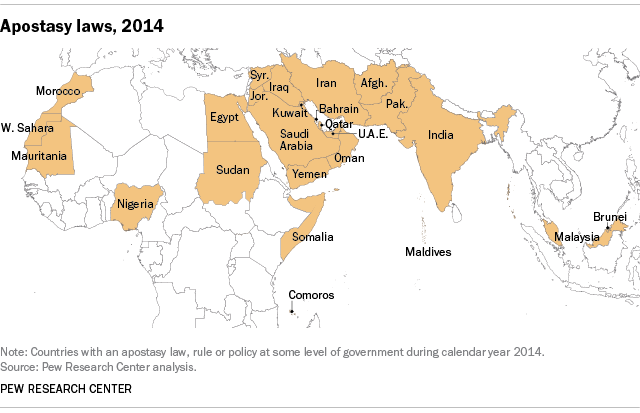
Of course, for most of them it would have been deeply hypocritical for them to have done so.  Here was the Pew Research graphic I used in the post the other day.

apostasy

These countries –  most or all of them members of the OIC –  have apostasy laws in place, making it an offence to leave Islam, let alone to embrace another faith.

Of them, this article from the (UK) Independent reports that

Thirteen countries, all of a Muslim majority, punish apostasy (the renunciation of a particular religion), or blasphemy with death.

The annual Freedom of Thought report by the International Humanist and Ethical Union, found that 13 countries impose capital punishment upon people simply for their beliefs, or lack of them.

Afghanistan, Iran, Malaysia, Maldives, Mauritania, Nigeria, Pakistan, Qatar, Saudi Arabia, Somalia, Sudan, United Arab Emirates and Yemen are the relevant countries.

Not that often enforced these days perhaps, but the law nonetheless.    All countries that will have been represented in this Organisation for Islamic Cooperation meeting, attended by Winston Peters and Jenny Salesa.

My concern here isn’t primarily with the OIC countries themselves.  Their governments –  very few democratic, few even allowing genuinely open political debate and scrutiny –  make their choices and New Zealand can’t change those.

My concern is with our own government.  I could suggest that they’ve been played by Erdogan and OIC, except that that might suggest they didn’t know what they were doing. I suspect they knew exactly what they were doing, and went ahead nonetheless.

We can be proud of our religious freedom and tolerance – hard-won –  and our government (Prime Minister, Foreign Minister on down) shouldn’t sully that good name by associating on such issues with a group of regimes that (mostly) have little or no regard for genuine religious freedom, and show no intention of granting it to their own people, or even to non-citizens living in their countries.

It is shameful, (presumably in some warped conception) opportunistic, and disrespectful of the values and practices of almost everyone who lives in this country.

People have been queuing up to laud the Prime Minister this week.  Some of it is probably due, much of it probably not, but on this significant foreign policy aspect of her government’s response she has allowed a pretty awful standard to prevail.


UPDATE: Not on the specific point of this post, but a chilling action by a government official nonetheless.  As people were pointing out, Mein Kampf is legal, the writings of Mao are legal (as they should be), but New Zealanders are now not supposed to see –  or cite – a document backgrounding perhaps the worst crime in New Zealand history.


Rereading the UN Compact on Migration

To listen to some of the more overblown rhetoric this week, you’d could only conclude that the speakers/writers thought that anyone opposed to the UN Compact on Migration –  signed late last year by many countries, including New Zealand, but boycotted by another 29 (including 9 EU countries, the US, and Australia) –  was at least indirectly responsible for Brenton Tarrant’s¹ [alleged] act of evil last Friday.

Most directly in their sights, so it seemed, was the National Party which (rather belatedly) opposed the Compact, promised to withdraw from it if/when returned to government, and had been running a petition of some sort opposed to it.  National didn’t help themselves by, whether through incompetence or something worse, initially giving erroneous stories about when the petition had been taken down.  Straight after the shootings appeared to be the final story.  As if they were now embarrassed by their previous stance – or simply anticipated the deranged rhetoric of the last few days.

I went back and reread the UN Compact this morning.   I came away with much the same view as I’d taken in December.   The document is unnecessary (as, largely, is the United Nations), statist, strongly pro-immigration….and it is a little chilling in a few places.  More than enough reason not to sign it –  the world is, after all, awash with largely meaningless resolutions, including from the United Nations, and that shouldn’t be encouraged.  But as I noted in my single post back then, I hadn’t written anything about it previously

as not only was it a non-binding political declaration, but most of it seemed more relevant to countries dealing with substantial illegal migration (and with migration mainly from very poor or disrupted countries – again, not the main situation in New Zealand).

I was, and remain, more than a little suspicious of National’s belated commitment to the issue.

My suspicion remains that National’s stance is more about positioning relative to New Zealand First –  the contest for provincial votes –  than anything of substance.

But perhaps I’m being unfair to them.

What follows is the heart of my earlier post, without blockquoting it all.

But it still isn’t clear to me quite what additional damage would be done by signing up to this pointless agreement.   Sure, even “non-binding” agreements will, at times, be used in domestic and international fora as a rhetorical stick to beat governments with if they ever look like stepping out of line with the mainstream.  But those sorts of arguments rarely deflect a government for long if it has domestic public opinion behind it in some direction or another (for good or ill).

There is some questionable economics in the document.  For example

Promote effective skills matching in the national economy by involving local authorities and other relevant stakeholders, particularly the private sector and trade unions, in the analysis of the local labour market, identification of skills gaps, definition of required skills profiles, and evaluation of the efficacy of labour migration policies, in order to ensure market responsive contractual labour mobility through regular pathways.

Or, alternatively, one could just let the market work it out.  When there are incipient skill shortages, wage rates tend to rise.  Same thing happens when, for example, bad weather creates a shortage of spinach or lettuce.    But, daft as the economics is, this stuff is the mindset of politicians and officials adminstering immigration schemes all over the western world. including New Zealand.  Recall that in New Zealand the current government is trying to get more actively involved in this sort of thing.

There are also totally vacuous bits, like the commitment to support and promote the United Nations International Day of Family Remittances.  Just what the world needs: another United Nations “day”.

Perhaps three clauses troubled me a little more.

There was this one

Enable political participation and engagement of migrants in their countries of origin, including in peace and reconciliation processes, in elections and political reforms, such as by establishing voting registries for citizens abroad, and by parliamentary representation, in accordance with national legislation.

I guess I can see what they are probably driving at (diasporas helping the reconstruction of the country of origin after say a protracted civil war). But, normally, we should expect migrants to commit themselves to their new country and its processes and political values and not be creating doubts about where their loyalties lie.  But in a country in which Jian Yang and Raymond Huo are MPs –  while still closely associating themselves with political interests in their country of origin –  and people like Yikun Zhang appears encouraged to play both sides –  it is hard to see how this particular provisions make things here any worse than they already are (around a small handful of our migrants).

And then there was this one

Promote mutual respect for the cultures, traditions and customs of communities of destination and of migrants by exchanging and implementing best practices on integration policies, programmes and activities, including on ways to promote acceptance of diversity and facilitate social cohesion and inclusion.

Which presents the issues as symmetric when they really should be asymmetric: the focus should be on encouraging the assimilation of the migrants, and ensuring their respect for the “cultures, traditions and customs” of the destination community –  just as when you go to someone else’s place for dinner you respect their practices, table manners etc.   One could also argue that encouraging “acceptance of diversity” and facilitating “social cohesion” are two contradictory, often mutually inconsistent, goals.  But again, flakey as all this stuff is, it is the way our bureaucratic and political “leaders” think and act anyway.  If the behaviour is a threat, it is hard to see that the UN agreement would be more of one.

Relatedly

Support multicultural activities through sports, music, arts, culinary festivals, volunteering and other social events that will facilitate mutual understanding and appreciation of migrant cultures and those of destination communities.

Quite what business this is of the UN –  or even of national governments actually – one has to wonder, but there is the “globalist” mindset for you.   And, again, it is pretty much what central and local governments do anyway.  I was interested that “religion” wasn’t on the list

And then, of course, there is Objective 17 (of the 23 in the document) which I have seen people express more serious concern about.

OBJECTIVE 17: Eliminate all forms of discrimination and promote evidence-based public discourse to shape perceptions of migration

We commit to eliminate all forms of discrimination, condemn and counter expressions, acts and manifestations of racism, racial discrimination, violence, xenophobia and related intolerance against all migrants in conformity with international human rights law. We further commit to promote an open and evidence-based public discourse on migration and migrants in partnership with all parts of society, that generates a more realistic, humane and constructive perception in this regard. We also commit to protect freedom of expression in accordance with international law, recognizing that an open and free debate contributes to a comprehensive understanding of all aspects of migration.

If that isn’t muddled I don’t know what is –  let alone, unrealistic (in no conceivable world are “all forms of discrimination” going to be “eliminated”).

The specifics under that Objective include commitments to

Enact, implement or maintain legislation that penalizes hate crimes and aggravated hate crimes

So-called “hate crime” legislation is almost always bad law and bad policy.  Punish assaults or murders or whatever as that: bad and unacceptable acts, regardless of who they are committed against or why.

And this

Promote independent, objective and quality reporting of media outlets, including internet based information, including by sensitizing and educating media professionals on migration-related issues and terminology, investing in ethical reporting standards and advertising, and stopping allocation of public funding or material support to media outlets that systematically promote intolerance, xenophobia, racism and other forms of discrimination towards migrants, in full respect for the freedom of the media.

Again, muddled at best.  You want to stop any public funding to outlets whose views are “unacceptable”, while having “full respect for the freedom of the media”.   Since I’m not entirely convinced there is a good case for public funding of any media outlets –  and since the publicly-funded outlets in New Zealand are champions of high immigration and all “worthy” leftist causes anyway –  it isn’t clear what difference this might make in New Zealand.    And there seem to be some MPs –  particularly in Labour and the Greens –  who aren’t too keen on allowing free speech on such issues anyway, whether or not we sign up to UN non-binding declarations.

And finally under Objective 17

Engage migrants, political, religious and community leaders, as well as educators and service providers to detect and prevent incidences of intolerance, racism, xenophobia, and other forms of discrimination against migrants and diasporas and support activities in local communities to promote mutual respect, including in the context of electoral campaigns.

All very asymmetric –  nothing at all about engaging with communities that might be uneasy about high immigration, or the immigration of groups with values antithetical to those of the destination community.  Perhaps, in some respects, this commitment troubles me more than most.   “Intolerance” is not an offence (in principle or in law) and it is the perfect right of people to debate –  perhaps especially in election campaigns – the future composition of their society.   A Saudi Wahhabi, a Chinese Communist Party zealot, an American evangelical, and a French secularist are all very different sorts of people. In large numbers, each group transplanted to (say) New Zealand would make a material difference to the society and polity we have here.  Those debates matter –  unless, apparently like the authors of this document –  you regard all differences of culture, politics, religion etc as superficial rather than fundamental.

March 2019 here again.

Rereading that, it still seems about right (and in fact we’ve had chilling signs of the antipathy to free speech from a number of quarters this week).

In their opposition to the compact, National repeatedly asserted that our sovereignty was going to be compromised.  I never quite saw them explain how.   But at the time of the earlier post, some people who were more negative than I was on the document highlighted a risk that –  although the agreement is formally non-binding on governments – our local courts could, or would, over time seek to introduce the provisions of the agreement (and the fact of it) into judicial rulings on immigration issues in New Zealand.   Such judicial conduct is not unknown.  Perhaps that was some of what National had in mind.

I’m not a lawyer, so am not sure how significant a risk that is.  But I guess at the time my response had a number of strands:

  • parliamentary sovereignty is still intact in New Zealand.  Even if it is bad form to legislate retrospectively (re a specific case) there is never anything to stop Parliament legislating to, in effect, counter any tendencies of judges to import non-statutory documents of this sort into their decisionmaking,
  • more substantial and important questions probably should be asked about how we appoint – and who we appoint –  as top tier judges in New Zealand.   These are, inevitably and sadly, somewhat political roles –  not party political so much, as “ideological”.  I had a post last week suggesting a more open process for scrutinising and confirming senior judicial appointments (as well as term limits).    That still seems a higher longer-term priority than a single non-binding UN document, even one with somewhat chilling language in a few areas.

And the third strand –  decisive to me –  was this, with which I concluded December’s post

As I said at the start, there is no obvious need for this document.  And even if there were obvious gaps, the very fact that it is a non-binding political declaration suggests it could meet no substantive need.  But in a New Zealand context, there are policies and practices around immigration that are much more damaging and threatening, particularly to our long-term economic performance, and perhaps in other areas too.  Among them:

  • the immigration policies of the National Party
  • the immigration policies of the Labour Party
  • the immigration policies of the Green Party
  • the immigration policies of ACT, and
  • the immigration policies of New Zealand First

I think that pretty much covers the spectrum.

There is no conceivable universe in which some international declaration –  or even agreement – around immigration would be more liberal and (in our specific economic circumstances) more damaging than what our political parties have done to us all by themselves.

And since Simon Bridges was asserting the other day

“If you look at our immigration position, I think we have the strongest pro-migration position across the Parliament.”

I think you’ll see my point.  As it is, I’m pretty sure he is wrong in his claim. ACT and the Greens, from apparently opposite ends of the political spectrum, beat him to the title.

But to suggest that National should be whipping themselves, or ashamed of their stance on the Compact, is just absurd –  and worse.  (Their ongoing support for our high immigration policies is another matter).  It is, like so many areas of public policy, something around which reasonable people will differ, perhaps quite strongly.  That is the stuff of politics, and indeed of life –  perhaps the more so, the more diverse (ideologically, religiously or the like) your society is.  Ideas matter.  Even non-binding declarations are championed for a reason –  so much energy wouldn’t be expended on them otherwise.  It is reasonable, perhaps, to pose the question to the champions –  or even those more indifferent –  “if it is so inocuous, what’s the point?  Why does it matter so much to you?”


  1. I won’t be following the Prime Minister’s stance of not mentioning the name of the [alleged] killer (nor, I presume, will our courts).   I thought this op-ed from the Jerusalem Post dealt with that issue well.   We think no better of Hitler or James Earl Ray or Sirhan Sirhan for mentioning them, and their acts of evil, by name.   More specifically, I’m a Christian and our faith teaches that no one is beyond the possibility of God’s grace. Those are hard words to hear, and at a civil level I’d be quite content if we’d had the death penalty in place.  But vile as the acts were, Tarrant was –  and is – a human being.  And, as Solzhenitsyn sagely put it, the line between good and evil runs not between people or states, but through every human heart.

Why is the Deputy Prime Minister going to Istanbul?

The government seems determined to do its utmost to assist in the election campaign of the odious Turkish President Erdogan.  It surely cannot be their conscious intention, but how else to read what they are doing?

There are local elections in Turkey next weekend. The Financial Times reports that the ruling party is facing the possibility of losing control of the capital city, Ankara.  The economy –  which has done remarkably well in recent decades (as I’ve noted here, real GDP per hour worked is now almost equal to New Zealand) – is currently in a sharp downturn.

Erdogan appears to be trying to bolster his local appeal by wrapping around himself some sort of self-acquired mantle as a leader among Islamic states.

And thus, although no Turkish citizens were killed in last Friday’s dreadful attacks in Christchurch, suddenly the Turkish Vice-President and Foreign Minister are in New Zealand.  There are motorcades in Christchurch and even a meeting with the Governor-General.   What was the government doing agreeing to even this visit?  Didn’t their advisers tell them how this would most likely be used?  And, to add insult to injury, this is a Turkish government that –  like all Turkish governments – actively denies (and threatens states that say otherwise) the active involvement of Turkish authorities in the Armenian genocide, one of the most hideous events in an awful war.

And that was before we learned of Erdogan using clips from the shooting video in his election rally, amping up the rhetoric with talk of Gallipoli and how the landings in 1915 had been anti-Muslim in nature, and talking of sending people (New Zealanders and Australians) home in coffins.  Perhaps it played well to his base, but not only was it irresponsible and inflammatory, it wasn’t even remotely historically accurate.  Turkey –  or its predecessor the Ottoman Empire –  actively chose to enter the war on the German and Austro-Hungarian side.  Right up to the outbreak of war the British had been helped develop the Ottoman navy.  I’m not relitigating the rights and wrongs of the First World War, but it was their choice.  The German establishment at the time was firmly Protestant.   The New Zealand government history site tells us

Enver grew impatient. On 25 October 1914, without consulting any of his ministerial colleagues, he ordered Admiral Souchon to take the Ottoman fleet, including the German-crewed ships, into the Black Sea to attack the Russians. The fleet carried out surprise raids on Theodosia, Novorossisk, Odessa and Sevastopol, sinking a Russian minelayer, a gunboat and 14 civilian ships. On 2 November, Russia declared war on the Ottoman Empire. France and the British Empire, Russia’s wartime allies, followed suit on the 5th. Enver Pasha had succeeded in bringing the Ottoman Empire into the First World War on the side of the Central Powers, Germany and Austria-Hungary. Whether he would be as successful in achieving his principal war aim – pan-Turkic expansion into Central Asia at Russia′s expense – was another question.

Erdogan can play domestic politics all he likes.  That is his problem, and that of his people/country.   But we should hold our officeholders to account for their (in)actions and words.

We are told that our Foreign Minister has had a quiet word to the visiting Turkish politicians.  But we’ve heard nothing from our Prime Minister.  By contrast, Scott Morrison has openly demanded an apology from Erdogan.  I’m sure he won’t get one, but at least he has put his cards on the table, and stuck up for his country.

What is our government doing?  Well, a press release yesterday told us that the Foreign Minister (Deputy Prime Minister in this coalition government) is off to Turkey, of all places, accompanied by another government minister.

“Our current intention is then to travel onwards to Turkey, at the request of the Turkish Government, to attend a special ministerial meeting of the Organisation of Islamic Cooperation being held in Istanbul.

“This important event will allow New Zealand to join with our partners in standing against terrorism and speaking up for values such as understanding and religious tolerance.

So, late in his election campaign, having insulted New Zealanders –  past and present –  Erdogan summons a meeting and our government comes running.   How does he supppose the state-dominated media in Turkey is likely to present that?  As if New Zealand has anything to answer for to Turkey.

And that is before we get to even consider this meeting of the Organisation of Islamic Cooperation.  This is such an odious organisation that just recently they issued a collective official statement endorsing the treatment of Muslims in Xinjiang by the People’s Republic of China.  I’ve been critical of our government for saying and doing nothing on that issue, but not once have I supposed that the Prime Minister and her Foreign Minister think it is all just fine (they leave that stance to Todd McClay). To his credit, Erdogan has actually been a rare leader to criticise the PRC over Xinjiang, but this is a meeting of the OIC itself Winston Peters is to attend.

And what messages does he envisage?  They will jointly speak out against terrorism –  no problem with that –  but they will also, we are told, speak up for “values such as…religious tolerance”.   Really?     It would be great if they both did it and meant it, but a significant proportion of the member countries of the OIC have apostasy laws on the books.

apostasy.png

And a significant proportion of those countries actually provide the death penalty as the punishment for leaving Islam.  I’ve listened to church leaders talk about the extreme courage of (rare) converts.  Tolerance in these countries means if you are born and raised Christian, Jewish or whatever you can stay that way, but no one is allowed to convert out of Islam.

It isn’t true of all countries.  Turkey is pretty good on the religious freedom score.  But  –  given the laws on their own statute books, freely chosen – any talk of religious toleration by the OIC is almost certain to be less than entirely honest.  And Winston Peters will be giving them cover by attending this meeting, just as he’ll probably be grist to Erdogan’s election campaign by turning up in Istanbul at all at a time like this.

Perhaps he will use the visit to make a strongly-worded call for an apology from Erdogan and for (too much of) the Islamic world to embrace genuine religious freedom –  the right to adopt or to leave a religion.  But I’m not holding my breath.

NZ Police help the PRC repression [UPDATE]

[As noted below, despite checking several websites, including that of the PRC Embassy, the first part of this post was clearly in error. Accordingly I have updated the title of the post.   The second, and more substantive, point stands.]

Like everyone else I guess, I’ve been following pretty closely the coverage of the Christchurch attacks.    And in the course of all that I’d noticed various statements of condolence from various overseas governments.  Some perhaps perfunctory (it is the sort of thing decent governments do), others genuinely shocked and heartfelt.  I found it quite moving that the UK government was flying flags at half-mast on Friday.   But there were also statements from the French government, the German government, the Canadian government, various arms of the US government from the President down, the Norwegian government, the EU, the Australian government, the Dutch government, and that was before we even got to various Muslim-majority countries, some of whom had citizens killed in the attacks.

But, it appears, nothing at all from the government of the People’s Republic of China.  It is not as if they are unaware of the attacks –  when I checked there was a story in the Global Times and, searching for the Dutch response, the story I found was actually on Xinhua.   As we are often told, New Zealand firms do more business with firms from the People’s Republic of China than with firms in any other country.  There are lots of PRC nationals living here.  And barely two years ago, the then government (in the form of Simon Bridges) signed up to some aspirational goal of a “fusion of civilisations” with the PRC (in the Belt and Road MOU).  There is lots of talk from both sides  – and their champions – about wanting relationships of “mutual respect”.  It is has never been clear to me why we would want to respect such an evil regime, but I’m not the Prime Minister, Opposition leader, or the New Zealand China Council.  They do.  They claim to believe the rhetoric, even though the evidence (globally) is that the PRC has no respect for any other country; just that some are useful to them at times.  They seem pretty clear-sighted about that; it is our leaders who are deluded and/or attempt to delude us.

Perhaps I’ve missed some message, but you can check the (typically very useful) PRC Embassy website for yourself.    I’d count on the China Council to have tweeted a link to any statement of condolences, but there is nothing there either.   There is simply nothing visible.  Perhaps (or perhaps not) there was some quiet behind the scenes statement to MFAT, but friends don’t hide messages of condolence in circumstances like these.

(UPDATE:  It appears I had missed a statement of condolence. Thanks to the reader who drew this to my attention.)

Of course, the PRC is open to a “damned if you do, damned if you don’t” risk.  After all, as a matter of official government policy, the PRC authorities currently have interned, in concentration camp conditions, an estimated 1.5 million Muslim Uighurs in Xinjiang.    People have been physically abused in these camps, denied all rights, and some have even been killed.  There are credible reports of the PRC using imprisoned Uighurs as a source for the large-scale PRC organ transplant business.  But even with this record, it is still quite a lapse for the PRC to have offered no official condolences on the mass murder of 49 (Muslim) people in New Zealand.  One of those small things that helps bring home the sort of regime the PRC is, and they way view a country like New Zealand (hint: not at all as the Prime Minister or the Leader of the Opposition would like us to believe).

(In fact, given that in Tarrant’s manifesto he is reported to have indicated [words amended to minimise risk re the Ardern govt’s censorship regime] that the country he most admires is the PRC –  ethnonationalism and all that I guess – you might have thought the PRC authorities would have been going out of their way to offer condolences.  Except that…….they didn’t.)

As I noted the other day, our Police –  certainly with the acquiesence of MFAT, and probably with that of the government –  has made itself party to aiding and abetting the dreadful abuses in Xinjiang (and elsewhere): their Assistant Commissioner is a visiting professor at the

People’s Public Security University of China – the first foreigner to hold such a role.

The university is where China’s Ministry of Public Security (MPS) trains the elite of China’s police. …..

The Ministry of Public Security does this dreadful stuff, and our Police are signing on to help (not, of course, consciously re that particular aspect, but it is all one organisation, and Police and MFAT know very well what they do –  not just in Xinjiang, but as instruments of oppression right across the country).

Perhaps now, once they have a few spare minutes, it might be time for Mike Bush, the Police Commissioner, to reconsider and tell his Assistant Commissioner to pull out of his visiting professor appointment, and stop assisting in the oppression of (inter alia) Muslims in Xinjiang.    If he lacks the decency, the imagination, the moral compass to do even that, then it is about time that the Prime Minister and Minister of Foreign Affairs get the Minister of Police in a room and tell him to instruct the Commissioner to discontinue that relationship.

The New Zealand Police aiding and abetting the PRC (absence of) system of repression was appalling enough a few days ago.  With 49 dead Muslims in Christchurch –  and not a word from Beijing – it is well past time for our authorities to come to their senses, and completely dissociate ourselves, and our people, from the oppression in Xinjiang.

(Perhaps some belated PRC message will finally come, but it is now 2:15 on Saturday and there is still no sign of anything.  Times like these help confirm who your friends really are.)

Almost unbelievable

I was about to settle in for the rest of the afternoon writing a review article of an interesting (but obscure) book on aspects of US monetary policy, when a reader sent me a link to an astonishing article from the New Zealand Police website.   In it we read

As he prepares to bring down the curtain on eight years as our man in Beijing, Assistant Commissioner Hamish McCardle has received a rare honour from his hosts.

He has been appointed Visiting Professor at the People’s Public Security University of China – the first foreigner to hold such a role.

The university is where China’s Ministry of Public Security (MPS) trains the elite of China’s police. …..

The university and the Royal New Zealand Police College have had a bilateral training relationship since 2016. ……

He says the university appointment is an endorsement of the healthy state of the New Zealand-China bilateral relationship, and “underscores the idea that New Zealand has values and ideas worth considering in the Chinese context”.

It also aligns with the aims and values of the New Zealand-China Friendship Society and the pioneering work of New Zealander Rewi Alley who fostered a life-long friendship with China from the 1930s.

I don’t have any particular problem with Police having a person in our embassy in Beijing.  The day job had “a focus on disrupting the flow of drugs and precursors to New Zealand”.  That sounds fine.

But in accepting this “honour”, have the Police, MFAT, and their political masters lost sight completely any sort of moral compass?

The People’s Republic of China is a country where the Chief Justice himself proclaims that the rule of law is not something for China.  The Party rules.   It is a country where the Ministry for Public Security plays a key role in imprisioning a million or more people in Xinjiang.  I’m sure they do basic policing work as well –  Chinese have road accidents, and break-ins just as we do –  but this is the New Zealand government actively participating –  on a ongoing basis – in making the repressive apparatus of the PRC state better and more effective at doing its job.  A big part of that job is an instrument of systematic repression –  political, religious, or whatever.    Political loyalty –  to the CCP – is, not surprisingly, a key element in recruitment, and presumably even more so at those studying to be “the elite of China’s police”.

And what about that weird stuff in the final paragraph of the quoted excerpt?  The New Zealand-China Friendship Society has been around for decades and long-served as a Beijing front organisation in New Zealand, right through the horrors of the Great Leap Forward, the Cultural Revolution, and on to their total silence today about repression in Xinjiang.    And Rewi Alley?   Well, he lived a fairly comfortable life in Beijing after the CCP took over, navigating this way through the thickets of changing CCP politics, reaching new lows when he published a jointly-authored book near the end of the Cultural Revolution defending the regime at its worst.  What possesses our Police to think these are “aims and values” to champion?   Why not, for example, the aims and values of the Tiananmen protestors, the Falun Gong movement, or the (underground) Catholic church?  But that wouldn’t fit the narrative I guess, of prostrating the New Zealand system before Beijing.

Presumably Mr McCardle is a perfectly decent chap, and probably won’t think of trying to import PRC methods to New Zealand policing on his return?  But did he not in the seven years he has been lecturing at this university already,  or does he not now, feel any qualms of conscience at all about abetting evil?  Because that is a big part of what the Ministry of Public Security, elite and otherwise, actually does.

And what of our subservient and deferential politicians?   Does the Minister of Foreign Affairs really feel comfortable with this “honour”?  ( I assume his officials at MFAT think it is just wonderful).  What about the Minister of Police?  Or the Prime Minister?

Or Simon Bridges or Todd McClay?  Or do all our MPs just think it is totally fine –  quite an honour in fact –  for the New Zealand government to be helping the PRC better repress its citizens, better repress freedom, free expression, free worship, free assembly or whatever?

It is a small thing in a way.  But a succession of individually small things build up to a narrative of a government system –  from the top down –  more interested in getting along, and supporting, this evil regime doing its work –  mercenaries, in effect, for trade deals and political donations –  than in representing the interests, values, and traditions of New Zealanders.   For Mike Bush and the New Zealand Police it seems that the values of the China Friendship Society and Rewi Alley count for more.

That’s shameful.

Kudos

I’ve been quite critical of the New Zealand China Council, which uses taxpayer money to champion an emollient, in effect subservient, relationship with the People’s Republic of China.  Doing so, of course, serves the business interests of the other corporate and academic members of the Council.   Whatever the intent, I’ve argued that their approach serves the interests of the PRC, one of the most awful regimes on the planet.

As part of that I’ve noted that it has been hard to find any examples of a case where the China Council has ever said anything critical of the PRC.  They will benignly note, in principle, that our systems differ, our interests differ, but will never articulate specific areas where they are critical of the PRC stance on anything, whether directly affecting New Zealand or otherwise.

And so it is only fair for me to draw attention to a welcome, if somewhat surprising, exception.

A couple of days ago a group of US foreign policy experts issued a joint statement calling for the immediate release by the PRC of Michael Kovrig.

You may recall that Kovrig is the Canadian former diplomat who was detained in China just before Christmas, apparently as “retaliation” over the detention and extradition proceeedings against the Huawei CFO in Canada.  No charges have been laid, and Kovrig is being held without access to a lawyer and with little consular access either.    It looks a lot like a state-sponsored abduction, presumably intended both to intimidate foreigners more generally, and perhaps as some sort of “bargaining chip”.

Late yesterday, I noticed that that tweet (above) had been retweeted by Stephen Jacobi, the Executive Director of the New Zealand China Council, with this comment added.

jacobi

Not only does he associate himself with the call by the US foreign policy experts, but he goes further, adding an unequivocal call also for the release of Michael Spavor, the second abducted Canadian.

Sure, this message isn’t being sent out on the China Council’s own Twitter account, but when you are the chief executive of a body, writing about areas closely related to your employer’s interests, no one is going perceive very much difference.   The Executive Director of the China Council, their high profile public spokesman, has made a public statement that can only be read as unequivocally critical of actions of the PRC.   There might be some price to pay –  perhaps a certain barely-detectible frostiness when next he encounters the PRC Consul-General? – but he did it anyway.

For a picture of what sort of detention Kovrig and Spavor are undergoing, you might want to read this article from someone who was subjected to the same treatment:

The law in China allows for these disappearances. Yes, as reported, Michael’s whereabouts are being kept secret. Yes, he will not be given access to a lawyer. But more so, even China’s prosecutor, who is supposed to monitor these secret detentions, will be denied the right to visit him. In a database that the NGO Safeguard Defenders keep, for which I’m the director, we have never come across a single case where the prosecutor has visited, even though it’s prescribed in law that they should.

Mr. Kovrig, and Mr. Spavor, and future American and European victims can, without any court order, be kept incommunicado, in solitary confinement, for six months. Actually, solitary confinement is only half true – he will have two guards sitting inside his cell 24/7, working in six-hour shifts. These guards, most of whom are civilian-dressed trainees for the Ministry of State Security, will not be allowed to speak to him, but will take notes on his every single movement. They will also stare him down as he uses the toilet, or when he is (rarely) allowed to shower.

Numerous foreign governments (including all our Five Eyes partners) have weighed in in support of Canada and the detained Canadians.  But not New Zealand.

I wrote about the contemptible silence of our government a couple of months ago

Jacinda Ardern and Winston Peters head the New Zealand roll of shame on this issue, since they are the most senior figures in the current government.   But the shame isn’t just theirs.  There is no sign of anything from Simon Bridges, Paula Bennett (perhaps both rather keen on those donations Yikun Zhang was arranging?), or Todd (“vocational training centres in Xinjiang) McClay.   Nothing from the Green Party or ACT leaders.   Nothing from the Minister of Justice (rule of law and all that). And of course nothing from our PRC-born and educated MPs.  In a decent society, they’d be at the forefront of condemning the abuses in the land of their birth.  In our society, it seems to be just fine that they keep very very quiet –  a silence that suits Beijing –  and help ensure that the donations keep flowing.  Perhaps a journalist might consider asking Raymond Huo his opinion on the abduction of the Canadians.  He was, after all, formerly a lawyer with a leading local law firm, and now he chairs the Justice select committee in Parliament.  You’d hope the rule of law meant a lot to him.  But, like his bosses, deferrring to Beijing, and never ever upsetting the murderous rogue state, appears to matter more than the rule of law, or standing by our friends and allies when they (almost inadvertently in Canada’s case) incur the wrath of a tyrant.

By their utter silence, on this as on so many other PRC issues, our MPs and ministers dishonour this country and its people.   Cowering in a corner, deferring to Beijing, is simply unbecoming people who purport to lead a free and independent country.

But credit where it is due.  Well done Stephen Jacobi.  On this, an example to others.

An establishment perspective

John McKinnon is a quintessential New Zealand establishment figure.  He fairly recently returned from a second stint as New Zealand’s Ambassador to the People’s Republic of China, and between those two stints he was first Secretary of Defence for several years and then head of another of those taxpayer-funded influence organisations, the Asia New Zealand Foundation.   And that is not to speak of the extensive family connections, including his brother, the former Deputy Prime Mininster, former Commonwealth Secretary-General, and current chair of the (largely) taxpayer-funded New Zealand China Council.

Having relatively recently retired, McKinnon is now free to speak more openly than during his official career.

On Saturday, McKinnon was interviewed on Newshub Nation about the relationship between the New Zealand government and the authorities of the People’s Republic of China.  It was fairly soft interview – so he was never put on the defensive – and the former ambassador was fluent and endlessly emollient. In many ways, it was quite impressive.  MFAT will have appreciated it, as will senior figures in both government and opposition.  He did far better in spinning a quasi-official line than either the Prime Minister or the Minister of Foreign Affairs could have done.  The Executive Director of the China Council was particularly impressed

And to many, what McKinnon had to say  probably sounded quite plausible.  He has an impressive way with words, sounding very calming without actually saying much.  Thus, we shouldn’t read “too much” into the long-delayed visit for the Prime Minister to Beijing, but presumably it is okay to read something into it.  “It will happen” we were told, but “not necessarily soon”.

The relationship was not, in his words, “in trouble” but “changes are afoot, in China, in New Zealand and in the world”.  “Navigating the relationship” has become “more difficult, more complex”.    There was the occasional reference to our “very different” political and social systems, but it wasn’t clear that Mr McKinnon thought these differences should make any difference to the relationship.  There had been, we were told, lots of conversations in private about things like the South China Sea and it was, on his telling, “helpful” (to whom, for what) to have these “private diplomatic exchanges”.   Treating the PRC –  arch-abuser of human rights, military expansionists of this century –  as some sort of normal country, we were told that New Zealand ‘respects’ PRC concerns, even if we don’t always agree.  Which sounds good I suppose until one remembers what sort of concerns they have –  taking Taiwan, imprisoning a million people in Xinjiang, systematic denial of political or religious freedom, claims that overseas ethnic Chinese have obligations to Beijing, state-sponsored intellectual property theft, and so on.   (Why, if they were serious about an open and reciprocal relationship, the PRC might even have condemned their former national and former intelligence official, Jian Yang, for bringing the good name of the PRC into disrepute by misrepresenting his past on his immigration/citizenship forms.)

And so the emollience went on. It was good that David Parker had been invited to, and would attend, next month’s Belt and Road Forum –  this PRC geostrategic initiative, that seems to have contributed to the intensified repression in Xinjiang.  Good for what one could wonder, except perhaps to reinforce the message last month when the Prime Minister made obeisance to Madame Wu.    Don’t worry, we’ll come quietly.

What of the sought-after upgrade to the preferential trade agreeement with the PRC?  It was not, the former ambassador thought, “at risk” but was “challenging” –  which does have the feel of reframing and re-expressing much the same thought.   It was, he accepted, harder than in 2008.

And the interview ended on an upbeat note.  We might have a very different background and history but the PRC could quite reasonably claim to have (the old line) lifted more people out of poverty than any other society in history.  Which isn’t much claim to fame when (a) you are the biggest country (population) in world history, (b) you immiserated your people (indifferently allowing tens of millions to die) for the first thirty years of your regime, and (c) even now, the material living standards of your people languish far behind the leading east Asian economies (including the one facing a constant military threat from you).  McKinnon did note that, of course, human rights matter.  In what sense –  given the rest of the interview –  wasn’t clear.

Between interviewer and interviewee it was in many ways an impressive performance.  Had many people been watching, who were not familiar with the story beyond recent headlines, it would probably have served the cause of emollience –  go back to sleep, nothing to worry about here.  As it is, I suspect it mostly had value for making those who’ve already thrown in their lot with the “never ever upset Beijing” line feel a bit better on a Saturday morning.  Thus Jacobi’s praise.

In a sense, you can’t blame McKinnon too much.  He’s been a career diplomat, and if he had some hand in shaping the New Zealand government’s approach to the PRC over the years, mostly he has been sent abroad to do the bidding of successive governments. MFAT might be a problem, but responsibility ultimately rests with successive governments. McKinnon on Saturday was about as on-message as he no doubt was throughout his stellar career.   And you can’t really expect him to answer questions he wasn’t asked: not only was there nothing about Taiwan or Xinjiang (“don’t you find shaming, Mr McKinnon, to serve governments that keep quiet in face of such evil?), let alone the PRC activities closer to home, or Messrs Jian Yang and Raymond Huo.  That will have suited the government and officialdom.  But McKinnon is still evidently very much with the programme.  I don’t suppose political party donations are his focus, but trade will have been….and other stuff only to the extent it couldn’t be avoided.  Perhaps when his older brother retires he’ll be considered as next chair of the China Council?

The bottom line for now is that there doesn’t seen to be any material disruption to trade or related matters.  If PRC student numbers and residence visa numbers are down, that has been underway for some time, and most likely not related at all to the recent heightened “complexities” in navigating the relationship.  That’s mostly good of course, and yet the great flurry of concern last month –  led from the craven National Party side –  was a reminder of how readily New Zealand governments seem able to be brought to heel, at the merest hint of a fluttering of the feathers.  That is more concerning.

The interview with McKinnon reminded me of a speech he had given late last year, after he had retired, to the New Zealand Institute of International Affairs.  I meant to write about it at the time, but one thing succeeded another and I’d never got round to it.

The speech is worth reading. It is interesting, and much the most impressive example of its genre (New Zealand establishment re the PRC) I’ve read.  Rereading it today over lunch I was struck by that same effortless emollience we’d seen in Saturday’s interview.  He is very skilled, and still very much the bureaucrat –  he’s retired now, but it was hard to see anything in the speech that he might not have said as Ambassador in Beijing.  And so much skill was devoted to minimising, time after time, the evil of the regime in Beijing and its representatives and champions.

Predictably, the New Zealander Rewi Alley who lived in Beijing for decades under the PRC and wrote propaganda defending its evil gets a positive mention.    Any possible “unfair exploitation of the multilaterial trading system” is “beside the point”. If there is any worry in New Zealand about what Beijing gets up to here, well that seems to be of concern mostly for making life tougher for bureaucrats and politicians (“making for a more complex China policy making environment than we have had hitherto in this country”).    Endlessly understanding too, passing on the message that Beijing “would be troubled” if any measures singled it out –  that suggestion again, that the PRC is just another normal state.    The elevation of Xi Jinping Thought wasn’t a concern, but a sign that “China can evolve”, and while he couldn’t exactly bring himself to praise the decision to remove the term limits for the PRC presidency, he wouldn’t criticise it either, and noted that it did have the upside of aligning the state rules with those for the Party.  He’s good is McKinnon.

He goes on to note that the PRC is now “an internationalised society, where information abounds”.  Just so far as that is information the Party wants people to have, but a shame that the blocks on various social media platforms, major foreign media websites, let alone the re-intensified censorship of domestic opinion didn’t get a mention.   “Arbitrary actions by the state” might look odd to New Zealanders but, he tells us, we have to understand what China has gone through.   The other side of the civil war eventually turned itself into a robust prosperous democracy, but even in retirement McKinnon couldn’t acknowledge the relevance of that.

What of suggestions of PRC interference (“a very contentious debate”) in other countries, and with ethnic Chinese abroad?  Well, none of this should be at all surprising we are told (apparently because a few overseas resident Chinese many decades ago had previously played a role in developments back in China), and shouldn’t (it seems) be troubling to us (or, presumably, the ethnic Chinese, citizens of other countries, on whom the pressure is put).  On that sort of logic, presumably it would be just fine for New Zealand to be seeking to interfere in the domestic politics of the UK –  look at the difference those Brits made here.

As for New Zealand

I have more confidence than some that in New Zealand [I don’t presume to speak for other countries] we have the wherewithal in terms of our law, practices and values to respond if we need to, and to deal constructively with both allegations and facts of interference, whatever country they come from, and so far as China is concerned, in a manner which is in accord with the mutual respect that subsists between us.

But Jian Yang is still in our Parliament, not (at least in public) something that seems to bother either main political party.  Raymond Huo does still chair the Justice Committee and the electoral inquiry.  Wealthy business people, with close ties to Beijing, secure royal honours, in effect for services to Beijing.  The Chinese language media is largely controlled from Beijing.  Ethnic Chinese here comment on the climate of fear many face if they speak up at all.    But the former Ambassador is confidence there is nothing to worry about.  After all, their government respects us (yeah right) and our governments respect them (well, do the kowtow).

And still it goes on.  There is a recognition that New Zealand and China disagree on the South China Sea (although has our current PM ever stated a substantive view on that?) but then the construction and militarisation of artificial island is itself relativised with the totally irrelevant observation that (good guys like) “the Dutch are past masters at it”.  Antarctica?  Anne-Marie Brady has written extensively about PRC interests in polar regions, and some of the threats that poses. For the former Ambassador, just a case of “China is now more present in …Antarctica than it was 10 or 20 years ago”.

New Zealand apparently has little interest in such issues as theft of intellectual property, subsidisation of SOEs, access to the Chinese market for services exporters –  someone else’s problem apparently.  Meanwhile, in perhaps the most obeisant quote in the speech  there was this

New Zealand, as a country which invests in and benefits from the international rule of law, has expectations of China, as it does of other great powers.  That they will comport themselves appropriately, especially towards those who have less power than themselves.  That is the true mark of greatness.  It is pleasing to see how China has responded to these expectations

Unbelievable. The same state that only two months later our own intelligence services would accuse, in a joint effort with other countries, of state-sponsored intellectual property theft.   Most observers believe the recent cyber attacks on Australian political parties and the Parliament was directed from, and for, Beijing.   One could go on of course.  Some “marks of greatness”.

Relativising to the end, we are told it is important to realise how different we are

China is of course very different from New Zealand…  It is important to realise this, as without this understanding we can be blindsided by aspects of China, especially in areas such as the definition and protection of human rights and the like, where our values are very far apart, and where we see or hear of developments in China which are at odds with those of our own.

It isn’t as if Chinese people want repression, abhor democracy, regard the rule of law of law as some irrelevant concept, and have no interest in speaking up and speaking out.  The big differences that count aren’t those between New Zealanders and Chinese citizens, but between New Zealanders, decent people of all races and ethnicities, and the PRC Party/state.  It is as if the retired Ambassador is invoking some quaint trope about the inscrutable oriential, rather than just playing defence for a near-totalitarian evil regime, lest any concerns threaten the flow of dollars (deals and donations).

McKinnon ends noting it doesn’t matter how much we agree (actually, it usually does –  decent enduring relationships, between individuals and states, are usually based on a set of shared values) but on how much “mutual respect” and “mutual benefit” there is.   Ambassador McKinnon can respect the butchers of Beijing –  this 60th anniversary year of the suppression of  the Tibet rebellion, 40th anniversary of Tiananmen Square, 70th anniversary of the regime itself – but I suspect few New Zealanders would choose to do so.

I’m a retired bureaucrat myself, so I can admire the technical skill of a well-honed, nicely rounded, piece of bureaucrat-speech: it is fluent, apparently thoughtful, and emollient.  And yet in a cause that decent people really shouldn’t be championing and defending.  You can –  as McKinnon does –  seek to relativise and minimise almost anything, but to what end?  Other than keeping the deals and donations going.

Late last year, I ran this extract from a speech by the (soon to be former) Australian Prime Minister, Scott Morrison

Our foreign policy defines what we believe about the world and our place in it.

It must speak of our character, our values.  What we stand for. What we believe in and, if need be, what we’ll defend. This is what guides our national interest.

I fear foreign policy these days is too often being assessed through a narrow transactional lens.   Taking an overly transactional approach to foreign policy and how we define our national interests sells us short.

If we allow such an approach to compromise our beliefs, we let ourselves down, and we stop speaking with an Australian voice.

We are more than the sum of our deals. We are better than that.

Wouldn’t it be great if our politicians really acted as if they believe that, especially in their dealings with the PRC.  And found a new crop of officials at MFAT who would effectively implement such a policy.