Raising the inflation target….in 2002

There is a bit of discussion around (internationally more so than in New Zealand) about the possible merits of raising inflation targets, to something centred on 4 or 5 per cent annual inflation, rather than the 2 per cent focal point of most countries’ targets today.  The main argument for doing so is to raise nominal interest rates in more normal times, in turn creating scope to cut policy interest rates further in real terms in future serious downturns.

I doubt it is a viable option at present for most inflation targeting countries, simply because most have largely exhausted conventional monetary policy capacity –  policy interest rates are already near or below zero –  and many are struggling to achieve their current inflation targets.  It is, probably, still an option for New Zealand (with the OCR still at 2 per cent), although in my view raising the target is less attractive an option than taking action to reduce the impact of physical cash in creating a near-zero lower bound on nominal interest rates.  The costs of positive inflation rates may not be that large, but they increase as the target inflation rate increases –  and perhaps especially so in a country like New Zealand where income on financial savings (eg interest, which includes compensation for inflation) is taxed just the same as labour income.

Unlike most inflation targeting countries, New Zealand does have a history of having raised its inflation target.  We started out aiming for 0 to 2 per cent annual inflation rates, and then raised that target to 0 t0 3 per cent at the end of 1996, as one aspect of the National/New Zealand First coalition deal.  The Bank acceded to the change, but had not sought it.

Yesterday I was asked a question about the background to the second increase in the target.  In September 2002 the inflation target was raised from 0 to 3 per cent per annum, to the current 1 to 3 per cent per annum.  Why?   My short answer was “politics”, and this is my fuller answer.  I was quite closely involved –  at the time I was one of the Governor’s three direct reports –  but others will no doubt have slightly different memories/perspectives.

The opportunity for a change in the Policy Targets Agreement (PTA) opened up when in late April 2002 the long-serving Governor, Don Brash, unexpectedly announced his resignation from the Bank, effective immediately, so that he could contest the forthcoming general election as a National Party candidate.  Key figures in the governing Labour Party – in particular the Prime Minister, Helen Clark – were furious, including with the Reserve Bank’s Board which had agreed terms and conditions with Brash that had not required any stand-down periods when he left office.  I can’t speak for all my then colleagues of course, but my impression was that many people at the Bank, while perhaps wishing Don well personally, thought that resigning as Governor to go straight into party politics wasn’t quite the done thing, and risked undermining (albeit at the margin) the reputation of the Bank.

The Bank’s (and Brash’s in particular –  as single decisionmaker) stewardship of monetary policy had been contentious in some circles for a long time.  Both National and Labour stood solidly behind the Reserve Bank Act, and especially its monetary policy arrangements, but the Minister of Finance, Michael Cullen, had been uneasy for a long time as to whether the target framework was too restrictive.  Back in the mid 1990s, as Opposition Finance spokesman, he had actually campaigned to widen the target band to -1 to 3 per cent per annum, and when he had become Minister in 1999 he added to the PTA the explicit requirement to  “seek to avoid unnecessary instability in output, interest rates and the exchange rate”.   No one ever –  in fact, still –  knew quite what it meant, but it was a response to the continuing unease, including that around the monetary conditions index debacle of 1997 to 1998.

The Labour-Alliance government which came to power at the end of 1999 commissioned, as had been promised, an international review of New Zealand’s monetary policy arrangements and the conduct of monetary policy.  Michael Cullen wasn’t looking for radical change –  or he would not have appointed Lars Svensson, one of the academic experts on inflation targeting, as the reviewer –  although there was a sense that he would not have been averse to a recommendation to shift to a committee or Board system for making monetary policy decisions.  In the end, the review was pretty tame –  I was part of the secretariat, at the same time as being a Bank senior manager, and we went to some lengths to encourage Svensson not to be too effusive about the Brash stewardship, fearing that otherwise the report would lack credibility.    Svensson did recommend a move to a committee system, but his proposal –  for a committee of internal senior managers, somewhat akin to Graeme Wheeler’s Governing Committee  – got no political traction.    There was no political mileage in legislating to shift from one technocratic economist making the decision to four or five technocrats making the decisions.

There was also longstanding unease, and puzzles, as to just why New Zealand’s relative economic performance had not improved.  At the time, our exchange rate wasn’t high, but our interest rates were still high relative to those in the rest of the world, and there was no sign that the income or productivity gaps to the rest of the OECD were beginning to close.  There was questions around whether somehow something in the way monetary policy was being run, or the way the target was specified, was somehow contributing to the medium-term real economic underperformance.  Were we, for example, by holding interest rates so high unintentionally lowering potential GDP growth? In some circles there was a sense that the Bank jumped at shadows –  raising interest rates at the first hint of inflation, and never “gave growth a chance”.  As people pointed out from time to time, our inflation target was lower than Australia’s, but our interest rates typically weren’t.

Add into the mix the government’s unease with Don Brash’s views of the wider economic policy framework.  His speech at the August 2001 Knowledge Wave Conference, on how best to accelerate economic growth, didn’t go down well with the government (understandably –  I think those internally who had seen the draft were all pretty much of a view that it was material that should be saved for his retirement).  It all seemed to just add to a sense that something was wrong at the Bank, and in how monetary policy was being run.

Actually, the Bank had been quite aggressive in easing policy during 2001, probably more so that (with hindsight) was warranted.  The US recession, and the 9/11 attacks, prompted pre-emptive easings, from an institution determined not to make Asian crisis mistakes again.  But by early 2002, the talk was turning again to the prospects for OCR increases.  There had already been two 25 basis point increases by the time Don Brash resigned, and the projections and policy statements foreshadowed a lot more increases to come.

It is also worth remembering that, at the time, just over a decade into inflation targeting, the Bank had had inflation out-turns averaging well above the midpoint of the inflation target range.  That track record continued right through until the 2008/09 recession, and it made us unusual by the standards of inflation targeting central banks –  the more so, perhaps, because our rhetoric often stressed the importance of focusing on the midpoint of the target range (to maximize the chances the inflation would be within the target range).     This chart illustrate the track record –  although note that, at the time, we did not have either of these particular core inflation measures (they are just readily to hand).
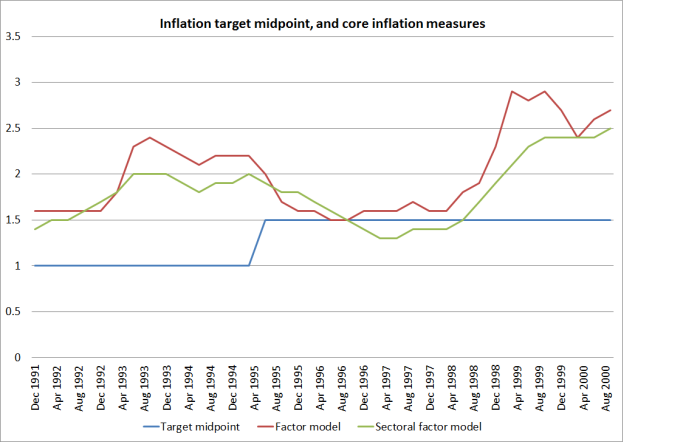
target change in 2002

Inflation had been above the target midpoint throughout almost all the inflation targeting period, had never (in core/underlying terms) been in the 0 to 1 per cent part of the range, and by now (mid 2002) inflation was not only in the upper half of the range, but was rising.

Deputy Governor Rod Carr was appointed as acting Governor once Don Brash resigned, and he took the next few OCR decisions, and did the associated communications.  The OCR was raised at both of his first two OCR decisions, and in the May 2002 MPS in particular, Carr’s rhetoric was (and was widely seen as) very hawkish –  words of man who might be champing at the bit to raise the OCR.  The May projections had envisaged another 150 basis points of OCR increases over the following year or so which would, so the projections showed, bring inflation progressively back to around the middle of the inflation range.

In the Beehive, there seems to have been a sense that they definitely didn’t want the Board nominating a “Brash clone” as Governor, and a real unease about what another 150 basis points of OCR increases would do to the prospects for the sort of “economic transformation”, including the growth in the export sector, they were seeking.  What, people might have asked themselves, was the point of having really large OCR increases to get inflation to the midpoint of the target range when it had never been there for long previously?  And since (core/underlying) inflation had never been in the zero to one percent part of the target range, why not just pull the range up a bit?  To do so, it could be argued, wouldn’t change anything much.

Throughout this period, Bank staff were at work on a major series of background briefing papers to help whoever was nominated as Governor, and perhaps the Minister, in negotiating a PTA.  For the first time, since the Act had come into effect, we passed the real possibility of an outside appointee, perhaps with little or no background in monetary policy.  I can’t now see that collection of papers on the Reserve Bank’s website (but will happily link to them if they are there: UPDATE: they are here) but suffice to say that they did not advocate a change to the PTA, or to the inflation target specificially.  They were not, by any means, doctrinaire on the importance  of the current target range, but saw little prospect of any real economic gains from raising the target.

In the Beehive, there was also a bit of a sense that if Australia could do just fine –  indeed, so it was seen, to prosper – with an inflation target centred on 2.5 per  cent annual inflation, perhaps we should move to adopt the same target.  I gathered that the Prime Minister in particular was quite keen on that option.

In the end, the Secretary to the Treasury, Alan Bollard was appointed as Governor.  He agreed to change the target in two ways.

The first was eliminating the 0 to 1 per cent part of the target range, so that in future the target would be 1 to 3 per cent annual inflation.  My understanding/memory is that he did not see this as a route to higher inflation, but rather to cementing in something more like the average inflation outcomes of the previous few years.  But it ruled out the need to tighten simply to get back to a target midpoint on 1.5 per cent.  To Alan’s credit, he strongly resisted the Prime Ministerial preference for adopting the RBA’s target, centred on 2.5 per cent.  Staff advice was that a target as high as that could not really be considered consistent with the statutory requirement to pursue and maintain price stability.

The second was to introduce the concept of a medium-term horizon explicitly into the PTA, as in these extracts

For the purpose of this agreement, the policy target shall be to keep future CPI inflation outcomes between 1 per cent and 3 per cent on average over the medium term.

3. Inflation variations around target

a) For a variety of reasons, the actual annual rate of CPI inflation will vary around the medium-term trend of inflation, which is the focus of the policy target.

Since we had always run inflation targeting looking out at the medium-term projections, it was never entirely clear to what extent this change was substantive, and to what extent it was (as with many PTA changes) rhetorical –  making explicit what was already happening.

Shortly after he took office, Bollard gave a speech in which he tried to explain how he interpreted the new PTA.  The speech was much haggled over internally, and so what emerged was pretty carefully considered drafting. The key passage was

The key change in the agreement is that the inflation target has been explicitly defined in terms of “future inflation … on average over the medium term”. This implies that monetary policy should be forward-looking, and avoid getting distracted by transitory fluctuations in the inflation rate. In typical circumstances, we expect to give most attention to the outlook for CPI inflation over the next three or so years. If the outlook for trend inflation over that period is inconsistent with the target, we will adjust the Official Cash Rate. Our intention will be that projected inflation will be comfortably within the target range in the latter half of the three year period.

Note that the “key change” in his view was not the increase in the target –  consistent with the notion that the unused portion of the range was just being dropped off –  but the “on average over the medium-term wording”.  There are no references left to the midpoint of the target range, just a focus on being “comfortably within” the target range when we looked at projections 18 months to three years ahead.

I recall writing an internal paper, probably as part of haggling over this speech, arguing that if anything the new PTA might have given us less (or at least not more) flexibility –  a narrower target range balanced against the “on average over the medium-term” wording.

Bollard operated with the same operational autonomy over the OCR as others Governors had.  But I think those of us there at the time felt that he had much the same unease about how the Bank had been run –  and about the anti-inflation inclinations of key personnel –  as the Beehive did.  It wasn’t that long after he took office that the OCR was cut by 75 basis points.  As always, there were economic arguments that could be made for and against those cuts –  at least one seemed reasonable to me at the time –  but they proved quite ill-fated.  They had to be reversed, and more, although it took too long to do so –  and to his credit, at the end of his term, Bollard explicitly acknowledged that the cuts had been unnecessary.  The cuts, and the slow reversal of them, set the stage for core inflation increasing to above 3 per cent over the following few years.   Without the Policy Targets Agreement change, it would have been a little harder for that particular mistake to have been made.

(In discussions about raising inflation targets, a focus is often on the response of inflation expectations.  In a sense, Alan Bollard was gifted a modest “free lunch” –  he could stimulate the economy a bit more than otherwise in the short-term –  because there was no immediate increase in survey measures of inflation expectations when the target midpoint was raised, perhaps reflecting some sense that –  whatever our rhetoric –  the 0 to 1 per cent part of the old range had already become something of a dead letter.)

So, as I said, it was politics rather than solid economic analysis that drove the 2002 PTA changes.  To the extent that it reflected unease about New Zealand’s economic performance, they were good questions, but the wrong answer.  The same could, of course, be said for the desire of Labour, the Greens and New Zealand First to change the Reserve Bank Act now (rather than just the PTA).  There are real economic challenges and puzzles around New Zealand’s long-term economic underperformance, but changing purely nominal measures – like the way an inflation (or related) target is specified  –  is likely to be almost wholly irrelevant to responding to those problems,
 

A former Prime Minister and Minister of Finance on immigration policy

A couple of weeks ago we had a family holiday in the Bay of Islands. It was almost 20 years since I’d been that far north, to a part of the country suffused with New Zealand history.  It is also a part of the country where some of tensions and divisions are still pretty visible. The visible divide between prosperous, heavily European, eastern towns, and the poorer browner inland areas is one example, but I was also struck by how often I saw the 1835 United Tribes flag flying.  In a country where flags are flown much less often than in, say, the United States, it was hard to miss.

As we looked over the historical sites and talked to the kids about New Zealand history, it had me wondering again, rather uneasily, about Maori perspectives on immigration in New Zealand history.  Scholars can debate quite what mix of factors led various Maori leaders to agree to sign the Treaty of Waitangi, or what they thought they meant in doing so.  But by some mix of consent and proclamation in and around 1840, the British government acquired control of New Zealand, and international recognition of that new possession.  At the time, the European population was probably no more than 2 per cent of the total population of New Zealand.

Mass European immigration wasn’t a specific article in the Treaty.  Many of the Maori leaders probably welcomed some immigration –  which had brought, for many, trade opportunities, education, Christianity and so on (as well as law and order problems etc).  But I don’t suppose anyone signing the Treaty, or probably anyone associated with establishing colonial government in New Zealand for that matter, really thought much about how the numbers would eventually turn out.

But whether it was foreseen or not, the numbers quickly changed.  Even by the mid 1850s, it is estimated that Europeans and Maori were roughly equal in number, and the immigration associated with the gold rushes further skewed the numbers towards European dominance, especially in the South Island.  Since then, of course, the numbers have swung ever further against Maori –  complicated by intermarriage.  Whatever benefits there might have been from the immigration, it is hard not to avoid a conclusion that it has created a society in which Maori are marginalized –  in important respects – in what had been for hundreds of years their own land.  Things Maori have more prominence now than they did when I was young, but the way things are done in New Zealand today isn’t primarily a reflection of Maori culture.  And, in a sense, that is inevitable –  countries reflect the cultures of the people who inhabit them –  but I can’t help wondering what that means to Maori.  Immigration changes societies, and in largely irreversible ways, whether intended or not.

My real focus today though is the history.  In the North Island in particular, the process wasn’t without tension.  There had been the Northern War of the mid 1840s, and then the North Island land wars of the 1860s and early 1870s.  These conflicts were enormously costly, and involved really large deployments of British military forces (in the 1860s apparently the British forces in New Zealand were the second largest British military deployment –  behind India –  anywhere in the world).  But by the end of the 1860s the British wanted out, and wanted the burden of defence and security to rest with the New Zealand government.  At the time, the colonial government could barely be said to have a secure hold on most of the North Island, at least outside the major towns.

It was around this time that the huge debt-funded immigration and public works programme was launched, driven by Julius Vogel.  It was a key event in New Zealand history, and features in all the histories and economic histories. The scale of the population inflows, and of the debt that was taken on in the process –  bringing in migrants and building railways and other public works –  swamps (proportionately) anything in more modern times.  The net migration inflow in 1874 –  the peak year –  was around 10 per cent of New Zealand’s total population at the time. Last year, our population increased by 2 per cent.

What isn’t much discussed is quite what drove the immigration and public works programme.  Earlier in the year I had seen a passing mention that in the leading biography of Vogel, the author –  Professor Raewyn Dalziel –   had suggested there was evidence that an active desire to change the population balance, “swamping” the Maori population in the troubled North Island in particular, was a key factor.  Having just come back from Northland, I decided to should look up the reference (p 105 for anyone interested).

In his own contemporary statement on the policy, which Dalziel quotes, Vogel had written

“The one chance of gaining adequate control was to introduce such a system of public works and workmen into the North Island as would 1st give protection in case of need 2nd occupy to some extent the natives 3rd open up communications 4th keep the natives in touch with the colonists….It was a matter of life and death to secure its adoption.”

Dalziel also draws from a lecture Vogel gave in London in 1893.  That was some time after the policy was introduced, but only six years after Vogel had ceased being Colonial Treasurer (Minister of Finance, in today’s terminology).  It is perhaps no different to listening today to Ruth Richardson explain the thinking behind the Fiscal Responsibility Act, or Bill Birch on the Employment Contracts Act.  Retrospectives are often tinged with the benefit of hindsight, but such reflections also often offer valuable insights on just what was shaping policy thinking.

Fortunately, Vogel’s lecture is available on-line here, as part of Victoria University’s Electronic Texts Collection.  I found it fascinating reading on numerous counts.

In discussing the immigration and public works programme, Vogel begins with the British government’s decision to transfer defence and security responsibility to the New Zealand government.

Mr. Gladstone euphemistically describes the sudden imperative withdrawal of the Imperial troops in 1870, at a time when war with the natives was proceeding on both sides of the North Island. There is a modern phrase which more aptly describes what took place. “Scuttled” is the word that would now be used. That the Colonists proved equal to the task they had to undertake was no excuse for the way in which the obligation was flung upon them in the midst of a double warfare existing at the time. I have always felt grateful to the Maoris for the way they behaved at this crisis. Had they been possessed of less generous instincts, they would have taken advantage of the position. The North Island was sparingly peopled, the Colonists of the Middle Island, by far the most wealthy and populous, were profoundly discontented with the onerous call which had been made on their resources, by expenditure which they comprehensively regarded as cast upon them to fulfil Imperial obligations contracted by the Treaty of Waitangi. The actual means of the Colony at the time were not large, and any attempt to raise a war-loan would have been scouted. The North Island was not only scantily populated, but much of the interior was almost impenetrable to Europeans, whilst the Maoris could go from end to end and from side to side of the Island with great ease. It took General Chute, with a considerable force, a long time to penetrate to New Plymouth from the Wellington Province, and his able performance of the task was regarded as a great feat. Had Te Kooti and Titokowaru, who were respectively at war with the Europeans on the east and west coasts, joined their forces, and other great chiefs combined with them, the issues would have been very grave. This risk the Colonists were left to confront whilst Downing Street exhibited the most stoical disregard of the consequences of its own previous acts, and of the responsibilities it had specially contracted.

The Public Works’ Policy.

The Government had but one resource, a policy of the utmost conciliation, until they could place themselves in a position of strength for the future. It was a most anxious period. The ‘Maoris were a fiery race, and any little dispute in any part of the Island might have occasioned a fierce and general war.

It has often been said and written that the Public Works’ Policy was the outcome of a speculative desire to obtain the expenditure of a large quantity of borrowed money for the gain that expenditure would bestow, leaving to chance subsequent consequences. I will tell you the real facts, and I think I may say there are only two or three men now living who can speak with equal authority. The Public Works’ Policy seemed to the Government the sole alternative to a war of extermination with the natives. It comprised the construction of railways and roads, and the introduction of a large number of European immigrants. The Government argued that if they could greatly increase the population of the North Island and open up the means of communication through the Island, and at the same time give employment to the Maoris, and make their lands really valuable, they would render impossible any future war on a large scale. They recognised that in point of humanitarianism there was no comparison between the peaceful and warlike alternatives. They considered also that, financially, it was infinitely preferable to spend large sums on permanent development, to expending equal, or probably larger amounts on issues of warfare.

…….

The Colonial Government dared not introduce the Public Works’ Policy as a measure to subjugate the natives to future peacefulness. To have done so would have involved the risk of exciting them to immediate hostility. The most that could be stated in that direction was contained in the following paragraph in the speech in which a declaration of the policy was made.

“I cannot close this branch of the subject without adverting to the effect which the promotion of railways and immigration must certainly have on the native question. The employment of numbers of well-paid natives on Public Works, to which in their present temper they will resort with avidity, the opening up of the country and its occupation by settlers, which will result from the construction of roads coupled with the balancing of the numbers of the two races by a large European immigration, will do more to put an end to hostilities, and to confirm peaceful relations than an army of ten thousand men.”

There was thus the necessity of bringing the measure forward on its merits, only as a colonising scheme. Pray do not think the Government had any doubt on the subject, but it was a bold departure for so small a community, and under ordinary circumstances it would probably have been proposed on a less ambitious and rapid scale. But the circumstances forbade anything of the kind. From what I have previously said it may be gathered that the South Island would not be willing to give its credit to benefit colonisation in the North Island without inducements applied to itself of a large character. Hence to really serve the North Island, it was necessary to frame the whole scheme on a scale sufficient to offer great advantage to the South Island.

What surprised me was that when I pulled other books off my shelves  –  political and economic histories of New Zealand –  there was almost no reference at all to this strand of argument.  There is plenty of discussion of the economic and fiscal impact of the immigration and public works programmes –  albeit nothing on what it might have done (good or ill) for per capita incomes in the longer-term –  but nothing at all on what seems to have a key motive for key figures in the government of the time, Vogel  –  former Premier and Colonial Treasurer – foremost among them.

I’m not sure why, but I can guess.  Among other things, it is pretty uncomfortable stuff for a European author –  or reader.  Conquest and displacement are, no doubt, the way of history, but it isn’t a comfortable thought about one’s own country, about events that are only 140 years or so in the past. It is a reminder of the fragility of many of the settler societies, and of how –  plausibly enough –  the New Zealand story could have ended quite differently.   Personally, I read it with a mix of conflicting thoughts and feelings: glad on the one hand that my own ancestors were all in the South Island, and  the comfort and familiarity of being part of a majority culture.  But on the other hand, more than a little uneasy about what it has all meant for the place of Maori in New Zealand –  and for all that the rest of us (rightly and reasonably) claim this place as home, it is the only home for Maori and their culture.

Quite plausibly, mass European immigration to New Zealand in the 19th century did raise per capita incomes here –  for Maori and for Europeans –  but it did so partly by operating on scale that substantially displaced the cultures and institutions that had been here previously.  Indeed, Vogel suggests that for the largest single wave of that migration, to do so was a matter of calculated government policy.

For many readers, there might be a “so what?” reaction to all this.  A family member’s response was “well that’s fine, but it happened and can’t be undone”.  And that is fine too – this isn’t directly about lessons for today, but for me anyway it prompts me to reflect afresh on how immigration –  and immigration policy – has shaped our country in the past, and in different ways continues to do so today.  And to wonder again about what it means for the relative and absolute place of Maori in New Zealand.

(On quite another matter, I was amused to see that the concept of value-added in exporting made the speeches of former Ministers of Finance even 120 years ago.  I’ve written here about how New Zealand performs pretty poorly on that score now.   Here is Vogel talking about value-added in exporting –  and the lowish proportion of imported inputs in New Zealand’s exports – back in 1893:

over the 40 years ending 1892 an exportation of articles produced in New Zealand equal to £14 annually per head of population. The United Kingdom prides itself on being a great exporting country. During the 16 years to the end of 1890, the annual value per head of population, of exports, the growth, or produce of the United Kingdom amounted to £6. 7s. 5d., against £14 per head in the case of New Zealand. But even this comparison does not give a full idea of the difference between the two countries. The New Zealand exports were entirely the growth and produce of the country, whilst one-half of the exports from the United Kingdom were merely preparations or manufactures of imports received from other countries.

For anyone with an interest in New Zealand history, Vogel’s lecture is fascinating stuff – an upbeat visionary politician’s take on what had been created in New Zealand over the previous 50 years, and what might yet be.)

Nationbuilding in Nelson

Today is Budget day in New Zealand and so no one is probably much interested in reading about other economic stuff.  And after the ickiness and dysfunction of some of the stuff I dealt with in yesterday’s post, I wanted a change too.  After my post the other day about nationbuilding, a reader sent me a few links to pieces about the planned Nelson railway and cotton-mill, the economic case for which might, as he put it, be considered ‘thread-bare’.

For younger readers, this all happened a very long time ago.  In fact, I first recall reading about it in 1974 or 75.  I was a budding (very young) political junkie, and my grandfather  – a denizen of the “elite Glandovey Road” (Brian Easton’s term in The Nationbuilders)  – had been given a (distinctly unwanted) copy of Robert Muldoon’s first book, The Rise and Fall of a Young Turk, which he had passed on to me.   In that book, Muldoon recounts his role in a backbench rebellion that helped overturn this nationbuilding, or blatant electioneering, project.

In the 1950s Nelson appears to have been something of a backwater –  a rather pleasant one, no doubt, to judge from Geoffrey Palmer’s account of growing up there then, as the son of the local newspaper editor.  There had long been a hankering for a rail connection from Nelson to the main trunk line.  But the National government of the 1950s had actually been bold enough to close down the local railway line that had operated, wildly economically, for a long time.  As the 1957 election approached, Labour promised to build a railway line from Nelson to Blenheim, thus connecting with the main trunk line.  Labour took the seat in that election, and became government on a rather slim majority.

In March 1960, the Prime Minister went to Nelson to start the earthmoving machines on the new station.  As Muldoon puts it

The railway, of course, should normally have been commenced from the Blenheim end, which was the railhead, but the votes were in Nelson

Sir John Marshall’s memoirs –  he was the minister who had to deal with all after the 1960 change of government  – record of Nash

At the same time he announced –  rather prematurely, since no agreement had been signed –  that Nelson would also have a new cotton mill to provide freight for the railway and jobs for Nelsonians.

This announcement apparently went into quite some detail. Nash’s biographer, Keith Sinclair, records

The boards of the companies had not yet approved the project. Neither they nor the Department nor the Minister wanted the project announced. But Nash liked giving away presents.  At the railway ceremony he said that Nelson was to have a 4 million pound cotton spinning, weaving, and processing mill. Initially it would produce meat wraps, denim, drills, sheetings and the like.

The 1957-60 government had devoted a lot of effort to attracting foreign companies to manufacture here, to take advantage of the high protective barriers –  raised further by that government –  which made local production cheaper than importing finished product, if one could even get a licence to import the finished product.

The next election was approaching and initial negotiations for the cotton mill fell through, which left the government in something of a bind.  The government had to secure a deal, and did so “after talks between the company and the Department which lasted only a few days”.  Perhaps unsurprisingly, the deal proved to have a lot of loose drafting.

A British company would import cotton from Britain (in turn presumably imported from India or the US), and would be guaranteed 80 per cent of the New Zealand market for the first few years.  There was even talk of export markets developing.

As Sinclair records, “there was a public outcry”.  Most newspapers opposed it, as did many business groups.  Even the Manufacturers’ Federation couldn’t support the deal, as it had many clothing and textile manufacturers among its members.    As Sinclair records

“The cotton project was criticized on many grounds. For instance, it hindered the expansion of trade with Asia. To many conservatives and economists the whole concept of a state-guaranteed monopoly was anathema.  But probably more important was a feeling that there was something ludicrous about starting a cotton industry, based on imported cotton in New Zealand.”

Labour lost the 1960 election – doomed by the 1958 “Black Budget” rather than by industrial policy.  Labour’s share of the total vote dropped by 5.87 percentage points.  As Sinclair records, however

Labour’s biggest gain was in Nelson, were the vote rose 2.76 per cent. Apparently the cotton mill had pleased some people.

Shortly after the December election, even the feisty head of the union movement –  F P Walsh –  attacked the deal as the “best racket ever”.

The British company, Smith and Nephew, had moved fast once the deal was signed and within months had, in Marshall’s terms “lost no time in purchasing land, planning the mill, and letting contracts for plant and machinery”. [Could anyone move that fast with today’s planning and resource management laws?] so that things were well underway by the time the government changed.      Approached by the British company, the new government agreed that the contract the previous government had signed was binding and must be honoured.   They had badly misread public and business sentiment.

In Marshall’s words

Throughout the year 1961 these pressure groups grew in strength and vehemence.  As time went on others joined the fray: the Meat Board, the Constitutional Society, the Chambers of Commerce, the Plunket Society, the Social Credit Political League, and some branches of the National Party

We had the unusual spectacle of the Labour Opposition, which had signed the deal, and the National Government, who had confirmed it, standing side by side, with their backs to the wall, trying to defend it. No one else came to their aid.

Muldoon records that he first got involved when, as a first year backbencher out mowing his lawns one Saturday, he was accosted by a neighbour who owned a clothing factory.

“He asked me why we were permitting the Nelson cotton mill project to go ahead when it would cost New Zealand so much in dearer goods and lack of variety.”

He and some backbench colleagues started asking awkward parliamentary questions of ministers of their own government.  Not content with being fobbed off (including being told “importers should now deal with the Nelson mill”), Muldoon pursued the matter in a general debate, noting explicitly that responses from the Minister (Marshall, the Deputy Prime Minister) had not been satisfactory and highlighting a wide range of concerns about the project.  The backbench group concluded that the cotton mill deal was the worst of the “ten new monopolistic industries” set up by the previous government, and became determined to stop it before it went into production.

The controversy heightened further, with the British company seeking reassurances, officials arguing that the mill should proceed, but with Cabinet increasingly rankled by the backbench discontent.  Long caucus and Cabinet meetings ensued in early January 1962, with the Prime Minister telling caucus his personal view was that “For my part, I’d close it tomorrow”.  Some months earlier Smith and Nephew has indicated that they would be will to withdraw, subject to receiving reasonable compensation.   Cabinet finally accepted that proposal on the evening of 12 January 1962. Company representatives were summoned to the PM’s office and a deal was agreed in the early hours of the following morning.  Smith and Nephew was reimbursed for its actual costs, and the Crown took over the assets.  The planned Nelson-Blenheim railway project had by then already been abandoned.

Muldoon notes that he and his colleagues

had saved the right of choice for the consumer and scuppered a proposal that should never have been started. The final cost of buying out the contract was money well spent and has already been repaid many times over in economic terms.

Marshall notes

from this time on, the policies, plans and projects for industrial development became matters of much wider public interest and more critical community assessment. Secondly, we set in motion, through the new Tariff and Development Board, a complete review of the criteria for approving new industries.

The citizens of Nelson were rather less impressed. Geoffrey Palmer notes that

my father wrote strong editorials condemning the decision to stop the mill….The decision caused outrage in Nelson.

This piece from a contemporary publication captures some of the local mood, in words and pictures.  Labour retained the Nelson seat for many years.

All in all it seem like a fairly good outcome for the country.  Public and business opinion combine to resist a particularly egregious example of manufacturing protectionism and the advance of the Labour Party “manufacturing in depth” strategy.  And for all the later concerns some had about the FPP electoral system, stroppy backbenchers acting behind the scenes and in public made a real difference.

Then again, when the cotton mill building was completed it was sold to another protected business –  becoming an assembly plant for British Leyland for the next few decades.

It was a signal victory for its time –  marked in part by the space key figures give it in their later books.   The cotton mill was closed before it became a long-term drag on the economy.   But it isn’t that obvious that the quality of decision-making is much higher, and more rigorous, than it was in 1960 when Walter Nash kicked off this project.  These days perhaps it isn’t import protection that is at stake, but sports stadia, convention centres, “roads of national significance”, and –  perennially –  railway lines. I guess Project Palace isn’t quite at the level of the cotton mill but it isn’t clear why we need taxpayers’ money spent trying to identify how many hotels might, or might not, be needed, and marketing the opportunities to foreign investors.  Fortunately, we got rid of the Tourist Hotel Corporation some decades ago. It isn’t obvious what any market failure might be in the market for the provision of accommodation for overseas visitors.

Oh well, I guess one has to take wins where one finds them.

Location matters

That was, more or less, the theme of my talk to the Fabian Society in Wellington last night.

I outlined some of things that seem to matter in explaining which countries prosper and which ones don’t.  The people and the “institutions” they develop, or adopt, matter most of all.  But natural resources also do –  note, for example, the contrast between the GDP per capita in Sweden (high) and Norway (materially higher).  But location, or geography also seem to matter. Once, much of that was about access to navigable waterways, and perhaps some climatic issues.  These days it seems to be more about proximity.  Whether in the past or present, one just doesn’t find many really prosperous places, or many people living in those places, at the peripheries.  As I noted

the total population of Kerguelen, the Azores, Hawaii, Seychelles, Fiji, Iceland, Tasmania, Reunion, St Helena and the Falklands is just a bit less than New Zealand’s.

If anything, proximity and personal connections seem to have become more important, not less.  Quite why this should be so, despite the rise of communications technology, isn’t entirely clear to me (it must be something about the nature of the products/services), but that it is so seems evident in the continued economic outperformance of big cities, even in already-advanced countries.  That puts New Zealand at a big disadvantage –  we have able people, a moderate level of natural resources, but are a very long way from anywhere.  And the stock of natural resources is largely fixed, and doesn’t need lots more people to make the most of (indeed, often fewer people –  think of how many more cows an average farmer can run now, compared with the situation a century ago).   New Zealand just isn’t a very natural place for many global businesses to develop successfully, or to stay.

The Treasury was the first organization really to capture my attention on the significance of distance.  About 15 years ago they drew a useful comparison:  if one drew a circle with a radius of 1000 kms around Wellington one would capture (now) 4.5 million people and a lot of seagulls, but the same circles drawn around northern European or Asian capital would encompass hundreds of millions of people.  But it is puzzling that Treasury doesn’t seem to have taken that point and applied it in thinking about the appropriate immigration policy for New Zealand.  They tend to ignore the market signal (the hundreds of thousands of New Zealanders (net) who have left), and also ignore the logic that if distance is, in effect, a tax on economic prosperity here, it isn’t obvious why one would set out, as a matter of policy, to expose even more people to that tax.    Nothing of these ideas was in the recently-released Treasury material that I wrote about the other day.    Implicitly, Treasury and MBIE immigration policy advice- and the advice of bodies like the OECD (perhaps more pardonably, located in the heart of Paris) –  is being formed as if New Zealand were moored just off the coast of western Europe or North America, or perhaps even in the South China sea.  They need to take more seriously the fact that these islands are in the middle of nowhere.  High value economic activity takes places on such islands, but mostly only stuff that is location specific –  the iron ore is in the heart of Australia, the fish stocks are off the coast of New Zealand etc.  But it is really hard for modern, non-location specific businesses, to develop, and be the best they can be, in such a remote location.  It isn’t specific to New Zealand –  check out those other remote islands too.

But we make it all the harder for anyone with the drive and ideas to develop such firms.  Having persistently the highest real interest rates in the advanced world, and a real exchange rate that never sustainably adjusted down following our decades of relative decline, just further skews things against the prospects of the tradables sector.  Business investment has been consistently modest.  And the Think Big mentality, of bringing in enough –  modestly skilled –  migrants each year to have given us one of the faster population growth rates in the OECD, both reinforces those pressures on real interest and exchange rate –  resources have to be used to accommodate a growing population rather than enriching the existing population –  but also ensures that the fruits of the largely fixed stock of natural resources is spread over ever more people.  In effect, we trade away one of our few advantages.

I argued that we need our politicians and their advisers to both take more seriously the constraints of our location, and abandon the sense –  embedded in the New Zealand psyche almost ever since first European settlement –  that we need more, and more, people.  There is simply nothing wrong with a country of around 4 million people.   There are plenty of successful small countries.  For many of them perhaps it is more of a discretionary choice. At such distance from world markets, mostly trading on our ability to apply smart ideas to natural resources, it is much more of an imperative –  at least if we are serious about trying to give our people material living standards that match those of the better-performing OECD countries.

Anyway, here is the text I spoke from. It was delivered to the Fabian Society –  where we had a good discussion and lots of questions.  But for readers skeptical of the left-wing audience, it is almost identical to what I would say on these issues to an audience anywhere else on the political spectrum.

Fabian Society speech 20 May 2016

As ever, comments (and questions) are most welcome.


80 years of underachievement

Yesterday afternoon, glancing at my email inbox, I was briefly take aback.  Like many no doubt, I’m signed up for the Prime Minister’s weekly mass emails.   But, not really concentrating at the time, the sender/subject line of the latest one grabbed my attention.

Rt Hon John Key        Celebrate 80 years with me Michael

It was an unnerving thought –  80 years with the Prime Minister.

It turned out that yesterday and today mark 80 years since the conference in Wellington in which the depleted forces of the then Opposition formed the new National Party (and the PM was trying to encourage people to join the party today).  I got curious and turned to that invaluable resource Papers Past to see how the papers in 1936 had covered the formation of the new party, which was to play such a large part in subsequent New Zealand political history.  Surprisingly, there was very little coverage at all.  I guess the media is often not very interested in the goings-on of the Opposition the year after a new governing party has won a crushing victory.

In its eighty year history, National has been in government (and the dominant party in all those governments) from 1949 to 1957, 1960 to 1972, 1975 to 1984, 1990 to 1999, and from 2008 to now.  That is 46 years – or 58 per cent of the 80 years.  Take out the period of World War Two –  when everyone’s attention was mostly elsewhere – and National has dominated the peacetime scene and, hence, the ability to set policy, pass legislation etc.  (In fact, as the Prime Minister’s email pointed out, the National Party was formed by merging existing political parties, which themselves had governed New Zealand for decades prior to 1936.)

Against that backdrop, their achievement –  as stewards, leaders, those entrusted with power – is pretty disappointing.

In 1936, Angus Maddison’s collection of national per capita GDP estimates suggests that New Zealand per capita incomes were among the very highest in the world –  behind, but not much behind, the United States, the United Kingdom, and Switzerland.  Denmark and Australia were a little way behind us.  The Great Depression had been pretty awful for New Zealand –  albeit not as bad as in the US – but we had emerged as still one of the most prosperous countries in the world.

By contrast, on the IMF’s PPP estimates, New Zealand was 29th in the world last year.

The 1936 dataset only has estimates for around 50 countries, but glancing down the 2015 list it is a pretty safe bet that none of the other countries (not in the 1936 collection) now above us would have had higher per capita incomes than New Zealand in 1936 had the data been available.

New Zealand has done badly (although it is fair to note that of the other leaders in 1936, even the US now only has the 10th highest GDP per capita).

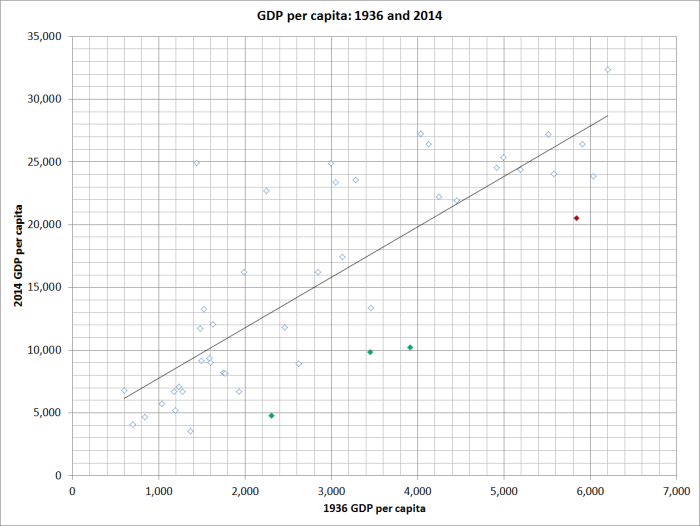
Here is a scatterplot showing GDP per capita in 1936 and 2014 for the 45 countries for which Maddison (and his successor, the Conference Board database) had per capita GDP estimates for both 1936 and 2014 (the latest actual data).

1936 and 2014

Broadly, countries that were rich then are still pretty rich now, and countries that were p0oor then are still towards the lower end of the distribution.  There are some striking exceptions – South Korea and Taiwan are two of the more striking examples here. (China, interestingly, for all the hype about the last couple of decades, is the dot furthest to the left on the entire chart).

New Zealand is marked in red, with incomes per capita well below where one might have expected knowing our economic performance in 1936.  Some places have done much much worse –  those green dots are Guatemala, Venezuela, and Argentina  – but New Zealand’s performance has little to commend it.  Relative to the starting point, it is the worst of any of the now-advanced countries.

Of course, some people will want to mount arguments that our severe underperformance is not a matter for which governments (or the political parties behind them) can be held accountable for.  And there are certainly some things government can’t change –  geography, natural resources, the EEC, and so on.  But almost every country has advantages and disadvantages –  permanent or specific to that 80 year window. In each country, governments are responsible for how they react.  Ours, typically, seem to have chosen quite badly.  Since our relative fortunes still aren’t improving, it is reasonable to suggest that our governments are still choosing badly.

The National Party, and those of its members who form governments need to take some considerable responsibility for that.  Of course, the Labour Party and its governments do too –  it is just that they have had rather less time with their hands on the levers of power.

Good luck to the National Party in celebrating their 80 years.  The party has done well for itself, but less well for the people of New Zealand.  I’m not suggesting any ill-will, or bad intentions, and I don’t subscribe stories in which parties skew things over time much towards their own voting base.  National Party-supporting groups have probably done about as badly as everyone else –  in those international comparisons –  over the 80 years. And that is a problem for all of us.

Somewhat to my surprise, I discovered recently that the Fabian Society still exists.  The Fabians developed in Britain as non-revolutionary socialists, and my images are of people like Sidney and Beatrice Webb, Clement Attlee, and Herbert Morrison.  But anyway, the movement still exists in New Zealand.  Also somewhat to my surprise, they’ve invited me to speak to one of their public meetings on what went wrong with New Zealand to generate this disappointing long-term  economic performance and what might be done about it.  Glancing through the list of past speakers, I think I will be the most conservative or market-oriented person ever to address them.   But I like the idea of any organization whose website leads with the aim of “inciting debate”.

Anyway, meetings appear to be open to anyone who wants to come along, and for any Wellington readers who might be interested I will be speaking –  sharing a platform with Herald columnist Brian Fallow (who is probably more naturally at home with the Fabians) –  this coming Friday evening (20 May)    Details are here, but the venue is Connolly Hall (Guildford Terrace, just off Hill St) and the meeting kicks off at 5:30pm


Twenty companies manufacturing TVs

No, that isn’t a statistic from South Korea or China.  It is New Zealand in 1963.

My in-laws live in Waihi and whenever we are up there I point out to the children the old television factory, just off the main road, and give them a little reminder about the bad old days when New Zealand destroyed value by manufacturing and assembling television sets.  Somehow I must have been under the impression that there was just one television manufacturing factory in New Zealand.

But browsing in a second-hand bookshop the other day, I stumbled on Electric Household Durable Goods: Economic Aspects of their Manufacture in New Zealand, an NZIER Research Paper published in 1965.  There is 15o pages of analysis, statistics and discussion –  not everyone’s cup of tea, but I found it fascinating.

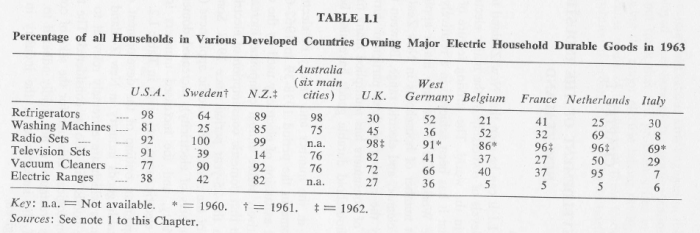
It doesn’t just have information on manufacturing.  There is an interesting reminder of just how many more electrical appliances New Zealand households back then had than their counterparts in other advanced countries.

durables

These sorts of international comparisons probably always have to be treated with some caution, but there is nothing very inconsistent with the data suggesting that at the time New Zealand still had among the highest real incomes per capita anywhere.   Actually, I was a little surprised there were quite so many consumer electrical goods here, since New Zealand had high protective barriers which meant many such things cost more here than in other advanced countries.  But, as the report notes, household electricity prices in New Zealand at the time were around half those in the United States and Australia, and around two-thirds of those in the United Kingdom.   A government commission of inquiry had recently noted that in most areas the price of domestic electricity was below the cost of production and transmission.

The domestic manufacturing of electric household durable goods was largely a result of the very heavy regime of import protection and controls put on from 1938 and kept in place, with varying degrees of intensity, for decades afterwards (that Waihi factory didn’t close until the mid 1980s).  As the NZIER piece notes

Before 1939, production of electric household durable goods in New Zealand, other than electric ranges and domestic radios, was practically non-existent.

Even for electric ranges, the report manages to cite statistics that over 80 per cent of those in use in 1939/40 had been imported.

The import controls which began in 1938 were precipitated by a foreign exchange crisis – which might well have led to a serious sovereign debt default if it had not been for the looming war –  but also reflected an active desire by the government of the day to promote domestic manufacturing (for a variety of reasons, including pessimism about the prospects for (and volatility of) agriculture, a desire for greater self-sufficiency, and so on).

In some sense it worked.  Many firms which had previously been importers and distributors turned to manufacturing.  The NZIER paper quotes from the company history of Fisher & Paykel –  a company established as importers and distributors.

The adoption by the Government in 1938 of a policy of controlling imports by licensing created an immediate problem for Fisher & Paykel Ltd,, as the company was trading principally in appliances imported from the USA. As dollar imports were even more restricted by the new system of import control than those from sterling sources, it became necessary to find alternative means of meeting a demand already barely filled and steadily increasing. The alternative was to produce the necessary appliances within the country, and so, in 1939, Fisher & Paykel entered the manufacturing field.

All sorts of New Zealand and foreign firms set up manufacturing operations here, producing all sort of products on a very small scale.  It individually rational, and often highly profitable, but wildly inefficient.  It took many decades to unwind.

But import licensing was considerably relaxed for a few years in the 1950s (although there were still typically tariff barriers), and there was a brief but substantial resurgence in imports of electrical household durables.  During the brief period of liberalization, annual imports of washing machines (for example) were ten times what they had been in the periods of heavy controls before and after.  Unsurprisingly, during that liberalization period there was some reduction in the number of domestic producers.

But when tight import controls were re-imposed in 1958, the whole focus on developing New Zealand industry was taken still further, with an emphasis on encouraging “manufacturing in depth”, and “since 1958 manufacturers in all industries have been encouraged to increase the ‘local content’ of their production”.

Television has been introduced into New Zealand since 1958 [experimental broadcasts only until 1960] and provides an excellent illustration of the policy in practice.  Not only is the supply of receivers to the New Zealand market the sole prerogative of New Zealand manufacturers, but the manufacture of television tubes and other components in New Zealand has been deliberately encouraged……..where manufacturers are allocated a licence to use overseas exchange which is not tied to any particular product (the so-called “pool” licensing system), it pays to take advantage of the facilities of as local supplier even if some cost disadvantage is incurred.

And thus it was that in 1963 “the number of firms engaged in the manufacture of [TV] receivers (20) constituted a record for the production of any electronic consumer good in New Zealand”.    The number of firms producing componentry is not listed.  The New Zealand Official Yearbook records that in 1963/64 there were 35 firms engaged in “radio and television assembly and manufacture”, producing 113904 TVs and 93676 radios.  The scale (or rather lack of it) is almost beyond belief  –  the average firms was producing just under 6000 units per annum.

Much of the focus of the NZIER is on the (in)efficiency of the New Zealand manufacturing operations.   The author went to some length to get good data, including from foreign firms with manufacturing operations here and abroad. They cite one example of a European manufacturer of radios (a sector where, they noted, the economies of scale were less than those for the production of televisions) who supplied data on the estimated costs of production for different size production runs.  That European manufacturer noted that they typically manufactured in Europe in production runs of 100000, but in New Zealand reasonably large firms typically did runs of around 5000 units.  The cost of production per unit on that scale was around twice that for the European-sized production runs (scaling up to runs of one million units was estimated to produce further per unit cost savings of less than 10 per cent).   Other estimates led the authors to conclude that New Zealand production was typically costing at least twice the “world” price.

The NZIER piece was primarily analytical and descriptive, rather than being policy-focused.  But the author, rather drily, concludes:

If the cost of producing radio and television sets in New Zealand are likely to remain 100 per cent above costs of production in large industrial countries (and on the basis of the evidence presented in chapter VI this is a generous assessment of the higher costs of production in New Zealand) then it is a valid question as to whether the capital and labour now engaged in this industry could not be employed elsewhere to the greater national benefit.

Indeed.

Such staggeringly wasteful economic policies for so long.

(And since we have only continued to lose a little more ground relative to other countries since these particular policies were scrapped, one might hypothesise some ongoing policy problems.  But that isn’t for today’s post.)

(And for anyone wanting a slightly caricatured sense of how things were, I recall this Alan Gibbs speech on New Zealand assembling television sets)


Some perspectives on reform and the RB in the 1980s

A new book came in the post the other day.  It is a scholarly look at the long-term relative economic performance of New Zealand and Uruguay, something I wrote about quite recently and a subject I may come back to when I’ve read the book.

But there is an old line, especially applied to newspaper and magazine articles, that when the coverage of something you know about doesn’t ring true, be wary of the rest of the article.  And flicking through this new book my eye lit on a strange reference to the Reserve Bank.

In a paragraph on the reform period from the mid-1980s to the early 1990s (“which showed characteristics of a coup”), the author writes

Douglas as well as further members of the Cabinet, the Business Roundtable, and other strategically located institutions represented the exclusive inner circle of the new right. Until at least 1988, they used their large human capacities at the Treasury and the Reserve Bank to suppress alternative views and to limit the choices for MPs to a laissez-faire policy agenda.  Just as under Muldoon before, opponents were driven out to other departments and the private sector through informal pressure or became subject to petty harassment [ a footnote at this point adds “even university staff were affected, as controversial articles were less likely to be published in 1990 than in 1930”].

Very little of this rings true to me.

I’m not going to speak much of the Treasury, except to note that (a) Roger Kerr always spoke of how Muldoon respected the traditional boundaries of the public service, allowing Treasury (and people like Kerr) to develop their more market-oriented approach to analysis and advice (even if the Minister himself was not receptive to much of that advice), and (b) that I do know a few very able (and later successful) people who were either turned down from jobs with Treasury in the late 80s, or chose not to apply, because they were not-entirely-sympathetic to the reform process.  Plenty of people from the “right” in Treasury left for the private sector during those post-liberalization years –  opportunities abounded.

What of the Reserve Bank?  I was a manager in the Bank’s Economics Department (then, its main economics and policy wing) from 1987 to 1993.  At any one time, there were around six of us in the management group (led by Grant Spencer, and then Arthur Grimes), and above the department were the Governor and two or three Deputy/Assistant Governors.  There were a handful of other key people leading other departments (Financial Markets, International, Financial Institutions).  I suppose we should be flattered to be described as “large human capacities”, but to read the extract above one might suppose this was some phalanx of right-wing zealotry, demolishing all in our path.

There was a fair amount of turnover at the Bank during these years.  It wasn’t mostly people fleeing to the rich rewards of the financial markets –  mostly that was the next tier down –  but people coming and going from positions with international agencies such as the IMF and World Bank and advisory positions in developing country central banks.  I jotted down a list of 24 people who held the various key economic roles in the Reserve Bank over those years, and went looking for the right wing zealots.  No doubt some would class Roderick Deane in that category, but he had left the Reserve Bank in 1986.  What was left was a very short list.  I recall one very able colleague who wrote a nice think piece on free banking, and another who (in the abstract) was keen on open borders.  We liked to believe we were keen on rigorous economic analysis –  others can judge how well we did.  Most probably believed in fewer controls rather than more, and lower inflation rather than the New Zealand track record of the 70s and 80s.  Probably all wanted to be part of turning around New Zealand’s disappointing economic performance.  But a haven of ideological zealots it was not –  and what research we were publishing was mostly quite technocratic (at the time, most of the Bank’s research resource was devoted to building a new macro model, which proved largely useless amid the transitions and data discontinuities) and not much oriented to the overall policy framework at all.   Assistant Governor, Peter Nicholl, was said –  I never knew if it was true –  to have been involved in the Labour Party in his younger days before Labour became market-oriented, and at least two of us canvassed for National in the 1984 election (I blame my colleague..).  Largely, we were not-very-ideological technocrats.  I wasn’t much involved with recruitment at that time, but I don’t recall any suggestion of ideological tests

Even when it came to the new goal of price stability, launched on  the public somewhat surprisingly one April Fool’s Day, and us a day earlier, by Roger Douglas, the Bank was hardly champing at the bit to get going and eliminate inflation.   Grant Spencer – then chief economist –  and Peter Nicholl, his boss –  were both pretty wary, very uneasy about the (unemployment) costs of getting there.  For some, enthusiasm waxed and waned as economic fortunes changed.

In fact, that was somewhat so for the institution as a whole.  Don Brash is other name associated with an ideological perspective.  Don only joined the Bank in late 1988, but was hardly pursuing very low inflation aggressively –  at least from the perspective of the in-house hawks (it did, after all, take more than seven years to get inflation down). Don was also the one who signed up to Mike Moore’s Growth Agreement with the trade union movement during the 1990 election campaign.  Don recommended extending the target date from 1992 to 1993, explicitly to help allow room for a fall in the real exchange rate, to assist with rebalancing the economy.  And during 1991 Don and his, by then deputy, Peter Nicholl shocked some of younger enthusiasts by easing policy on the argument that “preserving the framework [RB Act] was more important [in the near term] than price stability”.  (Some of this material I dealt with here.)

I’m not suggesting that we were without fault, but equally –  and contrary to the impression given in the quote above –  we were operating in a climate in which everything was contested, and no one was confident that the reforms would endure.  It is fine to say that both main parties supported the reforms, but the big divisions were within the two parties not  between the leadership of the two (Labour had large left-wing factions which had Jim Anderton as their most prominent figure, and National had Sir Robert Muldoon, Winston Peters –  and Bill Birch, then still mostly thought of as the former minister of Think Big).  It is no secret, for example, that National’s support for the Reserve Bank Act was the result of an extremely close caucus vote, which Muldoon missed on account of illness.  Even when National won the 1990 election, we in the Reserve Bank were not remotely confident that the Richardson wing would be in the ascendant (or for long).  For the first year of that government, we (and Treasury) were constantly uneasy that political fortunes would change quickly, and many of the reforms could go as quickly.

I was also a bit surprised by the comment about the universities. I know various academics felt quite embattled, and ignored (and there was some grievance about cuts of government funding for the NZIER eg), but from our perspective in the Reserve Bank we also felt embattled, and were the subject of frequent academic attacks  (those were the days, unlike now, when university economics academics were very engaged with policy issues).  There had been the several rounds of exchanges between Victoria academics and the Bank and Treasury in 1985, on the analysis in the respective post-election briefings.  And when the Reserve Bank legislation was going through Parliament in 1989, the New Zealand academic economics community was pretty united in opposition (there may have been the odd supporter, but they kept very quiet).  This was the occasion of one of the more embarrassing lines I wrote in my decades in the public sector: we published an official response I had written to one prominent submission that had noted the absence of local academic support for the legislation: that said, we asserted, more about the quality of New Zealand academic economics than about the merits of the proposal.  We felt pretty embattled –  even if it didn’t always look that way to outsiders.

There was a lot about the reform period that isn’t particularly attractive, and of course –  although I continue to think that most of what was substantively done was in the right direction –  it doesn’t help that our relative economic decline continues, albeit at a slower pace.  New Zealand political institutions in those days  (single chamber, FPP) allowed small groups of politicians to do a lot quickly with few formal checks and balances. Publishing manifestos the week after an election, or simply abandoning high profile campaign promises really shouldn’t be the done thing.

But this simply wasn’t a period of a monolithic reforming class dominating everything.  Battles within parties were often vociferous, and opponents often had to be bought off with one concession or other.   And Roger Douglas was ousted after only four years, and Ruth Richardson was to last only three years as Minister of Finance.  As it happens, most things that were done haven’t been reversed, but that was never inevitable.  Things were contested and challenged –  perhaps not as well as they could have been (the quality of public debate has long seemed to lack something, on all sides) –  and probably nobody emerged unscathed, or totally satisfied.

Perhaps one small marker of the times was a snippet I stumbled on in a scholarly biography of Ken Douglas, picked up at a charity sale over the weekend.   Douglas was then the head of the trade union movement, and was not exactly from modernizing centre-left: he was prominent in the Moscow-aligned Socialist Unity Party (openly defending, only a few years previously, the Soviet invasion of Afghanistan and the suppression of the Polish Solidarity movement). The book records that in 1988/89 there was a political furore over the possibility of Douglas being appointed to the Board of the Reserve Bank.  It didn’t proceed – the government at the time would not confirm or deny the possible appointment, suggesting there was something to it (and Douglas has subsequently confirmed that he was approached.)  Would it have been an inappropriate appointment? Not necessarily, but that the idea was even raised goes against any sense of Roger Douglas, and his Treasury and Reserve Bank “large human capacities” simply ramming through anything they liked.

I really hope the rest of the Uruguay/New Zealand book is better. If so, I’ll let you know.


Productivity: where do we now stand?

This post is mostly a brief follow-up to yesterday’s, with its comparisons between the performances of Uruguay and New Zealand.  I concluded that post noting that it wasn’t obvious what would prevent our continued slow relative decline.

Comparisons of material living standards across time and across countries are fraught with measurement problems.  No one seriously questions that 100 years ago we had some of the very highest material living standards, and equally no one really questions that we are long way off that mark now (some want to focus instead on wellbeing indicators: that is a topic for another day, but a country that has as many of its own people leaving as New Zealand has had shouldn’t be seeking to rest on any sorts of laurels).

Historical estimates are fairly imprecise, and only available for a small number of variables (typically GDP per capita). For more recent periods, we have much more, and better-measured, data –  although always less than researchers and analysts might want – but even then we face problems in comparing outcomes from country to country.  All of which suggests one shouldn’t put much weight on small differences – they might just represent imprecise measurement and translation.

The most common comparative metric is still GDP per capita.  It has all sorts of problems, but one in particular is that there is huge variation across countries in how many hours the population works on average.  If people in one country on average work twice as many hours as those in another country then, all else equal, the people in the first country will have higher incomes.  That provides greater consumption opportunities, but isn’t much of a reflection of the productivity levels being achieved by firms in the countries concerned.  For that, the best indicator that is reasonably widely available is GDP per hour worked. It is also much less affected by business cycles than GDP per capita.  For international comparisons, one needs to convert the various estimates into a common currency, not at market exchange rates but at (estimated) purchasing power parity exchange rates.

For many countries there are no worthwhile estimates of GDP per hour worked.  But the OECD has data for all its member countries (and a few others) and the Conference Board produces estimates for a wider range of countries, going back a little further in history. For the most recent years, they now have estimates for 68 countries.   Here is a (long) chart of the 2014 estimates.

real gdp phw 2014 levels

I’ve highlighted New Zealand and the countries estimated to have had GDP per hour worked 10 per cent either side of us.  That range both recognizes the inevitable measurement imprecision, but also highlights the countries that have a broadly similar level of labour productivity to our own.   It is a mixed bag: Cyprus, Japan, Slovenia, Slovakia, Malta, Israel, Greece.  But none were ever –  well, perhaps not for a couple thousand years in Greece’s case –  world leaders.  (I haven’t shown the OECD version but the rankings are similar –  and Cyprus and Malta aren’t in the OECD).

If the New Zealand numbers are not perhaps quite “middle income” country levels yet, they seem uncomfortably close to them.  And they are a huge distance behind those (mostly Northern European) top-tier countries,  from Belgium to Switzerland.

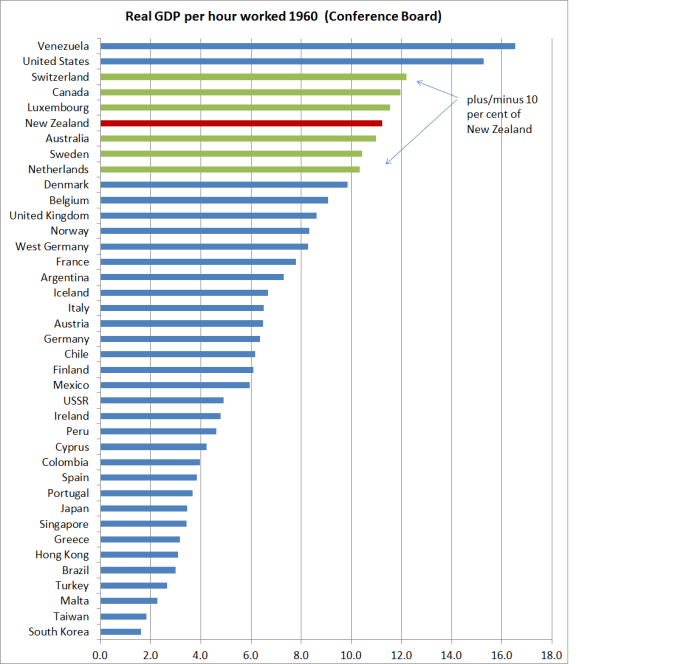
If it had always been so, that might be one thing.  Many of the middling countries have always been middling countries.  But we weren’t.  GDP per capita isn’t GDP per hour worked, but it is fairly safe to assume that our productivity levels 100 years ago would have been among the highest in the world.  And much more recently than that, the Conference Board has estimates for a reasonable range of advanced and emerging countries going back decades.

real gdp phw 1960

By 1960, New Zealand experts were already writing serious reports on our disappointing productivity growth performance.   But then only United States and Venezuela (all that oil) were estimated to have had GDP per hour worked more than 10 per cent higher than New Zealand.  In the space of less than one lifetime –  and this is more or less my lifetime –  our productivity levels have gone from still among the best in world, to lost among the rest.  These sorts of declines aren’t normal phenomena.   They typically happen when countries mess themselves up badly –  think of Venezuela or Argentina, or even Zimbabwe.  And, critical as I am of economic policymaking in New Zealand over 50 years, we’ve been a moderately well-functioning country (stable democracy, rule of law etc).

It isn’t that nothing has been done in response to our decline.  We stopped doing a lot of what a commenter yesterday aptly called “dumb stuff” –  the protection and subsidies that shaped our economy from the late 1930s to the 1980s.  But we’ve done our share of other dumb stuff –  all well-intentioned.  The Think Big energy projects of the 1980s were an example.  I class throwing open the immigration doors again 25 years ago in that same category –  a new Think Big.  A catastrophic decline in relative productivity here was, surely, a signal for resources to go elsewhere –  and New Zealanders responded to that signal en masse (as, within New Zealand, people have moved away from places –  perfectly pleasant places – like Invercargill, Wanganui, or Taihape as the relative returns have changed).    So what possesses our bureaucratic and political elites to think that a path back to prosperity and higher productivity involved searching out and bringing lots and lots more people?  If it was perhaps a pardonable error 25 years ago, it is an inexcusable policy failure now.

And then there are the totally flaky ideas that never actually amount to much: turning New Zealand into a financial services hub, R&D subsidies, becoming rich on back of wealthy Europeans fleeing terrorism, and so on.  And if that looks like a criticism of the current Prime Minister, he isn’t obviously worse – more practically indifferent to the real issues –  than his predecessors, or his potential successors.  I watched Q&A interviews with James Shaw and Andrew Little at the weekend, and there was nothing there which gave me any hope that our political leaders even care much any more about our precipitous decline.  Bank-bashing seemed easier no doubt.

We can’t, and shouldn’t try, to turn back the clock to 1910, or even (worse) 1960.   But we shouldn’t lose sight of what we once had here, or give up believing that we can produce incomes for our people once again as good as those almost anywhere in the world.  Governments don’t make countries rich –  firms and individuals, ideas and opportunities do that –  but governments can stand in the way.    I’ve been asked a few times in the last few days what policy remedies I’d suggest.  There are lots of smaller issues, but here are my big three:

  • Stop bringing in anywhere near as many non-New Zealand migrants.  At a third of our current target for residence approvals, we’d still have about the same rate of legal migration as the United States.
  • Stop taxing business income anywhere near so heavily.  We need more business investment to have any hope of reversing our decline, and heavy taxes on returns to investment aren’t the way to get more of it.  The tax system should rely more on consumption taxes.
  • Stop stopping people using their own land to build (low rise) houses, pretty much as and where they like.

It is a mix that would produce lower real interest rates (relative to the rest of the world), a lower real exchange rate, a lower cost of capital, lower population growth, and lower house prices.  Plenty more innovative outward-oriented New Zealand firms –  I heard Steven Joyce talking about them on the radio this morning –  would find that a rewarding climate to invest and export, supporting better productivity and income prospects for all of us.  Will we match Belgium, the US, and Ireland (see first chart)?  Well, perhaps not, but who knows –  for all our locational disadvantages, we do plenty of things better than those countries.  But we certainly really  should be able to do much better than Cyprus, Malta, Slovenia and Greece, if we are willing to take the issue, and challenge, seriously.


Uruguay: one more angle on our dire long-term economic performance

I’d never given much thought to Uruguay until some time around the turn of the century when Struan Little, then at Treasury and now Deputy Commissioner at IRD, came over to the Reserve Bank and gave us a presentation on his thoughts on comparisons between New Zealand’s economic performance and that of two other small and relatively remote countries, Uruguay and Iceland.  At the time, Iceland counted as a success story, and Uruguay not.     Since then, I’ve used Uruguay as a bit of a benchmark of what could happen to us if our continued relative decline wasn’t reversed. It was, after all, an agriculture-dependent colony of European settlement.

100 years ago, New Zealand had some of the very highest material living standards in the world.  Uruguay look reasonably good too, with GDP per capita estimated to have been above those in many countries in Western Europe.  The historical estimates move around a bit from year to year, but over the couple of decades from 1890 to World War One, the relationships between incomes in the United States, Uruguay, and New Zealand were reasonably stable.  Here are the averages, drawing on Angus Maddison’s collection of data:

uruguay nz 1

We were level-pegging with the United States, and Uruguay had incomes around 60 per cent of those of the United States and New Zealand.  Both Uruguay and New Zealand had around one million people back then.

Here is much the same chart for the last five year, this time using the estimates reported in the IMF WEO database.

uruguay nz 2

The Uruguay/New Zealand relationship hasn’t changed much, but both countries have fallen a long way relative to the US.  Relative to the United States, New Zealand is now about where Uruguay was prior to World War One.  Very few advanced or semi-advanced countries have done worse over that period: Argentina and Venezuela are the two I’m aware of.

Unfortunately, even this comparison still flatters us.   For every 100 hours the average Uruguayan worked over the last five years, the average New Zealander worked 116 hours (the US is in the middle).  Our relative productivity performance (GDP per hour worked) is rather worse than our GDP per capita performance.

We don’t have GDP per hour worked data going back to the decades prior to World War One.    In fact, in Uruguay’s case I could find that data only back to 1990.   Here are the Conference Board estimates.

uruguay nz 3

Despite all those reforms we did, we’ve continued to lose a little ground relative to the United States.  And Uruguay, wedged between two troubled countries (Brazil and Argentina) and having got into so much difficulty fifteen years ago that they needed an IMF support programme, has been improving significantly, against us most dramatically, but even relative to the United States.  They have a long way to go to get incomes or productivity anywhere near 60 per cent of those in the United States –  where they were 100 years ago – but GDP per hour worked is already up to almost 70 per cent of New Zealand.

uruguay nz 4

It isn’t just a labour productivity story either.   Here is total factor productivity growth since 1989, again from the Conference Board.   The improvement in Uruguay has been staggering, even allowing for the fact that the starting point had been a pretty badly distorted economy (and some decades of serious political turmoil).

From what one reads of Uruguay, there is still a long way to go –  consistent with the fact that it is still materially poorer than poorly-performing New Zealand.   But they’ve begun to catch-up, while we seem to just work longer hours (per capita) –  and add more people to the mix.  As late as 1970, New Zealand and Uruguay had much the same sized populations, but now their population is only around three quarters of ours.

Contrary to the wisdom of Treasury and MBIE –  accepted by the political elite –  all that infusion of new people doesn’t seem to have done us much good.

Of course, continuing the slow path of relative decline doesn’t prevent New Zealand being a pleasant place to live for many. The sun shines, the beaches and mountains call, and so on. But Montevideo’s beaches look attractive too.    What the continuing slow relative decline tends to mean is a continuing loss of our people –  our children, siblings, friends, grandchildren –  and for those who stay, the struggle to sustain good quality health systems, cancer drugs etc.

Perhaps our leaders might focus on these basic issues instead of pursuing seats on the Security Council, the Secretary-Generalship of the United Nations or whatever.  It isn’t just a National government failure after all.  Perhaps in the 1990s there was a reasonable “the cheque is in the mail” argument, but for the last 15 years –  under both National and Labour governments –  it has been increasingly apparent that economic policy just wasn’t working, and New Zealand was continuing its relative decline.  And nothing serious has been done to address that failure.   We are no better now –  relative to the leading countries – than Uruguay was 100 years ago.  What is stop us drifting further back, towards where Uruguay is today?

Thinking Big…..

…and drifting ever further behind (the rest of the advanced world).

That was the title of my address this morning to annual New Zealand Initiative Members’ Retreat in Auckland.  It is a gathering  of several dozen chief executives and senior executives of the Initiative’s corporate (and government) members.

Here is the text.

Drifting slowly ever further behind NZI retreat presentation 17 March 2016 

I was sharing a session on the economy with James Shaw, the leader of the Green Party.  I’m not sure how we got grouped together –  perhaps speakers the organisers thought the attendees would be rather suspicious of?

I talked only briefly about the current state of the New Zealand and global economies, concluding that there wasn’t much positive to look forward to over the next few years from either source, but that at least New Zealand didn’t seem to face much risk of a domestic financial crisis.

notwithstanding the obscene level of Auckland house prices, and the overhang of dairy debt, New Zealand as a whole has not been on some credit-fuelled rampant boom.  If we take the country as a whole, our dependence on foreign capital (the NIIP position as a share of GDP) has largely gone sideways for the last 25 years. Perhaps ideally it would have shrunk a bit, but this is no Greece, Spain, Ireland, or Iceland.  Or even the US –  with all that government sponsored or promoted poor quality housing lending.  Risks of a domestic financial crisis should rate very low on your list of concerns.

I got the impression that some people thought that was about the only upbeat comment in the speech.

The rest of the address was about the longer-term economic challenges facing New Zealand.  I pointed to some of the stylized facts:

  • persistently high (relative to other countries) real interest and (relative to our relative productivity trends) real exchange rate,
  • the continuing decline in our relative productivity (labour or MFP),
  • the failure to see any expansion in tradables production per capita over 15 years, and
  • the failure of Auckland incomes to rise relative to those in rest of the country, despite all the emphasis on possible agglomeration benefits and a policy focus on promoting Auckland.

I noted that New Zealand had been, and remains, a natural-resource based economy.

Modern New Zealand has always been, and remains, a natural resource-based economy, and no one is making any more land, sea or other natural resources. We find new and smarter ways to maximise what we earn from the natural resources – productivity in agriculture in recent decades, for example, has been quite impressive  –  but that doesn’t change the fact that we have a given stock of natural resources and a fairly rapidly growing number of people.    For each new person we add there are simply fewer natural resources per capita.    In a well-ordered society, abundant natural resources are a blessing not a curse, and there are plenty of opportunities for productivity gains in many of those industries.   But the stock of resources isn’t increasing, and the people are.

That wouldn’t matter if we were rapidly growing industries that were taking on the world based largely on the skills and talents of our people. After all, there are no known bounds to human creativity and ingenuity.    You could think of the US or the UK, or Belgium or Ireland.  But we aren’t.

What New Zealand exports has changed over 170 years – at one stage, gold was our largest export, perhaps whale products at one stage even earlier.  Optimists like to point out the agricultural exports have diminished in relative significance.  But if we look at all our exports, our natural resource based exports –  agriculture, oil, fish, gold, (most) tourism, forestry, aluminium –  make up probably 80 per cent of our total exports (good and services).  That proportion isn’t shrinking materially.  There are some globally successful companies based here, who don’t primarily draw on the natural resource base – Fisher and Paykel Healthcare might be the best known – but there aren’t many, and there is simply no sign of the export base transforming.  Exports of educational services have been in the headlines this year: they are a welcome boost, but we aren’t exactly selling premium Ivy League type products.

Against this background, I drew attention to the failure of our skills-based immigration programme

Unfortunately, there is not the slightest evidence that the New Zealand strategy has worked.  The formal evidence base around the economic impact of immigration to New Zealand is unfortunately still quite limited, and we never quite know what would have happened without the immigration.  But it was never a strategy that was likely to succeed.  For one thing, New Zealand is small, remote and (by advanced country standards) relatively poor – not exactly first choice for the hard-driving and ambitious best and brightest.  Our universities are middling at best, so we can’t attract many potential stars that way.  As Hayden Glass and Julie Fry  reportedly point out in their new book, our skills-based programme has been attracting less skilled people, on average, than the Australian or Canadian programmes.

And

There is simply no sign of a fast-growing knowledge-based outward-oriented tradables sector, that would lead faster national growth in productivity and incomes, emerging here. [Auckland].

And nor would I expect it to: this is a natural resource based economy, and simply not a place where those knowledge-based industries would naturally locate in any number.  Even if they started here, in many or most cases the owners could maximise value by relocating (or selling) abroad.

New Zealand might have plenty of smart people and low regulatory barriers to starting businesses but it seems to be a pretty poor place to base global business.  That seems to be our experience.  But look around the world, and you simply don’t find many such businesses on remote islands.

And

In their individual wisdom, knowing their own country, New Zealanders has been recognising that prospects for them and their families are better abroad than here.  Even last year, more left than came back.   And yet our governments –  backed more or less by all political parties –  have simply decided to bring in huge numbers of new people each year.  It is an astonishing example of a central planner’s hubris –  a whole new Think Big strategy in which governments, all with the best will in the world, mess up the stabilising adjustments that would otherwise have been underway.

Governments don’t help by messing up the housing market but, salient as that pressure is, especially here in Auckland, it isn’t the real issue. The real issue is simply that there are no new really good income earning prospects –  new highly rewarding export industries – that the much higher population is enabling us to tap.  We haven’t found new natural resources or ideas that need lots more people to take full advantage of them.  Of course, we sustain reasonable total GDP growth building to support a rising population, but it does nothing to close our productivity deficits.  And because people can’t be used for two things at once, the need to build to accommodate the ever-rising population crowds out some productive, internationally oriented, investment that would otherwise be profitable here.  If we keep on with such a strategy we’ll keep on, little by little, drifting further behind the rest of the advanced world. We are simply in the wrong place to support very many people.  No other remote island has anything like our population.  Our own people have implicitly recognised the limits of New Zealand for decades. It is governments and their official advisers who seem blind to it.

Concluding that we need to change course

Closing those gasps will take far more rigorous and robust analysis and advice from our key economic agencies, such as Treasury and MBIE, that looks hard at all the symptoms of our longer-term economic condition.  But it will also take political will, drive and vision –  and a willingness to put aside the implicit “big New Zealand” mentality that has shaped so much of our history –  from Vogel to Seddon to Holland to Holyoake to Douglas, Birch, Clark and Key. 

New Zealand isn’t in short-term crisis, and for that we can be grateful.  But our people –  our kids and grandchildren –  deserve more than leaders simply smoothing the pillow of continued relative decline, all the while pursuing a flawed “Thinking Big” more-people strategy that failed in the post-war decades, and has failed again in the last 25 years.

Depressing?  Well, several people thought so, one pointing out how fitting it was that I’d named the blog for Cassandra.  Personally, I’m a lot more optimistic than that.  I reckon there is no reason at all why a bunch of smart people can’t generate really high per capita incomes in these pleasant islands, combining our skills, institutions, and natural resources.  Various other small countries do so –  mostly from oil, but there is nothing unique about that particular resource.  We have been deluding ourselves –  or rather our politicians and officials have –  in the belief that a bigger population and bigger cities are the path to success.  There is simply no evidence they have been so far – not just in the last few years but in the many decades since the last really positive New Zealand-specific productivity shock.  But that is really quite easy to fix.  We can’t change where we are in the world, which is a big drawback in many ways – some activities are just never likely to be generated to any large extent in places like New Zealand –  but that shouldn’t hold back our living standards so long as we avoid the central planners’ ambitions to rush to populate.

But if you still reckon my presentation is bleak, James Shaw trumped it with a fairly shockingly dark joke.  (It was a Chatham House rules occasion, but he said I could say that) talking about robots and the risks they might pose he recounted a joke he’d come across on Twitter.

9 year old girl:  Daddy, will robots one day rule the world?

Father:  Yes, dear.  Probably.

9 year old girl:  Daddy, will that be before I die?

Father:  Probably dear.  Just shortly before.

Finally, I learned today that the New Zealand Initiative is planning to do some substantive work on the economics of immigration in New Zealand.  It might still be some way off, but I welcome the prospect of the work being done, and look forward to what they come up with.  Eric Crampton apparently is keen on inflows that would enhance the availability of Latin American cuisine.