On reading “Migration Trends and Outlook”

It is a glorious day in Wellington, suggesting that summer might really be with us soon.  Tempting as it is to just get outside, I had been reading MBIE’s flagship annual report Migration Trends and Outlook 2014/15 and wanted to note (again) a few concerns about the apparent quality of the immigration policy analysis being undertaken by the government’s chief advisory agency in this area.

Recall that, in New Zealand, immigration policy is no minor matter –  it is one of the largest discretionary structural economic policy interventions undertaken by governments.  Each year, on average, we drift a little further behind Australia and the rest of the advanced world.  And yet each year we target bringing (permanently) another pool of people equivalent to 1 per cent of the existing population.

Migration Trends and Outlook is not a heavily analytical piece.   But it tells the story MBIE wants us to hear about New Zealand’s immigration.  And it simply isn’t very convincing.

The report saying that it is aimed at “policy-makers concerned with migration flows and their impacts”  and “the wider public with an interest in immigration policy and outcomes”.

So we should take seriously what it says.  It begins with this statement:

1.2 Why immigration is important

Immigration helps grow a stronger economy, creates jobs and builds diverse communities. Skilled workers address skill shortages and bring skills and talent that help a wide variety of local firms. Business migrants bring their networks, experience and capital to boost the economy. Visitors and international students bring in significant revenue, with international education and tourism being two of New Zealand’s biggest export-earning sectors.

Internationally, migrants are increasingly mobile, and competition for skilled people in the global labour market is strong. In 2014/15, as in other recent years, the focus of immigration policies continued to be on attracting skilled temporary and permanent migrants to help resolve New Zealand’s labour and skill shortages and to contribute to New Zealand economically.

The “skill shortages” line pervades the entire 66 page document, in a way redolent of a manpower planning exercise from the 1960s.  In fact, it reaches a peak in the Conclusion to the entire report where it is asserted that

Like many countries with declining birth rates, an aging population and high emigration of local-born people, New Zealand relies on migrants to fill labour shortages.

I’ve been trying to work out which countries MBIE has in mind here.  For a start, there aren’t that many relatively advanced countries that have an average annual net outflow of their own citizens in excess of 0.5 per cent of the population.  And of the countries with large average outflows of their own citizens (various eastern European countries for example), few have large scale inward migration programmes at all.  And of countries with large scale inward migration programmes  – Canada or Australia for example – I’m not aware of any others that also have large net outflows of their own people.

So the statement seems to be factually false.  But perhaps more concerning is the apparent sense that somehow the number of jobs in an economy is independent of the number of people, or the price of the services of those people, and that if it weren’t for the wise actions of a prescient government, the economy really couldn’t cope with (a) New Zealanders pursuing better opportunities abroad, and (b) New Zealanders choosing to have only modest numbers of children.

What I find remarkable in this document, as in other MBIE immigration work I’ve seen, is the absence of any sense of market processes, and how the market might sort these things out.  For example, if there are excellent opportunities here which New Zealanders are simply ignoring in their rush to get to Australia, surely we’d expect real wages to increase here?    If that happened, some of the opportunities might disappear.  Some New Zealanders might change their minds about going to Australia.  Some people might regard more training as worthwhile, to better equip themselves for those higher-paying opportunities.  Some will switch jobs from less rewarding ones, to the ones where the returns are now higher.  Some people might work harder or stay in the workforce longer.  But not one of these market mechanisms is even discussed.  And this from a key economic agency, implementing the policy of a vaguely centre-right government?  Does it not occur to them that “shortages” don’t happen in most markets, and when they do they are usually just a sign that the price has not adjusted.  Why does MBIE think that labour is different?

Although MBIE and the government seem to see immigration largely as a labour market phenomenon (“a critical economic enabler”), the price of labour  “wages”  appears only once in the entire document (purely descriptively).  “Price” does not appear at all.  In fact, “productivity” and “competition” each appear only once, in neither case in the context of an analytical sentence.  “Labour market” does appear repeatedly, but almost always only descriptively.  There is simply no sense, anywhere in the document, of a competitive market process at work.  If one were being unkind, one might think MBIE saw the role of government as being to ensure that the right pegs were in the right holes.

The “skill shortages” argument has been with us for many decades.  I was wryly amused to dip into a book over the weekend which reported the claims of New Zealand employers’ bodies in the 1920s urging high rates of immigration on exactly the same sort of “skill shortage” arguments.  You really wonder how countries without large scale immigration programmes managed to survive –  let alone to consistently economically outperform New Zealand over many decades.

Immigration advocates have sometimes argued that if only we can attract the cream of the global crop –  talent, initiative, ideas – we can lift the productivity of New Zealand as a whole, and that of the pre-existing population as well.  It was never very plausible –  short of some of global catastrophe, it was never obvious why the cream would now want to come to New Zealand –  a pleasant spot to be sure, but small and very remote, and not at the leading edge of very much.  There is periodic talk of the transformative powers of immigrants in Silicon Valley, but even if it were true there, why would it be likely (on the balance of probabilities) to work here?   We are small and distant.  San Francisco is neither.  And we have universities that, in most fields, are mediocre at best.  We are fooling ourselves –  or rather our governments seem to keep trying to fool us – if we believe that plausible immigration (volume, type of people, or whatever) is the answer to New Zealand’s economic challenges.  There is no sign it has been in the last 100 years, and the boosters –  MBIE chief among them –  offer no reason to think that is about to change.  We have to make our own future –  as most successful countries in the past have done.  If we do, perhaps able people will be clamouring to join us and we can (or not) take the pick of the crop.  For the present, it still seems more likely that rational New Zealanders will choose to leave for Australia whenever they can, although it is harder to do so than it was previously.

I’ve written previously about the relatively low-skilled nature of even most of those being granted residence as Skilled Migrants over recent years.  The table below (from the MBIE report) updates that for 2014/15. And recall that these are the principal applicants in the Skilled Migrant category –  ie the most skilled of our migrants.  They make up only around a quarter of our annual residence approvals.  Not all of the others will be less skilled, but on average they will be.  I don’t know about you, but this list does not suggest that our immigration programme is functioning as any sort of medium-term “critical economic enabler” (to use one of MBIE’s own phrases).


Main occupations for Skilled Migrant Category principal applicants, 2014/15  
   
Occupation 2014/15
Number %
Chef 699 7.2%
Registered Nurse (Aged Care) 607 6.2%
Retail Manager (General) 462 4.7%
Cafe or Restaurant Manager 389 4.0%
ICT Customer Support Officer 282 2.9%
Developer Programmer 209 2.1%
ICT Support Technicians nec 205 2.1%
Software Engineer 147 1.5%
Accountant (General) 138 1.4%
Early Childhood (Pre-primary School) Teacher 127 1.3%
Marketing Specialist 124 1.3%
Dairy Cattle Farmer 123 1.3%
Carpenter 122 1.3%
Electrician (General) 111 1.1%
Office Manager 106 1.1%
Baker 105 1.1%
Program or Project Administrator 97 1.0%
Software Tester 95 1.0%
Sales and Marketing Manager 94 1.0%

I noted the other day, that the residence approvals target has not been met for the last five years (the target is 45000 to 50000 per annum, and approvals have lagged a bit below 45000 each year).  That raises some questions about even the design of our immigration programme.  I’ve always tended to work on the assumption that since most of the world is much poorer than we are, it should never be a problem finding enough immigrants if we wanted them –  even notionally “skilled” ones.  Returns to labour in New Zealand are higher than anywhere in Africa, Latin America, the Pacific, or most of Asia.  There are plenty of English speakers who could pass health and security tests.  So how come we can’t fill our targets with suitably “skilled” people –  especially as the skills threshold seems depressingly low?

I wonder if it is partly because most residence approvals are now granted to people already living in New Zealand (around 70 per cent) –  that is typically people here on a work visa, or a study visa.   The logic is apparently that people adjust more easily if they are already familiar with New Zealand.   So in applying under the skilled migrant category you get points for having a job or confirmed job offer.  92 per cent of successful applicants got points that way.  You also get points for a job outside Auckland, even though Auckland is the fastest-growing part of our economy –  just over half of all those with jobs/offers claimed points for jobs out of Auckland.

But it is expensive to come to New Zealand –  particularly for people relocating a family here.  And it is hard to effectively job-search from abroad.    And we impose an additional cost by rewarding people who get job offers in the less productive parts of the country (with fewer alternative future opportunities).   Personally, I think our immigration policy is pretty deeply flawed, but if our governments are serious about wanting lots of skilled migrants shouldn’t we think about putting fewer roadblocks in the path of any able person who wants to come?  There seems to be something wrong with the fact that a country with still relatively high returns to labour can’t manage to fill its immigration target (despite alleged “skill shortages”), even by taking such a pool of rather dubiously “skilled”people.    10000 a year (the number of skilled migrant principal applicant granted approval) simply isn’t that many in world terms –  we really should be able to do better than having the four most common occupations of our skilled migrants being chefs, aged care nurses, retail managers and café and restaurant managers.

Perhaps the continued emphasis on skill shortages is a sign that MBIE has largely given up on the other channels by which immigration might boost “the prosperity and wellbeing of New Zealanders” [the phrase from MBIE’s own mission statement]?  But even if so, the “skill shortages” argument –  for the sorts of people New Zealand is mostly importing –  is pretty intellectually slipshod.  In addition to the points I noted earlier, the MBIE document is also devoid of any macroeconomics.  It has long been pretty common ground among New Zealand macroeconomists that, whatever the possible long-term effect of immigration, in the short-term immigrants add more to demand than they do to supply.  The Reserve Bank’s own research shows it.  But what that means is that even though an individual immigrant might relieve an individual employer’s “skill shortage”, in aggregate an increase in immigration increases the pressure on the labour market as a whole. Resource pressures are intensified and not eased.  If the knowledge transfer and productivity stories carried much weight now for New Zealand –  as perhaps they may have in the 19th century – that might be fine.  But there is no evidence of that channel having worked, and no real sign of that changing soon.  And yet if our immigration policy is supposed to ease skill shortages it is almost doomed to fail by construction.

We deserve rather a better quality of analysis from a large public agency paid to provide high quality economic advice on immigration and economic performance issues.  I hope that when the Cabinet has been reviewing the residence approvals target recently they have been more willing to ask some hard questions about just what is being achieved by our immigration programme than has been evident to date.
These remote islands are different?

I was having a discussion the other night in the margins of the Goethe Institute event about the extent to which we should think about New Zealand’s economic advantages and opportunities as natural resource based.  I’ve been running a proposition that the only thing really going for us is the land, its attendant resources (fish, wind, geothermal, as well as pasture, forests, and –  at the low value end –  tourism opportunities), and the technologies and management skills that enable us to sustain reasonably good incomes from them.  Those resources can support really good incomes, but I’m sceptical as to how many people they can support such incomes for.

The person I was talking to posed an interesting angle which I hadn’t thought of before.  What if the North Island and South Island disappeared and New Zealand just consisted of Stewart Island (or the Chatham Islands).  What would 4.5 million people do in such a country?

As I’ve thought about it over the last few days, I’ve increasingly concluded that most of them would leave.  The opportunities would be just so much better elsewhere.

4.5 million people on an area the size of Stewart Island or the Chathams isn’t implausible.  Both are bigger than Singapore or Hong Kong –  Stewart Island (1680 sq kms) has more than twice the land area of Singapore (718 sq kms).

My nine year old daughter recently got fascinated by a book on our shelves about remote islands, so we’ve spent quite a bit of time together learning about some small, remote and very obscure places, such as.

Kerguelen                                                                                 7215 sq kms

Falkland Islands                                                                     12173 sq kms

St Helena                                                                                     420 sq kms

Seychelles                                                                                    455 sq kms

Reunion                                                                                       2512 sq kms

Azores                                                                                          2346 sq kms

And less obscure perhaps, but still relatively remote islands

Fiji                                                                                                 18270 sq kms

Hawaii                                                                                            28311 sq kms

Tasmania                                                                                      90758 sq kms

Iceland                                                                                          103001 sq kms

For reference, the South Island has 151,215 square kms of land.

But the total population of all those ten countries and territories is about 4.4 million.  Distance really seems to matter.  It is not that one can’t sustain good incomes in these places, but that not many do. History, revealed preferences, and revealed opportunities seem to have seen to that.

In the Stewart Island thought experiment my interlocutor posed, Stewart Island would be about as remote as the median of my 10 territories above.

Really smart people could choose to live there and with strong pro-market institutions perhaps they could build First World living standards there.  But it wouldn’t be Singapore or Hong Kong, even if it were populated by people from those places.  Geography doesn’t doom a country or territory to poverty, but it can make it a great deal harder.

Nothing in the global distribution of population or economic activity suggests that a Stewart Island New Zealand would have anything like 4.5 million people –  unless some social engineer, defying logic and history, kept shipping people in  (there are always some places poorer).  If, by some chance, 4.5 million people had ended up on Stewart Island, and governments didn’t interfere, I reckon many or most of them would have subsequently left –  to Australia, back to Britain if they could, perhaps even to South America.  The Falklands Islands does now support quite a high level of GDP per capita, for its 3000 people.   But the fishing and hydrocarbons wouldn’t go far across, say, three million.

Of course, New Zealand is not Stewart Island.  Our total land area puts us the middle of the list of countries of the world.  But we are still incredibly remote.  Last bus stop before Antarctica is unfair  (the Falklands and Kerguelen are closer), but not so very far wrong.  It just is not the sort of place, around the globe, that seems to be able to support First World opportunities for many people[1].

Of course, we have some advantages.  A temperate climate appeals as a place to live.  And northern European, specifically British, institutions and the rule of law have enabled people to secure pretty good livings wherever they have settled.  For perhaps 75 years, after all, New Zealanders had some of the very highest material living standards anywhere in the world.  But it was on the back of land-based industries.  And the overwhelming bulk of our exports still are, but with many more people than we once had.

So long as we don’t completely mess things up, New Zealand will never be what Uruguay is today (not much more than half New Zealand’s GDP per capita, the fruit of decades of really bad economic management last century).  But if, as a matter of policy,  New Zealand continues to  drive up its population quite rapidly, Uruguay might even have  better per capita possibilities in the very long run than New Zealand.   The same could probably be said, with even more force, of Romania (similar incomes today to those in Uruguay –  legacy of decades of even worse economic and political management last century).  They are just nearer where the people are. Locations still seem to matter.

New Zealand just isn’t a great place for many people to do terribly well.  Implicitly, New Zealanders have recognised that in the exodus to Australia that has occurred over the last 40 to 50 years.  The conventional wisdom on the right for a long time was that that was just a reflection of our mad policy regimes from the late 1930s onwards (heavy protection etc).  But it looks to have been more than that.  Decades on from the economic reforms, the average net outflow over time remains large (although it ebbs and flow with the Australian labour market), even as it has become more difficult for New Zealanders to make a smooth and secure transition to Australia.

One of my commenters is adamant that New Zealand’s immigration policy is “just” a replacement policy.  He is wrong on that .  (Over the last 15 years there has been an average annual net outflow of New Zealand citizens of around 25000 and an average net inflow of non-citizens of around 40000.  And our official target for residence approvals for non-citizens has been 45000-50000 per annum –  although not all who come stay).

But even if he were correct, there is no “just” about it.  What the government is doing is intervening to stymie a self-correcting mechanism that is going on in the private sector.   New Zealanders have seen, and responded to, the better opportunities (as they judge them) for themselves and their families in Australia.  They are moving to a place that –  with similar institutions –  is proving better able to generate high advanced-country incomes for more people.  What possible reason can the government have for interposing its own judgement, deciding that the resulting population and labour market outcomes are unacceptable, and actively seeking to bring in many more from abroad?

Perhaps as a policy approach it was more understandable in the 1950s and early 1960s.  After all, at that time our relative incomes were still high, and New Zealanders weren’t leaving in any appreciable numbers (the total outflow of New Zealand citizens in the 15 years to 1964 was 8283). And in the population discussion in New Zealand post-war, the idea of building up the population for national security reasons was also present.

But this is 2015 not 1950, and the economic signals have been pretty clear for a long time now –  and the central planners keep on ignoring the message.  Perhaps they believe the opportunities here are great.  But where is the evidence?  Remote places tend not to support very many people, and certainly not at the level of incomes New Zealanders aspire to.  Perhaps that won’t always be the case, but the onus should be on the planners to demonstrate that this island is different.

I’ve occasionally suggested that if “optimum population” meant anything,  New Zealand’s might be two million or 200 million.  With 200 million people, New Zealand would be a very different place, but it seems unlikely that in a world our size 200 million people would ever regard these remote islands as the best place possible to live and generate economic activities with an expectation of advanced country incomes. Peripheries seem, naturally, to be lightly populated places.

(To anticipate comments, I’m not arguing for a “population policy”  –  the idea seems absurd, but that is what we now have de facto –  but for leaving New Zealanders to determine these things for themselves.  In recent decades, the birth rate has been slowing and many New Zealanders see better opportunities abroad (most years), suggesting that their choices would leave us a fairly flat population.  But still one more than ten times that of Iceland –  which has 40 per cent of our land area, and is a great deal closer to prosperous population centres and markets.

[1] Australia faces somewhat similar issues, of course, but just has more natural resources.

A cause for great celebration?

Hamish Rutherford had an article in the Dominion-Post yesterday in which he quotes the Prime Minister as claiming, on the one hand, that the recent high net migration inflows are a “time of great celebration” and, on the other hand, that most of the arrivals are something the country “can do nothing about”.    Rutherford had a follow-up piece yesterday with some comments from me and from a couple of other economists –  a nicely balanced group; one relatively negative, one relatively positive, and one “it depends”.

Actually, I suspect nobody much shares the Prime Minister’s glib “time to celebrate” sentiment.    You can be as much a believer in more liberal immigration, or even open borders, as you like, but it still repays stopping to look at just why things are as they are.  Ours isn’t that positive a story.

Of course, contrary to the headlines, the net inflows we’ve been seeing recently are not “record migration” in any meaningful sense.  Yes, the net PLT inflow is at a record level, and perhaps even as a share of the population at any time in the last 100 years or more.  But the limitations of the PLT numbers are well-known.  If one looks instead at the total arrivals less total departures, the inflow over the last year has been around 60000.  By contrast, in 2003 the annual inflow peaked at 80000.  New Zealand’s population is now around 15 per cent larger than it was in 2003, so the per capita inflow over the last year or so has only been about two-thirds the size of what we experienced in 2003.  So the current inflow is large, but not really at record levels.

And although the target number of residence approvals for non New Zealand (and non-Australia) has been 45000 to 50000 per annum for years (despite the growing population), only 43000 approvals were granted in 2014/15, compared with almost 53000 in 2001/02.   I think MBIE even objects to the use of the word “target”, but however one characterises the number that Cabinet set, it isn’t met precisely each year.  In fact, perhaps reflecting the relatively weak domestic labour market since the recession, 2009/10 was the last year in which residence approvals were above 45000.

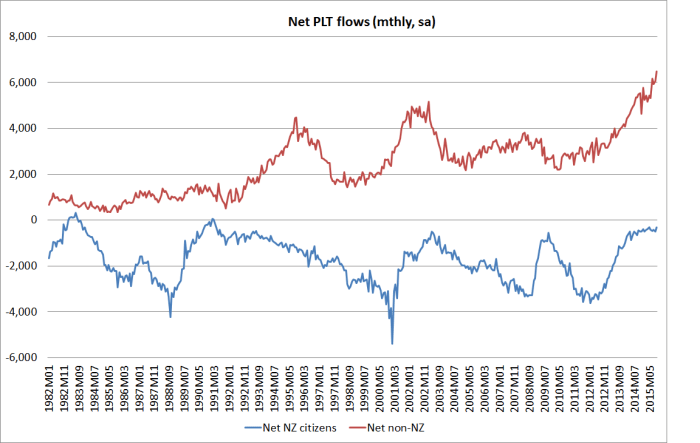
And can we control the total net flow numbers?  Well, not really since New Zealanders are free to come and go, and of course any foreigners who has come here (needing advance approval) can also leave any time they like.    Since the trough in 2011/12, the increase in the net PLT flow has been roughly evenly split between New Zealand citizens and other citizens, but over the last 18 months the decline in the net NZ outflow has levelled off, and all the further increase has been down to increased net inflows of non New Zealand citizens.  At around 6500 in the last month, that net inflow probably is a record, even in per capita terms (SNZ don’t report the total migration data by citizenship).  Every non-New Zealand citizen coming to New Zealand needs the approval of New Zealand authorities.

net plt by citizenship.png

It is worth bearing in mind that there is still a net outflow of New Zealanders each month.   The last times there were even modest inflows were 1983 and 1991, both occasions when Australia’s economy was in recession.  Given that the stock of New Zealanders living abroad is now much larger than it was in either 1983 or 1991, it would have been easier to envisage a larger net inflow of New Zealanders this time if our economy and labour market were really performing well.  But they aren’t.  We can’t rule out a small net inflow of New Zealanders at some point, but it hasn’t happened yet.

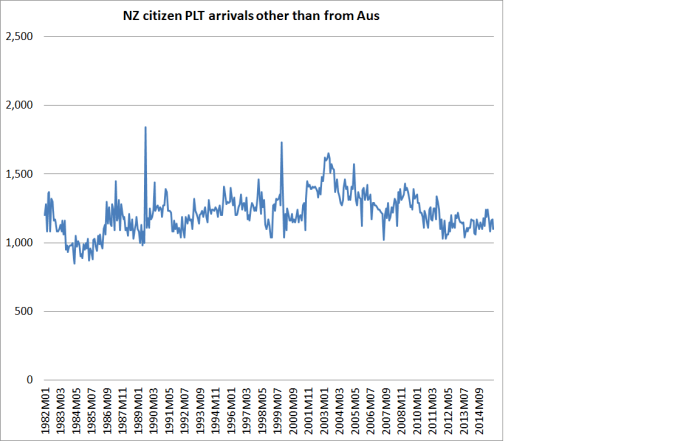
We can see the role that Australian conditions are playing by looking at the flows of New Zealand citizens to and from Australia, and the flows of New Zealand citizens to and from other countries. If the story were one of a strongly-performing New Zealand, I’d have thought we might expect to see New Zealanders flocking home from all corners of the globe (and not leaving for the rest of the world).    New Zealand citizen arrivals for the rest of world (other than Australia) are at quite a low ebb –  well below, for example, what we saw in 2003 when our unemployment rate was dropping sharply.

citizen arrivals row 2

And New Zealand citizen departures to the rest of the world, while quite notably lower than they were in earlier decades (tighter restrictions in place like the UK?) have been pretty stable for the last six years.

Instead, all the action in the New Zealand citizen flows is in those between New Zealand and Australia, suggesting that it is conditions in Australia that are at the heart of the story.

The unemployment rate in Australia is around 6 per cent, and there is now a much greater awareness than previously that the rules in Australia have changed for New Zealanders.  Any one going now, and who has gone in the last 15 years, is largely on their own if, for example, they can’t find a job, or they lose their job.  And their kids are often in some limbo, not really New Zealanders and unable to become proper Australians either.  Without that sort of welfare backstop if things go wrong, it is much more attractive than it was for anyone remotely risk averse to stay at home until the Australian labour market is much more robust.  It may be less attractive to try even then than it once was.  And that is so even though average incomes and real living standards in Australia are higher than those here, and that gap has shown no sign of narrowing.   But it is not that to any material extent there is a net outflow of New Zealanders from Australia (although the uptick in New Zealanders coming home isn’t something we’ve seen before), it is simply that for the time being the outflow to Australia has dried up.

Given that the adverse income gap has not narrowed and that our unemployment rate is high, nothing in that is a cause for celebration in New Zealand.  If anything, rather than reverse.  The more highly productive Australian economy has been an attractive option for New Zealanders for decades – enabling New Zealanders to improve their lot (and taking downward pressure off factor returns in New Zealand).  If that alternative outlet is less easy or safe to take advantage of, New Zealanders as a whole are a little worse off.  If, for example, people relocating from Invercargill to Auckland were made ineligible for welfare benefits,  Invercargill as a whole would be worse off economically –  even though some of the parents in Invercargill might be pleased to have their kids and grandkids a bit closer to home.

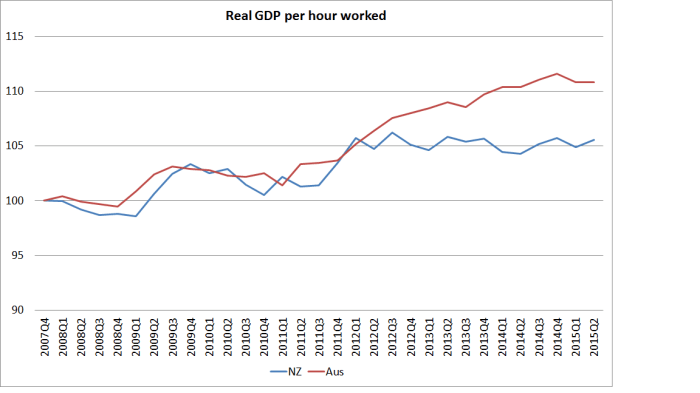
And what of New Zealand’s economic performance relative to Australia?  Real GDP per hour worked is a pretty good timely measure of relative productivity performance .  As the statistics stand at present –  who knows what revisions will eventually show –  the New Zealand performance in the last few years has been really bad by comparison with Australia’s.  Data suggesting no productivity growth for four years, while Australia has gone on achieving productivity growth, just reinforces a sense that the reduced outflow of New Zealanders to Australia –  partly temporary and probably partly permanent  –  is something bad for New Zealanders, not something to celebrate.

real gdp phw

It needn’t always be so.  I wish we had the sort of strong sustained economic performance, built on rapid productivity growth, that was putting us a path to income convergence (once again) with Australia.  If so, I reckon we’d see the net outflow turn into a material sustained inflow.  That would be cause for celebration.  This is not.

And all that with barely any discussion of the non-New Zealander flows.  But just briefly.  The Prime Minister correctly notes that foreign students are an export industry.  But I’d be more reassured by that if it were not explicit government policy to encourage foreign students, not on the intrinsic strength and quality of our own (middling at best) universities, but as a pathway to residence here.  Since there is no evidence that such permanent immigration to New Zealand has represented a net economic benefit to New Zealanders –  neither MBIE nor Treasury nor relevant ministers have been able to cite anything remotely convincing –  it seems that we are really just back in the export incentives business.  Instead of writing cheques, we write (the possibility of) a visa.  Export incentives “worked” in the pre-liberalisation period to –  people do what they are incentivised to do so we got more subsidised exports –  but it still wasn’t good policy.  It wasn’t under Muldoon and Rowling, and being done by Steven Joyce and John Key doesn’t change the proposition.  I’m not, at all, suggesting we should discourage export education, but let it stand on its own merits if the current numerical success is really to be a cause for celebration.

The Prime Minister also reckoned that “many of the arrivals fell into either highly skilled or investor categories”.   In the last year, just 1353 residence visas were issued under the investor and entrepreneur categories  (about a third as many as were being granted in the early 2000s) and as I noted in an earlier post MBIE’s research has highlighted just how questionable the net economic benefit of these migrants has been.

 One of the MBIE papers is on the web.  It discusses some work on investor migrants –  who already, in effect, buy their way into New Zealand.  The aim of the programme is to import people with business expertise and entrepreneurial skills, presumably to boost productivity in New Zealand.  And yet in these surveys of people at various stages of the investor migrant process  (and  in which respondents must have been at least partly motivated to give the answers MBIE wanted to hear, even if results were anonymised), 50 per cent of the money investor migrants were bringing in was just going into bonds, and only 20 per cent was going into active investments.  We aren’t short of money, but may be of actual entrepreneurial business activity.  And 70 per cent were investing only the bare minimum required or just “a bit more”.  And these people aren’t attracted by the great business opportunities in New Zealand, but rather by our climate/landscape and lifestyle.  It doesn’t have the sense of being a basis for transformative growth.

Set alongside the 1353 investor and entrepreneur visas were 4477 parent visas last year.

As for the highly skilled, I have covered previously and, in a succession of posts, at somewhat tedious length the question of just how highly skilled our skills-based immigration programme is.   Here, from the tables in MBIE’s excellent resource, Migration Trends and Outlook, are the numbers for 2014/15 –the top few occupations for the principal applicants for residence applications under the skilled migrant stream.

Chef 699
Registered Nurse (Aged Care) 607
Retail Manager (General) 462
Cafe or Restaurant Manager 389

It doesn’t have a strong sense of something to celebrate – the highly skilled of the world flocking to New Zealand and in the process strengthening our own skills levels and productivity.

And finally, the Prime Minister is quoted as saying

“Show me a country which is booming around the world where more people leave it than come to it”

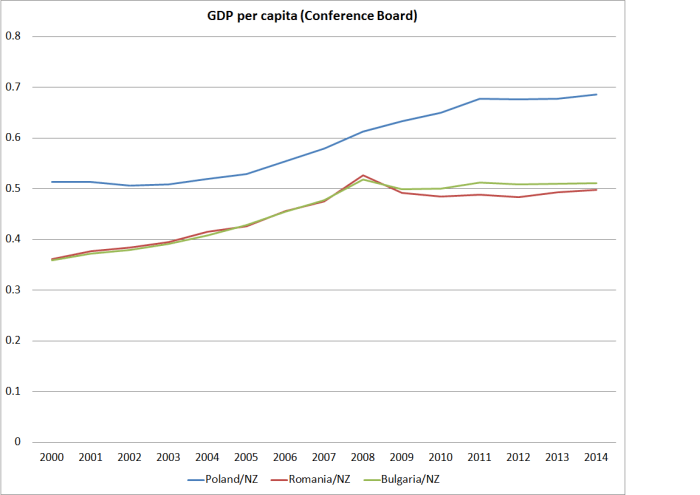
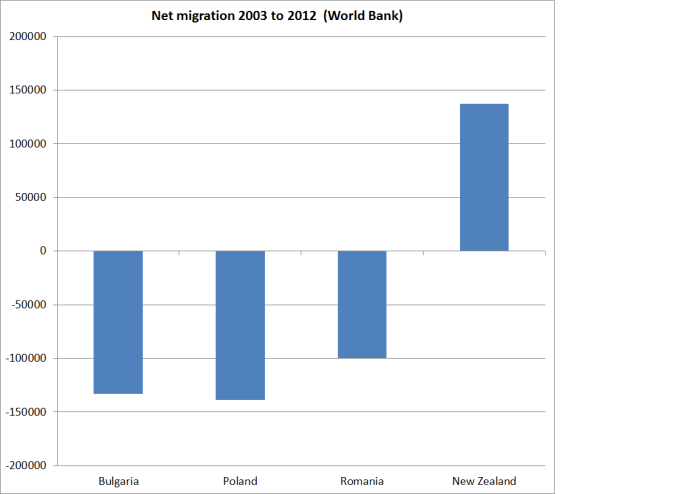
Glad to Prime Minister.  Consider Poland, which has been one of the strongest performing OECD countries in the last decade, and which has had steady net migration outflows.  Poland is gradually catching up to the living standards in Western Europe, but it has a long way to go.  In the meantime, the opportunities for many Poles are still better abroad.  Perhaps it is easy to dismiss Poland as just an ex-communist country, but it has done what New Zealand has failed to do –  make substantial progress towards converging with living standards elsewhere in the advanced world.  In 1989, Polish incomes were estimated to be less than a third of those in the United States.  Now they are almost half.

Bulgaria and Romania are less striking stories, but they are also countries with substantial net migration outflows –  again, the opportunities abroad are better than those at home.  But both countries have managed to grow materially faster than New Zealand since 2000, and have matched New Zealand’s per capita income growth in the years since John Key has been in office.

gdp pc nz vs poland etc

net migration nz and poland etc

Immigration policy is not, by any means, the whole story.  It probably isn’t even the bulk of the story in these countries.  But net inflows of people aren’t always good and net outflows aren’t always bad.  It depends.    There is no real reason to believe that the current net inflows to New Zealand –  or even the reduction in net outflows to Australia –  are cause to celebrate.  I suspect that, if anything, the inflow is compounding the underlying productivity problem.  But there is certainly no sign that it is either a response to us having solved those problems  ourselves (and thus being on some convergence path back to the rest of the advanced world) nor that the inflow will be any more likely to bring about a transformative lift in productivity than the previous inflows over the last 25 (or 75) years have.

Immigration, society, and the limits of knowledge

Last night the Goethe Institute and the New Zealand Initiative hosted a panel discussion on aspects of immigration.  The focus was not on the economic aspects  –  my arguments that our immigration policy has acted as a drag on economic performance got a mention only in the question time –  and I found it something of a challenge to pull together some moderately coherent thoughts around the implications of large scale movements of people, and what that means for cultures and societies –  indeed, whether those concepts themselves have much meaning or instrumental value.

Two of the speakers were themselves immigrants –  one had first come as a student in the late 1980s, and the other as a refugee from Rwanda after the mass murder of 1994.  They spoke from their experiences, and both offered interesting, if somewhat contrasting, perspectives.

Rob McLeod, former chair of the Business Roundtable (and countless other boards and committees) made what is probably best described as an in-principle case for open borders, although he pulls back from that in practice.  We had only a relatively short time each to present our own perspective, so I hope I’m characterising him fairly.  His principles for shaping immigration policy were

  1. Diversity is good; prejudice is bad. Exclusion and restriction are costly.
  2. A high premium on liberty and freedom to choose
  3. An obligation on everyone to obey the law.

His proposition was that the scope of the market should be extended as far as possible, and that those countries that had been open to immigration had generally benefited from it.  In the cases of possible exceptions, such as South Africa and Fiji, the roots of the problem had rested in coercion.

McLeod went on to note that more liberal immigration would generally enhance world welfare, and that world welfare should count for something in domestic policy setting.  He briefly made a case for immigration as one tool to counter terrorism, which he observed had (some of) its roots in poverty.  (My mind kept running towards Baader Meinhof, the Red Army Faction, and the IRA –  and that scion of a wealthy Saudi family, Osama bin Laden.)     I wasn’t quite sure how much more liberal McLeod would be in practice if he were in charge of immigration policy, but he did suggest that perhaps immigration quotas and targets might be something that should be negotiated multilaterally.

I was more sceptical.

My approach over recent years has been shaped by increasing doubts as to whether large-scale immigration has ever done very much economically for those who were in the country before the immigration began.   There is an arguable case in respect of the European migration to the United States, Canada, Australia and New Zealand.  Average incomes of the indigenous populations of those four countries are plausibly higher than they would have been if the colonies of large scale settlement had never been established.  But, even to the extent that is so, it is mostly because a new and more economically productive set of institutions  and people came in and largely displaced or replaced what was already there.  That might be the historical basis for modern New Zealand, but it isn’t a particularly attractive model to shape immigration policy debates today.  It was, essentially, a phenomenon of imperialism.    Mass migration generally was.

In my own remarks last night, I put a lot more emphasis on the part that cohesive cultures play in enabling societies –  state, clubs, churches or whatever –  to function effectively.  Cultures  –  broadly defined – develop, and are sustained, for a reason –  they encapsulate the tacit knowledge and understanding that help societies to work better.  They capture the things that unite people, in ways that strengthen the ability of those societies to manage the inevitable differences and difficult choices.

It isn’t clear to me that democratic societies can function very well in the longer-term without a reasonably strong common culture, or as a fall-back a single very dominant one.  Authoritarian ones might –  one could think of the Ottoman Empire.  Of course, we haven’t many strong and stable democracies at all (so the sample is small) but they seem particularly uncommon in the minority of states where there are major divides along racial or religious grounds.  Perhaps the only example I can think of at present is Israel –  and who would really be surprised if for one reason or another that experiment did not last many more decades.

The issue here is not about denying the gains from trade or the benefits of difference.  And since are no human clones, we all interact with (marry, work with, play sport with) people who are different than us.  And we gain in the process.  The question is more one about human nature, and the way in which strong well-functioning communities tend to form among those with whom we have important things in common.    And those strong common bonds enable communities to better do the things they exist for.  In the case of the state, we might think of that is mutual protection (external defence, law and order), mutual support (whatever form a society’s welfare system takes), and all the decisions states and communities take that affect the allocation of property rights.

In small communities –  eg families    the commonality might result from blood ties.  I might disagree forcefully with my brother but nothing changes the fact that he is my brother.  At the level of large communities, blood ties don’t bind us together.  It has to be about shared values (eg religions, including secularism) and, at very least, shared experiences and shared historical reference points.  Maintaining that commonality is perhaps never easy, but it is likely to be relatively easier with a relatively stable and homogeneous population, not one constantly displaced by large inflows of people from often quite different backgrounds (not better or worse, but different).  The challenge seems likely to be particularly great for free and democratic societies.

I argued that large scale immigration programmes are best seen as social engineering (and about as likely to prove useful as most such large scale government interventions).    Rather than allowing societies to evolve organically, negotiating their conflicts from a base of shared experience and mutual common destiny, immigration programmes put the government hand on the scales and tilt things, often rather sharply, one way or the other.   Our history was like that –  every Anglo immigrant who arrived in the years when Britons had fairly open access, tilted the scales, and the balance of power in society, further away from Maori.  The same went for Canada and Australia.   That may have suited the majority, but what of the minority that had once been the majority?   The limits of knowledge should forcefully confront all putative social engineers, who all almost always well-intentioned but (being human)  rarely recognise the long-term consequences of the choices they foist on us.

I’ve argued that we would be better off economically if we cut back quite severely our immigration programme.  But I think that if we did so, we’d also be better positioned as a society to build and sustain a degree of cohesion, drawn from shared experience and commitment, that would enable us to confront future challenges more effectively, and to deal with the permanent tension between the interests of Maori in New Zealand and those of the rest of the population.

Here is a fuller version (only five pages or so) of what I said last night.

The Sharing Game

And, yes, I did see the Prime Minister’s comment that recent record migration was “a reason to celebrate”.  I (mostly) disagree with him, but am out of time today, so will offer some rather narrower economic observations on his claim tomorrow.

The nation as a club?

In a moment of weakness a while ago I agreed to participate in a Goethe Institute and New Zealand Initiative panel discussion. “The Sharing Game” later this month.  Here is a link to event for anyone in Wellington who would like to come along.

The topic is written in a perhaps rather Germanic style

Sharing and exchange are basic human cultural practices. They play as big a role in poor countries as in affluent societies. But when do we share – and with whom? What social and cultural developments emerge from the various forms and manifestations of sharing and exchange in times of immigration from cultures that are foreign to ours? How is New Zealand’s face changing through an ever increasing influx from immigrants – rich and poor? Is a bicultural society a utopia?

But I take it as a discussion and debate around diversity and its implications for New Zealand.   I presume I was invited as someone who has been a bit sceptical about the economic benefits to New Zealand of our large-scale immigration programmes.  Since most of those arguments were independent of who the migrants were –  they would apply if the migrants were all from the Home Counties –  the diversity issues are not ones that I have previously focused on very systematically or for very long.

But in thinking about the topic, and reflecting on the importance of openness to new ideas in the historical success of nations, I’ve also been wondering what a nation state means today.  What, for example, if anything does it mean to be “a New Zealander”, (is it just citizenship of this legal entity)?  Are there things that unite us, and how does an immigration programme like ours affect that over time?    Is the decline of religion – itself once an expression of a society’s shared understandings – relevant to the answer?   Quite how is the distinctive position of Maori in New Zealand affected?

This post is an advertisement rather than one offering any answers.  But as I was reflecting on the issue this afternoon and reading around the (unpersuasive to me) open borders literature I stumbled on this stimulating blog post by the Canadian (but British immigrant to Canada) economist Nick Rowe on whether we should best think of the nation as a club.

Don’t think of a country as an area of land. Think of a country as a club, to which a group of people belong. Nomadic tribes were not attached to any particular area of land. Settled agriculture on scarce land is a recent and contingent fact.

Clubs provide club goods to their members. Club goods are (at least partly) non-rival and (at least partly) excludable. Mutual defence is the most obvious club good that countries provide their members, but they often provide others too.

Membership of a club brings with it both rights and obligations. Membership of a club is itself a good. It’s an asset that provides a future flow of benefits (and costs). Membership of a successful club, that non-members want to join, is a very valuable good. Should that very valuable good be priced at zero?

Open borders is not about free trade in land or labour. It’s not about physical geography. Open borders is a proposal that membership of a club be a non-excludable good, and must therefore be priced at zero. Anyone can become a member of any club, without the club being required to give its consent. Countries may not charge non-members a one-time enrolment fee (or cherry-pick applicants) to become a member. Anyone who applies for membership must be granted membership, and pay exactly the same annual schedule of dues (taxes) as existing members to benefit from using the club goods.

Rowe uses the image to build a possible case for an entry fee for migrants, perhaps a substantial one. But it is also prompts a thought around whether there is a sense in which the club has, or needs to have, some meaningful common identity or sense of purpose (the basis for the provision of public goods).  I’m not sure, but as Rowe he notes later in the comments (as much worth reading, in many cases, as the post itself).

My thoughts themselves are not at all clear on the migration question. I just think that the Open Borders people are missing some important stuff. They think of open borders as something like free trade (they say in labour, but I would say in land). But countries are a lot more than just land. Even thinking of countries as clubs seems to me to be leaving out a lot of what is important. Countries are also homes, and extended families. We are born into one, and changing countries is a big deal, both for the migrant and for the hosts (if there are a lot of migrants).

I’m a migrant myself. My views have changed over the years. I have become more small-c conservative. I don’t like too much change, and I can respect others who don’t like too much change either. Countries, and communities, and social institutions, don’t just create themselves overnight.

I find it an interesting perspective to reflect on, and to wonder about the implications of.  I’m suspect the other panellists will be more optimistic than I am, but I wonder if any will lean strongly towards an open borders approach for New Zealand?

Net economic benefits from refugees?

I noticed an odd story in the Dominion-Post this morning.  In the hard copy it is headed “Economic benefits to compassion”, while on Stuff it goes under the title “Refugees are good for NZ’s economy, say economists”.  The first heading seems like a category error, while the second is almost certainly wrong.

Let’s take the category error.  Surely we exercise compassion for its own sake, not looking out for what is in it for us?     We might, reasonably, count the costs and consider the risks.  In some sense, no doubt, the Good Samaritan did.   But if an act –  personally or nationally –  is about compassion, it is somewhat sullied by attempting to tot up what is in it for us.  Perhaps some see a refugee programme as an “economic lever” too, but I doubt there are many.

An economist then suggests that we should think of the money spent on resettling refugees as an investment.  But he lost me when he started talking about the economic benefits of other areas of government spending such as sport.  Does anyone really think that governments (central and local) spending money on the Rugby World Cup had a net economic benefit?  Or the America’s Cup?   The absence of economic benefits isn’t necessarily a reason not to spend the money:  there is nothing wrong with a party from time to time, so long as we recognise that it is a party, not an investment opportunity.

Perhaps even more egregious, a refugee advocate compares the cost of new refugees with the new flag proposal, noting that people have talked of billions of dollars of possible benefits from a new flag and that we should, similarly, be thinking about the opportunities the refugees create.  In fact, only the Prime Minister has mentioned such benefits, and no one else seems to agree with him.  But again, to change the flag, or not, shouldn’t be primarily a matter of economic costs and benefits.

But if we do want to do the economic calculations, how likely is it that new Syrian refugees will prove to be of net economic benefit to New Zealand (ie improving economic outcomes for New Zealanders)?  Professor Paul Spoonley is confident, but it is not clear what he bases his confidence on.    He notes that the average migrant to New Zealand is estimated to have made a positive fiscal contribution, but:

  • That is an average across all migrants, and everyone recognises that there are far higher upfront costs for refugees than for most migrants
  • The one careful study on fiscal contributions was a snapshot done a decade ago, and not looking at the lifetime fiscal costs and benefits.
  • That study was also done when the government was running very large surpluses (ie taxes on everyone were higher than they needed to be)
  • Fiscal costs/benefits are not the same as economic costs/benefits.

Spoonley recognises that refugees start at a disadvantage, but still believes they are “likely to make a net positive contribution”, albeit over a longer timeframe.

But reading the article reminded me of a table I had seen in the immigration papers MBIE released to me.  For those granted residence approvals between April 2001 and March 2009 it showed the proportion (of those 18 and over) who were on welfare benefits, and the proportion earnings wages and salaries as at 31 March 2011.  These new residents had, on average, been in New Zealand  for six years by this time.

For those who came under the skilled/business streams (about half the total), only 1.5 per cent were on welfare benefits and 71.8 per cent were earnings wages and salaries.  Even that latter number seemed surprisingly low, but let’s treat it as some sort of benchmark for now.

The table does not show the figures separately for refugees.  But it does report the numbers for those under the combined “International/humanitarian” stream, which includes 750 refugees per annum, and around 1500 people under the Samoan quota and Pacific Access category.  These latter are people who do not meet our skilled migration requirements, but who all come from countries where English is widely used (Samoa, Kiribati, Tonga).  It is a lot easier for them to adjust than for refugees from most countries.

And yet for the combined “international/humanitarian” stream, after six years in New Zealand  only 50.9 per cent (of those 18 and over) were earnings wages and salaries and 25 per cent were receiving welfare benefits.   I think it is reasonable to presume that figures will have been worse (perhaps materially worse) for the refugee quota alone.   Why would the Syrian refugees be different?.

Between coming from a non-English speaking environment, from a country whose economic institutions have been moribund for decades, and which had managed no convergence with the advanced world over the 50 years before the conflict, the chances are simply not good that these refugees, as a group, will end up making a net economic contribution to New Zealand.  And it is most unlikely that they will even make a positive fiscal cost.

None of which is an argument for not taking refugees.  Doing so is mainly a humanitarian choice, not something we do because we benefit from doing so.  I don’t have a strong view on how many refugees New Zealand should take [1], but I don’t think possible economic benefits to us should be a factor one way or the other.

UPDATE: A commenter correctly notes that we might reasonably consider the most effective way in which to provide assistance, and “most effective” would include a whole variety of possible costs.  In principle, benefits to us may reduce the net costs of some forms of assistance.  But my wider point holds, that the decision to assist shouldn’t be driven materially by any expected benefits to us.

[1]  Subsequent to writing this post, I have written a post on refugees and migrants on my Christian blog.

What New Zealanders thought of immigration and population issues

I got onto the New Zealand Election Survey when I was going through some old files and found a hard copy of a blog post Eric Crampton had run in 2011 on some earlier polling questions (including from previous NZES surveys) about immigration.  That prompted me to look up the 2014 survey to see if it had anything on immigration.

There is only a single question this time:

The number of immigrants allowed into New Zealand should be

Increased                                            10.7 per cent

About the same as now:                     37.4 per cent

Reduced                                              45.1 per cent

That seemed consistent with some other polling I’d seen.  Plenty of people seem to be happy with the current level of immigration, but a large number would prefer a lower level.

The 2011 survey, by contrast, had a variety of questions about population and immigration.  NZES uses many of the same respondents from survey to survey, and there was a very similar question to the 2014 question, producing very similar results.

Should the number of immigrants allowed into New Zealand be changed?

Increased                            13.1 per cent

Left about the same            34.1 per cent

Reduced                              44.5 per cent

But the 2011 survey also had four other questions about population and immigration.  The first was about the economy.

New Zealand needs more people to grow its economy

Agree                                    41.7 per cent

Neither/don’t know               26.1 per cent

Disagree                              29.2 per cent

The next was about skilled migration.

New Zealand needs to import more skilled workers

Agree                                  40.2 per cent

Neither/don’t know              18.3 per cent

Disagree                              38.3 per cent

Respondents were then asked about wider impacts

Immigration threatens the uniqueness of our culture and society

Agree                                   37.7 per cent

Neither/don’t know              21.3 per cent

Disagree                              37.8 per cent

And finally

A bigger New Zealand population would overstress our environment

Agree                                    55.4 per cent

Neither/don’t know               19.0 per cent

Disagree                              22.6 per cent

The first three 2011 questions seem broadly consistent.  People think that a rising population is good for the economy, and so don’t support (say) closing off immigration.  In fact, many think the current level of immigration is just fine.  The skilled worker question is potentially ambiguous –  do the people saying we need to import more skilled workers mean increasing the stock (which any immigration of skilled workers does) or increasing the flow (ie increasing the rate of skilled immigration beyond current levels)?

On the “uniqueness of our culture and society” question, opinion is evenly split.  In principle, and for some, losing “uniqueness” might be a good thing –  those emphasising the benefits of so-called “super-diversity” might have answered “agree” and still favour current or higher levels of immigration.

But, in some ways, the question I found most interesting was the environmental one, in which a huge majority think that a bigger New Zealand population would “overstress” our environmental.  Perhaps it is worded in a loaded way, but the margin is so large that can’t be the whole story.  It was a surprise to me –  personally I’m very fond of England’s green and pleasant land, even with 50m+ people.

Overall, there seems to be quite a tension among these respondents.  They believe a story that a larger population would be good for the economy, while worrying that it would “overstress” the environment.

The 2014 survey asked respondents about where they stand between protecting the environment and promoting economic development (thus skewing choices even in the way the question was posed).  22 per cent of respondents put themselves in the middle of the 7 step scale.  24.1 per cent leant towards “do more to encourage economic development” while 46.3 per cent leant towards “do more to protect the environment”.

Perhaps consistent with all this is the ambivalence about the current level of immigration.  A plurality want to reduce it somewhat, but perhaps mostly for environmental reasons.   A large proportion of people are comfortable enough at current levels, and a small proportion –  perhaps the strong believers in the potential gains (or libertarians simply focused on the likely benefits to the migrants  – favour a higher level of immigration.

There hasn’t been much of a public debate around immigration, but these sorts of results provide some small insights into what is shaping public attitudes to immigration.

Immigration: a “critical economic enabler” or a deeply-troubled programme?

MBIE (and the Minister of Immigration) believe that immigration is “a critical economic enabler” and, for example, that “immigration has been a driving force in the development of the country’s economy”.  Phrases like these, or that immigration is crucial for the success of the government’s Business Growth Agenda, pop up all the time in the papers MBIE released.  It is like a mantra they chant, even in face of their own evidence.

The papers repeatedly tell ministers that immigration is a “good thing”, serving not just economic ends but a whole variety of other goals.  And yet across all the papers there is hardly a shred of evidence advanced to support the belief –  for belief is all it seems to be – that, in the specific circumstances of New Zealand, as the New Zealand immigration system has actually been run over the last 25 years, that there have been any real economic gains for New Zealanders.

And yet, in parallel with the beliefs that appear to drive the system, the papers are full of details and observations which suggest that even officials recognise that actually the immigration system isn’t really working that well. Officials explicitly recognise that large proportions of the people we give permanent residence approvals to (eg lots of family approvals) can’t really be expected to add anything much economically, and many represent a significant net fiscal cost.  Officials note that a large proportion of skilled migrant category approvals are to former students in New Zealand, while observing that a large proportion of those have fairly low-level qualifications, and “we seem to have become less effective in retaining the skilled graduates we want”.  MBIE notes that “we are seeing a higher proportion of recent migrants (temporary and permanent) employed in industries with overall low or declining productivity.  In particular, we are seeing temporary migration increasingly becoming a structural feature of the workforce –  with certain sectors (eg dairy) increasingly relying on a ‘permanent pool’ of temporary migrant labour”.  I’ve noted previously the MBIE research suggesting that the investor visa approval show little sign of generating much investment in innovative or productivity-enhancing areas.  At the other end of the spectrum, MBIE observes “nearly a quarter of recent migrants are working in retail trade and accommodation and food services.  They are also likely to occupy a larger proportion of full time positions in these commonly part time industries.”

These issues have become increasingly more serious.  The fairly unskilled positions I highlighted yesterday have become a much larger share of residence visa approvals approvals of the last few years (MBIE included a chart in one of the papers, but it won’t reproduce well), and the number of Working Holiday visa approvals has more than doubled in the last decade (to around 55000 per annum now).  I had not previously paid much attention to these visas, granted under programmes that seem to have been more about foreign policy objectives (support for a Security Council seat?) than the economic interests of New Zealanders.  But MBIE themselves point out that whereas previously most working holiday makers were from wealthier countries, and often didn’t work for much of their time in New Zealand, many more are now from poorer countries (eg Latin American ones), who are working (rather than holidaying) for a much larger proportion of their time.

Here is a paragraph from one of the MBIE papers.

“As noted above, our current immigration settings have resulted in a reducing proportion of labour market-tested work visas.  In particular, we have seen a large growth in the number of people on Working Holidays.  Many of these people are relatively highly-skilled but take up relatively low skilled jobs in the agriculture, retail trade, and hospitality industries.  Given the ease with which these migrants can be employed and the skills they have, it would be unsurprising if employers preferred them to unskilled or otherwise less attractive local workers”.

Officials blithely talk of these visas serving “tourism and foreign policy objectives”, but at whose cost?  Isn’t it rather likely that the influx of unskilled workers, or temporary workers doing unskilled jobs, is driving down the relative real wages that these unskilled positions in New Zealand can command?  It is a controversial issue in the international immigration literature, but my reading of that literature suggests that in general the effect is real. In the specifics of New Zealand over the last decade, it seems quite likely that it is true here.  The effect may well be concentrated in some particular industries.  MBIE mention retail trade and hospitality/accommodation, but I suspect it also has real relevance in the aged-care sector.  One of the unions has been pursuing a dubious pay-equity case (“dubious” in that I think all such cases are largely meaningless, and probably should be disallowed by statute) in that sector, but it seems much more plausible to me that the huge number of visas given to people working in relatively unskilled positions in that sector will explain part of why wage rates in the sector remain very low.  As the government bears a huge proportion of the cost of aged care, this is a direct transfer from relatively unskilled New Zealand workers to the government.

Here are a couple of statistics.  Over the last decade (to 2013/14), there has been an average of 44900 residence visa approvals each year (just a touch under the target level of 45000 to 50000 per annum).  Of those, only an average of 11600 (or 26 per cent) have been for primary applicants for a visa under the Skilled Migrant or Investor categories.  In other words, only a quarter of the permanent migrants we’ve allowed in have been subject to a labour market test at all.   That doesn’t sound particularly high, but it gets worse.  Recall that, as we saw yesterday, at least 20 per cent of such approvals are for jobs that don’t seem particularly skilled at all, and many of the former students who get residence visas have quite low level qualifications.  There is no sign that New Zealand is short of people with certificates/diplomas or even bachelors’ degree (indeed, the empirical evidence is pretty clear that the returns to education here are among the lowest in the advanced world, suggesting a relative glut rather than a shortage that we need to remedy by immigration).  Of the primary applicants who were former New Zealand students, over the last decade an average of 318 per annum had honours, masters, or doctoral degrees.  Probably no one would quibble too much with allowing these people residence if they wish to stay, but that is a pretty small proportion of the overall permanent migrant inflow.

It isn’t very plausible that such a small group of genuinely highly-skilled migrants –  perhaps not many more than 5000 per annum – will have the sort of transformative capacity that officials and governments appear to have been hoping for.  And in that sense therefore it isn’t very surprising that we’ve seen no hard evidence of the economic gains to New Zealanders from immigration that keep being touted. Even if the theoretical model of potential gains from immigration were valid for highly-skilled workers, it is hard to expect to see much real empirical gain when 80 per cent or more of the permanent migrants actually simply aren’t that skilled (and in many cases, aren’t even in the workforce), and when there has been a rapidly growing revolving stock of temporary workers mostly doing pretty unskilled jobs.

And, actually, the Minister and MBIE appear to recognise a problem.  There is a review of the residence programme taking place at present, which is due to report to Cabinet in November.  It is surprising that the media has not paid more attention to this review.  On the papers released to me, much of the material is withheld (and it wasn’t what I was after anyway, as when I lodged the request I hadn’t even been aware the review was going on), but the material that was released –  in papers only a few months old –  is full of talk about reorienting the programme to better maximise the potential economic contribution from the immigration programme.   Here are some extracts from a May 2015 paper from Michael Woodhouse to Cabinet’s Economic Growth and Infrastructure Committee.

We already apply a strong focus on the contribution migration can make to economic growth but I believe more can be done. I propose a programme of work to improve:

  • The contribution of migration to the labour market
  • …..
  • The attraction, selection and integration of the investors and entrepreneurs who will help our economy to grow, and to become more innovative and productive
  • …..
  • The openness of the immigration system to better facilitate the entry of people that contribute to economic growth, whilst more efficiently managing risk.

To maximise the economic contribution of immigration a more strategic approach is needed.

I propose a more strategic approach on when, where, and how to use the immigration system, focusing more deliberately on its contribution to the Government’s wider long-run economic growth agenda.

We have already started using this approach to respond to immediate pressures and opportunities, such as demand for labour in the tourism industry in Queenstown, ICT skills shortages, and the targeting of high-value investor and entrepreneur networks.

Adopting a more strategic approach does not mean that we will place less emphasis on objectives such as family reunification or refugee settlement, but it will mean that policies designed to achieve these objectives will be considered with a more deliberate focus on long-term economic growth.

I intend to also instruct officials to consider the extent to which our immigration settings should target certain industries and regions.  For example, we provide some incentives to encourage migrants to settle outside of Auckland…but we can investigate other ways to encourage migrants to settle more evenly across New Zealand.

At one level it sounds good.  If immigration is to be a key economic lever or “critical enabler” it would be good to actually maximise the chances of that happening.  But the signs are not particularly promising.  We’ve already seen the new policy giving many more points to people with job offers outside Auckland.  As I’ve noted previously, to the extent that it works at all it must, almost by definition, actually lower the average quality of the “skilled” migrants we allow in.  One other aspect of that same package was providing a pathway to residence for people in low-skilled occupations who had been here for several years on work visas.  It might be charitable to think about doing so, but it doesn’t have the ring of a ruthlessly skills-focused policy.

But perhaps my bigger concern is the tone that pervades these documents, and Cabinet papers for a minister in a centre-right government, that officials and ministers think they can pick which sectors, firms and regions to favour.  The central planning tone is strong, and there is no sign of any evidence that officials and ministers know what they are doing, and can expect to produce the right outcomes.  Much of MBIE’s focus appears to be on meeting specific skill shortages –  a flavour redolent of the 1960s.  Never (I’m pretty sure) in any of the papers do ministers and officials stand back and ask how the market deals with shortages.  The usual response is higher prices, not quantitative government interventions.

And never once do the papers recognise that in the short-term the demand effects of increased immigration outweigh the supply effects.  That is not just some weird Reddell proposition, it is the standard result that all macro forecasters and analysts (and economic historians) in New Zealand have recognised for decades.  Outfits like the Reserve Bank don’t have a dog in the fight about whether immigration is good or bad in the longer-term, but their research has consistently found, and their forecasts have consistently assumed, that when immigration increases, all else equal, inflationary pressures increase.    The most recent piece of published research in this area is only a couple of years old.

What that means is that increased immigration does not ease overall labour shortages.  In a particular sector immigrants might ease stresses and keep pressures off relative wages for jobs in that sector (aged care workers etc), but in aggregate, immigrants add more to demand than they do to supply in the short-term (a short-term that lasts several years, and each year we have a new large wave or permanent or temporary migrants) and so increased immigration actually exacerbates any net shortages of labour (which is why, all else equal, increased immigration is typically followed by increases in the OCR).

As I said, these issues have been discussed in the New Zealand literature for a long time.  Sir Frank Holmes was, in his day, one of the New Zealand’s most eminent economists, straddling the boundaries between academe and public policy (and the private sector) in ways rarely seen today.   In 1966 and 1967, when he was Macarthy Professor of Economics at Victoria, he wrote a series of substantial articles for the NZIER on immigration.  In some respects they are specific to their time, but they still repay reading.  Since coming across them a few years ago, perhaps my favourite quote from them is this

“Give me control of the Government and the Reserve Bank and I can create a labour shortage for you very easily…The resultant boost in demand for goods and services would soon have employers competing vigorously with one another for more workers to help them meet it. If we had started  with full employment, we should soon have plenty of vacancies, money wages and prices would rise, and there would be a splendid rise in demand for imports. I think that you might agree that the best cure for that problem might be not more immigration but my replacement by a politician with less generous impulses towards the community.  I hope that you will also agree with me that our experience in New Zealand indicates that a big increase in the supply of labour does not necessarily cure labour shortages and certainly does not cure balance of payments problems”.

Persistent shortages across the economy as a whole are usually a sign of too loose a monetary policy (the story in New Zealand in the 00s –  and in the much of the 1960s for that matter).  Persistent “shortages” in particular sectors are usually a sign that real wages for jobs in that sector should be rising.  The central planners at MBIE seem to have a problem with that, or to have barely considered it as a solution.

There is an old line about the definition of insanity being doing the same thing over and over again and expecting a different result.  We’ve had one of the advanced world’s largest immigration programmes –  almost entirely under government control, since we have total control of our borders  – for 25 years, and have little or nothing positive to show for it.  We’ve had among the worst productivity growth of any advanced economy in that period, and persistent excess demand pressures reflected in the highest real interest rates in the advanced world, and a persistently overvalued real exchange rate.  What gives people any confidence that things are likely to be any better in future?

If the Cabinet is serious about a strategic review, and about maximising New Zealanders’ long-term prosperity by capturing any long-term economic benefits from immigration, I think they need to put a lot more material into the mix, including asking hard questions about why we haven’t seen obvious gains from the large and longrunning programme to date.  I’d suggest going back to the drawing board.  A helpful input in that context would be a Productivity Commission review, as they are (again) doing in Australia at present.

Occupations of residence approvals under the Skilled Migrant Category

I’ve started working my way slowly through the hundreds of pages of papers MBIE released to me last week about the economic impact of immigration and the permanent residence approvals programme.  I’ll write more on the substance of that material and advice later, but for now I thought I’d highlight one table from one of the 2013 papers.

Readers will recall that I highlighted a few weeks ago the rather less-than-highly-skilled nature of many of those given temporary work visas under the Essential Skills category.  I wasn’t aware of any similar data on those being granted residence visas and used a rough proxy, from the PLT data, in a post earlier this week.  Those data appeared to raise similar concerns.

But this table goes to the issue directly, and shows the top 20 occupations of the primary applicants who were granted residence visas under the Skilled Migrant category in 2011/12 and 2012/13.

SMC occupations

If New Zealand’s immigration really is “a critical economic enabler” (from the first line of the first of the MBIE papers I received), this should be where one expects to see the real quality and skills of the people who are let in permanently.  Presumably any spouses/partners of these people are less well-qualified on average (otherwise the spouse would, rationally, have been the primary applicant), there are dependent children, and of course all those other family, parental and humanitarian entrants.

As I said a while ago, I’m a bit of a naïve optimist at times.  So even having previously shown the work visa data, I was quite stunned by this table.  The top 4 occupations in both years were chef, aged care nurse, retail manager, and café or restaurant manager.  Those four occupations alone make up around 20 per cent of the total successful skilled migrant primary applicants –  the minority of those whom we allow in permanently who face any skills test at all.  Even MBIE laconically observe that, while “chef” and “café and restaurant manager” are classified in ANZCO as relatively highly skilled occupations, there are some signs/reports that many of those coming to New Zealand in such numbers under these headings may be towards the lower-skilled end of the spectrum.

The Treasury on the government’s plans to reward migrants to the regions

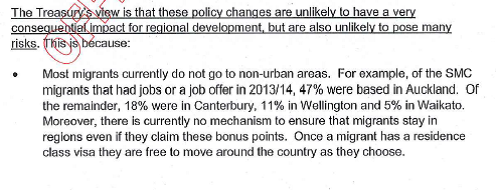
The sadly inadequate quality of New Zealand’s immigration policy, and official advice around it, is on display again today.

In late July, as the headline announcement in the Prime Minister’s National Party conference address, the government announced a number of immigration policy changes.  One of those changes was to offer materially more points to people applying for entry as skilled migrants if they had a job offer outside Auckland.  The relevant Cabinet paper hasn’t been released, and nor has there been any regulatory impact assessment published.

But the Herald asked for a copy of Treasury’s advice on these changes.  The Treasury’s view on the proposal to grant permanent residence to certain low-skilled workers was withheld (we might reasonably assume the comments were quite sceptical), but the Herald reported what they got here.  My thanks to Kim Fulton at NZME who passed on a copy of what was released.

Here is what Treasury had to say about the proposed scheme.

tsy 1
tsy 2

Cabinet must have agreed with them to some extent, since the final announced version of the policy was twice as generous as the version of the proposal Treasury was commenting on.

I entirely agree with them that the proposed changes –  and even the amped-up approved version –  is unlikely to do anything useful for regional development.  It is just another “subsidy”, and subsidies are both costly and aren’t what the regions need.  A sustainably lower real exchange rate –  and perhaps some comprehensive reform of capital income taxation – is much closer to the heart of what would make a difference.

But what I found surprising and disappointing was how blasé Treasury seemed to be about the whole proposal: “won’t do much good, but not many risks either”, which is pretty much a message from the government’s chief economic adviser that Cabinet might as well go ahead.

What are the risks?  Well, first and foremost, as I noted here, any person who just gets across the points threshold and secures permanent residence will beat out some other potential migrant who was objectively better qualified (whether on age. education, employment or capital investment –  Treasury’s own list).  And contrary to what Treasury suggests, this proposal isn’t just affecting a small number of people. On Treasury’s own numbers around half of migrants go somewhere other than Auckland, so the potential for debasing the average (and marginal) quality of New Zealand’s migrants is quite real.  As I’ve been highlighting in the last few weeks, a large proportion of our migrants (and temporary workers) are already not that skilled at all.  As Treasury has struggled to produce any convincing evidence of the gains from the large scale immigration programme, we might have hoped that they would be rather harder-nosed in pushing back against changes that worsen the chances of real and tangible gains to New Zealanders ever showing up.

And then Treasury observes that there isn’t much risk of competition with people at the lower end of the New Zealand labour market because the skilled migrant category rewards high-skilled people.  Yes, and very high-skilled people will easily cross the threshold already, and won’t represent competition for people at the bottom end of the market.  But this change is about making things easier for people who just aren’t that highly-skilled –  they are the marginal cases, and they get in only because they manage to get the extra points that will come from securing a job offer outside Auckland.  At the margin, it is those people –  the ones who directly benefit from this policy –  who are most likely to be competing with people at the lower end of the New Zealand labour market. I’m not suggesting they’ll be competing with shelf-fillers and checkout operators, but there are plenty of immigrants who don’t appear to rank very high up the spectrum of skills. There will be more under this policy.

As I read the advice I wondered why Treasury was not rather harder-nosed in its advice.  As we saw in previously released papers, they seem much less sanguine about the economic benefits of immigration to New Zealanders than their chief executive has been.  Perhaps they just didn’t have much time to look at the proposal and the weaknesses in the proposal just slipped through?  Perhaps they just knew it was all about politics, and the headlines in the media after the Prime Minister’s speech?

The permanent residence approvals programme, and especially the skilled migrant category, is seen by the government as an “economic lever”.  It operates on a very large scale, and has significant effects across the country.  We should expect a rather more rigorous critique –  and some of that rare free and frank advice – when ministers want to debase the currency (points), in ways that must, if the policy works at all, debase the average quality of the new migrants.  Productivity growth isn’t so abundant in New Zealand that we can afford a cavalier Treasury when proposals turn up that will, if they do anything, worsen our productivity prospects.