Are land taxes the answer to house prices?

I’ve been pondering a post on land taxes for some time, but was prompted to jot something down today by a couple of recent pieces, including in today’s Herald  by two lecturers in politics at AUT, Nicholas Smith and Zbigniew Dumienski.  Sub-editors present their arguments under the headline “Land tax best fit for housing crisis”, and the authors’ own conclusion is only a little more nuanced.

Given the multiple problems stemming from Auckland’s housing crisis, an LVT stands out as the best-rounded of the policy options on the table. Not only would it address house price inflation, it could also result in a more efficient use of land, mitigate urban sprawl, lower the burden on the natural environment and reduce the risk of real estate bubbles; all without undermining the foundations of economic growth.

I’m not a land tax expert, but I’m no longer so convinced.

Which doesn’t mean that I’m inherently unsympathetic to the argument for a land tax. In fact, I once wrote a Treasury paper on overall economic policy direction, that ended up on Bill English’s desk, and which was, with hindsight, rather too readily enthusiastic about a land tax.

In principle, taxing things that are in fixed supply has some theoretical and practical appeal.  Collection is pretty easy –  every piece of land has an identifiable owner.  And  whereas if one taxes business profits (say) heavily there will be less investment taking place,  taxing land won’t make much difference to how much land there is  (it will make some difference because the value of land is partly about work done to it (drainage etc).

And, of course, as the authors point out we’ve had a land tax previously –  it finally disappeared in the early 1990s, by when it apparently applied mainly to land under urban business districts.  And we still have, in effect, some partial land taxes: in some areas, local authority rates are levied on the basis of land values, and in many places (especially Auckland) even the capital value rating system have come a lot closer to a land tax as the land share of a typical “house + land” has climbed sharply.  And OECD data show the New Zealand property taxes, as a share of GDP, are already a bit above the OECD average.
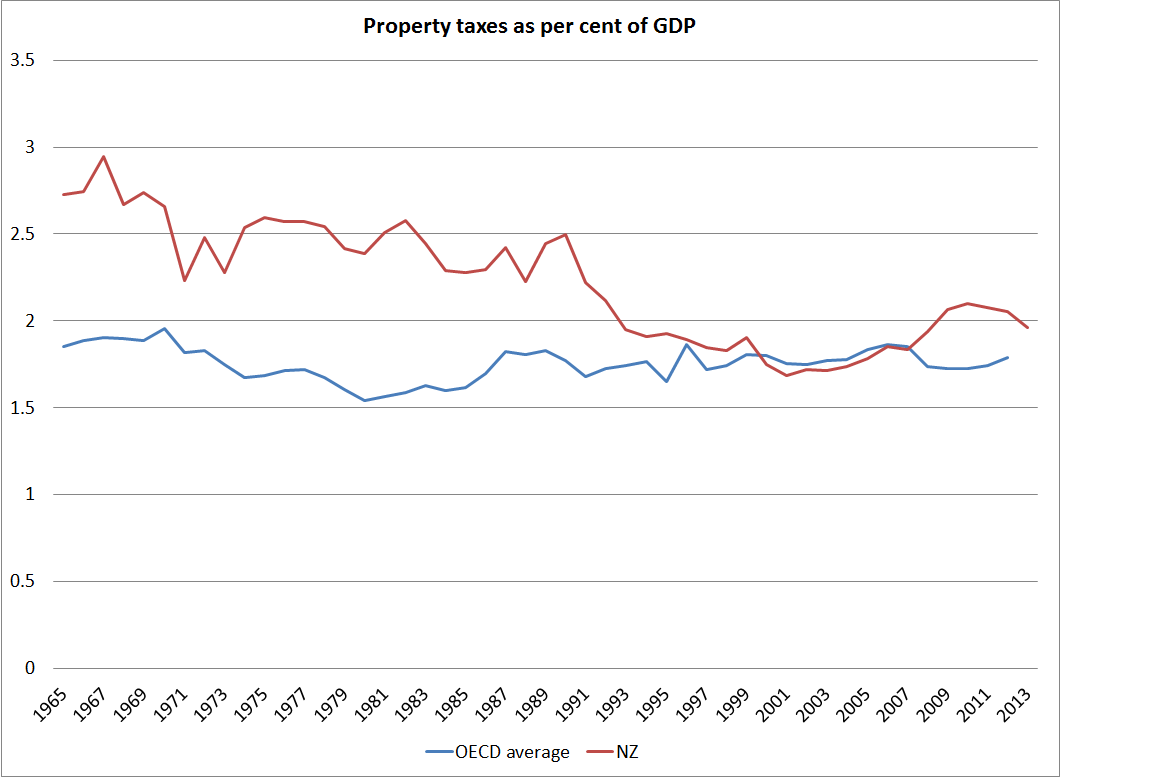
property taxes

Had we put a land tax on in 1840, and kept it in place ever since, I’m not sure I’d be arguing for abolition now.  But the historical track record of the tax we had was not that good.  Apart from anything else, the rules kept changing (and changing), with the base being progressively whittled down.  Smith and Dumienski note that “it was arguably an important factor contributing to New Zealand’s once-famed egalitarian character”.  I’d be keen to see the evidence for that claim.   New Zealand economic historians, at least those I’ve read, don’t seem to have seen the land tax in quite those terms.

Any material change in the tax system involves significant redistributive consequences (or big compensation packages).    No doubt there isn’t much public sympathy for “land bankers” in and around our cities (and since these people are mainly profiting from other regulatory distortions, I wouldn’t have much sympathy either).  But what, say, about the sheep farmer, in an area where values haven’t been much affected by dairy conversion opportunities?

I’m also not quite sure what sort of tax rate the advocates of a land tax have in mind.  People often glibly talk (and I have in the past) of a 1 per cent annual land tax as if this is a pretty small amount.    But real risk-free returns are not what they were.  New Zealand has probably the highest real interest rates among advanced economies and a long-term real interest rate here (20 year inflation indexed bond) is still just under 2.5 per cent.  The comparable US yield when I checked this morning was 1.1 per cent, and that is now quite a common sort of rate internationally.  People (especially central bankers) keep talking about interest rates “normalising”, but real interest rates have been trending down now for decades, and no one really knows with any confidence whether the process has ended, let alone whether it will be materially reversed.   In this climate, a land tax of anywhere 1 per cent would seem quite incredibly burdensome (in a way that it might not have seemed in New Zealand in the 1990s when real risk-free interest rates were touching 6 per cent).  Even if one could make a theoretical case for such an onerous tax, the political economy suggests that it could not be sustained (and would not be expected to be sustained).

Perhaps we could have a rather lower rate of land tax?  Perhaps a half or a quarter of a per cent land tax could be politically sustained?  But then one is left asking whether it is really all worth it.  Bearing in mind that urban land is already taxed, would it make that much difference to the cost of urban land –  the issue Smith and Dumienski are driving at  – or allow a material gain in economic efficiency from shifting away from more distortionary taxes (eg lowering our high taxes on capital income)?   After all, most people now agree that the real issues around urban land prices are not ultimately the tax system, but the regulatory restrictions on land use that central and local governments facilitate.  To some small extent, those restrictions seem endogenous to land prices –  ie when land prices get sky high (or least rise rapidly) there is pressure to ease the land use restrictions. If so, perhaps a land tax would just allow Councils to keep tighter restrictions in place for longer, undermining any possible efficiency gains from a land tax.

But let’s get back, in conclusion, to the Smith/Dumienski list of benefits.  They argue that a land tax would

  • address house price inflation,
  • result in a more efficient use of land,
  • mitigate urban sprawl,
  • lower the burden on the natural environment and
  • reduce the risk of real estate bubbles;

All without undermining the foundations of economic growth.

What’s not to like?  Well, first, in principle a land tax should lower the value of land (ie a one-off shift in the price). But it is not obvious that it will have much impact on either house price cycles, or trend pressures resulting from, say, the interaction of population pressures and land use restrictions.    Perhaps the authors have in mind some more sophisticated land tax that would  effectively be  a capital gains tax, but they don’t suggest so in their article. And as we know, real world capital gains taxes don’t appear to have done much to improve the functioning of housing and urban land markets

Would it result in a more efficient use of land?  I suppose that depends on one’s model, but I’d have thought that taxing an asset will result in a more intensive use of that asset, with no necessary presumption that the more intensive use is more efficient.  Of course, it might be less inefficient than the alternative possible taxes, but that is a different issue surely?

Relatedly, if land (across the country, not just in cities) is used more intensively, why is there a “lower burden on the natural environment”?  Land in its natural state poses no such burden, but if (say) farmers need to use marginal land more intensively, to maximise profit subject to a land tax, I’m not sure why this is an environmental gain.

And I simply don’t see the argument made that to “mitigate urban sprawl” is an appropriate public policy objective.  As is well known, urban areas in New Zealand make up a very small proportion of New Zealand’s total land area, and I’d have thought that revealed preference (reflected in prices) suggested that the most valuable use of land on the fringes of cities was typically for housing, rather than for agriculture.  “Sprawl” is just the pejorative term for “space” –  most people seem to want some (and historically as cities get richer they have gotten less dense) much though the planners might disapprove of their preferences.

To repeat, I’m not in principle opposed to a land tax, but I’m:

  • sceptical that it could be imposed, in an efficient way, on an enduring basis
  • sceptical that it would allow much effective tax system rebalancing
  • and doubtful that, on the scale at which it could be imposed, it would really make much sustained difference to urban land prices, and trends in them over time.

There is no great secret to why New Zealand urban land prices are high. It is largely down to the impact of the central and local government regulatory restrictions on land use.  Far better to tackle those at source, and give freedom back to landowners.  Competitive market processes could then be expected to produce affordable houses, as they have in much of the United States (which doesn’t mean Mt Eden prices will ever be the same as Invercargill ones).    Of course, one can reasonably argue that such reforms themselves might not prove durable, and if reform were totally “open slather” that would probably be true, but whether or not we have a land tax is simply not at the heart of the urban land price issues.

I’d welcome comments and thoughts on this issue, and if (for example) Andrew Coleman, at Otago, felt inclined to add one of his occasional, typically very insightful, comments drawing on his own past work (eg here) in the area I’d be very interested to read it.
The Government is doing everything it can?

Tempting  as it is to follow up yesterday’s post with some thoughts about how one might assess the Reserve Bank’s performance over recent years, I’m totally tied up today dealing with some rather older Reserve Bank issues. I’m preparing for a meeting tomorrow  surrounded by various old documents, a number of legal opinions, and numerous rulings from the Court of Appeal, the House of Lords etc all bearing on some important, but complex, questions about events from 25 years ago.   The investigative process has, unfortunately, already thrown up one explicit breach of the law –  responsibility for which  falls ultimately on the then Governor.

But before plunging back into that, I wanted to comment very briefly on a story Bernard Hickey ran yesterday on Auckland house prices.  The headline says “PM says government doing everything it can on Auckland prices”, and from the quotes in the body of the article it doesn’t seem to be an unrepresentative headline.  The quote that really caught my eye was this one

Asked if NZ$918,000 was too high, he said: “Well clearly it’s a lot but, there’s a big range and you can go on TradeMe and look at homes under $400,000 in Auckland and there are some.”

The blithe indifference was almost breathtaking.    Median house prices in Auckland are closing in on 10 times median income, and the Prime Minister can’t even say prices are too high.  He is reduced to suggesting that if you look hard enough you can find a few under $400000.

Those absolute bottom-end houses would still be more than five times median household income in Auckland.  A reasonable benchmark for median house prices  is around three times income –  about a third of the current ratio in Auckland.  I’ve never been one of those to criticise the Prime Minister for his wealth, but when he makes comments like this it does come across as someone who has got rather out of touch with the plight of ordinary New Zealanders (especially the younger, poorer, browner ones), perhaps reinforced by two weeks swanning round Europe attending rugby games at the taxpayer’s expense.

The Prime Minister is also reported as claiming that “There is an unprecedented level of construction and consenting now taking place in Auckland”.

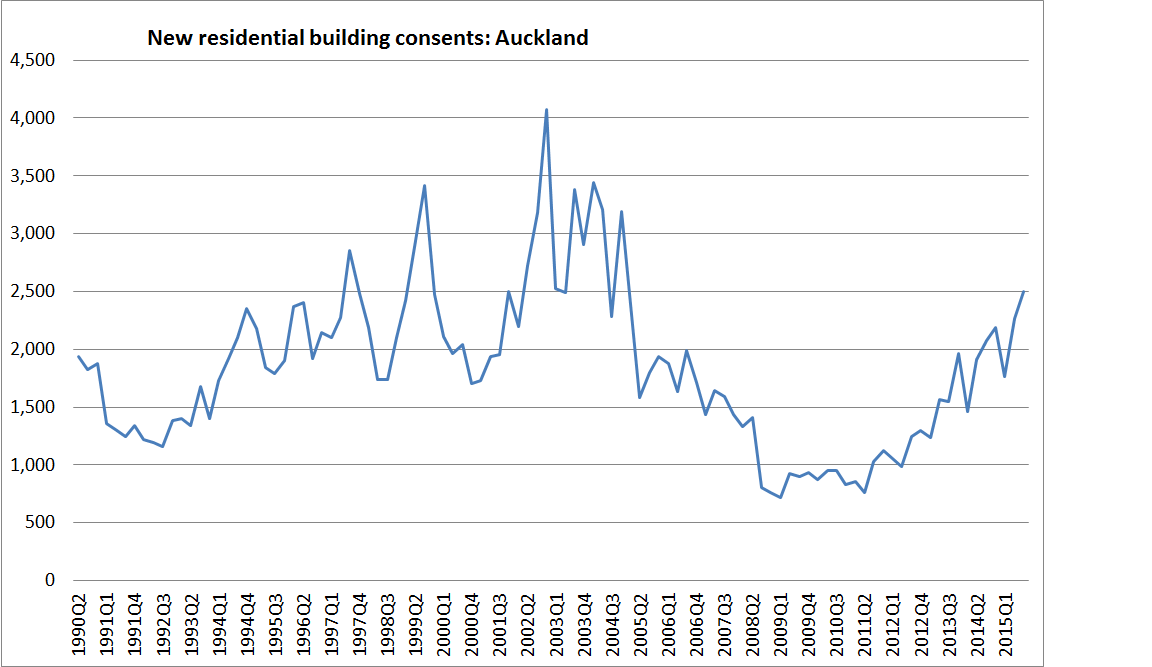
I’m not sure quite what he has in mind.  His claim took me by surprise, so I went to Infoshare and dig out the quarterly data on the number of residential building consents in Auckland.   The latest consents numbers are barely at the peak of the 1990s boom, let alone the 2000s one.   Auckland’s population is much larger than it was back then.

building consents auckland

Different experts in planning and parliamentary vote-counting might differ on whether the government could do more now, if it really wanted to, on freeing up land use restrictions, and allowing land owners to use their own land as they see fit, and as the market encourages them to.

But what is quite clear is that the government is doing nothing at all about cutting back the immigration target.  The number of residence approvals that is granted is wholly at the discretion of ministers, and could be changed tomorrow, requiring not a single vote in the House or any support from minor parties.  Cutting back the target from the current 40000 to 45000 per annum to, say, 10000 to 15000 would make a great deal of difference to population pressures on the housing market, especially in Auckland.  Cutting back immigration isn’t a direct solution to the longer-term issues about dysfunctional over-regulated markets in land use, but it would make a great deal of difference now.  And it is not as if the government, or its official advisers, have been able to show any convincing evidence that New Zealand’s large scale inward permanent migration programme is producing any other net economic benefits to New Zealanders.

Another Productivity Commission inquiry

A day after posting my sceptical comments on the Productivity Commission’s land supply report comes news that the government has asked the Commission to undertake more of a blue-skies exercise.  In the words of Bill English’s press release

The Government has asked the Productivity Commission to review urban planning rules and processes, and identify the most appropriate system for land use allocation, Finance Minister Bill English says.

“Urban planning in New Zealand not only underpins housing affordability but also the productivity of the wider economy,” Mr English says.

“Many parts of the regime are out-dated and unwieldy, having been developed over the years in a piecemeal fashion. International best practice has moved on and so must New Zealand.”

The Productivity Commission will undertake a first principles review of the urban planning rules that fall under Acts such as the Local Government Act, the Resource Management Act and the Land Transport Management Act, to ensure they support a responsive housing market.

“The Commission will also consider ways to ensure the future regime is flexible and able to respond to changing demands.”

There have not been many occasions in its seven years in office when the current government has pleasantly surprised me, but this was one of them.

And in the words of Murray Sherwin’s press release

“Most New Zealanders live in cities, and cities are places where most of the country’s economic activity occurs. It’s important that our planning system effectively controls harms to people and the environment, makes enough room and infrastructure available for homes, businesses and industry, and responds quickly to change,” said Commission Chair, Murray Sherwin.

“Cities across New Zealand face a range of challenges. Fast growing cities like Auckland are finding it difficult to provide enough capacity to house their rising populations, while others face the problem of maintaining essential services and infrastructure with flat or declining populations. Urban areas need a planning system that can respond effectively and efficiently to these pressures.”

“Our inquiry will explore the development of the current planning system in New Zealand, assess its performance compared to other countries, and identify where change is needed. The aim is not to draft new laws ourselves, but set out what a high-performing planning system would look like.”

The government’s terms of reference for this inquiry have not yet been released, so we’ll have to wait and see what, if any, constraints have been put on this particular inquiry.

I’m cautiously optimistic that the Commission will come up with something useful as it pulls together its report over the next year –  although ideas of private choice, preferences, markets, and knowledge limitations need to weigh at least as heavily as smarter government and better plans.

But it is worth bearing in mind that the current government has already been in office for seven years, and has achieved very little in respect of liberalising the rather dead-hand of the regulatory state in this area.  By the time the inquiry report emerges, the government will be eight years old and just about to head into an election year.  Major reforming legislation seems unlikely in 2017, and who knows what lies beyond that year’s election.  Have fourth term governments been known for their bold reforms (late Seddon, late Massey, 1946-49, 1969-72)?    Is a government in which the Greens are full members, or are  relied on for confidence and supply, likely to be one that introduces far-reaching reforms to make the land and housing markets work more flexibly and effectively?    And the Productivity Commission seems to have a hankering for more powers for central government –  more so, at least judging by their most recent report, than they favour more powers for individuals and more reliance on the market.  But more powers for central government might seem appealing if a particular central government shares one’s vision, but rather less so in other cases.

Perhaps the best we can really hope for is an authoritative document that will be mined for workable nuggets in the following decade or two?   But that, in itself, would be no small achievement.

I’ve noted previously that I’m not aware of examples where far-reaching planning regimes once in place have been materially unwound, enabling housing to become consistently more affordable and responsive to the needs and interests of potential purchasers.   Impressively, the Productivity Commission says its issues paper for this inquiry will be out only six weeks from now.  I hope they use that opportunity to draw our attention to any liberalising experiences abroad they are aware of.   And as the Commission has come across as rather sympathetic to the desire of councils to promote “compact urban forms”, I hope they consider the historical data suggesting that as cities have become richer they have tended to become less dense, not more dense.

It would be interesting to know what prompted this belated request from the government.  I wonder if the Hsieh and Moretti paper has played a part?  Certainly the Minister now talks of “urban planning in New Zealand…underpins…the productivity of the wider economy”, and the Commission was slightly breathless in its enthusiasm for the results

Quantifying the size of the prize is difficult, but it could be significant. One US study (Hsieh & Moretti, 2015) estimates that lowering regulatory constraints on land supply in three high-productivity US cities – New York, San Francisco and San Jose – to that of the median level of restrictiveness in the United States would increase GDP by 9.5%. A productivity bonus anywhere near this level would be of major significance to the New Zealand economy. Indeed, it is difficult to think of many other policies that would yield such an improvement in the nation’s economy.

I’m all in favour of much less heavily regulated land use, but I remain pretty sceptical about size of any aggregate productivity gains that such reforms might offer.  Well-functioning markets in affordable housing would be a great gain in their own right.  But papers like that of Hsieh and Moretti need a great deal more scrutiny before putting much weight on the idea that urban planning reform offers very large gains in productivity or GDP per capita.   It would be interesting, for example, to see some detailed scrutiny of comparisons between San Francisco and New York on the one hand, and Atlanta and Houston on the other.  And cross-country comparative analysis would also be interesting, including taking account of the economic fortunes of such cities (with tight land use and building restrictions) such as Sydney and London.

And I was curious about the timing of the announcement.  When an announcement is slipped out on the day of World Cup final, it doesn’t suggest any great desire on the 9th floor to draw much attention to the new work.  And consistent with that, perhaps, the capital’s daily newspaper, awash in black, does not even report the announcement (UPDATE: nor, as far as I can see, does the Herald).

The recent Productivity Commission report has a nice summary of the evolution of the planning regime in New Zealand.  Some time ago, browsing on the Ministry of Justice website [1] I stumbled on this snippet, from the speech of a Cabinet minister introducing to Parliament New Zealand’s first piece of town planning legislation in 1926:

Cities and towns in the Dominion at the present time have no schemes of town planning and the sooner the controlling authorities have the power and set to work and draft such schemes the better for themselves and the people generally.

Perhaps the councils benefited, but it less clear how “the people generally” – and especially those wanting reasonable housing for themselves and their children – have come to benefit.  Perhaps the new Commission report will help answer that question.

UPDATE: The Terms of Reference for the new inquiry are here.  As a quick reaction:

a.  They seem to take too much for granted the need for an “urban planning system”

b.   There are no references to individuals, markets, private preferences, choice, property rights etc

c.   The list of those the Commission is enjoined to consult is lengthy, and almost exclusively parties with vested interests in the process.  Many will have useful specialised knowledge, but there is no emphasis on property owners, potential house purchasers and the like.

d.    The Commission is enjoined not to undertake what might “constitute a critique of previous or ongoing reforms to the systems of legislation that make the urban planning system”.

[1] http://www.justice.govt.nz/courts/environment-court/about-the-environment-court/History

Land supply and the Productivity Commission

I’ve been a bit behind with my reading since I got back from holiday, but today was the first day of my son’s cricket season, and an opportunity for some concentrated reading on the sidelines.

The Productivity Commission released its final report Using land for housing last week.  It is a long report (400 pages or so), and I’ve only read so far the 35 page summary version, and the first few chapters of the body of the report.  From what I’ve read there are some useful specific findings and recommendations. But they come in a document that – as the Commission (with its rather Stakhanovite-sounding name) documents often do –  puts altogether too much faith in government –  the good intentions, knowledge, and capacity to execute of central government in particular.  It was enough to prompt me to pull The Road to Serfdom off the shelf when I got home, as a bit of a counter to the over-confidence.

I haven’t read the whole report, and may want to come back with some more detailed observations later, but I suppose my overarching impression was of a report that was largely lacking in a sense of a positive role for markets, for the price mechanism as a reconciling and coordinating device, or indeed for the value of individual preferences.    Markets work, and typically meet the needs of citizens when allowed to do so.  Government planners not so much.

In its defence, the Commission would no doubt observe that they were asked not to undertake a fundamental review of the Resource Management Act (or, no doubt, the other relevant pieces of legislation). But I don’t find that sort of response particularly persuasive.  The Commission shows no signs of unease with the concept of urban planning, and indeed seems to treat as wholly legitimate the choices of local councils to pursue particular visions of urban form (especially compact ones).  It is simply those pesky voters who stand in the way of councils realising their visions.  And perhaps worse, the ill-defined concept of “national interest” provides an overarching framework to the report.   It is certainly true that local authority powers all flow from central government –  ours is not a federal system –  but the Commission seems to provide no basis to believe that central government will consistently establish better policy than local government.  Is the track record any better?  I’m not convinced.   All sorts of governments –  here and abroad  –  have defined all sorts of questionable things as being in “the national interest”.  As I recall, it was an argument for the Clyde Dam.  In some senses, this report was reminiscent of a report some worthy body might have written 50 years ago on making import licensing and exchange control work better –  not entirely unworthy goals in their own right, but not really the point.

Part of this “national interest” story involves the Commission signing on all too easily to the idea that Auckland should get even bigger even faster than it already has.  They do cite a single recent journal article about some modelling work done on several cities in the US (none of which makes up even 10 per cent of the population of the United States).  Auckland, by contrast, already makes up a third of the total population of New Zealand, and since World War Two has grown faster than the largest cities in almost any other OECD country (Tel Aviv is an exception, and Israel’s economic performance has been about as bad as New Zealand’s).  Scandalous as Auckland house prices are, is it really credible that the failure of Auckland to have grown even faster is –  as the Commission strongly suggests –  one of the largest conceivable explanations for New Zealand’s long-term underperformance?

And in neither its general tone nor in its recommendations is the Commission a friend of property rights, even though the land supply issues arise in the first place because central and local governments have severely restricted the ability of landowners to do as they like with their land.  The Commission, for example, proposes legislation to time-limit covenants put in place between willing buyers and willing sellers in private residential developments.  To what end?  And, worse, they endorse the extension of compulsory acquisition powers to allow local authority Urban Development Authorities to take private land (at less than the value to the owner –  by definition) for housing purposes.  Again, wasn’t it central and local governments that created the problem in the first place?  And now they want to further undermine the security of people’s interest in their own land, to enable Councils to pursue “their visions”.  Even if such an approach were likely to prove helpful on the immediate issue (lowering urban land prices) in the short-term, how does the political economy of powerful urban development agencies look in the longer-run?  Is it likely to be a model of good governance?  Or is it more likely to be a channel through which vested interests (public and private) operate to benefit themselves, to the disadvantage of the public.  In general, the report’s sense of political economy seems rather naïve.  They are very taken with the idea that Councils operate at the behest of voters, who are disproportionately older and home-owning, but never really analyse alternative perspectives.  Home-owners, for example, typically have children, but there is little sense of an intergenerational perspective in what I have read so far.   And it has never been clear to me why the Commission thinks that middle-aged home-owners would have any problem with their Councils facilitating new housing developments on the fringes of cities provided that those developments covered the true marginal costs to the Council of such development.

Finally, I was interested in the Commission’s description of the overseas visits they had undertaken.  There were visits to Australia, and to the United Kingdom, but aren’t these the two countries with the most similar problems to those in New Zealand (at least as indicated by the Demographia price to income data)?  No doubt there are interesting insights to be found in Australia and the United Kingdom, but the evidence suggests they have not gotten round to actually solving the problems.   I was quite genuinely surprised that the Commission had not visited the United States and looked at the models that operate in many large and growing cities there, where house and land prices remain highly affordable (medians often under US$200000).  It all seems to reinforce a sense that the Commission sees New Zealand’s urban planning not just as an unfortunate and costly feature we might be stuck with for now, but as something positively useful and appropriate.  Doing so might be politically opportune in the short-term, but it is hard to see that it really deals with the longer-term issues in a durable and sustainable manner.

I may have cause to revise these comments when I’ve read the rest of the report, but based on the front window the Commission itself has put it up, I’m not optimistic of being able to do so.  And that is a shame.

Thinking about housing again

I gave a talk in Nelson last night on housing issues.  It was largely a rework of material I’ve used before (posted here and here) so I won’t post the text here.   I’m not sure the speech quite hit the mark for the audience, but as always when I put together a presentation I find that I learn something in the process, or  some things come together more clearly in my own mind.

By Auckland standards, Nelson-Tasman house prices aren’t that high.   In real terms, house prices are still lower than they were in 2007.   But a median house price of around $400000 against a median household income of not much over $60000 reminds us just how high price to income ratios are across most of New Zealand (my old home town of Kawerau remains an unattractive exception).  Most of the “problem” is in the land.

As I often do, I devoted a bit of time to explaining why I don’t think features of the tax system are a material part of the explanation for high New Zealand house prices, or for the cycles that we –  and other countries  – experience.  As a slight counterbalance, I took the opportunity to put in another plug for land-value rating by local authorities, a case also recently made by the Productivity Commission.  Most New Zealand local authorities now use capital value rating, which – relative to a land value base –  provides less of an incentive to bring vacant land into development.  In principle, and all else equal, greater use of land value rating should help to dampen urban land prices, and close the gap between rural and peripheral urban land prices.

But one of the audience, a highly-respected figure in Nelson, with decades of experience in the building industry and on the local council, pointed out to me that Nelson city had, some decades ago, moved to land value rating.    Urban land prices remain very high.  It isn’t obvious that land value rating has been very helpful in easing land supply pressures.  Then again, nothing operates in isolation.  Neighbouring Tasman District Council, where much of the (flat land and) population and housing growth has been, still operates a capital value rating system.  And an ever-growing District Plan, that now runs to 1000 pages in Nelson City, probably has not a little to do with the continuing high land prices, and the continued excessively costly houses, in that part of the country.

A variety of factors no doubt explain the shift to capital value rating, although one can’t help wondering if the pervasive biases of so many councils towards more intensive, rather than extensive, development isn’t part of the story.  Many councils really don’t seem to want more land developed, or they want it developed only at a pace that suits them.  It is probably unrealistic to think that councils would favour a move back towards land value rating when those same councils are the ones applying land use restrictions in the first place.  If councils were committed to making urban land affordable, they could quite readily do it now.    Instead, as the Productivity Commission put it –  seemingly approvingly –  in its report last week:

Many urban councils in New Zealand have a clear idea about how they want to develop in the future, and how they intend to meet a growing population demand for housing.  Many larger cities have chosen to pursue a compact urban form.  Yet some of our cities have difficulty in giving effect to this strategy”.

Sadly, the Productivity Commission seems to see councils, and the planning regime, as part of the solution rather than as a large part of the problem.

I hadn’t been thinking much about housing while I was on holiday, but a conversation with friends we were staying with, in their growing prosperous (2 per cent unemployment rate) Midwest small college city, had got me thinking. I’d asked about local house prices and they’d commented that their house was probably worth about US$175000 –  decent-sized section, four bedrooms, and five minutes walk from the local college.  And they observed that prices had been moving up, and local sentiment was that they were really quite expensive.  In exchange I offered them scare stories about Island Bay prices, and vague references to the scandalous Auckland prices.

I didn’t give it much more thought until I got home and started preparing last night’s talk.  That observation that US$175000 was quite expensive was still running round in my head, and so I printed out the latest Demographia tables.  I’ve often used Houston as an example of a large, fast-growing, city with very moderate house prices –  in fact, lower in real terms than they were 35 years ago.   But, actually, Houston prices aren’t at the low end of the range –  the median house price was about US$200000 there last year.  Astonishingly cheap, absolutely and relative to income, by New Zealand standards but not by US standards.   Detroit (inner city) is a byword for cheap, but among cities with over a million people (and remember that Auckland hasn’t that many more than a million), these places last year had median house prices in a range of US140-175K (and price to income ratios of around 3).

Cincinnati

Grand Rapids

Pittsburgh

St Louis

Atlanta

Indianapolis

Kansas City

Louisville

Columbus

Oklahoma City

Memphis

Tampa

And there are dozens of other similarly affordable smaller cities.  I haven’t checked each of them, but I suspect “densification” hasn’t been a big part of keeping housing affordable.

Of course, the US has places at the other end of the range as well –  places I’ve barely heard of as well as Los Angeles, Honolulu, San Diego, San Francisco, and so on.

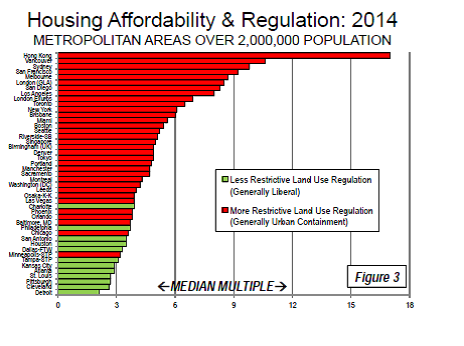
What marks out one group from the other isn’t being a “global city”, or a growing city:  it is mostly the land-use restrictions.  As Demographia highlight,  there are no cities  with high house price to income ratios that have liberal land-use regimes.

demographia

Which brings me back to a speech given last month by Bill English on housing affordability.  I noticed it has even been getting some coverage abroad, and it certainly has some useful perspectives on some of the issues (although looking through my copy I noticed I’ve scrawled “dubious” in a surprising number of places).  I liked the idea that our Deputy Prime Minister was making the case that urban planning has become a net drag on the country, and especially on its poorer and more vulnerable people, for whom housing has become progressively less affordable.  I was surprised to learn that the government now subsidises 60 per cent of all rentals in New Zealand.  And as the Minister notes of the 3000 page Auckland Unitary Plan “no one person [ or, one might add, no committee or Council] could possibly understand all the trade-offs in that plan”, or the implications of those choices.

I did, however, splutter at the suggestion that planning was an externality that central government might have to deal with just like “other externalities, such as pollution”.  The Minister seems to conveniently forget that the powers local governments have all flow directly from central government legislation – the centrepiece of which, the Resource Management Act, was passed by a government in which he served as junior backbencher.  Individual members of central and local governments may have their hearts in the right place, but this is ultimately a problem of central government failure at least as much as of local government failure.

And there are few signs that the problems are going away.  But perhaps that shouldn’t surprise us.  As I’ve noted here previously, I’m not aware of any examples of places in advanced economies where tight land use restrictions once in place have ever sustainably been removed.  When I first made this observation, I made it pretty tentatively.  I’m not an expert in the details of urban planning or familiar with the hundreds of individual regimes in various countries.  I was half-expecting that someone would come back to me quite quickly pointing me to a compelling case study of successful liberalisation.  So far no one has.  And I haven’t heard the Minister of Finance or the Minister of Housing highlight such studies.  I haven’t seen the New Zealand Initiative do so, and I haven’t seen Demographia do so, even though they have every incentive to highlight such examples if they exist.  I still hope there are such case studies out there, but it looks increasingly unlikely.

Bad policies don’t last for ever, but they can carry on for a  very long time.  I highlighted last night that New Zealand once had the unique feature of a car market where second-hand cars held their value and (by repute at least) were at times worth more than new cars.  My maternal grandfather often liked to tell the story that he reckoned my father was keen on marrying my mother as much because she owned a car as anything else (she’d done an OE and had overseas funds).  The insanity of the import licensing and local assembly regime eventually came to end, but it took a very long time –  sixty years or more.  Is there any reason to be more optimistic that housing will once again be affordable in New Zealand any decade soon?  If house prices had been bid up simply on the back of reckless bank lending policies, then perhaps so. But that isn’t the New Zealand story. Ours is a story of microeconomic policies, implemented and maintained by successive central and local governments, with the clear and predictable effect of making housing, and the sort of housing people want, much less affordable than it needs to be.

An official target for house prices to disposable incomes

Getting back to thinking about housing issues, in preparation for a speech next week, I noticed that the Auckland Council’s Development Committee had adopted a target of reducing the Auckland ratio of median house prices to median disposable income to five (from around ten at present) by 2030.

The target appears to have been adopted following the recent report on housing affordability issues by the Council’s Chief Economist. That report,  if rather patchy, has some interesting material I’d not seen previously, such as the estimated range of costs of some of the view shaft restrictions on building that Auckland currently has in place.

I wasn’t that impressed by the new target.  The report notes that house price to income ratios probably “should” be around three, and then adopts a target which, even if taken seriously, would still leave price to income ratios 15 years hence well above the sorts of levels that should be able to be sustained over the longer-term.  Targets for asset prices leave me queasy at the best of times, but set that ‘theoretical” objection to one side for now.

But what chance is there of this target being taken seriously?  It is being adopted by the Development Committee of a Council that is a year out from an election.   Five sets of local authority elections will occur before 2030.    And unlike central government there is no strong party discipline in local government, which means there is even less meaningful basis for anyone to believe that a target adopted today by a committee of the current Council will translate meaningfully into action over the next 15 years.

There is an old cynic’s line that in making a prediction one can safely offer a number or a date, but would be most unwise to include both.  Probably the same goes for target-setting.  But an alternative formulation might be that if you must include a number and a date, set the date so far into the future that no one is likely to even remember it when the date comes round, and all those involved in setting the target will long since have moved on.     Concrete targets around things the Auckland Council can actually control for the 12 months between now and the next election  –  or at a pinch the one after that, which sitting councillors might campaign on next year  –  might have been more impressive.

Targets like this have more of a feel of “virtue-signalling” –  adopted and articulated to signal that the adoptees “feel the pain” rather than because they necessarily intend to do much about the problem in question.  To say that is not to doubt the goodwill of the Auckland councillors, simply to observe that in isolation this target gets some cheap feel-good headlines (the word “ambitious” gets associated with one’s name, and not necessarily in a Sir Humphrey sense) and commits them to precisely nothing.

In fact, I was reminded of some previous targets.    Numerous governments have talked about getting New Zealand back into, say, the top half of OECD per capita income rankings.  Not that long ago there was the goal of catching up with Australian per capita incomes by 2025.  No doubt all those involved would have welcomed achieving the targets, but weren’t willing to actually do anything much themselves to achieve them.  And having served their short-term purpose (fill out a speech, fend off a minor party or whatever) the targets themselves would soon be forgotten.

Getting rather long in the tooth now, I was also reminded of the 1989 Budget.  The then Labour Government was in increasingly desperate straits.  The economy was doing badly, the financial crisis was continuing to unfold, the tensions within the Cabinet grew more intense by the day, and Labour’s position in the polls looked bleak.  The Minister of Finance needed something a bit new for the Budget, and so a serious of macroeconomic targets were announced.  By December 1992, the government  –  which looked most unlikely to be re-elected anyway –  would aim to:

  • Reduce public debt to 50 per cent of GDP
  • Reduce inflation to 0 to 2 per cent
  • Reduce unemployment below 100000,
  • And get first mortgage interest rates in a 7-10 per cent range.

This was actually the first time the 0 to 2 per cent inflation target had been given a specific target date.

At the time, the new Reserve Bank legislation was being considered by Parliament.  That legislation would give someone –  the Reserve Bank Governor –  specific responsibility for getting inflation to the target by a particular date.    And it was (over)achieved, (nobody having mentioned the need for a severe recession when the targets were articulated).

But none of the other targets was ever heard of again. No one was made responsible, no one took them seriously, and there was no reporting and monitoring mechanism established.

I hope the Development Committee’s target is the next step in a serious process of freeing-up housing supply, and making housing and urban land in Auckland affordable once again.  But I’m not convinced.  I’m still not aware of any Anglo country major city in which planning restrictions have been materially and sustainably unwound to facilitate a responsive and affordable housing market (are there such examples?)  Perhaps Auckland can be the first, but there is little sign of the vision, passion, commitment, and political leadership –  whether at central or local government level –  to really address, and reverse, these issues.

(And, of course, we could get to the goal –  and beyond –  much more quickly if the target rates of inward non-citizen migration –  being reviewed by Cabinet now –  were materially reduced.  That could be done quickly and easily –  and it has worked previously.  It might buy time for a considered reassessment of the planning rules, in a rather less-fevered, less threatening, environment.)

Housing, the Reserve Bank, and an advisory

In the wake of Thursday’s Monetary Policy Statement there has been a round of further comment on house prices and the risks around the housing market.  In fairness to the Reserve Bank, it wasn’t a focus of their document, and comments from the Governor and Deputy Governor seem to have been made in response to questions, at the press conference and at the Finance and Expenditure Committee.

I had been a little sceptical of the strength of the nationwide housing market, and pressures are clearly still concentrated in Auckland and, to a lesser extent, nearby cities.  But, equally, the overall level of activity appears to have picked up.  Here is my favourite timely chart, of per capita mortgage approvals.

mortgage approvals

Earlier in the year. mortgage approvals were running no faster than they were last year.  In the last couple of months the pace has clearly picked up.  That shouldn’t be surprising, as the interest rate increases last year have gradually been reversed, but it is worth bearing in mind not only that the rate of approvals is still below the decade average, but it is barely two-thirds the rate in the peak years of this series, 2005 and 2006.  And the mortgage approvals series does not go back far enough to capture 2003, the year when national house prices rose 23 per cent.  There is no nationwide house price boom.

Housing market activity has clearly picked up.  As it should have.  I don’t think I’ve seen any commentator make the (perhaps too obvious) point that cuts to official interest rates work by a combination of lowering the exchange rate, and encouraging more interest-sensitive expenditure.  In part, that is about bringing forward some spending from tomorrow to today.  But it is also about boosting the prices of long-lived fixed assets, which (in part) encourages people to build instead of buy.  If house prices hadn’t risen to some extent  – relative to some unobserved counterfactual –  in response to lower interest rates. there would probably be reason for concern. Real long-term interest rates have fallen by around 50 basis point since this time last year (15 year inflation indexed bond).

But, of course, this brings us back to the question of what is a fixed asset.  Houses are long-lived assets, but –  in principle –  a new house can be built quite quickly.  And lower interest rates actually reduce the cost of new building a bit (finance costs are non-trivial).  Land is in fixed supply, but unregulated land isn’t particularly valuable or expensive.   Good dairy land goes at perhaps $50000 per hectare.  Lower expected long-term interest rates should raise the unregulated market price of land – at these low interest rates, a 50 basis point change in long-term real interest rates might make quite a large difference, all else equal.  The unregulated price of land is a small component in the cost of a suburban house+land.  But the unregulated price isn’t what we observe.  Instead, what has driven land (and thus house+land) prices sky high is the interaction of two policies – high levels of inward immigration, mostly under direct government controls, in conjunction with tight land use restrictions.  The combination has been disastrous in Auckland.   Non-resident purchases probably haven’t helped either.  With much looser land use restrictions, house+land prices would be much less sensitive to demand pressures (whether from population or interest rates) than they are now.

The Reserve Bank talks of the Auckland market being in “dangerous” territory, but mostly that seems to be slightly inflammatory rhetoric more than the fruit of hard analysis.  Yes, house price to income ratios are higher than in most cities around the world.  And yes, that is a social and political scandal.  But it is largely the outcome of real forces –  not underlying economic ones, but mostly government policy-controlled ones.  They also aren’t, by contrast, the result of some speculative frenzied lending binge (unlike many of the boom-bust markets in the US last decade).  Of course, many property purchases need credit, but credit growth remains pretty subdued, and housing market activity (per capita) remains well below previous peaks. And the Reserve Bank has pointed to no evidence of a material deterioration in credit standards.  If that sort of deterioration is going on, it is surely incumbent on the Reserve Bank to illustrate the evidence (as, say, Waynes Byres recently surveyed the Australian evidence).   Moreover, banks operate on a nationwide basis, and as the Governor observed the other day, the “problem” is largely an Auckland one.  That suggests looking at Auckland-specific causes –  and the interaction of immigration policy and land use restriction policy is the most obvious one.

The Deputy Governor was quoted the other day as telling MPs that “it’s always very difficult to pick the top of any asset price cycle”.  Indeed, and nor is it the job of officials to do so.  But it is also very difficult to know what the equilibrium price of an asset is, especially when the market for that asset is so heavily distorted by policy interventions, in this case policy-driven population growth running head on into land use restrictions.  Auckland prices are very high, scandalously so, but there is nothing that guarantees –  or even offers a high degree of certainty – that real house prices will settle any lower over the longer-term.  I hope they do, and I’m sure most of those currently shut out of the Auckland market do, but this is not just (or even primarily) a market process.  The same goes for Sydney, or London, or Vancouver, or San Francisco.  All the Reserve Bank should be doing is monitoring lending standards, and  –  most importantly  – ensuring that banks have ample capital to cope with things going badly wrong.  They’ve done the second part of that job, and on their own numbers they (and the banks themselves) have done it well.  Beyond that, if they can add in-depth and considered research that sheds light on the housing issues that might be welcome –  although the research resources might be better spent on getting monetary policy right – but beyond that the housing market just isn’t their job.

Just briefly, I noticed a soft interview with the Governor in today’s Herald. It is a platform for the Governor to advance his (remarkably upbeat) case, rather than an occasion when the journalist posed any searching questions. Some of it is just misleading, or straight out wrong.  New Zealand’s economic performance in the last few years has been mediocre at best –  better, certainly, than many of the euro area countries, but generally underwhelming  – poor by historical standards, and no better than, say, the United States which was at the epicentre of the financial crisis.  There has been no per capita real income growth at all in the last 18 months, and real per capita GDP is not much higher than it was in 2007.  That isn’t (mostly) the Bank’s doing, but it isn’t a good performance either.  Oh, and the unemployment rate –  had I mentioned that before –  has hardly come down since the severe recession of 2008/09.

The Governor attempts to rebut some (currently straw man) critics.

Wheeler is keen to make the point that the bank is anything but robotic with its primary focus on inflation.

Critics, particularly on the political left, have called for the bank to broaden its outlook.

“Some people say … we don’t care about growth. But I think every central bank thinks quite deeply about how the economy is going, what’s happening to demand, to investment, to unemployment.”

Perhaps, but right at the moment –  and for the last five years –  a rather more “robotic” focus on actual inflation might have produced better outcomes than we’ve seen.  The Governor seems totally unbothered about his persistent inflation errors, or about the increase in the already high unemployment rate.  As I noted the other day, at present there are no nasty trade-offs between real activity and inflation.  Easier monetary policy would be likely to lower the exchange rate –  something the Governor calls for at every opportunity –  to boost economic activity, lower unemployment, and –  not incidentally –  get inflation averaging somewhat closer to the 2 per cent target midpoint that he agreed three years ago to deliver.

And finally an advisory.  There won’t be many posts here in the next few days, and none for several weeks from next Thursday.  We are taking the kids off to see museums and art galleries (and a few other things) in the United States, and to reintroduce two of them to the land of their birth.  Despite a suggestion from one reader, I won’t be blogging about the lead up to the presidential primaries, fascinating as those races always are, or anything at all.  I’ve been quite taken aback by the level of interest in this blog, and have really appreciated the many typically thoughtful comments and questions. I’ve also written much more than I had ever expected, or intended to (and especially more than I intended to about the Reserve Bank), but it has been fun.  As for the future, I have quite a large pile of topics I haven’t yet got to write about –  in some cases ones that were on the pile on 2 April when I left the Reserve Bank –  so I expect I’ll be back writing here once the rest of the family is back to school and work on 13 October.

Two central banks on property: a study in contrast

Luci Ellis, head of the Reserve Bank of Australia’s Financial Stability Department,yesterday  gave a speech titled “Property Markets and Financial Stability: What do we know so far?,  at a real estate symposium at the University of New South Wales.

The Reserve Bank of Australia is a fairly hierarchical organisation, and so although Ellis is a department head, there is an Assistant Governor (several of them) and a Deputy Governor and the Governor above her.  It is a reminder of how deep a bench of talented people the RBA has.

I didn’t agree with everything in Ellis’s speech by any means – among other things there is an uncharitable dig at the 1990s RBNZ, and I was surprised to find no references to land use regulation at all –  but it is the sort of speech that one comes away from with plenty of food for thought.  It is thoughtful and balanced, offering some fresh insights, and reframing other material in an interesting way. It will repay rereading.   Taken together with the speech from Wayne Byres, chairman of APRA, that I discussed recently, it is the sort of material that gives one some confidence that the key Australian institutions  have thought carefully and deeply about property market issues and risks.  And that they have sought to use historical experiences, and those of other countries, for illumination and not just for support.  Not everyone in Australia will agree with Luci Ellis’s way of looking at the issues, but it would be foolish not to grapple with the arguments and evidence that people like her advance.

The contrast with our own Reserve Bank is a sorry one. Our central bank does plenty of speeches, but most of them are pretty lightweight affairs.  As they will, and must, market commentators scour them for hints about near-term policy direction, but I don’t think any reasonably well-informed observer comes away from a Reserve Bank speech –  whether from Wheeler, Spencer, Fiennes, McDermott, or Hodgetts – feeling that they now understand the isssues, or even the nature of the questions, better.  Sadly, it isn’t only the Reserve Bank: the quality of the economic analysis from our key economic policy agencies more generally now seems patchy at best.  I bang on here about the New Zealand’s slow continued relative economic decline, but when I look at the quality of the policy advice etc (whether it is MBIE or Treasury on (eg) immigration, or the Reserve Bank) I sometimes wonder if we should really be surprised.

I’m not going to try to excerpt Luci Ellis’s speech, simply encourage anyone interested in the substantive issues to read it.  Little of it is Australia-specific and many of the insights and questions are relevant to the discussions and debates that should be occurring in New Zealand.

Rather than excerpt the core content of the speech, I want to draw attention to just one section about good public policy processes.  Here is what Ellis has to say:

But the policy imperatives inspiring the work make it even more important to be scientific in our approach. By scientific, I mean the idea that the celebrated physicist Richard Feynman talked about in a much-cited university commencement address (Feynman 1974).

“Details that could throw doubt on your interpretation must be given, if you know them. You must do the best   you    can – if you know anything at all wrong, or possibly wrong – to explain it. If you make a theory, for example, and advertise it, or put it out, then you must also put down all the facts that disagree with it, as well as those that agree with it.”

It’s an argument for nuance, for being rigorous about your approach and for being prepared to admit you might be wrong. But I don’t want to understate the challenges this poses in a policy institution.

I hadn’t come across Feynman’s speech previously, but it is also worth reading.   Here is the fuller version of the bit Luci Ellis quoted from.

It’s a kind of scientific integrity, a principle of scientific thought that corresponds to a kind of utter honesty–a kind of leaning over backwards. For example, if you’re doing an experiment, you should report everything that you think might make it invalid–not only what you think is right about it: other causes that could possibly explain your results; and things you thought of that you’ve eliminated by some other experiment, and how they worked–to make sure the other fellow can tell they have been eliminated.

Details that could throw doubt on your interpretation must be given, if you know them. You must do the best you can–if you know anything at all wrong, or possibly wrong–to explain it. If you make a theory, for example, and advertise it, or put it out, then you must also put down all the facts that disagree with it, as well as those that agree with it. There is also a more subtle problem. When you have put a lot of ideas together to make an elaborate theory, you want to make sure, when explaining what it fits, that those things it fits are not just the things that gave you the idea for the theory; but that the finished theory makes something else come out right, in addition.

In summary, the idea is to give all of the information to help others to judge the value of your contribution; not just the information that leads to judgement in one particular direction or another.

The easiest way to explain this idea is to contrast it, for example, with advertising. Last night I heard that Wesson oil doesn’t soak through food. Well, that’s true. It’s not dishonest; but the thing I’m talking about is not just a matter of not being dishonest; it’s a matter of scientific integrity, which is another level. The fact that should be added to that advertising statement is that no oils soak through food, if operated at a certain temperature. If operated at another temperature, they all will–including Wesson oil. So it’s the implication which has been conveyed, not the fact, which is true, and the difference is what we have to deal with.

And this, I think, is what most seriously troubles me about our own Reserve Bank’s contributions to the discussion of property risks etc.  Whether it is speeches from the Deputy Governor, the Governor’s own comments at FEC, consultation documents, and responses to consultation documents, we’ve seen far too little of the sort of scientific integrity that Feynman was talking about.  We might not expect much from advertising agencies, or from politicians.  But we really should expect it from an independent technocratic agency such as a central bank.

We had some glaring examples of how not to do policy in the Reserve Bank’s processes that led to the decision to treat lending on investment properties as riskier than other housing lending.  Ian Harrison documented various examples of selective quotation, dubious use of published studies etc. I gather that the Bank reckons it has found some holes in Ian’s arguments, but it shouldn’t have needed him to be raising the issues at all.  We should expect an organisation like the Reserve Bank to go out of its way to make its case, and to make its case more convincing by showing that it was aware of, and had drawn attention to, any potential pitfalls or weaknesses in the arguments, or case, it was making.

My own concern is much more with the new investor finance restrictions.  Perhaps they are an appropriate response to the situation, but even if so we will never be able to have a well-founded confidence in such a conclusion because of the poor quality, highly selective, case the Bank has made, the secrecy with which it guards the submissions that were made on its proposals, and the cursory or non-existent responses it has made to concerns and criticisms of its consultative document.

My submission to the Reserve Bank  on the proposed restrictions is here. Here is an extract that summarised some of my key concerns

My concerns about the substance of the proposal fall under five headings:

  • The failure to demonstrate that the soundness of the financial system is jeopardised (this includes the failure to substantively engage with the results of the Bank’s stress tests).
  • The failure of the consultative document to deal remotely adequately, with the Bank’s statutory obligation to use its powers to promote the efficiency of the financial system.
  • The failure to demonstrate that the statutory goals the Bank is required to use its power to pursue can only, or are best, pursued with such a direct restriction.
  • The lack of any sustained analysis (here or elsewhere in published Bank material) on the similarities and differences between New Zealand’s situation and the situations of those advanced countries that have experienced financial crises primarily related to their domestic housing markets.
  • The failure to engage with the uncertainty that the Bank (and all of us) inevitably face in making judgements around the housing market and associated financial risks, and the costs and consequences of being wrong.

The absence of any substantive discussion of the likely distributional consequences of such measures is also disconcerting.  Distributional consequences are not something the Reserve Bank has ever been good at analysing.  In many respects they were unimportant when the Bank’s prudential powers were being exercised largely through indirect instruments (in particular, capital requirements) but they are much more important when the Bank is considering deploying direct controls.  In particular, the combination of tight investor finance restrictions in Auckland and the continuing overall residential mortgage “speed limit” is likely to skew house purchases in Auckland to cashed-up buyers.  In effect, to the extent that the restrictions “work” they will provide cheap entry levels.  New Zealand first home buyers and prospective small business owners will be disadvantaged, in favour of (for example) non-resident foreign owners.    At very least, it should be incumbent on the Bank to spell out the likely nature of these distributional effects.

Conclusion 

The restrictions proposed by the Reserve Bank do not pass the test of good policy.  The problem definition is inadequate, the supporting analysis is weak, and the alignment between the measures proposed and the statutory provisions that govern the use of the Bank’s regulatory powers is poor..

The Reserve Bank refuses to release the submissions it receives (unlike, say, parliamentary select committees) and instead published what it loosely describes as a “response to submissions”, together with a Regulatory Impact Assessment(RIA).   I had intended to comment in detail on these documents, but did not get round to it when they came out a few weeks ago, and won’t bore readers with that now.  Instead, lets take a higher level approach.

The RIA is barely five pages long, and two of those pages are largely devoted to three simple charts.  There is no attempt at a cost-benefit analysis, or to quantify any of the judgements. There is also little or no engagement with the relevant statutory provisions of the legislation the Reserve Bank operates under.

The response to submissions was 10 pages long, but most of this is devoted to operational details of the proposal, with only three pages given over to the policy issues themselves (is such a restriction an appropriate, and net beneficial, policy response to a real and substantive issue).  Although the document is described as a response to submissions, most of the points I included in my summary above are not even mentioned, let alone dealt with or responded to.  Since the Bank keeps submissions secret, it is only if submitters themselves choose to publish their own submissions that we can know what points are being made.  We should be able to count on a more honest reporting of the issues that have been raised (there were, after all, only 13 submissions).

The Bank may have a strong case for its position, but all it has done –  in the consultation document and response – is a piece of advocacy work.  It has made no sustained attempt to outline the strengths and the weaknesses of its case. There is, for example, no substantive discussion of the efficiency issues even though financial system efficiency is a key element in the statutory objective and LVR limits cannot but impair the efficiency of the system.  And there is no recognition, or consideration of the implications, of the fact that many countries have had rapid credit growth and high house prices, while avoiding a financial crisis.   It is simply poor science (in Feynman’s terms) and poor public policy.   And the points around the distributional effects of the policy are not even touched on.    Such selectivity speaks poorly of the Bank as a public policy agency.

I don’t want to idealise the Australian institutions, which (being comprised of human beings) have made their own misjudgements over the years.  But at present the quality of the material the RBA and APRA are putting out shows up the Reserve Bank of New Zealand in a particularly poor light.  New Zealanders deserve better from such a powerful institution, and from those who are paid to hold it to account.

Let’s hope they manage a better quality of argument and engagement in the Monetary Policy Statement tomorrow.

Grant Spencer speaking on the housing market again

Reserve Bank Deputy Governor, Grant Spencer, gave another speech on housing yesterday. I was pretty critical of his previous effort (here and here).

The latest Spencer speech has some interesting material in it.   But too much of what he is saying doesn’t seem to be based on any substantial research or analysis. A good example is around tax. Apparently the Bank now regards”tax policy as an essential part of the solution, given the historical tax-advantaged status of investor housing”. But if it is an essential part of the solution why are they content with such modest changes? And what has happened to previous Bank analysis suggesting capital gains taxes would have little sustained effect on house prices?   Grant Spencer has neither presented, nor referenced, any analysis that supports either limb of his statement.     Indeed, previous Reserve Bank work, done by someone who now works at the heart of the Bank’s regulatory interventions, showed that to the extent that the tax system favoured housing, the greatest biases (by a considerable margin) were in favour of the unleveraged owner-occupiers.    That work was done in 2008, and since then the tax situation of investor property owners has become relatively less favourable, because of the depreciation changes in 2010.

And yet there is not a mention in the speech of the awkward issue of tax on imputed rents on owner-occupied houses[1]. As I noted yesterday, the Bank seems to have adopted a disconcerting style of endorsing whatever measures the government of the day is happy with, and staying quiet on other aspects of policy that might directly affect house prices (eg first-home buyer subsidies, large scale active immigration programme, arguments about stamp duties for non-resident buyers, and the non taxation of imputed rents).   That sort of pandering has become too common in government departments, but shouldn’t be the standard adopted by an independent Reserve Bank.

There is lots in the speech I could comment on. But I want to focus mainly on one of my perennial issues, the stress tests undertaken by the Reserve Bank and APRA last year, and reported in the November Financial Stability Report. As regular readers will know, faced with a pretty severe test:

  • real GDP falling 4 per cent,
  • house prices falling 40 per cent (and 50 per cent in Auckland) and
  • the unemployment rate rising (by more than it has in any floating exchange rate post-war country) to 13 per cent.

banks came through largely unscathed. Loan loss expenses peaked at around 1.4 per cent of banks’ assets (compared to a peak of around 0.8 per cent in 2009). That seemed like the basis of a pretty sound financial system. Don’t just take my word for it: in the FSR the Reserve Bank itself observed “the results of this stress test arereassuring, as they suggest that New Zealand banks would remain resilient, even in the face of a very severe macroeconomic downturn.”

The Reserve Bank Act allows the Bank to use its regulatory powers to “promote the soundness and efficiency of the financial system”. How, I have asked, could further highly intrusive restrictions be warranted when the system was so sound, especially as such restrictions have inevitable efficiency costs? For quite a while, we got nothing in response from the Governor and his staff. The Governor simply avoided answering a direct question on the issue at Parliament’s Finance and Expenditure Committee – even though the Bank has often argued that the Governor’s appearances at FEC are a key part of the accountability framework.

The Reserve Bank finally addressed the issue in the consultative document, released on 3 June, on the proposed investor property finance restrictions. This was what they had to say.

The Reserve Bank, in conjunction with the Australian Prudential Regulation Authority, ran stress tests of the New Zealand banking system during 2014. These stress tests featured a significant housing market downturn, concentrated in the Auckland region, as well as a generalised economic downturn. While banks reported generally robust results in these tests, capital ratios fell to within 1 percent of minimum requirements for the system as a whole. Since the scenarios for this test were finalised in early 2014, Auckland house prices have increased by a further 18 percent. Further, the share of lending going to Auckland is increasing, and a greater share of this lending is going to investors. The Reserve Bank’s assessment is that stress test results would be worse if the exercise was repeated now.

We don’t know what other submitters made of this argument, but in my submission I argued that this was both a weak and flawed claim.  Weak, in that there is no claim that the results would be “materially:, “significantly” or “substantially” worse.  And flawed in that higher asset prices would, all else equal, provide a larger equity buffer in the event of a subsequent fall.

In its response to submissions, released last Friday, the Bank went some way to acknowledging this point

It is true that rising house prices do not immediately increase the risks of losses in a stress test. Indeed any given percentage fall in house prices will leave house price levels higher in absolute terms if house prices have risen further prior to the downturn (so someone borrowing years prior to the downturn may still have substantial equity). The Reserve Bank is mindful, however, that gross housing credit originations are substantial (in the order of 30% of the outstanding stock of housing credit each year). So elevated levels of house prices tend to lead fairly quickly to higher levels of borrowing and debt to income ratios for many borrowers. Additionally, if house prices rise further relative to fundamentals they are likely to fall further in a downturn.

But again this is misleading.   The statistic that 30 per cent of the stock of housing credit is newly originated each year tells us nothing about risk. A borrower shifting his or her (otherwise unchanged) debt from one bank to another will be captured in the Reserve Bank’s gross originations data, but that shift does not change the risk in the banking system. Overall, debt is growing very sluggishly, and the Bank has still not given us a single historical example where a banking system has run into crisis when for the previous several years the stock of the debt had been growing no faster than nominal GDP.   In principle, too, a higher peak of prices might suggest a larger fall, as the Bank says, but they already allowed for a 40 per cent fall, and a 50 per cent fall in Auckland, and I’m not aware of any historical case in which house prices have fallen much more than 50 per cent.

So far, so unconvincing.   But in his speech yesterday, Grant Spencer took a new and interesting tack on stress tests.  Here is what he had to say

There is a point to clarify here around the stress testing that the Reserve Bank conducts on the banking system as part of our prudential oversight function. Sometimes commentators incorrectly interpret the aim of macro-prudential policy as preventing bank insolvency. From a macro-prudential perspective, we may wish to bolster bank balance sheets beyond the point of avoiding insolvency. Stress tests help to inform our assessment of the adequacy of capital and liquidity buffers held by the banks. However, they are only one of the tools contributing to that assessment. In a downturn, banks will typically become risk averse and start to slow credit expansion in order to reduce the risk of breaching capital and liquidity ratios. In a severe downturn, faced with a rise in impaired loans and provisions, banks may start to contract credit which can quickly exacerbate the economic downturn. In this way, a financial downturn can have severe consequences for macro-financial stability well before the solvency of banks becomes threatened.

In 2014, the four largest New Zealand banks completed a stress testing exercise that featured a 40 percent decline in house prices in conjunction with a severe recession and rising unemployment. While this test suggested that banks would maintain capital ratios above minimum requirements, banks reported that they would need to cut credit exposures by around 10 percent (the equivalent of around $30 billion) in order to restore capital buffers. Deleveraging of that nature would accentuate macroeconomic weakness, leading to greater declines in asset markets and larger loan losses for the banks. Such second round effects are not reflected in the stress test results. A key goal of macro-prudential policy is to ensure that the banking system has sufficient resilience to avoid such contractionary behaviour in a downturn.

I suspect that Grant has my comments in view here. Actually, I had long assumed that the Reserve Bank did not aim to prevent all bank insolvencies – the official line, after all, has long been “we don’t run a zero failure regime”. Prudential policy has avowedly been aimed to reduce the probability of an institution failing, but not to prevent all failures. That seems to me like the right public policy approach.

But I have also assumed that the aim of prudential measures (call them “macro-prudential” if you like, but there is no distinction in the Act) was to promote the maintenance of a sound and efficient financial system. Why? Because that is what the Reserve Bank Act, passed by Parliament, says the Bank is to use it powers to do.   It is not clear that the Bank has any statutory mandate for actions motivated by a “wish to bolster bank balance sheets beyond the point of avoiding insolvency”, and especially not when there is apparently no regard being paid at all to the efficiency of the financial system.

Anyway, Spencer goes on to argue that the real purpose of the controls – whatever the Act says – is to avoid banks contracting credit in a severe downturn.   But actually in a severe downturn – and especially one associated with a prior credit and asset price boom of the sort the Deputy Governor worries about – some contraction of credit seems like a good and desirable outcome. No doubt it would be unhelpful if the doors was closed to all loan applications, but no adjustment process ever occurs perfectly or costlessly. In fact, as the Reserve Bank noted in its discussion of stress tests in the FSR last November, “it can often be difficult to implement mitigating actions in the midst of a severe crisis”, and as a result “the Reserve Bank’s emphasis tends to be on ensuring that banks have sufficient capital to absorb credit losses before mitigating actions are taken into account”.

Spencer worries that a material deleveraging could exacerbate the extent of the fall in GDP and asset prices, and the rise in unemployment, worsening the credit losses relative to those highlighted in the stress test scenario. That is a plausible argument in principle, but it drives us back to the question of how demanding were the stress test scenarios in the first place.

I’ve already mentioned how demanding the unemployment component of the stress test was. No floating exchange rate country since World War 2 has had an increase in the unemployment rate as large as implied in the Reserve Bank tests. Countries are typically much better able to adjust to shocks if the exchange rate floats, than if they are fighting to defend a fixed exchange rate . Interest rates can be cut further and with fewer constraints, and the exchange rate itself can fall, a lot.

The Reserve Bank used a scenario in which nationwide house prices fell by 40 per cent, and Auckland prices by 50 per cent. Since 1970 I’ve found only been six episodes in which advanced country real house prices have fallen by more than 40 per cent (the stress tests rightly use nominal house prices, so a 40 per cent fall in nominal house prices is a more demanding test than a 40 per cent fall in real  prices).

Five of those six cases occurred in countries with fixed exchange rates. In only three of those cases was there a material fall in GDP, but the falls that did happen were very large: Finland’s GDP after the 1989 house price peak fell by 10 per cent, Ireland’s GDP after the 2006 house price peak fell by 9 per cent, and Spain’s GDP after its 2007 house price peak fell by more than 7 per cent[2].      Based on historical experience, to get an increase in the unemployment rate from around 5 per cent to 13 per cent, and a more than 40 per cent nationwide fall in nominal house prices, it would probably take more a more severe recession than a 4 per cent fall in GDP.    US real (altho not nominal) house prices fell by almost 40 per cent in the late 00s, but even there the unemployment rate did not rise by as much as is assumed in the Reserve Bank of New Zealand’s stress tests.  Losses on mortgage portfolios mostly arise from the interaction of falls in nominal prices and sharp rises in the unemployment rate.

What do I take from that? If the stress tests have been done robustly – and no one has raised serious substantiated doubts about that, the scenario probably already implicitly reflects any short-term deepening of the recession that might result from any active deleveraging banks might undertake. Banking crises everywhere – Finland, Spain, Ireland, Norway, Korea, Japan (and the United States) –  has seen some deleveraging, and the effects of that are reflected in the historical data.

I welcome the attempt to address the stress tests directly, and to attempt to defend current policy against the results of that work.  But it still doesn’t seem to stack up. The Reserve Bank has a statutory mandate to use prudential powers to promote the soundness and efficiency of the financial system. The Bank’s own numbers suggest the system is sound “even in a very severe macroeconomic [and asset price] downturn”, and direct controls have real and substantial efficiency costs which the Bank just does not address. And cyclical stabilisation is primarily a matter for monetary policy, a point the Deputy Governor also does not address.

This post has gone on long enough, so I’m going to largely skip having another go at Spencer’s unsubstantiated enthusiasm for high-rise apartments, pausing only to note that his continued enthusiasm for the number of apartments in Sydney – where land use restrictions are even tighter than in Auckland – , reads rather oddly given that Sydney is one of the few cities with higher house price to income ratios than Auckland.   I have no problem if people want to live in apartments – laws should allow them to be built – but I’m not sure there is any good basis for the Reserve Bank Deputy Governor to be trying to dictate people’s housing choices.  There is plenty of land in New Zealand.

And, finally, I was struck by Grant’s observation that housing issues keep the Reserve Bank “awake at night”.   He went on to note that “when something keeps you awake at night, it is good to do something about it”. Perhaps.  Sometimes, it might be good to get up, read a book for half an hour and go back to sleep. If my kids wake with a bad dream, I give them a hug and send them back to bed.   Focusing on the facts can also be a way of dealing with the night worries. Avoiding too much caffeine and rich food can help too.

Lying awake at night can induce tiredness and irritability, reducing one’s ability to analyse issues clearly. The Reserve Bank has offered lots of snippets of information, and lots of prejudices, but very little sustained analysis on the nature of the risks to the soundness and efficiency of New Zealand’s financial system. As someone put it to me yesterday, it is also a very macroeconomic speech, conveying little sense of what is going on in domestic credit markets.  I suggest the Bank should  focus again on the stress test results, and the very demanding assumptions used in those tests, keep a close eye on credit standards, and that they then look to monetary policy to do the cyclical stabilisation job. The price of financial stability is constant vigilance, but the Bank still looks as though it is jumping at (financial stability) shadows. Their own earlier hard analysis suggests a pretty robust financial system, no matter the insanity of the mix of other policies that is producing house prices as high as they now are in Auckland. That is a measure of the success of the Reserve Bank – charged by Parliament with financial system soundness and efficiency, not house price stabilisation – not the basis for a need for ever more costly and inefficient interventions.

(And in case any of this sounds complacent, I suspect I’m much more worried about the New Zealand and world economies right now than the Bank has given any hint of being.)

[1] I don’t necessarily favour such a change, but then I don’t think tax issues play a material role in explaining house price behaviour in New Zealand.

[2] In Korea nominal prices fell gradually during the real economic boom of the 1990s, in Japan nominal prices fell for 20 years, without a very severe recession, and in Norway in 1980s there was also no substantial recession. Both Norway and Korea had fixed exchange rates through most of these periods.

On a somewhat selective account of policy measures affecting the housing market

In the somewhat party-political and evidence-light press release on housing the Reserve Bank has just released…

“Much more rapid progress in producing new housing is needed in order to get on top of this issue. Tax policy is also an important driver, and we welcome the changes announced in the 2015 Budget, including the two year bright-line test, the proposed non-resident withholding tax and the requirement for tax numbers to be provided by house purchasers.”

…it is perhaps not too surprising that, once again, there is no reference to the enhanced first-home buyer subsidies announced, as it happens, a year ago today, as the centrepiece of the Prime Minister’s launch of the National Party election campaign.   We know quite a lot about first home buyer subsidies.  In the presence of supply constraints, all they do is bid up the price of houses (house plus land).  Other countries have tried them (Australia closest to home).  They don’t raise home ownership rates or do any socially useful thing.  And, if the subsidies don’t last for ever (which they often don’t, especially in real terms –  for example, Sir Robert Muldoon had a short-lived one of these subsidies late in his term), they simply increase the risk of a nastier correction in house prices later.  Those corrections are what the Governor, and his deputy, often tell us they are worried about.

You might think it would be inappropriate for an unelected central bank to be commenting on party election promises, even when they become legislated government policy.  And I would have some considerable sympathy with that position.  But the same surely goes for other aspects of tax policy, regulatory policy, government data collection policy and so on (eg the list in the press release), all of which are contentious in some circles or other.  Oh, and was there any mention of the role of immigration policy –  the bit directly controlled by central government?

Today’s papers report on the take-up of the enhanced subsidies. Fortunately, perhaps, Auckland prices are already too high for many potential Auckland buyers to bid prices higher.  But elsewhere, in Tauranga, for example, where people worry about the spillover from the Auckland boom, those who’ve used that subsidy will have bid prices up just a little faster than otherwise.  But no mention of it from the Reserve Bank?

In getting so involved with regulatory matters, that go well beyond its areas of responsibility, the Reserve Bank is playing a dangerous game.   There is a strong, but not unarguable, case for central bank autonomy on monetary policy, but the case is much harder to sustain when the unelected Governor is weighing in, with words and actions, to decide who should and shouldn’t get credit, what general regulatory interventions make sense, and which he thinks don’t.  And when it stays quiet on really bad policy that drives house prices higher, but helped generate some useful headlines in the middle of an election campaign,

The Governor –  and his deputy –  would be well-advised to stick to their knitting.  Get inflation back to around the middle of the target range and keep it there (it would make a change), and focus on indirect instruments (capital requirements) to promote the continued soundness and efficiency of the financial system.  And leave the rest to the political debate, and decisions made by those whom we can hold to account.