Should NZ establish a Fiscal Council?

The Treasury this morning hosted a guest lecture on the merits (or otherwise) of a Fiscal Council, hosted by the acting Secretary to the Treasury, Struan Little.

A Fiscal Council in this context is something quite different from the sort of state-funded policy costings office that many of the New Zealand political parties seem to be gravitating towards thinking would be good idea (more state funding, under the guise of something in the public interest, so why should we be surprised). Over the years I’ve written consistently sceptically about the policy costings unit idea, and was only reinforced in that view by my involvement last year in the contretemps over the costings of National’s proposed foreign buyers tax.

The general idea of a Fiscal Council is to have an independent expert-led small agency that provides independent and non-partisan analysis, research and advice on aggregate fiscal policy, aiming to improve the overall quality of debate on fiscal policy issues and, so it is hoped, improve fiscal policy itself. Such bodies have become flavour of the decade over the last 15 years or so. Fiscal councils are particularly common in Europe, where the macroeconomic issues are generally rather different: countries in the euro-area not only give up the option of monetary policy for national cyclical stabilisation (leaving any such national countercyclical activity to fiscal policy), but are also subject, loosely as it may be, to European Union rules.

The idea of establishing a New Zealand fiscal council has been championed by the OECD (but there have been other advocates, including a report from a former top IMF fiscal official done for The Treasury a decade or so ago, and the New Zealand Initiative). I also tended to be somewhat sympathetic (but see below).

The speaker at this morning’s lecture was Sebastian Barnes, a (British) mid-level manager in the OECD’s Economics Department, and (while working for the OECD) a former long-serving member (and then chair) of the Irish Fiscal Advisory Council (IFAC), that had been set up in 2011 in the wake of the Irish financial and fiscal crises of the previous few years.

My impression, from a distance, of the IFAC had been fairly positive over the years, and nothing Barnes said this morning shifted that sense. IFAC is a pretty lean body (apparently costing about EUR1 million per annum), with five part-time council members (a mix of academics and people with more of a policy background), and a secretariat of five fulltime economists and one administrator (they apparently share premises, and admin support with the main national economic research institute). If you look at the current council, three of the five members seemed to be non-Irish (two UK-based and one Italian – a retired IMF official who used to be the desk economist for Ireland).

Barnes spoke very positively about the Irish IFAC. That wasn’t exactly surprising – he’d spent 10 years on the Council, was present at its creation, and works for the OECD, which has called for New Zealand to set up a Fiscal Council – but his comments and experiences were interesting. For a small entity, they are pretty active and publish quite a few regular reports each year, as well as more occasional (but not infrequent) research. Barnes noted that the role of IFAC was threefold: monitoring compliance with the fiscal framework, improving fiscal and economic analysis in Ireland, and promoting informed debate on fiscal issues (and not just among technocrats and politicians).

He claimed (and I have no reason to doubt him) that IFAC had become a fairly respected and well-regarded entity on the Irish scene, and that (for example) it had established a strong reputation with the media as a credible analytical agency and a clear communicator. Barnes reckoned IFAC’s presence had helped strengthen parliamentary oversight on fiscal policy issues. One thing that he was at pains to stresses is that IFAC focuses on analysis and avoids getting into normative debates. Here he seemed to be primarily referring to choices around raising taxes or reducing spending (as ways to maintain overall fiscal balance and moderate debt), let alone to specific tax policy or (say) pensions spending. There is, it seems, quite enough to do in deepening understanding of the fiscal arrangements and highlighting risks around fiscal policy becoming pro-cyclical, a big issue for Ireland leading up to 2007. It is worth noting that Ireland now has some very distinctive issues, notably an abundance of tax revenue from foreign multi-nationals (and a big budget surplus), of the sort that may (or may not) prove particularly sustainable, and where the associated tax bases are not always hugely well understood.

It is difficult to see that the IFAC has done any particular harm. Perhaps it has even done some good for overall economic policy in Ireland. It doesn’t appear to have become politicised, it has maintained a clear sense of an expert-led analytical and advisory body. And it hasn’t cost the Irish taxpayer very much at all.

But it is still rather hard to pin down quite what useful difference fiscal councils, there or elsewhere, have made, and thus whether New Zealand really should regard the establishment of one as a medium-term priority. Barnes did note that a very visible effect of establishing fiscal councils had been that more people were now working on fiscal policy issues (he reckoned at least 100 more across Europe) and argued that fiscal policy issues had tended to be under-researched, especially relative to monetary policy. He several times referred to their inspiration as being expert-led research-oriented central banks. More research isn’t necessarily a bad thing, but…

I posed a question, noting that across the OECD there had been a proliferation of fiscal councils and yet it wasn’t obvious that overall fiscal management was getting better (he’d opened his talk with a multi-country chart of gross debt as a share of GDP, and if not every country had gotten worse over the decades, the upward trend (dominated by large countries) was pretty clear). Perhaps things were improving relative to a counterfactual (not directly observable) or perhaps fiscal councils might be more in the nature of a nice-to-have, a luxury consumption item – and good for the employment of macroeconomists and public finance people – rather than an effective contributor to better fiscal policies?

His (honest) answer was that we “can’t really tell”, but that he thought some had had “some incremental impact”, while going on to note that some of the better-regarded ones were in places (like Netherlands, Denmark, and Sweden) which had long managed themselves fairly well anyway. Perhaps a decent Fiscal Council was then a common output of a wider disciplined approach to good government and effective fiscal management? As for Ireland, I was struck the other day by a feature article in the FT about Ireland’s fiscal challenges (those big surpluses from the corporate tax revenue), in which numerous Irish commentators were quoted/mentioned, but there was no reference to IFAC or its analysis at all.

It was an interesting presentation, but if it was the best case for a Fiscal Council here (and it should have been given his OECD and IFAC background) I didn’t find it very persuasive. It wasn’t helped by the New Zealand experience of the last decade, where (a) the central bank has become anything but expert-led and produces little serious research or analysis of its own (for all its limitations, Treasury is now producing more), and (b) a Productivity Commission was set up, with a vision of being expert-led, and has now disappeared again, amid a sense (well-justified in my view) that the previous government had substantially degraded it (and to be clear this isn’t a partisan critique – active partisan seem to have been appointed by this government to several boards which should be known for being highly non-partisan). How optimistic could one be that a Fiscal Council could avoid being quickly degraded and politicised, in the New Zealand as we now find it? And do we really think that our fiscal challenges – as we drift towards being a normal OECD country in that regard – have to do with lack of sufficient analysis (official or public)?

A decade ago I had a somewhat different view. About the time I was leaving the Reserve Bank I wrote a discussion note for my then colleagues, prompted by a recent visit from US academic economist Ross Levine who was championing an arms-length monitoring body for banking regulation, suggesting that perhaps there was a case for a Macro Council, providing arms-length and independent analysis, research and review around fiscal policy, monetary policy, and financial regulation. I put the discusssion note on this blog back in its early days.

These days I’m pretty deeply ambivalent. While such a body might, perhaps, play a useful role (mostly as luxury consumption item, but if one is wealthy and successful there is nothing wrong with luxury consumption) in enriching debate/analysis in a successful and well-governed New Zealand, if I was a Minister of Finance seriously interested in much better institutions for economic policy etc in New Zealand, it isn’t where I would start. Whatever really able people are available, whatever financial resources can be spared, which be much better used in seeking to overhaul and get to (or in some case back to) real and sustained analytical and policy expertise. If I had in mind particularly the Reserve Bank, it is far from being the only economic institution with diminished capabilities (and perhaps limited demand for something better from successive ministers). And it is difficult to see how an effective Fiscal Council, let alone a Macro one, would be appointed (and able composition maintained). We have very few academics working in the area, no non-partisan research institutes, and while there are partisan people with real expertise attempting to tap them is just a recipe for repeated games of partisanship in appointments. And while I quite like the Irish use of foreign expertise, the realistic pool is limited to Australia (travel distance still matters a lot) and that pool itself doesn’t seem deep). And Ireland doesn’t need to stock a quality MPC.

It was an interesting presentation, it was good of Treasury to host it, but count me unconvinced.

Fiscal and monetary policy

Over the last few years, The Treasury seems to have been toying with bidding for a more significant role for fiscal policy as a countercyclical stabilisation tool It seemed to start when Covid hubris still held sway – didn’t we do well? – and the first we saw of it in public was at a Treasury/Reserve Bank conference in mid 2021, at which both the Secretary and some of her staff were advancing thoughts of that sort (I wrote about it here). More recently, this mentality has shown up in the commissioned report from US economist Claudia Sahm (post here) and in the consultation for The Treasury’s forthcoming long-term insights briefing (post here).

Last week they issued three papers in this vein (all carrying standard disclaimers that the views presented are not necessarily those of The Treasury itself, let alone the government).

The first one (long, and I haven’t read it yet) appears to be a fuller and final version of something presented at the 2021 conference. The second, quite short, is Sahm’s report (how much did the taxpayer pay for it?). The focus of this post is the third paper.

In the interests of full disclosure, the author is a former colleague and was my first substantive boss decades ago at the Reserve Bank. We have ongoing connections through the troubled Reserve Bank superannuation scheme, where Bruce has been a dogged campaigner for the trustees (appointments of most controlled by Orr/Quigley) to do the right thing, fixing some pretty egregious historical errors, and he was for a time a trustee himself. We have spent many many hours over the decades debating issues around macro stabilisation, in the 20+ years our Reserve Bank careers overlapped and since.

It is a 40 page paper covering multiple decades and so I’m not going to try to review the entire document, but rather to pick out a few themes that struck me, including revisiting my ongoing scepticism about Treasury (or Treasury staff/consultants) bids for a new and bigger role. Doing core fiscal policy, and associated analysis, seems quite challenging enough – and if ever that was in doubt the last couple of years should have brought it back into focus. Sticking to your knitting (and doing your own core job excellently) is typically good advice for government agencies.

Particularly if you are young, or haven’t followed New Zealand macro policy developments closely, there is useful background material in Bruce’s paper. It is easy for detail and institutional context to be lost as time passes, memories fade, (and embarrassing episodes – think the Monetary Conditions Index – are quietly swept under the carpet, the place the Reserve Bank would probably now like the LSAP losses to disappear to).

But I’m inclined to think that the paper is mis-titled. On my reading of things – and I was reasonably close to macro policy from the inside for much of the period – there was very little of what could properly be described as “fiscal – monetary coordination” over the last 35 years. That was mostly by design, and in my view was (and is) mostly a good thing. There have at times been tensions, but that isn’t necessarily a bad thing, but not usually much coordination. It generally hasn’t been needed. The approach was, and is, pretty standard among countries of our sort. So the paper is more of a retrospective on the parallel developments in each of fiscal and monetary policy, with some added thoughts on whether, and if so how, there might be room for more in future.

Contrary to one claim in White’s paper, active monetary policy isn’t new. But for a long time, in those countries that had central banks (we didn’t until 1934), interest rate (and related instrument) policy adjustments were mostly about defending exchange rate pegs (Gold Standard or simply fixed exchange rate choices). In the post-war decades fiscal policy sometimes played a part in that (think of prominent episodes like the 1958 “Black Budget” or adjustments following the wool price collapse in 1966), and through those decades in New Zealand both fiscal and monetary instruments were directly in the hands of the Minister of Finance.

Floating the exchange rate (in 1985) and making the Reserve Bank operationally independent in conducting monetary policy (formalised in law from 1 February 1990) opened the way for what we call the “consensus assignment” of tasks. The Reserve Bank would focus on delivering inflation at or around target, and in the process – and particularly in the presence of demand shocks – would do something towards leaning against big swings in real economic activity. And the Bank would be accountable for its stewardship. Fiscal policy would be made as transparent as reasonably possible (so that the Reserve Bank could properly take fiscal developments into account), but that fiscal policymakers (ministers) could concentrate on doing stuff voters expect with the public purse (schools, hospitals, Police, Defence, roads or whatever) while keeping debt to tolerable and sensible levels. There were, of course, the “automatic stabilisers” (mostly, the fact that taxes are proportional or progressive, and so government revenue shares some of the gains/losses when times are particularly buoyant or subdued) but they operated in the background, not overly strongly. Any macro stabilisation dimension was an incidental nice-to-have (eg we don’t pay unemployment benefits to try to keep GDP up, but because we don’t think people should simply be left to their own devices and whatever private charity can offer when times get (perhaps very) tough).

The separation was pragmatic and practical in the world New Zealand has chosen. People will rightly point out that fiscal choices can, in the extreme, end up dominating monetary policy (hyperinflations are always political – and fiscal – phenomena), but not when government debt as a share of GDP is in the sort of ranges it has been for (say) the last 80 years in New Zealand.

And so it has largely proceeded, really since the late 1980s (ie before the changes to the Reserve Bank Act or to the Public Finance Act (or what was initially a standalone Fiscal Responsibility Act). Sometimes the stance of fiscal policy has been working in the same direction (affecting demand) as monetary policy, and sometimes in opposite directions. Sometimes those similarities or differences have been helpful, sometimes not. But there really hasn’t been much co-ordination, in the sense of the Governor and the Minister of Finance getting together and agreeing which party (which policy) would do what when.

In his paper, White often conflates “working in the same direction” and “co-ordination”. He recognises that it is his definition, but I genuinely don’t find it helpful and, if anything, I think that usage muddies the water.

For example, if there is a really big earthquake at a time when the economy is badly overheated, you’d expect the aggregate effect of the resulting fiscal choices and pressures to be adding more to demand/activity but at the same time would expect that monetary policy would be acting to dampen overall demand (in practice, squeezing out some private sector spending/activity to make room for the post-earthquake repair and rebuild spending). That is a good example of both sets of policies doing what they do best, within a policy framework recognised by both the Minister (and her Treasury advisers) and the Governor (and his MPC colleagues). There is no particular for any further coordination because both parties know how things work. You might – as always – expect that Reserve Bank and Treasury officials would be exchanging notes (understanding respective models and analytical frameworks, and ensuring the RB is well aware of the fiscal plans, including timing) but the ground rules are clear.

And if the huge earthquake happened to come when there was a great deal of slack in the economy then we might have a very stimulatory fiscal policy (all that rebuild spend) but monetary policy might still need to be expansionary (just less so than otherwise). Policies now look like they are both working in the same direction, but in fact it is exactly the same framework – no more or less coordination – with the only difference being the (macro) starting point. I was bit surprised that in his account of how fiscal and monetary policy have operated over recent decades, including following shocks, there was little no reference to output gaps (or, less technically, to the starting point, whether of excess demand or excess capacity). It really matters: in 2007/08 for example the Bank’s best estimate was that economy had been badly overheated and thus contractionary monetary was required, whatever fiscal policy was doing, while by 2010/11 (earthquakes) economywide excess capacity was again a thing. But neither earthquakes nor pandemics (or foreign financial crises/downturns for that matter) can be counted on to conveniently time themselves to the state of the NZ business cycle.

White covers what is probably the closest example of fiscal-monetary coordination over the 30+ years he looks at.

It is good for governments to be conscious of where their fiscal choices might put pressure on monetary conditions but…..as both Brash and White note…..it often isn’t a particularly robust basis for making fiscal choices. Macro forecasting is notoriously challenging.

I don’t think the exercise has been repeated in quite that way. And perhaps, for various reasons, it is better not to. One could think of this year’s tax cuts for example. The government knew that, all else equal, tax cuts would put a bit pressure on demand and inflation but actually neither they, nor their Treasury advisers, nor the Reserve Bank knew whether by the time any cuts came that would be particularly problematic or not. And to, in effect, invite the Reserve Bank to exercise a yea/nay call on whether the political promise of tax cut proceeds seems to risk undesirably politicising the Bank.

White structures his discussion of history around four sets of shocks: the Asian crisis in 1997/98, the “global financial crisis” of 2008/09, the Christchurch earthquake(s), and the Covid pandemic.

I wasn’t fully sure how helpful this was. Discretionary countercyclical fiscal policy really didn’t play a material role in either of the first two episodes. In the late 00s, fiscal policy had moved into a quite expansionary mode but that had more to do with politics (Labour’s position was slipping, and large surpluses over many years had become an appetising opportunity for the Minister of Finance’s colleagues) and a rather belated – and, it turned out, erroneous change of heart by Treasury, which advised governments that revenue had moved sustainably high – than anything designed to be deliberately countercyclical. As it happened, fiscal policy was expansionary into the recession, but that was more by chance and poor forecasting than by design. Beyond the 2008 Budget, the Crown offered guarantees (for retail deposits and new wholesale bank funding), and that was an area in which the RB and Treasury worked closely together, but the overwhelming bulk of the macro policy discretionary adjustment was monetary policy. We ended up with one of the very largest cuts in our Tpolicy rate of any advanced economy (partly because our economy had been more overheated, and inflation more troublesome, than many other advanced economies).

Treasury officials (and advisers/consultants) seem more enamoured with the earthquake and pandemic stories. I don’t think either has much to offer in favour of more coordination. The series of earthquakes from September 2010 created fiscal obligations (legal and political), for spending that needed to happen over a succession of years. At the Reserve Bank, we knew that the earthquakes (especially from February 2011 on) represented a substantial positive shock (positive in a “pressure on resources” sense; serious earthquakes are themselves not positive events) over several years. It wouldn’t have made sense for the government to have tried to hold back the repair and reconstruction effort because there was going to be pressure on whole-economy resources; rather they got on and got things done, and the Reserve Bank was left to manage economywide pressures (and all the uncertainty around them) to keep overall inflation more or less in check. As per the earlier discussion, as it happened, the output gap was negative and the unemployment rate was high at the time, so the OCR stayed pretty low. But bad earthquakes can happen in badly overheated economies too.

What of the pandemic? Officials are – probably rightly – proud of the fact that they could roll out the wage subsidy scheme so quickly. They needed to. Their political masters had decreed that we all had to stay home for weeks on end – likely time initially unknown – and thus that many people would have no way of earning an income. The wage subsidy scheme was (largely) an income replacement scheme, with a leavening of “keep existing firms together as far as possible”. The point was not to maintain GDP, or to avoid people being (in economic substance) temporarily under or unemployed (not actually working) – the sort of traditional countercyclical stabilisation goals. If anything, the goal was to shut down a lot of the economy for a while, but to ensure not too much damage (including to individual ability to feed their kids and pay their mortgage) was done in the meantime. It was probably a worthy goal (certainly a politically necessary one) but it really does not have implications for countercyclical stabilisation policy. After all, if the pandemic had struck when the economy was grossly overheated (eg the 4.5% positive output gap the Bank now estimates for late 2022) no serious person would have said “oh never mind about a wage subsidy, it is a good chance to get inflation down”. Any more than we cut off unemployment benefits at the peaks of booms. They are instruments and tools for particular purposes (eg some sense of fairness), but those purposes just aren’t primarily countercyclical macro stabilisation. We have monetary policy to do that.

The pandemic is also a good example where the “both pulling in the same direction” approach to coordination is flawed. With hindsight it is pretty clear that the best policy mix in March/April 2020 would have been a stimulatory fiscal policy (the macro effects of the measures governments needed to take to assist the populace – notably the wage subsidy) and a contractionary monetary policy (a higher OCR). Again, that wouldn’t have been a case of policy being at odds, but of the framework working – governments being free to do what the circumstances demanded (and having the balance sheet capacity to do it), while not having to worry about what if anything it might mean for inflation because the Reserve Bank had that covered. (As it is, both the Reserve Bank and The Treasury misread the macro situation and what was really warranted from monetary policy, but that doesn’t change the conclusion. But just think if the Reserve Bank had done its job better – and been raising the OCR in mid 2020 – how much pressure they might have come under from the fiscal – political – authorities, had their been a more-formally coordinated model.)

You could imagine a half-respectable case being made back in 2019. Back then, the public finances were in reasonable shape and (after far too long) inflation was also back to around target. If someone had been doing a scenario exercise around a pandemic it would have been easy to talk about fiscal policy: yes, we can do something quickly (timely), temporary and targeted. And, as noted earlier, on the narrow issue of the wage subsidy they did. But what happened to fiscal policy subsequently? It was thrown badly of course, and we now sit here in 2024 – having come thru post-Covid booms and busts still with not the slightest idea as to when the operating balance might be returned to surplus. There was a decent case for some big fiscal outlays in 2020 and 2021, but…..we are years on now, and nothing of the fiscal predicament is directly caused by Covid. But the legacy is still problematic, and the record suggests that Treasury advice was (to put it mildly) not always helpful in that regard. Officials don’t seem to have been focused on the basics – getting back to balance. As a matter of realpolitik it is simply much more difficult to change track on fiscal policy than it is on monetary policy. The Reserve Bank did badly over recent years, but by late 2022 monetary policy was on a contractionary footing and inflation has now largely been beaten. As for fiscal policy, this year’s Budget was still expansionary and no one knows when we might next see a surplus. How much riskier if we were to empower ministers and officials to use fiscal policy more routinely for countercyclical purposes (in reality, almost inevitably, much more enthusiastically to boost demand than to restrain it)? The temptation should be resisted by officials, not encouraged.

If there hasn’t been much fiscal and monetary policy coordination over the years, that doesn’t mean there haven’t been tensions between them, and between ministers and the Bank. It also doesn’t mean there haven’t been times when reasonable people have argued that a different fiscal policy might help ease some of the burden on monetary policy and monetary conditions. Decades ago, before the RB become legally operationallly independent, I ran a small policy team that wrote a monthly memo to the Minister of Finance on monetary policy and conditions: every single one of them ended with what became almost a ritual incantation that faster progress in reducing the fiscal deficit would ease pressure on monetary policy. I doubt our view ever made much difference – it was hard enough to get the deficit down just focused on fiscal issues and associated political constraints.

White notes that one of the big presenting issues over the years was the exchange rate. Intense upward pressure on the exchange rate would reawaken these issues: all else equal, a tighter fiscal stance would mean slightly lower interest rates and less pressure on the real exchange rate. It was an issue for decades, until it wasn’t. One of the little appreciated aspects of the last decade or more is how much less volatile our real exchange rate has been than it was in the period from 1985 to about 2010 (for reasons that I don’t think are that well understood by anyone).

The last such period of angst was in about 2010. After the recession the exchange rate rebounded very strongly, and there was quite a sense of “oh no, here we go again”, including among senior ministers. At about that time, then private citizen Graeme Wheeler encouraged the government to move faster on fiscal consolidation, to take pressure off the exchange rate, citing experiences from 1990/91. It came to nothing much, but did prompt me to write a paper for my colleagues on that earlier experience. After I left the Bank I OIAed that document and wrote about it here.

Over the years, there was angst on both sides of the street. Don Brash was well known (to his colleagues and others) for his hankering for “tweaky tools” – things that might ease the exchange rate pressures. After his departure, Michael Cullen became increasingly exercised about the exchange rate implication of our tightenings in the mid 00s, to the point where we and Treasury were commissioned to provide a joint report on Supplementary Stabilisation Instruments, and then a follow-up report on a scheme for a Mortgage Interest Levy (taxing mortgages to keep down the extent of OCR adjustment). I wrote about that episode in a post on Cullen’s autobiography. Very late in his term, Cullen became quite vocal – even talking of overriding the RB – and in particular was exercised by our public view that expansionary fiscal policy was exacerbating pressures on interest and exchange rates (his claim was that this could not be so since the budget was still in surplus, but it is changes in balances not the levels of them that matter for these purposes). An open clash of view culminated in a two page box in the December 2007 MPS, articulating our approach to these issues.

The established framework does rest partly on the willingness of the Reserve Bank to identify honestly fiscal pressures as they arise. A couple of decades ago The Treasury developed the fiscal impulse measure specifically for the Reserve Bank, to help provide a common framework. Over the last 18 months there have been signs of considerable slippage. I wrote last year about how the Bank had suddenly stopped referring to overall fiscal balance measures and fiscal impulse type indicators, and had switched to focusing on just one part of the overall fiscal mix, the level of real government consumption and investment spending. OIAs revealed, unsurprisingly, no serious analytical basis for such a switch, and the most likely story seemed routed in opportunism: government spending was projected to fall as a share of GDP (including from Covid peaks), which distracted attention from the fact that last year’s Budget was really quite expansionary (as the IMF pointed out in public even as the Reserve Bank refused to) and this year’s was also modestly expansionary. Those are political choices open to the politicians, and we shouldn’t expect the Reserve Bank to make a song and dance about them (whether the budget is in surplus or deficit) but we should expect some honest, balanced, and calm analysis of fiscal pressures on demand (as for any source of pressure). We aren’t getting it at present.

This has ended up being a long post and only partly focused on the White paper. My view remains pretty strongly that both the Reserve Bank and the Minister/Treasury should continue to specialise; that countercyclical macro stabilisation is best assigned to the Reserve Bank (for various reasons, notably around reversibility, but illuminated by the dubious record of the last 2-3 years), and with the Reserve Bank held to account for its performance in that role. One of the developments of the last half dozen years was the addition of a Treasury observer (formally the Secretary but usually a deputy) on the MPC, as a non- voting member. I championed such a move and welcomed the change that Grant Robertson introduced. That said, I have been struck over the years by the lack of any evidence in the record of MPC meetings that the Treasury observer or the Treasury presence has made any difference (positive or negative) whatever. Perhaps that is just about how the record is written, but perhaps not either. And yet the presence of senior Treasury officials in the MPC meetings must, at the margin, fix them with some sense of ownership for the resulting policy, and in turn impede their willingness and ability to ask hard questions of the Bank – when things turn out poorly, as they have in recent years – and to be part of supporting the Minister of Finance in holding the Bank to account.

Tantalising as it might be to Treasury officials to be more active in the countercyclical space, it isn’t a good idea. They have quite enough to do in just sticking to their knitting and doing that excellently.

Treasury wanting to use fiscal policy more

Government departments are now all required by law to write and publish a Long-term Insights Briefing at least every three years.

and they have to consult the public on both choice of topic and the draft report

The Public Service Commission gives its take on these provisions here

Count me more than a little sceptical. Good agencies, addressing significant issues/challenges, would in days gone by been offering serious analysis and free and frank advice in Post-Election Briefings, which used to be written with a clear expectation that the same advice/analysis would be offered no matter which party won (I still remember finalising one such Reserve Bank briefing at about 6pm on election day, with a clear expectation that we had to be finished by the time the polls closed). Good agencies, dealing with complex analytical issues, will also often be publishing research from time to time. So I’m at a bit of a loss to understand what the Long-term Insights Briefing provisions are meant to add, other than more bureaucratic overlay. And if, perhaps, good agencies could readily find a first topic, churning out something different every three years feels like it will quickly become a compliance burden and little more.

But government department chief executives are stuck with the law as it is, including no less than the outgoing Secretary to the Treasury. Her staff are currently consulting on a proposed topic for their next Long-term Insights Briefing, complete with the somewhat pointed observation that resources available for “department stewardship work” are “finite” (presumably, “so don’t expect too much”). Submissions close on Friday, for anyone interested in sending them some comments (I sent in a few quick comments yesterday).

The proposed topic is focused on “sustainable and resilient fiscal policy over economic cycles”, and thus is quite (and probably appropriately distinct from the long-term fiscal pressures that Treasury addresses in its (also now somewhat repetitive) statutorily-required Long-term Fiscal Statement.

Ever since 2020, The Treasury has seemed to be hankering to use fiscal policy more actively for counter-cyclical stabilisation purposes. In a speech in 2021 (which I wrote about here), the Secretary (and those around her) were talking up what fiscal policy could do in this area. Those were the days before it was clear that both inflation and fiscal deficits had gone badly off the rails. But the enthusiasm still seems to be there. There was the work Claudia Sahm has been doing for them on so-called semi-automatic stabilisers, which I wrote about a few weeks ago. And now there is this consultation document, which has in it a very strong flavour of wanting to see fiscal policy used more actively for countercyclical purposes. If it was perhaps pardonable to think about that in the abstract five years ago, you’d have hoped that the actual experience of the last four years would have prompted a rethink, and some fresh humility. But there is no sign in Treasury’s consultation document that they plan any sort of hardheaded review of the experience of fiscal policy here since the start of 2020, or the use of active fiscal policy in other countries either in the 2008/09 recession or since 2020. You’d certainly get no hint that years after the shock – that did warrant deploying some government expenditure resources – we are now stuck with structural deficits, and successive governments repeatedly extending the horizon for a return to surplus.

Treasury repeatedly, and after all this time I can only conclude deliberately, choose to conflate counter-cyclical macroeconomic stabilisation (a role that has long been assigned primarily to monetary policy) and other natural or established functions of government (eg income support in crises, or tail risk insurance). Treasury officials like to talk up the wage subsidy scheme. And it isn’t unreasonable that they should do so, as income support (even if it was, arguably more generous than was really needed). When the government compels people to stay at home and directly or indirectly shutters their businesses, it isn’t an unreasonable quid pro quo (citizens might reasonably demand it) that governments ensure people can keep body and soul together (perhaps even keep together established employment relationships). Income support is something governments can do, and do quickly. Macroeconomic stabilisation policy isn’t primarily about income support, and typically doesn’t, and doesn’t need to, operate that fast. And income support might be needed even if the economy as whole was overheating (eg production was cut but expenditure demands stayed high). They are simply too different functions, and shouldn’t be conflated, either conceptually or in practical policymaking. One can think too – Treasury does – of things like the fiscal consequences of severe earthquakes. Such activity is likely to be net stimulatory for the economy as a whole (this was something the RB recognised way back in the first days after the 2011 quake). If the severe quake happens to come at a time when the economy has a lot of excess capacity – as was the case in 2010/11 – there is no tension between the two. But earthquakes don’t conveniently time themselves to fit the state of the economic cycle. The next severe one might hit when the economy happened to be already overheated for other reasons. In those circumstances, what it was right (or legally obligatory) for governments to do wouldn’t materially change. Managing the overall macroeconomic consequences – crowding out other spending to make way for this combination of government and private activity – would then just be the Reserve Bank doing its job. Two quite separate jobs, two quite separate set of tools. And yes, big government spending commitments have macro consequences, but the system is set up for the Reserve Bank to take those into account, to move last, and – as far as they are capable – maintain price stability.

One might think it was a bit of a fool’s errand to defend monetary policy after the experience of the last few years. But, if anything, I think it is to the contrary. What the last few years actually show – and I suspect the Governor would agree (he used to say it in 2020 and 2021) – is the potency of monetary policy. When mistakes are made it can do a great deal of damage (viz, the most severe outbreak of inflation in decades) but it can also be turned around very quickly (see the 525 basis point rise in the OCR in 19 months) and inflation is on course for being at target again before long. It would, clearly, have been better if they’d not made the mistake in the first place, but that is a forecasting and macroeconomic comprehensions issue not one about the tools – and an issue that faced The Treasury just as much as the Reserve Bank (noting that the Secretary to the Treasury now sits on the Monetary Policy Committee). Reversing fiscal policy is just evidently a great deal harder – not just here, but in most countries at most times. So-called “shovel-ready” projects, designed to provide short-term stimulus, were still going on years later, having exacerbated inflation pressures in the meantime.

Treasury has also appeared to be hankering for a greater role for itself using as justification the effective lower bound on nominal interest rates. This was an issue the Reserve Bank saw itself facing in 2020, belatedly realising it had done nothing for years to even alleviate the self-imposed problem. But it is also an issue that is quite easily fixed technically, and you might think that a Treasury – both sitting on the MPC, and concerned about unnecessary fiscal pressures, difficulty of reversing fiscal imbalances etc – would have been at the forefront of insisting that the Reserve Bank and the Minister of Finance get this technical issue fixed. It isn’t of course a problem today – with the OCR still at 5.5% – but no one has any great confidence where the neutral rate is, or how deeply below it the OCR might need to go in the next severe recession.

Treasury may think my comments are a little unfair. There is other stuff in their (short) consultation document, but nothing in what they have presented suggests anything like an appropriate degree of critical scrutiny of options for more active use of fiscal policy, or of their own fiscal policy advice in the last few years.

Perhaps it doesn’t matter that much. The new government seems unlikely to be interested in more-active fiscal policy (with asymmetric risks), and in some respects the Long-term Insights Briefing has the feel of a compliance burden they simply have to jump through. But if the work is going to be done it needs to be done in suitable critical and hard-headed way.

One of the questions Treasury poses is around “what rules and strategies can be used to support a credible commitment to rebuilding fiscal buffers after negative shocks”. Personally, I think there is a fairly simple response to that. Severe adverse shocks will come, and they will tend to be asymmetric, but fiscal policy is unlikely to knocked off the rails if there is a strong and shared commitment to a modest structural surplus. There will be one-offs that mean that in the year of a disaster (pandemic or earthquake) the cyclically-adjusted balances will be in deficit, but keeping the structural balance in modest surplus – and quickly restoring surpluses if there are unanticipated deviations – is the simplest and surest way to keep fiscal capacity able to do stuff only governments can do, while leaving countercyclical macro stabilisation to monetary policy, the tool best suited (and largely costless to the Crown) to doing that job. Unfortunately, the Treasury of the last decade – and more specifically the last four years – has tended to talk and write in ways that leave political parties more comfortable in deviating from that sort of standard.

A Sahm-type rule for NZ? I think not.

The Treasury yesterday hosted the first in their new series of guest lectures, under the broad heading “Fiscal Policy for the Future”. In introducing the series Dominick Stephens, Treasury’s chief economist, told us that the focus would be on three sub-headings: policy dimensions around fiscal sustainability, the potential stabilising role of fiscal policy, and ideas around value for money. Which sounds fine I suppose, but it perhaps wasn’t a great example of reading the times that the first lecture was about an idea that would, when it was used, involve the Crown simply giving away a lot more money (automatically).

The guest lecturer was the left-wing (a description she embraces) American economist Claudia Sahm. Sahm was formerly an economist at the Fed and these days seems to divide her time between consulting and being chief economist for a US funds management firm.

Sahm is best known for the Sahm rule US recession indicator

She didn’t develop the indicator simply for analytical interest but (as she reminded readers in a recent Substack) with a policy proposal in mind

The idea being that when the recession indicator threshold point is met, the IRS would mail out checks automatically, to lean against the incipient downturn by boosting consumer spending. It would be, in her words, a quasi automatic stabiliser

(The “automatic stabilisers” are the extent to which government budgets vary with economic cycle without any discretionary policy changes – you can think of unemployment benefits, but typically the tax side of things is much more important. We don’t have lump sum taxes, rather governments share in the gains/losses when wage bills, spending, and profits rise/fall. Relative to a lump sum taxes benchmark, the actual way we design tax systems – proportional and, in respect of income tax, progressive – tends to dampen economic cycles a bit.)

Ever since Covid Treasury seems to have been freshly keen on a more active role for fiscal policy (Stephens indicated yesterday that they are looking at making the stabilisation role of fiscal policy the topic for their next Long-Term Insights Briefing). I’ve written previously about a conference Treasury (and the RB) hosted three years ago, before it was really appreciated what a mess Covid macro management and associated misjudgements had wrought. At that point, Treasury people from the Secretary down were very upbeat, partly as a result of misapplying the hardly-surprising “insight” that if you forced people to stay home and, in many cases, not work, income support was going to be done a lot more effectively using income support tools than via monetary policy. As if it was not ever so – we provide income support to unemployed people using direct Crown payments too, rather than simply relying on monetary policy to sort everything out in the end. They were at again yesterday. Yes, there are plenty of things governments need to directly spend money on, but when it comes to macroeconomic stabilisation it is very much still “case not made”. But in fairness to Stephens, he did emphasise that if many people are Keynesians in foxholes (nasty recessions), rather fewer of them were keen on using fiscal policy to take away the punchbowl as the party was in danger of overheating. On yesterday’s showing, Sahm among them.

Anyway, that was all by way of introduction. Treasury seems to have been paying Sahm (over a period of several months) to develop her ideas in a way that might be applicable in New Zealand. If I was inclined to wonder whether this might not have been a potential budgetary saving (US macro consulting economists probably don’t come cheap), I actually found the lecture quite useful, mostly in shifting me more firmly into the camp of regarding the quasi automatic stabiliser idea as neither very workable nor very useful in the New Zealand specific context, using New Zealand macro data, and the experience of New Zealand recessions.

Sahm started by claiming that New Zealand had worse stabilisation challenges than many other (advanced?) countries, claiming that we had “really volatile output”. I wasn’t quite sure what she was basing that claim on, and just went back and dug out the OECD series of quarterly changes in real per capita GDP over the last 30 years (the period for which the data is fairly complete across the whole membership). New Zealand doesn’t really stand out – actually the median country for the variability of quarter to quarter changes over that period. What is perhaps more notable – and relevant here – is that the United States had the second lowest standard deviation of any of the OECD countries over that period. (It is also worth bearing in mind that many international comparisons, notably the OECD, use the expenditure measure of GDP, which used to be much more volatile than it has since become – an open question as to whether that is a reflection of changing reality or just better measurement by SNZ.)

Sahm is keen on the automatic stabilisers. She claims New Zealand’s are more effective than average, although in the past I’ve seen people reach the opposite conclusion (for the good reason that we have flat rate unemployment benefits rather than income-related ones, and that our tax system is not highly progressive, and our taxes as a share of GDP are not overly high). But whatever useful impact the “automatic stabilisers” have in dampening the extremes of economic cycles, it is important to remember that those features of the tax and transfers systems were put in place on their own specific individual merits, and any macroeconomic stabilisation benefits are at best nice-to-haves. We have unemployment benefits because we think people (and their kids) shouldn’t starve. We have progressive taxes because of conceptions of fairness, and proportional rather than lump sum ones for similar reasons. We have bigger governments in some countries than in others not primarily from macroeconomic stabilisation considerations, but because of differing conceptions – fought through political processes – about the role of the state.

By contrast, what Sahm is proposing is a fiscal tool that would exist solely for macro stabilisation reasons. It really is a quite different beast. To be fair to Sahm, she argues that her tool isn’t necessarily a case of more total fiscal outlays in downturns, but different or better ones. But you get the sense that her personal politics leans in the direction of bigger government rather than smaller, and as we shall see – whatever might have been the case in her US calibrations – in New Zealand it doesn’t look as though it would have worked that way.

Her New Zealand starting point was to identify the agreed upon recessions, using the official New Zealand data.

One might quibble, but lets take that list and move on

She then trawled through the New Zealand data looking for a rule that would be timely, simple, easy to understand (and legislate), involving reliable data, and free from external influence. This is the proposed rule she came up with

You will quickly see that it is quite a lot more complex than her US rule (which has just one variable – the unemployment rate – to trigger similar sized (in aggregate) payments.

Who would be eligible? Her basic proposal was that payments (around $1000 a head [UPDATE altho I suppose larger if children were excluded; she didn’t clarify one way or the other]) should be made to the bottom 80 per cent of people by income (no doubt greatly welcomed by middle class kids doing after school jobs, their older siblings at university, and the retired). In her time working with Treasury she had, it seemed, been regaled with stories of the previous government’s “cost of living” handout, and she (fairly) noted that the advantage of pre-positioning an instrument is that you can sort out all/most of those sorts of issues in advance.

Where I started getting uneasy was with the consumption indicator (I wasn’t clear whether she was using private consumption or total but what follows is relevant either way). First, as she acknowledges, she is finding empirical regularities (data mining might be a bit unfair) not laws of nature, and it is over a sample of only five recessions, (two of which really ran into each other, one of which was very very unusual in nature). Perhaps the thing that most surprised me was that there was no sign she had done her analysis using real-time data – which is what any automatic instrument would have to be keyed off. She mentioned the point in passing, but surely between Treasury and SNZ they could have got her the real time (ie first contemporaneous release) data to check?

Those revisions matter. As just an example, on a very quick Google around the eve of the 2008/09 recession this was how the Treasury March 2008 Monthly Economic Indicators report saw the latest GDP numbers

That was production GDP, up by an estimated 1 per cent. The current official estimate for that series for that quarter is an increase of 0.13 per cent.

(In passing I would note that anything that is a legislated mechanical rule then puts a great deal onus on the processes and capability and integrity of the organisation producing the data. Their staff and management will know that a great deal may rest on one tenth of a decimal point in some circumstances. In years gone, I would probably have played that down as an issue in New Zealand, but…..SNZ has been in the headlines in the last 10 days or so for reasons that don’t fill people with confidence in their integrity or capability, and in recent decades SNZ has been run by generalist public servants from the SSC/PSC stable, not fierce statisticians. It wouldn’t be my biggest worry by any means, but….)

But much the biggest issue is that inflation line in the rule. I’ve not seen anything similar in her US proposal. The general idea is that if (core) inflation is high you really don’t want to be adding automatic stimulus to the fire (any more than discretionary bits, like the “cost of living payments”). As Dom Stephens pointed out, there is an argument the restriction isn’t tough enough even as Sahm expressed it: after all the Reserve Bank is supposed to be aiming at 2 per cent, and if inflation is above target overall macro policy is still supposed to be bearing down on inflation (although here I would note the lags, and if macro policy isn’t adjusted until inflation is all the way back to target midpoint it is almost certainly rather too late). But lets stick with Sahm’s version.

She presented this chart (Treasury sent out her presentation to attendees but hasn’t yet put it on their general website)…

…and claps herself on the back. Her fitted rule, she claims, triggers in all the recessions except the 1997/98 one (which had as much to do with drought and bad domestic monetary policy as Asia). Unfortunately, I think she has been misled by some of her data, and doesn’t have any real domestic context. As a starter, from the bottom half of her table (“technical recession”) the 1989 sharp fall in consumption was from a base quarter immediately prior to an increase in GST, so at very least you’d need to adjust the rule for such (easily observable) events.

But what about the real recessions (top half of the table)? There is some ambiguity about the 87/88 event as her table says N to automatic payments but her text seems to say yes. But either way, there is absolutely no way that macro policymakers in early 1988 would have been wanting to add fiscal stimulus (automatic or otherwise). Inflation (headline and core concepts) was coming down but was far too high (for the Bank and for ministers), and every single one of the regular Reserve Bank reports in those days called for more fiscal consolidation to ease the pressure on monetary policy and the real exchange rate. Same goes for the 1991 recession. We were still trying to drive down inflation (it was too high relative to the new official target) and fiscal policy was all in a flurry by the averted threat of a double credit rating downgrade. Aggressive fiscal consolidation was the order of the day, both for fiscal reasons (primarily) but also to ease pressure on monetary policy),

Skip over 97/98 for the moment and we come to 2008/09. The sectoral model of core inflation – probably the best retrospective indicator of core trends – was well above 3 per cent all through 2008 and into 2009, so although I’m not sure what core measure Sahm is using in the table, inflation certainly wasn’t anything like acceptable to the Bank in the early days of the recession (Sahm’s focus). It was a year of fiscal expansion……but mostly because (a) Treasury misjudged the permanence of the high levels of government revenue at the peak of the boom, and (b) it was election year and the government was losing (and presumably preferred specific own-brand giveaways to mechanised ones). Even had the rule been in place, it probably wouldn’t have triggered before final Budget decisions were being made in April and early May 2008.

As for Covid, if I was trying to design an automated rule I’d just take the Covid period out of my sample. The (discretionary) wage subsidy – which might have been too generous, but did its job – was put in place in late March 2020, months before the Q1 consumption data were available. Not only would the rule have been far too late to trigger, but in the specific circumstances it would have been too small to be relevant (swamped by the size of the wage subsidy). And, as it turned out, the last thing that was needed in 2020 was more encouragement to people to spend…..when the overall policy response helped generate the worst breakout in inflation for decades.

She calls the current episode a “technical recession”, but the unemployment rate has risen already by more than a full percentage point and per capita GDP is down as much as it was in 2008/09 (and consumer spending has been very weak). So it feels like another downturn when the rule triggered but payments would not sensibly have been made because…..inflation.

It was Dominick Stephens who pointed out recessions are sometimes the solution (to inflation) not the problem to be resisted. And I think that does mark our experience out at least somewhat from the US – notably we went into the severe 2008/09 recession with a pre-existing inflation problem, and they did not.

So, curiously, what we are left with is that I can think of only one episode in the last 37 years (the data sample) when triggering the rule and making payouts might have been helpful (and I stress “might” because she isn’t modelling responses, or comparing alternatives), and that is the one of her real recessions where payments would not in fact have been made: the 1997/98 episode. Which seems a bit awkward for the proposal.

And that is before we start on the other problems with the scheme.

For example, if one could identify a new and reliable rule – for indicating that the economy was probably in recession – why not just (a) advertise it widely, and (b) pass it on with a strong commendation to the central bank MPC. If it is a great and reliable rule (a) the Bank would be likely to use it in some form or other, and (b) the markets and the public would recognise that conditions were likely to ease, and respond accordingly. And to turn things on their heads, if there is a preloaded fiscal response, doesn’t that make it more likely that the central bank will be even slower than usual (this isn’t personal to the RB, central banks generally tend to be too late) to react, relying in part on the coming fiscal hit to buy them a bit more time to wait and see? A realistic assessment of such a policy proposal would need to make allowance for those sorts of interactions.

And then there is politics. Why would any political party or coalition want to preload lump sum handouts, rather than (a) look to the RB to do its job, and (b) keep the fiscal fuel for its own spending or tax cutting priorities (and perhaps again this is a difference to the US: here the government automatically (by construction, having supply) has a majority for its own budget plans? And why would much of the public think that big handouts to beneficiaries, high school kids, the retired etc would be a great idea at a point in the cycle where – again by construction – the unemployment rate is perhaps only a little off cyclical lows – and some of those lows (as recently) may have been quite extremely low. (This is, incidentally, one of the conceptual problems with the rule – which is just based on empirical regularities. Unemployment rates do drop below sustainable levels, well below at times. There is no good reason to think that additional policy stimulus is required just because the unemployment is finally heading back towards some sort of NAIRU.)

Monetary policy isn’t perfect. Our central bank these days is certainly anything but. But the case for looking beyond monetary policy for cyclical stabilisation just hasn’t really been made convincingly, and – particularly here in the New Zealand case – a simple automated rules looks to have been as unfit for purpose as was the idea (touted a bit in the US) of having the Fed mechanically implement a Taylor rule.

Oh, and then there was the profound asymmetry. There is nothing in this sort of rule – or even a readily conceivable alternative one – that could credibly operate on the other side of the cyclical; pulling money out of the system according to some rule. It really is easier to give money away than to take it back. Much better to keep fiscal policy doing what it does best, and leave cyclical stabilisation efforts to the central bank (a case that, admittedly, would be more compelling in New Zealand were the central bank and its key public faces not so egregiously bad, and unwilling ever to admit or learn from inevitable errors).

But, as I say, I found it useful to think hard about Sahm-type rules in the specific context of New Zealand and its experiences in recent decades.

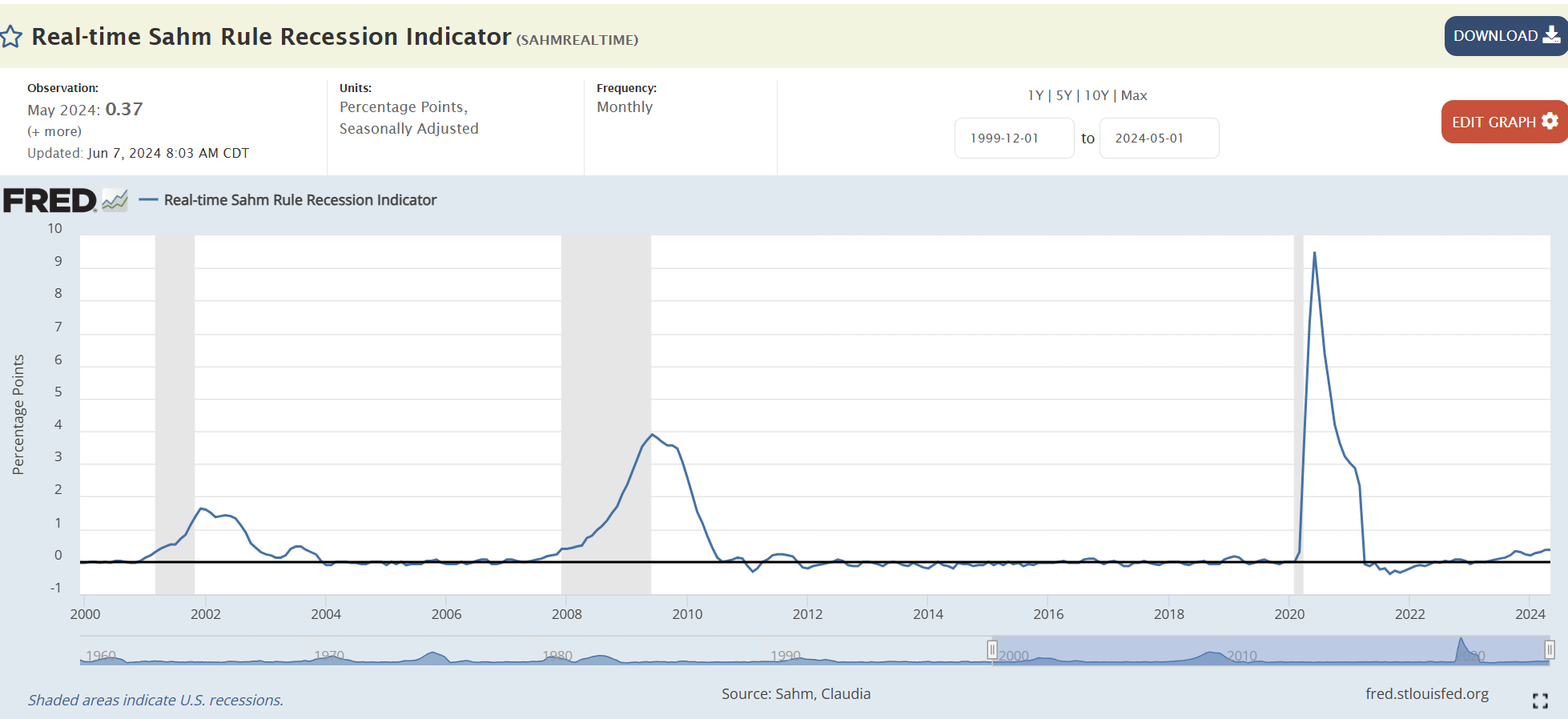
PS. Finally, I thought I’d take a look at the US Sahm rule indicator. It isn’t yet indicating that it is time for additional stimulus (0.5 is the threshold). But then the market doesn’t think the Fed should be cutting yet either. And when it is time for taking the foot off the brake, if I were an American taxpayer contemplating huge debt and deficits, I think I’d prefer to see the Fed do the stabilisation action.

PPS Sahm did not that a tool like this might be more useful when monetary policy was constrained (ie at a lower bound). But since there are ready technical solutions to lower bound issues – that don’t cost taxpayers billions of dollars – perhaps it would be better for central banks (chivvied along by Treasurys if necessary) to final fix the lower bound issues and leave monetary policy free to do its job, imperfectly (in the nature of human institutions).

UPDATE 13/6 Thinking a little more about Sahm rule types of proposal, they seem best suited to a world in which the economy is routinely running at or around capacity and then a demand-shock recession arises out of the blue (and thus an increase, even a modest one, in the unemployment rate might reasonably indicate a case for policy stimulus). But that isn’t often the case (probably generally, but certainly not in New Zealand in recent decades). As just one example, around two thirds of OECD countries had their lowest unemployment rates in the period 1995 to 2007 in 2007 itself, often in the December quarter, the very eve of the recession getting underway,

Comparing Treasury and Reserve Bank forecasts

I put a range of charts on Twitter late last week illustrating why, from a macroeconomic perspective, I found the government’s Budget deeply underwhelming. I won’t repeat them but will just show two here.

The first is the Treasury’s estimate of how the bit of the operating deficit not explained just by swings in the economic cycle change from 2023/24 (which was largely determined by last year’s Labour Budget) to 2024/25 (influenced by this year’s Budget choices)

On both these Treasury metrics, things are expected to be a bit worse in 2024/25 than in 2023/24. Not a lot necessarily, but things are heading in the wrong direction: a larger share of the groceries are being paid for by borrowing. And, sure, the projections have the deficits eventually tailing off and returning to surplus eventually – as they have for each of the last few years – but those numbers rely on more fiscal drag and rather arbitrary indications of what future Budget operating allowances might be. Perhaps they will deliver, or perhaps not. We don’t know and neither really do they. At this stage, anything beyond 24/25 is little than aspirational vapourware.

And consistent with that, the Treasury’s fiscal impulse measure – designed to measure the overall of fiscal activity on aggregate demand (with the central bank in mind) – is just slightly positive. Fiscal choices for the coming year aren’t estimated to ease pressure on demand and interest rates at all.

When the starting point is quite a large structural deficit, that seems, shall we say, less than ideal. Perhaps the more so when history (and common logic) suggests that the first year of a new government is usually by far the best time for a government to make tough fiscal choices and adjustments. (I dug out some old Reserve Bank estimates the other day and way back in 1976, the first Budget of that new government had a fiscal impulse of around -6 per cent of GDP. Muldoon had inherited a bigger mess than Luxon/Willis did, but…..a deficit is a deficit, and inflation and interest rates have been a problem.) If the 24/25 Budget wasn’t the year for hard choices, which one will be?

But for this post, I was more interested in comparing some of the Treasury macroeconomic forecasts in the Budget documents with those published by the Reserve Bank the previous week. Here I should stress an important difference: the Treasury economic forecasts were finished on 5 April and the Bank’s weren’t finished until a few days prior to the MPS. But my impression is that there wasn’t much in the way of crucial or very surprising domestic economic data in that period.

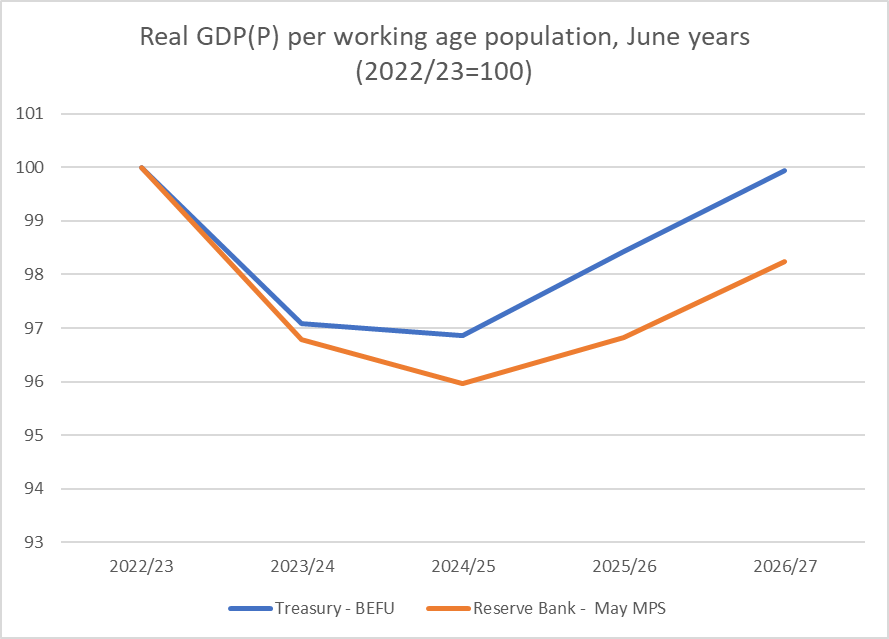
First, compare the outlooks for real GDP per person of working age (the RB doesn’t publish per capita projections, so this is the basis on which we can do a comparison).

Neither line represents a particularly rosy outlook. Even Treasury has us just barely back to the 22/23 level of GDP per working age population by 2026/27, but over that full period the difference between the two sets of forecasts builds to something quite substantial (a gap of 1.7 percentage points by 2026/27).

After the MPS I wrote here about how there seemed to be nothing robust behind the recovery the Reserve Bank was forecasting for next year (given that interest rates stayed high, lags were long, net immigration was declining etc), but I think one important difference between the two sets of forecasts is nearer in time.

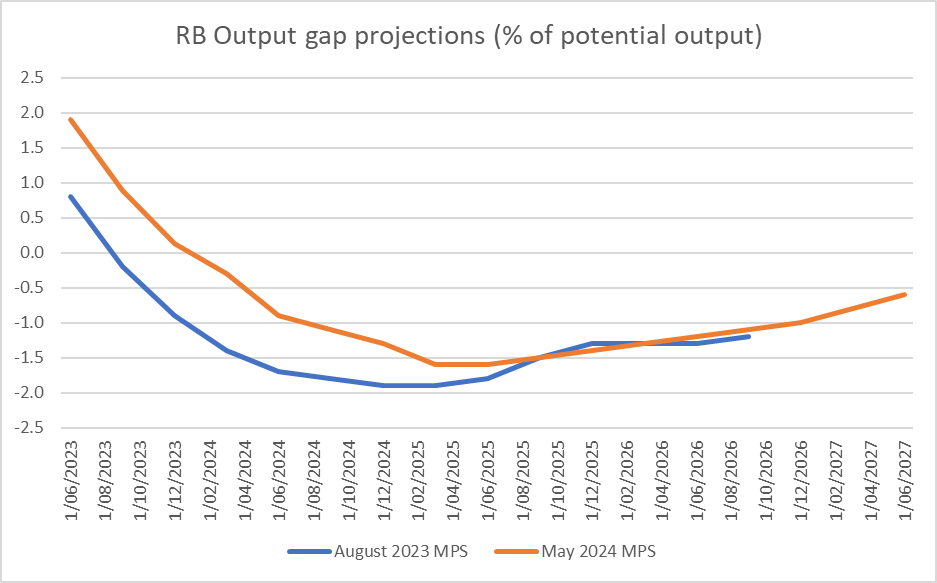
There are really striking differences in how The Treasury and the Reserve Bank see excess demand having evolved over the last couple of years. Output gaps aren’t directly observable, but the most recent hard GDP data is still for December last year, but whether for that quarter or the estimate for the March quarter the difference in the two estimates is almost 1 per cent of GDP. On the Treasury numbers there was a significant negative output gap – posing a powerful drag on inflation all else equal – while the Reserve Bank reckons that output gap was only around zero.

Perhaps Treasury would have revised their thinking after the CPI if they’d had been able to incorporate those numbers in their forecasts, but there is nothing in the BEFU document that seems to suggest so.

If inflation has been a problem and you think that the economy has recently been only at around capacity then it isn’t too surprising that you have rather weak real GDP forecasts for the period ahead (especially the coming year). Both agencies build their forecasts around inflation eventually getting back to target midpoint; the difference is about what doing that will take.

The Reserve Bank reckons the OCR next June quarter will no lower than it is now, and may have gone higher in the interim. The Treasury forecasts the 90 day bank bill rate, and they reckon that will already be a lot lower (4.5 per cent) by next June. Quite who is closer to right (or least wrong) will matter.

As I say, perhaps the difference mostly come down to timing – the Reserve Bank had the CPI and Treasury did not – but frankly it seems too large a difference to be explained by a single inflation number.

One uncertainty is quite how fiscal policy affects the Bank’s picture. As they noted, their numbers didn’t include the Budget numbers themselves, but Westpac has noted – presumably from something the Bank has said – that the MPC had been briefed on the broad direction of fiscal policy (as you would hope, since it is one of the reasons for having the Secretary to the Treasury as a non-voting ex officio member of the MPC), and speculated that perhaps the Bank’s hawkish tone might have been explained in some sense by that understanding of the fiscals. I’m not sure what to make of that, and after all, the Bank’s chief economist was then at pains to play down the apparent hawkishness in the days following the MPS, with his weird line that somehow it was all just “model output”. More generally, the Bank has been taking a weird approach to fiscal policy over the last year, since that awkward 2023 expansionary Budget, ignoring conventional conceptions of the fiscal impulse and trying to focus attention on real government consumption and investment (in turn very different from either total government spending or a deficit/surplus measure). But for what it is worth, as the chart above shows the fiscal impulse for 2024/25 is estimated to be very slightly positive, and at the time of the HYEFU it had been estimated to be about -2.5 percentage points negative.

At very least, whatever was in the Budget simply wasn’t any help in easing pressure on demand and interest rates. Quite where too from here is going to depend a lot on just how much disinflationary pressure was already building up in the system from a now fairly prolonged period of contractionary interest rates. Given how weak last year was, and how weak things like business surveys still are, my sense would be quite a lot. But time will tell.

Reading the MPS numbers thinking about the fiscal situation

The Reserve Bank doesn’t do independent fiscal forecasts so there is no news in the fiscal numbers in today’s Monetary Policy Statement themselves. The last official Treasury forecasts don’t take account of whatever the government is planning in next week’s Budget, and as the Bank notes they will need to update their assessment in light of whatever the spending and tax plans prove to be.

So I was more interested in the Bank’s numbers for the things they do forecast independently, and which in turn have implications for both the tax revenue the government could expect to collect on any given set of tax rates and for the likely expenditure pressures (from things like population growth and inflation).

One of the lines the Minister of Finance has repeatedly sought to use over her time in office is something about how much worse the economy was than they had appreciated (or had been clear) pre-election, to soften us up (it appeared) for yet more delay in getting back to fiscal surplus (see, we can’t really help it, it was done to us, and no one told us). It has always been an unsatisfactory argument (to say the least) since the previous projections (say, those in the PREFU and those in National’s fiscal plan) weren’t for a return to surplus for a couple more years anyway (2026/27) and by then whatever the forecast fiscal outcome, it is purely a matter of policy choice.

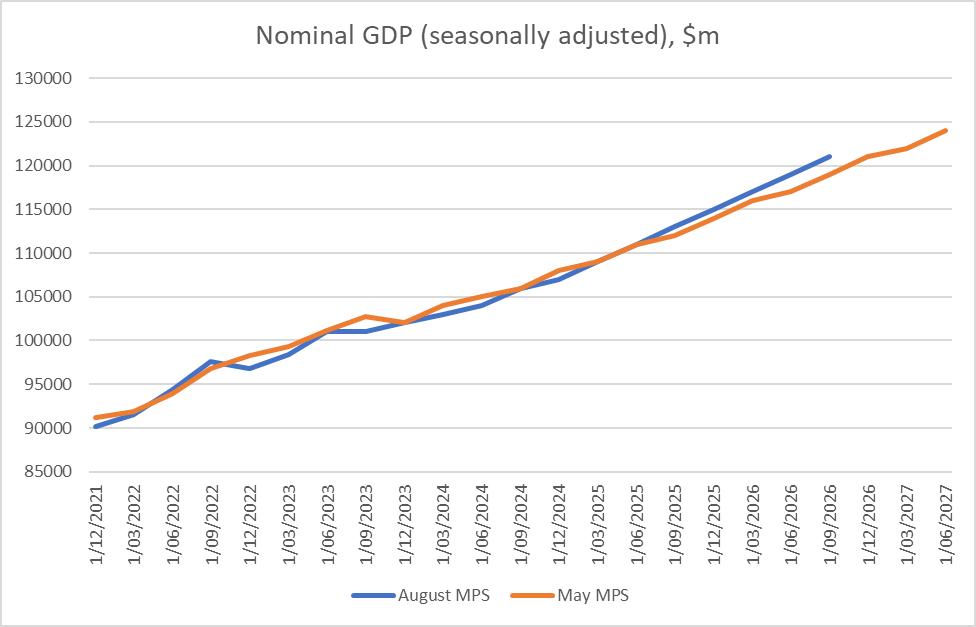
Now, the Budget numbers out next week will use The Treasury’s forecasts as their base. But here are the nominal GDP projections the Reserve Bank was making (a) at the August 2023 Monetary Policy Statement (ie the last set of forecasts pre-election), and b) today. Nominal activity is what gets taxed.

There is a slightly larger gap opening up a couple of years out (when, of course, who knows; both sets of numbers are just anyone’s guess out there) but as late as the June quarter next year the two observations are exactly the same, as they are (a 0.1% difference) for the last pre-PREFU quarter, 2023Q2.

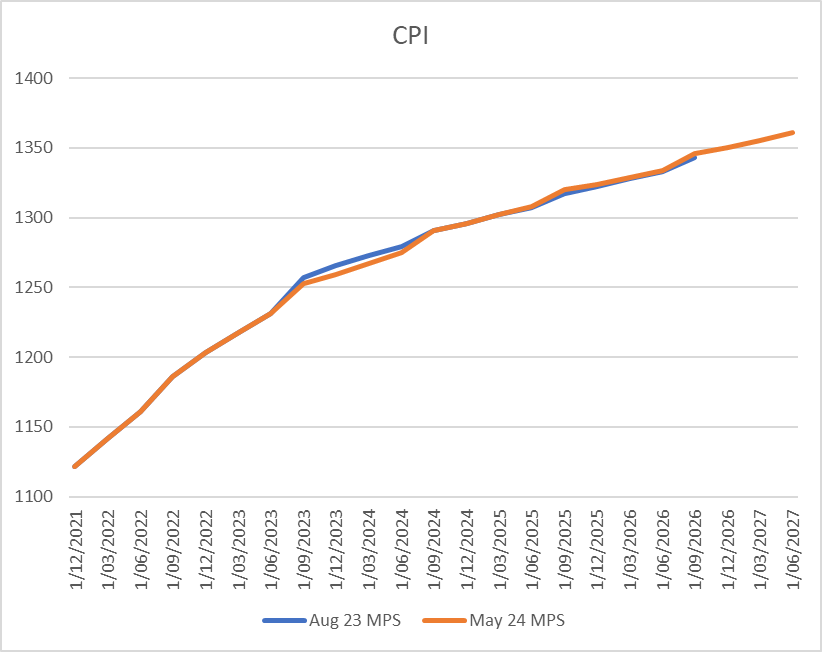
Ah, perhaps you are thinking, but what about inflation. If there is more inflation than was previously forecast the revenue just won’t go as far.

But there isn’t anything much in that sort of story either.

There were some historical revisions late last year to the estimated level of real GDP. Those revisions don’t have any material implications for anything much, since life had already been lived through that period, and (in any case) it is nominal GDP that more closely approximates the tax base.

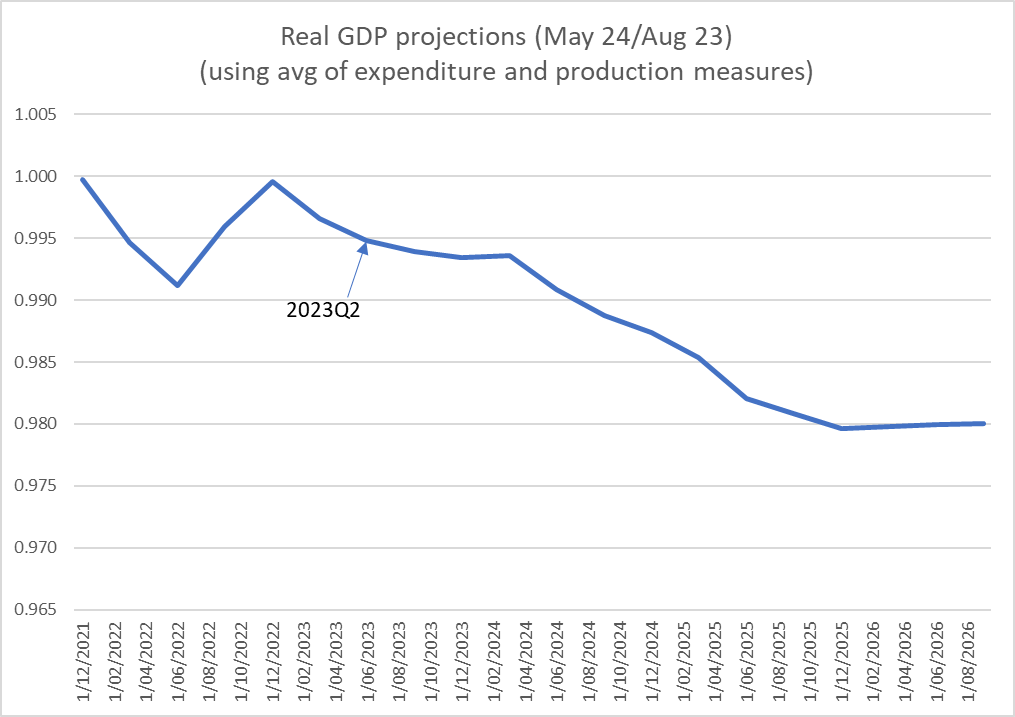
But in this chart I’ve shown the ratio of the RB’s latest forecasts for real GDP to those it did last August, and it is certainly true that over the full forecast period the latest forecasts are a couple of per cent weaker than last August’s forecasts.

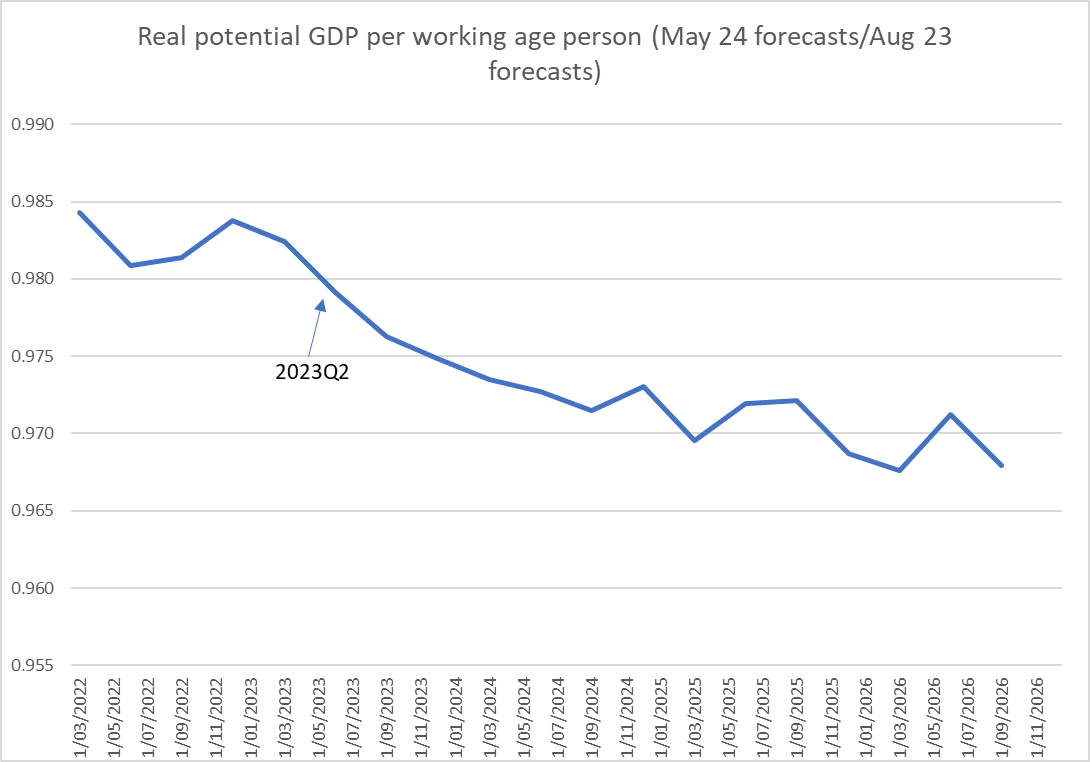
Here is a slightly more obscure chart: the same sort of ratio but this time for the Bank’s estimates of real potential GDP per working age population. Things worsen there by about 1 per cent relative to the position thought to have prevailed just prior to the election.

And if weaker GDP per person implies some loss of productivity (some things the government might be purchasing won’t be getting relatively cheaper), it also suggests that (eg) public service wage pressures and NZS adjustments should be less than they might otherwise be.

The key point? At least on the Reserve Bank’s telling – and they could of course have a very different view than the Treasury – there just isn’t that much there. We are set to be less well-off per person than the Bank thought just prior to the election, but nominal GDP and the CPI forecasts have barely changed, and even the real output changes aren’t particularly large in the scheme of things (nothing at all like the extent of the revisions that followed in the wake of the 2008 recession). What we have, on the Bank’s numbers, is a recession and a protracted period of excess capacity (slack) that is not quite as deep, but quite as protracted, as the Bank suggested to any and all readers (Opposition politicians included) just prior to the election.

Tougher than that

Thomas Coughlan has a column in the Herald this morning, under the heading “Nicola Willis is just the right amount of Tory”. To this centre-right voter it isn’t obvious Willis is (or sees herself) as any type of Tory, but what Coughlan seems to be suggesting is she is just right if the aim is to hold office, and never mind the large structural fiscal deficit the government inherited from Labour.

It isn’t an uninteresting column, and this post is just about one snippet where I don’t think the author is quite right. Here it is

The simple maths looks about right: $3.5 billion is 25 per cent higher than $2.8 billion and the CPI has increased by about 25 per cent since Budget 2018 (depends a little on your precise reference point). But that isn’t the right way to look at things: it misunderstands how the operating allowances work. And it doesn’t come even close to meaning that Willis is splashing the cash just like Grant Robertson was doing in his first Budget.

There are two things Coughlan seems to have overlooked. First, a big part of what the operating allowances cover is cost pressures on existing government spending programmes. Some increases, eg to welfare benefit rates, are done automatically by statute, and so don’t count against the operating allowance. But most other things do – new programmes of course, but also many of the spending implications of population growth (very rapid at present) and general inflation.

One way of looking at this is to compare the two operating allowances (2018 and 2023) with the total government (core Crown) operating expenses in the year just ending at the time of each Budget.

Grant Robertson gave himself an operating allowance of $2.8 billion in 2018 against an estimated final level of operating spending then for the year to June 2018 of $81.7 billion (3.5 per cent of that spending). Willis by contrast talks of an operating allowance of (probably just under) $3.5 billion against estimated (at HYEFU) spending in the year to June 2024 of $140.3 billion (or 2.5 per cent of that total). National was very vocal about the increases in spending under Robertson, but they went into the campaign not promising to get rid of many programmes (and needing most of their spending savings to finance promised tax cuts). The programmes still cost, inflation is still a thing, and the population keeps growing.

But this year’s story is even tighter than that simple comparison might suggest. Inflation is not something under control of the Minister of Finance – we have the autonomous Reserve Bank for that – and so from any one year’s Budget perspective inflation (as forecast by Treasury) is just one of those things the Minister of Finance is stuck with. In the early 2010s, one thing that made Bill English’s zero operating allowances less extreme than they might have seemed was that inflation was very very (and surprisingly) low. In the 2018 Budget – Robertson’s first – Treasury forecast CPI inflation for the year to June 2019 at a mere 1.5 per cent. By contrast, at least in the HYEFU the Treasury forecast for inflation in the year to June 2025 was 2.5 per cent (and in the BPS last week that forecast was still 2.2 per cent). Willis faces more cost pressures just from inflation than Robertson did in his first year, and that chews up not inconsiderable amounts of the operating allowance.

So it seems quite unlikely that the room she has given herself (all nominal) will do anything close to justifying Coughlan’s claim that this Budget will be “one of the more generous right wing Governments in New Zealand history”. Core Crown expenses as a share of GDP will almost certainly be dropping.

I’m no fan of this government’s fiscal policy – and the apparent indifference to the deficit, and the spooky scare stories about not being Ruth Richardson or Tony Abbott (both mentioned in the article) – but on the numbers the minister has given herself and the general inflation pressure Treasury is forecasting it hardly looks like being all that generous, even by National Party standards (one could make a case for not in effect being that much different than Steven Joyce’s Budget in 2017). That is neither surprising nor inappropriate coming off the back of six years of very large increases in government spending. And after all in 2018 (fairly or not) Robertson and Ardern were banging on about making up for “9 years of underfunding”, a very different narrative to Willis’s now. But the big difference from Steven Joyce in 2017 is that he was running surpluses, and Luxon/Willis apparently are content to keep running deficits.

But….there is the nagging question of what specifically are ministers deciding they don’t want to spend money on that Labour was spending it on (over and above the savings they are now exacting from departments, but on which the promised tax cuts have first claim). We don’t know. Do they?

Not very bothered by deficits

I was away last week so have been rather late in getting to the Budget Policy Statement and associated material released last Wednesday. It does not make for pleasant reading, at least if one cares at all about governments not borrowing to pay for the groceries.

Once upon a time – still not that long ago – New Zealand had a fairly enviable fiscal record. This chart, comparing New Zealand and the median advanced country, draws from data published in the IMF’s last World Economic Outlook

We used to have smaller deficits or larger surpluses than the typical other advanced countries (consistent with that our net public debt as a share of GDP was materially lower than the median advanced country). But no longer.

Using data from the same WEO (which, incidentally, was published before our election in October), on the IMF’s estimates we had one of the very largest structural fiscal deficits of any of the advanced countries.

Structural deficits – by definition – do not go away of their own accord as the cyclical position of the economy improves. They are removed only by conscious and deliberate choices by governments, and – by the same token – if they are left to linger that is a conscious and deliberate choice by a government.

There wasn’t even a hint of this starting position in any of the material released last week (although they did mention an international comparison of the increase in net debt over the Covid period). And consistent with that, there is very little about eliminating the structural deficit or getting back to operating balance/surplus. In her BPS the Minister outlines several priorities for the coming Budget, but none of them involves any priority or emphasis on getting the structural deficit down. The current government inherited the deficit, but if they choose to continue to run structural deficits – which aren’t about the cyclical state of the economy – the responsibility is on them, quite as much as it was on their predecessors when they chose to continue to run structural deficits once the heavy Covid spending was behind them. If it was pretty irresponsible then, it isn’t much better now.

Consistent with this overall approach, the Prime Minister has this morning released an “action plan” for the next three months, a period which includes the Budget. There is not even a vague suggestion in that list that closing the deficit is any sort of priority for the government.

Under the previous government the forecast date for a return to surplus kept getting pushed back. And this government now seems to be engaged in the same game – the fiscal version of the old line from St Augustine (“grant me chastity and continence but not yet”) – and whatever numbers finally emerge in the Budget projections should probably be accorded no more weight than when the Treasury produced (eventual) surplus forecasts under Labour. It might be nice to be back to surplus by whatever the next published horizon is but….don’t hold us to it. Much more important to keep funding the baubles that both Labour and National competed to offer last year.

Much of the Minister of Finance’s rhetoric in recent months has seem designed to convey a sense that structural deficits are things that just happen and that ministers can affect only at the margin. That wasn’t so under Labour – when Grant Robertson chose to run substantial structural deficits – and it is no more so under the current government. It is simply a policy choice, and a bad one, especially when there is no particular besetting crisis. She talks about the difficulty on the projections of getting back to surplus by a particular date, but the issue isn’t projections – especially when the economy operates fairly close to capacity – but choices, political choices. It might be particularly challenging for a government to take the budget from substantial deficit to balance in its first year, but over a two or three year horizon it really is pure choice. If we still run structural deficits by, say, 2025/26 that is purely a policy choice by the current government, for which responsibility will rest wholly on them.

The Minister appears to attempt to cover herself from this sort of critique using this line, which I saw twice in the documents she released: “International evidence is that reducing deficits is best done over the course of several years by focusing on structural reforms to expenditure and revenue settings”.

Which might sound good but (a) there are no footnotes or references to support this claim of “international evidence”, and (b) there isn’t anything much specific about these “structural reforms” (at present the focus of fiscal policy seems to be on finding enough spending savings to fund tax cuts and other giveaways, rather than on a actually reducing the deficit). I’m rather sceptical of the claim. It might have a little merit in an economy in a deep recession with monetary policy constrained by the effective lower bound on nominal interest rates, but…..that very much isn’t the world New Zealand fiscal authorities now face. Instead, the line just feels like an unsupported excuse for a few more years of deficits (“they had them so why shouldn’t we?”).

The Minister has also been making quite a play of a story that it has all gotten so much harder than she had envisaged because the economy has been deteriorating. At present, that seems a dramatically overblown story, designed to distract more than to enlighten.

Much is made of the revisions downwards late last year in the level of real GDP (and thus the level of labour productivity). But that is mostly distraction, because before those numbers came out Treasury and IRD already knew how much tax revenue the economy had been generating, all they didn’t know was the latest macroeconomic estimates of the size of GDP itself. That matters for, eg, nice charts of tax/GDP ratios but not very obviously for making sense of the fiscal situation and its challenges.

Some weeks ago I showed this graph on Twitter, showing the Reserve Bank’s latest nominal GDP forecasts against those the Bank produced in August last year (ie the last projections before the election).

The Reserve Bank reckoned in February that if anything nominal GDP would be a little higher than they’d thought just prior to the election. And while nominal GDP tends not to be a big point of focus for the RB in putting together its forecasts, the Secretary to the Treasury (or her senior delegate) does actually sit on the MPC.

What about real GDP? Well, as we know, there were some downward revisions to the historical data, so in this chart we will focus on forecast real GDP growth, using as the base date the March quarter of last year (the latest actual data the RB had when it did its last pre-election projections)

Those are pretty tiny differences. And, after all, the Reserve Bank had been telling everyone – including the then Opposition – that the economy was going through a tough patch as part of getting inflation back down.

Among the material released last week was a four page Treasury note on the economic and tax outlook. It contains some preliminary high level forecasts, but can’t be directly lined up against the Reserve Bank numbers because there is no quarterly track for nominal GDP (the best proxy for the tax base). It appears from Treasury’s annual forecasts that they are running with a lower nominal GDP track than the Reserve Bank has (perhaps by around 2 per cent), although it isn’t clear quite why (and although the documents note a revision downwards in inflation forecasts, the Treasury inflation forecasts for the first year or so still seem higher than those of the Reserve Bank).

In terms of spinning a story around the deficit this is perhaps the paragraph the Minister will have been most keen to have readers pay attention to.

You are meant to take away from this that it is going to be so much harder than the current government had thought last year when they were in Opposition, to get back to balance by 2026/27 (recall, a date already pushed out under Labour). But there are a few crucial words in that excerpt: “all else equal”.

And they aren’t (of course). When the size of the nominal economy is smaller than previously expected – but still operating at around capacity (and the Treasury preliminary forecasts have unemployment by 2025/26 and beyond around their estimate of the NAIRU) – it isn’t just revenue projections that need to change. So will many spending obligations – both statutory things like indexed benefits (remember, Treasury has revised down its inflation forecasts since late last year) but also expected wage inflation (in the private sector but also in the public sector). Economies with a dreadful productivity growth record – and the productivity assumptions in these forecasts seem likely to be very weak indeed – tend not to support large wage increases. Of course, there are other items in government spending where there are no semi-automatic savings, but the weak productivity story doesn’t seem to be just a New Zealand phenomenon at present. (More generally, of course, all medium-term economic forecasts – RB, Treasury, IMF, or whoever – are subject to huge margins of error, and not worth a lot more than the paper they are printed on.

Being in surplus two to three years hence (or not) is purely a political policy choice. Not to be is a bad choice. (Of course, in the meantime some really bad event could hit – earthquakes, deep global recessions or whatever – but since no one can or does pick the timing of those we can worry about them when and if they hit. At the moment, planning proceeds on the basis of an economy developing fairly routinely (if underwhelmingly).

I’m old enough to remember when a National government and Minister of Finance first got New Zealand back to operating surplus in the mid 1990s. I’ve told stories about what seemed to have been bipartisan commitment to get back to surplus fairly promptly when occasional nasty shocks happened (although in truth it was really tested only once). It is disheartening now to see little sign that National (and their coalition government) is any more bothered about deficits – borrowing to pay for the groceries – than their Labour predecessors were. (The new debt target enunciated in the BPS is no more encouraging, with the new government seemingly willing to settle for higher levels of (net) debt than New Zealand has averaged over the last 25 years, with no evidence of strong potential productivity growth that might compellingly justify such debt.)

UPDATE: Incidentally, I saw in the weekend papers (page 3 of Saturday’s Post) one academic economist defending the government’s fiscal approach as classic supply-side economics. I don’t find that claim at all persuasive. There are certainly elements in the fiscal grab-bag that might fit that bill (one could think of restoring interest deductibility to rental property owners, on the same basis as any other business in New Zealand). In the abstract, lower income tax rates might, were it not for the fact the starting position is one of a deficit. Savings from cuts to spending can be used to cut the deficit or for tax cuts, but tax cuts today with a structural deficit – all else equal – just mean either further cuts to spending or higher taxes in the future. And some of National’s policies are distinctly retrograde even with a supply-side focus in mind – one could think, for example, of the policy both they and Labour campaigned on, the elimination of depreciation for tax purposes in respect of commercial buildings (office, factories, warehouses). Simply a freshly distortionary revenue grab. And meanwhile we run one of the highest company tax rates in the OECD with not even a suggestion the government is interested in addressing that.

Not exactly encouraging

[NB: I wrote a few quick paragraphs here before fully appreciating that nothing of the government’s own policies were being allowed for in the numbers (which itself seems unsatisfactory). Nonetheless I am leaving the post up because (a) I don’t want to pretend it wasn’t written, and b) the Treasury’s own comment (see below) that, to a first approximation, government plans to date do not seem likely to improve the outlook, and c) the fact that the Minister’s statements give no particular reason to think actual policy will be better than what is allowed for in these numbers. Fiscal policy has been badly mishandled in recent years and we should not be looking at deficits for the next few years.]

As I wrote prior to the election, both in the PREFU (reflecting Labour’s plans, some plucked from the ether just in time for Treasury to do the numbers) and in National’s Fiscal Plan, there was a strong element of either wishful thinking or vague “trust us, we’ll do it” about the numbers. Both parties talked up getting the operating balance (OBEGAL) back to surplus by 2026/27, but neither gave us any specifics as to quite how the substantial structural deficit was going to be closed. There were lines on a graph, and that was about it. In its pre-election plan National indicated that by 2026/27 it would deliver a slightly large surplus than Labour (in PREFU) had foreshadowed.

That was then. In their pre-election fiscal plan, National’s numbers were for an OBEGAL surplus in 2026/27 of $2.9 billion. In the first EFU of the new government, incorporating the new government’s fiscal plans [UPDATE: the government’s plans are not included, but - see note below - Treasury’s best guess so far is that for things foreshadowed or announced they would make little difference], that surplus has been revised down to $140 million, basically zero (Treasury shows it as 0.0% of GDP). Recall that under the previous government, the date for a return to surplus was always just somewhere over the (rolling forward) horizon. Is it any different now? And the revisions aren’t just to that one year: for 2025/26, the Fiscal Plan foreshadowed a deficit of $1.0 billion, but the HYEFU numbers now show a deficit that year of $3.5 billion.

Core Crown spending was, unambitiously, supposed to fall to 31.0 per cent of GDP by 2027/28 (the only year for which the Fiscal Plan gave us numbers), but HYEFU has spending that year of 31.4 per cent of GDP. Perhaps unsurprisingly, net debt by 2027/28 is also a couple of billion higher in 2027/28 than National’s plan had portrayed.

In the grand scheme of things, these dates are quite a long way away, and the changes are, in isolation, perhaps of only middling significance. But from a starting point of (a) years of structural deficits (when one, just possibly two, years of deficits might have been warranted by Covid), and (b) repeated revisions which pushed further into the future the return to surplus, it is hardly an encouraging sign from the new government and its Minister of Finance (whose comments on the HYEFU bottom lines seems to take them for granted, rather than foreshadowing something materially less bad).

And all this in a “mini-Budget” (perhaps itself an ill-advised pre-election promise, which put the Minister against very tight deadlines) that seems to offer nothing any more specific about how the government proposes to return to surpluses, and what (at scale) it proposes to spend materially less on.

It was all rather underwhelming, and the slippage relative even to what National was promising just over two months ago is disappointing. It is though perhaps consistent with the pre-election rhetoric from National that seemed very little bothered by the size and duration of the run of fiscal deficits Labour had run, and proposed to carry on running.  Sure, they have to deal now with coalition partners, but when the first fiscal numbers have a worsened outlook it hardly speaks of a strong and demonstrated commitment to “getting New Zealand back on track”. On these numbers, we’ll have had eight years in a row without an OBEGAL surplus…..and even those numbers rely on high-level wishful plans rather than concrete specifics.

On the economic numbers, much will have been superseded by the surprises in the GDP numbers last week. But it is perhaps worth noting that - working with much the same information the Reserve Bank had for its MPS late last month – the Treasury reckoned that the economy was still runnjng excess demand to a greater degree than the Reserve Bank (a positive output gap on average for the year to June 2024), but that the Treasury also envisaged earlier room for OCR cuts (having the OCR at 4.9 per cent by June 2025, while the Reserve Bank was projecting 5.4 per cent), with a weaker exchange rate too.

UPDATE

From the HYEFU document.

UPDATE:

Notwithstanding the Treasury headline, the highlighted sentence is probably more pertinent. With a higher than previously forecast population, potential output has still been revised down, so mediocre is the NZ productivity story. Treasury should probably have been more careful earlier about believing that somehow productivity growth had accelerated in the wake of Covid, something for which there was never any a priori reason to expect/believe.

Government net debt: how does NZ compare?

In my post yesterday on the new OECD Economic Outlook fiscal numbers I included this chart

Even if you leave off the last two observations (OECD projections based on current – Labour government – fiscal policy) recent trends have hardly been something to take any comfort in. But at least we were still a bit less indebted than the median OECD country. But as I also noted in passing, the big OECD countries mostly were a lot more indebted than most of the rest.

I was talking this morning to my son – yes, a geeky economist-in-waiting- about the German constitutional “debt brake”. The great and the good in much of the rest of the world have been critical of this provision since it was put in place in 2009 – for the FT editorial view recently see here – and just recently a constitutional court ruling has created tensions that apparently may threaten to bring the government down. The rule stops German governments running material structural fiscal deficits, except in an emergency (Covid was, appropriately, treated as one), which I’ve long thought should be the benchmark fiscal rule our government should work to (yes, formally operationalising it is a challenge, given uncertainties about output gaps etc, but in principle a rule of that sort is a useful discipline).

The cynic in me has sometimes wondered whether other people disapproved of the rule because it showed up their own countries’ fiscal fecklessness. Here is a chart showing net general government liabilities for the group of large OECD countries.

Germany’s public debt is not extraordinarily low in absolute terms – just a bit higher than New Zealand’s at present – but it is this only one of the large OECD countries to have kept the level of public debt (a) fairly low, and b) stable this century. Were I a German voter I would look favourably on that sort of record. Remember that such “brakes” do not stop governments choosing to spend more, they just require them to front up to the voters with additional tax demands now.

The group of large OECD countries is different. Here is another chart with the OECD countries for which there is data (not the Latin American ones,Turkey or Iceland) grouped as large (as above), medium, and small (population of about 10 million or less), and compared to New Zealand (also in the “small” grouping).

A couple of things caught my eye. First, when the comprehensive data start (1995) our debt was a bit higher than the medians for any of these groupings. 1995 isn’t really that long ago. Second, that group of large countries really is different. It isn’t that there aren’t other highly indebted countries – Greece is in the “small” grouping – but the small and mid-sized countries have typically run much lower (and more stable) public debt ratios than the large countries. And that isn’t because of some threat to the ability to borrow: both Japan and Switzerland are big net external surplus countries, and Japan has very large debt (and deficits) and Switzerland has net general government financial assets. it is, by and large, simply a series of political choices.

Third, all the debt ratios rose in 2020, through some combination of GDP taking a hit (lockdowns etc) and more spending being judged necessary appropriate. What makes New Zealand unusual is that our debt ratio has kept on rising even after the economy had recovered, Covid spending had ended, (and surprise inflation has reduced somewhat the ratio of debt to (inflating) nominal GDP).

And finally, of course, the convergence at the end of the chart. We used to run lower debt than the typical OECD small and medium-sized country – although we were never (not even in 2008, when 10 OECD countries had lower net debt) anywhere near the least indebted-country. But now we look pretty much like the typical OECD country, once one leaves out the feckless few (the big countries minus Germany plus Greece). If your inclinations are more leftist than mine you might think that is just fine – where I think it is regrettable – but in a country where much political and economic coverage is still focused on the US and the UK – it is a reminder that there isn’t now vast unexploited capacity to borrow, just to make us like some “normal” advanced country, rather than one characterised by Cullen/English alleged “underborrowing”.

And if in some senses we are just another small (underperforming) advanced economy, we are also one more exposed to natural disasters and the associated fiscal risks than most (Iceland is another, but not in this particular dataset).