Known by the company they keep

Where might one turn if writing today about the New Zealand/ People’s Republic of China issues?

One could start with yesterday’s extraordinary interview our Foreign Minister gave yesterday on Radio Live where, on the one hand, he laid into Jian Yang, and on the other seemed to suggest that anyone who questioned the activities of the PRC here or abroad was somehow motivated by racism.    Quite extraordinary.  And while we are on the subject of Jian Yang, perhaps Mr Peters could have a chat to the Prime Minister (who seems totally unbothered by Jian Yang), or to the MP from his own party who is Minister of Internal Affairs, responsible for citizenship law (Jian Yang having acknowledged a year ago that he misrepresented his past to get into the country in the first place, apparently under “guidance” fron Beijing).

And the Herald this morning was awash with material.  There was a rather wishy-washy editorial, which ended with the suggestion that if the delay in the Prime Minister’s visit to Beijing was “a rebuke it is not warranted”.   Well, of course not, both the Prime Minister and (successive) leaders of the National Party do their utmost to cover for Beijing, and never ever give offence.

There was the flippant cartoon, suggesting that all the PRC would be interested in here was the recipe for slow-cooked lamb, which one might just pass over without note if the issues weren’t so serious, the abuses undertaken by the regime –  at home and abroad – so grave.

There was another article in which the Prime Minister and Simon Bridges seemed to compete for who could grovel before the PRC regime –  tossing overboard any sense of decency or right – the most.    You’ll recall that Simon Bridges had a head-start, having been the minister responsible last year for signing New Zealand up to the rather warped aspiration of a “fusion of civilisations” –  with the PRC of all people.   According to Bridges

He said New Zealand’s default position should not be to question the legitimacy of China’s actions in the Pacific and around the world.

But, being independent and all that, and with the PRC’s track record, it actually doesn’t seem a bad starting point.  Perhaps his predecessors suggested our default shouldn’t be to question the legitimacy of Germany actions in the Europe in the 1930s, ….but I doubt it.  It is hard to see that Bridges is guided by anything resembling the word “principle”.

As for PM,

Ardern would offer no definite view when asked which country, United States or China, was more important to New Zealand.

“Some of the discussion around choosing lanes in which we swim does not fit with our independent foreign policy,” she told reporters.

“New Zealand has a range of important relationships, some for different reasons, some with different histories. But for me, the most important thing is maintaining the independence of that foreign policy basing it around New Zealand values, upholding those values and continuing to strengthen them when it is in New Zealand’s interests.”

No sign of anything resembling “principle” there either.  For her, it seems, “independence” is the primary virtue, not standing up for what is right, and standing up for the freedoms and interests of New Zealanders, including those in the ethnic Chinese community.   From both her and Bridges, it seems that visceral anti-Trumpism is being allowed to provide cover for simply sacrificing the integrity of our domestic political system, and a climate in which New Zealanders can go about their business in New Zealand –  including call out the abuses by the PRC –  free of fear.

And then there was the frankly pretty scurrilous column by Fran O’Sullivan, “Academic draws a long bow on China”.  I thought it was pretty bad on two counts.  First, she accused Anne-Marie Brady of “China derangement syndrome”, and yet when one gets to the end of the column all O’Sullivan has to say in disagreement with Brady’s paper –  which, as published was only in working paper form –  was that it included Ruth Richardson among the former politicians now involved in the boards of Chinese (PRC controlled) companies.  Whatever the ins and outs of the Synlait situation, former Minister of Finance, Ruth Richardson sits on the board of one Chinese bank here, Don Brash chairs another, Jenny Shipley is on one of the boards, and former National minister Chris Tremain is on another.   In all cases, with the possible exception of Don Brash, no one supposes these appointments were about banking expertise.  It is about connections, and such appointments also have the side benefit of putting such senior former politicians in a position where they can’t really criticise anything the PRC does.   But, in a way, the second count bothers me more.  O’Sullivan is the “Head of Business, NZME”, but she is also co-chair of the China Business Summit, and sits on the Advisory Board of the taxpayer-funded advocacy and propaganda outfit, the New Zealand China Council.  Neither of those involvements was noted in the article.  General readers can’t just be assumed to know such things, and should be able to assume that staff writers and columnists have no personal interests in the causes they are championing.

(Oh, and there was also the de haut en bas tone –  O’Sullivan being a favourite of the establishment these day –  of  this comment on Brady’s paper

It highlights issues that the higher echelons of the NZ Government are currently grappling with: whether foreign-sourced political donations carry a tag; an alleged Mainland influence on Chinese nationals and local ethnic media and unanswered questions that remain over National MP Jian Yang.

Except that there is no sign of the Prime Minister or the Leader of the Opposition taking a stand on either issue.  Perhaps some officials are indeed troubled, but politicians call the shots.  We know there are problems – answered questions in the case of Jian Yang.  Bridges and Ardern simply refuse to face what they – and their predecessors –  have reduced our politicaL system to.)

But actually what I really wanted to write about today was an article not in the New Zealand media at all, but in the Chinese media (a Xinhua story to be exact –  thanks to a reader for sending through the link).

Both main party presidents –  Peter Goodfellow for National and Nigel Haworth for Labour –  have form when it comes to gushing over the PRC regime and its leader, Xi Jinping.  It keeps the donations flowing I suppose, and Goodfellow was the source of reported line that Chinese donors were less trouble than others.  Goodfellow is also reported as having business links with Jian Yang, including in the promotion of the Belt and Road Initiative, and –  as reported only relatively recently –  is closely involved in one of PRC-favourite Yikun Zhang’s promotional activities in New Zealand.

This story is about Goodfellow, who was apparently up in China last week, one of the

….attendees of a meeting held in Hangzhou, east China’s Zhejiang Province, on Friday.  The meeting to showcase Zhejiang’s achievements in high-quality development invited leaders and representatives of more than 80 political parties from over 30 countries.

The Chinese Communist Party was singing its own praises

Che Jun, secretary of Zhejiang Provincial Committee of the Communist Party of China (CPC), introduced the coastal province’s experiences in improving governance capacity to better serve economic growth, promoting innovation-driven development, nurturing new growth drivers while upgrading old ones, and building an ecological civilization.

and so was Peter Goodfellow

Noting China’s national rejuvenation is a good thing rather than a threat for the world, President of the National Party of New Zealand Peter Goodfellow expressed his willingness to strengthen friendly exchanges with the CPC and to actively participate in construction under the Belt and Road Initiative.

I’m sure we can all welcome China’s economic development, even as we note how badly the PRC lags behind Taiwan, Hong Kong, Singapore, as well as Japan and South Korea.  But there was a time, not that many decades ago, when hobnobbing with the Chinese Communist Party was looked on rather suspiciously in New Zealand (I’ve just been reading James Bertram’s  slightly sickening account of his party’s trip to China in the mid-1950s, meeting with Mao and Chou En Lai just before the dreadful Great Leap Forward ), but now the president of our largest political party is wanting to work together with Communist Party, source of so much evil for the PRC citizens in the subsequent decades.  And no serious observer any longer pretends that the Belt and Road Initiative is anything much other than a geopolitical play.  Peter Goodfellow seems keen on pretending otherwise.

Probably from his perspective, so far so routine.  He – and his Labour peers –  probably do this sort of stuff all the time, long since detached from the sort of values their respective parties were founded on.  But it shouldn’t be normalised. It should be about as shocking as their counterparts in the late 1930s praising the Nazi Party and pledging to work together in its geopolitical initiatives.  Bad as the appeasers were, that would have been unthinkable then.  It should be again today.

But in a way what really struck me was the company Peter Goodfellow was keeping in this article.    There was Arshad Dad, Secretary-General of  (ruling) Pakistan Tehreek-e-Insaf party.  There was Alsayed Mahmoud Al-Sharif, the first deputy speaker of Egypt’s House of Representatives, who was clearly very taken with the regime

….[he] said the experience of the CPC is worthy of deeper exploration.

“China, represented by Zhejiang, pays attention to the quality behind the speed in its development, continuously enhances its innovation and competitiveness, accelerates industrial transformation and upgrading, and opens up a unique, high-quality development path,” said Al-Sharif.

And Pavle Budakov, a Bureau member of the Socialist Party of Serbia.

But here’s the thing.  Pakistan is widely-recognised as something close to a Chinese client state, now deeply indebted to Beijing.    Egypt seems to be heading in somewhat the same direction, sucking in PRC money and labour (and “craving allies at a time when much of the world has recoiled from its brutal crackdown on dissent”) to build a new capital, and as for Serbia…..well, for a start the Socialist Party of Serbia was formerly the party of Slobodan Milosevic, and in an ongoing New York Times series on China (from whence the Egypt quote is taken), the Prime Minister of Serbia outdoes even Li Keqiang

Mr Li seeks to allay European worries that China poses a challenge to its rules. He promises that Chinese-financed projects will be awarded on the basis of competitive bidding.   “There needs to be open and transparent tendering”, the Chinese premier declares.

But the Serbia prime minister, Ana Brnabic, has just undercut that aseertion.  Asked moments earlier about the [highly-contetious, almost certainly uneconomic] high-speed rail from Belgrade to Budapest, she says Chinese companies have been promised construction work.  “China is a strategic partner”, she says.  “We are not putting out tenders”

Not even the deference that vice pays to virtue in pretending to a proper process.

Whether it is Beijing and the CCP, or these other regimes, our politics –  our political parties –  really should be better than that.  We had a long and honourable tradition, which our political parties seem only interested in trashing, along with the sort of values that underpinned this democracy, this society.

In closing, just two brief things.  The first is to encourage readers to view this short clip, sent to me by a reader.  It is the story of a (now) New Zealand Chinese family –  father and daughter.  The mother died in a PRC political detention facility, three months pregnant.  The regime wanted the father and daughter back (they’d got to Bangkok) but fortunately the then New Zealand government offered them refuge here.  They are still harassed by Beijing and its agents, formal or informal here, and threats made about family back in China.  Bravely, they are still willing to speak up and speak out, about their own awful experience.   I commented to the person who sent me the link

Powerful, sad, and yet a little hopeful too – that people aren’t willing to just give up and be quiet

Perhaps Todd McClay –  who repeats PRC propaganda about the Xinjiang internment –  could watch it, or Simon Bridges, or Jacinda Ardern.  These are New Zealanders.  And that is the regime to which you –  who purport to be “leaders” – give cover.  Surely they can’t really believe the regime is morally worthy at all, but perhaps it might be less shameful if that were their excuse, rather than “another deal, another donation”.  As Scott Morrison put it recently, in an Australian context, we have to be more than the sum of our deals.

Anastasia Lim isn’t a New Zealander. She is a Chinese-born Canadian actress who a few years ago won the Canadian competition to qualify for the Miss World finals.  She hasn’t been afraid to speak out about China’s human rights abuses –  including the forced organ transplants – and was thus banned from China (and thus the competition finals) in 2015.  If the PRC hoped to silence here, the ban only seemed to draw attention to her and her cause.  She pays a price –  her family back in China is scared to talk to her – but seems undeterred.  She is visiting New Zealand briefly next week.  Auckland readers might be interested in this  Monday evening screening of an award-winning film based around real-life PRC events,  at which she will host a question and answer session.  Perhaps Winston Peters could drop in, and listen to another courageous ethnic Chinese voice speak up about the regime in Beijing.
 

Squirming and hoping the issue goes away

The Prime Minister was briefly put under the spotlight on Radio New Zealand this morning on the narrow issue of her reaction to the open letter regarding the Anne-Marie Brady/PRC situation.   The Radio New Zealand story reports that

The prime minister said at her weekly post-Cabinet press conference on Monday that she would not be making any moves to condemn China, despite rising concern from academics about the country’s attempts to suppress talk of its interference in domestic politics.

And in her interview this morning she was at pains to minimise and play down the issue, on the defensive, and playing red herrings

“As much as I support academic freedom, I also have to be careful how much I’m seen to interfere in the police as well…

Had anyone suggested she interfere in the Police?

If you took her responses line by line, each line might have seemed reasonable on its own.  But what it added up to was the sound of someone who (a) desperately wanted the issue to go away, and (b) was not interested at all in providing a clarion call for freedom from fear, whether for Professor Brady and her family, or those members of ethnic Chinese community in New Zealand who report harrassment and threats (including to family in China) from Beijing’s agents if they dare to exercise rights –  to speak up and speak out –  in New Zealand.  She seemed totally unbothered that an investigation, which she tried to imply was being conducted solely by something like the Riccarton suburban police station, was still going on after nine months.  Maybe it really is, but as Professor Brady notes

But Prof Brady said she had been told her case was closed.

“The discussions I’ve had with police make it clear that they’ve done everything they can, and I think that they would be ready to make a report to the government.”

She said this was a case for the national security teams at the highest levels, and not just a police matter because it was “not an ordinary burglary”.

The Prime Minister gives every sense that she wishes the whole situation would go away. Perhaps she doesn’t.  Perhaps she really cares about the freedom of New Zealanders. But it wasn’t the impression she was giving.  It came across as it might if the Prime Minister were more concerned about the interests of a few big businesses (public and private) selling to China, and perhaps the flow of political donations (presumably greater now she is in office).   Only she can really allay that impression, if in fact it is false.

From my perspective, one of the sad aspects of this affair is that people sticking up for Professor Brady seem to have been almost entirely from the left (I don’t know most of the people on the open letter list, but I’m guessing there aren’t many people not of the left on the faculty of the AUT school of social sciences and public policy (from whence many of the signatories come)).  But what is interesting is that much of the pushback also seems to come from the left. I’ve seen some particularly nasty comments in the comments sections of, for example, the left-wing The Standard blog.

And this morning one of the more respected figures of the left, Chris Trotter, is out with a full-blown attack, (“The Case of the Problematic Professor), having a go at Professor Brady and suggesting that all that should guide government policy on these matters is some narrow economic perspective –  what is good for Fonterra, or Red Stag, or Auckland University is good for New Zealand.  It almost deserves a post of its own, but just (relatively) briefly some comments.

He writes that annoying “China, on the other hand, can be extremely injurious to this nation’s economic health”.    Well, no, actually not.  Should the government of the People’s Republic ever decide to attempt to “punish” New Zealand they could create some short-term damage, and perhaps even some serious damage in individual sectors, but our total exports to China are about 5 per cent of GDP, and we have tools like monetary and fiscal policy to stabilise the economy in face of shocks.  China doesn’t make us rich (or, actually, as underperforming as we are), we do.  And do we have any self-respect or not?

Weirdly, for someone who is part of the Free Speech Coalition, Trotter seems to suggest universities should be pretty hesistant about criticising China.

Prattling on about being the “critic and conscience” of society is all very well, but when New Zealand’s universities are so dependent on the continuing inflow of international students, is it really all that wise to antagonise one of the largest contributors to this country’s educational export trade? It would be interesting to see how the nation’s vice-chancellors would react if equivalents of Anne-Marie Brady started popping up on their own campuses. Each academic activist launching equally uncompromising attacks against the Peoples Republic. How would all that criticising and conscientising affect their bottom-line I wonder?

Well, indeed, and the absence of the vice-chancellors from yesterday’s statement (or any other) was notable, but Trotter’s point argues for managing our universities differently, in a way that reduces our short-term vulnerability to thugs, not just pushing deeper into the market, and becoming more afraid of our own shadow, indifferent to those actually being intimidated.

Then Trotter repeats one of Murray McCully’s old lines –  no more true for being repeated from the left.

New Zealand lives by its agricultural exports – which is why the New Zealand-China Free Trade Agreement was so important when the Global Financial Crisis struck. Without it, this country would have had significantly less to come and go on. Chinese consumers saved us from the sort of vicious austerity measures that afflicted the people of the United Kingdom and Greece. The nature of the Chinese system has not changed since 2008.

The economics is simply wrong (I’ve pointed out in previous posts the similarities between the path of our economy and that of the US over the last decade) and what about that last sentence? Most observers will say China has changed markedly, and for the worse, under Xi Jinping, and at very least that the hopeful trajectory many in the West envisaged certainly hasn’t come to pass.

Then Trotter has a go at Brady herself

The good professor is not, however, above advancing a little soft power on her own account. Is it no more than a coincidence that she has been called upon to present her ideas to the Australian parliament during the “China Panic”? Or that her academic articles and speeches are followed closely, and receive considerable approbation, in Washington DC? That the name of Anne-Marie Brady started appearing in our news media at exactly the same moment as the rivalry between the USA and China ratcheted-up several notches – was that nothing more than serendipity?

Might not her appearance before the Australian parliamentary committee have something to do with (a) her expertise, and (b) a bipartisan Australian commitment to taking PRC influence activities seriously?  And as I understand it, her name became prominent here after she released her Magic Weapons conference paper –  not intended for publication until a later book came out –  after the FT/Newsroom (hardly agents of Trump) published the astonishing story last year on Jian Yang’s background.

Trotter writes in praise of the crass Donald Trump approach to Saudi Arabia, reflected in the appalling statement last week.  In Trotter’s description – which he appears to endorse – if that involved “turning a blind eye to cold-blooded, state-sanctioned murder, then so be it”.   If the Prime Minister really wants to line up with Donald Trump’s approach to foreign policy, perhaps she could at least come out and say so.  But, as a reminder, evil as the Khashoggi murder was, he wasn’t a US citizen.  Anne-Marie Brady and many of the intimidated in the ethnic Chinese community are New Zealand citizens.

Trotter concludes urging that the Prime Minister should stay silent, and that in so doing she will “earn the respect of Beijing and Washington alike”.  More likely, both would despise her, if for slightly different reasons.  More importantly, it would be the sort of stance –  prioritising a few big businesses over the interests and values of New Zealanders –  that eats away at any residual respect people have for the political process and our “leaders”.   Far better the words from Scott Morrison’s recent speech (as aspiration, if not always observed)

I fear foreign policy these days is too often being assessed through a narrow transactional lens.   Taking an overly transactional approach to foreign policy and how we define our national interests sells us short.

If we allow such an approach to compromise our beliefs, we let ourselves down, and we stop speaking with an Australian voice.

We are more than the sum of our deals. We are better than that.

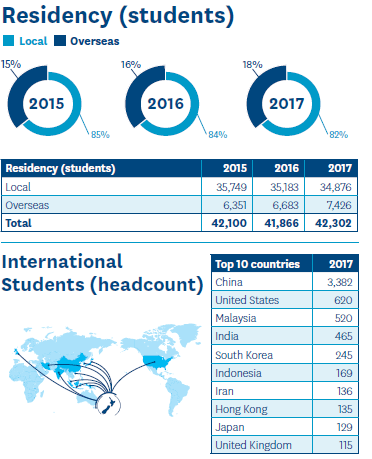
As a reminder of just how compromised our university hierarchies are I found this graphic on the Auckland University website.

au students

Not only is the dependency on foreign students rising, but the foreign student numbers are totally dominated by PRC students.    I’m usually very keen on free and open trade, but when you find yourself dealing with thugs, the sensible response (in almost any business or area of life) is to pull back and reduce your exposure to thugs, not to simply do the kowtow –  perhaps especially when you are a university, residue of some of greatest bits of the Western tradition.    We can’t allow our values, and the safety of our people, to be simply played around with to protect the interests of a few big (public and private) corporate businesses.   In Australia, a former Secretary of Foreign Affairs and Trade recently called for Australian universities to not act as if the revenue will always be there

“While demand remains high, it makes little sense for Australian universities to turn their back on the revenue stream offered by students from China and elsewhere,” he said. “But it would be wise to invest the profit margin for the longer term, not use it for current expenditure. Put it into a future fund or endowment, which would give universities a measure of resilience in the event that the market abruptly shifts for reasons beyond the control of universities.”

That would seem prudent here too, but of course it might force governments to look harder at the long-term financial structuring of our tertiary sector.

Finally, there was a story on some of these issues on Newsroom this morning, the key line in which is best captured in this tweet.

As Geremie Barme notes further (perhaps rather generously on the government’s intentions)

“China’s challenge to everybody in this region … is it requires governments are much smarter in dealing with a rising superpower that is aggressive, totalitarian, bullish and nasty in many ways, but also is varied and complex and interesting and engaging.”

Standing up to China, while still maintaining a working relationship, was difficult.

“It’s hard work and it’s constant work. This Government wants to do good but can’t quite manage to do so,” Barmé said.

“This is the real deal, and New Zealand’s never had to face this … You have to sit down and you have to work out, what is a consistent long-term policy, at least for the life of this Government. And how do you articulate that.

“And I get the sense they haven’t done that; Jacinda Ardern just runs for cover.”

She can’t even bring herself to talk, concernedly, about the astonishing situation in which a former PRC intelligence official, Chinese Communist Party member, sits in our Parliament –  close to the Embassy, never criticising the regime for anything –  having acknowledged that he misrepresented his past to get into the country in the first place.

I guess it suits the handful of big corporates and university bosses that she simply keeps quiet.  It should shame the rest of us.

Thoughts prompted by the open letter

There was an open letter to the Prime Minister, cc’ed to the Deputy Prime Minister and Foreign Minister, released this morning and signed by 29 people (mostly academics), prompted by

….the reports of intimidation and harassment suffered by Professor Anne-Marie Brady of Canterbury University. According to news reports, she has been repeatedly burgled and her car tampered with, starting from December 2017. Reports have suggested that these events are related to her high-profile academic work on overseas influence campaigns by the government of the People’s Republic of China.

The letter calls for two things

…we echo the recent calls by Professors of Chinese history and literature Geremie Barmé and John Minford for the New Zealand authorities to take the threats against Professor Brady more seriously, in consideration of their implications for all New Zealanders.

(I ran the Barmé/Minford letter here last week.)

We also urge Prime Minister Jacinda Ardern to make a clear statement in defence of academic freedom in New Zealand in light of the Brady case, and to be very clear that any intimidation and threats aimed at silencing academic voices in this country will not be tolerated.

It should be hard for decent people to dissent from the broad thrust of the letter (which even appears to have briefly united ACT and the Green Party –  at least the bits out of office.)  One might quibble about the details –  for my own tastes it seems a bit too focused on “academic freedom” (which is mostly about the relations between universities and their staff), as distinct from the more general freedoms of New Zealand citizens and residents, including those of the ethnic Chinese community, whether or not they happen to be associated with a specific government tertiary institution –  but the thrust of the case really shouldn’t have needed saying, and yet apparently did need to be said.

But I found two things about the statement interesting.  First, who did and didn’t sign.  And, second, the (reported) reaction of the Prime Minister.

By my count, 21 New Zealand-based academics signed (plus a couple of PhD students, and one New Zealander working at a US university).  Of those 21, only one appears to specialise in international relations, and none appear to be specialists in matters to do with China (politics, society, economics, international relations or whatever).

One of the signatories was (former academic and now) consultant Paul Buchanan.  In  an exchange of comments here on Saturday, and in reference to this letter he noted

It appears many academics are reluctant to sign on because a) they fear retribution of one sort or another (say, loss of funding); and b) they personally dislike Ms. Brady and/or claim that her research is flawed etc. The fact that people cannot separate personal animus and/or concern about funding from a defence against criminal harassment is telling. As for her research, her “Magic Weapons” essay is an example of applied research and was not meant to be a theoretical or conceptual path-breaker, so sniping about its quality is pedantic.

Perhaps some of our media might like to ask, for example, those involved in the Contemporary China Research Centre about why not one of them signed this statement (or, so far as I’ve seen, have issued their own statements supporting Professor Brady).   As a reminder

The New Zealand Contemporary China Research Centre is New Zealand’s national research centre on China. We are based at Victoria University of Wellington with New Zealand’s other seven universities all being University Members of the Centre, University of Auckland, Auckland University of Technology, the University of Canterbury, the University of Otago, the University of Waikato, Lincoln University and Massey University, and with each University providing a Deputy Director.

Here is a list of the senior people at CCRC, including the Executive Chairman, Tony Browne (who also happens to chair Victoria’s Confucius Institute, and to sit on the board that advises the PRC government agency on the Confucius programme worldwide).   As the excerpt says, there is a director and then deputy directors in each university, and there are research/senior fellows.

But then here is the Advisory Board to the CCRC.   It includes representatives of MFAT, NZTE, MBIE, and Treasury, as well as the Director of the Asia New Zealand Foundation, the chair of Education New Zealand and the former chair of the New Zealand China Trade Foundation.

The CCRC helps run courses for MFAT.  And it hosts various visiting delegations from PRC government agencies.  Just next week, it is hosting a conference on next year’s Year of Chinese Tourism which event, no doubt, the PRC Embassy smiles benignly on.

Wouldn’t do then for anyone to speak up or speak out.  I don’t suppose there was anything quite as crass as a directive to all to keep quiet, but all those involved surely know which side their bread is buttered on (perhaps they wouldn’t have got appointed if not).  Much as I care about the intimidation and threats to Professor Brady, if there is a narrow issue of academic freedom, it is probably more about the utter silence of the rest of the China-focused New Zealand academic community.  It was perhaps also telling that no university vice-chancellors signed the open letter.  Perhaps they are all sympathetic –  and there have been no reports of Canterbury trying to close Professor Brady down –  but they have enrolments to sell, and the PRC is a big and threatening market.    But, again, perhaps some journalist could ask them about their attitude to attempts to intimidate a prominent New Zealand academic?

I guess the Prime Minister will probably get some direct questions on this issue at her post-Cabinet press conference, or in her weekly media rounds tomorrow, but I was interested in her initial response, as Radio New Zealand reported it.    It was terse and largely empty, apparently attempting to avoid the issue, with brief comments along the line that she “supports” and “defends” academic freedom, but that she couldn’t say anything more substantive until the Police investigation had concluded. She couldn’t even manage –  wasn’t willing to –  make a statement that was (in the words of the signatories)

“very clear that any intimidation and threats aimed at silencing academic voices [or others] in this country will not be tolerated.”

And, again as Radio New Zealand reported it, Professor Brady understands that the Police investigation has already concluded, and the question now is whether the government will show any backbone.     Whose values is the Prime Minister actually sticking up for?

Of course, if anything the Leader of the Opposition, interviewed on Radio New Zealand a few minutes later, was worse.  He managed some quick passing comments vaguely in support of the letter –  I guess he could hardly say he opposed “academic freedom” –  before moving on to run his own (in effect) defence-of-Beijing line.    Rather rashly he declared the US and China to be in a “virtual war”, was more or less defending Huawei (there was “no smoking gun” –  it might be a bit late when there is, surely?), and criticising the government for being a little hesitant about the Belt and Road Initiative (recall that Bridges was the minister who signed us up for a “fusion of civilisations”) and for upsetting China by buying the P8s and stating a few honest words –  never echoed by the PM –  in a defence policy statement.

“We’ve got a situation of inflamed language, particularly from the Foreign Minister whether it’s been on defence strategy, whether it’s been Belt and Road. These things will be of concern to the Chinese and they will be sending a [subtle] signal.”

As if he belonged to the youth wing of the Labour Party, he was reciting lightweight lines about how “we shouldn’t take sides”.   Not in opposing evil?  Not in resisting aggression?   That wasn’t New Zealand’s historical approach –  National or Labour. Then again, his stance seems to be avoiding even taking New Zealand’s own side, given the continued presence of Jian Yang in his caucus, and Yikun Zhang in arranging large donations for his party.

To return, finally for now, to the Prime Minister, TVNZ ran a story/article on Friday night about the decision – no doubt from Beijing –  to deny the Prime Minister a trip to Beijing this year.   With the website version there was a little video clip from the opening moments of her meeting with Chinese premier Li Keqiang in Singapore a couple of weeks ago.  I very rarely listen to such clips, but for some reason did this time.   The clip captures the Prime Minister opening the meeting stating that she was encouraged by “the significant common ground between your vision for China and the policies of my government”.  She went on to observe that “just as you are focused on a balanced development model and the wellbeing of the Chinese government, my government is focused on sustainable economic development and a fair society”.

It is, frankly, sickening and shameful.  Our Prime Minister, elected leader of a free, open and democratic society, governed by the rule of law etc suggests that there is “significant common ground” between her government’s policies and those of one of the most brutal un-free regimes on the planet, that has spent at least the last six years going backwards not forwards on the sorts of values and practices that most New Zealanders cherish,

Sure, Prime Ministers and like need to mutter pleasantries at the start of meetings, but surely “did you travel well, and get a good sleep?” beats this sort of stuff?    And why is she giving recognition and apparent approbation to the desire of the Chinese Communist Party to extend its brutal rule (“the wellbeing of the Chinese government”).

Is there any decent moral core there at all?  No wonder she hasn’t managed a robust defence of free and open debate, of the sort the academic signatories called for.

(I’d been going to write a bit about former NSW premier, former Australian foreign minster, current head of a somewhat Beijing-sympathising think-tank, Bob Carr’s interview on China-related issues on TVNZ’s Q&A last night.   There were plenty of bits to disagree with, but actually compared to either Simon Bridges or Jacinda Ardern he came across as fluent and somewhat reasonable.  Perhaps it helps being out of office, but he was willing to welcome Mike Pence’s efforts to highlight China’s human rights abuses, and was explicit that he would not have signed Australia up to the Belt and Road Initiative.    By his standards, New Zealand’s “leaders” seem very far gone.)

NZ and the PRC: Friday bits and pieces

I noticed in the Herald’s “Dynamic Business” supplement, associated with the Deloitte Top 200 awards (themselves notably short on successful outward-oriented companies based on anything much other than natural resources), that the former Prime Minister John Key was interviewed about China.   It was, to say the least, a bit of a mixed bag.  In his first answer this line appeared

“I think Xi Jinping’s going to go down in history as a good leader of China.”

That would be in the history as written by the Chinese Communist Party (assuming it survives that long)?  I’d accept “consequential”, “influential”, even (in a bleak way) “pathbreaking”, but “good”?  What does John Key possibly see as “good” –  a term that usually has some moral connotation to it – about Xi Jinping’s rule?   It isn’t even as if the economy has been set on firmer foundations, let alone the seizures of power, seizures of territory,  the Xinjiang situation, or whatever.  But I suppose the PRC embassy will have taken note, and doors are likely to remain open in Beijing.

Key was then asked about the (straw man) question about balancing China and the United States.  I don’t particularly agree with his stance but at least –  in contrast to our current Prime Minister –  he seems capable of giving a straightforward answer, including recognising where our values, our culture, and our history take us.

…the reality is that our relationship with China is still a very economic relationship…. In the case of the US and our traditional allies –  Australia particularly – it’s a much different relationship.  They are the people that we culturally feel most at home with.  We share such a massive history.  Everything lines up much more closely there…..

I think if we turned our back on the Chinese, we’d find a lot more Irish an Dutch dairy products would flow into China and less would flow from New Zealand. It might be a bit mercantile but I think that would be negative for the New Zealand economy, for dairy farmers and for lots of New Zealand businesses –  from tourism to education services

I think he is mostly wrong about dairy –  it is a globally traded market and as we are seeing in the soybean market at present in time what doesn’t go to one country ends up going to another (if, say, the Irish and Dutch industries had WMP capability, to divert that product to China would involve not selling to the people they are now selling to).  But at least Key seems willing and able to give a straight answer –  even if it is an amoral one:  “never mind the nature of the regime, we should give priority to businesses selling stuff there”.

There was an interesting snippet in the Herald’s (typically rather well-sourced) “Insider” column in which it is noted that

NZ diplomats have been told the long-expected invitation for Jacinda Ardern to go to Beijing won’t come any time soon.

Perhaps that is the explanation for her shameful refusal to front up for the Herald’s longstanding interview request.  But if so, she needs to rethink her priorities.  Tea at today’s Berchtesgaden beats an open and honest discussion with –  and accountability to – her own citizens and voters, confronting concerns about the activity of the regime at home, abroad, and here in New Zealand?

You could read the account on the Chinese Embassy’s website of her meeting with the PRC Premier Li Keqiang and not come away with any sense of any awkwardness at all, with bizarre talk of working together for the “peace and prosperity” of the Asia-Pacific region.  We are presumably supposed to accept with a straight face words like these from the Premier

He also encouraged New Zealand companies to expand investment in China and boost technological cooperation with China, saying that China will conduct the cooperation on the basis of strict protection of intellectual property rights.

Surely only that distinctive New Zealand “Yeah right” should greet claims like that?.  Perhaps the Prime Minister’s perspective on the meeting would be different, but there is no similar account on the Beehive website (and if MFAT had problems with Beijing’s account, no doubt they have raised those concerns).

Can it really be that deals and donations are all that now matter to her?    If she doesn’t care about the citizens of the PRC, or about surrounding states, or even about how closed an economy China is in many respects, is she really not bothered about the PRC activities here?  Presumably not.  After all, Raymond Huo chairs the Justice committee and sits in her caucus, and Jian Yang sits on the other side, and not a word in heard from the Prime Minister.

There was an interesting post a couple of days ago from Paul Buchanan, the American (but New Zealand resident) former academic and now consultant on issues international.  He began by addressing the somewhat extraordinary suggestion (made by David Parker and the Prime Minister) that New Zealand could be some sort of bridge or broker between the US and China. He is simply dismissive of it, and doesn’t think either Beijing or Washington is likely to take it seriously.

For my tastes, Buchanan’s discussion  is altogether too cold (then again, perhaps his future isn’t tied to New Zealand?).   He suggests

While New Zealand audiences may like it, China and the US are not fooled by the bridge and broker rhetoric. They know that should push come to shove New Zealand will have to make a choice. One involves losing trade revenues, the other involves losing security guarantees. One involves backing a traditional ally, the other breaking with tradition in order to align with a rising power. Neither choice will be pleasant and it behooves foreign policy planners to be doing cost/benefits analysis on each because the moment of decision may be closer than expected.

I’ve disagreed with him in comments here on earlier posts, because I think he grossly overstates the extent of any sort of “economic dependence” of New Zealand on China.

On trade, New Zealand has an addict-like dependency on agricultural commodity and primary good exports, particularly milk solids. Its largest trading partner and importer of those goods is China. Unlike Australia, which can leverage its export of strategic minerals that China needs for its continued economic growth and industrial ambitions under the China 2025 program, New Zealand’s exports are elastic, substitutable by those of competitors and inconsequential to China’s broader strategic planning. This makes New Zealand extremely vulnerable to Chinese economic retaliation for any perceived slight, something that the Chinese have been clear to point out when it comes to subjects such as the South China island-building dispute or Western concerns about the true nature of Chinese developmental aid to Pacific Island Forum countries.

But even if there is some potential for short-term disruption to some sectors or firms, countries largely make their own medium-term fortunes. That was true of us in the past, is today, and will be still in the future.  Policymakers here have been very unwise in continuing to encourage stronger trade links with China, even as they recognise the sorts of threats and disuptions China has proved capable of in other countries, and the more aggressive approach China is taking internationally across a range of fronts.  No serious and free country, none with any integrity whatever, ever prioritises (for any length of time) the interests of a few of its export firms, over the values of its people.  In the medium to longer-term values and interests amount to the same thing.

And it is not as if other countries in years past have not faced these sorts of tensions.  Denmark and the Netherlands had Germany as a major trading partner in the late 1930s, but they didn’t simply roll over and invite Hitler in.

Perhaps more importantly, and a reason why I think the US vs China framing is a distraction, is that whatever the US is or isn’t doing, we face the interference activities of the PRC in our own country.  Simply taking a stand there –  clearing Jian Yang and Raymond Huo out of Parliament, standing up for Anne-Marie Brady and for those ethnic Chinese New Zealanders facing regime pressure and threats, being more open and serious about the cyber-security threats, shunning people with recognised United Front connections (not honouring Yikun Zhang), protecting and promoting an independent Chinese language media here.  These are the sorts of things a minimally decent government would be doing, even if it said not a word about abuses in China or China’s near-abroad.  But not our government: faced with the choice not between China and the US, but between decency on the one hand, and deals and donations on the other, they seem to side with the deals and donations.  And the National Party provides them cover to do so.

On the topic of cyber-security, the Australian papers this week had several stories about PRC cyber-attacks on Australia.   There were two classes of attack in the stories I saw –  one about a resurgence in direct cyber attacks on Australian companies, in violation of some deal Malcolm Turnbull and the PRC had done a couple of years ago.    The other built on this academic article, in which the authors report the results of a study showing how the PRC appeared to get round a similar deal between Barack Obama and the PRC in 2015, by using China Telecom to route selected international internet traffic through China –  where presumably the PRC could spy on it, copy it or whatever –  rather than following the standard (shortest distance) protocols. The authors provided evidence to the Australian media strongly suggesting a specific such attack involving Australia last year.

But here is the thing that interested me.  In the newspaper articles I read we saw senior government officials confirming “a constant, significant effort to steal our intellectual property”, and even a senior Cabinet minister expressing concern about the number and severity of such attacks.

By contrast, what do we get here, but blather from the Prime Minister about needing to keep an eye on cyber-security, and otherwise silence –  “national security” don’t you know, providing cover for anything ministers and officials don’t want to talk about.  I did see a Radio New Zealand article quoting a PWC person saying there was no evidence New Zealand had been caught up in the first class of attacks described above.  It would be nice to hear it from official sources, but even if it is true in the specific case, how likely is that the PRC approach to New Zealand is very much different than that to Australia –  take what they want, and can get at?   Occasionally, I make glib remarks about how perhaps New Zealand has nothing much advanced to steal, and when I do I get firmly put in my place, with links to various advanced university departments (for example).  Surely we might reasonably expect the Prime Minister or the Minister for the Intelligence Services to front up on this sort of issue, at least to give us reason to believe (confidently) that they aren’t living in some fool’s paradise, convinced they are uniquely immune from the efforts of the Ministry for State Security?

And finally,  I was sent yesterday a copy of a statement by a group called the New Zealand Values Alliance, which appears to be a group of ethnic Chinese people living in New Zealand who are concerned about the intrusion of the PRC into New Zealand.  (There is a similar, more prominent group in Australia, called the Australian Values Alliance.)   This was the statement

We, New Zealand Values Alliance(NZVA) , hereby issue the following declaration:

It is learned from media that the prominent China researcher Anne-Marie Brady has encountered on-going harassment which has recently widened to include a vehicle  sabotage of her private car, which “absolutely posed a risk to her life”.  We hereby express our concern and condemnation on the matter.

To our knowledge, similar harassments and threats sometimes happen to people who criticize CCP. Such harassments include text intimidation, tracking, stalking and a variety of harassment activities which has now escalated to sabotaging private vehicle to seriously threaten life safety.

We are very concerned about the personal safety of people who publicly criticize CCP. We earnestly appeal to the NZ government and police to pay close attention to the safety of those human rights activists and researchers against dictatorships and give more attention  to the rampant activities related to foreign political infiltration. Meanwhile an investigation into foreign interference should be started ASAP   and relevant laws be established for deterrence and punishment against related activities from agents with foreign interests.

Hard to disagree (the Values Alliance had an earlier statement about Jian Yang, reported here).  The organiser, a relatively recent migrant from China, Freeman Yu, has noted on his Twitter feed his own experience of what he talks of

Does this sort of thing bother our politicians at all?

You might have hoped that New Zealand political leaders would be speaking out  (let alone New Zealand academics working on China and/or international relations).  Former Prime Ministers, former Opposition leaders, former foreign ministers?  People like Don McKinnon, Jenny Shipley, Don Brash, Murray McCully, Helen Clark, Phil Goff, Geoffrey Palmer, Jim McLay, Jim Bolger or Mike Moore.  But, it appears, not a word from any of them, let alone Bill English or John Key.   A sad commentary, that rather tends to make the point Anne-Marie Brady was making in her paper about how too many of our elites have been persuaded that keeping quiet and going along is somehow in the best interests of New Zealand.  In fact, it largely just serves Beijing’s interests.

Blathers away when directly asked

Another week and another Matt Nippert article in the Herald updating us on the Prime Minister’s continued refusal to be interviewed substantively on the government’s approach to the People’s Republic of China.

A Herald request filed in May to discuss the Government’s China policy with Ardern was this week again rejected, with possible windows for an interview now pushed into early next year.

Perhaps it  –  refusal to be interviewed by a serious journalist on a major public policy issue – might not matter as much if our MPs were not, apparently, all in thrall to the PRC, such that there is no questioning in Parliament of the government’s approach on this really important issue.  But Parliament is useless –  and worse –  and the Prime Minister simply avoids (refuses to face) sustained media questioning.  Not, it seems, that many try, but to their credit the Herald has.

Cheap virtue-signalling is apparently fine: the Prime Minister was reported as (to her credit) having refused to travel in a Maserati at APEC.  But that’s only PNG, and hardly anyone here (well, perhaps a few MFAT diplomats) will question her small stand against such excess.

But she is not willing to engage seriously on the activities, including those in our own country and own political system, of a great (if evil) power.

Fortunately, an occasional journalist does still manage to ask the odd question.  But they are typically short interviews, and rarely focus in on things she is directly responsible for, and so she gets away with what can only be described as “blather”.    There was an excellent example on Radio New Zealand’s Morning Report yesterday when she was interviewed by Guyon Espiner.

It was a consistent attempt at minimising any issues, relativising everything, and never ever calling out China on anything.  It was actually pretty fundamentally dishonest to the New Zealand public, in attempting to imply that all that is really going on is a trade dispute.   Then again, I thought she was given a pretty easy run by the interviewer.

Thus, we were told that there was “significant consensus” around the APEC communique and that the issues were only a few words.  But she knows as well as anyone that most such communiques are just bumpf anyway, and the real issues always resolve around a few critical words.  It matters a lot –  tells us a lot – that neither the US nor China decided that it was in their interests to compromise on this specific point, which could almost certainly easily have been drafted around (and the results spun by each side) had there been a will to do so.  (“Unfair trade practices –  of course we disapprove of those, but our country doesn’t have any, just standard national security provisions”.  That sort of thing.)

She stated that both sides should “step back and de-escalate”, without addressing the substance of the issues at all.    But she must know that her consistent refusal to say anything of substance plays into the hands of the People’s Republic.  You might think –  as I do –  that Trump’s initial focus on bilateral trade deficits is pretty flakey, but it doesn’t detract from the wider issues around theft of intellectual property, market access, and so on.  The PRC remains one of the least open markets in the world.  And the US by contrast, for all its many faults, is one of the most open.

The government seems to see itself as having some sort of role as a ‘bridge” between the US and China.  Questioning drew on a comment to that effect over the weekend from the Trade Minister, David Parker.   The Prime Minister attempted to minimise this, talking of some specifics around WTO governance.  But perhaps the interviewer could have pushed her rather more on what it is that the government disagrees with in the recent combined (ie not just the US) EU, Japanese, and US approach

On November 12, the United States, European Union, and Japan will submit a package of proposals to the World Trade Organization’s Council on Trade in Goods that would significantly help curb China’s practices of heavily subsidizing its state-owned enterprises. They are also discussing ways to prevent China from forcing Western companies to transfer technology to Chinese firms.

The Prime Minister was asked why we wanted to be a “bridge”, to which her response was to burble on about a “values-based approach”, an independent foreign policy, and not picking sides.  Surely in any sort of values-based approach –  one where life is more than deal and political donations – you would be found on the side opposing the greater evil?  But, of course, there was none of this from the Prime Minister, just the suggestion that somehow being neutral was better, for its own sake.  To believe her, for example, you’d have to believe that Michael Joseph Savage and Peter Fraser were forced into World War Two against their better judgement, rather than as leaders of an independent country deciding to act together with other countries that shared our values, and the attitude to the presenting evil.

It is the sort of answer that wins praise from the largely taxpayer-funded propagandists for all things PRC.   It shouldn’t be acceptable to decent New Zealanders, not compromised by deals or donations.

The interviewer tried again, asking if she was really saying we (well, she) was as aligned with the PRC as with the United States (with whom, as he pointed out, we are in a longstanding intelligence relationship).  Even there she couldn’t manage a straight answer, burbling on about how “we align ourselves with a set of principles and values. Some of these things are not black and white”.  But even then she seemed to be trying to reduce everything to technical details about a trade dispute.  No sense, for example, that imprisoning a million people in Xinjiang, for being who they are, qualifies as pretty unconditionally “black”.  Or probihiting freedom of speech, scoffing at the rule of law, widespread theft of intellectual property, severe restrictions on freedom of religion, and no capacity of a country’s citizens to change their government –  and all that is mostly just the internal stuff –  are pretty black.  No other country –  let alone our own – is perfect, but in real life you choose to align with real people and real countries, and when you choose to consistently refuse to identify that New Zealand has a lot more in common –  in its values –  with Australia, Canada, the US, Japan, the UK, Taiwan, or EU –  than with the PRC, by default you side with other lot.   You give legitimacy to their evil.

The interviewer moved onto the Belt and Road Initiative, which the previous government signed us up to last year –  some sickening text (“fusion of civilisations”), but mostly a big propaganda win for the PRC.  Because although the Prime Minister tried to spin her listeners suggesting that lots of countries had signed up, we are the only advanced country – and the only Five Eyes partnership country – to have done so.   Of course, given that the deadine in the original agreement for specifics has now passed, one might deduce that the government is not too keen on doing too much under the loose aegis of the Belt and Road Initiative.  Perhaps the pressure from Beijing for some specifics is beginning to mount –  if, for example, New Zealand wants that extension of the preferential trade agreement (or the Prime Minister wants that trip to Beijing).

The interviewer moved onto matters we have full control over: our response to the PRC influence and interference activities in New Zealand.    He quoted Anne-Marie Brady’s line that those activities (“covert, corrupting, coercive”) were now at a “critical level”.   The Prime Minister simply refused to engage with specifics (she was “very cautious about labelling”), talking about the need for good and broad “legislative frameworks” –  as if the real issues were primarily legislative, rather than attitudinal ones being at least as important  – while naming nothing specific there either (although some mention of cyber-security).   We need, we were told, to be “vigilant across the board”, trying to play distraction with references to North Korea and Russia.   She was, she said, comforted that there was no evidence of interference in the election, without being pushed to engage with the fact that the current inquiry into last year’s election is being led by her own MP, Raymond Huo, who is himself associated with various United Front organisations, who adopted a Xi Jinping slogan for Labour’s campaign, and who organised the function at which Phil Goff funded a large chunk of his mayoral campaign with a “donation” (charity auction bid) from mainland China.  I wonder how the intelligence services would feel if they were called to testify to a committee chaired by Mr Huo?

And, finally, the interviewer moved on to the burglaries at Anne-Marie Brady’s home and office, and suggestions of interference with her car.   There was no clarion call in defence of the freedom of New Zealanders (academics or otherwise –  this isn’t largely about academic freedom) to write, advocate and lobby as they like, no observation that while the investigation hadn’t yet been resolved, if there were evidence of involvement of a foreign power it would be a very grave matter, which the government would need to respond to with utmost seriousness.  Instead we got attempts at obfuscation and procrastination.  She told us she didn’t comment on intelligence briefings, only for the interviewer to point out that she was first one to mention intelligence services.  Twice she attempted to point out that she had “been away”, as if she’d been communing with nature alone on top of some high mountain, not travelling on a government plane, accompanied by all manner of senior government officials.

If it wasn’t that surprising –  given what we’ve come to see of her performance –  it was disappointing nonetheless.   I wonder if we will even get a straight answer when the Police finally – next year, the year after  –  finish their investigation.  Effective freedom of speech –  let alone a stand for the core values of New Zealanders – seems to be an inconvenience next to keeping the donations going, and keeping the business interests trading with China (notably Fonterra, the universities, and the tourism sector) on side.  Her only “value” in this area seems to be the dollar.

But, of course, she gets away with it because the Opposition leader is just as bad.   She has Raymond Huo in her caucus (and in a senior select committee role), he has Jian Yang, and both seem to keep the donations flowing, and neither will call out the other.  The parties combine to honour Yikun Zhang for what, it seems, is in effect services to Beijing.

There was an interesting article in the Financial Times yesterday, reporting that the US is considering banning exports to China of a range of advanced technologies

In a document published on the Federal Register, the commerce department listed all the products it might subject to export curbs. These included items from genomics, to computer vision and audio manipulation technology, to microprocessor technology, quantum computing, mind-machine interfaces and flight control algorithms.

It is the sort of thing that illustrates that however silly the initial focus on bilateral trade deficits was, the tensions between the US and China are well beyond that stage now.  At a time when the Chinese economy is in any case looking under more threat as the longrunning credit boom appears to have exhausted itself, and the authorities seem unsure how –  if at all – to respond, surely an honest and decent Prime Minister would be more interested in levelling with the public, about the nature of the regime in Beijing, the nature of its threats here and abroad, than in engaging in some sort of weird amoral “balancing act”.   If she wants to run the “not black and white” line, at least she could honestly recognise the distinction between off-white and something very very deeply dark grey.

But not in New Zealand.  One could almost say she puts herself in something like the same category as Trump over Saudi Arabia –  with obfuscation and avoidance, rather than bluster, her chosen rhetorical style.

In closing, and having praised the Herald for persevering (I guess at near-zero cost) in its quest for a serious interview on these issues, I noticed this earlier in the day

https://twitter.com/niubi/status/1064907102412513281
Translated from Chinese by
Microsoft
New Zealand has fallen.

Bill Bishop is a pretty astute and highly-regarded China analyst (who wears his distaste for Trump pretty visibly).  I clicked the link and sure enough there seemed to be a whole series of sponsored articles (links down the right hand side of this particular article) from the People’s Daily –  main Chinese Communist Party newspaper – on the Herald website.  Quite extraordinary.

Voices in support of Anne-Marie Brady

Many, perhaps most, readers will have seen the article by Matt Nippert on the front page of yesterday’s Herald, about Professor Anne-Marie Brady and indications that her car may have been sabotaged.  This, of course, comes in the wake of break-ins to Professor Brady’s home and office, that are still –  months afterwards –  being investigated by the Police.  The strong suspicion has been that agents of the People’s Republic of China were involved in the break-ins, including (inter alia) because of what was, and wasn’t, taken, and letters that Professor Brady had received.  Yesterday’s article included this comment from Brady about the very slow-moving investigation.

She was unwilling to comment on the lengthy and still unfinished Police investigation, but told the New York Times in September the lack of comment or public action from government to date was “starting to look like procrastination”.

Official Wellington might be thought to have a strong interest in the investigation not coming to a conclusion, and it has (sadly) become difficult to have much confidence in the independence and integrity of the Police when it involves issues that matter to governments.

Nippert also included this section

The ongoing investigation …. had raised the temperature of local debate on the issue of China.

Commentary in local Chinese-language media has been an especially heated, with a recent op-ed by Morgan Xiao – published simultaneously by SkyKiwi, the Mandarin Pages and the New Zealand Chinese Daily News – describing Brady and other New Zealand-Chinese democracy activists as “anti-Chinese sons of bitches” who should “get out of New Zealand”.

Freeman Yu, whose New Zealand Values Alliance has started a petition urging the government to follow Australia’s lead and curb China’s local influence, was also called out by Xiao.

Yu said the language used in local debate had recently hardened, with “extreme expressions used in the Cultural Revolution”.

“The language used in their articles expressed intense hatred for different voices and the freedom of speech,” he said.

Comments sections on (for example) Stuff often don’t reveal humanity at its finest, but this is a description of a published op-ed.   New Zealanders should get out of New Zealand?

I know Professor Brady only slightly.  We’ve talked a couple of times and exchanged emails from time to time over the last year.  I’ve found her contribution to the New Zealand debate –  which seems to involve stepping a bit beyond her personal comfort zone (academics are often most comfortable behind the scenes) –  on these issues invaluable.   Such debate as there now is wouldn’t be occurring without her.

But Geremie Barmé and John Minford know Professor Brady very well.     Barmé and Minford are both emeritus professors at the Australian National University where Barmé was formerly Director, Australian Centre on China in the World and Chair Professor of Chinese History at Australian National University College of Asia and the Pacific in Canberra.   They now live near Featherston –  which perhaps accounts for the number of China books I found in a Featherston secondhand bookshop recently –  and host The Wairarapa Academy for the New Sinology.  Their website has a fascinating collection of material, which I’ve linked to occasionally.

They have today put out a statement about Professor Brady, her work, her position and so on.   I’ve reproduced it here (with permission).

17 November 2018

Re: Professor Anne-Marie Brady

To Whom It May Concern,

Professor Anne-Marie Brady is a noted specialist in China’s domestic and foreign politics at the University of Canterbury. Her work on contemporary China, and its increasingly controversial global engagement, contributes directly to the national interest of New Zealand. It is also having a considerable impact internationally, not only in academic circles but also in political debates and policy formulation among the major allies and trading partners of this country.

As teachers and mentors of Professor Brady — John Minford was one of her undergraduate teachers at the University of Auckland; Geremie Barmé was a supervisor of her doctoral work at the Australian National University — we are proud of her achievements and we strongly support her ongoing academic research work and engagement with issues of public, national and international significance.

In February this year, we were profoundly disturbed to read media reports about break-ins at Professor Brady’s workplace and of her home office, resulting in the theft of electronic equipment and research materials. The details of the break-ins, still a subject of police investigation, suggested that Professor Brady was being subjected to intimidation for her internationally recognized work on official Chinese strategies to influence the politics and societies of foreign countries, in particular New Zealand. (See: https://www.pressreader.com/new-zealand/the-dominion-post/20180219/282355450217707) We were shocked by the latest media reports — on 16 November — that, during routine Warrant of Fitness maintenance, it was discovered that her vehicle may well have been purposely tampered with. There are indications that this was done to endanger the occupants of the vehicle: Professor Brady, her husband and their three teenage children. (See: https://www.stuff.co.nz/national/108649435/professor-annemarie-brady-who-warned-about-china-interference-says-car-was-sabotaged )

The freedom from fear was long ago recognized as a basic human right; academics should be able to pursue their work, and their daily lives, without being subjected to intimidation. In any modern democracy worthy of the name, academic freedom and independent research are crucial “public goods”. They are also germane to university life.

As residents of New Zealand and as independent scholars — our main institutional affiliation is with The Australian National University as emeritus professors — we hereby express our deep concern about the on-going threats to Professor Anne-Marie Brady’s research and private life.

We hope that others whose research and teaching involves contemporary China will offer her and her important work collegial encouragement, as well as public support.

Furthermore, we also hope that the New Zealand authorities take the threats against Professor Brady seriously. We appeal to the Prime Minister, Rt. Hon. Jacinda Ardern, and her coalition partner the Foreign Minister, the Rt. Hon. Winston Peters, to address directly the issues raised by her work which she has further articulated in practicable, and succinct, formal advice to the government.

Since September 2017, Professor Anne-Marie Brady’s work has attracted overwhelmingly positive global attention. It has also been subjected to vilification by Chinese officialdom. Regardless, her work continues to influence the debate about China’s “sharp power” on the international stage, and it contributes to practical policy discussions in Europe, North America and in Australia. This work remains ever more pressingly relevant to the public life, and the future, of her homeland.

Yours,

Geremie R. Barmé
Professor Emeritus of History
The Australian National University
Founding Director, Australian Centre on China in the World
Fellow of the Australian Academy of Humanities

John Minford
Professor Emeritus of Chinese
The Australian National University
Sin Wai Kin Distinguished Professor
Hang Seng University of Hong Kong

To me, the most important lines in the statement are those addressed to our political leaders

We appeal to the Prime Minister, Rt. Hon. Jacinda Ardern, and her coalition partner the Foreign Minister, the Rt. Hon. Winston Peters, to address directly the issues raised by her work

(To which I would add “and the leaders of the National Party, so recently in government”.)

They might also speak about, for example, things like that appalling op-ed from various Chinese-language local media.

Shameful as the government’s stance on, say, Xinjiang is –  the refusal to add our voice to the protest by our friends and allies –  we can’t change China.  But we  –  they –  have no such excuse when it comes to New Zealand itself, our political system, the environment facing freedom-loving ethnic Chinese New Zealanders, and the actions of the People’s Republic of China and its agents here.

And yet Matt Nippert’s article reminds us again of the supine, scared of their own shadow, attitude of the government.

Since May the Herald has been seeking to interview Prime Minister Jacinda Ardern about the governments’ China policy in light of Brady’s research and legislative action in Australia.

The Prime Ministers’ Office has regularly put off the request

Simply refusing to engage on such vital issues with a serious journalist from our largest newspaper is astonishing, and a telling commentary on how corrupted our political system appears to have become.  Perhaps as telling is the utter silence from the National Party on the government’s refusal to engage.

UPDATE: I would strongly recommend this new piece, by the commentator on China issues who goes under the label Jichang Lulu, to anyone at all interested in the PRC influence issues as they relate to New Zealand.


The Prime Minister continues to shame us

The Prime Minister has been attempting to defend her handling of the meeting with the Malaysian Prime Minister, following his apparently quite forthright comments on the South China Sea.  She parrots a line about not taking sides in the dispute, but surely she knows that when you don’t take sides between a bully and his (or her) victim you side with the bully.  And when you say

New Zealand’s position on the issue had been “utterly consistent”, and the country had never taken sides, she said, adding all claimants should uphold international law, and the law of the sea.

and yet fail to point out which party –  the PRC –  consistently refuses to uphold international law in this area, you make yourself a party to the abuse, the aggression, aiding the new status quo in which the PRC has taken control.  It really is like not taking sides when Germany takes Czechoslovakia or Poland.

But perhaps journalists could also ask the Prime Minister to explain New Zealand’s absence from this list

Australia, Canada, and the European Union as a whole, but not New Zealand, are part of an approach to Beijing over the abuses in Xinjiang.

Life –  even foreign policy – really has to be more than the sums of the deals, or the sum of the donations.

The Government’s stance is these areas –  much the same as the Opposition’s –  shames us.

UPDATE:  A reader sends me this (I’m not sure from which publication)

“We decided not to sign it because we have raised concerns about the situation in Xinjiang directly with Chinese authorities,” a spokesman for Ardern told Newsroom when asked if New Zealand had joined the protest.

“New Zealand concerns have been registered by the Prime Minister with senior counterparts, including yesterday with Premier Li. Concerns have also been raised at officials’ level, including through New Zealand’s bilateral human rights dialogue with China, and at the UN in Geneva,” the spokesman said.

This is pathetic.     As if none of the other countries has made direct or bilateral comments, and –  as noted here –  other countries (including the US, UK, and Australia) were much more visible and vocal at the recent UN human rights review on China.   There are those old lines about “stronger together”, and people being known by the company they keep.   I don’t think trade agreements and the like should drive our policy stances –  our values should – but you have to wonder what the EU (with whom New Zealand wants to sign of an agreement) makes of a New Zealand government so supine it won’t join its (erstwhile) friends in this process.   Perhaps unilateralism is an option for the US, but it is the same Prime Minister who regularly reminds us, and the world, about the merits of acting together.  Just not when it comes to never ever upsetting Beijing?

Making the Trump administration look less bad

I’m no fan of Donald Trump.  He is unworthy of the office he holds, and almost every week there is new data to reinforce that view.   And if his character is unworthy, there is no offset in the way in which he attempts to govern or in the clarity and excellence of his thought or vision.

And yet, when it comes to the People’s Republic of China, our Prime Minister –  probably with the full support of the Leader of the Opposition –  manages, somehow, to leave the US Administration looking as though –  for the moment at least – it is on the side of the angels.   And as if it is our governments that are simply all about “the deal” –  be it an “FTA” upgrade, party political donations. or just students flowing to our public universities that have made themselves so dependent on not upsetting the thugs in Beijing.

Then there is Scott Morrison.  I guess he probably won’t be Australia’s Prime Minister for long, but a couple of weeks ago he gave a pretty good speech under the heading “The Beliefs That Guide Us”.  Sadly, I didn’t see it reported here at all (from the Australian media there is a good commentary on it here) but it comes in stark contrast to the way in which our governments (present and past) behave and talk (or simply refuse to talk).  Rhetoric is, of course, easier than action, but at least the words were good (emphasis added).

Our foreign policy defines what we believe about the world and our place in it.

It must speak of our character, our values.  What we stand for. What we believe in and, if need be, what we’ll defend. This is what guides our national interest.

I fear foreign policy these days is too often being assessed through a narrow transactional lens.   Taking an overly transactional approach to foreign policy and how we define our national interests sells us short.

If we allow such an approach to compromise our beliefs, we let ourselves down, and we stop speaking with an Australian voice.

We are more than the sum of our deals. We are better than that.

And what does Morrison regard as the “beliefs that guide our interests”?

We believe that the path to peace and liberty demands the pursuit of prosperity through private capital, rights to own property, entrepreneurialism and free and open markets. That is what lifts people out of poverty.

We believe that acceptance should not be determined by race or religion. Rather, we accept people by their words and judge them by their actions.

We believe in freedom of speech, thought, association and religion.

We believe in peaceful liberal democracy; the rule of law; separation of powers; racial and gender equality where every citizen has choice and opportunity to follow their own paths and dreams.

A fair go for those who have a go – that is what fairness means in Australia.

We believe in the limits of government – because free peoples are the best foundation to show mutual respect to all.

We believe in standing by our mates, side by side with nations that believe the same things we do.

Few or none of those things would be embraced by the People’s Republic of China, or the Party that controls it.  As he goes on to point out, by omission in listing the sorts of nations which do.

From the United Kingdom and the democracies of Europe to the United States and Canada. From the state of Israel to the city state of Singapore. From Japan and South Korea in North Asia to New Zealand, across the ditch.

He goes on later to observe, of Australia’s participation in various conflicts

We have done this because we believe it is right. Being true to our values and principles [will] always be in our interest.

Whereas, so it seems, in our Prime Minister’s mind (and that of her Opposition counterpart) not only are the two in constant tension, but the values and principles of this nation are constantly sacrificed to some short-sighted, limited, and mercenary conception of “interest”.    It is shameful to watch.

What of the US Administration?  You might think, as I do, that the focus on the US-China bilateral trade deficit is wrongheaded and economically illiterate.  Which isn’t to say that there are no real economic issues that it is right for the US Administration to take the lead in addressing –  with, so it appears, pretty widespread endorsement across the political spectrum in the US.  Even if you think –  as I generally do –  that intellectual property protections generally reach too far, and even if you recall that most rising powers have attempted to gain an edge by purloining the technology or insights of firms/countries nearer the technological frontier, China’s approach is particularly systematic, aggressive, and unacceptable.  It needs to be called out.  China doesn’t offer anything like an open market in many areas (services and investment notably), and if  –  in the longer-run –  those choices will mostly harm the Chinese, I don’t have any problem with a big and powerful country attempting to encourage change.  They are the sort of changes most in the West probably looked towards when China was allowed into the WTO.  It was clearly a sick (if opportunistic) joke when New Zealand agreed to deem China a “market economy”, when it remains far from that –  and, in many respects, getting further from it.

But it isn’t just about trade and investment.  Last month, the Vice-President gave a pretty forceful speech on the Administration’s approach to the People’s Republic of China.    There was a trade dimension

Over the past 17 years, China’s GDP has grown 9-fold; it has become the second-largest economy in the world. Much of this success was driven by American investment in China. And the Chinese Communist Party has also used an arsenal of policies inconsistent with free and fair trade, including tariffs, quotas, currency manipulation, forced technology transfer, intellectual property theft, and industrial subsidies doled out like candy, to name a few.

But there was so much more. The military position for example

And using that stolen technology, the Chinese Communist Party is turning plowshares into swords on a massive scale…

China now spends as much on its military as the rest of Asia combined, and Beijing has prioritized capabilities to erode America’s military advantages – on land, at sea, in the air, and in space. China wants nothing less than to push the United States of America from the Western Pacific and attempt to prevent us from coming to the aid of our allies.

Beijing is also using its power like never before. Chinese ships routinely patrol around the Senkaku Islands, which are administered by Japan. And while China’s leader stood in the Rose Garden of the White House in 2015 and said that his country had “no intention to militarize the South China Sea,” today, Beijing has deployed advanced anti-ship and anti-air missiles atop an archipelago of military bases constructed on artificial islands.

and systematic issues with a more individual impact

Nor, as we hoped, has Beijing moved toward greater freedom for its people. For a time, Beijing inched toward greater liberty and respect for human rights, but in recent years, it has taken a sharp U-turn toward control and oppression.

Today, China has built an unparalleled surveillance state, and it’s growing more expansive and intrusive – often with the help of U.S. technology. The “Great Firewall of China” likewise grows higher, drastically restricting the free flow of information to the Chinese people. And by 2020, China’s rulers aim to implement an Orwellian system premised on controlling virtually every facet of human life – the so-called “social credit score.” In the words of that program’s official blueprint, it will “allow the trustworthy to roam everywhere under heaven, while making it hard for the discredited to take a single step.”

And when it comes to religious freedom, a new wave of persecution is crashing down on Chinese Christians, Buddhists, and Muslims…

Last month, Beijing shut down one of China’s largest underground churches. Across the country, authorities are tearing down crosses, burning bibles, and imprisoning believers. And Beijing has now reached a deal with the Vatican that gives the avowedly atheist Communist Party a direct role in appointing Catholic bishops. For China’s Christians, these are desperate times.

Beijing is also cracking down on Buddhism. Over the past decade, more than 150 Tibetan Buddhist monks have lit themselves on fire to protest China’s repression of their beliefs and culture. And in Xinjiang, the Communist Party has imprisoned as many as one million Muslim Uyghurs in government camps where they endure around-the-clock brainwashing. Survivors of the camps have described their experiences as a deliberate attempt by Beijing to strangle Uyghur culture and stamp out the Muslim faith.

And the sort of influence activities that Anne-Marie Brady has written about here

I want to tell you today what we know about China’s actions – some of which we’ve gleaned from intelligence assessments, some of which are publicly available. But all of which is fact.

As I said before, Beijing is employing a whole-of-government approach to advance its influence and benefit its interests. It’s employing this power in more proactive and coercive ways to interfere in the domestic policies and politics of the United States.

The Chinese Communist Party is rewarding or coercing American businesses, movie studios, universities, think tanks, scholars, journalists, and local, state, and federal officials.

He explicitly championed Taiwan as an example of a better way –  a country, actively threatened by China, and which is not only free and democratic, but more prosperous than China.

As far as I can see a few people in the US quibbled at the margins, but there was no great dissent from the broad thrust of the speech. It characterises the regime, and its threat, in a way that many or most experts seem to regard as pretty descriptively accurate.  The PRC is a threat to its own people of course, but abroad –  to countries in the region who espouse the sorts of values Scott Morrison talked of, and in the internal political processes of countries like our own, Australia, or the US (and many others).

It wasn’t just a one-shot effort from Pence, who is representing the President at this week’s summit meetings.  In the Washington Post yesterday there was a report of new interview with Pence.  With political theatre in mind, the interview took place as Pence’s plane flew across the contested South China Sea.  The report included

The vice president said this is China’s best (if not last) chance to avoid a cold-war scenario with the United States.

In addition to trade, Pence said China must offer concessions on several issues, including but not limited to its rampant intellectual property theft, forced technology transfer, restricted access to Chinese markets, respect for international rules and norms, efforts to limit freedom of navigation in international waters and Chinese Communist Party interference in the politics of Western countries.

and ended thus

I asked him what would happen if Beijing doesn’t agree to act in Asia in a way that can avoid a cold war with the United States.

“Then so be it,” Pence said. “We are here to stay.”

Who knows whether his boss really means it – or will still mean it in six months time –  but at least it was being said.   And there is an interesting article in today’s Financial Times, highlighting the apparent bipartisan support (including among business leaders) for a more robust stance.  There was also an interesting Bloomberg column which observed

Trump usually gets the blame (or credit, depending on where you stand) for souring relations. He’s not the real culprit, though. The man truly responsible is China’s president. Xi has altered the course of Chinese policy in ways that made a showdown with the U.S. almost inevitable, whoever sat in the White House.

Even that interview wasn’t all that can be set to the credit of Mike Pence in this sort of area: speaking out about manifest evil, actions that don’t align with the sorts of values countries like the US, Australia, and (once upon a time at least) New Zealand sought to espouse and –  rather imperfectly to be sure – operate by.  There was Pence’s meeting with Aung San Suu Kyi, where he talked plenty bluntly and openly.

“The violence and persecution by military and vigilantes that resulted in driving 700,000 Rohingya to Bangladesh is without excuse,” Pence said.

And then there is the Rt Hon Jacinda Ardern, our Prime Minister.

On the day the Chinese deputy foreign minister warned other countries not to “obstruct” China’s growing activity in the Pacific, it was as if our Prime Minister was just falling into line when, in an interview yesterday, she refused to even address the issue of China’s activities in the Pacific.

When she met Aung San Suu Kyi –  who, as far as I can see has no New Zealand economic “interests” to threaten –  her language seemed to be much more muted than Pence’s

“We, of course, share the concern of the international community around what has happened in Rakhine State, and the ongoing displacement of the Rohingya,” Ardern said following the meeting.

As the Newsroom report puts it

[Aung San Suu Kyi] has also been stripped of the US Holocaust Museum’s Elie Weisel award and Freedom of the City awards, which were revoked by Edinburgh, Oxford, Glasgow and Newcastle.

While in Singapore, Malaysia Prime Minister Mahathir Mohamad said Suu Kyi was “trying to defend the indefensible”.

But Ardern said she did not detect any defence from Suu Kyi during their meeting.

And US Vice President Mike Pence also had firm words for Suu Kyi during the pair’s meeting in Singapore.

“This is a tragedy that has touched the hearts of millions of Americans. The violence and persecution by military and vigilantes that resulted in driving 700,000 Rohingya to Bangladesh is without excuse.”

Suu Kyi was brief in her remarks, saying each country knew their own situation best. “So we are in a better position to explain to you what is happening and how we see things panning out.”

Sounds pretty defensive to me.   When the Trump Administration and Mahathir Mohamad are more willing to speak out on human rights abuses than a New Zealand Prime Minister, something is very wrong.    “Kindness” and “empathy” might be her watchwords, but I didn’t suppose she meant them for tyrants and those who abet gross and systematic abuses.

And what of the PRC regime.  Here was how the Herald reported her

Ardern said before her meeting with Premier Li that she would be raising human rights issues with him but they were kept to the closed door session.

In her opening remarks she said: “New Zealand’s relationship with China is incredibly important to us. We see that relationship being incredibly important not just from an economic perspective but from a regional perspective.”

Only sweetness and light in public –  this, after all, from someone who only a few months ago pledged stronger ties between Labour and the Chinese Communist Party –  and if she politely indicated in private the odd area of possible difference, who really cares?  I’m sure the Chinese won’t.  After all, her party president is on record –  not behind closed doors – lauding the regime and its leader.

Has she ever said tried to lead ther discussion and debate at home about the character of the regime?   Has she ever said anything openly critical about one of the most dreadful regimes on the planet –  about its activities at home (a couple of weeks ago she said she “might” raise Xinjiang privately) –  and –  more importantly –  about its activities abroad, let alone its activities in New Zealand?  Even “small” things like, for example, the presence in our Parliament of a former PLA intelligence official, close to the PRC Embassy, who acknowledges misrepresenting his past to get into the country, and who has never once said anything critical of the regime.  Decent people shake their heads in disbelief (as I do each I write this), but not the Prime Minister.   Or arranging –  with the National Party –  to award a Queen’s Birthday honour to a non-English speaking Chinese-born businessman, who associates closely with MPs (and mayors) from all sides of politics, seems to arrange party donations (partly with a view to getting additional MPs into Parliament) and who the record shows is very closely associated with the Chinese Communist Party and the regime –  back in China, and here.

The local media seemed taken with the fact that Mike Pence was reported to have asked to be seated next to our Prime Minister at one of the summit dinners.  But strangely, while the local media talked up how the PM might raise such issues as steel and aluminium tariffs, or even speculated on the (manifold) political and personal differences between the two of them,  I didn’t notice anyone speculate on the possibility that China, and New Zealand’s rather shameful and supine attitude to the PRC, might have been among Pence’s list of talking points, amid the pleasantries and fine food.  I’m sure our allies welcomed the P8 purchases, and even the additional money New Zealand and Australia are (for how long?) throwing at the Pacific, but someone who won’t utter an open word of disapproval of such a regime, who won’t even speak out about the disgrace of Opposition MP, Jian Yang, who does nothing –  and refuses to openly take seriously –  the domestic interference issues is hardly someone showing any sign of living by those sorts of values that Scott Morrison enunciated in his speech.  And yet I suspect they represent rather well the values of most individual New Zealanders –  just not our political classes, who seem to act as if “values” are just some nice-to-have for other people, not something integral to how they live and act and speak.

It is pretty shameful when the Trump adminstration –  for now at least –  puts our country in such a poor light, on such a significant (and potentially a defining) issue. I remain sceptical about Trump’s willingness to follow through (on almost anything) or indeed about US administration’s willingness to pay much of a price to, say, defend Taiwan (and, if perchance, the trade strategy puts real pressure on, the temptation to action  – and distraction – there may only increase –  the Falklands weren’t invaded when Argentina was prospering).  The South China Sea is already, in effect, lost.  And no outsider can do much about China’s awful internal record.  But words still matter.  They express what we care about, what we value (more than just a deal).

And on these issues, the Trump administration at least has the words.  Jacinda Ardern –  and Simon Bridges –  sit cravenly silent.  It is as if, to upend Scott Morrison’s words, they think New Zealand is defined solely as the sum of our deals. It is shameful.

Some reading for Todd McClay

Perhaps naively, I’m still in shock at those comments the other day on the situation in the Chinese province of Xinjiang from National Party foreign affairs spokesman, former senior minister, Todd McClay.

“Abuses of human rights are a concern wherever they occur,” says National’s Foreign Affairs spokesperson Todd McClay, “however, the existence and purpose of vocational training centres is a domestic matter for the Chinese Government.”

Perhaps the million of so spies forced into Uighur households should, in Mr McClay’s reading, best be described as intensive case management of needy families?

I’d come to take for granted that our members of Parliament – all sides –  pretty much knew the evil the regime was up to at home and abroad, but preferred to look the other way, keep quiet, and get along (careers to advance, Beijing to buddy up to).  I didn’t suppose that senior politicians  –  on the public payroll, not that of Beijing-affiliated entities (that’s for too many retired politicians, here and abroad) – would be so shameless as to literally run PRC regime propaganda for them.

But who knows. Perhaps Todd McClay really does believe the regime narrative?  In which case, there was a useful little exercise by a Dutch academic popped into my inbox yesterday morning, courtesy of the US think-tank the Jamestown Foundation, using fiscal transparency, PRC version, to illustrate what is going on.   I had no idea there was such transparency in China.

He begins

In August 2018, the U.N. Committee on the Elimination of Racial Discrimination expressed its concern at reports the PRC had detained as many as a million members of Muslim ethnic minorities in extrajudicial re-education camps in the Xinjiang Uyghur Autonomous Region (XUAR). At the same meeting, the PRC flatly denied the existence of “re-education camps”, with United Front Work Department official Hu Lianhe arguing that “criminals involved only in minor offenses” are assigned to “vocational education and employment training centers to acquire employment skills and legal knowledge” (China Daily, August 14).

Perhaps that was what Todd McClay had been reading?

But the PRC government’s own budgets appear to contradict these assertions. Xinjiang’s budget figures do not reflect increased spending on vocational education in the XUAR as the region ramped up camp construction; nor do they reflect an increase in criminal cases handled by courts and prosecutors. Rather, they reflect patterns of spending consistent with the construction and operation of highly secure political re-education camps designed to imprison hundreds of thousands of Uyghurs with minimal due process.

It is tempting to reproduce some of his tables – I like tables but they might be detail too far.  But here are his summary observations from the Xinjiang government budget data

This article supports this conclusion through examination of official PRC budgetary figures, analyzing spending breakdowns at the regional, prefectural, and county levels to produce findings of unprecedented granularity. Among its most striking conclusions:

  • Spending on budget items that explain nearly all security-related facility construction rose by nearly RMB 20 billion (or 213 percent) in 2017
  • Vocational spending in Xinjiang actually decreased from 2016 to 2017, as widespread camp construction began.
  • Instead, camp construction has largely been funded by the same authorities that oversaw the recently-abolished system for re-education through labor.
  • Spending on prisons doubled between 2016 and 2017, while spending on the formal prosecution of criminal suspects stagnated.
  • Expenditures on detention centers in counties with large concentrations of ethnic minorities quadrupled, indicating that re-education is not the only form of mass detainment in the XUAR.

There’s more

The region’s so-called “vocational training” is arguably not substantially different from the former re-education through labor system, which was abolished because the PRC government deemed it inappropriate for a modern society governed by the rule of law (Zenz, September 6).

Moreover, Xinjiang’s so-called “vocational training” campaign has not actually improved employment outcomes among the campaign’s target population. Official reports note that in 2017, 58,500 “poor persons” found employment, 17 percent more than planned, but not a large increase from the 57,800 in 2016 or the 57,900 in 2015. The same figure for the first three quarters of 2018 was 38,800, equivalent to only 51,730 per year [6]. This data provides a powerful official counternarrative to what Xinjiang’s governor is claiming. Neither the 2017 nor the 2018 XUAR employment reports refer to the purportedly successful “vocational training centers”.

Before he concludes

These facts do not support the notion of a large campaign to improve vocational skills. Rather, the mass disappearances of Muslim minorities in Xinjiang, beginning in early 2017, almost certainly resulted in their imprisonment in de facto political re-education institutions administered by public security or justice system authorities. It is safe to assume that in 2017, billions of renminbi were spent on these highly secure facilities, where individuals undergoing “training” are involuntarily detained for indeterminate time periods. Furthermore, budget figures indicate that it is unlikely that many of the so-called “criminals involved only in minor offenses” underwent formal trials. It is therefore entirely inaccurate to label them “criminals”. Often, their only “offense” is being Muslim.

Whatever “employment training” these facilities provide is, evidently, not administered or paid for by the vocational education system. This would explain why teacher recruitment notices for the newly constructed re-education system do not require tertiary degrees or relevant skills, in stark contrast to genuine vocational education (Zenz, September 6).

The actual employment benefit of the camps’ re-education “training” is questionable. Quite the contrary: the real goal of Xinjiang’s “skills training” campaign appears to be political indoctrination and intimidation.

In a way it is sickening to even have to write this bloodless stuff.  Every honest and decent person with the slightest interest knows what this campaign is about –  and it isn’t better job opportunities.  But careful work like that of Adrian Zenz helps remove any sort of fig leaf that people like Todd McClay might try to use for cover.

And what of those million spies forced on Uighur households? I’d urge you to read the full story, which ends with this chilling reflection

The tyranny that is being realized in Northwest China pits groups of Chinese citizens against each other in a totalitarian process that seeks to dominate every aspect of life. It calls Han “relatives” into coercive relations with their Uighur and Kazakh hosts, producing an epidemic of individualized isolation and loneliness as families, friends, and communities are pulled apart. As new levels of unfreedom are introduced, the project produces new standards of what counts as normal and banal. The “relatives” I spoke to, who did the state’s work of tearing families apart and sending them into the camp system, saw themselves as simply “doing their jobs.”

I believed them. For the most part, they simply did not seem to have thought about the horror they were enacting. No free press was available to them. The majority of the people I interviewed simply did not know or believe that the reeducation camps function as a Chinese-specific form of concentration camps where beatings and psychological torture are common, or that Uighurs and other minorities tended to view being sent to the camps as a form of punishment. Only one of the 10 Han people from Xinjiang I interviewed believed that the camps were functioning as prisons for people who were guilty of simply being in the wrong religious and ethnic categories. It is also important to remember when writing about Han civilian participation in the mass detention of Muslim minorities, as David Brophy and others have noted, that Han civilians who resist state policies toward Uighurs put themselves in serious danger. As one of my Han friends from Xinjiang told me, in this part of the world the phrase “where there is oppression” is met not with the phrase “there will be resistance,” but rather, “there will be submission.” Given the totalitarian politics of the Xinjiang police state, Han civilians in Xinjiang often appear to feel as though they have no choice but to participate in the state-directed oppression of Muslim minorities.

Citizens of totalitarian states are nearly always compelled to act in ways that deny their ethical obligations. In order for a grass-roots politics of Han civilian refusal of Chinese state oppression of Muslims to even be imaginable, what is taking place in Northwest China needs first to be accurately described. As Hannah Arendt observed decades ago, systems like this one work in part because those who participate in them are not permitted to think about what they are doing. Because they are not permitted to think about it, they are not able to fully imagine what life is like from the position of those whose lives they are destroying.

Perhaps Todd McClay thinks this is all made up too?  If so, I can only do that rare thing and urge him to read the strident ultra-nationalist spinoff of the People’s Daily, the Global Times, where the story a couple of days ago was.

1.1 million civil servants in Xinjiang pair up with ethnic minority residents to improve unity

Northwest China’s Xinjiang Uyghur Autonomous Region has implemented the pairing and assistance program between officials and the ethnic minority citizens to promote communication and interaction among different ethnic groups in Xinjiang.

Until September 2018, some 1.1 million civil servants have paired up with more than 1.69 million ethnic minority citizens, especially village residents, People’s Daily reported on Wednesday.

The report said that various administrative departments, enterprises from the central government and military departments, including the Xinjiang Production and Construction Corps and Xinjiang Armed Police Corps, have made over 49 million visits to local residents. The number of activities themed “ethnics unite as a family,” held by these departments, reached more than 11 million.

“The pairing and assistance program has been implemented for two years, which is a successful practice for Xinjiang,” Zhu Weiqun, former head of the Ethnic and Religious Affairs Committee of the National Committee of the Chinese People’s Political Consultative Conference in Beijing, told the Global Times on Wednesday.

Besides promoting the unity of different ethnics in Xinjiang, Zhu noted that the program is beneficial to both the masses and civil servants in Xinjiang, as it helps officials get close to the grassroots level of Xinjiang society, bringing advanced technology and views to rural districts, which can solve their life difficulties and develop the productivity.

“It can also help officials of Xinjiang to improve their serving conscious and capabilities,” he added.

Zhu pointed out that the program should be insisted for a long time in accordance with the practical need.

The program began from October 16 in 2016, encouraging civil servants to interact actively with the masses in Xinjiang through various methods like pairing and regarding as relatives.

It is a sickening level of repression, intimidation, destruction of families, of faith, or cultures, and so on.  And that is before one gets onto the bird-like spy drones (which initially sounded a bit fanciful, but the story is fron a regime-sympathising Hong Kong newspaper) the movement restrictions, the forced organ transplants and so on.

That’s unambiguously sickening.  But so is senior elected politicians in a free Western state –  who know better – trying to minimise evil, spin the regime propaganda, and provide cover for one of the worst regimes on the planet.  Without any legitimate excuse whatsoever.


Perhaps standards are different in Rotorua?

When you think that our politicians can’t sink much lower when it comes to matters related to the dreadful regime in Beijing all one has to do is wait another day or two.

Stuff has a major piece (a double page spread in this morning’s Dominion-Post) about the situation of the Uighur people in Xinjiang province in China, focusing on the stories of some of the Uighurs now living in New Zealand.

But what I wanted to highlight was the reaction of our politicians, National Party foreign affairs spokesman (and MP for Rotorua) Todd McClay in particular (emphasis added).

Ardern’s office didn’t respond to questions. Foreign Affairs Minister Winston Peters is overseas and also couldn’t comment.

“Abuses of human rights are a concern wherever they occur,” says National’s Foreign Affairs spokesperson Todd McClay, “however, the existence and purpose of vocational training centres is a domestic matter for the Chinese Government.”

McClay adds that “if credible evidence of human rights abuses came to light,” National would expect the government to “make representations to China through formal channels”.

The Chinese embassy did not reply to any questions about the issue.

So neither the Prime Minister nor the Foreign Minister would comment (in this era, being overseas is not a justification for saying someone “couldn’t” comment).    We saw the Prime Minister’s own feeble stance on this issue a couple of weeks ago

She said she might raise her concerns at a future meeting with Chinese officials, but made no firm commitment.

But McClay’s stance plumbs whole new depths.   Had he said “look, we know Beijing is an awful regime and often treats its citizens abominably, but we really want an upgraded FTA”, that would be bad enough, but at least it would be honest.  Instead he adopts the chilling language of the regime itself, suggesting that these (forced) internment and indoctrination camps are “vocational training centres”, and that the accompanying intense surveillance and control regime (electronic surveillance, let alone the government spies Uighur families are forced to host in their own houses) is just as nothing.  Does he suppose that the million of so people locked up in these centres are there voluntarily?  What bits of the evidence of systematic abuse and repression does he not believe?  Or, more probably, does he just not care?

All manner of brutal regimes have had Western apologists.  But history tends not to look very kindly on them.   And this man sits in our Parliament –  alongside Jian Yang –  aspiring to again be a senior Cabinet minister.  In my view, anyone that senior who sinks that low should never be allowed anywhere near the reins of government.  He disgraces himself, and disgraces a once-decent and honourable party.  The same party whose current leader last year, as a senior government minister, signed up with Beijing to some sickening aspiration to a “fusion of civilisations”.

To be clear, the current government seems no better, content to sit by as evil happens, even if not quite so sickeningly crass in their wording as Todd McClay.

As the Stuff article notes, more or less in passing, China’s human rights record has been under review in Geneva this week (part of a five-yearly review that all UN members face).   I’m no great fan of the United Nations or its associated bodies, and the Human Rights Council seems to be mostly a sick joke.  Nonetheless, these forums –  the Universal Periodic Reviews –  do pose the opportunity for other countries to ask (openly) searching questions about evident or apparent abuses.    A leading US China scholar wrote about it on his blog

On Nov.6, the People’s Republic of China underwent its third UN Universal Periodic Review (UPR), which is a peer review at the Human Rights Council of China’s human rights record. Each country, ridiculously, only had 45 seconds to speak! All eyes were watching if China’s mass incarceration of Muslims in Xinjiang and related repression outside the detention prisons would be criticized. Many countries did speak out, including the U.S., Canada, Germany and the UK. The only Muslim country that raised this issue is Turkey. It is shameful that Muslim countries and their regional organizations have done so little to date. The PRC cleverly lined up a large number of sycophant states to sing its praises and take time away from states that wanted to be critical. (All UPR-related documents are here at the UN’s website.)  The PRC has moved relentlessly to increase its influence over the Human Rights Council while the U.S. has withdrawn from it. Accordingly, many countries, including developing and authoritarian countries that rely on China’s economic ties, lavished high praise on China’s human rights achievements, instead of treating the session seriously.

But in addition to the 45 seconds, individual countries could lodge written questions.  Many did.    From our traditional allies, there was (a selection in each case)

The UK asking

  • When will the Government implement the recommendations made by the UN Committee for the Elimination of Racial Discrimination regarding Xinjiang Autonomous Uyghur Region, including to: halt the practice of detaining individuals who have not been lawfully charged, tried, and convicted for a criminal offence in any extra-legal detention facilities; immediately release individuals detained under these circumstances; eliminate travel restrictions that disproportionately affect members of ethnic minorities; and provide statistics on the numbers of those held involuntarily in the past 5 years?
  • What steps is the Government taking to ensure that freedom of religion or belief, freedom of movement, and cultural rights are respected and protected for all religious and ethnic groups in China, particularly those in Tibet?
  • What steps is the Government taking to ensure that lawyers, activists, journalists and human rights defenders including Wang Quanzhang, Yu Wensheng, Jiang Tianyong, Li Yuhan, Gao Zhisheng, Tashi Wangchuk, Ilham Tohti, Wu Gan and Huang Qi are protected from harassment, mistreatment and discrimination, and that those detained for merely exercising their constitutional rights are released without delay?

And the US

  • Can China provide the number of people involuntarily held in all detention facilities in Xinjiang during the past five years, along with the duration and location of their detention; the grounds for detention; humanitarian conditions in the centers; the content of any training or political curriculum and activities; the rights detainees have to challenge the illegality of their detention or appeal the detention; and any measures taken to ensure that their families are promptly notified of their detention?
  • Can China clarify the basis for its apparent criminalization of peaceful religious practices as justification to detain people in these political “re-education” camps in Xinjiang, as well as which officials are responsible for this policy?
  • Since the Chinese constitution guarantees religious liberty, what steps is China taking to stop the continued repression of religious freedom, such as increasingly strict regulations being passed or proposed on religious activity China has passed or proposed, the detention and mistreatment of Falun Gong practitioners, and the church closure and demolition campaigns seen in multiple provinces throughout the country?
  • What is China doing to end the unlawful practices of torture, secret detentions, and detention without due process halt the practice of detaining individuals who have not been lawfully charged, tried and convicted for a criminal offense in including Wang Quanzhang, who has been held incommunicado for over three years without an open trial, and Swedish citizen Gui Minhai, who was released in 2017 and redetained in January 2018?

And Australia

·                 Paragraph 4 of China’s 2018 National Report states that “there is no universal road for the development of human rights in the world”, with the relevant section headed “human rights with Chinese characteristics”; in contrast China’s 2013 report stated “China respects the principle of universality of human rights”.

Does China still accept the principle of universal human rights, and if not, can China explain how its conception of human rights fits into the international human rights regime built on the concept of universality? Can China explain how “human rights with Chinese characteristics” differs from universal human rights, and if it does not, why it wishes to introduce this distinction?

 ·                 Australia is concerned about reports regarding the arbitrary detention of Uighurs and other Muslim groups in Xinjiang, and the lack of transparency and access for members of the international community, including monitors from the United Nations Office of the High Commissioner for Human Rights.

What steps is China taking to ensure that the concerns raised by the United Nations Committee for the Elimination of Racial Discrimination (CERD) are being addressed in an open and transparent manner?

And what of New Zealand?   Perhaps our diplomats used their 45 seconds in a courageous and searching intervention?  But there was no sign of any advance written questions.  No sign our government cares even a little.

It isn’t even as if this is some left vs right issue.  Human Rights Watch and the United Nations are alarmed by what is going on, but so (according to a piece in my inbox this morning) is the libertarian think-tank the Cato Institute.     Can we make a difference?  On our own no, although us speaking up (even quietly) would probably lead Beijing to sit up and take a bit of notice – if even their pet Caucasians (a description someone passed on) are willing to speak, perhaps we need some different tactics? – but sometimes you just have to do what is right.

I’m going to end as I ended a post last week

The Churchill quote – from his famous ‘iron curtain” speech – is very apposite, but in the specific New Zealand context, and the way our politicians court the regime and fear doing or saying anything even slightly controversial, the commentator’s own line was a nice place to end.

It comes back to the values, not bank balances, we want to have for ourselves and for our children.

Perhaps ethics, morality and decency mean something different in Rotorua. But I’m pretty sure it isn’t that.  It is just that they seem to mean something different at the top of our two main political parties.