Wholly inappropriate

It didn’t used to be terribly controversial that powerful independent government bodies and powerful statutory officeholders should “stay in their lane” or “stick to their knitting”. Those entities/individuals typically have a pretty narrow set of official statutory responsibilities and if they are exercising power independently of the naturally-partisan governments of the day, they should focus their energies on those official responsibilities and keep quiet about, and keep out of, other stuff. Central banks are a classic example. Independent central bankers exercise enormous delegated power in some narrow and specific areas (monetary policy, banking regulation). Part of the way they build and retain trust – our willingness to delegate that power to them – is by doing the day job excellently. But one of the other ways is by staying out of other highly contentious and/or party political stuff. We need to be able to be confident that these very powerful people aren’t using their (rather limited) official position to advance personal ideological or political agendas. And, frankly, that should be so whether or not we as individuals might happen to agree with a particular cause the powerful decisionmaker happens to be advancing (I’ve written here previously (see link above) about Orr in this respect, but also the very dubious case of Don Brash – as Governor – and the Knowledge Wave speech, some of which I did agree with). As I noted in an earlier post

We should value a good independent central bank, but the legitimacy of the institution –  and its ability to withstand threats to that independence –  will be compromised if Governors play politicians or independent policy and economic commentators.

And that applies to statutory members of the Monetary Policy Committee too, especially ones employed fulltime in the service of the Reserve Bank.

(Here I would note that, rightly or wrongly, central bankers have tended to be given more societal leeway to weigh in on this, that or the other policy issue when the central bank itself is perceived to have been doing its day job excellently. No serious observer would accord that description of the Reserve Bank of New Zealand in the last few years,)

I opened The Post this morning to find a headline “Cutting a $20b fossil fuel bill”, and read on. It was a report on a new paper from a think tank called “Rewiring Aotearoa” championing widespread electrification and all sorts of policy levers in support of that end. Fair enough you might suppose, were it coming from the Helen Clark Foundation, or really anyone independent. They are welcome to present their arguments and make their case. But it wasn’t until I got halfway through the article that I learned that “it was co-written by Reserve Bank chief economist Paul Conway”.

The chief executive of this think tank, one Mike Casey, was at pains to assure us that

So, at least according to Casey, the Reserve Bank didn’t “endorse” the document, but had it seems done enough checking to know that it was all “economically viable”. Quite whether that is how the Reserve Bank would see it – having its imprimatur asserted by Casey – is not clear (one would hope not). Casey himself seems like a pretty entrepreneurial guy – and was featured on Country Calendar last year around his impressive central Otago cherry orchard – but……he isn’t a central bank statutory officeholder wielding considerable power/influence over the macroeconomy and not supposed to be using his office, or associations, to advance personal agendas.

I went and downloaded the report, which was apparently released yesterday at an online event in which the two speakers were an Australian entrepreneur/author and Conway. There were four authors of the paper but Conway is one of the two used to market the release.

I opened the report and the concerns grew. On the first page I found this

So Conway’s involvement in this report is explicitly linked to his rather important day job as chief economist of the Reserve Bank. Conway must have been aware of this, highly inappropriate, linkage being drawn (he is a co-author, it is on the very first page).

Then I went looking for any sort of disclaimer. Often enough, when official agencies publish their own research reports there is a standard disclaimer noting (generally not very credibly) that views expressed are those of the individual and not necessarily those of the institution they work for and which is publishing the research. Here, as illustration, is an example from a recent Reserve Bank research Discussion Paper

But there is no disclaimer at all on the Rewiring Aotearoa paper that Conway co-authored and fronted, even as he is presented by them as the chief economist of the Reserve Bank. Conway simply cannot be unaware of this lapse: even if he was authorised by the Reserve Bank to get involved in this project in whatever spare time he has, surely they and he would have been bending over backwards to ensure that there was no association between this involvement and the Bank? A disclaimer would have been the bare minimum. At least among central bankers with any regard at all for appropriate boundaries.

Perhaps you wonder if all this is just very technical and not worth bothering about. Well, here (from Rewiring Aotearoa’s LinkedIn)

This is a highly political project. And there is nothing wrong with that – it is how policy debate goes – but not the place for the central bank’s chief economist (and even less when pro-actively identified as such, with not even a hint of a disclaimer in the official report, even while the champion of the project claims that the Reserve Bank thinks it is all very robust or they wouldn’t have let their chief economist get involved.)

Or there is this from the report itself

I’m sure parts of the political spectrum will really welcome the report and be cheering on its state-led approach. But senior central bankers aren’t supposed to be championing divisive causes – at least not ones other than those Parliament has specifically assigned to them.

You’ll note earlier that the report described Conway as having given his “personal time” to working on this report. One does wonder quite how much spare time a senior manager of the Reserve Bank actually has. After all, this is an agency that has been coming off the back of the biggest policy failure, in Conway’s own area, in decades (the sustained outbreak of inflation, only just now getting back inside the target range). It was Conway himself who was on record after the May Monetary Policy Statement lamenting potential problems with either the modelling tools or the Bank’s use of them (both things the chief economist might be thought primarily responsible for). Mind you, this was the same Conway who chose to take his holidays and miss the (July) Monetary Policy Committee meeting where the MPC executed perhaps its biggest U-turn in decades in such a short space of time. Very few people looking at the conduct of monetary policy over the last six months (hawkish lurch in May, quick reversal in July, rate cut in August, all on not much new data) would think that all was well in the economics functions of the Reserve Bank, and that it was appropriate for the Bank to be signing off on its senior officeholder getting heavily involved in any other project, no matter how non-political or innocuous.

And is if all that wasn’t enough, it is worth remembering the Code of Conduct governing MPC members

And the Reserve Bank staff conflicts of interest policy

Conway’s boss is the underqualified Karen Silk, but it is hard to believe that this involvement wasn’t signed off by the Governor himself. It shows remarkably poor judgement by all three of them (Silk, Conway, and Orr), around both the initial involvement and the active identification of Conway’s involvement in the Rewiring Aotearoa report and the absence of any serious disclaimer (not that the latter would have materially allayed concerns).

I’m sure work in the area of this report was after Conway’s own heart. His inclinations seem to be to the technocratic left, and his professional experience has been most strongly in these microeconomic areas and issues around productivity. But he chose to take up a role as a senior statutory officeholder, wielding huge influence over the near-term performance of our economy. That needs to be his focus, and we need to be able to trust that he – and his colleagues – are using their professional endeavours only for the narrow task Parliament has given them.

In a serious world, the Minister of Finance and the chair of the Reserve Bank’s Board would be asking hard questions about all this, including around the judgement of those involved. In latter day New Zealand (with Quigley and Willis in those offices) it seems sadly unlikely. And so standards degrade even further, and there is a bit less reason still to have any trust in or respect for our central bank.

An external MPC member speaks

This blog has been a bit quiet in recent weeks (if anyone has insights on what sections 15D and 98 of the Government Superannuation Fund Act do and don’t allow I’ll be happy to hear from you) but I hope to make up for it this week.

In the 4+ years the statutory Monetary Policy Committee has been in existence, there has been not a single public speech given by any of the three external members. There have been no serious interviews either, just one petulant and testy set of responses to some emailed questions late last year, responses that I characterised at the time this way:

At times, Harris displays all the grace and constructive open and engagement we might expect in a rebellious 15 year old told they have to make conversation with Grandma at the family Christmas celebrations. If the answers aren’t quite monosyllabic grunts. most of them might as well be.

There have never been any rules against external MPC members speaking, just some mix of the Governor’s wishes and their own predilections (shy, lacking confidence in their own views, reluctant to face scrutiny, or simply not believing in either openness or accountability?) that meant it never happened. It really was quite astonishing: not only was it a new regime, which one might have thought participants might have wanted to show off at the best it could be, but we then went into a period of turmoil and fairly extreme policy experimentation, quickly followed by……the biggest monetary policy failure in decades (that high and persistent core inflation), as well as $10 billion of financial losses, for which the taxpayer (you and me) were on the hook. Surely any decent person, charged with all the power and responsibility they personally took the taxpayer’s dime to assume, would want to explain their thinking, their mistakes, and the lessons they’d individually learned.

But not Harris, Buckle, and Saunders, all three now limping towards the end of ill-starred terms in office (each having been reappointed once, they can’t be appointed again – Harris and Saunders will be gone by this time next year, and Buckle by early the following year). And we know nothing at about their views, their contributions, their defences, the lessons they’ve learned, or even any contrition they might feel. Of that latter, presumably none or surely they’d have told us. Decent journalists are only an email or phone call away. Meanwhile, we live with the inflation, the looming recession…..oh, and as taxpayers are $10 billion poorer as a result of their choices.

You’ll remember that the external members were selected in a process whereby (in the words of a Treasury paper to the Minister of Finance)

Which did tend to select against people who might either think hard or make serious and self-critical attempts to learn from their mistakes.

You may also remember a strange article a few weeks ago in which the Minister of Finance and The Treasury (but not the Bank or the Bank’s Board) tried to pretend that there had never been any such restriction. A couple of us are still waiting for responses to OIA to better make sense of quite what game Treasury and the Minister were playing there, but my post a few weeks back makes clear – from their own contemporaneous words at several points through the process- that there had in fact been such a restriction. It appears to have been removed for the next round of MPC appointments (vacancies being advertised at present), and if so that is a welcome step forward.

And somehow, one of the external members, (emeritus professor) Bob Buckle, emerged from his monetary policy purdah to deliver a keynote lecture at the recent conference of the New Zealand Association of Economists (invited, he tells us, by the council of the NZAE no less). His topic? “Monetary policy and the benefits and limits of central bank independence”.

There is 25 pages of text and more than 150 references at the end. But here’s the thing. I’m pretty sure I learned nothing from the lecture and wasn’t prompted to think harder or differently about anything.

In a way, perhaps that isn’t surprising. Buckle’s focus has tended to be on empirical macro (VAR models and all that) and some public finance and tax issues. He doesn’t have a publication record in areas around central bank independence, and has not (that I’m aware of) offered any speeches, presentation, papers or anything with interesting or challenging angles on the issue over the course of his academic career. He is, in many respects, a pleasant establishment figure (and there is a place for them) not one who will make you think about things freshly or differently.

Perhaps the council of the Association of Economists was thinking, “well, after four turbulent years as a foundation member of a Monetary Policy Committee perhaps he will offering some perspectives informed by his experience as a policymaker. After all, he done no speeches, but this will be a more academic audience, which might be in his comfort zone. And, after all, a lot hasn’t gone well for monetary policy in the last few years”. If so, they must have been disappointed.

Someone who was there sent me a message later that day

I’m no expert so cannot speak about the literature he described, but the lack of NZ content was so noticeable it was weird. Cliches about “elephant in the room” and all that. He did mention “we need to wait for full assessment” when someone asked a question about the covid monetary interventions, but he was obviously uncomfortable saying even that.

It seemed impossible to distinguish from a paper he might have written had he never been appointed to the MPC. Was there nothing he thought differently about, or understand more (or less) from having been inside the tent? If so, he clearly wasn’t inclined to tell us. And, in fact, as my correspondent pointed out there was hardly anything about New Zealand at all (I checked and there are no mentions of “New Zealand” outside footnotes and references that are more recent than about 1990).

It can’t have been just that he didn’t want to offer any thoughts relevant to the immediate monetary policy situation (where will the OCR peak and when and why?). It must instead have been that he had nothing insightful or challenging to say on his own topic (just possibly, the Governor had persuaded him to deliver something so grey and un-insightful, but (a) that would hardly be in the Governor’s interest (he is usually keen to talk up his committee), and (b) real insight shines through anyway. There was none in Buckle’s paper.

There might, for example, have been thoughts on accountability. The literature is replete with references to the importance of accountability if a central bank is to have operational autonomy. But how does Buckle think about that specifically, having been one of those who were to be (in principle) held to account, in tough times. What sort of accountability does he think really matters and why? What, if anything, made a difference to his own conduct/advice. He offers us nothing.

Or, say, on communications. What is it that convinced Buckle, now as a policymaker, that never hearing from (ostensibly) powerful key policymakers (and it isn’t just no speeches or no interviews but no select committee appearances) is the best way to run an operationally independent central bank? Again, no insight.

And if operational independence for central banks tends to reduce inflation (there is some suggestion in the literature that it may), is that always and everywhere a good thing. After all, in the aftermath of 2008/09, a whole bunch of countries went through a protracted period of inflation undershooting the target. Perhaps an inflation-happy Minister of Finance might then have been better than an independent central bank? Perhaps not, but the issue isn’t addressed (not even, more extremely, in the Japanese context). And on the other side, there is no serious engagement – even slightly speculative – on what the experiences of the last few years tell us about the case for central bank independence? The implied promise 30 years ago was that if we handed over day to day control to central bankers, we wouldn’t see core inflation of 5-7 per cent again. And yet we did. Buckle never engages much with Tucker’s criteria for delegation to expert agencies (either for central banks, or by comparison with other government activities), but it isn’t controversial that the case for delegation is stronger, all else equal, when the delegatee knows what it is doing.

There is nothing at all about whether, and if not why not, it might be important to buttressing central bank monetary policy operational independence to do something about fixing the effective lower bound on nominal interest rates.

There isn’t even any sense of an intuitive familiarity with the experiences of other countries. What, if anything, do we learn from the cases of the (very small handful) of advanced countries that hadn’t given independence to their central banks (low inflation Singapore being a prime example). These aren’t just issues for New Zealand, but he is a (retired) New Zealand academic and a New Zealand policymaker.

And so on.

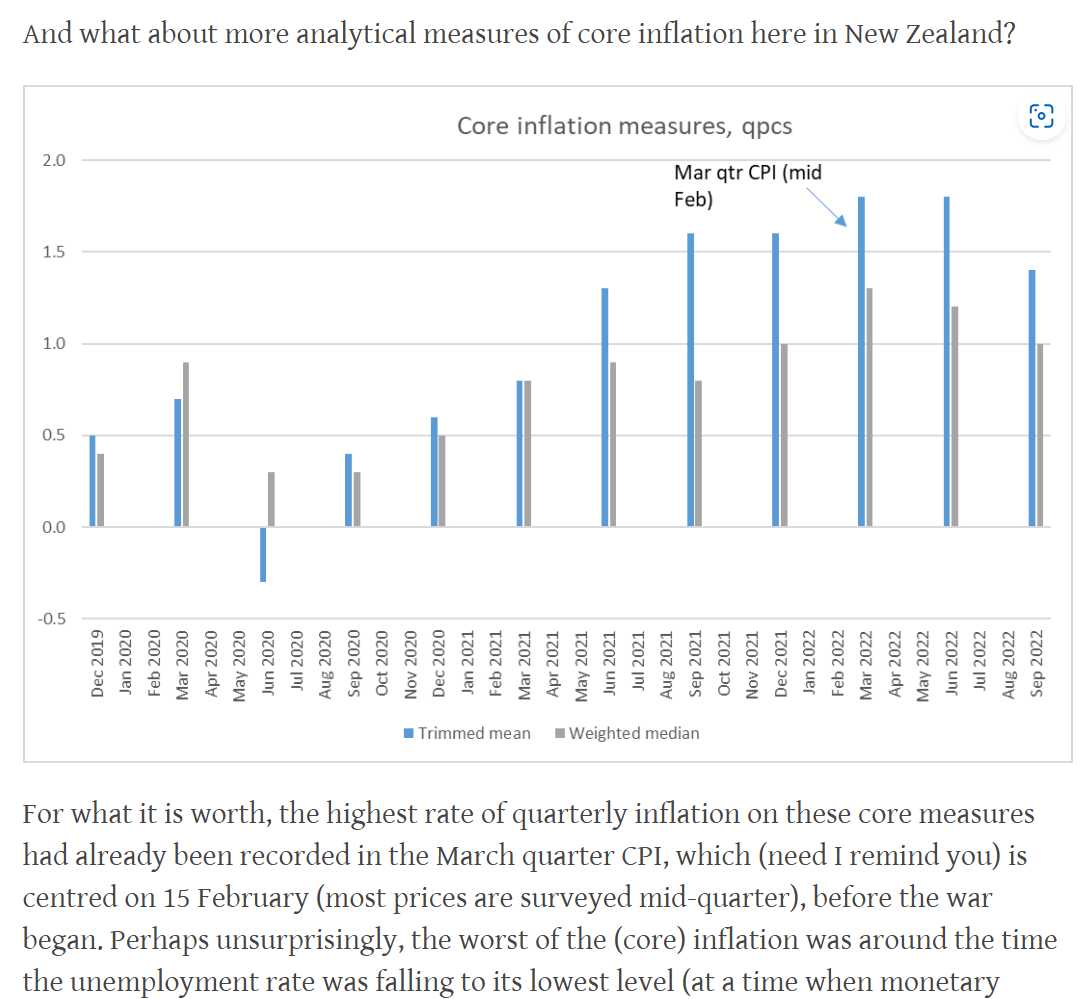
There were various small things I took exception to. There were hints of Orr (misleading Parliament) in a couple of attempts to shed some of the blame for inflation onto the Russians, as if core inflation had not already reached its peak (and unemployment its trough) before that invasion

There was the somewhat surprising claim

That footnote 50 took you, among other places for other countries, to the Reserve Bank’s report marking its own homework late last year. Sure enough, when you check it the word “mistake” doesn’t appear at all (or “error”) and there is no expression of “regret” at all (you’ll recall Orr’s standard line is the non-regret regret “I regret that NZ has had to deal with a pandemic, the war etc”).

And if this paper might not have been the place to go into all that in detail, wasn’t it an obvious place to think aloud about the place for contrition (people being human, mistakes being inevitably, and some of those mistakes are very costly indeed to people who are not themselves policymakers, while often appearing to have no consequences at all for those who made the mistake) in the independence/accountability context.

One interesting line that popped up in several places during the speech was a concern about anything that might tie the hands of the MPC.

This paper suggests there are intersections between legislated objectives and operational independence that could have implications for central bank independence and the political acceptability of CBI. These intersections involve expanding central bank mandates, conditions attached to the pursuit of primary objectives of monetary policy, and funding arrangements that could influence central bank independence over the choice and scope of alternative monetary policy instruments.

That is fairly wordy, but what it means is that Buckle thinks they need to be free to lose $10 billion again on fresh highly risky financial interventions (having neither here nor in the 2022 self-review either expressed contrition for the actual losses, shown how they would do better in future, or explored whether there might be reasonable limits to the financial losses taxpayers might be willing to let unelected officials incur (almost all government spending has to be appropriated by Parliament first, but not when the MPC takes the public balance sheet for a spin)).

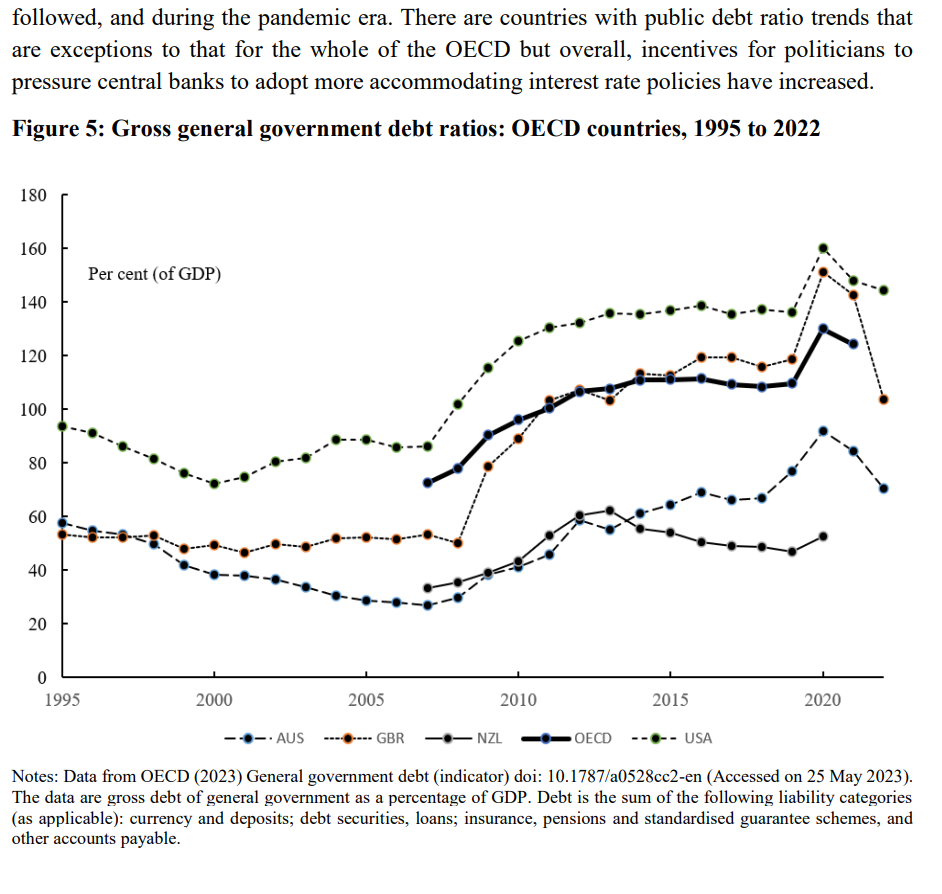
Which brings me nicely to the last substantive section of Buckle’s paper, on fiscal policy connections. It is fairly unenlightening (and reminded me of the ambitious play by the Secretary to the Treasury for a greater role for fiscal policy just before everything went to pot on inflation). But Buckle repeats, unreflectively, suggestions that central bank independence might have led to lower fiscal deficits (and seems to think this is automatically a good thing). He then suggests that times are changing and fiscal policy might be more of a threat, illustrated with this chart

Perhaps, but here is another way of looking at things. Here is net government debt for half a dozen small to middling inflation targeters with independent central banks, including New Zealand

All these countries have pretty moderate levels of net debt, and all except Australia (barely) have had a falling ratio of net government liabilities to GDP over the last 30 years.

On the other hand, here are some other (larger) countries with independent central banks (in the euro area by far the most independent of any of the central banks)

All four lines slope upwards, and in all four cases debt is a lot higher than it was in 1995, early in the new era of central bank independence.

Perhaps it is fair to suggest there may be some future issues in some of these countries for central banks, but you’d have thought that a New Zealand policymaker might recognise the very wide range of country experiences (which might also make one a little sceptical that whether or not the central bank is independent explains much if anything of advanced country fiscal choices and outcomes).

No doubt there will have been some readers who got something from something like the Buckle lecture (I passed it on to my economics student son eg, and there is always a use for introductory material), but from a serving policy maker, to a premier New Zealand economics audience, it really is pretty disappointing.

Buckle is probably the least unqualified of the external MPC members, but efforts like this are a reminder of how far from the frontier of best practice New Zealand’s new MPC – creature of Orr, Quigley, and Robertson – is. One can only hope that if there is a new government that they will care enough to insist on much better (in the RB, and in so many of New Zealand’s degraded public sector institutions)>

Central bankers and climate change

Thirty or so years ago I was having a conversation with a fellow manager in the Reserve Bank’s Economics Department.  I’d learned that he was working on a submission on superannuation policy issues.  I was interested in the topic and so was he, but it wasn’t at all clear to me why we should be devoting scarce Bank resources to a topic that seemed well outside our mandate.  Ah, he responded, “but savings behaviour might affect the natural rate of interest and anything that affects the natural rate of interest must be something that matters to the Reserve Bank”.

I used the story, off and on, for decades in making the point that while, in principle, almost anything that affected the economy might be something the Bank should be aware of, it didn’t justify us weighing in on, or spending scarce research resources, on matters so far from our core responsibilities no matter how interesting we, as individuals, might find the topic or how important the policy issue itself might (be thought to) be.   “Stick to your knitting remains” sage counsel, perhaps especially for central banks who (rightly or wrongly) exercise significant discretionary policy power and need to build and maintain broad public confidence in their competence and impartiality in discharging those specific responsibilities.  Get very involved in other areas and people will reasonably begin to suspect you are using a public platform for private political ends.

The recent enthusiasm of senior central bankers all over the world for opining on climate change issues seems to fit that bill.     Whether it is about pushing personal political agendas or some desperate quest for relevance (as if macro stabilisation and financial stability weren’t quite significant enough challenges, especially as the world converges on the effective lower bound constructed by central bankers and their legislators) or (more probably, more commonly) some mix of the two isn’t clear.   What is clear is the generally tenuous nature of the case being made.

There was a conference on such issues held last week, hosted by the Federal Reserve Bank of San Francisco. Perhaps our Reserve Bank had someone attending.  I don’t really want to encourage this stuff, but if you are interested there are links to the papers here.   As just one example of the tenuous nature of the connections, I clicked on a paper –  forthcoming in a journal – with the promising title of “Climate Change: Macroeconomic Impact and Implications for Monetary Policy” by some Bank of England staff.    I haven’t read the whole paper but the Abstract told me as much as I needed to know

Climate change and policies to mitigate it could affect a central bank’s ability to meet its monetary stability objectives. Climate change can affect the macroeconomy both through gradual warming and the associated climate changes (e.g. total seasonal rainfall and sea level increased) and through increased frequency, severity and correlation of extreme weather events (physical risks). Inflationary pressures might arise from a decline in the national and international supply of commodities or from productivity shocks caused by weather-related events such as droughts, floods, storms and sea level rises. These events can potentially result in large financial losses, lower wealth and lower GDP. An abrupt tightening of carbon emission policies could also lead to a negative macroeconomic supply shock (transition risks). This chapter reviews the channels through which climate risks can affect central banks’ monetary policy objectives, and possible policy responses. Approaches to incorporate climate change in central bank modelling are also discussed.

Note all the uses of “could”, “might”, “may” and not a mention that inflation – the key target for monetary policy –  is primarily a monetary phenomenon.   It all seems to boil down to something along the lines of “productivity shocks can affect potential output, and potential output is one of the inputs central banks often using in trying to gauge appropriate monetary policy.  Oh, and policy uncertainty –  in whatever areas –  can act to hold back demand”.   All that is true but (a) not obviously more true in respect of climate change than of numerous other innovations, positive and negative, and (b) shocks –  surprises –  are typically what creates problems for central banks and financial regulators, and yet a key theme of much of the rhetoric around climate change is the long-term, inexorable for some considerable time, nature of what is at work.   Markets tend to be better able to take such structural trends into account than for genuine “shocks” –  be they wars, financial crises or whatever.  It is also striking that nothing in this vein that I’ve yet read illustrates any of the argument by reference to the climate change we’ve already experienced over decades.

But the contribution to last week’s FRBSF conference that really interested me was the speech by Lael Brainard, a member of the Federal Reserve’s Board of Governors. She is a policymaker, not just a researcher.  Being the United States –  unlike secretive New Zealand where monetary policy decisionmakers are hidden away from scrutiny behind the Governor’s apron strings –  we get thoughtful speeches like this, even with the standard disclaimer that the views expressed are hers, not those of the Board of Governors collectively.  One doesn’t need to agree with her to appreciate the openness.

Brainard is a centre-left economist.  She was a senior political appointee in the Obama Administration (and slightly less senior in the Clinton years) and, as I gather it, pretty well regarded in those roles.  She has now been a Fed governor for five years or so.   And her topic was very much to the point: “Why Climate Change Matters for Monetary Policy and Financial Stability”.  So one might think she would make as good a case as anyone could for central bank involvement in climate change issues (smart, rigorous, policy-focused, not really the ivory-tower type).

But if it was as good a case as could be made, I didn’t find it convincing – or even challenging –  at all.  Perhaps it is what happens when you speak to the converted, but whatever the explanation, it only reinforced my sense that central bankers are typically getting well out of their lane when they start weighing in on climate change.  With the superfluity of researchers and senior officials the Federal Reserve system has, perhaps casting the net widely has fewer direct opportunity costs than it does for other, much smaller, central banks, but the reputational issues are just as real.  You might like the central bank weighing in on your pet topic, but you really won’t when they weigh in on some other issue or cause you don’t like.  Cumulatively it corrodes confidence in the system and in the operational independence of the central bank.

Brainerd steps through the possible implications for the Federal Reserve under various headings.  The first is monetary policy.  Here is the gist of her case.

To the extent that climate change and the associated policy responses affect
productivity and long-run economic growth, there may be implications for the long-run neutral level of the real interest rate, which is a key consideration in monetary policy.  As the frequency of heat waves increases, research indicates there could be important effects
on output and labor productivity.  A shifting energy landscape, rising insurance premiums, and increasing spending on climate change adaptations—such as air conditioning and elevating homes out of floodplains—will have implications for economic activity and inflation.  

As policies are implemented to mitigate climate change, they will affect prices,
productivity, employment, and output in ways that could have implications for monetary policy.  Just on its own, the large amount of uncertainty regarding climate-related events and policies could hold back investment and economic activity.

All of which really boils down to only two points:

  • relative prices change, neutral interest rates change and potential output changes,
  • policy uncertainty tends to be bad for economic activity.

And that, really, is it.    As it was, is now, and (no doubt) ever more shall be.  There is (rightly) no suggestion that climate change (or measures in responses) will impair the Fed’s ability to achieve its inflation target or even any suggestion that the target might need to change.  There is no sense in which she suggests the Fed’s instruments will be impaired.   All that is there is really economic forecasting –  and disentangling actual data to make sense of what is happening and why.  In that sense, climate change issues are no more (or less) relevant to the central bank than a myriad of other sources of policy or market change and uncertainty.  None of which is to suggest that climate change issues aren’t important, just that they aren’t something of particular relevance to a monetary policy central bank.

But what about the Fed’s financial stability role?

She starts this way

Similar to other significant risks, such as cyberattacks, we want our financial system to be resilient to the effects of climate change.

Which, at one level, is reasonable enough. We want our financial systems to be resilient, to all sorts of things, but there is no real attempt to demonstrate/illustrate that there is a significant systemic risk from climate change issues, or the associated policy responses.

She goes on

Although there is substantial uncertainty surrounding how or when shifts in asset
valuations might occur, we can begin to identify the factors that could propagate losses from natural disasters, energy disruptions, and sudden shifts in the value of climate exposed properties.  As was the case with mortgages before the financial crisis, correlated risks from these kinds of trends could have an effect that reaches beyond individual banks and borrowers to the broader financial system and economy.  As with other financial stability vulnerabilities arising from macroeconomic risks, feedback loops could develop between the effects on the real economy and those on financial markets.  For example, if prices of properties do not accurately reflect climate-related risks, a sudden correction could result in losses to financial institutions, which could in turn reduce lending in the economy.  The associated declines in wealth could amplify the effects on economic activity, which could have further knock-on effects on financial markets.  Beyond these physical risks, policymakers in some jurisdictions are assessing the resilience of the financial system to so-called transition risks:  the risks associated with the transition to a policy framework that curtails emissions.

All while offering no evidence at all that market pricing will not adjust –  never perfectly but more or less okay over time – to the changes associated with climate (as to all manner of other changes over the years).    One can always advance hypotheticals but (for example) serious stress tests need to be grounded in the real-world range of possibilities. In this case, as she goes on to note, it is hardly as if the private sector has been slower to get to these issues than central banks.

The private sector is focused on climate risks.  Private-sector businesses—
including insurance companies, ratings agencies, data companies, and actuaries—are actively working to understand climate-related risks and make this information accessible to investors, policymakers, and financial institutions.  Although this work is at an early  stage, thousands of companies around the world are now reporting climate-related financial exposures to the Carbon Disclosure Project (CDP) under the guidelines of the Financial Stability Board (FSB) Task Force on Climate-Related Financial Disclosures (TCFD).12  Based on these disclosures, the CDP estimates that the 500 largest companies by market capitalization are exposed to nearly $1 trillion in risk, half of which is expected to materialize in the next five years. 

That sounds like quite a large number, at least until one realises that the market capitalisation of (say) the S&P500 index is about US$26 trillion.

She ends her treatment of this topic thus

An essential element of our bank supervision and regulation duties is assessing
banks’ risk-management systems.  We expect banks to have systems in place that appropriately identify, measure, control, and monitor all of their material risks.  These risks may include severe weather events that can disrupt standard clearing and settlement activity and increase the demand for cash.  Banks also need to manage risks surrounding potential loan losses resulting from business interruptions and bankruptcies associated with natural disasters, including risks associated with loans to properties that are likely to become uninsurable or activities that are highly exposed to climate risks.  

Well, no doubt.  But where is the evidence of systematic problems –  ie ones large enough to actually matter for the health of the financial system?    We’ve seen no such evidence advanced in New Zealand –  for all the talk of a modest number of potentially uninsurable properties –  and Brainard advances none in the US.  Sure, you want your central bank to be alert to potential risks and posing probing questions, but given (a) the extent of structural change that occurs in any economy over several decades, and (b) the lack of any (apparent) severe adverse economic/financial effects from decades of climate change to date, the case for treating this as a high priority area for central banks seems weak, at least if they are doing their jobs, rather than advancing the personal agendas of their management.  Where perhaps there is a little more reason for concern might be around ill-considered or uncertain (in application) government policy responses –  a significant part of the cause of the last US financial crisis –  but even then the primary responsibility for advice, analysis, and policy choices around climate change rests squarely with other parts of government. 

I deliberately picked a US speech to write about, precisely because it wasn’t about New Zealand but also because it is calmly and moderately expressed.  But our own central bank has been out again more recently.  Perhaps reflecting the character of our Governor, their statements tend to be less calm and nuanced, and rather more crusading in nature.  All this from a central bank that (a) constantly tells us it is seriously resource-constrained and (b) which hasn’t been doing a great job in recent years in commanding confidence in handling things that are squarely its responsibility (whether monetary policy or financial stability).

I wrote last week about the seriously-flawed, highly ideological, report of the Sustainable Finance Forum.  The Governor, by contrast, put out a statement “commending” the report and, regardless of his own limited statutory mandate, burbling on about

enhanc[ing] our role in the greening of the financial system, and the managing of environment and climate related risks.

and seemingly uninterested in the fact that any mandate he has around economic performance is around short-term and cyclical issues, not long-term structural ones.

He then had one of his deputies –  one with no known expertise in economics, monetary policy, or financial stability –  publish a Herald op-ed (text also here) channelling the Governor and simply ignoring the specifics of the Bank’s mandate.  For example

Sometimes, we are asked why we are placing such an emphasis on climate change, and that’s easy for us to answer. In our assessment, climate change could lead to material economic and financial stability impacts. Managing major risks to the economy, such as climate change, sits squarely within our core responsibilities and like all of our functions, we do this with a long term view for generations to come.

On this view, every bit of economic and social policy, strategic defence policy for that matter, or the potential future eruption of Lake Taupo is a matter for the Reserve Bank (“sits squarely within our core responsibilities”).  It is simply nonsense and rather “imperial” in its overreach.   And if the Bank thinks it has the funds to do such things –  with no statutory mandate at all –  it is simply overfunded and should have its budget cut.

She goes on

Globally, there is growing recognition of the role central banks and regulators have in understanding, managing and quantifying climate-related risks. By being more visible in this space we hope to encourage the financial sector to focus on not only managing risks, but opportunities, such as responsible, sustainable investment with long-term benefits.

Is any evidence banks and insurers aren’t focused on the material risks that matter (two important qualifications, as no one has yet managed to identify major issues here).  Beyond, risk management the Bank veers very close to rank fiscal policy. It is not the responsibility – and should not be – of an independent central bank and prudential regulator to be trying to steer the direction of credit.  What matters is that there is a good prospect of the bulk of debts being repaid, whatever the purposes they were taken on for.

The op-ed burbles on through the Bank’s own carbon emissions to a new role of counsellor-in-chief

Climate change can feel overwhelming at times and leave people confused about what they should or shouldn’t do to help the situation, but that does not mean inaction, quite the opposite.

Perhaps (or perhaps not, since uncertainty is real) but what has any of this to do with the Reserve Bank.

All ending with this extraordinary paragraph

As financial system participants we all need to actively look for opportunities to ‘finance the green’ and help New Zealand firms as well as our own organisations transition to lower emissions practices, and ensure we are well placed for a net zero world. It’s heartening to see that there are many businesses who are already well advanced on this journey. We now have a ‘road map’ from the work of the Sustainable Finance forum to help us all navigate and focus our collective efforts and we look forward to playing our role.

The sort of thing one might expect from a politician or a lobby group, but not from a senior public servant, charged (quite narrowly) with managing short-term economic fluctuations consistent with price stability and the soundness of the financial system.  If is Ms Robbers and her boss think that Sustainable Finance paper is any sort “road map” we (and the Bank) are a lot more lost than most would think.

In that same  Herald  climate change supplement (31 October) another senior central banker was quoted, this time Christian Hawkesby, the Assistant Governor responsible for monetary policy and markets.    He also was championing the idea that it is the Reserve Bank’s business to try to steer business strategies in particular directions

‘Again, just using an analogy from the asset management industry, when I started in asset management eight years ago, ESG investing (environmental, social and governance investing) was seen as a real niche and — if anything — was seen as potentially a marketing tool to use for niche investors. That’s moved now from being absolutely and completely mainstream in the sense that fund managers know that why would you invest in a company that doesn’t have a long-term future over the next 20 to 30 years.

“So our challenge at the Reserve Bank is to encourage banks and insurers to have that same approach to their lending and their relationships and take a commercial view that it’s actually going to be in the long run a benefit that they take those environmental and climate change factors into account.”

Whatever you think of ESG, it simply isn’t an appropriate role for the Reserve Bank to e trying to shape what factors banks should take into account when lending.  Apart from anything else –  not having the mandate, for example –  they simply don’t have the knowledge or incentive to get things right, and bear none of the costs or consequences if they get things wrong.  And it is a diversion from the day job –  the one Parliament actually charged them with  –  of managing monetary policy consistent with price stability and promoting the soundness (not the wokeness) of the financial system.

But the Hawkesby comment that took me more by surprise was his response to a question about bank capital

Asked if banks and borrowers would get capital relief for sustainable lending if the central bank is serious about climate change, Hawkesby responded: “That’s not in the plan at the moment. But that is very well something we could move to. At the moment, the onus is on really getting banks and insurers to focus on the issues and look at it from their own commercial incentives.

Glad to hear it isn’t “in the plan” at present, but it shouldn’t be now or ever.  We’ve just endured a year of the Governor and his acolytes trying to convince us that the financial system is in peril if he doesn’t hugely increase capital requirements, and one of his senior offsiders now won’t rule out capital requirement discount to advance the Governor’s environmental whims.

“Stick to your knitting” remains sage advice for central bankers –  and probably for all senior public officials with any sort of independent role.  There is a nice column along those lines in this morning’s Australian newspaper, citing RBA Governor Phil Lowe’s line from a recent speech

“I want to emphasise that the discretion we have and our broad mandate to promote the economic welfare of the Australian people do not constitute a licence for the Reserve Bank board to pursue or advocate economic policies outside our area.”

As Judith Sloan points out, Lowe isn’t very good at following his own advice, but wouldn’t it be nice to hear such words of restraint, actually practised, by our own Governor and his senior staff?

After all, those day jobs –  the ones we actually pay them to do –  haven’t done so well that they really command the sort of respect that might invite occasional restrained and judicious comments on other matters.

Instead, we are left only to presume they are using a public pulpit for private ideological ends, and for advancing causes favoured by their allies in the Beehive.  There should never be able to be such a suspicion of a central bank that actually values its independence.


Founding the Fed

It has been at least a week since I mentioned central banks on this blog  – probably a first.   There are many areas of economics and public policy that interest me more, and which matter more.  But I have just finished reading Roger Lowenstein’s new book, America’s Bank: The Epic Struggle to Create the Federal Reserve.  The Federal Reserve opened for business on 16 November 1914, amidst  the global liquidity crisis, affecting the United States as much as the combatants, created by the outbreak of World War One.   There was, of course, little hint of what was to come when Woodrow Wilson had signed into law the new Federal Reserve Act into law on 23 December the previous year, one of the landmark pieces of legislation in Wilson’s first year in office.

(For anyone wanting to know more about the 1914 crisis, there are two worthwhile modern books; Saving the City  is a British-focused global story and When Washington Shut Down Wall Street is the American story.)

Lowenstein is a financial journalist (rather than an economic historian), with a number of books to his credit.  He is perhaps best-known for When Genius Failed: The Rise and Fall of LTCM.  His tale of the political and banking background to the passage of the Federal Reserve Act is a very readable account for anyone interested in the topic.   In places, it felt like an account of 1912 presidential election campaign – a particularly torrid affair as the Republican incumbent, Taft, was challenged at the general election both by the Democrat Wilson, and by Theodore Roosevelt, Taft’s predecessor and former friend and mentor.  I hadn’t realised how important William Jennings Bryan –  1896 Democratic nominee, and author of the famous Cross of Gold speech –  still was in the Democratic party’s own debates on a central bank.

By the early 20th century, the United States was relatively unusual , but hardly unique, in not having a central bank.  Britain, France, Japan, Germany and Italy all did, but then Canada, Australia, South Africa and New Zealand did not.  The US had had central banks previously –  the most recent had lost its position when Andrew Jackson vetoed the renewal of its charter in the 1830s.   But what marked out the United States in the 1900s was not the absence of a central bank but the presence of repeated severe financial crises –  the most recent in 1907, the effects of which –  while relatively short-lived-  were felt around the world.  As I’ve noted here previously, it is not as if the repeated financial crises seemed in any way to be derailing the longer-term  progress of the United States or the sustained lift in living standards.  At the time, the United States competed with places like New Zealand and Australia for having the highest material living standards in the world.

But in the short-run, the crises were enormously disruptive,  and even the seasonal pressures  – in an economy where farming still played a large role –  were large.  There were plenty of signs that something was broken, and some fix was needed.

The fix chosen turned out to be a central bank –  or rather, a system of regional central banks, loosely overseen and bound together by the Federal Reserve Board in Washington.

It needn’t have been.  Lowenstein tells the story as if the only sensible outcome was the founding of a central bank –  an outcome towards which all history was tending.  He tells his story vividly, and draws on a wide range of primary and secondary sources –  and the cover includes plaudits from former central bankers Ben Bernanke, Alan Blinder, and Paul Volcker.  But the book is weakened because the author shows no sign of having engaged with the alternative hypotheses about what had left the American system so prone to crises.    Many –  most recently Calomiris and Haber – have noted the contrast between the US system and that of Canada, which has been largely free of serious financial stresses before and after the founding of the central bank in 1935.  On a much smaller scale, but also in a heavily agricultural economy, one could include among the relative stable systems that of New Zealand.

If what rendered the US prone to crisis was the absence of a lender of last resort –  or even of external seasonal finance –  then the case for a central bank was much stronger. But a plausible case can be made that what left the US system prone to crises was the regulatory structure put in place over the previous few decades.  The United States system pre 1914 is often loosely characterised as “free banking”.  In fact, it was a highly regulated system.  The two most important regulations were the restrictions on branch banking and interstate banking, which made it very difficult for banks to effectively diversify risks, including liquidity risks, and the restrictions on the issuance of notes.  Physical currency was still a hugely important medium, and demand was highly seasonal.  State banks could not issues notes, and national banks were able to issue their own notes only to the extent that they held US government bonds to back them.  Bonds were relatively scarce, and expensive and, as noted, the demand for notes was highly seasonal.  The conversion of a deposit into a note did not change the nature of the credit risk the holder of the claim faced, but the ability of banks to do that readily, when customers wanted it, was constrained by law.  Perhaps the political economy would have made dealing with the restrictions on the geographic scope of banks impossible  at the time (it took many decades), but Lowenstein does not even deal with the question of whether, for example, amending the restrictions on the note issue might have largely dealt with the pressures –  for an ‘elastic currency’ – that, at the time, gave rise to the creation of the Fed.

Not doing so perhaps make the construction of his narrative easier, and more powerful.   But by not treating seriously those opposed to the creation of a central bank it does limit the insights he can offer.  Some perspectives from, say, the archives of the Bank of England of the Banque de France on what they made of the whole long process might also have been interesting.   Of course, the beauty of being a big country is that there are many other books and papers that deal with some of these issues.

I notice that George Selgin, from whom I’ve learned a great deal over the years, expresses similar views in his own comments on Lowenstein’s book and offers some richer comments on the weaknesses of the pre-1914 regulatory structures.  To repeat, Lowenstein’s book  is a good read, especially for anyone interested in the politics of it all, but just bear in mind the limitations

Our own central bank was not founded for another 20 years, opening for business on 1 August 1934.  There is a line commonly heard these days that central banks were largely created to deal with financial system stresses.  That was true in the United States –  although the most severe crises in US history have come since 1914 –  but it certainly wasn’t true here (or in Australia or Canada).  The Reserve Bank of New Zealand was created to allow independent macroeconomic management for New Zealand, especially to be distinct from Australia.    No one envisaged anything quite like modern discretionary central banking, with data reviews and potential policy adjustments ever six or eight weeks.  But it was about ensuring that New Zealand conditions –  export earnings and access to credit in London –  drove the behaviour of domestic credit in New Zealand, not those of the larger Australasian area.   New Zealand’s sovereign debt was extremely high around the time of the Great Depression, but nothing like as concerning to lenders as that of Australia.

Gary Hawke’s 1973 history of the Reserve Bank, Between Governments and Banks, remains the best account of the background to the founding of our central bank.    A more easily accessible perspective, by Matthew Wright –  a New Zealand historian on the Reserve Bank’s staff – is here.

Stan Fischer on central bank independence

Stan Fischer is one of the global elite of macroeconomic policy. Born in what is now Zambia, he has spent most of his adult life in the United States. He was Chief Economist of the World Bank, First Deputy Managing Director of the IMF, Governor of the (central) Bank of Israel, and is now Vice Chairman of the Board of Governors of the Federal Reserve.   He spent several years making a great deal of money at Citigroup in one of those door-opening roles senior officials and politicians often gravitate to.  Fortunately for his reputation, the next big job came up before Citi ran into its latest crisis over 2008/09.

In his time as an academic, Fischer, together with Guy Debelle, came up with the nice delineation between “instrument independence” and “goal independence” in analysing monetary policy arrangements.  In practice, the distinction is never as clean as all that, but one can think of our Reserve Bank having “instrument independence” in monetary policy (it can set the OCR wherever it likes from day to day) but as having relatively little “goal independence”.  The Minister of Finance takes the lead in setting the policy targets and although the Governor is a party to the PTA, the PTA has to be agreed before the Governor is formally appointed.  The Minister does not need to appoint someone who will not agree with his proposed policy targets. And, in principle, the Minister can have the Governor dismissed if the Minister is satisfied that “the performance of the Governor in ensuring that the Bank achieves the policy targets …has been inadequate”.

In many other modern central banks, there is no counterpart to the Policy Targets Agreement, and the statutory objectives for monetary policy are written sufficiently loosely that the central bank has a fairly high degree of goal independence too.   The Federal Reserve  –  where key policymakers rarely even quote the relevant section of the Federal Reserve Act[1] –  is a good example of the latter.

Stan Fischer gave a speech on central bank independence a couple of weeks ago, in which he discussed independence in respect of both monetary policy and (some aspects of) financial stability and regulatory policy.   I thought it was a slightly disappointing, rather complacent, speech.

Part of the context presumably is the simmering discontent with the Fed.  The 2016 Presidential race is getting underway and demand for changes to the Federal Reserve  legislation governing the Fed are being heard –  something that used to be common in New Zealand, but rarely seen elsewhere.

Two issues in particular have prompted legislative initiatives in the United States. One is to limit the Federal Reserve’s operational flexibility in response to financial crises, and the second is the ‘audit the Fed” movement.   I wanted to focus on the audit side.

At present, although the Federal Reserve is subject to regular financial audits, it is exempt from GAO reviews of “deliberations, decisions or actions on monetary policy matters”.   The purpose of the exemption is, supposedly, to protect the day-to-day operational independence of the Federal Reserve  –  the fear, in the words of a Wall St Journal piece, is “that aggressive members of Congress unhappy with a Fed interest-rate decision could dispatch the GAO repeatedly to investigate, essentially using the GAO as a way to pressure the Fed to change its policies.”

I don’t find this resistance overly persuasive.  After all, as Fischer points out, there is lots of external scrutiny and debate around the actions of the Federal Reserve.  Members of the FOMC need to have the fortitude and integrity to make the decisions they think are needed, in accordance with the law, regardless of the weight of external pressure.  If they can’t take the heat, there is always the option of finding another job.  It isn’t clear to me why GAO inquiries, no matter who prompts them, represent a more serious threat.  Either Congress can or can’t overrule the FOMC on specific decisions.  It can’t now, and wouldn’t be able to under any of the legislative initiatives that are around.  Anything else is scrutiny and steps towards effective accountability.

A similar fight is going on in the UK at present, where the Bank of England is fighting back (successfully it appears) against government plans to allow the National Audit Office to undertake value-for-money audits of Bank of England activities (the Court –  the equivalent of our Board –  will be able to block such audits).

Consider, by contrast, the situation in New Zealand.  Not only is the Reserve Bank Board paid to scrutinise and hold to account the Governor, in respect of all his responsibilities (including, quite explicitly, monetary policy), but in New Zealand the Auditor General is (in the Reserve Bank’s own words) “able to commission quite extensive investigations into the activities of the Bank”

And then there is section 167 of the Reserve Bank Act, which explicitly provides the Minister of Finance with powers to commission a performance audit of any or all aspects of the Bank’s responsibilities under the Reserve Bank Act [but not, it appears, those under the other Acts the Reserve Bank is responsible for?]

167 Performance audit

  • (1) The Minister may, from time to time, appoint 1 or more persons (whether as individuals or as members from time to time of any firm or firms) to carry out an assessment of the performance by the Bank of its functions and of the exercise by the Bank of its powers under this Act.

    (2) As soon as practicable after completing an assessment the person appointed shall submit a report to the Minister setting out the results of that assessment.

    (3) The report stands referred, by virtue of this section, to the House of Representatives.

    (4) A person appointed to conduct an assessment under this section, for the purpose of conducting that assessment,—

    • (a) shall have full access to all books and documents that are the property of or that are under the control of any person relating to the Bank or its affairs:

    • (b) may require any director, officer or employee of the Bank or any other person to answer any question relating to the Bank or its affairs:

    • (c) may, by notice in writing to any person, require that person to deliver any books or documents relating to the Bank or its affairs in the possession or under the control of that person and may take copies of them or extracts from them.

    (5) Nothing in subsection (4) limits or affects section 105.

    (6) The fees of the person appointed to carry out an assessment under this section shall be paid out of the funds of the Bank.


Of course, the section 167 powers have not been used in the 26 years since the Act was passed (although Lars Svensson’s inquiry into New Zealand monetary policy, commissioned by Michael Cullen, might be seen in that light)

And yet the best argument that Fischer can put up in response is that if such further audit or review powers were established

“the Fed would be subjected to the very sort of political pressure from which experience suggests central banks should be independent. Instead, a modern governance framework calls for the political system to give the central bank a mandate along with the operational freedom to pursue that mandate, supported by transparency and accountability”

Central banks are very keen to conflate the ideas of transparency and accountability – the Reserve Bank did it recently in their Bulletin on monetary policy accountability – but apply the parallel to an employee. Effective accountabiity for an employee rests on the simple fact that, after all the discussion and debate, if the employee does not work to the required standard he or she can be dismissed.

Members of the Federal Reserve Board cannot be removed from office for their policy choices, no matter how bad they might be. That is not uncommon for central bankers internationally, but it severely compromises the meaning of accountability. Central bankers don’t face re-election either. Reappointment is certainly one opportunity for effective discipline, but in principle members of the Federal Reserve Board of Governors are appointed for 14 year terms.

If Fischer is serious about maintaining a distinction between instrument independence and goal independence in the United States it is not clear why he would not support a move more towards a New Zealand system, where policymakers can be removed if they make bad policy. But if that can’t be practically be done – and perhaps it can’t in a US system, and perhaps it isn’t a practical option even here – it is far from clear why he (and his colleagues would continue to push back against measures that would provide for more official scrutiny of the choices and actions of the Federal Reserve. It is all very well to say that markets, the media, and think tanks scrutinise the Fed, but statutory provisions bring with them statutory powers, including access to relevant papers and information. I’m not suggesting that the Rand Paul “audit the Fed” bill has things precisely right,   But as Vincent Reinhart, a former very senior Fed monetary policy official, has argued, what possible threat could a twice-yearly “GAO audit of monetary policy:, a week before the Fed’s own semi-annual monetary policy report to Congress”, be?

Of course, one could reasonably counter “what good would it do”? But that is surely a matter for Congress, as the people’s representative, not for those who are being reviewed. Central banks are given very great power and it is up to us, as citizens, to find ways to effectively hold them to account. That has to include the ability to put pressure on them, even if the day to day decisions are finally theirs.

The New Zealand model has not worked particularly well in that regard – the Board is just too close to the Governor, and Parliament’s Finance and Expenditure Committee has too few resources and incentives. But equally, one can hardly say that the powers that do exist – which go well beyond those in the US – have threatened the operational independence of the Reserve Bank, on monetary policy or any of its other functions.

But surely the practical problem for citizens is the difficulty of securing effective accountability. There is plenty of debate about what central banks do – at least in the US – but accountability is more than debate, and has to include the ability to make a practical difference.

There is a price for operational independence. If legislatures do not think that those wielding the operationally independent powers are doing so appropriately, on  average over time, and yet cannot effectively hold decision-makers to account for their choices, operational independence itself will come under threat.  In a sense, that is what the Warren-Vitter legislative initiative (which the Fed is also fighting) seeks to do in the United States, in further restricting the Fed’s freedom of action in a crisis.   As I’ve noted previously, the US authorities (Treasury and the Fed) already have far less operational autonomy in a crisis that the New Zealand authorities do. In some respects, the New Zealand powers are disconcertingly wide –  the Public Finance Act appears to allow the Minister of Finance to bankrupt New Zealand with no parliamentary vote, and the Reserve Bank also has uncomfortably unconstrained powers in these areas. I suspect that something between the two models provides a better balance, but at least we have formal powers to review, and potentially dismiss, the Governor if he acts unwisely or inconsistently with his statutory mandate.  The US system has no such power.    If anything, it looks to me as though the Fed –  were it operating consistently with the goal vs operational independence model –  should be embracing as many reviews, and as much official scrutiny, as possible.

But perhaps that is the problem with global elites, in macro policy or other areas.  They often don’t really believe in effective accountability to citiznes, or in their potential for making mistakes.  They believe, too readily, in the rightness of their own judgements.  Institutional design has to operate with the limits of human knowledge and incentives. Humans –  even very able ones – and human institutions make mistakes.  And yet in the whole of Fischer’s speech, the words “error”, “mistake” and “misjudgement” don’t appear once.  Good models for governing powerful institutions have to built, and refined, starting from the proposition that people like Stanley Fischer, Ben Bernanke , and even Graeme Wheeler, will actually make mistakes.

[1]The Board of Governors of the Federal Reserve System and the Federal Open Market Committee shall maintain long run growth of the monetary and credit aggregates commensurate with the economy’s long run potential to increase production, so as to promote effectively the goals of maximum employment, stable prices, and moderate long-term interest rates.”

Central banks blogging

The Bank of England has launched a new staff blog, and the fact of the blog –  rather than the initial content –  has attracted some attention.  The Bank of England summarises its aim this way:

Bank Underground is a blog for Bank of England staff to share views that challenge – or support – prevailing policy orthodoxies. The views expressed here are those of the authors, and are not necessarily those of the Bank of England or its policy committees.

Tony Yates, a former BOE staffer, seems surprisingly optimistic.

There is a growing number of ex central bank bloggers, eminent (Bernanke) or otherwise, but central bank blogs are uncommon, if not entirely new.  The New York Fed has been running the Liberty Street Economics blog for a while, and Macroblog at the Atlanta Fed has been around for even longer.  At a supranational level, there is the iMFdirect blog.

But a blog is just a technology, one of many “communications channel” that central banks, as powerful public institutions can use.   The interesting point is the suggestion that the BOE blog will be a vehicle in which staff can “share views that challenge –  or support –  prevailing orthodoxies”.

That certainly would represent quite a change for most central banks.  But again, it is along a spectrum.  Many/most central banks have long published research and discussion paper series, which typically carry a disclaimer that the views were those of the authors and not necessarily those of the institution (at the Reserve Bank, we drew a strong distinction between Bulletin articles which carried no disclaimer, and thus could be taken as, in some sense, the views of the Bank, and other papers). Central bank analysts and researchers give conference papers, dealing with a variety of technical or policy issues, which carry similar disclaimers.  And not that many years ago, I heard Janet Yellen, then only vice-chair of the Fed, give a speech at a conference, and that speech also carried the standard disclaimer[1].

But the truth is that most central banks –  and I’m sure other government agencies, even those with operational independence, are no different –  typically have quite strict, but not always clear (to themselves or staff), limits to what staff are allowed to say in such documents or papers.   I’m still somewhat surprised, and impressed, that senior Fed researcher Robert Hetzel has been able to publish major books carefully (but critically) reviewing the Fed’s conduct of monetary policy.  Perhaps it is an advantage to be a very big but decentralised central banking system.

Tony Yates gives some of the flavour of this (historically quite tight) control in a BOE context, and I have also heard some BOE horror stories from people who used to work there.  It will be interesting to watch the BOE experiment, but I suspect it will end up being a channel primarily for the sorts of pieces on the blog today –  one on a topic not related to the Bank’s responsibilities at all, and one a nice, but anodyne, piece of analysis illuminating the rather obvious point that risks of deflation rise if shocks happen when conventional monetary policy has reached its limit.

And that is fine.  Openness and transparency in powerful public agencies are important, and there is far too little of both.  But the ability to have robust debate within an organisation in the formative stages of policy development is also important.   Great leaders can probably cope with challenge and scrutiny wherever it comes from, but on average we have to expect average leaders.  Often enough, they will feel threatened if someone down the organisation is being used by external critics to bash the organisation.  I’ve mentioned earlier how Graeme Wheeler got the Ombudsman to block release of a discussion note I had written, some time previously, on governance issues.    I think he was worried that the Green Party –  who have championed the cause of reform and greater transparency at the Reserve Bank –  would use my note to “politicise the issue” [aren’t institutional design and governance issues appropriately political choices?] and to undermine his own preferred approach to reform.

In many ways, a central bank blog is not much different than what we were trying to do at the Reserve Bank when we set up the Analytical Notes series a few years ago (a product I edited) –  or the Fed’s FEDS Notes series.  Our idea was that analytical pieces, that weren’t heading for journal publication, could be published, carrying a disclaimer that they were the views of individuals not the Bank.  Since any of this material would have been discoverable under the OIA, it was thought good for openness, and for staff themselves, to have a vehicle for putting such material in the public domain.  Sometimes it was actively used by the institution to get supporting material out for scrutiny.  There are quite a few interesting papers in this series, and I’ve already linked to several of them, but I’m pretty sure there was nothing in them that challenged current orthodoxies.  Prone to challenge orthodoxy as I was personally, I was pretty good at judging what could be got out the door, and phrasing things accordingly.

I’m not suggesting that the Reserve Bank has typically been a monolith in how staff participated in external events.  We hosted, with Treasury, an exchange rate policy forum a couple of years ago  –  to which a range of business and other people were invited.   All the papers were published with no “censorship” (at least for the Reserve Bank ones) and are still on official websites.  My paper involved a fairly critical perspective on New Zealand’s immigration policy and the potential adverse macroeconomic implications (not, of course, that the Reserve Bank is responsible for immigration policy).  I’ve given discussant comments at international central banking conferences casting doubt on the benefits of publishing extensive central bank forecasts, and have a chapter in a recent (fairly obscure) book suggesting, with all sorts of caveats, that we should not automatically think of inflation targeting as the ‘end of history’ (although this did prompt efforts at censorship by one new Deputy Governor).

But all that is different from whether staff should be able to question, in public, current policy preferences and frameworks.  Much as I think the Governor’s LVR policies are unnecessary, inappropriate and costly, I really don’t see that it is appropriate, or in the interests of good government processes, for staff to be saying so, even with all the qualifications in the world, in public fora.  And I’ve thought the Governor’s monetary policy decisions over the last few years were wrong, but no matter how carefully crafted the argument was, it wouldn’t have been appropriate to run that argument in public as a staff member.  In fact, I did a variety of speaking engagements in which I persuasively made the case for the Governor’s stance.  That was the external-facing bit of the job.  And rightly so.

Perhaps in some idealised world all debate could or should be open –  Tom Scott once ran a cartoon satirising Don Brash’s commitment to open comment and suggesting Don would have liked to broadcast all monetary policy deliberations live  –  but it isn’t the world we live in.  Organisations need to be able to have robust debate internally, without the sense of a simultaneous parallel track being pursued externally by people who happen to disagree on a particular issue.  And as I listen to accounts of people reluctant to comment on this or that issue because, for example, it might affect their future consulting opportunities, it is a reminder of why it is not a realistic alternative vision.

Now, I’m quite sure the Bank of England has no intention of allowing that level of dissent or openness either.  Perhaps pieces that “challenge current current orthodoxies” will be published when Mark Carney or Andy Haldane themselves want to challenge such “orthodoxies”, but it will be a surprise if we see pieces directly challenging views advanced by those senior managers.  The blog might also be used actively at times as a place for testing the waterr –  putting an idea or some analysis out, in a controlled way, but with some plausible deniability (‘it was just the author’s view”).

I’m not critical of that approach.  If I have a criticism, it is that perhaps the Bank of England is overselling what the blog can be.  If it can be a vehicle for some shorter and more informal pieces of analysis, or for translating into English some of the more technical working papers, it will probably serve a useful purpose.  And its existence is something of a “brand marker” –  the Bank’s current management wanting to mark itself out from the past.

In the end, there are always going to be judgements about the appropriate level of openness.  It will depend on the person, the issue, and even the specific external environment.  For some issues, treated in some ways, at some times, senior management will be comfortable with alternative perspectives (perhaps even quite critical, but well-argued, ones) from staff being published.  On other issues, the market or political sensitivities just make it unrealistic.

There are delicate balances to be struck.  For example, if central banks want to have and retain top-flight researchers there needs to be a reasonable commitment to a willingness to publish.  And a willingness to publish a range of views can help signal a general openness to challenge and the contest of ideas.  And engagement with alternative perspectives –  genuine engagement, not just an evangelisation exercise –  is important.  But robust internal debate –  with ex post scrutiny and document discovery –  remains far more important to well-functioning central banks.  Central banks, and those holding them to account, should be much more concerned to establish that those processes and cultures are in place.  In my observation and experience, that increasingly has not been the case at the Reserve Bank of New Zealand.

[1] It struck me at the time, because at much the same time the Reserve Bank Communications Department was trying to insist that we should not use the disclaimer in any presentation, on the grounds that when anyone was speaking anywhere they were speaking “for the Bank”.