On Saturday dozens of candidates for the governing Labour Party stood for election to Parliament. The aim was to form (at least a big part of) the next government. They didn’t succeed. People will debate for decades precisely what motivated the public as a whole to vote as we did, but having governed for the last three years, they (Labour) lost. It is perhaps the key feature of our democratic system, perhaps especially in New Zealand with so few other checks and balances. You (and your party) wield great power, and if we the public aren’t satisfied – think you’ve done poorly, think another lot might be better, or simply wake up grumpy on election day – you are out. It is your (and your party’s) job to convince us to give you another go. If you don’t convince us you are out (and typically when a party loses power a satisfying number of individuals – even if rarely Cabinet ministers – actually lose their job (as MP) altogether). And if you are a disappointed Labour voter this morning, the beauty of the system is that no doubt your turn will come again. It is accountability – sometimes crude, rough and ready, perhaps even (by some standards) unfair or wrong – but the threat and risk is real, and the job holders keep it constantly in mind.
Many other people in the public employ also wield considerable amounts of power. In some cases, that power is quite tightly constrained and often (for example) there are appeal authorities. If a benefit clerk denies you a benefit you are clearly legally entitled to you will probably end up getting it, and if the clerk’s mistake is severe or repeated often enough they might lose their job. Less so at more exalted levels. When, for example, the wrong person is put in prison for decades typically no one responsible pays a price. When the Public Service Commissioner engages in repeated blatant attempts to mislead to protect one of his own, it seems that no pays a price.
And then there are central banks.
Every few months I do a book review for the house journal of central bankers, Central Banking magazine. They are often fairly obscure books that I otherwise wouldn’t come across or wouldn’t spend my own money on (at academic publishing prices). A few months back I reviewed Inflation Targeting and Central Banks: Institutional Set-ups and Monetary Policy Effectiveness (hardback yours from Amazon at a mere US$170 – yes, there is a cheaper paperback if anyone is really interested), by a mid-career economist at the Polish central bank, in turn based on her fairly recent PhD thesis. The focus isn’t on the question of what difference inflation targeting makes but on what institutional details, which differ across inflation-targeting central banks, seem to make a difference. Sadly for the author – these things happen – her thesis was finished before the outbreak of inflation in much of the advanced world in the last 2-3 years.
At the core of the book is a set of painstakingly-compiled indexes on various aspects of inflation-targeting central banks which might be thought to be relevant to how those central banks might perform in managing inflation. There are ones for independence, ones for transparency, and so on, but the one that stuck with me months on was the one for accountability. Accountability used to be thought of as an absolutely critical element – the quid pro quo – for the operational independence that so many countries have given to central banks in the last few decades. With great power goes great responsibility, and ideas like that. The Reserve Bank itself was very fond on that sort of rhetoric. In fact, there used to be a substantive article on that topic by me on their website, in which I waxed eloquent on the topic (after it was toned down when my original version upset the Bank’s then Board by suggesting that for all the importance of accountability it was more difficult in practice than in theory). At a more casual level my favourite example has always been a radio interview then-Governor Don Brash did in 2003, the transcript of which the Bank chose to publish, in which there is a snippet that runs as follows:
Brash: ….we were concerned……we were running risk of inflation coming in above 2 per cent which is the top of our target
Interviewer: And then you’d lose your job?
Brash: Exactly right.
I was working overseas at the time, and can only assume my colleagues gulped when they saw it put so unequivocally. But it wasn’t inconsistent with a meeting the handful of senior monetary policy advisers had with Don in one of his first days in office. He eyed us up – chief economist, deputy chief economist, and manager responsible for monetary policy advice – and said (words to the effect of) “you know we are going to introduce a new law in which if inflation is away from target I can lose my job. Just be sure to realise gentlemen that if I go, you are going too.” Not ever taken – at least by me – as a threat, but as a simple statement of the then-prevalent idea (crucial in the public sector reforms being done at the time) that operational independence and authority went hand in hand with serious personal responsibility and potential personal consequences. It was part of the logic of having a single decision-maker system (an element of the New Zealand system that no one chose to follow and – in one of Labour’s better reforms in recent years – was finally replaced here_.
But that was then.
By contrast, these are the components of the Accountability sub-index in the recent book I mentioned

There is nothing very idiosyncratic about the book or the work in it; indeed, she seeks to be guided by the literature and current conventional understanding. And if you look down that list of items – which is the sort of stuff central bankers often now seem to have in mind when they ever mention “accountability – you’ll quickly realise that there is really a heavy emphasis on transparency (a good thing in itself of course) and almost none of them on any sort of accountability that involves real consequences for individuals, anyone paying any sort of price. The only one of these items that represents anything like that sort of accountability is item 6.7 but even there the provision is about whether Governors/MPC members can be dismissed for neglecting their work (not turning up to meetings etc), not for actual performance in the job.
But if there are no personal consequences for failure and inadequate performance, why would we hand over all this power? I’ve written here before about former Bank of England Deputy Governor Paul Tucker’s book Unelected Power – which ranges much wider than just central banks – where his first criterion for whether a function should be delegated to people voters can’t themselves toss out (eg central bankers) is whether the goal – what is expecting from the delegatees – can be sufficiently specified that we know whether outcomes are in line with what was sought. If there is no such clear advance specification either there will be no effective accountability or such accountability will at best be rather arbitrary.
As it happens, almost no one believes the over-simplified accountability expressed in that 1993 Brash quote above makes sense, even if expressed in core inflation terms (I don’t think most people involved really did even in 1993 – although there was a brief period of hubris where it all seemed surprisingly easy – and certainly as soon as inflation went above the target range in 1995 there was some hasty rearticulation of that sense).
But if we have handed over all this power – and central bank monetary policy decisions, good ones and bad, have huge ramifications for the economy as a whole and for many individuals – we should be able to point to behaviours or outcomes that would result in dismissal, non-reappointment, or other serious sanctions. Or otherwise in practical terms central banker inhabit a gilded sphere of huge power and no effective responsibility at all. And central banks aren’t like a Supreme Court, where we look at judges to be non-corrupt (including conflicts of interest) and able……but the desired products are about process – judging without fear or favour – not about particular outcomes, or decisions in a particular direction. It is right that it should be hard to remove a Supreme Court judge. It is less clear it should be so for central bank Governors, MPC members etc. The jobs are at times difficult to do excellently, but no one is forced to take the job, with its associated pay, power, prestige and post-office opportunities.
The problem – power has been handed over, but with no commensurate real accountability – isn’t just a New Zealand phenomenon, but one evident across the entire advanced world (the ECB at the most extreme, an institution existing by international treaty rather than domestic statute).
When I wrote my review I noted that “it isn’t clear that any central bank policymaker has paid any price at all for the recent stark departures of core inflation from target. It tends not to be that way for corporate CEOs or their senior managers when things go wrong in their bailiwicks.” It is possible there is now one exception to that story – the decision by the Australian government not to reappoint Phil Lowe on the completion of his seven year term – but even there it isn’t clear how much is about specific policy failures and how much about a more general discontents with the organisation and a desire for a modernised etc RBA structure, and the desire for a fresh face atop it. The promotion of a senior insider – not known to have sharply dissented from what policy mistakes there were – is at least a clue.
It increasingly looks to me as though delegation of discretionary monetary policy to central bankers should be rethought. I have long been fairly ambivalent but when the system is faced with its biggest test in decades – in all the years globally of delegating operational independence – central banks fail (the only possible to read recent core inflation outcomes relative to the targets given them) and no one pays a price (with just possibly a solo Australian exception) it begins to look as though we should leave the decisions with those whom we can toss out – Grant Robertson’s fate on Saturday – and keep central banks on as researchers, expert advisers, and as implementation agencies, but not themselves being unaccountable wielders of great powers.
The outgoing New Zealand government has made numerous bad economic choices in the last couple of years. Prominent among them were the decisions to reappoint MPC members, to allow the appointment to the MPC of someone with no relevant professional background or expertise, to reappoint the chair of the RB Board (while surrounding him with a bunch of non-entities, none of whom had any relevant expertise) and (above all on this front) the decision to reappoint the Governor. The latter decision was most especially egregious because it was Robertson himself who had amended the law to require parliamentary parties to be consulted before a Governor was (re)appointed, and when the two main Opposition parties both objected, Robertson went ahead anyway. If the operational independence of a Governor, appointed to a term not aligned with parliamentary terms, means anything, it surely should at least mean that the person appointed commands respect – for their capability, integrity etc – across political party lines. By simply ignoring dissent – that his own reforms formally invited – Robertson made Orr’s reappointment a purely opportunistic partisan call. At the time – 11 months ago – I outlined a list of 22 reasons Orr should not have been reappointed (and at that I wasn’t convinced simply missing the inflation target was one)
I’ll come back – probably tomorrow – to a post on what I think the incoming government and its Minister of Finance (presumably Willis) should do about Orr and the Reserve Bank now.
But this rest of this post is to illustrate that not even the rituals Parliament forces them to go through – in this case the production of an Annual Report – amount to any sort of accountability at all. (One day. perhaps next year now, they will have to front up on it to the new FEC, but sadly select committee scrutiny – committees being seriously under-resourced – is hit and miss at best, the more so in this case if Grant Robertson is the key Opposition figure on the new FEC reviewing the performance of the man he appointed and reappointed.)
It is difficult to know where to start on the Annual Report that was released last week.
It might be quite useful if you care about the Bank’s emissions, as there is several pages of material, but you shouldn’t (since we have an ETS for that). It is almost utterly useless for anything much that the Bank is responsible for. There are administrative things like why the Bank has 22 senior managers earning more than $300000 a year, or why it has 36 people shown in the senior management group (in a total of 510 FTE), or why staff numbers have risen sharply yet again, or why – having signed up to a very generous five year funding agreement in 2020 – they were coming cap in hand for lots more funding (much of which they got) this year. Or why the part-time chair of the Board – who has a fulltime job running a university, and where many of the key powers are statutorily delegated to the MPC – is pulling in $170000 a year; this the same chair who has been shown to have actively misrepresented – and led Treasury to make false statements about – the past ban on expertise on the MPC (issues he has never addressed). Or why the Governor gets away with actively misleading FEC. Or how seriously (or not) conflicts of interest are taken (even how the Board sees itself relative to the recent lofty words in the RB/FMA review of financial institutions’ governance).
But on policy matters it is arguably even worse. In a year when core inflation has – again – been miles away from the Bank’s target, the Board chair’s statement is reduced to 1.5 emollient pages uttering no concerns at all (recall that the Board does not do monetary policy, but it is charged by statute with reviewing monetary policy and the MPC and making recommendations on appointments of MPC members and the Governor). We learn nothing at all from the highly-paid chair as to why he and his Board of unqualified non-entities considered, in the circumstances, that reappointments had been warranted (nothing in Board minutes has provided anything more).
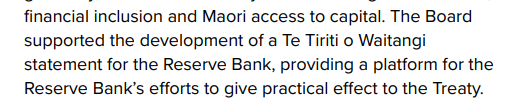
We do however learn of the Board’s effort to indulge the political whims of the Governor and Board members, the Treaty of Waitangi (a) not being mentioned in the acts supposedly governing the Bank, and b) not itself mentioning anything even remotely connected to monetary policy or financial stability.
There is a couple of page section on monetary policy in the body of the report. But in itself this is a reminder that the MPC – which wields the power – publishes no Annual Report, and exposes itself to no serious scrutiny. In this central bank not only does the deputy chief executive responsible for economics and monetary policy never give a serious speech on the subject, she is never seriously exposed to either media or parliamentary scrutiny. External members are so sheltered we have on idea what any of them think, what contribution they make, and so on. They never front FEC or any serious media. Perhaps it isn’t surprising that the total remuneration of these three ornamental figures isn’t much more than what the chair of the Board himself is paid.
But then surely the Board would be doing a rigorous review (it is after all the Board’s job, by law)? That would be difficult when most of the Board has no relevant expertise (the Governor is the main exception, and he chairs the MPC….).
But what we actually get in no sign of any serious thought, challenge or questioning, no attempt to frame the MPC’s achievements and failings. Instead we get this process-heavy but substantively-empty little box

It might be interesting to OIA that “self-review” MPC members are said to have carried out, but you’d just have no idea from any of this that the biggest monetary policy failure in decades had happened on the MPC members’ watch – even as all expiring terms were renewed. It is Potemkin-like “accountability”, with barely even that level of pretence. (Note here that the weak internal review last year wasn’t even an MPC document but rather a management one.)
If that is all rather weak it gets worse when the LSAP comes into view. This, you will recall, was the bondbuying programme in which the MPC’s choices cost taxpayers now just over $12 billion, a simply staggering sum of money, swamping all those “fiscal holes” of the recent election campaign. There are lot of LSAP references – it is the Annual Accounts after all – but none from the Board chair, and here is the one substantive bit.

I’ve highlighted the utterly egregious bit. As they say, IMF staff did put out a little modelling exercise. but it has no credibility whatever, as the scenario described in the exercise bore no relationship to what actually happened in the New Zealand economy in 2020 and 2021. It was a scenario under which, even with the LSAP, the New Zealand economy languished underemployed for three years (but a bit less so because of LSAP) rather than an overheated economy with very high inflation and – in the Governor’s own words – employment running above maximum sustainable employment. I critiqued the piece in a post here, and I know of no economists who read the IMF piece and concluded “ah yes, of course, notwithstanding that the LSAP had a direct loss of $12bn, in fact the taxpayer was really made better off by that intervention after all”. I’m sure no serious economist at the Reserve Bank – there still are some – believes it either. But there seems to be a premium on keeping quiet, and keeping your head down, in the Orr central bank. It was dishonest when the Governor first ran this line in an interview with the Herald but perhaps then he’d seen no critiques (or asked for one); it is materially worse when the Board chair (and the Governor’s 35 senior colleagues) let him get away with it and repeat it, without any scrutiny or further attempt to make a case, in what is supposed to be a powerful public institution’s premier accountability document.
Any serious accountability for the Bank seemed to be dead, at least under the outgoing government. Whether it will be any less bad under the new government it is far too soon to tell. But if it isn’t, serious questions needed to be asked about whether the model is any longer fit for purpose in the sort of democracy New Zealanders typically aspire to have – we’ll delegate power, but if you take up that power and stuff things up then you should personally pay some price. In this document not only in there is serious scrutiny, no personal consequences, but not even a glimpse of contrition from any of them. Never mind the huge losses, never mind the arbitrary deeply disruptive inflation, never mind the lies……after all, the government hasn’t seemed to mind.
Almost any private sector CEO, committee or Board that had stuffed up as badly as the Reserve Bank – with corporate excess and loss of focus thrown in – would have been sent packing some time ago. The stock price would have been falling, investors demanding change, and the business press all over the situation. But not here, not our central bank………
 croaking cassandra