Reading the hardcopy Herald over lunch I spotted an article under the heading “Ministry boss apologises over spend-up”, referring to Mr Leauanae, the chief executive of the Ministry of Culture and Heritage (MCH) as regards the events surrounding his farewell from his previous role as head of the Ministry of Pacific Peoples (MPP) and his welcome to MCH. This was the key bit
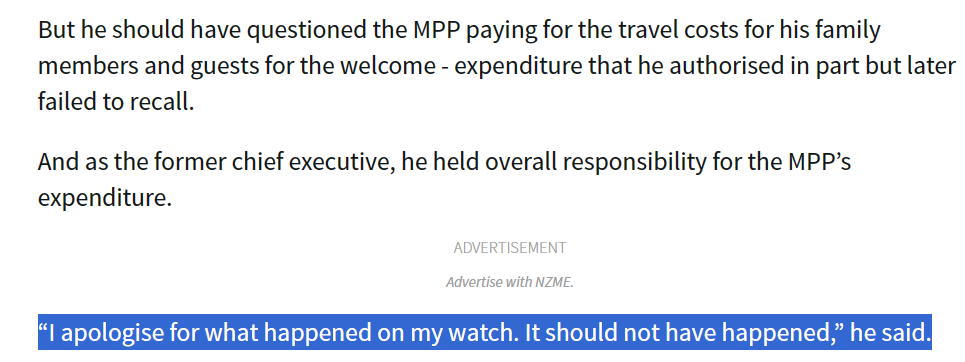
“on my watch”? He seemed to be trying to minimise what PSC had found had actually happened (written up in my post yesterday) and suggest that he himself hadn’t done much, but had after all just been the CE (so, in some sense, formally responsible but not really to blame). It was as if his wayward former underlings had done stuff that didn’t relate to him at all. What the PSC report actually described was Leauanae having accepted $7500 of taxpayer gifts himself at the farewell and then accepting $4000+ of travel for family members and friends for his welcome to MPP. (In addition of course to the rest of the extravagant $40000 spent in total on his farewell, as he moved from one small Wellington government department to another.)
As I noted on Twitter, one of the things the PSC report carefully never directly stated was quite when (a) the gifts were returned, and b) when the travel was reimbursed. It would have been easy for either the PSC report or Mr Leauanae to have given us specific dates, but they (obviously deliberately) chose not to. I have now lodged a couple of OIA requests to find out. Was it the day after the relevant events (say) or only after PSC started digging into the matter? The difference is likely to be quite important. If the former, one might take a more charitable view.
But the comments reported in the Herald prompted me to read the statement from Peter Hughes again more carefully. The lines Hughes will have been keen to see reported were
I thank Mr Leauanae for putting the matter right at the first opportunity.”
The “first opportunity” might suggest the day of the events or perhaps the day after. After all, as the full PSC reports note (carefully, without either evidence or further comment)
He advised it was always his intention to pay for his family and personal guests’ travel costs.
So on a casual reading you might have assumed it was all an oversight and was put right within a day or two.
But, from the Commissioner’s own statement, that can’t have been the case.

Perhaps the gifts really were returned very promptly (eg the night of the farewell function or at worst the day after), although the report/statement carefully does not give dates or times. (There is also that strange comment that he returned both the gifts and the money spent on them, which leaves questions as to whether the gifts had been able to be returned to the vendors for full refunds or not).
But that clearly wasn’t the case with the travel, because the second paragraph above says that it was the PSC review which uncovered the fact of this spending on Mr Leauanae’s family and friend’s travel, and that it was only in light of the review finding that he reimbursed MPP. And we know from the documents PSC released that they did not formally decide to look into the spending regarding the welcome to MCH until 19 June. That was eight months after the personal benefit to Mr Leauanae. That doesn’t seem even close to putting things right at the “first opportunity”, casts further doubt on Leauanae’s claim that he had always intended to pay for the travel himself, and strongly suggests someone with no strong sense of what is right and wrong when public money is being spent. Someone who still sits in a highly paid job as head of a New Zealand government department.
Peter Hughes was obviously somewhat constrained by the facts, but he consciously chose not to explicitly point out this timing, but to spin a story that would lead quick readers to think Leauanae had fixed things up straight away, not many months later only after the inquirers from his boss came calling.
Nothing in this story reflects at all well on Leauanae, and it really should be staggering that he goes on as a government department CE with, as far as the report suggests, no adverse consequences (he just repaid things when he finally got caught). Of course, it isn’t just the personal benefit, but the modelling and leadership (or lack of it) that will have led his former MPP underlings to think the lavish expenditure was ever acceptable, and the undisciplined processes etc reported last night in the Newshub story after they got hundreds of pages of documents from MPP. What gets you dismissed, or strongly encouraged to resign, when you hold a New Zealand government department CE role? Clearly not this record.
I’m also a bit surprised no one seems to have asked relevant ministers whether they have any confidence in Leauanae. In one of the weird bits of our legislation, they can’t sack him themselves, no matter (apparently) what he did, but the position of a CE would surely be untenable if the Prime Minister and the Minister of Culture and Heritage (as it happens the Deputy PM) indicated that they had no confidence in Leauanae. The PM has been reported as saying that the expenditure was unacceptable, but what of it? What is he going to do about it? He is, after all, the Prime Minister, and it is hard to believe that the Opposition parties will be leaping to the defence of Mr Leauanae.
Of course, it is always possible Hipkins and Sepuloni do still have confidence in Leauanae, even after what is already revealed about him (personal entitlement, weak and undisciplined financial management and people leadership etc). If so, that would be sadly telling. But you might have thought media outlets would at least ask whether they still have confidence in him, and if so why.
 croaking cassandra
Thanks again Michael for persevering with this issue, I feel it is even wider than just the inappropriate expenditure of a departing/arriving CEO of a minor state entity.
One can accept that Island cultures are strong on hospitality, and respect of aristocratic rank, which has its delightful aspects. Island communities are very small, even island by island so it can be difficult to apportion jobs and or favours without involving family members, village, etc.. They are very strong on celebration.
In fact we need to acknowledge that even with the wider NZ society it is often difficult to appoint people to high office without considering who knows who and how they obtain office. (Even our judiciary springs to mind)
However the point is that a small nation like ours must recognize these potential conflicts, and in the civil service at the very least, strong rules and systems are even more important than in larger societies. We have the recent debates about MP’s accepting lobbying positions the moment after they have quit Parliament.
For all these reasons, the person who should be in the cross hairs to be held ultimately responsible for this latest lapse? …debacle?…is the Minister for State Services. Surely there must be some handbook laying out all the snafu’s to be avoided by state entities and their senior staff…acceptance of gifts/celebrations of achievement, etc., etc..
If such a tome exists, it makes this particular CEO even more guilty of malpractice. And if it does exist how come the State Services Chief Executive didn’t pounce on the rule breaking instantly!
And if it does not exist, the Minister in charge of State Services should resign. Gifts versus corruption, celebration without expenditure guidelines should surely be front of mind for a minister responsible for the huge expenditures on the employment of civil servants.
LikeLike
As I understand the law all the power re employment issues rests with the Public Service Commissioner and none with the minister. But as I note in the post if the PM or relevant departmental minister makes it clear they have lost confidence in a particular CE that person’s position should be untenable.In this case I suspect the relevant CE is one of Peter Hughes’s protégés.
LikeLike
You are probably right, and I guess this incident is not huge, just suggestive of slack oversight, but the ‘buck’s has to stop somewhere. I guess it will stop, as seems to be usual these days, with muggins taxpayer.
Frankly I am fed up with the proliferation of “commissions” & ” commissioners “. Theoretically they are a mechanism to give Parliament more teeth in controlling the Executive. But in reality they just seem to fudge the true role of HM Opposition with said commissioners seeming to be more a creature of the Cabinet than of Parliament.
I feel we need to adopt more of the US practice of hauling Departmental CEO’s before a Parliamentary Committee for a good old grilling examining their performance in rigorous detail.
But as you have pointed out with respect to the Governor of the Reserve Bank, our system of Parliamentary oversight has been rather tame…. a black mark against opposition MP’s, or maybe an indication that there is something wrong with our constitutional structures? I feel our Executive has been too dominant, but it is a complex issue. Geoffrey Palmer had a shot at it but probably just exacerbated the problem.
LikeLike
I always find it interesting when something is declared to be “unacceptable”, yet clearly has been accepted. If something is unacceptable then that surely means you wouldn’t accept it – because you cannot.
LikeLike
“Cultural Advice” seems a nice little earner
LikeLike
Hi Michael Reddell, you laid things out very well… Did you get an answer to the OIA about the timing of things…
LikeLike
Yes, here https://croakingcassandra.com/2023/10/10/one-final-post-on-psc-mpp/
and some other relevant material here
https://croakingcassandra.com/category/psc/
LikeLike