To what end?

It is two years today since my first post about pandemics (and the economy). Rereading it, and another the following week, over the weekend and it was interesting to reflect on what issues had (and hadn’t) sprung to mind. But back then, however fearful people might or might not have been initially, few would have supposed that two years on we’d be labouring under new, and even more onerous, restrictions, and that for the best part of two years few of us would have been able to travel.

I was quite supportive of the need for restrictions, especially at the border, for quite a long time. Even last year, when the government was so slow to roll out the vaccine, doing everything possible to keep the virus out would have seemed appropriate (ie more than the government actually did). As for domestic restrictions, in both 2020 and 2021 the government clearly overshot, imposing (and renewing) some restrictions that seemed more about asserting power and showing who was in control than about public health, and others that failed all tests of decent humanity. (None, of course, were ever justified by any sort of cost-benefit analysis – an abdication of any sort of decent policy analysis that I hope one day our politicians and senior officials look back on in shame.)

But that was then. Since late last year, the government’s approach has increasingly lost any coherence. Despite high vaccination rates, we’ve had extreme coercion used on those reluctant to get vaccinated, and we’ve lurched down a path of “papers please” where those who refuse to show their government papers are prohibited (either by law directly, or enabled by it) from undertaking many of the normal activities of life. All this as (a) it was clear that the biggest risk posed by the unvaccinated was to themselves, and (b) that lots of vaccinated people were getting Covid anyway, apparently often/mostly from other vaccinated people. Government guidelines as to when it would ease restrictions were repeatedly ignored by the government itself. The government meanwhile had confirmed that it had given up on elimination some time ago.

And then, of course, came Omicron – two months ago in other parts of the world. The experience of Omicron so far seems to be that it is highly highly infectious, partly as a result waves don’t last long, and among the vaccinated (even more so the boosted) the rates of serious illness and/or death seem remarkably low. In some places – the UK is the most obvious example – even with a lot of cases, numbers in hospital ICU care did not even increase during the Omicron wave (but there is a variety of experiences, depending in part on starting points). Nowhere, it seems, is there evidence of the spectre of “overwhelmed health system” having been realised (although you might expect, even hope, that systems would be put under some pressure).

As for our government, first it seemed that they shut down for the holidays. In normal times, no one would begrudge them that, but this was something more akin to “wartime” – a major threat unfolding, inter alia, just across the Tasman. You might have thought that all hands would have been on deck, led by the Prime Minister, with planning (and public consultation on those plans) advancing rapidly. And vaccination centres operating night and day to get vaccinated many more of those eligible for a third dose. Oh, and the child vaccination programme might have got going before Christmas too. But no, this was the government of complacency – we still don’t have their “plan” (apparently something is coming on Wednesday) – and now controls.

Even on what we have seen, policy is all over the place. Last week, they stopped allocating MIQ rooms for ordinary New Zealanders, but that was (a) done with no ministerial announcement, and (b) to affect arrivals a couple of months hence (when who knows what the environment will be). They keep telling us (sensibly, rightly) that Omicron will spread in the community, but then on Friday the government quietly put in place much-extended isolation requirements – of the sort that perhaps might make some sense (if complied with) in an elimination model, but which make no sense now – the more so as they will powerfully deter some from even getting tested.

And then yesterday we got the new general restrictions. From both the PM and the Director-General we were told they were still aiming to “stamp out” the outbreak, but even (especially?) they must know they are just making things up now – a Level 4 lockdown in August didn’t stamp out that outbreak (or wasn’t pursued long enough to), and this lot of restrictions is nothing like Level 4. The more realistic rhetoric/spin seems to be about “slowing the spread” – there are big adverts in the papers this morning enjoining us to get with the team, play our part.

But why do we want to “stop the spread”? I don’t. We are already two months behind much of the world – two months of repressive domestic restrictions and onerous border controls – and for what? Various other places are coming out the other side now, not having had particularly bad health experiences – England, Ireland, the eastern states of Australia, South Africa – while Ardern and her colleagues – apparently with little opposition from National – seem to be determined to try to slow the incoming tide. They’ve provided no supporting analysis, no cost-benefit analysis, there are no end-point dates for these controls (which may not do much “good” anyway, while disrupting lives), and no published criteria – not that on the past record they would ever stick to them – for getting controls off, getting our lives back to normal, binning the “papers please” regime, and opening the border (even just for New Zealanders).

Events are being cancelled all over the place, and whereas (say) we watched the Ashes test in Hobart a couple of weeks ago with large local crowds in attendance (in the middle of a not-small Omicron outbreak) the government is going to condemn us to the grim spectre of test matches with no crowds at all.

Of course, it could be worse. The government could – and may yet – resort to more onerous restrictions (have they done anything to prepare the public for several weeks of 30-40 deaths a day?) but it is unclear what they are trying to achieve, and how their cobbled-together policies fit a strategy. We hear talk about “flattening the curve” but that seems like a recipe for months and months of controls – the sort of restrictions that may appeal to public health professors and some left-wing politicians, but which should generally be anathema in a free and open society. There is talk, always talk, about getting our booster rate up – but (a) whose fault is it they weren’t offered earlier?, and b) even now, because of the delay, the percentage of our population with boosters is already higher than (say) the Australian share 6 weeks ago when their outbreak was getting underway.

People oriented to controls can always dream up reasons for delays – and I might have had a touch more sympathy if the government had shown itself ever willing to get rid of controls that were no longer self-evidently necessary – but they never attempt to show an overwhelming case. In an interesting Newsroom article over the weekend, on preparing for Omicron, Prof Michael Baker justified his case for more restrictions on the basis that “several hundred people” might die if we just let Omicron sweep through. Quite possibly – if one takes the Australian numbers as a guide – but 34000 people a year die in New Zealand, and that number fluctuates (easily plus or minus 1000) from year to year. It simply does not justify restrictions without limit, and lives lived – unable to sensibly plan – at the whim of politicians.
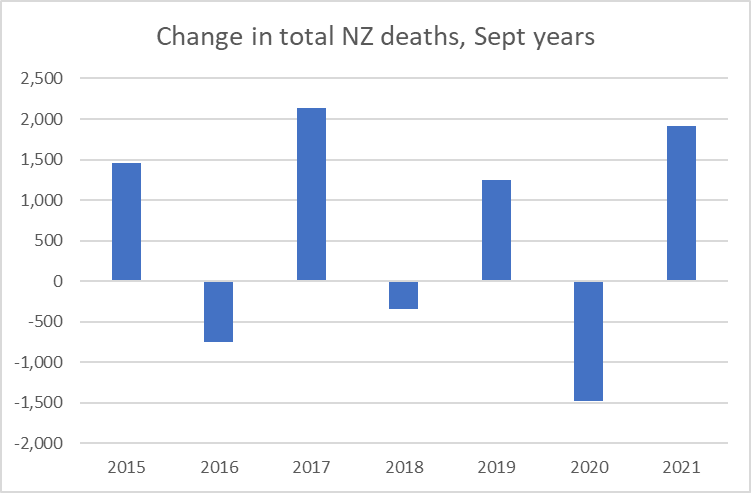
baker

And, of course, we are rightly reminded of the limitations of the public health system. It was a reasonable argument two years ago, but not now, when the government has done little or nothing to boost capacity over two years, and now wants to put us under their (somewhat half-hearted) controls anyway. Sure, there would be likely to be some weeks of extreme pressure on the system, but it is hard to conceive of any serious cost-benefit analysis – that value freedom at all – justifying society-wide restraints, indefinitely, to avoid a few weeks difficulty (and even some otherwise avoidable loss of life).

Now, of course, Omicron will be disruptive even if the government does nothing. Baker, in that same article, seemed to use that as justification for “oh well, we might as well just have lockdowns then”. But there is a big difference between government controls – backed by the coercive power of the state – and individuals and firms taking their own precautions, calibrated to their own individual risk and risk tolerance. I’m pretty sure no one would put off a quiet swim at a deserted beach, or a driving lesson for their child, except the state compelled them,

(And I say all this as someone who is almost 60, and hasn’t had the best of health in the last couple of years. There are risks to life, and – fully vaccinated and soon boosted – I’m quite happy to run those modest risks. I’m not happy seeing events cancelled willy-nilly at government fiat, or governments still stopping people travelling (indefinitely), and so on.)

There are lots of things the government could and should have done much better re Covid over the last 12-18 months. Had they been done we might be in a slightly better position now, but it is water under the bridge now, and nothing about the government or Ministry of Health gives any reason for confidence that we should put up with indefinite restrictions on their say so. They have the power of course, but they abuse and misuse it (down to and including the arrogant disdain evident in the way the government refuses to even put out case/hospitalisation data at a fixed time each day – a simple thing in some ways, but one that simply reveals their indifference and, quite possibly, incompetence).

Better to (a) scrap the vaccine pass system (which simply institutionalises repression, of the sort that should be alien to this country, for no significant public health benefit), (b) open the border to NZ citizens, and (c) cut the isolation requirements to something like those in the US and UK, with a view (d) to following the English lead and looking to remove all Covid restrictions by, say, 31 March (subject to renewal only by vote of Parliament, not arbitrary ministerial fiat with no consultation or transparency).

Oh, and release all the relevant Cabinet papers and ministerial briefings within two days of decisions having been made. These are our lives, our freedoms. We are not supposed to be just playthings of the government. The smallest regulatory changes in normal times have to go through proper (if often faux) consultative processes. Sometimes in emergencies needs must, but this was Omicron – they had the best part of two months to be prepared; do the analysis, test it in public, consult. Instead, perhaps we’ll see a “plan” on Wednesday, perhaps we’ll see the papers and analysis (if any exists) six months from now.
Central bank research

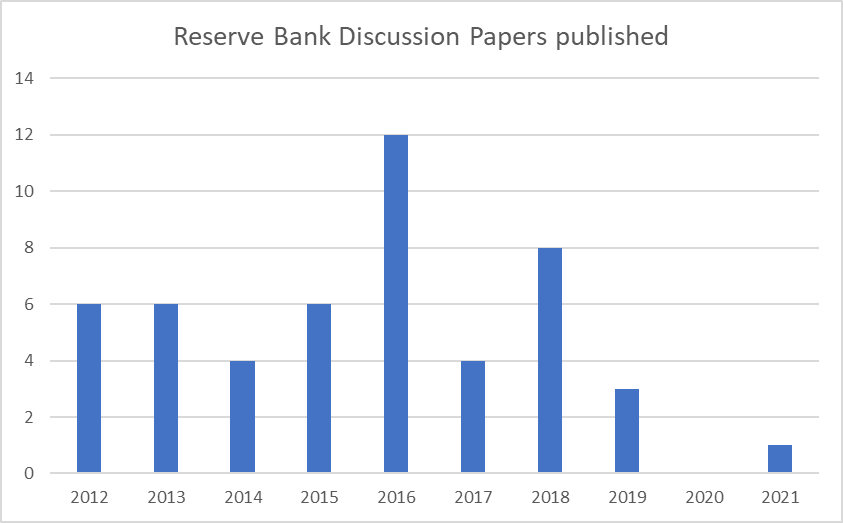
For some reason the other day I was prompted to have a look at how many research papers the Reserve Bank had published in recent years. This chart resulted.

RB DPs

Only one in the last two years, and that one paper – published last February – had five authors, four of whom worked for other institutions (overseas). It was really quite staggering. It wasn’t, after all, as if there had been no interesting issues, policy puzzles or the like over the last two years. It wasn’t as if universities had suddenly stepped up to the mark and were producing a superfluity of research on New Zealand macro and banking/financial regulation issues. It wasn’t even as if the Bank had suddenly been put on tight rations by a fiscally austere government – in fact, the latest Funding Agreement threw money and the Bank and staff numbers have blown out. Rather, or so it appears, management just stopped publishing research.

These research Discussion Papers are usually quite geeky pieces of work, formal research that is subjected to some external review before publication, and often written with the intention of being of a standard that might be submitted to an academic journal. The Reserve Bank had put quite an emphasis on this sort of research (mostly on macroeconomic matters) for probably 50 years, as one part of the sort of analytical work that underpins its policy, operations, and communications.

Of course, what ends up in published research papers like this isn’t all the thinking, analysis, or even research that the Bank has been doing – ever, not just now. Apart from anything else, they have a variety of other publications, including the Analytical Notes series that was started up a decade ago to fill a gap (for example, less-formal research, often with shorter turnaround times), and even the Reserve Bank Bulletin which had had a mix of types of articles, but itself appears to have been in steep decline. There are speeches from senior managers, but as I’ve pointed out previously these days these are few and rarely insightful (not much research, here or abroad, informs them). There will be other analysis and research that simply never sees the light of day – the Bank not being known for its transparency – but what appears in public is likely to be an indicator of what does (or doesn’t) lie beneath the surface. The Bank still has some staff who appear to have formal research skills – indeed a year ago they recruited one of New Zealand’s best economists apparently to work on preparations for the next review of the monetary policy Remit – but what we see is thin pickings indeed. Most of most able researchers of the last decade have left, and as far as I can see there is no one working in the research function with any long or deep experience of the New Zealand economy and financial system.

Recall that the previous Governor espoused a goal that the Bank should be not just adequate but the “best small central bank” in the world, while the current one often reminds people of his mantra “Great team, best central bank”, suggesting a vision not even constrained by the (small) size of New Zealand.

Does any of this matter? I could probably mount an argument that much of what the Bank is charged by Parliament with doing could, in principle, be done with little or no formal research (of the type that appears in Discussion Papers). In principle, a keen appetite for the products of overseas research, a climate that encouraged debate and diversity of ideas, active engagement with other central banks, and a steady flow of less-formal analysis wouldn’t necessarily lead to particularly bad outcomes. And having been around in the days when the Bank was doing some world-leading stuff (notably inflation targeting, but also some of the bank regulatory policies) it is fair to note that little or none of that drew on (or was reflected in) formal RBNZ Discussion Papers.

But it isn’t really the standard that we should expect these days, nor is there any sign that people in other countries do. It is not that a single research paper is likely to decisively change any particular policy setting (perhaps not even 5 or 10 would) and many of the papers might go nowhere much at all. But a flow of formal published research is one of the marks of an institution that thinks, that has an intellectually vibrant culture, that is open to new ideas etc etc. And on some policy calls, we really have a right to expect that the Bank – with huge amounts of policy discretion, and quite limited accountability – is doing world-standard research of its own, and/or commissioning it from others, and making that research available for challenge, scrutiny etc. One might think here of appproaches to bank capital policy, where the current Governor took a bold non-consensus decision, but where the institution has no published record of any substantive serious research. Sometimes these things might just be about trying to find frameworks that make some sense – never all of it – of what has been going on, or bringing formal evidence to bear on (for example) what the LSAP has accomplished.

But, these days, there is little sign of any of it from our central bank – and as a straw in the wind, it is at one with a record of few (and rarely good) speeches, inaccessible MPC members (themselves ruled out from doing research), and policy documents that rarely seem to reflect robust analysis.

Of course, one can expect formal research outputs to fluctuate a bit from year to year. Topics come and go, immediate management priorities come and go, particularly able and productive researchers come and go. But one paper (and that mostly co-authored) in two turbulent years isn’t a sign of an institution that any longer takes seriously generating research output, or the sort of climate that makes an institution attractive to really able people.

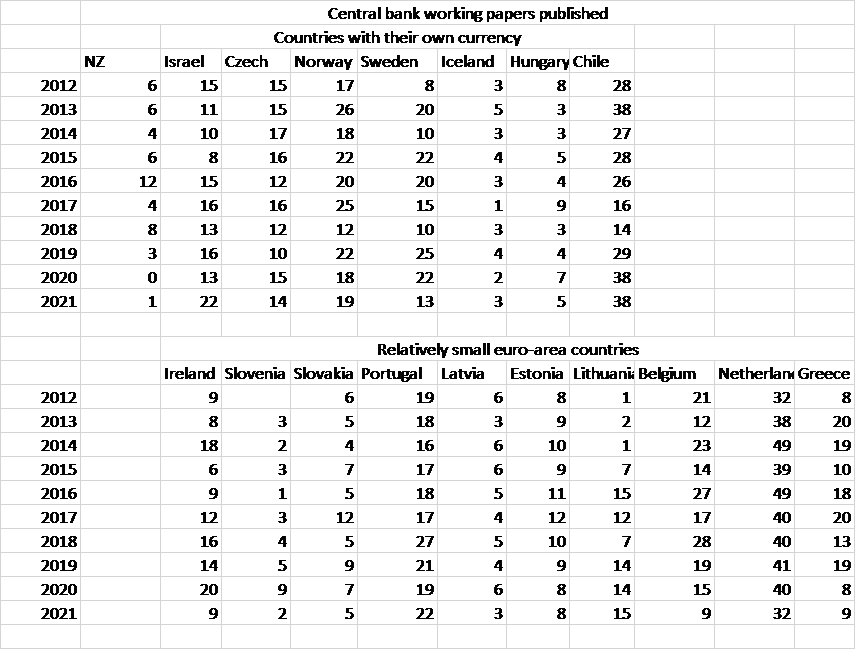
What about other countries? I went counting.

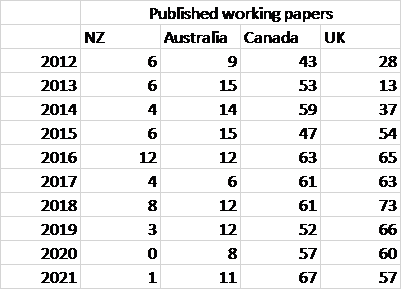
Much discussion in New Zealand compares us to other Anglo countries, and in central banking terms, Australia, Canada and the UK have had similar (inflation-targeting) macro policy frameworks.

anglo DPs

Of course, each of these are much bigger countries than New Zealand (and on that basis one might think the RBA rather light on its published research) but (a) there aren’t huge economies of scale in central banking (our economic puzzles can be just as intractable as those of much larger countries), and (b) both the RBA and the Bank of Canada have a narrower range of policy responsibilities than the Reserve Bank of New Zealand.

So how does the RBNZ compare with the central banks of other small advanced countries?

DPs adv countries

Central banks of very small countries (in this case, Iceland and Slovenia) have tended not to publish much formal research – although still more than the RBNZ in the last couple of years – and one might wonder at the budgetary priorities of the central bank of Lithuania (just under three million people and without a monetary policy of its own), but even before this decade the flow of formal research from our central bank looks to have been at low end of what one might expect given (a) our population, (b) the wider range of issues the RB is responsible for, and (c) the idiosyncratic nature of some aspects of our economy. There is no single right or wrong volume of formal research, but next-to-no published research simply looks like a dereliction of duty. (One might have hoped that a Board chaired by a university vice-chancellor – one with a reputation of getting research metrics looking good – might have raised questions, but…….this is the mostly-useless Reserve Bank Board.)

Again, does it matter? In my more cynical moments over the years I used to observe that perhaps the main difference inventing inflation targeting made was that we subsequently got invited to a better class of international conference. It might not sound much, but it is a straw in the wind for something that really does matter – the connectedness of the institution, the exposure to ideas, the ability to get leading people to take an interest and visit etc etc. We used to have that. Not all the conferences were useful, not all the visitors were useful, and so on, but becoming known as a central bank that (a) rules out from its MPC anyone with ongoing expertise in monetary policy, (b) publishes hardly any serious research, and (c) where senior management, if they speak at all (recall that the chief economist gave not a single published speech), make only the lightest-weight speeches isn’t a recipe for keeping engaged with the world, or the flow of ideas or research. When you are all already small, remote, idiosyncratic, and not as rich as Croesus (we can’t just throw money at potential visitors) it is a poor lookout.

These outcomes must have been the result of deliberate decisions. They need not be forever. Capability can be rebuilt, although doing so in an enduring way takes time and leadership. Who Orr appoints to the current key vacancies is likely to reveal quite a bit as to whether the Governor has any interest in creating a research-informed Reserve Bank, across the range of key policy areas he is responsible for. If not – and most likely not – it will be another sign of a deeply troubled institution, taking a similar path of decline to too many other New Zealand institutions in recent years. Responsibility for that rests not just with individual officials, but with a government (and Minister of Finance in particular) who seems not to care.

A sad ending

Yesterday morning’s news was an NBR headline – story accessible only to those with a subscription – in which the Reserve Bank appeared to have confirmed to this single media outlet that Deputy Governor, Geoff Bascand (a statutory appointee, and member of the Monetary Policy Committee) had left his job early, after speaking without authorisation to a third party about the Bank’s management restructuring. Later in the day, we got more accessible versions of this astonishing development (including this interest.co.nz account).

Bascand had been a public servant for a period spanning 40 years, starting in The Treasury in the 80s, and including stints as head of the Labour Market Policy Group (at the old Department of Labour), Government Statistician, and (since 2013) as Reserve Bank Deputy Governor. His public sector career had had its ups and downs, and he never quite reached the very top levels, but what a way to end it. In many ways, he was a classic public servant – most people seemed to like him, quite a few respected him, he wasn’t (it seemed) flamboyant or reckless. He went along. He wasn’t an intellectual leader, but he got things done. He didn’t seem to stand on titles etc – I was quite impressed that he was willing to take the step back from a CEO role at SNZ to (initially) the third-ranked position at the Reserve Bank (even as I assumed at the time that he saw it as a stepping stone back into the policy-institution mainstream, perhaps with aspirations to be Governor or Secretary to the Treasury). And in 2017 he was quite (unusually) open (to media) that he’d applied for the Governor’s role, knowing (presumably) that even as incumbent (but new) deputy chief executive he probably had no better than a 50/50 chance. In the first three years of the Monetary Policy Committee, he had been by far the least-unimpressive of the members, and gave speeches that were sometimes almost worthy of a member of a powerful independent policymaking committee in an advanced country.

I first met Geoff 35 years ago, but had only had off and on contact with him until he came to the Bank. We then sat on many of the same committees, but I left the Bank a couple of years later, and my main dealings with Geoff were actually over the last 8 years when we were both trustees of the troubled Reserve Bank staff pension scheme and spent too many hours locked in long meetings. We had our differences there – sometimes quite stark, sometimes on quite important issues – but in recent years in particular we seemed to have got on well, and even together crafted a resolution to one of the lesser issues the scheme was dealing with. I say this mostly as context. I don’t wish Geoff any ill at all.

When it was announced a few months ago that Bascand was leaving the Bank at the start of 2022, it wasn’t entirely clear what was going on. One plausible story was that at his age (60ish), unlikely now to ever become Governor, he’d simply opted for a slower pace of life – golf, grandkids, and some directorships/consultancies etc. Another was that he had become so frustrated with the Orr approach that he simply wanted out. The two weren’t incompatible necessarily, but if you are part of a project you are totally at one with, it isn’t usual to simply walk away – in good health, and not that old. But the new governance structure for the Bank was coming in mid-2022, and he might also have thought someone needed to be willing to commit several years to bedding in the new model. There was always the possibility Orr wanted him out, but as holder of a statutory office appointed by the Minister there was no direct way of effecting that, despite the reputation Orr had long had for churn among his senior staff. The speed with which Bascand’s replacement was announced – with no advertisement etc process – did tend to reinforce suspicions.

The concerns about top-level departures started to step up in November when it was announced that the Bank’s Chief Economist was leaving after less than three years in the job – having been appointed by Orr, it was quickly apparent he was being restructured out by Orr (Orr having restructured out the previous Chief Economist). Questions started to be raised, including at Parliament’s Finance and Expenditure Committee. With inflation rising sharply, and unease (justified and not) about the Bank’s handling of monetary policy through the Covid period, the Governor’s position was becoming somewhat exposed.

But there was more to come. The management restructuring was ongoing and now claimed the two senior managers responsible for banking regulation and supervision, who had been direct reports of Geoff Bascand’s (as deputy governor and head of financial stability). We still don’t know the details of the restructuring – the Bank is playing OIA obstruction – but both Andy Wood and Toby Fiennes decided to leave, their own previous jobs presumably having disappeared (Fiennes already having been effectively demoted in an earlier Orr restructuring). That might prove quite uncomfortable for the Governor, with annual select committee hearing coming up on 15 December (this time the annual Financial Review, focused on the year to 30 June, but allowing a very wide range of issues to be raised).

And so, it seems (Orr did not deny it when questioned on it at FEC), the Bank decided to keep this news secret (from staff and the public) until after the FEC hearing was over.

And yet the news got out, with a story from Business Desk’s Jenny Ruth late the previous afternoon (and a statement from the Bank confirming the departures). Orr faced repeated questions at FEC the following day (I wrote about it here), and some of the answers from him and his team proved to be quite misleading. There was a lot of bluster, and the Governor did not emerge well.

There were a couple of straws in the wind – no more – that week that suggested that the Bascand situation was less than happy. Watch the FEC hearing (accessible on the FEC Facebook page) and you will see that Bascand was there – Orr even mentions it at one point – but in the back seats with the large group the Bank brought along. That was odd. Bascand was at this point still the incumbent Deputy Governor, and the hearing was formally focused on the 2020/21 financial year. It wasn’t that there wasn’t room at the top table – Orr was joined there by the incoming Deputy Governor and one of the his many more-obscure Assistant Governors. Not having Bascand up front – and several MPs have made generous comments about Bascand – looked not quite right.

And then on the Friday of that week, Bascand simply did not turn up for a long and important meeting of the superannuation scheme trustees, a meeting that had been scheduled explicitly to draw on his expertise and experience before his scheduled departure in the first week of January. His replacement had already been appointed (from 5 Jan) and invited to attend the meeting as a silent observer. Initially not suspecting anything – other than idly wondering what financial stability drama there might be on 17 December – I asked the chair if Geoff had then nominated the replacement as his (legal) alternate, which would enable that person to participate fully. It would have been a natural thing to have done if something had come up and Geoff was simply too busy. But all we got was a rather flustered “no”.

But none of that took one anywhere, at least until yesterday’s story.

The story did not tell us what Bascand had told to whom, only that he had had unauthorised discussions with an outsider, had confessed and apologised, and had left the Bank on 17 December, several weeks before his scheduled (early Jan) departure date.

So it is hardly a stretch to suppose that he was the ultimate source of the 14 December story about the further senior management departures – since it (a) involved people who had directly worked for him for several years, and (b) came out late on 14 December, and while he was still there (FEC) on the early morning of the 15th he was gone by the 17th. Most probably Bascand didn’t directly communicate with the journalist who broke the story – although even had he done so, the journalist would have needed independent confirmation to help provide cover to her source – but may well have told someone with the explicit intention that the news get to a journalist with a reputation for taking RB issues seriously. (It is quite clear, on the other hand, that these unauthorised discussions weren’t, say, a passing mention to his wife – the consequences, confirmed by the Bank yesterday, tell us it was much more serious than that.)

There can’t have been many people at the Bank who knew (on say 13 Dec) that Wood and Fiennes were going. The Governor, the incoming deputy (who would soon be responsible for financial stability), perhaps the Assistant Governor responsible for HR, perhaps the respective PAs, Wood and Fiennes themselves, and Bascand. Bascand either because he was still incumbent Deputy Governor or because either or both of Wood and Fiennes would most likely have talked to Bascand – their boss for several years, but not now the person driving decisionmaking – before making their final decisions. Only disgruntled people had an incentive to leak, which would have quickly narrowed the field, and Bascand apparently confessed, apologised, and agreed to go early. It could reasonably have been seen as a sacking offence but (a) no doubt the Bank wanted to keep this quiet, and (b) getting rid of a statutory officeholder isn’t quite like dismissing an ordinary staff member.

Why would Bascand have done it? Presumably the motive was pure and simple to put Orr on the spot at FEC, perhaps driven by frustration at how his loyal and capable senior staff had been treated. But it was still a strange step for someone like Bascand – the mostly fairly buttoned-down bureaucrat – to have taken. After all, although the FEC hearing became more of a spectacle, and more uncomfortable for Orr, it wasn’t as if this was really whistleblowing – the FEC hearing itself was never going to be decisive (of anything), and the Bank would have announced the departures a day or two later anyway. If – as I think there are – there are serious questions to be asked about Orr’s stewardship, a couple of days wasn’t going to make much difference in the scheme of things. Perhaps Geoff was just at the end of his tether?

If this is the story – and while it seems likely we can’t be certain – did he suppose he’d not be found out? Perhaps, but why take the risk? Perhaps he thought there weren’t really any downsides for him? But if so, he was wrong. Leaving two weeks early a job you’d resigned from anyway isn’t the cost. But yesterday’s story is. I guess that story wasn’t guaranteed to leak out, but….Wellington is a small place, and who knows what story staff were told as to why Geoff wasn’t around for his scheduled last few days.

It is simply a really bad look. Even real whistleblowers – of information about (a) misbehaviour that (b) would never otherwise come out – rarely prosper (even though society needs such people). But this wasn’t whistleblowing – Orr was within his rights to restructure, and the news was going to come out anyway – and just looks rather petulant and undisciplined. And whatever you think of Orr’s stewardship of the Bank, a senior figure behaving this way – breaching his obligations (moral and otherwise) is unlikely to endear himself to people (government or private sector) considering Geoff for future directorships and consultancies. If he had real concerns about Orr’s stewardship – and he should have – a detailed letter to the Minister of Finance, after he had left the Bank, might have been in order. Perhaps even a serious interview with a major media outlet a few months down the track (Orr is up for reappointment early next year), although in cosy Wellington even that would have raised eyebrows. But not leaking to the media – with a high probability of being found out – simply for some short-term additional embarrassment for the boss. (And it is not as if Geoff in the past has not expressed firm views on anyone speaking out in a way that might embarrass him or those he supports.)

I was glad the news of those further senior management departures got out in time for FEC, was glad to see National and ACT MPs asking hard questions of Orr – and hope they now follow up further – but what Bascand (who had obligations to the Bank) appears to have done was quite inappropriate and unacceptable, and it is good that that news has belatedly come out. It is a sad way to end a long public service career.

But what a mess an important and powerful public agency is clearly in. So many key people going or gone, so little analytical, operational or policy excellence, so little banking or regulatory experience at the top of a major banking regulatory agency, and so on. Meanwhile, the Board chair who presided while all this went on has been given another term, and all indications are that none of this much bothers the person with the ultimate responsibility, the Minister of Finance. It should. We need to end, and reverse, the degradation of major New Zealand public institutions.

UPDATE: Continuing to mull over this business, I’m still a bit inclined to wonder if there is more to the story. Is there a possibility that Bascand took the fall, covering for someone else (for whom the consequences of discovery might have been greater)? I guess we’ll never know, and perhaps it is just that I don’t want to believe that someone like Geoff could have acted this way, even tired, even frustrated. There is something particularly treacherous about a deputy deliberately undercutting his boss in a way implied by the story told in this post. But probably only a couple of people know the truth of the matter, and they won’t be saying.