Blunders of our local government

Shortly after I began this blog, I wrote about a couple of books on government failure.  There was Why Government Fails So Often which had a US focus, and The Blunders of our Governments which had a UK focus.

The authors of the second book define a blunder as

as an episode in which a government adopts a specific course of action in order to achieve one or more objectives and, as a result largely or wholly of its own mistakes, either fails completely to achieve those objectives, or does achieve some or all of them but contrives at the same time to cause a significant amount of “collateral damage” in the form of unintended and undesired consequences….financial, human, political or some combination of all three.

Most of the specific episodes the authors wrote about were on quite a large scale.  But smaller debacles can be just as telling.   Take, for example, the Island Bay cycleway.

I was the among the hundreds of local residents who crammed into a local church last night for the latest round in what must surely be a case study in how not to do things.  Unless, that is, your purpose is to deliberately and repeatedly ignore the cleary-stated wishes and preferences of the most directly affected members of the public –  in this case, the residents of the suburb.

Some years ago, the Wellington City Council and its cycling (Island Bay resident) mayor kicked off an ambitious (to give it the most flattering possible description) plan to build a cycleway from the sea (Island Bay) to the city.  The cost would, we were told, be modest and the benefits considerable.

As most readers will know, Wellington is not a flat city.  And much of the territory the cycleway was supposed to go through included older suburbs with cramped housing, narrow streets, and no nice wide grassy verges.   Berhampore isn’t Grey Lynn.  It was never remotely likely that creating a cycleway the full length planned would be cheap or easy.  Probably not very sensible either, but set that observation to one side.

By contrast, the main road through Island Bay is flat and wide (at least by Wellington standards), lined with pohutakawa trees that help make it a pleasure to be around home at Christmas.  So, thought the Council enthusiasts and the cycling lobby group, lets start in Island Bay.  A cycleway might go nowhere, but at least we’ll have made a start: they’d show sceptics what could be done.  It should have bothered evidence-based policymakers, that (a) there that weren’t many cyclists, and (b) that over the decades there had been very few accidents.   In other words, not much case for doing anything at all.  The status quo seemed to be working well.  Not, of course, that that ever deterred a visionary with someone else’s money and no effective accountability.

The process that led to the cycleway being constructed a couple of years ago was deeply flawed.  There was no proper consultation with residents, and the Council simply barged ahead with their plan.  In the process, they spent around $1.7 million –  that was originally what the entire cycleway (sea to city) was planned to cost.   And thus we have today a bizarre cycleway.    There still aren’t many cyclists.  There are more accidents than there were.  And in the one potentially dangerous part of the road –  though recall, with few or no actual accidents over the years –  through the main shopping area, there is no cycleway at all.    Visibility is much worse than it was (especially turning from side streets. or getting out of driveways of houses on The Parade), and the designers coped with bus-stops by weaving the cycleway onto the footpath in places.    Dozens of car parks were removed –  and anyone who does find a parallel park has to remember (in this small part of the city alone) to look on the passenger side before opening the door, lest they open the door into the path of a (rare) cyclist.   It is an outcome that has almost nothing to commend it.

Most of all, most residents really don’t like it or want it.   The Residents Association last year organised a vote of residents.   It wasn’t perfect, but as these things go it was organised pretty well, the checking was pretty good, and the final result wasn’t even close.  On a pretty big turnout, there was overwhelming opposition  (80 per cent plus, if I recall correctly) to what the council had landed us with.

That prompted a rethink.  In a constructive spirit, the Residents Association and the Council agreed to work together in a consultative process on better options.  That was more than a year ago.   There was a series of public meetings and workshops, and then the council staff went away to consider.  In all this, the elected councillors seem to have been largely absent  –  as if the staff ran the council, not the councillors.

Last week. the council staff revealed four new options, and opened a short period of public consultation on those options.    When I picked up the newspaper and read the story, I was flabbergasted. I have a low opinion of the Wellington City Council, but even I wasn’t prepared for what I read:

  • four possible options, not one of which involved simply unwinding what was done a couple of years ago and putting The Parade back as it was,
  • the cheapest of these four options –  recall, to fix something that had already cost $1.7 million –  was anouther $4.1 million (others cost up to $6.2 million).

And having taken out 34 parking places when they put the cycleway in, the council bureaucrats now proposed to take out another 57 parking places – including, in three of the four options, removing more than half the public carparks currently available in the shopping centre.

It was incredible.

And thus there was a huge turnout to the public meeting last night, at which council staff and their engineers/architects attempted to make their case (burbling on about “urban design principles”, the priority of safety etc) and councillors rather lamely defended the process.  We’ll see what the overall tone of the submissions/votes is, but I think it is prety easy to predict that residents’ opinion will be overwhelmingly opposed to any of the four council options, and in favour of something that looks a lot like a simple reinstatement of the way things were until a couple of years ago.

The committee of the Residents’ Association, and representatives of the local business community, took the stage to denounce the council.    The president of the association –  who has been keen to work with the Council –  described the process as a travesty of democracy, noting further

Greco called the four sanctioned options an insult, and warned the removal of 57 car parks could economically ruin the suburb.

She said residents had been put in an untenable position by arrogant council officers.

They offered a fifth option, which they estimated –  using some of the council’s own numbers – could be put in place for well under $1 million.   Applause from the floor suggested that at least among those attending the meeting it would command a great deal of support.

Who knows how it will end.   Most councillors don’t live in Island Bay, and aren’t necessarily responsive to residents’ wishes.  It is easy for them simply to impose a Green/cycling agenda, at ratepayers’ expense.  Of our own two ward councillors, neither will be standing at the next local body election –  one is heading for Parliament in a rock-solid safe Labour seat, and the other is also running for Parliament, in Christchurch, and plans to move to Christchurch anyway. He appears more interested in his Green Party agenda than in the interests and preferences of residents.

There are roughly 8000 people in Island Bay.  The cheapest of the Council’s four options is another $4.1 million –  or around $500 per head.    I know that my family of five would much rather have the $2500.  In fact, if the Residents Association costings are roughly right, we could have our main street back, parking spaces and all, fewer accidents, easier driving, better visibility, and still save 80 per cent of that money.

Island Bay is at the end of the road.   Get to the end of our suburb and the next stop would be Antarctica.  There is no through traffic, so no obvious reason why people outside the suburb should have any say at all, especially when the clear preference of residents is the spend much less money (most would prefer none had been spent in the first place) than the Council bureaucrats want to spend.    The principle of subsidiarity – making decisions at the lowest level possible –  seems highly relevant here.  If the Council don’t trust expressions of public opinion so far, perhaps they could run a proper little referendum, restricted to Island Bay residents, and including the Residents’ Association option.  Ask people to rank the five options, use preferential voting, and see which option wins.    It seems highly likely that the cheapest option would win, and not just because it is cheapest but because it reflects the way most residents would prefer Island Bay to be.

But I guess there is an ideology to pursue and bureaus to build.  And even our notionally centre-right government is apparently committed to lavishing public money (our money) on cycleways, whether they are needed and wanted or not.    I’m still torn as to whether the cycleway is a blunder of our (local) government, or a deliberate arrogant strategy.  Even if the latter, I suspect it is destined to end up the former.  It will be a long time before residents –  not just here, but in much of the rest of Wellington looking on –  will trust councillors again.

In sort of, kind of, half-hearted partial defence of Wellington City Council

That isn’t a stance that comes naturally.   Wellington City Council wastes money with the best of them (convention centres, possible runway extension, bike stands outside our church, and so on –  they even use ratepayers’ money to help fund the New Zealand Initiative) and presides over land-use restrictions that deliver increasingly high house prices.  And then there are more localised gripes – but which have managed to get quite a bit of national coverage –  like the Island Bay cycleway.

It was built without adequate consultation, and after it was built an overwhelming majority of participants in a well-run survey of residents conducted by the Residents Association told the Council they didn’t like it and wanted it gone.  There was never an obvious reason for it in the first place –  The Parade was one of the wider flatter safer streets in Wellington –  but the then Mayor lived in Island Bay and liked to cycle to work.   (It remains part of a grand vision of a cycleway all the way into the city –  key bits of rest of the route currently serviced by roads that are barely wide enough anyway).   And the only bit of the street I’d be a bit hesitant about cycling –  through the shopping centre, with reversing angle parkers etc –  is the only bit where there is no cycleway.  It has been a fiasco all round.  It is still relatively early days, but as someone who is mostly a pedestrian or a motorist, I suspect the overall environment is now more dangerous than it was (not very).  As a pedestrian, one suddenly finds the cycleway merging with the footpath (to get round bus stops).  As a motorist turning out of side streets it is materially harder to see oncoming traffic than it used to be.  And I’m not at all sure how people who live on The Parade, backing out of their driveways, cope.  It would probably matter even more if there were many cyclists, but on a nice autumn morning I just walked the length of the cycleway and didn’t see a cyclist.

The story is back in the news because a local dairy owner has decided to close his business, and blames the loss of short-term parking for a downturn in business (more than a few parks were removed to facilitate the cycleway).  Perhaps so, but I’m just a little sceptical.  Perhaps that is partly because it isn’t clear to me who uses dairies, even when parking is no problem, apart perhaps from school kids buying lollies.   I’m in the neighbourhood all day, and I might have used a dairy twice in a year.  But along the length of the cycleway –  a distance I just walked in 14 minutes –  there are six dairies (including the one planning to close soon) and a full-service supermarket (open from 7am to 10pm every day), for a population of around 7000.  There were only one or two more when I first moved here 40 years ago.  On one corner, two dairies face each other across the street –  and somehow seem to survive.  And actually, the dairy that is to close is the furthest from all the others, and the only one everyone has to pass coming into Island Bay from the city.  It is a little hard to believe that the ill-considered cycleway is the only, or even dominant, factor.  The Wellington City Council is guilty of many things, and a prima facie assumpton that they will be guilty of whatever they are charged with is often safe (don’t get me started on the walkway they currently have indefinitely closed to protect “heritage interests”), but perhaps not this time.

None of which excuses the inaction on the cycleway.  It was kicked beyond the election last year, even after the survey results had been released, and now we are told to expect a decision in six months time.  Meanwhile, of our two local councillors, one is off to become a member of Parliament –  unless perhaps the Greens find a more dynamic candidate, in this one of their strongest party vote seats –  and the other sees his future in Christchurch –  he’s running for Parliament for the Greens in Ilam.   The fear remains that the other councillors, the bureaucrats, and the cycling lobby  –  all keen on a whole network of cycleways –  will just wait things out and the monstrosity will be with us forever.

What’s wrong with Auckland and Wellington?

Having not lived anywhere else in New Zealand since I was 10, I’m not quite sure.

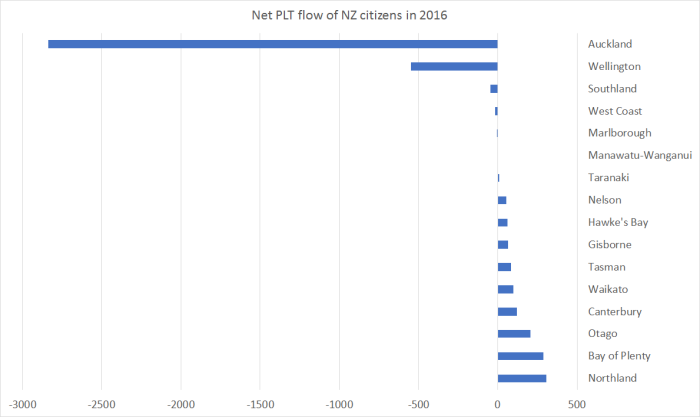
Yesterday I was filming an interview in which one of the questions the interviewer asked was whether Auckland house prices could be explained, at least in part, by an influx of New Zealanders, whether returning from overseas or moving to Auckland from elsewhere in New Zealand.  I noted that the data actually still showed a net outflow of New Zealanders from Auckland to other countries in 2016 (albeit much smaller than in earlier years), and that Census data had suggested a modest net outflow of Aucklanders to the rest of New Zealand since the mid 1990s, and that that pattern seemed unlikely to have changed in the years since the last census.

All of which got me curious.  If New Zealanders were still (net) leaving Auckland for abroad, what was happening in other regions of the country.  Were there places where there was a net inflow of returning New Zealanders?   As it happened, the answer proved to be most of them.

plt-by-region

Auckland and Wellington were, in fact, the outliers.

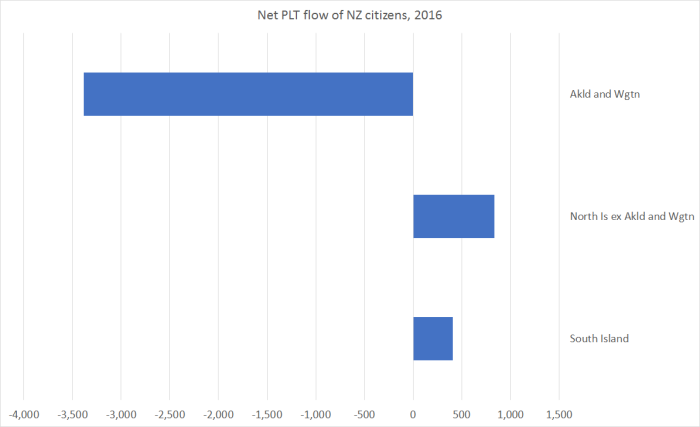
Here is a  more aggregated look at the same data.

plt-by-agg-region

New Zealanders (net) came back last year to the rest of the North Island, and to the South Island, but not to Auckland or Wellington.

I wouldn’t want to make too much of it.  It is, after all, one year’s data, and has all the pitfalls of the PLT data (self-reported intentions and all that).

But it did bring to mind some analysis from The Treasury that I highlighted a couple of weeks ago

As agglomeration and clustering theory predicts, our more urban services-based regional economies (Auckland and Wellington and to a lesser extent Christchurch) are relatively more productive and generate higher incomes than our more resource-based regional economies.

Our Treasury preference is usually to encourage or permit the continued concentration of economic activity in key centres (forces of agglomeration) where returns are expected to be greatest.  Resources and activities should be allowed to flow betwen regions over time.

New Zealanders don’t seem to have been convinced by our officials’ analysis of the prospects and opportunities within New Zealand.

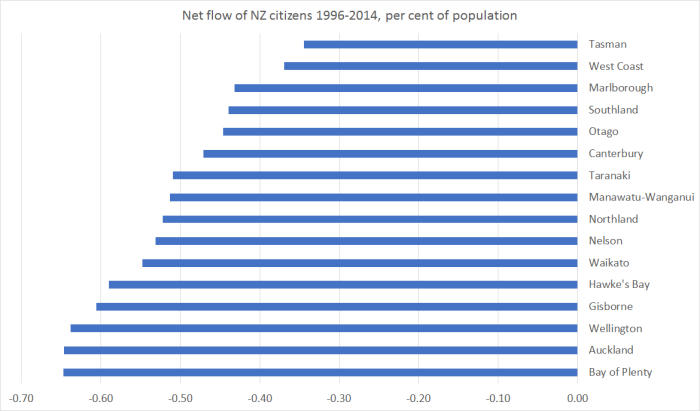
What about over a longer period?   Here is the average annual net outflow of New Zealand citizens from each regional council area, as a per cent of that region’s population each year, for the period 1996 to 2014 (ie from when the data start to just prior to the current sharp reduction in the overall outflow of New Zealanders).

plt-net-flow-96-to-14

Wellington and Auckland were losing just over 0.6 per cent of their population each year as New Zealand citizens left those regions for abroad.  But so were the Bay of Plenty and Gisborne.    (What is, perhaps, more striking is how much lower the net outflow rate abroad was from the South Island).    And in the last year, New Zealanders flowed into Gisborne and the Bay of Plenty, and they still flowed out of Wellington and Auckland.

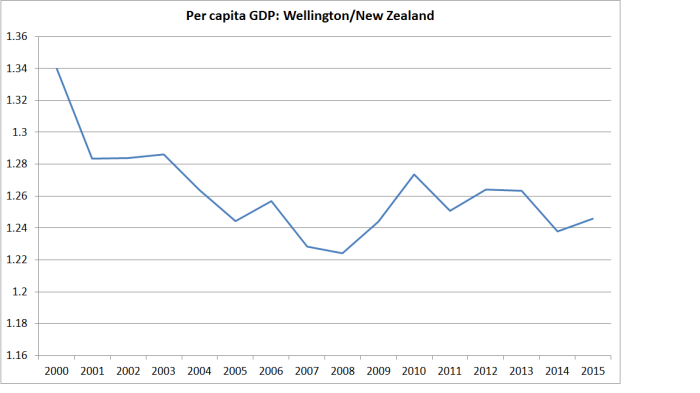
I can think of various stories why this might be.  Auckland, presumably, has the highest share of naturalised citizens, and perhaps there is more of tendency for those new citizens to leave, than for natives?  But if so, it doesn’t explain the previous 20 years of Wellington, Bay of Plenty or Gisborne.   And while house prices are ruinously high in Auckland, they are nowhere near so bad in Wellington.   Perhaps there is something in a story about Auckland and Wellington people being more “internationally connected” – but again, over almost 20 years, the outflow rates were the same in the Bay of Plenty and Gisborne.   And perhaps, for all the talk of agglomeration opportunities, and a focus on Auckland and Wellington, the economic opportunities, and overall prospective living standards, just aren’t really there in Auckland and Wellington.   The regional per capita GDP data certainly support that story for Auckland.

Perhaps the patterns will change again this year –  and there is quite a bit of year-to-year variation in the regional outflow rates –  but for now, despite all the talk of “problems of success“, or “quality problems“, the migration data suggest New Zealanders when deciding whether to stay or go, and where to come back to if they do, don’t seem to share the sense of Wellington and Auckland as success stories.

Other interpretations/perspectives most welcome.

Wellington rental market: a problem of success?

I’m a bit tied up with other stuff today, so will come back to the New Zealand Initiative’s immigration report next week.  But in the meantime, I was somewhat taken aback to see the Prime Minister quoted as describing the current squeeze on the Wellington private rental market as “a problem of success“.

Sadly, it is like some line lifted directly from the John Key playbook.  I wrote last year about the then Prime Minister’s ludicrous, and frankly insulting to the intelligence of ordinary citizens/voters, attempt to pass off the extraordinary pressures on Auckland house prices and infrastructure, including traffic congestion, as “quality problems”.  In fact, what they were –  and are –  are failures of central and local government to get the land supply market functioning effectively, having over-regulated it in the first place, interacting with central government’s decisions to keep on bringing in lots more non-citizen immigrants.

How does the new Prime Minister justify his insouciance about the Wellington situation?

However, English said the demand for rentals was “a problem of success”, which the Wellington City Council was already trying to address.

“It’s actually a long time since Wellington has felt the pressures of growth – the Government’s investing large amounts of money in the infrastructure…

“The council has shown that it understands for the first time in a number of decades, there is pressure on the housing stock and they are enabling more houses to be built because that’s the only way that they’re going to see a bit less pressurised.”

Damage to Wellington office buildings from last November’s Kaikoura earthquake had also had “a bit of a flow-on effect” to the city’s accommodation, English said.

Although the large lines were “certainly concerning for people who are looking for accommodation”, they did not show a crisis as the housing shortfall was well understood by the council.

Wellington hasn’t experienced pressure in its market for quite some time and as long as they respond quickly, they’ll be able to deal with it.”

I presume not even he is arguing that the earthquake effects were a problem of success.

I was a bit puzzled by the infrastructure spending line.  I’m looking forward to trying out the new Kapiti expressway, but the biggest local infrastructure spend is on Transmission Gully,  the total uneconomic  new motorway on the outskirts of the city.  Perhaps that might, in time, help ease housing pressures in Wellington city, if people could get in more easily from Kapiti, but then I recall a commenter a while ago pointing out how little land Kapiti had actually zoned as residential.

But what really puzzled me about the PM’s comment was that it was a long time since Wellington had felt the pressures of growth, as if this was the dawn of some new renaissance of Wellington.  But here are the population growth data for Wellington city (where the pressures seem to be), greater Wellington (Wellington, Upper and Lower Hutt, Porirua and Kapiti) and New Zealand as a whole.

wellington-popn

Wellington city has had population growth rates very similar to those for the country as a whole –  Wellington city grew faster than the country as a whole in the previous population surge in the early 2000s, and has been just slightly behind in the last few years.  As for the “greater Wellington” region –  a more comparable basis to compare to Christchurch or Auckland –  there has certainly been a rebound in population growth in the last few years, but it continues to lag behind New Zealand’s population growth rate as a whole.  In only two years in the 20 shown here has greater Wellington’s population growth exceeded that of the country as a whole, none of them in this decade.    House prices rose rapidly in Wellington in the 2000s boom, and they are doing so again now.  It just looks like the same old shared central and local government failure.

I’ve written about rents previously.  In a well-functioning urban land supply market, a substantial and sustained fall in real interest rates should be expected to result in rents falling.  Actually, what has happened –  and still appears to be happening in Wellington –  is that real rents have been rising: not as much as house prices have certainly (rental yields have been falling), but they;ve been rising when, if governments hadn’t so badly messed up the housing market, they’d have been falling.

But, says the Prime Minister, not to worry: the Wellington city council is apparently on the case and moving to resolve the problem.    Really?  They didn’t do anything very much in the previous boom, and I haven’t seen much sign of far-reaching reform this time round.  Last week, they announced a plan to build more “social housing” –  which might or might not be a good thing in time –  but I’ve seen little sign of any sort of serious reform of the land supply regulatory situation.

Immediately after the local body election late last year, I wrote about the prospects for housing supply liberalisation in Wellington.

Sadly I don’t expect much.  Here is the housing policy of the new Labour Party mayor of Wellington.

For starters, I’ll be sending a bill through to parliament to make rental WoF a reality in Wellington. If you’re paying rental for a house it’s only fair that house meets basic standards. Living in a warm, dry house that’s free of mould should be a right for every Wellingtonian.

I’ll also invest in social housing, so there’s more available for the people who need it most. This means a long term building program, partnering with third sector housing providers to increase the number of live-to-own dwellings. It also means improving the 2500 existing Wellington council owned social housing units, making them safer and better to live in. 

But that’s not enough. It’s vital that we look after those in need, but we also want Wellington to grow and prosper. That’s why I’m offering a $5000 rates rebate for anyone building their first home in Wellington. Newer homes means better quality homes, and Wellington needs to encourage fresh young talent and new families to move here if we want to keep thriving. 

Plus, I’m committed to establishing Build Wellington, an urban development agency that will utilise existing green-field land holdings for affordable, good quality residential development in the tradition of state and Council housing in years gone by.

Nothing, at all, about freeing-up land supply, just more statist “solutions”, and a local version of the sort of first home buyer grant central government offers –  the sort of tool that has been proved, time and time again, to do precisely nothing to improve housing affordability.

And this is the Council that the Prime Minister thinks is going to quickly resolve the stresses?    Promising to make renting more costly, and offering subsidies to first home buyers to bid up the price of houses

In truth, Wellington’s situation looks a lot like the situation in the country as a whole –  a milder form of Auckland’s stresses, with 2 per cent population growth at present rather than 3 per cent.  There is no sign that housing stresses are a result of some great Wellington renaissance, but rather it looks like the outcome of the same old mess: land use regulations imposed and enabled by central and local government combined with a fresh wave of fairly rapid population growth.  Some of that is about a drop in the number of New Zealanders leaving Wellington –  only about 800 last year – but much of it is, in effect, down to central government’s non-citizen immigration policy.

What Wellington house prices have come to

A real estate agent yesterday sent me a PDF showing all the recent house sales in southern and eastern Wellington.

This one caught my eye

rintoul st.png

It is tiny, by almost any New Zealand standards.

It caught my eye because it is almost over the road from the school one of my daughters goes to, and because a fellow parishoner had spent her adult life in the almost identically small next door house.

Not only is the house tiny, but the section is pretty small by any standards.  No great redevelopment opportunities, unless (I suppose) someone managed to buy up the whole row of tiny houses.

Berhampore isn’t such a bad location I suppose.  It is an easy walk to the hospital or to Massey’s Wellington campus.  And I guess one could walk to work in town. The distance from this house to, say, Unity Books in Willis St is about the same as the distance from the Mt Eden shops to the Auckland Unity Books in High St.   But…….Berhampore is not Mt Eden.  It is slowly rejuvenating, and is apparently very popular among Green Party voters, but it will always have small houses, tiny sections, and rather a lot of council/state housing (oh, and the Satan’s Slaves are almost over the back fence).

And yet this tiny property went for $633,500.

Out of curiosity I checked out the real price I paid for my first house in 1989.  It was another couple of kilometres out of town, but the house was bigger, it was a couple of blocks from the beach, and the section was about three times the size of the Berhampore one.  In 2016 dollars, that house cost me $282000.

People in central and local government –  ministers, mayors, councillors, relevant officials – should really be hanging their heads in shame, at having so badly messed up housing and land supply markets to have produced such an atrocious situation.  Sadly, shame now seems like a foreign concept to those who do so much (always well-intentioned, but good intentions are never enough) damage to the prospects, and reasonable expectations, of our younger generations.

Wellington airport and the runway extension

Fairfax’s Hamish Rutherford had a substantial piece in Saturday’s Dominion-Post on the proposed Wellington airport runway extension, under the heading If we build it, will they come? (a rather similar title to my own first post on the airport last year).  It seemed like a fairly balanced article, covering many (but not all) of the key uncertainties about the project.   Most of them wouldn’t be a matter for public concern if this was to be a privately-funded project, but it isn’t –  and everyone agrees on that.

There was an interesting quote to that effect at the start of the article from airport company chair Tim Brown.

As Tim Brown tells it, the first time he discussed a “back of the envelope”-type analysis of the cost to extend Wellington runway with the airport’s chief executive, Steve Sanderson, the conversation was “completely negative”.

…..Brown had just been presented an outline of a $300 million project, aiming to enable non-stop long-haul flights to the capital.

However, the  potential gains to the airport (two-thirds owned by Infratil, the rest by Wellington City Council) were likely to see a boost in profits that would only justify it investing around $100m.

Whatever the final costs of the project might be (and the estimates are unmoved in the years since), Brown was clear about the chances.

“Literally within 10 seconds I said: ‘So what? What do I care? We’re not going to do that, are we?’,” Brown recalled this week.

This isn’t a project that might need the last 10 or 20 per cent of the cost picked up by the taxpayer/ratepayer to make it viable.  Instead it only works –  even on their own numbers –  if the Crown/WCC picks up two-thirds of the capital cost (and ratepayers have already paid millions of dollars to get the proposal this far).  This is a politically-driven project at least as much (and probably more) than it is a WIAL/Infratil one.

The whole process is getting underway again now, both because the airport company (WIAL) has restarted its resource consent application, and because now that the election is past the ability of citizens and ratepayers to hold in check the big spending “boosterish” tendencies of the mayor and councillors is diminished considerably.  It is difficult to tell quite what the balance of the council now is, but the new mayor has been at the forefront of the various “booster” projects the Council is spending money on, and one councillor who was vocally opposed to the extension in the previous term is no longer on the council.  WCC’s track record –  of wanting to “do something”, spend money on big ticket initiatives, often with little or no public scrutiny (sometimes not even with scrutiny from councilors) – is pretty disquieting.

Presumably under some pressure during the election campaign, the new mayor Justin Lester modified his stance somewhat in responding to pre-election candidate surveys.

I have committed to seeking the resource consent for the airport extension project. It’s too early to say whether the project will proceed because the following three caveats will need to be satisfied before it proceeds:

1. Resource consent approval

2. Financial support from Central Government

3. Commitment from airlines to fly direct routes to Asia.

This is a 50 year project and needs careful consideration before any decision is made.

On the face of it, that looks like a fairly insurmountable set of hurdles.  It is very unlikely that any airline is going to give a commitment to fly direct long-haul routes between Asia and Wellington in advance of (multi-year) construction even starting –  they couldn’t know what would happen to fuel prices, the world/regional economy or the like in the intervening period.    That is especially so given the expressed lack of interest in flying long-haul from Wellington from the one airline that always will be flying New Zealand routes, Air New Zealand.

And, to date, central government seems to have been commendably non-encouraging about any suggestion of central government financial support.

So what –  beyond the track record of poor quality secretive spending – makes me uneasy about the Lester-led Council?  First, Lester knows very well that he won’t get commitments from airlines before the Council has to make decisions on whether to fund the runway extension –  but he might get non-binding expression of interests, which could be politically spun to sound a bit like commitments.  Second, the government has a  track record of ending up funding uneconomic infrastructure projects, including ones it initially poured cold water over.  One could think of Transmission Gully, or KiwiRail, or Northland (by-election) bridges or –  perhaps most concerningly – the City Rail Link in Auckland.   With a modest budget surplus to be subject to an electoral auction next year, is it so inconceivable that the government could change tack (government built houses and immigration last week) and throw $100 million in the direction of the runway extension?  Compared to the spending on Transmission Gully, it would be chicken feed.

And while Lester is quoted extensively in the Fairfax article, neither of the conditions in the pre-election quote above (airline commitments, central government funding) is repeated.  [UPDATE: I gather they are still part of his set of pre-conditions]

So ratepayers beware.  Citizens beware.

In the Fairfax article, Lester tries to blunt possible ratepayer concerns by suggesting the bulk of any Council funding should be raised from business rates rather than from residential ratepayers, because “the majority of the benefit would go to the business sector”.  That might sound superficially plausible (if there were material benefits at all) but the mayor seems unaware of the notion of tax incidence: that the party who writes the cheque to pay a tax or rates bill isn’t typically the party that bears the economic cost.   Much of any company tax is actually borne, over time, by workers –  because less investment occurs than otherwise, and wages are lower as a result.  Just as renters bear some/much of the incidence of rates bills paid by landlords, we should expect that the wider pool of Wellington citizens would bear much of the economic cost of higher business rates to fund an airport extension, even if no non-business ratepayer ever has to increase their direct rates bill.  This is an issue that should bother all citizens, not just business ratepayers.

A lot of the decision-making should turn on a robust cost-benefit analysis of the proposal.  WIAL and the Council have commissioned their own analysis, which suggests large positive national benefits.  Not many people who have looked carefully at the numbers have found their numbers persuasive.  Justin Lester seems to suggest this is all about self-interest

“I’m not going to have people telling me and telling Wellington and telling our council what we should be doing because of their own interests.”

If one wanted to descend to a similar level, one could ask about the incentives on and interests of councillors –  spending other people’s money on big ticket projects.  But, perhaps more importantly, advocates like Lester would do better to front up and explain why they disagree with specific points raised by critics –  whether those critics are representatives of the airline industry, or other commentators and economists.

In the last few weeks, questions have begun to surface about the estimated cost of the runway extension itself.  In a private sector project, citizens wouldn’t need to worry too much.  After all, if the company proposing the development gets it wrong, its own shareholders will be the ones who lose money.  But this is a project where large amounts of ratepayers/taxpayers money will be at stake, and where it isn’t clear how well aligned incentives really are.  The construction estimates are being done for WIAL, which has already concluded that it would only be worth them putting in around $100 million.  If the project is to proceed central or local government will be on the hook for the rest.  Mightn’t the incentives at present be to keep the construction estimates to the low end of a possible range?  Doing so might (a) increase the chances of getting a resource consent (since, sadly, the Environment Court needs to do an economic appraisal) and (b) increase the chances of getting central and local government approval to proceed, with political commitment to the project, with any later cost-overruns perhaps largely falling on those parties.

My own unease has been around three main points; developed in earlier posts:

(a) the large assumed increase in long-haul visitors to New Zealand, simply because of an option to fly long-haul into Wellington (rather than Auckland or Christchurch.

(b) the very large assumed “wider economic benefits” assumed to flow from such increases in visitor numbers, even if the passenger projections were accurate, and

(c) the discount rate being used to evaluate such gains (many of them decades into the future).

I dealt with the visitor number points in this post late last year.   The WIAL cost-benefit analysis uses passenger projections which assume an increase of 200000 visitors to New Zealand (building up over time) simply because it becomes physically possible to fly long haul into Wellington.   That seems implausible.  In his own look at the passenger projections, Ian Harrison of Tailrisk Economics, noted that the numbers assumed that within 20 years 30000 more Americans a year will come to New Zealand simply because they can fly directly into Wellington.   One can imagine a few more might want to arrive via Wellington, but is it really credible that so many more will come to New Zealand as a whole?  Perhaps more startling were the assumptions for “other Asia” (ie other than China and Japan).  At present, only around 30000 people come from those countries to Wellington in a year.  The projections assume that putting in a runway allowing long-haul flights will provide a boost of an additional 105000 visitors annually within 20 years.  Were Wellington Florence, perhaps it would be a credible story.  As it is –  and even with some more marketing spending and a heavily subsidized new film museum – it just doesn’t ring true.  Long-haul passengers don’t come to New Zealand for its cities –  the cities are mostly gateways, and in the case of the lower North Island, Wellington isn’t the gateway to much.  (And yes, I can see the South Island as I type, so perhaps there is a small “gateway to the South, by slow ferry” market).

I touched on the “wider economic benefits” and the discount rates in this post. Here are some extracts from that post:

But much the biggest issues relate to the possibility of benefits to New Zealand from additional foreign tourists buying real goods and services in New Zealand.  Sapere appear to have estimated a total for the likely increase in tourist spending in New Zealand and then subtracted an estimate for the cost of providing those services.  For that they have assumed that 45.5 per cent of the expenditure is domestic value-added (ie returns to labour and capital).  That approach doesn’t seem right and generates highly implausible estimates.

The producer surplus is the gain to the provider of a good or service over and above what he or she would have been willing to provide that service at.   The cost of providing the service includes the cost of intermediate inputs (materials etc) but also the cost of the labour and the cost of capital (a normal rate of return).  If the producer sells product at that cost, there is no producer surplus. In this context, there is no net economic benefits –  economic costs have just been covered.

Over the long haul, in reasonably competitive markets, producer surpluses should be very small (in the limit zero).  For a hotel that budgeted on 80 per cent occupancy, a surprise influx of visitors for the weekend will generate a producer surplus –  the windfall arrivals add much more to revenue than they do to costs of supplying the service.  But over the long haul –  and the airport project is evaluated over the period out to 2060 –  it is fairly implausible that there will be any material producer surplus resulting from well-foreshadowed increases in visitor numbers.  Most of what tourists spend money on in New Zealand are items such as accommodation, domestic travel, and food and beverage.  In all those sectors, capacity is scalable.  One would expect new entrants just to the point where only normal costs of capital were covered.  In the long run, supply curves for most of these sorts of services/products should almost flat.

My proposition is that there are few or no producer surpluses likely to arise from a trend increase in foreign tourism as a result of extending Wellington airport.  But even if there were, any such gains would have to be offset against the loss of producer surplus for New Zealand producer (to foreign producers instead) from New Zealanders taking more holidays abroad.  It makes little difference to the hoteliers if I take my holiday in London instead of Queenstown, while at the some time someone in Manchester takes his in Queenstown instead of taking it in London.

Even if the consultants are right that there would be more additional inward visitors than outward, any producer surpluses from either set of numbers should be small.  And the net of two small offsetting numbers is even smaller.

The safest assumption, in evaluating the WIAL proposal, is to assume that the economic benefits of the proposal all accrue to users, and that there are no material net economic benefits (or costs) to the rest of the community.  Perhaps there is a small amount in the net GST flow, but it is hardly worth focusing on given the scale of the other uncertainties.

Perhaps this point will seem counterintuitive to lay readers and city councillors.  Surely “Wellington” or “New Zealand” is better off from having more foreign visitors (assuming the numbers outweigh the increased outflow of New Zealanders)?  And if so, shouldn’t we –  Councils, government –  be willing to spend money to get those benefits?   The short answer is no.    Good and services cost real resources to provide, and in a competitive market simply providing more goods and services won’t make the city or country better off –  you need to be able to sell stuff that generates more of a return than it costs to provide (including the cost of capital).  Vanilla products and services typically don’t do that.  After all, labour that is used to provide services to tourists is labour that can’t be used for something other activity.  And over a horizon of 45 years we can’t just assume there are spare resources sitting round unused.  Spending public money to generate this economic activity will come at a cost of some other economic activity being displaced (as well as the deadweight costs of taxation, which are allowed for in the cost-benefit analysis).

If, to a first approximation, there are no “net incremental economic benefits” for the “rest of the community” then even if the WIAL/Sapere passenger number estimates are totally robust, the net benefits of the project drop from $2090 million to $954 million.

It is not as if the new visitors – even if they eventuate –  are likely to be top-end exclusive customers.  Business and government travel –  a significant part of the Wellington market –  is unlikely to be much affected, and any boost to overall visitor numbers seems likely to be mostly tourists, consuming fairly vanilla, easily replicable, goods and services.

And what of the discount rate?

It is very unlikely that any private company (or shareholder) would evaluate such a risky project using anything as low as a 7 per cent real cost of capital.  On the WIAL/Sapere numbers, even raising the discount rate to 10 per cent –  a fairly typical cost of capital for Australian companies according to a relatively recent survey by the RBA –  roughly halves the value of any net benefits from the project (even if all the other assumptions about passengers numbers, and “wider economic benefits” are in fact well-founded).  But this runway extension seems much riskier than the typical investment project –  it is location-specific, not usable for anything else, and relies on assumptions that involve transforming the nature of the business (ie there is no long haul capacity at present, and no one can know with any confidence how much demand there might be for the service).  It would be enlightening if Infratil/WIAL told us what cost of capital/discount rate assumptions they would use in evaluating such a project if all the risk were on them?  I’m sure, for such a hard-nosed bunch of operators, if would prudently be more than 10 per cent real.

The Fairfax article picks up a number of other points, including some comments from me. In some of those comments, I probably wasn’t as clear as I might have been.

A few weeks ago, Singapore Airlines –  assisted by a non-transparent Wellington City Council subsidy –  began flying several times a week between Singapore and Wellington, with a stopover in (of all places) Canberra.  No one know whether those flights will succeed (SIA reportedly wants to move to daily), and become viable without ongoing Council subsidies.  That uncertainty is reflected in the article.  Tim Brown from WIAL seems to believe that if the route succeeds, and attracts a larger proportion of foreign passengers, it would tend to support the case for the runway extension.  Justin Lester seems a bit nervous

Like the airport company, Lester also appears to concede that if the Singapore Airlines flights do not show the demand its supporters hope, it would be bad news for the runway extension.

“People are getting on and off these planes four times a week and if the demand doesn’t go up to seven times a week, you know, we won’t need to do it,” he said, quickly adding that this would be a “strong indicator” rather than proof the runway extension was not worthwhile.

I was quoted along similar lines

Would strong success of Singapore Airlines’ new route, with a high proportion of visitors, help prove the case of the missing passengers?

For a man who freely admits he is naturally sceptical about most public infrastructure projects, Reddell is surprisingly open to the idea.

“If they can make that route viable without larger public subsidies than they’ve got then I think that would be interesting”, especially given that passengers face being “stuck in Canberra for a couple of hours”.

But with several caveats.  First, even if the Wellington-Canberra-Singapore route proves viable, it only offers any insight on the long-haul issue if a material proportion of the passengers in and out of Wellington are not just Wellington-Canberra passengers (although it seems unlikely that a daily 777 flight just Wellington/Canberra would be economic).

Second, if such flights prove viable with the current runway, that is great. All involved are likely to gain.  But that is different proposition than spending  (an irreversible) $300 million on a new runway.  As I noted

However, Reddell adds, this may only prove Brown is right about the problem being a lack of marketing, without proving the airport extension itself was needed.

“I would open up the argument, [of] let’s subsidise some more flights, and if they don’t work we can shut them down, whereas with the $300m runway extension, it’s a sunk cost,” Reddell said.

“The great thing about marketing is you can shut it off. You can’t do much with a runway extension” that doesn’t work out.

In the cost-benefit analysis, one of the options they looked at was a big increase in marketing expenditure.  It produced net benefits not that much smaller than those purportedly on offer from the runway extension, and could be re-evaluated constantly, rather than being irreversible.

If central and local government do go ahead and fund the extension, it wouldn’t surprise me if 10 years hence there were a few long haul flights in and out of Wellington.  But, of itself, that would prove nothing about the economics of the project.  The financial contribution of central or local government would, no doubt, be treated as a bygone –  with no direct financial returns, and arguable and uncertain indirect ones –  and with a runway in place, and only its own capital contribution to cover, perhaps WIAL could attract a few flights.  That might leave today’s councilors feeling better, as they show the extension to their grandchildren, but is no reason to think that Wellington citizens and ratepayers will have been made better off as a result.

I’ve not touched at all on issues like the possibility that future carbon charges make long haul travel less attractive than it is today, or that rising sea levels might raise questions about Wellington airport more generally.  But they all should bring us back to Justin Lester’s point

This is a 50 year project

and

His “gut instinct” was that the case would eventually be proven, but it could be soon, or it could be decades away.

The costs of waiting simply aren’t that large.  If the proponents are right, the case will look that much more compelling  –  and less risky –  10 years from now.  If they are wrong, (lots of) real resources will have been irreversibly wasted –  and that burden will be felt not just by Wellington businesses, but by all citizens and ratepayers of Wellington.   I’d urge the incoming Council to reflect on that choice, and to take seriously what decisionmaking under uncertainty should mean.
Subsidy city…airport, airlines and the Council

Earlier this week it emerged that the Wellington City Council’s decision to subsidise flights between Wellington and Canberra (and on to Singapore), details of which are still unknown to ratepayers, had been made on the basis of almost no supporting documentation.   There were, so the Ombudsman found, no emails, no cost-benefit analyses, in fact almost nothing at all.    As Stuff reported it:

Documents released by the Wellington City Council show that apart from a presentation made to councillors after the decision was made, the council generated a single two page document, which refers to the subsidy only in passing.

This subsidy could be as much as $8 million over 10 years.

Outrageous as the lack of documentation is, in a way it isn’t really surprising.  This is the Wellington City Council –  and the cabal at the top of the organization –  we are dealing with.  They aren’t exactly known for rigorous and robust policy and analysis processes.

In any half-decent public sector agency, proposing to use public money,  there would have been a proper substantive piece of policy analysis, reviewing the arguments and evidence,  critiquing the reasoning and evidence advanced by the private parties pursuing such a subsidy and, typically, an attempt at a properly quantified cost-benefit analysis.  Not all cost-benefit analyses are very robust, but if officials are forced to write down their reasoning and assumptions at least it opens things up to subsequent scrutiny and questions, based on numbers, not just the hunches or preferences of councillors.

But Wellington City Council doesn’t do things that way.

After refusing comment for several days, the Council’s CEO –  a temporary blow-in from the UK with no obvious expertise in evaluating industry subsidies or airlines – dug his own hole deeper today.

Lavery initially claimed that he had received a six-page report on the funding request written by “my staff”, before acknowledging that the report was actually written by Wellington Airport which had “different interests” to the council.

That looks a lot like a deliberate attempt by the Council to mislead the public.

The council commissioned no work of its own to review the airport’s claims, but could have, Lavery said.

“We could have done that, if we’d felt uncomfortable with it. But we didn’t, so we didn’t. And that’s not uncommon.”

So  he acknowledges that analysis done by the airport company will have been done primarily serving the interests of the airport company  (as it should) but nonetheless saw no reason to commission any analysis of its own, as regards the interests of the Council and the citizens and ratepayers of Wellington.  He didn’t feel “uncomfortable” with the airport company’s short paper.  And why would he?  I’m sure it was written persuasively and Lavery has no known background in aviation matters.  But that is precisely why he (and his bosses) should have commissioned some independent analysis.  Not to have done so might serve his “can do” mentality, but it looks and feels much more closer to dereliction of duty to the citizens of Wellington.

Lavery goes further

“The “paper trail” is the contract itself,” Lavery said.

Later he claimed government agencies often signed contracts without other documentation.

“That’s the way any contract goes. You get in rooms and have discussions. Then you write it up, that’s the way it works.”

Yes, I’m sure all the contractural terms are in the contract itself –  a contract so secret that not even councillors have access to its terms – but that simply isn’t the point.  What matters here is the disciplined process and analysis leading up to the decision to negotiate the contract at all.  And on that, in Lavery’s own words, there was all but nothing.

Of course, it is easy to focus on Lavery.  No doubt he likes the power the leading cabal of Council have entrusted to him .  He even argues that

The amount at issue was a “relatively modest delegation” Lavery said, adding that he had the power to allocate much larger amounts on sewerage schemes.

One is a core ongoing operational function of the Council, the other is a new industry subsidy, in a sector where councils don’t have a great track record.

But in fact the real responsibility here surely rests with the Council itself, and even more so on this particular occasion with the leading cabal –  the outgoing Greens mayor Celia Wade-Brown, the Labour Party Deputy Mayor Justin Lester, and councillor Jo Coughlan.  Lester was apparently a key figure in the discussion over this new subsidy, and Coughlan has chaired the Economic Growth and Arts Committee which seems to deal with such matters.

I suspect that what actually happened is that the airport company –  always keen to attract new flights – was negotiating with Singapore Airlines, who wouldn’t fly to Wellington (making a normal return on capital) without some sort of subsidy. So the airport company approached the senior “booster” councillors, and Lavery, with the idea of a subsidy scheme, all backed up (we are told)  by a six page paper from the airport company.  Lavery won’t really have been acting alone here –  even if he signed the contract –  but giving effect, with no supporting documentation, to the preferences of these key councillors, perhaps especially Justin Lester who will have been looking to the new flights starting around local body election time.

A lot of people attack this subsidy as corporate welfare.  I’m less sure about that. I doubt Singapore Airlines is benefiting much – the deal probably just makes it barely economic for them to trial this odd route.  Probably Wellington Airport, and its shareholders, are directly benefiting, since they make their money from people and planes passing through Wellington Airport.  But the biggest intended gainers really look like the Mayor (then still toying with re-election) and councillors Lester and Coughlan, wanting to be able to sell voters a line that “Wellington was prospering, new connections were growing etc”, all with ratepayers’ money as secret subsidies.   It was certainly convenient timing that the flights started almost to the week when the voting papers went out.

Justin Lester in particular seems to now be feeling some heat.

Lester believed the decision to subsidise the route was a good one, but called on Lavery to release further information.

“I haven’t seen enough information yet” to be satisfied the process had been robust. “I think there should have been more paperwork.”

Easy to say now as people are filling in their postal votes having read the Dominion-Post’s coverage.   But there is no evidence that the Deputy Mayor sought that sort of documentation and scrutiny back when he, and the rest of the cabal, were doing the deal.  Lavery has already told us about the documentation: there wasn’t any, and it is hard to believe that Lester was not aware of that all along.  As I say, Lavery won’t have been acting without political cover.

It is disgraceful all round.  And good reason to be very uneasy about how the Wellington Council will go about evaluating a proposal to contribute to the runway extension (on top of the considerable money already spent).  No doubt they will assure us that for a much bigger commitment there would be much more scrutiny, and much more transparency.  But how much confidence should voters have in such assurances?  Very lirtle, I’d suggest.

A couple of weeks ago, Treasury put out a link to a rather good few pages on a Policy Quality Framework, developed I gather in the Department of Prime Minister and Cabinet.  I can only commend it to the incoming Wellington City Council, and their employee Mr Lavery, as a starting point for evaluating policy proposals.  It is easy to read and digest, but would involve a sea change at the Council.  Evidence, rigour, and documentation have a great deal to commend them.  It is, after all, public money not that of Mr Lester or Mr Lavery..

To end, I’m reproducing a mock Council discussion sent to me the other day by an irate reader, and reproduced with his permission:

Today’s Dom Post on SQ flights left me more than outraged – quite ruined my breakfast
I can imagine the discussion at the Council table:
Councillor A: “ I have an idea – why don’t we increase the rates on struggling widows in Tawa and use the funds to subsidise shareholders in Singapore Airlines”
Councillor B: “Shouldn’t we call for tenders first as other airlines might be interested. After all Air NZ will lose traffic from Auckland?”
Councillor C: “ No we can’t do that – it is commercially sensitive?”
Councillor D: “ Hang on a minute – since when is a subsidy a commercial activity?”
Councillor E: “ Good point – perhaps we should rename it as market development and then the CEO can authorise it without bothering us”
Councillor A: “The taxpayers’ money will bring added business to Wellington – drawn from Christchurch and Auckland. And what is more, these flights will save Wellington business people 40 minutes compared to going via CHC to get the SQ flight from there. That is a big saving”
Councillor B: (the lone slightly more rational member): “ If business folks and others are enjoying a benefit that must be worth something to them – so why don’t we recoup the costs of the subsidy by a surcharge on the tickets for SQ flights?. Actually, come to think of it, the ratepayers are already subsidising all other flights out of Wellington through our involvement in the WIA so we could charge an extra fee on those too”

Councillor A: “ You all seem to be overlooking the multiplier effect; our own analysis (based on data supplied by the WIA and Singapore Airlines) shows a significant net economic benefit to Wellington”

Councillor B: “ But perhaps we should get a slightly more independent, disinterested party to review the business plan?

Councillor C: “No, no  – we can’t do that– remember all this is highly commercial sensitive

But, as I noted sadly to my correspondent, it was, of course, even worse than that. There was no such discussion around the Council table before the deal was signed –  just the inner cabal and Mr Lavery.  Even after the deal was done, councillors –  elected members –  are only allowed access to the terms if they pledge subsequent secrecy.  It is no way to run a government, but sadly it seems all too common in local government.  Wellington might well be no worse than most, but its failings are quite egregious enough.

UPDATE: When I wrote this post I hadn’t read the Herald story, from which this comes

“I think the current debacle in the press illustrates perfectly why it’s not appropriate to have it in the political domain. It gets politicised, and I think a lot of organisations wouldn’t touch us with a barge pole if that happened.”

The Dominion Post has reported the 10-year subsidy is worth up to $800,000 a year, but Lavery would not reveal the agreement, citing commercial sensitivity.

“We don’t want to lose out to competitor cities that would love to have the deal we have with Singapore Airlines,” he told Radio New Zealand.

Two thoughts:

  1.  “politicized” = voters/citizens concerned about how the city council they elect spends their money?    It simply isn’t the business of Councils to be subsidizing flights…..or election campaigns.
  2. “competitor cities”.  Those would be…..?  SQ already fly to Auckland and Christchurch, so was Lavery (and Lester) concerned about somehow “losing out” to flights from, say, Palmerston North to Canberra?


Subsidy city…Wellington airport

At about 3pm, the first Singapore Airlines flight to Wellington, via Canberra of all places, lands at Wellington Airport.  Wellington-boosters, well represented on the Council and the Chamber of Commerce, talk up the first “long-haul” flight to and from Wellington.  All of which would be more impressive if it were not for the ratepayers’ money being (secretly – no information on the amounts or terms of these sweetheart deals, no robust cost-benefit analysis etc) used to make it all possible.    Were the flights financially self-supporting that would be the best evidence of them being “a good thing”.  But they aren’t.  That means (a) a presumption against them being “a good thing”, and (b) a likelihood that they won’t survive for long, at least without some permanent subsidy from the long-suffering ratepayers of Wellington. It probably isn’t a subsidy to the giant Singapore Airlines –  they’ll probably just manage a normal return on capital –  but by quite which canons of social justice ratepayers should be subsidizing government departments (probably the main purchasers of tickets on the Wellington-Canberra leg, and one of the larger sources of international passengers from Wellington) is beyond me.

But at least these sorts of subsidy deals can usually be terminated with not too much notice.  Other cities have tried this sort of thing, and the arrangements have typically fallen over before too long.  There isn’t much irreversibility about them.  The same can’t be said for the proposed Wellington Airport runway extension.  If it goes ahead, very large amounts of money will be irreversibly lost.

There was a very nice, accessible, article out a few weeks ago in City Journal by leading US economist Ed Glaeser.  In “If you build it…..” Glaeser tackles some of the “myths and realities about America’s infrastructure spending”.  There is a lot enthusiasm around, especially in centre-left circles, for more – much more –  infrastructure spending, to “take advantage” of the current very low global interest rates.  Enthusiasts, of course, rarely stop to ask why interest rates are so low, and expected to remain low, but set that caveat to one side for now.   Glaeser reports on a variety of studies on just how underwhelming most government-led infrastructure actually is: too often in regions that are declining rather than ones that are growing, all too often with low payoffs (and massive cost over-runs) at the best of times, and so on.  There are plenty of specific differences between the US situation and our own – we don’t have the Senate, steering funds to lightly-populated states, but then we have by-election promises to build bridges to anywhere –  but I don’t think we have anything to be complacent about.  His penultimate paragraph is relevant pretty much anywhere

Economics teaches two basic truths: people make wise choices when they are forced to weigh benefits against costs; and competition produces good results. Large-scale federal involvement in transportation means that the people who benefit aren’t the people who pay the costs. The result is too many white-elephant projects and too little innovation and maintenance.

Just last week we heard of the latest large cost-escalation in the hugely-expensive questionable Auckland inner-city rail loop.  “Who cares” seems to be the reaction of central (National) and local government (Labour) politicians –  ratepayers and taxpayers will pay.   In Wellington the largest regional roading projects for generations (probably ever) is underway at Transmission Gully.  The economics of the project are simply shocking, but that doesn’t seem to bother our National or Labour politicians.

And then there is the airport extension proposal.  Now, on paper, it might look like a project that might pass some of Glaeser’s tests.  After all, Wellington Airport isn’t owned by central or local government –  although Wellington City has a minority stake –  but by a company majority-owned by some fairly hard-headed infrastructure investors/operators, Infratil.

There are plenty of people around –  including commenters here on previous airport posts –  who will attack Infratil.  I’m not one of them.  Infratil is a private sector business, no doubt pursuing (as it should) the best interests of its shareholders.  And Infratil has been quite unambiguiously clear that the airport extension project simply does not stack up on commercial grounds.  In a comment on this blog six months ago, the chairman of the airport company Tim Brown put it this way:

The Airport extension is forecast to cost $300m. If airport users who get no value from it (people on smaller aircraft, people buying coffee, parking cars, etc) don’t pay anything towards it, then the estimated present value to the airport company from those who do benefit from the extension and do help pay for it may be about $100m. So on purely commercial grounds and avoiding cross subsidies the shareholders are expected to contribute that sum.
Clearly that makes it a dead duck on a purely commercial basis. Who would hand over $300m for something “worth” $100m?

Since Infratil owns 66 per cent of the airport company (WIAL) that would involve them putting up around $66m and the minority shareholder putting up $34 million.

So when people attack the idea of council or government handing over (lots of) additional money to get the project going (in addition to the millions the Council has already spent) as “corporate welfare”, they are simply wrong, at least as regards Infratil.   This project seems to be driven by the Council “boosters”, presumably why they’ve been so ready to spending large amounts of ratepayers’ money on it already.  If some branch(es) of government in fact do stump up hundreds of millions of dollars beyond what is commercially justifiable, some of it will certainly benefit some local businesses, but most of it will simply be money down the drain; spent on real resources to build an extension that simply has almost no economic value.  Other than the exercise commissioned by the airport company itself –  funded by the Council –  no one who has taken a hard look at the numbers regards the claims of large scale economic benefits as stacking up.  Of course, there are plenty of “boosters”, and others who think of (real) long-haul flights from Wellington as a nice idea, but the numbers simply don’t stack up.

Fortunately, it is local body election time.  If it weren’t, I fear the project might be rammed through with as little serious scrutiny as the cosy subsidy deal to fund a movie museum/convention centre in Wellington recently was.  (The movie industry, of course, surviving on large scale taxpayer subsidies).  At present, WIAL has a resource consent application underway.  (Of course, if the project can’t get a resource consent, the economics is irrelevant.)  Somewhat curiously, WIAL recently temporarily put the resource application on ice. This was, ostensibly, to allow them to take account of points raised in the numerous public submissions. I’m a bit skeptical of that story –  surely the submissions can’t have been much of a surprise –  and wonder if it isn’t a convenient way to minimize coverage of the issue during the local body election season.  Perhaps not, but the timing is certainly convenient.

A year ago, I assumed that the Wellington City Council – which hardly ever turns down an opportunity to waste money, and which is in the thrall of an “economic development” mindset –  would simply write the cheque, shifting large amount of ratepayers’ money into a project which  –  while fundamentally uneconomic –  it would not even secure a much-increased ownership interest in.

But as the election season has gone on, I’ve begun to be a little more hopeful that perhaps hard-headed analysis might actually play some role in the eventual decision on Council funding (or indeed, central government funding, where there is little sign of much greater discipline around capital spending).   Our mayoral race is hotly contested, and so there have been plenty of surveys asking candidates for their views on the airport extension.  Here I’m drawing mostly from a survey done by my local residents’ association.

Somewhat encouragingly, of the eight mayoral candidates not one is now unambiguously in support of spending lots of ratepayers’ money on the runway extension.

One of the mainstream candidates –  centre-right councillor Nicola Young –  is outright opposed

 Opposed. Initially I thought it should funded in line with its ownership (Infratil 66%, WCC 34%) but now I believe it would be a $300million folly. Subsidising international airlines is very costly, as Christchurch Airport discovered when it paid Air Asia X millions to get direct flights to Asia; the flights were cancelled after nine months

Another sitting councillor, this time from the left, Helene Ritchie, is also opposed

I have repeatedly opposed it and any funding towards it-including Council using rates to support an application by the Company for a  resource consent.

She further offends the elites by suggesting that voters should get to make the final decision on such an expensive proposal

The Environment Court should throw it out. If it is not thrown out, then as mayor I will call for a referendum/poll of the people, on this proposed rates funded $350 million (probably likely $500million) Airport Extension, asking residents, “Do you want to pay for the proposed airport extension? Should rates be spent on “corporate welfare”-an unnecessary airport extension?”

Another candidate –  left-wing economist Keith Johnson, campaigning (I suspect) against waste rather than to be elected –  is also clearly opposed

I am opposed to the project and have submitted a substantial paper detailing my objections to the Environment Court, covering safety, environmental, budgetary and business-case concerns.
I am absolutely opposed to the allocation of $90 million from Wellington City Council to the project, as the proposal essentially constitutes corporate welfare funded from the pockets of ratepayers.

A final minor candidate is also clearly opposed.

Unfortunately, most of the more likely candidates are somewhat more positive.

Sitting councilor Andy Foster probably isn’t going to be mayor, but despite being a typical “booster” most times when it comes to council spending, on this one he has clearly been having second thoughts.

It will depend on whether it can get over some very tough hurdles: consent, demonstrated airline commitment, robust economic case and obtain funding.  If it can, I will support it. If it doesn’t I won’t.  I suspect it won’t.

The election seems set to come down to a race between the current Labour Deputy Mayor (endorsed by the Greens) Justin Lester, the current Labour mayor of Porirua Nick Leggett, and the centrist councillor Jo Coughlan.  All three have a track record of supporting spending (lots of) public money on “economic development” projects, but I am mildly encouraged by how cautious they now seem to have become.

Here is Coughlan

I support the runway extension subject to it getting a resource consent, a business case that stacks up and appropriate funding. If the city does contribute, it should be reflected in our ownership skate. It should not be a donation

On that basis, the Council would end up owning a very large share of WIAL.  It is a middle of the road line, but it is important for Wellington voters to remember that the project is fundamentally uneconomic, and whether any money was contributed as an equity stake or as a “donation” doesn’t change that.  Central government had lots of equity stakes in Think Big projects in the 1980s.  They were all financial and economic disasters.

Here is Leggett, current mayor of Porirua

I support the idea of the runway extension. Wellington has to open itself outwards and create better connections internationally to grow jobs and investment.   I don’t support the council funding the extension beyond its 33% shareholding and if the Resource Consent is not successful – or the Government refuses to offer funding – then the project won’t proceed.

Ah yes, the “idea” sounds good.  But if it were such a good idea, users would pay for it.  That is the market test, usually a pretty sound one.  One gets the impression he doesn’t actually think the project will pass a proper cost-benefit analysis for the Council –  and $200m is a lot of money.  Leggett seems to be looking to central government –  and as he must drive past the Transmission Gully works each day on the way to the office, perhaps that is no wonder.  Wasteful capex is just par for the course –  especially when it could be dressed up in current fashionable rhetoric about advancing (with subsidies) export education and tourism.

And what of the Labour (and Greens –  even though as a party they ostensibly oppose the runway extension) candidate, Justin Lester?  He has been a strong advocate of the project, and was apparently the key figure in securing subsidies for the Singapore Airlines flights to Canberra. But now….

I have committed to seeking the resource consent for the airport extension project. It’s too early to say whether the project will proceed because the following three caveats will need to be satisfied before it proceeds: 1. Resource consent approval 2. Financial support from Central Government 3. Commitment from airlines to fly direct routes to Asia.
This is a 50 year project and needs careful consideration before any decision is made.

So even for Lester this is too big for the Council.  It can only proceed with central government funding.

Perhaps the most encouraging bit is his final sentence.  It is a long-lived project, and the option to delay must be a real one.  Perhaps in five or ten years time we will have a more secure feel for, for example, the viability of the new Singapore flights.  And –  for those more environmentally inclined than I am –  there is always the question of sea-level rise to consider, for a very low-lying airport.  Perhaps we could have another look in 20 years time?  Who knows, by then the benefits might be so overwhelming the users might even pay for the project?

In our council system, even mayors have only one vote.  Whichever of these candidates gets elected the project might still get significant additional council funding, or not.  And as central government has a terrible record of pouring money down sinkholes –  Transmission Gully, KiwiRail, probably the Auckland CRL etc – it might get funding from there even if the Council isn’t willing to stump up much.  But it is at least slightly encouraging that the mayoral candidates, reading the tea leaves of voter attitudes, have all either come out opposed to the Council paying for the project, or hedging support around with some tests that will be very hard to pass.

I’m not usually a single issue voter –  and the debacle of the Island Bay cycleway still concentrates the mind in other directions at times –  but this time I am.  There is simply too much money at stake, to allow boosters with the public cheque book to pursue their field of dreams vision for Wellington airport.

(For those wondering, I have  not run out of ideas or enthusiasm, just energy. I hope to be back to normal soon.)

UPDATE: From page 35 onwards of this Chamber of Commerce survey there are fuller statements of each candidate’s approach to the runway extension issue.   There isn’t anything very different than in the quotes I’ve included above, but for those interested the more detailed responses are worth consulting.  I strongly agreed with this line from Andy Foster

As much as possible all information pertinent to the decision should be made available to the Wellington community so that it can be scrutinised by everyone.


Wellington Airport: a factual high level summary

This morning’s Dominion-Post features a full page advert, notionally inviting people to make submissions on the resource consent application to extend the runway at Wellington Airport.

In fact, the advert is mainly an opportunity to tout the case for the hugely-expensive proposed extension –  in what must be one of the most expensive locations in the world in which one could add 300 metres to a runway (and still not comfortably meet international safety guidelines).  The pretty graphic highlights 20 Pacific Rim cities which planes could reach from Wellington –  without ever mentioning that the most likely outcome, if the project succeeds at all, is flights once or twice a week to one or two of them.

All one really needs to know about the proposal is that the owners of the airport think the project is sufficiently unattractive that there is no way they would proceed with the extension if it involved investing their own money.

The owners –  WIAL, majority-owned by Infratil – have been quite clear that the project will only proceed, even if it gets resource consent, if there is a massive public subsidy –  huge contributions from some combination of local, regional, and central government that would not be reflected in a commensurate ownership interest in the airport.  But there is no mention, at all, of this fact.

In a little note at the bottom of the advert  it is described as a “high level factual summary of some of key effects from the extension”.   I did spot the odd fact in the advert, but mostly it was boosterish opinions, clothed in consultants’ reports – and  all summarized in the huge alleged national benefit estimates.  I’m deeply unconvinced by the economic case for this airport runway extension –  the benefits appear to be overstated, and the discount rate used to evaluate them seems too low – but would have no real objection if private shareholders were paying for it.  But they aren’t.

I wrote a few posts about this proposal late last year, here, here, and here. Ian Harrison, at Tailrisk, has a nice piece here on the same issue.

I’m not making a submission.  As a matter of principle, I don’t think the Resource Management Act should be used to block business developments, unless there are compelling environmental grounds –  and I have no expertise in environmental issues, and am interested only to the extent Lyall Bay remains a pleasant spot for the family to swim.

The real debate should be around decisions new local and regional councilors consider making about injecting public subsidies to this operation (over and above what has already been spent). The quality of public sector investment spending is typically quite poor, and around the country airport investments (see eg Rotorua) are no exception.   As the local body elections are just weeks away, the focus needs to be on the attitude towards the project that each candidate takes.  So much money is involved, and attitudes to this project seem to reveal so much about candidates’ views on the role of local and regional government, that for me it will be a defining issue.  I will be seeking out candidates who are clearly opposed to spending public money on the extension.  In the huge field of mayoral candidates there appear to be a couple of options –  but their fine print needs checking out.  I haven’t yet done my research on the council and regional council candidates.  I encourage greater Wellington readers –  because although the Wellington City Council has been driving this, they’ll be looking for money from other local authorities in the region –  to prioritise this issue.

My fear is that once the election is over, there will be a behind-closed-doors process rushed through, with no rigorous evaluation of the economics of the project.  Cheer-leading from the local business community –  always keen on the sort of public subsidies and activities that don’t face the market test that keep Wellington afloat – reinforces the risk.

Wellington…still growing sluggishly

There was an annoying story on the front page of the Dominion-Post this morning.  The online version of the story is headed “The big squeeze: Wellington’s population could almost double in the next 30 years”, a proposition which appears to be based on nothing more than compounding last year’s estimated population growth for the Wellington city area.  I suppose anything could happen.  The annual immigration target could be doubled or trebled, central government could go on a massive expansion path, or the private sector could discover hitherto untapped opportunities in Wellington.

But if Wellington has outstripped Dunedin over the years, it has hardly managed strong growth.  I went back to my 1913 New Zealand Official Yearbook.  Back then, greater Wellington made up 17 per cent of the total population of the 14 large urban areas (a group made up of the places that were largest then, and those which are largest now –  eg in 1913 Hamilton and Tauranga barely figured, while Gisborne and Timaru did).  Today, the population of greater Wellington (including Kapiti) is about 14 per cent of the population of those 14 urban areas.

population shares wgtn

More recently, SNZ reports estimated data for urban area populations from 1996 to 2015.  Over that period, even Wellington city’s population growth has only slightly exceeded population growth for the country as a whole  –  and been ever so slightly slower than population growth in Nelson.  Take the greater Wellington area and population growth has been slower than that in greater Christchurch, despite the massive disruption from the earthquakes.

population growth since 1996

I’m not sure that this should greatly surprise anyone.  Wellington has been helped by the growth of government (the regulatory state needs staff and it keeps growing, even if the tax share in GDP doesn’t) and by happening to have industries which it remains fashionable to subsidise (the film industry).  On the other hand, it has a somewhat bracing climate –  albeit one staunchly defended by some true Wellingtonians.    There have been some good market-driven businesses built here, but not many choose (and find it optimal) to stay in the longer-term.

Average GDP per capita in Wellington is higher than that in New Zealand as a whole –  no doubt reflecting some combination of the huge number of professional government and government-dependent roles, and the fact that Wellington tends to be attractive to young people not old ones (it is windy and not very warm).  The labour force participation rate in Wellington averages higher than those in, say, Auckland and Christchurch.  But over the 15 years for which we have regional GDP data, average per capita GDP in Wellington has been growing more slowly than that in the rest of the country (a similar story to Auckland).

wgtn regional GDP

So I don’t really see much chance that the population of Wellington – even just that of Wellington city –  is going to double over 30 years.   Even the Wellington City Council’s “chief city planner” (shouldn’t anyone from outside the old eastern-bloc be embarrassed to hold such a title?) acknowledges it is unlikely.

But the focus of the Stuff article was on the Wellington housing market.    Of course, since it is an article about local authorities perhaps it isn’t too surprising that the word “market” does not appear at all –  not once in a reasonably substantial article.  The Council’s British chief bureaucrat, Kevin Lavery, is quoted instead as saying

Lavery said the 15 people who find themselves sitting around the Wellington City Council table after October’s election will have some big decisions to make on the supply, quality and diversity of housing in the capital.

Which really sums up all that is wrong with our system of local government.  Councils and their officials simply should not be in the business of making decisions on the “supply, quality, or diversity” of housing in the city.  That is what we have –  or should have –  markets for.  They are the mechanisms through which private tastes and preferences are reflected and private businesses respond to that (actual and anticipated) demand.  We need local authorities to do things like pave the streets, manage the water and sewerage, provide parks, and perhaps even run libraries.  We don’t need them deciding what sort of houses people are living in and where   The problems –  including the affordability problems – mostly arise when officials and councillors get in the way.  Now if Mr Lavery had simply been noting that no one can really predict what future population growth rates will be, or where people and businesses will prefer to operate, and that Council rules need to be sufficiently minimalistic and flexible to enable housing supply to easily respond to emerging demand, I’d have applauded him.  But no, he doesn’t see a dominant role for the market, but for 15 elected individuals, with neither the expertise nor the incentives to get those decisions right –  and that is no criticism of them individually, no one has that knowledge.

But the “chief city planner” is worried.

The danger was that developers would concentrate more on packing people in than on good design. “We’re not out to generate developments and profit margins for developers. We’re building communities.”

Council bureaucrats are “building communities”?  The mindset is really quite starkly on display.  In market economies, profit margins are part of what makes people willing to take risks, and build businesses –  even develop new subdivisions or apartment blocks –  taking the risk that things might actually go badly wrong.  But “profit margins” seem anathema to the chief planner.  And “good design” seems mostly to be a mantra to impose the tastes of some on everyone, and raise costs of housing.  Again, why is it a matter for local government?

It isn’t just the bureaucrats. Here is our Mayor, presumably somewhat torn between her Green Party credentials (supposedly sceptical of population growth) and her local authority boosterism.

Wellington Mayor Celia Wade-Brown said she believed her council had done plenty during her six years in charge to set the city up for a population boom.

It had signed off on a number of special housing areas with the Government, and was actively consulting communities in several suburbs on potential medium-density housing rules.

Establishing an Urban Development Agency this year would also help increase the city’s housing stock and keep prices in check, she said. The agency will be able to buy and assemble land parcels, and partner with developers.

It is all about bureaucrats and politicians, not at all about empowering markets.  Nothing about respecting property rights or promoting market solutions –  just put your trust in the Mayor and Council staff.  I’m wryly amused by her references to SHAs. There are a few not far from here.  One –  on the site of an old church –  now has a few townhouses almost completed. A much larger one, not 200 metres from where I sit, remains as overgrown, dark, brooding, and undeveloped as ever.  I’m keen to see it developed – though I know many locals aren’t –  but there is simply no sign of any progress.

I guess the election is coming up and the incumbent isn’t well-positioned but when she can end with the observation that

“When our average house price is $560,000 and the Government considers $600,000 to be affordable in Auckland, then I think our city is looking pretty good.”

it is as if very small ambitions indeed have triumphed.

One only has to fly over Wellington to realise just how much land there is in both Wellington city, and the greater Wellington area.  No doubt, the development costs are higher than those for flat cities such as Hamilton, Palmerston North or Hastings.   But there is little excuse for average house prices of $560000 –  responsibility  for that mostly rests with the mayor, councillors and their legion of planners, aided and abetted by central governments that have allowed councils to have such powers.

The Productivity Commission’s draft report on a new urban land use policy framework is apparently due out next month.  They had a mandate to be ambitious in their proposals.  The Commission has so far shown a disconcerting enthusiasm for giving more powers to councils and governments, not fewer (they are bureaucrats themselves, so perhaps even if disappointing it shouldn’t be so surprising). I hope they take seriously the possibility of largely withdrawing the state (central and local) from the urban planning business.  There was a nice piece the other day from a US commentator, Justin Fox, marking the 100th anniversary of zoning in New York.

It also appears to have been the first set of land-use rules in the U.S. that (1) covered an entire city and (2) used the word “zone.”

That was 100 years ago Monday. So happy birthday, zoning! OK if we kill you now — or at least maim you?

There’s a thought. Put markets, and private contracts, back in the driver’s seat, and let local authorities respond to private sector developments, efficiently delivering the limited range of services we really need councils to provide.  Don’t “plan communities”, but provide services to ones that develop.  (And that doesn’t include airport runways.)