Reserve Bank BIM: resisting reform

Once upon a time, post-election briefings to an incoming minister actually contained some free and frank official advice on major policy issues.  I have sitting on my desk the 1987 Treasury briefing  –  almost 800 pages of analysis and advice (good and bad).   But as the briefings started being  routinely published, it seemed to start an inexorable trend towards documents of astonishing banality, often containing little more than lists of the official ministerial responsibilities and/or the activities of agencies (I just flicked through the BIM of one major ministry, released yesterday, and it was a startlingly content-free zone).  If there still is free and frank advice offered by the public service, you won’t often find it in these documents.  It isn’t helped by the growing practice of writing (or finalising) the BIMs only after the composition of the new government is known, rather than in advance of the election.

Reserve Bank BIMs over the years have tended to go in the same banal descriptive direction.  So I didn’t expect to find anything interesting when I opened up the document released yesterday.  But I was wrong.    The (unlawfully appointed) “acting Governor” Grant Spencer had used the opportunity to make his case for minimal change to the governance and decisionmaking provisions of the Reserve Bank Act, including an eleven page appendix on that specific issue.

At the time of last month’s Monetary Policy Statement, Spencer –  and his deputy, Geoff Bascand –  went public on their opposition to any substantial change.  But they did that just in response to press conference questions.   I summed up their position –  “just cement in the status quo, and if we really have to have externals make sure they are silenced and that there is no greater transparency” –  this way

[their] approach is that of “the priesthood of the temple” –  we will tell you, the great unwashed, only what it suits us to tell you, in the form we want to present it.  It is simply out of step with notions of open government, or with a serious recognition that monetary policy is an area of great uncertainty and understanding is most likely to be advanced by the open challenge and contest of ideas.

In the BIM, they go further and stress how keen they are that any external appointments should be made by the Governor rather than –  as is the case in most other advanced democracies –  the Minister.   They were keen to keep any review of the Act very narrow, and to control the process themselves as far as possible

we would be happy to prepare a draft terms of reference, in consultation with the Treasury

Fortunately, they lost that one and the review is being led by The Treasury, supposedly supported by an (as yet unnamed – or unannounced – Independent Expert Advisory Panel).

But it was that eleven page appendix I really wanted to write about this morning.  They describe even it as a “brief summary” and refer to a more detailed version of the paper being available. I have lodged a request for it, without any great expectation of it ever seeing the light of day (it might, for example, have been logical to have released it when the Minister of Finance announced his review –  logical, that is, if the government or Bank were interested in open government).

The Bank’s first claim is that the current system –  a single unelected decisionmaker, appointed by other unelected people –  “works well” at least for monetary policy, and that the Reserve Bank’s monetary policy “is highly regarded internationally”.    In principle, those are two separate points.  It is hard to imagine the Reserve Bank being held in “high regard” internationally for its monetary policy over the last decade –  whatever sentimental respect there still is for the Bank as pioneer of inflation targeting almost 30 years ago.    Our central bank remains the only advanced country central bank to have launched into two tightening cycles since the 2008/09 recession, only to have to fully unwind both of them.   Perhaps it is the sort of mistake anyone might have made, but our Reserve Bank did.    And the Bank has no more successful than anyone else in keeping inflation close to target –  even though, with interest rates still well above zero, it faced fewer obstacles than most.

The one recent report the Bank attempts to use in its defence is a brief one written earlier this year by an old friend of the then Governor.  I wrote about it at the time.

When an old uncle or family friend is in town and comes for dinner, the visitor will usually compliment the cook, praise the kids’ efforts on the piano, the sportsfield, or in dinner table conversation, and pass over in silence any tensions or problems –  even burnt meals –  he or she happens to observe.    Mostly, it is the way society works.  No one takes the specific words too seriously –  they are social conventions as much as anything.  One certainly wouldn’t want to cite them as evidence of anything much else than an ongoing, mutually beneficial relationship.

It is a shame the Reserve Bank is reduced to publishing, and touting, a report like this in its own defence.  When good old Uncle Philip, a fan of yours for years, swings by, it must be mutally affirming to chat and exchange warm reassuring thoughts.  But as evidence for the defence his rather thin thoughts, reflecting the favourable prejudices of years gone by, and institutional biases against doing much about inflation deviating from target, isn’t exactly compelling evidence for the defence.    Sadly, getting too close to Graeme Wheeler as Governor seems to diminish anyone’s reputation.  It is a shame Turner has allowed himself to join that exclusive club.

In a way, what strikes me most about the Bank’s appendix is the near-complete absence of (a) any critical self-scrutiny, and (b) any sense of operating in a society that expects scrutiny and accountability of powerful public agencies, and not just on terms set by those agencies.

For example, they organise their thoughts around the notion that “the objective of decision-making design is to create a system that leads to rigorous decision making”.  I’m not sure which management textbook they got that from, but it doesn’t sound a lot like the way we should organise things  for making public decisions in a democratic society (internal management decisions in a private company might be another matter).  “Rigour” in decisionmaking is certainly important, but when those decision are outward-facing and have pervasive effects across a country, with no rights of review or appeal, it is far from being the only relevant criterion.   “Legitimacy” for example –  an ongoing sense of public confidence that the agency is being well run, in the interests of the public not just of officialdom – matters a lot.  So should openness.  For many year now our statute books have contained this provision (part of the purpose clause in the Official Information Act).

to increase progressively the availability of official information to the people of New Zealand in order—
(i) to enable their more effective participation in the making and administration of laws and policies; and
(ii) to promote the accountability of Ministers of the Crown and officials,—
and thereby to enhance respect for the law and to promote the good government of New Zealand:

Around their centrepiece –  the goal of “rigorous decisionmaking” –  they circle “four key components”

  • institutional design,
  • high quality inputs,
  • genuine deliberation, and
  • accountable for decisions

There is nothing of interest under their heading of “institutional design”.  As they note, the Governor is legally responsible for all Reserve Bank decisions, and although all Governors since 1989 have operated with advisory committees (the form and names have changed over time), in a single decisionmaker model there is only one Reserve Bank view.   However, it is worth noting that the Reserve Bank remains intensely secretive about the range of internal views or advice ever becoming known, in ways that do nothing to support good decisionmaking, let alone robust scrutiny, challenge, and accountability.

On ‘high quality inputs’, the Bank claims that its decisionmaking “is supported by a broad range of high quality inputs”.  Perhaps, but (a) despite the inputs they’ve still made some bad policy mistakes, which should at least raise questions about the inputs (recognising that in a field like monetary policy, riddled with uncertainty, some mistakes are inevitable), and (b) we don’t know, because they hold all the inputs very closely, and refuse to release any, even years later.   Just yesterday, we had the refusal to release their background analysis on the aspects of the new government’s policy they’ve incorporated in their latest projections.  I once wrote a paper with Grant Spencer to the then Minister of Finance in which we referred rather scathingly to one particular proposal as involving “trust us, we know what we are doing”.  These days, unfortunately, Grant seems to treat it as a practical guide to running a central bank (whether on most regulatory matters or monetary policy).

They claim, only briefly, that their current system produces “genuine deliberation”.  Again, how would we know?   They refuse to release the minutes of the Monetary Policy Committee, or of the Governing Committee, they refuse to release a summary of the individual recommendations on the OCR, and they refuse to release the background papers.  Not just in the weeks after a decision, but even years later. I know, I’ve asked.   How robust, for example, were the deliberations around the ill-judged tightening cycle than began in 2014?  In my observation –  I was still involved at the time –  not very.

Then there is “accountability”, which sounds good, but isn’t really.  Of course, they cite the role of the Reserve Bank Board, and its reports to the public and to the Minister. But this is the same Board that will have appointed the Governor and which, in history, has never openly said a remotely critical word about any Reserve Bank decision.   Perhaps in private they do a really good job  –  in my experience, at times some of them (usually the more awkward ones) asked some useful questions –  but that isn’t serious public accountability.  The Board seems to see their role primarily as having the back of the Governor –  how else, for example, did they stay silent in the face of Graeme Wheeler’s deployment of his entire senior management to try to silence Stephen Toplis?   The Bank goes on to claim (correctly) that the Board is given the materials used to lead up to OCR decisions, but then (outrageously) claims that “a subset of this information is made available to the general public”.  In fact, none is at all.    All we get is what the Governor chooses to allow us to see scrubbed up and sanitised in his Monetary Policy Statement, even though all the background material is public information, produced with public money.    They have a very strange definition of accountability at the Reserve Bank.

(As they do every few months, they roll out an academic paper from a few years ago suggesting that on that particular measure, the Reserve Bank is one of the most transparent central banks in the world.  As I’ve noted previously, there is a big difference between telling us a lot about what they know (almost) nothing about –  eg where the OCR might be in 2020 –  and telling us stuff they do know about (their own advice, analysis, range of views etc). They do the former well, and the latter is almost non-existent.)

The Bank then turns to potential modifications to the Act.   The (unlawfully appointed)
“acting Governor’s” preference is simply to codify the current committee (the Governing Committee, consisting at present of the “acting Governor”, the Deputy Governor and the chief economist).

In earlier incarnations of this idea, the proposal was that the members of such a statutory committee would all have formal voting rights.  But even that –  weak advance –  has now gone out the window and the Bank is now arguing to protect the single decisionmaker model, while putting into statute simply a requirement that the Governor have an advisory committee.  Under their proposal the Governor “would be responsible for the manner in which the Governing Committee conducts itself”.

Frankly, this is a worse than useless suggestion.  The Bank claims it would increase transparency around the decisionmaking process. In fact, the effect would be quite the reverse.  For a good Governor it might make no effective difference.  For a bad Governor, it would allow him or her the fig-leaf of being able to claim that decisions were made in (statutory) committee even though (a) the other members had no formal vote, and (b) all members would be appointed by, remunerated by, and accountable to, the Governor.  The Bank simply shows no sign of recognising the institutions need to built to be robust to bad appointees (because, in every human institution, they will happen from time to time).

Interestingly, they are open to the idea of separate committees for monetary and financial policy.  I’ve strongly favoured that, but recall that the sort of committees they propose are advisory only.  In fact, there is nothing to have stopped them putting such committees in place already.  Arguably, it was actually the way things worked before the Governing Committee was established: the Governor made OCR decisions in the OCR Advisory Group, and financial regulatory decisions in the Financial System Oversight Committee.  Those specialist committees still exist (OCRAG renamed as the – formal –  MPC).

We get to the real concerns –  they know they’ve lost the fight over keeping the single decisionmaker model –  when they come to the question of external members, the decisionmaking approach, and the communications.

On externals, they argue

The extent to which policy committees benefit from external members depends on the nature and objectives of the committee and the conditions associated with the external members’ appointment. Policy committees which have to interpret political objectives or indeed establish goals to be achieved should benefit from having external members. In New Zealand, the objectives of monetary policy are clear in the Act, and through the PTA. For prudential policy, the objectives of soundness and efficiency are clear, but their interpretation requires complex judgement.

To which my reaction is “yeah right”.  No one thinks the prudential policy objectives are clear –  in the sense of easily operationalisable.  There are big choices to be made about goals and instruments (eg around use of LVR restrictions). But actually it isn’t much different with monetary policy.  No one seriously regards the PTA as a document that avoids trade-offs, or involves no judgements –  indeed, wasn’t the “acting Governor” only the other day arguing for more flexibility in interpreting the goals?   More generally, they offer no support –  none –  for their claim that there is a special case for external members where goals are relatively more fuzzy.  External members can matter for a range of reasons, including minimising the risk of external groupthink, and helping ensure that a full range of models/perspectives are brought to the table.

They go on.

Policy making in monetary and financial policy often involves complex considerations based on multiple indicators, analytic models and competing economic theories. Full-time members with experience and expertise are likely to be better suited to this task than part-time external participants.

So you say.  But there are two separate issues here.  The first is about expertise (do we need subject experts only, or a range of perspectives) and the second is about whether the job is fulltime or part-time.   In Sweden, for example, most of the monetary policy committees members are outsiders (often academics or former market economists), but they are appointed to non-executive fulltime roles while they are on the committee (weirdly, this leads the Reserve Bank to claim they are insiders).  As for expertise, the Bank still seems to have made no effort to show that the issues it deals with an inherently more complex, or in more need of specialist expertise at the decisionmaking phase (as distinct from technical advice and supporting analysis) than many other agencies of the New Zealand government (which are typically run by part-time boards, appointed by ministers, with a range of backgrounds).  Even among executives, I don’t imagine the chief economist actually spends much time on financial regulatory matters on which he helps the Governor make decisions in the Governing Committee (at best, he is a part-timer non-expert in that area).

I’ve covered previously the Bank’s preference to avoid voting in committees, and (especially) to avoid any public revelation of differences of perspective.  They claim that

Research into decision-making practices finds that consensus is the preferred decision approach as it allows for more in-depth discussions, the frank exchange of views, more accurate judgement on average, and higher committee morale.

But they neither provide any references, nor engage with the practical experiences of various other advanced central banks that seem to have found a voting plus openness model works well –  I’ve noted previously the cases of the UK, the US, and Sweden.    And, as I’ve noted previously, you have to wonder how local councils, Parliaments, and higher courts manage?  The Supreme Court –  rather more important on the whole than the Reserve Bank –  seems to manage with both voting and disclosure of individual views.  The public –  a priority, if not for the Bank –  seems to be better for it.

Perhaps most extraordinary is the Reserve Bank’s assertion around the appointment process.

In New Zealand, the Governing Committee is a “technical” committee created to carry out the purpose and objectives set out in the Act, the PTA and the MoU. The Reserve Bank is the government’s agent in carrying out its monetary, prudential and macro-prudential policy objectives, and we consider it critical that policy committee appointments be made by the Reserve Bank for their policy competence and not through a political body.

I could understand if they thought that “on balance, we think it would be better” to have appointments made by the Bank itself.  But “critical”……….really?

You have to wonder what makes New Zealand so different from most other advanced countries.    In Australia, the Governor and the Deputy Governor are both appointed by the Treasurer.  In the UK, the Governor and the (various) Deputy Governors are appointed by the Chancellor.  In the UK, the members of Fed Board of Governors are all appointed by the President (confirmed by the Senate). In Sweden, the key appointments are made by the parliamentary committee that oversees the Riksbank.

It is a good practice that major policy decisions should be made only by elected people –  and the Reserve Bank can’t surely pretend their decisions aren’t “major”, including having significant redistributive consequences –  and that where any such powers are delegated they should be made by people appointed directly by elected officials.  Typically, such decisions –  like those of the Cabinet –  will actually be made (legally) collectively.  But for some reason –  that they refuse to state –  the Reserve Bank thinks it should be different.  It shouldn’t.   There are plenty of different models of how Reserve Bank goverance should be done, but a system that keeps single decisionmaking, or which has all decisionmakers appointed by the Reserve Bank itself, should simply be ruled out from the start.

As a final point, the Bank includes a table which they use to support a claim that “about two thirds of the monetary policy committees of inflation targeting central banks have external members”.  It is a pretty shonky table.  For example, they class Sweden as having no external members, when (as noted earlier) most members are non-executive (but fulltime) externals.  They seem to make the same mistake for the Czech Republic, which appears to have several fulltime non-executives.  Weirdly, they claim that the ECB has a majority of outsiders –  but they appear just to mean the Governors of the constituent central banks, who are insiders if ever there were.  But perhaps as importantly, I’m not sure that Armenia, Peru, Hungary, South Africa, Thailand, Guatemala –  none beacons of good governance –  are the sorts of places I’d be looking to for guidance in structuring a robust and accountable decisionmaking system for the central bank.    Not all of the more advanced countries do have externals on their monetary policy decisionmaking committees, but Australia, Norway, Sweden, the US, the UK, Israel, Iceland, Japan, and Korea do.  And of all those advanced countries, only New Zealand and Canada have the sort of single decisionmaker system that the Reserve Bank wants to maintain.

South Africa –  an embattled central bank, facing the increasing prospect of political interference –  doesn’t have externals, but I did find this nice quote on their website

In monetary policy decision-making processes, committees are preferred above individuals. Not one central bank has replaced a committee with a single decision-maker, a fact that has both theoretical and empirical support; the ability to draw diverse viewpoints from constituent members in committees ensures that there is likely to be some moderation of extreme positions and policies and more even policymaking.

Indeed.  We shouldn’t let the Reserve Bank keep such a flawed system, even gussied up with a statutory advisory committee appointed by the Governor himself.   Other countries don’t do it that way –  and our Reserve Bank has far more power than most central banks because of its regulatory functions –  and hardly any other government functions in New Zealand are run that way.

It was good that the Bank included this material in its BIM, rather than just quietly slipping it to the Minister of Finance in a document we didn’t know existed.  It would be better still if they now released the full version of the document making their case. At present, that case is looking pretty threadbare, not informed by either good comparisons or a strong recognition of what open government should look like, and –  if anything –  designed to serve the interests of career bureaucrats rather than of the public.  That’s not too surprising: bureaucrats typically do what they can to protect their bureau.  But it doesn’t make it a good basis for public policy.

As for the Minister of Finance, perhaps he could take a stronger lead by (a) encouraging the Bank to release the fuller paper, (b) ensuring that Treasury releases the Rennie report on similar issues (and associated supporting documents) and (c) actually named the Independent Expert Advisory Panel supposedly playing a key role in the current Treasury-led review of the relevant provisions of the Reserve Bank Act.

Transparency: Bank of England vs RBNZ

Open government –  or the lack of it –  has been getting a bit of attention in recent weeks.  The previous National-led government was pretty poor in that area, and if anything there now seems to be a risk that the current government could be worse.  But at least there is some debate around the issues.  Former Cabinet minister, and now Speaker, Trevor Mallard, had one promising suggestion in an article this morning

“Eventually getting some websites going which contain most of that material, for example, Cabinet papers two months after they’ve been to Cabinet automatically up unless there’s a good reason not to, just that sort of stuff would mean you’d have a lot of access to, actually quite boring information, but access to what’s going on.”

Easy to suggest, of course, when you are no longer a minister.  I hope the new Speaker will be as keen on extending the provisions of an (overhauled) Official Information Act to cover Parliament itself.

The Reserve Bank is one of the bodies that likes to claim that it is highly transparent.    There are plenty of counter-examples –  and occasional examples that might suggest that progress is actually being made –  but I stumbled across an interesting contrast this week between our central bank and the Bank of England, the central bank of the United Kingdom.  Recall that the British public sector was notoriously secretive for a very long time, and our Official Information Act was enacted many years before the UK’s comparable legislation.

In its Financial Stability Report this week, the Reserve Bank released a high-level summary of the results of its latest stress tests on the four major banks.  What they released was interesting enough but there wasn’t much of it; 850 words and a couple of charts.  There was, for example, no information on individual banks –  despite a disclosure-focused system –  and no detail on housing mortgage losses –  despite the active regulatory and rhetorical focus on those risks for the last five years.

Earlier in the week, the Bank of England released its Financial Stability Report, and as part of that they released their latest stress test results.  Their release –  on the stress tests alone –  was 64 pages, with a great deal of detail, on the test scenarios themselves, on the overall results, and on the results for individual banks.   It even has an interesting annex on how markets’ view of banks square with the stress test results.

To be sure, the UK banks are typically more complex than the New Zealand banks (some, such as HSBC, are primarily global banks with big international exposures), and there are more of them (seven in this test) so we might not expect 64 pages of results here.  But we really should be entitled to more than the Reserve Bank is giving us.  There is no obvious (good) reason for withholding the material –  including that at an individual bank level.  Disclosure statements are actually already supposed to disclose banks’ risks, and  stress tests are just shocks designed to test the circumstances under which those risks turn bad.  And, in the end, it is banks (individually) that fail, or not, not “banking systems”.

Sure, there is probably some cost to pulling all the material together and presenting it nicely, but those costs will be trivial compared to the costs the banks face in doing the stress tests, or even than the Reserve Bank faces in conducting them and writing them up for senior management and/or the Board.  Accountability provisions and openness do have direct costs –  and, for that reason among others, aren’t typically popular with bureaucrats – but we put them in place for good reason.  With such large and powerful governments we are long past the days when we could safely accept an approach of “trust us, we know what we are doing”, all the more so when it involves agencies – such as the Reserve Bank –  with huge power concentrated in one person’s hands and little direct effective accountability (we can’t vote him out).

I could, of course, lodge an Official Information Act request .  If I did they would probably release some more aggregated material.  But I wouldn’t get very far, as the Bank continues to shelter –  with the protection of the Ombudsman –  behind the egregious (or, more accurately, egregiously abused) section 105(1) of the Reserve Bank Act.  When the Reserve Bank Act is reviewed, doing something about that provision needs to be on the action list.

If the British can manage this high degree of openness around banking sector stress tests –  only a few years after they had to grapple with actual bank failures – surely so can we.

On the Reserve Bank FSR

There are some interesting things in the Reserve Bank’s Financial Stability Report, some questionable ones (including, at the mostly-trival end of the scale, Grant Spencer’s assertion that he is “Governor” when by law he is, at best, “acting Governor”) and some things that are missing altogether.

The Reserve Bank observes that banks have tightened their own (residential mortgage) lending standards

Banks have tightened lending standards, reducing the borrowing capacity of households. Typically, banks are using higher interest rates when assessing the ability of borrowers to service a new mortgage and their existing debt, restricting the use of foreign income in serviceability assessments, placing stricter requirements on interest-only lending, and ensuring that living expenses assumed in a loan assessment are reasonable given the borrower’s income.

If so, you have to wonder why the Reserve Bank is still intervening in such a heavy-handed way in the decisions banks would otherwise make about their mortgage lending.

But they go on to back their claim with an interesting, but on the face of it somewhat dubious, chart

The overall impact of the tightening in banks’ lending standards is illustrated by the Reserve Bank’s recent hypothetical borrower exercise,  which asked banks to calculate the maximum amount that they would lend to a range of hypothetical borrowers. This repeated an exercise that was conducted in 2014. The 2017 results suggest that maximum borrowing amounts have declined by around 5-10 percent since 2014 (figure 2.3).

max lending amounts

But it is hardly surprising that, with the same nominal income, banks would lend a little less now than they would have been willing to do so in 2014.  After all, there has been three years’ of inflation since then.   Even if the borrowers had declared the same monthly living expenses to their bank, banks use their own estimates/provisions for living expenses in deciding how much to lend.  Supervisors, indeed, encourage them to do so, and to be sure to leave adequate buffers.   An income of $120000 would comfortably support more debt in 2014 than the same income does in 2017  (the reduction in the maximum amount lent to owner-occupiers was 3.5 per cent in the chart).  It would probably be better to do all these comparisons using inflation-adjusted inputs.

In this FSR, the Reserve Bank reports the results of their latest set of bank stress tests.    This year’s macro stress test didn’t seem particularly demanding in some ways.

stress test.png

Previous scenarios have featured falls in house prices of more like 50 per cent (in Auckland) and 40 per cent nationwide, which seemed like suitably tough tests.  Previous test also featured an increase in the unemployment rate to 13 per cent (which was so implausible that I pointed out then that no floating exchange rate advanced country had ever experienced such a large sustained increase in its unemployment rate).

But there are several unrealistic things about this scenario

  • it is highly improbable that even a severe recession in another country would lower New Zealand house prices by 35 per cent.  A massive over-supply of houses here might do so, or even the end of a massive credit-driven speculative boom, but neither an Australian nor Chinese recession is going to have that sort of effect.  In the 2008/09 recession –  as severe a global event as we’d seen for many decades – we saw about a 10 per cent fall in nominal house prices in New Zealand.
  • it is also highly unlikely that house and farm prices would fall by much the same amount in this sort of scenario.  Why?  Because in this scenario it is all but certain that the exchange rate would fall a long way (helped by the fact that the Reserve Bank has more scope to cut interest rates than their peers in other countries), in which case the dairy payout (and any fall in farm prices) will also be buffered relative to the fall in prices of domestic-focused assets.
  • But perhaps most implausible of all was the requirement that “banks’ lending grows on average by 6 per cent over the course of the scenario”.   Governments of the day might, at the time, be keen for banks to keep taking on more credit exposures, but those private businesses –  amid a pretty severe shakeout –  are unlikely to be willing to do so.  And there wouldn’t be many potential borrowers. If the asset base was stable –  or even shrank a bit, as it would tend to do naturally with sharply lower asset prices –  a fixed stock of capital goes quite a bit further.

As it is, once again the stress tests suggests that on the lending practices banks have operated under over recent years –  and they can change –  our big banks are impressively resilient.   Here is the key chart.

buffer macro

The chart is presented to make the deterioration in banks’ capital positions look large (by being presented as a margin over the minimum regulatory capital, rather than an absolute capital ratio –  creditors lose money when banks run out of capital, not when they get to the regulatory minimum).   But even then, look at the results.   The blue line is the result if the banks do nothing in response.  Which bank would do that in the middle of a period of multi-year stress?  But even then, at worst, the banks in aggregate end up with a buffer of capital of 2 percentage points above their required minimum.  With mitigants –  the red line –  they never even dip into the capital conservation buffer (the margin over the minimum; if banks dip into that zone there are limits of their ability ot pay dividends).

It is good that the Reserve Bank does these stress tests.  It would be better if they provided more information on the results (eg in this scenario they tell us that half the credit losses come from farm lending and residential mortgage lending, but don’t provide the breakdown –  from previous tests’ results, I suspect the residential contribution is relatively small  –  and don’t give any hint where the other half of the losses is coming from (given that housing and farm lending get most of the coverage in FSRs).

It must surely be hard to justify onerous and distortionary controls on access to credit for one large sector of borrowers when year after year the results come back showing that the banks look pretty robust to pretty severe shocks.  And when the Bank also tells us that the prudential regime isn’t designed to avoid all failures.  In combination, could one mount an argument that banks aren’t being allowed to take enough risk?

Operating in a market economy, banks in New Zealand –  and those in Australia and Canada –  appear to have done a remarkably good job of managing their own risks and credit allocation choices.  It is, after all, more than a 100 years since a major privately-owned bank has failed in any of those three countries.  Things can go wrong –  and often have in heavily distorted financial systems (eg that of the United States) – and bank regulators are paid to be vigilant, but it might be nice –  just occasionally –  to hear senior Reserve Bankers pay credit to the competent (never perfect) management of the risks our banks take with their shareholders’ money.

I mentioned things that were missing entirely from the FSR.  

The Reserve Bank Act requires FSRs to be published

A financial stability report must—

(a) report on the soundness and efficiency of the financial system and other matters associated with the Bank’s statutory prudential purposes; and
(b) contain the information necessary to allow an assessment to be made of the activities undertaken by the Bank to achieve its statutory prudential purposes under this Act and any other enactment.

That second item is no less important than the first.  And when the Reserve Bank has, during the period under review, imposed significant regulatory sanctions on a major bank you might have supposed that in the next FSR there would be a substantial treatment of the issue (there is, after all, more space than in a press release).  It is, after all, an accountability document, designed to allow the public (and MPs) to evaluate the Reserve Bank’s handling of its responsibilities.

But in the case of the recent Westpac breach (operating unapproved capital models), which resulted in big temporary increases in Westpac’s minimum capital ratios and –  it appears –  a requirement that Westpac issue more capital over and above those minima you would be quite wrong.  I read the entire document yesterday and didn’t spot a single reference.  A proper search of the text revealed a single footnote, which simply noted that Westpac’s minimum capital ratios had been increased, with a link to last week’s Reserve Bank press release.

This really should be regarded –  by the Board, by MPs, by citizens and other stakeholders –  as unacceptable: an organisation, that despite its constant claims, seems to regard itself as above any sort of serious public accountability, despite the clear requirements imposed by Parliament.    You will recall that last week I noted that there was a range of unanswered questions about this whole episode (here and here).  The FSR answered none of them.  For example:

  • who discovered the error, and how?
  • how did it happen (both at the Westpac end, and at the Reserve Bank end)?,
  • what confidence can we have that there are not similar problems at other banks?,
  • what changes has the Reserve Bank made to its own procedures to reduce the risk of a repeat?
  • why was there no reference in the Reserve Bank statement to the failures of Westpac directors (even though director attestation is supposed to be central to the regulatory regime)?
  • did the Reserve Bank compel Westpac to raise new capital?
  • how much difference did the use of unauthorised models make to Westpac’s capital ratios?

Jenny Ruth of NBR (who covered the story in a column last week, noting that the Bank’s failure then to provide more information was “appalling”) asked some questions about the issue at press conference yesterday.     The answers weren’t particularly clear or helpful.

She asked why no directors were prosecuted (these were, after all, strict liability offences, and director attestations are a key part of the regime).  Grant Spencer basically refused to answer, just claiming that the steps they had taken were a “strong regulatory response”.

She asked about the other internal-ratings banks and whether there were such problems with them.  The first answer seemed to suggest that the Bank was confident, having checked, that there were not.  But as Spencer and Bascand went on, even that seemed to become less clear.  By the end it seemed to be a case of “we aren’t aware of any other problems and we are encouraged that some are having a look to check”.  It didn’t exactly seem like an aggressive pro-active response by the Reserve Bank, to a potential problem it has known about for more than a year (since the Westpac issues first came to light).  It turns out that ASB has had other problems around its capital calculations (apparently without penalty).

We learned one thing.  Asked who first uncovered the issue –  Ruth suggested she had heard that Westpac had uncovered the problem itself –  the Bank representatives responded that they had had their own suspicisions and had raised the matter with Westpac, who had then confirmed that there was a problem.   That was good to know, but it was only one small part of the questions that should be answered.

It is, perhaps, getting a bit repetitive to say so, but if the new government is at all serious about more open government –  and serious media outlets have raised questions about that in recent days –  then the Reserve Bank would be a good place to start.   The culture needs changing, and culture change is only likely to come from the (words and actions at the) top.    How the government can expect to find a Governor who would lead the Bank into a new era of openness and transparency when they are relying on the Board –  always emollient, always keen to have the Governor’s back, never revealing anything, never even documenting their meetings in accordance with the law,  – is a bit beyond me.  Sadly,a more probable conclusion is that the government doesn’t really care much, and that the repeated promises  by Labour, the Greens, and New Zealand First around the Reserve Bank were more about being seen to make legislative changes, rather than actually bringing about substantive change in the way this extraordinarily powerful, not very accountable, agency operates.  If so –  and I hope it isn’t –  that would be a shame.


Towards a more open central bank

Earlier in the week I wrote a post making the case for reform of the Reserve Bank to be done in such in a way that encourages a much more open central bank, at least in its monetary policy dimensions (there are similar, but different, issues around the other areas of the Bank’s responsibilities).     That post was prompted by the public efforts of the “acting Governor” and his deputy (and acknowledged candidate to be the new Governor) to push back against (a) external members on a new statutory Monetary Policy Committee, and particularly (b) to resist any suggestion of any greater transparency around monetary policy.   As I illustrated in that post, what these officials dislike are systems that work well, and have become established, in places as diverse as the United Kingdom, Sweden, and the United States.  There is no obvious reason why such an approach could not work well in New Zealand.  And it is not as if the Reserve Bank’s reputation now stands so high that no sane person can envisage any possible room for improvement.

I gather that Spencer and Bascand have since given other interviews restating again their opposition to reforms along these lines.  Whatever their views, it is astonishing that they are carrying on this campaign in public –  even as Bascand has been privately making his case to be the next Governor.  They are bureaucrats, who are paid to operate under the laws, and governance arrangements, that Parliament – acting on behalf of the people –  establishes.  Good statutory provisions governing powerful public agencies involve striking a balance between, on the one hand, drawing on technical expertise, and on the other hand, protecting the interests of citizens against over-mighty bureaucrats advancing their personal interests and/or the interests of their bureau.    Openness and transparency are among those protections.  It is perhaps telling that Bank officials are keen on openness when it allows them to advance their views on this issue –  to protect their patch –  but not when it might prove awkward for them.   Graeme Wheeler was much the same  –  last year willing to go public to tell us that for one controversial OCR decision every single one of his advisers had supported him, but then willing to fight all the way to the Ombudsman to prevent citizens seeing comparable numbers for other decisions (even ones well in the past).  The only principle that seems to guide them on such matters is patch protection and self-interest, precisely the things we need protection against (and the sorts of things that motivated the Official Information Act 35 years ago).

In the purpose provisions of the Official Information Act, the very first item is this

to increase progressively the availability of official information to the people of New Zealand in order—

  • to enable their more effective participation in the making and administration of laws and policies; and
  • to promote the accountability of Ministers of the Crown and officials,—

and thereby to enhance respect for the law and to promote the good government of New Zealand

It is a mindset that has never taken hold at the Reserve Bank.    And thus it was encouraging that in the Speech from the Throne the other day there was an explicit commitment to “improving transparency” around monetary policy.

But after my post the other day, someone got in touch to point out that I’d left out one argument for a more open (monetary policy) central bank.  This correspondent noted that they would have

….added another argument for the value of individual responsibility of committee members: Central banks should stop pretending that the future is knowable, and the economy well understood. Monolithic representation of THE Bank view perpetuates that dangerous myth.

I agree entirely.  To have left it out the other day was an oversight, but it was also something implicit in many of the other arguments and international experiences.

Getting monetary policy roughly right –  the best than anyone can hope for –  is a process of discovery, iteration, revision and so on.  It isn’t a case of one wise person, or even a handful of wise bureaucrats, consulting the secret oracle, and revealing truth to the peasants.   Members of a monetary policy committee –  or the Governor under current NZ law –  get to make the final decision on the OCR, but they know no more about how the economy works, or what might happen next, than any number of other observers.  Indeed, of the four members of Wheeler’s advisory Governing Committe, only one could be considered pretty much fulltime focused on monetary policy (the chief economist).  Of course, they have more analytical resources at their command –  but, in fact, those are our resources, paid for by taxpayers.

When it suits them, the Bank will –  correctly –  emphasise just how much uncertainty there is about the appropriate monetary policy, and how the economy and inflation might unfold in future.  But, if so, what do they have to be afraid of from a much greater degree of openness?

I went back and listened again to the relevant bits of Thursday’s press conference.  Governor-aspirant Geoff Bascand was quite explicit that he thought people needed to focus on the issues that “the Bank” had set out in its Monetary Policy Statement, on “the risks ‘the Bank’ was considering”, on “the substance”.  Bascand didn’t want people focusing on the other issues, or divergences of views, and so on.

It is the same old mindset: we know “the truth”, we know which issues are important and which aren’t, we know how best to balance risks, and so on. And “we” can’t possibly risk letting people know that there might, at times, be genuine differences of view among able people at the Reserve Bank.   But what evidence do they have for such claims?  Either of the degree of knowledge they (implicitly) claim for themselves. or for the level of risk they claim explicitly to worry about.    Instead, life is just easier for bureaucrats if we maintain the secrecy, and continue to channel a monolithic view –  monolithic this time, monolithic next time, monolithic the time after, even though each of those monolithic views may be quite different from each other.

It would bore readers to run through the evidence for how often the Governor’s monolithic view has been wrong (or central banks in other countries have been wrong).  Sometimes one could count him culpable. At other times, things just turned different than most people –  inside or outside the Bank –  reasonably thought likely.  That is the nature of the beast: things are highly uncertain and nothing is gained, no one’s interests (probably not even those of really capable bureaucrats) are advanced by keeping on pretending otherwise.  The evidence to the contrary is there almost every time any central bank sits down and deliberates on monetary policy.  Mostly, it seems as of Spencer, Bascand, and McDermott have settled in a comfortable rut.  It may suit them, but that isn’t a good argument in institutional design.

I noted the other day the Supreme Court offers a good counter-example.   Final appellate decisions are, in some ways, quite like OCR decisions.  They aren’t necessarily “the truth”, but they are final.   Smart lawyers make sophisticated arguments on either side of any particular case.  Smart judges often enough disagree among themselves.  Some decisions end up being made by a 5:0 vote, but many are 3:2 decisions, and the Chief Justice can easily be in a minority.    Court hearings are, typically, open, and decisions – in the affirmative, and dissenting –  are typically published.    Only an idealist would pretend that the decision is “truth” –  the only possible, or sensible, way of reading the facts and relevant statutes.  But that particular panel of judges –  chosen for their character and expertise –  gets to make the final decision.

It isn’t clear why monetary policy should be so different.  It is even more provisional since, although each OCR decision is final, the panel is back every couple of months looking at an only slightly different set of facts, but sometimes reading them in quite different ways.  I’m not suggesting –  at the ludicrous extreme –  broadcasting meetings of a Monetary Policy Committee, but I can see no possible harm – to the public, or to a well-managed Reserve Bank – from shifting to a culture of much more radical openness, suited to the specifics of monetary policy.   Why shouldn’t the relevant background papers be published, even with a bit of a lag?  Doing so would not only gives stakeholders more a sense of the quality of the staff analysis, it would allow outsiders to point to things staff might (being human) have missed.    Why shouldn’t dissenting opinions, carefully crafted, be included in the minutes (much as the appellate judges do)?  And why shouldn’t members of the MPC –  each independent statutory appointees, and accountable as such –  be giving thoughtful speeches, or interviews, outlining how they see the issues around monetary policy, in ways that invite input from outsiders.  Capable people –  the only sort who should hold these roles –  need have nothing to fear from the contest of ideas.  From such exchanges, from such scrutiny, usually better decisions –  still imperfect –  will emerge.  And the public will have a better sense of the limits of what they can expect from any agency in an area so (inevitably) riddled with uncertainty.

Openness can be messy.  There will be mis-steps at times.  But that is nature of a free and open society.    Choreographed uniformity of view should be left to Xi Jinping.  I noticed a day or so ago that Robert Kaplan, head of Dallas Fed, was on the wires observing

“History has shown that normally when we have a substantial overshoot the Fed ultimately needs to take actions to play catch-up,” Kaplan said in an interview with the Financial Times.

Kaplan said he was actively considering “appropriate next steps” when asked if he was willing to consider a rate rise at the upcoming Fed meeting, FT reported.

I’m sure there are plenty of people around the Fed who will disagree with Kaplan’s particular perspective.  But the question for old-school bureaucrats like Spencer and Bascand is what possible harm, to the conduct of monetary policy or the interests of the American people, is done by such openness?  I can’t see any.  I hope the Minister of Finance –  helped by the forthcoming Independent Expert Advisory Panel –  will draw the same sort of conclusion, and ensure that the new legislation is crafted, and key appointments are made, accordingly.

An open central bank is the way to go

The new government is setting up a process to review the Reserve Bank Act, including –  but not limited to –  giving effect to Labour’s campaign promises to introduce some sort of employment objective to the Reserve Bank Act and to create a statutory committtee, including external appointees, to take OCR decisions.

It is a once-in-a-generation opportunity to reshape the central bank, a key policymaking (and implementing) institution in our economy and financial system.   As the Minister has pointed out, the current Act was written almost 30 years ago.  Lots of things about monetary policy, and the wider role of the Bank, turned out differently that was expected, or perhaps hoped for, thirty years ago.   Little about the New Zealand system has been followed by other countries who’ve reformed their central banks in the years since.

Of course, the bureaucrats at the Reserve Bank (“the old guard” as Bernard Hickey described them last week) aren’t keen on change at all.  Bureaucrats rarely are.  For years they have been successful in keeping secret their preferences –  Graeme Wheeler refused to release any of the work they’d done on reform issues and options a few years ago –  but last week they went public.    Unlawfully appointed “acting Governor” Grant Spencer, and his deputy –  and declared candidate to be the next Governor –  Geoff Bascand, used the platform of the Monetary Policy Statement press conference to outline their opposition to change –  or at least to any change that might diminish the power of Reserve Bank management (ie them, or people like them).

Spencer loftily declared that, of course, they weren’t opposed to a committee.  In fact, they supported one. But, in his words, they already had a committee, they thought it worked well (perhaps unsurprisingly since they are members of that  – purely advisory –  committee), and would be happy to see it established in law.   But, asked about outsiders on the committee –  something the government had promised, both in the Labour Party campaign, and in the Speech from the Throne the previous day-  Spencer was very wary.  How, he wondered, could we sure of finding enough suitable people without insuperable conflicts of interest? (How, I wonder, do we manage with almost every other agency of the state?)  Worse still was the idea that the members of any new Monetary Policy Committee might individually be held to account, and their views on the OCR be known to the public.   Why, Spencer declared, it could turn into a “circus”, with much too much focus on monetary policy –  as, he asserted, it had in some other countries.  Bascand worried that people might focus on the views of members of the committee, not on the issues “the Bank” wanted to focus on.

It was like some sort of blast from the past. Many bureaucrats, for example, hated the idea of the Official Information Act too.  Open government is an anathema to most.  But of considerable benefit to citizens.    Not one of the three “old guard” sitting at the top table at that Reserve Bank press conference has ever shown any serious or sustained interest in open government, especially as it applies to the Reserve Bank.  They are, in practice, devotees, to the “cult of the expert”, in which the public is told only what the “wise experts” determine they should know.   Thus, our Reserve Bank will happily tell you what they think the OCR will be in 2020 –  by when the decisionmaker will have changed, and the PTA and Act too –  but they fight tooth and nail, too often with the support of the Ombudsman, to keep secret their current deliberations, current analysis, or the advice the “acting Governor” receives on current monetary policy.   It is tidy, to be sure.  Open government isn’t –  in fact, it is often a bit messy.  But it benefits citizens, and over time actually makes for better government institutions and policies as well.

As I noted the other day, despite claims that an open central bank could turn into a “circus”, neither Spencer nor Bascand has offered any evidence in support of their claim.  There are aspects of how central banks work in other countries that, at times, career central bankers don’t like. But the interests of career central bankers and bureaucrats and those of the public don’t necessarily overlap much, if at all.

Each country has its own system, with its own idiosyncracies.  Many of those provisions aren’t –  and probably shouldn’t be – written into law.  Institutional cultures need to evolve.

But in Canada, they manage to run an open programme of research and dialogue as part of each five-yearly review of the inflation target.  In Sweden, members of the monetary policy decisionmaking board can, and do, articulate their views, not just in speeches around the decisions, but in substantive records in the minutes.  At the Bank of England, the Governor has been willing to be out-voted (and for that to be in the published minutes), even to vote differently than his own senior executives (some of whom are members of the Monetary Policy Committee).  The Bank of England runs a staff blog that, at least at its foundation, was sold as an opportunity for staff to challenge established orthodoxies (it is a good blog, although it never quite delivered on that –  unrealistic promise).  In the United States, senior researchers have been free to publish papers and books that disagree quite strongly with the way the Fed has run monetary policy.   The Atlanta and New York Feds have competing, and published, nowcasting models of current GDP growth.  John Williams –  head of the San Francisco Fed –  was not long ago out in public suggesting that the Fed shift away from inflation targeting, towards something more levels-focused.  As I noted then

I’m not persuaded by Williams’ case, but what struck me is how open the system is when such a senior figure can openly make such a case.  The markets didn’t melt down. The political system didn’t grind to a halt.  Rather an able senior official made his case, and people individually assessed the argument on its merits.

The FOMC doesn’t publish minutes as detailed as those of the Riksbank, but voting members can record their dissent from a majority decision, and they (and other regional Fed heads) can and do use speeches to articulate their own thinking about the economy and monetary policy. It is rarely, if ever, as explicit as “I’ll be voting for a 25 point increase at the next meeting”,  but outlining how that particular person thinks about the economy, the risks, and perhaps the challenges/opportunities the Fed faces.

My impression –  and I’ve kept an eye on these things for a long time –  is that the Swedish, British and US system all work well.    I’ve heard current and former Governors of some of these places moan about the systems, and individuals –  Stefan Ingves of the Riksbank, who was famously wrong in his disagreement with Lars Svensson, was here only about three years ago.   But since the whole point of dispersed, and open systems, is to limit the power of a single Governor, that unease should more likely be seen as a feature than as a bug.  Same goes for the claims of Spencer and Bascand here.

There have been concerns –  again from internal career people –  that externals on Monetary Policy Committees may use the visibility of a public platform to pursue their next career opportunity.    This was strongly asserted of one particular member of the Bank of England MPC in its early days –  a member who made life difficult for the Bank of England management.

It is, probably, a bit of an issue.  But it is no less so for management people.  I”m old-fashioned enough to think that Governors of the Reserve Bank (like Prime Ministers)should retire, and settle for gardening, charity work or whatever.  But it isn’t the way public life now runs.  Don Brash was on the board of our largest bank just a few years after ceasing being Governor, Ben Bernanke makes large amounts of money from his new roles in the financial sector,  Glenn Stevens has just signed-up as adviser to a macro hedge fund, and if I recall rightly when Graeme Wheeler announced he wasn’t seeking a second term as Governor he indicated that he had always planned to do only five years and then to step back into Board roles.    There is empirical evidence that the prospect of the “next job” has, at the margin, influenced monetary policy decisions that central bankers have made, and real concern that it can affect regulatory policy decisions.     These aren’t just issues for central banks –  and they certainly aren’t just issues for part-time external members of policy boards.

And the other issue that often gets raised is the potential for “confusion” or heightened market volatility.    The public, and markets, just won’t (it is suggested) be able to cope with differences of view in plain sight.  Strangely enough, they seem to in other countries.  There is no evidence I’m aware of suggesting that market conditions are less volatile here because we have a secretive monolithic central bank, but if such evidence exists perhaps the Bank could publish it, or point us to it.  If anything, there is a possible counter-argument (which I wouldn’t want to make much of) that if it is known that a variety of voters on a monetary policy committee have different views, and different (explicit or implicit) models, and if those views are being updated in public periodicially, market adjustment might be easier and less disupted than being restricted to a six-weekly decree from the mountain-top.  As I say, I wouldn’t want to make much of that argument –  open government is good in its own right, and seems to work (in central banks) in various other democratic countries –  but it is just to note that the argument doesn’t run all one way, even on this narrow point.

The “acting Governor” attempted to back his opposition to any sort of open acknowledgement of differences of view –  on a subject where, the Bank rightly and regularly reminds us, there is huge uncertainty –  by comparison with the Cabinet.

Cabinet collective responsibility has, historically, been an important part of our system of government.  In ye olden days – ie before MMP –  all our government ministers were, without exception, from a single political party.  They were elected on a common platform and, even if there were intense rivalries among them, they expected to seek re-election on a common platform.  These days, of course, we have often have ministers outside Cabinet who are representing parties not considered part of the government, and those ministers –  not having a common programme –  are not bound by the conventions (which is all they are) of Cabinet collective responsibility.

But even if Cabinet collective responsibility is one legitimate model, it is hardly the only one.  In Parliament, for example, laws are debated and passed, and who voted for the law and who voted against it is no secret.  MPs lobby, and are lobbied, give speeches, go on disagreeing after the final vote, but the law is the law.  The authority and robustness of the law is not diminished by robust open debate.  If anything, it is the alternative that would worry us –  the Chinese People’s Congress anyone?  Our local authorities mostly debate things openly –  majorities win, minorities lose, and life goes on.   And talking of the law, no one seems to think it a problem, that a bench of judges on the Supreme Court will often divide 3:2, and the Chief Justice might well be on the losing side.  Dissenting views can be, and typically are, properly documented and made available.

And it is worth reminding ourselves the nature of the OCR decisions. They aren’t once-for-all decisions, but ones that are revisted every couple of months, precisely because new data come available, and what to make of that data remains very uncertain.   There are, often enough, no self-evidently “correct” answers.   It is the sort of climate in which good decisionmaking is likely to be advanced by as open an approach as possible, and public confidence in the quality of the decisionmaking is likely to be advanced by the ability of citizens to assess the arguments (and the quality of the argumentation) of those given statutory power to make these decisions.  Truth doesn’t simply flow from the Reserve Bank to the public.

And the open approach seems to work in a variety of other countries.  It isn’t the only approach that can work.  But it does work, without obvious problems, in Sweden, in the UK, in the United States, three otherwise quite different countries.  There is no reason why it shouldn’t work here.

How might a reformed Reserve Bank work in respect of monetary policy?

  • The (monetary) policy targets should be set by the Minister of Finance in each year’s Budget (essentially the UK system),
  • all members of the statutory Monetary Policy Committee should be appointed directly by the Minister of Finance (the Australian system),
  • all members should be subject to confirmation hearings at Parliament’s Finance and Expenditure Committee.   Members would not be subject to parliamentary ratification, but the committee could publish any serious concerns it hard (essentially the UK system),
  • probably a five member committee (Governor, a Deputy Governor, and three non-executive members), with all members having overlapping five year terms (the Swedish system has a majority of external members),
  • a statutory requirement to publish the minutes of MPC meetings, including the numerical vote on any OCR decision, within two weeks of the meeting date (publication of minutes, on a timely basis, is now pretty standard),
  • publication of all the background documents for each monetary policy decision within two months of the relevant policy annoucement,
  • no statutory prohibitions on the ability of individual members to make speeches or give interviews on monetary policy matters (pretty standard these days).

On that final bullet point, I don’t think this is a matter for statute, and it is something the new Monetary Policy Committee should work out for themselves over time.  Institutional cultures need to be able to be able to evolve.  Having said that, I would strongly favour a more open approach –  of the sort that works well in several countries abroad – and would encourage the government to appoint people (as Governor and as committee members) who are committed to building an open institution, and yet who can engage effectively, and with mutual respect, with each other.

I’d also establish a statutory provision allowing the Minister of Finance to appoint an external reviewer perhaps every five years, to encourage periodic  independent external review of how the system is working, and of how the Bank has been conducting monetary policy.

Many of the issues are about culture rather than statute, but I would hope that the new Governor will look carefully at encouraging staff to engage more openly on policy and analytical issues.   Blogs have been adopted by several overseas central banks, but the precise vehicle is less the issue than the cultural change that should be encouraged.

None of this sketch outline should be considered as the details of what I might recommend to the government’s review when it gets underway.  There are lots of fine-grained details to consider in reshaping the statutory provisions around monetary policy, and quite a few interdependencies among them (let alone interdependencies with other functions, and issues around what –  precisely –  an MPC would and wouldn’t be responsible for).  If they invite proper submissions, I will make one –  and publish it –  but my point today has really just been twofold:

  • open systems work well in various other countries –  including countries with central banks that are at least as well-regarded (generally better in my view) than our Reserve Bank, and
  • to sketch out a set of arrangements that look as though they could be workable for New Zealand and which could, with goodwill and the right people appointed, deliver us a more open, more effective, and better-regarded central bank for New Zealand.

And to suggest that, no matter how genuinely Spencer and Bascand might believe their points in opposition to serious reform, the views of the Reserve Bank “old guard” are best seen as (predictably) serving the interests of Bank management, rather than those of the public, and shouldn’t be taken very seriously unless they can advance much more evidence (than the zero so far) of the sort of potential problems the sorts of open systems that work well in other countries might credibly pose.

It isn’t clear how committed the government is to serious reform. But they have an open opportunity to put in place something much better and different, more suited for this generation.  Doing so will require good laws and good people.  I hope they don’t let the opportunities –  on either front –  slip by.


The Reserve Bank second XI takes the field

The second XI at the Reserve Bank fronted up to present today’s Monetary Policy Statement.    There was the unlawfully appointed “acting Governor” Grant Spencer –  who is now signing himself as “Governor”, not even as acting Governor –  the chief economist, John McDermott, and the new head of financial stability (and openly acknowledged applicant for Governor) Geoff Bascand.    At best, they are holding the fort until the new Governor is appointed, and a new Policy Targets Agreement put in place, but despite that Spencer still felt confident enough to assert that “monetary policy will remain accommodative for a considerable period”.     How would he know?  He won’t be there.

One could feel a little sorry for the Bank.  After all, not only is the second XI holding the fort, but a new government took office only a week or so ago.    Between Labour’s manifesto commitments and the agreements with New Zealand First and the Greens, there are a lot of new policy measures coming.  But there is not a lot of detail on most of them.    The Bank’s typical approach in the past has been not to incorporate things into the economic projections until they become law (at, in the case of fiscal policy, in a Budget).   They’ve departed from that approach on this occasion, and have incorporated estimates of the macro effects of four new policies:

  • fiscal policy,
  • minimum wage policy,
  • Kiwibuild, and
  • changes to visa requirements affecting students and work visas.

I suspect they’d have been better to have waited.  On fiscal policy, for example, there are no publically available numbers yet –  just last week the Prime Minister told us to wait for the HYEFU.    On immigration, there has been nothing from the new government on the timing of any changes.  And on Kiwibuild, there is no sign of any analysis behind the assumption the Bank has made that around half of Kiwibuild activity will displace private sector building that would otherwise have taken place.  And so on.

And then there are the numerous other policy promises the Bank hasn’t accounted for.  In the Speech from the Throne yesterday there was a clear commitment to “remove the Auckland urban growth boundary and free up density controls” in this term of government.  If so, surely that would be expected to affect house prices and perhaps building activity?   Binding carbon budgets are also likely to have macro effects.

I’m not suggesting the Bank can produce good estimates for any of these effects.  Rather, they’d have been better to have stayed on the sidelines for a bit longer, since they were under no pressure at all to change the OCR today, rather than incorporate rough and ready estimates of a handful of forthcoming changes, with little sign that they have really stood back and thought about how the economy is unfolding.

And the conclusions they’ve come to do seem rather questionable.  The “acting Governor” kicked off his press conference talking of the “very positive” economic outlook.  I’m not sure how many other people will agree with him. As the Bank themselves note, they’ve been surprised on the downside by recent GDP outcomes, and housing market activity has been fading.  Even dairy prices have been edging back down, and oil prices have been rising.  (And, of course, there has been no productivity growth for years.)

The Bank forecasts an acceleration of economic growth –  even as population growth slows –  on the back of additional fiscal stimulus and additional building activity under the Kiwibuild programme.    Like other commentators, I’m rather sceptical that we will see anything quite that strong.  But even on their own numbers, productivity growth over the next few years is now projected to be weaker than the Bank was projecting in August.       And if Kiwibuild really is going to add so much to housing supply, in conjunction with slower population growth than the Bank was expecting, how plausible is it real house prices will simply be flat as far the eye can see (or the forecasts go)?  Not very, I’d have thought.

In the end, the numbers don’t matter very much.  Spencer will be gone at the end of March, and we’ll have a new Governor and a new PTA.  A new Governor will make his or her own assessment, and own OCR decisions.  But part of what that person will need to do is take a look at lifting the quality of the Bank’s economic analysis.

For all the talk of initiatives promised by the new government, the Monetary Policy Statement itself was striking for containing not a word –  not one –  mentioning that the monetary policy regime itself is under review.  Of course the “acting Governor” can’t pre-empt changes the detail of which aren’t known, but the Act does require the Bank to discuss in MPSs how monetary policy might be conducted over the following five years: a horizon over which we’ll have a different PTA, a different Governor, an amended statutory mandate, and a statutory committee to make decisions.

My main interest was in the contents of the press conference, where journalists raised both the issue of the proposed new mandate and the proposed changes to the statutory decisionmaking model.    In both cases, I suspect the second XI said too much.

Asked about the proposed mandate changes, Spencer began noting that he couldn’t say too much as the review was just getting started.  He then went on to assert that “moving to a dual mandate was unlikely to have a major impact on how policy is run”, explaining that in many ways flexible inflation targeting is akin to a “dual mandate” (something that, in principle, I agree with).     But then, somewhat surprisingly, he claimed that the proposed change could lead the Bank to become more flexible, potentially allowing greater volatility in inflation to promote greater stability in employment.  I guess it depends on the details of the changes, which none of us yet knows, but it was the first I’d heard of anyone calling for more volatility in inflation.  Over the last decade, those who think the Bank hasn’t put sufficient weight on the labour market indicators (like me) would have been quite happy to have seen core inflation at the target midpoint on average.  The previous Governor committed to that, but didn’t deliver.

On which note, it was a little surprising to hear the Chief Economist talk about how the Bank had improved its forecasts, and got its inflation forecasts right over the last couple of years.  That would then explain why core inflation has remained persistently below the target midpoint???  And has not got even a jot closer in the last couple of years?

Spencer noted that at present the Bank regarded the labour market as ‘pretty balanced’, such that a dual mandate wouldn’t make much difference right now.   But it turns out that they really don’t know.

They were asked a question about the government’s goal of getting the unemployment rate below 4 per cent, and –  fairly enough –  drew a distinction between structural policies that might lower the NAIRU and anything monetary policy could do.  When pushed, they argued that on current structural policies, an unemployment rate lower than 4 per cent would be inflationary, and suggested that estimates of the NAIRU range from 4 to 5 per cent at present.

But then all three of the second XI went on.  Spencer noted that the estimates are ‘very uncertain” and that in anticipation of a “dual mandate” the Bank was now doing some work to come up with some estimates of the NAIRU, suggesting that they haven’t had a precise estimate until now [although there were always assumptions embedded in the model].    Then the chief economist –  who at almost every press conference tries to discourage the use  of a NAIRU concept –  chipped in claiming that any NAIRU was “very very variable” and “changes all the time”, without offering a shred of evidence for that proposition.

And then the head of financial stability chipped in, opining that estimates of NAIRUs around the world have been declining (not apparently seeing any connection between this thought and (a) the NZ experience, and (b) his colleague’s observation a few moments earlier that the numbers were pretty meaningless anyway.

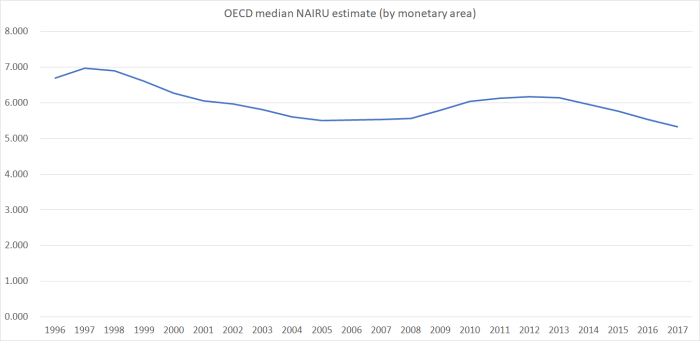
Out of curiousity I had a look at the OECD’s published NAIRU estimates.  This is the NAIRU for the median OECD monetary areas (ie countries with their own monetary policy plus the euro-area as a whole).

nairu oecd

The estimate for 2017 is 5.3 per cent.  That for 2007 was 5.5 per cent.     There just isn’t much short-run variability in the structural estimates of the long-run sustainable unemployment rate. That is true for other advanced countries.  It is almost certainly true for New Zealand.    It reflects poorly on the Reserve Bank how little they’ve done in this area, and it one reason why a change in the wording of the statutory mandate is appropriate.  The unemployment rate is a major measure of excess capacity, pretty closely studied by most central banks but not, until now it appears, by our own.

(Of course, had they wanted to be a little controversial, they could have noted that proposed structural policy changes –  notably the increased minimum wages they explicitly allowed for –  will tend to raise (not lower) the NAIRU to some extent.)

If they were at sea on the unemployment rate issue, what really staggered me was the way Spencer (and Bascand) used the press conference to campaign for minimal changes to the statutory governance and decisionmaking model for monetary policy.      They didn’t need to say more than “decisionmaking structures are ultimately a matter for Parliament, and we will be providing some technical input and advice to the Treasury-led process the Minister of FInance announced earlier in the week”.

But instead, they took the opportunity to campaign for as little change as possible.  Spencer noted that they agreed the Act should be changed to provide for a committee, but noted that they already had a committee, they thought it worked well, and they would like to reflect that in the Act.   Others might challenge whether the advisory committee, or the Governor, has done such a good job in the last five years (or today) but set that to one side for the moment.

They loftily conceded that there were possible advantages to having externals on a committee –  the potential for greater diversity of view. But they were concerned that in a small country it could be very difficult to find outsiders with unconflicted expertise to make the system work.  There was nothing to back this –  no explanation, for example, as to how places like Norway and Sweden manage, or how we manage to fill the numerous other government boards in New Zealand.

But what they really hate –  and I knew this, but was still surprised to hear them proclaim it so openly, just as a proper review is getting underway –  is the idea that any differences of view might be known to the public.   They could, we were told, tolerate a system of ‘collective responsibility’ –  in which all debates are in-house and then everyone presents a monolithic front externally –  but were strongly opposed to any sort “individualistic committee” in which individual views might become known.    These systems –  of the sort prevailing in the UK, the United States, Sweden, and the euro-area –  have, they claimed, the potential to become a “circus” with too much media focus on monetary policy, and a concern about “heightened volaility” in financial markets.   Spencer went so far as to suggest that an individualistic approach could undermine the reputation and credibility of the institution.

A slightly flippant observer might suggest that the second XI and their former boss have done that all by themselves –  between the actual conduct of policy, and attempts (in which they all participated) to silence one of their chief critics.  A more serious observer might ask for some evidence from the international experience, to suggest that the more individualistic approach has damaged the standing of the Fed, the BOE, or the Riksbank.  Are these less well-regarded organisations than the Reserve Bank of New Zealand?    I’d have thought it would be hard to find such evidence.

Bascand –  one of the declared candidates for Governor –  then chipped in to note that what management was concerned about was to ensure that the focus of discussion was on the issues “the Bank” had identified, not on individuals or their particular views. Loftily –  earnestly no doubt – he declared that they wanted the focus to be on substance.  No doubt, as defined by management.   It reinforces the point I’ve made often that Bascand is the candidate for the status quo.  Bureaucrats setting out to protect their bureau.  Predictable behaviour – even if usually more subtle than this –  and what the public need protecting from.

There are successful central banks that adopt the collegial approach –  the RBA is one, albeit one with a rather old-fashioned committee decisionmaking model –  but there is nothing to suggest, in the international experience, that that model produces better outcomes, or a more credible central bank, than the individualistic approach.  Indeed, many observers would regard Lars Svensson’s open disagreement with his colleagues on the Riksbank decisionmaking committee as a useful part of the process that finally led the rest of the committee, including the Governor, to abandon their previous excessively hawkish approach a few years ago.

The second XI’s approach is that of “the priesthood of the temple” –  we will tell you, the great unwashed, only what it suits us to tell you, in the form we want to present it.  It is simply out of step with notions of open government, or with a serious recognition that monetary policy is an area of great uncertainty and understanding is most likely to be advanced by the open challenge and contest of ideas.

Fortunately, the new government shows signs of seeing things differently.   There is a minister for open government (admittedly, lowly ranked), a commitment to improving transparency under the Official Information Act.  And in the Speech from the Throne yesterday there was an explicit commitment –  not referenced by the Second XI, still trying to relitigate – that

“The Bank’s decision-making processes will be changed so that a committee, including external appointees, will be responsible for setting the Official Cash Rate, improving transparency.”

Note the use of “will”.   The Bank management’s preference for a “collective model” would do nothing at all to improve transparency.

It is all a reminder of how uncertain things still are, and how important the membership of the Independent Expert Advisory Panel the Minister of Finance has pledged to appoint as part of review of the Act might be (including whether the panel is really “expert” or –  as rumour suggests – a politician might chair it).   And also how important it is that Bank management do not have a leading say in the advice that goes to the Minister.  Management is paid to implement Parliament’s choices, not to devise models that cement in the dominance (and secrecy) of management.

It is also a reminder of just how important the appointment of the new Governor is, and why it remains hard to be confident about just how committed the government is to serious change when they’ve left that appointment in the hands of the Reserve Bank Board –  all appointed by the previous government, all on record endorsing the way things have gone for the last five years, and with a strong track record of serving the interests of management rather than those of (a) the public and (b) good public policy.

The Robertson reviews of the RB Act

When you’ve favoured a reform for the best part of 20 years, and made the case for it –  inside the bureaucracy and out –  for several years, then, even though it was a reform whose time was coming eventually, there is something deeply satisfying about hearing the Minister of Finance confirm that legislative change will happen.    That was my situation yesterday when Grant Robertson released the terms of reference for the review of the Reserve Bank Act, including specific steps that will before long end the single decisionmaker approach to managing monetary policy.   Various Opposition parties had called for change (the Greens for the longest), market economists had favoured change,  The Treasury had tried to interest the previous government in change five or six years ago, before Graeme Wheeler was appointed.  But now the Minister of Finance has confirmed the government’s intention to introduce legislation next year.   The amended legislation won’t be in place before the new Governor takes office, but presumably the policy will be clear enough by then that the new Governor will know what to expect, and what is expected of him or her.  Reform was overdue, but at least it now looks as though it will happen.

There were several aspects to yesterday’s announcement from the Minister of Finance:

  • the new “Policy Targets Agreement”,
  • the two stage process for an overhaul of the Reserve Bank Act, and
  • inaction on the appointment of the new Governor.

In what looks like not much more than a photo opportunity, Grant Robertson got Grant Spencer, current “acting Governor” of the Reserve Bank over to his office and together they signed a “Policy Targets Agreement” that was, in substance, identical to the one Steven Joyce and Grant Spencer had signed in June.

There was no legal need for a new Policy Targets Agreement (even if either of these two documents had legal force, which they don’t), and no incoming Minister of Finance has ever before requested a new PTA (the Minister has to ask, and can’t insist) that is exactly the same as the unexpired one that was already in place.   When National came to power in 2008, they did ask for a new PTA.   The core of the document –  the obligations on the Governor –  weren’t altered, but they did replace clause 1(b), which describes the government’s economic policy and how the pursuit of price stability fits in.  Under Labour that had read

The objective of the Government’s economic policy is to promote sustainable and balanced economic development in order to create full employment, higher real incomes and a more equitable distribution of incomes. Price stability plays an important part in supporting the achievement of wider economic and social objectives.

National replaced that with

The Government’s economic objective is to promote a growing, open and competitive economy as the best means of delivering permanently higher incomes and living standards for New Zealanders. Price stability plays an important part in supporting this objective.

If the new Minister of Finance really thought a new PTA was required to mark his accession to office, surely he could have at least replaced the National government’s policy description with one of his own –  even simply going back to Michael Cullen’s formulation, which actually mentioned full employment.

Apart from the photo op, I’m not sure what yesterday’s re-signing was supposed to achieve.  The Minister presented it as providing certainty to markets, but it does nothing of the sort: we are in the same position now we were a couple of days ago, Robertson had already told us he wouldn’t make substantive changes until the new Governor was appointed and we still have no idea who that person will be, or what the precise mandate for monetary policy only a few months hence will look like.  Nor, presumably, does the Reserve Bank.

And by signing the document, Robertson seems to have bought into Steven Joyce’s “pretty legal” (but almost certainly nothing of the sort) approach to the appointment of an “acting Governor”.    As I’ve noted previously, the Reserve Bank Act does not provide for an acting Governor except when a Governor’s term is unexpectedly interrupted (death, dismissal, resignation or whatever), and –  consistent with this –  there is no provision in the Act for a new Policy Targets Agreement with an acting Governor (since a lawful acting Governor will only be holding the fort during the uncompleted term of a permanent Governor who would already have had a proper and binding PTA in place).    Spencer’s appointment appears to have been unlawful, and Robertson has now made himself complicit in this fast and loose approach to the law.   Consistent with the fast and loose approach, he allowed Spencer to sign yesterday’s Policy Targets Agreement as “Governor”, not as “acting Governor”.  He cannot be Governor, since under the Act any Governor has –  for good reasons around operational independence – to have been appointed for an initial term of five years.  And he isn’t acting Governor, since there is no lawful provision for him to be so in these circumstances.  At best, he is “acting Governor” –  someone purporting to hold that title.

The heart of yesterday’s announcement, however, was the two stage process for reviewing and amending the Reserve Bank Act.

Phase 1:

The review will:
• recommend changes to the Act to provide for requiring monetary policy decision-makers to give due consideration to maximising employment alongside the price stability framework; and

• recommend changes to the Act to provide for a decision-making model for monetary policy decisions, in particular the introduction of a committee approach, including the participation of external experts.

• consider whether changes are required to the role of the Reserve Bank Board as a consequence of the changes to the decision making model.

A Bill to progress the policy elements of the review, including on the details necessary to introduce a potential committee for monetary policy decisions, will be introduced as soon as possible in 2018. This will give greater certainty on the direction of reform in advance of the appointment of the next Reserve Bank Governor, currently scheduled in March 2018.

Phase 1 of the review will be led by the Treasury, on behalf of the Minister of Finance. The Treasury will work closely with the Reserve Bank who will provide expert and technical advice. An Independent Expert Advisory Panel will be appointed by the Minister of Finance to provide input and support to both phases of the Review.

Phase 2:
In line with the Government’s coalition agreement to review and reform the Reserve Bank Act, the Reserve Bank and the Treasury will jointly produce a list of areas where further investigations of the Reserve Bank’s activities are desirable. This list will be produced in consultation with the Independent Expert Advisory Panel.

This list, and the next steps for the review, will be communicated early in 2018. This phase of the review will incorporate the review of the macro-prudential framework that was already scheduled for 2018.

It is clearly intended as a pragmatic approach.  With a new Governor to take office in March, they want to get on with the specific changes Labour campaigned on  so that they come into effect as soon as possible after the new Governor is in office (realistically, it is still hard to envisage the new Monetary Policy Commitee making OCR decisions and publishing Monetary Policy Statements until very late next year –  perhaps the November 2018 MPS – at the earliest.)  It also appears to aim to separate the things on which the government mostly just wants advice on how best to implement changes they’ve promised, from other issues that may need looking at but where the parties in government have not taken a strong position.

But it still leaves me a little uneasy, on a couple of counts.

First, while it would be easy enough, after due consideration, to make limited changes to the Act to give effect to the desire to make explicit a focus on employment/low unemployment without many spillovers into the rest of the Act (I listed here a handful of clauses I think they could amend to do that),  I’m less sure that is true of the monetary policy decisionmaking provisions.    As the terms of reference note, if monetary policy decisions are, in future, to be made by a statutory committee, it raises questions about the role of the Bank’s Board –  whose whole role at present is built around the single decisionmaker (the Governor has personal responsibility for all Bank decisions not just monetary policy ones).

But how can you sensibly make decisions about the future role of the Board without knowing what changes (if any) you might want to make to the Bank’s other functions?  If, in the end, you leave all the other powers in the hands of the Governor personally, something like the current Board structure might still make sense, with some minor changes as regard monetary policy decisions.  But if you concluded that a statutory committee was also appropriate for financial stability issues, and that even the corporate functions should be governed in more conventional ways (Board decides, chief executive implements), there might be no place at all for a Board of the sort (ex post monitoring and review agency) we have now.    Decisions about the governance of an institution need to start by taking account of all the responsibilities of the institution, not just one prominent set of powers.

Second, it may be difficult to maintain momentum for more comprehensive reform once the government’s own immediate priorities have been dealt with.    On paper, it doesn’t look like a problem, but resources are scarce, legislating takes time and energy, implementing new arrangements for monetary policy takes time and energy, and it would be easy for momentum on the second stage to lapse (whether at the bureaucratic level, or getting space on the government’s legislative agenda).    That risk is compounded by an important distinction between phases one and two.    In phase one, the Treasury is clearly taking the lead, on behalf the Minister.  In phase two, we are told, “the Reserve Bank and the Treasury”  (the order is theirs) will “jointly” produce a “list of areas where further investigations of the Reserve Bank’s activities are desirable”.    A joint list raises the possibility of the Bank holding a blocking veto –  not formally, but in practice –  and where the Bank is more interested in (a) blocking other far-reaching changes that might constrain management’s freedoms, and (b) advancing whatever list of minor reforms it might have in mind itself.

Perhaps in the end much will depend on the Minister himself, and on the Independent Expert Advisory Panel he plans to appoint.  But the Minister of Finance will be a very busy man, and up to now he has shown little interest in reforms of the Reserve Bank legislation beyond the first stage ones.

What of the panel?  We’ll know more when we see what sort of people are appointed to it, and how much time they are being asked to give to the issue.

In a set of Q&As released with yesterday’s announcement the Minister indicated of the panel that “they will be individuals with independence and stature in the field of monetary policy, including governance roles”.   That is probably fine for phase one (which is monetary policy focused), but the bulk of the Bank’s legislation, and much of its responsibility, has nothing to do with monetary policy at all.  So if the panel is going to play a substantive role in the planned phase 2, I’d urge the Minister to consider casting his net a bit wider.

As to who might serve on it, there aren’t that many with what look like the right mix of skill, experience, and independence.  It is sobering to reflect that when the (still secret) Rennie review on related issues was done earlier in the year, not a single domestic expert was consulted.  I imagine they will want to draw mainly on people who actually live here.  But if possible, I would urge Treasury and the Minister to consider inviting Lars Svensson to be part of the panel –  as someone who has undertaken a previous review for an earlier Labour government, someone who supports an explicit employment focus, and someone with practical experience as a monetary policy decisionmaker.    David Archer – a New Zealander (and former RB senior manager) who now heads the BIS central banking studies department – might also be worth drawing on.

The third dimension of yesterday’s announcement was the Minister of Finance’s comments about the process for appointing a new Governor.    There I think he is making a mistake.

In his Q&As, the Minister noted that “the process for appointing a new Governor is in the hands of the Board”.

Newsroom reports that, when asked, Robertson noted that

“I’ve met with the chair of the board and he has assured me that process is underway and well under way and going well. I sought an assurance from him that any candidates he was interviewing would be ones who would be able to implement a change to policy along the lines we’re going, he expressed his confidence about that but in the end the process itself lies in his hands.”

Appointing a new Governor of the Reserve Bank is –  or should be –  the most consequential appointment Robertson will make in the next three years.  For a time that person will, single-handedly, wield short-term macro-stabilisation policy (which is what monetary policy is) and –  perhaps indefinitely –  will wield all the regulatory powers of the Bank.  Even if committees end up being established for both main functions, the Governor will have –  and probably should have –  a big influence on how, and how well, macro and financial regulatory policy is conducted over the next five years.

There has been a pretty widespread sense that the Reserve Bank in recent years has not been operating at the sort of level of performance –  on various dimensions –  citizens and other stakeholders should expect.  That isn’t just about substantive decisions, but about supporting analysis, communications, operating style etc.  And yet the Reserve Bank Board –  and chairman Quigley –  have backed the past Governor all the way (whether on minor but egregious issues like the attempts to silence Stephen Toplis, or on the conduct of monetary and regulatory policy).   But the new government claims to want something different.   The issue isn’t whether a potential candidate can, as a technical matter, manage the sort of phase 1 changes the Minister plans.  I’m sure any competent manager could.  The more important issues are around alignment and vision.  Is the Minister content to leave the process to the Board –  all appointed by the previous government – and take a chance on them coming up with someone who represents more than just the status quo?   At this point, it appears so.  Apparently, the selection process will not be reopened, even though the advertising closed months ago and the role of the Bank (and Governor) is to be changed.

It is quite an (ongoing) abdication by the new Minister. In (almost all) other countries, the Governor of the Reserve Bank is appointed directly by political leaders (Minister of Finance, head of government or whoever).   Those leaders no doubt take soundings in various quarters, but the power –  and the responsibility –  rests with the politician.   Here, Grant Robertson just rolls the dice –  relying on a bunch of private sector directors appointed by his predecessors –  without (it seems, from the tone of his comment above) a high degree of confidence in the outcome.  Perhaps he’ll like who the Board comes up with. But if he doesn’t, so much time will have passed that he’ll be stuck. He can reject a Board nomination, but they’ll just come back with the next person on their own list, evaluated according to their own sense of priorities etc.  It isn’t the way appointments to very powerful positions –  the most powerful unelected person in the country for the time being –  should be done.

And two, very brief, final points:

  • now that the government has changed, and the Minister who asked for the Rennie review of Reserve Bank governance issues has gone, surely there can be no good grounds for continuing to withhold Rennie’s report and associated papers?  It is not as if it is playing any role in the current Minister’s thinking.

    Newsroom also asked Robertson if he had seen a review of the bank undertaken by former State Services Commissioner Iain Rennie that was requested by former Finance Minister Steven Joyce.   He said he was yet to see it, but had asked Treasury about it.

  • we are told to expect a new Policy Targets Agreement when the new Governor is appointed.   Presumably, true to past practice, the first the public will know about it is when the document –  guide to macro-management for the next five years –  is released.    It would good if the Minister of Finance would commit now to proper transparency, including pro-active release (once the document is signed) of  relevant documents.  It would be better still if he would think about adopting the considerably more open, and rigorous, Canadian model.

    Less than a year since completing the last review of its inflation-targeting mandate, the Bank of Canada is starting to prepare for the next one in 2021.

    Consultations kick off in Ottawa on Sept. 14 with an invitation-only workshop of economists that will be webcast on the central bank’s website. It’s an early public start to the process, and comes amid a growing sense that a deeper look at the inflation target is needed after almost a decade of poor economic performance.

A more open approach to these issues – as practised in Canada for years – has much to commend it (even if I didn’t always think so when I was a bureaucrat.)