100 years of the New Zealand/Australia exchange rate

Yesterday I looked briefly at some of the recent indicators of relative economic performance for New Zealand and Australia over the last few years.  New Zealand hasn’t done that well.

One item I didn’t mention was the exchange rate.  The fevered talk of parity parties has, fortunately, receded once again, although who knows for how long.  It will probably happen eventually –  after all, New Zealand’s inflation rate averages a little lower than Australia.

We’ve been at parity before of course.  Indeed, for all our history until 1972 a New Zealand dollar (or pound) had been worth as much (or more) as an Australian dollar (pound).  Until 1914 that was all about common gold convertibility, and neither country had a central bank.  This chart starts in 1911.
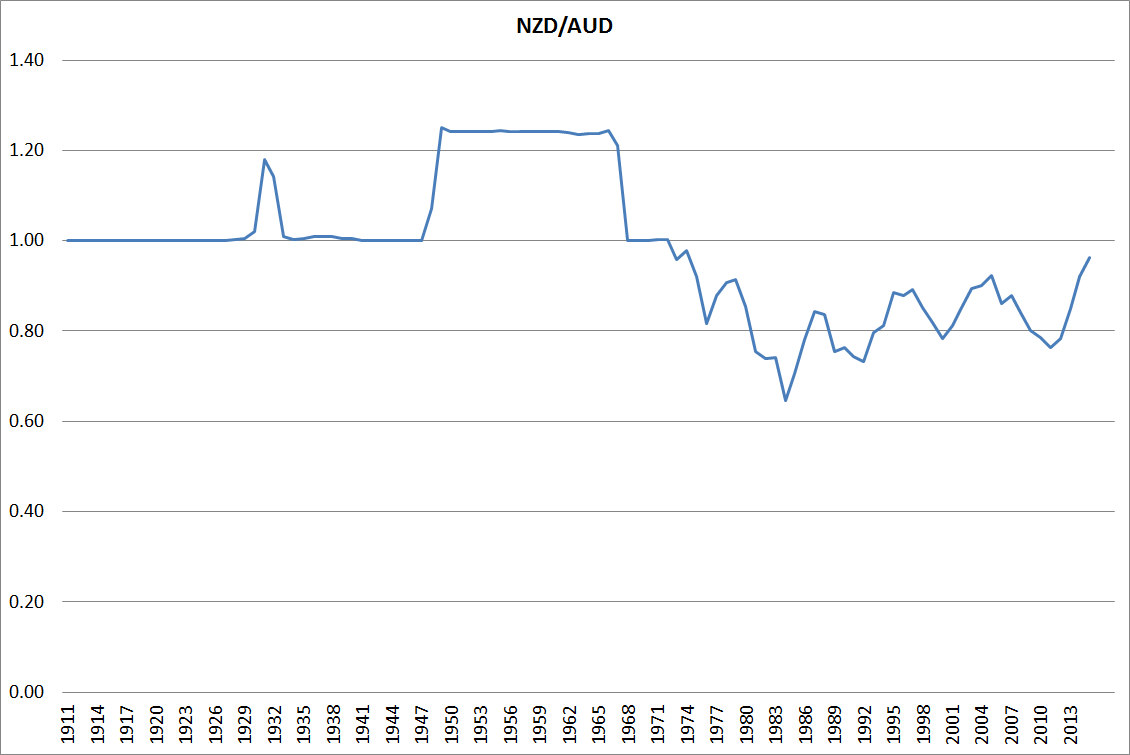
exchrate1

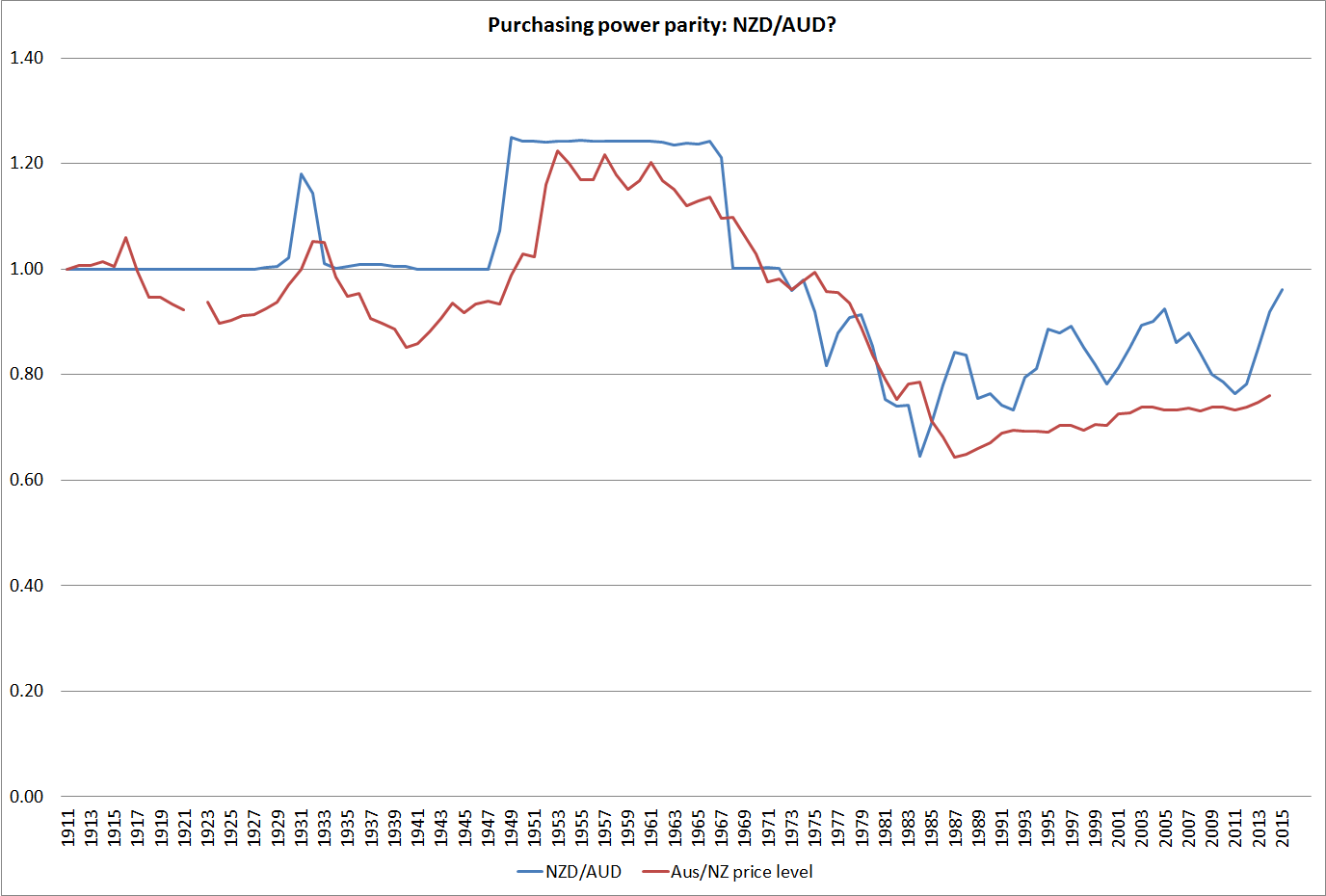
In the long long run, changes in the exchange rates of similarly wealthy countries should broadly reflect differences in the inflation rates of the two countries (relative purchasing power parity). My reading of the literature suggests that empirical support for this long-term proposition has been growing.    But here is what the chart looks like for New Zealand and Australia  (my data source for Australia, Measuring Worth, has a missing observation in 1922).  When I first did the chart a few years ago I was pleasantly surprised by the way the two lines moved broadly together.  When our nominal exchange rate appreciated against Australia’s –  as it did most enduringly in 1948 – it was associated with a rise in Australia’s price level relative to ours.  And, of course, as our high inflation (relative to theirs) became an increasing issue from the mid-late 1960s, our nominal exchange rate fell substantially relative to theirs.  The troughs were in the mid 1980s.
exchrate2

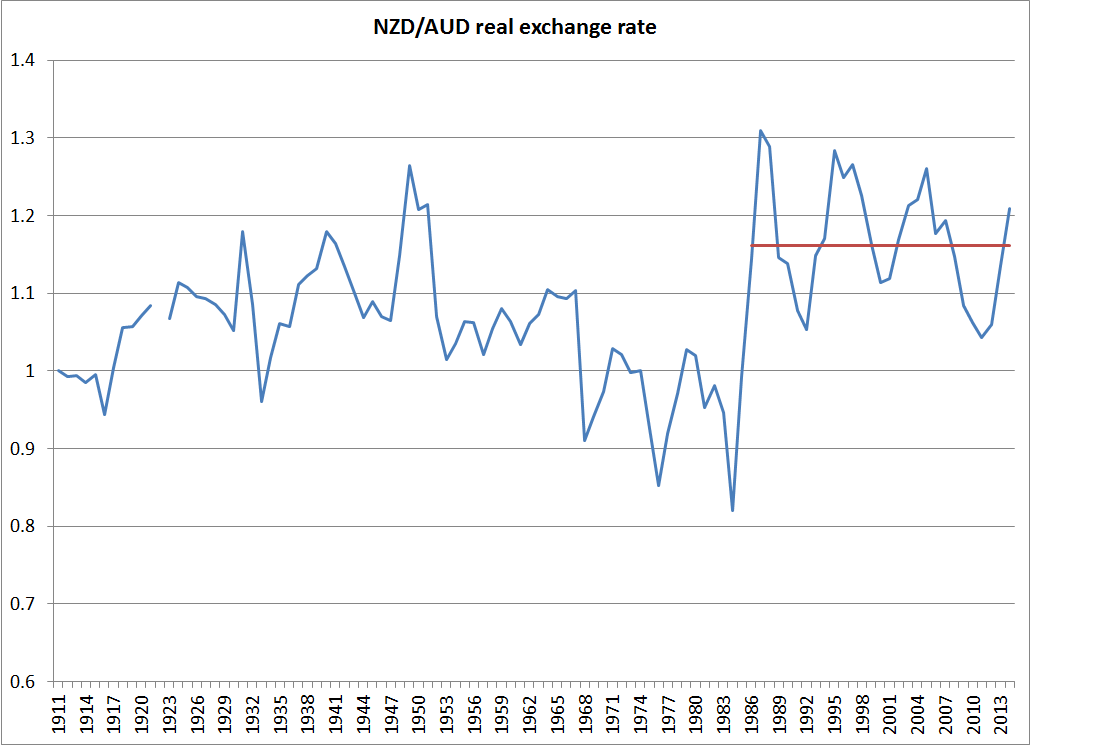
What if we combine the two lines into a real exchange rate series?   Two things strike me?  The first is just how relatively tight a range that bilateral real exchange rate has fluctuated with in over a century.  And second is the way the real exchange rate appeared to be falling in the 1970s and early 1980s, only to step up and subsequently fluctuate around a new materially higher level.  The last observation is for 2014 (annual averages), but the current level would not be much different.
exchrate3

At one level, that higher real exchange rate might look like a good thing.  After all, it means we can buy stuff abroad more cheaply, lifting the purchasing power of our incomes.    The problem is that we have to earn an income before we can spend it.  And there our performance relative to Australia has not been good.

People often point out that the higher terms of trade has lifted the ability of New Zealand firms to compete profitably internationally.  All else equal that should be consistent with a higher real exchange rate.  The problem with that story here is that we are doing a NZ vs Australia comparison and New Zealand’s terms of trade have done less well than Australia’s.

We only have consistently national acccounts deflator for both countries back to 1987, but actually all the differences in the two terms of trade are in that recent period.  This chart shows merchandise terms of trade for the two countries back to the 1920s.  They are remarkably similar until the last decade or so.

2025 TOT

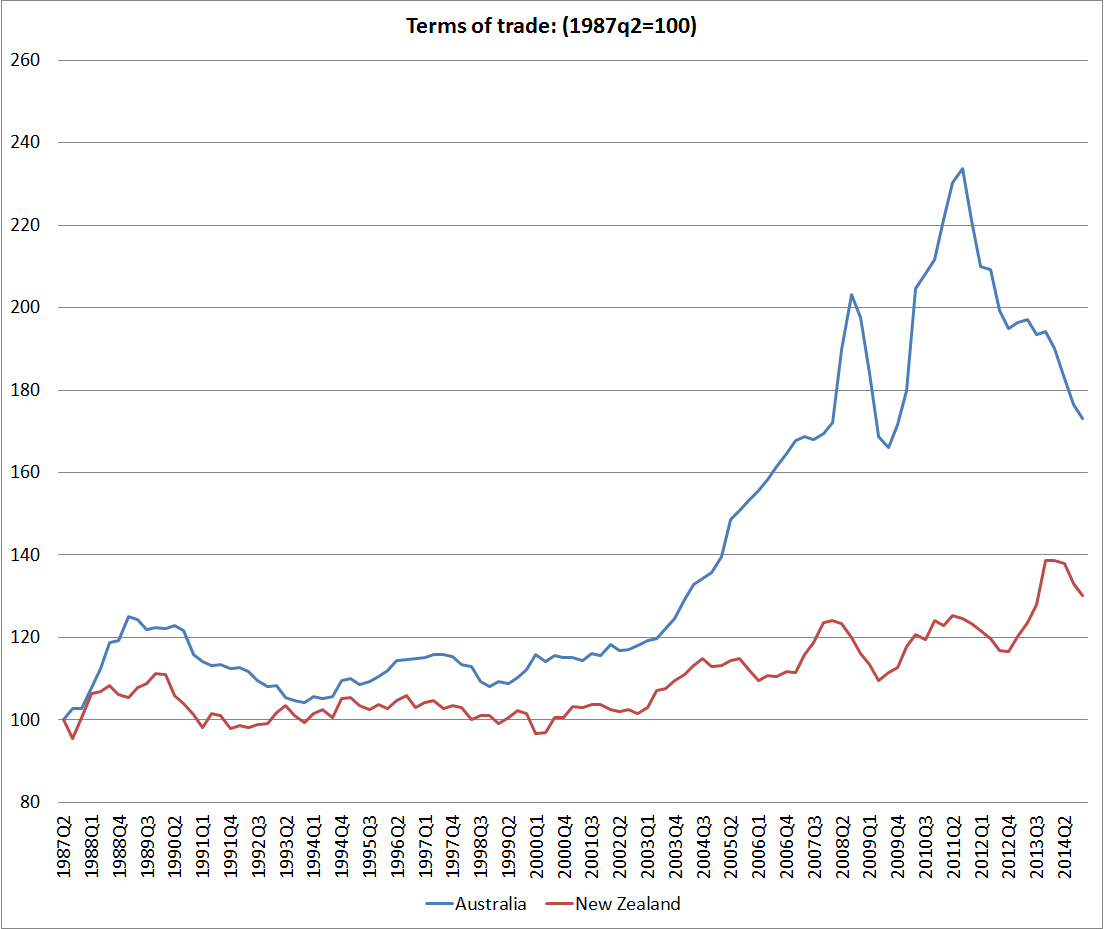
And this chart is the SNA terms of trade for the two countries, drawing from the national accounts export and import price deflators.  Despite the difficulties of the last couple of years, Australia has still experienced the much larger increase in the terms of trade than New Zealand.  All else equal, we might have expected our real exchange rate to have fallen relative to Australia’s.  It hasn’t of course.
TOT since 87

There is also good reason, and some cross-country supporting evidence, for the idea that real exchange rates tend to move to reflect longer-term trends in relative productivity.  That makes sense.  A country with poor productivity growth is likely to need to see its real exchange rate fall, to “compensate” for the impact of poor productivity –  enabling its tradables sector firms to remain competitive, and increasing the relative cost of imported consumption items.

And what is the New Zealand vs Australia story.  We don’t have productivity data back to 1911, but we do have estimates of per capita real GDP, and over the long haul differences in growth rates will mostly reflects changes in relative productivity.  Using Angus Maddison’s estimates, spliced with Conference Board estimates for more recent years, this is the relative GDP per capita picture.  There is quite a lot of year-to-year noise in the earlier period, but painting with broad brushstrokes one could characterise the last century as one of a first half where New Zealand and Australian real per capita GDP growth were very similar (and levels, on these estimates, were pretty similar too).  But since the mid 1960s, the traffic has been almost all one way: New Zealand real GDP per capita has fallen very substantially, and pretty steadily, against Australia’s.  Maybe the worst of the falls are now behind us, but there is no sign of any sustained reversal.
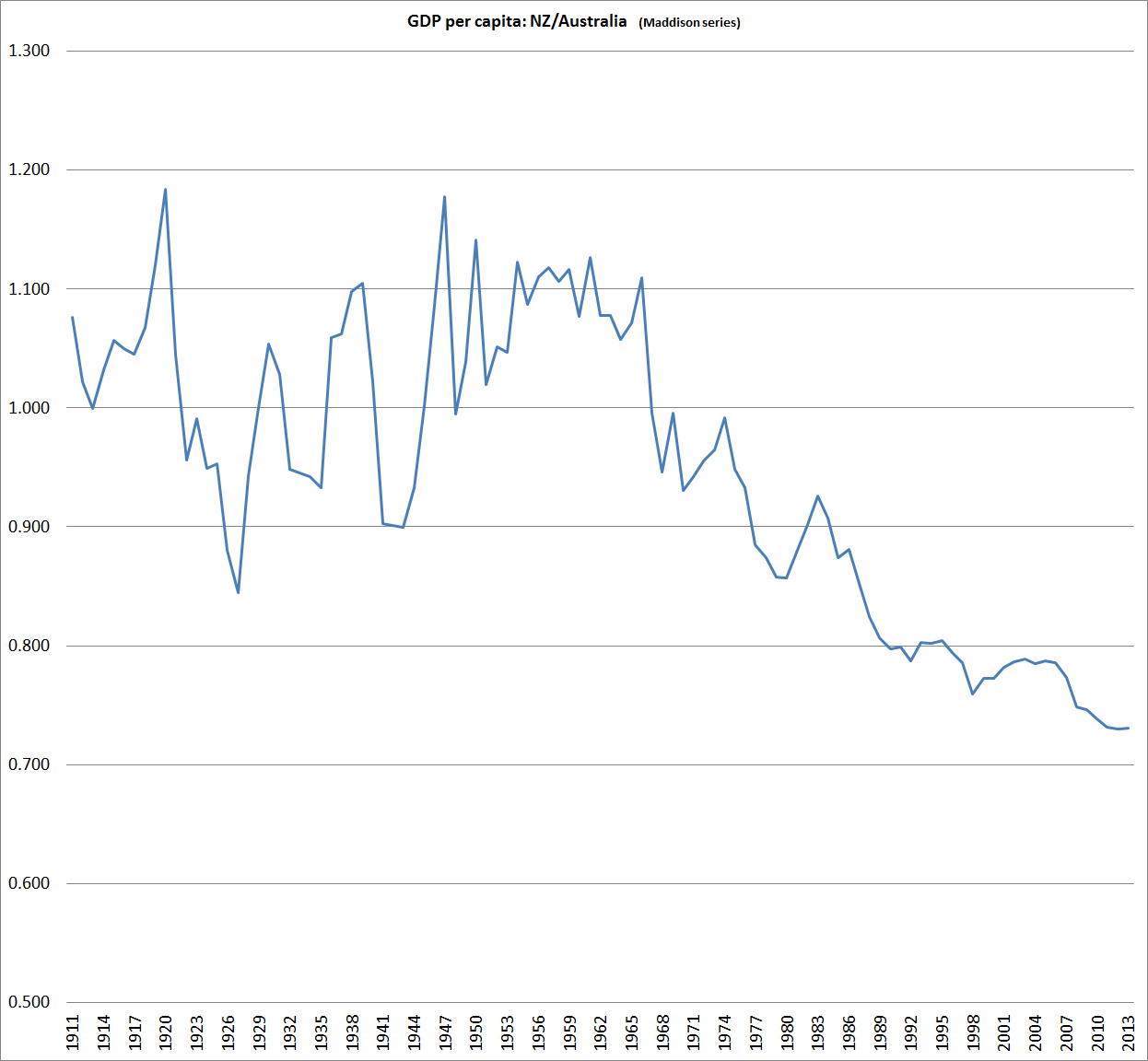
nz vs au since 1911

The Conference Board estimates GDP per hour worked for the two countries since 1956.  No doubt there are some heroic assumptions behind the New Zealand estimates in particular (Australia has official quarterly national accounts data back to 1959) but they are the best we have for now.  And the picture is much the same: a sharp decline over the full period, which continues more recently (I showed yesterday the quarterly chart of real GDP per hour worked for the period since 2007).  And the decline in much the same whether one uses the measures calculated on 1990 prices (also the basis for the Maddison GDP estimates) or 2013 prices.
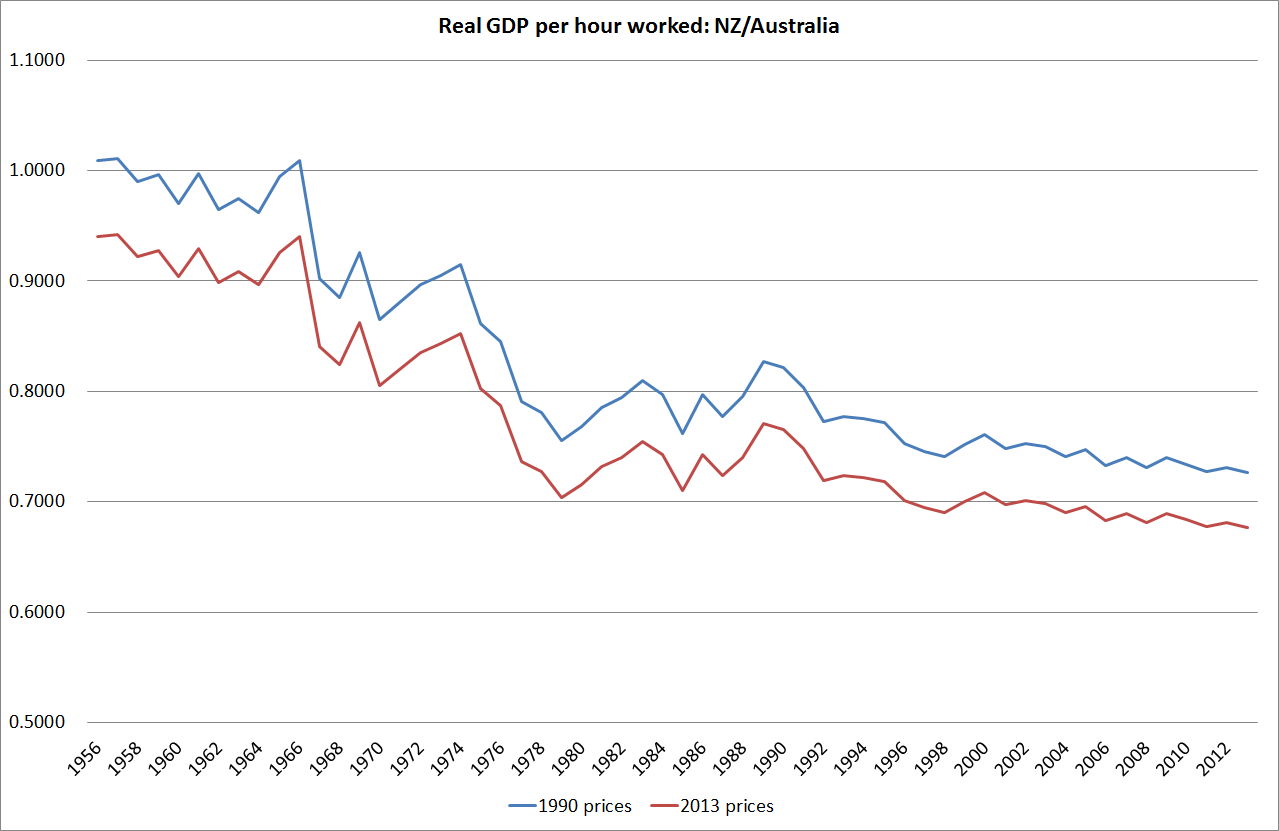
nz vs au since 56

And so we have this somewhat paradoxical position of quite a high real exchange rate (last 20-30 years) relative to Australia, even though our terms of trade have done much less well than Australia’s, and our labour productivity and growth performance have been materially less than Australia’s.  Consumption of tradables is made relatively cheap, while producing for the international market – a key element in longer-term prosperity –  is expensive.  It is perhaps not that surprising that our export share of GDP has remained so weak, and our aspirations to close the income gaps to the rest of the advanced world have shown no sign of being met.

After spending years reflecting on the issues, I’m convinced there is nothing much wrong with New Zealand’s economy that a real exchange rate averaging 20-30 per cent lower for a few decades could not resolve.  Perhaps issues around size, distance, and agglomeration mean we will never again be the richest country in the world, but we can do a great deal better than we have done in recent decades.

Views differ on why the real exchange rate might have been, on average, so strong over the last few decades.  My story emphasises the high average real interest rates that have been needed to balance demand and supply (keep inflation near target) in New Zealand relative to those abroad.  As just one example, the yield on a 20 year New Zealand government inflation-indexed bond has been around 2.2 per cent this month.  The yield on 20 year US government inflation indexed bond has been around 0.7 per cent.  Persistent differences in returns like that, which don’t appear to reflect differences in riskiness, have really big (and quite rational) implications for the exchange rate.

But, to be clear, this is not a monetary policy story.  Long-term real interest rates reflect the pressures on real resources that result from government and private choices.    They are real phenomena, not monetary ones.

For those who haven’t come across my story in this area before, much of it is elaborated in this paper. I included there some charts suggesting that the strength of the real exchange rate, relative to underlying economic performance, is not just an issue for comparisons against Australia.

A forgotten result of World War One

From 2014 to 2018 countries like ours are marking the centenary of successive phases of World War One.  For New Zealand, next month’s commemorations of the 25 April 1915 Gallipoli landings may well be the high point –  complete, no doubt, with rather saccharine portrayals of the enemy, devoid of any reference to the systematic Turkish massacres of their own Armenian subjects which, rather hauntingly, date from 24 April 1915.

But this is a blog about economic matters.  And for New Zealand, World War One marked the end of the Gold Standard.  Like the other British Dominions, New Zealand did not have a central bank at the time.  Commercial banks took deposits, made loans, and issued paper banknotes.  By law, these had to be convertible into gold, on demand, and banks held substantial gold reserves.  With the UK (and Australia) also on a Gold Standard, this established a very stable series of fixed exchange rates against the currencies of the economies most important to New Zealand.

There had been a departure from the gold convertibility provisions earlier, at the time of the BNZ crisis of 1894 –  convertibility was a double–edged sword, helping to build well-founded confidence in the value of deposits, but potentially exacerbating a crisis if a contagious run on banks looked like taking place. But that suspension was, and was always envisaged as, temporary.

When World War One broke out, New Zealand’s Parliament had already been considering banking legislation which would allow the Government, in an emergency, to suspend the convertibility into gold of notes issued by commercial banks. and declare bank notes themselves legal tender.  We can easily read the contemporary accounts thanks to the National Library’s wonderful Papers Past. The proclamation declaring that New Zealand was at war was not read until 5 August, but on 4 August the banking amendments were passed under urgency in view of the imminence of war.  The legislation also gave the government power to prohibit the export of gold during the period convertibility was suspended.

The next day, as part of New Zealand’s entry into the war, convertibility was suspended and gold exports were prohibited.  The suspension was initially for one month, but it was later extended.   New Zealand bank notes were never again convertible into gold as of right.  LIke many things, it was quite unforeseen in 1914.

What followed was a curious arrangement, which appears to have confused some eminent modern students of historical monetary arrangements (including Barry Eichengreen in his great book Golden Fetters).  Unlike most Gold Standard countries, New Zealand never resumed any sort of gold convertibility requirement after the war was over (unlike, say, the UK which did so in 1925).   Indeed, at least until the negotiated devaluation of January 1933, and perhaps until the opening of the Reserve Bank in 1934, there was no direct or indirect government control over the issuing, or management, of money in New Zealand.  In the jargon, there was no nominal anchor, only customary practice.  In fact, until the onset of the Great Depression, the banks managed their lending policies to ensure that notes were convertible into sterling (but not to gold) at par.

New Zealand’s economy in World War Two

I’ve been reading, in quick succession, the three non-military books in the New Zealand official war history series:

F.L.W. Wood’s The New Zealand People at War: Political and External Affairs

J.V.T. Baker’s War Economy, and, in two volumes,

Nancy Taylor’s The Home Front

The books emerged quite slowly. Michael Bassett records that the 1950s Holland government wanted the history series to stick to military matters, and it was not until the Nash government that Baker and Taylor were commissioned.  Even then, Taylor’s work wasn’t published until 1986.

Read together they are a fascinating set of accounts of the civilian side of New Zealand’s involvement in the war.  My prime interest is the economics volume, but I was also struck by, for example, how far-reaching press censorship was in New Zealand –  often apparently to avoid political embarrassment, more than to safeguard military secrets.

War Economy is full of details –  perhaps too many in places, but it is detail that is hard to find elsewhere.  What it lacks is much of an analytical framework, not supplied in other economic histories of New Zealand (or, as far as I can tell, in scholarly articles).  If our universities were not now almost entirely devoid of economic historians, a modern analytical history of the period, drawing in more cross-country comparative analysis, would be a great opportunity for someone.

Two things from the period did stand out.

The first is that, while New Zealand, devoted almost as much of its GDP to the war effort as any of the major combatants (at peak similar to that in the UK, although the UK held the peak for longer), material living standards for the civilian population seemed to remain relatively high –  notably the quality of the diet, access to petrol etc.  Perhaps that partly reflects just what a rich country New Zealand then was.  Using Angus Maddison’s data:

Featured image

New Zealand’s GDP per capita in 1939 was second highest of those countries shown.  It may have been easier to devote a larger share of GDP to the war in a rich country like New Zealand than in a relatively poor one like the USSR, where a larger share of resources would have to have been devoted to subsistence.

And the second point is the dramatic transition, from New Zealand being on the brink of default in 1939, to New Zealand being, in effect, defaulted on just after the war.  In 1939, in the wake of the imposition of exchange controls, Walter Nash emerged from a humiliating mission to London, with a very onerous schedule of overseas debt repayments.  If the war had not been looming –  which made the British government keen on maintaining good relations with the Dominions –  it is quite possible that New Zealand would have been unable to rollover maturing debt at all, probably ending in a default to external creditors.  By just after the war, New Zealand  –  having markedly reduced its external debt ratios during the war – made a substantial gift to the UK: in reality, Britain was quite unable to meet all its obligations and needed some of them written down.

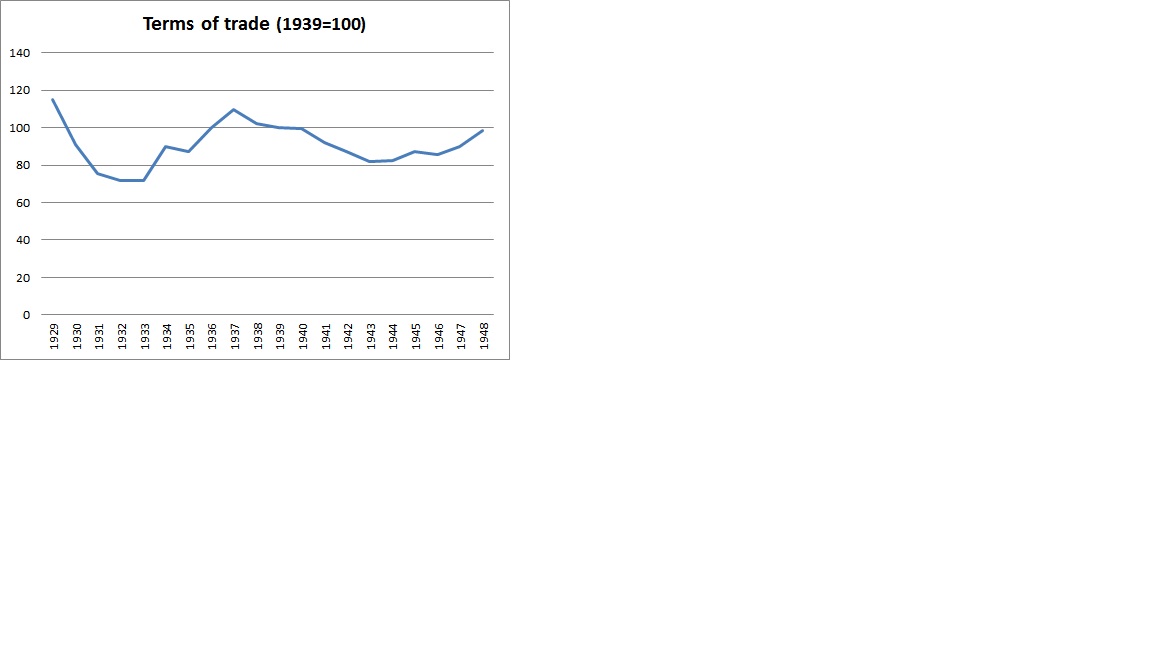
In a paper a couple of years ago, some IMF economists looked at examples of countries that had markedly reduced their overseas debt.  The New Zealand experience during WWII was as stark as any of those reversals, but is too little studied.  It seems to have mainly resulted from a determination to pay for as much of the war as possible from taxation, together with the controls and rationing that limited private sector consumption and investment.  What it was not down to was any strength in New Zealand’s terms of trade:

Terms of trade (3)

The terms of trade fell during the war years –  our import costs rose as global inflation increased, but there was little adjustment in the prices of the agricultural/pastoral products New Zealand sold to Britain.

A  fascinating phase in New Zealand’s economic history, to which I may return.

Why New Zealand languishes

New Zealand’s long-term economic underperformance, and what can be done about remedying it, should be one of the most keenly-debated topics in New Zealand public life.  Sadly, it isn’t.  Too many of our political and economic elites seem to view it as something for the too-hard basket, or perhaps are simply reconciled to declinism, or implicitly take the view that “New Zealand is still a nice place to live, and me and my children will be fine –  after all, they can always leave”.

I don’t think that is good enough.

To the credit of The Treasury, they have sometimes sought to engage with these issues.  A couple of years ago, they ran a series of lunchtime presentations for staff, inviting in various people to offer their views.  I was one of those invited –  and the invitation encouraged me to be a little provocative.  As it happens, the presentation itself never happened, but I took the opportunity to write down what I would have said, in pretty much the style I would have said it.  I’ve distributed copies to a wide range of people, then and subsequently.

The very short version of the story: New Zealand had an abundance of productive land, made valuable by the urbanisation of Britain and the emergence of refrigerated shipping in the late 19th century.  That natural endowment, and the associated technological innovation, was  –  and is – enough to support very high living standards for a quite limited population.  Since World War Two, New Zealand has had no big new opportunities –  unlike, say, Australia’s mines or Norway’s oil – and our governments haves repeatedly handicapped the country’s prospects by pursuing large programmes of inward migration.  Particularly in the last 25 years, governments have been actively hindering adjustment  –  more than replacing the many New Zealanders who have responded to market opportunities and left.  Growing population has rarely, if ever, been a basis for successfully lifting per capita income.

I’d write some things a bit differently now, and I will flesh out many of the points in later papers and entries on this blog, but for now here is one hypothesis for

Why New Zealand languishes

As ever, I will welcome comment and debate.