The Reserve Bank stands by its stress tests

Last Saturday I highlighted the Reserve Bank’s response, via Herald columnist Mary Holm, to a reader’s concern about the possible impact of a 50% fall in house prices.  A Bank spokeswoman, speaking prior to the release of the Financial Stability Report and of the Bank’s proposed restriction on banks lending to investor property borrowers in Auckland, had expressed confidence in the ability of the financial system to withstand such a shock.

While I was happy to highlight those comments, I had wondered (and had mentioned the possibility to a couple of people) if it was just a case of the left hand not knowing what the right hand was doing –  perhaps the Governor had not been aware of what someone in his PR department had been saying.   That doubt was reinforced after I was told that at the Finance and Expenditure Committee hearing on the FSR the Governor had refused to engage on, or respond directly to, a question about the stress tests.

However, in today’s Mary Holm column another Reserve Bank spokesman was commenting. He is quoted as saying:

“We repeat our comments from last week that the Reserve Bank was generally satisfied with how banks managed their way through the impacts of two adverse economic scenarios in the 2014 bank stress tests, which included a scenario similar to what your reader describes.

“We are comfortable that the New Zealand financial system is capable of withstanding a major adverse event, such as a collapse by up to 50 per cent of the Auckland housing market.”

That is good to know.  It is not just a statement about last year, when the stress tests were done, but about the risks banks have on their books now.

But it just reinforces the question as to what possible basis, under its Act, the Reserve Bank can have for proposing to ban banks from lending a singe cent to anyone, secured on an Auckland investment property, above 70 per cent of the value of that property.    The Bank is required to use its regulatory powers to promote the soundness and efficiency of the financial system.  Efficiency will inevitably be impaired by the proposed restriction, and the Reserve Bank has just told us today that the system can cope with a fall in house prices as large as has been seen anywhere.

The Reserve Bank told us its consultation document would be published later this month.  That now leaves only the coming week.  We should look forward, with considerable interest and some scepticism, to the case they will make.

More housing risks….in the US

Last month I wrote about Peter Wallinson’s book Hidden in Plain Sight, about the role that Federal government interventions, and mandates, in the US housing finance market had played in the US housing credit boom of the late 90s and early 2000s.  Wallison argued, pretty persuasively to me, that it was these interventions that drove down credit quality and which meant that when house prices in the US fell, the losses to lenders were large – much larger than has typically been seen when house prices have fallen sharply in other countries.  Those losses in turn –  and the uncertainty around them –  was the catalyst for the US-centred financial crisis of 2007-09.

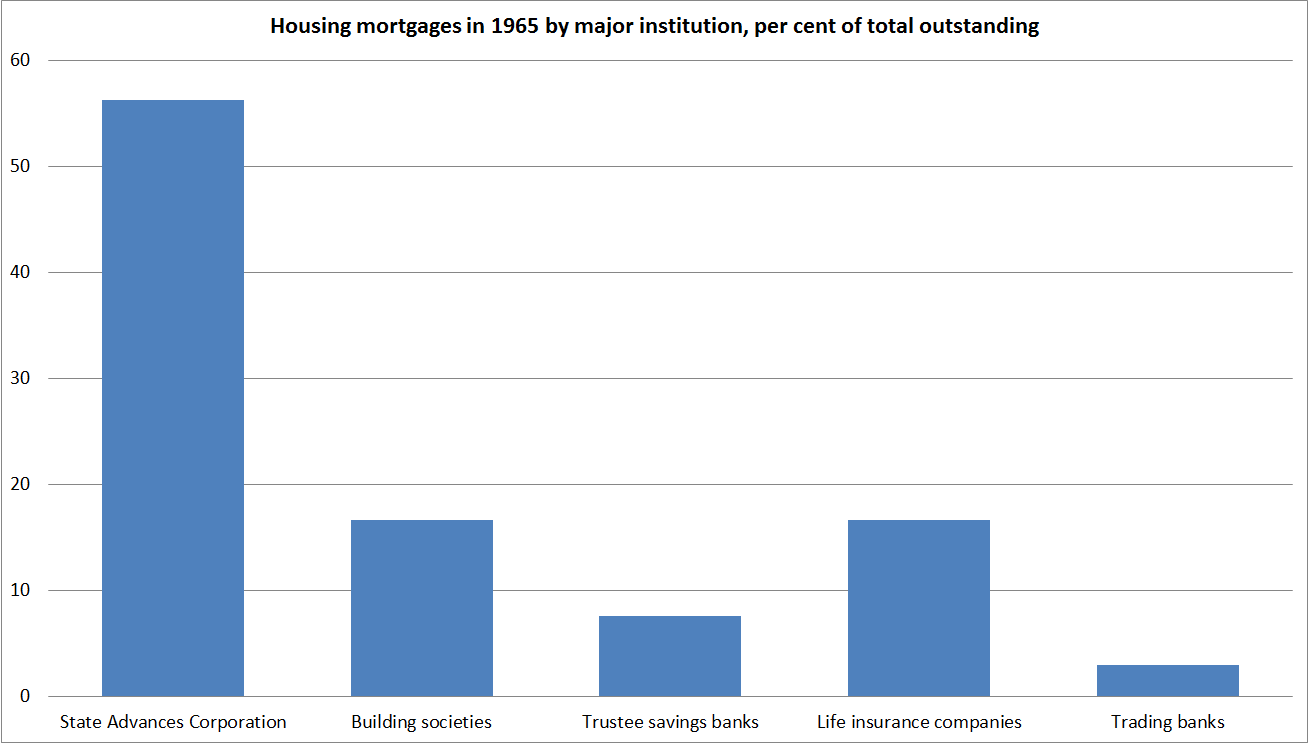
The US government has had a very large role in the housing finance market for decades now.  That has become quite unusual by the standards of advanced market economies.  Take New Zealand, by comparison.  In the early post-war decades, most first home buyers got a mortgage from the State Advances Corporation.  Indeed, the Monetary and Economic Council in their 1972 report on Monetary Policy and the Financial System reported that in 1965 just over 50 per cent of all outstanding mortgage debt advanced by financial institutions was held by the State Advances Corporation.

sac

That lending didn’t go bad for a variety of reasons –  overall debt levels were low (relative to GDP or household income), inflation increased, and credit rationing was pervasive (SAC dominated the market, but government policy was focused on administrative measures to restrain excess demand and so even SAC lending standards were not overly liberal).  By contrast, any government-provided or government-guaranteed mortgages in New Zealand now make up a derisory share of the market.  That has been the trend in most advanced economies in recent decades.  Housing debt is now initiated by private lenders, and while those lenders have at times made mistakes, or got over-exuberant, the losses on housing loans have not typically been large enough to threaten the health of the system.

The United States was different.  Not only did the government stay actively involved, but possibly in the worst possible way: mandating greater access to credit in a system where the private rewards from complying (and private costs from failing to comply) were very high.  State Advances Corporation managers did not have the sorts of bonuses and options at stake –  let alone the potential for merger approvals to be withheld –  that characterised the US.

But I’m not writing about this today simply to rake over history, but because in some respects the US government involvement in the housing finance market has just got worse since last decade’s crisis.  Around 80 per cent of all new residential mortgages initiated in the US now have a federal government guarantee.

This new short piece from Stephen Oliner, a former senior Fed official and now a fellow at the UCLA Ziman Center for Real Estate, outlines some of the facts and some of the risks.  (The FHA is the Federal Housing Administration, which accounts for a quarter of all government guaranteed mortgages.)   Oliner writes:

A few statistics about FHA loans are sufficient to dispel the myth that only pristine borrowers can get a mortgage. In recent months, the median credit score for borrowers who took out an FHA-guaranteed home purchase loan was 673. About two-thirds of all individuals in the U.S. have a higher credit score than that. FHA’s credit standards are loose as well for two other primary determinants of loan risk: the size of the down payment and the monthly payment burden. The median FHA borrower makes a down payment of less than five percent. If the borrower were to turn around and sell the home, the agent’s commission and other costs would exceed five percent. Hence, the median borrower is effectively underwater on day one. Second, many FHA-guaranteed loans have onerous monthly payments relative to the borrowers’ income. In fact, the payment-to-income ratio for more than four in ten FHA borrowers exceeds the ability-to-repay limit that was set in the recent Qualified Mortgage rule. This is a not a picture of tight credit.

The default rate on these FHA loans, while relatively low in today’s benign environment of solid job growth and rising home prices, would increase substantially in an ordinary recession and would skyrocket if we have another financial meltdown. To gauge the vulnerability of recently originated mortgage loans, AEI’s International Center on Housing Risk publishes every month the results of a rigorous stress test, the National Mortgage Risk Index (NMRI). The NMRI uses the default experience of loans originated in 2007 to estimate how recent loans would perform if hit with a shock akin to the 2008-09 financial crisis. The index shows that nearly 25 percent of recent FHA loan borrowers would default in that scenario. This would be exceptionally harmful, not just to the borrowers, but also to the neighborhoods in which they live and to the taxpayers who would have to make good on the FHA’s loan guarantees.

Note that well: the median FHA borrower –  and typical FHA borrowers have low credit scores –  has a down payment of less than 5 per cent.

The US systemic risks are not nearly as great as those in 2007.  The total stock of mortgage debt is growing much less rapidly, and so far most US housing markets seem less overheated.  But it is a reminder both of how hugely distorted the US housing finance market is, and a contrast to the sorts of housing finance markets we see in New Zealand, Australia, or the UK.  In those latter countries, private lenders make their own assessment of the riskiness of the loans they are making, and of the wider market.  And those private lenders have their own shareholders’ money primarily at stake.  The risks here are simply very different from those in the United States –  both pre-crisis, and now.  For that, we should be very grateful.  But we also need to recognise that it is not primarily a matter of grace, but of superior policy.  When governments stay out of markets things are  – generally – much less likely to go spectacularly wrong.

Housing loans: big buffers and moderate risks

Paul Glass, of Devon Funds, had an article in the Herald yesterday, containing his agenda for action for New Zealand economic policymakers.   I was sympathetic to quite a bit of his analysis, but this section caught my eye:

It’s a technical area, but the amount of regulatory capital held against residential mortgages should be increased substantially, not just tinkered with around the edges as is currently happening. This would limit the amount of debt available for mortgages.

It is a common view, but I think it is wrong.  I’m not sure what reasoning Glass has behind his recommendation, but Gareth Morgan has argued along similar lines for years.  Morgan argues that  the bank regulatory capital regime (whether Basle I, II, or III) artificially favours lending secured on housing, because the risk weights used in calculating the amount of capital that needs to held in respect of such loans are less than those used in many other types of commercial bank assets.

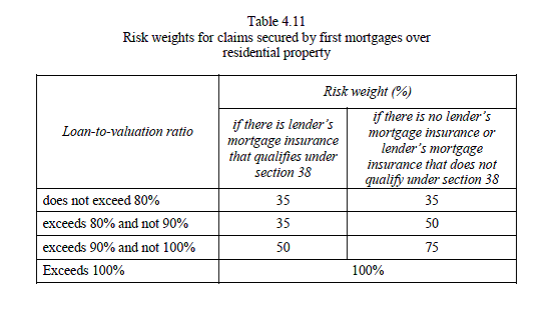
Calculation of risk weights for banks using internal ratings based model (the big 4 banks) is far from transparent, but the easiest way to see the difference is in the rules for other (“standardised”) banks.  Risk weights for residential mortgages are as follows:
riskweights

For loans with an LVR of less than 80 per cent, the risk weight is 35 per cent

By contrast, exposures to unrated corporate borrowers generally have a risk weight of 100 per cent.

But that is because the risks to banks from typical housing loans have been found to be less than those on many other bank assets.  This is not just an observation about boom times, or about New Zealand and Australia in recent decades, it is a result across many countries and many different circumstances.  Housing mortgages initiated by banks themselves, not under regulatory mandates to take on dubious risks, have rarely if ever played a major role in financial crises.  A recent Reserve Bank Bulletin reported on some of the international literature in this area.  A good example was Finland in the 1990s, where after a major credit boom and rapid growth in asset prices in the late 1980s, house prices fell by about 50 per cent in nominal terms, real GDP fell away sharply and unemployment rose substantially.  Banks took losses on their mortgage portfolios, but those losses were modest and not remotely enough to have threatened the health of banks.  The experience in the US since 2007 superficially looks like a counter-example, but binding federal government and congressional mandates played a key role in driving down the quality of new mortgage originations (and hence driving up subsequent loan losses).

It is not surprising that housing loan portfolios are not overly risky.  Lenders have a lot at stake, but they also have solid collateral.  Borrowers also have a lot at stake, especially in countries (like New Zealand and Australia with with-recourse mortgages).  You can escape your debts if you go bankrupt but fortunately (in my view) we don’t have a culture that is overly welcoming to bankruptcy.    And a owner-occupied home is not just a roof over the head, it is often also about a place in a community –  the local school, or sports club, or church.  So most residential mortgage borrowers do everything they can to avoid defaulting on their mortgage, and losing their house, even in very tough times.  There will always be a minority of bad borrowers, and other people who are just overwhelmed by events and the size of a shock.  Recent loans tend to be riskier than older loans –  most of us probably borrowed about as much as we could afford to get into a first house,  but mortgage portfolios age and typically get safer as they do.  And it portfolios of loans –  not individual loans –  that need to be evaluated in thinking about the risk to banks.

By contrast, the typical unrated business loans will have no collateral, revenue streams that depend quite strongly on the economic cycle (profits are more volatile than wages) and limited liability.   The nature of business is taking risk, and sometimes risks pay off and other times they go spectacularly wrong.  Empirical evidence is that a portfolio of unrated business loans is materially risker than a portfolio of unrated residential mortgages.  To be more specific, even in respect of property-based exposures, the evidence is that commercial property, and especially property development exposures, are far riskier (and more likely to lead threaten the health of banks and the financial system) than residential loan books.  Markets will, and regulators should, reflect that in their expectations around capital.

Actual risk-weighting for our big banks is more sophisticated than this description and, as mentioned, much less transparent.  Reasonable people can differ on whether anything is gained by having the IRB approach, or whether it would be better to simply use the standardised approach for all our banks –  all of which are relatively simple.

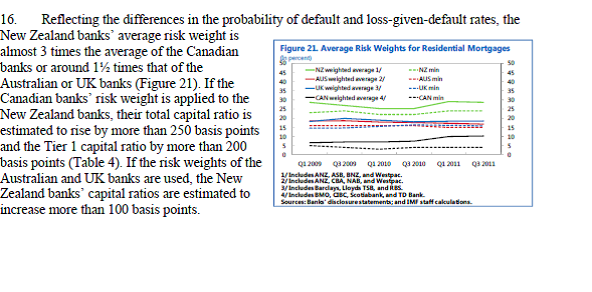
But not only is there good reason for residential mortgage risk weights to be lower than those on many/most commercial exposures, but New Zealand’s risk weights on residential loans are high by international standards.  This IMF piece, done a couple of years ago, contrasted effective risk weights on residential mortgages with those then in the UK, Australia and Canada
riskweights2

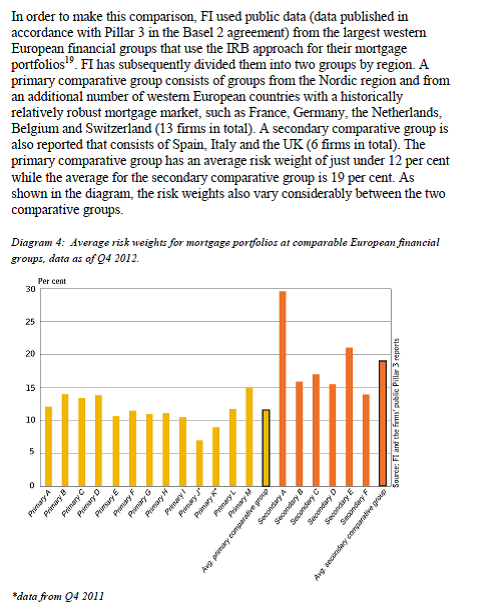
Sweden recently raised the minimum risk weights used by their banks on residential mortgages.  As part of the preparation for that move they produced this document, which includes this chart.  Again New Zealand risk weights on residential mortgage loans are higher than any of the banks in this chart – and are higher than the newly increased Swedish risk weights.
riskweights3

Residential risk weights, or overall required capital ratios, might still in some sense be too low in New Zealand.  But the onus should be on those calling for such increases to make the case that the threat to financial stability is greater than what is already allowed for in the bank capital framework.  The Reserve Bank did stress tests last year looking at the impact of a really quite severe adverse shock, in which nominal house prices fell a long way and unemployment rose substantially (it usually takes both to cause real trouble).  Not one of the banks, let alone the system as a whole, had its capital materially impaired in that scenario.  Those tests may well have been flawed, they may have missed something important, and they certainly won’t have captured everything that mattered, but on the information we have actually available the New Zealand banking system currently looks pretty well-placed to cope with a severe shock affecting the residential mortgage book.  With the stock of credit growing at only around 5 per cent per annum, that also should not be a great surprise.

And since housing seems to be one of those areas where to cast doubt on one possible explanation/solution is to risk being accused of thinking there is no issue or problem at all, I refer anyone inclined to react that way back to my take on housing.
Hidden in plain sight?

Peter Wallinson’s Hidden in Plain Sight (“what really caused the world’s worst financial crisis and why it could happen again”), had been sitting for a couple of months on the unread pile on the coffee table, when I found a reference to it on one of my favourite economics blogs/newsletters.  David Warsh’s Economic Principals is a weekly must-read, for his ability to put together succinctly enlightening perspectives on a range of issues in economics, including the history of economics.  So when, last week, in the middle of a column devoted to the American Enterprise Institute, I found a sneering attack on Wallinson, I decided it was time to read the book.  Without taking time to engage the substance, Warsh drips contempt:

He is, however, a lawyer, with no sense of what constitutes a satisfying economic explanation. What makes him a crank is the affable certainty with which he asserts a partial truth explains the whole.

No sensible analyst thinks that political pandering to poor people is a sufficient explanation of the crisis.

The book clearly polarises readers – when I checked on Amazon this morning, readers’ ratings were roughly evenly split between five stars and one star, with almost nothing in between.    That is something of a pointer to how much is at the stake in ongoing debates of how best to understand the causes, and handling, of the 2008/09 crisis.

So what is the essence of Wallinson’s story?    It is that without repeated, sustained and frighteningly successful US government efforts – under both Clinton and Bush administrations – to promote easier access to housing credit, particularly through the agencies (Freddie Mac and Fannie Mae), there would most likely have been no serious US financial crisis.  Wallinson documents how government mandates compelled the agencies to drive down their lending standards, and how because of the dominant role of the agencies in the market, this contributed to a sustained deterioration in the quality of new housing loans being made across the United States.  As late as 2004, new mandates were imposed, forcing the agencies to meet higher low income lending targets with loans for new purchases, excluding any refinancing or equity withdrawal loans.

Wallinson also explains how the distinction between prime and subprime was progressively eroded, and yet how difficult it was for anyone to be fully aware of the scale of what was going on.   Even in the early days of the crisis, data were interpreted as suggesting that the agencies had very little subprime exposure, and indeed that subprime exposures were a small part of the stock of housing credit.  But in fact commercial data providers treated all mortgages purchased by the agencies as prime by definition – unless they were purchased from explicit subprime lenders.   In other words a sustained deterioration in the quality of the agencies’ loan books was largely masked from outside observers –  Wallinson, who had worked on agency issues for some years, notes that he was himself in this category.

And he deals with an argument that the agencies themselves were responsible, pursuing profit-maximising strategies at least during the boom years.  In fact, the agencies constantly struggled, and often only narrowly met, the ever-increasing minimum legal requirements for the share of lending to low and below-median income borrowers.    If loan losses on agency-held mortgages were a little less bad than those in the market as a whole, that is also unsurprising  –  given the dominant position of the agencies, and their low (implicitly government guaranteed) costs of funds, they could typically out-compete other purchasers and get the best (least bad) loans available in any cohort.      The argument isn’t intended to elicit much sympathy for the agencies or their shareholders, who fought doggedly to protect their political position and government preferences, but they increasingly found themselves in an ever more threatening vice.  Their political position depended on being able to sell themselves as facilitating the “American dream” of widening home ownership, and this vulnerability was increasingly exploited by politicians who did not (or would not) appreciate the scale of the risk they were driving into the system.

I don’t agree with everything in Wallinson’s book, but that doesn’t detract from its value.  I think he overstates the importance of fair value accounting requirements – in a panic, fear and uncertainty will drive equity prices deeply lower, regardless of the basis on which institutions are formally valuing the assets in the spotlight – and I’m still not persuaded that, even given the Bear Stearns precedent, Lehmans should have been bailed out.

But if you are at all interested in the 2008/09 US crisis, this book is well worth reading.  It matters to New Zealand oriented readers for at least two reasons:

  • The crisis was a hugely influential event, not just on near-term economic developments back then, but in influencing the global debate about markets, banks, regulatory policy, and the role of government.  It will be a reference point for decades to come, and which narrative dominates will matter.
  • Graeme Wheeler’s perspectives on the New Zealand housing market seem very shaped by having lived in the United States through the boom and bust years.  But if the experiences of other countries are to shape policy in New Zealand –  and it is very important that we do learn from other countries’ experiences –  it matters greatly that we understand those experiences correctly.

The conventional wisdom of recent years has been that the crisis was primarily a result of flawed private market behaviour, with the world pulled back from the brink by the heroic efforts of various government actors.  The understandable mood of “never again” translates into a bigger role for government – more regulation and more regulated entities.  Governments protect the public from the (mostly unwitting) predations of inadequately regulated private markets, and the too easy ebbs and flows of private capital.  But an alternative story – to which Wallinson’s story contributes – would emphasise the role of government choices in generating the conditions that made severe crises likely in the first place.  For example, the US crisis would never have occurred, on the scale it did, without the sustained government efforts to drive down lending standards and expand credit, all made possible by the role of the extraordinary role that state has long had in the US market for housing finance.  And the two other worst housing collapses of recent years –  Spain and Ireland – would probably never have happened on anything like the scale they did without the decisions of the respective governments to adopt the euro, and hence apply interest rates not set to reflect domestic economic conditions.

No single story is ever the whole explanation of complex phenomena, and the two perspectives in the previous paragraph are deliberately sketched out in slightly caricatured fashion

Of course, John Taylor would add another strand to the “government failure” story, with his emphasis on the Federal Reserve’s departure from the prescriptions of the Taylor rule in the early 2000s.  I don’t find that particular argument very persuasive, and indeed in some respects I think it helps shed light on the Wallinson story.  The US was far from being the only country where monetary policy departed from the prescriptions of a Taylor rule.  For example, Willy Chetwin and I showed a few years ago that New Zealand’s OCR had for some years in the early-mid 2000s been set below what a New Zealand Taylor rule (using the Reserve Bank’s own estimates of the output gap and neutral interest rates) would have suggested.    The US was also far from the only country exposed to foreign capital inflows pursuing yield.  But the US experience of housing loan losses was uniquely bad.  It points to something unique to the United States as being a key part of any explanation.  Statutory mandates to drive lending standards ever lower looks like a pretty compelling element of any successful story of the causes of the crisis.  Fortunately, we’ve had nothing similar in New Zealand…or in Australia, the United Kingdom, or most other countries.  That doesn’t mean we can’t have big sustained falls in nominal house prices here, but it might mean the narrative around the US-centred crisis might not shed much light on vulnerabilities here.

Case not made: investor housing consultation

The Reserve Bank has been out consulting, I think for the third time, on proposals to differentiate clearly, in bank capital requirements, between loans for investment properties, and loans to owner-occupiers.   I made a fairly short high-level submission on their consultation document.  It is here:

housing consultation document 13 April 2015

The thrust of my argument is “case not proven”.  The Bank argues that, for otherwise similar borrower/loan characteristics, loans for investment properties are materially more risky than those on owner-occupied properties.  But they present surprisingly little data –  none from New Zealand, since we’ve had no material housing loan losses since the 1930s –  and what data are presented are largely taken as is, with no attempt to think seriously about how the New Zealand investor property market might be similar to, or different from, those in other countries.  In particular, the longstanding prevalence of small investors  –  which arises because our tax system treats them fairly neutrally with other potential holders –  is different from countries that often have large corporate holders of residential properties, and perhaps a rush into buy-to-let by individuals very late in the boom.

The Bank is quite open about the fact that its proposals would facilitate the imposition of eg a investor-specific LVR speed limit.  That is presented as an advantage, but as they have not consulted on the benefits and pitfalls of such a further intervention –  on top of the avowedly temporary initial LVR limit –  it cannot be considered as a public benefit at this stage.  The latest iteration of the proposals has the feel of something more focused on making an investor speed limit work, than on remedying material deficiencies in the New Zealand bank regulatory capital framework.  New Zealand already has among the very highest risk weights on housing loans of any advanced countries and, as the Reserve Bank has recently acknowledged, international experience is that housing mortgages are rarely central to even very serious financial crises.