Brian Fallow covers my criticisms of the proposed new controls

In his weekly column in today’s Herald, Brian Fallow outlines and reviews some of the criticisms I have made of the Reserve Bank’s proposed Auckland investor property finance controls.   The accompanying cartoon (only part of which is online) shows pygmies attacking the giant Wheeler, secure in his moated castle.

Fallow’s piece is a very fair presentation of some of the arguments I have made, particularly in my LEANZ address last week (and he also notes the Treasury’s evident disquiet about the proposed controls).  I’m not going to repeat old material here, but will just highlight a couple of the points that arose in subsequent discussion.

Brian noted that Grant Spencer, the Bank’s Deputy Governor, has often argued that even though the stock of debt is not currently growing rapidly, there are a lot of new loans occurring and hence the risks are rising.  My response to that point is that, in normal times, there will always be lots of new loans, and lots of repayments going on.  It is great that the Bank is now collecting more detailed flow data that enables us to better see that breakdown.  But because we have no historical time series, we don’t have any good basis for interpreting it, and knowing what it might mean about risk.  In particular, as I noted, we don’t know what the pattern of new loans vs repayments was in the credit and housing boom of 2003 to 2007 when, for example, housing turnover was much higher (and from which episode, as a reminder, banks emerged unscathed).   That drives me back to the international empirical literature on crises, which suggests that big increases in the stock of debt (relative to GDP) over short periods of time has been one of the best indicators of building crisis risks.  Of course, historical empirical work is also limited by data availability, but at this stage with no material increase in debt to GDP ratios, and no sign of any material deterioration in lending standards, there doesn’t seem a basis for great concern about financial stability in New Zealand.

I have also suggested that the Bank should be doing more careful comparative research and analysis on the similarities and differences between New Zealand’s situation and those of countries that have had nasty housing busts (US, Spain ,and Ireland) and those that did not (UK, Canada, and Australia for example).  Brian posed the reasonable question as to whether people won’t just focus on the superficial similarities and differences, cherry-picking points of similarity or difference that suit their own argument.  That is a risk, but in a sense that is the point of doing research and analysis (for which the Bank has far more resources than any else in New Zealand), and making it available.  It enables informed debate to occur, and each piece of data or analysis is open to scrutiny and challenge.  The contest of ideas and evidence is a big part of  how we learn.

Fallow concludes his article thus:

A financial crisis is a low probability but high-cost event, as the Treasury says.  If you focus on the low probability, like Reddell, the conclusion is that the bank should pull its head in.  If you focus on the high potential cost, like Wheeler, you would want to do whatever you can to slow the growth in house prices and buy time to get more built and for the net inflow of migrants to return to more normal levels.

Maybe, but actually I suspect that misrepresents both Graeme and me.  Graeme Wheeler probably thinks the probability of something nasty happening in the New Zealand financial system in the next few years is higher than I do.  And I’m not just focused on the low probability of serious financial stresses.  That is the importance of stress tests.  They aren’t probability-based.  Instead, they take an extreme scenario (in the Bank’s stress tests, a tough but appropriate extreme scenario) and examines what happens to banks if the scenario happens.  On the evidence the Bank has presented so far, the soundness of the financial system is not jeopardised in such an extreme scenario.  Whatever Graeme Wheeler’s personal inclinations or feelings, a threat of that sort is the only statutory basis on which the Reserve Bank should be acting.

What the government does is, of course, another matter. I reckon it should be doing more about liberalising land use restrictions and, since large scale change in these restrictions seems unlikely, should probably reduce the very high target level of non-citizen immigration.

Criticism of the RB is “bizarre”

Reading the Herald over lunch, I found a column by Matthew Goodson, the head of a funds management company.   Authors don’t get to write the headlines, but I think the gist of Goodson’s piece is summed up here in his own words:

“Thank goodness that Graeme Wheeler and the RBNZ are beginning to pay attention to the issue.  It is simply bizarre that they are being criticised for being the one official institution to show some leadership and tentatively use their limited tools to lean against Auckland house prices.”

I assume that I’m one of those whose views are being described as “bizarre”.

But let’s step through Goodson’s argument:

First, he seems to suggest that critics of the Bank think house prices will never come down.  Perhaps there are some who believe that, but I’m quite happy to work with an assumption that some event, at some point, could lower Auckland house prices by 50 per cent.  Indeed, that is what the Reserve Bank assumed when they did their stress tests.  And the banks came through unscathed.  Goodson does not mention this work, which has been published by the Bank, and Graeme Wheeler has not engaged with it.  Perhaps it is wrong or seriously misleading –  I’m open to the possibility –  but let’s see the evidence and argumentation.

Second, Goodson rightly stresses the bad economic consequences that have at times followed from credit-fuelled asset price booms.  As he says, the post-1987 New Zealand equity and commercial property crash springs to mind.  But the operative word is “credit-fuelled”.    Credit is growing at around 5 per cent per annum, just a little faster than nominal GDP, right now.  But over the years since 2007 the ratio of credit to GDP has fallen, not risen.  Big increases in the ratio of debt to GDP over quite short periods of time have been one of the better indicators of future problems (but there have been plenty of “false positives” too).  We had those sorts of increases from 2002 to 2007.  We’ve had nothing similar since.

Third, Goodson invokes Spain and Ireland, and fails to mention that these were economies that had German interest rates during the boom when they needed something more like New Zealand ones, and when the construction boom burst –  and construction booms do much more damage than pure asset prices booms – they were still stuck with German interest rates, not something lower, and couldn’t adjust their nominal exchange rates either.  There are plenty of lessons from Spain and Ireland if New Zealand is ever thinking of adopting a common currency.  But otherwise not.

Fourth, Goodson does not mention that all his points could have been made, more compellingly, about New Zealand in 2007.  We’d had rapid rises in the prices of all types of assets, rapid growth in credit across all components of bank lending books, signs of material deterioration in credit quality around dairy loans, and probably commercial construction, and big corporate-finance loans as well.  And yet, the banking system came through unscathed.  If controls had been put on back then, would they still be on today, at what costs to individuals and to the efficiency of the financial system?

Fifth, Goodson does not engage with the provisions of the Reserve Bank Act.  Perhaps what Graeme Wheeler is doing is in some sense good for the country –  I doubt it, but let’s grant the possibility.  But Graeme is not the elected Minister of Finance, proposing legislation to a Parliament of elected members.  He is an unelected official, supposed to operate within the confines of a specific Act.  That Act requires him to use his banking regulatory powers to promote the soundness and efficiency of the financial system.  But his own stress tests tell him that the soundness of the banking system is not impaired –  and even if it were to be, the capital buffers in the system are much bigger than they were in, say, 2007.  And what of the adverse impact on the efficiency of the system?  Equally creditworthy borrowers in Auckland will not, by the coercive power of the state, be permitted to take a loan from a bank that they would be able to if they were in Wellington or Christchurch. And non-banks can make such loans in Auckland, but banks can’t. Where is the evidence that banks and borrowers are behaving so recklessly that they cannot safely be permitted to have a single cent of debt secured on investment property if the loan is above a 70 per cent LVR?  Goodson doesn’t present it, and neither has the Bank.  Build bigger capital buffers if you must –  they have much smaller efficiency costs, and  don’t directly come between willing borrowers and willing lenders.

Finally, Goodson observes that “the RBNZ’s tools need to be sharpened rather than tempered, with other countries providing plenty of evidence for the success or failure of tools such as stamp duty, removing the tax advantages of so-called investors, overseas investment restrictions, loan restrictions et al”. To which I would make two responses.  The first is to say “Really?”   I think the evidence of the impact these differences make to house prices is much less clear.  Tax regimes differ enormously around the world, and if ours offer unjustifiable advantages to anyone it is to unleveraged owner-occupiers, rather than those operating residential rental services businesses (“so-called investors”).

But perhaps more importantly, I hope he isn’t suggesting that such tools should be wielded by the Reserve Bank.  We live in a democracy, where key economic policy decisions should be taken by those whom we elect, and whom we can vote out.  Goodson alludes to Sir Robert Muldooon.   Some of Muldoon’s interventions were pretty damaging and unwise, but we voted him into office, and we could (and did) vote him out again.

As I’ve said previously, the sense that “something needs to be done” seems to be  leading to sense that “anything is something, so let’s welcome anything”, with no proper problem definition, no sense of what should properly be done by whom, and no sense of the risks and costs if the authorities have it wrong.    The Reserve Bank has an important role to play. It should be doing two things.  It should be continuing to refine its stress-testing exercises, and the risk-weighting models used by banks in their internal capital models, to ensure that the banks really can cope with a very nasty shock.  And beyond that should be using part of the significant research and analysis capability the taxpayer funds to produce rigorous and well-grounded papers identifying the real issues in the local housing (and housing finance) markets, reviewing the lesssons from countries that have, and have not, had banking crises related to their house prices booms, reviewing lessons from past interventions (successful and otherwise).  They might even develop (or commission) expertise in things like capital income taxation or urban planning regulations, to better be able to provide advice on the costs and benefits of action, or inaction.  Considered analysis of this sort, complementing that from core government departments, can provide a good foundation for political decision-makers to act, or not act.  But these are the sorts of instruments that, in a free society, only elected people should be deciding on.

Serious liberalisation of planning laws, and/or a reduction in the non-citizen target immigration level would be good places to start.  Both would, very belatedly, lower house and land prices, probably rather a lot.  But they would not threaten the soundness of our financial system..

The Reserve Bank’s releases on proposed investor finance controls

I noted yesterday that the Reserve Bank had also released some papers on the proposed new LVR restrictions on Thursday.  When that release was pointed out to me yesterday, the Bank’s website suggested that the papers had been released in response to an OIA request.  The papers still appear in the obscure corner of the Bank’s website where (in a welcome development) they have started publishing some of the responses they make to OIA requests.

But when I checked again this morning, the table now says of the latest release:

Date of Response Subject matter
25 June 2015 Loan-to-value ratio (LVR) restrictions, proactively released, jointly with the Treasury

Go through to the detailed page, and it suggests that the release is partly pro-active and partly a response to an OIA request.

This is information relating to loan-to-value ratio (LVR) restrictions that has been released proactively and in response to requests for information under the Official Information Act 1982 (the Act).

I’m a little confused.  But if there genuinely is a pro-active component to the Bank’s release then I welcome it, even if (say) they may just have released one additional paper to provide context for a few that were covered by the OIA.

It still leaves a little bit of a puzzle about the Treasury’s (entirely pro-active) choice to release.  Sometimes documents requested of one organisation cross-reference material generated in other organisations, but that does not appear to be the case here.  Perhaps the OIA request to the Reserve Bank included material the Bank held, even if it did not generate it.  If so, no doubt the Bank held copies of at least some of the Treasury papers?    But having been on the receiving end of numerous OIA extensions from the Bank (and recently one from Treasury), when documents written little more than 20 working days ago are pro-actively released, it has the feel of a genuinely deliberate timing choice.

But enough of the bureaucratic process stuff.  What I had intended to write about was the content of the Bank documents.  They released six, one of which (the 17 Feb one) I had previously seen.

Date Released on 25 June 2015
19/5/2015 Memo to Minister on draft consultation paper on LVR policy (PDF 818KB)
30/4/2015 Memo to Minister on estimated impact of changes to LVR policy (PDF 1.36MB)
24/4/2015 Memo to Minister on potential adjustments to LVR ratio policy (PDF 2.67MB)
21/4/2015 Memo to MFC on Proposed changes to the LVR policy (PDF 350KB)
2/4/2015 Memo to MFC on revisiting the case for regional targeting of marco-prudential policy (PDF 134KB)
17/2/2015 Memo to MFC on effectiveness of a tighter investor LVR limit (PDF 99KB)

We don’t have much context for this release.  In particular, we don’t know the scope of any OIA request the Bank may have been responding to, but if these papers are intended to reflect the analysis the Bank undertook in developing the proposed control on investor lending (and the Auckland-specific nature of the new policy), they are surprisingly short and weak.  Recall that the Bank is,  implicitly, saying the banks and borrowers are so risky and irresponsible that not one single (practical) cent can safely be lent by banks to Auckland residential property investors on LVRs over 70 per cent without jeopardising the soundness of the financial system.  That is a pretty ambitious claim.  It is not supported.

I have been critical of the Bank for not making a stronger case for its proposed controls.  The one comfort I suppose that we can take from these papers is that they are not hiding anything from us.  But if this is all there is – the extent of their engagement with the law, the economics, the stress tests, the uncertainty –  it is even less surprising that The Treasury was also not convinced that a compelling case had been made for the new controls.  Unfortunately, the Reserve Bank also continues to repeat to the Minister of Finance its claims that lending to investors is generally materially riskier than other housing lending.  An attendee at the LEANZ seminar the other night told the audience that he had gone through all the references the Bank has previously invoked in support of its claim, and had found that they simply did not say what the Bank claimed they were saying.  If that assessment is correct, it is pretty concerning, and should be so to the Board and the Minister –  charged with holding the Governor to account on our behalf.

A process issue struck me in reading the papers.  In discussing the possible new policy, the 21 April paper lists a possible timeline.  It suggests that a consultation period should end in “late June” and “Release final policy position and revised conditions of registration” in “mid-July”.  Allowing perhaps 10 working days to read, analyse, and reflect on submissions, write up recommendations to the Governor, write-up a response to submissions, and finalise the new conditions of registration themselves does not suggest that the Bank had in mind a very open process of consultation.  Actual timing slipped somewhat, as the consultative document was not released until early June, but we should hope that they take a little more than 10 working days to work through all the issues likely to be raised in submissions.

As I noted yesterday, the cause of serious scrutiny of the Governor’s proposals (and of open government more generally) would be advanced if the Bank were to publish on its website, as they are received or at least on the closing date, all the submissions they receive.  They are, after all, public, official, information.

The Treasury on the new proposed LVR limits

UPDATE: There was also a release yesterday of some Reserve Bank papers on these issues.  The Reserve Bank papers are described as being released in response to OIA requests.  The Treasury papers were pro-actively released, but apparently in coordination with this Reserve Bank release.  I have not yet read the RB papers.

I got home late last night and missed the significance of Stuff’s story about the newly-released Treasury papers on the Reserve Bank’s proposed new LVR controls.

But reading the package of material that The Treasury released, it does not paint a particularly pretty picture.

First, it is interesting that Treasury has pro-actively released this material, about the proposed investor restriction that the Reserve Bank is currently consulting on.  It was not extracted from them reluctantly by a citizen’s Official Information Act request.  One assumes that they released the material with at least the acquiescence of the Minister of Finance.   I’m all for transparency, but this release suggests something quite uncomfortable about relationships between the Reserve Bank, Treasury, and the Minister –  something already hinted at in the Minister’s comments on a couple of occasions about the Bank’s handling of monetary policy.

I don’t agree with everything in the Treasury papers –  for example, invoking the results of a DSGE model as a basis for advice on the timing of a relaxation of LVR limits is not particularly persuasive.   But the bottom line seems to be that Treasury, the government’s chief economic policy advisers, are also not convinced that the case has been made for the proposed new investor controls.

For the moment, as they note, decision rights on these matters rest exclusively with the Governor, but if the Governor can’t make his consultative paper convincing to The Treasury  –  who are by no means as sceptical of the general case for active regulatory interventions in this area as I might be  –  it should be a little concerning to the rest of us.

Here is what Treasury had to say on the substance a month ago in their aide memoire to the Minister on the Bank’s consultative document:

Overall, we do not think that the consultation document makes a compelling case for the proposed use of these macroprudential settings, due to the concerns below. Nevertheless, the RBNZ does have the decision rights, and so our focus will be to work with the RBNZ to make improvements in some key areas. Our main focus will be to encourage:

  • Clarification of the problem identification, evidence and channels. We accept that house price changes can have macroeconomic implications, but the RBNZ’s mandate is to promote financial stability. Therefore, the policy should be reframed to focus more clearly on reducing systemic risk, rather than on prices in a particular market.
  • Additional evidence on the investor segment. The evidence presented is somewhat mixed on the extent that high-LVR investors underpin systemic fragility, as they are a relatively small part of the market and many may be able to alter their portfolio. Similarly, we will be asking the RBNZ to provide further information on the extent to which the increase in investor activity may have been encouraged by the original LVR policy.
  • Discussion on the risks of relaxation of the speed limit outside of Auckland should credit growth and prices pick up again. Although we appreciate that the policy was designed to be temporary, and that the RBNZ prefer light touch regulation, there are a number of potential downsides. In this case, the policy rule is not clear, and the RBNZ policy settings are reactive to recent data. This may lead to an active management of policy settings, which may increase market uncertainty and reduce RBNZ credibility. This is particularly important around LVR limits – Treasury modelling using a DSGE framework suggests that the costs of taking the limits off early may be greater than leaving them in place for longer.
  • Evidence from policy evaluation and additional cost benefit analysis of this policy to be published, including with respect to the other options available. The consultation paper contains little discussion on some of the possible unintended consequences, such as: increased risk of disintermediation or higher non-bank lending; the possibility of shifting demand towards cashed-up buyers; or risks that investors leverage up property outside of Auckland. We will also be asking the RBNZ for more detailed evaluation on the impact of the existing LVR policy, and of the unintended consequences compared with the impacts anticipated in the Regulatory Impact Statement.

The points expressed about process are also a bit disconcerting:

Process

A robust process of consultation is a characteristic of good regulatory practice and should occur within government at the options stage well before the policy is made public.

The late notice and lack of consultation complicates the ability of government agencies to coordinate, which could lead to government policy that conflicts or pays inadequate attention to government’s wider economic objectives.

We will raise these issues with RBNZ and propose process changes to address these concerns.

As I noted in my address last night, under the current Reserve Bank Act model the Governor comes close to being prosecutor, judge, and jury in his own case.  That is a dangerous feature.  Managing the risk makes it all the more important that the Bank goes out of its way to engage pro-actively with the Minister and with Treasury when it is proposing new regulatory measures.  Consultation matters for a whole variety of reasons, but Treasury’s views and questions can, among other things, offer one arms-length test of just how persuasive the Bank’s arguments are.

A more pro-active release policy from the Bank would also be welcome.  Perhaps, for example, the Reserve Bank could consider posting all submissions on the current consultative document on the Reserve Bank website, as and when they are received.  These proposals need all the scrutiny and debate they can get.

Housing, financial stresses, and the regulatory role of the Reserve Bank

Last night I spoke to the Wellington branch of LEANZ on “Housing, financial stresses, and the regulatory role of the Reserve Bank”. They had a good turnout and some stimulating discussion ensued.

The text of my address is here

Housing, financial stresses, and the regulatory role of the Reserve Bank LEANZ seminar 25 June 2015

The presentation was organised in three parts:
• Making the case that high house (and land) prices in Auckland are largely a predictable outcome of the interaction of supply restrictions and high target levels of non-citizen immigration. With, say, 1980s levels of non-citizen immigration, New Zealand’s population would be flat or falling slightly. Much of that ground will be familiar to regular readers of this blog.   It matters because what has raised house prices in New Zealand is very different from what raised them in the crisis countries. In the United States, government policy initiatives systematically drove lending standards downwards in the decade prior to the crash, and in Ireland and Spain, imposing a German interest rate on economies that probably needed something more like a New Zealand interest rate systematically distorted credit conditions across whole economies. New Zealand – and other countries with floating exchange rates and private sector housing finance markets – had no such problems.  Credit was needed to support higher house prices in other advanced economy, but it was not the driving force behind the boom.

If I am right that the New Zealand house price issues result from the interaction of our planning regime and our immigration policy, then these are structural policy choices that systematically overprice houses, largely independently of the banking and financial system.  They are not ephemeral pressures –  here today and gone tomorrow.  They have been building for decades.  I hope they are reversed one day, but there is no market pressures that will compel them to (any more than there are market pressures that compel the reversal of planning restrictions in Sydney, London, or San Francisco).  These distortions are not making credit available too easily and too cheaply right across the economy  (which is the single big difference between NZ or Australia, and say the Irish, US or Spanish situations).  They are simply making houses less affordable.   The Reserve Bank has no better information than you, I, or the young buyers in Auckland do, on whether and when those policy distortions will ever be reversed.   And even if the policy distortions were corrected, it is pretty clear that real excess capacity (too many houses, too many commercial buildings) is a much bigger threat than simply an adjustment in the price of banking collateral.   No one thinks Auckland has too many houses, or too much developed land.

• The core of the paper was the proposition that the Reserve Bank’s actual and proposed LVR restrictions appear both unwarranted by, and inconsistent with, the Reserve Bank’s statutory mandate to promote the soundness and efficiency of the system. In subsequent discussion, a very senior lawyer went so far as to suggest that the Bank might even be acting ultra vires. My arguments around the LVR policies had a number of dimensions including:
o The almost total absence of any sustained comparative analysis of the international experience of the last decades, including the issue of why some countries (Spain, Ireland, and the United States) had very nasty financial crises and housing busts, and others (New Zealand, Australia, the UK, and Canada) did not.
o The lack of any engagement with New Zealand’s own experience in the last decade. Risks appeared much greater in 2007 than they are now, and yet the banking system came through a severe recession, and sluggish recovery, unscathed.
o The lack of willingness to engage openly with the results of the one piece of sustained work the Bank has done, the 2014 stress tests, which suggested that the New Zealand banking system, on the current composition of their asset portfolios, could relatively easily withstand even a very severe shock.
o The failure to address the efficiency dimension of the Bank’s statutory responsibility. Both the actual and proposed LVR controls will impair the efficiency of the financial system.
o The failure to identify and address the distributional implications of the controls.
o The failure to grapple with the limitations of the Bank’s (and everyone else’s) knowledge. There might be an arguable case for controls if we could be sure a crash was coming 12 months hence, but in fact the Bank has no better information than you or I do as to when, or if, there will be a substantial fall in nominal house prices.

• Discussion of the regulatory powers of the Bank, and its governance. As I put it in the conclusion:

These concerns bring into focus the weaknesses that have become increasingly apparent in the Reserve Bank Act. That Act was a considerable step forward in 1989, at a time when only a modest and limited role was envisaged for the Reserve Bank. But it is now 2015, and the legislation is not consistent with the sorts of discretionary policy activities the Bank is now undertaking, with modern expectations for governance in the New Zealand public sector, or with how these things are done in other similar countries. Doing some serious work on changing the single decision-maker model would be an excellent place to start, but it is only a start. A much more extensive rethink and rewrite of the Act, and the Bank’s powers, is needed to put in place a much more conventional model of governance and accountability, especially in these regulatory areas.

Real economic costs of financial crises – part 1

A couple of days ago I looked at how one might best classify countries, as to whether or not they had experienced a “financial crisis” since 2007.  But this chart is one reason why I’ve become increasingly sceptical that “financial crises”, however one defines them, have large or enduring adverse real economic effects.  I think I first saw it in a sets of slides by Nobel laureate Robert Lucas, and every so often I would use it to try to stir up a bit of debate at the Reserve Bank.

maddisonUS

It is a quite simple chart of real per capita GDP for the United States, back as far as 1870.  These are Angus Maddison’s estimates, the most widely used set of (estimated) historical data, and as Maddison died a few years ago they only come as far forward as 2008.  The simple observation is that a linear trend drawn through this series captures almost all of what is going on.  More than perhaps any other country for which there are reasonable estimates, the United States has managed pretty steady long-term average growth rates over almost 140 years.  And yet, this was a country that experienced numerous financial crises in the first half the period.  Lists differ a little, but a reasonable list for the US would show crises in 1873, 1884, 1893, 1896, 1901, 1907, perhaps 1914, and 1929-33.  There were far more crises than any other advanced countries experienced.

And yet, there is no sign that they permanently impaired growth, or income.  One never knows the counterfactual, but right through this period the US kept on towards establishing the dominant position it was to hold in the decades after World War Two.  Even the Great Depression, awful as it was (costly as it was to many people) does not look to have had permanent adverse effects.  Another source I’ve bored people with over the past few years is Alexander Field’s excellent relatively recent book on US economic growth, productivity, and the Great Depression, A Great Leap Forward.  Field reports the best estimates for TFP growth in the US over the last century, and growth was faster from 1929 to 1941 than in any of the other periods he presents.  One might quibble about when to start and end these sub-periods, but 1929 was before the downturn became well-established, and 1941 is around when GDP per capita got back to pre-crisis trend (before temporarily going well above it in World War Two).

fieldtfp

The United States in the Great Depression had almost all the factors that are often cited to explain why financial crises might have permanent or very long-lasting adverse effects:

  • Lots of bank failures, and in a system without nationwide banks, disrupting the intermediation process.
  • Lots of corporate failures
  • Big changes in the price level (steep deflation)
  • Huge regulatory uncertainty (including around the robustness of the judicial system –  see, eg Roosevelt’s attempt to stack the Supreme Court)
  • Significant fiscal costs (in this case, not bank bailouts, but the defaults by other Western countries on the huge US World War One loans).

And yet the underlying rate of innovation is estimated to have gone on just as strongly as before.

This is not, remotely, to trivialise the Great Depression.  But it still looks a lot more like an event that became as severe as it was because of inadequate demand, and was resolved when sufficient strong aggregate demand returned (in the US case not until World War 2).  Output lost in the interim is a real and substantial cost to the people involved, but the numbers get really big if something changes the long-term future path of growth.  And there is no sign of that having happened in the many financial crises the US experienced from the 1870s to the 1930s.

A few years ago, Andy Haldane of the Bank of England got a lot coverage for a speech in which he presented this table, suggesting that the cost of the 2008 financial crisis could be huge –  100 per cent or more of annual GDP.

haldane

If so, it could be argued that everything should be done, all resources of the state thrown at, avoiding such events, which –  as Haldane put it –  our children and probably our grandchildren might be paying for.  But if there is little or no permanent reduction in the future path of per capita income, as a result of the financial crisis itself, the real economic costs of crises are much much smaller.  And the benefits of any regulatory measures to reduce the risk of crises are commensurately smaller –  all the more so when we allow for how little any of us know about the long-term costs and benefits of such regulatory restrictions.  Even recessions occurring at the time of a financial crisis can’t all (or perhaps even mostly) automatically be ascribed to the crisis itself.

I’ll have a few more posts on related issues in the next few days or weeks.  But recall where I started on this, and where I will loop back to. Per capita income GDP growth in New Zealand and the United States since 2008 has been very similar, even though New Zealand had only a minor domestic financial crisis, while the US was at the epicentre of a major global liquidity event,  and many significant US institutions failed or came close to failing, and US lenders experienced very large losses.   Sadly, as earlier posts have illustrated the relative productivity performance in New Zealand (relative to the US)  has been even weaker.

us vs nz 2

Financial crises since 2007

I’ve been working my way through a series of posts on the post-2007 economic experience of a large number of advanced countries, with a particular focus on trying to make some sense of New Zealand’s (no better than middling) experience.

Today I wanted to have a quick initial look at the incidence of financial crises, since the shorthand for what has gone in recent years has often been “since the financial crisis” or “since the [so-called] GFC”.  Many authors, including some pretty serious and respected ones, have ascribed much of the poor economic performance to the “financial crisis”, adducing the experience as evidence supporting a case for much tighter regulatory restrictions all round.  And there are plenty of theoretical discussions as to how financial crises might have detrimental economic effects.

But what do we mean by a “financial crisis”?  Many authors who try to classify events do so by looking at the gross or net fiscal costs of a crisis (eg the costs of bailouts, recapitalisations, guarantee schemes and so on).  I’ve long thought that was a flawed basis for classification, for a variety of reasons:

  • A country that allowed its banks to fail, with no bail-outs, might have no direct fiscal costs at all, yet on any plain reading could have experienced a very substantial crisis.
  • Most (though not all) of any fiscal support for troubled financial institutions tends to benefit citizens of the country concerned, and so redistributes wealth rather than destroying it.  There may be all sorts of adverse incentive effects, and deadweight losses from the taxes required to cover the fiscal costs, but the level of fiscal support is not a very meaningful indicator of the cost to society.  In rare cases (eg Ireland) the fiscal costs themselves can become quite directly problematic, in terms of on-going market access, but that is not the general experience.
  • A country’s banking system might be very highly capitalised, such that no banks actually failed even under severe stress, and yet on most reckonings the country concerned would have experienced a financial crisis.
  • In some cases, banks will have experienced the bulk of their losses on offshore operations, while the intermediation business in the home economy might have been fine.  The home government might choose to bailout the bank concerned, but there are few obvious reasons to think that those offshore losses (and the choice to bail) will have much effect on the home economy.  A good example, in the most episode, was the losses sustained by German banks.  On many classifications, Germany shows up as having had a financial crisis, and yet almost all of the increased loan losses resulted from offshore exposures (particularly in the United States housing finance market).  If we are trying to understand the economic implications, it probably makes more sense to think of those losses as a US event than a German event.

So instead, I proposed a classification based on non-performing loan data, which the World Bank collects and reports by country.   The proposition here is that, if there are sustained economic consequences from something we can label a “financial crisis”, they are likely to arise primarily from the initial misallocation of resources that led to the loan losses in the first place.  Gross over-investment in a particular sector (say, commercial property in New Zealand in the late 1980s, or in Ireland in the last decade) eventually leads to losses.  The projects don’t live up to expectations, and real resources devoted to those projects can’t easily or quickly be reoriented to other uses. Buildings lie empty, or even half-completed. If there are problems, they arise whether or not any bank ever fails, or is bailed-out by the state.  And banks have to reassess their entire models for generating income, and are likely to become more risk averse as a result of the losses their shareholders faced.  There might be additional costs if a large number of major financial institutions actually close their doors permanently after a crisis (that argument is part of the case for the OBR tool in New Zealand), but relatively few major institutions actually closed their doors in the period since 2007.

The table below classifies countries based on data on banks’ non-performing loans (NPL) from the World Bank’s World Development Indicators. The 20 countries that had a substantial increase in the stock of domestic NPLs after 2007 (the final two columns), are treated as having experienced a domestic financial crisis.

Non-performing loans since 2007
NPLs
Source: World Bank.

Note:

Very low and stable: NPLs:                     less than 2.5 percent of loans throughout, remaining at a stable percent of loans

Moderate and stable: NPLs:                  2.5 to 5.2 percent of loans throughout, remaining at a stable percent of loans

Moderate and small increase:               : NPLs greater than 2.5 percent of loans throughout, increasing by less than 2.5 percentage points

Mostly, the classification looks intuitive, and much as expected. All advanced countries that had a support programme with the IMF during that period are in the financial crisis category. At the other end of the spectrum, the commodity-exporting advanced countries (including New Zealand) all avoided a domestic financial crisis on this, as well as other, measures.

Two points may be worth noting. First, although the extreme liquidity crisis in the United States in 2008/09 attracted headlines – and had global ramifications – loan losses in the United States have been overshadowed by those in many European economies.  One element of this is that more loans in the United States were not on the books of banks (and this is bank data). Second, although some banks in countries such as Germany and Switzerland got into material difficulties, in most cases those were the result of losses incurred in the United States.  As discussed earlier, these losses probably had different implications for the performance of the home (German or Swiss) economy than losses arising out of domestic lending business.

If this classification looks broadly sensible, it is somewhat ad hoc, and might not easily generalise to other crises and other times, even if broadly comparable data were available for earlier periods.

One can’t just jump from this classification to the chart of GDP per capita performance to see whether countries that had financial crises, on this measure, did worse than those that did not.  Apart from the many other influences on any country’s performance, it is also important to recognise that any causation can run in both directions.  The argument that a quite-unexpected period of very weak economic performance will have generated large loan losses (many projects will have been based on assumptions that, however apparently reasonable, did not play out as expected) is at least as strong (I’d argue stronger) than the proposition that “financial crises” themselves cause sustained economic underperformance.  Loan losses did not cause Greece’s problems, but were an integral of an overall process of economic mismanagement and misallocation of resources that led to Greece’s disastrous underperformance in recent years.

And what of New Zealand?  We have had pretty low banking system NPLs throughout.  Finance company losses mattered a lot to investors in those companies, but were still quite modest relative to the overall stock of loans in New Zealand.  There were fiscal costs, through the deposit guarantee scheme, but without the international rush to guarantee schemes there would have been much the same loan losses and probably no direct fiscal costs.

As no major institutions failed, and (economywide) there was little evidence of sustained over-investment in any particular class of asset, one would not generally think of New Zealand having experienced a domestic financial crisis.  Funding was disrupted for a time in late 2008/09, and that was among the factors inducing a greater degree of caution among lenders, but 6-7 years on it seems unlikely that any domestic financial stresses have materially affected New Zealand’s overall performance.  For some sub-sectors, the picture might have been a little different, as finance companies had been major financiers for property developments, but for the economy as a whole the effect seems likely to have been quite peripheral.  And yet, our economic performance has been similar to that of the United States, the epicentre of the initial crisis, and where the increase in actual loan losses was substantial.

Housing, financial stability etc – LEANZ seminar 25 June

About the time, back in April, when I posted some comments on Grant Spencer’s speech on housing LEANZ invited me to speak at one of their Wellington seminars, next Thursday 25 June.

LEANZ is an organisation dedicated to the advancement in New Zealand of the understanding of law and economics. It provides a forum for the exchange of information, analysis and ideas amongst those with an interest in this form of analysis. That interest may be practical (for example, the field of law and economics is very relevant to many aspects of the practice of law, public policy and consultancy), or it may be more academic.

“Nowhere is the baneful effect of the division into specialisms more evident than in … economics and law … the rules of just conduct which the lawyer studies serve a kind of order the character of which the lawyer is largely ignorant; this order is studied chiefly by the economist who in turn is similarly ignorant of the character of the rules of just conduct on which the order he studies rests.” F A Hayek Law, Legislation and Liberty Vol I, pp 4-5. LEANZ hopes to work to bridge this divide.

This is the topic blurb I gave them some time ago –  by the look of it, written before the new lending restrictions proposed in the May FSR

House prices, especially in Auckland, have become increasingly unaffordable. This is largely the outcome of the collision between two sets of public policies: restrictions on land use which impede new housing supply, and high target levels of inward migration of non-citizens.  One or other policy might make sense, but the combination has very adverse effects on the younger and poorer elements of the population of our largest city.  It is a real phenomenon rather than a financial one, and the pressures can only be sustainably alleviated by government action in these policy areas.  The Reserve Bank appears to have taken on itself some responsibility for trying to manage house price fluctuations.  However, the Bank’s involvement appears to be based on a misconception of what is going on, and a misapplication of insights from financial crises abroad, notably that in the United States last decade. There is little or no evidence that financial stability in New Zealand is in any way threatened.  The LVR restrictions –  and others the Bank appears to be contemplating – undermine the efficiency of the financial system.  They may also be slightly impairing its soundness.  Parliament should be asking harder questions about whether such uses of regulatory powers, especially by a single unelected official, are appropriate.

LEANZ tell me that all are welcome to attend –  there is no obligation to become a member first, although I’m sure they would also be happy to have a few more paid-up members.   Details of the event are here.

Yet more on stress tests

Two more points on the stress testing issue.

I’ve mentioned a couple of times that someone who was at the Finance and Expenditure Committee hearing on the day of the Financial Stability Report had told me that the Governor deliberately refused to answer a question about the stress tests, and the implications of those results for assessments of the stability of New Zealand’s financial system.

I’m told that the transcript of that hearing is now on the public record, so here is the relevant question and answer.  The questioner is National MP Chris Bishop, who is deputy chair of the committee:

Bishop             Thanks, Governor. I’m just interested in teasing out what the specific risks to financial stability are for Auckland house prices, because the banking sector has rising capital and liquidity buffers; they exceed the minimums. The banks came through the stress testing pretty well last year. Credit growth is relatively restrained, and as a percentage of GDP, credit is below where it was in 2008-09. So given all that, what are the specific risks to financial stability—which is what we’re discussing here today—from the rising Auckland prices?

Wheeler           I think they’re very substantial. I mean, if you look at mortgage commitments, you quoted a number that credit flowing to the housing sector was low. It is on a net basis, but if you look at mortgage commitments, they’re growing at around 20 percent. House prices in Auckland are growing at around 17 percent. They’ve been growing in the rest of the country over the last year at around 2 percent. If you look at house prices to disposable income in Auckland, that ratio is 7.4 percent. But the rest of the country is 4.2 percent. If you look at rental yields in Auckland, they’re at historic lows, which suggests that there’s a lot of people basically investing for capital gain, whereas the rental yields across the country are basically where they have been for the last 10 years.
If you look at the median house price in Auckland, it’s up 60 percent since 2008. We had the highest rate of house price inflation in the OECD from 2003 to 2008. So the median house price in Auckland is now 60 percent above that. If you look at the Demographia survey that was done last year, we were 14th out of 370 housing markets around the world, in terms of affordability. If you look at the survey that was done by ANZ Bank in terms of investor expectations, late last year, basically, investors in Auckland were forecasting that house prices would increase by 75 percent over the next 5 years. Now, our job is to try and keep inflation, on average, at around 2 percent per annum. So that’s just a phenomenal increase in house prices that are anticipated, and that would just drive house price to disposal income ratios up at a huge rate.

So there’s a whole range of reasons why there are major, I think, financial stability risks around Auckland.

The Governor raised a number of interesting issues, and possible areas of risk, but did not respond to any of Bishop’s points or questions.  Now sometimes MPs at select committees can ask questions just to be on record as having asked them, or to make partisan points.  And so there is an art in how public servants respond to such questions.  But Bishop’s questions and points don’t look as though they fit either of those categories.  They seem to be entirely reasonable questions, drawing on the Bank’s own factual material, and yet the Governor simply chose not to engage or respond.  That doesn’t seem very wise, or very accountable.

And now, back to some geeky stuff.  In discussing the stress tests this morning I mentioned the issue of what size house price fall one might reasonably assume if the stress tests were re-run today.  But as someone pointed out, neither I nor the Bank touched on the other factor that is critical in assessing the likelihood of large loan losses, and that is what happens to unemployment.

By and large, falls in house prices alone do not result in large losses for banks.  Between with-recourse lending and a general desire to avoid moving (which is costly and disruptive), owner-occupiers don’t tend to default if they can service their debts.  Banks can, typically, foreclose if the borrower has negative equity, but are unlikely to do so if the debt is being serviced.  Much the same is likely to go for lending for investment properties –  if rents are high enough to cover the debt service, banks aren’t likely to foreclose.  Foreclosing (itself expensive) crystallises a loss, which might otherwise never happen.

Similarly, high unemployment alone doesn’t typically lead to large loan losses on residential lending.  Some individuals will end up losing their houses, but if they have to sell up (or be sold up) the sale price will usually cover most or all of the debt outstanding.

What gets really nasty is the scenario in which house prices fall a long way and unemployment goes up a lot (and stays high for a while).  In that scenario, many people can’t service their debts (even if the OCR is cut) and if they have to sell, in many cases the proceeds won’t be large enough to cover the debts.

That is the scenario the Reserve Bank’s stress tests (rightly) focused on.  It is the true test of the quality of the residential mortgage loan book.

The Reserve Bank tells us that in the stress test they assumed that the unemployment rate “peaks at just over 13 per cent”.  The unemployment rate at present is 5.8 per cent, and the “natural rate” is probably around 5 per cent.  The modern low was 3.4 per cent.  So 13 per cent is a long way away.  In normal times it would take around an 8 percentage point increase in the unemployment rate to get to “just over 13 per cent”.

I was curious how unusual 13 per cent unemployment rates were, so I downloaded the OECD data as far back as it goes.  In most cases, that is just over 30 years (but we also know that in most OECD countries the earlier decades were decades of pretty full employment).

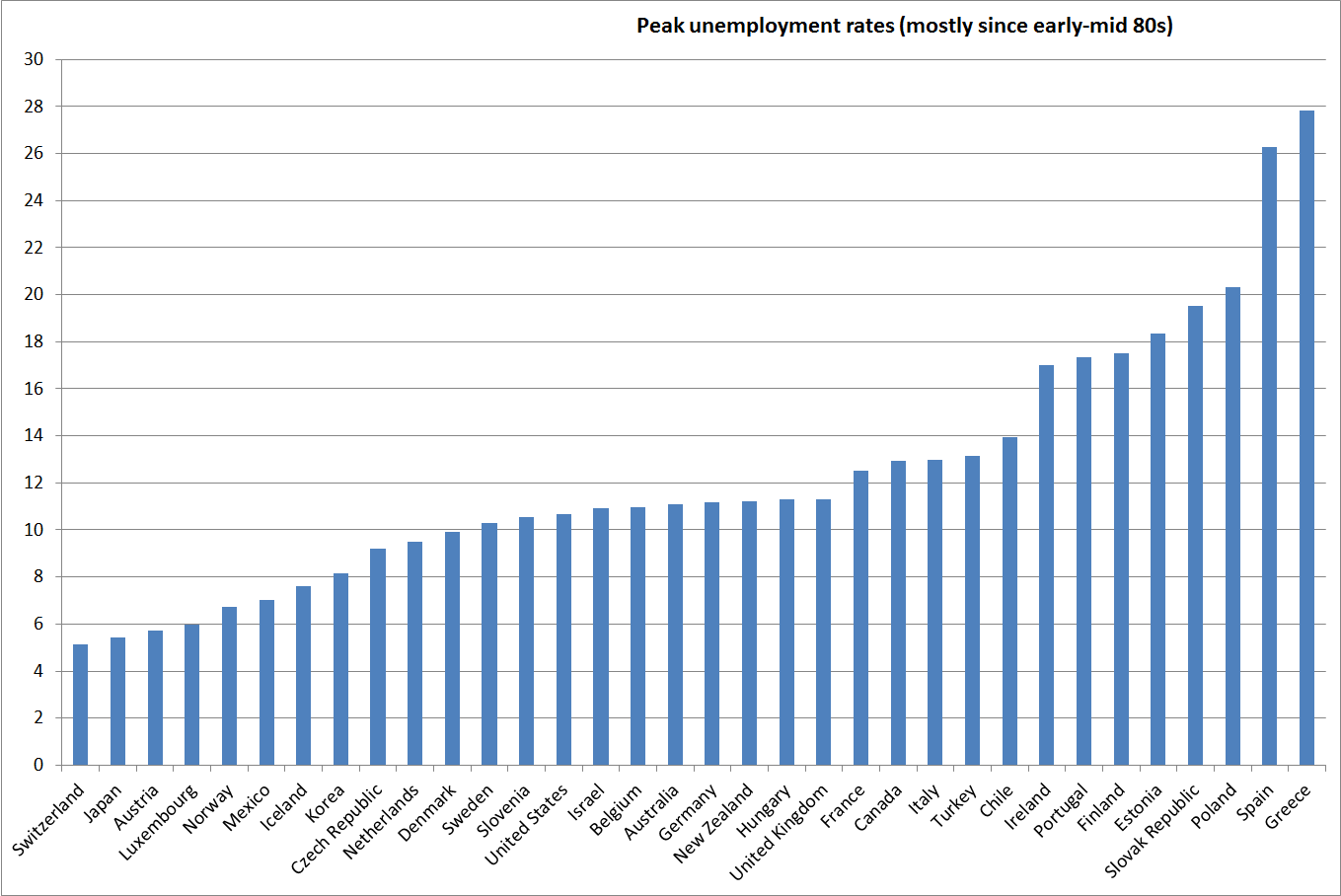
Here is the chart of the highest unemployment rates on record for each of the 34 OECD countries.  Only 13 of the 34 countries has had an unemployment of 12.5 per cent or above in more than 30 years.

peakU

I took a look at those countries.  First, I wanted to understand how much the unemployment rate had increased by in each of those country episodes.  If the NAIRU in one country had been 10 per cent (perhaps reflecting very restrictive labour market regulation), an increase in the unemployment rate to 13 per cent would have much different implications than if that country’s NAIRU was 6 per cent.

Of the 13 countries whose unemployment rates had peaked at over 12.5 per cent, in one case that peak was the first observation in the database (so I couldn’t tell where the unemployment rate had risen from).  Six of the other 12 had had increases in their unemployment rates of 8 percentage points or more (from the previous cyclical low to the measured all-time peak).  Thus, for example, Greece’s unemployment rate peaked at 27.8 per cent last year, but had been as low as 7.5 per cent in 2008.

But the other factor I looked at was the exchange rate regime these countries had been using when their unemployment rate rose to 13 per cent or more.  In only two of the 13 cases had the exchange rate been floating, and in neither of those cases had the unemployment rates increased by anything like 8 percentage points.

Why do floating exchange rates matter?  Simply because they act as a buffer when the economy is hit by severe shocks.  Greece, Spain, and Ireland have had very high unemployment rates (and large increases in those rates) in the last few years because they have had no independent national monetary policy, and no ability for their national nominal exchange rates to depreciate.  The US, the UK, and Iceland, on the other hand, each having had a nasty financial crisis, had nothing like the extent of those increases in unemployment.

Adjustment is a great deal harder, and more costly, without the additional flexibility the floating exchange rate provides.  But New Zealand has had a floating exchange rate for 30 years now, and when the economy has been in serious difficulties the exchange rate has fallen a long way.  No one really doubts that the same would happen again if, say, there was a serious recession here that involved the OCR being cut to, or near, zero.

I’m not suggesting that the unemployment rate could not possibly rise by 8 percentage points here.  From 1987 to 1991, the unemployment rate did rise by 7 percentage points, to around 11 per cent, even with a floating exchange rate.  But that was a pretty stringent test:

  • Huge amounts of labour-shedding from public and private sector structural reform
  • A serious domestic financial crisis
  • And the transitional costs of both lowering inflation markedly, and closing the fiscal deficit, at the same time.

My point is simply to highlight that the Reserve Bank’s stress tests were very stringent, using an increase in the unemployment rate larger than any seen in any floating exchange rate country in at least 30 years.  It is right that stress tests are stringent (the point is to test whether the system is robust to pretty extreme shocks)  but these ones certainly were.  And yet not a single one of big banks lost money in a single year.  That might seem a bit optimistic –  it did to me when I first saw the results –  but they are the Reserve Bank’s own numbers.

And so, again, we are left wondering where is the evidence for the Governor’s latest regulatory initiative?

The Reserve Bank’s stress tests – again

On 13 May, the Reserve Bank released its latest Financial Stability Report. As part of that release, the Governor announced that he intended to impose a ban on (highish LVR) lending secured on Auckland residential investment properties. The Bank indicated that a consultation document on the proposal would be released in “late May”.

The consultation document finally appeared yesterday. I have some fairly extensive comments on the contents of the document, and on the process. I will be making a submission, and will publish that here in due course.

But today I wanted to focus on just one aspect: the place of the stress tests the Bank undertook, with APRA, last year.

As a reminder, the results of the stress tests were reported in the November 2014 FSR (details on pages 9-11 here). The Reserve Bank was, apparently, then very happy with the resilience of the banks (individually and as a system – the latter rather than the former being the required statutory focus). As they noted:

The Reserve Bank’s emphasis tends to be on ensuring that banks have sufficient capital to absorb credit losses before mitigating actions are taken into account. The results of this stress test are reassuring, as they suggest that New Zealand banks would remain resilient, even in the face of a very severe macroeconomic downturn.

As I noted on 13 May, it was somewhat surprising then to find no reference to these stress test results in the latest FSR, even as the Governor was moving to impose very restrictive and intrusive new controls. I suggested that perhaps the Governor did not believe the stress tests. But if so, he owed us an explanation for why, especially in view of the fairly unconditionally positive coverage of the stress test results which he had signed off on in finalising the November report.

I was further puzzled when someone who had attended the Finance and Expenditure Committee hearing on the FSR told me that when the Governor was questioned about the stress test results and their implications for conclusions about the soundness of the financial system, he had simply avoided answering that element of the question.

However, the Reserve Bank then referred to the stress test results in responding to questions to the Herald’s personal finance columnist, Mary Holm. I covered those comments earlier.

On 16 May, there was this extract:

What does the RB think about the possibility of a property plunge. “Whether property prices could drop by half from today’s values is purely speculative,” she says. “Nevertheless, a 50 per cent drop matches some of the more severely affected economies in the global financial crisis such as Ireland.”
So they’re not ruling it out. But would such a drop cause banks to “collapse”? “The short answer is no, we do not believe so,” she says.
“The Reserve Bank conducts regular bank stress tests in collaboration with the Australian Prudential Regulation Authority. The most recent one was last year, and the results of it are featured in the November 2014 Financial Stability Report, pages 9 to 11, on our website.
“This stress-test exercise featured two imagined adverse economic scenarios over five years, one of which involved a sharp slowdown in economic growth in China, which triggered a severe double-dip recession in New Zealand. Among the impacts were house prices declining by 40 per cent nationally, with a more pronounced fall in Auckland – similar to your reader’s worst case scenario.”
So how would our banks fare?
“The Reserve Bank was generally satisfied with how the banks managed their way through the impacts of these scenarios, and we are comfortable that the New Zealand financial system is currently sound and stable, and capable of withstanding a major adverse event.”
Note that present continuous tense in the final sentence: we are comfortable “that the New Zealand financial system is…capable of withstanding a major adverse event”.

That was reassuring, but it did appear inconsistent with proposals for heavy-handed new controls on the other.

And then the following Saturday, we got some more comment from another Bank spokesperson.

“We repeat our comments from last week that the Reserve Bank was generally satisfied with how banks managed their way through the impacts of two adverse economic scenarios in the 2014 bank stress tests, which included a scenario similar to what your reader describes.
“We are comfortable that the New Zealand financial system is capable of withstanding a major adverse event, such as a collapse by up to 50 per cent of the Auckland housing market.”
These words, given to the Herald after the publication of the FSR and published less than two weeks ago, stated quite explicitly that the Bank is “comfortable that the New Zealand financial system is capable of withstanding a major adverse event, such as a collapse by up to 50 per cent of the Auckland housing market”.

And there I half-expected the matter to rest. Since policy development around LVRs seemed to be on a (rather distant) parallel track to stress-testing analysis, I half-expected the consultation document to avoid any mention of the stress-testing results at all, the Bank having reaffirmed only 10 days or so ago the resilience of the system.

But in yesterday’s consultation document, they do address briefly the stress-testing issue. Here is what they say:

The Reserve Bank, in conjunction with the Australian Prudential Regulation Authority, ran stress tests of the New Zealand banking system during 2014. These stress tests featured a significant housing market downturn, concentrated in the Auckland region, as well as a generalised economic downturn. While banks reported generally robust results in these tests, capital ratios fell to within 1 percent of minimum requirements for the system as a whole. Since the scenarios for this test were finalised in early 2014, Auckland house prices have increased by a further 18 percent. Further, the share of lending going to Auckland is increasing, and a greater share of this lending is going to investors. The Reserve Bank’s assessment is that stress test results would be worse if the exercise was repeated now.

First, they note that “capital ratios” in the stress test fell to within 1 per cent [percentage point] of minimum requirements for the system as a whole. But here is how those results were described in the November FSR.

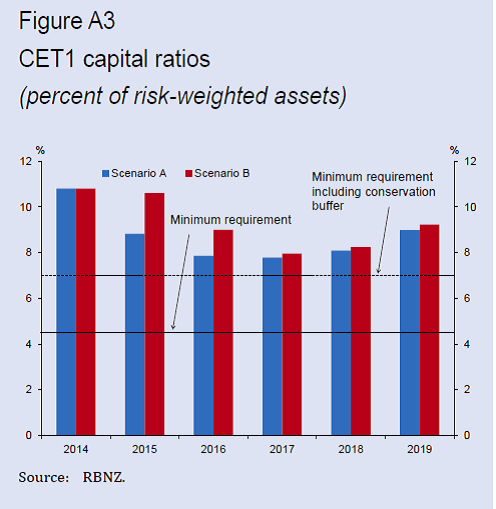
Common equity Tier 1 (CET1) capital ratios declined by around 3 percentage points to a trough of just under 8 percent in each scenario, but remained well above the regulatory minimum of 4.5 percent (figure A3). Banks are also required to maintain a 2.5 percent conservation buffer above all minimum regulatory capital requirements, or else face restrictions on dividends. On average the banking system fell within this buffer ratio in both scenarios, due to total capital ratios falling close to minimum requirements (figure A4). Average buffer ratios reached a low of 1 percent in both scenarios. As a result, some banks would have been faced with restrictions on their ability to issue dividends. The intention of the buffer ratio is to provide a layer of capital that can readily absorb losses during a period of severe stress without undermining the ongoing viability of the bank. Given the severity of the scenarios, capital falling within buffer ratios was an expected outcome.

In other words, the Bank seemed pretty comfortable. As they should have been. A banking system that can withstand a very severe asset market correction and adverse macroeconomic shock with, at worst, “some banks would have been faced with restrictions on their ability to issue dividends”, while all were always above minimum required ratios (themselves calculated using risk weights that are demanding by international standards) is an extremely strong banking system. Plenty of banks abroad raised additional capital during 2008/09 without ever coming close to failure, but not one of the big New Zealand banks ever needed to raise any new capital in these stress test scenarios. But that it is what one would expect when capital buffers are large, and credit to GDP ratios have been going nowhere for seven or eight years.

As the Bank also notes, it is not even that the loan losses in the scenario were large enough to cut into the dollar level of capital banks held: the deterioration in capital ratios arises only because the risk weights on bank loan books rise in the course of the severe downturn. Not a single bank had less capital at the end of the severe stress scenario than at the beginning.

CET1 (tier one, common equity) is the focus of the Bank’s capital framework.  Here is the chart from the stress test results.
CET

The Bank also rightly notes that the scenarios for the stress tests were finalised in early 2014 and things have changed since then. Of course, they have not changed materially in the two weeks since the Bank publically reaffirmed the resilience of the system, but let’s put that detail to one side for the moment.

Unfortunately, neither the Bank nor I can easily tell what this set of facts means for the results if the stress tests were to be run today. Auckland house prices have certainly increased a lot in the last year, the share of lending going to Auckland has increased, and a greater share of this (Auckland) lending is going to investors.  But other things have changed too – among other things, nominal incomes are higher than they were then, and interest rates look to be lower for longer than the earlier scenario envisaged. Those owing the large accumulated stock of debt (a stock that continues to worry the Bank) have had more time, and more income, to strengthen their own ability to handle adverse shocks.

Perhaps the much higher level of Auckland house prices now suggests that any future stress test scenario should use an even larger fall than the 50 per cent used last year. But 50 per cent is about as large a fall in house prices as has been seen, on any sustained basis, anywhere. If a 50 per cent fall is still a reasonable scenario from the new higher level (as I’d argue it is, given that no one has a good basis for knowing the “equilibrium” level of prices in the presence of ongoing regulatory constraints and policy-fuelled population growth), then all else equal there would be fewer loan losses for banks in an updated test not more.

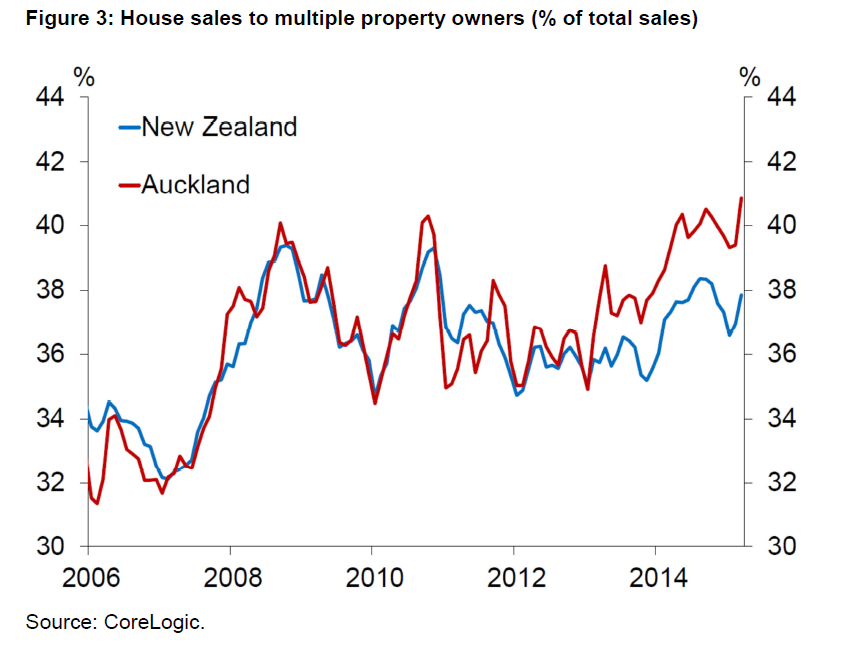
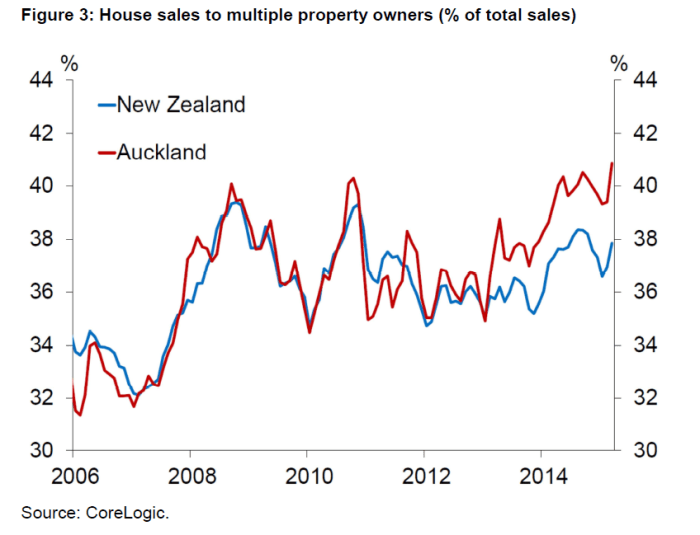
It is certainly true that a higher share of residential lending is now taking place in Auckland (although I suspect the share of the stock can’t have changed much in one year). In the stress test scenario that would, mechanically, mean a higher level of losses (since the scenario assumed a larger fall in house prices in Auckland than elsewhere). And of the lending in Auckland a little more has been going to investors. But note that final point carefully – as Figure 3 in their consultation document illustrates, the proportion of house sales being made to “multiple property owners” (the proxy for investors) is now no higher than the average in the series since 2008.
multiple

The investor property share is higher than previously in Auckland but (a) the difference from the rest of New Zealand is small, and (b) the greater role of investors is partly due to the earlier LVR restriction, which will have forced some first home buyers out of the market, to be replaced by investors. Moreover, in the consultation document the Bank indicates that the earlier LVR restriction has improved the overall “resilience” of the financial system. Even if one believed that lending to investors was riskier than lending to owner-occupiers, all other characteristics of the loan held equal (and the Bank has still not yet persuasively made that case), the overall implications of any changes in portfolio structures over the last year look likely to be small.

Stress tests run today would certainly produce different results to stress tests run a year ago.  But housing loan losses have hardly ever been at the heart of a banking crisis, the stock of debt is rising only slowly, and the 2014 results were so strong that it is difficult to believe that the Bank’s analysts are seriously wanting us to believe that stress tests run today would suggest that the financial system was now imperilled. Indeed, I noted the careful way their claim was worded – they suggest that the results today would be “worse”, but not “materially” or “substantially” worse. Given how strong the 2014 results were – as the Bank itself told us – a slight deterioration, in a business so fraught with uncertainty, should not really be a matter of particular concern.  Recall that in last year’s tests –  an exercise to which the Bank and APRA devoted a lot of resource –  not a single bank had a single year of losses.    It might sound too good to be true, but it is the Bank’s own work, and “no losses” leaves rather large room for them to be wrong without the soundness of the system being in jeopardy.

Unfortunately, the Bank seems to be all over the place on this issue. It is difficult not to feel some sympathy for the staff who are required to dream up rationalisations, and explain away past robust results, to provide some support for the Governor’s strong pre-determined views.  But if they really do believe that stress tests run today would result in a materially greater threat to the financial system then (a) they should probably have steps in train already to raise required levels of bank capital, and (b) it might have been helpful if they made the case in the Financial Stability Report.