Makhlouf on China

In a blog post the other day, which briefly touched on the activities of the People’s Republic of China in New Zealand, former ACT MP and senior lawyer Stephen Franks observed that

Our colonial forebears gained their colonial power and wealth by suborning the elites of the peoples subjugated more often than with military violence.

I hadn’t particularly thought of it that way before, but of course once one thinks about it for even a moment he is correct about the history, and (I suspect) about the relevance of the parallel to the current situation.

In fact, the parallel came to mind in pondering the latest public speech by Gabs Makhlouf the British ring-in Secretary to the Treasury, who not only qualifies as one of the “elite” but isn’t even someone with a strong ongoing personal interest in the future of ordinary New Zealanders, or even of New Zealand institutions.  Of course, even public servants holding as high an office as Secretary to the Treasury don’t make policy –  we hold politicians to account for that –  but Makhlouf seems to be actively engaged with, and supportive of, the longrunning deference to one of the most evil regimes on the planet, and apparent indifference to the tentacles of that regime in our system and country.

It mightn’t even be quite so annoying if his pandering was supported by decent economic analysis or a compelling understanding of the economic challenges facing New Zealand.  But it isn’t.    The speech, given at the university in Beijing, is under the title “The role of the China-New Zealand relationship in raising living standards”.

He burbles on about his beloved Living Standards framework, reaching the astonishing conclusion in his final paragraph that

Green mountains and blue rivers are as good as mountains of gold and silver.

Perhaps when you have a secure government income of many hundreds of thousands of dollars a year they are, but not to most New Zealanders – the people who struggle to get by, who’d appreciate the opportunities for better housing, better medical treatment, or even a better holiday.     Of course, the environment matters (rather a lot), and greater wealth and productivity has given us cost-effective options to reduce pollution (contrast the pollution levels in London or Beijing).  Perhaps we could extend the parallel: uninhabited New Zealand 1000 years ago –  beautiful and untouched as it may have been –  as good as a reasonably prosperous country today that makes extensive use of natural resources, and which has changed the landscape?   Few will think so, but perhaps the Secretary does?     If this is the sort of economic analysis governments have been getting, no wonder there is no progress in reversing our relative productivity decline.

Makhlouf goes on at length about the value of international trade and investment, and I can go a reasonable way along that line with him.  But it is as if he is talking for a totally different country when he observes enthusiastically that

And back in 1990 the ratio of global trade to world GDP was 30 percent; by 2015 that ratio had doubled to around 60 percent.

Which is good, but in New Zealand –  the country he supposedly represents –  the total exports and imports were 52 per cent of GDP in 1990 and 54 per cent last year.    We simply haven’t shared at all in the dramatic increases in world trade.   And because he seems not to understand that, the Secretary presumably has no credible analysis for what might make a helpful difference in future.   As it is, the New Zealand story is even worse than those snapshots suggests: exports as a share of GDP peaked as long ago as 2000, and even exports of services –  where the Secretary likes to talk up tourism and export education –  peaked as share of GDP in 2002.    The services exports share of GDP is now 30 per cent smaller (three percentage points) than it was then.

Then there is one of his tired old lines, claiming that “we” (New Zealand) are “part of the fastest growing region in the world” when, as he delivered his speech in Beijing, he was closer to home in London than to his office in Wellington.

I could go on, but the weaknesses of the Secretary’s economic analysis have been documented in many earlier posts.   What appalled in this particular speech was the craven grovelling to the PRC, the total relativisation of our two countries in ways which suggest that he thinks their system, their government, is just as good as ours.  (I don’t suppose he really does, but when you are a senior official, backing your government, what you say counts  –  including no doubt to the PRC authorities. He does the kow-tow)

He begins his speech with the rather empty claim that

Yet there is so much that we have in common.

We are all human beings I guess, but it wasn’t clear what else he had in mind.   He tries, not very convincingly, to elaborate.

All of us here want open trade, thriving business, and economic growth. Those things matter for our material wellbeing. But they are only a subset of what contributes to the quality of our lives. I’m sure we share a belief in the importance of good health and education, decent housing, the support of family and friends, a clean natural environment, a safe and peaceful society. We seek that for ourselves and for future generations.

As the Secretary surely knows, the People’s Republic of China has no commitment to open trade, having a highly regulated economy, and tight restrictions on international services trade in particular, and on investment.    But what of that broader list of things he thinks we have in common?  Perhaps it is fine as far it goes, but he is talking to people in a country whose government has a million people from Xinjiang in concentration and re-indoctrination camps.  And for all the Secretary’s talk about wellbeing –  and even “social capital” –  it is notable that things like free speech, free expression, the ability to change your government, freedom of religion, and even the rule of law – explicitly disavowed not long ago by the PRC Chief Justice –  are totally absent from his list.  The things that divide free and democratic countries from the PRC regime are huge and important.  Perhaps even the sorts of things that might appear in a typical New Zealand assessment of wellbeing?  But they, apparently, don’t matter much to the Secretary to the Treasury.  He goes on the praise the Belt and Road Initiative –  under the aegis of which the previous New Zealand government committed to the (rather frightening) aspiration of “the fusion of civilisations” with the PRC.

In all that he was just warming up.  There is later a substantial section of the “NZ-China relationship”, which is almost nauseating in places.  Thus

It is a relationship that goes beyond diplomacy and trade. It’s also about the links between people, about investing in our mutual success, and about recognising our shared interests in the world.

Liberty, democracy, the rule of law for example?  I guess not.  Respect for established international borders?  I guess not.    Then again, there is this in common, that both China and New Zealand have dramatically (economically) underperformed their near neighbours over the last century of so: in China’s case, Japan, South Korea and Taiwan, and in New Zealand’s case Australia.

Then we get this

It hasn’t all been one-way traffic. New Zealander Rewi Alley helped establish the Gung Ho movement in the 1930s and dedicated 60 years of his life to improving the living standards of Chinese workers.

You mean the active member of the Chinese Communist Party and unashamed apologist for its evils  (I have one of his books sitting on my desk, co-authored with the dreadful Communist fellow-traveller Wilfred Burchett, written towards the end of the Cultural Revolution celebrating the quality of life in the PRC).    Then again, when we have a Chinese Communist Party member in our Parliament what might one expect from our elites?

The Secretary moves on to celebrate PRC foreign investment in New Zealand.  He notes, without further comment, that

Over half of the 25 largest Chinese investors in New Zealand are state owned enterprises including Huawei, Yili and Haier.

as if this is a good thing (Treasury not being known for its enthusiasm for SOEs in New Zealand), as if he cares not about the national security threat various allied governments have determined Huawei represents –  and note that Huawei likes to represent itself as a private company –  and as if he is unaware (or cares not a bit) about the PRC law under which companies (private and public) are required to operate in the interests of the partt-State, at home or abroad.  In the best of circumstances, state ownership (and murky ownership) is a recipe for weakened capital allocation disciplines etc, and the Secretary to the Treasury really should know that.

The Secretary goes on

I believe one of the main reasons the China-New Zealand relationship is so close and constructive is because we both recognise the importance of diplomacy.

A line so vacuous it can only mean that New Zealand knows when (almost always) to rollover, never upset Beijing, and so on.   And who would want a “close and constructive” relationship with such a tyrannical regime anyway –  unless money is now all that matters (surely not so, especially in the Secretary’s wellbeing world.   Do these people have no shame?

Channelling the government, the Secretary touches on the Pacific, where the PRC is increasingly active, and in ways that look quite damaging not just to our interests, but to those of the ordinary citizens (although, again, not necessarily the “elites) in those countries.  Here is his final line.

We believe it is in everyone’s interest in the region – including New Zealand and China – to encourage sustainable economic development, good governance, respect for sovereignty and the rule of law.

I guess that is really a timid suggestion to the PRC, but they are quite open that they have no time for the rule of law (unless, of course, in their own interests), good governance (surely you’d practice what you preach), let alone “respect for sovereignty” –  ask the neighbours in the South China Sea, or Taiwan, the peaceful independent productive democracy.

We believe it is in everyone’s interest in the region – including New Zealand and China – to encourage sustainable economic development, good governance, respect for sovereignty and the rule of law.

Sounding like his countryman, Neville Chamberlain –  who did finally come to his senses –  we apparently don’t believe in right and wrong, or standing by those who are threatened.  The Secretary –  and his government –  just want to be “honest brokers”.  It is a shameful stance.

Perhaps you think I’m being a little unfair to Mr Makhlouf.  He is after all just a (very senior) public servant, channelling government policy.  But no one forces him to parrot these sorts of lines, and to make public speeches re-emphasising New Zealand’s deference and subservience, all under the mask of “mutual benefits”.  Sure, he can’t run an alternative, more challenging, perspective in public, but it is entirely his choice to attach his name to these lines.    He is one of the guilty, sacrificing our values, our institutions, while giving cover to the evils of the PRC regime, all for what?   A few more dollars for a few more big institutions.  In the Secretary’s case there isn’t even the shameful, feeble excuse about political parties “needing” to fund themselves.

Sacrificing our values?  Well, in his speech Makhlouf also talked about his living standards framework and how Treasury had gone out to do some weird race-based consultations about what mattered to people. I haven’t read these papers yet but he reported that of their consultation with Asian New Zealanders (emphasis added)

There is a strong belief in the value of collectivism, diligence, responsibility, frugality and recognition of hierarchy in relationships.

Surely, if there is any traditional New Zealand value –  and as I noted earlier in the week, I’m not fan of values-test – it is the polar opposite of “recognition of hierarchy in relationships”.  But probably Makhlouf, MFAT, and the political elites of all parties would prefer we all knew our place and left all this to them; another deal, more donations, and a refusal to ever stand for the values the Prime Minister sometimes talks about if it might even create even a little awkwardness in Beijing.

Sometimes, moments of hope arise in the strangest places.  I’m no fan of Donald Trump, and could only agree with the right-wing US columnist who the other day declared Trump the single most unsuited person to be President in all of US history.  And yet the other day, his Vice-President Mike Pence gave a speech on the Administration’s policy towards the PRC that came as distinctly refreshing after reading the Makhlouf effort.  I’m not going to excerpt it at length, but for anyone interested I suggest you read it.  I was pleasantly surprised by much of it, and have seen fairly positive commentary on it from various Democrtic-leaning China commentators.

But I come before you today because the American people deserve to know that, as we speak, Beijing is employing a whole-of-government approach, using political, economic, and military tools, as well as propaganda, to advance its influence and benefit its interests in the United States.

China is also applying this power in more proactive ways than ever before, to exert influence and interfere in the domestic policy and politics of this country.

Pretty much what Anne-Marie Brady (I’m pretty sure no right-wing Republican) has been saying here, although you will never hear such honesty from our politicians.

Previous administrations made this choice in the hope that freedom in China would expand in all of its forms -– not just economically, but politically, with a newfound respect for classical liberal principles, private property, personal liberty, religious freedom — the entire family of human rights. But that hope has gone unfulfilled.

Gabs Makhlouf claims to believe we have so much in common with the PRC.

Beijing is also using its power like never before. Chinese ships routinely patrol around the Senkaku Islands, which are administered by Japan. And while China’s leader stood in the Rose Garden at the White House in 2015 and said that his country had, and I quote, “no intention to militarize” the South China Sea, today, Beijing has deployed advanced anti-ship and anti-air missiles atop an archipelago of military bases constructed on artificial islands.

Blunt, but unquestionable.  And thus utterly unacceptable in New Zealand.

At the University of Maryland, a Chinese student recently spoke at her graduation of what she called, and I quote, the “fresh air of free speech” in America. The Communist Party’s official newspaper swiftly chastised her. She became the victim of a firestorm of criticism on China’s tightly-controlled social media, and her family back home was harassed. As for the university itself, its exchange program with China — one of the nation’s most extensive — suddenly turned from a flood to a trickle.

While in our universities, Confucius Institute advance PRC interests, and our multi-university Contemporary China Research Centre is chaired by someone who chairs a Confucius Institute, advises the PRC on Confucius Institute, and has a range of other interests that could be severely disadvantaged if the PRC were ever upset.

I don’t have any confidence in the Adminstration’s willingness to stick to anything, or in Trump’s temperament in handling a crisis.  But at least the US government is willing to call a spade a spade in this area.  Ours are determined to see never ill, say nothing ill, while their party leaders (sickeningly) praise the regime, and the party donations keep flowing in.

Sadly, there is a yawning vacuum where courageous and honest political leadership, standing for our system, our values, and (to the extent we can) for the rights and freedoms of people in China, might be.   As Stephen Franks put it, it is the elites we have to worry about.

And, in closing, I noticed this link this morning on Anne-Marie Brady’s Twitter account

The article it links is (or at least I found it so) a little difficult to make your way through, but it represents the efforts of some ethnic Chinese New Zealanders not content with successive New Zealand governments’ supine approach to the PRC.
The PRC and the Prime Minister

National Public Radio (NPR) in the United States is a bit like Radio New Zealand National, and about as left-wing in the assumptions and orientations (sometimes probably unconscious) of most of its presenters and interviewers.  I listen regularly to their politics podcast, and it struck me recently that the people involved are probably almost as left-wing as our Prime Minister (who, while an MP, served as president of the International Union of Socialist Youth, complete with the speech in which she used the word “comrade” 15 times in eight minutes).

Which is by way of saying that when NPR reports on a story, it isn’t exactly Breitbart, or the fevered imagination of some vast right-wing conspiracy.    These are people with whom you’d think our Labour and Greens parties would normally be in sympathy with.

But earlier this week, NPR published a lengthy story about the influence activities of the People’s Republic of China in Australia and New Zealand.  It is missing a few nuances, but is an interesting treatment for an international audience.  In the Australian section there is a nice quote from a serious senior academic.

“China’s different in scale and it’s different also in that it can integrate the private sector, education, civil society — all arms, if you like — of the state and the community with the objectives of the Chinese Communist Party,” says Rory Medcalf, head of the National Security College at Australian National University. “We’re not really dealing with a normal country here. We’re dealing with an authoritarian party state, where in fact Chinese citizens owe a higher loyalty to the party than to the state itself. So what we’re dealing with here is the largest secret organization in human history.”

and

Medcalf says the problem is not China’s people, but its Communist Party. Some of the most vulnerable victims of the party, he says, are Chinese people who left their country to live in democracies like Australia and New Zealand.

Very similar themes to those in the work, on this side of the Tasman, of Anne-Marie Brady –  vilified in last year’s election campaign by the then Attorney-General and Minister of National Intelligence as some sort of nasty xenophobe.

NPR interviewed Chen Weijian who

….moved from China in 1991, escaping imprisonment for working on a pro-democracy newspaper. He restarted the newspaper in New Zealand, but even there, Beijing caught up with him, he says: A pro-Chinese Communist Party newspaper in Auckland sued him for defamation after he criticized it for being too pro-Beijing. Ongoing legal fees forced his paper into bankruptcy in 2012.

“Their paper was funded by businesses supported by China’s government,” Chen says. “So an overseas Communist Party’s propaganda wing crushed our democratic newspaper here in New Zealand.”

A reader who is closer to these things tells me

The Chinese newspaper which crushed Chen Weijian’s pro-democracy paper is the Chinese Herald, now NZME’s joint venture partner of the Chineseherald website.
The international news on this website are primarily sourced from the three major CCP’s state media and they apparently uphold the CCP’s stance.
And more US readers/listeners got to hear of the curious, not to say alarming, case of Jian Yang.

Last year, local media reported that a prominent, Chinese-born member of New Zealand’s Parliament, Jian Yang, had lied to authorities about his education background on his citizenship application for New Zealand.

Yang, a member of the National Party, which led the government from 2008 to 2017, had worked for 15 years in China’s military intelligence sector. He studied English at the People’s Liberation Army Air Force Engineering University, taught at the college for five years after graduating and then obtained a master’s degree at the People’s Liberation Army University of Foreign Languages in Luoyang, one of China’s best-known military intelligence schools.

Later, at the same institute, Yang taught English to students who were studying to intercept and decipher English-language communications on behalf of Chinese military intelligence.

Yang declined an interview request from NPR. He admitted to journalists last year that he was a member of China’s Communist Party, though he insisted he has not been an active member since he left China in 1994. He has steered clear of the media spotlight since the scandal hit.

NPR joining the honourable company of all English language media that Jian Yang –  an elected member of the New Zealand Parliament, elected (to their shame) by all National Party voters  – simply refuses to talk to.

Chen Weijian goes on, rather more speculatively in some places

“Jian Yang is not just connected to China’s Communist Party,” says Chen Weijian. “He was sent here by them to spy on New Zealand. But people in Yang’s party — the National Party — all think he’s good for New Zealand-China relations. A lot of his party’s donations come through him, and he often leads government trips to China to make lucrative deals there.”

Yang, who has served in Parliament since 2011 and remains in office, played a prominent role during official visits to China in 2013 and 2016, sitting alongside then-Prime Minister John Key opposite Chinese leader Xi Jinping and serving at times as interpreter during bilateral meetings.

As Yang’s political influence grew, so did New Zealand’s economic dependence on China. In 2008, New Zealand became the first developed country to sign a free trade agreement with China. As a result, trade between the two economies has tripled in the past decade, largely because of China’s thirst for imported New Zealand milk: A quarter of all imported milk in China comes from the tiny island nation.

The (so-called) FTA was signed three years before Jian Yang turned up in national politics, and as a the world’s largest exporter of milk powder it seems probable that exports to China would have increased considerably over the last decade whether or not an FTA had been signed, whether or not Jian Yang was in Parliament.

NPR talked to Charles Finny, former diplomat, trade negotiator, and now lobbyist who declared last year that he knew Jian Yang (and Raymond Huo) and was always very careful what he said in front of either of them.

Finny [talking of FTAs] believes the same to be true in politics. He says China has most likely been using New Zealand as a testing ground for diplomatic relations with other developed nations.

“We’re small, nonthreatening,” he explains. “We’re not as close to the United States. China, I think, wants to learn from us about how to deal with other, larger players. It’s very common for Chinese leaders when they’re just about to be appointed to a big position to come to New Zealand to learn about democracy, to learn about how to deal with the media, to learn there are going to be some protests — all these things that are going to be a much bigger factor in bigger relationships, they get to learn how to deal with it here.”

Perhaps, but you get a pretty easy ride here.  Universities lined up to have photos taken with Xi Jinping.  Our former Prime Minister Jenny Shipley went out of her way to ensure that the visiting Chinese leader in the 1990s didn’t have to see protestors.

NPR did talk to one senior New Zealand politician who made some interesting remarks (if typically cryptic and defensive) that seem to have had surprisingly little local media attention.

After New Zealand’s intelligence agency began looking into Yang’s background in 2016, he was removed from parliamentary select committees on foreign affairs, defense and trade. But he hung on to his seat in Parliament, leaving some wondering why.

“The answer to that is not something that can be given today, but it is an answer that will soon have to come from our country and our system as to what our response is,” Winston Peters, New Zealand’s deputy prime minister and foreign minister, tells NPR. “At that level of growing public interest — and I would think intelligence interest as well — plus the shared intelligence from our closer allies, one would be naive in thinking that our response would not be forthcoming.”

Does that mean anything at all?  And if so, what?    Surely it is pretty clear why Jian Yang hangs onto his seat, despite his past, and his misrepresentations to New Zealand authorities, being exposed and acknowledged?   And despite his ongoing close associations with the PRC and his refusal to ever utter a negative word about that totalitarian state.  On the one hand, the National Party wants the donor money and doesn’t want to risk the relationships with donors by acknowledging that there is something very wrong.  And, on the other hand, because all other parties –  including that of the Deputy Prime Minister, once in office – make it easy for National to do so.  Not a negative word is heard from any of them –  the Prime Minister, the minister responsible for the intelligence services and the electoral system, the Deputy Prime Minister, the Minister of Defence, the leaders of the Green Party (or their foreign affairs or intelligence spokespeople).

The interview with Winston Peters obviously got a little tetchy.

Analysts in the U.S. and Australia have suggested the Yang case is evidence that China is exploiting New Zealand as a weak link in what’s known as the “Five Eyes,” the intelligence alliance including the U.S., U.K., Canada, Australia and New Zealand. This angers Peters. He is the longest-serving parliamentarian in New Zealand’s history [which he isn’t] and has long been vocal about his country’s dependence on China, but he draws the line when his country is criticized for being used as a political tool for the Chinese.

“This country turned up to two world wars, two years before the United States on both occasions,” he points out. “So we don’t like that sort of talk down here.”

The journalist obviously missed the important context that Peters only ever says anything critical when he is in Opposition and unable to actually do anything.

One might point out in response to the Deputy Prime Minister that 80 years ago our then government was at the forefront of calls to pushback against aggression by Germany and Italy, recognising the nature of the evil.  So different today…..

The NPR journalist then turned to Stephen Jacobi

“To suggest that New Zealand may be naive, well, OK, fine,” says Stephen Jacobi, executive director of the New Zealand China Council, a group in Auckland promoting business ties. “We don’t have to see the world the same way Americans do, or even Australians do. We’re very proud of that.”

Jacobi says the evidence against Yang — who serves on the board of his organization — is largely hearsay and is not enough to prove that he is working for China’s government.

The NPR people obviously missed the rather important point that the China Council isn’t just a bunch of businesses wanting to sell out their own country for another deal, but a taxpayer funded organisation designed to play distraction and influence public opinion in favour of the (successive) government’s strategy of doing much the same.

New Zealanders might be proudly independent, but only foolish people are proud of having a different view from other countries simply for the sake of it.  Most New Zealanders aren’t that foolish.   Jacobi –  whose background was trade with the Americas –  seems to simply ignore issues around the integrity of our political system, the evils of the PRC regime, and its external aggression.    But who cares about those things when there are deals to be done by your members, visits to host etc.

But his comment about Jian Yang is interesting.  On the one hand, he now seems to concede that there is something to the concerns (it is only “largely” hearsay).  Perhaps things like the:

  • service in the PLA military intelligence system,
  • membership of the CCP,
  • expert assessments that (a) no one voluntarily leaves the Party, and (b) a person with his background would not have been allowed out of the PRC unless he was regarded as totally politically safe and reliable,
  • the acknowledged misrepresentations of his past on immigration/citizenship forms,
  • the photographic evidence of his close ongoing associations with the PRC Embassy,
  • the absence of any sign, in his time in Parliament, of ever being willing to criticise the PRC regime, for anything.

Does he actively “work for” the Chinese government?  One hopes not, but even if not –  and Charles Finny appeared to think otherwise, on national TV – the list of things we know, with a high degree of certainty should be enough to have any leaders of decency and integrity dissociate themselves from Jian Yang.   Perhaps it is a bit like the Kavanaugh case: the relevant standard, in putting people in influential leadership positions, shouldn’t be whether one could avoid a criminal conviction.  In Jian Yang’s case, it isn’t even clear that he could get over that hurdle in respect of the immigration/citizenship non-disclosures.

The willed reluctance of the New Zealand establishment to confront the issue was captured again in this week’s Newsroom column by Peter Dunne. Writing about who might leave Parliament at the next election, our longserving former minister writes

Likewise, Dr Jiang Yang may decide to stand aside if the vague but persistent whispers about his links to Chinese intelligence agencies persist and intensify


You mean pretty basic, now acknowledged, “links” like the fact that the man worked for them for a decade?   A bit more than a “whisper”.

The NPR story ends with some coverage of Anne-Marie Brady, both her papers (and associated testimonies) and the break-ins to her home and office, which are widely assumed to be the ultimate responsibility of the PRC authorities.  There isn’t anything new in that section of the story, although it is good for a wider range of overseas readers/listeners to be exposed to the material.

The Peters quote aside, in many ways there isn’t anything new in the NPR story; the news is as much that another major overseas media organisation, one whose people are probably not generally unsympathetic to the leftish slant of most New Zealand politics, ran it.

But I was struck by it partly for the contrast with the speeches the Prime Minister was giving last week on her progress through New York, making the most of her baby for publicity purposes (I checked, and Tony Blair and his wife had a child while he was Prime Minister, who wasn’t –  as far as I could tell –  paraded at the UN General Assembly).  I read all six of them, looking for substance and mostly coming up short.   It was the speech to the United Nations General Assembly that I focused on most.  After all, there might have been hardly anyone there is hear it, and only a few Guardian types to praise it, but it was an official statement of New Zealand Prime Minister to an international agency which New Zealand is a founding member of.

There were plenty of sly digs at the United States –  some even warranted –  but not a word, directly or indirectly, about the People’s Republic of China.  It might be the most populous country on the planet, with the largest (total) GDP, on an aggressively repressive path domestically (as just one particularly egregious example, those million or more people of Xinjiang in concentration camps, having done nothing but be) and a pretty aggressively expansionist path abroad, including the direct interference in the commercial and political affairs of other countries, including our own.  There was a whole section on “universal values”, which of course bears no relationship to how the People’s Republic operates.  There was a great deal on climate change, most just cheap rhetoric –  and perhaps not that different from what Xi Jinping might have said.  And then the speech ended this way

Perhaps then it is time to step back from the chaos and ask what we want. It is in that space that we’ll find simplicity. The simplicity of peace, of prosperity, of fairness. If I could distil it down into one concept that we are pursuing in New Zealand it is simple and it is this.  Kindness.

In the face of isolationism, protectionism, racism – the simple concept of looking outwardly and beyond ourselves, of kindness and collectivism, might just be as good a starting point as any. So let’s start here with the institutions that have served us well in times of need, and will do so again.

Kindness and collectivism.  There’s the answer, at least according to our Prime Minister.  Frankly I found it unnerving that we get this level of vapidity of someone charged with running the government.   “Kindness” is an admirable, perhaps under-rated, characteristic in interpersonal affairs, but it is hardly any sort of useful benchmark for making public policy.  In fact, it is incredibly naive and dangerous, and simply pays no heed to the realities of human nature.    As for “collectivism”, perhaps it is something the members of the Interational Union of Socialist Youth think fondly of, but many of the rest of us are inclined to think of manifest evils of the Soviet Union and Communist China (I could recommend a couple of good books I’ve read recently –  here and here).  I’m pretty sure neither the term nor the idea of “freedom” or “liberty” appeared in the Prime Minister’s speech at all.    Much of the active government talk was rather reminiscent of the sorts of speeches the Chinese Ambassador gives here every few weeks, with her talk of

“building of a community with a shared future for mankind”

Or rather like Simon Bridges signing the government up last year to an aspiration of a “fusion of civilisations” with a regime so evil.

Not, of course, that the PRC would be so vapid as to suggest that “kindness” is some sort of watchword for policy, whether domestic or international.

But then why would we be surprised.  The President of the Labour Party sings the praises of the regime, and of Xi Jinping.  And, so we learn from the Chinese Embassy website (although not from the Prime Minister), on the recent visit of a Politburo member there was talk of strengthened ties between (presumably) the Labour Party and Communist Party of China (emphasis added).

Li, secretary of the CPC Guangdong Provincial Committee and a member of the Political Bureau of the CPC Central Committee, met with New Zealand Prime Minister and Leader of the Labor Party Jacinda Ardern on Monday.

Li said China is ready to work with New Zealand to enhance political mutual trust, expand economic cooperation, keep closer party-to-party exchanges, and strengthen coordination and communication in international and regional affairs.

People say (I see it even in the ACT newsletters) that the Prime Minister is a nice kind person at an individual level, but she seems wilfully indifferent –  if not worse –  to the nature of the regime with which she and her party deal,  and about whose evils  –  and whose interferences here –  she will never once openly speak of, whether at home or in New York.

It was interesting to see the government joining yesterday in a multi-national effort to denounce various incidents of Russian government hacking.  I welcome them doing so, even if I couldn’t help wondering what marked out our own government’s signals intelligence efforts, Waihopai and all.  Isn’t such interception what governments do?  And isn’t complicity in actual and attempted murder on foreign soil –  about which the government was so slow to speak out, whether over the Malaysian airliner over Ukraine or the Skripal case – rather more substantively important.

But those were rather cheap words –  about episodes not actually involving New Zealand directly – signifying not much more than our ongoing relationship with the UK and Australia.   But China is a much bigger issue globally, and particularly in New Zealand, than Russia is.

And where is the Prime Minister on things like Xinjiang (or do “universal values” not apply there)?  Where is the Prime Minister on things like the episode in the South China Sea earlier in the week –  a Chinese warship within 45 metres of a US ship on innocent passage through international waters –  let alone the now fait accompli of the illegal militarisation of reefs etc in that sea?  Where will the Prime Minister be on the new in-depth Bloomberg story about the PRC using their place in supply chains for espionage purposes?

The Big Hack: How China Used a Tiny Chip to Infiltrate U.S. Companies

The attack by Chinese spies reached almost 30 U.S. companies, including Amazon and Apple, by compromising America’s technology supply chain, according to extensive interviews with government and corporate sources.

Or on the PRC attempts to use research cooperation agreements, including with NZ universities, to steal sensitive technology?

And, of course, where is the Prime Minister on situations like Jian Yang, or Raymond Huo –  apparently associated with various United Front bodies –  who sits in her own caucus.

Perhaps she and her colleagues think kindness is the answer?

“Kindness” is no substitute for a serious hardheaded analysis or for engaging with the New Zealand public on the nature of the PRC threat, here and abroad.   It seems more like an excuse for covering your ears and eyes and reciting repeatedly “hear no evil, see evil”.     But then there are none so blind as those who wilfully choose not to see.

(And critical as I am of the Prime Minister here, there is no sign that any party in New Zealand is any better, even if not all of them would use quite her particular vapid rhetoric to simply avoiding facing reality, or standing up for New Zealand and the values of her people, and her friends in other free and democratic countries.)

But what did Winston Peters mean in those quotes above? Perhaps some New Zealand journalist could ask him?

Tomorrow, I might tackle the latest public effort of a senior public servant to dine with the devil.

Shame on our MPs

There are some things I write about here that I really don’t care that much about.

But this isn’t one of them.

Yesterday at the start of Parliament’s sitting day, the prayer was read in Chinese by Labour MP, Raymond Huo.   This was apparently in recognition of the PRC-government sponsored Chinese language week.

There are three “official” languages in New Zealand: English, Maori, and sign language.  Chinese is not one of those languages, so why is it being used as an official part of parliamentary proceeedings in this country?

There are, of course, migrants from the PRC (and other Chinese-speaking countries/territories), as there are migrants from many other countries.  But when they come to New Zealand, and participate (as they should) in our political processes, they should do so speaking one of our languages.  As a migrant you might, to some extent hold on to your birth culture, but you made a choice to come to New Zealand, and part of that choice should be to adopt New Zealand ways and laws.   We are not some PRC colony.

I noted that Chinese language week is a PRC-government sponsored event.  The patron is Her Excellency, the PRC’s ambassador in New Zealand.   Among the trustees are Raymond Huo himself, the president of the New Zealand China Friendship Society, well-known for its close associations with the regime, the chair of the Victoria University (PRC-funded) Confucius Institute (and a senior consultant to the PRC government around Confucius Institutes) and the chief executive of the local branch of one of the Chinese banks.   (On this occasion, former PRC intelligence offical Jian Yang  – who misrepresented his past to get into New Zealand – is only an honorary adviser.)   And who do we find among the “sponsors” and “partners”?  Listed first in Hanban, the PRC government agency behind that network of Confucius Institutes around the world.   In the same top-tier is one of the Chinese banks (recalling that all Chinese corporates are seen, by the Chinese government, as arms of the PRC party/state).  Just behind, are the New Zealand government propaganda arms –  the China Council (from whom never a sceptical word is heard) and the Asia New Zealand Foundation –  the individual Confucius Institutes, the Wellington City Council (wasting my rates again) and various businesses and universities that want to keep on side with Beijing.

This is, overwhelmingly, a PRC promoted and sponsored body/event.  Any serious observer would recognise that, and the propaganda win involved in allowing the parliamentary prayer to be said by Huo, in Chinese.   No wonder Huo could talk of a record number of people watching Parliament TV from abroad (assuming there is any data to support such a claim).    Could one imagine a member being invited to open the day’s session of the PRC legislature with a prayer in English?   Silly me.  Legislature, in the PRC.  Ritual rubber-stamp more like.  Prayer?  Why, it is an avowedly atheistic regime, uneasy about anything or anyone that claims a higher allegiance than the Party.

Being a fairly open-minded place, where our leaders are largely heedless –  and careless –  of our heritage, it might have been one thing if Chinese language week had had as joint patrons (evil as her regime is) the PRC Ambassador and the Taiwanese government’s representative in New Zealand.    Or if the key figures were not political at all.  Or if the ethnic Chinese MP reading the prayer had a track record of standing up, and speaking out, against the evils of the totalitarian regime that brutally rules the land of his birth.  Or had originally from another Chinese-speaking country.

But, of course, none of these things held.    What do we know of Raymond Huo, senior Labour backbencher (presumably hoping for higher office before too long) who – remarkably (or perhaps not given the carelessness of our MPs) – chairs the Justice select committee in Parliament.  A man who has never once that I’m aware of, in his years in Parliament, uttered a single word critical of the PRC regime.  A man who openly defends the Chinese conquest of Tibet, and the brutal suppression of the people and their identity.   And here is what Anne-Marie Brady wrote about him in her Magic Weapons paper last year.

Even more so than Yang Jian, who until the recent controversy, was not often quoted in the New Zealand non-Chinese language media, the Labour Party’s ethnic Chinese MP, Raymond Huo霍建强 works very publicly with China’s united front organizations in New Zealand and promotes their policies in English and Chinese. Huo was a Member of of Parliament from 2008 to 2014, then returned to Parliament again in 2017 when a list position became vacant. In 2009, at a meeting organized by the Peaceful Reunification of China Association of New Zealand to celebrate Tibetan Serf Liberation Day, Huo said that as a “person from China” (中国人) he would promote China’s Tibet policies to the New Zealand Parliament.

Huo works very closely with the PRC representatives in New Zealand. In 2014, at a meeting to discuss promotion of New Zealand’s Chinese Language Week (led by Huo and Johanna Coughlan) Huo said that “Advisors from Chinese communities will be duly appointed with close consultation with the Chinese diplomats and community leaders.” Huo also has close contacts with the Zhi Gong Party 致公党 (one of the eight minor parties under the control of the United Front Work Department). The Zhi Gong Party is a united front link to liaise with overseas Chinese communities, as demonstrated in a meeting between Zhi Gong Party leaders and Huo to promote the New Zealand OBOR Foundation and Think Tank.

It was Huo who made the decision to translate Labour’s 2017 election campaign slogan “Let’s do it” into a quote from Xi Jinping (撸起袖子加油干, which literally means “roll up your sleeves and work hard”). Huo told journalists at the Labour campaign launch that the Chinese translation “auspiciously equates to a New Year’s message from President Xi Jinping encouraging China to ‘roll its sleeves up’.”   However, inauspiciously, in colloquial Chinese, Xi’s phrase can also be read as “roll up your sleeves and f..k hard” and the verb (撸) has connotations of masturbation.  Xi’s catchphrase has been widely satirized in Chinese social media.  Nonetheless, the phrase is now the politically correct slogan for promoting OBOR, both in China and abroad. The use of Xi’s political catchphrase in the Labour campaign, indicates how tone deaf Huo and those in the Chinese community he works with are to how the phrase would be received in the New Zealand political environment. In 2014, when asked about the issue of Chinese political influence in New Zealand, Huo told RNZ National, “Generally the Chinese community is excited about the prospect of China having more influence in New Zealand” and added, “many Chinese community members told him a powerful China meant a backer, either psychologically or in the real sense.”

and

During his successful campaign for the Auckland mayoralty, in 2016, former Labour leader and MP, Phil Goff received $366,115 from a charity auction and dinner for the Chinese community. The event was organized by Labour MP Raymond Huo. Tables sold for $1680 each. Because it was a charity auction Goff was not required to state who had given him donations, but one item hit the headlines. A signed copy of the Selected Works of Xi Jinping was sold to a bidder from China for $150,000.  A participant at the fundraiser said the reason why so many people attended and had bid strongly for items was because they believed Goff would be the next mayor.

and

In June 2017, at the Langley Hotel in Auckland, the State Council Overseas Chinese Affairs Office hosted an update meeting to discuss the integration of the overseas Chinese media with the domestic Chinese media. In attendance was Li Guohong, Vice Director of the Propaganda Department of the State Council Overseas Chinese Affairs Office, and other senior CCP media management officials, representatives of the ethnic Chinese media in New Zealand, representatives of ethnic Chinese community groups, and Labour MP Raymond Huo.  Update meetings (通气会) are one of the main ways the CCP relays instructions to the domestic Chinese media, in order to avoid a paper trail. Party directives are accorded a higher status than national law.

There is no sign at all of Huo putting any distance between himself and one of most repressive totalitarian regimes on the planet.  If anything, he only seems to want to hug the regime, and Xi Jinping, closer.  No wonder former diplomat and now lobbyist Charles Finny told a TVNZ Q&A interviewer last year that he was always very careful what he said in front of Huo.

And since this was a prayer being said, what about the religious dimensions?  Parliament’s prayer is an odd sort of beast, made odder by the current Speaker who rewrote the prayer to remove any distinctive Christian aspects, while keeping it distinctively monotheistic (references to Almighty God –  and not to localised tree gods or other minor deities).  As a Christian, I’d be happy enough (would probably prefer) Parliament dropped the prayer altogether: even if hypocrisy is the tribute vice pays to virtue, I’d rather MPs just recognised that the dominant “religion” of New Zealand (and every society has one, defined broadly) isn’t theistic at all.

But, for now, Parliament is opened each day with a monotheistic prayer, some vague nodding reference to our heritage, but vague enough that the small numbers of Muslims and Jews in New Zealand can probably nod along.

And what is the status of religion in the People’s Republic of China?   The Communist Party, which runs the state, is avowedly atheistic.  Religous believers, of whatever stripe, aren’t allowed to join the Party, as a matter of ideological commitment.    And both the Party and state are threatened by any sense of higher loyalties, not just theistic ones –  witness the extreme measures they’ve taken to suppress Falun Gong.   And what of theistic religions?    In the case of Islam, consider the extreme repression now in place in Xinjiang province, where some estimates suggest more than a million people may be in concentration and indoctrination “camps” (prisons), the surveillance state is taken to extremes, kids are taken from imprisoned parents, declared orphans, and then retrained to forget the identity, or even the existence, of their parents.   No New Zealand public figure –  no minister, no MP, and certainly not Raymond Huo (former countrymen of these victims) –  has spoken up, or spoken out, against that almost unbelievable persecution.     What you don’t speak up about –  when you in a position to be heard – is what you tolerate, what you really don’t care much about at all.  And yet Raymond Huo has the cheek to accept the offer to utter the prayer to this monotheistic Almighty God.

What of Christians?   They’ve had an uneasy relationship with the PRC over recent decades.   There are tame churches, in the Three-Self Patriotic Movement (Protestant) and a parallel with Catholics.  In many respects, they are orthodox, and yet they allow themselves to be placed under the thumb of the party-State (as for example, much of the Lutheran church in Germany did during the Nazi era).  But those churches who won’t bend the knee to the party-State are subject to increasing persecution in the Xi Jinping era, and attempts to suborn them and their leaders.  One large independent church in Beijing recently closed –  went to operating in small groups and by podcasts –  after the authorities insisted on the right place surveillance cameras in their buildings.  In response to growing repression and threats more than 100 pastors recently signed a declaration ending this way (emphasis added)

Christians are obligated to respect the authorities, to pray fervently for their benefit, and to pray earnestly for Chinese society. For the sake of the gospel, we are willing to suffer all external losses brought about by unfair law enforcement. Out of a love for our fellow citizens, we are willing to give up all of our earthly rights. 

For this reason, we believe and are obligated to teach all believers that all true churches in China that belong to Christ must hold to the principle of the separation of church and state and must proclaim Christ as the sole head of the church. We declare that in matters of external conduct, churches are willing to accept lawful oversight by civil administration or other government departments as other social organizations do. But under no circumstances will we lead our churches to join a religious organization controlled by the government, to register with the religious administration department, or to accept any kind of affiliation. We also will not accept any “ban” or “fine” imposed on our churches due to our faith. For the sake of the gospel, we are prepared to bear all losses—even the loss of our freedom and our lives. 

The situation has got consistently worse under Xi Jinping – who Raymond Huo holds close –  who is reported to regard churches as “severe national security threats”.

And yet Raymond Huo is invited by the Speaker of our Parliament –  presumably with the acquiescence of other party leaders, including the Prime Minister and the Leader of Opposition – to utter the daily prayer to the monotheistic Almighty God?   It is shameful.

But also telling.  After all, Simon Bridges last year signed up to the idea of a “fusion of civilisations” with this evil totalitarian regime.  Party presidents, Haworth and Goodfellow, head up to Beijing and sing the praises of the party/State and of Xi Jinping himself.

And just the other day, the chief executive of the Ministry of Foreign Affairs and Trade  –  about to become head of the PM’s department, and so we can presume was assuredly on-message –  gave a rare published speech.     In it he articulated New Zealand foreign policy, including among his ten basic principles this one

Second, be deliberate in supporting New Zealand’s values, speaking out in defence of them when required, even where that might put us at odds with others.

In fact, he quoted the Prime Minister from a speech earlier in the year

“In this uncertain world, where long accepted positions have been met with fresh challenge – our response lies in the approach that, with rare exceptions, we have always taken. Speaking up for what we believe in, standing up when our values are challenged and working tirelessly to refurbish rules and build architecture, and to draw in partners with shared views.

And noted

I can say with confidence that all of the Governments for which I have worked would hold these things to be true. 

In which case, I guess we must be able to deduce the real values of our leaders –  ministers past and present, and MPs –  but what they do and don’t say.    After all, they speak up for what they believe in, or so we are told?

When our Parliament invites a CCP-affiliated MP, who champions the interests of the atheistic PRC regime, and has his own party campaign under a Xi Jinping slogan, to open the day’s parliamentary sitting in prayer, in Chinese it seems unlikely that any of them care much about anything other than trade deals for big corporates and their donors, and none of them has the slightest regard for our own heritage, our own values, or for the freedom (including to worship, or not) of Christians, Muslims, and others in China.   There are, so we are told, Christian MPs in our Parliament.  But apparently not even a single one of them was willing to speak up, or speak out.

I don’t suppose New Zealand ranks very high among the issues that concern Beijing, but it must have been a good day in the relevant corners of Beijing officialdom yesterday –  bonuses for the Ambassador perhaps –  as they looked at the useful idiots masquerading as leaders in the New Zealand Parliament.

As a matter of urgency, we need someone –  some party –  to stand up for taking back our country, for asserting the values, traditions, and liberties of its people, the self-respect that (among other things) was presumably part of what attracted some ethnic Chinese to move here in the first place.  As for the present leadership, heedless, careless, and useless……selling out their country (mostly not for personal enrichment) whether by their indifference or their active involvement.

Yes, it will have been a good day in Beijing.  If the butchers ever take time to chuckle, yesterday might have been one of those days.


Is this what leadership looks like?

When the news broke earlier in the year that Canterbury University academic Anne-Marie Brady’s house and office had been broken into, and that the only things taken seemed to relate specifically to her longrunning research work on the People’s Republic of China, the initial response from the government didn’t seem too bad.

Ardern said at the post-Cabinet press conference on Monday that “everyone would be concerned” if Brady had been targeted because of her academic work.

“If there’s evidence of that, we should be taking stock and taking action,” Ardern said. “I will certainly ask some questions.

“I would certainly want to be informed if there was evidence that this was a targeted action against someone who was raising issues around foreign interference.”

Brady  herself was impressed (although I think I thought –  and perhaps wrote – at the time that these comments seemed more designed to encourage the Prime Minister, rather than accurately describing any evidence to date of taking foreign interference “very seriously’).

“I am very heartened to see the Prime Minister is taking the issue of foreign interference activities in New Zealand very seriously and that she has instructed the security agencies to look into the break-ins I have experienced,” Brady said.

The story has been back in the media again thanks to the persistent efforts of Matt Nippert of the Herald.  Last weekend there was his widely-viewed (and linked to abroad) article “The curious case of the burgled professor”, and this morning the front page of the Herald has the story “SIS sweeps prof’s office“.

Electronic surveillance specialists from the Security Intelligence Service have carried out a search for listening devices at the University of Canterbury office of the professor revealed to be a possible target of Chinese espionage.

News of the sweep, confirmed by several university staff, comes as academic colleagues of Anne-Marie Brady came out in support of the China specialist….

The Herald understands a similar search for bugs by the Security Intelligence Service (NZSIS) has also been conducted at Brady’s Christchurch home, the site of another suspicious burglary being investigated by authorities.

From what is reported in that story, and in Radio New Zealand’s interview this morning with Anne-Marie Brady, the Police and the SIS seem to be doing a pretty thorough job.  Brady herself praises what she has seen and heard of their efforts.

But what of the Prime Minister?  Remember that this is the “leader” of whom Matt Nippert has reported

She won’t talk about the general issue, and here she is (quoted in Nippert’s article this morning) on the specific one.

Prime Minister Jacinda Ardern, asked about the case on Monday at her post-Cabinet press briefing, said she had yet to be briefed on whether the episode could be attributed to China.

“I have not received any further advice on that, but nor have I sought it. As it were, nothing has since been raised with me to suggest that it was, or wasn’t,” she said.

“Speaking more generally, what the underlying suggestion here is of foreign interference. I’ve been very, very cautious around always stipulating that New Zealand needs to be live to general issues of interference, and that’s something we keep a watching brief on.”

She hasn’t asked.  How convenient.  If she were really concerned about the issue, and the potential, you’d have thought she –  and her office –  would be all over an issue of this sort (as a matter of sovereignty, national security, defence of academic freedom etc, not as “interfering” in a potential criminal prosecution).

And as for that final paragraph, if that is “leadership” we’ve lost all sense of how a leader might actually act or speak.   Of course she probably isn’t in a position to make specific accusations –  especially not having asked for the information –  but what would have been so wrong about a clear and strong statement that she, and New Zealanders, would deplore and push back strongly against any foreign interference in New Zealand, and in particular if agents of a foreign power were found to have been responsible for the Brady break-ins.  She could even have gone on to say that if such evidence were found then –  even if it were not possible to launch criminal prosecutions (after all, we don’t have an extradition treaty with China) –  the damage to our bilateral relationship with such a country would be severe.

Instead we get this vacuous waffle

I’ve been very, very cautious around always stipulating that New Zealand needs to be live to general issues of interference, and that’s something we keep a watching brief on.

saying precisely nothing, from someone who appears to desperately hopes to avoid the issue.  Her response here is much weaker than her February one.

Does the Prime Minister stand for academic freedom in New Zealand, for the rights and freedoms of New Zealanders to do research, to speak out, to challenge other countries here in New Zealand, the rights of New Zealanders to be secure in their homes?  “Stand for” in the sense of being willing to pay a price to protect and defend?  Or is she more interested in doing everything possible to be able to look the other way, prioritising party fundraising, trade agreements, the interests of a few big corporates (and universities) and visits to Beijing over the values and freedoms of New Zealanders, including those like Professor Brady who’ve done in-depth research on PRC efforts here?

She, her party president, and their peers in the National Party together.

On the anniversary of learning about Jian Yang

It was a year ago today that the Financial Times and Newsroom told us that we’d had a People’s Republic of China spy in our midst….well, in our Parliament actually.   Unknown to the voters – but presumably not to the National Party hierarchy, which must (presumably) have done its candidate vetting – for six years Jian Yang had sat in our Parliament, had sat each week in the governing party’s caucus, had spent several years on Parliament’s Foreign Affairs committee, and been part of official government delegations to the PRC.  And, so this joint FT/Newsroom investigation revealed, Jian Yang –  who had only moved to New Zealand in his 30s – had  (in the words of the FT article)

….spent more than 10 years training and teaching at elite facilities including China’s top linguistics academy for military intelligence officers, the Financial Times has learnt. Since being elected in 2011, Mr Yang has been a big fundraiser for the National party. He has consistently pushed for closer ties with Beijing and for international policies and positions echoing those of China’s Communist party.

He’d been a member of the military intelligence system of the People’s Republic of China….in colloquial terms, a spy.

The story sparked no action from the National Party –  other than the then Attorney General and minister for the intelligence services attempting to tar the stories as “racist” –  and Jian Yang was duly re-elected to Parliament ten days later, where he sits still.  Doing little (search Hansard, and you’ll find  – for example – that, despite being a third term Opposition MP, he has asked only two oral questions this Parliament).  And explaining less (he has refused all media comment to English language media for months, while apparently being quoted regularly in the PRC-dominated Chinese language media).  He has been fully backed by both the previous and current National Party leaders.

The story unfolded further.  Having initially claimed he’d been fully open about his past –  while explicitly asking the FT not to report it –  Jian Yang eventually acknowledged that he had withheld information about his PLA background when he had lodged residency and/or citizenship applications to New Zealand.  Extraordinarily, he told journalists that he had done this because the PRC authorities had told him to –  this even though by the time he was applying to New Zealand he hadn’t lived in China for some years.  But nothing seemed to happen as a result.   A few weeks earlier, the Green Party leader’s acknowledgement that in her youth she’d lied to claim welfare benefits, had (rightly in my view) cost her her job, and a full MSD investigation supposed to result in a refund.

It also emerged that Jian Yang had been a member of the Chinese Communist Party –  only a small minority of PRC citizens are members –  and although he claimed no longer to be a member, China experts say that from a CCP perspective no one leaves the Party unless they are expelled.   And Jian Yang had clearly been in favour with the Party, regarded as politically sound etc, or he’d never have been allowed  –  with his background in the PLA system  – to leave the country to study.

Various observers have noted the way in which Jian Yang prominently and frequently associates with the PRC embassy in New Zealand.  It was noted that in Jian Yang’s maiden speech –  where MPs often talk about the things that shaped them, their values etc –  he couldn’t bring himself to condemn the Tiananmen Square massacres.  In fact, in now seven years in Parliament it isn’t clear that he has ever said anything critical about the Party-state he chose to leave –  one of the most evil and repressive on the planet.

Even a doyen of the establishment –  former diplomat, current member of the board of the Contemporary China Research Centre, Charles Finny –  who claimed to have known for years of Jian Yang’s intelligence background was moved to comment in a TV interview that he knew that Jian Yang (and Labour MP Raymond Huo) was close to the PRC embassy, and that he was always careful what he said in front of either man.   The (unstated) implication was that he was worried that anything he said might well be passed back to the PRC Embassy.  It was an extraordinary admission, that he didn’t feel comfortable being fully open to people serving in New Zealand’s Parliament, who have sworn allegiance to New Zealand.

But then the whole situation is extraordinary:

  • we’d never have tolerated a former Gestapo official, who later acknowledged he’d lied about his background (on the instructions of his German masters) to get into the country, and who didn’t (once) have a bad word to say about the Nazi regime, to have served in our Parliament,
  • we’d never have tolerated a former KGB/GRU official who’d……..to have served in our Parliament, especially while the noxious Soviet regime was still in power,

And yet, even if Jian Yang won’t say so, that is the sort of regime the People’s Republic of China and its CCP rulers actually is.

In truth, there would probably be outrage (reasonably and understandably so) if someone with a background in US military intelligence lied about their background to get into New Zealand, and somehow got into our Parliament, refused ever to say anything critical about the US, and still spent lots of time close to the US Embassy.  And, for all its faults, the US is a long-term military and intelligence ally of New Zealand.

But about Jian Yang….nothing.  No investigation into those applications for residency/citizenship  –  by contrast, didn’t we turf out Indians on student visas who had (perhaps unknowingly) misrepresented their finances?   And not a word now from any member of Parliament, or any political party (there were a few comments suggesting unease from Winston Peters, but that was before he took office).

I’m sure there are decent people in Parliament, but none –  not one – seems to have any moral courage when it comes to this issue.   Don’t upset Beijing, don’t upset the donors, don’t upset that handful of big businesses that have chosen to make themselves highly exposed to the wrath of Beijing.

But then why would we really be surprised.  As Anne-Marie Brady’s paper –  released just a few days after the initial Jian Yang revelations – highlighted, the presence of someone like Jian Yang in a prominent place in New Zealand public life is just the tip of iceberg when it comes to the way in which the PRC has sought (successfully it seems) to seek influence in New Zealand (and a range of similar countries).  Little of it appears to be illegal, and perhaps little of it even should be (although tightening up, and closing some of the loopholes in, our electoral finance laws has merit, as would stronger rules on post-Parliament employment opportunities for former ministers).   The issue is more about political will.

And the political will is clearly to keep the New Zealand public in the dark as far as possible (did National advertise in 2011 their recruitment of an uncritical Communist Party member and former member of Chinese military intelligence?), play up spurious –  well, simply wrong –  arguments about New Zealand’s reliance on China for our economic fortunes, and do all they possibly can to play nice (and more) with Beijing.  Both National and Labour party presidents have been on record in the last year praising Xi Jinping and his regime, even as he has assumed more power, and the regime has become more repressive.  It is sickening.  But keep the money flowing, and simply set aside any values New Zealand governments once stood for seems to be the approach of all our political leaders, and their underlings.

Not a word, for example, has been heard from the Prime Minister or the leaders of the Green Party.   Given that Jian Yang is a member of an opposition party –  whom normally they would have no interest in protecting –  that suggests they think it is just fine to have a former member of Chinese military intelligence, who acknowledges he lied to get residency here, and who simply never says anything critical about Beijing, as a member of Parliament.   In my book, that makes them at least as bad as the current National Party leadership and MPs.

It is shameful.

A couple of weeks ago, ministers of the Five Eyes group issued a declaration about foreign interference in domestic politics, and wanting more surveillance powers etc.  Andrew Little, our justice minister and minister responsible for the intelligence services, was part of that grouping.   There were some fine words

We condemned foreign interference, being the coercive, deceptive and clandestine activities of foreign governments, actors, and their proxies, to sow discord, manipulate public discourse, bias the development of policy, or disrupt markets for the purpose of undermining our nations and our allies. Foreign interference threatens a nation’s sovereignty, values and national interests — it can limit or shape the polity’s ability to make independent judgements, erode public confidence in our political and government institutions, and interfere with private-sector decision making. We agreed the five countries would work collectively to counter foreign interference, protect our individual sovereignty, and ensure our values and interests are upheld.

But it is all a bit meaningless when successive New Zealand governments are so utterly supine around China, unbothered by the (plain as day) presence of Jian Yang in our Parliament.  Political leaders, cheered on by elements of big business, voluntarily assuming some sort of quasi-vassal status also sacrifices the nation’s values and the interests of its people.  It should erode public confidence in our leaders and our institutions.

Of course, the current government –  or at least elements of it – would have you believe that it is different.   And I was pleased to see them committing to purchase the P8 patrol planes-  even if the PRC threat to New Zealand isn’t really military, there is a military dimension to the threat to other free societies nearer the PRC.  And there are relationships to maintain with Australia (in particular) and the US, for non-PRC issues.  And they do seem rather worried about the activities of the PRC in the South Pacific and Melanesia –  potential debt-traps, potential military bases, and so on.

But they won’t name the evil.  They won’t speak openly about the character of the regime.  They won’t even call out the unacceptability of Jian Yang’s position.

There was a story on Newsroom the other day, clearly sourced directly from the Prime Minister, in which the message was supposed to be that the government was speaking up (“an increasingly frank New Zealand line on China”) –  including when a member of the Politburo came through Wellington last week.

“We acknowledged of course we are both countries on different development paths, that the nature of our political systems, but that we’ve always as our two countries found ways to discuss those differences in a way that works for our relationship, and I put human rights under that category,” Ardern said.

The detention of Uighur Muslims in Chinese “re-education camps”, the subject of concern by a United Nations panel, was raised under that banner, Ardern said.

 But that first paragraph is what all New Zealand politicians always say: we find ways to “discuss these differences”, but never actually mention them openly.  I’m sure the PRC leaders get used to those private ritualised conversations, which make no difference to anything.  Since they happen in private among “men or women of the world” they probably don’t even make anyone uncomfortable.  Couldn’t have that of course.

This time, it seems, there was some mention of the Xinjiang situation.  I guess that is better than no mention, but where is the moral leadership of the Prime Minister in shaping New Zealand perceptions of the regime she is dealing with?

Thus, having given lots of time to a New York Times columnist for a puff piece, a serious New Zealand journalist notes the continued refusal of the Prime Minister to engage seriously on issues around the PRC and New Zealand.

We hear nothing from our political leaders about:

  • the growing Chinese threat to a free and democratic Taiwan,
  • nothing about the ongoing militarisation of the South China Sea,
  • nothing about the debt traps associated with much of the PRC “aid”
  • nothing about the outrageous evil being perpetrated by the regime in Xinjiang (perhaps a million people in concentration camps),
  • nothing about new threats to religious liberty for Christian Chinese (“install surveillance cameras or close down”),
  • nothing about organ donor abuse,
  • nothing about new PRC laws to essentially require all Chinese companies to act as agents of the Party-state (including ones that operate here, notably Huawei),
  • nothing about the growing attempts to treat all ethnic Chinese abroad as forever part of the PRC

And, of course, nothing about that very visible tip of the iceberg Jian Yang.

The Xinjiang situation has been getting more attention internationally recently, including a searing report from Human Rights Watch.   One academic observer who read the report in full drew up a lengthy list, from the various interviews HRW did, about things that get you locked away.  Here are the first 10 –  the complete list is here.

Things which may cause you to detained without trial and locked away in an education camp indefinitely, in Xinjiang, China, 2018:

  • Owning a tent
  • Owning welding equipment
  • Owning extra food
  • Owning a compass
  • Owning multiple knives
  • Abstaining from alcohol
  • Abstaining from cigarettes
  • Wailing, publicly grieving, or otherwise acting sad when your parents die
  • Performing a traditional funeral
  • Inviting more than 5 people to your house without registering with the police department

But our political leaders show no sign of caring.  Actually caring, when you hold positions in government that enable you to do and say things, implies more than a quiet, and no doubt very very muted, pro forma word to your CCP peers when, at the same time, you are trying to negotiate new deals with them.

How about levelling with the New Zealand people about the nature of the regime – the Nazi Germany of our day, if (so far) with more staying power.   How about bringing even a modicum of a moral stance to politics, not subordinating everything to the business interests of a few firms, and the fundraising imperatives of the political parties?   Yes, it would require some courage, and some rare honesty.  But it would be much truer to the values most New Zealanders uphold.   Perhaps there would be a price –  there almost always is for things that matter, things that are worthwhile –  but if tiny Palau can stand up for itself (though for how long?) surely distant, diversified, New Zealand could?

Saying “enough” and refusing to any longer tolerate Jian Yang in our Parliament would be a (pretty modest but) telling start.  More likely, a shameful anniversary will pass in embarrassed silence…and again next year.

The China Council surveys New Zealanders

Late last week the New Zealand China Council released its first Perceptions of China survey.  The China Council, you will recall, was established by the previous government, largely paid for with taxpayer money, with boards and advisory committees stuffed full of retired and current politicians, heads of government agencies, even an active journalist, and business people with interests in China to try to keep public opinion on side, and not worry their heads about the way successive governments cosy up to a heinous regime in pursuit of another dollar, another deal.  They have a hired gun –  a former MFAT diplomat – as Executive Director, who is never shy of articulating a pro- (People’s Republic of) China story, or of downplaying or attempting to trivialise any concerns about the nature of the regime, or its activities in countries like New Zealand.  I attempted to unpick one of his speeches a few months ago.   The PRC embassy in Wellington must regard him as a considerable asset, speaking in a New Zealand idiom to normalise the abnormal, downplay the risks, ignore the evil, and so on.

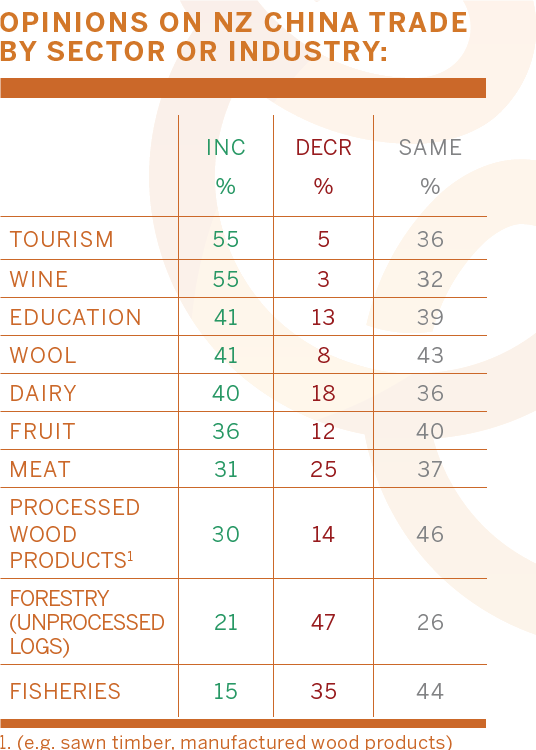
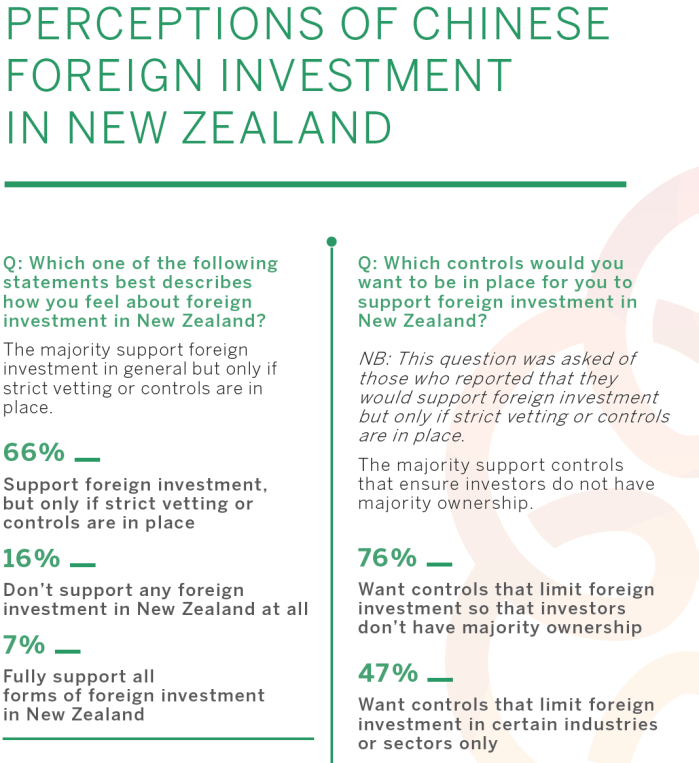
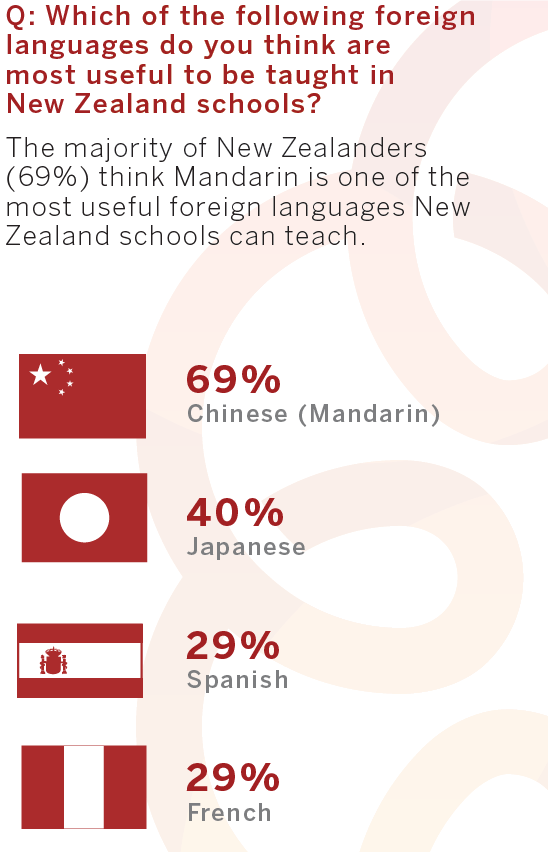
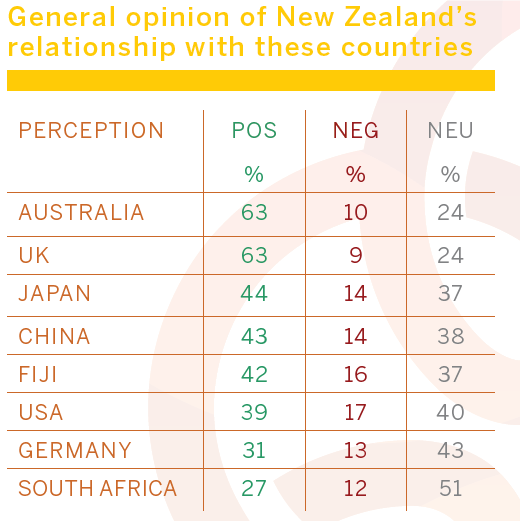
But survey data are usually interesting, and if the China Council is going to have a claim on our taxes, a decent survey is less bad than some of things they could spend money on.  There were a few interesting snippets in this one.    The first question asked “Would you say your general opinion of New Zealand’s relationship with these countries is positive, negative, or neutral”

china survey 1

The China Council was, of course, keen to highlight that 43 per cent of respondents answered “positive” and only 14 per cent “negative”.    But I’m not at all sure what to make of the results, partly because I’m not sure what to make of the question (I’m not sure how I’d answer it) and partly because of the cross-country comparisons.

For example, who is “New Zealand” here –  the government or individual citizens?  And, on the same note, who is “China”?  And is one being asked to describe or evaluate?  From what we see and hear, the New Zealand government and the People’s Republic of China have a generally good relationship (Comprehensive Strategic Partnership and all that), but that is something that I think is inappropriate and not in the interests of New Zealanders.

But I also found it striking that the results for China were so similar to those for Japan and for Fiji.  Japan is now a stable democratic prosperous First World country, no longer any threat to anyone.  Fiji is a semi-free small state, perhaps a nice place for a holiday, but poor and also no real threat to anyone other than its own people.   And then there is the People’s Republic of China – expansionist, aggressive, brutally suppressing the freedoms (political, religious or whatever) of their own people, without the rule of law,  engaged in economic coercion of any country that gets offside with them, and so on.  But, I suppose, there is a fair amount of trade between New Zealand firms and PRC ones.      Survey responses are what they are, and readers can only try to make sense of them, but on this occasion I suspect they can’t mean much.   Perhaps much of it is just about trade.  Perhaps the China Council has just been doing its propaganda job very effectively.

These were the results of the second question

china survey 2

I found these results interesting, and more than a little surprising (in fact, they go against the idea that trade explains the China answers in previous question).  But again, how would I answer?   Since trade is usually (not always) mutually beneficial, that would incline me towards “equally”.  And I put no weight on the spin, beloved of the previous government, that China had somehow “saved us” during the last recession.  I suppose I would answer “China”, but that is because I think New Zealand governments are excessively deferential, scared of their own shadows when it comes to China, and are selling out the interests of New Zealanders as a whole (around the integrity of our system, and the sort of values most New Zealanders espouse) for the business interests of a handful of firms (that somehow convince governments that what is good for them is good for us).  That’s my view, but it is a bit puzzling why the survey respondents both think China does best from the relationship, and that the relationship is positive.

There are some questions about trade, in which it turns out that people are aware that, for the moment anyway, China is our largest trading partner (well, Chinese firms and New Zealand firms –  trade isn’t government to government), and know that dairy is the largest export from New Zealand to China.  More New Zealanders want trade with China to increase than want it to decrease (and I’d probably be one of them – if China were to finally remove restrictions on services exports etc it would be particularly welcome).  But then there was this surprising (to me) result, in which respondents were asked about individual export sectors.

china survey 3

My own view would be almost exactly the opposite of this.  Export education is substantially a rort, cross-subsidised by access to work rights and immigration points, and it and tourism are two types of exports particularly vulnerable to the sort of economic coercion the PRC is now establishing a track record for.  By contrast, if firms can sell more fruit or fish to China, good luck to them (so long as they aren’t bending the ear of government – to go quiet on the PRC –  to do so).  Slightly off-topic, it is perhaps a telling reflection on New Zealand’s overall economic underperformance, what sorts of products aren’t on the list at all (eg advanced manufacturing).

What of foreign investment from the PRC in New Zealand?

china survey 4

Most respondents are only happy with foreign investment from the PRC with “strict vetting or controls”, and an overwhelming majority want restrictions to prevent majority ownership from the PRC.   I’m generally much more open to foreign investment than the median New Zealander, but regard PRC-sourced investment (where all firms have to be treated as, in effect, arms of a hostile state) as different.   But even so, I can’t see a case for (say) preventing majority PRC ownership of an office block in Queen St or The Terrace, or a hotel in Queenstown, or even a milk powder plant in Canterbury. On the other hand, allowing Huawei a role in New Zealand telecoms infrastructure seems reckless.

And then, presumably in the cause of defending Confucius Institutes in New Zealand (something the Executive Director has previously championed), there was a question about languages in schools.

china survey 5

I was mostly surprised that Japanese still scored so highly (a language spoken in only one, large but shrinking, country).  Whether Mandarin is really more “useful” than French or Spanish is anyone’s guess –  and how one defines “useful” is surely wholly in the eye of the respondent –  but learning a foreign language, whatever it is, is generally a useful discipline.  On the other hand, very few people who do several years of language study at high school ever emerge with much more than the ability to read a menu.  But the bigger point remains the one I made in a recent post on Confucius Institutes: when we teach foreign languages in our schools we should pay for, and resource, that ourselves, just as we do with maths and science teaching, not rely for support on foreign aid from a considerably poorer country, pursuing its foreign policy agenda.

Overall, some interesting data, with a few surprises and quite a few questions. It will be interesting to see how responses change, if at all, over coming years.

As for the China Council itself, the full prostration seemed to be on display late last week when they (a body largely funded by New Zealand taxpayers) held a “Gala dinner” to welcome the new PRC Ambassador to New Zealand.   I’m sure our authorities need to have formal, but distant, diplomatic relations with the PRC, but the “gala dinner” (not even just a “dinner”) is sickening to contemplate: people apparently so willing to set aside any values, any decent morality, any hardheaded assessment of the nature of the regime, to celebrate the arrival of today’s equivalent of the ambassador from the Soviet Union, Nazi Germany, late 1930s imperial Japan, Mussolini’s Italy (or a host of smaller, more modern, examples).    New Zealand once had the decency and moral sense to take some sort of stand against these regimes and their activities.  But…there is a dollar to be earned no doubt.

As often, one turns to the Chinese Embassy website for more information than one gets from the China Council.  There is no record of the speeches of the China’s Council Executive Director (or any other “worthy”), but the Embassy published the Ambassador’s speech.   Here is part of it

While we celebrate our achievements, we should also be sober-minded that the world is undergoing profound and complex changes. We need to deal with the economic and social divide in many countries, address the international divide between the existing powers and the emerging countries, and to handle the divide between 21st century realities and outdated policies. How do we respond to these profound challenges we face? What kind of vision should we have for our two countries and for our relationship? The choices we make today will not only influence our own development, but also have an impact on the long-term development of our relations and even the evolution of the world order.

China has made its own choice. The 19th Party Congress held last October drew a new blueprint for China’s development for the decades to come. China will continue to follow the path of socialism with Chinese characteristics. China’s development has entered a new era with the main task of addressing imbalances and inadequacies of our development, in order to meet growing needs of our people for a better life. China will continue to maintain a strong economic growth, guided by the new vision with greater emphasis on innovation, coordination, green growth, openness and inclusiveness.

This year marks the 40th anniversary of China’s reform and opening up. Tremendous achievements have been made over the past 40 years. As put in his keynote speech at the annual conference of the Boao Forum for Asia last April, President Xi Jinping reaffirmed that China would adhere to its fundamental national policy of opening-up, and pursue development with its door wide open. President Xi also announced a series of major measures for further opening up.

A stronger and more confident China will be able to make even greater contribution to the international community. China will stay as determined as ever to build world peace, contribute to global prosperity and uphold the international order. China will continue to follow the path of peaceful development, implement a strategy of opening for mutual benefit and win-win outcome. What China seeks is global partnership, instead of global dominance. Our aim is to build a new model of international relations and a community of shared future for mankind.

(That last phrase is apparently one of Xi Jinping’s specials.)

Presumably the audience lapped it up or (if ever inclined to a little scepticism about this rose-tinted, not to say tendentious, description of the world as seen from Beijing) said nothing.  This the regime that is today’s Soviet Union, today’s Nazi Germany –  whether in the way it treats its own people at home, lays claim on the loyalties of ethnic Chinese in other countries, pursues expansionist agendas abroad, seeks to silence critics and so on.

Gala dinner indeed…..


Reflecting on the government and the PRC

Early last month, the government published its Strategic Defence Policy Statement.   That was the one that caused a bit of a flurry because of the inclusion of the odd, rather mild, honest statement that appeared to that put noses out of joint among the tyrants of Beijing and their representatives and advocates (not all PRC citizens) in Wellington.

And that was so even though early on the document reminded us that

New Zealand continues to build a strong and resilient relationship with China. Defence and security cooperation with China has grown over recent years, supported by a range of visits, exchanges, and dialogues.

It isn’t clear what values or interests the People’s Republic of China and New Zealand would share.   We knew better 50 years ago when we didn’t do military exchanges and joint exercises with the Soviet Union.

The pandering goes on with talk of how “China is deeply integrated into the rules-based order” (one of those much-used but very ill-defined phrases that seems to bear little relationship to reality).

Moving along, the report gets a little more frank, but in repeating lines that are news to no one.    China is not  –  and shows no sign of or interest in becoming – a liberal democracy, and its “views on human rights and freedom of information…stand in contrast to those that prevail in New Zealand”.   The document notes also growing Chinese military power and a disregard for international fora in dealing with “the status of sovereignty claims” in “disputed areas of maritime Asia”.     There is, rather brief, reference to attempts to “disrupt and influence Western nations’ political systems from the inside”, although those comments aren’t specific to China.

And (in a statement of what one would have hoped would have been blindingly obvious) there is this

Developments in Europe and Asia have crystallised a sense that non-democratic and democratic systems are in strategic competition, and that not all major powers’ aspirations can be shaped in accordance with the rules-based order [whatever the government means by that], in the way that had been hoped until recently.

And yet, if this is partly in reference to China, what have the presidents of both the Labour and National parties been doing praising Xi Jinping and the contribution of the PRC?  There has been no sign of them recanting.

A little later on in the document, there are two paragraphs specifically about China.  They are purely descriptive, with not a word of disapproval to be found among the descriptions of China’s aggression in the South and East China Seas, the construction of military bases on artificial islands in contested waters.  Remarkably –  but no doubt pleasingly to both Beijing and our Ministry of Foreign Affairs and Trade –  there is apparently no mention of Taiwan, a key potential flashpoint, at all.

You could perhaps read the document more charitably than I have done –  for example, hints of unease about Chinese activity in Antarctica –  but it is still a pretty anodyne document.  There is no explicit or outright criticism.   Even China’s major geopolitical initiative, the Belt and Road Initiative, is described in positive terms.

But Beijing didn’t like it

At a press conference in Beijing on Monday, China Foreign Ministry spokeswoman Hua Chunying said the country had taken note of the defence policy statement and “lodged stern representations with New Zealand on the wrong remarks it has made on China.”        …

“We urge New Zealand to view the relevant issue in an objective way, correct its wrong words and deeds and contribute more to the mutual trust and cooperation between our two countries.”

Quite telling that wording.  Not a matter, apparently, where reasonable people might disagree, but rather “wrong words” (and “deeds”) that need correcting.   New Zealand should abase itself.   And the PRC sometimes wonders why it doesn’t have more genuine friends….

The document itself is now rather old news.  But what struck me in the days and weeks after its release was that, anodyne as it was, it was made even weaker by the complete silence of the Prime Minister and senior Labour Party figures (and, for that matter, the Greens).  Labour is by far the largest component of the government, and not a peep has been heard from the Prime Minister (conveniently on leave when the policy statement was released).  But that is par for the course from the Prime Minister –  I wrote here about a speech she gave earlier in the year to the China Business Summit in Auckland.   There was no sign of any moral core to her views.   Not surprisingly, since her own party president has been in Bejing, since she became leader, praising Xi Jinping.   It is sickening.

Incidentally, for anyone inclined to look favourably on New Zealand First’s involvement in all this, I stumbled on an article on the PRC Embassy’s website about an event in Wellington a couple of weeks ago to celebrate the 91st anniversary of the People’s Liberation Army.  Among the speakers were our Defence Minister, Ron Mark, and our new Chief of Defence Force, Kevin Short.  Various other senior New Zealand officials also attended.  Neither man published the text of his remarks, but the Chinese Embassy reported them.

Here was Ron Mark

The New Zealand Minister of Defence Ron Mark extended his heartfelt congratulations on the 91st anniversary of the founding of the PLA and expressed his admiration for the contribution of the Chinese army towards safeguarding world peace. The Honourable Ron Mark noted that China is New Zealand’s strategic partner and that the relationship with China is one of New Zealand’s most important and valuable relations with foreign countries. Over the past 30 years since Royal New Zealand Navy frigates visited Shanghai in 1987, China-New Zealand military-to-military relations have continued to develop on the basis of openness and mutual respect.

What planet is the man on?  He’d probably have had a good word for the Wehrmacht and the Luftwaffe in 1938 as well.

As for the Air Marshal

Mr Short noted that over the past 91 years since its founding, the PLA has made tremendous contributions to China and the world.

A decades-long civil war, enabling one of the brutal and murderous regimes on the planet, and now  –  according to our own Strategic Defence Policy Statement

China’s military modernisation reflects its economic power and growing leadership ambitions. China’s growing military capabilities raise the costs of any potential internvetion against its interests and include stronger expeditionary capabilities, including a military presence in the Indian Ocean.  China has expanded its military and coastguard presence in disputed areas of maritime Asia. It has determined not to engage with an international tribunal ruling on the status of sovereignty claims.

Perhaps all that had slipped the Air Marshal’s mind when he made the kowtow before the PRC Ambassador, presumably with the approval of his Minister?

Distasteful as the PRC regime is, at least there was a bit more honesty in some of their reported remarks

In his speech, Defence Attaché Li Jingfeng stated that as socialism with Chinese characteristics entering a new era, the building of the PLA has also reached a new stage. With the deepening of defence and military reforms, the entire army adheres to the absolute leadership of the Chinese Communist Party and resolutely implements President Xi Jinping’s thought on building a strong military. By constantly advancing the policy of developing the military through political work, strengthening it through reform, and governing it according to law, the PLA’s combat effectiveness has been significantly enhanced

Against what external threat, other than those generated by the PRC’s own aggression, one has to wonder?

As the PRC Embassy reported it

The atmosphere at the reception was cordial and friendly. The participating New Zealand guests spoke highly of the achievements made by the Chinese armed forces and their contribution to world peace,

I guess we can take such propaganda with a pinch of salt, but it clearly wasn’t a remotely awkward occasion for such an expansionist power just a few weeks after that defence policy document had been released.  It should be a cause for shame among our ministers, officials and senior defence force officers.

And if I’m critical of our government and its officials, the Opposition is no better.  After all, they still have former PLA intelligence staffer Jian Yang –  the man who acknowledges he misrepresented his past to get into the country –  as one of the lesser lights of their parliamentary caucus.    Their leader was the man who, as a senior minister last year, signed New Zealand up to the Belt and Road Initiative, in a document full of nauseating and ingratiating rhetoric (next steps of which are due, in terms of the agreement, in the next six weeks).  Perhaps worse, when the government came out with its rather mild Strategic Defence Policy Statement, mostly just stating –  barely even criticising –  the blindingly obvious, Simon Bridges was all of a flutter.  The government couldn’t possibly say such things: it might upset Beijing.  There would be consequences he ominously warned.    Does the man have no respects for the values and systems of his own country at all?  Is he only interested in the perspective of a few businesses (including universities) that want better trade terms, never mind the character of the regime they pander to?  Never, ever, apparently must a disrespectful word be uttered.

There have been a few interesting articles around from abroad in recent weeks that are worth reading.  Perhaps most directly salient was a substantial piece in the Australian magazine The Monthly by John Garnaut, formerly a senior Fairfax journalist (and long-term China correspondent), more latterly an adviser to the Australian government.    His article is on the challenge PRC influence strategies pose in many countries –  in Asia, the Pacific, Europe and the Americas.

Garnaut writes

The CCP’s international influence system is a complex, subtle and deeply institutionalised set of inducements and threats designed to shape the way outsiders talk, think and behave. The modus operandi is to offer privileged access, build personal rapport and reward those who deliver. It seeks common interests and cultivates relationships of dependency with chosen partners. The Party uses overt propaganda and diplomacy, quasi-covert fronts and proxies, and covert operations to frame debates, manage perceptions, and tilt the political and strategic landscape to its advantage.

Beyond the foundational assumption of a single, civilisational “China”, the specific demands of United Front work are framed by permutations of three narratives: China is inherently peaceful and beneficent, the growth of Chinese power is inexorable, and China is vengeful and dangerous if provoked.

These narratives are internally contradictory but consistent over time. The first two are delivered openly by leaders, diplomats and state propaganda. The third is usually delivered via back channels with plausibly deniable connections to the state: PLA “hawks”, specialist military hardware websites, academic forums, personal meetings with top leaders, editorials in the Global Times. Together, this messaging orchestra is designed to condition audiences into believing that the rewards are great, resistance is futile, and outright opposition may be suicidal.

The meta-narrative of Beijing’s ever-growing power is the drumbeat that accompanies China’s policies of territorial coercion across its southern and eastern seas. It is the subtext that persuades foreign governments to remain silent as Beijing abandons restraint in the restive borderlands of Tibet and Xinjiang. It is also the incentive for economic beneficiaries to avoid seeing, or to rationalise, or to even actively support the Party’s efforts to degrade the values and institutions of civil society.

That final sentence sounds a great deal like the New Zealand situation.

But Garnaut isn’t just writing about distant places like New Zealand and Australia.  Of Taiwan he writes

In May I attended a closed-door forum hosted by the Taiwan Foundation for Democracy that was publicly opened by the deputy foreign minister, François Chih-Chung Wu. He set aside diplomatic platitudes to issue this plea for international help:

“In Taiwan, and in countries elsewhere, China moves from soft power to sharp power, and then to hard power. And it is becoming more brazen every day … In other countries, this process may begin with a Confucius Institute, scholarships, grants, but the next thing you know you must self-censor discussions China considers sensitive … In the face of this authoritarian onslaught of China’s misinformation, cyber hacking, bribery, economic coercion, theft of technology, and intrusion in internal politics – Taiwan is crucial. If it can hold on, other democracies will be able to hold on. But if it fails, there will be no security for the democratic governments of the world.”

He also writes about the Singaporean government’s expulsion last year of a resident Chinese-born US citizen, a reasonably prominent academic, for being an “agent of influence for a foreign country”.     Garnaut writes

What is striking about this official statement is that it makes detailed allegations relating to a form of espionage that sits a long way from the traditional Western counterintelligence agenda. The intelligence officers who were allegedly behind this operation were not stealing secrets. And nor were they aiming to directly control any policy lever. Rather, they were allegedly planting or nurturing a series of words and ideas in order to tilt the strategic decision-making landscape in a particular direction. They didn’t want to force Singaporean policy makers to make decisions in their favour. Rather, they wanted to condition policy makers to make such decisions of their own volition.

He quotes a recent speech from a retired top Singaporean diplomat (reprinted in the government-managed media in Singapore)

“China does not just want you to comply with its wishes. Far more fundamentally, it wants you to think in such a way that you will of your own volition do what it wants without being told. It’s a form of psychological manipulation.”

As I read that, it brought to mind Beijing’s description of the New Zealand defence document: “wrong words”.

Garnaut reports his own experiences, and the attempts of the regime to suborn his reporting

At first, my exposure to United Front work was all about inducements, with an occasional warning to keep me on my toes. I was offered red envelopes, neatly packed with US$100 bills. And sounded out for a lucrative “consultancy” arrangement with a Hong Kong bank. In one encounter, I was offered air tickets, hotel accommodation, a five-star family holiday, a job, and a gift bag containing bottles of Bordeaux wine valued at up to US$2000 each. These were all reciprocity traps, to be avoided at all costs. Gradually, over time, the ratio of carrots to sticks was inverted.

Garnaut was recently the subject of legal action by one extremely wealthy PRC resident in Australia,  put out by his open and sceptical reporting.

Another recent piece people might like to read was piece by Didi Kirsten Tatlow, long-serving (and then China-resident) journalist, and currently visiting fellow at the (German) Mercator Institute for China Studies, on some of the ideas, values, and language (often ancient) that seem to guide PRC actions today, including around the United Front activities  (“Imperial philosophy meets Marxist orthodoxy in Beijing’s global ambitions”).

In one quote, resonant of Beijing’s descriptions of the defence policy document,

A direct consequence of this worldview is that, from the party’s point of view, China’s sovereignty applies everywhere in the world. The party-state reserves for itself the right to negate values such as freedom of speech anywhere if it feels these challenge its sovereignty.

This stance is often expressed in terse demands to “outsiders” to apologize for getting things “wrong,” such as classifying Taiwan as a nation, or referencing the Dalai Lama in an advertisement, as happened recently to western airlines, hotels and car companies. These demands are increasingly coupled to direct threat to trade, in a classic example of jimi.

Rarely is the rationale behind the demand spelled out, but it was, in January, in an article in Global Times. The article responded to a previous New York Times article that documented how Chinese diplomats and soccer officials were interfering in political and speech freedoms in Germany. (That article was by this author.)

Efforts in Germany to support the rights of Tibetans were not a question of free speech, wrote Zhang Yi in Global Times: “What the author fails to understand is that the Tibet question is a matter of Chinese sovereignty; the Tibetan separatists aimed at splitting China and they should not use freedom of speech as an excuse,” Zhang wrote.

In that quote the underpinnings of the democratic order are removed and the intrinsic value of free speech negated everywhere. This isn’t simply change. This is revolution, in the sense of overturning. While the Global Times is not the party or government, the sovereignty argument expressed by Zhang cleaves to official thinking.

Towards the end of her paper, Tetlow notes

How can an anti-democratic, universalist China be accommodated and managed?

Firstly, a mental reset is needed. In a time of system competition it is of utmost importance to understand one’s competitor. Chinese officials and official commentators often talk about “changing and improving” global governance – pluralist societies must assume they mean to do it. Open societies must stop seeing the People’s Republic of China as a paler copy of themselves, merely lagging in terms of democratic modernity. Such teleology is unjustified, barring major political change in China.

By seeing the threads that the party is picking from the past and weaving into the future, we see China as it is – human yet totalitarian, strong yet weak, defensive yet aggressive, and ultimately a great challenge to democratic nations. When China calls for a tianxia-esque, civilizational system such as the “commonwealth of human destiny,” we must listen carefully, analyze closely the historical context and development of the term, identify the techniques used to achieve it, and assume party leaders mean to implement it if they can.

And what of the vaunted Belt and Road Initiative, that local taxpayer-funded PR outfits like the China Council and the Asia New Zealand Foundation are constantly keen to talk up (and on which the New Zealand government soon has to make decisions)?  I noticed a new short piece out of a US think-tank suggesting that all might not be well with the programme even inside the PRC.

the PRC’s policymaking apparatus appears to have already responded to concerns of BRI overreach by adjusting the scale of lending to limit possible financial risk. BRI lending by major PRC banks has dropped by 89% since 2015, and lending by commercial banks—who are dealing with their own financial issues domestically—has ceased almost entirely. Policy banks have also scaled back, despite their status as arms of PRC government policy.

What are these concerns?

On July 20, Sun Wenguang, a retired professor of physics at Shandong University, penned an open letter criticizing China for “offering almost CNY 400 billion in aid to 166 countries, and sending 600,000 aid workers” (Canyuwang, July 20). On August 1, as he expanded on his concerns in an interview with the US-based Voice of America, police forced their way into Sun’s apartment. As he was taken away, Sun could be heard saying, “Listen to what I say, is it wrong? Regular people are poor, let’s not throw our money away in Africa … throwing money around like this doesn’t do any good for our country or our society.” (VOA Youtube, August 2)

Ah, the character of the regime our politicians and officials pander to…..

As the author notes

Although a Western observer might dismiss a few professors’ unhappiness with the BRI as ivory tower grumbling, PRC academic critiques are worth noting, since outspoken academics are often the channel through which other PRC societal elites communicate their dissatisfaction with the CCP.

And draws atttention to one much-better-connected leading academic’s recent essay.

Although Sun has long been a government gadfly, he is also long retired, and resides far from the center of power in Beijing. But similar criticisms have found voice much closer to the corridors of power. On July 24, Xu Zhangrun (许章润), a professor at Beijing’s elite Tsinghua University, published an extraordinary essay entitled “Imminent Fears, Imminent Hopes” (我们当下的恐惧与期待). Among many other criticisms, Xu excoriates Xi’s government for its profligacy abroad, saying:

At the recent China-Arab States Cooperation Forum [on 10 July 2018], [Xi Jinping] announced that twenty billion US dollars would be made available for ‘Dedicated Reconstruction Projects’ in the Arab world, adding that [China] will investigate offering a further one billion yuan to support social stability efforts in the [Persian Gulf]. Everyone knows full well that the Gulf States are literally oozing with wealth. Why is China, a country with over one hundred million people who are still living below the poverty line, playing at being the flashy big-spender? (China Heritage, August 1)

Xu Zhungrun’s essay is a fascinating read (the readily available, and extensively quoted, translation was done by the Australian China scholar living in the Wairarapa).   As the translator notes in his introduction

On 24 July 2018, Xu published a lengthy online critique of China’s present political and social dilemmas. In issuing his Jeremiad, Xu, who is something of a latter-day  儒, locates himself in the Grand Tradition by effectively addressing a Memorial to the Throne, 諫言 or 上書. Given the relentless police repression and intensifying ideological clamp-down in Xi Jinping’s China, this is a daring act of ‘remonstrance’ 諫勸.

The professor doesn’t pull his punches

Over-investment in international aid may well result in deprivations at home. It is said that China is now the world’s largest source of international aid; its cash-splashes are counted in billions or tens of billions of dollars. For a developing country with a large population many of whom still live in a pre-modern economy, such behaviour is outrageously disproportionate. Such policies are born of a ‘Vanity Politics’; they reflect the flashy showmanship of the boastful and they are odious. The nation’s wealth — including China’s three trillion dollars in foreign reserves — has been accumulated over the past four decades using the blood and sweat of working people, in fact, it has actually been built up as a result of successive policies and countless struggles dating from the time of the Self-Strengthening Movement [launched during the Tongzhi Restoration during the 1860s when, following its defeat in the Second Opium War, the court of the Qing-dynasty adopted the first modernising reform agenda in Chinese history. By saying this Xu, to an extent, indicates that he does not completely embrace the Communist narrative or its soteriology]. How can this wealth be squandered so heedlessly?

The era of fast-paced economic growth will come to an end; how can such wanton generosity be tolerated — a generosity which, in many ways, replicates [the vainglorious Maoist-era policies when China boasted that it was the centre of world revolution to] ‘Support Asia-Africa-Latin America’ [which meant that an impoverished China was generously giving aid to Third World countries in an effort to gain political advantage and counter the influence both of the American imperialists and the Soviet revisionists] that led to countless millions of Chinese being forced to tighten their belts simply to survive, and which even saw the corpses of those who had starved to death scattered in the fields.

Recall that New Zealand too –  far richer than China per capita –  is a recipient of this lavish PRC “foreign aid” –  paying for language teaching assistance in numerous of our state schools,  all encouraged by our government at the expense of poor Chinese.

Average Chinese are most frequently offended by the way the state scatters large sums of money through international aid to little or no benefit. China is still slowly making its way up the steep slope of development. In terms both of basic infrastructure and social facilities, as well as in regard to people’s ability to access welfare, we are confronting massive problems; our burden is great and the road ahead leads far into the distance. And I make this point without even mentioning the crisis in aged care, or issues related to employment opportunities and education.

Or

Even the most commonplace international meeting organised in China involves extraordinary levels of expense. There is no regard for budgets; fiscal waste and the heedless loss of human work hours is considerable. Such activities are content-free and superficial. It’s all about pursuing ‘Vanity Politics’ not ‘Practical Politics’, let alone ‘Hard-edged Politics’. Such events have nothing to do with the so-called ‘venerable traditional of warmth and hospitality demonstrated by the Chinese people from ancient times’; only the most vain and self-serving [leaders and bureaucrats like to] indulge in such things. If foreigners were to copy what we ar constantly doing here, then the VIP-filled headquarters of the United Nations in New York would be on police lock-down 24/7, and the headquarters of the numerous international organisations based in Geneva and Paris would perforce have to stage nightly fireworks displays with their personnel expected to be decked out in all their finery all the time.

One might think of cocktails to celebrate the 91st anniversary of the PLA.  But more tellingly one might think of PRC gifts to PNG (a fancy convention centre and a new six lane highway for example) to enable it to host APEC this year.

Or

An emergency brake must be applied to the unfolding Personality Cult. Who would have thought that, after four decades of Reforms and the Open Door, our Sacred Land would once more witness a Personality Cult? The Party media is going to extreme lengths to create a new Idol, and in the process it is offering up to the world an image of China as Modern Totalitarianism. Portraits of the Leader are hoisted on high throughout the Land, as though they are possessed of some Spiritual Mana. This only adds to all the absurdity. And then, on top of that, the speeches of That Official — things previously merely to be recorded by secretaries in a pro forma bureaucratic manner — are now painstakingly collected in finely bound editions printed in vast quantities and handed out free throughout the world. The profligate waste of paper alone is enough to make you shake your head in disbelief.

Didn’t former Labour leader Phil Goff pay for a large chunk of his mayoral campaign auctioning off collected works of Xi Jinping, to PRC-based donors?

It is a bracing read, and one can wonder at the likely fate of the courageous author.

Meanwhile, our Prime Minister –  and her Opposition counterpart – refuse ever to utter a critical word about the regime, or what it represents here  (Jian Yang, the infiltration of Chinese community groups, control of the Chinese language media), abroad (South and East China Sea), or back home.    The most egregious recent example is around the mass concentration camp (actual detention, and extreme surveillance for those not detained) in Xinjiang.    What would it take for Jacinda Ardern, Simon Bridges, Winston Peters, Ron Mark, James Shaw, Marama Davidson to speak up and speak out.   Does nothing but a dollar matter in their world nowadays?  It looks a lot like civilisational decadence taken to whole new levels.  So well-schooled it doesn’t even occur to them to speak up.     Another cocktail party perhaps?  Pass the canapes, and quietly ignore the great evil Beijing and the CCP are responsible for –  not just in decades past, but (in more refined, and perhaps unnerving) forms right now.

These were parties that once prided themselves on standing against (variously) apartheid South Africa, French nuclear testing, the Soviet Union, Nazi Germany, mass murder in Cambodia or Rwanda, and so on.  Is there anything left they believe in enough, or care about enough, to speak up, take a stand, or do something?


Confucius Institutes, the PRC, and all that

Last week there were screenings in Auckland and Wellington of Canadian journalist and filmmaker Doris Liu’s documentary “In the Name of Confucius” .  Each screening was followed by a Q&A session with the filmmaker herself, who has been on a bit of a roadshow promoting the film (which is funded by the Canada Media Fund) and its message (which has now also been screened at the British Parliament and at various parliaments in Australia).

From the promotional material

Culture. Language. Power.  On average, China opens one Confucius Institute per week in partnership with school boards and academic institutions around the world, with a goal of opening 1000 by 2020.  Yet, a growing number of schools are also starting cut ties with the program, alarmed by concerns ranging from human rights violations, financial incentives and censored content to national security and espionage.

In the Name of Confucius is a one-hour documentary about the Chinese government’s multi-billion dollar Confucius Institute (CI) program and the growing global controversy at academic institutions around the world as scholars, parents and others question the program’s political influence and purpose.

The Confucius Institute (CI) programme began in 2004, and there are now three of them in New Zealand (made possible as part of the 2008 China-New Zealand “Free Trade” Agreement), one each at Auckland, Victoria and Canterbury universities.  Given the substantial amounts of money involved –  the universities get to extensively leverage their brand with PRC money –  and the sensitivities of the PRC authorities on all manner of things (try the Rockhampton fish story for example), it was to the credit of Victoria University that they allowed their facilities to be used for the Wellington screening, even with the strange disclaimer that “This external event does not necessarily reflect the views, thoughts and opinions of the university”.    Perhaps naively, I’d associated universities with the contest of ideas, evidence etc, rather than with any single view held by “the university”.

(Reflecting an official PRC perspective, the film featured a clip of the head of Hanban –  the PRC government agency responsible for the CI programme –  stating that the CIs meant that it was “like foreign universities work for us”.)

The documentary centres on two main Canadian stories.  The first was the defection of a Mandarin language assistant (the main strand of what CIs do), Sonia Zhao, whose defection and subsequent human rights complaint (based on the then formal PRC prohibition of anyone with Falun Gong connections being a Mandarin language assistant) contributed to the closure of the Confucius Institute at McMaster University in Ontario.   Zhao herself had been a Falun Gong practitioner who, on her telling, had been unaware of the prohibition until presented with her draft contract, and was then fearful of imprisonment or other punishment in China.    She recounted the instructions the assistants received that –  in Canadian government classrooms –  they should avoid issues like Taiwan and Tibet, change the subject if possible, and otherwise parrot the Party line.

The second story was around the battle, ultimately successful, to convince the Toronto public schools system (apparently the third largest in North America) to end its association with the Confucius Institute/Confucius classroom programme.  It featured rather gruesome footage of little Canadian kids singing a song, drawn from CI resources provided by the PRC authorities for Toronto schools, in praise of Chairman Mao “leading his people forward” (no mention presumably of the tens of millions of deaths ascribed directly to government choices?).

The section focused on the Toronto debate featured footage of vociferous protests outside the meetings (on both sides, mostly from the ethnic Chinese community, with those in favour of the CI programme apparently organised by other PRC front organisations), some pretty arrogant bureaucrats (including one who had clearly enjoyed being “wined and dined” –  his words –  by Beijing), and some dramatic footage of the impassioned debate at meetings of the school district board of trustees.    There were the competing perspectives: one Chinese immigrant tried to claim that Tibet’s status was really just like Quebec’s.  That sparked a feisty response from one trustee about the possibilities for independence referenda in Tibet, to which the response was ‘oh, we don’t need referenda, because we know no one wants independence”.    And, on the other side, other ethnic Chinese noted that for all the CI claims to promote Chinese culture, it was the Communist Party which had set out to destroy so much of Chinese culture.     At the end there was an overwhelming vote (20 for, 2 against) to end the Toronto school district’s association with the Confucius programme.

The documentary was primarily about the Confucius Institute programme.  But it was also –  particularly through the lens of the Sonia Zhao story –  about the brutal and systematic PRC persecution of the Falun Gong.    The filmmaker –  herself a Chinese immigrant to Canada only about 10 years ago – has some involvement with Falun Gong herself, and indicated that she has family members back in the PRC who are active practitioners. One could only admire her courage in speaking out, although wondering about the risks she might be exposing her family still in the PRC to.

Here is an extract from a pamphlet Falun Gong people were distributing in central Wellington last week

falun gong

Or you could read an Australian (ABC) article.

This is the sort of regime that we allow to put its people into our schools.

Falun Gong isn’t, to put it mildly, my cup of tea.  But that isn’t the point.   States shouldn’t get to compel, or proscribe, religious/spiritual practices in this day and age (cuius regio, eius religio was from hundreds of years ago) and, when they nonetheless still choose to do so, we should not be actively aligning ourselves with such regimes (one could add regimes like Saudi Arabia to such a list), let alone allowing them to put (ideological “sound”, politically safe) people in our schools.   The PRC has now removed the explicit prohibition on Falun Gong people from the websites describing these Mandarin language assistant roles, but it makes no practical difference, given that the practice of Falun Gong is prohibited in the PRC and the government actively persecutes (and in some cases, it appears, murders) practitioners.

As it happens, and to her credit, the director of Victoria University’s Confucius Institute attending the screening of “In the name of Confucius” in Wellington.  Rebecca Needham was, until recently, a fairly senior MFAT official, including former New Zealand Consul-General to Guangzhou.  As I noted recently, in the weird conflation of roles and interests that swirls around Wellington over the PRC relationship, even though her current job (directly on the payroll of Victoria University) involves implementing a programme largely funded by the PRC, she is still shown on the MFAT website as one of the group of public sector experts on China (the only non public servant on the list).

When it came to the Q&A session, Needham made a couple of points:

  • to the extent that events were portrayed accurately in the film, they bore no resemblance to the way the Confucius Institute at Victoria (or others in NZ) were run, and
  • that the Victoria Confucius Institute was completely transparent and non-political.

Since I had met her once before, and she had then volunteered a willingness to talk and answer questions, I emailed her and asked whether she could be specific about any differences in how the New Zealand CIs were run, and whether there were any prohibitions on Falun Gong teaching assistants.

She invited me to come and talk it over, and we met in her office yesterday. Despite her offer to talk, she was clearly a bit uneasy about talking to me, and so I offered to keep her remarks off-the-record, and simply use them as background to my own descriptions etc.  In the course of the discussion, Tony Browne – former New Zealand Ambassador to China, chair of the Confucius Institute and senior consultant (unpaid) to Hanban (the PRC agency behind Confucius Institutes –  dropped in.  I’ve also written previously about the multiple hats Browne wears.

To recap, the main focus of the Confucius Institute, despite its location in a university, and use of the university brand, has almost nothing to do with the traditional role of a university.  They neither teach undergraduates, nor conduct research.  It is mostly a programme of (at PRC government expense) putting native Chinese speakers (typically young graduates from good Chinese universities) into our schools, to support Chinese language (and related) programmes. (There are also “cultural” programmes that look as though they should be better done, if at all, directly through the PRC embassy, not with a local university imprimatur).   A different cohort of these young people come out each year, and they are based in various towns and cities (in Victoria’s case, the North Island up to and including the Bay of Plenty), working in local schools alongside New Zealand registered teachers.  Apparently, no textbooks or the like are provided by Hanban, the Confucius Institutes, or the Mandarin Language Assistants themselves (presumably reducing the likelihood of kids in our schools singing songs celebrating Chairman Mao).

Apparently the hope of Hanban has been to localise Chinese language teaching over time (presumably, in turn, reducing the substantial cost the PRC taxpayer –  in a much poorer country than NZ –  bears).  Even if that is the hope, it isn’t the situation at present, whether in New Zealand or in other countries where CIs are operated.

The recruitment process for the Mandarin language assistants who come out here involves the New Zealand Confucius Institute staff making the final decisions (sensibly enough –  they need people who will fit in, living in perhaps a small New Zealand provincial town for some time). But they make those decisions from a list provided to them by PRC universities.    We can be pretty sure that all of those people –  after all, coming to pursue an official government agenda just by their presence – will have well-vetted. No Falun Gong will have survived the vetting process, but nor will anyone calling for (say) independence for Tibet, free and open elections in the PRC itself, respect for Taiwanese democracy, or freedom of religion or freedom of expression.   That is just the way the PRC is, and he who pays the piper calls the tune.  New Zealand staff needn’t concern themselves with this sort of pre-vetting.

Now, of course, these are young graduates.  Some might be politically passionate, but probably most aren’t –  more concerned with seeing the world, shopping, the opposite sex, developing their English, or whatever, all the while adopting the only safe PRC position (keeping your head down, and your speech tightly constrained).  So I’m not suggesting that when these people come into our classrooms they are generally consciously actively propagating some PRC agenda or worldview to our kids.  But it doesn’t change the fact that they are approved representatives of a heinous regime, and they (and the Victoria staff) have chosen to be complicit with that regime, no matter how often they repeat the line that “we just do language and culture”.     Are they helping some New Zealand kids in the process?  Yes, no doubt.  (And having myself spent time growing up in Kawerau, I was half-pleased to see that kids in places like Kawerau and –  still poorer –  Murapara are getting support in their Chinese language learning.)

But it doesn’t make the system right.  I suggested to the director that it really wasn’t much different than if, say, a cohort of Hitler Youth (which pretty much everyone had to join, whether a zealot or not) had beeen coming to the UK in the mid-late 1930s each summer to teach German language and culture, at the expense of the Nazi regime.  There is nothing wrong with learning German, or Chinese, but the people who work on those programmes (from university vice-chancellors down) make themselves complict in the evil.

If we want to encourage Chinese language learning in New Zealand, how much better if we spent our own money on it?   That is what we do when we want to improve science or maths or English or economics teaching.   It is what self-respecting people do, not mendicants.  We don’t (that I’m aware of) have a government-facilitated programme to bring in native French or German or Spanish speakers for our schools, but if that were regarded as a worthwhile part of secondary education I’d have no particular objection. But spend our own money, recruit people directly ourselves, and recruit them from places (in the Chinese case, eg Taiwan, Singapore, or even semi-free Hong Kong) where we can reasonably confident that a foreign government won’t have prescreened for political suitability and safety.  Particularly not a foreign government like that of the PRC.   (And this is all the more so for courses for our public servants, of the sort the CI conducts.)

You can read the Victoria University Confucius Institute material for yourself: there is plenty of it on their website.   You can also see that the talk about it being “just” language and culture (and doesn’t “culture” encompass “the way we do things” –  the PRC not being a model for most New Zealanders), they are quite open about the political nature of what is going on.  The handbooks for schools might mostly be branded as “Victoria University” products (Vic has many institutes and schools) and perhaps that helps marketing and recruitment in the provinces.  The Annual Reports are a bit different.   We find photos of a Vice-Premier, of a visiting Communist Party secretary.  We read that a counsellor from the PRC Embassy sits on the board of the Confucius Institute, and that one of the CI staff is involved in programmes “to raise China literacy in the public sector”  (we ask the PRC government to help “educate” us on China?   And the Nazi Party to educate us on Germany in the 30s?)   In fact, in the 2017 Annual Report there is a celebratory photo of Xi Jinping on page 2 –  clearly not embarrassed that this tyrant, just taking power for life and further clamping down on any freedoms in the PRC –  launched the Victoria CI in 2010.

The PRC doesn’t have any doubts about the point of the Confucius Institute programme.  But you have to wonder why New Zealand universities, government departments, and decent individuals are so willing to allow themselves to be used by such a dreadful regime.  Language learning generally is a good cause, but ends aren’t all the matter. Means matter too.

The presence of Confucius Institutes clearly isn’t the biggest issue that should be worrying people in the supine, even slavish, way our authorities approach the PRC.  Rather more important is when, for example, the Leader of the Opposition (who as a minister signed us up for a “fusion of civilisations” with this dreadful regime) can claim, apparently with a straight face

He also said he continued to back National MP Jian Yang who was forced to defend himself after confirming that he had taught ‘spies’ in China.     “Before me being or becoming the leader, he has asked and answered quite decisively the questions around all of this … he is a highly valued member of parliament,” Mr Bridges said.

(This of a man hardly heard from in the English language media since the allegations surfaced)

or a Defence Minister who was reported the other day, at a function to celebrate the People’s Liberation Army 91st anniversary, that New Zealand was a “strategic partner” of the PRC.

If you want to update on what sort of regime it is that we allow to put its people in our schools, that we solicit foreign aid from, and have our universities celebrate, I recommend that new Der Spiegel piece on the open-air concentration camp that the Chinese province of Xinjiang has become.  Or an update on the organ transplant abuse situation, that someone sent to me a few days ago.  Perhaps you are inclined to look the other way, or just ignore this issue, as I was until quite recently.  If so, at least I suggest you check out the calibre of some of the people involved in leading the fight against this practice.  Yes, governments need to have relationships with the PRC (stiff formal ones ideally), but we shouldn’t be beggars, and we shouldn’t give our good name to voluntary association with such a regime.

Choices: New Zealand and the PRC

There was an article on interest.co.nz the other day from the New Zealand resident American geopolitical and strategic affairs consultant, Paul Buchanan.  In his column –  well actually even in the headline –  he argues that

New Zealand is facing a very tough choice between our security interests and our economic interests, and that choice may have to be made very soon.

This is, as he sees it, a choice between the PRC and that of the United States (and our traditional allies).

Perhaps, but I reckon Buchanan misunderstands the nature of New Zealand’s economic exposure to the PRC.  The economic interests involved aren’t those of the country as whole –  countries make their own prosperity – but rather of a relative handful of, perhaps politically influential, businesses (and universities)  And if there is a choice it is more likely to be between the sort of values and friendships that have guided this country for the last 100 years and more, and those of one of the most brutal aggressive regimes on the planet; a regime which, as this article highlights, is becoming worse –  more threatening to its own and others –  not better.  It should be no choice at all, unless our politicians are now quite without shame.  Values and beliefs –  the things that unite people, communities, countries, beyond just common material interests –  don’t appear in Buchanan’s story.

Buchanan sets up his article noting that New Zealand`s trade and security relationships had diverged.   He seems to present it as a matter of active choice, whereas I would see it –  at least on the trade side –  as a natural evolution.  There was no conceivable world in which the bulk of our firms` overseas trade (and it is firms that trade, not governments) would continue to be with UK counterparts, or even with Australian or US firms.   That is true in respect of both imports and exports.   Our previous position –  buying and selling from firms in a single dominant country –  was historically not the norm.   These days –  though you wouldn’t know it from Buchanan’s article –  our foreign trade is relatively unusually widely spread.  No single country’s firms –  not even the very largest or the very closest –  take or provides more than a quarter of our foreign trade.  And, unfortunately, our foreign trade is rather smaller, as a share of GDP, than it would be if our economy were more successful.   To the extent that one worries about trade with the PRC –  and some individual firms clearly should, having chosen to sup so large with the “devil – a much larger share of Australia’s trade is with PRC counterparts than New Zealand’s.

Buchanan presents New Zealand as caught on the horns of a dilemma, or as he puts it

…that makes the New Zealand’s stance more akin to straddling a barbed wire fence while standing on ice blocks rather than balancing between competing great power interests.

It seems he sees it as a choice because he has bought into the narrative, often promoted by the previous government, that somehow our (so-called) prosperity (weak productivity, shrinking tradables sector etc) owes much to the PRC.

On the one hand, the Chinese presence in New Zealand has been materially beneficial. But that has come with strings attached that are believed to compromise the integrity of New Zealand institutions. For its part, New Zealand’s Anglophone orientation has not recently paid similar material dividends even though it gives it a seat at the table in security meetings with our traditional partners.

But where is the evidence that, in anything other than a willing buyer/willing seller sense, New Zealanders as a whole have particularly profited from the relationship with the PRC?   Is there reason to suppose that more milk powder would have been produced, if PRC buyers hadn`t purchased it from New Zealand sellers?  It is a globally-traded product, and what isn`t sold in one place is sold in another. In that respect, it is a little like oil.   The same goes for many of our exports, which aren`t specifically designed from the Chinese market.  And no one supposes that the PRC is about to impose export bans on the sort of stuff New Zealand firms purchase from the PRC.

Trade is, generally, mutually beneficial, and so things that disrupt trade patterns are generally costly.  But the cost of any particular disruption can easily be overstated, especially in a bilateral relationship where total exports to a particular country (in this case, New Zealand to the PRC) total only around 5 per cent of GDP.   Dairy prices fluctuate from week to week and, quite a lot, from season to season.  On the other side, so do oil prices.  But economies have a lot of capacity to adapt, and instruments like monetary policy and a flexible exchange rate that help smooth the adjustment.  It isn’t always easy for particular firms –  but they’ve made choices about their exposures, and the failure to manage them effectively – but the focus of policymakers needs to be on the economy, and country, as a whole.

Buchanan sets up a looming almost inevitable choice, about rising US/PRC tensions (economic, but even more so strategic)

The question is therefore not a matter of if but of when and for/against who?

He offers this scenario of “going with” the PRC (although it isn’t entirely clear what specifically he thinks this choice would involve doing, or not).

Should New Zealand choose China, it will lose the security umbrella and suffer the diplomatic wrath of our most traditional and closest international partners. The consequences will be felt in a loss of trade and diplomatic ostracism, but most acutely in damaged security relations with other Western democracies. The Five Eyes listening posts in New Zealand will be dismantled and all of the highly sensitive equipment, to say nothing of archived records and stored data, will be removed under duress. This could prompt a revolt within the New Zealand intelligence community given its Anglophone orientation, and when coupled with “dark” influence operations by former allies could cause civil unrest amongst those disinclined to cast their lot with the Chinese. It could even lead to covert and overt hostile responses from jilted partners, who will likely discontinue military relations with New Zealand, including sale and supply of equipment. There will be a moment of national reckoning.

I`d certainly join any protests against such a choice – utterly morally reprehensible as it would be.  It would be akin to Marshall Petain treating with Hitler, with less excuse. It isn`t entirely clear why Buchanan thinks this opting for the PRC option is a realistic possibility though.   All he offers is economic coercion initiated by the PRC.

Should New Zealand opt to side with the US and its security allies, it will suffer serious economic losses as a result of Chinese retaliation. This has already been presaged by the PRC response to New Zealand’s support for the International Court of Arbitration’s ruling in favour of the Philippines in its dispute with China over island-building in contested waters, where state-controlled media editorials warned New Zealand over the consequences of siding against China (including in trade). More broadly, there is ample record of Chinese economic retaliation against countries that do not toe its preferred line on a number of issues, so New Zealand has both immediate and contextual reasons to see the writing on the wall.

This is all rather overwrought.   I’ve written previously about PRC attempts at economic coercion.   In a case that will have bothered the PRC far more than anything New Zealand could do, and where the PRC authorities had far more effective leverage, –  missile defence system being installed very close to the PRC – the central bank of Korea estimated an effect from PRC coercive measures of perhaps 0.4 per cent of GDP.

As I noted in that earlier post, a couple of industries –  one government-owned anyway (the universities) – have made themselves overly-dependent on the PRC.  A sudden stop on PRC students or tourists coming to New Zealand (the option that would hurt here and do least harm to PRC people themselves), would be very disruptive to those industries.  But those are risks they need to be managing –  and not just by persuading governments never to see anything upsetting to Beijing.     No matter what the PRC did, there is no sense in which the “writing is on the wall” for the New Zealand economy.   The next international recession –  whatever its cause – is more of an issue to worry about (especially as our authorities aren’t that well prepared).

So we can choose to abandon traditional allies, and abandon any interest in supporting democratic countries in the east Asia region, and in doing so abandon any sort of self-respect as a nation.  Or we could summon some self-respect, and perhaps give some lead (moral if not military) in pushing back against PRC intrusions abroad (including here specifically), and abuses at home.  But whichever choice our leaders ended up making –  and it should be no choice at all –  it isn’t one that seriously threatens our (rather attenuated) economic prosperity (let alone our physical security).

On which note, it was interesting to see that in a week the government had moved from being unwilling to name the villain in the South China Sea, to being a bit more explicit in the Strategic Defence Policy Statement released on Friday.  Even then, they can barely bring themselves to disapprove, and cloak there concerns in all sorts of rather laughable diplospeak such as the suggestion that “China is deeply integrated into the rules-based order”.  When it suits perhaps, but that is not at all the same thing –  what matters is the choices made when it doesn’t suit.  And those aren’t encouraging.

Also interesting to note the contrasts in the comments of two senior officials, one from New Zealand and one from Australia.  Our outgoing ambassador to the PRC, John McKinnon, was profiled in the Dominion-Post on Saturday.

Some have expressed unease over China’s expanding influence in the Asia-Pacific region. Canada’s Security Intelligence Service has claimed China is busy “co-opting political and economic elites” in New Zealand.

McKinnon makes it clear it is not a topic he will comment on; nor will he discuss current government policy towards China or the policies of the ministers he has served while in Beijing.

He also does not want to venture an opinion on whether China will move towards a more Western-style democracy.

“To understand the dynamic of what’s driving China now you have to understand where they’re coming from. It’s something they have to make their own decisions about and I can’t foreshadow what will happen.”

I’m enough of a bureaucrat to not encourage officials to speak out-of-turn openly. But clearly his masters also had no interest in him ruffling any feathers at all, even as the defence strategy document was being released.

And on the other hand, in his final days in his role, the outgoing head of the Australian defence forces comments thus

Defence chief Mark Binskin says Beijing’s broken promise not to militarise the South China Sea means it has squandered the trust of its neighbours and undermined its aspirations to regional leadership.

and

Asked about China’s trajectory since he took over in 2014, Air Chief Marshal Binskin agreed “it has changed” and cited the “very, very concerning” militarisation of features as well as “the influence of some nations starting to come down into the south west Pacific”.

Chinese President Xi Jinping said during a 2015 visit to Washington that his country had “no intention to militarise” the artificial islands it had built in the strategically important South China Sea.

Air Chief Marshal Binskin dismissed Beijing’s claims that its placement of weapons on built-up features in the Paracel and Spratly archipelagoes were purely defensive and said other countries around those waters were entitled to stand up for their legal and territorial rights.

 “I don’t think there is trust there … because [according to] all the reports that you see, they are militarising,” he said. “They’ll put a spin on that and say it’s only for defensive reasons. But … if you didn’t build an island, you wouldn’t need to defend it. If there are weapons on those islands, they are militarised.”

Asked what the militarisation was for, he said: “I think that they are looking to expand into there and I think it is quite obvious what their approach is.”

Not, sadly, the sort of thing one hears from New Zealand ministers or their senior officials.  But then, why would they, when they seem unbothered by Jian Yang as a member of Parliament, and where the parties seem to compete over which president can offer the most laudatory praise of Xi Jinping and the PRC.

Do our leaders –  National, Labour, New Zealand First, or Green –  care any longer about anything but the quiet life, and the next trade transaction? Do they feel no shame at all about associating with such a heinous regime?  If so, how would we know?  Thank goodness that wasn’t the approach of people like Michael Joseph Savage, Peter Fraser or their then Opposition counterparts.

The debate on PRC influence on Q&A

Late last week I posted as a standalone item the comments that Peter Jennings, director of the Australian Strategic Policy Institute (and former senior Australian defence strategy official), had made in response to my post about last week’s Asia New Zealand foundation roundtable on People’s Republic of China (PRC) influence/interference in New Zealand.   Jennings was pretty critical of successive New Zealand governments’ attempts to pretend there is no issue.

This morning someone pointed out to me that Jennings had been interviewed on TVNZ’s Q&A programme on Sunday, so I took a look.  His comments were pretty moderate (especially about New Zealand), and largely focused on the Australian situation, and the new foreign interference laws passed with support from both the Liberal-National coalition and the Labor Party.   He highlighted issues around political donations, the Sam Dastyari affair (Labor senator forced to resign over inappropriate activities in this area), and noted that, between Federal and state Parliaments, there was concern that Dastyari’s wasn’t the only worrying case.

Re New Zealand, he noted that New Zealand seemed to face similar pressures as Australia, and that things weren’t that different in Canada, in the UK, and in many EU countries, and that in his view it would be smart if New Zealand and Australia tried to align their approaches.   While noting that New Zealand and Australia had different geographies and different strategic imperatives, he noted some risk to the bilateral relationship (important to both sides) if our governments don’t take the PRC intrusions seriously.

Corin Dann, the interviewer, pushed back, suggesting for example that Sir Don McKinnon would see things differently.  McKinnon is, of course, head of the government-sponsored China Council, designed never to see anything concerning, never to say anything upsetting, about Beijing and its activities.   As Jennings noted, there is an interest in having an effective relationship with the PRC, but that all countries needed to recognise that there were downsides as well as upsides in relationships with such a massive power, in the process of being more dictatorial.   He argued that even if officials were confident they had things under control –  something he was explicitly sceptical of in his comments here –  it was important for governments to take publics with them, and engage in open dialogue on the issues, risks, and responses.

Dann again attempted “what-aboutism” – every country spies, there is no military threat etc.  Tell that to Taiwan –  or countries with lawful claims in the South China Seas –  was my reaction, but Jennings was a bit more emollient, simply pointing out that countries like ours did not engage in large scale intellectual property theft by cyber-hacking etc.

And finally, asked about the PRC backlash to the new Australian laws, Jennings noted that the PRC (and some its populist media) didn’t like the new approach, but that the relationship goes on.  He argued that there was a mutual interest in a “steady relationship”, and that the PRC would come to recognise that Australia couldn’t do less than say “thus far and no further”.   Given past PRC attempts at economic coercion (which I wrote about here) that seemed optimistic.

All in all, it was pretty emollient stuff, and there wasn’t even any material bad-mouthing of New Zealand governments –  an approach which, fair and accurate or not, tends to get the backs of New Zealanders up.

But it was still all too much for two members of the Q&A panel, political scientist Bryce Edwards and former Minister of Defence, Wayne Mapp.  The word “overwrought” appeared so often that one could almost use it to describe their reaction.

Edwards began claiming that there “no compelling evidence of a problem” in New Zealand, and asserted that the new laws continued Australia’s journey down a path towards being an authoritarian illiberal state, where people could no longer participate freely in political debate and protests.  To be honest, I wasn’t really sure what he was on about – and I hold no brief for the specifics of Australian legislation.  The BBC –  no right-wing authoritarian outlet – summarised the law thus

The laws criminalise covert, deceptive or threatening actions that are intended to interfere with democratic processes or provide intelligence to overseas governments.

They are designed to include actions that may have fallen short of previous definitions of espionage.

Industrial espionage – the theft of trade secrets – is among new criminal offences, while people who leak classified information will face tougher penalties.

The government also plans to ban foreign political donations through a separate bill later this year.

But I presume that what Edwards is on about is material in this Guardian article.   But even if the specific points the critics make were sound  –  and both government and opposition disagree with them – they are details, perhaps even important ones, not a challenge to the basic proposition about PRC activities and agendas in Australia and similar countries.

Former Defence Minister Wayne Mapp then joined in, claiming that Australia would not put any pressure on us to follow suit, because our political donations laws were very tight.  That would, presumably explain how former Foreign Minister Phil Goff was able to get a very large donation to his mayoral campaign from a PRC-based donor, through a charity auction organised by, among others, Raymond Huo?  I’m not disputing that the New Zealand laws are tigher than Australia’s, but here is the relevant section from my post on the Asia NZ roundtable last week.

There was clear unease, from people in a good position to know, about the role of large donations to political parties from ethnic minority populations –  often from cultures without the political tradition here (in theory, if not always observed in practice in recent decades) that donations are not about purchasing influence.  One person observed that we had very much the same issues Australia was grappling with (although our formal laws are tighter than the Australian ones).  Of ethnic Chinese donations in particular, the description “truckloads” was used, with a sense that the situation is almost “inherently unhealthy”.

Dr Mapp went on to claim that there was no need at all for new laws in New Zealand, lauded New Zealand’s role as a pioneer in relations with the PRC, and highlighted favourably the New Zealand government’s choice to eschew the term “Indo-Pacific” in favour of “Asia-Pacific”.   I can’t excited about that latter point –   New Zealand has no exposure to the Indian Ocean, and on the other hand Asia is a big place, including Israel and Syria as well as the east Asian bit.  But Mapp went on to declare that concerns about New Zealand were ‘overwrought” and that he would put his trust in his former National Party colleague Don McKinnon, over the perspectives of Peter Jennings.   The McKinnon approach, like that of the China Council more generally, has been to consistently pooh-pooh any concerns, and in the article I linked to a few lines back even asserted that

To suggest we are too scared or cautious to ever rock the boat with China is simply incorrect.

I think most of us –  agreeing or disagreeing with the stance –  will take the evidence of our senses over Don McKinnon’s make-believe.

At this point, Anne-Marie Brady’s work, and her Magic Weapons paper, finally came up.  Bryce Edwards volunteered that she had raised some points, especially about particular MPs (Jian Yang and Raymond Huo) and their closeness to PRC interests, that hadn’t really been debated, and which needed to be debated.  But this was all too much for Wayne Mapp, who asserted that we hadn’t had the debate because we didn’t need to –  the claims were all overwrought.  Weirdly he then went on to assert that we wouldn’t go down the Australian path because we don’t have overwrought debates like the Australians do.  One can only assume he was determined to keep it that way, and keep on avoiding debate and serious scrutiny of the issues.

So, for example, one can only assume that Dr Wayne Mapp, former Cabinet minister, former military intelligence officer, former law professor, and current Law Commissioner, is quite unbothered about such facts as:

  • his own party putting Jian Yang on its list and, through successive elections, never disclosing his past.
  • that past included study and work as part of the PRC military intelligence system, and
  • membership of the Communist Party
  • (experts point out that no one voluntarily leaves the Chinese Communist Party, and that given his military intelligence background he would only have been allowed to go abroad if was regarded as politically sound)
  • Jian Yang himself now acknowledges, after the media exposed his past, that he had withheld key details from the New Zealand immigration authorities, and that the PRC authorities had encouraged him to do so,
  • that in seven years in Parliament he has never once said anything critical about the PRC regime, whether about Tianammen Square or more recent abuses (domestic and foreign),
  • that a prominent former diplomat and lobbyist has gone on record of Jian Yang (and Raymond Huo) that both are close to the PRC embassy, and that he is careful what he says in front of either man.
  • or about the efforts of his own former Cabinet colleague, Chris Finlayson, to tar Anne-Marie Brady as some sort of xenophohic racist –  one of the more despicable events of the last election campaign.

No, according to Dr Mapp, there is no problem here, just a few “overwrought” claims.

But, as I’ve pointed out previously, calling things “overwrought” or “sensational” is no substitute for dealing with the specifics of Brady’s paper.  I’m not aware that anyone has rebutted anything much in her paper, despite plenty of opportunities over almost 10 months now.  They aren’t just about Jian Yang, or even Raymond Huo.  There are the party presidents grovelling to the regime, whether for fundraising or trade purposes.  There are things like a former MP trying to block out from local Council minutes any record of listening to citizens with an alternative view on the regime.  And it isn’t as if the issues and threats are all in past either –  I was told just this morning about a university which has, under pressure, withdrawn, permission to screen a documentary on campus about aspects of the PRC regime.  And much of it is about pressure on New Zealand citizens of ethnic Chinese orientation, unseen to most of us, but no less real for that.

It was a pretty extraordinary performance from Dr Mapp in particular.  As Jennings had usefully pointed out, it is not as if these issues are unique to New Zealand  But the sustained denial –  whether wishful thinking or a deliberate choice to look the other way –  of any issue, any risk, any problem, does seem to be something rather more specific to successive New Zealand governments and the Wellington establishment.  They seem willing to sacrifice self-respect, and any interest in our friends and allies in other democratic countries including in east Asia, for the mess of pottage –  some mix of trade for a few firms, and keeping the flow of political donations flowing.