For years now it has been recognised that New Zealand’s foreign trade (share of GDP) is small compared to what one would expect to see in a small country. Small countries generally sell to and buy from firms abroad to a greater extent (relative to the total size of the economy) than larger ones. There is nothing surprising about that: there are simply fewer domestic opportunities in a small country than there are in a large one. The United States, for example (and well before Trump), has exports of around 11 per cent of GDP. But New Zealand’s foreign trade share is small by the standards of small countries, and actually not many large countries now have a smaller trade (exports or imports) share than New Zealand. I’ve done various posts on variations of this issue over the years.
But time passes and I hadn’t noticed that exports from Australia – a country with a population more than five times ours – are now about as large a share of GDP as those from New Zealand. I put this chart on Twitter yesterday, with the observation that Australia itself is hardly a stellar success story.

Even back in the bad old protectionist days, when New Zealand tended to have higher trade barriers than Australia did, the value of exports as a share of GDP was higher in New Zealand than in Australia.
The imports chart is not as stark, but the gap has been narrowing (Australia now has a current account surplus after some decades of having run substantial deficits like New Zealand).
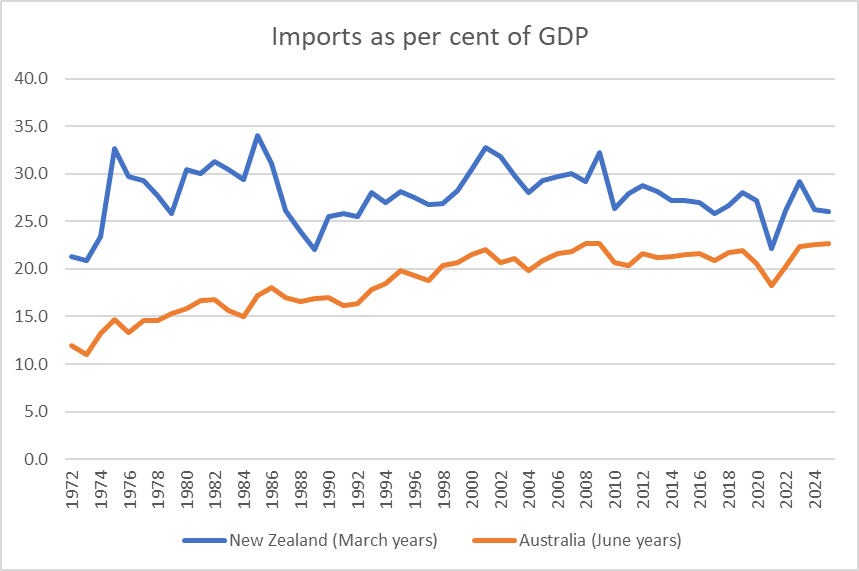
And, of course, from a New Zealand perspective don’t lose sight of the fact that as a share of GDDP both exports and imports are now well below the peaks, themselves well in the past. It isn’t exactly a marker of a successful economy. I’ve made this point numerous times before but I’ll say it again anyway: it isn’t that exports are special, simply that in successful economies it is usual for domestically-operating firms to find more and more opportunities to sell successfully in the rest of the world. You’d certainly expect to see it in any economy that was successfully closing the gaps to the rest of the world. Which New Zealand isn’t.
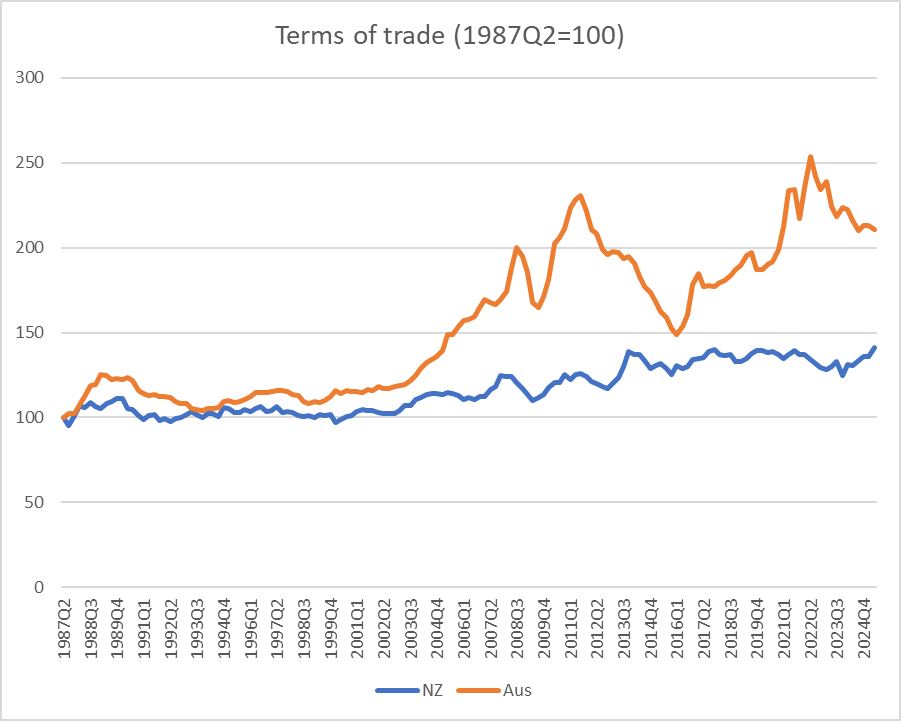
Export revenues result from the mix of price and volume. By wider advanced country standards our terms of trade have been pretty good in the last couple of decades. But Australia’s terms of trade (export prices relative to import prices) have been much more favourable – although also more variable. In the near-term, terms of trade for commodity exporting countries are largely outside their control, but over the longer-run firms presumably invest in anticipation of a particular view of future average selling prices.
What about export volumes? Using the constant price exports series for each country, here is how the volume of exports per capita has unfolded in the two countries this century.
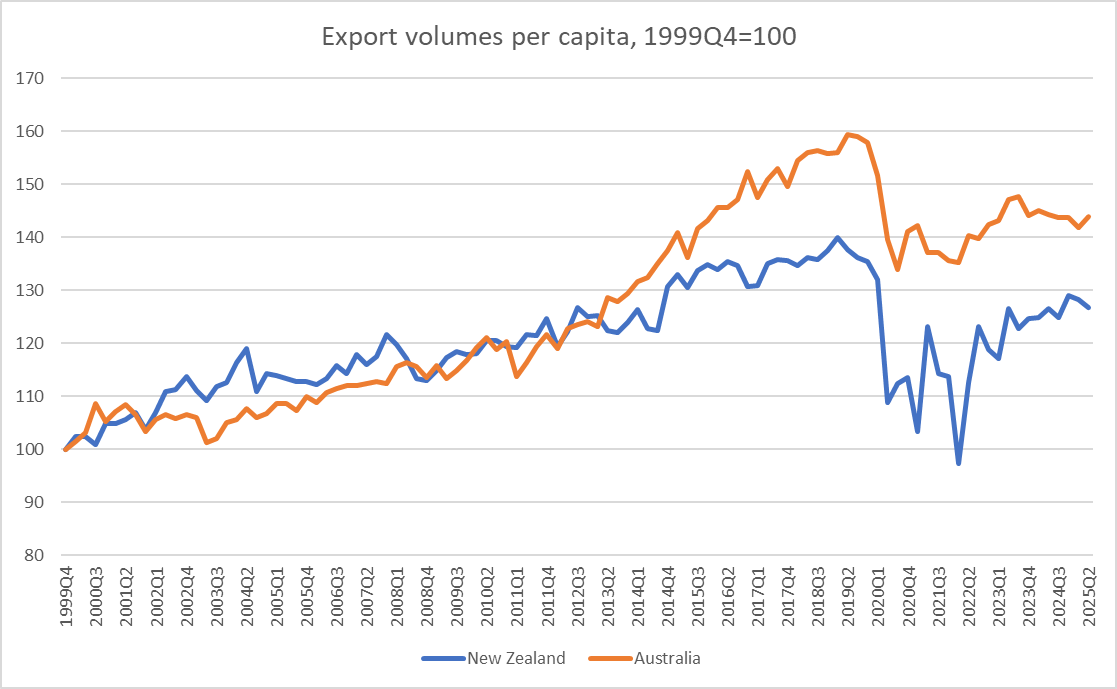
The two lines don’t materially diverge until the last decade or so,
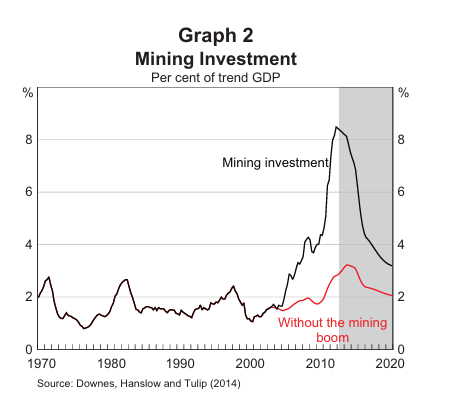
as the massive Australian mining investment boom translated into materially higher export volumes (and revenues). New Zealand simply had nothing similar.
One sobering snippet I took from that export volumes chart is that New Zealand export volumes per capita are no higher now than they were in 2012, 13 years ago now. As a share of GDP total export revenues are now at a level first reached in 1977.
But the other sobering snippet from that volumes chart is Australian export volumes per capita haven’t grown now for almost a decade (and so the gap between the New Zealand and Australian lines isn’t widening further). But then, as I noted already, Australia isn’t a stellar economic success story – and productivity growth there in the last decade has been next to non-existent – just richer and more successful than New Zealand, and the easy exit option for our people.
Both the New Zealand and Australian economies are very heavily reliant on natural resources for their exports to the rest of the world, and that shows little or no sign of changing. If, as the Australian economy did, firms can bring newly to market a huge swathe of natural resource exports things tend to go better for you, as a very remote economy, than if you can’t or don’t.
 croaking cassandra
Interesting and concerning
I would have thought our export earnings per head would have been higher B4 the UK joined the EU; weren’t we sometimes referred to as England’s off-shore farm?
Do you know if export revenues include tech; like ERoad and Xero (before it moved to the ASX)?
LikeLike
The first observations on my first chart were from just prior to the UK joining the EEC. Note that going back 100 yrs you find people writing about NZ having the highest exports per capita of any country (a combination of being one of the richest countries in the world and then a very small one).
Yes, exports is goods and services, which includes tech exports generated from physical NZ. That is standard national accounts practice but different, say, from how the annual TIN reports work (& generate v high tech numbers): they report all sales globally of NZ owned tech firms, whether or not that value-added results from NZ work/staff)
LikeLike