A few more bits from recent RB releases

There are still lots of outstanding questions around the sudden departure of the Reserve Bank Governor, and the handling of those events by the board and the Minister. But, even amid ongoing OIA obstructionism – the Bank simply ignoring the substance of specific requests, in a flagrantly illegal way – some more bits and pieces have emerged.

Back in April I lodged these requests
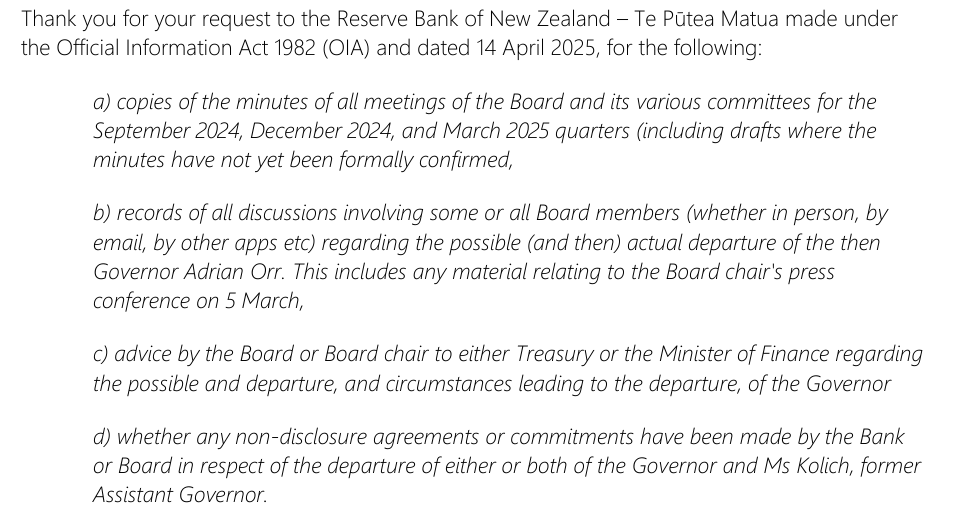
The Bank finally got round to responding on 30 June.

Of those, item a) wasn’t primarily about Orr’s departure (for unrelated reasons I wanted to see how their board committees work). Nonetheless, the response was interesting because although they sent me the committee minutes (with redactions), they didn’t even address the request for the minutes of actual Board meetings. As it happens, the Bank periodically (normally quarterly) releases rather limited and selective minutes of regularly scheduled Board meetings (you can find them here) and I’d lodged the request mostly because by 14 April they hadn’t released any for six months). They’ve since put up more recent ones. The Bank’s usual approach when someone requests something that is already on a website by the time the reply goes out is to point requesters to a link to those documents and then decline the specific request because the document is already publicly available (legitimate grounds for denial). This time, however, there is no mention in the response of the board minutes at all (only a mention that the committee minutes were attached, as they were).

This suggests an (illegal) effort to avoid addressing the specific request. One possible reason might be because it is almost certain that there will have been short-notice board meetings in and immediately around Orr’s resignation, which they don’t want to either acknowledge or disclose the records of. How could it have been otherwise? The Governor tells the board chair he’s thinking of resigning, and the Board does nothing, never meets, never authorises an exit package with gag agreements? Even for an apparently supine board like that of the Reserve Bank it seems very very unlikely. And when the Governor actually resigns – recall it was brought forward at the last minute by several days – there is no short notice Zoom board meeting to discuss what next? Yeah, right. (I’ll come back later to some interesting points in the minutes of the scheduled board meetings).

Another reason to believe that might be the explanation is the Bank’s response to my second item (above). This was it

That is a reference to the belated bulk release (available here), apparently designed to shape how we should think about Orr’s departure. But…..that response to my request by the Bank simply does not address my specific request, because the 11 June release contained precisely nothing about discussions among board members and nothing about the chair’s press conference later on the afternoon of Orr’s resignation (and nothing about any short-notice board meetings). Of course there will have been discussion among board members, and there might be even be some OIA grounds to withhold some of that specifically (in which cases such withholding needs to be justified specifically, item by item), but this response seeks to pretend answers have been provided when in fact the whole issue has been avoided.

Item d) of my request was overtaken by events. I was no longer particularly interested in Kolich’s departure (and the 11 June release suggested it was in train before Orr left), and the 11 June release did tell us there was an NDA with Orr (although we still have no idea what the nature of the gagging provisions were, or why they were imposed or accepted by the Board, or the Minister – you’ll recall from previous posts that a Governor’s resignation is addressed to the Minister not the Board).

But then there was item c) (above). There is a typo in the request, but the Bank seems to have understood it as intended (about possible and actual departure). This was their response
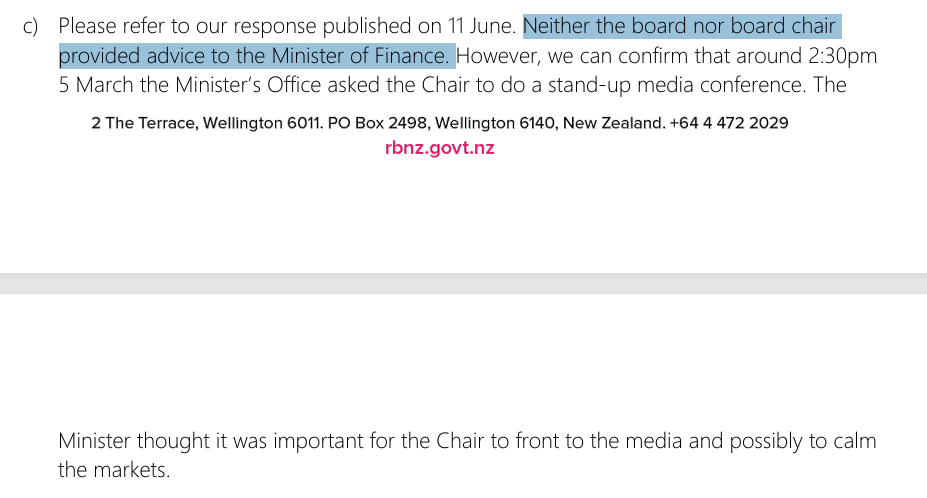
It is quite extraordinary really. Things had run so far off the rails that the Governor was first talking of resigning then actually planning to resign – partly, the 11 June release tells us, because effective future working relations were so impaired, in the context of the funding agreement disagreements – and neither the Board nor the Board chair initiated any (direct) contact with the Minister of Finance at all; no meetings, no texts, no calls, no written advice, no nothing. If true, and I guess we must assume it is so, it is extraordinary, and something of a dereliction of duty, given that the Board governs the Bank, monitors the Governor etc all on behalf of the Minister, who not only has general responsibility for the Bank but specific responsibility for hiring, firing, and (in this case) receiving a Governor’s resignation. (Other releases show that Quigley had alerted Iain Rennie to what was going on, who’d mentioned it to the Minister). I usually word such requests quite carefully to specifically include “or the minister’s office” and failed to do so this time. I guess it is possible they are hiding behind that and there was contact by Quigley and the Board with senior advisers to the Minister, but on this occasion I doubt that is so because of the final two sentences in that response. It was nice of them to tell me about that but since it was from the Minister, conveyed via her office, it wasn’t specifically within the scope of my request (but one is left wondering why it wasn’t disclosed in the 11 June release).

It just seems astonishing. And not least because of how the Board just seems to assume the freedom to negotiate gag orders with Orr, when a) his resignation had to be made to the Minister not to them, and b) when there would inevitably be intense public questioning and scrutiny of what was going on, and they were proposing even to tie the Minister’s hand without consulting her.

And then the only contact is the ill-judged (as it turned out) request from the Minister’s office for the Board chair to do a press conference. I don’t disagree that both the Board chair and the Minister owed us answers (which we still don’t have) but Quigley is singularly bad at fronting when dealing with challenging questions, and his responses in that press conference ended up raising more questions than answers, at times apparently actively misleading journalists and the public, all while there were no evident market ructions to calm. More questions for the Minister I guess: does she even now know the terms of the gagging agreements entered into? If not, why not? If so, how and why does she defend or justify them?

I noted earlier that the March quarter Board minutes (released on 18 June, conveniently after the 11 June release) had some interesting content (and some telling omissions).

There were records of two meetings. The first was on 27 February (which reports the Board approved minutes of a 14 February special meeting, minutes of which – not disclosed – were clearly within scope of my request). This was the meeting – we were told in the 11 June release – where things crystallised
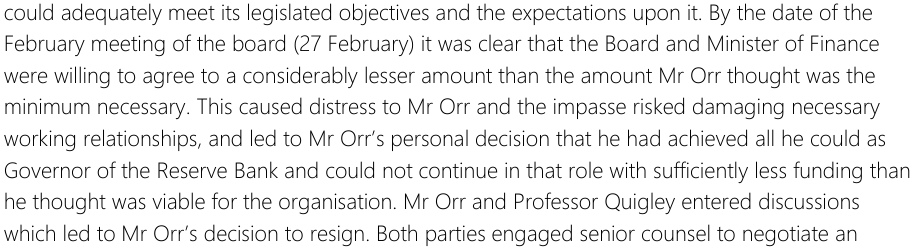
with the Board taking one view on the future Funding Agreement (bowing to reality) and the Governor refusing to do so. You have to imagine there was quite an extensive and tense discussion. But here is what the Board minutes have to say about discussion of the Funding Agreement and associated negotiations.

That’s right. Precisely nothing. And it is not as if some very sensitive material has been withheld on legitimate OIA grounds (hard to see what now that so much is a) finalised and b) in the public domain). It is just that there is no mention of the Funding Agreement in the 10 pages of minutes of a seven hour meeting.

It is extremely dubious, because it appears like an active effort to mislead readers (of these proactively released documents) and, unless there are secret shadow minutes, a breach of the Public Records Act, which requires public agencies to maintain proper records, including of such consequential meetings and discussions. It seems likely that much of the discussion will have occurred in item 6.2 “Board Only Time”, where nothing is disclosed (or withheld), although even then how plausible is it that all the discussion of the Funding Agreement, where there were major differences, occurred without any other senior management present (CFO or that person’s boss, or the Deputy Governor)? It really is a classic example of minutes theatre: it is good that the Board releases proactively what they do, but this example illustrates again just how selective (and thus dishonest) their approach is.

The next meeting for which they published minutes was on 27 March, three weeks after Orr had resigned. This time there is a short note that “The Five Year Funding Agreement negotiations have neared completion”. On this occasion there were quite a few interesting snippets.

The first was this
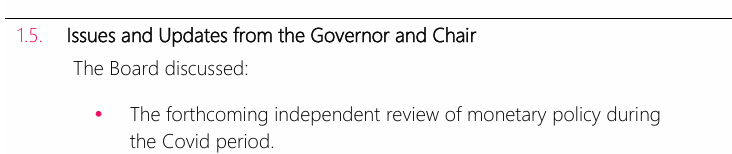
This one took me quite by surprise. When in Opposition, Willis used to promise an independent review pretty much as soon as she took office. Nothing had been heard of it since they did take office. Nothing else has found its way into the public domain since 27 March. What review then? Who will be conducting it? What will the terms of reference be? How does it fit with the Royal Commission which did a – poor, once-over-lightly, channelling officialdom – chapter on economic policy in its Stage 1 report? Who, if anyone, will be invited to submit? And (frankly) at this late date what really is the point – unless, I guess, it asks hard questions of Christian Hawkesby, assuming he has applied to be Governor, about his responsibility for the costly mistakes and bad calls (as deputy chief executive then responsible for macro and monetary policy). But I do hope some journalist with access to the Minister will ask about the review.

The second was more forward looking.
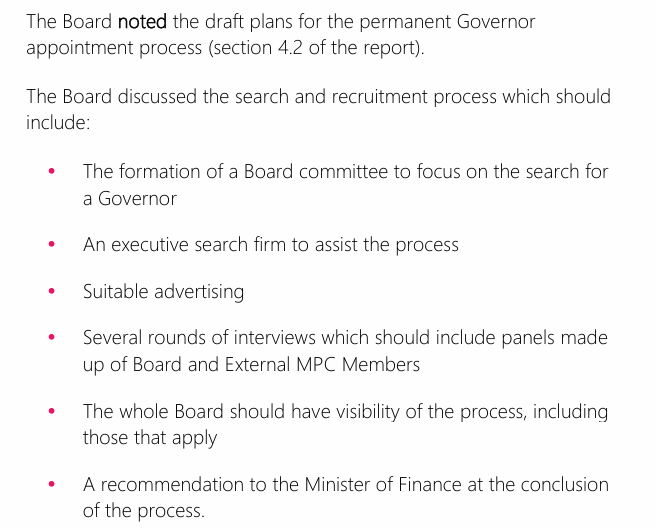
That sounds sensible enough, even if it remains egregious that Neil Quigley is driving the process, having been chair through the Orr years, policy failures, culture of excess, messy departure of the CE and all. But for some, still inexplicable, reason that appears not to bother the Minister.

One of my big concerns about the new governance structure created by the 2021 Act has been that the Board had major responsibilities around the appointment of MPC members, including the Governor, but members had little or no expertise or background to making those calls (including reviewing performance on monetary policy matters, something they are also charged with). Two things partly allay those concerns. The first is the appointment of a couple of new board members with an economics background: Professor Philip Vermeulen and the former Deputy Governor and chief economist Grant Spencer. And the second, at least in principle, is involving external MPC members in the interview process. I say “in principle” because of the three externals, one is 80 and coming to the end of six years on the MPC where he shares responsibility for the very costly mistakes and is not on record as having made any distinctive contribution, and another – Prasanna Gai – is thought in some circles to be interested in becoming Governor himself. It does rather narrow the value of such an external panel.

Note, however, that one of Bank’s main roles is bank (and related) supervision and regulation. The Bank’s policies there have been quite contentious – including apparently with the Minister – and yet there is no one on the board with a strong banking or banking regulation background other than Spencer, and he tended to be a status quo figure in his last decade in the Bank when responsible for those functions. It just isn’t obvious where the intellectual vigour and fresh perspectives will be coming from (and it is interesting that, contrary to the practice for many top public sector jobs these days, there is no suggestion of having a respected outsider or two on an interview panel).

It is difficult to be optimistic about the process. There are no obvious ideal candidates, and the Board remains led by the same chair who gave us Orr in the first place, appointed and reappointed. But……fingers crossed I guess.
Reserve Bank planned spending: 12% up on 2023/24

Yesterday’s post focused on the puzzling events around the adoption of last year’s Reserve Bank budget: the board planned to spend massively above what the Funding Agreement had allowed and for reasons still totally obscure neither Treasury nor the Minister of Finance raised any concerns whatever.

A few months ago now, after Orr had left the scene (with many questions still unanswered), a new Funding Agreement for 2025-30 was signed. I noted then that while the new spending allowances were well down on what the Bank had itself egregiously planned to spend in 2024/25, they didn’t appear to represent much of a cut at all relative to previously agreed levels (past Funding Agreement and 2023 variation), despite the huge increase in allowed spending that had been granted on the Orr-Quigley-Robertson watch. A few weeks ago – and only a day or two beyond the statutory deadline – the Bank released its Statement of Performance Expectations (SPE) for 2025/26. You’ll recall that, by law, the Minister (and hence Treasury) will have had a chance to provide comments on the draft.

The SPE contains the Bank’s budgets for 2025/26, and enables us to use some directly comparable numbers over time for total operating expenses. One of the sleights of hand in the new Funding Agreement was moving more items – some potentially quite significant – out of scope of those particular limits. It turns out that in the Bank’s 24/25 budget 13 per cent of operating spending was out of scope, while in their 25/26 budget, as reported in the SPE 24 per cent is.

It is fair to observe that the relationship between recent Reserve Bank budgets and actuals seems to have been surprisingly loose – Orr seems to have been unable to spend all the money that board allowed him when they set annual budgets – but for 2024/25 and 2025/26 budgets are all we have to go on. For 2024/25, the Minister was still happy to have used the budget numbers in her March Cabinet paper on the new Funding Agreement and we know (from that document) that there had been a big increase in actual staff numbers (FTE) between 30 June 2024 and 31 January 2025 (up about 10 per cent in 7 months), and staff expenses are by far the largest item of opex.

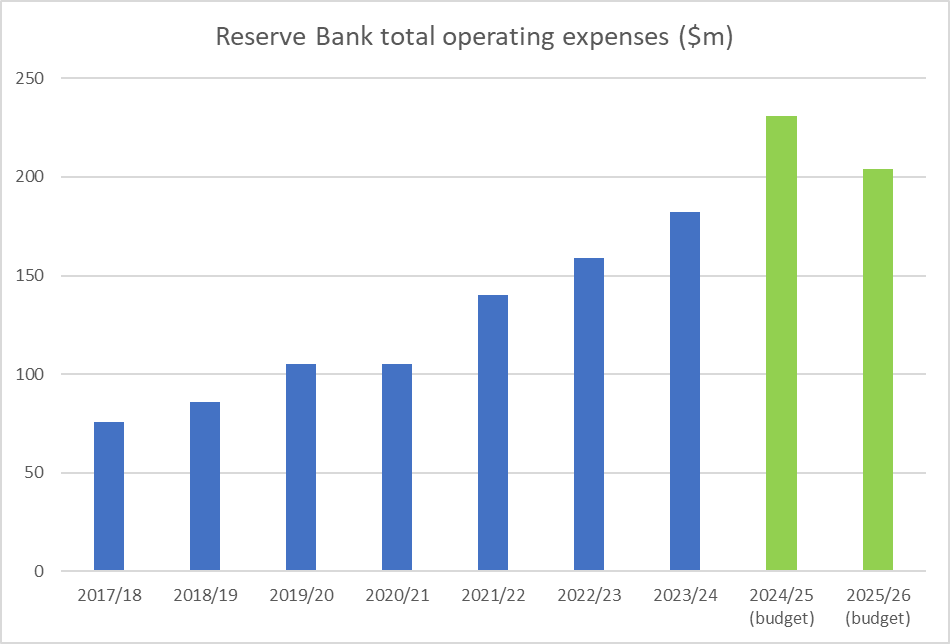
Anyway, here is the best chart I can put together, using Annual Reports for actuals and the SPE budget numbers for 2024/25 and 2025/26.

Since the Bank has been in full-on retrenchment mode in recent months (eg top management numbers have more than halved, and they’ve been reduced to laying off a quarter of their first and second year new graduates), it isn’t impossible that the 2024/25 actuals will come in a fair way below the budget adopted last June (although there will be unforecast redundancy costs).

But what really caught my attention was the budget for 2025/26. You’d have to think that, having been adopted only last month, with a Board chair and temporary Governor wanting to show how they’ve moved with the spirit of the times, these aren’t vapourware numbers, but the best hardnosed estimate of what the Bank expects operating expenses to be in 2025/26. That number is 12 per cent above actual operating expenses in 2023/24, the last year in which budgets were adopted under the previous government – the one the current Minister of Finance rightly and regularly attacked for extravagant levels of spending. 12 per cent above…..(this only becomes apparent now because it is only now that we can put hard numbers on how much spending was moved out of scope of the Funding Agreement limits, in a way that allowed the Minister to sell the extent of restraint as materially greater than it turns out to have been). How many other government agencies have budgets this year 12 per cent above levels of spending in 2023/24? Not many would be my bet. It is quite astonishing.

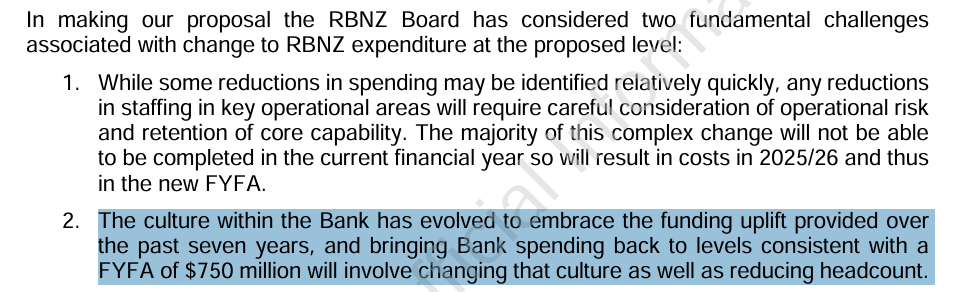
(Yesterday, I linked to someone else’s OIA published on the Bank’s website. It included this plaintive appeal to the Minister of Finance not to cut the funding agreements amounts further in a report dated 14 March

The Board chair owning up to the culture of excess that had developed over recent years. Who had been the board chair right through that period? Why, that would be Neil Quigley. Who is the board chair still today? Why, that is Neil Quigley. )

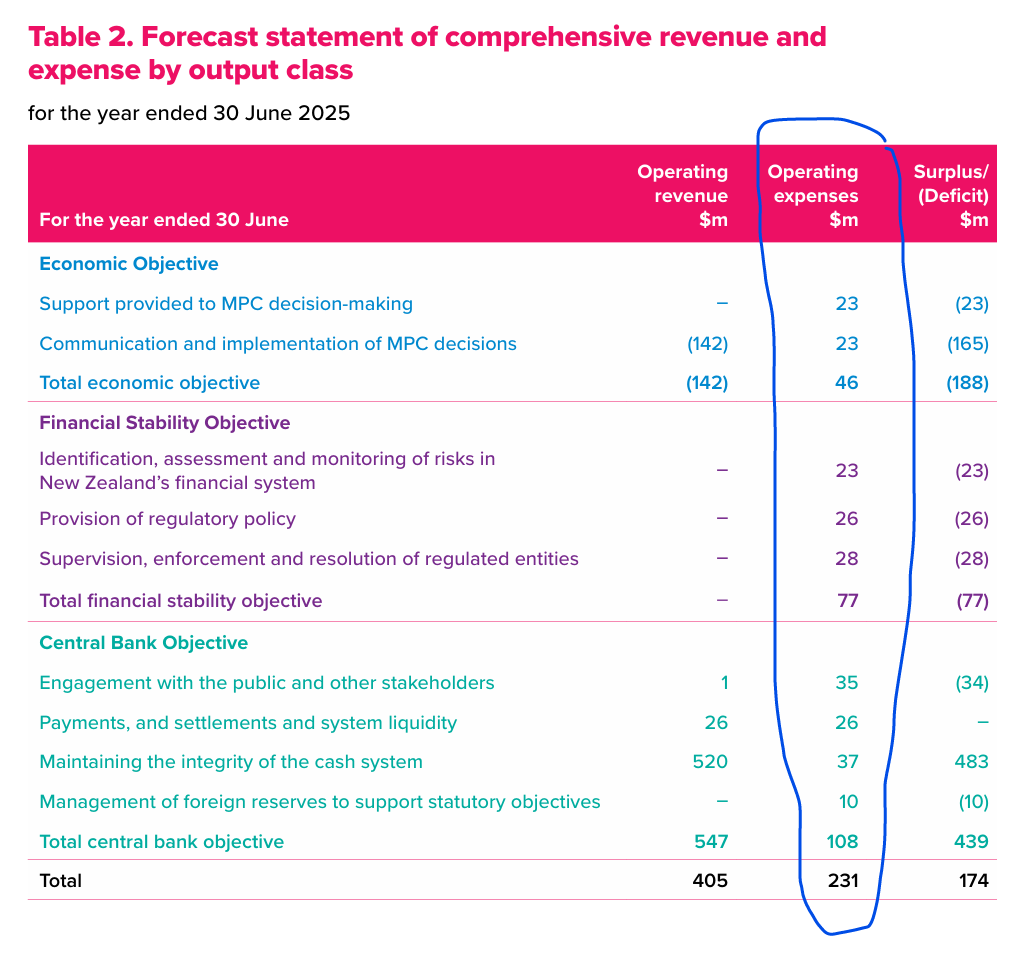
What of the rest of the Statement of Performance Expectations? It is very little use to anyone (I’d have thought). There is less of a breakdown of planned spending this year than last. This was from last year (bother only about the spending column)

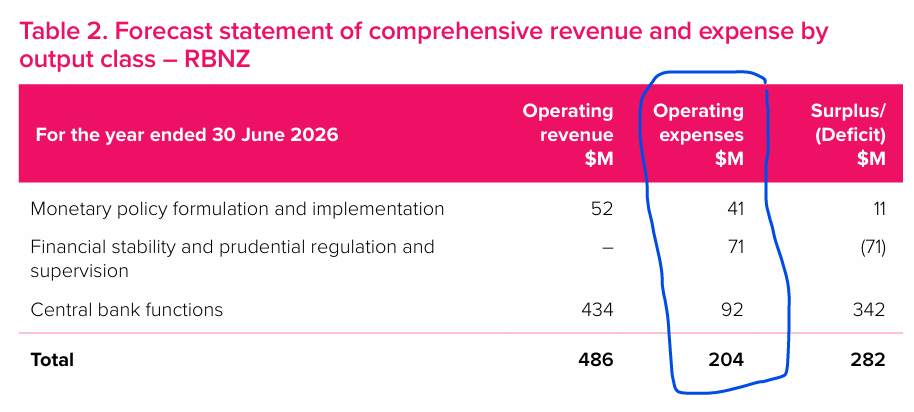
It raised several questions then (I had a post about the extraordinary $35 million of planned spending on “engagement with the public and other stakeholders”, which seemed so egregious that the truth surely couldn’t be quite as bad as it seems (but we have never any answers). This year, they’ve collapsed the categories so we get only this

With that utterly-meaningless “central bank functions” heading hiding almost everything that might be interesting.

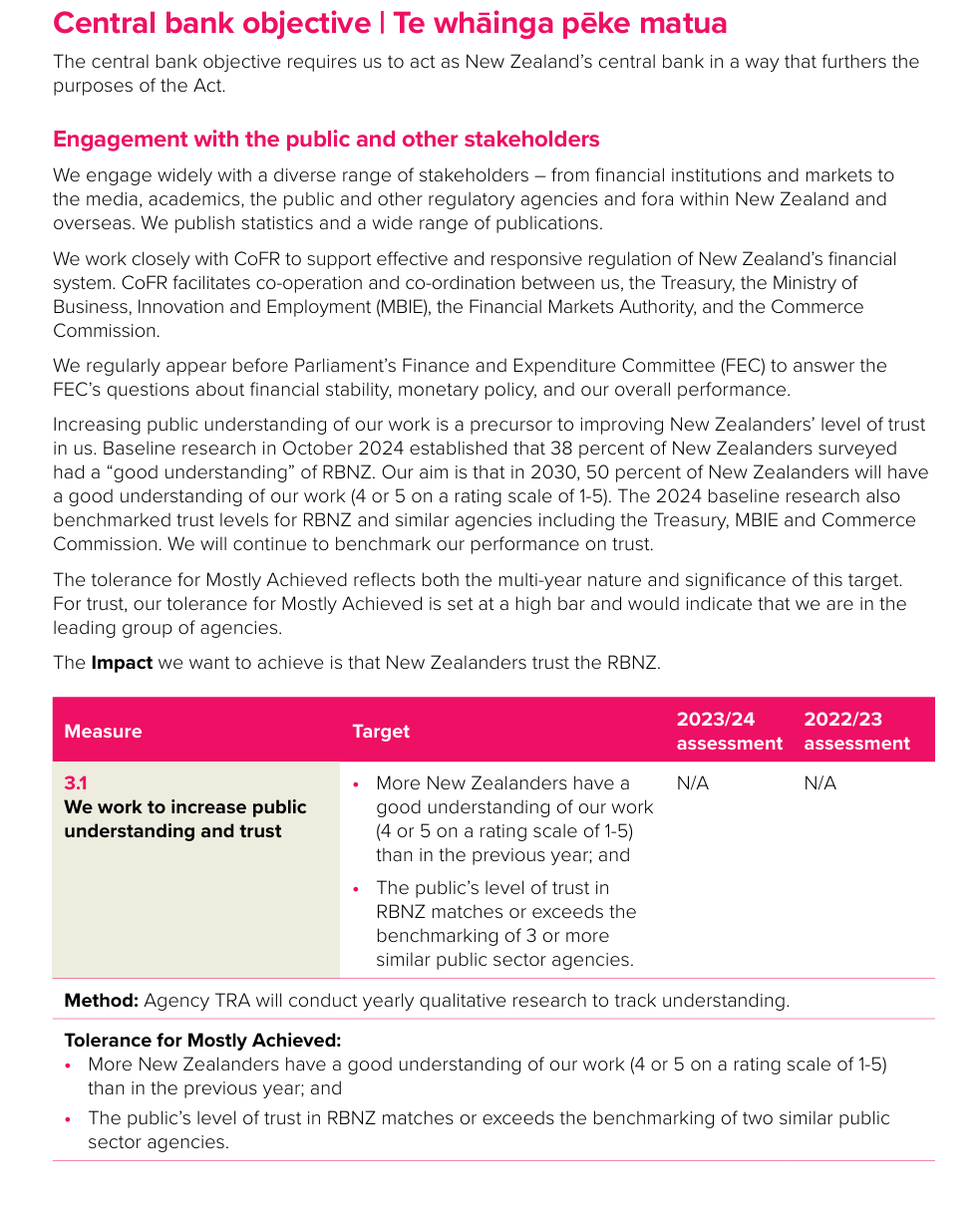
And then there is this (with no numbers at all)

After the six months the Bank has had (coming on the back of the last few years – $11bn of losses, worst outbreak of inflation in decades), you really wonder how they can write this stuff with a straight face. But I guess that is the sort of quality bureaucrats (and associated board members) are recruited for. Well-grounded trust usually requires a record of achievement or at very least a record of open and self-critical transparency when things don’t go so well. The Orr-Quigley-Hawkesby Reserve Bank is still failing on both counts. A Governor just disappears, with no notice and no explanation. Or recall all those unanswered questions in my recent post (let alone all the ongoing OIA obstructionism), and the inability to even give straight answers regarding the actual level of spending restraint when the Funding Agreement was released three months ago. (Note too the odd benchmark: while the Commerce Commission has some independent powers, Treasury and MBIE are simply ministries whose activities or advice are rarely directly visible to the general public in a way the Reserve Bank’s independent exercise of its powers is. They aren’t similar, and I don’t think “no worse than how the public thinks of (or trusts) Treasury” is really an adequate benchmark at all.)

What were the Minister and Treasury doing?

Four weeks ago I noted that I was going to be tied up for the following couple of weeks. Between a busy trip to Papua New Guinea, the extremely dubious governance of the Reserve Bank superannuation scheme, various family members coming to stay, and a health relapse all that turned into a rather longer break from the blog than I’d expected/intended. But in that time, several interesting responses to Official Information Act requests turned up.

My last post was 41 Questions, in reference to the many questions still unanswered by the Minister of Finance, the Reserve Bank board, Neil Quigley (the Board chair), the temporary Governor, and The Treasury about the events surrounding that sudden departure in early March of Adrian Orr as Governor of the Reserve Bank.

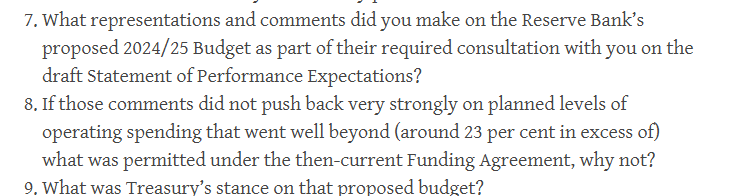
A few of those questions (around one particular set of events) have now been answered, and the answers leave everyone involved in a poor light. These were a few of the questions from that earlier post that I thought the Minister of Finance owed us answers on.

The short answer (developed in the rest of the post) is that the documents show that neither the Minister of Finance nor The Treasury raised any concerns at all about the Bank’s plans to substantially increase operating spending last year, to levels far above what was permitted in the (Labour government’s) Funding Agreement. It is really quite extraordinary.

But lets go back to the beginning.

As a reminder, the Reserve Bank operates under a Funding Agreement reached every few years with the Minister of Finance. Quite a few classes of spending are excluded from the Agreement, and there is no external limit on what the Bank spends on those items, but around 85 per cent of the operating expenses were within the scope of the agreement in place last year.

When the Reserve Bank’s Board was approving the budget for 2024/25 – around the time of the government’s first Budget, where much was made of expenditure restraints (and cuts) for most core government departments – the Reserve Bank was operating under a Funding Agreement for 2020-2025 agreed with Grant Robertson in 2020, with amendments (the most recent, providing for a large increase in operating spending for the final two years, signed off shortly before the 2023 election).

Under that amendment, the Minister and Bank agreed on how much the Bank could spend on (within scope) operating expenses in the year ending 30 June 2025.

This was a very marked increase from the $118.3 million originally provided for 2024/25 in the 2020 Agreement.

Both the agreement and the Act are quite clear that these are limits for the financial year concerned. The agreement is not structured to provide for (and the Act does not envisage) a five yearly total within which the annual numbers are merely indicative.

There are two caveats. First, the 2020 Agreement had provided a separate category for spending on direct currency issuance expenses (a sensible provision because you wouldn’t want the Reserve Bank stinting on a functioning currency system to pursue some other whims). For 2024/25, this allowance was $14.5 million. However, by 2023 it was apparent that the Bank was needing to spend a bit less than expected on currency issuance, and so the Minister had agreed that for 2023/24 and 2024/25 the Bank could utilise any underspend on this item for general (in-scope) operating expenses. The Bank thus had ministerial approval to spend up to about $154.4 million in 2024/25 on general (within-scope) operating expenses.

The second caveat was this (from the 2020 Agreement)

Budgeting five years in advance is hard (like the Bank – as disclosed in recent papers – I think the Funding Agreement approach is not really fit for purpose and should be replaced; useful as it was transitionally 35 years ago). This provision recognised that in any one year the Bank’s actual spending might go over the Funding Agreement limit. It put the onus on the Bank – and the Board after new law came into effect in 2022 – to offset any one year’s excess with savings in subsequent years.

The Board sets operating budgets for the Bank. You would expect that those budgets would be in line with the Funding Agreement amounts – and two Board members (the chair and the Governor) had signed that 2023 amendment – but there are no direct or immediate consequences if either budgets or actual spending aren’t in line with the Funding Agreement. That is one of the real weaknesses of the system.

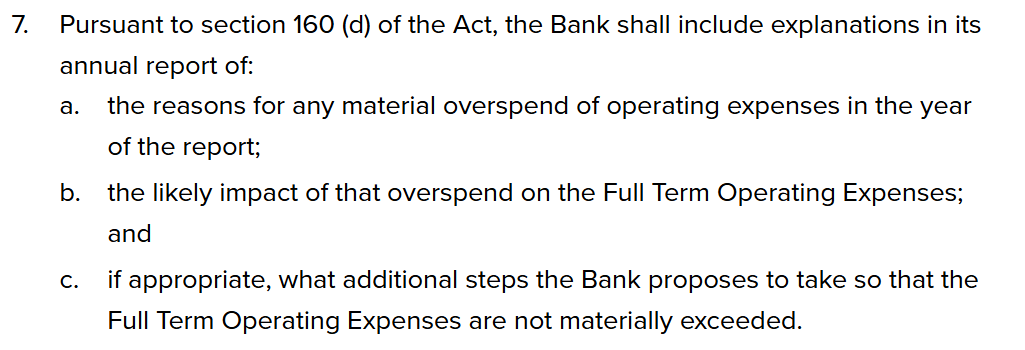
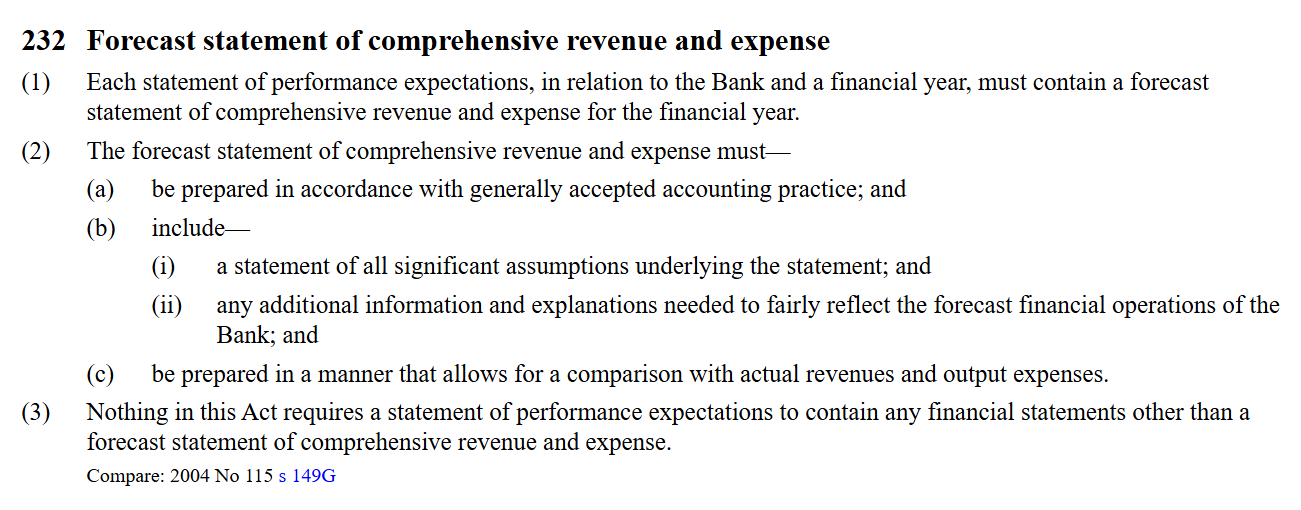
But, weak as the system is, we (the public) weren’t supposed to be left unprotected. After all, in the 2021 amendments to the Reserve Bank Act a stronger responsibility was assigned to Treasury to monitor the Reserve Bank and act as adviser to the Minister of Finance on things involving the Bank. And then there was the Minister herself. Flawed as a five-yearly Funding Agreement (with amendments) model might be, these days the Reserve Bank is required to produce a Statement of Performance Expectations each year. The relevant clause of the Act reads well.

and, yes, the financial dimension is included

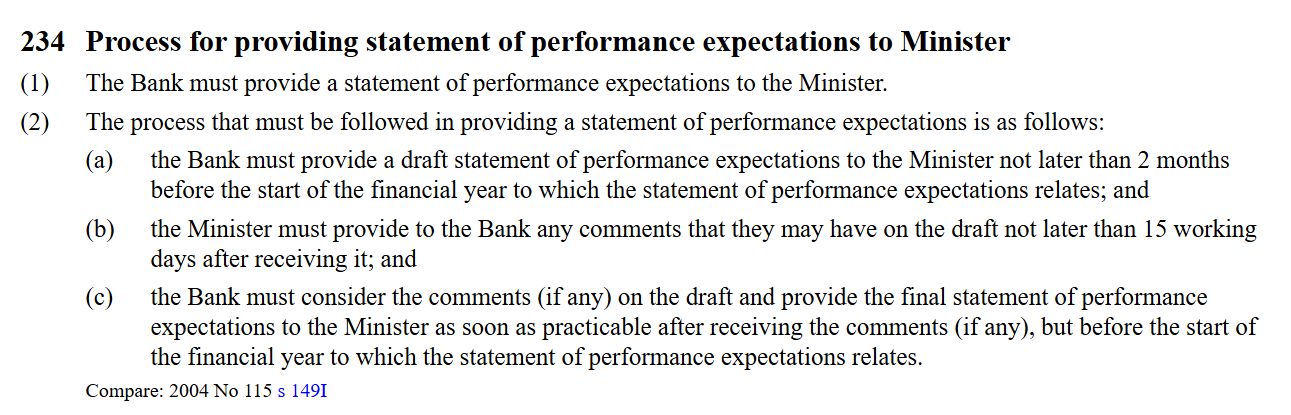
and the draft needs to be with the Minister well before the finished document has to be finalised and published.

We know, from the final published Statement of Performance Expectations, that the Bank budgeted for total operating expenses in 2024/25 of $231 million. That was well up on the previous year’s budget (and on the biggest discretionary item – personnel expenses – the budgeted increase was 21 per cent, this in the first full year of a new government emphasising spending restraint).

The published Statement of Performance Expectations does not provide numbers that enable direct comparisons with the Funding Agreement limits (surely a weakness in the statutory provisions?) but material released subsequently show that of the $231 million, $200 million was on items covered by the Funding Agreement (around $9 million on currency expenses and around $191 million on the core within-scope operating expenses). Recall, that the 2023 Funding Agreement amendment allowed them to spend about $154.4 million on those core within-scope operating expenses in 2024/25. The final published budget was thus consistent with spending around 23 per cent in excess of what was provided for in the Funding Agreement.

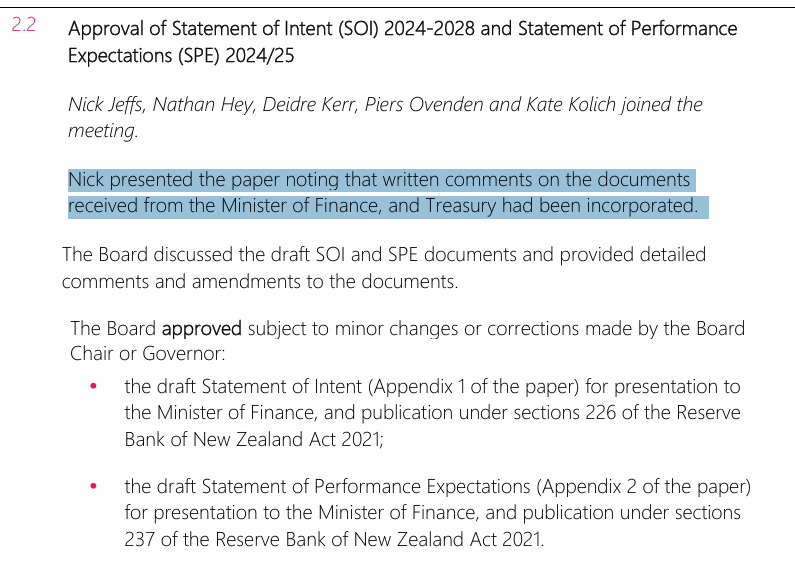
In recent years – since the Board became the primary governing body – the Bank has been published partial (and limited) minutes of meetings of the Board. We know from the June 2024 minutes that the Bank had received and incorporated comments on the draft Statement of Performance Expectations from the Minister of Finance and Treasury.

The mystery then was how such a huge blowout in operating spending had happened despite the input of the Minister and Treasury. So I asked the Bank for copies of those comments (as part of a request for several other items that, three months on, they have still not responded to). Their response was to tell me that the comments had actually been released in October last year, as part of a very long document for a standard Treasury pro-active release. The relevant pages are here as a standalone document.

MOF and Treasury comments on RBNZ draft Statement of Performance Expectations for year ending 30 June 2025

These documents are Treasury advice to the Minister and a proposed letter from the Minister to the Board chair (which is, presumably, the version that was sent, since what I’d asked for was what the Bank received).   There is simply nothing in the documents (even considering redactions) even mentioning the overall proposed level of spending, let alone highlighting the inconsistency with the Funding Agreement, or raising concerns.  Nothing.

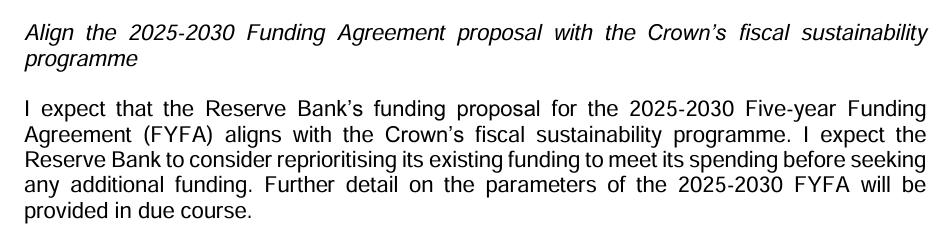
It is difficult to decide who is more culpable here, Treasury or the Minister.  The Minister should be able to rely on hardnosed Treasury advice on such things.  And, after all, Treasury had been involved in the previous Funding Agreement increase only nine months or so earlier, it had been fully involved in the spending cuts for agencies in the 2024 Budget, and had been involved the April 2024 Letter of Expectation sent by the Minister of Finance to the Bank’s board, which included this.

You’d think that a Treasury doing its job – in fact, a Treasury even half awake – would recognise that a big increase in spending in the last year of the old Funding Agreement, well in excess of what was allowed for that year in the Funding Agreement, was a glaring “red flag” and should be called out in no uncertain terms. Neither they nor the Minister had the power to override the Board and compel a lower budget, but they could have put a great deal of pressure on, including threatening to call out excess in public. Instead, it seems that they did nothing at all. Nothing.

At very least they might have made the point that consideration of the next Funding Agreement would start from a baseline of what had been allowed in the previous agreement and that it would be quite unacceptable for the Bank (as it went on to do) to bid for the next five years’ spending from a starting point so far in excess of what the Bank was allowed to spend in 2024/25.

And what of the Minister of Finance? If she is entitled to expect hard-nosed advice from The Treasury, highlighting all the relevant issues and risks, and giving her both recommendations and choices as to how she deals with the Bank, what on earth was she thinking herself, and what was going on with the political advisers in her office, who are there partly to protect her interests when bureaucrats aren’t doing their job? Willis, and (surely) her own advisers, had long been sceptical of Orr. They’d rightly highlighted in public some of the spending excesses undertaken by the Bank under Labour’s watch. Did it never occur to them to check what percentage change in operating spending the Bank was proposing, or to check how that spending compared to the Funding Agreement, or to line up the Bank’s plans with the spending limits Willis was imposing on most departments? If any of it ever occurred to them – and it would have been easy to go back to Treasury and get them to follow up – there is not the slightest sign of it.

It is quite an astonishing lapse (or choice) by a very senior minister, in a climate of (purported) fiscal restraint. And if the Reserve Bank isn’t the biggest spending agency (by far), the old mantra about looking after the pennies and the pounds will take care of themselves still has something going for it, including in inculcating in government entities a culture of frugal restraint. Willis let the mad Reserve Bank spending binge run on for a whole additional year, and in addition to the resulting sheer waste of taxpayer money, and the demonstrated capacity for the Bank to simply ignore (or twist) the Funding Agreement, the result was also lives badly disrupted. The Bank carried right on substantially increasing staff numbers in 2024/25, drawing people away from other jobs, only for many now to be losing their jobs (and if we needn’t sympathise even slightly with Orr’s senior managers now departed, think of the new graduates just starting out being laid off, and many others in between). Large scale restructurings are wrenching, dislocating, and hard on people innocently caught up in them at the best of times.

It is easy to blame Adrian Orr in all of this, and I’m sure he deserves his fair share. None of the excess would have occurred without him. But the Governor is not the governing body of the Reserve Bank any longer: the Board is. And who is supposed to act as monitors and checks on the board – when they let themselves be carried away by the ambitions of an over-mighty Governor, and thus simply fail to do their job? Why, that would The Treasury – premier economic advisers to the government – and the Minister of Finance, the person accountable to Parliament (and thus voters) for the Bank and both its policies and (in this case) its use or abuse of public resources.

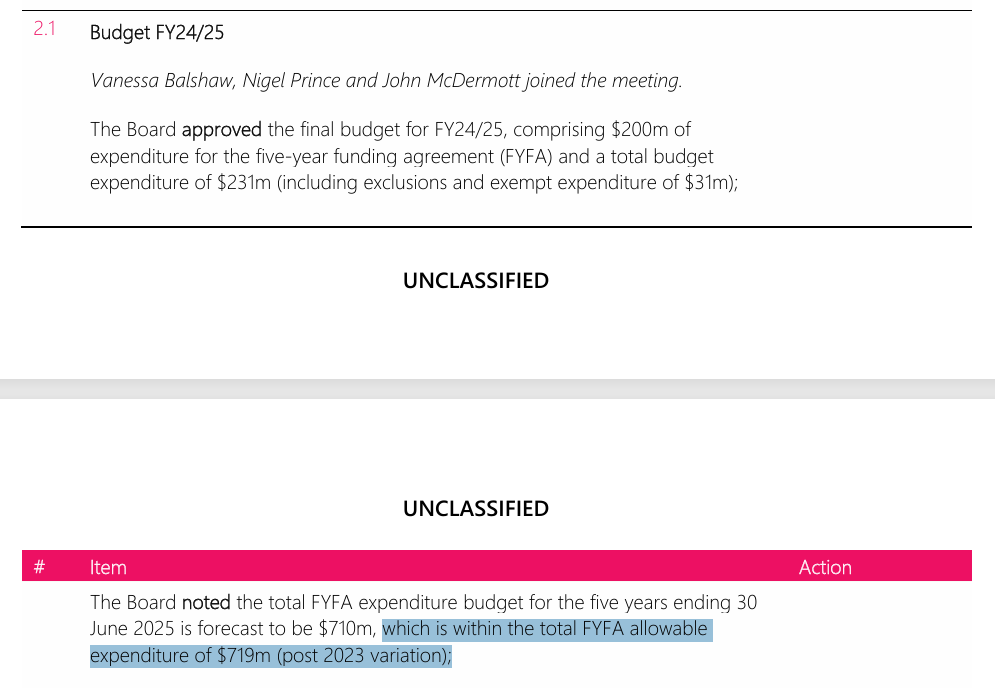
I had wondered for a while how even a useless underqualified board, apparently in the Governor’s pocket, as the 2024 Reserve Bank board seems to have been, could have thought it appropriate or right to increase spending so much last year, so much in excess of the Funding Agreement limit. There isn’t an obvious or easy answer to that, but the Board minutes suggest they thought – and presumably were told by management – that it was all just fine. This is also from the June 2024 Board meeting minutes

Somehow, even though the Funding Agreement is very clear about annual limits, they talked themselves into believing that somehow any past underspends could be used for a final splurge in the last year. It is hard to believe that anyone of honesty and integrity could have reached a conclusion that that was either a) possible, or b) right. No doubt they would have been pointed to that extract from the 2020 agreement about what happens if the Bank overspent in any early year of Funding Agreement. But not only is there nothing in that section suggesting underspends could be saved up and spent later but (and importantly) a) spending for the first three years of the agreement was already water in the bridge by the time Grant Robertson reset approved spending levels in August 2023 for the last two years of the agreement (had he wanted them to spend even more in 23/24 and 24/25 presumably he’d have set the annual allowances even higher, b) did no one on the Board stop to think how disruptive it would be to massively increase spending and staff numbers in the final year, with no assurance that such artificially high spending levels and staff numbers would be approved for future years (it wasn’t as if the sharp increase was a specific one-off project), when c) the Minister – see letter of expectation – had already highlighted the need for fiscal restraint in approaching the new Funding Agreement negotiations.

We can only conclude that either the Board was asleep at the wheel (paying no attention no matter Orr was doing) or – more likely in my view, given the bid for the 2025/30 Funding Agreement that the Board approved a little later last year – Orr persuaded them to go along with some reckless double or quits strategy: spend up large now, get a bigger empire, and then hope we can persuade the Minister to reset the new baseline level of spending not off the previous Funding Agreement starting point, but from the (hugely in excess) Bank-determined level of planned spending for 2024/25. Either way, you wonder how they thought they were serving the public interest, or how they have had the gall to claim their fees.

Perhaps even more surprising then is that just a couple of weeks ago, the Minister of Finance – having reappointed Quigley last June for a final two year term as chair – reappointed yet another of the existing Board members, Byron Pepper, for a full five year term (while leaving another board vacancy unfilled). There is not the slightest evidence in any of the minutes that Pepper had ever (a) dissented on the reappointment of Orr, or b) dissented on the Funding Agreement blowing 2024/25 budget, or c) dissented on the 2025/30 Funding Agreement bid. And yet, such it seems is the New Zealand way, he is rolled over for a full five year term, and now chairs the Board’s Financial Stability Oversight Committee. You’d at least hope he’d be demanding evidence of better standards of governance from the institutions the Bank regulates/supervises that he displays in participating in the governance of the Reserve Bank.

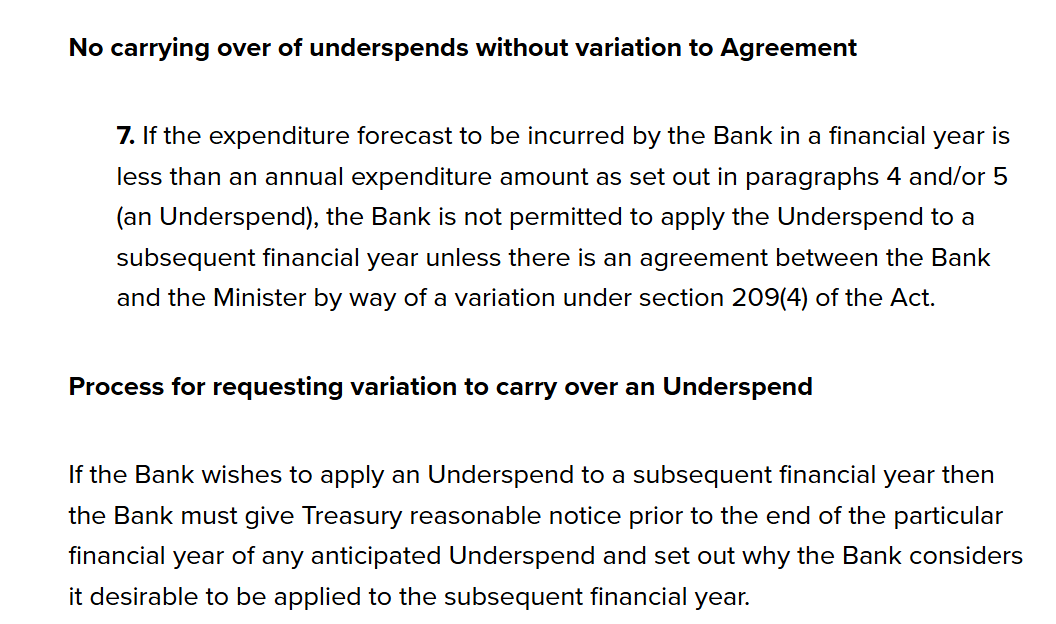
(As it happens, the “carry forward underspends” point is explicitly clarified in the new 2025-30 Funding Agreement which states

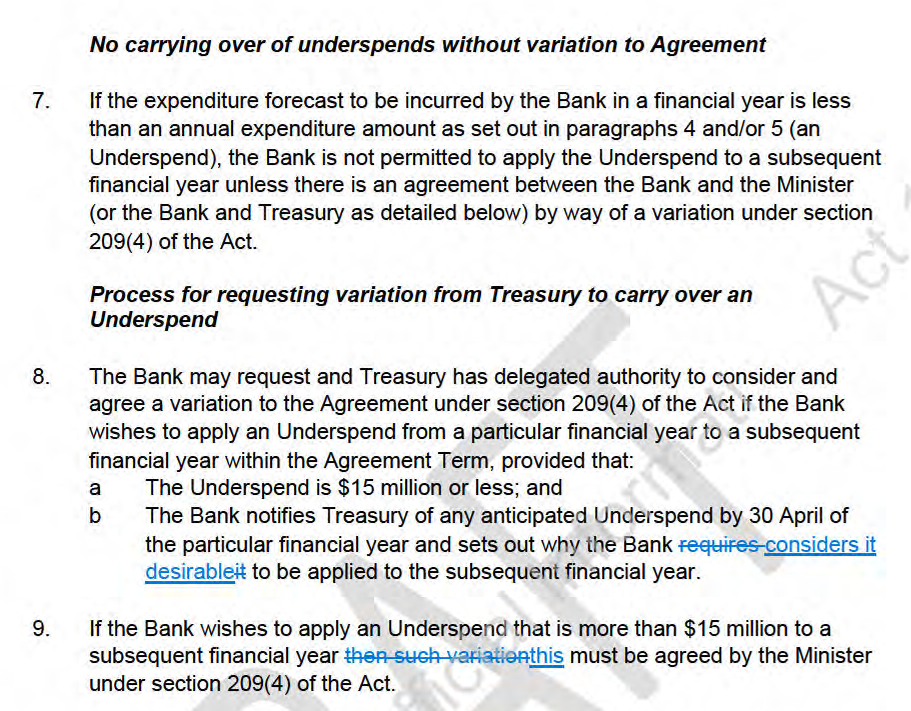
That seems sensible, making explicit what was always really the law – variations were allowed, and happened as in 2023. But is interesting that right to the end, the Bank was still championing a looser model. On their website I noticed someone else’s OIA which included a late draft of the 2025-30 Funding Agreement sent by the Bank to the Minister of Finance on 14 March (after Orr’s departure)

Presumably the Minister said no to giving that sort of leeway to Treasury. Rightly so, but where was she in pushing back on excess last year, or holding to account those – eg Board members – who nodded through the last mad wave of spending excess?)

UPDATE 17/7

Had the Bank been at all interested in transparency etc no doubt I’d already have had a response to this follow-up OIA. I expect to wait at least 20 working days.