Following on from my post yesterday, two of the key players in the story (one of whom is keen to minimise her role) faced questions.
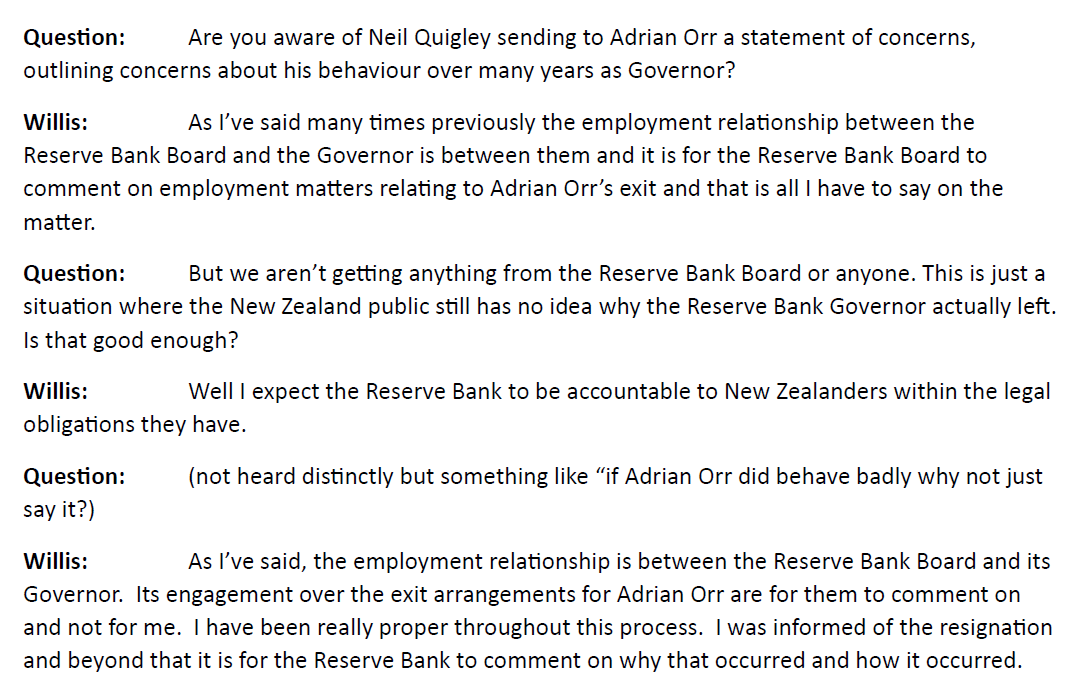
The first was the Minister of Finance who was questioned by a number of journalists before going into Parliament’s debating chamber early yesterday afternoon. The Herald posted the audio, and I’ve made a transcription here.
Comments by Nicola Willis on Adrian Orr departure Transcript of 22 July comments
Ever since the announcement of Orr’s resignation on 5 March, when he departed with no notice on the very eve of a major international conference he’d been quite ebullient about planning to host, the Minister of Finance has attempted to distance herself from it all.
At times she has asked us to believe that she didn’t actually know any more than we did about why Orr resigned (“I have always been able to speculate” was one of her early lines), which can really only be true if she let it be known to The Treasury and the board chair that she did not want to know, and if Orr himself gave no reasons in the letter of resignation which he had (by law) to have addressed to her (I have asked for a copy of that letter and of any reply). What responsible Minister of Finance, advised by the Secretary to the Treasury (in turn advised by the board chair, Quigley) that Orr had indicated he would resign would not ask (a) why, and b) seek out details of when and on what terms? A resignation with three months notice might be a very different matter (including in terms of temporary replacements etc) than leaving with no notice at all. Someone tired and wanting to retire to his farm very different from someone going following a scandal about to be revealed or an irrevocable breakdown of trust. No one can seriously believe that she didn’t know (even if what paper trail we actually have is thin at best).
The thrust of Willis’s comments yesterday was, again, that it was nothing to do with her and all a matter for the Bank’s Board. That is playing fast and loose with the law.
As a reminder, the Board does not appoint the Governor. The Minister (via Cabinet and the Governor-General) does, albeit she can only appoint someone the Board recommends. The Minister is the only person who can fire the Governor. The Board members are all appointed by the Minister and are, by law, accountable to her for the performance of their duties. Board members can only be dismissed for just cause, but the board chair is not only appointed by the Minister but can be removed by her at will (no substantive cause required although she has to consult the person before dismissing them). Resignations of a Governor are made, again by law, to the Minister of Finance. The Board does not even get to set the Governor’s pay (that is a matter for the Remuneration Authority) although it does get to set the other terms and conditions of employment (presumably including standard resignation and notice provisions in the Governor’s contract).
I noted that only the Minister could fire the Governor (and only for, statutorily identified, ‘just cause’, which doesn’t include policy disputes). The Board has a responsibility to monitor the Governor’s performance and is obliged by law to report to the Minister if they think there is just cause for the removal of the Governor (a couple of grounds – re obstructing the Board – can only be used by the Minister if there is a positive recommendation to act from the Board). They simply do not hire or fire the Governor, notwithstanding the Minister’s attempts to influence the general sense otherwise. The Governor is the Minister’s responsibility. Which is as it should be given (a) how much power Governors wield, and b) that only the Minister is accountable to Parliament and the public.
Instead we get stuff like this (which probably captures the flavour of the rest)
Or
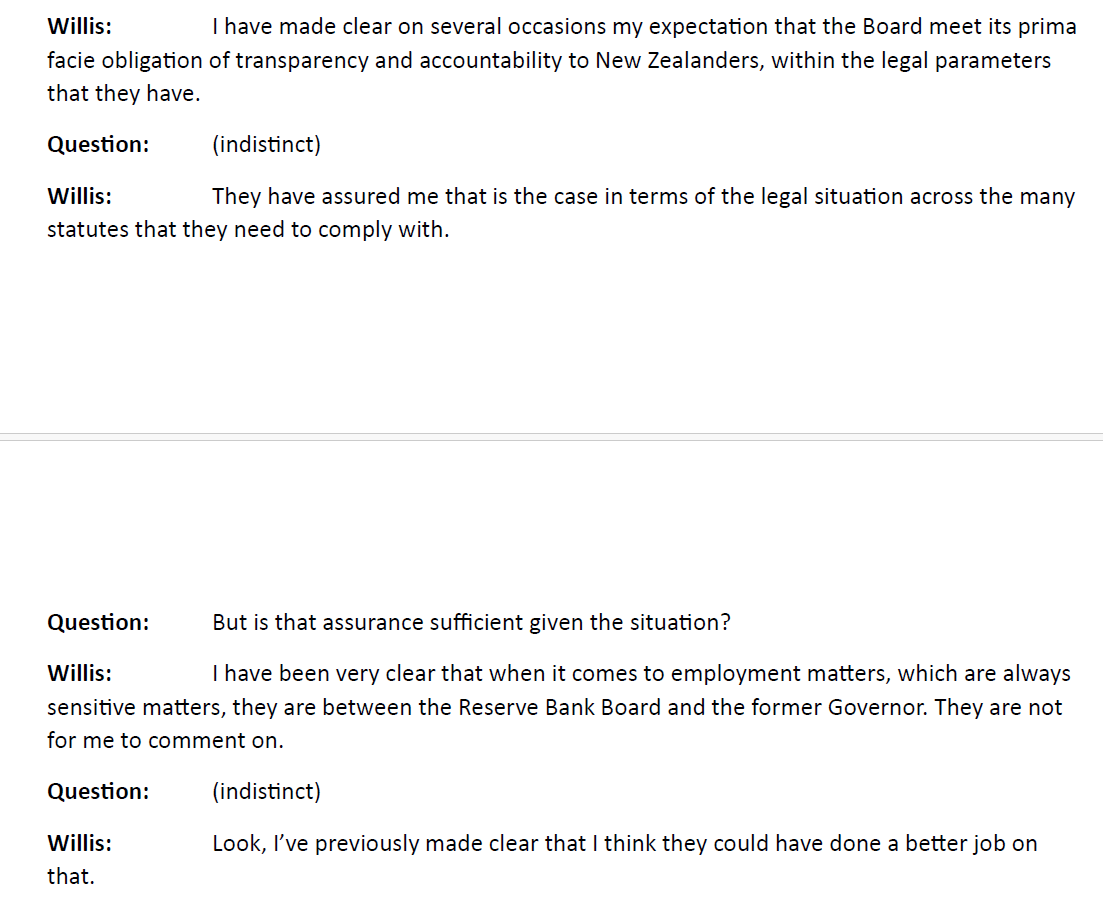
The Board chair serves at your pleasure Minister. If the Board is not being adequately transparent with, and accountable to, New Zealanders, and you do nothing about the chair, that responsibility is on you.
And note that rather than answer the very final question about the non-disclosure agreement apparently signed with Orr – the terms of which we also don’t know – Willis simply walked away.
In an earlier post, I identified a substantial list of questions for Willis. None of them has yet been answered. All remain germane to understanding what happened, and the context for what happened.
I’m almost inclined to wonder if there is not yet one more final layer behind the story in yesterday’s post. Why is the Minister so determined to try to convince us it is all nothing to do with her, when a powerful senior official appointed by the Minister of Finance, dismissable only by her, suddenly ups and leaves with no notice (but several weeks of pay nonetheless)?
The second interview yesterday was one Heather du Plessis-Allan did with board chair Neil Quigley. You might wonder how she got him on her show, given his usual reluctance to engage with journalists on Bank matters, but apparently he wanted to be heard in defence of his medical school, and that provided the opening for questions on Reserve Bank stuff. The audio is here (starting about 4 minutes in) and my transcription is here
Transcript of Heather du Plessis interview with Neil Quigley 22 July 2025
I hadn’t previously noticed that the 2021 Reserve Bank Act now requires the Board to operate “in a manner consistent with the spirit of service to the public” (that Peter Hughes phrase that is supposed to guide all the doings of the public sector as a whole). I’d be surprised if anyone thinks that the Board’s approach since lunchtime on 5 March has shown any resemblance to being “consistent with the spirit of service to the public at all” (and probably not in the days prior when they appear to have, with the Minister’s acquiescence or not, signed up to a gag agreement with Orr to protect them, Orr, perhaps the Minister (or all three) but definitely not the public). Quigley last night was in his usual poor form, obstructive, misleading, and still defending the claim that it was just a “personal decision”.
Since it was such a good quote from Luke Malpass, it is a shame not to use it again
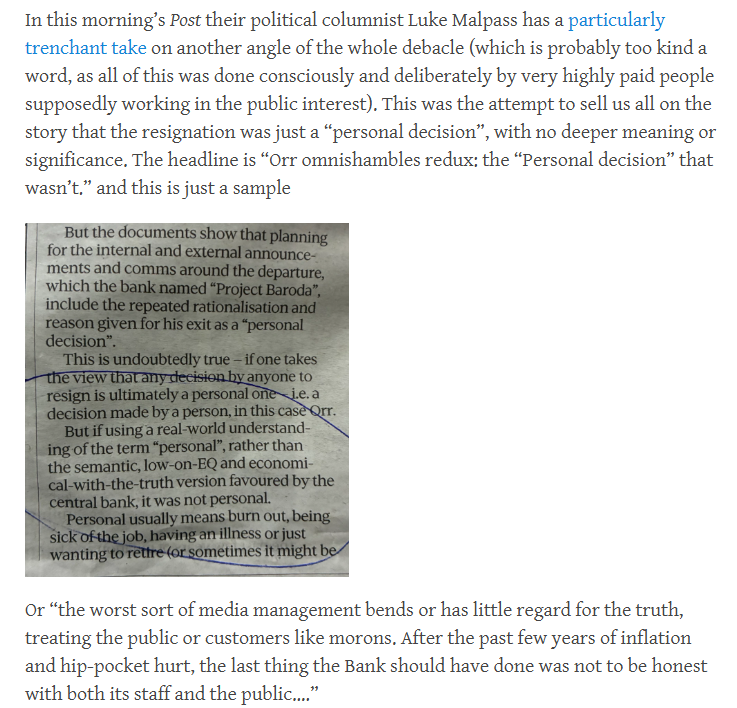
In this particular interview, Quigley spends some time trying to convince the interviewer that there is a material difference between saying that a departure was a “personal decision” (his actual words on 5 March) and saying that it was “for personal reasons”. It is angels-on-the-head-of-a-pin in this context.
In the interview, faced with repeated questions about claims reported in yesterday’s post, Quigley refused to say anything. He refused to say whether Orr had sworn in a meeting with Treasury on 21 February. He refused to say whether Orr had sworn at a meeting with Minister and Treasury on 24 February (he was at both meetings). He refused to say whether he’d sent an email to Orr three days later with the catalogue of conduct/behavioural issues. He attempts to justify his silence on some pretend right that Orr has to privacy, but of course by refusing to comment he confirms the essential truth of the claims. Had they been materially false, sure it was his obligation – having been directly involved or witness to all three, and as chair of the Board – to have refuted the claims in the strongest terms (quite possibly having a go at me as well, as gullible or worse) precisely to protect the former Governor. If none of this happened, surely Orr too would want us to know, lest we think worse of him than he really deserves.
Quigley’s other line was that all this was covered by “an Official Information Act request” (there were actually multiple requests)

This is simply nonsense. The Bank’s 11 June pro-active release covers nothing at all about the meetings on 21 or 24 February, nothing at all about the Board’s deliberations or communications with Orr, nothing about the substance of gag orders (or why they ever made), and nothing (of course) about the (claimed) 27 February email. In addition, the Bank has chosen simply to ignore (not to decline with specific reasons) whole categories of inquiry that made up those Official Information Act requests. What is truer is another a line he used which is basically that we said all we are going to say on 11 June, and tough luck on anything else. Which doesn’t seem like either the “spirit of service” or any sort of spirit of compliance with the Official Information Act itself. We shall one day – perhaps next year, perhaps the following one – what the Ombudsman makes of the defiance of the law.
The final aspect of Quigley’s specific comments I wanted to touch on was the convoluted round-in-circles discussion on the role of differences over the Funding Agreement played. For example
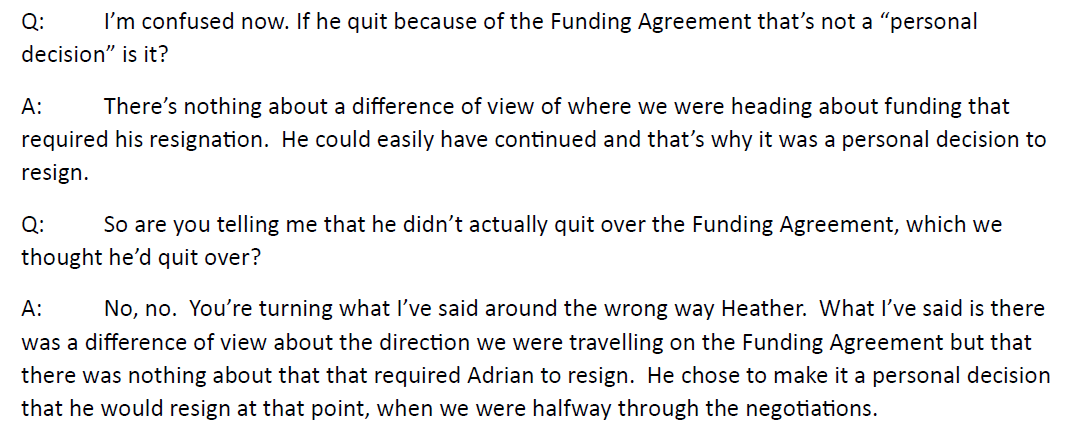
But that is actually quite telling. It goes to the point I have been making since 11 June, that this was not a departure simply over differences around the future Funding Agreement (bureaucrats face those sort of disappointments all the time, especially in the last couple of years). And, actually, the Bank has said as much. Remember this from their statement of 11 June
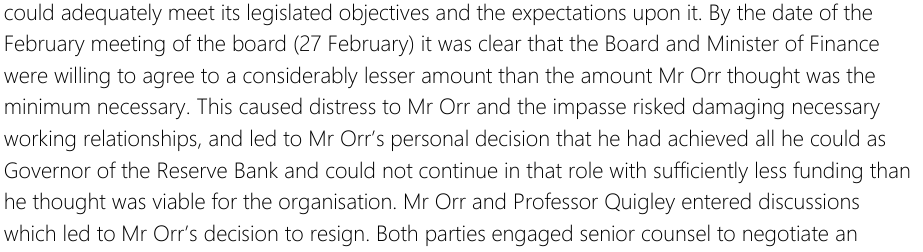
Even if this was true – and it seems increasingly unlikely that it was anything like the essence of the truth – it is such a severe difference of opinion, expressed presumably in ways from which there was no going back (unlike usual robust discussion among peers etc), that it was pretty clear the Governor had to go, that things just wouldn’t work in future if he stayed. That is the clear import of the Bank’s own statement, and the bit they released in error on the morning of 11 June, had tied that breakdown more closely not just to the board but to that meeting with the Minister. Of course, in some sense it was a “personal decision” (as Quigley claimed all along) but it had nothing to do with being tired, sick, or a sense of a job now completed. There is, as my source yesterday implied, a strong element of being pushed (and Quigly himself consistently refuses to shed direct light on that, despite his role supposedly being to serve the public, accountable to the Minister). It wasn’t (as Neil says) the funding discussion per se that “required” Adrian to resign – smart people will have robust arguments about resourcing and then, once settled, move on – but about things much deeper about Orr’s own conduct, quite possibly building on the list of behavioural complaints that Quigley seems to have compiled over several years.
Some straightforward answers would be nice – from the Minister, from the Board chair, perhaps even some board member who might consider breaking ranks (perhaps at the cost of their position) because they think the public deserves to know. The questions are about both substance and about process. Had we had an honest accounting months ago (at absolute latest when the Funding Agreement was signed), the issue would all be water under the bridge by now. Instead….most questions are still unanswered, and Quigley presumably hopes the Ombudsman takes his usual dilatory approach (on usual form, Quigley would be gone next July before we hear anything from the Ombudsman’s office).
 croaking cassandra