You’ll remember during the election campaign how National (Willis and Luxon) repeatedly told us that their fiscal plans (notably the Back Pocket Boost giveaway plan) was fully funded. Whenever doubts were raised about the foreign buyers’ tax revenue estimates National (a) asserted full confidence in their numbers, and b) reiterated that their plan was…..fully funded. The pretty clear implication – one might even be able to find specific quotes – was that if by some chance the revenue from that tax fell short they’d make it up elsewhere.
National’s fiscal plan – with the foreign buyer tax – was already some mix of ambitious and unambitious. Unambitious in that by 2027/28 (beyond the next election) National envisaged net debt at 0.7 percentage points lower than Labour’s plan, which had been captured in the PREFU numbers. The operating balance, having been in deficit for years (with no good economic basis for deficits) also wasn’t to return to surplus until 2026/27. “Ambitious” in the sense that National promised to do all this – closing a large structural fiscal deficit – without cutting any specific programmes, but with promises that fat would be squeezed out of the public sector. Like Labour’s fiscal plan there was a considerable element about it of “we’ll draw a line on a chart, and then just ask you to trust us that we might deliver”. Alternatively, as the target date for a surplus drew closer it might be pushed out further, as Labour in government has now done a couple of times.
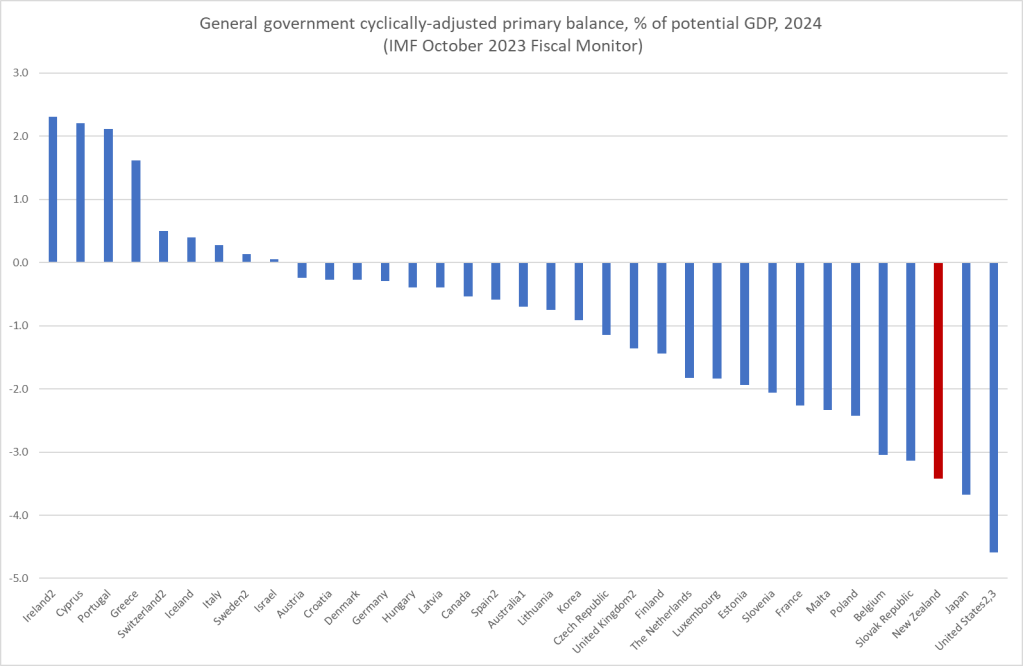
You will recall that Labour has left a large fiscal deficit. On the New Zealand operating balance measure, a deficit this year of 2.7 per cent of GDP (in an economy more or less fully employed), while on the IMF’s internationally comparable metrics, a deficit among the very largest among advanced economies (all having nothing to do with the pandemic, the heavy spending on which was in 2020 and 2021).
Today we got the two coalition agreements. There aren’t any specific fiscal numbers in those documents, but there are policy commitments that all three parties are pledged to support.
To no one’s great surprise, once it was clear NZ First was going to be in the mix, the foreign buyers’ tax is not proceeding (and so unless some researcher with IDI access gets curious – about the detailed pattern of foreign purchases pre-ban) we may never know whether National’s revenue numbers were ever plausible), and with it $750m per annum of promised revenue has gone.
In my post last week I speculated that perhaps National might look to cover this by delaying a few of their promised giveaways a bit, and at least kicking the shortfall a year down the road. Instead, promises of fully funding the giveaways were scrapped along with the proposed foreign buyers tax.
In fact, not only did they not delay any of their giveaways but the restoration of interest deductibility (a good policy) is being done a little faster than National had promised, costing a bit more over the four years than National had allowed for. Not mentioned was the point some critics made pre-election that the deductibility costings had been done in a climate of low interest rates, such that at least over the next few years the cost of restoring deductibility will be a bit more than the National costings had allowed for.
Oh, and the agreement with NZ First allows for an extra $1.2 billion of regional development capital expenditure. That won’t count against the operating balance – at least until depreciation cuts in – but it is all debt, and NZ First last term didn’t have a great track record for high quality regional development spending. It is likely to be much more akin to extra public consumption (one reason why those IMF and OECD fiscal balance measures don’t use an operating balance concept – when governments are spending the money the distinction between operating expenditure and capex often tends to be hazy).
If one wants to look on the bright side of things, there is agreement to shift the tertiary fees-free policy from first year fees to third year fees. That seems pretty daft in terms of any substantive case for the policy – presumably about helping encourage people into tertiary education (which it hasn’t done) – but it does have the one-off fiscal advantage that it should mean no outlays in 2025 and 2026 before normal service resumes in the 2027 academic year. The optimist in me wonders if having operated for two years with no outlays, Cabinet in 2026 might decide to just scrap fees-free altogether but….that will be the election year budget. [UPDATE: paying fees-free for the third year will be cheaper, on account of students who don’t complete, but that just highlights the absurdity of the policy – rewarding those on the cusp of the higher incomes qualifications usually bring.]
A point I’ve made all along is that none of these sorts of things individually amount to much macroeconomically. The foreign buyers tax, for example, was supposed to raise less than 0.2% of GDP in annual tax revenue, but that comes on top of an already large structural deficit for which the parties had no clear or explicit plans for closing. A 2.7 per cent deficit becomes a 2.9 per cent deficit. A large fiscal hole bequeathed by Labour is dug a bit deeper by today’s announcement, making climbing out of that hole all the more challenging (especially if programmes aren’t to be cut). There would seem to be now next to no hope of the fiscal drag tax bracket adjustments in 2026/27.
And it is not as if this is all the potential slippage.
I looked through the ACT agreement and found these items:
- a promise to consider sharing a portion of GST collected on new residential builds with councils. The same revenue can’t be spent twice, and
- “explore further options to increase school choice and expand access to integrated and independent schools including reviewing the indepedent school funding formula to reflect student numbers”
And in the NZ First agreement:
- Fund Gumboot Friday $6 million per annum
- Look to increase funding of St John
- Ensure Plunket is funded to do their job properly
- Investigate the funding formula for new residential care beds
- Look at asset thresholds for aged care
- Work towards a bipartisan agreement on funding care and dementia beds
- Upgrade the Super Gold Card
Some of those are more specific than others, and several may go nowhere. It also isn’t as if it could ever realistically have been expected that there would be no new spending initiatives even within the tight planned operating allowances. But, the pressures for nice shiny new stuff are going to be very real…..in a government that launched itself today by widening the structural fiscal deficit.
I was critical of National during the campaign for not making more of the fiscal deficits, a legacy of a succession of expansionary budgets by Labour even after the pandemic spending period had passed. But one might have hoped that they (Luxon/Willis) would at least hold the line on the starting point – to coalition parties if you insist on some revenue things not proceeding, additional savings need to be found, not in the never never land of successive budgets, but now.
But no.
Perhaps the deal is good politics – not for me to say – but it is unfortunate macroeconomic management policy, and is likely to further dent Willis’s reputation before she has even formally taken office. Robertson gathered a reputation as a Minister of Finance who was reluctant to say no. We really don’t need a successor like that.
It all puts a heightened pressure on Willis in her micro-budget before Christmas to start laying out some credible specifics as to how the large deficits are to be closed. There are limits to what she will be able to do in 3-4 weeks, but simply drawing lines on a graph again shouldn’t cut it (remember those Treasury cautions on even Labour’s numbers, and the task has just gotten bigger today). ACT had talked up the abolition of various government agencies, but it seems the coalition deals ruled that out – the Productivity Commission goes but the money just goes to fund a new public sector agency (whose effectiveness we can only guess at, but have to hope lasts longer than that of the PC), and the Maori Health Authority goes (as National always promised) but the cost of that just gets transferred into the main health votes. Willis and her leader in particular should face serious scrutiny about just how serious they are about sustained fiscal discipline.
It was always one of the worst things of Labour’s voluntary lurch to large deficits in the last year or two. Once the commitment to a firm focus on balanced budgets was sacrificed by one main party – voluntarily running larger deficits when times (revenue-wise) are good – it provides cover for the other lot. What’s another year they will each ask themselves.
Defenders of National will no doubt say “that’s MMP”, but I think it is fairer to say something like “that is what you get when the putative next PM and Minister of Finance don’t campaign hard on the unacceptable starting point of some of the largest deficits in the advanced world”. If they aren’t too bothered, why would their coalition partners be?
UPDATE (Sat): Realised that the discussion above does not allow for the fiscal effects of the change in tobacco policy. Those changes look as though they will avoid the large drop in tobacco excise revenue that was otherwise expected (and which was allowed for both in PREFU and by implication in National’s fiscal plan). The amounts involved are large and may well cover the gap opened by the absence of the foreign buyers tax.
 croaking cassandra