Yesterday the news broke of the extravagant spending at the Ministry for Pacific Peoples (MPP), and to a lesser extent at the Ministry of Culture and Heritage, centred on the transfer from one division to another of the core public service of MPP’s then chief executive Laulu Mac Leauanae. In the spirit of the unified public service (all that stuff that Peter Hughes and Chris Hipkins touted), shifting from running one smallish unimportant department to running another one seems about on par with someone moving from one modest division of an indebted private company to another.
As the Herald reports MPP has already been a bit of an example of the extravagance with the public purse over recent year. A quadrupling in staff numbers for an agency with no clear or legitimate purposes….
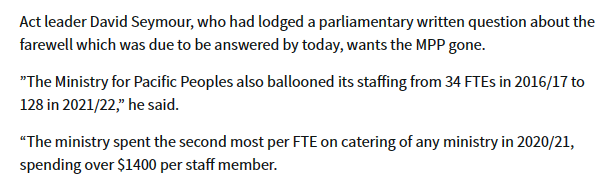
In this example, staggering amounts ($40000) were spent on a farewell (for a person who’d worked for the Ministry for only five years), including extravagant personal gifts to the outgoing chief executive. Probably there was a case for a morning tea in the office (a cake and a few sausage rolls etc) or a drink after work for staff and a handful of outsiders. But it is hard to see a case for having spent more than a couple of thousand dollars in total. And impossible to see any case for (anything more than token) taxpayer-funded personal gifts…..the more so when the outgoing CE was just transferring to another wing of the same organisation.
And thousands of dollars spent by MCH on a welcome? What happened to simply turning up – at your new division of the same (government) enterprise – and starting work, with perhaps a staff morning tea or all-staff meeting at some early getting-to-know-you point? MCH has under 200 staff. Supermarket sausage rolls come quite cheaply. Four Governors started at the Reserve Bank in my decades there, and I don’t recall anything more extravagant for any of them (and in the earlier years the Reserve Bank was not a notably austere organisation).
You can read the Public Service Commission’s report and statement here. But what isn’t said there is at least as interesting as what is.
Starting with, how did PSC come to be so asleep on watch?
The farewell (and welcome) occurred in October. But this is the introduction to the PSC report
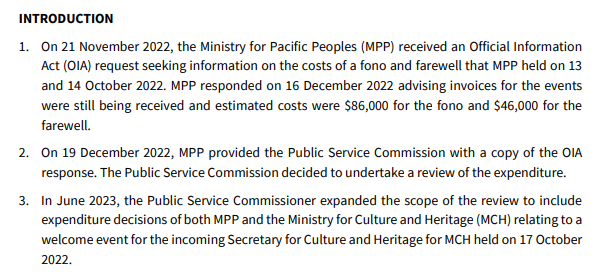
So either PSC didn’t even know about the event(s) – which frankly seems unlikely, unless they are even more slack than it seems – or no one there stopped to wonder just how much public money was being spent….until someone in the public asked. It is also pretty remarkable that MPP – by then under an acting CE – never thought of mentioning the OIA request to PSC until after the response had already gone to the respondent. As regards the costs of a farewell for one of the Public Service Commissioner’s CEs. And even when in mid January PSC decided to look into the farewell spending, it wasn’t for another five months that they thought to look at what had gone on as regards the welcome.
And that Herald extract above leaves one wondering just how much of all this we might have heard of the waste if it had not been for the written parliamentary question. Perhaps that is unfair, but the Commission’s approach was on display in a letter sent by the Deputy Public Service Commissioner on 17 January to the acting CE of MPP.
In that letter she states
my expectation is that the entire review process will be completed by mid to late February 2023. The final report will be published on the Commission’s website, but it will not identify any individuals by name and your agency will have the opportunity to comment on the draft report before it is finalised.
Not sure how she envisaged a report on a farewell for a CE naming no names but…. And it is August now.
Perhaps more concerning was this later in the letter

Which feels a lot like an attempt by PSC to stymie uses of key instruments of scrutiny and democracy (OIAs and PQs). It isn’t clear what OIA grounds they might have tried to withhold using……but with the OIA that rarely seems to stop agencies…..and PQs are questions from MPs to ministers, not matters that should be within the ambit of the PSC. The same text is in a letter dated 19 June from Peter Hughes to the MCH chief executive.
The PSC report has no reflections at all on PSC’s role or approach (or on any briefings they might have provided to their minister – at the time all this kicked off that was Chris Hipkins). In addition to the matters already touched on there was nothing at all about their own approach to agency oversight or to key appointments, that meant a culture developed in one or two of their agencies where spending of this sort happened. But of course to have done so might have been embarrassing for them, including because they had just promoted the CE, lauding him as a “sophisticated organisational leader” and not missing the opportunity to mention that expensive senior management course he’d recently done at Oxford. And yet his MPP senior management team not only thought it was okay to spend up big on his farewell (transfer) but (as the report documents) did so with no decent systems or budgets. The values and priorities of top leaders are well known by those beneath them. Nothing about this report suggests this CE preached or lived any sort of public sector frugality. But, never mind, he got the promotion……and holds the bigger job to this day.
Quite a lot else is glided over too. This is from the Peter Hughes statement

But neither here nor in the report are there any relevant dates. Mr Leauanae should simply never have accepted government departments paying for travel for his family members (tickets don’t just turn up), so reimbursing the cost when found out just doesn’t cut it.
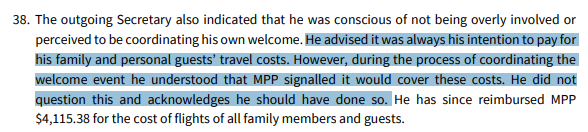
Hard to see that sort of lackadaisical attitude being acceptable in anyone, at any level of the organisation. but……he was CE, displaying no sign of appropriate leadership at all. At best careless, at worst entitled (and note that the PSC report cites no evidence for his claim that “he always intended” to cover those expenses himself). And when did these refunds happen? A few days after the event, or only after PSC started digging? If it were the former it is highly likely PSC would have said so. Hughes refers to “the first opportunity” but the report itself does not.
And what of the gifts?

Many of the same questions arise? Surely on the day of the farewell, any public service leader should have expressed immediate extreme discomfort and returned all the gifts the same day? But there is no sign of any of that, and no indication that anything was returned before PSC started digging.
One could go on to note the sort of expenditure Hughes and the PSC seem to have no problem with. Recall that the welcome was to a transferring CE in a New Zealand public service department. As I said, a few sausage rolls and a welcome speech might seem reasonable. But not to PSC, which deemed all of this “moderate and conservative”

Sausage rolls and cup of coffee just don’t present the same challenges (or sheer waste). There was also this weird claim that somehow lavish expenditure was appropriate because
“In addition, the incoming Secretary was a Matai or chief, community leader as well as a public service leader.”
What he is or does in his private life is really neither here nor there (or shouldn’t be). You could be a hereditary peer, a billionaire, a generous philanthropist or whatever, and the fact remains that public money is being spent on a transfer of a public servant from one small agency to another.
In the end, the report seems to be largely a whitewash, at best slapping Mr Leauanae over the hands not even with a wet bus ticket but with a feather. He was found out, paid the money back after the event, and goes on to hold a CE position, in which if he ever utters words along the lines that public money should be used sparingly, rules adhered to in spirit as well as letter, staff probably scoff and go “one rule for you, and Peter Hughes’s favourites, another for the rest of us”.
But why should we be surprised? The twin cultures of entitlement and corruption, all accompanied by public sector bloat, are creeping ever onward. It is rare that any culprit ever pays a price – another Hughes CE took hospitality from an agency lobbying him to exercise discretion in their favour, and he went on to get a knighthood – and by their indifference we have to conclude that the government itself is unbothered.
As for the Opposition parties, they do part of their job in bringing some of this stuff to light and making a fuss now. But is there any sign of a robust open commitment to specific and much higher standards when their turn in government eventually comes? A CE who did what Mr Leauanae did (and allowed to happen) simply should not be still holding a government department CE job. That he is says that the standard now is not even “don’t get caught”. What standard is that for either other public servants? What sort of accountability to citizens and taxpayers?
 croaking cassandra