After my post yesterday I remembered that I had also written a post in 2019 based around the excellent talk Jenny Wilkinson, then the Australian federal Parliamentary Budget Officer had given at Treasury in 2019. I ended that post this way
….it was a very useful presentation (I hope Treasury makes her slides available) from a technocrat’s technocrat. I’m left sceptical on two main counts:
- first, whether elections ever much do, or really should, turn much on precise fiscal costings. Perhaps it appeals to inside-the-Beltway technocrats to conceive of that model, but I see elections as mostly about things like competing visions, competing personalities, competing diagnoses, and competing claims to competence. If so, why spend so much on highly-detailed and expensive state-funded costings, that the parties themselves don’t think it worth spending their own money on?
- second, we should think harder about the whole panoply of support and information etc we provide to political parties and the public, preferably without further reinforcing the favoured position of established large parties. Thus, it is interesting to note that written parliamentary questions are much much less used in Australia, as a way of garnering information, than is the case in New Zealand. (“In the years 2008–2014 only about 8 questions in writing were being asked each sitting day, but this number increased to 19 in 2015, and was 14 in 2016.”). What about better resourcing select committees (to me a better use of money)? And if we threw in a free PBO service, should we reduce existing money parliamentary parties are funded with? If not, why not? And would resistance to that idea suggest the costings were some epicurean nice-to-have rather than a central element of a well-functioning democracy? And then, of course, there is the OIA. Mightn’t it be better to require agencies to release documented costings models themselves, in ways that would allow political parties and their consultancy firms to use them to the extent they judge appropriate (and not otherwise).
And if I had the analytical resource implied by 40-45 more staff and had to deploy it somewhere in the public sector, it is far from obvious that a policy costing operation (with supporting analysis and research as the PBO) would offer the highest benefit-cost ratio.
Rereading that got me thinking again about the resource requirements for such an agency in New Zealand, that both Grant Robertson and Nicola Willis now seem keen on (despite apparently straitened fiscal circumstances). As I noted in yesterday’s post, no small advanced economy I’m aware of runs one of these costings offices (Australia, you will recall, has five times our population and rather more than that multiple of real GDP, the real resources used for this luxury product). And policy issues aren’t really less complex or less numerous just because your country is smaller (Australia has some federal/state interaction issues, but they aren’t likely to material affect the potential demand for policy costing work).
As far I can see there are three such costing offices in Australia. I will focus on the federal and Victorian versions, but the first such entity was the New South Wales one.
The NSW entity is a bit of an odd beast, and I don’t think anyone has championed anything like it in New Zealand. It is set up only for the 9 months prior to each state election (not sure if snap elections are allowed in NSW), and can be used only by the leaders of the two main parties, who in turn are required to submit all their policies to the PBO 10 days before the election, and the PBO is required to publish costings for them at least 5 days before the election. It seems to be staffed largely by temporary secondees from existing public service departments, overseen by an academic. From the report on the 2019 election, it seems to have had about 20 staff at peak
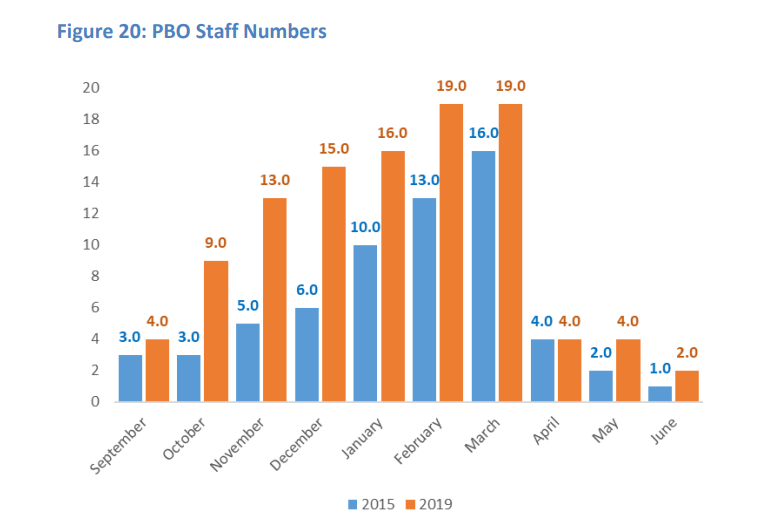
In practice, it seems that parties work with the PBO behind the scenes in advance getting their policies costed, and either modifying or dumping ones that come in too expensive etc, with only the final policies and the costings of them seeing the light of public day.
If you believe in these sorts of things, I guess one can see the logic of the NSW approach, as it tries to put the main Opposition party on something like the same footing as the governing party. It isn’t a small financial or resource commitment (about the total staff numbers of, say, our Productivity Commission), for what is after all only a state government, but it is only for 9 months every three years.
What of the federal Parliamentary Budget Office? There is quite a lot of material in that earlier post. One other extract that might be worth bringing forward is
…in answer to a question from me, Wilkinson observed that what the PBO can best do is cost programmes that represents small deviations from the status quo (they have good tools to estimate direct and immediate fiscal costs/gains) while wider economic second round effects, and the associated fiscal impacts, are likely to be small. But, and using her own (deliberately extreme) example, if some party were to campaign on getting rid of the welfare state, her office could do the direct fiscal costs, but could offer little or nothing on the wider economic (or social) effects of such a policy, including the possibility that it might have large long-term indirect fiscal implications. They will only offer qualitative statements about those wider effects. Which left me thinking that the the PBO probably does very well on things that don’t matter that much, and can’t offer much on the bigger issues that elections probably should really be about (whether about the welfare state, climate change, productivity or whatever).
They do a lot of costings
Another aspect of the presentation that surprised me was (a) the number of costings the PBO does, and (b) the extent to which demand is not concentrated just in the pre-election period. In fairness, she noted that the latter had surprised them too. In the most recent year (an election year) they’d done 2970 costings, while in the previous two non-election years they had averaged about 1700 costings. Only MPs can request costings, and there are 227 MPs (across House and Senate). Those numbers don’t mean 2970 separate items of policy, as many of the costings will be, in effect, rework as members or parties iterate towards a policy that meets their ends and will be scored by the PBO as not costing too much.
but note (see above) how much less extensively written parliamentary questions are used in Australia.
At the time of that 2019 presentation, Wilkinson told us her office normally had about 45 staff, scaling up to around 55 at elections (and recall that this is a federal government, in a system where a lot of policies are state responsibilities). The table in the latest Annual Report suggests that is still about right

What of the Victorian state Parliamentary Budget Office? Here is what they say they do
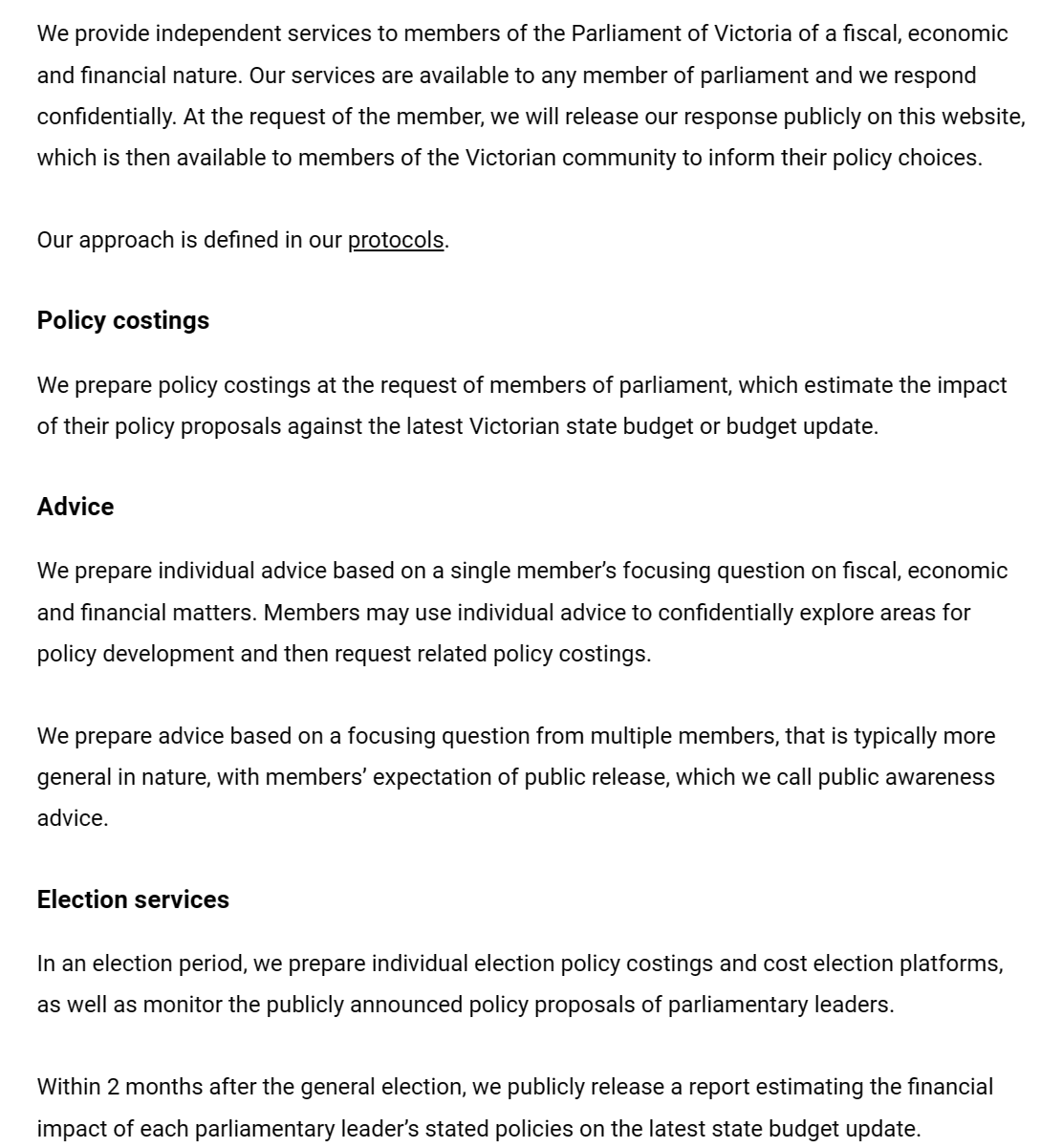
All MPs have access (unlike in NSW).
This doesn’t come cheap. Their documents say that for last year’s election they peaked at 26 FTEs, and they appear to have a permanent staff of about 16.
For a system of unitary government it seems reasonable to think in terms of the combined Victoria plus federal offices (which thus cover all the policy areas that affect Victoria, whether via federal or state policy). That seems to involve a base level of 60 staff, scaling up to perhaps 80 in the run-up to elections.
Now, of course, Australia is a fairly big country. But as already noted, neither the number of policy issues nor the design complexity of those policies is really scalable with the size of the country. And it seems most unlikely that one could do a worthwhile job – across the multiplicity of areas of policy – with 12-16 staff in New Zealand. In fact, I find it difficult to see how it could be done well – and there is really no point if it is not done well – with fewer than perhaps 30-40 staff.
That would be bigger (much bigger) than either the Productivity Commission or the Parliamentary Commissioner for the Environment (21 staff). Would it be a priority use of scarce resources for taxpayers to be putting this additional financial assistance towards political parties and MPs? I continue to think that better-resourcing select committees would have a much larger payoff for citizens and good governance. There is likely to be a good reason why no other small advanced countries run state-funded policy costing offices (while parties themselves are of course free to use economics and other consultancy firms to the extent they find useful – in a political market).
Issues of scale are very real for small countries’ central government policy functions. I’ve already mentioned that the Productivity Commission has 15-20 people in total. To the extent there was an inspiration behind our Commission (as distinct from a bauble for the Key government to throw ACT’s way), it was the Australian Productivity Commission, which has over the years produced a lot of useful reports. The latest Annual Report suggests that Commission has 165 staff and 12 commissioners. The sorts of issues facing Australia are not likely to be any less numerous or complex than those facing New Zealand, and even if the staff of our Commission walked on water they simply could not match the value that could be added by the Australian Productivity Commission.
I would have thought there was no credible way we would devote 180 people to the Productivity Commission – nor do I think we should – but I guess if the Ministry for the Environment now has more than 1000 staff really who knows anymore. But with 15-20 people it was always going to be vulnerable to going the way it has, and was always going to struggle to maintain depth and critical mass.
The pool of really able people is small, and fiscal resources are limited (in a smallish underperforming economy). It just doesn’t make a lot of sense to be thinking of putting dozens of people into helping political parties cost their specific policies. On the track record of their performance, nor does having 15-20 people in a Productivity Commission that now seems, in practice, to perform a more general role in support of political parties of the left. A new government should rebuild Treasury, and if there is resource it would be better spent strengthening select committees to scrutinise actual legislation and actual government agencies, rather than (further) funding the bids of the parties competing for the keys to the Beehive.
 croaking cassandra
I am surprised these offices have any staff at all outside of the election period.
LikeLike
One gets the impression they are functioning as an ongoing part of the parties’ ongoing policy development programme
LikeLike