Coronavirus economics and policy: from the mailbox

But first an update of the chart showing numbers of new announced coronavirus cases for New Zealand and Australia (the latter divided by five to produce a comparable per capita number).

new cases 15 apr

A few days on from the last time I ran the chart and New Zealand is still finding about twice as many new cases per capita as Australia.  At the margin, we seem to do be doing a few more tests per capita each day than Australia is –  in both countries the number of tests being done has fallen back from the peak.  But despite our more restrictive regime, we don’t seem to be producing better (lower new cases) results than Australia.    Who knows why, although those left-wing academics from Otago, professors Baker and Wilson, while lavishing praise on the Prime Minister in the Guardian

One critical success factor that is, unfortunately, harder to guarantee is high-quality political leadership. The brilliant, decisive and humane leadership of Ardern…

went on to note to Stuff yesterday that in their view the case for a tougher lockdown in New Zealand than in Australia rested on the fact that

“New Zealand has had to go to this strong, intense, lockdown, because it started from a pretty low base.

“It didn’t have really sophisticated systems for mass contact tracing…Things like basic contract tracing were working better in Australia from earlier on.”

Wasn’t Ardern Prime Minister for more than two years prior to this, including the two months apparently wasted prior to the lockdown? Wasn’t David Clark Health Minister?  In fact, wasn’t Ashley Bloomfield Director-General of Health for most of that time?

But my heading suggested this post was about things that had turned up in my mailbox.

First was a useful short note from the trans-Tasman economics consultancy Castalia on the respective experiences and approaches of New Zealand and Australia.  I found the summary table of the regulatory restrictions particularly helpful.

Second, and following on from my post on Monday about the New Zealand Initiative’s short attempt to think about some sort of cost-benefit approach to assessing interventions, I had an email from one of New Zealand’s leading academic economists, Professor John Gibson from Waikato.  I’ve never met Professor Gibson –  although it turns out we both spent time in Papua New Guinea early in our careers –  but he kindly sent me a note he’d done looking at similar issues through a slightly different lens.  Gibson’s paper is not available online, but he has given me permission to quote from it.

His note opens this way

The approach taken in New Zealand to dealing with Covid-19 may result in unnecessary loss of life. The outbreak of a hitherto unknown disease poses an important new risk to humans, so it is appropriate to devote resources to mitigating this risk. These risk mitigating resources mean some output is foregone. In other words, our lives are going to be somewhat more risky and people will be somewhat poorer, than would have been the case without this new disease.  A key question for public policy is where to strike the balance between reduced risk and foregone economic output.

Gibson doesn’t pull his punches in places

There are at least two grounds for concern about the New Zealand strategy. First, the people making decisions are the same ones who botched the preparation for the arrival of Covid-19 and so there is little reason to have faith in the wisdom of their choices. I say “botched” advisedly and would ask readers to consider the following four facts:

  • Taiwan recorded their first case of Covid-19 on 21 January, a full month before New Zealand’s first case
  • Taiwan usually has about three million visitors a year from China, while New Zealand gets about 400,000. The gap is even bigger in terms of visitors to China (who posed a risk of spreading the disease upon their return)
  • Taiwan has not had a lock-down
  • Yet despite earlier exposure and much greater risk due to more travel to and from China, Taiwan has just 373 cases (16 per million) of Covid-19 while the rate in New Zealand is currently 17 times higher (266 cases per million)

Similar comparisons could be made with respect to Hong Kong or South Korea, who also provided lessons on management of this new risk. The complacency by politicians and bureaucrats in New Zealand, who had the advantage of an extra month for preparation and much greater distance from China, is staggering. Obviously that chance to respond to the risk in a low-cost manner was missed and so a very costly lockdown has resulted. While we can hope for better decision-making going forward, there is little reason to be confident of this.

He goes on to lament the lack of an informed open public discussion

In that regard, it is mainly the BIG SCARY NUMBER approach to political decision-making that has been evident, rather than a careful discussion about trade-offs. When announcing the lockdown, the Prime Minister claimed that if strong action was not taken against the spread of the SARS‑CoV-2 virus, New Zealand’s health system would be overwhelmed and tens of thousands would die:

“If community transmission takes off in New Zealand the number of cases will double every five days. If that happens unchecked, our health system will be inundated, and tens of thousands of New Zealanders will die”[1]

There is very little critical scrutiny of this claim, which seems to be based on modelling done by public health academics at the University of Otago. No empirical data from New Zealand on key parameters informed this modelling, which used an off-the-shelf European model (http://covidsim.eu). It is unknown whether the spread of the virus in a low-density, younger population like New Zealand is the same as in high density, public transport-reliant Northern Hemisphere populations, that are older, and have worse respiratory health to start with.[2] At best, these models are informed projections. It is also the case that across the six scenarios modelled by the Otago academics, the average number of forecast deaths was just over 8000 (mean 8,300, median 8,600).[3] So Prime Ministerial claims that “tens of thousands will die” are vague at best and alarmist at worst.

Moreover, the projections have not been presented in a way that empowers people to make considered judgements. We are shown big numbers of projected deaths, with no context to interpret them. Deaths are bad, more deaths are worse, so it feeds into the narrative that there is no alternative to the approach taken. This approach to public policy tends to disempower people who are not privy to the epidemiological models.

Of course this is unwarranted, as ordinary people make decisions about trade-offs all the time and typically use careful judgement when doing so.

[1] https://www.stuff.co.nz/national/health/coronavirus/120501534/coronavirus-jacinda-ardern-just-made-the-most-consequential-decision-of-her-career-putting-nz-on-house-arrest

[2] There is also a more subtle criticism of the “If that happens unchecked…” phrasing by the Prime Minister. This implies no change in behaviour but we know from the Lucas Critique that when circumstances change, people change their behaviour, so forecasts that are not based on “deep” or “structural” parameters provide poor predictions. The virus reproduction rate is unlikely to be a deep parameter, which is why careful treatments distinguish between R0 – the reproduction number in the absence of behavioural change or immunity, and R‑effective (see https://fivethirtyeight.com/features/coronavirus-case-counts-are-meaningless/). So a forecast that assumes no behavioural change by people seeing an epidemic unfolding is not a plausible counterfactual.

[3] https://www.health.govt.nz/system/files/documents/publications/report_for_moh_-_covid-19_pandemic_nz_final.pdf

It is perhaps worth noting here that Professors Baker and Wilson are among the academics with their names on that modelling.

And here I would interject to note that whatever modelling the government may have solicited or received unsolicited, so far we have none of the official advice (from the Ministry of Health, from Treasury) on what officials made of the modelling, how they assessed risks, costs etc.   As I’ve noted before it is our country, our lives, not those of a few Cabinet minister and officials: transparency of key documents should have been an integral part of any sort of serious confidence-building approach.

Gibson’s own contribution is to attempt to recast things in terms of the potential impact on life expectancy

One contribution I want to make with this essay is to show that it is entirely possible to recast these projections of forecast Covid-19 deaths in terms of reductions in life expectancy, and there are four advantages of doing so:

  • Life expectancy is intuitive to most people, as a measure of the lifespan that can be expected by the average person;
  • The calculated impact on life expectancy can be used for risks that change in the future, such as if controls on spread of SARS-CoV-2 fail;
  • Life expectancy summarizes the impact on everyone in New Zealand, and is naturally weighted in the sense that the people who will suffer the consequences the longest (the young) contribute more to the average value; and,
  • Life expectancy is affected by health shocks and by income shocks and so it naturally allows analysis of trade-offs without needing so-called contests between health and the economy which may initially seem incommensurable.

In terms of this last point, a key fact being ignored in New Zealand discussions is that poorer people and poorer societies have lower life expectancy. The actions being taken to deal with the Covid-19 risk are making New Zealand poorer, and so will reduce life expectancy.

Specifically

It turns out that life expectancy in New Zealand is more sensitive to changes in real income than is so for many countries. Using World Bank data on real GDP per capita (in purchasing power terms) and life expectancy, from 1990 to 2017, the income-elasticity of life expectancy for New Zealand is estimated as 0.171±0.009. In other words, a ten percent decrease in real per capita GDP reduces life expectancy by 1.7 percent. The most recent period life tables for New Zealand report that male life expectancy was 79.5 years and female life expectancy was 83.2 years, so 1.7 percent of the average of those two values is 1.4 years. In other words, if real per capita GDP in New Zealand falls by ten percent due to the lockdown and other effects associated with Covid-19, life expectancy would be predicted to fall by 1.4 years.

and

No one knows how much lower New Zealand’s real GDP per capita will be as a result of the lockdown and other steps taken to deal with the risk of Covid-19. So to help people think about the trade-offs, I present a range of values: if real GDP per capita falls by five percent, that would translate into a fall in life expectancy of 0.7 years; ten percent would be 1.4 years lower life expectancy, and with a 15% fall in real income then life expectancy would be reduced by 2.1 years. Some readers might object that these effects are on some unidentified people sometime in the future, but exactly the same point can be made about the forecast deaths from the epidemiological models. Moreover, the current calculation has the benefit of being based on actual New Zealand data, rather than just on assumed values.

He works through various calculations concluding

With these estimated impacts on life expectancy it is now possible to compare both the health shock and the income shock using the same measuring rod of life expectancy. For example, if the lockdown leads to a ten percent fall in real GDP per capita, we can expect life expectancy to be 1.4 years less than otherwise. This could be justified as a rational investment in risk reduction if it prevented a Covid-19 death toll that would be ten times the usual flu shock. In contrast, if the death toll would otherwise have been four flu-shocks or less (so 3500 or fewer deaths), shrinking the economy by ten percent would reduce life expectancy by 1.4 years, in order to avert a risk that otherwise would have produced a 0.6 year decline in life expectancy. In other words, this mix of risk and response would take almost one year off the expected life span of everyone in New Zealand. The apparent kindness of doing everything possible to limit deaths due to Covid-19 would, instead, be killing more people by making them poorer.

There are no easy choices here. Nevertheless, it is possible to present the trade-offs in ways that can be interpreted by ordinary people, who rightly should have far more input into these decisions than they have to date.

I found it an interesting approach –  even if I was a bit less convinced than Gibson that the framework was likely to be widely accessible –  but had a couple of questions about his approach.  I went back and asked him about this one

It is an interesting way of looking at the choices/tradeoffs issues. I suppose my only question is how we should think of a single year very steep drop in GDP per capita.  Given that GDP per capita is usually a very persistent series (a bad recession might be perhaps only a 3% fall), do you think that (say) a 15% fall in GDP per capita fully regained perhaps three years hence, would have a material life expectancy effects (by contrast, if the whole future path of GDP per capita was pulled down by 15% the likely effect seems pretty clear?)

To which the relevant bit of his response

What I do think would occur if we lost three years of progress in raising GDP is that the strong progress that has been made in extending life over the past couple of decades would weaken, so we would lose much of the rise in life expectancy that would have been expected to occur over that time with rising incomes. I have two reasons for thinking this: a. even though we haven’t lost the old blueprints for longevity improvements turning those blueprints into reality often takes a lot of resources that will be in short supply – we already see this with expensive treatments that can be afforded in Australia but not NZ, reflecting our falling income relative to over there, and b. even with a three year deviation from trend rather than a permanent lower track in real GDP per capita, that is three years where there will be far fewer resources for developing new blueprints for improving life expectancy – those blueprints might be both the technological ones (where we can free-ride a bit on international leaders) but also the social ones like improved childhood nutrition, interventions on family violence, substance abuse and so on.

That seems plausible.

I suppose my other observation, which I have made about all manner of contributions to these discussions over recent weeks, is that in thinking about what policy approach the New Zealand government should take we have to be careful to look only at the truly marginal effects of that particular set of policies.  For example, even if GDP per capita this month is 40-50 per cent lower than normal (roughly where The Treasury and my own guesses would put it) only part of that is attributable to the lockdown regime, only part of it is even attributable to any New Zealand policy choices.  Gibson’s note does not attempt to directly address that point. Perhaps his response might be to note that, whatever the source of the sharp losses in GDP per capita, we should expect them to result in worse long-term health outcomes (life expectancy) whatever effect they may have in saving lives from Covid itself.

That, in itself, makes it a worthwhile contribution and I was glad to receive it.

The final item this morning is still work in progress, although I gather the author hopes to finish and release it in the next day or two. My former Reserve Bank colleague Ian Harrison, now operating as Tailrisk Economics, has developed something of a knack for picking apart papers used by officials and politicians to support favoured regulatory interventions.  Ian is much more willing to read every single cited source than, say, I am, and his deep dives have often revealed significant weaknesses and issues in papers officials and ministers claim to rely on.    His collection of past efforts is here.

Over the last week or two Ian has turned his attention to the Otago modelling (also referred to above by Professor Gibson) released by the Ministry of Health and waved around  –  for support if not necessarily illumination –  by the Prime Minister.  He focuses particularly on this paper, dated 23 March (which Baker and Wilson are among the co-authors).

Ian has given me permission to quote from his draft paper.  In that paper he raises some significant concerns about the Otago modelling, but also reports some modelling work he has been doing (Ian is pretty experienced with models, having been primarily responsible for the Reserve Bank’s capital modelling in years gone by and done related work since leaving the Bank).  For now, I will focus on the critiques and concerns about the Otago work, given the role we are led to believe it played in government decisionmaking (or at least in post-decision spin).

Ian begins his paper this way

The only publically available information on the Ministry of Health’s (the Ministry) modelling of the impact of Coronavirus on New Zealand is a set of reports on the Ministry coronavirus website, all produced by the University of Otago Covid-19 Research Group (OCRG). These papers address a range of issues and the later ones used a model, that is in the public domain and is available at covidsim.eu. Here we focus on one paper -‘Potential Health Impacts from the COVID-19 Pandemic for New Zealand if Eradication Fails: Report to the NZ Ministry of Health’ that was dated 23 March. It has received a substantial amount of media attention.

The key headline result in the report is that if this lockdown shock therapy fails. the consequences are serious. Between 8560 and 14000 could die over the next year. The conclusion was:

If New Zealand fails with its current eradication strategy toward COVID-19, then health outcomes for New Zealand could be very severe. If interventions were intense enough however, in some scenarios the epidemic peak could still be suppressed or pushed out to the following year (at which time a vaccine may be available.

and

Like any modeling the OCRG results depend on the most critical assumptions used by the modelers. To a degree modeling results can be what the modellers want them to be, so it is always critical that modellers clearly report their main assumptions and their impact on the results, upfront. They should not be hidden in the technical detail.

We found that OSRG’s model runs grossly overstated the number of deaths because they made an assumption about the critical tool in the Ministry’s arsenal. It was assumed that there would be no tracing and isolation of cases. This led to an explosion in the number of cases and deaths. The reporting of the range of deaths was also inflated by the simple expedient of excluding the model runs that produced low numbers. One of their six scenarios showed just seven deaths over a year.

But that is not what the public saw. The Stuff report on the modeling read as follows:

Up to 14,000 New Zealanders could die if coronavirus spread is uncontrolled, according to new modelling by the University of Otago, Wellington.

Covidsum is, apparently, relatively easy to use.

When we ran the Covidsim model we found credible paths that could reduce the pace of infections to sustainable levels. Deaths in the range of 50 – 500 over a year are more realistic numbers. 500 deaths is around average for normal seasonal flu [note that Gibson used 870 annual flu deaths]. We found that the higher OCRG numbers were mostly generated by their assumption that tracing and testing would be abandoned.

and

The main purpose of this report is to look behind the ‘shocking’ headlines to assess the robustness of the ORSG modeling, and to present our own modeling results, using the same model. We also present the arguments for the lockdown being less restrictive and present a rough cost benefit analysis of the decision to lockdown the building and construction industry.

From the body of the paper

The OCRG modelling

The OCRG ran six scenarios with the Covidsim model. Three R0 assumptions (1.5, 2.5 and 3.5) were combined with two intervention scenarios that assumed either a 50 percent contact reduction in R0 over six months; or a 25 percent reduction over nine months. As previously noted there was no reduction in the post intervention effective R0 reduction due to case management.

The results are shown in table x

Table x: OCRG scenario results 

Model assumptions Deaths over one year
R0 1.5 25% control over 6 months 2520
R0 1.5 50% control over 9 months 7
R0 2.5   25% control over 6 months 12,700
R0 2.5   50% control over 9 months 8560
R0 3.5   25% control over 6 months 14400
R0 3.5   50%   control over 9 months 11800

As noted above, the R0 1.5 results were not reported in the media. The range was reported as between 8560 and 14400. If the OCRG had so little confidence in the 1.5 estimate then they should have replaced it with a more plausible lower estimate, such as a R0 of 2, and then reported that number. Similarly the upper estimate could have been set at a high, but still reasonably possible 3. Instead the public is given a range of between 8560 and 14400 deaths, giving the misleading impression that there is a good deal of certainty around the estimates of high death numbers because the upper and lower bands are relatively close together.

More importantly the headline results are absent the impact of any case management. They should never have been released to the general public without explaining that there was no contract tracing and isolation process in effect. The numbers with contract tracing should also have been prominently reported.

Who knows what mandate was given to the Otago researchers, but again the bigger issue here is that we do not have any access to the papers the government itself used, to know whether or not the Ministry of Health, Treasury, or ministers themselves were really influenced by these headline numbers –  or whether, for example, they were just being used to sway the public.

There are lots of other specifics in Ian’s paper and when he releases the final version I will be sure to link to it here.  As allluded to earlier, he attempts a cost-benefit analysis for restrictions on one particular large sector –  construction, which has not been closed down in some other lockdown countries –  and concludes that any benefits are vanishingly small relative to the economic costs of that particular marginal restriction.

Ian also tells me that he has attempted to contact the Otago researchers but has not (yet) had any response.

In giving these papers some coverage I am not myself advancing any particular policy view.  I have more questions than answers –  in part because of the continued refusal of the government to make core pieces of analysis and advice public, and instead to fling around numbers that others have generated but that don’t seem to stand up to much scrutiny (and in some cases are not public at all).   As I noted the other day, at a visceral level (rather than an analytical one) I am somewhat uneasy about the rush towards easing restrictions, and I’m not sure 20 cases a day (that the authorities know of) is yet that reassuring.  But, equally, the costs of the path the government has taken to date have also been very high –  and those costs are not just economic in nature (if anything I worry that all the pressure building to ease restrictions is economic in nature, and little at all about families, civil society, and so on.)

And now it is almost time for Orr’s appearance at the Epidemic Response Committee.   Of the Reserve Bank’s institutional failings around this crisis –  and, par for the course, utter lack of transparency –  I am much more confident.

UPDATE: Ian Harrison’s report is now available here.
Questions for the Reserve Bank

Wednesday mornings at present don’t find me at my most relaxed and sanguine. It is the morning I join the supermarket queue at 6:50am (a bit shorter this week than last), and notice that the owners have now erected shelters for customers to queue in the rain –  winter coming and all that.  And I’m reminded of the Prime Minister’s fantasies, when she was urging people not to stock up before the lockdown, that the supermarkets would run normally no matter how intense any lockdown.  When milk is scarce (in New Zealand….?), flour is available patchily at best, there is little or no fresh fish (my supermarket is about a kilometre from where the fishing boats moor), and the availability of almost anything else seems to be something of a lottery, it is a strange definition of normality.  Add to that packing groceries into bags in the carpark –  where it is cold, but not yet wet.   As it is, it is a bit like a bank run…if people come to doubt,  rationally or otherwise, that the bank can meet its debts, it is an incentive to get out entirely while you still can.  Here, the medium-term risk probably isn’t the New Zealand produced basics, which will eventually get sorted out, but the foreign-produced non-perishables (not much affected by New Zealand government choices).  Which year will supplies of those get back to normal?

Anyway, having got that off my chest, it is time to turn back to monetary policy and the Reserve Bank of New Zealand.  The Governor is scheduled to appeared before Parliament’s Epidemic Response Committee tomorrow.  If the Committee is serious about holding the government and powerful independent government agencies and figures to account, there should be a whole series of hard questions posed to the Governor (and to his colleagues on the Monetary Policy Committee, the external half of whom never seem to face any scrutiny, challenge, or questioning.  There are important questions about the past, the present, and (a few) about planning for the future, and only a few can be addressed in a short session (many are likely to need to wait for a Royal Commission or a later external review of the Bank’s handling of the crisis).

At an overarching level, there should be much the same question for the Bank as for the rest of government: why is there so little transparency, so little pro-active release of relevant background and decision documents.  Anyone would think we didn’t have a central bank that likes to boast about how transparent it is, or a government that used to boast that it would be the most open and transparent ever.    Say it often enough and it still doesn’t change the (quite different) reality.

The first set of questions might reasonably be about the past and Reserve Bank preparedness.

For example, Committee members might consider asking the Governor about the state of preparedness of unconventional monetary policy when he took office (in March 2018), many years after other countries had already been undertaking such activities and, in some cases, dealing with negative official interest rates.

And as it is now almost two years since the Bank published an article on options around unconventional policy, including negative official interest rates.  In that article, the authors observed

Overall, it appears that the Reserve Bank could implement negative interest rates, with the potential leakage into cash relatively small in value terms at modestly negative rates.

So the Bank might reasonably be asked what steps the Bank had put in place by this point to ensure that there were no technical obstacles to using a modestly negative OCR (eg checking out whether bank systems were readily able to cope and, if they were not, prioritising getting them ready)?

Since the Bank was well aware of the limits to how deeply the OCR could be cut –  because of the possibility of conversion to zero interest cash –  what work programmes did the Bank have in place to explore options for easing, or even removing, the constraints (all of which were under the Bank’s direct control).   If there are such papers, the Committee might ask for them to be released.

It might be reasonable for the Committee to ask what modelling and scenario-based work the Bank had undertaken in recent years to prepare for the possibility of a new serious economic downturn while the initial starting level of the OCR was still very low?  How, for example, did they factor in the observation that in typical recessions the OCR (or equivalent) has been cut by 500+ basis points, in turning often helping generate a large reduction in the exchange rate.   Macrostabilisation in the face of deep adverse shocks being, after all, at the heart of why we have a central bank with discretionary monetary policy.

In a lengthy interview last August, the Governor indicated his preference for using a negative OCR before using large scale asset purchases etc.  As late as his speech on 10 March 2020, a negative OCR was still being presented as a live option.  What changed?  When?

At the February Monetary Policy Statement the Bank was quite upbeat about economic prospects here and abroad, even moving to a mild tightening bias.  Almost two weeks later, in a tweet approved by the Chief Economist, the Bank was still talking up economic prospects for 2020.   Doesn’t this suggest an extraordinary degree of blindness, backward-lookingness, and complacency about the risks just about to break over us?  To what extent, if at all, had the Ministry of Health or The Treasury been alerting you by this time to the scale of the health and economic risks?

In your speech on 10 March and in interviews immediately after that, the Bank was still coming across as extraordinarily complacent and reluctant to do anything with monetary policy.  Given the way the Bank had responded to past exogenous shocks threats, how do you justify the refusal to act for so long, perhaps the more so when you knew the limits of conventional monetary policy were approaching and (in various statements/interviews last year you were alert to the threat of inflation expectations falling away in any renewed downturn).  The Governor might also be asked if the technical working papers promised in his speech are now ever going to be released.

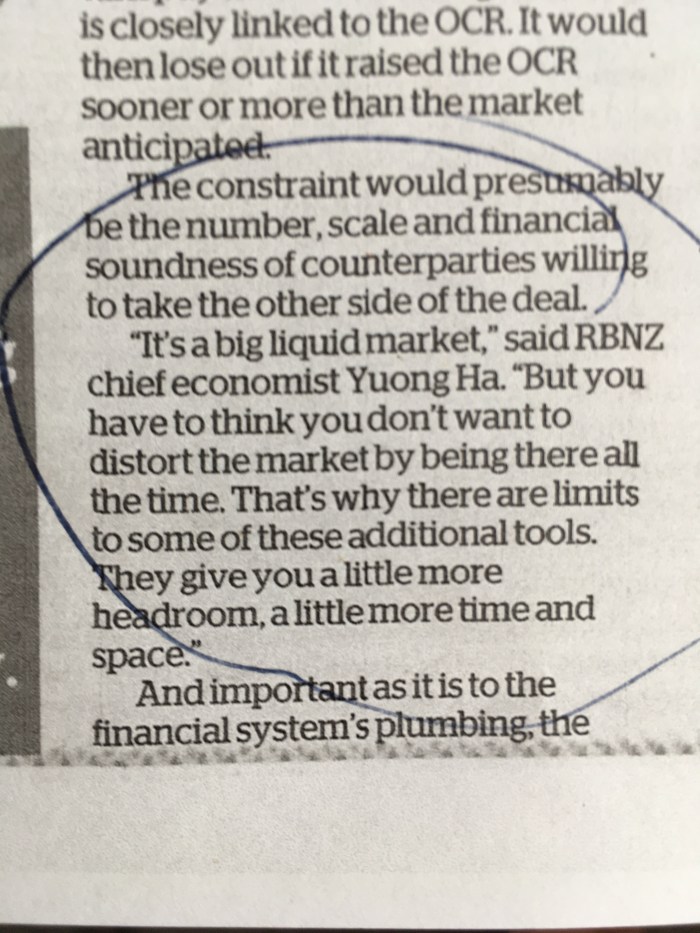
And finally, in the pre-action, phase, it might be reasoanable to ask whether the Bank’s Chief Economist was correctly quoted in the  Herald on 13 March, when he is reported as saying  –  of the various possible unconventional instruments (asset purchases and the like) – that “there are limits to some of these additional tools.  They give you a little more headroom, a little more time and space.”

The Present

The Monetary Policy Committee finally acted on Monday morning 16 March.   The OCR was cut by 75 basis points to 0.25 per cent, but a floor was put in place at that level. The Committee pledged not to change the OCR “for the next twelve months”.     It was an extraordinary commitment to make amid so much uncertainty, and again suggested a degree of misguided complacency or comfort that something close to the worst had already been seen.

But, most importantly, the new floor came completely out of the blue.  There had been no hint of it in the speech or interviews the previous week and we have still seen not a shred of analysis in support of a floor at that level.  Various central bankers were wheeled out to tell us that not all banks’ systems could cope with negative rates and that the Reserve Bank didn’t now want to put any pressure on those banks.

So, a reasonable question might be when did the Governor and the MPC first learn that not all banks’ systems could cope with negative interest rates?  (For that matter, when did they ask?)  How many banks had this system failure, and roughly what share of the banking market do they account for?    Are the issues with retail or wholesale systems bearing in mind that many overseas wholesale rates have been negative for several years)?  If retail, given that term deposit rates are still mostly above 2 per cent, and lending rates higher (often much higher) than that, why couldn’t the OCR have been cut further?

Another reasonable question might be to ask what steps is the Bank now taking –  and at what level of the organisation – to insist that banks either get ready for negative rates or risk being left to one side in favour of those that are ready? (Bank spokespeople have suggested a negative OCR might be an option some time down the track.)  What deadlines have been given by the Bank?  What commitments made by the tardy banks?  Why is there no naming and shaming (in fairness, it might be easier for a journalist to ask each bank and do the “naming and shaming” that way).

The Governor has indicated that urgent work is proceeeding on details of a deposit insurance scheme. What, if any, urgent work is underway on easing or removing the constraints that give rise to the effective lower bound on nominal interest rates?  If none, why not?

The Bank has announced a large scale purchase programme of government (and now local authority) bonds.  How would the Governor evaluate the effectiveness of that programme.  It is easy to see that it has limited the sell-off in government bond yields, and perhaps in some other asset markets, and thus limited any tightening in monetary conditions.  But relative to the conditions the MPC delivered on 16 March, is there any credible evidence that the asset purchase programme has eased conditions, and thus materially substituted for a lower OCR itself?  If so, what are the relevant transmissions mechanisms.

The Bank has injected huge amounts of settlement cash to the banking system. Given that all settlement cash balances are now being remunerated at the OCR itself –  the previous tiering system has been scrapped for now –  aren’t you at risk of further holding up market interest rates by offering almost unlimited risk-free investment at 0.25 per cent?  (This is a concern that, for example, George Selgin had posed in the US in the wake of the Fed’s earlier large scale asset purchases.)

The Governor might reasonably be asked about the falls in inflation expectations observed in both surveys and market prices, and invited to offer his thoughts on how those expectations are likely to be returned to around 2 per cent when (a) his asset purchase programme is achieving little overall loosening, and (b) MPC has pledged not to cut nominal interest rates further, no matter how bad the economic and inflation situation gets.

Relatedly, the Governor might be invited by the Committee to tell it how much real retail interest rates (borrowing and lending) have fallen since the start of the year, and to contrast that with the scale of the reductions in each previous New Zealand recession.  Hint: there has been almost no reduction at all (and, at a wholesale level, the real five year government bond rate is at the same level now it was in early December).

Since the Reserve Bank’s last economic projections were completed in early February, perhaps the Governor might be invited to comment on the inflation numbers in The Treasury’s economic scenarios published yesterday (the Secretary to the Treasury is, after all, a non-voting observer at the MPC table).  The best of those scenarios had inflation at 1.25 per cent for each of the next two years (several scenarios had negative inflation), outcomes which –  if realised –  would risk further entrenching lower medium to long term inflation expectations.  Are such outcomes consistent with the Bank’s own thinking, and if so would they be acceptable to the Committee?  If not, why won’t they ease monetary policy further?  And if the Governor thinks the Treasury numbers are too pessimistic, what channels does he expect to be at work to avoid such low inflation?

Perhaps time might be spared for a hypothetical: what does the Governor think would be worse, in terms of the economic responsibilities the Bank has, if the OCR were able to be set at,say, -5 per cent and retail lending and deposit rates were commensurately lower (modestly negative)?  Inflation?  Employment?  What? How?

Given the Governor’s enthusiasm for the employment dimension of his new mandate, how does an adamant refusal by the MPC to cut the OCR further no matter how bad the economic situation gets square with all that rhetoric?

Does the Governor (and MPC) now regret the “no change for 12 months” commitment?   What positive stabilisation value did it add, given that no serious observer has ever supposed that OCR increases were at all likely in the year after 16 March?

Here it is perhaps worth adding that the Governor is well known as an enthusiast for the active use of fiscal policy, to pursue all sorts of personal agendas.  However, he is Governor of the Reserve Bank, responsible for monetary policy, and his refusal to actually use the tools he has –  and is statutorily charged with using –  seeems little short of dereliction of duty.

The Governor might also be asked about the foreign exchange intervention option. Very unusually for a New Zealand recession, the exchange rate has fallen very little at all (even though one of our major export sectors is just shutdown completely for the time being).  The Bank has indicated that foreign exchange intervention is one of the tools open to it to attempt to ease monetary conditions further. Why has this tool not yet been deployed?  How effective does the Governor expect that it could be?  (For what it is worth, I’m sceptical as to how much difference it will make, but (a) we won’t know until we try, and (b) if it is tried and failed, it would help turn the spotlight back on the adamant refusal to adjust the OCR.)

And finally for this section, there was that op-ed of the Governor’s a couple of weeks back that concluded with this injunction

Support each other, think beyond just the next six months or more, and visualise the role you can and will play in the vibrant, refreshed, sustainable, inclusive New Zealand economy.

Just which planet was he on as he touted this vision of a “vibrant, refreshed” New Zealand economy as the wreckage mounts of one of the biggest economic shakeouts, and losses of wealth, ever?

Oh, and when he was stating at about the same time that New Zealand had perhaps the strongest banking system in the world, how does he square that with his relentless rhetoric last year in favour of much higher ratios of bank capital, all the time suggesting that even if that were done our banking system would not then be out of step with international norms?

The Future

Why will the Reserve Bank not publish all relevant background and analytical papers relevant to monetary policy decisionmaking this year?

The Reserve Bank’s balance sheet has been hugely increased by the interventions undertaken in this crisis.  Experience in other countries, after the last recession, suggests that getting back to normal size is likely to be a long slow process.  One of the risks of very large central bank balance sheets is that central bankers then become part of the credit allocation process itself, favouring some sectors, disfavouring others (in ways usually more appropriate to fiscal policy).  What protections do citizens and taxpayers have against balance sheet choices being made by the Governor  –  still the single decisionmaker in key areas –  in ways that advance his personal political agendas.

What approach are you planning to take to economic forecasting for the May Monetary Policy Statement?  Can any central forecasts be particular meaningful or instructive in such a climate of extreme uncertainty?


The Treasury’s economic scenarios

The Treasury this morning released a report to the Minister of Finance offering several scenarios for how the economy might develop over the next few years.  Before getting into the substance, there are a few points worth noting:

  • these are not forecasts, but are best seen as conditional projections (mostly on unchanged macro policy –  fiscal and monetary –  and then various different assumptions about the extent of the (a) the policy restrictions, and (b) the state of the world economy,
  • note that “unchanged fiscal policy” here includes the fact that the current wage subsidy scheme expires in June (in fact, much of what will be paid has already been paid, since it is a lump-sum scheme from government to firms),
  • two of the scenarios allow for some fairly significant additional government spending,
  • none of the scenarios seems to explore different assumptions about the how the private sector responds (all the variation arises from government anti-virus measures only),
  • none of the scenarios really seems to explore the economic implications of a mitigation strategy
  • with one exception, the scenarios all seem to have real GDP back to around the previous path (HYEFU 2019 forecasts) by the year to June 2024.

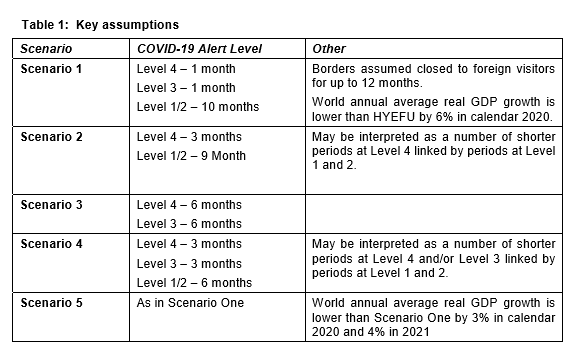
These are the five basic scenarios, all with unchanged macro policy.

tsy covid 1

I noted in my post this morning that it was relatively easy to get to forecasts of a 20-25 per cent fall in GDP in the June quarter even on assumptions that the restrictions are wound back relatively promptly after next week, and that I was surprised how (relatively) modest many of the falls forecasts by bank economists had been.   I was, therefore, pleased to find that on The Treasury’s scenario 1 they project that GDP would fall by 25 per cent in the June quarter.  They are perhaps a bit less pessimistic than I am on how much smaller the economy is under the current Level 4 –  they assume 40 per cent while my stab in the dark is 50 per cent –  but relative to many of those other private sector forecasters I was encouraged to see where they had got to.  In this scenario, Treasury projects that GDP would be back to 90 per cent of normal by the September quarter.   That seems excessively optimistic (when overseas tourism alone accounts for 5.5 per cent of GDP).  On their telling, alert level 1 –  borders still closed, world economy still pretty deeply depressed – only results in a loss of New Zealand GDP, relative to normal, of “5-10%”.  Perhaps.

I reckon The Treasury is generally understating the scale of the world economic losses.  But Scenario 5 deals with that in part –  scenario 1 locally, but with a deeper and more protracted world economic downturn.  The 9 percentage point hit to GDP growth in calendar 2020 and 4 percentage point hit in calendar 2021 seems more in the ballpark of what Treasury expects to see for New Zealand (across the range of scenarios).    In scenario 5, however and somewhat remarkably, the unemployment is only 10.5 per cent by the June quarter of next year despite no material further policy support/stimulus.  That would be a surprise.

Unsurprisingly, the very worst economic outcomes are under Scenario 3 –  six months of “Level 4” and six more months of “Level 3”.  On that scenario, the unemployment rate is 22 per cent a year from now, with GDP having fallen another 23.5 per cent in the full year to June 2021 relative to the June year 2020.

As I said earlier, Treasury does not explore differences in assumptions about how the private sector respond. And at this stage they don’t seem to provide any information on how quickly they’ve assumed foreign travel (inward and outward) would revive.  The document is what it is, but I hope they will before long offer some more detail as to how they are thinking about such issues/risks.

The paper is written up in a way designed to make the government and the Reserve Bank pretty happy.   As I’ve said, the five basic scenarios assume no further macro policy support.   That is without precedent in a post-war New Zealand recession, when monetary policy would usually be eased very very substantially, and the additional stimulus that easing provides is part of what gets the economy back towards full employment as fast as possible.  In these scenarios the exchange rate does not fall far at all .  And the Treasury makes no mention of the Reserve Bank’s refusal to cut the OCR further or deal with the physical cash related constraint on just how far they could usefully cut right now.  And they have bought into the idea that the Bank’s announced large scale asset purchases are easing monetary conditions relative to what is implied normally by an OCR level of 0.25 per cent.    That is, at best, a heroic assumption, and even much of the Bank’s own commentary has talked in terms of the announced asset purchases limiting a tightening in overall monetary conditions.

Frankly, with no additional macro policy support at all the base scenarios, which assume a return to full employment by the year to June 2024, seem optimistic to say the least.  There is, for example, no mention of how many years it took to get back to full employment after the much-milder 2008/09 recession, even with the support of big cuts in interest rates and the demand impetus from the Christchurch repair and rebuild process.

Still on monetary policy, Treasury publish the inflation forecasts consistent with their scenarios and with unchanged monetary policy.   In none of those scenarios does inflation get back up to even 1.5 per cent until the year to June 2024 (whereas Treasury had been forecasting inflation at around 2 per cent from here on out).  In all the base scenarios inflation drops below 1 per cent –  in some cases goes negative –  in each of the next two years.  There is, then, the small matter of real interest rates –  which will be rising, since Treasury assumes no change in nominal rates.  That represents another downside risk to the economic outlook.

As I noted, all those base scenarios assume current announced policy only.  That includes the expiration of the wage subsidy scheme in June.  I don’t suppose anyone really expected that the government would simply let the scheme run off, with nothing to replace it, in June.  If they were to do so, it is likely that the measured unemployment rate would go much higher.

So The Treasury offers us two more stylised scenarios.  Under scenario 1 (the optimistic one about how quickly alert level restrictions are eased) they toss in another $20 billion of fiscal support aimed at households and businesses.  This variant boosts GDP by 2 per cent over the next year but –  somewhat remarkably –  lowers the unemployment rate by 3 percentage points.  This is the somewhat heroic scenario in which the unemployment rate peaks at only just over 8 per cent and is back at 5.5 per cent by the middle of next year.

Under scenario 2 (see above) we have two more months at Level 4 restrictions and only then drop back to levels 1/2.  In a variant, The Treasury throws in another $40 billion of idscal spending.  Despite the much-worse backdrop, this package is assumed to raise GDP by 4 per cent but only lowers the unrmployment by 3.5 per cent.  Again, the unemployment rate is only 6 per cent by June next year –  all thanks to the power of fiscal policy.   After the last recession, supported by monetary policy and the rebuild, it took five years to get the unemployment rate down by a full two percentage points.

As a final observation, as far as I can tell there is no allowance in any of the scenarios for future fiscal policy tightening, even in those with much much more fiscal stimulus frontloaded.   Given the likely level of public debt that will emerge from all this, it seems unlikely that by 2024 there would be no pressure for a tighter fiscal policy to start lowering again the ratio of public debt to (normal) GDP.   After all, bad as this crisis has been, all the arguments  – about vulnerability to future shocks – used to support low levels of debt in the last 25 years will be just as valid then as they ever were.   And if fiscal policy is tightening, and monetary policy –  here and probably abroad –  is assumed to be doing little, it is even harder to see how we get back to full employment relatively quickly.

It is much better to have the scenarios than not to have them.  The important differentiation they attempt to illustrate is between different levels of government restrictions on economic and social activity.  But the basic level of shock underlying them all still looks as though it is a bit optimistic –  less perhaps about the June quarter (though see above) but about things like the pervasive level of economic uncertainty that seems likely to persist (and be reflected, for example, in a willingness to invest and to lend).   Perhaps one way of seeing that is to do the thought experiment of what if domestic interest rates were assumed to fall by another 500-600 points (and some associated fall in the exchange rate).    Then the speed with which economic conditions get back towards normal in these scenarios might have seemed more plausible –  consistent with past serious recessions.  As it is, it looks a bit as though they have –  consciously or not –  assumed away some of the severity of the problem, in turning keeping the spotlight off the Reserve Bank and off their Minister who has the power to compel the Bank to act.   Monetary policy is supposed to be the primary stabilisation tool.  Failure to use it –  going off gold –  greatly exacerbated the Great Depression; failure to use it now (getting wholesale interest rates materially negative) risks greatly exacerbating this slump.


Measuring the slump

One of the current challenges for economists and others is making sense of the scale of what is happening to economic activity, employment, unemployment, underemployment etc at present.

It isn’t helped by the persistent refusal of successive governments to fund Statistics New Zealand adequately for core functions –  you could think of the Census debacle, but I’m more focused on basic macroeconomic data.  We and Australia are the only two OECD countries without a monthly CPI, our GDP estimates (quarterly only, as with most countries) come out only with a very long lag, we don’t have a monthly industrial production series, and we still don’t have an income-based measure of GDP.   One could add into the mix the degraded state of our timely net migration data too, although for the time being I guess that won’t matter much to anyone (largely closed borders and all that).

Those failings can’t be fixed in short order, although I hope that as we emerge from this crisis the weaknesses in our statistical base will prompt some fresh thinking and a willingness to spend more on these core public services (ones for which there are few votes).

I suggested a couple of weeks ago that for now Statistics New Zealand look at hosting some sort of dashbboard pulling together, and making openly available, all manner of formal and informal economic indicators.  There have to be lots, and I’m sure various government agencies are either producing or collecting all sorts of bits of information, but there are real gaps in what is available to analysts.

There are also some temporary initiatives SNZ could look at implementing.   For example, New Zealand’s unemployment data are drawn from the quarterly Household Labour Force survey.  At present, we can expect no information on anything from the June quarter until early August –  almost four months from now.  But the HLFS is conducted by surveying thousands of households each month, steadily through the quarter.     The full sample will, obviously, tend to produce more accurate estimates than, say, a third of the sample. But there doesn’t seem to be any obvious or good reason why, for now, SNZ could not calculate and publish a subset of the key HLFS series each month, within a couple of weeks of the end of that month, drawing on the sample of households surveyed during that month (still thousands).  The regional numbers might be not worth publishing, and perhaps the fine age breakdowns too, but the headline numbers (unemployment rate, employment rate, participation rate, and perhaps each by male and female) would be very much worth having.  At present, the issue is not whether the unemployment rate is, say, 12.7 or 12.9 per cent, but whether it is more like 10 per cent or more like 15 per cent.  Without the HLFS we have no good way of knowing.   (And while this expedient would be unusual, SNZ has shown some willingness to do the unusual with early reads on foreign merchandise trade data.)  Having this sort of timely monthly data would be likely to be useful for at least the next year.

But there are also some real issues around measurement that are probably more specific to the immediate extreme dislocation.  Take unemployment as an example.  To be counted as unemployed in the HLFS, you have to be without a job, actively looking for a job, available to start work the following week.  And “actively looking” means more than skimming through adverts on job websites.  But right now, in the midst of the partial lockdown, opportunities for search are extremely limited (as are actual vacancies) and many people are extremely constrained in their ability to start work next week even if they wanted to.  There are issues around “employment” too.   To be employed, in an HLFS sense, you have to have done at least an hour’s work for pay in the reference week (assuming you weren’t on annual leave or similar).    But one wonders if the SNZ interviewers have been issued with good guidance as to how to treat people who may be at home at present, still being paid (to some extent or other) but who have done no work at all in the past week (that might encompass people normally doing a job that just can’t be done at home, or public servants never equipped to work from home, or…).  Some of those people might be being only partially paid, through the wage subsidy scheme, but who are pretty certain their current job won’t be there at the end of all this, and who are to all intents and purposes (if not for HLFS purposes) “unemployed” and doing whatever (perhaps little) they can to search for another job.

When we get the full quarterly data there will be a somewhat richer picture of the extent of labour underutilisation (for example, there are questions about hours worked in the reference week relative to usual hours worked), but getting a good read on this month –  which may be the worst of the economic slump –  will always be a bit problematic because we haven’t invested enough in a full monthly HLFS.   I’m not so cynical as to suppose this was a motive (even a month ago when the scheme was designed), but it is certainly convenient that with an election scheduled for September, the current wage subsidy scheme –  which will keep down headline official unemployment numbers, even if beyond that it is little more than (important as that is) a more generous income support scheme – runs into June, encompassing most of the last full HLFS to be out before the scheduled election.

(There are going to be some related sorts of issues with the other main labour market series, the Quarterly Employment Survey, which captures people employed and the hours they are paid for –  both valuable in normal times –  not the amount of work actually being done.  In some areas of the GDP estimates, QES numbers are used.)

I’ve been quite surprised by how small the forecasts for the fall in GDP over the June quarters from a couple of banks have been  (although also not sure how long ago they were finalised).  As noted yesterday, I struggle to see how right now the economy is not running at perhaps 50 per cent of normal (even if a larger percentage of the workforce than that may still be on full pay).  Even if there was a considerable rebound in May and June, if the government decides to allow more activities to occur, it is easy to see a 20-25 per cent fall in GDP in the June quarter.     But whatever the “true” scale of the fall, it seems unlikely that SNZ will have a close-to-accurate read on that fall (and then only quarterly, on official measures) for a very long time, perhaps ever.  We may be more reliant on academic estimates, generated in research papers in years to come, for a “true” read.  And without quarterly (business) income data at present, whatever official estimates SNZ does publish later this year are likely to have substantial margins of error, and be subject to substantial revisions for years to come (it takes several years for GDP numbers to settle towards finality at the best of times).  Indicators that serve reasonably well in normal times may be little use in this exceptional period.

Thus, it will be easy enough to get data on who has been paid, and how much, during this quarter, but not on what they are actually producing.    Working from home is generally less productive –  if it were not so, it would be done more often in normal times.  Working at physical distance is generally less productive (ditto).  But if, for example, much of the public sector component of GDP is estimated from employment/paid hours data….and many of those people are doing little, or even doing quite a bit but much less productively, how will the official statistics ever capture that as a reduction in real GDP?  Nominal GDP data should be subject to fewer distortions, and perhaps we will need to focus more on that than usual over the next couple of quarters.

No doubt there are all sorts of smaller issues, many of which perhaps don’t matter as much.  Clearly the effective cost of groceries has risen this month –  between waiting times, limited choice, no packers etc –  but I’m sure none of that will end up in the CPI.  The actual potential consumption basket is also very different now than in normal times – and in some respects may stay different for some time to come (overseas travel components of the CPI anyone?).

There are real challenges here for analysts and for statistical agencies, in our case SNZ.    In some cases, there are no easy answers (in others, there are some possible remedies).  What would be helpful early on would be some proactive communication from Statistics New Zealand on how they are planning to respond, and to meet the reasonable public demands for information, partial as much of may for a time inevitably be.    It isn’t a time for insisting on utter accuracy: that is important in normal times, but at present the urgency of the situation outweighs that, with more of a need for timely indicative numbers.  As an example of what can be done, see the recent estimate by the French national statistical agency, stepping outside their normal formal frameworks but using the data they, and only they, have overall access to, to produce estimates of the real-time loss of GDP (to which I was pointed by an SNZ manager).  There are gaps here that really only SNZ can adequately fill.

Some economic dimensions

No one quite knows –  and may never do so –  quite how bad the slump in GDP is during the current four-week partial lockdown.  We don’t have a monthly GDP series (unlike Canada and the UK), our quarterly series comes out with a very long lag (June quarter data should be around in late September) and we can expect greater than usual revisions to that data in the years to come, and (so far at least) there is no sign of Statistics New Zealand doing the sort of flash estimate the French statistical agency published a few weeks ago.     One thing to remember is that to whatever extent consumption is holding up, there is almost certainly large-scale destocking going on.

But whatever the scale of the slump in value-added (GDP) where would it take us back to, in real per capita terms?  Using the Conference Board database (which goes back to 1950) here is GDP per capita for each year as a percentage of last year’s.

old GDP

If GDP for the current month were 64 per cent less than last year’s, we’d be back to real per capita GDP levels in 1950.  60 per cent takes one back to 1957, and a 50 per cent fall to 1970.

If, perchance, you are an optimist, a 40 per cent fall takes us back to 1984 and a 30 per cent fall to 1997 levels.

Now, of course, there are important differences.  First, the fall in GDP during the partial lockdown is for four weeks only, not a full year.  But second, plenty of people (think public servants, farmers etc) aren’t losing any income at all – even if, as in the case of many public servants value-added is likely to be down – while others are facing catastrophic losses.   By contrast, in 1950, 1957, and 1970, there was pretty much full employment in New Zealand.  The third important difference is, of course, the scope for a rebound – the underlying technologies and knowledge that made our society relatively prosperous haven’t suddenly disappeared.

Time and fragmentary data will eventually tell, but I struggle to see how the economy right now can be running at more than 50 per cent of normal.  There are baseline things that haven’t changed:  the imputed rent on owner-occupied housing is the starkest example, but you could think of Police, supermarkets (and their suppliers), farmers, the main news media outlets, and so on.  Others probably aren’t very adversely affected: banks as an example (in terms of GDP contribution), and some online services. But even in the public sector, there will be plenty of areas where real value-added will have dried up –  not much activity for immigration or biosecurity staff at airports, hospitals are much emptier than usual and so on.  Getting paid isn’t the same as producing: in many cases, the real value-added just won’t be there, just income transfers from employers (including government ones) to employees.

Of course, whatever the extent of the loss of output/value-added at present, perhaps that loss will be shortlived and we will soon emerge to some slightly less-restricted scenario.  There was one optimistic columnist last week looking forward to a scenario in which New Zealand had, in effect, “eliminated” the virus and so life could, in time, return to “normal” behind our ocean moat: this was described as an “idyllic scenario”.  In overall economic terms it would be anything but.    Recall the statistic I heard quoted by a government minister at the Epidemic Committee a week or two back: just over 9 per cent of New Zealand jobs stem from overseas tourism.  So there is a tenth of the workforce added to the unemployment numbers, alone enough to still leave us with the highest unemployment rate we’ve had since before World War Two.  And if the virus continues to rage in the rest of the world, even if only lurking in some places, the fear and uncertainty will remain very real. Business and consumer confidence will remain extremely low. Willingness to commit to long-term contracts will be at a very low-ebb, so private investment (20 per cent of GDP) will be very low.  And banks, quite rationally, will be very cautious indeed, watching out for the adverse selection problem –  people keen to borrow in such a climate will, in many cases, not be those banks would sensibly wish to lend to.

Now, sure, there is some scope for substitution. But for those (many) accustomed to sunny winter holidays, Ohope or Whangamata in the July holidays just isn’t going to be a serious substitute.    And there are going to be compounding supply chain problems –  not just for local producers, but for local consumers, as not only foreign production of many items is disrupted, but air and sea freight services, and local distribution, just don’t work as they once did.  Even if people are keen to spend –  and many won’t be –  their options are likely to be fewer, even behind the moat.

Of course, direct government demand for goods and services (as distinct from just income transfers) may boost economic activity to some extent.  But (a) realistically, it will take some considerable time for even ambitious schemes to hit the ground in meaningful ways, and (b) as the scale of the gaping fiscal deficits begins to hit home, people (firms and households) are likely to begin adjusting their behaviour, at least to some extent, to allow for the near-inevitable fiscal austerity (higher taxes, cut to some other spending) to come.

At this point, specific numbers are really not much more than a marker of broad orders of magnitude, but even if that Hooton “idyllic scenario” were to be in place by, say, the start of the third quarter, I struggle to see how real GDP is not still perhaps 15 per cent (range perhaps 10-20 per cent) lower than otherwise for the second half of the year.   That would still be by far the deepest recession we’d had since before World War Two.  (And simply on the revenue losses alone –  automatic stabilisers to be sure, but it could take some years to fully recover –  that could add 6-7 percentage points to the fiscal deficit as a share of GDP.)

Finally, I wanted to draw attention to a piece published on Thursday by Bryce Wilkinson of the New Zealand Initiative, under the heading “Quantifying the wellbeing costs of COVID-19”.   I haven’t seen any media coverage of it, which is a shame.  It is a nicely framed and phrased note.  This is from the summary.

In deciding whether to extend the current lockdown, the government must balance the likely benefits of reduced sickness and deaths against the cost of lost national income and jobs. To do so systematically requires an analytical framework that organises the available information.

A preliminary model illustrating how this can be done was published in 2017 by five of New Zealand’s leading epidemiologists and colleagues. This research note does not critique that model. Instead, it uses it to quantify the possible costs of morbidity and mortality due to Covid-19 as a starting point for further analysis and debate.

(Among the co-authors are the newly- prominent Otago academics Michael Baker and Nick Wilson.)

(And before anyone gets upset at the idea of economists wanting to “sacrifice the old”, I hope Bryce won’t mind me pointing out that since his PhD was awarded in 1976, and he got his first degree in 1968, I’m pretty sure he must be over 70 himself now.)

What is the nature of the exercise?

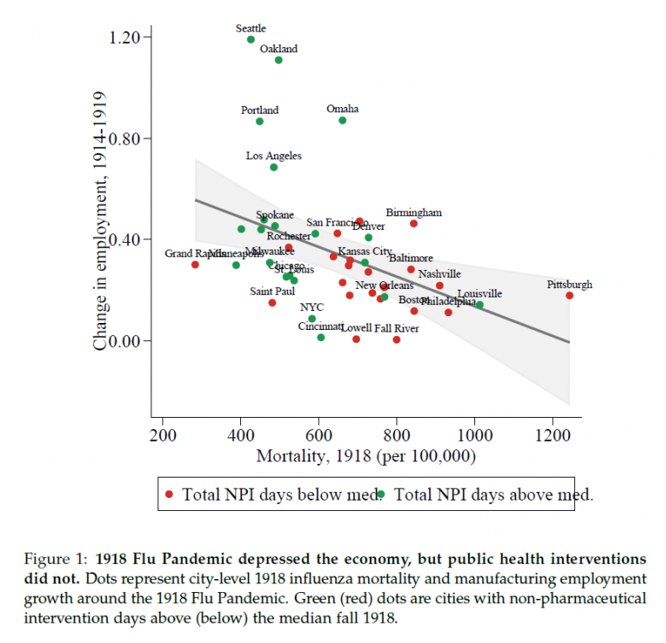
The five New Zealand authors developed the model using parameters drawn from the experience of the 1918 flu epidemic. Some have since made a major contribution to the papers addressing the Covid-19 crisis published by the Ministry of Health in the last fortnight.

Unfortunately, an updated version of the 2017 model does not appear to have been published. Nor do the recently released papers appear to express the potential morbidity and mortality implications of Covid-19 in terms comparable to costs.

This research note takes the 2017 spreadsheet model as given and modifies it only to measure the morbidity and mortality rates indicated for Covid-19 in the papers.

Bryce adds the caveat

It cannot be stressed enough that these results are highly conditional. This report is a contribution to public debate, nothing more. Hopefully, the public sector is building much better models to advise ministers.

I wish I had any confidence that they were.

These are the adjustments/updates done

b) Modifying the model to Covid-19 parameters.
The first necessary adjustment replaced the age distribution of deaths for the 1918 flu epidemic with one that considers that Covid-19 disproportionately kills the elderly.

Values for the age distribution for hospitalisation and deaths were taken from Table A3-2 in a February draft paper for the Ministry of Health.8 With some interpolation, it showed those aged at least 65 years accounted for 35% of estimated 336,000 hospitalisations and 82% of deaths. In its “plan for” scenario, the number of hospitalisations was kept at 336,000 whether deaths were 33,600 or 12,600.

The next step was to align various other parameters with advice from New Zealand’s leading epidemiologists to the Ministry of Health.

Specifically, a draft paper for the Ministry of Health dated 27 February 2020 provided the following guidance about relevant parameters:9
• 65% of the population (3.23 million) stood to be infected if the virus was “substantially uncontrolled;”
• 34% of the population (1.68 million) would be symptomatic.

The total 2014 population in the 2017 model was scaled up until 65% of the 3.23 million were infected which increased the value of a lost QALY was to $52,500 (national disposable income per capita for the latest available year).

With a bottom line as follows

The adapted model indicates spending 6.1% of GDP to save 33,600 deaths, or 3.7% of GDP to save 12,600 lives, is economically justifiable. To spend more begs the question of whether more lives could be saved over time if [as illustrative examples of the sort of prioristisation that routinely goes on in public and private choices] the money went instead to make safer roads and buildings, or perhaps spent on other health services.

There are a number of caveats and uncertainties listed on page 6 of the note.  The first of them is

This presumes spending 6% of GDP would achieve the hoped-for savings. It would not justify spending as much where there is only a modest chance of success.

As I said, I thought it was a nice, short, note highlighting some of the issues and choices; a way of thinking about things which should be influential with policymakers and advisers even if (with all the resources available to them) the specific estimates and assumptions Bryce uses might be usefully refined.

Of course, even if in some sense Bryce’s numbers are “right”, it isn’t entirely clear how much further ahead it leaves us, whether individually as voters/citizens or for the government supposedly making collective decisions on our behalf.   As I’ve noted in various posts here it is really important to think in marginal terms –  eg how many lives are likely to be saved from this particular intervention –  not in the broadbrush.

Almost certainly, (New Zealand) GDP this year will be more than 6 per cent lower than otherwise. But interesting as that number is for some purposes, much of it simply isn’t a matter under the control (or heavy influence) of New Zealand governments.  The world economy –  yes, even China –  is in a very severe slump, and there isn’t anything much we can do about that (although, hobbyhorse issue, sorting out domestic monetary policy would help a little).  There is no global coordinating mechanism.   Travel bookings to New Zealand were slumping well before the government closed the border and imposed quarantine requirements (and if the government re-opened the border tomorrow there still would not be much travel).  Domestically, many people had made choices to, for example, avoid air travel, or avoid large events etc before any restrictions were in place.  The relevant metric for New Zealand policymakers is surely the marginal economic costs of their specific interventions, relative to the marginal number of lives saved as a result only of that same set of interventions.

Recall too that Bryce’s numbers are expressed as a share of annual GDP.  But suppose a series of domestic lockdowns (to a greater or lesser extent) affected economic activity for only a quarter, then even if everything else in the note was accurate, it could be worth sacrificing almost 25 per cent of one quarter’s GDP purely as a result of those lockdowns if by doing so the authorities were highly confident of saving the 33600 lives purely as a result of those lockdowns.  For the economic costs, that order of magnitude might yet be in the right ballpark for the marginal impact of these lockdown measures.  Whether, with a high degree of confidence, that many lives are likely to be saved purely as a result of those specific interventions isn’t something I’m going to opine on.

There aren’t many, perhaps any, clearcut answers to many of these issues (apart from anything else, no one knows the end-game), but that doesn’t make a disciplined framework for trying to help structure thinking and policy advice any less valuable.   One would like to think that The Treasury, the Ministry of Health, and other key agencies are doing exactly this sort of thinking, and scrutinising and robustly debating each wave of results, and each apparent fresh set of insights on the broadly-defined costs and beneftis of each set of interventions being explored.

(And, although this is an economics-focused blog, I hope that when Cabinet is deliberating on choices in the next few weeks it isn’t just the measureable economic dimensions of the costs of interventions they focused, but also some of frankly inhuman restrictions that have been imposed to date, that treat families and civil societies as, in effect, some luxury considerations, able to be set aside at the whim of politicians.)


Comparing our experience with Australia

Cross-country comparisons are often enlightening, even if they just throw up more questions. In matters economic I’ve often highlighted New Zealand/Australia comparisons – both distant, resource-dependent, economies, with a similar legal and political background, market-oriented economies etc.

Ever since the coronavirus issue started to come to the fore it has also seem natural to try to make a little more sense of the New Zealand experience by looking at what is happening in Australia.  After all, both countries took the China travel ban route (us dragged along a day later by the Australian choice), both are islands (to the extent that matters at a time of more generalised movement restrictions), both have just come off summer (to the extent that may, or may not, matter) and both typically prided themselves on being open and democratic societies.  In both countries, (lots of) returning travellers seem to have accounted for most confirmed cases.

For quite a while, the raw numbers in New Zealand looked quite good relative to Australia. The first Australian case was more than a month before the first New Zealand one (by the time our first case was confirmed they had 25 confirmed cases).  When I was running some charts on the comparisons in March they were still perhaps two weeks ahead of us  (eg on 21 March we had 13 new confirmed cases, the number (adjusted for population), Australia had had on the 6 March). Quite why there was that difference wasn’t (still isn’t, that I know of), clear, although Australia had been doing more testing per capita. But the gap was beginning to close.

By mid-March some mix of government urgings and conscious voluntary unease and precautions was already inducing quite a lot of behavioural change, and physical distancing (I recall a quick trip to Auckland on 19 March, and coming back through a largely empty Auckland airport domestic terminal with a sense of the world closing down around us) but the extent of official restrictions was still a few days away from being beefed up dramatically.  The following week, New Zealand was put into a partial lockdown that went significantly further, in important respects, than the restrictions put in place by state and federal authorities in Australia.

Physical distancing works.  There seems little or no doubt about that.  Our government seems to have insisted on quite a bit more of it than Australian governments have.  And so over the last few days I have been intrigued, perhaps even a little puzzled, to watch the evolution of this chart.

CV cases nz and aus

It is an updated version of a chart I’ve shown before, showing new confirmed cases for the two countries, with the Australian total divided by five, to adjust for their much larger population.

You can easily see how their new confirmed cases numbers were well ahead of ours, right through until 23 March.  Then they more or less level-pegged for a week or ten days, but for the last week or more their confirmed new cases (per capita) have been running well below the new confirmed case numbers in New Zealand.

I don’t know quite what to make of that chart. I’m genuinely intrigued by it.  But a few points are worth making:

  • first, confirmed cases reported today do not reflect actions/choices made today, but those made up to, say, 10 days previously (take time for people to get infected, develop symptoms, get tested, and get the results reported),
  • second, I’m not sure we can yet put much weight on the idea that Australia’s position is now still worse than ours because they have more deaths and more in ICU.  Clearly, their position was worse than ours (the early weeks of the chart), but it takes time for cases to get serious enough for people to get to the ICU stage and/or die (see, most, prominently, the Boris Johnson cases) and three weeks ago we had very few new cases,
  • relative to many countries, our confirmed cases so far were for a long time more concentrated among younger people (travellers), where the effects of the virus are generally less serious (I haven’t seen the Australian data on that particular point),

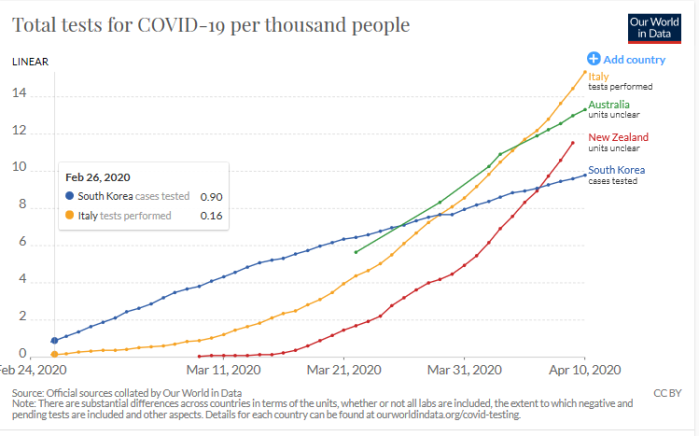
What of testing?  Australia has done more tests per capita than New Zealand, but in the last couple of weeks our per capita rate of new tests has been higher than in Australia. In both countries, the rate of confirmed cases to tests done is fairly low (a good sign about how much testing is being done).

tests april

Presumably in both countries not all actual cases are being captured in the numbers (this seems to be standard line worldwide), but whatever the “true” situation, all indications are that both New Zealand and Australia have, for now at least (and in some sense), got on top of the situation, and new cases numbers have not only not escalated, but fallen away (sharply so in Australia’s case).  In both countries, the reduced flow of travellers from abroad must have helped and (residually at least) the quarantine of the few remaining travellers.  Private choices to distance must have made a difference.  And so must government restrictions and injunctions.

But it must still be a bit of an open question quite what things explain which bits of the respective slowdowns in the number of new confirmed cases.  A detached observer two weeks ago might have looked at the respective regulatory regimes and controls in the two countries and reasonably have expected a much sharper slowing in case numbers in New Zealand than in Australia (that would probably have been what I would have expected).   But it hasn’t happened.  Perhaps it still will: time will tell.

Is it then possible that, given the extent of the virus in both countries, our partial lockdown –  and partial it is –  went further than was really necessary, well beyond the point where there were material marginal gross benefits at all?  I don’t know, and I don’t suppose anyone does at this point.  But in thinking about appropriate next steps it is a possibility that looks as though it at least needs to be explored, teased out and tested.  After all, there are gross costs to take into account before any sort of net benefit assessment is possible.

At very least there seems to be very little basis for the sort of all-or-nothing thinking embodied in the Prime Minister’s spin the other day –  waving around a chart of case projections from mid-March, contrasting it to the actual new case numbers, and suggesting –  at very least by implication –  that the difference is all about the extent of New Zealand’s stringent partial lockdown.   In principle,  only any superior performance relative to Australia should be able to be attributed to the more stringent regime in place here.  It is hard to get any sort of clean read on the “true” relative performance, but the prima facie numbers suggest reason to doubt we’ve done better at all.

Finally, and to be clear, I am not championing any particular approach to policy over the next few weeks.   There are details of the current regime that I regard as frankly barbaric and inhuman, unworthy of the sort of Prime Minister who endlessly exhorts people to “be kind” (as if we’d ever take our moral lead from Prime Ministers or MPs), but personally I remain somewhat uneasy about any very substantial easing of the economic restrictions in the near future.  That is visceral more than analytical. It is also easy for me to say –  my life hasn’t changed much through the lockdown (once a week to the supermarket rather than once or twice a day, and that’s about all), I like having the kids around (boring as it may be at times for them), our household income seems secure, and even family members with businesses seem able to run them more or less.  I might well feel differently if my livelihood were at stake. My only point here is that we need to keep testing and challenging interpretations, including against what is happening in other otherwise similar countries.  And relative to Australia, there are some real unanswered questions and intriguing puzzles.


Central bank watch

Our Reserve Bank has been all over the place on monetary policy going back to last year.

There was the totally out-of-the-blue 50 basis point OCR cut last year.  It may or may not have been substantively justified, but they never had a compelling rationale at the time and were reduced to dreaming up (quite reasonable) stories after the event.    The concern about minimising the risk of falling expectations was one of those stories –  good, but clearly an ex post rationalisation (since all the contemporary statements made little or no mention of the issue).

In the wake of that cut, the Governor gave quite a few interviews.  One of the most substantial was with Newsroom’s Bernard Hickey (there is a full transcript at the link).   In that interview – barely eight months ago –  we learned that the Governor had no particular qualms about a negative OCR and in fact preferred that options to large-scale asset purchases (“QE”)

The effectiveness of interest rate changes, even into negative territory, made it preferable to other types of policies such as quantitative easing, which is where central banks invent money to buy Government bonds to force down longer term interest rates.

and

Probably the most effective and simplest one is having negative interest rates – so, bizarre as that seems, it still operates the same difference around the shape of the yield curve, and it makes people either bring spending forward or delay spending: it’s just zero – around negative sides. It also makes people think much harder about alternative investments: so, it makes them think about putting their capital to work outside of just a bank deposit. And that is, again, another positive reason for monetary policy.

We also heard from the Governor about the importance of keeping inflation expectations up (ex post rationale for the 50 basis point cut).

We’ve spent a lot of time around, I suppose, regret analysis, and I spoke about – you know, in a year’s time looking back, thinking ‘well, I wish I had done what?’ And I thought it’s – I would far prefer – and the committee agreed – far prefer to have the quality problem of inflation expectations starting to rise and us having to start thinking about re-normalizing interest rates back to, you know, something far more positive than where they are now. And that would be, you know, it would be a wonderful place to have regret relative to the alternative: which would be where inflation expectations keep grinding down.

It was a really substantive interview –  much more so than any speech or other interview the Governor has given on monetary policy in his time in office.   Much of it was explicitly focused on options if conventional monetary policy reached its limits.  So you might reasonably have supposed that this sort of thinking would still have been the sort of framework the Governor had in mind when a really severe crisis began to unwind only a few months down the track.  And, specifically –  given the gung ho comments on a negative OCR –  you’d have taken for granted that the Governor had assurred himself that all relevant systems were ready to cope with a negative OCR.

More fool you (or me) then.

But on negative interest rates, it wasn’t just a one-off comment.     When this crisis was already well upon us –  on 10 March in fact –  the Governor gave a speech outlining the Bank’s monetary policy options.   As I wrote at the time, he was astonishingly complacent that day, but set that to one side for the moment.  In his discussion of options there was no hint at all that a negative OCR was about to ruled out of consideration, let alone of the argument he was shortly to fall back on that it couldn’t be done because (some) banks “weren’t ready”.   In fact when I saw this item in the table in the speech, I nodded approvingly (especially, in fact, about that second sentence).

Negative OCR

Reduction of the OCR to the effective lower bound (the point at which further OCR cuts become ineffective), which may be below zero. The Reserve Bank could consider changes to the cash system to mitigate cash hoarding if lower deposit rates led to significant hoarding.

In that speech incidentally, the Governor promised that the Bank would be releasing a series of technical working papers on the options over the following weeks.  As yet, we’ve seen nothing; not a shred of supporting analysis for the choices the MPC has ended up making.   Consistent with the balance in the speech, on 13 March the Bank’s chief economist was quoted in the Herald stating that asset purchases etc weren’t that much of a substitute for interest rates, but just give “give you a little more headroom”.

But by 16 March the MPC finally, quite belatedly, cut the OCR, but it was a mystifying “one and done” strategy.  A 75 point cut was all well and good, but suddenly  we had a floor being put in place on the OCR: not at the sort of negative levels several other central banks had gone to, not even at zero, but at 0.25 per cent.

And, the Monetary Policy Committee agreed to provide further support with the OCR now at 0.25 percent. The Committee agreed unanimously to keep the OCR at this level for at least 12 months.

And not a shred of substantive analysis for this position has been published.  All we get from the Bank is the bland assertion that (not all) banks were ready for negative interest rates (not even clear whether the problem is the wholesale rate –  the OCR –  or retail rates which are typically still well above zero)…..and (not having put any pressure on banks to be ready in the preceding years) they now don’t want to trouble the banks.  I’m sure there are myriad businesses across the country that today wish they hadn’t been troubled by regulatory interventions (let alone viruses).  But the Reserve Bank has suddenly become solicitous of the banks, in utter disregard of their statutory mandate, which focuses not on the convenience of banks but on price stability and employment.  In the face of the unfolding huge slump in economic activity and demand.

Within days, the MPC had lurched into a very large announced programme of buying conventional government bonds, supplemented further this week (more questionably) by huge purchases –  relative to the size of the market –  of local authority debt.

I’m not suggesting that the bond purchase programme was inappropriate given the MPC’s refusal to cut the OCR.  It is the sort of climate in which, all else equal, one might expect an upward-sloping yield curve to steepened.   But had they been willing to cut the OCR aggressively, including signalling action on the notes constraint, there would have been much less need to announce a bond-buying programme.  And, more importantly, real and substantial relief would have been provided to floating rate borrowers, redistributing income from floating rate depositors/funders (ie the way monetary policy usually works).  All else, the exchange rate would also have fallen….again, a typical part of how monetary policy works.   As it is, the announced bond-buying programme has, more or less successfully, capped the rise in government bond yields.  That is a gain worth having, been it falls a long way short of lowering interest rates across the board –  in the face of a simply unprecedented economic slump.  I’m pretty sure that no other central bank in history, with a floating exchange rate, has ever pledged not to cut interest rates into a deepening slump, no matter how bad things get.  But that’s the Orr Reserve Bank for you, accommodated by the Minister of Finance and his appointeee as chair of the Bank’s Board.

There has been a fair bit of commentary from the Reserve Bank over the last few weeks, some of it just weird (the Governor on Stuff last Sunday), others fairly routine.  What is worth noting is that not once, not in a single communication from any of the Monetary Policy Committee (whether the four internals who speak, or the three internals who stay silent and seem to avoid all scrutiny from the media). has there been any mention of falling inflation expectations, as a risk that needs to weigh highly with any central bank faced with a deflationary shock and a reluctance to cut interest rates further.  To the extent that expectations fall –  and they have been, on both market and survey measures – real interest rates start rising.  And that is the exact opposite of what the situation demands.  But, of course, the MPC has offered no analysis or commentary on why they are now so unconcerned about something that, when simply hypothetical, the Governor seemed very concerned about just a few months ago.

But I wanted to jump forward to a succession of comments this week from the second tier internal MPC members, Assistant Governor Hawkesby (Orr’s chief deputy on matters macro and markets) and Chief Economist Ha.

On Monday, Ha told Bloomberg (written responses to written questions)

“The OCR can technically be taken lower, but as outlined in the Unconventional Monetary Policy principles and tools document, we would assess the effectiveness, efficiency and an impact on financial system soundness of doing so,” he said. “That would also take into account the operational readiness of the banks’ systems to implement a lower OCR.”

Asked if the OCR could be lowered in increments of less than 25 basis points, he said adjustments have to strike a balance between making changes meaningful — “will it translate into changes in rates faced by New Zealanders” — and avoiding excessive fine tuning from smaller moves.

“We also have to avoid unnecessary volatility in interest rates and exchange rates in setting monetary policy,” Ha said. “International practice has largely settled on 25 basis point increments as a minimum.”

A lot of that made no sense at all –  especially the bit about avoiding volatility – but sadly the Bloomberg journalist doesn’t seem to have asked (a) why the Bank never ensured banks were ready, (b) the exact nature, and scale, of the technical constraints (is this one small bank or ten; is it wholesale or retail?) and seemed content just to report the Bank’s lackadaisical approch – never mind the economy, don’t bother the banks.

Then Bloomberg get a real interview with Hawkesby. Here were his comments on this issue

Asked about cutting the official cash rate further below its current level of 0.25%, Hawkesby said banks weren’t operationally ready for negative rates and the RBNZ had given them an assurance that was off the table for the time being. However, the central bank was “open minded” about a negative OCR, he said.

“There could well be point down the track, where time passes, that we do have a negative official cash rate somewhere, sometime in the future.”

“Where time passes”, “sometime in the future”……even as economic activity is collapsing around them now, and deflationary risks are rising. It is just an extraordinary approach, still not supported by any serious analysis, just this line about “keeping their word” to the banks.   Who are the stakeholders here?  Surely, the public –  the wider economy –  of New Zealand, with a statutory mandate about keeping inflation up near target and leaning against losses of output/employment?  Again, though, the questioning seemed pretty tame, but since the Bank only tends to grant interviews when the questioning is likely to be tame, I guess the journalist did what he thought he had to do.

Then Ha reappeared.  I’m going to take his latest two comments out of order.  This morning on RNZ I heard Ha talking up the success of the Bank’s asset-buying programmes, claiming that they had got lots of interest rates well down.    As noted above, no doubt that is true from the peaks, but it is to deliberately skate around the real issue.  Given the MPC’s refusal to cut the OCR further, very few interest rates have fallen far at all relative to where they were just a couple of months ago –  and nothing like what a slump of this magnitude would typically see.  All the big banks, for example, are offering well over 2 per cent for a six month term deposit, a more 20-30 basis points lower than they were offering in February.  In the midst of the biggest economic slump in history, real deposit rates are flat or rising.      That is simply a choice – an extraordinary one –  by the MPC, and one that their members never own up to or justify (and which, sadly, media never seem to challenge them on).

Ha’s other comments were in an interview yesterday with interest.co.nz.   There was quite a bit there I could unpick, including some comments –  similar to Hawkesby’s –  about the (strange to me) decision to buy local authority debt, perhaps even Housing New Zealand bonds (both of which sets of issuers are non-market entities) but not corporate bonds.    But I wanted to keep the focus on interest rates. From Ha we got this

While the RBNZ on March 16 cut the OCR by 75 basis points to 0.25%, and committed to keeping it there for at least 12 months, Ha said cutting it further is “probably something that comes back on the table at some point”.

He said the RBNZ had been mindful of giving banks some “breathing space” before going into negative interest rate territory.

Same complacency –  “at some point” (well after the worst is over?) –  same consideration for the banks, at the expense of the economy.   And still no serious rationale, no detail as to the nature of the issue, simply a bunch of officials –  ministerial appointees all –  who simply see no urgency about actually getting interest costs lower, even as though urge that more debt be taken on (as Ha did in his interview this morning, urging banks –  already facing higher risk and lower credit ratings –  to “step up”).

But in a way what really took the cake, and prompted this post, was the final bit of the report of the Ha interview

Pressed on why the RBNZ hasn’t released technical papers or more information explaining the rationale behind the unprecedented moves it’s making due to COVID-19, Ha said it was trying to be transparent.

He noted the speed at which things have been moving and how quickly data necessary for decision-making was becoming outdated.

He said the RBNZ was trying to be innovative, sourcing more real time data like credit card transactions, bank balance sheet data, information from the Inland Revenue and Ministry of Social Development and internet traffic.

Economists have been critical of the RBNZ, Treasury, Statistics New Zealand and government agencies more generally for not releasing more real time information ahead of regular releases.

I totally share the concern in the final paragraph (isn’t it extraordinary that we don’t yet routinely have weekly data on new unemployment benefit applicants, or a commitment from SNZ to publish indicative HLFS data monthly for the duration, and so on.  And it is good to hear that the Bank is looking at more real-time data but……..that claim that the Bank itself “was trying to be transparent” is simply belied, day in day out, by their actions and choices.  It is either an outright lie, or (more probably) just a typical manifestation of a longstanding approach: to them transparency means telling us what they think is good for us to know, and only that.

Of course, things are moving quickly. Of course data are quickly outdated.  Most probably some of the analysis presented to the MPC has been overtaken by events.  But that doesn’t justify the secretive approach the MPC continues to take, as they’ve embarked on huge monetary experiments (in this case,  for example, lets not cut the OCR despite the biggest most sudden economic slump in many half-centuries) or as they’ve lurched from one “model” to another with no explanation whatever.  It simply isn’t good enough.

I reckon their stance of policy is utterly indefensible, and have urged the Minister of Finance to use his long-established statutory powers to override the MPC’s choices (crisis times justify use of extreme, but well-established, statutory provisions).  Presumably the MPC members –  each of them, internal and external –  disagree.  Presumably they have a story to tell about:

  • why inflation expectations no longer seem to matter when they were a big concern a mere matter of months ago (exactly the same MPC members),
  • why doing something serious about negative rates was a realistic option on 10 March but by 16 March it had been absolutely ruled out for at least a year,
  • why real interest rates that are little or no lower than they two or three months ago remain appropriate in the face of the huge economic slump and deflationary shock,
  • why the MPC had done nothing to ensure banks were operationally ready for negative interest rates (retail or wholesale)

and so on.  But they’ve given us precisely nothing.

If Yuong Ha is remotely serious about his claim that the Bank/MPC is trying to be transparent, there is an easy remedy: simply release all the staff papers that have gone to the MPC this year to date (extraordinary times, extraordinary departures from usual practice).  It is, after all, official information, generated with taxpayers’ money for public policy purposes.

But of course they aren’t serious.  They were asleep at the wheel in getting prepared, complacent as the economic risks began to mount, and now seem out of their depth,  lurching from story line to story line, and oblivious or indifferent to the scale of the economic fallout and the way monetary policy should be responding.  Capping a rise in government bond yields is all very well and good, but it is a long way from actually fulfilling the mandate Parliament and the Minister of Finance have given them.

We deserve better, from the Bank/Governor/MPC, but also from those who have the power to do something about it: the chair of the Bank’s Board and, most notably, the Minister of Finance.  But seems the latter himself seems to have no vision or overarching framework for thinking about the economic dimensions of this crisis, and is ever loathe to go against conventional wisdom –  whatever it is at the particular hour – we can expect nothing from him.

(And, of course, talking of transparency, isn’t it remarkable that not a single Cabinet paper or substantive officials’ papers – whether or the health or economic dimensions –  has yet been released, even as one of the biggest crises for a century breaks over us, extraordinary powers are taken, rights shredded etc etc.  It was a government that once claimed it would be the most open and transparent ever. You have to wonder what the government and the Bank have to be afraid of. It isn’t that the enemy is listening –  it is a virus remember – but perhaps the fear is that we might see just how threadbare much of what has been done has been based on.  I suspect the Ombudsman is going to be kept busy for the next few years adjudicating on the determination of agencies and ministers –  including the Bank – to simply not be transparent at all.)

Framing an economic policy response

I’ve been championing the idea of thinking of what the government does now financially in terms of a national pandemic income insurance policy, of the sort we might have formally set up had we thought about it decades ago, but which also wouldn’t be inconsistent with the cautious way successive governments have run aggregate fiscal policy over the last 25-30 years.  I used these two charts this morning responding to someone on Twitter

kent 1

kent 2

Consistently low net debt (basically zero on this broad, comparable, measure) and among that group of countries that has kept debt in check even in the wake of the last recession (and the earthquakes in our case).

I want to come back to my “80 per cent net income insurance” scheme for the first year later in the post, but before doing so I want to comment on a recent short paper from a group of academics at the University of Lausanne proposing an approach that seems very much in sympathy with the way I’ve been thinking about the issues, although different in form and, it appears, more open-ended in commitment.

Here is the brief abstract

Due to COVID-19, large parts of the world economy are being put on hold by government fiat. We argue that – on efficiency as well as equity grounds – the state should generously support not only labour but also capital costs, the latter through ex ante partially reimbursable, rapidly disbursed ‘corona loans’. The exact criteria for reimbursement can be determined ex post – depending primarily on the sector-level severity of lockdown-induced income shortfalls.

Of course, the dramatic slump in economic activity is only partly the result of government actions, but set that detail to one side for the moment.

They set out reasons why compensation should not be complete

While the state should bear the bulk of the coronavirus costs for workers and firms, we do not advocate 100% compensation. The main reason for this is that even in the current exceptional situation, certain moral hazard problems remain. For example, full wage replacement would eliminate the financial incentive to look for jobs in sectors that are expanding during the lockdown, for example in health care or logistics. Companies that could open up new areas of activity during the COVID crisis – think of restaurants that could offer home deliveries – would likewise have little incentive to do so. And, looking ahead to when the lockdown will be gradually eased, workers able and allowed to return to work should have an incentive to do so, while their quarantined peers should continue to receive financial support.

The loss of wages caused by the lockdown also means more (albeit constrained) leisure time and cost savings (e.g. for external childcare), which can justify a certain reduction in income.

To which, perhaps, one could add that with shops etc closed, consumption options are constrained anyway.

In most countries, there isn’t a great deal of controversy about supporting workers, although there is ongoing debate around the extent of such support (in New Zealand, that support is relatively modest, and in a scheme that currently expires in June).  The really contentious bit of any far-reaching proposals is what to do about capital income.  These authors address that directly

Unlike actions taken by most countries to bridge wage outlays, policy responses with regard to capital costs (rent, maintenance costs, storage costs, depreciation, interest, etc.) are much more limited. Fixed non-wage outlays can account for significant shares of the costs of small and medium-sized companies.   So far, around the globe, only repayable loans have been made available for this purpose.  The implicit public compensation here is therefore very close to zero. This is neither efficient nor fair.

The inefficiency of a pure loan policy is due to the fact that a repayable loan equivalent to several weeks’ or even months’ turnover is likely to be a major burden for many firms. Companies with tight margins and thin capital cushions may well be forced to file for bankruptcy in the face of such a debt burden. This phenomenon would affect an increasing number of companies as the lockdown drags on. In view of the high external costs of a wave of bankruptcies, zero compensation of the cost of capital is therefore inefficient from a macroeconomic perspective.

Pure loan policies can also be questioned from an equity perspective: Why should the owners of affected companies have to bear the loss of income themselves? They are no more or less to blame for the crisis than owners of businesses that happen not to be affected by this uninsurable once-in-a-century event (e.g. food retailers or certain IT companies). The insurance logic outlined above therefore also applies not only to labour but also to capital.

As I’ve argued here, loans might have a place for some firms, but for most they are no sustainable solution.  The Lausanne authors suggest using loans that might later by written off by the state.

What might a practicable solution look like? Again, efficiency considerations do not speak in favour of 100% public compensation of revenue shortfalls due to the crisis. Companies that still have a certain sales potential during the lockdown should not have an incentive to halt all activity and rely fully on state support. In addition, companies that are already ailing should not be kept afloat artificially.

An efficient and fair compensation of capital costs of affected companies should therefore be in the same percentage range as the wage replacement measures, i.e. up to 80%. The compensation rate could be set higher or lower depending on the duration of the lockdown and the severity of the turnover foregone. Such compensation could initially take the form loans issued by commercial banks, as is currently the case in many countries.  However, the particularity of ‘corona loans’ would arise from an announcement from the outset that they will be not only backed by a state guarantee but also accompanied with a promise that in the future a portion of the loan (up to 80%) would not have to be paid back, being covered by the public purse instead. The precise discount would be determined after the crisis, depending on the duration of the lockdown, on the severity of the impact on different sectors, and on individual companies’ cost structure. There would be sufficient time for such an examination after the crisis (as opposed to immediately, before granting any bridging loans).

And they offer some thoughts on what write-off conditionality might look like

What could a workable rule for ‘corona loans’ look like? Non-repayable grants could be reserved for sectors that cannot, or only to a very limited extent, make up for lost revenue during the lockdown by deferred demand – think of the catering, personal services or florists. Other sectors, such as furniture stores or construction companies, have a greater potential to catch up on lost sales after the crisis, which means that profit-contingent or even fully repayable loans would be more appropriate. It would be important to develop and publish such sector-specific criteria as quickly as possible in order to keep the financial uncertainty of the borrowing companies to a minimum. Clear criteria for transforming loans into grants should be published in advance also in order to avoid arbitrariness in making the final rulings firm-by-firm once the crisis is over. For the scheme not to be open to manipulation by firms or bureaucracies, these criteria should depend on industry-wide measures of corona-affectedness and on firm-specific characteristics that pre-date the onset of the crisis (i.e. taken from 2019 tax filings).  The interest rate on such loans should be kept so low as to just cover banks’ additional administrative costs.

As an approach, it seems a great deal better than nothing, or than the sort of case-by-case probably-not-very-generous support to favoured large high profile firms that get the ear of the government that seems to be our government’s current default option.

But without some pretty clear rules upfront, these sorts of loans –  that might or might not be written off, no one knows, and politics inevitably playing a part ex post –  might help with immediate cashflow (not a trivial consideration of course) but actually offer very little in term of a buffer owners and operators can count on, or (relatedly) of certainty.   The proposed loans also seem strongly skewed towards a presumption that the economy should just pick up again where it left off, but that also isn’t likely to make a great deal of sense, particularly (for example) in a country where a major industry –  tourism –  may be very slow to recover fully.   It is also going to involve a huge amount of bureaucratic/political judgement about different types of firms that, in the end, isn’t likely to be terribly robust, even if in the end lots of money is paid out.

The conceptual simplicity  – and, relatively speaking, the practical simplicity –  of what I’m proposing is why I continue to think the 80 per cent pandemic income protection insurance approach, for firms and households, is the cleanest and simplest, and fairest, way to conceptualise how governments should be responding.  I think it probably has superior efficiency characteristics to what the Lausanne authors are proposing, because it leaves entirely with the owners the choice about whether and when (subject to lockdown etc rules) to reopen or continue in business.

As a reminder of what I’m championing, here is a summary from an earlier post.

Recall the key dimensions from a couple of earlier posts:

  • Parliament would legislate urgently (preferably, or the guarantee powers in the Public Finance Act would be used) to guarantee that every tax-resident firm and individual in the coming year would have net income at least 80 per cent of their net taxable income in the previous year (loosely the 2019/20 and 2020/21 tax years, but of course the slump will already have been serious this month),
  • the guarantee would be restricted to a single year (Parliament and the Minister can’t bind themselves not to extend, but the framing would be a one-year commitment),
  • it is a no-fault no-favourites approach.  My taxes have to prop up Sky City just as yours will have to support people/firms you really can’t stand.  Picking favourites is a recipe for corroding trust and the willingness of the public to see the public purse used responsibly to get us through the next few years,
  • since the guarantee would be legally binding, and structured to be assignable, financial institutions should generally be willing to extend credit on the security of the guarantee (they don’t need the cash upfront, just the assurance that the Crown can’t really walk away).  This is primarily relevant to businesses, given the ‘mortgage holiday’ banks have already agreed,
  • the guarantee need not displace actual immediate income support measures, designed to get cash in the pockets of households now (rather any such state payments would be factored in when everything was squared up at the time of next year’s tax return), but especially if you are in lockdown and any mortgage commitments are deferred, high levels of immediate cash are less an issue than usual (not much to spend cash on).
  • for firms, the guarantee would not be conditioned on any commitment to stay in business.  In you are a heavily indebted tour operator in Rotorua and you think it will be three years until “normality” returns, walking away (closing down) now may well make a lot of sense.  The 80 per cent guarantee for one year is simply a buffer, that limits the downside for the first year, and buys some time both for the business(owners) and their financiers.    For some, however, it will be enough to give them time, and access to credit, to get their firm to a scale best suited to being able to come back.  But that needs to be their judgement, and that of financiers, not a template imposed from Wellington.
  • for individuals, the income guarantee will also help to underpin public support/tolerance for whatever restrictions remain in place for an extended period. …
  •  there might be merit, fiscally and from a fairness perspective, in considering supplementing the downside guarantee with a one-year special additional tax on any 2020/2021 earnings more than 120 per cent of the previous year (there wouldn’t be much revenue in it, and it plays no stabilisation role, but there might be an appealing political/social symmetry).

Note that such an approach would embrace –  rather than be in addition to  – all existing assistance, notably the income support through the wage subsidy scheme and the benefit system.  The residual amounts due to households and firms would be paid out at the end of the 2020/21 tax year.

I had a good discussion yesterday with a smart person who posed a number of questions and challenges, some of which I’d thought about and others not (I’ve always envisaged that if any officials or politicians wanted to take the idea seriously, there would need to be some intense work done quickly by officials etc to flesh out the operating details).

One obvious question is what about cashflow? It is all very well to pledge, by statute, a payout, but cash now also matters for many (not all of course).    As I’ve previously noted, for most households it is unlikely that a higher immediate cashflow is particularly pressing: there is a mortgage payments deferral scheme from the banks, there is the wage subsidy for now for many, and with so much closed there are relatively few options for many to spend much money on.   In principle, an iron-clad guarantee from the Crown should be something people can borrow on the security of.  But, in addition, and as I noted in the earlier post

I quite liked the idea the New Zealand Initiative put forward the other day (of allowing people to borrow –  capped amounts – directly from the Crown, akin to a student loan, with income-contingent future repayments) and also like Michael Littlewood’s proposal –  akin to what has already been done in Australia – of allowing people easy access to a capped portion of their Kiwisaver funds, it being after all their own money, and times being very tough. (KiwiSaver and COVID Littlewood)

The New Zealand Initiative proposal dovetails nicely with what I’m proposing here –  immediate access to cash, and ability to repay once the squaring up occurs next year.

And what about businesses?  Well, the government and banks have already launched a business loans guarantee scheme, in which the government guarantees 80 per cent of the risk.    With an income guarantee of the sort I’m proposing, banks will be somewhat more willing to advance cash now against the security of the guarantee.  Perhaps as importantly, more firms/owners will be willing to take on more debt, knowing that it is really just bridging finance pending the arrival of the grant (the “income insurance” payout).

What about the expense?  I also touched on that in the earlier post

Since I only propose guaranteeing 80 per cent of the previous year’s net income, it is only if aggregate GDP drops by more than 20 per cent for the full year that the numbers start getting large at all (there will be expense well before that because many people –  notably public servants, and those in some “essential industries” – will face no hit to wages or profits, while others are already experiencing huge losses).  Suppose that full-year GDP fell by even 30 per cent –  larger than any guesstimate I’ve seen, although who knows what next week will bring-  and you still looking at an overall fiscal cost that should be no more than perhaps 20 per cent of GDP.  That simply isn’t an unbearable burden for a country that had net general government financial liabilities last year (OECD measure) of 0 per cent of GDP (no, no typo there, zero).

A 30 per cent annual GDP loss is starting to look a bit closer to a central estimate at present, but I’ve still seen no full year estimates larger than that.

Now perhaps it is too simple to think in terms of a 20 per cent of GDP payout, and glibly assert that from our starting point (see chart above) that is readily affordable.  The deterioration in the Crown’s fiscal position is not limited to whatever is paid out now or in the next year. In thinking about fiscal policy options presumably the government also needs to factor in the likelihood that this time next year not only will outgoings be running ahead of normal (all those extra unemployed) but, more significantly, tax revenue will be well below normal.   And there will be who knows what pressure for more structural increases in government spending, every person and their dog championing their own “solution” for recovery.

Of course, depending on the situation with the virus, there might be a clamour for an extension of the income insurance into a second year.  That latter probably should not be a major issue –  not only could only further income insurance be set at a lower multiple (perhaps 60 per cent) it could also be set relative to the lower of  2019/20 and 2020/21 years (the latter only protected to 80 per cent).  And, more importantly, unless somehow we believe this thing goes on forever, the likelihood of any very large expenditure in the second year has to be quite modest.

Frankly, this approach is both affordable and fair and something like it should be done now, when it offers some real underpinnings for people in a time of extreme uncertainty.  But it is certainly true that fiscal policy after the crisis is going to be under a great deal of pressure –  some of it from voters who are likely to demand an early end to perceived “largesse”.

There are all sorts of fine operational details (including trying to limit potential for rorting) to be worked out if something like this scheme was to be adopted.  For households, the issues seem unlikely to be overly complex, given how little discretion most households have over their taxable income position.  For firms, and especially multinationals, there may be more significant risks, and significant sums will be at stake for some of our larger firms.   One obvious protection might be to limit the payout to any firm not just to 80 per cent of the previous year’s net profit, but also subject to a constraint that the payout could not be larger than 80 per cent of the previous year’s total gross expenses (to further limit scope for expenses abroad to be channelled through the books of the New Zealand resident entity).

The final issue I wanted to touch on here is about incentives.  One way of looking at the 80 per cent income guarantee for this year is that it establishes an effective marginal tax rate, for firms and households, of 80 per cent (at least up to the point where market income is itself 80 per cent of last year’s).  Marginal tax rates often influence behaviour.

At a household level, I’d be surprised if there were much of an issue here.  In principle, establishing the guarantee might prompt some people to resign their job content to know they could collect 80 per cent of their previous year’s income.  There would be a high risk of that happening in normal circumstances with something approaching full employment.  But for most, walking away from a job would seem a rather rash step to take in the current climate, where the insurance is on offer for only one year, and yet the labour market a year out could still be very tough.  If need be, perhaps one could supplement the rules with a provision reducing the guarantee for anyone who voluntarily left a job without another to go to.  If one were worried about new entrants to the labour market (young people) being more than usually prone to such an approach, the guarantee could be set at a lower proportion for those under, say, 25.

What about firms?    Here the risk is not that firms choose to shutdown operations knowing that they can collect the income guarantee anyway.  Few firms that want to be around when the recovery comes will want to shutdown now any more than absolutely necesssary –  you lose contact with customers (who go elsewhere), staff, and so on.  I guess there is a reduced incentive to aggressively cut back on costs……but that would seem to be a feature not a bug.  Everyone’s scheme or proposals are designed to help provide some sort of the bridge to the future, including by maintaining relationships with staff, as well as providers of other services (be it landlords, insurance providers, other professional advisers or whatever).   So, yes, it will probably affect firm behaviour, but mostly in ways that are generally thought desirable, including providing that underpinning that might make firms more willing to play for time for a while –  with a one year income buffer –  rather than close precipitately.

Oh, and relative to many other schemes – including the Lausanne one –  there is no distinction by type of firm, and all the judgements about what to do going forward rest with firms and their owners/managers, not on lobbying for favours or special deals, or any other sort of bureaucratic whim or vision of the new economy that will eventually emerge from the wreckage at present.

I’ll leave it there for now.  I reckon the scheme has a great deal going for it, on both fairness and efficiency grounds.  In a New Zealand context, it has the great merit of being a scheme that takes seriously the wider situation facing the mass of New Zealand businesses.  Nothing the government –  or the Reserve Bank, simply refusing to cut interest rates –  has said or done so far yet comes close to addressing those issues.  Perhaps they just don’t understand, perhaps they have poor advisers (quite likely, given RB and Treasury weakness), perhaps there is some tribal left-wing reluctance to be seen helping owners of capital.  Whatever the explanation, the passivity is costing more and more economic activity, and firms, by the week.


Central bankers in another world

The government’s economic policy, such as it is, in response to the coronavirus situation has the distinct feel of inadequacy.  Hamish Rutherford did a big piece late last week on the Minister of Finance, but interesting as it was what was most notable was the utter absence of any overarching narrative or strategy.    Of course, we have the wage subsidies –  now apparently being paid in respect ofmore than a third of the entire employed population – but that is about it.   There is the business loan guarantee scheme, and although time will tell I suspect that won’t be very much used (not many businesses will sensibly support much more debt).   There is much talk of special deals for favoured big firms, but Air New Zealand (first round) aside we’ve seen nothing more on that front.  And more generally there is no sign of anything systematic to assist the broadly-defined business sector, the bits that don’t necessarily grab headlines or have strong political connections.  The Minister appears utterly unbothered by the high interest rates firms and households are paying, in a climate in which time currently has no (and probably negative) value.   With a lockdown that, while far from total, is still more stringent than those in many countries, the economic dislocation is going to be enormous.  And yet weeks pass and the government appears to have nothing systematic to offer.  Sadly, they still no sign of recognising that an “income loss insurance” model remains the best way to think through this episode and organise the economic policy response.

But today I wanted to focus on the Reserve Bank again: two lots of comments in recent days from the Governor, and one from the Bank’s chief economist (who is appointed by the Minister of Finance to serve on the Monetary Policy Committee).  None of it is reassuring.

On Friday, there was an interview with the Herald’s Liam Dann.  It was pretty soft stuff: Dann gets interviews with the Governor (and his predecessor) and maintains access by never asking searching questions.  As I noted to someone the other day, that approach has the advantage (I suppose) of providing a platform for the Governor, but has the disadvantage for the wider public of only providing a platform, and never challenge or scrutiny.  The Governor, of course, doesn’t like challenge or scrutiny, despite being a very powerful public official.

And so, for example, the Governor was never once asked why the Monetary Policy Committee promises not to cut interest rates any further (even though the economic dislocation must be much more savage than envisaged when they made the pledge) or why retail interest rates that are substantially positive in real terms makes any sense whatever in an economy like that we face now.

It was a soft interview so most of what he said wasn’t very noteworthy.  But a couple of things caught my eye. Orr was asked about the Bank’s $30 billion government bond buying programme,

The RBNZ has committed to up $30 billion worth of QE in the next year.

Where does that money come from?

It was effectively drawing down on New Zealand’s current and future collective wealth, Orr said.

“The Government, whenever it spends, it has to raise its own money through taxes and borrowing. Bonds are a form of IOU that the Government writes,” he said.

But that is to confuse two quite different things.  The bond-buying programme itself is nothing more nor less than an asset swap.  The Reserve Bank buys government bonds on which it earns a yield to maturity probably averaging a bit under 1 per cent, and in exchange banks end up holding deposits at the Reserve Bank, currently paying 0.25 per cent.  There is no particular expected value cost of that operation at all.  What is drawing down New Zealand’s “current and future collective wealth” is the fiscal policy responses to the crisis, but they have nothing whatever to do with the Reserve Bank.

And then there was the claim, by the Governor mind, that New Zealand had the “best banking system in the world”.    On this occasion, I happen to agree with him that our banking system will prove one of the best-capitalised and soundest around (which doesn’t mean that the toxic brew of rapidly rising unemployment and falling asset prices could not yet lead to some difficult times).    Even if our headline bank capital ratios are not super-high by international standards, the way the rules are applied mean that the effective buffers are high here even by international standards (and our banks have pretty vanilla assets).

It is just that none of this is what the Governor was saying last year when he was pushing to double the capital ratios applying to banks.  Then we heard about inadequate current capital levels really were for severe shocks, and a reluctance ever to produce, or engage with studies suggesting that bank capital ratios here were already high by international standards.  Strong parent banks also help New Zealand, but again last year Orr was often heard rather cavalierly almost championing the case for disinvestment and local listings.

When people who are supposed to be serious public figures just spin like this, and flit from one convenient line to another as suits, it is important that they are called out and challenged. But, in truth, were it not for Orr’s op-ed in the Sunday Star-Times  (reproduced here), I’d probably have let in pass: one can’t write about everything.   But then there was the op-ed, the one that prompted one correspondent to head his email

What!!??

followed by the suggestion that

The guy’s on drugs!!!

If only, because then we might hope for better the next day.  Instead this seems to have been the calm lucid thoughts of one of the most powerful public officials in New Zealand.  Spare us then.

Anyway, what does the Governor has to say?

He opens this way

Working at the Reserve Bank for the people of New Zealand is a privilege and at a time like now there is no shortage of motivation. We are working both as a skeleton crew at our premises and remotely. Productivity has been high, as is the case across all essential services, and I have personally appreciated and needed the connectivity.

To date our ‘bubble’ has mostly included the Government, Treasury, and New Zealand’s banks, non-bank deposit takers, and insurance companies. We have proved we can work together for a common goal – cash-flow and confidence – at pace. We recognise the threat of COVID-19 to our collective well-being and have responded accordingly to ensure we address the issues at hand and reduce the impact on future generations.

One can probably skip over most of that, although do note that strange final sentence.  Probably the best way to “reduce the impact on future generations” would be to do very little now, especially around fiscal policy.  But most people –  rightly in my view  – don’t think that makes much sense, and are encouraging governments to adopt policies that do spread much of the economic impact onto future generations (that is what increased government debt means).

Then he gets more specific

To maintain commitment to our future prosperity, we have ensured that the cost of borrowing is very low through reducing the OCR to 0.25 percent and undertaking ‘Quantitative Easing’ (QE). The latter involves us buying Government Bonds (public debt) from banks and swapping it for cash – so that the banks can on-lend. This activity keeps long-term interest rates low, where we need them, as well as helping the Government to fund its own expanding activities.

Perhaps he simply hasn’t noticed quite where retail interest rates are, but by no reasonable standards can those rates be called very low in the specific context we now face.  Perhaps he hasn’t noticed that the OCR cut was a mere 75 basis points, belatedly, and that by contrast in the much less significant economic shock of 2008/09 the OCR was cut by 575 basis points.  As for “keeping long-term interest rates low, where we need them”, it is certainly true that Bank announcements have limited any rise in bond yields, but had the Governor not noticed that even a five year real interest rate (and probably most would still think things would get largely back to normal by the end of five years) is still no lower now than it was late last year, or even in mid-February when the Governor and the MPC were talking up the outlook for the world economy?

five yR IIB

And, of course, no mention at all of the way medium to long-term inflation expectations have been falling away.

Then the spin changes tack

Further assisting banks is the ‘capital relief’ we provided them, encouraging banks to use their rainy day funds given that it is raining. We insisted banks hold large capital buffers despite their considerable consternation. They can now use them as necessary.

Except that, as the Governor knows, the new capital requirements had not yet come into force, and banks had done little yet to increase actual capital.  Actual capital ratios now are almost certainly much as they would have been had the Governor never embarked on his crusade.

But it is at the end of the piece that the Governor seems to become simply detached from reality.

Income support, mortgage relief, business lending, tax relief, and a broad range of regular welfare assistance is available and needs to be used. Support each other, think beyond just the next six months or more, and visualise the role you can and will play in the vibrant, refreshed, sustainable, inclusive New Zealand economy.

It is as if the pandemic is a refreshing shower of rain on a hot summer’s day, clearing the air, helping the garden etc.  Perhaps in lockdown the Governor has been digesting some bastardised version of Schumpeter’s creative destruction, with a dose of Andrew Mellon (“liquidate, liquidate, liquidate”) thrown in for good measure.  We’ll emerge, it seems, better for the experience?

Wasn’t this the same Governor who only months ago was regaling us with stories (often overblown) of how terrible economic crises were –  mental health, inequality, or whatever, as well as the economic costs –  and in particular how his aggressive bank capital proposals were to spare us from all this.   Not a “crisis as refreshing shower of rain” then as I recall.

But who really knows what he is going on about.  These are going to be unbelievably tough times for many individuals and firms –  but not, of course, for central bankers and most core public servants –  which it is going to take years to fully recover from (some just never will) and yet still the Governor is chanting from the Labour playbook with his mantra of the “sustainable, inclusive” New Zealand.  I suppose dead economies don’t emit, but they don’t tend to be very sustainable or inclusive (whatever those words actually mean either).  Apart from anything else it is unbelievably tone-deaf.

For those who simply want cheering up (there were a few in the comments section on Stuff), find an old episode of Dads’ Army or a more-modern comedy act.  From a central bank Governor we should hope for seriousness, rigour, and a gravitas fitting to the moment.  We simply don’t get it from Orr.

Sadly, of course, the poor quality of our current crop of senior central bankers doesn’t stop with the Governor.     Yesterday, Bloomberg reported on some written answers to questions on monetary policy that they had managed to extract from the Bank’s chief economist Yuong Ha.  One had to wonder why the Bank insisted on questions and answers in writing (isn’t a phone call typically quicker) but perhaps the Governor wanted to ensure that his chief economist stayed on message: it was after all only a few weeks ago that Ha hadn’t kept up sufficiently and acknowledged that things like large scale asset purchase programmes aren’t really much of a substitute for conventional monetary policy

yuong ha

Just “a little more headroom, a little more time and space”, which doesn’t quite cut it in the biggest slump in modern history.

Anyway, Bloomeberg’s Matthew Brockett apparently asked about the MPC’s refusal –  pledge, promise –  to cut the OCR any further.  And the written response was as follows

The main reason the Reserve Bank committed to keeping its benchmark rate at 0.25% for at least a year “was to take away the imminent distraction of needing banks to prepare their systems for a negative OCR,” Chief Economist Yuong Ha said in written responses to questions from Bloomberg News. “That situation will change over time,” but the RBNZ was not working with banks on the issue at the moment, he said.

So they’ll leave the OCR hundreds of basis points above where any guide, such as a Taylor rule, might suggest it needs to be because they don’t want to inconvenience some of the banks.  Poor borrowers, but apparently never mind because Messrs Orr and Ha don’t want to put the banks to any trouble.  It is simply extraordinary.

As I’ve discussed previously, in 2012 an internal working party on preparing for a new crisis recommended that the Reserve Bank work with banks to ensure their systems could handle negative interest rates.  That was almost eight years ago. For several years not only have various advanced country central banks had negative policy rates, but much of the sovereign debt in advanced countries has been trading at negative yields.

And yet it appears our central bank did nothing, and is still doing nothing.   I’ve been impressed by stories of government agencies standing up whole new electronic systems in a day or so in the midst of this crisis.  Perhaps for those banks  –  protected by the RB –  who weren’t ready, it would take a bit longer than that, but there is just no apparent sense of urgency.  As, of course, has been true of the Monetary Policy Committee since this crisis first began.

Even if some banks –  and Orr or Bascand told us previously it was only some –  aren’t ready for negative rates, there is still the question of why the Bank has set a floor on the OCR at 0.25 per cent.  Why not 0?  (After all, the OCR is a deposit rate not a mid-rate).  25 points isn’t that much, but in a climate where every little bit helps, there is simply no good reason at all for sitting at 0.25 per cent.

Brockett appears to have asked Ha whether the OCR could be cut in increments less than 25 basis points.  Ha noted, rightly, that such moves aren’t common, and then fell back on another weird line of argument

“We also have to avoid unnecessary volatility in interest rates and exchange rates in setting monetary policy,” Ha said.

Well, yes, sure…..but precisely what, if anything, does that have to do with the question of whether the OCR should be cut to, say, 0.1 percentage points, even if for some arbitrary reason they won’t take it zero.     And this wasn’t even the first thing that came out of a flustered official’s mouth; recall that these were written responses to written questions.

The lot of them seem badly out of their depth, playing distraction, and not doing what we should expect from a capable central bank in the heart of our economic crisis of such magnitude.  That isn’t just Orr or Ha, but the other members of the Monetary Policy Committee: the internals (probably the best of them) Deputy Governor Bascand, and Christian Hawkesby, and the three stooges (sorry, externals) of whom, from whom, we never hear anything and for whom there seems to be not the slightest accountability: Bob Buckle, Peter Harris, and Caroline Saunders.  To which one could add the Reserve Bank Board, especially their chair, Neil Quigley.

There really is almost no point in a discretionary monetary policy central bank if in the biggest crisis, and deflationary shock, any of us are ever likely to see, monetary conditions aren’t materially eased by the central bankers.

But, of course, ultimate responsibility rests with the Minister of Finance, Grant Robertson.  He appointed Quigley.  He endorsed Board recommendations to appoint all the other MPC members.  He has the power to have any of them dismissed if they aren’t doing their job, which by any reasonable interpretation they haven’t and aren’t.  He has the power to directly override the MPC and insist, say, on a much lower OCR, and the moral suasion capability to insist that such cuts were passed through to retail interest rates (easing servicing burdens, redistributing income in ways consistent with the nature of the crisis, supporting medium-term inflation expectations, lowering the exchange rate, and setting signals about the conditions potential borrowers will face when we finally begin to emerge).  But, lacking any obvious strategy, and always reluctant apparently to do anything that isn’t conventional wisdom, the Minister of Finance sits on his hands and does nothing.  I doubt it is the case that the Minister doesn’t care, but it comes to the same thing when he is unwilling to demand action or to take the steps open to him to break out of the central bankers’ straitjacket.


Looking to the past

It was tempting to devote the whole of this morning’s post to the two latest utterances from the Governor of the Reserve Bank (perhaps together with the column in the Herald by the Governor’s chief journalistic channeller).  Particularly egregious was Orr’s sunny upbeat piece in the Sunday Star-Times yesterday.  Perhaps I still will write such a post –  it is frightening that such powerful senior officials are capable of such pap, and yet face very little accountability – but for now perhaps  I’ll just copy the heading of the email someone sent me yesterday about the SST column.

What!!??

But in this post I wanted to look at a couple of papers that came out a week or so ago trying to look at some of the economic effects of past pandemics.  One of these appeared even to have been cited or referred by the Prime Minister in her press conference yesterday.    For those comments I’m relying on the report this morning in the Politik newsletter.  On several points it appears that there was quite a lot of spin in her remarks, but I suspect that on the narrow economic point she will simply have been relying on something she’s been told, whether from The Treasury or her own department.

Of the spin, two things in particular caught my eye. The first was the continued boasting about the government’s initial economic package (size/timing), when a large chunk of that package had little or nothing to do with the coronavirus, or the economic effects thereof, and those parts instead just represented a permanent worsening in the underlying fiscal position at a time when the rapidly deteriorating economy was in any case about to cut rather severely into the revenue base.   Little of the package was really cognisant of what was just about to break over them (recall that this package was a mere three weeks ago).  For all the advertising urging us to “Unite”, when politicians continue to play politics they can’t expect to go unscrutinised or citizens simply to fall in behind them.

The other point that I wanted to comment on briefly was the Prime Minister’s use of work by Rodney Jones’s firm to justify the lockdown. I heard her on RNZ this morning say that the government had had work suggesting that we might soon be at 4000 cases and that since we had only 1039 it showed the lockdown had worked.    But that is the same sort of all-or-nothing reasoning I criticised in my post on Friday.   As I understand it, that work essentially applied estimated aggregate reproduction rates as they were up to when the numbers the PM referred to were calculated.  Such an approach would also have generated predictions of 4000 cases in New South Wales by early April (up from about 400), and yet New South Wales was only at around 2200 cases by then.  But all that was before really widespread voluntary behavioural change had cut in. And New South Wales is still not in the equivalent of the Prime Minister’s level 4, and in significant respects is not as restrictive as New Zealand.  I don’t doubt the government’s lockdown has made a difference to the path of the virus in New Zealand, but it is highly misleading to imply that the move to Level 4 has made anything like all the difference in those numbers the PM was referring to.   For now, growth in case numbers in Australia also seems to be levelling off, and the total confirmed cases in the two countries are now much the same in per capita terms (Australia previously having had consistently higher numbers). Ideally –  and it might not be possible –  in thinking about the merits of retaining the current highly restrictive approach a truly marginal analysis (of both costs and benefits) would be desirable.

But it was the economics I wanted to focus on.  According to Politik, mostly direct quotes from the PM

“A strategy that sacrifices people in favour of supposedly a better economic outcome is a false dichotomy and has been shown to produce the worst of both worlds loss of life and prolonged economic pain. “

Ardern quoted “research available” on the Spanish flu which underlined her point. That research is presumably a paper published last week by three New York Federal Reserve researchers [actually two Fed researchers and one from MIT] which showed that areas that were more severely affected by the 1918 Flu Pandemic saw a sharp and persistent decline in real economic activity.

“We find that cities that implemented early and extensive non-pharmaceutical interventions suffered no adverse economic effects over the medium term,” they said.

“On the contrary, cities that intervened earlier and more aggressively experienced a relative increase in real economic activity after the pandemic subsided.”

There is a link to the full paper here.  For geeks, it is a fascinating exercise, and must be a testimony to the resources available to US researchers, that they managed to pull together so much data –  even if often a bit fragmentary –  and make sense of it in such a short space of time.

The centrepiece, including in shorter write-ups of the paper, is this chart.

npi chart 1

For the cities for which they could data, it shows on the x axis the influenza death rate in 1918 and on the y-axis growth in manufacturing employment over the period 1914-1919,  The red dots are the cities which use non-pharmaceutical interventions (eg shutdowns on public places) more and the green dots are the cities that used such interventions relatively less.    In the chart you can see two things:

  • first, cities with a lower flu death rate had higher growth in manufacturing employment (differences statistically significant and economically material), and
  • second, cities that use NPIs more intensively and earlier had, on average, low flu death rates.

And on this chart appears to rest the communications line applied to today used by many, including by our Prime Minister.

As I said, I thought it was a pretty impressive exercise to pull all this data together and make sense of it.  The authors report a number of checks and controls they used suggesting that the relationship they report, for one country in 1918, was something real.

On the other hand, it is only fair to point out that when they look at some other economic variables –  bank assets, bank loan losses, and motor vehicles registration –  the results, attempting to relate city-level mortality to later economic outcomes are mostly not statistically significant.   And I haven’t seen this line in the paper much referred to either

Several studies explore the long-run implications of the 1918 Flu. Brainerd and Siegler (2003) find that states with higher 1918 influenza mortality experience stronger per capita income growth in the long-run, from 1919 to 1929.

So count me a little sceptical as to just how generalisable the specific result in the chart above was for 1918, let alone now.   For 1918, there was huge variability across countries in mortality rates, and although the data on death rates is not particularly robust, I’m not aware of papers suggesting that differences in mortality rates across countries were an important explanatory factor in relative economic performance over the following decade or two.  Perhaps I’ve missed something, but if the literature existed I imagine these researchers would have cited it.

But there are some more important caveats around the ability to apply this study re 1918 to the current situation and use it to justify a claim –  of the sort the PM seemed to be making –  that a pretty severe lockdown is a net positive in terms of economic outcomes.

Among those caveats:

  • note that all those cities in the chart above had really quite substantial death rates from the flu, (as distinct from, say, the current situation in New Zealand or even Australia),
  • the deaths in the 1918 pandemic were unusually heavily concentrated among men in the 20-40 age group (prime working age, and at a time when female labour force participation was lower).   In other words, a higher death rate directly reduced manufacturing labour supply (and presumably output).  By contrast, in all the countries we’ve seen much data of so far, for this virus deaths are very heavily concentrated among those out of the labour force,
  • and perhaps most importantly, none of the NPIs cited in the paper the PM referred to were anything like as stringent as what is being applied in New Zealand at present.    The paper lists many examples of the approaches adopted in different cities, but the restrictions imposed seem to have been mostly limited to things like schools, large public gathering and parades, places of entertainment, and in some cases staggering working hours to allow greater physical distancing on public transport.  In some places, shopping hours were limited.  But I could not see a single example cited – either here, or in the various other 1918 books/papers I’ve read –  of the sort of restrictions New Zealand has, which simply forcibly close almost all shops, and most workplaces (to the extent work can’t be done from home).

I am not, repeat not, here taking a view on whether the New Zealand approach is the correct one (it is similar to those in some other countries), simply noting that whereas in 1918 disruptions to production were mostly about absences due to sickness, and the restrictions were around the margins for most firms, on this occasion – including in New Zealand – the restrictions go much more consciously and deliberately to the heart of the production process.    Not only are the short-term GDP/income losses almost inevitably deeper, but given the shock to households and the additional failures of many firms, there is little or no reason to think that the specific 1918 result in this Fed/MIT paper would be of general applicability to lockdowns like those in New Zealand.    It might turn out to be so, but nothing in the paper really gives us any specific reason for confidence –  and it should not be cited to that end by our Prime Minister.  That is all particularly so because –  as the Prime Minister herself noted on RNZ this morning –  even if we manage to largely stamp out each new outbreak, the disruptions, restrictions and uncertainties are likely to be with us for some considerable time.

(In addition, it is worth noting that nothing in the paper offers any insight on, say, whether the Australian approach at present is likely to produce better/less-bad economic results, over say a 1-2 year horizon, than the New Zealand approach.  Again, I am not taking a view on the answer to that issue, but it is where (say) Treasury officials and ministers should be concentrating some of their analytical resource right now.)

The Prime Minister doesn’t appear to have been referencing the other paper I wanted to write about. It is a short piece by several of my favourite economic history/crisis authors trying to look at some of the longer-run economic consequences of pandemics, back to and including the Black Death.

Here is the key bit of the abstract

 Significant macroeconomic after-effects of the pandemics persist for about 40 years, with real rates of return substantially depressed. In contrast, we find that wars have no such effect, indeed the opposite. This is consistent with the destruction of capital that happens in wars, but not in pandemics. Using more sparse data, we find real wages somewhat elevated following pandemics.

They look at twelve “major pandemics”

plagues

It is a pretty heroic effort to make what they can of the very limited data.  But it is worth bearing in mind that dreadful as these events must have been for those directly affected, only two stand out as likely to have been large enough to have had the substantial macroeconomic effects that the fragmentary data might support: the Black Death (which killed probably a third of the population) and the Spanish flu (bad as it was still on a much much smaller scale).

And I’m not sure the experience of the Black Death is likely to be very enlightening at all.  As is, I think, fairly well understood, in an economy where land and labour were the two main factors of production, and in an early economy where most adults worked because they had to to live (no widespread concept of retirement), if you take out a third of the available labour, returns to the remaining labour (wages, for the moderate proportion of the population who were wage labourers, rather than tilling their own –  or rented – land) were likely to rise, and returns per unit of land were likely to fall.    And that that is exactly what happened in the standard reading of the evidence, which the authors of this paper share, noting a doubling of real wages and a sharp fall in rates of return on land, effects that persisted for decades.

The authors produce results suggesting that a pandemic has the effect of lowering the natural rate of interest by up to 2 percentage points, effects unfolding over to a maximum effect 20 years out.    They contrast this to the effects of major wars

plagues 2

I guess my first caveat is that none of the results are statistically significant over the first 10 years (beyond that not only do connections inevitably become more tenuous, but even the more recent events often overlap).  And while authors try to distinguish a pandemic from a war by arguing the destruction of physical capital stock in wars, my impression-   perhaps wrongly – is that that destruction is far from universal.  Take, as an example, the war in the West in World War One.   I guess there was a great deal of physical destruction in north-eastern France and parts of Belgium, but almost none in the UK, much of France, Germany, let alone Canada, Australia, New Zealand and the United States.  World War Two, of course, was different, and yet our most destructive modern war was also followed by a sustained period of pretty low real interest rates (by most standards other than the last few years).

More specifically, if we try to think about the current situation, the strategies being adopted by all or almost all advanced countries at present are based on the assumption that the total death toll can be kept very low (relative to anything like per capita death rates in 1918 for example).  If that proves to have worked, we will –  mercifully –  have lost few people (and those mostly not in the labour force) and yet taken on huge amounts of new debt, especially public but also private.  Next to none of the capital stock will have been scrapped/destroyed either, and the capital stock is not now fixed natural resources, but reproducible/scalable machines, ideas etc, and who knows what dynamic the political/economic policy process will yet loose upon us.

None of this is to criticise the paper. I’m glad the authors put it together for us to read.  But however much light is shed on some past events (and collections thereof) I’m a little sceptical that we can garner much insight on how some of those key economic variables will be affected by this coronavirus and the policies being adopted to fight it, and to counter some of the worst of the individual and firm level economic losses. In fairness, the authors’ own final words are “this time may be different” (although even then it isn’t clear whether this is economists’ irony –  it is a standard dismissive response to people trying to explain why this time will be different – or a real uncertainty: quite probably the authors aren’t quite sure either).