Considering the veracity of Chinese GDP – Christopher Balding

One of my favourite sites for making sense of what is, and isn’t, going on in China is Balding’s World, written by Christopher Balding, a professor of economics of Peking University.

He has had a succession of useful posts over the last few weeks, and here is the link to his piece on yesterday’s somewhat implausible GDP data.  The summary of Balding’s take is captured in his title.  As he notes, the problems with Chinese data have been deep-seated, extensive, and long-running.  In conclusion he tellingly observes:

Only last month, an initiative was announced to improve labor market data as the official unemployment rate has been nearly unchanged for more than a decade.  If Chinese leaders are telling the world how poor the statistical agencies in China are, imagine the reality.

Wouldn’t it be preferable if these issues were getting serious treatment in the media rather than the hyper-ventilation about the gyrations of the Chinese stock markets? When stock prices rise 100% in less than a year, in an economy that appears to have been slowing sharply, sharp falls are hardly a surprise. And they mean no more for economic performance than falls in stock prices in the US in 1929 did – while media continue to run a cheap, incorrect, line that a collapse in share prices somehow caused the great depression. Stock prices move for a reason, and it is much more useful to try and get behind what is going on in the underlying economies than to focus too much on share prices themselves. That was true in New Zealand around 1987, and is probably true of China today.

A useful SNZ innovation, but a question

Statistics New Zealand, our under-resourced national statistics agency, has just taken another small but useful step forward.  As from the June quarter CPI this week they will be publishing additional series seasonally adjusting the CPI data.  Most other major SNZ series are published, and analysed, in seasonally adjusted terms and there is clearly significant seasonality in some of the components of the CPI.  Analysts could previously do their own seasonal adjustment but few did, and none of those estimates got any media coverage.  In time, we might hope that the seasonally adjusted series will become the ones analysts and media focus on.

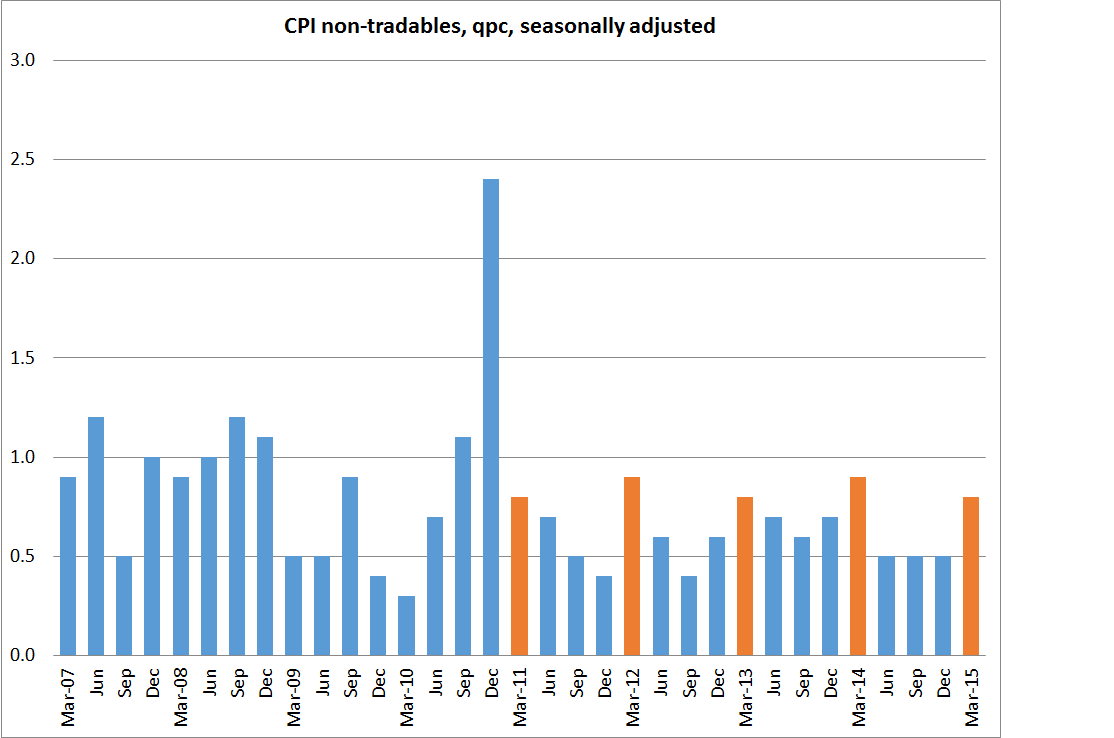
Last week, SNZ released the seasonally adjusted historical data.  True to my hope that people would focus on the seasonally adjusted series, I went to the table which showed quarterly non-tradables inflation in seasonally adjusted terms.  As one who has been sceptical for a long time of the Reserve Bank’s story that core inflation is just about to turn up, I was somewhat taken aback to find SNZ reporting that seasonally adjusted non-tradables inflation had been 0.8 per cent for the March quarter, up from 0.5 per cent in each of the previous three quarters.

But then I looked at the rest of the series, and was disconcerted to find that in each of the previous three years, the March quarter inflation rate had been higher than the quarterly inflation rates for each of the other three quarters.  That looks a lot like some residual seasonality that hasn’t been picked up in the seasonal adjustment.  I took comfort from the fact that the March quarter increase was the (equal) lowest March quarter increase over 2011-2015.   But something about the seasonally adjusted series doesn’t look quite right.

cpi seas adj

(If anyone from SNZ has an explanation, I’ll happily report it.)

In terms of future innovations, backdating the tradables and non-tradables breakdown, as official (even if “experimental” or “analytical”) SNZ series, would be helpful.  The Reserve Bank has estimates going back to the early 1990s that we derived from detailed SNZ data (not initially very scientifically –  I and one of my staff went through the components with a pen, labelling each T or NT), but it would be useful to have semi-official series going further back than 2006.  Producing good linked estimates of trimmed mean and weighted median inflation further back would also be helpful.

And then, one day, perhaps we might dare to hope that SNZ might be funded to allow the publication of a monthly CPI, joining the rest of the advanced world (other than Australia, the only other country producing a quarterly CPI).

UPDATE: A commenter reminds me of the role of the tobacco tax increases.  Here is the SNZ comment

Non-tradables are goods and services that do not face foreign competition. They include rentals for housing, and services such as hairdressing. The non-tradables series is seasonally adjusted. The algorithm suggested the series probably wasn’t seasonal, but that there was emerging seasonality in the data over the past three years. Figure 5 below shows this, where the pattern from 2011 in the actual series appears to be more consistent than previously. We see the biggest peak occurs in the March quarters in the actual series, but this effect is lessened in the seasonally adjusted series.

The multiple-point method detects seasonality in the full time series when we include the more recent quarters. We investigated to see if any one contributing series was influencing the pattern and found that cigarettes and tobacco did increase the size of the peak in March quarters since 2011. Checking the diagnostics, we found it was a marginally seasonal series and decided to seasonally adjust.

Sadly, this suggests that the seasonally adjusted series is not very helpful.

Individual freedom, choice, and personal responsibility – or not

The National Party seeks a safe, prosperous, and successful New Zealand that creates opportunities for all New Zealanders to reach their personal goals and dreams.

We believe this will be achieved by building a society based on the following values:

  • Loyalty to our country, its democratic principles, and our Sovereign as Head of State
  • National and personal security
  • Equal citizenship and equal opportunity
  • Individual freedom and choice
  • Personal responsibility
  • Competitive enterprise and reward for achievement
  • Limited government
  • Strong families and caring communities
  • Sustainable development of our environment

Or so I read on the National Party’s website.  And I thought we had a National Party government.

And so I was bemused to read that the government is to propose legislation, and regulation-making power, to require all rental properties to have smoke alarms installed and to be insulated.

Quite how this fits with the National Party’s stated values (especially the four from “individual freedom” onwards) is a bit of a mystery.  It is also mysterious how it fits with the emphasis the government claims to have been putting on improving the supply of housing and housing affordability.

I glanced through the Cabinet paper and am pretty sure I found no discussion or analysis of any market failures.  There was certainly no discussion of government failures.  And, perhaps as ever, both in the Cabinet paper and in the commissioned cost-benefit analysis on MBIE’s website, possible private benefits are routinely described as “social benefits”.  People make choices, and revealed preferences tell us something about the value they place on things.

The private rental market is a competitive one, offering a range of types and standards of accommodation.  That seems to me to be as it should be.  In that respect, it is like the owner-occupation market.  Personally, I had not had smoke alarms in the houses I’ve owned and lived in (but did have them in a rented apartment) until very recently.  Securing a building consent forced us to have them installed.  I would happily have them removed if I could (I’m pretty sure the cost-benefit analysis did not factor in the time and aggravation in digging out the broomstick to turn off yet another alarm triggered by routine cooking vapours).

I don’t yet see a RIS on the MBIE or Beehive websites.  Perhaps one will display more signs of analytical rigour, but it is difficult to be optimistic on that score.  This has all the signs of “ feel good” policy, which typically results in poor policy.  And if it is such a good policy, with such a compelling social case that we can coercively override private preferences, why not mandate such standards for all existing owner-occupied homes as well?  But perhaps to mention that option is just to give ministers ideas.  Sadly there is also no sign in the Cabinet paper as to why rental properties (where mobility is considerably easier) should be subjected to this regime, and not owner-occupied properties.  Are private renters so uniquely unable to assess their own interests?

UPDATE:  I didn’t get far enough through the Cabinet paper to get to these fairly damning paragraphs, which I thank a reader for pointing me to

Regulatory impact analysis

113 The Regulatory Impact Analysis (RIA) requirements apply to the proposal in this paper. Two Regulatory Impact Statements (RIS) are attached, one for the indicative smoke alarm and insulation standards and one for tenancy abandonment. A final Regulatory Impact Statement will be developed for smoke alarm and insulation standards following public consultation.

Smoke alarms and insulation

114 The Regulatory Impact Analysis Team (RIAT) in the Treasury has reviewed the smoke alarm and insulation RIS. RIAT considers that the information and analysis summarised in the RIS does not meet the quality assurance criteria. As well as lacking analysis (particularly of the proposals to strengthen enforcement powers, rec 8), there has been inadequate consultation.

115 Given the broad and pervasive nature of the problem definition, the objectives are narrowly defined, preventing consideration of alternative standards and methods of improving health outcomes for tenants. RIAT is not confident that the range of potential options has received adequate analysis, particularly for enforcement.

116 The RIS does identify, describe, and where possible quantify, likely impacts of the proposals. However, the impact in practice will be highly dependent on the responses of individual tenants and landlords, which are difficult to assess given the limited consultation. RIAT notes in particular that the cost-benefit analysis for smoke alarms is dependent on an assumption of high or full compliance. There is also a lack of discussion about the potential for landlords to pass on to tenants increased costs of insulation (in the form of higher rents).

117 Finally, the RIS does not differentiate the proposal to strengthen enforcement powers for RTA breaches from the proposed standards for insulation, despite these options addressing different problems. RIAT recommends that more consideration be given to including enforcement matters in the monitoring plan which should enable informed analysis in any future reform.

The contrary views of Croaking Cassandra

For anyone interested in a bit of background to this blog, and on me, Richard Harman, proprietor of the new New Zealand political news and analysis site, Politik ran a profile of me this morning.

It is a pretty fair reflection of our interview, and reflects my interests and aspirations –  in particular, the issues around New Zealand’s long-term economic underperformance matter a great deal more to me than critiques of aspects of the Reserve Bank.  When I left the Reserve Bank, I intended that Bank-related material would represent a distinct minority of my posts.  That is still my aim, but it may take some time to get there (and as one journalist who came to visit said to me “I wouldn’t be here if you were writing mainly about long-term economic performance issues”).

Sadly, the description of the Governor’s attitude to some criticisms I made of a draft document around the first set of LVR controls is accurate.  After that episode –  where even the extreme disapproval was only conveyed indirectly –  our next conversation was two years later when we accidentally found ourselves alone in the same lift in the midst of the restructuring that led to my job being abolished.  I was clearing my desk and carrying a box of books down to my car.  To his credit, Graeme did actually manage to make conversation –  about Piketty’s book, a copy of which was on top of my pile.

I should make one clarification/correction.  I’m reported as saying, about LVR restrictions, “Furthermore the Bank had done no research on what the likely impact of the controls might be.”.  I don’t think that was what I said, but if I did say it, it was not what I intended.  My criticism of the Bank’s analysis and argumentation around LVRs has been around

  • the failure to produce research looking carefully at the lessons of countries that did, and did not, experience financial crises in the last decade,
  • the failure to meaningfully engage with the Bank’s own stress test results, which suggest the New Zealand system is very resilient to even quite severe adverse shocks, and
  • the failure to engage with the statutory requirement to promote the efficiency of the financial system.

And  in the final sentences, I’m not sure how my friend and former boss Don Brash ends up classified by Harman as a “non-practitioner”.

Reforming NZS – a pertinent private member’s bill

Our Members of Parliament have, at present, 72 proposed members’ bills lodged with the Clerk, each hoping that his or her own bill will be drawn in the periodic ballot that is held to determine which will get the opportunity to be debated and voted on in the House.

There was a ballot the other day.  Four bills were drawn (the list is at the previous link).  On a quick glance, three of them look quite sensible, but here I wanted to highlight just one of them.

It is the New Zealand Superannuation and Retirement Income (Pro Rata Entitlement) Amendment Bill, in the name of New Zealand First MP, Denis O’Rourke. Unusually for a member’s bill, it is designed to (and would appear to) save the taxpayer considerable amounts of money.

The policy statement at the start of Mr O’Rourke’s draft bill sets out the gist of the proposal.

This Bill proposes a pro rata entitlement (PRE) to New Zealand superannuation (NZS) based on residence and presence in New Zealand between the ages of 20 and 65 years; a period of 45 years, or 540 months.

The Bill confronts the demographic realities of an increasingly ageing and mobile New Zealand population and its impact on NZS. These global trends require fair policies for the New Zealand taxpayer, the migrant, and the expatriate Kiwi who return to New Zealand to retire.

Within the OECD, NZS is unusually generous in terms of residency requirements. For example, a migrant who lives in New Zealand for 10 years may make little or no contribution to the New Zealand economy, yet is entitled to full NZS. Under the PRE system, this migrant is entitled to 120/540 of NZS, but retains any overseas government pension which is currently deducted from his or her NZS under the direct deduction policy (DDP).

Another example is an expatriate Kiwi who has worked overseas for 30 years, contributing to another economy, and has most likely earned an overseas pension. On returning to New Zealand to re-tire, he or she is also entitled currently to full NZS. Under PRE, with 15 years’ New Zealand residency, this returning Kiwi is entitled to 180/540 of NZS, but will also retain his or her overseas pension, which is currently deducted. Within the age period between 20 and 65 years, the Bill disregards up to 2 months’ overseas travel per calendar year. The Bill also exempts an aggregate period of 5 years’ absence for those whose rite of passage may cover their overseas experience, education and training (often bringing back exceptional skills), and, of course, the well-earned extended world cruise.

I touched on this issue in a post a couple of months ago.  It is a particularly serious issue because time spent living in Australia counts towards the residential eligibility requirement for NZS.  That just seems like skewing the playing field against the New Zealand taxpayer, in favour of those who have spent large chunks of their working lives in Australia.

One could, no doubt, debate details of O’Rourke’s proposal. But, in a sense, that is what should happen.  Whatever their reservations, I hope MPs will vote this bill through a first reading and allow it to examined by a Select Committee, inviting public submissions and perspectives from experts from MSD.  Perhaps there is a better way to deal with the issue, and I wonder if O’Rourke hasn’t gone a little too far (in requiring 40 years residence after age 20 to collect full NZS) to be sustainable.  But this looks like a constructive response to a feature of our system that otherwise looks likely to be increasingly expensive.  Not being at all a fan of the SuperGold card, there is much more money at stake on this issue, than on the card.

Here is what I had to say on the issue in early May:

New Zealand has a high rate of inward migration.  The target level of non-citizen immigration is around 1 per cent of the population per annum.  Many of those people come to New Zealand young and will spending most of their working lives contributing to New Zealand and its tax system.    But to collect a full rate of NZS you need only have lived in New Zealand for 10 years (at least 5 after the age of 50), so many people will be able to collect a full New Zealand pension having been in New Zealand for not much more than a quarter of a working life.  New Zealand does enforce quite strict offset rules on those who have accumulated foreign pension entitlements, but many migrants now come from countries with little or no public provision of pensions.  Surely it would make more sense to introduce a graduated scale –  perhaps paying half the full NZS after 10 years residence, and a full rate only after someone has lived here for 30 years?

I had always assumed that New Zealanders who had emigrated to Australia in their hundreds of thousands over the last 40 years or so would be unlikely to come back to New Zealand when they were old, because they would have to live here for five years after age 50 before being eligible for NZS.    I wasn’t the only one to assume that – I was corrected recently by a public servant doing some work in the area who had just discovered that residence in Australia (and several other countries with whom New Zealand has social security agreements) counts as residency in New Zealand for NZS purposes.  It looks as though people can leave New Zealand at 20, spend an working life in Australia, accumulate significant private assets under the Australian compulsory private superannuation scheme (enough that they would not be eligible for the Australian age pension), and having cashed in those assets could return to New Zealand at 65, claiming a full rate of NZS never having worked, or paid tax, in New Zealand at all.  Indeed, one might even be able to go on living in Australia.  Perhaps I have misunderstood the rules, but this structure strikes me as pretty scandalous.  What New Zealand public policy interest is served by such a generous universal approach to people who have not lived here for a very long time?

Personally, I’m happy that we should treat quite generously people who have spent most of their life in New Zealand and have reached an age that can genuinely be considered “elderly”, but I don’t feel the same sense of generosity towards those who have migrated here quite late in life, or to New Zealanders who have spent most of their working lives (and taxpaying years) abroad.

I subsequently had it confirmed that I had interpreted the rules correctly, and it was also pointed out to me that the Productivity Commission had highlighted this feature in its report, with the Australian Productivity Commission, on trans-Tasman issues.

Earthquakes, lives saved, and the OIA

I’ve posted a couple of times (here and here) on a “blunder of our government”; the plans and legislation to impose earthquake-strengthening requirements on many building owners, with seemingly little regard for any sort of robust cost-benefit analysis.  A sense, following the Canterbury earthquakes, that “something must be done”, plus perhaps some lobbying from vested interests, is the only way I can account for even the latest modified proposals.

This isn’t really my area, but I have great deal of time for my former RB colleague Ian Harrison who has led a lot of the thinking critiquing the government’s proposals.    EBSS (“working towards a rational seismic strengthening policy”) has been trying to use the Official Information Act to better understand the analysis and reasoning behind the government’s proposals, and its claims regarding the costs and benefits.    Their website is worth keeping an eye on from time to time, and they have a new post up about their latest request to MBIE.   I suspect they won’t mind if I reproduce it here.

The classic schoolboy excuse for failing to hand in homework looks credible compared to the excuse that MBIE has made for not provided us with documents requested under the Official Information Act.

In our analysis (the Minister’s new clothes) of the new seismic strengthening policies announced in The Building Minister’s speech in May we pointed out some ‘schoolboy’ errors  and suggested that there might be more.

The Minister said that the policies would save 330 lives over the next 100 years, but when MBIE last did the analysis in 2012 only 24 lives would be saved. We were also told that the whole strengthening exercise would cost only $770 million when the Tailrisk Economics analysis suggests that the true cost could be 10 times that amount.  The differences are critical to an understanding of the merits of the new policy.

To get to the bottom of the evidence on balance of the costs and benefits we asked for the following documents:

All documents relating to the following information presented in the Minister of Building and Housing’s speech on 10 May 2015 on the Government’s new seismic strengthening policies

(a)

  • The estimate of lives saved by the policy
  • The cost of the policy
  • The difference in risk between buildings near the 34% threshold and those with lower %NBS
  • The relative risk of dying in a car accident compared to dying in an earthquake

(b)   All documents relating to seismic strengthening policy for the period 1 April 2014  to 9 May 2015

Our requests were refused (past the statutory deadline for making information available) under section 18(c)(ii) of the Act, “as the making available of the information requested would constitute contempt of Court or the House of Representatives.” The rationale was that the Earthquake Prone Building Amendment Bill is currently before the Select Committee and that “all of the Committees’ ‘other proceedings’, including advice MBIE has provided to the Committee, are strictly confidential to the Committee”.

What MBIE seems to be saying here is that every document relating to seismic strengthening that has been produced by MBIE over more than a year have been provided to the Select Committee.

MBIE’s apparent claim is not plausible.   While MBIE might be entitled to withhold the advice they have specifically provided to the Select Committee there is no justification for a blanket refusal to provide the requested documents.

We suspect that what is really going on is that the Minister really hasn’t done his homework on the costs and benefits of his new policies and that MBIE is trying to cover it up.  On the 330 deaths there must be a strong suspicion that there has been a blunder or the evidence was engineered..

The material under (a) in particular seems like the sort of stuff that, in a genuinely open government, would have been pro-actively released a long time ago

A disappointing cheap shot from ACT

I keep an eye on what quite a few political parties have to say.  Among the bits and pieces that turn up in the in-box is the ACT Party’s newsletter.  This afternoon it had this gratuitous piece in it.

Keep Politicians away from Monetary Policy
Like the rugby boor who wants to endlessly debate past refereeing decisions, we have Russell Norman, with time on his hands now, tweeting about the OCR decision: Would Reserve Bank have made (mistaken) decision to start tightening last year if Board (w broad economy reps) were deciders not just Gov? One thing Russell obviously is not, is an expert on monetary policy.

Who knows what the answer to Russel Norman’s question is.  It might well have depended both on the sort of Board chosen, and the quality of the people appointed to it.  But it seems to me that is an entirely reasonable question for an opposition party finance spokesperson to be asking.  Parliament made the Reserve Bank operationally independent.  Parliament funds the Reserve Bank.  The Minister of Finance takes the lead in setting the policy target.  And the Finance and Expenditure Committee –  which Norman has served on for some years –  has an important role in scrutinising and holding to account the Reserve Bank, including in its conduct of monetary policy.  And, as everyone recognises, Reserve Bank choices, and  occasional Reserve Bank mistakes, have implications for people and their businesses.  People elect MPs to hold public agencies to account.  And we learn by reviewing past decisions in the light of experience.  Who does ACT think should be asking questions if not MPs?

I’ve long been rather ambivalent about the ACT Party, but have usually respected their willingness to treat serious issues seriously. And, in fairness, much the same could be said of the Greens.  There are plenty of Russel Norman’s observations about monetary policy that I’ve disagreed with over the years, but his proposal for a different governance structure is not unusual internationally, and his question as to whether it might have made a difference to the actual path of policy seems an entirely reasonable one.

Cheap shots of this sort don’t advance either the issue, or the reputation of the ACT Party.

A small win for transparency

It has only taken just over two months, for papers that are more than 10 years old, but the Reserve Bank has finally complied with my request for the papers for the March 2005 Monetary Policy Statement.  I welcome the fact that the papers are also being released on the Bank’s website (link below), which makes them widely available, and highlights to future researchers that they have been released.

The Bank has released the papers without redaction, and without withholding any complete papers.  Again,that is welcome (if no more than we should have expected).  But the interesting question is where the Bank’s threshold is.  Would they take the same approach to papers from 2010, or from 2013?  Perhaps someone might like to lodge such requests?   My interest had first been to establish the principle that, albeit with some lag, forecast week papers should be accessible to the public, and open to scrutiny from researchers, MPs, and interested members of the public.  That seems to have been done.

3 June 2015

Mr Michael Reddell

18 Bay Lair Grove

Island Bay

Wellington 6023

Dear Mr Reddell

On 2 April 2015, you made an Official Information request to the Reserve Bank seeking:

Copies of all the papers provided to the Bank’s Monetary Policy Committee, and Official Cash Rate Advisory Group, in preparation for the March 2005 Monetary Policy Statement. In particular, I am seeking all papers that would now be described as “forecast week papers” and any/all email updates/clarifications provided to the committee (whether through hard copies, or thru email groups such as MPCCOM or OCRAG, or their predecessors) from the start of the forecast week for that round to the release of that Monetary Policy Statement

The Reserve Bank is releasing to you the following information:

  1. Alternative forecasts – MPC Paper March 2005
  2. Alternative forecasts presentation (March 2005).ppt
  3. Alternative scenario and uncertainty dept meeting Feb05.ppt
  4. Alternative Scenarios and Uncertainty Memo – March MPS 2005 (final).doc
  5. Alternative Scenarios for MPC.ppt
  6. At first glance – Dwelling consents jan 05
  7. At first glance – Dwelling consents, December 2004
  8. At first glance – wpip December 20040.pdf
  9. At First Glance Feb 05 Consensus Forecasts.pdf
  10. Business investment forecast notes (March 2005 round)
  11. Business Investment Slides March 2005
  12. Consumption forecast notes – March 2005 MPS
  13. Domestic Chart pack March MPS round 2005
  14. Economic Projections for March 2005 MPS
  15. Economic Projections presentation March 2005 MPS
  16. Economic Projections under unchanged policy path, March 2004 MPS.doc
  17. Effective mortgage rates and OCR graph
  18. Emails to MPC and or OCRAG  for March MPS
  19. filenote for Board and OCRAG to reconcile changes between 1st-pass and published March 05 MPS projections
  20. FINAL: Economic projections for March MPS
  21. Financial Market Developments – Week 5 Paper March 2005 MPS.doc
  22. Forecasting notes External Sector March 2005.doc
  23. GDP Forecasting Notes
  24. Indicator chart – 28 February 2005
  25. Migration slides March 2005.ppt
  26. Near-term GDP forecasts
  27. Nearterm GDP slides.ppt

The Reserve Bank intends to publish this response to you on its website. http://www.rbnz.govt.nz/research_and_publications/official_information/

You have the right to seek a review of the Reserve Bank’s decisions, under section 28 of the Official Information Act.

Yours sincerely

Angus Barclay

External Communications Advisor | Reserve Bank of New Zealand

2 The Terrace, Wellington 6011 | P O Box 2498, Wellington 6140

www.rbnz.govt.nz

Time to reform Reserve Bank goverance – international perspectives

On Saturday evening I put out my paper Time to reform the governance of the Reserve Bank.  It was slightly odd timing in some ways, but the Sunday Star Times had expressed interest in giving the issue some coverage.

Many people won’t read an 18 page paper, so I’m going to highlight some of the key aspects of the paper in a series of posts this week.  The essence of my argument is that decisions around monetary policy and financial regulatory policy should not be exercised by a single unelected official, no matter how good the official.  No other advanced democracy does it that way, and New Zealand runs no other aspects of policy that way.

But I should first repeat one point.  Decisions around the governance of the Reserve Bank are a matter for the Minister of Finance and, ultimately, for Parliament, so my arguments for change are not criticisms of the Bank, but of the choices Parliament and successive ministers have made (most recently, through decisions not to change the system).    Officials operate within structures that politicians establish.  And contrary to the headline in print version of the Sunday Star Times, I am not arguing that the “RBNZ wields too much power”, rather that, given the responsibilities Parliament has assigned to the Bank, the Governor himself (any Governor) exercises too many of those powers.  What powers the Bank should, or should not have, is a topic for another day.

The Reserve Bank operates under an Act that was initially passed in 1989.  The Act has been amended quite a few times since then, mostly to add new powers and responsibilities.  The governance structure, however, has not materially changed since 1989.  In the paper, I highlighted four strands of thinking or data that influenced choices made a quarter of a century ago, and how differently things look on each of those counts today.  The governance structure chosen in 1989 was unusual, but there was a logic to it.  Things are different now.

The first of my four aspects was international experience.  In 1989, not many other central banks had effective and statutory independence in monetary policy (and not much attention was paid to financial regulation).  In 2015, there are plenty of countries to look at.  Only one other allows (as a matter of law) the central bank Governor to make interest rate decisions himself (rather than by legislated committee, with the associated checks and balances).  No other country allows a single unelected official to make decisions on both monetary policy and supervision/regulation himself.

Here is what I said, quite briefly, about international experience.

As things looked in 1989:

First, at the time only a few other central banks had (both statutory and effective) operational independence.  The ones New Zealand officials tended to be interested in were the central banks of the United States, West Germany, and Switzerland, and none of those were from the the British-based tradition of parliamentary and public sector governance.  In other words, there were few international models that could readily be adopted in New Zealand[1].   The Reserve Bank of New Zealand legislation was the first in what was a whole wave of new central banking legislation around the world over the following 10-20 years.

[1] The Reserve Bank’s own initial proposal to the Minister of Finance was based around the Australian statutory model. In that (1959) model the Reserve Bank of Australia’s Board was formally the decision-making body, but the Federal Treasurer could override the Bank so long as this was done openly (tabled in Parliament).  Appealing as the model may have looked on paper, it was a curious recommendation since, in practice, the RBA  participated actively in the public sector policy debate but ultimately did as it was told from Canberra, and the formal override powers were never –  and have never been – used.

For some discussion of this and some of the other historical material see my 1999 Reserve Bank Bulletin article “Origins and early development of the inflation target”

http://www.rbnz.govt.nz/research_and_publications/reserve_bank_bulletin/1999/1999sep62_3Reddell.pdf

And as things stand today

The fourth aspect where events have unfolded differently has been in what other countries have done in reforming their central banks and financial regulatory institutions.

Take monetary policy first.  Since 1989, there has been a substantial global shift, in both legislation and practice, to provide many more central banks with operational autonomy for monetary policy:  Among the G7 countries, central banks in the UK, Japan, and France have been given independence, and the (new) ECB has the highest level of monetary policy autonomy of any modern central bank.  Across eastern Europe (still mostly communist in 1989), and other parts of the emerging world, there have been similar trends.  But not a single advanced country, of the many to have reformed their central bank legislation, has moved to a model with a single unelected individual as decision-maker for monetary policy[2].    Despite all the attention paid to the New Zealand reforms, no country has adopted the New Zealand governance model[3].

Governance models for banking regulation/supervision in other countries are quite diverse.  In some countries many or all of these activities occur within central banks, and in other cases most of the regulatory functions occur in separate agencies.  However, I am also not aware of any advanced economy in which Parliament has delegated the major policy decisions in respect of financial supervision/regulation to a single unelected official.  A decision-making Board, advised by technical experts, is a much more common model, and in some cases many more of the policymaking powers (than in New Zealand) are reserved for ministers.

In sum, in no other advanced democratic country does a single unelected official exercise so much power in matters of monetary policy and financial regulatory policy.  Only in Canada’s case, with rather old legislation, does a single official exercise final legal power (in respect of monetary policy), and the Bank of Canada has very much more limited functions than the Reserve Bank of New Zealand.

[2] I am not aware of any developing countries having done so either, but have looked less deeply into the range of reforms in those countries.

[3] A few years ago Israel amended its central banking legislation to shift from a single decision-making Governor, to a decision-making monetary policy committee.  For a useful survey of monetary policy governance in a range of advanced countries see http://www.rbnz.govt.nz/research_and_publications/reserve_bank_bulletin/2014/2014mar77_1aldridgewood.pdf
What can the Reserve Bank do about the exchange rate?

(This isn’t the follow-up post on real interest rates.)

A commenter on interest.co.nz , referring to my piece on the exchange rate the other day, posed the following question:

It is gratifying to see an apparently reputable NZ economist such as Reddell explain the long term effects of an overvalued exchange rate, and that the NZD is still overvalued. I had thought NZ economists, perhaps for political reasons, remained in denial on this point. Does he have a view, do we know, whether the Reserve Bank could be more active in encouraging the exchange rate down, other than occasionally attempting to talk it down?

I think the second sentence is a little unfair, although it does depend what people mean by “overvalued”.  Most prominently, Graeme Wheeler routinely highlights that the exchange rate appears out of line with long-term fundamentals.

On the question the commenter poses, I do have view and the answer is “typically not”.  At present, I think the Reserve Bank has the OCR set too high, and will need to lower it.  At the margin, the overly tight monetary policy in recent years has left the exchange rate a little higher than otherwise.

The other instrument the Reserve Bank has at its disposal is foreign exchange intervention.  I have come and gone over the years on whether the Bank should be able to do such intervention, but no one believes it can make any material or sustained difference to the sorts of real exchange rate misalignment I was talking about in the earlier post.

Central banks can do things that make a difference to the real exchange rate for short periods of time.  Monetary policy makes more difference than intervention.   But sustained misalignments, over decades, are real phenomena, not monetary ones.  To understand those sorts of sustained pressures, one needs to look to what drives differences in real interest rates over long periods.  And, again, the answer isn’t monetary policy (as the Bank explained here).  Regulatory policy doesn’t make much sustained difference either, although there are some intriguing suggestions to the contrary here.