Good news, but some continuing concerns

Today’s OCR decision was good news (and a pleasant surprise).  The Reserve Bank has finally recognised just how persistently weak inflation pressures are in New Zealand and has cut the OCR.  It has foreshadowed the possibility of one more cut.  And at least for the next two years there is no hint of the OCR being raised back towards the unchanged  estimate of the “neutral interest rate”.

There is likely to have been an element of deliberate smoothing of the numbers to produce such a flat track for two years ahead.  If so that is something to be welcomed.  I have two  –  slightly contradictory –  reasons for welcoming it.  First, no one (ever) has any good idea what the appropriate OCR will be two years hence. But, second, easing cycles (or tightening cycles) rarely stop at 50 basis points.  In the 16 years of experience with the OCR, the only time the Reserve Bank has moved by only 50 points was when it prematurely raised the OCR in 2010, and then unwound those increases after the February 2011 earthquake.  As I noted yesterday, if the Governor was going to cut the OCR he was most likely to back into modest cuts rather than embrace a wholesale change of view at this stage.

The document does not give a sense of a central bank with a very strong sense of what is going on.  In a sense, that is a step forward.  Huge uncertainty is something all central banks always face, and so many central banks have got things so far wrong over the years since the recession (repeatedly thinking that tightenings will soon be needed)  that it is better to play things by ear, putting quite a lot of weight on actual developments in (core) inflation, rather than on stories about how future events might unfold.

I’m not going to comment in much detail on the numbers in the projections, but I did want to make a couple of points on them and then turn to slightly longer-term policy considerations.

The first point was around this chart from the MPS, showing the Bank’s output gap estimates 18 months ago, and those now.
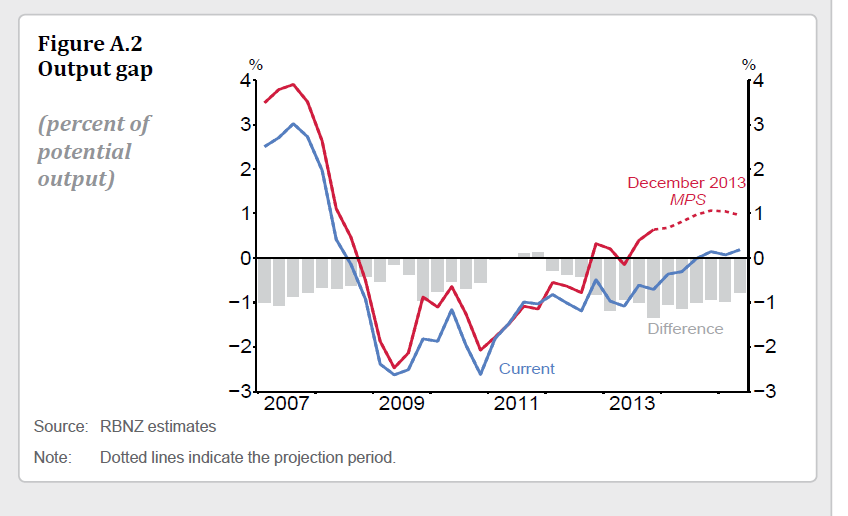
mps output gap

In one sense, the levels of the two estimates are not hugely different.  And  when we look back five years from now neither might closely resemble the best historical estimates.  But the differences  matter because the Bank, and its forecasting staff, have for several years been putting a lot of weight on the notion that excess capacity was exhausted (and hence it was “time to tighten”).  But in this chart there is almost two years difference in the crossover point.   Other indicators –   notably the unemployment rate –  cast doubt on whether the economy is even now operating at potential.  The point is not that the previous precise estimates are wrong (that is inevitable), but that the Bank has been consistently wrong in its narrative about what has been going on.

The second was around the line, oft-repeated this morning, about the way the economy’s supply potential had expanded rapidly, enabling supply to accommodate growth in demand.   It was presented as a good news story.   But it just is not that good.

The labour supply has certainly increased rapidly, largely on the back of high (not record) net inward migration.  But in the short-term increases in population growth boost demand more than they boost supply –  always have done in New Zealand, and there is no sign of that changing.  As the tables in the MPS remind us –  and it is a point I’ve made here repeatedly –  productivity growth has been lousy (on the Bank’s measure 0.7 per cent per annum).  And even investment has just not been that strong.  Here is a chart of investment/GDP .
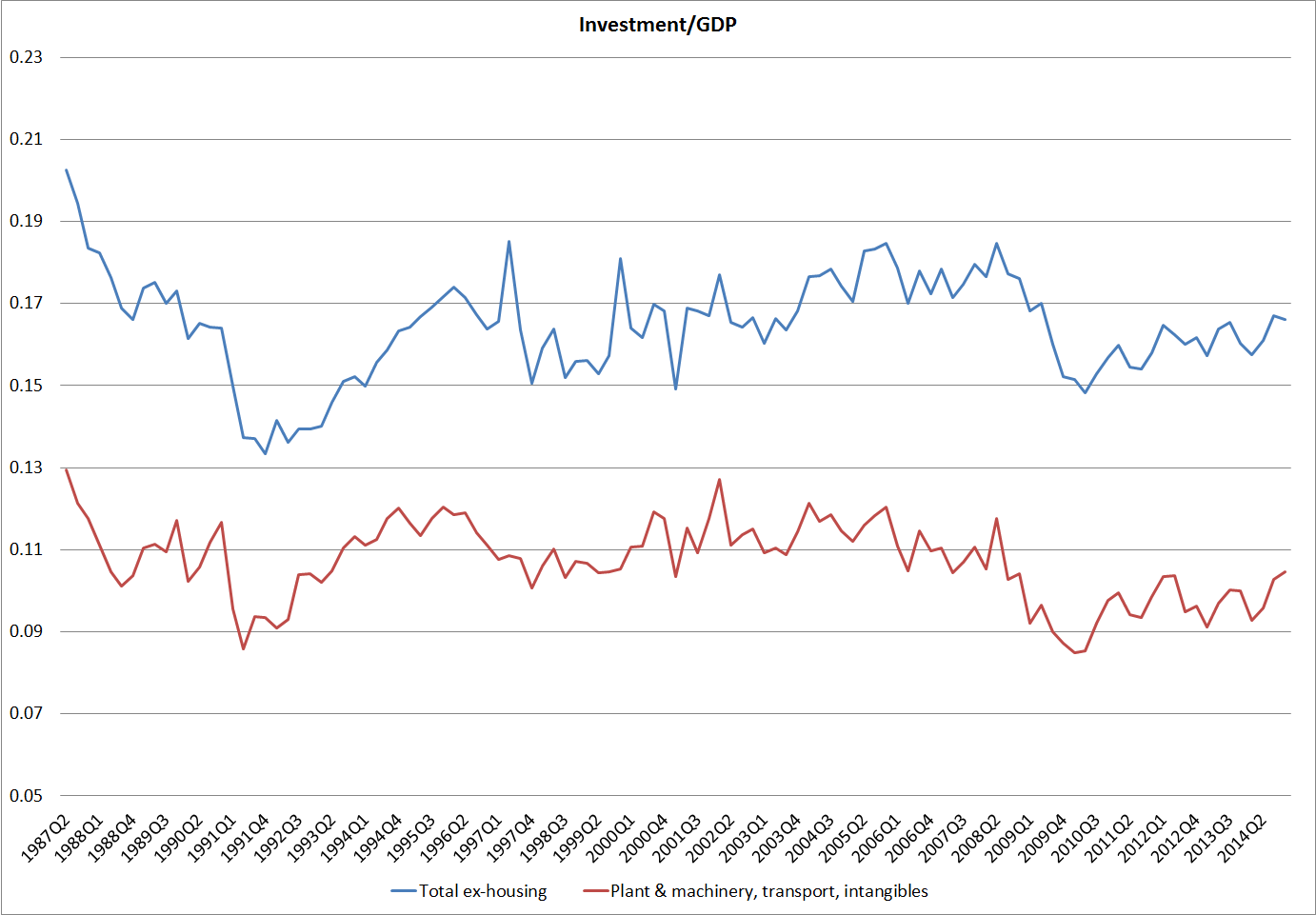
investment mps

I’ve shown both total investment ex housing, and investment in “plant and machinery, transport equipment, and intangibles”.    Investment has been recovering, but on neither of these measures has investment as a share of GDP got back to the average levels seen in the decade prior to the recession,  even though employment has been growing quite rapidly (lots of workers need equipping).  And both measures (even though they exclude housing) will have been boosted by activity in Christchurch to replace lost capacity (think of that underground infrastructure work).  There is no easy way to strip those Christchurch effects out, at least until we get the annual capital stock estimates, but there is really nothing to suggest that underlying growth in per capita capacity has been strong.  A more likely story of what has gone on in New Zealand (as in many other countries) is just that there was quite a lot of excess capacity, which has been enough to accommodate even the demand pressures of a migration inflow without boosting inflation.

The press conference was striking for how little searching scrutiny there was of the Bank’s judgements and performance over the last year or two.  Perhaps FEC will do better this afternoon?  But Rob Hosking of NBR did ask whether the Bank had made a mistake in raising the OCR last year and holding it up for so long.  “Not at all” was the Governor’s response.  His argument was that no one 18 months ago could have anticipated the sharp fall in oil prices or the sharp fall in dairy prices  (which, incidentally, are offsetting effects in the Bank’s forecasts).  I’m not sure about “no one”,  but even if we grant the point, the Governor is surely not arguing the continued weak core inflation, and declines in non-tradables inflation that we have already seen in the data, are a reflection of either of those forecast errors?  Weak commodity prices are going to exert an increasing drag on spending this year, and perhaps beyond,  but weak wage and price inflation were well-entrenched before  the depth of the correction in dairy prices became fully apparent.  I think it is more accurate to say that the Bank misjudged the level of spare capacity at the end of 2013, it misjudged the underlying inflation processes, it misjudged the inflation implications of the resurgence in the housing market, and thus was far too ready to initiate, and carry on, a tightening cycle.  It was a mistake.

As I’ve said before, there is huge uncertainty in monetary policy. In a sense I can understand why the Governor would not want to openly acknowledge that he had made mistakes (he’s human too), but it is a shame that he did not use the opportunity to convey to journalists and the public more of a sense of the limitations of anyone’s knowledge, and the inevitability that central banks will from time to time get it wrong.   And if the Governor did not want to  acknowledge the mistake in the press conference, some more sustained critical self-examination in the Monetary Policy Statement itself would have been appropriate, and consistent with the spirit of the legislative provisions governing such documents.  Perhaps a scenario experiment, running through the Bank’s models the implications of having held the OCR at 2.5 per cent since the start of last year, would have been an interesting basis for a conversation, including with the Bank’s Board (the Minister’s agent in holding the Governor to account).

But perhaps my biggest concern about today was an issue that won’t get any headlines.  It was how the Governor and Assistant Governor dealt with a question about whether the inflation target should be changed.  The Governor noted that outgoing IMF Chief Economist Olivier Blanchard had [been among various others who had] proposed raising inflation targets, to help minimise the risk that the near-zero lower bound would be such a problem in future.  As the Governor noted, Blanchard [and one of his predecessors Ken Rogoff ] had not got a lot of support for his proposal.   But then the Governor went on to note that monetary policy was proving a lot harder than people had expected and that it was very difficult to raise very low inflation expectations.

As I’ve noted previously, for other countries –  already entrenched at zero interest rates –  there is no easy way in which raising the inflation target now would make much difference.  It is too late.   But New Zealand (and Australia) are different.  We still have materially positive policy interest rates.  That means we are both still exposed to the possibility of hitting the zero lower bound in the next serious downturn.  And yet the Governor seems indifferent  to –  or perhaps not even consciously aware of –  the possibility, and the implications for the economy (and for the people who would be unemployed).  Raising the inflation target is certainly not an ideal option, but as I’ve argued here previously unless governments and central banks are going to do something active about removing the near-zero lower bound (and neither the Governor nor the minister has given any hint of doing that) there should be a more serious discussion about whether our inflation target should be raised, as a pre-emptive and precautionary move.   At very least, inflation outcomes in the upper half of the target range would provide slightly better buffers than a continuation of outcomes below the midpoint.   There would be no excuse, given how much notice our central banks have had, if in the next serious downturn New Zealand or Australia become trapped for years with interest rates at some floor (a floor that arises out of policy and legislative choices, not as some force of nature).  Perhaps, at a pinch, it was excusable not to think much about the zero bound when the Governor was signing the PTA in 2012.  It can’t be excusable now.

The Assistant Governor’s response to the question about the target was even more disappointing.  I suspect he was trying to help his boss, by asking the journalist whether he meant to suggest raising or lowering the inflation target.   But it is difficult to believe that a serious senior central banker could, in the current climate of extremely low inflation (here and abroad), seven years on from a recession which took policy rates to their lower limit and has seen them more or less stuck there, could even toy publically with the idea of lowering the inflation target.  If the Bank were to convincingly sort out the zero lower bound issues, then perhaps it would make sense to have that conversation (to aim for “true” price stability, rather than 2 per cent annual inflation).  But the Bank has given no hint that it even takes these risks seriously.

McDermott concluded that “changing targets is a very risky thing to do”.  Well, perhaps, but the risks in considering raising the target need to be weighed against the risks of adverse shocks that deliver New Zealand another recession before  the unemployment rate has even fully recovered from the last recessions.  Those are people’s lives the Bank toys with. As even the Governor recognised, the risks of something very nasty around a Greek exit from the euro are far from trivial –  though how, in the same breath, he could assert that deflation risks had passed in Europe was something that eluded me.

And finally a reminder about the gaps in the Bank’s transparency around monetary policy:

  • The forecasting models, developed at considerable public expense, are still not public
  • We will not see, even with a lag, any minutes from the Governing Committee or the Monetary Policy Committee, and will see no hint of the advice provided to the Governor.
  • Despite the Bank last week releasing 10 year old “forecast week” papers, we still have so sense as to how long a lag we might face before having access to the Bank’s forecasting papers for the last 18 months or so.
  • We will not see any minutes of the Board discussion of monetary policy and the Bank’s adherence to the PTA.  Nor we will see the written advice prepared for the Board.

As I’ve put it previously, the Bank is quite transparent about the things it (and we) don’t know much about –  ie the future –  and not very transparent at all about the things it knows a great deal about (its own analysis and deliberations and debates that went into shaping the Governor’s decisions, both today’s and those of the last 18 months).

Time to cut

Tomorrow the Governor will announce his latest OCR decision and publish the Reserve Bank’s June Monetary Policy Statement.    Having been inside the Reserve Bank for so long, I don’t claim any great expertise in reading the tea leaves as to what the Governor will actually have chosen to do when 10 days or more ago, he sat down, took advice, and made his decision.  I think he probably will not cut the OCR, but if so that will, most probably, be a mistake, compounding the series of mistaken monetary policy judgements he has made since the start of last year.  I shocked some colleagues in the middle of last year when I opined that the Reserve Bank would cut the OCR before the Federal Reserve raised US policy rates.   It was a rather speculative call at the time.    I’m still sticking to it, but I’ll be surprised if confirmation comes quite yet.

One of the things about monetary policy (at least, active discretionary forecast-based monetary policy) is that there will always be considerable uncertainty as to just what the right OCR will be.  As I’ve observed before, with that level of uncertainty there is no particular shame in being wrong, provided one learns quickly from the mistake.  The Reserve Bank doesn’t seem to have been very good at that over the last 18 months.  It should have been apparent pretty quickly that there was little or no basis for the tightening cycle that the Governor initiated last year, when he boldly foreshadowed 200 basis points of OCR increases.  But any recognition of that point has been pretty slow and grudging. Mea culpa, mea culpa, mea máxima culpa it most certainly is not.   Too bad about the people who have lingered on unemployed for longer than was necessary.  Perhaps tomorrow’s MPS will contain some retrospective self-examination of how those mistakes came to be made, and what lessons can be learned from them.  If such self-examination is not strictly required by the section of the Act governing MPSs,  it is pretty strongly encouraged.

A journalist asked me the other day if it was just embarrassment that made the Governor reluctant to reverse course.  I don’t think so.  I think is about views of the world.  All of us have them, and need to have them to make sense of things at all.   And views of what is going on in the world –  paradigms, models – don’t change quickly.  There is a tendency (again, in all of us) to discount observations that might undermine our story, and focus on data, insights, or arguments that tend to support our story.    That makes it hard to get material changes of view, and all the more so when a single decision-maker, who does not set out to foster the contest of ideas and the open-minded examination of alternative views, is in charge.    A downside of the single decision-maker model is the tendency to assign too much weight to one person’s “model”.

In the Governor’s defence, of course, outside observers are still split on what he should do tomorrow.  Many of the market economists in 2013 and 2014 were even more hawkish than the Governor, and each of them faces the same challenge of revising their view of what is going on.

I’m just going to make three other quick points:

  • I noticed the BNZ economics team out a little while ago picking that the OCR would not be cut tomorrow, but arguing that if the OCR was cut the Reserve Bank would signal a series of OCR cuts of perhaps 100 basis points or more.  I think that is very unlikely to be right.  Practically, there just is not much time between the previous OCR review and finalising the forecasts for this Monetary Policy Statement, and big changes in the whole direction of the forecast don’t seem very likely in that time.  But perhaps more important is the point about paradigms or views of the world.  It seems much more likely that the Governor would back reluctantly into any OCR cuts, treating them as little and precautionary.  He could do that within a world view in which he thought the future OCR would still have to be at least as high as it is now.  That seems much more likely than that he would –  with no foreshadowing – embrace a full-scale reversal of last year’s OCR increases.  It might happen, perhaps it even should happen, but it seems very unlikely at this stage.
  • The data.  I know some market economists have changed their view, and their OCR calls, since the last OCR review at the end of April.  But to me, the data since late April don’t seem enough for a major change of view.  For those, like me, who think the OCR should have been lower there has been nothing to contradict that view.  There is no sign of inflation pressures building, and perhaps a little more sign of the building boom tailing off, a little more sign of excess capacity in the labour market, and a little more weakness in dairy prices.   It has been enough to shift a few people across the line, but if one had been a confident believer in the sort of story the Reserve Bank was telling in its last MPS, it would have been nowhere near enough to have prompted a radical revision of one’s view.    The same goes for the world economy.  To me the data flow, especially from the emerging world, looks weak and quite worrying, but that is the read of someone inclined to a pessimistic take.  The Governor, by contrast, has repeatedly articulated a story about the strength of global growth.
  • I like the NZIER’s Shadow Board process, where a group of outsiders offer their views not on what the Reserve Bank will do, but on what it should do.  At times it has been interesting to watch divergences between what bank economists are telling us the Bank will do, and what they think it should do.    Those involved in the Shadow Board are asked to assign probabilities that a range of different possible OCRs will be appropriate, recognising the uncertainty most of us face.    I’m not sure if they are still doing it, but the NZIER innovation prompted the Reserve Bank to introduce such a system for the group advising the Governor on what he should do with the OCR.  We provided written advice (one page each) but also assigned probabilities.  It was designed to help foster debate, and to help recognise (and help the Governor recognise) that when one adviser was advocating one rate and others another rate, both recommendations were typically medians or means of a distribution of views.    The latest Shadow Board results, for tomorrow’s OCR decision, came out today.  Here is the chart of the individual respondents’ views.

shadow board

Two things strike me about the chart.  The first is how tightly bunched the distributions actually are.  It is as if all of them have a difficulty with grappling with just how uncertain we should be about what the right level of the OCR will turn out to have been.  I wonder if they are answering “what would you do if you were Governor” rather than “what OCR will prove to have been right for New Zealand given the inflation target”?  But the second observation is how the two academics in the group –  Viv Hall and Prasanna Gai –  have the tightest distributions of them all.  Viv is 85 per cent confident that 3.5 per cent is right, and Prasanna is 100 per cent confident.    Academics usually remind practitiioners of the huge margins of uncertainty in any of this stuff.  Fan charts have not been popular in New Zealand , but they do help to illustrate the historical range of uncertainties.  Presumably, given the way the PTA is written, the appropriate OCR today depends on the things that will determine the trend inflation outcomes a couple of years hence.  Who can say that they know that with any confidence?

For what it is worth, my own distribution of probabilities for the appropriate level of the OCR tomorrow is roughly as follows:

OCR                                       Probability

1.5                                          5

2                                              5

2.25                                        10

2.5                                          10

2.75                                        12.5

3.0                                          15

3.25                                        12.5

3.5                                          10

3.75                                        10

4                                              5

4.25                                        5

My distribution is wider, and much flatter, than any of those in the Shadow Board grouping, and yet it still feels too narrow to really grapple with the huge uncertainty we – and the Reserve Bank –  all face.

There is a great deal of complex, and pseudo-sophisticated, debate around monetary policy.  But when:

  • Core inflation has been below target midpoint for years
  • Unemployment is still above any estimate of NAIRU
  • Major commodity prices are falling
  • The building cycle –  often a key element in business cycles, and more so than usually this time given the salience of Christchurch –  looks to be turning,
  • And there is little or no sign of material demand or inflation pressures globally

the decision around the OCR really should be straightforward.  It should be cut.

Time to reform Reserve Bank goverance – conceptions of monetary policy

I’ve been arguing that it is Time to reform the governance of the Reserve Bank.  Earlier in the week, I pointed out that no other country does things the way we do (giving a single unelected official discretionary control over monetary policy and much of financial regulatory policy), and that New Zealand does not operate any other areas of policy in this way.  Other policy decisions are generally made by elected politicians or by boards, not by single unelected officials.

But, as I have also pointed out, the model adopted in 1989 had its own logic.  Not only did it reflect (slightly uneasily) the public sector reforms then being put in place, that set out to establish powerful but accountable (and dismissable) chief executives of core government ministries, but it also reflected views about monetary policy that were around at the time.  And when the 1989 Act was being written, and debated, it was the monetary policy role of the Bank that got far and away the most focus. The Act said (and still says) that monetary policy is the “primary function” of the Bank.

The gist of the story is this (more extensive background is here and here):

  • Monetary policy in the late 1980s was highly contentious and subject to lots of uncertainty.  Policy was focused on getting inflation down once and for all, in a newly-deregulated economy where many indicators were hard to interpret.
  • But in some quarters, especially in the Treasury, there was a view that the issues could (and should) all be made much simpler, especially once the initial post-liberalisation period passed.  If, for example, the Reserve Bank could be required to target a steady growth rate in the money base, there would be little room for discretion, and no room for debate as to whether or not the Bank had done its job.
  • Even if those sorts of targets weren’t feasible (and I don’t think anyone in the Reserve Bank ever thought they were), perhaps an inflation target itself could a very close approximation.  If inflation ended up inside a target range, job done.   If not, then not.
  • In short, in the minds of some those shaping the Act there was a sense that monetary policy should not be particularly controversial, and should be a largely technical matter, not involving material amounts of discretion.

Against that backdrop (and I’m inevitably stylising views somewhat), a single unelected decision-maker made some sense. The person would have little effective discretion, and could be dismissed if he/she stepped out of line.

Of course, actual monetary policy, whether in New Zealand or abroad, turned out nothing like that stylised story, even in a low inflation environment.  If done sensibly, monetary policy under inflation targeting involves huge amounts of discretion, amid a great deal of uncertainty.  There are choices to be made that have implications for the price level, and for how things like the unemployment rate and the real exchange rate (and the impact those have on livelihoods of people and businesses) for several years at a time.  Oh, and there hasn’t been an election since 1990 when monetary policy has not been a campaign issue for at least some of the parties.

So the single unelected decision-maker is not a model other countries use, it isn’t how we in New Zealand run other areas of policy, and it also doesn’t fit well with how monetary policy actually works, here or abroad.

Here are the relevant extracts from my paper:

As things were seen in the late 1980s:

This outputs vs outcomes framework was an important factor in the debate around how the Reserve Bank of New Zealand should be governed[1].    From the original discussions around the possibility of converting the Reserve Bank into an SOE, through until at least a year after the Reserve Bank Act was passed, elements of the Treasury were heavily influenced by a strand of thought that reckoned that monetary policy could be appropriately, and perhaps best, configured as an “output” problem.  If so, an autonomous decision-maker could be held clearly and directly accountable for delivering a pre-specified desired output.

At one stage, the idea of a statutory quantitative limit on the Reserve Bank’s note issue was floated.  Rather more persistent was the view that a target rule for growth in the money base – something that could be directly controlled by the Reserve Bank if it chose – was the appropriate basis for setting monetary policy.  If so, it would have been easy to judge whether (or not) the Bank had done its monetary policy job.

Within the Reserve Bank and Treasury it was largely common ground that something like price stability was the appropriate medium-term desired outcome.  However, it was also accepted that, in a market economy, inflation was not directly controllable by policy actions, and could be influenced (indirectly) by monetary policy only with fairly long and variable lags, and subject to a variety of exogenous shocks[2].   A robust relationship between the monetary base and medium-term price stability might have provided a suitable foundation for an outputs-based approach.  But such a relationship never emerged.

The point here is not that the governance aspects of the 1989 Act mechanically reflected views of particular individuals about which operational targets the Reserve Bank should use to conduct monetary policy.   It is more that the milieu inevitably, and perhaps even appropriately, affected the thinking about institutional design.  On the one hand, public sector reforms processes put a strong focus on individualised accountability.  On the other, there was a sense – perhaps rarely written down explicitly, but implicit in a lot that was written – that once low inflation had been achieved, the conduct of monetary policy should be relatively straightforward and not especially controversial.  The implicit vision of monetary policy was of an important, but essentially technical, matter.

And now:

Except for fixed exchange rate countries, output-based approaches to monetary policy do not work.  That was fairly generally recognised internationally by the time the 1989 legislation was passed, but ideas around an output-based framework still had an impact on the New Zealand framework.

For a time perhaps, some hoped that even though an inflation target was for an outcome, it might still be amenable to output-like accountability regimes.  If inflation outcomes were inside the target range, the Reserve Bank had done its job, and if not, then not[3].  But it has not proved to be that simple, for a variety of reasons.  Even core inflation outcomes can be away from the target midpoint for years, and considerable amounts of judgement are required to interpret the Policy Targets Agreement (including, but not limited to, questions around avoiding “unnecessary variability” in output, interest rates and the exchange rate).

Monetary policy setting, in the forecast-based approach adopted across the advanced world, involves considerable discretion.  Reasonable people can reach quite different views

And since Reserve Bank discretion involves choices that can materially affect output and unemployment, for periods of perhaps 1-2 years at a time, or the real exchange rate (and hence relative returns across major sectors of the economy), these choices matter to many people.  To be clear, monetary policy choices materially affect only the price level in the long run, but transition paths (especially when discretionarily chosen) have real implications for real people.

At the time the 1989 Act was passed, monetary policy was highly controversial (as, of course, was much of the rest of the reform programme). But the implicit view was that once low and stable inflation was established monetary policy would be a fairly low-key matter, not exciting much debate or political contention.  In fact, since 1989 there has not been a single general election in which at least one party has not been campaigning for change to the monetary policy aspects of the Reserve Bank Act[4]. Latterly, the tide has been rising, and at the last election for example all the parties on the political left were campaigning for change.  The point here is not whether (or not) the advocates for change are correct, simply to highlight that monetary policy remains contentious, and that to vest all powers in such a controversial area in a single unelected official increasingly seems anomalous.

……..

If a central bank has discretion – and all modern ones (not adopting fixed exchange rates) do – then preferences and values come into play, and it is not obvious why the preferences of a single unelected official should be given such a high weight.

One previous Reserve Bank Governor sometimes liked to argue that he wasn’t very powerful at all – that he was tightly constrained and really had little choice around the decisions he took.  If he really believed it (and he was talking only of monetary policy in any case), I think he must have been the only one to have done so.

Reflect, for example, on the last boom during the 2000s.  Core inflation ended up persistently well above the target midpoint (with no action taken against the Governor by either the Board or the Minister).  That suggests that a different Governor could equally legitimately have made choices that delivered inflation as far below the midpoint of the target range.  Over a 10 year view that difference might not have made much difference to the end-point level of GDP, but it almost certainly would have made a huge difference to the trajectory of GDP, and of many economic activity/price variables, including house prices, debt, the exchange rate, and exports.

Or consider the years since 2007.  Actual decisions have been widely regarded as PTA- consistent, but different Governors could have made a plausible case for a materially looser stance.    That is real, and largely untrammelled[5], power of the sort that societies such as ours very rarely repose in a single person –  elected or not –  no matter how able.  (Indeed, this was the gist of Lars Svensson’s case, in his 2001 review for the previous government, for a formal decision-making committee. Svensson thought very highly of the then Governor, but argued that we needed to build institutions to cope with the less good ones –  less technically able, less inclusive, less good judgement or whatever.)

[1] These issues are treated in Singleton, in a Bulletin article on the origins of inflation targeting http://www.rbnz.govt.nz/research/bulletin/1997_2001/1999sep62_3reddell.pdf, and in  this Reserve Bank piece on monetary policy accountability and monitoring http://www.rbnz.govt.nz/monpol/about/2851362.html

[2] As the Bank itself noted in one 1988 paper, the problem with inflation targeting (relative to, say, money base targeting or a fixed exchange rate) is that it had a “trust us, we know what we are doing” dimension.

[3] The high tide of this sentiment was Don Brash’s unequivocal statement in a radio interview in 1993 that if inflation went above 2 per cent (the top of the then target range) he would lose his job (this statement is reproduced in an interview with Dr Brash included in the September 1993 edition of the Reserve Bank Bulletin).

[4] As far as I am aware, this degree of electoral debate over central banking, spanning multiple elections, is unique to New Zealand.

[5] The note on accountability and monitoring, referenced earlier, discusses some of the practical constraints on what appears in statute to be the Board’s considerable freedom of action to hold a Governor to account.

Some overnight reading

Last week I wrote up some thoughts on negative nominal interest rates, and how important it is that finance ministers and central banks start treating as a matter of urgency the elimination of the regulatory constraints and practises that make it impossible for policy interest rates to go materially negative.  If they won’t, they need to raise inflation targets, but that would be a distinctly inferior option.

In that light, it was encouraging to read the blog of Miles Kimball –  one of key academic proponents of action in this area – and learn that he was talking overnight on exactly that topic at the annual central bank chief economists’ workshop hosted by the Bank of England.  The annual BOE meeting is an important and interesting forum (I got to go once) and typically John McDermott, chief economist at the Reserve Bank, attends.  The link to Kimball’s slides (“18 misconceptions about eliminating the zero lower bound”) is here.

I don’t agree with everything in Kimball’s presentation.  In particular I still think he puts too much weight on government providing the answer, rather than just getting out of the way and providing greater scope for market innovation. But then there is (or should be) a much greater urgency to addressing the issue in most of the rest of the advanced world, where policy interest rates have now been stuck at or near zero for a depressing number of years now.

The obstacles to negative nominal interest rates have been around as long as banknotes, but haven’t mattered very much in the past  –  after all, despite the occasional peripheral discussions and local experiments during the Great Depression, there was then a mechanism to generate recovery –  breaking the link to gold.  That option isn’t available this time.  Kimball rightly compares creating the ability to take nominal interest rates materially negative to breaking off gold in the 1930s.

In countries where interest rates have not yet hit zero, such as New Zealand and Australia, the Minister of Finance (who controls the gateway to taking legislation to Parliament), the Treasury (as chief economic adviser to the governments), and the Reserve Bank (as, in essence, implementation agents –  and to some extent the institution that benefits from the current system) need to be planning now to ensure that these old restrictions don’t impede the ability of our countries to cope with the next severe downturn.  This isn’t just something of academic or obscurantist interest – it is about unshackling one limb of macroeconomic policy so that it is ready when it is needed.  And as I’ve noted before, at 3.5 per cent our OCR is less high now than most of policy rates were in 2007 in those countries now stuck with the near-zero lower bound constraint.

And two other brief items:

I drew attention some weeks ago to the work Ian Harrison had been doing on earthquake strengthening requirements, an area of policy which appeared to have the makings of another government “blunder”.   A group Ian is associated with called EBSS (Evidence Based Seismic Strengthening) now has a website, and it includes a brief critique of the government’s revised proposals in this area announced earlier this month.  Those changes seem to amount to a step forward, in reducing the extremely heavy cost burden that the government had planned to impose on building owners, to mitigate extremely low probability and low cost risks.

However, as the EBSS paper notes, the new proposals still seem a long way short of ideal.  Now that I’m based at home I’m often down in the Island Bay shopping centre.  Many of the older buildings there –  including one housing the excellent and popular butcher –  are yellow-stickered, but I neither notice among other people, nor feel any myself,  any unease in using them.  Sometimes I wonder if that is just a short-sighted perspective, oblivious to the risks, but that is where numbers help.  This quote from the EBSS paper caught my eye.

As a point of comparison, flying has similar characteristics to earthquakes. There is a very small chance that there will be a catastrophic event that results in death. The chance of being killed, per hour, when flying is 4000 times greater than being in a typical Auckland ‘earthquake prone’ building. For New Plymouth buildings it is about 600 times greater, and for Wellington 20 times.

We fly because we know that flying is very safe. But the Auckland, New Plymouth and Wellington buildings will be shunned because they will be falsely identified as ‘high risk’ when there is overwhelming evidence that they are not.

And finally China. I must have missed the reports of the recent Chinese government instruction to banks that they must keep lending on local authority projects even if those local authorities can meet neither interest nor principal commitments on existing debt.  Christopher Balding has an excellent summary of what an edict like that seems to mean.  As he puts it “the Chinese bailout is starting to bail fast”.

Why not?

The Governor’s press release this morning, leaving the OCR unchanged, was no surprise.

But it continues to seem out of step with the data, and with his responsibilities under the Policy Targets Agreement. The statement has the feel of being written by someone who really really does not want to cut the OCR, but who won’t explain why.  It is if the current level of the OCR were being treated as an end in itself, or being held up in pursuit of some other goal, rather than being a tool for influencing the (rather too low) medium-term rate of inflation.

Fortunately, the statement corrects what must have been a mis-step in John McDermott’s speech last week.  Today the Governor states that:

It would be appropriate to lower the OCR if demand weakens, and wage and price-setting outcomes settle at levels lower than is consistent with the inflation target.

Last week, that criterion was expressed in terms of lower than the “target range”.

But there is no reference anywhere in the statement to the 2 per cent midpoint, even though the Governor and the Minister explicitly agreed that the midpoint should be the Bank’s focus.  And wage and price-setting outcomes are already inconsistent with the target midpoint and have been now for some years.  This statement offers no tangible basis for expecting that to change, just the limp observation that underlying inflation “is expected to pick-up gradually”.  Why?  When?  What is about to change that will now reverse a slide in core inflation that has been underway, more or less continuously, since 2007?  It has to be something more than just a belief that monetary policy is “stimulatory”.

Once again, the Governor anguishes about the exchange rate.  I agree totally with the substance of his references to New Zealand’s long-term economic fundamentals and how out of step the exchange rate is with them (it was the heart of this paper I wrote for the Treasury-Reserve Bank forum on exchange rate issues in 2013).  But……this is a press release about the nominal OCR, not about the real factors that shape New Zealand’s longer-term competitiveness.  And while the Governor observes that “the appreciation in the exchange rate, while our key export prices have been falling, has been unwelcome”, he seems unwilling to take the obvious step in response.  Exchange rates are largely influenced by expected relative risk-adjusted returns, broadly defined.  When New Zealand interest rates have been rising while those in most of the rest of the world have been falling, and we have a Governor who appears very reluctant to cut those interest rates, it is hardly surprising that we end up with a cyclically strong exchange rate.  Cutting the OCR won’t solve the long-term economic challenges:  they are about real factors, not monetary policy. But a strong sense from the Bank that the OCR was heading back towards 2.5 per cent over the coming year, or perhaps even lower, would be likely to make a useful difference.

And why not do so?  Core inflation is very low, the number of people unemployed (and underemployed) lingers uncomfortably high, inflation expectations are falling, farm incomes are falling, credit growth is pretty modest, and so on.  So why not cut?    Of course, no one can be totally certain that, with hindsight, cuts will prove to have been the right policy, but on the New Zealand and global data as they stand today –  and without a compelling case to suggest the inflation picture is about to change materially –  not doing so increasingly looks negligent.  In time, it is the sort of stance that also risks further undermining public and political support for the broad monetary policy framework, and the Governor of the Bank’s powerful position within it.

The Bank’s take on the rest of the world, as reflected in the press release, is both puzzling and disconcerting.  The Governor reiterates what appears to be one of his favourite lines, that trading partner growth is around its long-term average.  This is true, but largely irrelevant.  First, it simply reflects the fact that China is a more important trading partner than it was, and its growth rates are higher than those in our other trading partners.  But even China is slowing, probably quite sharply.  And commodity prices –  a key way the rest of the world’s economy affects New Zealand –  have fallen a lot.

In addition, in almost all of our trading partners – and in most countries that are not our trading partners –  GDP remains well below pre-crisis trend levels. Not all of that is excess capacity, but a significant proportion is likely to be.  Again, the Governor makes much of the low interest rates abroad, but seems not to put much weight on why those rates are so low.  There are all sorts of idiosyncratic factors in individual countries, but across the world interest rates are low and falling not because central banks have arbitrarily put them there (it isn’t some “monetary policy shock” in the jargon), but because markets and central banks both judge that underlying demand and inflation pressures require interest rates be at least as low as they are.  That is a very worrying perspective on the world, not a comforting one.

Finally, the Reserve Bank likes to claim that it is highly transparent, citing for example its scores in papers like this one.  But in many of the more transparent central bank we could look forward to the minutes of the meetings that led to the decision being published. In some central banks, even the range of views is extensively outlined.  The Governor has noted he now makes his OCR decision in the so-called Governing Committee, with his three senior colleagues.  But we do not have access to the minutes of these meetings, even with a lag, or to a summary of the advice provided to the Governor by his wider group of advisers, including the external advisers.  Transparency and open government are not just about announcing and explaining final decisions, but about the process whereby those decisions were reached.  Some other New Zealand government agencies are quite good at pro-active release of background material (for example, papers leading up to the Budget).  It is a model the Reserve Bank could look at emulating.  In the next few days, I am expecting a response from the Reserve Bank to my OIA request for background papers to an OCR decision from 10 years ago.  It will be interesting to see how they interpret the Act is deciding how to respond.

Tomorrow’s OCR announcement

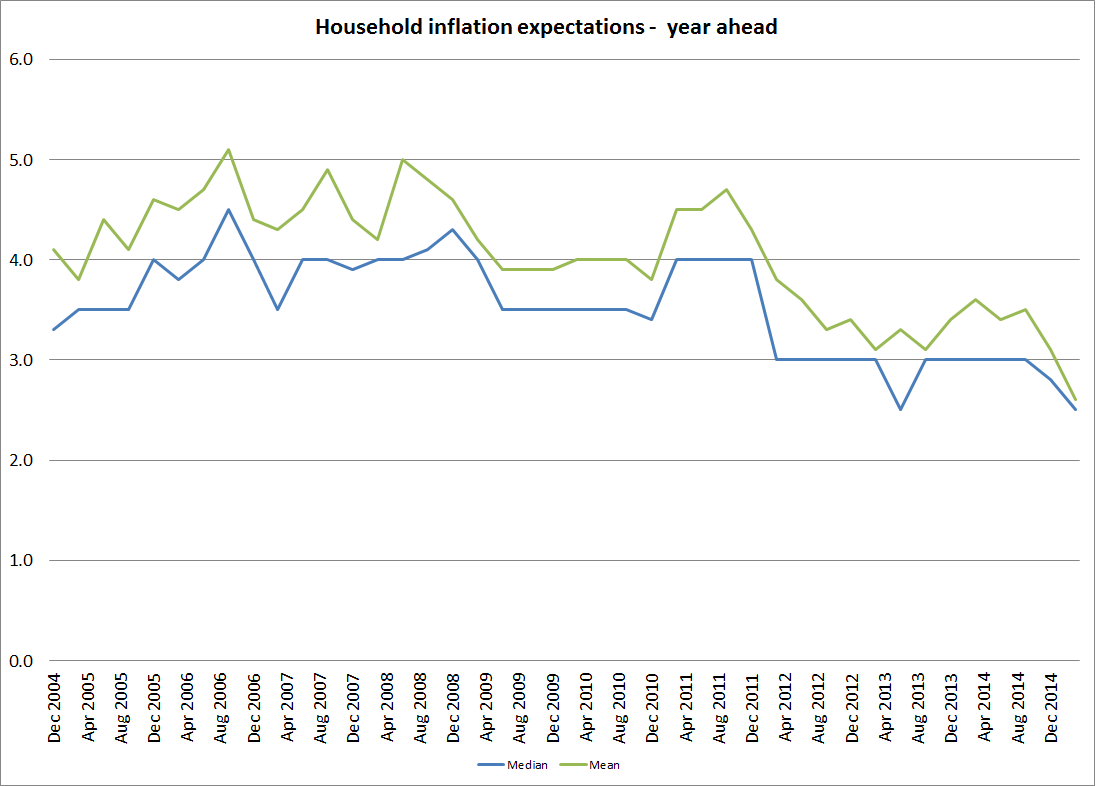
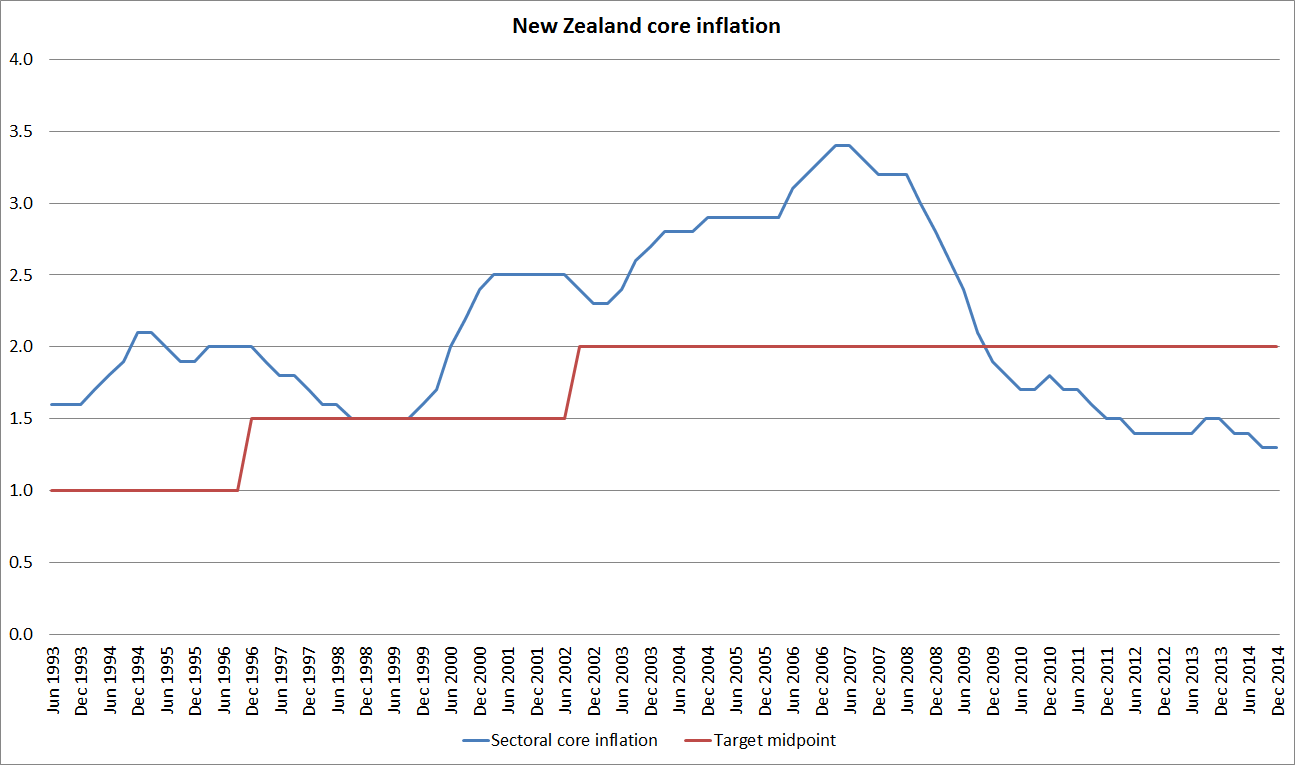
Tomorrow morning Graeme Wheeler, the single unelected official responsible for the conduct of New Zealand’s monetary policy, will announce his latest OCR decision.  That decision will, no doubt, already have been made – lags between decision and announcement are longer in New Zealand than in most other countries, even more so at Monetary Policy Statements  – and the only discussion now will be around wording the one page press release.   Do we really need to say anything this time about future policy?  Will that slight change of words spook the markets?  Is that claim really defensible?  How appropriate is it to comment on another country’s monetary policy?  How does talk about the exchange rate and the medium-term challenges it poses fit in a statement about today’s OCR.  How will local economists read it?  How will offshore markets read it?  Where are the political fishhooks?  Don’t we need a comma there rather than a semi-colon?  And so on. But the heart of the matter is the OCR decision itself – where will the interest rate the Bank pays on (some) settlement cash balances be set for the next six weeks or so.  The key influence on that should be the inflation target: a range of 1 to 3 per cent annual CPI inflation, with a focus on keeping future inflation “near the 2 per cent target midpoint”. The Reserve Bank would no doubt argue that that is exactly what they have been doing.  The target is not about inflation today, it is about “future inflation outcomes over the medium term”.   The Reserve Bank’s published inflation forecasts always show inflation coming back towards the target midpoint a year or two ahead.  They do that by construction, but policy over the last few years has been set consistent with that view.  The judgement was that interest rates needed to be first at 2.5 per cent, and then move progressively higher, to ensure that future inflation did turn out consistent with the inflation target.   Reading through the Monetary Policy Statement from last March, when the OCR increases began, it is quite clear that the Bank expected to see more non-tradables inflation, higher inflation expectations and higher wage inflation, even with the programme of OCR increases they had in mind. But the Reserve Bank was wrong.  There is no particular shame in being wrong, so long as one learns from one’s mistakes.  It isn’t clear that the Reserve Bank has been very good at that.  Of course, what matters is not that so-called headline inflation was 0.1 per cent in the last year.  All sorts of things will throw headline inflation around in the short-term and generally it won’t make sense for monetary policy to try to offset them.  That is why people develop measures of core inflation –  simple ones like CPI ex food and energy (volatile items), trimmed means, weighted medians, and the sectoral core factor model. Core inflation has been falling core cpi So have household inflation expectations household So have business wage and inflation expectations business And dairy prices – a major influence on incomes, and incentives to invest – have been coming in much lower than the Reserve Bank expected, consistent with the pretty relentless decline in global commodity prices. Had the Reserve Bank had known last March how the New Zealand economic data would turn out, I don’t think Mr Wheeler would have seriously considered raising the OCR then.  Had they done so anyway, they would, I hope, have faced very serious questions from their Board and from the Finance and Expenditure Committee: raising the OCR while showing forecasts suggested that core inflation would keep falling even further below the target midpoint looks like something other than inflation targeting. Everyone makes mistakes, and economic forecasting is something of a mug’s game,  But it is the Reserve Bank that chooses what weight to put on its own forecasts, and how far ahead to look.  When they have been so persistently one-sided in their errors, it is surely time to down-weight the forecasts quite considerably.  The “model” –  the way of thinking about what is going on –  just isn’t helping much, if at all. Such one-sided errors aren’t new.  During the boom years, the Reserve Bank was consistently surprised by how strong inflation was.  We didn’t fully understand what was going on, but didn’t correct for that and, as a result, by the end of the boom core inflation measures were above the top of the target range.  The underlying belief that surprisingly strong inflation pressures were just about to end is quite strongly parallel to what seems to be going on now – an apparent wish to believe that whatever has kept inflation down is just about to end. With perfect foresight the OCR would not have been raised to 3.5 per cent. No one has perfect foresight, but knowing what we now know  there is a strong case for starting to lower the OCR now.     As it is, it is not just that nominal interest rates were raised by 100 basis points last year (and not just the OCR, but floating mortgage rates) but that as inflation expectations are still falling, real borrowing rates are still rising further. Perhaps it would be different if there were strong, well-substantiated, reasons to think that underlying inflation pressures were just about to recover strongly –  and I stress “strongly”; it has taken five years or more for core inflation to drift this far below the target midpoint. But there aren’t.  The construction cycle looks to be pretty close to peaking .  Recall that the gearing-up of activity in Christchurch represented the biggest single project pressure on resources in New Zealand at least since Think Big, and yet core inflation just went on falling.  There is no sign of business or consumer confidence pushing up to new heights.  Export commodity prices are weak, especially for dairy –  and the exchange rate is at a level which, if sustained, can only act as a drag on other tradables sector activity.  And while I wouldn’t suggest setting policy on a non-consensus forecast for the rest of the world, no one really sees global activity or inflation posing a material new inflationary risk in New Zealand in the next year or two.  If anything, the deflationary clouds continue to gather. John McDermott’s speech last week was slightly encouraging –  a very belated recognition of just how weak inflation has been, and how little the Reserve Bank (or anyone) really understands about what is going on.  But I noted then this disconcerting line from the speech:

We remain vigilant in watching wage bargaining and price-setting outcomes. Should these settle at levels lower than our target range for inflation, it would be appropriate to ease policy.

In 2012, the Governor and Minister explicitly, and consciously, decided to include a focus on the target midpoint in the PTA.    It is the midpoint, not the bottom of the target range which the Bank should be focusing on. I can really only see one argument against an OCR cut, a line which I’ve seen reported in various media: the housing market, and what lower interest rates might do to house prices.  There are several points worth making briefly here:

  • In its monetary policy, the Reserve Bank is explicitly not charged with managing house prices.  The only target for monetary policy –  agreed with the Minister – is for the CPI.  Neither existing house prices nor land prices are in the CPI, and the CPI’s treatment of housing is one the Reserve Bank has endorsed.
  • To the extent that rising house and land prices in some parts of the country reflect the interaction of regulatory obstacles and population pressures, they are real relative prices changes –  not something that, even in principle, monetary policy should be paying much attention to.
  • House prices in much of the country have been flat or even falling.  There is no evidence of some generalised speculative dynamic, let alone a credit boom.
  • Any possible threats to future financial stability –  the case for which the Reserve Bank has not yet convincingly made – should be dealt with through prudential regulatory tools.  Higher required capital ratios, or higher risk weights on housing loans, would be an orthodox response if a cost-benefit analysis suggested that larger buffers were required.

Finally, the Reserve Bank does not have an explicit “dual mandate”.  But any time a central bank engages in discretionary monetary policy – as opposed to, say, a long-term fixed exchange rate – it is assumes such a responsibility de facto.  Changes in the OCR affect output and employment in the short to medium term.  Perhaps I’ve completely lost perspective, but it disconcerts me how little public attention the Reserve Bank gives to the number of people unemployed (and underemployed).  At 5.7 per cent, the unemployment rate is still well above normal, and underemployment measures in the HLFS have not come down much at all.  The decision to hold the OCR is not just a decision between higher and low inflation.  If it were, there would still be a case for a cut.  But the cut/hold choice is also one between a faster reduction in the number of people unemployed and a slower reduction.  Involuntary unemployment is a blight, that scars families and individuals, and often has permanent adverse economic effects on the unemployed.    When there is so much  inflation leeway –  inflation so far below target, with few looming inflation pressures – the plight of the unemployed should get more attention from the Reserve Bank, and from those who hold it to account.