Not the usual stuff of this blog, but at lunchtime yesterday I went along to this well-attended event (St Andrew’s was full).
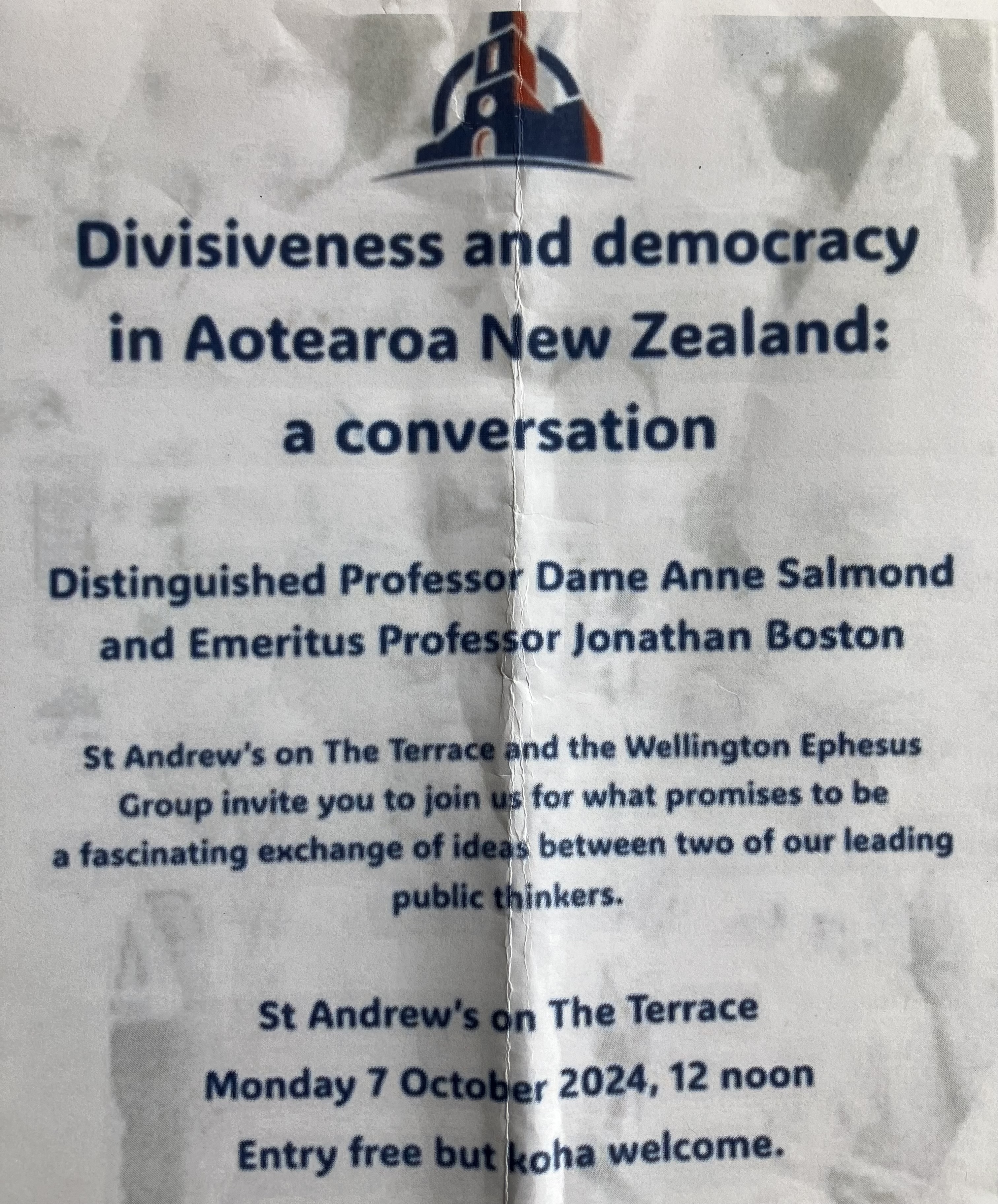
I had a few reactions and didn’t think I could do them justice in a few quick tweets.
Why did I go along? Well, several reasons really. Being semi-retired one has time, in principle the topic sounded interesting and important, I’d never heard Salmond speak before, and I have some time for Boston. I can’t say I necessarily expected to agree with the thrust of the promised “conversation”, but it is always good to hear people you disagree with make their best cases. Boston noted that it was a rare event at which he lowered the average age (and he is a few years older than me).
As it happened, Salmond did most of the talking, while Boston acted more as guide and host to the conversation (although he threw in some more comments in the Q&A session, including stating his preference to raise the NZS eligibility age to 70 – I clapped at that point). He sought to structure the discussion under 4 headings: treaty issues, environmental issues, the future of democracy, and “what on earth should we do now”.
Of course, I should have anticipated that the “conversation” wasn’t really going to be anything at all disinterested. If you were concerned about the way in which politics and society were going, and were interested in exploring common ground, rebuilding trust, engaging in efforts towards mutual understanding etc, you certainly wouldn’t have taken Salmond’s approach. From Salmond’s side in particular, it was mostly a series of sneers and laments about this government (David Seymour in particular, and Christopher Luxon who seemed to have fallen into the hands of bad people).
(As regular readers will know I am not myself a particular fan of this government, have little time for either Seymour or Luxon, and do not support Seymour’s Treaty Principles Bill.)
If inflammatory language is one of the problems of our day, Salmond contributed more than her fair share in just one session. Had anyone who strongly disagreed with her own politics been present they’d not have felt as if Salmond had any interest in them, except to sort them out and put them on the straight and narrow, or any recognition that there might be legitimately competing interests, world views, models for how policy should be done or New Zealand governed. Instead – particularly on treaty issues – we got sneers at how David Seymour couldn’t read Maori (which seemed particularly strange from someone of wholly European ancestry re someone of part Maori ancestry), claims that his approach was “impertinent”, that it was all “heartbreaking”, and that “it takes a lot of work to remain as ignorant as many of us have been”. It was, apparently, okay to have a discussion about the Treaty of Waitangi, “but not like this” – more, it seemed, a case of it was okay for the unwashed to ask questions of the experts and be put back on the right path, as if historical research (fascinating as it often is) was the answer, rather than one contribution to dialogue and debate as to how a modern New Zealand should best be governed, and what (if any) ongoing role an 1840 treaty might play in that.
The government was then accused – in the calm moderate language that fosters dialogue – of an “ambush of our democracy”, a claim which appeared to apply not just to treaty things but to the environment. This government, we were told, “is going in the opposite direction to our survival as a species”. Strangely – or perhaps not – the fact that the ETS continues in place, which caps emissions across the economy as a whole, was never mentioned. The fast track list seemed very unpopular……and yet of course there was no mention of projects fast-tracked under the previous government. Perhaps one line I might welcome was that there wasn’t much evidence of the coalition agreement commitment to evidence-based policymaking, if only it weren’t that successive governments – of both political stripes – have been so poor on that score.
And if the rhetoric hadn’t been amped up enough, we were then told that the government was “tossing whole categories of people on the rubbish heap”, while being invited to evaluate the government on how many New Zealanders were leaving, the suggestion being that it was because of this “ambush of democracy” – as if this hadn’t been a stark and sad feature of New Zealand, across governments except when the borders were closed, for too many decades.
I’m sure it was quite entertaining and emotionally satisfying for the much of the audience – and there were audible gasps of approval when she quoted Nobel economics winner Paul Romer to the effect that “we must stop apologising for regulation. It is the only thing that protects us from the abyss” – as if no one had noticed that David Seymour’s own new ministry is actually called the Ministry FOR Regulation.
I suspect that Boston was pretty sympathetic to a fair amount of Salmond’s commentary but he did inject a moment of realism, noting that the government (and its component parties) are about as popular now as they were in the election last year. If good Christopher Luxon (Salmond had been keen on him at Air NZ) really had fallen among the disreputable, “many of our fellow New Zealanders” seemed to quite like what he was doing.
(Now again to be fair, Boston seemed distinctly unimpressed with the Labour Party, and Salmond with the Green Party, so perhaps they might think it was all just the failures of the Opposition).
Salmond seemed dead keen on allowing New Zealand policy to be shaped by international “great and good” people: we got repeated references to various reports of Nobel Prize summits. It wasn’t quite clear how this was going to help her treaty concerns, but I guess she had in mind the environment. Quite why we’d want New Zealand policy to be guided by a bunch of people who are very expert in usually quite narrow technical areas, when most political hard choices are about values and distributional tradeoff, wasn’t ever made clear. Salmond seemed very keen on “citizens’ assemblies” and exercises in so-called “deliberative democracies” but presumably only so long as people like her got to guide the material these selected citizens were presented with. More money for journalism, and public broadcasting in particular, seemed to be a policy line both Boston and Salmond were championing, seemingly utterly oblivious to the declining public trust in journalism.
Perhaps weirdest of all was the way Salmond ended. Apparently oblivious to Boston’s reminder that the current government isn’t exactly unpopular (at least outside central Wellington) there was an impassioned plea that we should “let leaders lead”. Since I doubt she in mind Seymour, Shane Jones, or even the diminished Luxon, one can only assume it was only the right sort of approved leaders who should be allowed to lead. In a final flourish of no nuance whatever, we were told that we needed leaders who would look to the interests of their children and grandchildren, not to the interests of donors. A particular unconstructive approach to enhancing mutual respect etc to simply assert that everyone who disagrees with you is either ignorant or in the thrall of donors, and has no concern for next generations (even their own) at all. It really was quite breathtaking.
Perhaps if one went along to an ACT rally, or even a New Zealand Initiative members’ retreat, it might all be about as bad on the other side: the dismissive sneering and the automatic assumption of a single right pathway, if only the peasants could be cowed or brought to understand. Maybe (I genuinely don’t know). For myself, I’m sceptical of constant calls for “social cohesion” etc, since there are really big and important differences and values and world views and priorities, and there isn’t much point in assuming that one side or the other only needs to be enlightening (or perhaps silenced). But it really was astonishing that someone as able in her own field as Salmond evidently is, had no apparent interest in anyone else’s models or values or frameworks, or even a conception that there could be such things: the people of goodwill and intelligence might genuinely, deeply, and perhaps intractably disagree.
But it probably all played well to the elderly base present at the meeting. Just like so many gatherings – so much social media for that matter – do.
 croaking cassandra
I have noticed that Prof Salmond has claimed on Newsroom at least five times this year that if you can’t read te reo you can’t have an informed opinion on the Treaty. It’s an extraordinary example of academic elitism and rather stupid.
Try telling the billions of Christians who can’t read koine Greek that they can’t have an opinion about the text of the New Testament or the Muslims who can’t read Arabic that they can have no worthwhile insights into the Koran.
LikeLiked by 1 person
And while there are significant debates to be had about the precise meaning of the text(s) and what any and all parties thought they were signing in 1840, there are equally important, but quite distinct, arguments to be had about, if any, role that text should play in the government of modern New Zealand.
LikeLiked by 1 person
“Modern New Zealand” – this oft used premise that a treaty agreed/signed less than 200 years ago has no relevance in today’s NZ society is an affront to me. Heck, 200 years is but a spit in time. The world still respects the fundamental premise of the Magna Carta (1215) – no one points out it has no relevance because of its age. In the NZ sense, the Treaty of Waitangi is a foundational document of our sovereign Parliamentary democracy – the beginning/conception of our constitution – the start of our ancestral desire as a new nation to co-exist peacefully with the peoples who had been here millennia before European explorers and settlers. How could it not have relevance today? It’s as relevant and reflective of who we are and what we represent in NZ, as The Constitution and the Statue of Liberty is to the US. It is sad that we fail as a nation to have the type of pride and respect that Americans do for their founding fathers – the signatories to our Treaty are our founding fathers.
LikeLike
I guess I think the closest US parallel is something like the Declaration of Independence. Powerfully symbolic and a material element in historical memory and any shared sense of what it is to have become the USA. But not law.
LikeLiked by 2 people
Not everyone believes the Treaty is NZ’s founding document, of course. Elizabeth Rata, for one, thinks the New Zealand Constitution Act (UK) 1852 is a better candidate, establishing a system of representative government for the colony.
I assume you’re not aware the US Constitution has been amended 27 times: “The founders also specified a process by which the Constitution may be amended, and since its ratification, the Constitution has been amended 27 times. In order to prevent arbitrary changes, the process for making amendments is quite onerous.”
https://www.whitehouse.gov/about-the-white-house/our-government/the-constitution/#:~:text
LikeLike
@gadams. It is not a matter of “belief” – no one disputes The treaty exists; was drawn up by the Queen’s representative and signed by those in authority at the time. and I was careful to say;
“the Treaty of Waitangi is a foundational document of our sovereign Parliamentary democracy…”
“a” meaning one of a number of foundational documents – we can go back throughout British history to find any number of other foundational documents (such as the Magna Carta) that make up the constitution of New Zealand – a collection of statutes (Acts of Parliament), Treaties, Orders-in-Council, Letters patent, decisions of the Courts and unwritten constitutional conventions.
As with the United Kingdom, there is no one supreme document; the New Zealand constitution is not codified and only certain laws are entrenched (require a 75% majority of the House to amend).
And yes, I’m very knowledgeable and aware of the US Constitution and its amendments. I grew up there and was required to study it throughout my undergraduate education. Treaties don’t get amended – they are either honoured or broken. That too was a big part of my undergraduate education given most entered into with the indigenous Americans were broken. And like the Treaty of Waitangi, historians have diligently researched and documented those legal breaches.
LikeLike
It is in fact a question of “belief” when it comes to how much weight is given to any historical document. Sure, the Treaty exists and was signed by British representatives of the Crown etc, but its importance is heavily contested.
As David Lange put it in 2000 at the Bruce Jesson lecture:
“The treaty cannot be any kind of founding document, as it is sometimes said to be. It does not resolve the question of sovereignty, if only because one version of it claims one form of sovereignty and the other version claims the opposite. The court of appeal once, absurdly, described it as a partnership between races, but it obviously is not. The signatories are, on one side, a distinctive group of people, and on the other, a government which established itself in New Zealand and whose successors represent all of us, whether we are descendants of the signatories or not. The treaty cannot even resolve the argument among Maori themselves in which one side maintains that that you’re a Maori if you identify as such, and the other claims that it’s your links to traditional forms of association which define you as Maori. As our increasingly dismal national day continues to show, the treaty is no basis for nationhood.”
Treaties are not only honoured they are frequently abandoned when their terms no longer suit one or both of the parties.
LikeLike
@gadams – appreciate that response. Not familiar with the Lange quote – and very interesting – as we can see the progress since then in his (then) perception of our national day;
No longer is Waitangi Day regarded as a “dismal” display of nationhood – rather it has become a very positive celebration – a sign that what Dame Anne in the full title of Tears of Rangi refers to as Experiments Across Worlds. Now it is attended and heralded by all manner of peoples that make up our diverse, young nation. For many an overseas visitor we have had to NZ, a visit to Waitangi, the Treaty grounds and the marae community is one of the most uplifting experiences they recall of their visit.
When two distinct worldviews can come together and co-exist in a respectful and compassionate manner – that is a beautiful thing. We’ll ‘get past’ this Seymour-thing. It will not be remembered in the greater scheme of our progress and nationhood.
LikeLiked by 1 person
I think it is awesome that you went and listened to someone outside your usual frame of reference and then took the time to critique the experience. Much like yourself – any personalizing of politics around individuals makes me queasy – the focus should always be on policy and in particular economic policy and the impact that has on ordinary peoples lives.
No matter how much I might disagree with a politician or commentator – I always remind myself that they have a family and friends that they care about and care about them. But mostly I remind myself – who am I to judge? As someone once said – ‘let he who is without sin throw the first stone’.
In NZ I think our politicians and traditional media are generally respectful when it comes to privacy and personal attacks. That probably isn’t the case on social media of course.
LikeLike
Michael
Thank you for attending the meeting and providing useful insights. No doubt we are all to some extent a product of our background, education, friends and preferences. This what it means to be human.
What I find deeply discouraging, particularly amongst our academic elite, is the smug certainty surrounding their convictions. No one doubts they are sincerely held.
It would have been useful at such a meeting to have others who held equally strong but opposing views to present alongside Boston and Salmond, that they chose not to facilitate such a discussion is not surprising. In their world, error has no rights and deserves no platform.
They appear to exist in a mutually affirming self congratulatory bubble that is hermetically sealed against the intrusion of diversity. I am speaking of course about diversity of thought, diversity of opinion.
For an alternative insight into the ‘fundamental question’ at Waitangi Ewen McQueen submitted a helpful article to KiwiBlog that the Herald refused to run. There may have been good reasons for the Herald’s decision of which we are not aware, but increasingly our media appears to have positioned themselves as gatekeepers of public opinion rather than facilitators.
Another reason, as you pointed out, that trust in the NZ media is so low.
At any other time McQueens observations, based upon historical record would be uncontroversial. They deserve a wide audience.
https://www.kiwiblog.co.nz/2024/10/guest_post_kawanatanga_katoa_was_the_fundamental_question_at_waitangi.html
LikeLiked by 1 person
Thanks Brendan. Interesting article. My own view of the treaty, for what little it is worth, is that whatever either side thought they meant in 1840 was superseded by the proclamation of May 1840, and that notwithstanding that symbolic significance of the treaty (backdrop to the proclamation re the North Island) it is no sensible or feasible basis for ordering society today (incl because it is by its nature unamendable).
LikeLiked by 1 person
How we move forward today is an open question, and one we should debate. What is unhelpful however is an ahistorical revisionist interpretation of the Treaty to include the modern novelties of partnership and co-governance.
The previous government did more to damage race relations in New Zealand than any in living memory by setting expectations for (some) Maori that were predicated on a fiction, and stretched the tolerance of most New Zealanders beyond reaonsable limits.
That Boston and Salmond appear blind to this is remarkable.
That 440 church leaders in New Zealand seem blind to this is also remarkable.
I don’t know if ACT’s David Seymour’s Treaty Principles bill is the right approach, but I do believe we are overdue for a public discussion about the role of the Treaty.
LikeLiked by 1 person
Largely agree, altho the very detailed historical arguments tend to have salience only because of the tight connection many seek to draw between whatever was signed/meant etc in 1840 to the government of NZ today. I find the historical debates fascinating in their own right but I’m a history buff, I find all sorts of historical questions fascinating (origins of WW1, causes of the Great Depression, the US sovereign default of 1933 etc etc) without thinking they have any v particular application to policy or government today.
LikeLike
Meant to add that the 440 church leaders seem engaged in at least as much of a creative reimagining of the treaty as Seymour, the Maori Party, or anyone else trying to use it as a meaningful basis for anything much today.
LikeLiked by 2 people
“Perhaps if one went along to an ACT rally, or even a New Zealand Initiative members’ retreat, it might all be about as bad on the other side: the dismissive sneering and the automatic assumption of a single right pathway, if only the peasants could be cowed or brought to understand. Maybe (I genuinely don’t know).“
Having dipped your toes into that particular stream isn’t it likely that whatever you achieved from that would be at least augmented, possibly exceeded by getting the other foot wet?
You may not like Seymour, but given even a brief survey of his work it seems unlikely he’d be as dismissive or condescending as the above, and that alone is telling.
LikeLike
If there were a convenient Seymour meeting I’d happily go along.
(I will note that over my decades at the Reserve Bank we used to take very the lofty disdain, presumption that we had the truth, approach to critics and those who disagreed with us. Looking back, one of the lines I’m most embarrassed by was a submission to a select committee in which I wrote (for the Bank) “the fact that most academics oppose this bill says more about the state of NZ academic economics than about the merits of the proposed law”
LikeLiked by 1 person
I will say this in support of David Seymour, albeit I didn’t vote for him at the last election, he is a courageous and gifted communicator. Both attributes, particularly the former are increasingly rare in politicians of any persuasion.
LikeLike
“Most political hard choices are about values and distributional tradeoff”
Brilliant line, and one I wish everyone could be conscious of in their thoughts on lawmaking – nice one Michael
LikeLike
Very interesting read. I’m with you, Michael – we have to experience and respect all the different worldviews in order to make this world work for as best we can for everyone. And that type of learning and appreciation, to my mind, requires first a grounding in the philosophy of ethics – then moving into more specialised ethics (such as environmental ethics) and the associated worldviews, relating to that specialisation.
Dame Anne is an anthropologist and historian of tremendous capability. I disagree with you in that there really aren’t many ‘elites’ in academia (the vast majority of us working in academia are not particularly gifted or noteworthy, and for me I was attracted to it for the joy of teaching), but Dame Anne would be one of the ‘elites’ (and I say that in a respectful and positive way). She’s simple amazing. And, yes, she’s used her voice a lot – and yes, I think she’s very passionate about te ao Māori/the Māori worldview because her deep, deep dive into the history and culture (as is her professional specialisation) has made her so much more acutely aware of the injustices arising from the lack of interest, lack of understanding and lack of respect for tikanga Māori by the settlers and their successors – David Seymour included. Having some Māori ancestry has nothing to do with being Māori (being in the spiritual sense of tikanga).
But enough of the adoration of Dame Anne from me – let’s let her use her own voice to put a very poignant thought in all our minds – something to truly contemplate; – it made me think what have we (NZ collective) done?
https://www.nzherald.co.nz/nz/anne-salmond-maori-once-were-tender-fathers/MXIMYNLIEUDT4BZSG2N6LXJQUI/
LikeLike
I don’t think I did (and certainly didn’t intend to) suggest that there are many “elites” in academe (my starting point is that, as in most professions, most are fairly diligent journeymen (or women).
Take your point on Seymour and the language, but in many ways it sort of makes the wider point. So much of the Maori-descent population is now really quite mixed, and many don’t primarily identify as Maori (much as there are many in the Uk with some Scots ancestry but don’t primarily think of themselves as Scots). A document that probably made sense in 1840 – largely distinct communities – seems now largely to be something that should be thought of as an important historical symbol/memory.
LikeLiked by 1 person
I might agree with you that an 1840 document had diminished in relevance were it not for the many statistical measures and the plethora of data we have that indicates clearly that having a strong Māori ancestry in your family history is detrimental to wellbeing/health, educational attainment; stable living conditions; being victims and perpetrators of crime; having less (if any) accumulated wealth; and so on. Had progress since 1840 been equitable (i.e., the same rights and obligations of British citizenship) across both cultures, perhaps those of us of British ancestry could rest and be proud that the intentions of the Treaty had been met – but they have not. I think it’s really hard for many of us who have come from multigenerational advantage, to understand/accept how multigenerational disadvantage is responsible for the statistics we see today. This understanding of history (if it is not told to you from within your own family’s stories of their past and that of their ancestors who experienced it first hand) comes from reading as much as you can to gain that kind of empathy through historical knowledge, e.g.,
https://e-tangata.co.nz/history/equality-on-the-battlefield-but-not-at-home/
As long back in my family history as I have knowledge of – each generation were the benefactors of accumulated wealth (inheritance and/or gifting) and such wealth grew with respect to the size of the inheritance with each subsequent generation as well. Wealth accumulates.
LikeLike
Probably not worth extending this debate at any length here (too many possible and overlapping strands etc), altho I would note that personzlly I do not come from families that benefited from accumulated wealth, whether inheritance or gifting.
LikeLike
[…] Divisiveness and democracy […]
LikeLike