Further thoughts on Wellington airport – Part 2

In my first post today, I posed some questions around the plausibility of the assumed increase in international travel into and out of New Zealand if the proposed Wellington airport runway extension was to proceed.

In this post, I want to focus mainly on how the consultants have calculated the net national benefits from the runway extension.

The Sapere cost-benefit analysis estimates net benefits to New Zealand from proceeding with the runway extension now of $2090 million (2015/16 dollars).  These results are summarised in Table 30 of the report.  Of these gains, just under half accrue to New Zealand users of the airport (in respect of both passenger and freight traffic) and just over half accrue to “other sections of the community”.

Even if the passenger number assumptions are correct, the benefits to New Zealand users appear to be somewhat overstated, and the benefits to the rest of the community are largely non-existent.

Take  the users first.    The main benefit to New Zealand users is the lower cost of travel.   Much of that is the cost of time.  The consultants have valued the time of New Zealand travellers using some standard values from an Australian Civil Aviation Safety Authority document, but don’t appear to have allowed for the fact that New Zealand earnings  (and hence the appropriate value of time) are materially lower than those in Australia.  In PPP terms, real GDP per hour worked in New Zealand is only around 75 per cent of that in Australia.  That suggests the consultants have overstated the value of the time savings, and that the actual number would be lower by perhaps 25 per cent.

Concepts of consumer and producer surplus are very important in evaluating the welfare implications of proposals such as this.   The basic idea is illustrated in this chart.
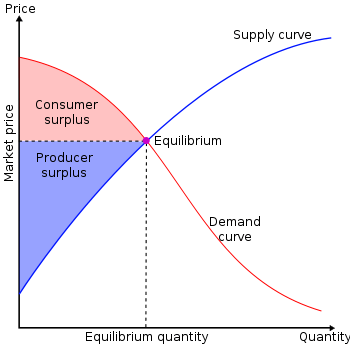
surpluses.png

Consumer surplus is the value from consuming a product or service over and above what the consumer had to pay for it.  For some consumers, the surplus will be large (think of the first refreshing drink on a very hot day), but for the last additional consumer (the marginal) consumer, that surplus should be zero.  People will purchase additional products or services up to the point where the marginal cost to them is just equal to the marginal value of that additional consumption.  We’ll come back to producer surplus shortly.

Sapere have allowed for an estimate of the consumer surplus  that arises from the additional use of air travel services by outbound New Zealand residents ($73 million of the benefits). I’m not totally clear how they derived that benefit estimate   But they consciously do not to attempt to put a value on the additional consumer surplus New Zealand residents gain from the additional goods and services consumed on their additional overseas holidays.  It is hard to estimate such a value, but (as they pointed out to me) this omission does somewhat understate the benefits to New Zealanders of a runway extension that leads to the sort of increased outbound New Zealand traffic the calculations are based on.  However, while this is an omission, the magnitude seems likely to be quite small.  Recall that these are the marginal travellers, for whom a holiday abroad is only attractive because of the option of travelling directly through Wellington.   It is also worth stressing that while these gains are real, they accrue directly to users of the airport, and provide an additional basis on which the airport could recoup the considerable cost of providing the longer runway.

The bigger questions arise around the estimates of the benefits to the rest of the community.

The first of these is the value of the additional GST on sales of goods and services to the 200000 more (by 2060) annual foreign visitors to New Zealand as a result of the runway extension.    That GST is mostly a net real gain to New Zealand (foreigners funding our government spending).    In the Sapere estimates, it would be worth a discounted present value of $184 million, so represents almost 10 per cent of the estimated total economic benefits.

But increased GST from foreigners spending in New Zealand is not the only GST effect likely from extending the runway.  Cheaper travel also works by encouraging more New Zealanders (especially those from around Wellington) to travel abroad.  When New Zealanders travel abroad they pay GST (or the equivalent) to foreign governments.  And the income they spend abroad can’t subsequently be spent at home.  Had they spent the same money in New Zealand, the GST would simply have been, in effect, a transfer from one set of New Zealanders to another.  But with an increase in foreign travel, it is now a transfer to foreign governments. Even on the InterVISTAS/Sapere numbers, around a third of the net increase in foreign travel results from New Zealanders going abroad.  If anything, I’ve suggested that long-haul flights to/from Wellington, if viable, might be more attractive to New Zealanders than to foreigners.  At best, the GST gain is likely to be no more than half the Sapere number.

But much the biggest issues relate to the possibility of benefits to New Zealand from additional foreign tourists buying real goods and services in New Zealand.  Sapere appear to have estimated a total for the likely increase in tourist spending in New Zealand and then subtracted an estimate for the cost of providing those services.  For that they have assumed that 45.5 per cent of the expenditure is domestic value-added (ie returns to labour and capital).  That approach doesn’t seem right and generates highly implausible estimates.

The producer surplus is the gain to the provider of a good or service over and above what he or she would have been willing to provide that service at (see the earlier chart).   The cost of providing the service includes the cost of intermediate inputs (materials etc) but also the cost of the labour and the cost of capital (a normal rate of return).  If the producer sells product at that cost, there is no producer surplus. In this context, there is no net economic benefits –  economiccosts have just been covered.

Over the long haul, in reasonably competitive markets, producer surpluses should be very small (in the limit zero).  For a hotel that budgeted on 80 per cent occupancy, a surprise influx of visitors for the weekend will generate a producer surplus –  the windfall arrivals add much more to revenue than they do to costs of supplying the service.  But over the long haul –  and the airport project is evaluated over the period out to 2060 –  it is fairly implausible that there will be any material producer surplus resulting from well-foreshadowed increases in visitor numbers.  Most of what tourists spend money on in New Zealand are items such as accommodation, domestic travel, and food and beverage.  In all those sectors, capacity is scalable.  One would expect new entrants just to the point where only normal costs of capital were covered.  In the long run, supply curves for most of these sorts of services/products should almost flat.

My proposition is that there are few or no producer surpluses likely to arise from a trend increase in foreign tourism as a result of extending Wellington airport.  But even if there were, any such gains would have to be offset against the loss of producer surplus for New Zealand producer (to foreign producers instead) from New Zealanders taking more holidays abroad.  It makes little difference to the hoteliers if I take my holiday in London instead of Queenstown, while at the some time someone in Manchester takes his in Queenstown instead of taking it in London.

Even if the consultants are right that there would be more additional inward visitors than outward, any producer surpluses from either set of numbers should be small.  And the net of two small offsetting numbers is even smaller.

The safest assumption, in evaluating the WIAL proposal, is to assume that the economic benefits of the proposal all accrue to users, and that there are no material net economic benefits (or costs) to the rest of the community.  Perhaps there is a small amount in the net GST flow, but it is hardly worth focusing on given the scale of the other uncertainties.

Perhaps this point will seem counterintuitive to lay readers and city councillors.  Surely “Wellington” or “New Zealand” is better off from having more foreign visitors (assuming the numbers outweigh the increased outflow of New Zealanders)?  And if so, shouldn’t we –  Councils, government –  be willing to spend money to get those benefits?   The short answer is no.    Good and services cost real resources to provide, and in a competitive market simply providing more goods and services won’t make the city or country better off –  you need to be able to sell stuff that generates more of a return than it costs to provide (including the cost of capital).  Vanilla products and services typically don’t do that.  After all, labour that is used to provide services to tourists is labour that can’t be used for something other activity.  And over a horizon of 45 years we can’t just assume there are spare resources sitting round unused.  Spending public money to generate this economic activity will come at a cost of some other economic activity being displaced (as well as the deadweight costs of taxation, which are allowed for in the cost-benefit analysis).

If, to a first approximation, there are no “net incremental economic benefits” for the “rest of the community” then even if the WIAL/Sapere passenger number estimates are totally robust, the net benefits of the project drop from $2090 million to $954 million.

In my earlier post, I noted that the cost-benefit analysis had been done using a 7 per cent real discount rate.

The authors defend it by reference to the Treasury’s guidance on evaluating infrastructure and single-use building projects (eg hospitals and prisons).

Frankly, I’m sceptical that that is an appropriate discount rate for this project.  And I would be astonished if Infratil –  the dominant shareholders in WIAL – treated their own marginal cost of capital for a project like this as being as low as 7 per cent real.  Perhaps a case might be made for something that low in respect of projects that depend simply on existing traffic (growth) patterns –  eg the current extension to the domestic terminal at Wellington –  but at the margin this runway extension has the feel of a much higher risk project.  After all, they could build it and no one might come.  I’ve written previously about government discount rates, and also linked to a recent Reserve Bank of Australia article suggesting that private sector firms are typically using hurdle rates of at least 10-13 per cent nominal (almost as many in the 13-16 per cent range).

I would reiterate the point here. For a project like this, a much higher discount rate should be being used.  Perhaps if it all goes wrong, WIAL itself might be able to recoup the costs from all airport users (I don’t know the Commerce Commission limitations on that), but even if so, this evaluation is being undertaken from a national benefit perspective.  The risk of all users being lumbered with higher charges to cover the cost of a project gone wrong has to be factored in to any evaluation as to whether public money should be used. A 10 per cent real discount rate seems a pretty reasonable commercial benchmark, and the sensitivity analysis (table 33) indicates that using a 10 per cent discount rate rather than a 7 per cent rate roughly halves the estimated net economic benefits of the project on the “most likely” scenario.

Using a higher discount rate and removing the producer surpluses (that are most unlikely to exist)  would reduce the estimated net national gains of the runway extension proposal –  advertised at in excess of $2 billion – by around three-quarters, even if the passenger number estimates were totally robust.

If one uses the low scenario instead (Table 33), net economic benefits are estimated at $802 million.  But $533 million of those benefits were estimated to accrue to the rest of the community –  and I’ve argued that those producer surpluses just don’t exist to any material extent.   And on that scenario, using a 10 per cent discount rate reduces the net economic benefits by 57 per cent relative to the estimate done using a 7 per cent discount rate.

Perhaps there is a viable proposition in all this for the airport company itself.  I rather doubt it.  I suspect that the additional landing and passenger charges that would have to be levied on the new wide-bodied/log haul services would undermine the additional demand to the extent where it was simply uneconomic to provide those services. Wellington doesn’t look like a natural place for economic long haul services. But that should be the airport company’s call, with their own money at stake

Councils –  and especially Wellington City Council –  should steer well clear of the temptation to put ratepayer money into this proposal.  It is not as if Infratil appears to be proposing to reduce its stake in the airport.  What is apparently proposed is a ratepayer/taxpayer capital subsidy, without the councils gaining any additional ownership interest.    If things go wrong, the airport company itself may well, over time, be able to recover its investment, since many people need to use Wellington airport.  Even if things go right, the Wellington City Council has little way of recouping the cost of its gift/investment.  And if things go wrong, it has no way at all.  Only the chimera of alleged “wider economic benefits” could lure otherwise intelligent people into a proposition with such a weirdly asymmetric payoff structure.


Further thoughts on Wellington airport – Part 1

Shortly after the release of the cost-benefit analysis of the proposed Wellington airport runway extension, prepared by Sapere for Wellington International Airport Limited (WIAL) I wrote a post in which I posed the question “If they build it, what if no one comes?”

Since that post, I’ve been to one of the open day/public consultation meetings, have read and thought about the documents more thoroughly, and have read various pieces written by others, including the new one by Ian Harrison that I linked to yesterday.  I have also had some engagement with Sapere and WIAL, which has helped to sharpen my sense of what the issues really are.

The cost-benefit analysis is not a business case document.  It has been prepared in support of a resource consent application.  What I hadn’t known when I wrote earlier (and was advised of by Sapere) is that  under the RMA the applicants will need to be able to demonstrate national benefits to get permission to fill in some more of Lyall Bay, to extend the runway.

I’m sure that the cost-benefit analysis is not serving as a business case for Infratil, the major shareholder in WIAL.  But since this project is generally accepted to be viable only if there is significant public funding, and any such funding can only be defended if there would be material net public benefits , the Sapere cost-benefit analysis is by default serving as something of a business case at present.  If the numbers don’t stack up, neither the Wellington region councils nor central government should be putting any money into the project (beyond WIAL’s resources, and of course Wellington City Council is a 34 per cent shareholder in WIAL).

In this post, I will offer a few thoughts on the plausibility of the assumed increase in international passenger traffic to/from New Zealand as a result of the extension

Extending the runway at Wellington airport could materially reduce the cost of some forms of international travel in and out of Wellington. If long-haul flights were offered,  lower costs could result by reducing the time taken (eg. by eliminating the one hour flight to Auckland and the stopover time in Auckland, it might reduce the total time for a trip to Singapore (and onward points) by perhaps 2.5 hours).  For those travelling anyway, those gains could be material –  time has an opportunity cost.  In addition, by allowing long-haul aircraft to fly into Wellington, the direct cost of international airfares in and out of Wellington could also be expected to fall –  quite materially, if the numbers Sapere quotes are correct.  Those gains apply not just to long haul routes themselves –  a Wellington-Singapore direct fare should be materially cheaper than the current options via Auckland, Christchurch or Sydney –  but also to trans-Tasman flights, as the longer runway would also facilitate used of wide-bodied aircraft on trans-Tasman routes (as for examples, the Emirates flights between Christchurch and Australia).

Of course, simply building the runway extension does not bring about any of these savings.  They depend on airlines finding it profitable to run additional services.  And although international air travel has increased enormously to and from New Zealand in recent decades, provincial New Zealand is littered with the dreams of local authorities (airport owners) with aspirations to have an international airport.  New Zealand has plenty of attractive places, but one main international airport.

Wellington, of course, has a significant business market, and business travel is typically much more profitable for airlines than leisure travel. And unlike the predominantly leisure travel into Christchurch, the Wellington business travel probably isn’t very seasonal.  So the idea the long haul flights into Wellington could be viable isn’t self-evidently absurd.  But, on the other hand, the economic cost of making such flights technically feasible – lengthening the runway –  is far higher than in many other places.  At $1m a metre, it is considerably more costly than putting some asphalt on some more grassy fields in Christchurch.  Wellington isn’t a natural place for a long-haul international airport.

The WIAL proposal uses modelling by international consultants to estimate likely growth in traffic and passenger numbers with and without the extension.  There are some questions about the baseline forecast, including for example around the potential future impact of climate change mitigation policies.  But my main interest is the difference between these two –  the increase in traffic that would result from the runway extension itself.

It is hard to pick one’s way through all the numbers, but the bottom line appears to be that the cost-benefit analysis is done on the basis that by 2060 there will be an additional 400000 foreign international passengers per annum arriving in Wellington, and an additional 200000 New Zealand international departures per annum through Wellington[1].  Many of these are people who would otherwise have travelled via Auckland or Christchurch, so that the net gain in international travel numbers to New Zealand is around 200000, with an additional 100000 or so New Zealanders travelling abroad.    Many of the gains are forecast to occur early in the period.  Thus, by 2035, the analysis assumes an annual net gain to New Zealand of around 125000 international visitors (relative to the no-extension baseline).

How plausible is this?    The various reports highlight the phenomenon of “market stimulation” –  putting on new air services tends to stimulate total passenger numbers.  That shouldn’t be surprising.  Not only do point-to-point services lower the cost of visiting a particular place, but marketing expenditure raises awareness of the destinations concerned.

On the other hand, one can’t just take for granted that such market stimulation will render long haul flights into and out of Wellington viable.  After all, there are plenty of cities around the world with few or no long haul flights.  Closer to home, Rotorua is an attractive tourist destination and can’t sustain direct flights even to Sydney.

What of Wellington?  The modelling exercise involves lowering the cost of foreigners visiting Wellington –  to some extent artificially, because the costs of providing the longer runway are not passed back in additional charges to those using long haul flights –  but not the cost of them visiting New Zealand (since Auckland and Christchurch fares would stay largely unchanged).   Any long-haul flights into Wellington will almost certainly be from cities that already have flights to Auckland (and possibly to Christchurch).  Is it really plausible that an additional 200000 people per annum (or even 125000 by 2035) will visit New Zealand simply because they can fly direct to Wellington, or (in respect of trans-Tasman traffic) fly into Wellington more cheaply than previously?

Perhaps I’m excessively negative on Wellington.    I reckon it is a nice place for a weekend, but not a destination that many long haul leisure travellers would choose.  What is there to do after the first two days?  And there is little or nothing else in the rest of the bottom of the North Island.   So it is plausible that lower fares resulting from additional competition would attract more weekend visitors from Australia. But no one is going to come for a weekend in Wellington all the way from China or Los Angeles.  And since the principal attractions of New Zealand are either in the upper North Island or the South Island, how many  more people are likely to come to New Zealand just because they can choose Wellington as the gateway for their New Zealand holiday?

And what of New Zealanders travelling abroad?  Since the costs of Wellingtonians (and others in the nearby areas) getting to desirable destinations abroad would be cheaper if there were direct flights from Wellington, it is credible that the total number of New Zealand overseas travellers would increase.  In fact, whereas the modelling suggests twice as many new foreign visitors as new New Zealand international travellers (and in total there are twice as many international visitors to New Zealand as travelling New Zealanders), in this case I wonder if the putative new  routes would not be more attractive to New Zealanders than to foreigners?  One can illustrate the point with a deliberately absurd example: put on long haul international flights to Palmerston North, and they would be quite attractive to people in Manawatu (much easier/cheaper to get to desirable places like New York or London) but not very attractive at all to foreigners (for whom Manawatu has few attractions).

But even if wide-bodied aircraft flights from Wellington did make overseas travel more attractive to New Zealanders, is the effect really large enough to be equivalent to one more trip every year for every 10 people in Wellington and its hinterland?  And would the effect still be remotely that large if passengers (users) had to cover the cost of providing the longer runway (which should really be the default option)?

Reasonable people can differ on these issues. In my discussions, a lot seems to turn on just how attractive people think Wellington is.  I’m pretty sceptical that long haul tourists will ever come to New Zealand to see cities.  Perhaps if one is thinking of visiting New Zealand cities, Wellington is more attractive than our other cities, but even if so Wellington still has the feel of being a logical gateway to nowhere much.  It isn’t an obvious starting point for a “whole of New Zealand” trip, or a North Island one (given that most of the attractions are further north), or a South Island one.   So I’m left (a) sceptical that the net addition to visitor numbers to New Zealand will be as large as the analysis assumes even if the users don’t bear the costs, and (b) suspecting that the boost to the demand for New Zealanders to travel abroad might be greater than the boost to the demand for foreigners to visit New Zealand.

On that latter point, the experts point out that they assume that the new long haul services will be provided by foreign airlines, and that the evidence of recent new air services to New Zealand provided  by foreign airlines is that they disproportionately boost the number of foreigners travelling.  I have no reason to doubt the numbers, but I still wonder if the same result would apply to routes into Wellington.  New flights into Auckland are often the first direct flights offered into New Zealand (as a whole) from that city or country.   My impression is that “New Zealand” is the destination marketed to long haul passengers.  But direct flights to/from Wellington do more to open up the world (more cheaply) to Wellingtonians than they do to open New Zealand to foreigners.   And if so, would the foreign airlines be keen to offer the Wellington services at all?

This post has been about the sort of increased passenger numbers that might be expected if the runway was extended.  In some sense, that should be largely an issue for WIAL.  If they can extend their capacity and attract sufficient users at a price that covers the cost of capital of WIAL and its shareholders, the rest of us might not care much (I’m not much bothered about environmental issues, although my family enjoys the waves at Lyall Bay beach).    But the cost-benefit analysis being used to lure ratepayers and taxpayers into funding much of the proposed expansion suggests that there are very large economic benefits to New Zealand which cannot be captured directly by airlines or airports.  I think they are wrong, and my next post will explain why.

[1] From tables 5.11 and 5.12 in the InterVISTAS report.

If they build it, what if no one comes?

A throwaway line of mine a couple of weeks ago about the Wellington City Council’s enthusiasm for the proposed airport runway extension prompted a couple of comments here from Tim Brown, chair of Wellington International Airport Limited (WIAL) –  owned 66 per cent by Infratil and 34 per cent by the Wellington City Council.  As I noted in response to Tim, I was predisposed to be sceptical about the proposal, but would be keen to see the analysis when it was published.

This week a swathe of reports was released, including a cost-benefit analysis prepared for WIAL by Sapere Research Group.  The Dominion-Post led with talk of $2000 million of benefits for an investment of $300 million or so, suggesting that there really shouldn’t need to be much further debate about the economic merits of the proposal.

But, of course, any cost-benefit anaIysis is only a reflection of the assumptions fed into it.   So I spent some time yesterday reading the report.  I had a few questions and observations, and was left unpersuaded that this was a proposal that either my rates or my taxes should be used to fund.  Quite possibly, this proposal could offer even worse value than Transmission Gully –  as the WIAL report notes, the benefit to cost ratio  for that project is only 0.8.

The report proceeds by analysing three options:

  • Option 1:  Build the extension now, to be open from 2020.
  • Option 2:  Build it in 10 years time, to open from 2030,
  • Option 3:  Using the equivalent of the capital cost of the extension instead to promote Wellington airport as a “tourist and airfreight hub” for the next 40 years (the estimated economic life of the extended runway).

The alternative options seem designed to deal with the irreversibility involved in committing now to build now.  I’m not convinced that the delay option does that to any useful extent.  Will it be any clearer 10 years hence whether a material number of long haul flights from Wellington will be viable?  It doesn’t seem quite like a decision on whether to invest in a new technology now, or wait a few years until it is more apparent what the potential of that technology is.

In any case, the bottom line is the estimated benefit-cost ratio for each of the three options.

Option 1                               1.7

Option 2                               1.6

Option 3                               1.4

Even just reading that far into the summary, my eye was drawn to Option 3, and then Option 2, and only finally to Option 1, WIAL’s preference.  Why?  Well, if a heavy promotional programme could really boost passenger numbers etc as much as extending the runway (as the scenario assumes), why not just go for that.  If it works, most of the benefits accrue anyway.  And if it doesn’t, the programme is not irreversible and could be canned five or ten years hence.  As for Option 2, it delivers almost all the benefits of Option 1, without having to do anything for 10 years.

The report had quite a lot of interesting material about how a longer runway will allow airlines to use aircraft more efficiently than they do now.  Load factors will, apparently, be able to be increased on the trans-Tasman flights and a longer runway will also apparently allow landings and take-offs to be done in ways that put less pressure on engines and tires than is the case now.   That all sounded plausible enough, but they also sounded like gains that should be able to be captured by WIAL in, for example, its landing charges.

It was a little hard for me to tell – I might have missed something in the tables – but main factor in the success or failure of the airport extension if it went ahead seems to be whether and, if so, how many long haul international flights and passengers would be added.   The sceptics’ worry is that if they build it, perhaps no one will come.

The cost-benefit analysis does not look at that scenario at all.  It uses traffic volume forecasts and scenarios prepared by another set of consultants.  Using Monte Carlo simulation techniques they generate scenarios that are supposed to represent 5th and 95th percentiles around the central forecasts.

Even in the low scenario, international passenger numbers are forecast to grow by 2.5 per cent per annum over the next 45 years in the business-as-usual baseline.  Add in the runway extension –  and recall that this is the low scenario (the 5th percentile) –  they are forecast to grow by 3 per cent per annum.  Over 45 years, those cumulate to really big differences:  204 per cent growth vs 278 per cent growth .   The consultants estimate that there is only a 5 per cent chance that passenger numbers will fall below these levels.  But how credible is that?   Shouldn’t we at least see a scenario in which no long haul services use Wellington airport, and the only gains result from the ability of existing operators to use aircraft more efficiently?

One of the puzzling – or perhaps not so puzzling –  aspects of the report is the complete absence of any analysis of Christchurch airport’s experience with long haul flights.

The traffic forecasts, prepared by InterVISTAS, involve a central scenario in which in thirty years time there would be 56 long haul departures a week from Wellington (eight per day on average).   This is defended with the observation that “Wellington in 30 years time. (FY 2045) will have less than half the number of average weekly frequencies on long haul services as Auckland has now.”  And this was supposed to reassure me?  In addition to having almost four times the population of slowly-growing Wellington (and a larger hinterland), Auckland is inevitably a more natural gateway to New Zealand than Wellington is.  The authors go on to defend their assumptions with the observation that Adelaide has 44 weekly long haul departures (their forecast for Wellington in 2035).  But Adelaide is a city of 1.3 million people.

And still no mention of Christchurch.  Christchurch has about the same population as Wellington.  And if Auckland is one natural gateway to New Zealand, Christchurch is the other, given the much greater tourist appeal of the South Island (and the impossibility of long haul flights into Queenstown).  I couldn’t find an easy reference to how many direct long haul flights there are out of Christchurch at present, but there seem to five weekly flights to Singapore.  A new service to Guangzhou is also starting this month, so perhaps that is another five flights a week.  Other wide-bodied aircraft use Christchurch airport, but to get beyond Australia you still have to stop in Australia.

And it is not as if long haul international flights from Christchurch are relentlessly increasing.  I have distant memories of flying direct into Christchurch from Los Angeles, but that was 10 years ago, and the service is long gone.  AirAsia’s direct flights from Malaysia to Christchurch didn’t last long either.

Surely it is such an obvious comparator that the Christchurch experience really should have been addressed directly?  I can think of a couple of areas where demand for flights in and out of Wellington might be greater than those to and from Christchurch –  business and government, and they are probably more lucrative than leisure travellers –  but we should have seen the analysis?  At the moment, it looks as though the Christchurch story might be a little uncomfortable and so has been quietly ignored.  (Canberra comparisons might also have been interesting.)

For a long-lived asset one would normally expect the discount rate used to make quite a difference to the viability of the project.  Cash flows far into the future aren’t worth very much if the providers of the capital have a high cost of capital, and thus need a high discount rate to be used.

The main analysis in this report uses a real discount rate of 7 per cent.  I am a bit puzzled by that.  The authors defend it by reference to the Treasury’s guidance on evaluating infrastructure and single-use building projects (eg hospitals and prisons).

Frankly, I’m sceptical that that is an appropriate discount rate for this project.  And I would be astonished if Infratil –  the dominant shareholders in WIAL – treated their own marginal cost of capital for a project like this as being as low as 7 per cent real.  Perhaps a case might be made for something that low in respect of projects that depend simply on existing traffic (growth) patterns –  eg the current extension to the domestic terminal at Wellington –  but at the margin this runway extension has the feel of a much higher risk project.  After all, they could build it and no one might come.  I’ve written previously about government discount rates, and also linked to a recent Reserve Bank of Australia article suggesting that private sector firms are typically using hurdle rates of at least 10-13 per cent nominal (almost as many in the 13-16 per cent range).

However, the report does include some sensitivity analysis.  For the central scenario of Option 1 (build the runway extension now), recall that a 7 per cent real discount rate produced a benefit-cost ratio of 1.7.  Using a 10 per cent real discount rate only reduces that to 1.6.    I don’t understand why that is.  Perhaps it is because the capital costs are quite small compared to the additional operational costs airlines would face in putting on the new services (thus many of the costs and benefits are matched in time) but it still doesn’t seem quite right –  especially from the perspective of the ratepayers/taxpayers asked to put up the capital cost now.

The report included in its calculation of the benefits to New Zealand the GST paid by the additional foreign visitors.  I was a bit puzzled by this, but perhaps I’m missing something.  If we assume that the economy is on average fully employed, isn’t it likely that one additional form of exports will be, in part at least, at the expense of some other form of exports?   Discovering huge oil deposits, say, will crowd out manufacturing or tourism exports.  New Zealand as a whole might be better off, but not to the extent determined just by the increase in one form of exports.  Same goes for even high value airport extensions surely?

Many of the gains in the report seem to flow from the additional competition that it is assumed that the longer-runway will make possible.  They cite some impressive numbers for how much lower fares are for international routes out of Christchurch or Auckland relative to Wellington.  But if we grant that that is a plausible story, again surely this aspect of the extension should be able to be self-financing?  For example, if having a longer-runway in Wellington lowered airfares for people from the lower half of the North Island by 10 per cent (the report talks of 20-30 per cent premia at present), surely the airport departure charge for those sorts of flights could be adjusted accordingly?  The report spent surprisingly little time discussing such issues/options.  Perhaps there are Commerce Commission obstacles to such charging?  But if so, surely they should be identified in the report?

While WIAL is a commercial operation, it seems pretty clear that the runway extension does not really stack up on commercial grounds.  We aren’t told on what basis Infratil would be happy to proceed with this project –  if they really are at all –  but the report is clearly written with a political (and voter) audience in mind, rather than a commercial one.  Section 2.9 devotes several pages to various sets of central planner objectives –  the current Wellington City Council’s 25 year vision, international air transport policy, current central government tourism targets, national infrastructure plan goals, and something chillingly called the “Leadership Statement for International Education”.  Not much about the market, or risk and return there.  Just the whims of a current set of bureaucrats and politicians, who might be beguiled into using other peoples’ money to proceed with this project.

Perhaps this is too glib, but there does seem to be a relatively straightforward solution.  It isn’t obvious why Wellington City Council still holds 34 per cent of the airport.  If the project really stacks up for Infratil, it should be a good time for Wellington City to sell its stake[1], and let the private sector go for it.  It looks like a pretty risky proposition, but (I’m a bureaucrat by background not a business person and ) if private shareholders want to put their capital behind it then I’m fairly happy for it to proceed (assuming the environmental issues etc can be adequately addressed).

Of course, a common response might be that the putative benefits are national or regional and the costs would fall to the operators of the airport.  I’m not persuaded.  As I’ve noted, many of the gains documented in the report seem as though they should be able to be appropriated by the airport operator, at least to the extent required to cover its own cost of capital.  If airlines can use planes more efficiently, presumably landing rights at Wellington would be more valuable than they are at present?  That should be charged for.   And if investing in a runway extension really would markedly lower flight prices for Wellingtonians, surely those of us who fly can be charged for the saving?  Great projects taken to market by the private sector hardly ever see all the gains captured by the promoters/investors. Bill Gates and Steve Jobs got rich from Microsoft and Apple, but the rest of us did even better as a result and by rather more than we paid for the product.

As it is, the Christchurch experience should be a salutary warning to the citizens and ratepayers, especially  those in Wellington.  If the initial comments from government ministers seem mildly encouraging (ie discouraging to WIAL), the track record suggests reason for caution even there (this is the government now amenable to funding the Auckland inner city rail loop, and which has been right behind the Christchurch convention centre).  As for Wellington City Council, the sceptical comments from Greens councillor David Lee notwithstanding, I wonder what will stop these planners pursuing their vision, egged on by the Chamber of Commerce?  What lessons have they taken, for example, from the disaster of  the Dunedin stadium?  I hope that, at very least, no binding commitments are made by the council until after next year’s local body election.

To their credit, WIAL is holding a series of lengthy public sessions in the next couple of weeks at which apparently their experts will be available to answer questions.  If I have time I will try to go along, and if any of my concerns are materially assuaged I might come back to the issue later.

[1] To which my only caveat would be a concern about what even lower-value projects they might use the resulting cash for instead.