With both the annual and quarterly national accounts data having come out recently it is time for a quick update of some old charts.
First, labour productivity (real GDP per hour worked). This chart is from the period since just prior to Covid, and for both New Zealand and Australia
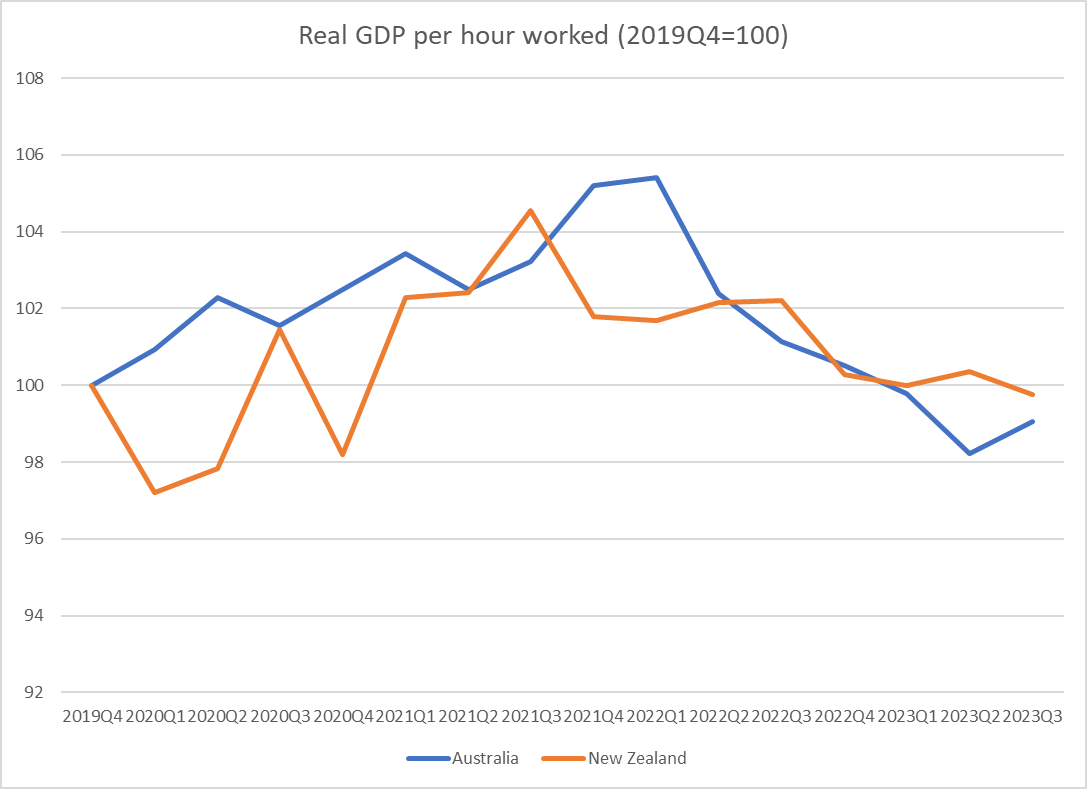
If you want some slight consolation, at least we haven’t lost any ground relative to Australia over this period, but for both countries it is (on current readings) almost four wasted years, with no economywide productivity growth at all.
And whereas Australia’s terms of trade have risen by 11 per cent over that period New Zealand’s have fallen by about 5 per cent. That’s an additional income difference in their favour of 2-3 per cent.
(NB for resident UK pessimists, note that on current readings the UK has done less badly on labour productivity than either New Zealand or Australia over the Covid/inflation period.)
What about the longer-run series? This one is since just prior to the last big recession.
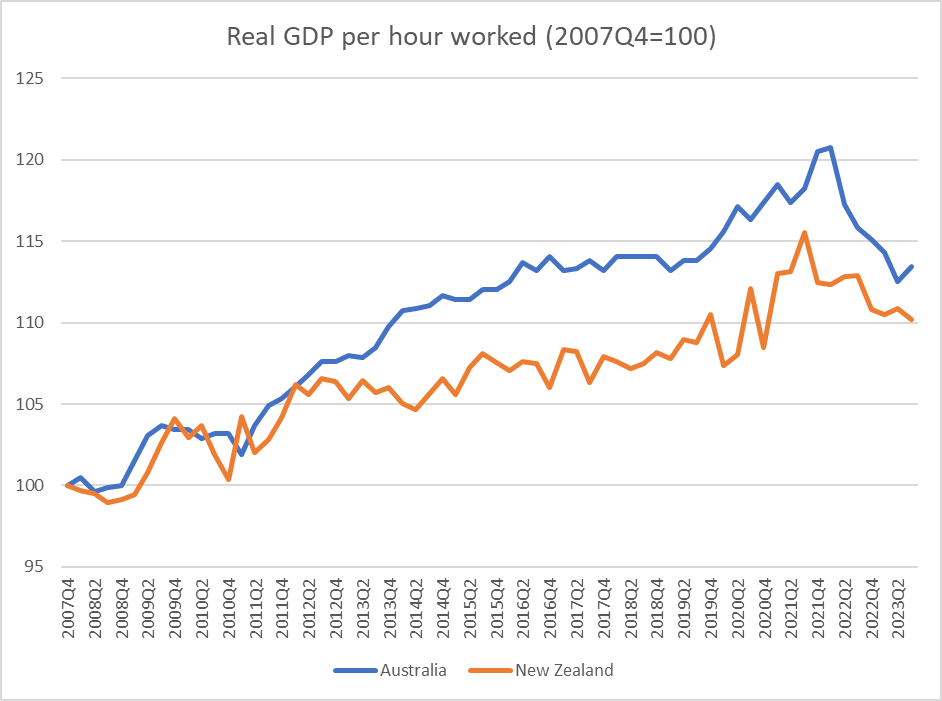
Pretty dismal productivity growth in both countries - less than 1 per cent per annum on average over the full period – but, as usually, we have done a bit worse than them over the full period. Note that although Australia is much more productive on average than New Zealand, it is also well behind the global frontier advanced economies.
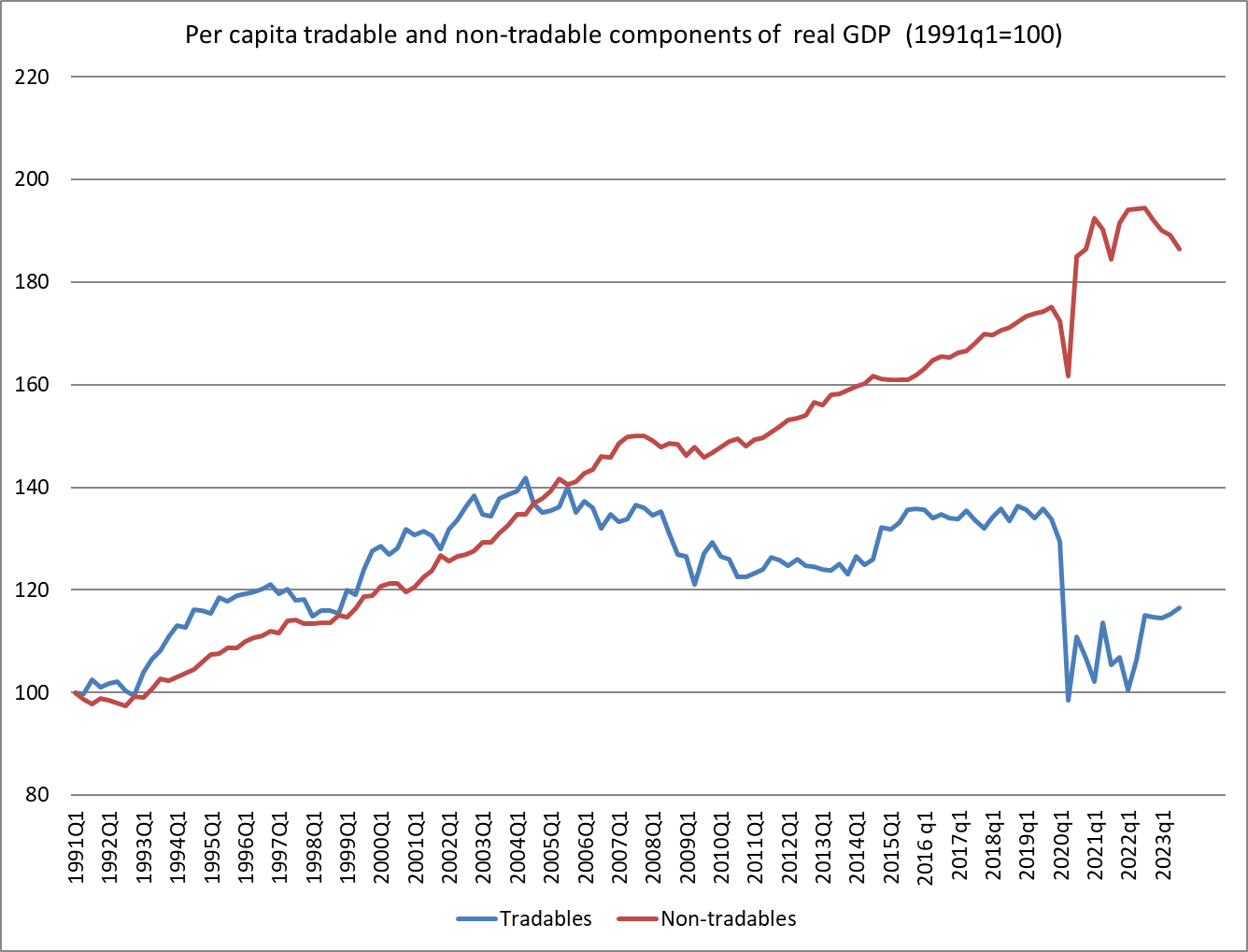
Here is another of my longstanding charts, an inevitably crude breakdown of GDP (per capita) into tradables and non-tradables components.
First, covering the entire period back to 1991
and then just for the Covid/inflation period, when the gap between the two lines has widened markedly (as you would have expected initially) and (so far) stayed wide.
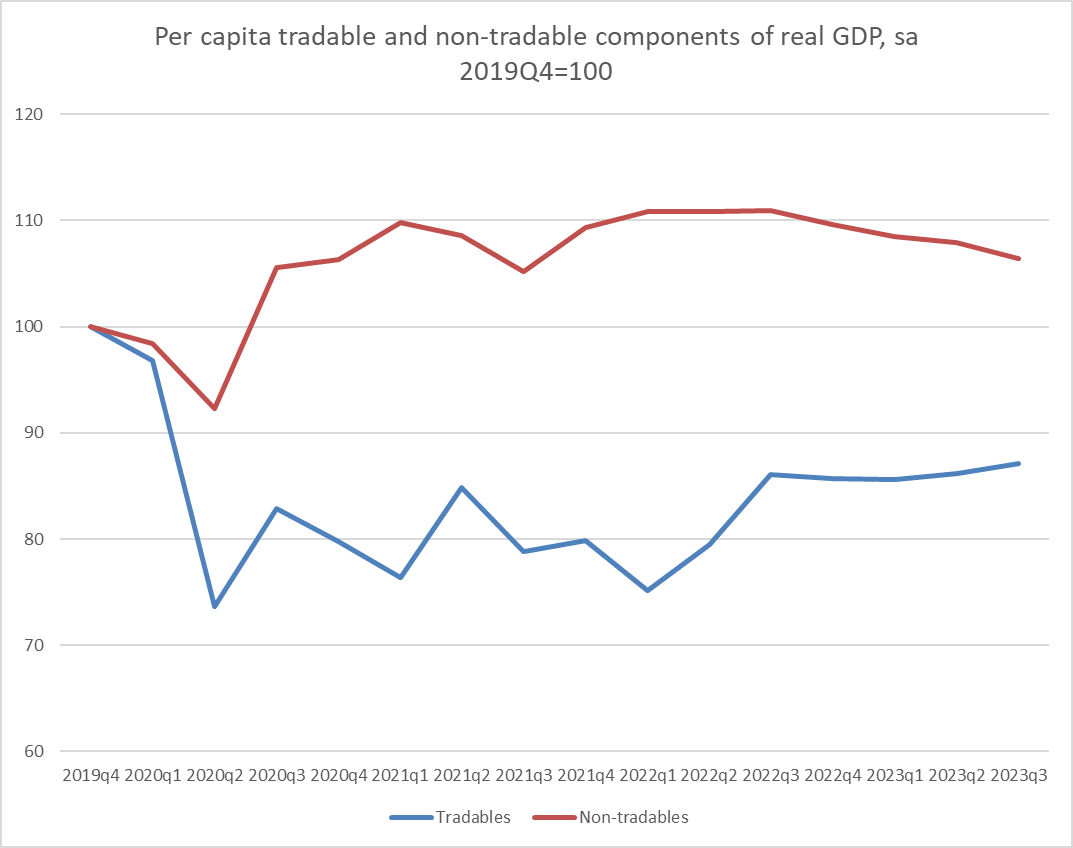
On this measure, per capita (real) tradables sector production now is about where it was almost 30 years ago and is about 15 per cent less than it was at the peak 20 years ago.
And then one final graph. This one shows (nominal) exports as a share of GDP
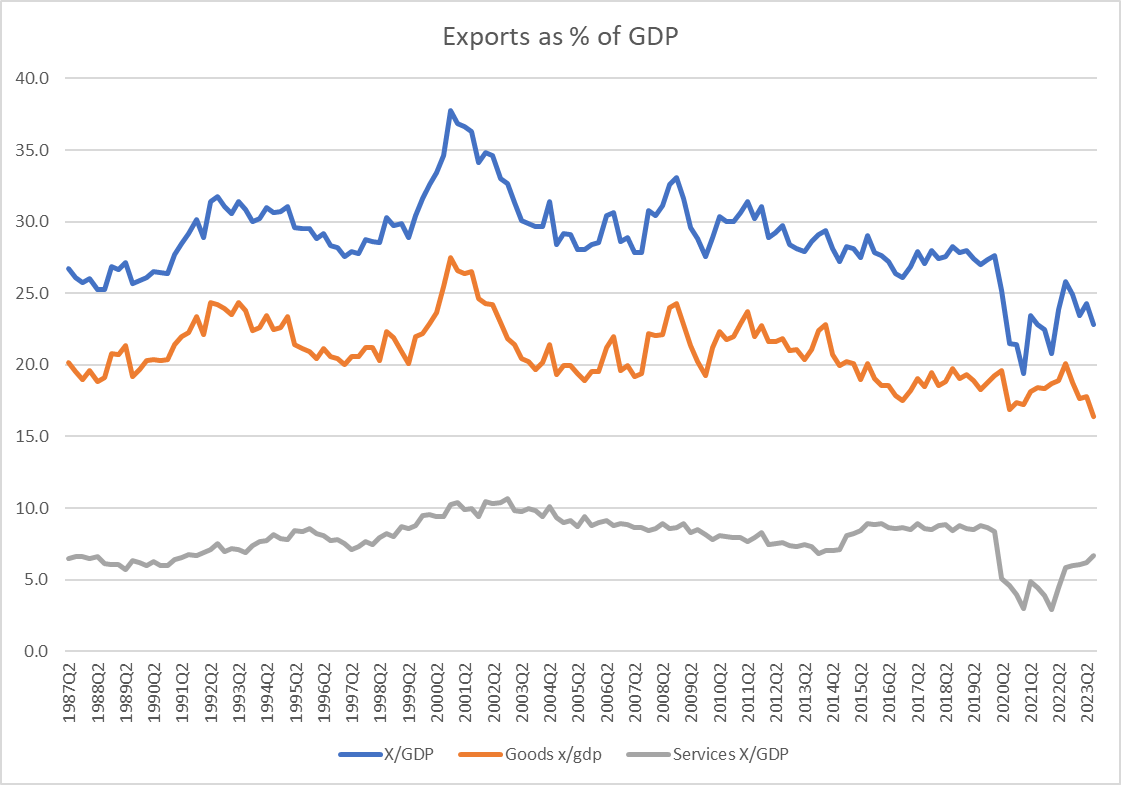
Total exports as a share of GDP have recovered somewhat after the Covid border restrictions but to a level (share of GDP) not seen pre-Covid since 1972 (off this chart, but using SNZ annual data).
And somewhat to my surprise, it is goods exports - not materially hindered by the border restrictions of 2020-2022 – that look really weak, now making new multi-decade lows as a share of GDP. Perhaps one shouldn’t have to say it: exports aren’t special. But successful economies tend to be ones where firms find more and more opportunities (and more firms find those opportunities) to take on world markets and succeed. The economy’s problems can’t be solved by exporting per se (which would be to put the cart before the horse), but successful and competitive economies will typically have a lot of firms succeeding internationally. New Zealand, by contrast (and for all the individual success stories that can be found) is an economy that seems to have become increasingly inward-oriented, increasingly less successful competing internationally. And these aren’t just narratives about one government, or one term in office; they are multi-decade failures.
But each government bears responsibility for their acts of commission and omission, and we now have a new government.
Sadly, there is little sign that senior ministers have absorbed just how poorly things have gone in New Zealand - and were doing when the National Party was last in office - or to have any driving commitment to much better outcomes, or (and the two are no doubt related) any driving narrative for what has gone wrong and what might make a difference. And, of course, there is little sign of an engaged and energetic bureaucracy offering the sort of analysis and advice that might, just possibly, engage a minister or Prime Minister who one day wondered what sort of economy their kids and grandchildren might inherit, if those generations are rash enough to stay.
For reference, and least those Australia comparisons at the top provide some sort of excuse for do-nothing complacency, recall that over the last 10 years half a dozen countries have gone past us on the OECD productivity (GDP per hour worked) league table.
 croaking cassandra
What would you suggest the new government prioritise as realistic policy initiatives in 2024?
In addition what are 3 or 4 big initiatives that they should do but almost certainly won’t out of fear of political consequences?
I’ve always wondered why New Zealand seems to have so little interest in this poor performance in mainstream discourse. Other countries that have had massive step changes in prosperity (the Asian and Celtic tigers, or more recently new EU members from the Eastern Bloc), appear to be obsessed with it at one point or another.
Whereas in New Zealand there is effectively no discussion amongst the commentaries or political and business elites about this miserable performance.
Very disappointing to be a citizen of such malaise.
LikeLike
I’d be looking to
a) sharply reduce the company tax rate (and business income tax more generally),
b) remove all restrictions on foreign investment from OECD countries (and an approved list of other countries, incl Singapore and Taiwan), keeping overseas investment restrictions solely for demonstrable national security purposes,
c) sharply and permanently cut the rate of non-citizen immigration (both residence approvals and work visas),
d) allow houses to be built on any land, to pretty much any height/density, but also provide an easy opt-out regime for (say) blocks on individual landowners in respect of their own land.
As a series of important starting measures.
LikeLike
“What would you suggest the new government prioritise as realistic policy initiatives in 2024?… I’ve always wondered why New Zealand seems to have so little interest in this poor performance in mainstream discourse. Other countries that have had massive step changes in prosperity (the Asian and Celtic tigers, or more recently new EU members from the Eastern Bloc), appear to be obsessed with it at one point or another.”
An interesting post. Personally, I don’t believe that there are a few initiatives that will magically turn around the situation, although obviously good policy-making would help.
For 24 years, I worked with many people in Western Europe, who were from the former Eastern Bloc (Poles, Czechs, Slovaks, Hungarians etc). Typically, they were children or young adults when the Berlin Wall came down in 1989. They seemed to relish working in Western market economies, and had the confidence, optimism and can-do attitude that New Zealanders had back in the 1980s. I talked to them about their time under communism. They explained to me that for them the transition from communism to market economy was easy (because it happened while they were young). They said that for their parents, the transition was virtually impossible, and they were still all at sea in the new world. The parents were insular, unable to speak the international business language of English (often they had Russian as a second language, which was now virtually useless). More to the point, they couldn’t cope with the mental flexibility that market economies demand. Decades of being told what to think and do by communist leaders resulted in their resilience and mindset being crushed.
With regards to the Celtic tiger Ireland, I find it ironic that a country that was transformed by the market economics exported to New Zealand many prominent neo-Marxists. For example, the lady that bought Stuff for $1, and other left-wing activist “journalists”, routinely came from Ireland. Somewhat strangely, the Irish that come here often reject the economic policies that made Ireland flourish, instead favouring hard-left economics…
In the 1980s, in New Zealand, anything was possible. The country was flying. Since 1989, I sense that New Zealand has gone in the opposite direction from the former Eastern Bloc countries (and the others countries you mention), both economically, and in terms of culture and mindset.
The Clark and Key governments moved policy-making sharply statist. Recently Cindy Ardern came from being the President of the Socialist Youth, to be perhaps our most truly transformational Prime Minister in New Zealand’s recent history. I think that she completely changed the culture. Widespread insularity, victimhood, envy, failure, defeatism, inefficiency, lack of accountability, dependency on the state, and an unwillingness to take responsibility for actions were just some of the changes she bequeathed to our culture, in no time at all.
Somehow, the new government needs to change the hearts and minds of New Zealanders, back to the culture of self-belief and confidence that we had in the 1980s. It’s probably a long shot.
LikeLike
I’m pessimistic. Not that things can’t be turned around (they could), but that they won’t be. Perhaps the only thing that might make me more optimistic would be if Australian policymakers started getting serious again about productivity and closing their gaps to the frontier. If Aus incomes started markedly pulling away from NZ’s it might finally spark a huge renewed outflow of NZers and some crisis sense that brought forward leaders determined to make something better of NZ.
Re central and eastern Europe, for once of course location was v much in their favour.
LikeLike